Eid Milad-Un-Nabi & End the Siege of Gaza – 2008

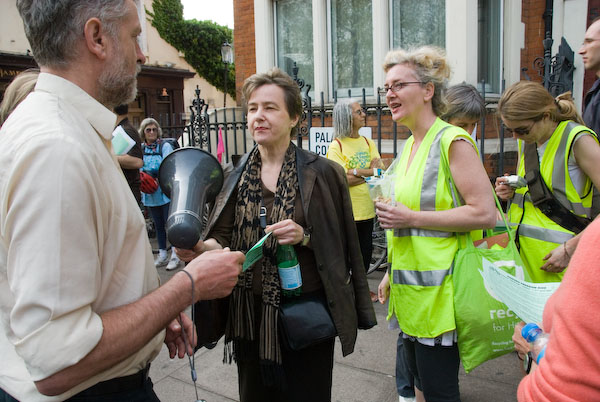
Eid Milad-Un-Nabi & End the Siege of Gaza: On Saturday 5th April 2008 was a rather frustrating day for me. I struggled to get to Tooting for the procession honouring the birthday of the Prophet as rail services to the west of London came to a halt. I finally made it but left as the procession neared its end. Thankfully the tube was working to take me into central London to view some exhibitions and photograph a protest at Downing Street calling for an end to the Israeli siege of Gaza.


Milad 2008 – Eid Milad-Un-Nabi

Procession and Community Day, Tooting

Eid Milad-Un-Nabi & End the Siege of Gaza - 2008

As usual I’d planned my journey into London carefully, intending to arrive in Tooting well before the start of the procession but a cable fire stopped all services into Waterloo with trains piling up back along the lines. Mine “came to a halt in Feltham, then crept forward slowly to Twickenham where it expired completely. Ten minutes later another service took me the few hundred yards further to St Margarets, where I abandoned rail and jumped onto a passing bus to Richmond.”

Eid Milad-Un-Nabi & End the Siege of Gaza - 2008

Then as I commented “Should you ever want a slow and frustrating ride through some of the more obscure southwest London suburbs I recommend the 493 route, which even includes a ride past Wimbledon Park and the world’s most famous tennis club before taking you past the dog track and on to Tooting.”

Eid Milad-Un-Nabi & End the Siege of Gaza - 2008

A full 50 stops and over an hour later I jumped off the bus and ran the last mile or so towards where the procession was to start on Tooting Bec Road, meeting the procession a few hundred yards from its start. Back in 2008 I wrote “half a mile” but I’ve just measured it and my run was at least double that. The Tooting Sunni Muslim Association’s procession for Eid Milad-Un-Nabi had started ‘promptly’ only around 20 minutes late so I hadn’t missed too much.

Eid Milad-Un-Nabi & End the Siege of Gaza - 2008

The Juloos to honour the birthday of the Prophet was part of an all-day community event and as well as the Muslims there were other local community representatives taking part including the Deputy Mayor of Wandsworth, Councillor Mrs. Claire Clay.

Eid Milad-Un-Nabi & End the Siege of Gaza - 2008

The previous year I’d gone on after the procession to the celebrations at Tooting Leisure Centre, including the impressive whirling dervishes – who I photographed again there in 2009. But in 2008 there were exhibitions I wanted to see in London – and a protest at Downing Street, so I left as the procession turned into Garratt Lane and took the tube from Tooting Broadway.

Milad 2008 – Eid Milad-Un-Nabi


End the Siege of Gaza

Downing Street

Eid Milad-Un-Nabi & End the Siege of Gaza - 2008
A demonstration on a wet Saturday afternoon at Downing St

In September 2007 the Israeli government had imposed a siege which was preventing vital medicines and other supplies from entering Gaza. This was a collective punishment against the population, illegal under international law and had by April 2008 already resulted in a number of deaths.

It was one of a series of protests organised by the Palestine Solidarity Campaign on a rather smaller scale than the hundreds of thousands in some more recent demonstrations, but sharing similar aims. It called on the British government to end the arms trade with Israel, and to press Israel to abide by international law, end its illegal occupation and allow the return of refugees.

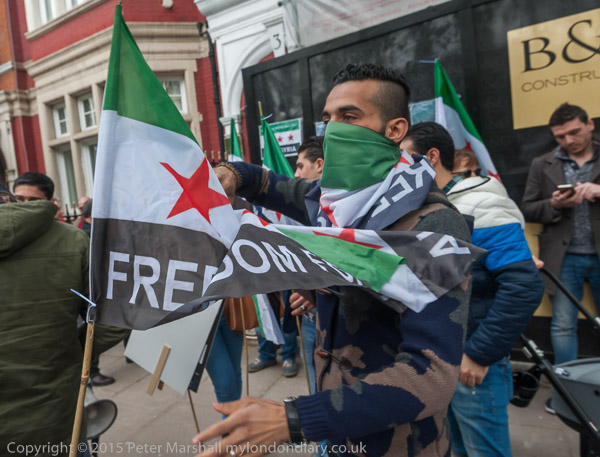
During the protest one young man with a Palestinian flag crossed the road and stood in front of the gates of Downing Street holding it. It was the police reaction to this – and their attempts to stop me photographing it that made up most of my report in 2008.

The man picks his flag up from the wet pavement and the officer shouts at him, telling him to put the f***ing flag down

Police pulled him to one side and questioned him, telling him that the SOCPA had made it a crime to protest there. They pulled his flag from his hands and dropped it on the pavement, and when he picked it up an officer swore at him, dragged it out of his hands and dropped it on the pavement again. He was then told he was being stopped and searched under the Terrorism Act 2000, though waving a flag is clearly not terrorism.

Clearly I was a already a good distance away when the officer on the left edge of this picture ordered me to move away

At this point an officer stood in front of me to stop me taking photographs. I told him I was press but he insisted I move further ways as I was “interfering with the actions of the police.” Clearly I wasn’t and I made this clear to him before moving back as ordered.

A woman officer came up and held her hand in front of my lens. I told her that this was illegal and a senior officer in the Met had told a colleague that he would consider it “a sacking offence” and she hurriedly moved off across the road and away from the area. Unfortunately I failed to get a good picture of her or to take her number.

I went back across the road to continue photographing the protest. Police officers at the protest on the other side of the road were approached by the event organisers about the man being held but denied any connection with the officers on the other side of Whitehall. The officer did attempt to excuse their actions on possible grounds of security, but I didn’t feel he felt too happy about it. The man was still being held by police when I left the area.

End the Siege of Gaza


FlickrFacebookMy London DiaryHull PhotosLea ValleyParis
London’s Industrial HeritageLondon Photos

All photographs on this page are copyright © Peter Marshall.
Contact me to buy prints or licence to reproduce.
Property Developer’s Awards – 2017

Property Developer's Awards - 2017

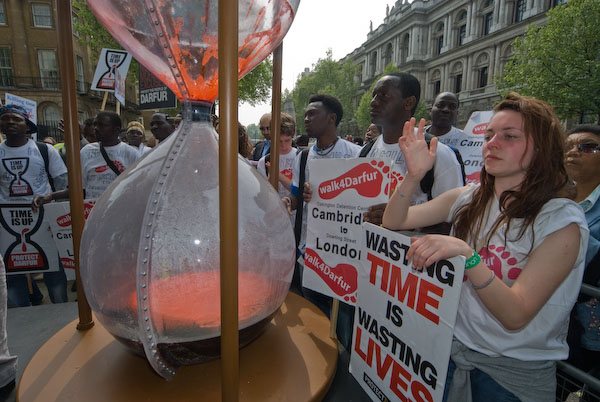
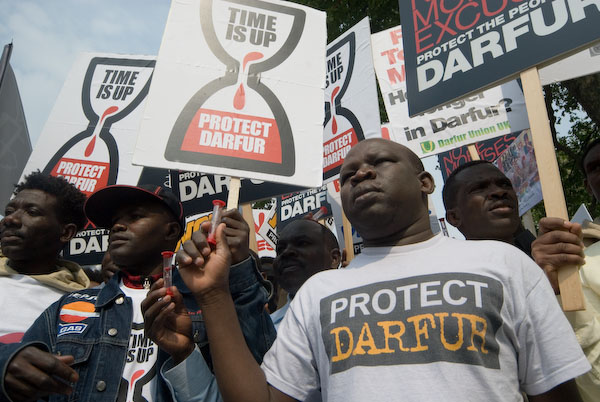
Property Developer’s Awards: On Tuesday 4th April 2017 I joined protesters on the pavement in front of the Grosvenor House Hotel in Mayfair where the annual Property Developers Awards were being held .

Property Developer's Awards - 2017

Property developers largely operate at one of the greedier ends of capitalism, many clearly putting their profits above everything else. Of course we need to build things, but we need to build the right things rather than those that maximise profits for the developers. Capitalism and the market doesn’t serve the interests of the vast majority.

Property Developer's Awards - 2017
Rev Paul Nicolson of Taxpayers Against Poverty speaks

In London we are clearly not building the right things. The desperate need is for social housing, while developers are working together with local councils to destroy this, demolishing council estates and replacing them with largely private developments with rents and prices beyond the reach of Londoners in desperate need of housing. And landlords are making obscene profits for lousy (sometimes literally) accommodation.

Property Developer's Awards - 2017
Landlord – Parasite!’ poster from Private Renters Unite – many rented properties suffer from damp and are infested by cockroaches etc

London councils have huge waiting lists for social housing and an estimated 210,000 Londoners are homeless and living in temporary accommodation, including 102,000 homeless children. The situation is now even worse than in 2017 and London councils now spend around £5.5 million per day on homelessness.

Property Developer's Awards - 2017

And yet there are huge developments taking place in London, but so many of these are for student housing and expensive private flats, many bought by overseas investors and remaining empty for all or most of the year. Because these are the kind of developments that make the largest profits for the property developers.

Property Developer's Awards - 2017
Activists rush up with a sack of horse manure and tip it on the hotel entrance

Of course gaining planning permission for many developments require them to include social housing and ‘affordable housing’. “Affordable housing is used by governments to mean 80% of market prices – something totally unaffordable for most people – the term true Orwellian doublespeak.” But if the developers feel they are not getting enough profit when building they can simply ask for a reduction in these and it gets granted.

Cockroaches crawl around a poster next to the manure
which a hotel employee tries to sweep up as Ian Bone walks in front with a siren

London Mayor Sadiq Khan has funding of up to £11.7 billion for a ‘London Social and Affordable Homes Programme 2026-36‘, but it remains to be seen what this will actually deliver – other of course than profits for the developers.

Jane Nicholl confronts a man going into the Property Developer’s Awards who seems amused by being accused of social cleansing

Of course both developers and councils who work with them do so in a political atmosphere which since Thatcher has made providing social housing much more difficult. But some councillors and officers have joined with developers in pursuing their personal fortunes rather than public good.

People from the Property Developer’s Awards came out to have a cigarette and watch the protest

“The protesters, who included queer coalition the Sexual Avengers and Class War say the developers demolishing social housing and community facilities across London in a process of social cleansing aided by largely Labour councils and led by Savills who sponsor the awards and were nominated for six of them. They are demolishing council estates and replacing most of their social housing with high cost private developments, often largely sold to foreign investors and making obscene profits – and tickets for this event were £396 per seat.”

Ian Bone directs some of those coming to the Property Developer’s Awards, calling them “rich scum”

The protesters made their views very clear, calling those entering the Award beanfeast ‘scum’ and ‘parasites.’ A small group rushed up to the hotel entrance and dumped a sack of horse manure and coackroaches in front of it. A hotel employees came out with a bin and broom to try to sweep it up.

Police hold back a woman giving those coming to the awards the finger

The protest continued with Class War in particular confronting the developers as they arrived and police ensuring they could walk past and enter, holding back the protesters. Some of those entering appeared to be amused by the idea they were ‘social cleansing’ and a small group came out to watch the protest.

Class War – Our Estates Are Not for Sale – No Developers, Estate Agents, Gentrifiers or Bent Councillors – We Know What You’re Up to – Keep Away!

More pictures at Property Developer’s Awards.


FlickrFacebookMy London DiaryHull PhotosLea ValleyParis
London’s Industrial HeritageLondon Photos

All photographs on this page are copyright © Peter Marshall.
Contact me to buy prints or licence to reproduce.

The Woolwich Ferry

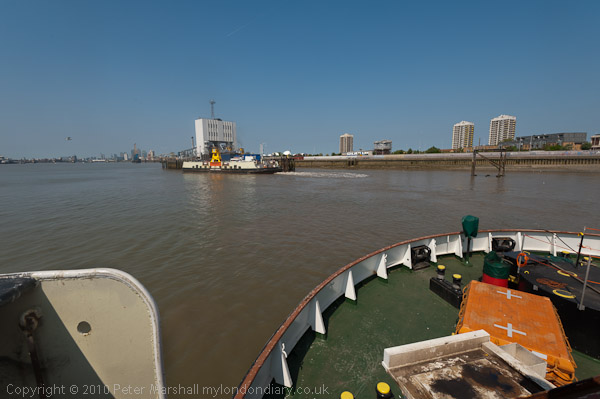
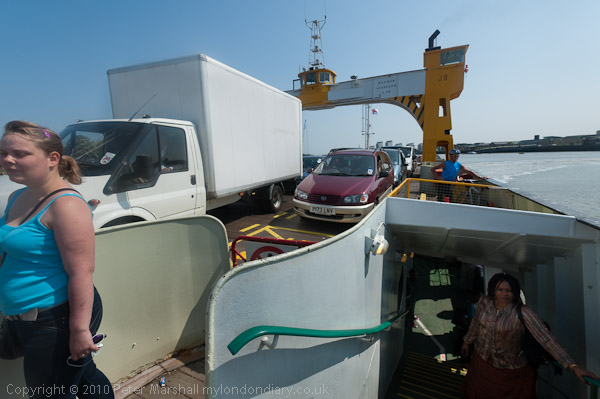
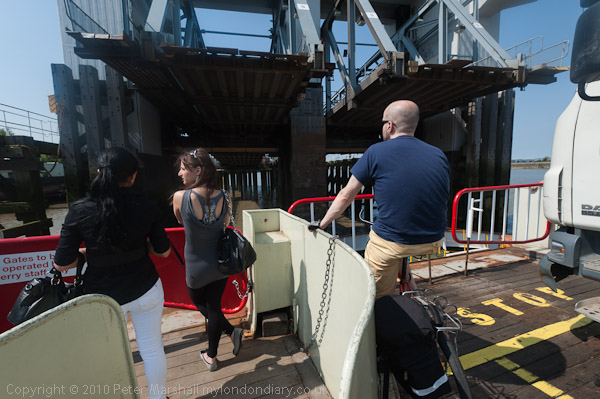
The Woolwich Ferry: Continuing my walk in Plumstead and Woolwich in August 1994 I came to the Woolwich Ferry and couldn’t resist taking a ride across the river on it. And since I wanted to continue my walk in Woolwich, rather than in North Woolwich, I stayed on the ferry to come back.

Woolwich Ferry, River Thames, Woolwich, Greenwich, 1994, 94-808-41

There had almost certainly been a ferry across the Thames at Woolwich at least since the Norman Conquest, though the first written reference by name only came when it was sold together with a house by William de Wicton to William atte Halle for £10. In the early years of the 19th century there were three Woolwich Ferry Acts (1811, 1815 and 1816) establishing a commercial ferry.

These were passed in particular for the movement of troops and supplies from Woolwich Arsenal across the river. From 1846 there was also a rail connection from North Woolwich to Stratford and eventually there were three steam ferries on the route

Woolwich Ferry, Ambulance Station, River Thames, Woolwich, Greenwich, 1994, 94-807-11

After the Metropolitan Board of Works (MBW) was created in 1855 it had taken over toll bridges in West London and made them free to use. People to the east of London in Greenwich and Woolwich argued that they should also be able to cross the river without paying. Eventually in 1884 the MWB agreed and tasked Sir Joseph Bazalgette to oversee the provision of approaches, bridges and pontoons for the ferry. These were built by the still familiar name of Messrs Mowlem in 1887-9. (The company is no longer; having got into financial difficulties it was acquired by its rival Carillion in 2005.)

Woolwich Ferry, River Thames, Woolwich, Greenwich, 1994, 94-807-12

The London County Council was established on 21st March 1889, two days before the Free Ferry was due to open and so it was Lord Roseberry, the LCC’s first chairman who led the huge procession and festivities to the new ferry terminal in Woolwich and announced to a crowd of thousands “The free ferry is open to the public.

There was only one paddle steamer working the ferry that weekend and it must have got very crowded. As well as those in Woolwich , “the Great Eastern Railway Company carried 25,000 people to its North Woolwich terminus, most of whom were intent on riding the ferry.”

Woolwich Ferry, River Thames, Woolwich, Greenwich, 1994, 94-807-13

The initial fleet of two paddle steamers soon became three and were replaced by newer paddle steamers in the 1920s. It was these that inspired the story and wonderful illustrations by Charles Keeping in his 1968 children’s classic ‘Alfie and the Ferryboat (1968), very much enjoyed a few years later by myself and my two boys. So of course we had to come to Woolwich and I took my first crossing with them in the early 1980s.

Woolwich Ferry, Ambulance Station, River Thames, Woolwich, Greenwich, 1994, 94-807-11

But by the time that book was published the paddle steamers had gone, replaced from 1963 by the diesel-powered double ended James Newman, John Burns and Ernest Bevin which enabled vehicles to drive up newly built causeways with hinged bridges and drive directly onto the ferries, greatly speeding up the loading. As they were double-ended vehicles could also drive off forwards on the other side and the ships did not need to reverse. They were steered from a central bridge over their roadways.

Woolwich Ferry, River Thames, Woolwich, Greenwich, 1994, 94-807-12

The ferries in my pictures continued in service until 2018, when the ferry closed down for four months waiting the arrive of replacements. These have had various problems with London May Sadiq Khan apologising and saying the new vessels “aren’t good enough.”

Woolwich Ferry, River Thames, Woolwich, Greenwich, 1994, 94-807-13
Woolwich Ferry, Ambulance Station, River Thames, Woolwich, Greenwich, 1994, 94-807-22

I had just missed the ferry and spent it walking around the area and taking pictures.

Woolwich Ferry, Ambulance Station, River Thames, Woolwich, Greenwich, 1994, 94-807-33

All of the pictures before this one have been of a vessel not in use, moored at Woolwich but in this picture you can see one ferry at the North Woolwich terminal and another approaching Woolwich, and I hurried up the approach to catch it. In my next post from 1994 I will include some pictures I made on the ferry.


FlickrFacebookMy London DiaryHull PhotosLea ValleyParis
London’s Industrial HeritageLondon Photos

All photographs on this page are copyright © Peter Marshall.
Contact me to buy prints or licence to reproduce.

Good Friday 2010

Good Friday 2nd April 2010 I went to London first for the annual procession on Victoria Street in Westminster and later for the first Passion Play to be produced in Trafalgar Square since 1965.


Crucifixion on Victoria St

Westminster

A man carrying the cross leaves Westminster Methodist Central Hall

There are three major Christian churches on or around Victoria Street in Westminster, Methodist Central Hall, the Catholic Westminster Cathedral and Anglican Westminster Abbey, and for some years there has been a procession, ‘The Crucifixion on Victoria Street’ up and down the street between them.

The procession included clergy and people from other churches and organisations in the area. It was led by a large wooden cross carried by men from The Passage, a project for homeless people. Following this were around 500 people including members of The Passage, children from St Vincent de Paul Primary School, the Lord Mayor of Westminster, Councillor Duncan Sandys as well as Westminster clergy and members of various congregations.

It began outside Methodist Central Hall before making its way up Victoria St to Westminster Cathedral where on the plaza outside the cathedral it was met by the Most Reverend Vincent Nicholls, Archbishop of Westminster. He became the third Archbishop of Westminster I’ve photographed on these steps.

After hymns, a bible reading by The Reverend Philip Chester, Vicar of St Matthew’s Westminster, a mediation by the Reverend Martin Turner from Methodist Central Hall, a prayer by Mr Mick Clarke, CEO of The Passage and a reflection on peace by the Archbishop the procession went back along Victoria Street for a service in Westminster Abbey, but I left them to get out of the rain then falling steadily.

Crucifixion on Victoria St


The Passion of Jesus

Trafalgar Square

Jesus’s body taken down from the cross

Trafalgar Square was packed for the The Passion of Jesus, the first Passion Play there since 1965, performed by around 150 devout Christians and a donkey by a group based on the Wintershall estate in Surrey.

Property developer Peter and Ann Hutley, owners of the 1,000 acre estate and retreat centre began staging religious events after a visit to the Catholic pilgrimage centre of Medjugorje in Bosnia and Herzegovina, beginning with a Nativity event in a barn they had just bought in 1989.

They first staged ‘The Life of Christ’ on their estate in 1999, a five or six hour open air production around a lake in the grounds, with over a hundred actors as well as camels and a flock of sheep.

The ‘Passion of Jesus’ in Trafalgar Square was on a slightly reduced scale, but still very impressive and colourful, and a dramatic rendition of the traditional story from the four gospels, with some touches of added spectacle.

As I reported, “Although the flogging of Jesus occurred off-stage and the sound effects were rather unconvincing, the crucifixion that followed was a pretty gory sight.

As in the Gospel narrative, the Jewish hierarchy of the time was typecast as villains, perhaps too typecast, and the resurrection too presents some dramatic problems.”

Wintershall stages performances elsewhere – and I photographed their Staines Passion at Easter in 2014. There is another Passion of Jesus in Trafalgar Square tomorrow, Good Friday 3rd April 2026, with two free performances at 12 noon and 3:15 pm open to all. You can also watch it on Youtube if you can’t get there in person.

Many more pictures from 2010 on My London Diary: The Passion of Jesus.


FlickrFacebookMy London DiaryHull PhotosLea ValleyParis
London’s Industrial HeritageLondon Photos

All photographs on this page are copyright © Peter Marshall.
Contact me to buy prints or licence to reproduce.

Fossil Fools Day – 2008

Fossil Fools Day: Tuesday 1st April was Fossil Fools Day, a day of protests around the world over our increasing use of fossil fuels, despite the effect they are having on global climate.

Fossil Fools Day - 2008

The ‘greenhouse effect‘ of various gases in the atmosphere had first been described in 1824, although the actual term only dates from 1901. But already in 1856 American scientist and women’s rights campaigner Eunice Newton Foote had shown that carbon dioxide was very effective in trapping the sun’s energy and warming the atmosphere.
Almost all polyatomic gases are ‘greenhouse gases’ with some such as methane much more effective than carbon dioxide. But its great importance is because of the huge amounts of it formed when carbon-containing fuels are used. And burning wood, coal and oil and their use in powering machines of all types and electricity production became the basis of the industrial revolution and our whole civilisation from around the beginning of the nineteenth century.
Fossil Fools Day - 2008
Protesters with power station ‘cooling towers’ in Parliament Square

Wood is not of course a fossil fuel, and in pre-industrial times the carbon dioxide produced by burning it was more or less in balance with the amount that was removed from the atmosphere by photosynthesis producing new plants, trees and other organisms. CO2 levels remained roughly constant during human history at around 280ppm until they began to rise more and more rapidly after 1850, and increasingly rapidly since then. They are now around 430ppm and rising steeply.

The full effects of the current levels only become apparent over a period of around 50 years, though we are already seeing some of them already, particularly in the global South – though we too are beginning to see the effects on our climate, not just in terms of temperature but even more as instability.

Fossil Fools Day - 2008

For well over fifty years it has been obvious that we need to take urgent action to stop burning fossil fuels, but that urgency has not led to any really significant action. Talk, investment in renewable energy – but fossil fuel use, even of coal, is still increasing. If life on this planet is to have a future we need to see a rapid drop in the consumption of coal, oil and gas – and also aathe development of ways to use renewable energy to remove greenhouse gases from the atmosphere, as well as increasing natural ways such as planting more trees.

And there is another reason to end the use of oil for fuel, as I first mentioned in the 1970s. These finite resources are of much greater use as a chemical feedstock for producing other essential materials of our modern life, including plastics.

Everything at the moment is still going in the wrong direction – and the huge energy requirements of AI are making things worse.


Fossil Fools Day: No New Coal

Parliament Square

Fossil Fools Day - 2008
Lighter fuel goes up in flames on the Climate BIll

The focus of the protest by students from ‘People and Planet’ and other climate activists were the plans by E.ON to build a new new coal-fired power station at Kingsnorth in Kent.

The protesters brought three large white ‘cooling towers’ and many had cutout masks of Gordon Brown’s face as they shouted out advice to him over the ridiculous Draft Climate Change Bill which would have resulted in an increase in carbon emissions.

The launch of ‘ev-eon Unnaturally Carbonated Water’

They were joined by a group with the spoof launch of ‘ev-eon Unnaturally Carbonated Water’ a new carbon capture technology to be used at E.ON’s Kingsnorth Power Station.

“‘Ev-eon’ uses the CO2 from coal burning to carbonate water which you then swallow. And if you can swallow the governments coal-fired policy you can swallow anything. And of course with Ev-eon, should you burp, breathe or otherwise release that CO2 you’ve swallowed, global warming is all your fault – and not E.ON’s.”

As a result of this and other environmental protests and criticism by a wide range of organisations E.ON eventually dropped the plans.

More on My London Diary at Fossil Fools Day: No New Coal.


Fossil Fools Day: Opencast Coal

Albany Courtyard, Piccadilly

Campaign against Climate Change protest at the offices of Argent Group PLC in Piccadilly over the UK’s largest opencast coal mine, Ffos-y-Fran in Merthyr Tydfil, South Wales, run by Miller-Argent.

The manager of Albany talks with the demontrators, taking some information for Argent

As well as the at least 30 million tons of CO2 of carbon dioxide from the coal the mine was expected to produce over the next 15 years, this mine was also only 36 metres from the nearest houses – compared to the Scottish Safety standards of 500 metres. The Welsh Office delayed the implementation of a Welsh safety standard to enable the mine to go ahead.

Locally it produced years of misery and health hazards through air-borne dust, diesel fumes and noise to the 70,000 or so people who live in Merthyr. A Health Impact Study commissioned by the authorities was so damning they refused to accept it.

The initial scheme for the mine had been approved by the Welsh Assembly in 2005 despite huge local objections and residents took it to the High Court which quashed it – but this was reversed on appeal in 2006.

The mine licence expired in 2022 and an appeal for an extension was refused with the mine shutting down in November 2023.

London protest Welsh Opencast Coal


FlickrFacebookMy London DiaryHull PhotosLea ValleyParis
London’s Industrial HeritageLondon Photos

All photographs on this page are copyright © Peter Marshall.
Contact me to buy prints or licence to reproduce.