Workers Memorial Day, HS2 Protest – 2014

Workers Memorial Day, HS2 Protest: Every year since 1989, April 28th has been International Workers’ Memorial Day, and on Monday 28th April 2014 I once more attended the event commemorating this at the statue of the Building Worker on Tower Hill in London, later going to Parliament Square where protesters called on MPs to vote against the HS2 Bill being debated in the House of Commons.


Workers Memorial Day

Tower Hill
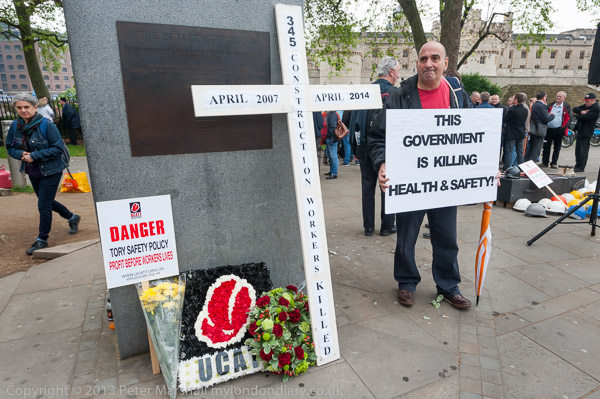
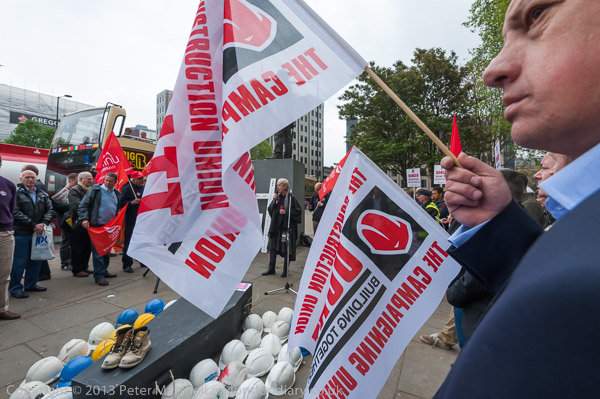
One of the more hazardous industries in the UK is construction, and the annual Workers Memorial Day points this out. There had been over 50 deaths on construction sites in the previous year and the rally place around a coffin with boots, work gloves and hard hats.
Workers Memorial Day, HS2 Protest - 2014

A TUC report published for the day, ‘Toxic, Corrosive and Hazardous: The government’s record on health and safety‘ pointed out that since the coalition government came to power in 2010 it had “drastically cut Health and Safety Executive (HSE) inspections, cut funding to the HSE by 40 per cent, blocked new regulations and removed vital existing protections, prevented improved European regulation on health and safety, cut support for employers and health and safety reps, seen local authorities reduce their workplace inspections by 93 per cent, and made it much harder for workers to claim compensation if they are injured or made ill at work following employer negligence.”
Workers Memorial Day, HS2 Protest - 2014
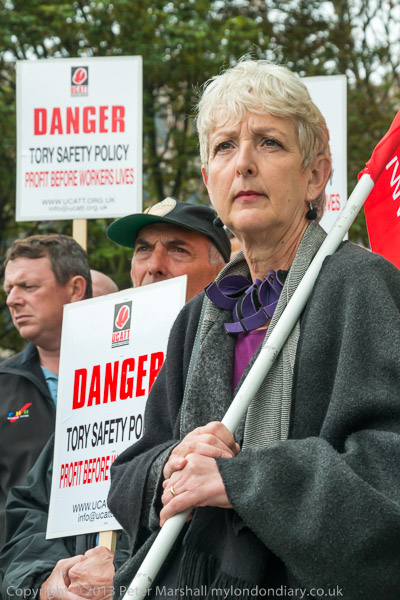
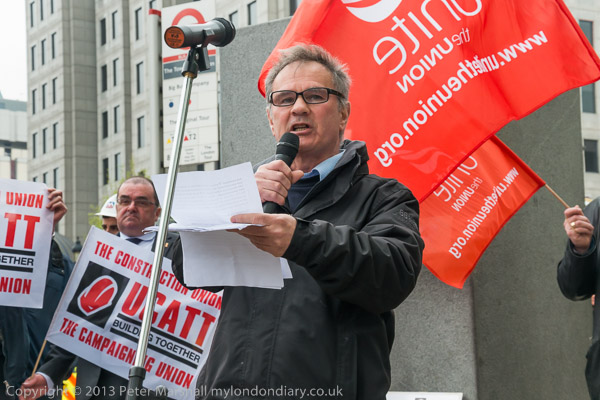
Gail Cartmail, Assistant General Secretary of Unite

The government was now planning to exempt many ‘self-employed workers’ from health and safety protection – despite them being twice as likely to be killed at work than other workers.
Workers Memorial Day, HS2 Protest - 2014

This attack on health and safety, carried out under the title of ‘reducing red tape’ also played an important role in providing the environment which allowed the disastrous fire at Grenfell Tower.
Workers Memorial Day, HS2 Protest - 2014
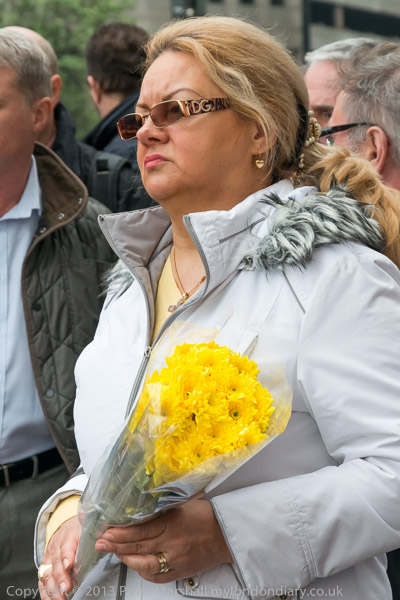
Liliana Alexa of the Battersea Crane Disaster Action Group

The theme for the 2014 events from the ITUC, the global union body coordinating the event worldwide, is ‘Protecting workers around the world through strong regulation, enforcement and union rights’ and it encouraged unions to use the slogan, ‘Unions make work safer’.
Workers Memorial Day, HS2 Protest - 2014
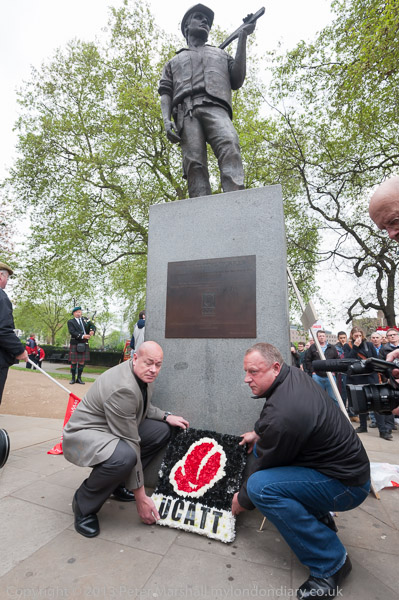
Tony O’Brien of the Construction Safety Campaign

There were speeches including by Gail Cartmail, Assistant General Secretary of Unite, Tony O’Brien of the Construction Safety Campaign and Jerry Swain Regional Secretary for UCATT’s London and South East Region, after which wreaths and flowers were laid at the base of the statue by UCATT, Tower Hamlets Mayor Lutfur Rahman and Liliana Alexa who founded the Battersea Crane Disaster Action Group after her son Michael was killed by a falling crane as he walked past a building site near his Battersea home.
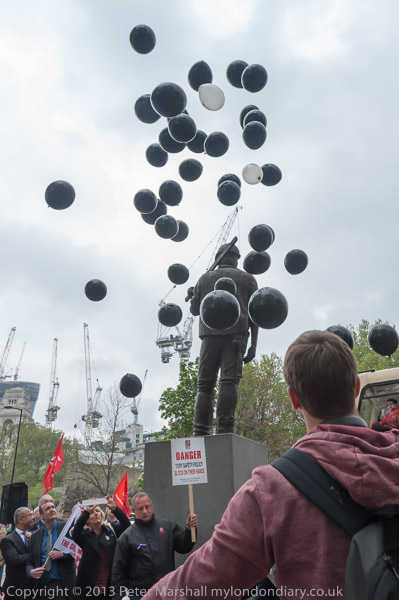
The event ended with the release of black balloons, for the 50 workers killed in the last year and a period of silence around the coffin with its boots, hard hat and work gloves and a hard hat for each one of them.

More pictures from Workers Memorial Day


Stop HS2 Rally at Parliament

Old Palace Yard, Westminster
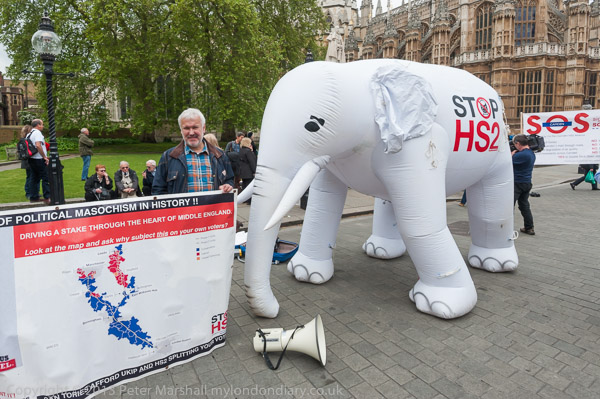
HS2 is generally seen now as an expensive disaster, failing to achieve its aims and becoming something of a white elephant. It doesn’t go to where it was intended and will have to run rather slower than planned.
Despite the plans to run to Manchester and Leeds having been dropped the scheme has had a massive increase in costs. It still remains doubtful if it will ever actually reach its intended destination in London, Euston or simply serve its temporary terminus at Old Oak Common, six miles out in the middle of nowhere very much, where it will largely rely on a connection to the Elizabeth Line.
The project was almost certainly doomed from the start in 2009 under Labour, but its position was worsened by decisions by each successive government. There are various detailed studies of where it went wrong on-line, including by Graham Winch of the Productivity Institute.
The London to Birmingham section we may one day get was only a minor aspect of the original scheme and a part that offers relatively little gain – nobody really needs to get to Birmingham 20 minutes faster. Its route was poorly chosen and bound to result in the kind of local opposition that has greatly put up costs, and the whole project was severely over-specified – and in a way that makes it incompatible with the existing network.
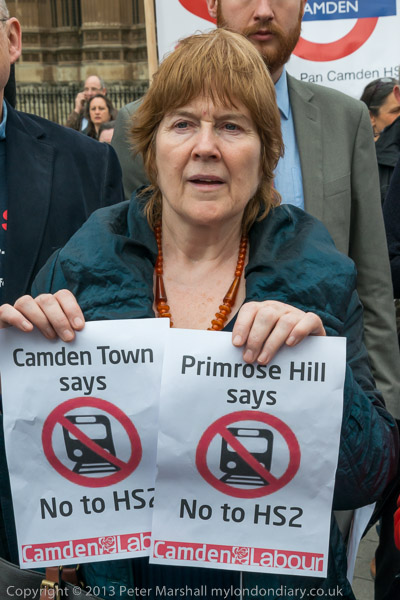
Others, such as High Speed UK have developed much more coherent plans for the future UK rail network which governments have refused to consider seriously – and were one of those supporting and speaking at this protest. Their plans in 2014 would have avoided “damage to the Chilterns by following the M1 and would be 25% cheaper than HS2, while offering time savings on average of 40% for most intercity services – not just those on the high speed route.

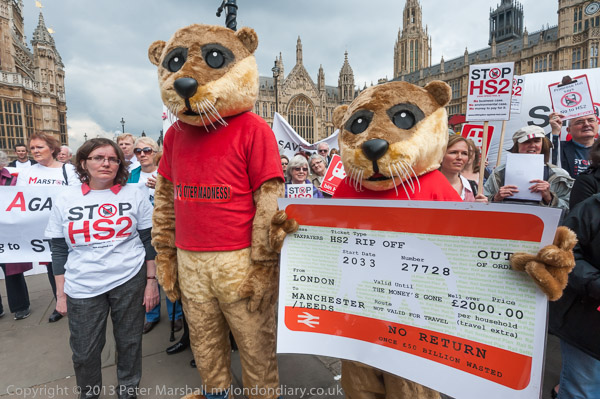
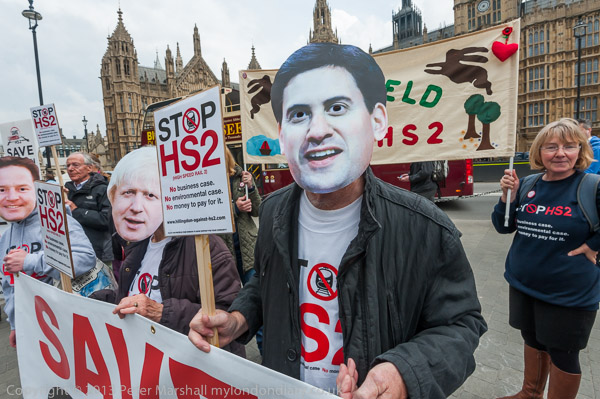
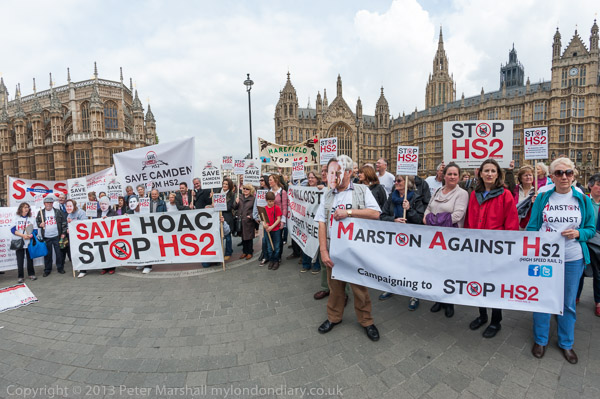
This was a relatively small demonstration with perhaps a couple of hundred people, but a colourful one, with a large inflatable white elephant and a couple of bears with a very large rail ticket about the £50 billion rip-off of HS2. There were speeches including from several MPs and campaigners.

More at Stop HS2 Rally at Parliament.


FlickrFacebookMy London DiaryHull PhotosLea ValleyParis
London’s Industrial HeritageLondon Photos

All photographs on this page are copyright © Peter Marshall.
Contact me to buy prints or licence to reproduce.
Hoxton Olympic Hand Over 2008

Hoxton Olympic Hand Over: On Sunday 24th August 2008, fifteen years ago the Olympics were officially handed over from Beijing to London. To mark this, events were arranged in Hoxton, part of Hackney, one of the three London Boroughs in which the main Olympic site was being developed.

Hoxton Olympic Hand Over
A critical point in the slow race at the Hoxton Austerity Olympics

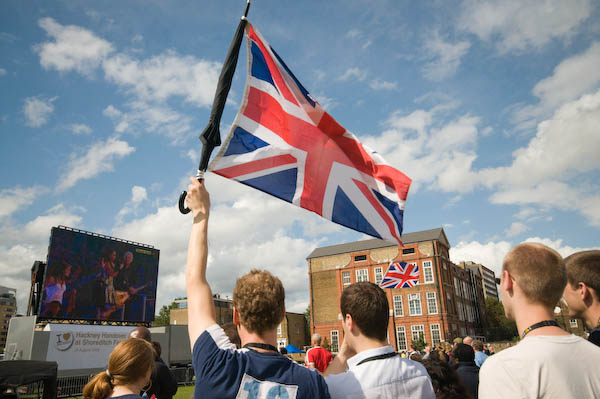
Hackney Council hoped that they would gain some money for regeneration from the huge Olympic spending, though it is difficult to find much evidence that it did in any way improve the borough. They had arranged what turned out to be a very boring event in Shoreditch Park with a giant TV screen showing events from Beijing and some performances and speeches. It was very poorly attended – probably only by a few council officials and families of the local kids who ran a few races or took part in the displays and singing. I took a few pictures – including one showing both the Union Jacks being waved in the park, but soon left for the more interesting local event – a 1948 Street party – in Hoxton Street.

Hoxton Olympic Hand Over

The previous London Olympics in 1948 were arranged on a shore-string budget when the whole country was still under rationing and still recovering from the war. They made use of existing facilities and were truly an ‘Austerity Olympics’. But they were also a very successful event.

Hoxton Olympic Hand Over

Back then the athletes were truly amateurs, taking time off from work to compete and training outside their work hours. Now, particularly since lottery funding it is a massively professional affair, with billions going into Olympic sports, and little if any of the original Olympic ideals remain.

Hoxton Olympic Hand Over

Studies published in 2016 reveal that London 2012 was the most expensive Summer Olympics in history, costing $15 billion, overrunning its original budget by 76%. The organisers doubled the estimate after winning the bid, then claimed that they had come in under budget in what the study describes as “deliberate misinformation of the public about cost and cost overrun” saying it “treads a fine line between spin and outright lying“.

But the figures are actually a huge underestimate of the actual cost, as they exclude “indirect capital costs, such as the money spent on upgrading the local transport infrastructure”, much of which is inappropriate to current needs or the future development of the area.

In contrast, the total spending on the 1948 Olympics was £732,268, equivalent in 2012 allowing for inflation to around £16 million, only just over one thousandth of the cost of London 2012. And the 1948 cost was a little under budget and was more than paid for by ticket sales – there was a profit of over £29,000.

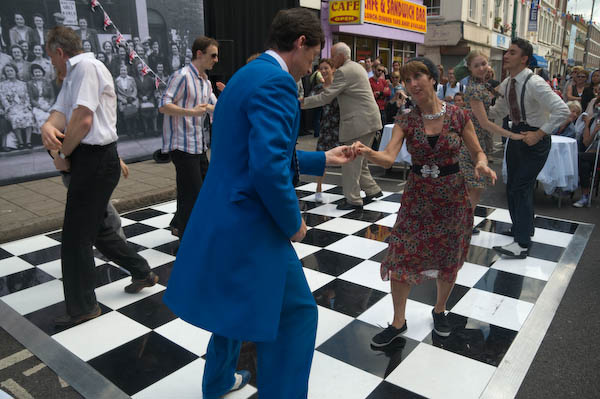
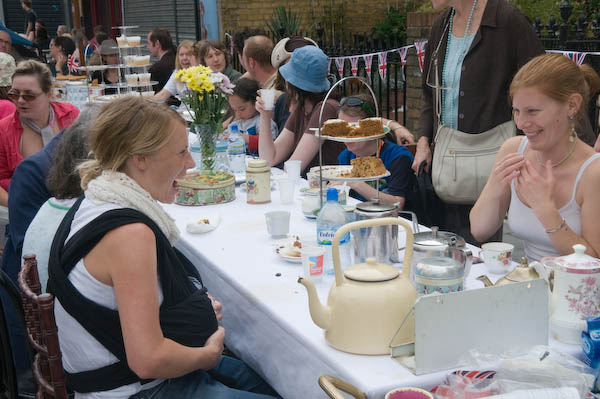
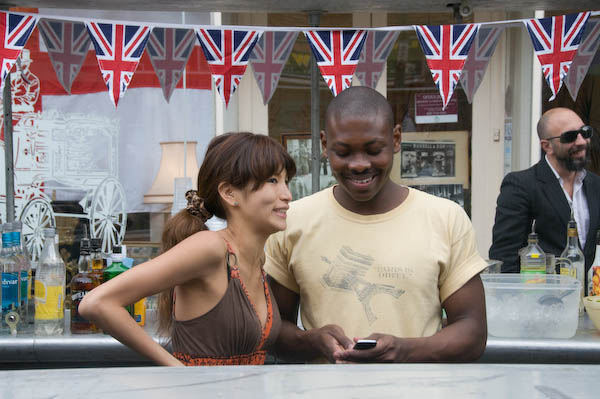
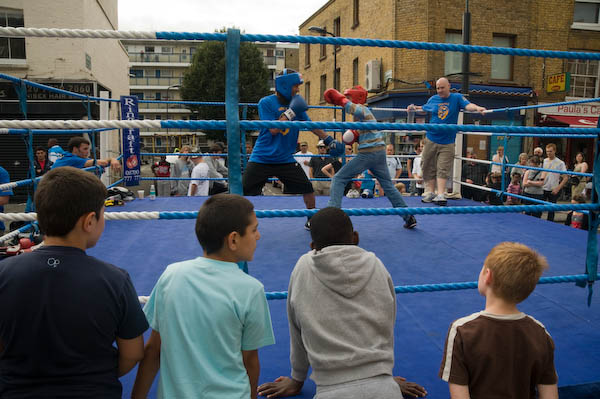
Hoxton had decided to put on a ‘1948 Street Party’ in the area of Hoxton St where the market takes place, and there were shops, museums and various local organisations taking part and putting on events and displays.

Back in 2008 I wrote:

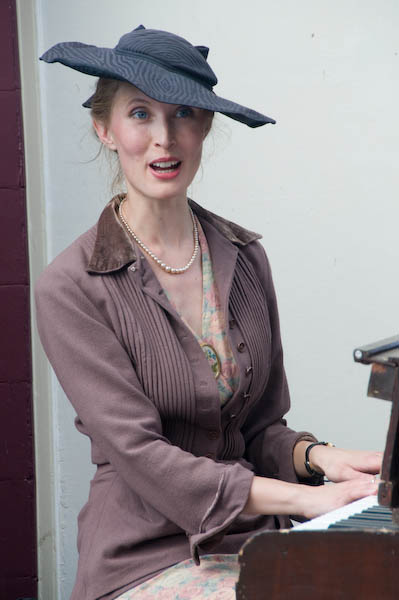
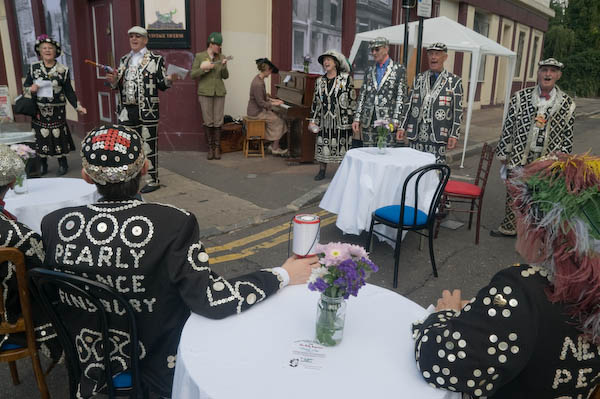
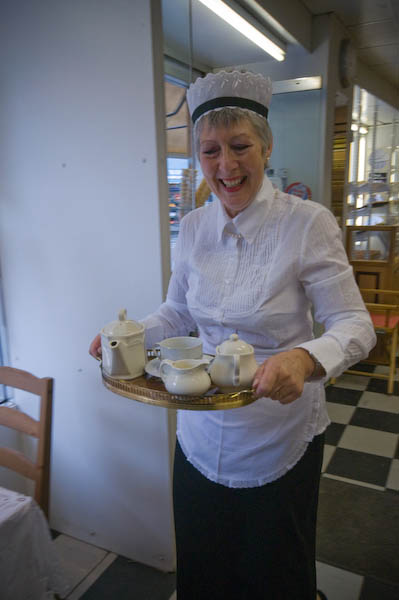
I’d had a very nice cup of tea served in 1948 style china by a “nippy”, and in the street were tea parties (with free cakes) and displays of boxing, jitterbugging and various objects from the 1940s kitchen (almost all of which we still use here, including a pastry blender – and no, it isn’t used to make bread.) Pearlies came in force and had a sing-song round the joanna.

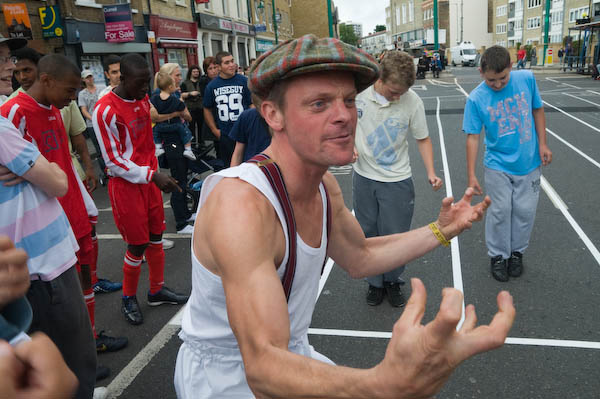
Of course there was a bar, and there was also a little welcome madness in the section of road where the Hackney Austerity Olympics was taking place. It was of course highly appropriate, as the last Olympic Games held here were very much run on a shoe-string in 1948.

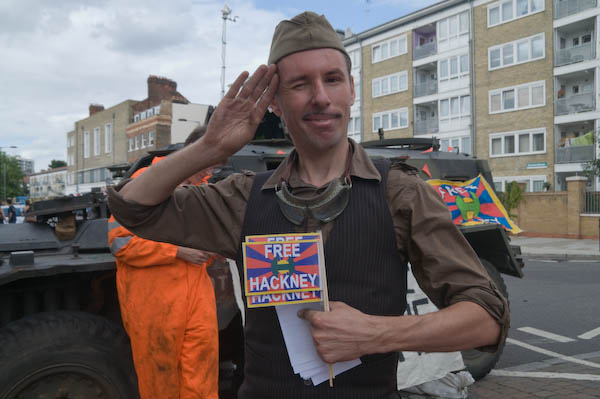
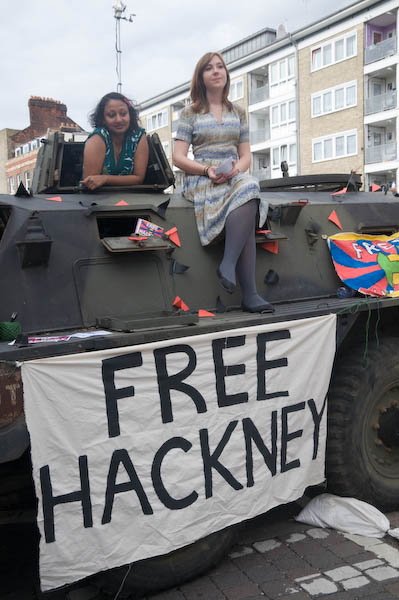
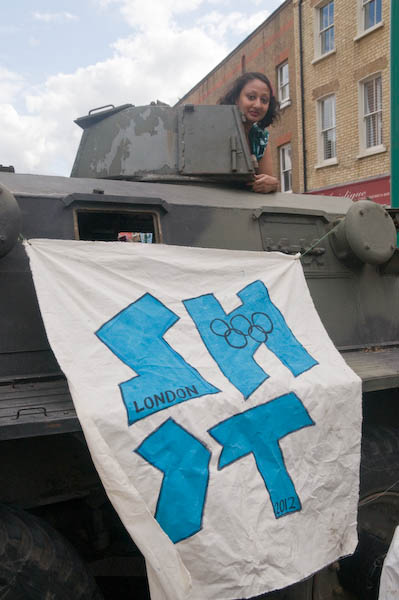
There was dancing on the street and everyone was having a good time. Including the ‘Free Hackney Movement’ Space Hijackers who arrived in what they call a tank to celebrate the handover of the protest torch for the Olympics from the Free Tibet protesters to Free Hackney.

The Free Hackney protest sees London 2012 as a great opportunity for property developers to rip us off and make obscene profits building luxury flats in the area, while at the same time restricting public access, closing down the existing free facilities and demolishing social housing and local businesses. So far its hard to argue against their case given the closure of local sports facilities including the closure of the Temple Mills cycle circuit and the removal of the Manor Gardens allotments and the wholesale clearance of small local firms which were based on Stratford Marsh.

There are a few locally based companies that have done well from their move, but more that have moved outside the area or closed down, with a loss of jobs in the area. There has also been considerable development of tall blocks of flats, but mainly for private sale or student accommodation which has done little if anything for the huge housing problems faced by local residents who want to remain in Hackney, Tower Hamlets or Newham.

Of course the London 2012 Olympics did give pleasure to many in the UK and around the world who watched the events, including the relatively few who bought tickets and watched them live. But any overall economic benefit for the UK – as claimed by the government – is debatable and given the extreme cost in any case marginal. Personally I find the media induced hysteria generated by the media around sporting events such as this objectionable and feel it is bad for the moral health of the country which needs a greater emphasis on the social and less on individual achievements of a tiny minority.

More at
Free Hackney Movement
Hoxton Handover – 1948 Street party