Another Don’t Bomb Syria Protest – 2015

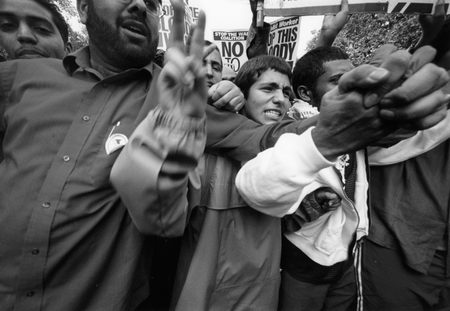
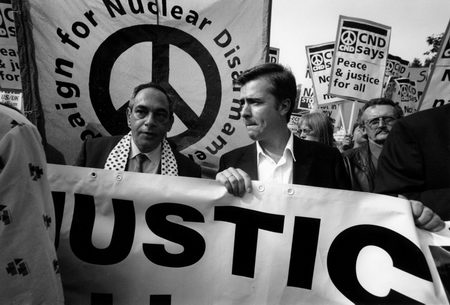
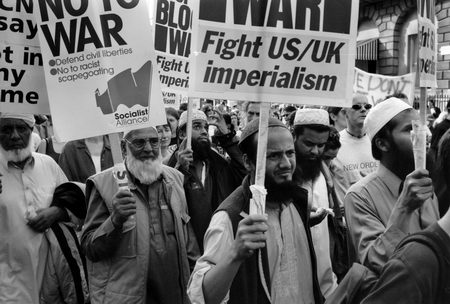
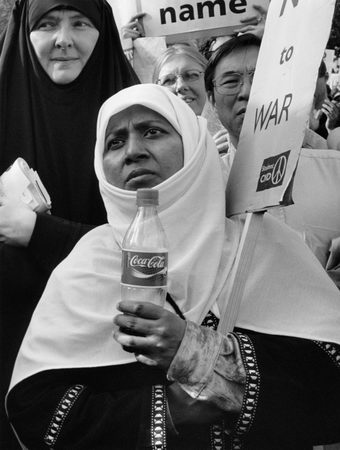
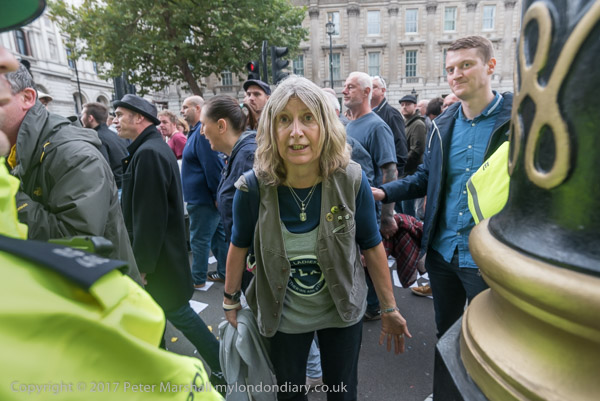
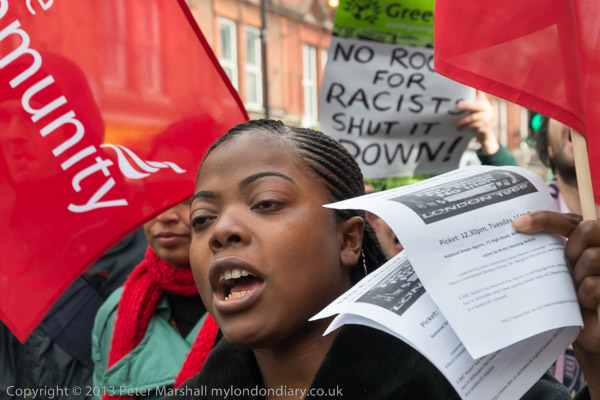
Another Don’t Bomb Syria Protest: On the evening of Tuesday 1st December 2015 a protest by Stop The War again called on MPs not to back David Cameron’s motion to bomb Syria.

Another Don't Bomb Syria Protest - 2015

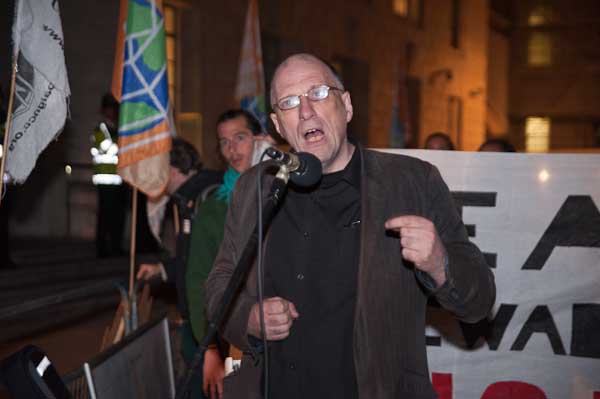
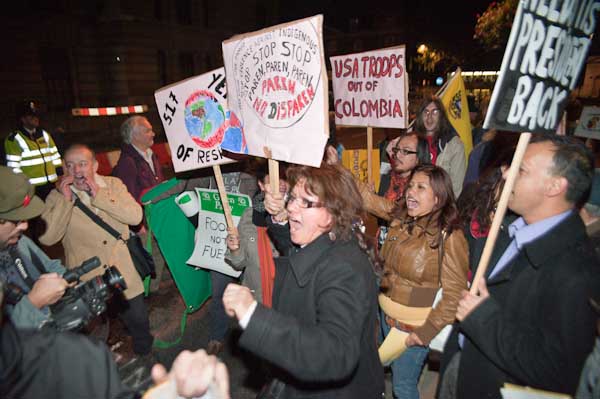
There was a large crowd in Parliament Square who listened to speeches by a wide range from the British left including Andrew Murray, Lindsay German, Salma Yaqoob of Stop the War, Kate Hudson of CND, SNP MPs Philippa Whitford and Tommy Sheppard, Former Green Party leader Caroline Lucas, Labour’s Richard Burgon and Imran Hussain, Weyman Bennett of Unite Against Fascism, Momentum organiser Adam Klug, George Galloway.

Another Don't Bomb Syria Protest - 2015

I photographed all of these speakers and you can see several pictures of most of them on My London Diary.

Another Don't Bomb Syria Protest - 2015

But as in the previous Stop The War protest, there were “no speeches by Syrians or Kurds, and no real attempt to take their views into account. And while the speakers all condemned the UK plans to bomb in Syria, there was no condemnation of the Russian bombing of the Syrian opposition, perhaps a greater threat to the Syrian people than Daesh, and certainly than the handful of UK planes.

Another Don't Bomb Syria Protest - 2015

Present in the crowd were a number of supporters of President Assad, with flags of his regime, though most of those present were opposed to the Assad regime and Daesh as well as to bombing by the UK.

John Rees of Stop the War

As I commented, “It’s rather unfortunate that the only organisation promoting large-scale protests against the bombing is Stop the War rather than one clearly supporting the aspirations of the Syrian people for freedom.”

Hours after this protest, Stop the War issued an article ‘For the avoidance of doubt‘ by John Rees which began by stating “The STWC has never supported the Assad regime.” I commented: “Well, it’s good to make that clear, because there have been many protests by Stop the War which Assad supporters have attended and appeared to be welcome, and by refusing to let Syrians opposed to the regime speak at this and other protests STW have certainly given that impression.”

It had become clear by 2015 “that while our government has fulminated against ISIS/Daesh it has also been complicit in support for them through its support of Saudi Arabia which provides support for their Wahabi ideology and more materially, for Turkey which is deeply involved in their oil exports, refining much of their output as well as providing pipelines and ports, and Israel which is the major customer for the smuggled oil.”

The bombing which later took place was largely ineffectual, hypocritical and immoral. While inflicting “little damage on Assad’s military inflicting real damage on the economic and military capability of Daesh” it was as predicted “catastrophic in effect on the civilians” that were bombed either deliberately or by accident.

After the speeches, the protesters marched first to the Tory HQ and then to Labour to deliver letters before returning to Parliament Square where the official protest ended.

A police officer tells Jasmin Stone that megaphones are not allowed to be used in Parliament Square

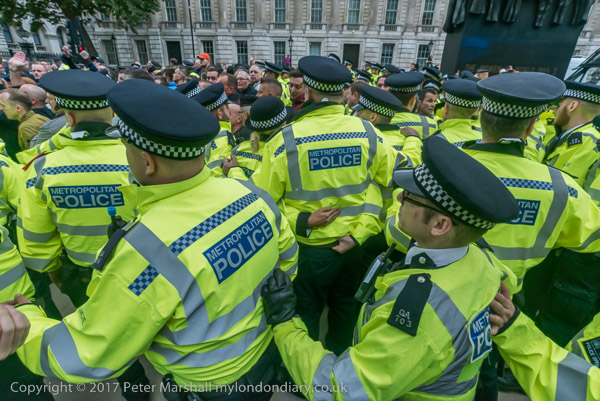
Many stayed on in the square and there were minor incidents with police making a few who had climbed onto the plinth of Churchill’s statue come down and stopping some from using a megaphone. But after a few minutes I decided it was time to go home.

More about the protest and many more pictures at Don’t Bomb Syria.


FlickrFacebookMy London DiaryHull PhotosLea ValleyParis
London’s Industrial HeritageLondon Photos

All photographs on this page are copyright © Peter Marshall.
Contact me to buy prints or licence to reproduce.

Second Day of Student Fees Protests – 2010

Second Day of Student Fees Protests: London Tuesday 30th November 2010 - A student holds a lighter to set fire to a placard
Second Day of Student Fees Protests: London Tuesday 30th November 2010 – A student holds a lighter to set fire to a placard

Six days earlier a march against the Browne Review of Higher Education Funding, which had advocated an increase in tuition fees, allowing them to rise to £9000 a year, as well as the scrapping of the Educational Maintenance Allowances (EMA) for 16-18 year old and other changes including closing many arts and humanities courses had led to an angry confrontation between students and police when police decided to halt and kettle the march in Whitehall.

Second Day of Student Fees Protests - 2010

I had been there and reported at some length on the events, including the smashing of a worn-out police van which seemed to have been deliberately left by the police “as a plaything for the protesters” and charges in which some “police made pretty liberal use of their batons and a couple clearly went a little berserk“, and protesters were in danger of being crushed, screaming that they couldn’t breathe.

Second Day of Student Fees Protests - 2010

It hadn’t been like those protests I had taken part in during the late 60’s and most of those taking part “were probably well-behaved students on their first demonstration” who when more militant students breached the police lines “just stood around wondering what to do rather than following them.”

Second Day of Student Fees Protests - 2010

I concluded:

“It had been a pretty confused situation, and it seemed to me that neither police nor students came out of it with much credit. The police tactics seemed designed to create public disorder by kettling and a small minority of the students rose to the bait. Although most of the students were out for a peaceful march and rally and to exercise their democratic right to protest, the police seemed to have little interest in upholding that right.”

Protesters run down Whitehall – but turn around when get close to a police line

The following Tuesday around 5000 students came back to Trafalgar Square for what was meant to be a peaceful march at 1pm along the same route down Whitehall to a rally in Parliament Square – which had been agreed in advance with police. I think both sides wanted to avoid a replay of the previous week.

They go back and through Admiralty Arch – with not a policeman in sight

But shortly after noon, more radical students, including a group of younger students who would lose the EMA took to the plinth under Nelson’s column and called for the crowd to go down Whitehall and demonstrate at Downing Street; several hundreds followed them.

When they see the police in Parliament Square they turn around again

There were only a few police at the top of Whitehall and clearly they stood no change of stopping them, but their attempts to do so heightened the tension and when police formed a tighter line further down Whitehall the protesters began shouting that they were being kettled.

They turned around and went under Admiralty Arch and on to the Mall before continuing down Horse Guards Road. Police followed them, walking beside them as they crossed into Storey’s Gate, then turned into Parliament Square.

Near Hyde Park Corner

By now this group of protesters – perhaps by then a thousand or two were obsessed with the idea that they were being kettled – and certainly there were a large number of police in Parliament Square, particularly behind barriers set up in front of Parliament and at some of the exits from the square.

A police medic attacks a protester in one of the only violent incidents I witnessed

The protesters turned around and walked and ran, beginning a “long rather rapid walk around London“, rather painful for me as I was still suffering from a foot injury, “taking in Hyde Park Corner, Piccadilly Circus, Oxford Circus and Oxford Street and turning down Kingsway at Holborn and then walking into the City of London along Fleet St” with a couple of hundred police walking along the side of the march.

The march passes the Stock Exchange

Most of the Met police stopped at the City of London boundary as the march continued “past St Pauls, the Stock Exchange, on up some of the narrow winding streets around St Bartholomews Hospital (it rather looked as if they were trying to kettle themselves there) to Smithfield Market before going back along Holborn Viaduct where I eventually left them to catch a bus and make my way back to see what was happening in Trafalgar Square.” The City of London Police had seemed to ignore the march and there was little or no trouble on their patch.

In Trafalgar Square there were still some of the original demonstrators but things were pretty quiet. There were police at the exits but people could walk past in both directions; “the protest was being isolated and watched rather than being kettled.”

Some of those I had been marching around London with made their way back into the square and there were a few short speeches before one of the official organisers announced that the demonstration was over and police would be happy for people to leave in small groups towards Charing Cross Station.

But most people decided to stay on and there were a few scuffles with police, with other students “linking arms in front of the police to protect them and stop any violence.”

It was snowing and beginning to get dark and it seemed to me that little further was happening so I walked out of the square and went home. It had been a confusing and tiring day for me. Later I heard that small group who had remained in Trafalgar Square had been kettled and some had been arrested.

More at Students Fees Protest – Day 2.


FlickrFacebookMy London DiaryHull PhotosLea ValleyParis
London’s Industrial HeritageLondon Photos

All photographs on this page are copyright © Peter Marshall.
Contact me to buy prints or licence to reproduce.


Leveson & Cold Homes – 2012

Leveson & Cold Homes: On Thursday 29th November press and protesters were outside the QEII centre waiting for the publication of the Leveson inquiry report, and were joined briefly by people who had been protesting outside the treasury over George Osborne’s cuts and energy policies and later moved to protest outside parliament where Energy Secretary, Ed Davey was to introduce the Energy Bill.

Leveson Comes Out

QEII Centre

Leveson & Cold Homes - 2012

Lord Justice Leveson had been appointed in 2011 to lead an inquiry into the culture, practices, and ethics of the British press after the News of the World had been found to have illegally hacked into the phones of celebrities, politicians, royals and others since the 1990s.

Of course the News of the World which had been closed down by Murdoch’s News International in 2011 over this was not the only newspaper to have used illegal hacking. As well as other papers in the Murdoch Press it was said to be fairly widespread across the tabloid papers.

Leveson & Cold Homes - 2012

The Leveson Inquiry was to be in two parts and the report on Part 1 was due to be released on 29th November 2012. Part 2 which was to examine the extent of phone hacking in News International and other media as well as the complicity of the police in receiving bribes and other ways was shelved in 2015 and then scrapped in 2018.

Leveson & Cold Homes - 2012

Leveson found that the Press Complaints Commission was toothless and ineffective and recommended that a new voluntary independent body be set up. There are now two press regulators; Impress, which largely follows Leveson’s proposals and IPSO, the Independent Press Standards Organisation which as its name says remains independent, and which more publications have signed up to, while others, including The Guardian belong to neither.

This was a small but visually interesting protest, and ss I wrote in 2012:

Leveson & Cold Homes - 2012

Avaaz had brought large puppet heads of Murdoch and a gagged Cameron with placards ‘End the Murdoch Mafia’ and a flaming dustbin into which Murdoch lowered the Leveson report.

Political artist Kaya Mar had brought one of his paintings with the judge and a cart-load of people, though I couldn’t recognise them all.

And a protester from Kick Nuclear was walking up and down with his dog which was wearing a poster about Fukushima warning of the dangers of nuclear power.

More pictures at Leveson Comes Out.


Cold Homes Kill Treasury Protest

Westminster

Fuel Poverty Action along with others including Disabled People Against Cuts, the Greater London Pensioners’ Association, Single Mothers’ Self-Defence, Southwark Pensioners’ Action Group and WinVisible (women with visible and invisible disabilities) had come to protest against the cuts to come from George Osborne’s energy bill which they say will cause 24,000 extra winter deaths.

The protest which began outside the Treasury and then moved on pausing briefly at the Leveson protest outside the QEII centre to Parliament Square in front of the House of Commons where Secretary, Ed Davey, was to introduce the Energy Bill later that day.

“The protesters had brought plastic silver reflective coated ‘space blankets’ to wear and had three ‘tombstones’ with the messages ‘George Osborne Your Cuts KILL’, ‘Gas Power = Killer Bills’ and ‘24,000 Winter Deaths – Big Six Profits up 700%’.”

They say that already because of the government cuts many people were going hungry, with food banks being set up and kept busy even in the more prosperous areas of the country, and now with winter coming many have to chose between ‘eating or heating’.

A protester with a hot water bottle tries to walk into the Treasury but is stopped by the police

Cuts will mean more people suffering from “hypothermia, and the disabled in particular are hard hit, both because of the ruthless removal of benefits by poorly designed tests adminstered by poorly qualified testers with targets to meet and also because they often have special needs for heating.”

The protesters ignored police requests to leave the steps up to the Treasury and police then pushed them down, “usually with minimum force, but just occasionally rather more than necessary, but both protesters and police generally remained calm.” The rally continued on the pavement with speakers including Green Party leader Natalie Bennett.

After this the group of 50 or so protesters moved to the pavement in front of the Houses of Parliament, pausing briefly on the way for photographs in front of those waiting for the Leveson report.

Police again tried to get them to move on when they stopped in front of the Houses of Parliament, at first telling them they had to move as “a Royal movement” was about to take place, an announcement that cause much hilarity and comment but no movement. A little later they were told they could stay, but decided instead to cross onto the grass in Parliament Square for some final photographs.

More pictures at Cold Homes Kill Treasury Protest.


FlickrFacebookMy London DiaryHull PhotosLea ValleyParis
London’s Industrial HeritageLondon Photos

All photographs on this page are copyright © Peter Marshall.
Contact me to buy prints or licence to reproduce.


Don’t Bomb Syria – 2015

Don't Bomb Syria - 2015
Don’t Bomb Syria – a woman listens to the speeches at the rally

Several thousands had come to Downing St on Saturday 28th November 2015 to urge MPs not to support British air strikes on Syria and more arrived as the rally was beginning bring the number up to perhaps ten thousand.

Don't Bomb Syria - 2015

Police who had tried to restrict the crowd to the wide pavement area were forced to stop traffic on the southbound carriageway, but put in a row of barriers so they could keep northbound traffic moving.

Don't Bomb Syria - 2015

There were a long list of speeches – you can read a partial list and see photographs of most of them on My London Diary.

Don't Bomb Syria - 2015 Tariq Ali
British Pakistani writer, journalist, and filmmaker Tariq Ali

The speakers called for the need to take effective action against the Turkish complicity in Daesh oil exports, in which members of Erdogan’s family take a leading role, and against what Tariq Ali described as “the obscenity of the Wahabi regime in Saudi Arabia” which provides the fanatical religious basis and much funding for Daesh. And, always in the background, the continuing crisis over Palestine.

Kaya Mar had brought 3 paintings

But there seemed to me to a glaring omission. As I wrote, I was there “with notebook poised ready to write down the names of the speakers representing the Syrians and the Syrian Kurds, who should surely have been at the forefront of this protest rather than so many old ‘Stop the War’ war-horses. None came, not because none were available or willing to speak, but because the politics of those most closely involved don’t accord with those of Stop the War.”

Throughout the speeches some protesters had been trying to move across onto the roadway directly in front of Downing Street. Eventually so many moved past the barriers that it became impossible for the police to force them back and keep the road clear for traffic.

Hundreds then sat done on the road and were still there chanting ‘Don’t Bomb Syria’ and other slogans well after the speeches had ended. After around an hour after police reinforcements arrived.

Previously police had been trying to persuade the protesters to stand up and leave the road with little success, but now they were warned they would be arrested if they failed to do so. Some were more reluctant than others to move, but I think eventually all did and I saw no arrests.

People slowly decide to move rather than be arrested

In September 2014 the UK Parliament had voted overwhelmingly in favour of British air strikes against ISIS in Iraq, but Parliament had also blocked the government’s plans for military action against Syria after the 2013 Ghouta chemical attack.

PM David Cameron had repeated calls for air strikes following a mass killing of tourists by an Islamist militant group in Tunisia, but it was only after the terrorist attacks in Paris in November 2015 that the House of Commons approved air strikes against ISIL in Syria – which began hours later in December 2015. In the next 15 months the RAF carried out 85 strikes – and there have been others since.

Many more pictures on My London Diary:
Don’t Bomb Syria
Speakers at Don’t Bomb Syria
Don’t Bomb Syria Blocks Whitehall


FlickrFacebookMy London DiaryHull PhotosLea ValleyParis
London’s Industrial HeritageLondon Photos

All photographs on this page are copyright © Peter Marshall.
Contact me to buy prints or licence to reproduce.


Stop Killing Cyclists Die-in 2015

Stop Killing Cyclists Die-in
Stop Killing Cyclists Die-in at TfL, Blackfriars Rd

Ten years ago today I was outside the Transport for London Offices on the evening of Friday 27th November 2015 for a rally and die-in by cyclists calling for much greater provision for safe cycling in London.

Stop Killing Cyclists Die-in
A row of 21 coffins remembering the 21 cyclists killed in London 2013-2015

This was two years after their earlier die-in here which had followed the killing of six cyclists in a terrible fortnight on London roads. And after a rally with speeches, poetry and music and reading the names of the 21 cyclists killed, people and bikes again blocked this junction on Blackfriars Road with a short die-in, closing the junction for 15 minutes.

Stop Killing Cyclists Die-in

On My London Diary I wrote a fairly lengthy account of the rally, which included speeches from several cyclists who had been seriously injured on London’s roads and were fortunate to still be alive. But in the two years since the previous die-in here, 21 cyclists had been killed and at the protest there was a row of 21 white coffins on the pavement outside the TfL offices, one for each death.

Stop Killing Cyclists Die-in

Most cyclists are killed by drivers of heavy goods vehicles, particularly skip lorries, which have very limited vision vision behind and to the side and are unaware of the presence of cyclists.

Stop Killing Cyclists Die-in

In the two years since 2013 progress on cycle safety has been very limited, and before this protest the organisers, ‘Stop Killing Cyclists‘ had sent a questionnaire to all the candidates standing in the forthcoming election for Mayor of London asking them whether they supported the demands for safer cycling, in what they called the “10% by 2020” London Mayoral Cycle Safety Challenge.

You can read the ten demands on My London Diary but the first was for 10% of TfL budget to be spent on cycling safety by 2020. Stop Killing Cyclists point out that this spending and their other proposals would also make London safer for pedestrians and by encouraging cycling (and walking) would make London healthier for us all.

One of the speakers was Professor Brendan Delaney, a doctor working in London, who pointed out that air pollution which comes mainly from traffic, particularly diesel-engines in buses and lorries, is thought to kill around 7,000 a year in London. More people cycling and less traffic could reduce that number dramatically.

The demands also called for a speed limit of 20 mph (except on motorways) across London and more traffic free areas and all five candidates supported the pedestrianisation of Oxford Street. Only Sian Berry of the Green Party and Independent Rosalind Readhead (who stood to ban private cars from London’s Zone 1 & 2) supported the 10% budget demand, though Labour’s Sadiq Khan promised a “significant” increase.

Green Party Mayoral candidate Sian Berry (in black coat)

In his first two terms as Mayor, Khan massively expanded the network of protected cycle tracks and also brought in and improved the Direct Vision lorry standard. And the expansion of the ultra low emission zone (ULEZ) to cover all of London has greatly improved air quality. But this in particular led to considerable public opposition and was blamed by Labour for them failing to win the Uxbridge by-election – although they still came close in what had long been a safe Tory seat.

Donnachadh McCarthy makes the final speech after the 15 minute die-in

Labour’s 2024 election victory has been a disaster for sensible transport planning – as well as more general environmental policies – with a switch to supporting major road-building, a third runway at Heathrow and other measures. Active travel seems no longer to be one of his or TfL’s priorities. Pressure from Labour leader Starmer after Uxbridge forced Khan to commit to not implement smart road user charging in his third election manifesto, severely damaging any chance of realising his ambition to make London a ‘Net Zero’ city including for transport by 2030.

More about the protests and more pictures on My London Diary at Stop Killing Cyclists Die-in.


FlickrFacebookMy London DiaryHull PhotosLea ValleyParis
London’s Industrial HeritageLondon Photos

All photographs on this page are copyright © Peter Marshall.
Contact me to buy prints or licence to reproduce.

End Slave Auctions in Libya – 2017

End Slave Auctions in Libya: On Sunday 26th November 2017 a large protest outside the Libyan Embassy in Knightsbridge called for an end to the slave auctions of Black African migrants in Libya.

End Slave Auctions in Libya - 2017

The protest came following a number of reports earlier in the year showing migrants being sold as slaves in Libya. The situation had worsened since the EU clampdown on migration across the Mediterranean, working with the Libyan authorities to intercept and tow migrant boats back to be detained in Libya.

End Slave Auctions in Libya - 2017

This clampdown had resulted in around 20,000 people, mainly from the Afgrican continent being detained in inhumane conditions in Libya, where many were being held with ransom demands being made from their families and others sold into slavery.

End Slave Auctions in Libya - 2017

As Wikipedia notes, Libya has a history of slavery dating back into antiquity with slaves from across the Sahara being sold there along with Berbers (the pre-Arab residents of the area), Jews and Europeans captured in Barbary slaving raids around the Mediterranean and as far north as Ireland, Scotland and even Iceland.

End Slave Auctions in Libya - 2017

The slave trade was made illegal by a decree in Tripoli in 1857, but this had little practical effect for many years and it was only under Italian rule in the 1930s that it was largely brought to an end.

End Slave Auctions in Libya - 2017

As I wrote in 2017, “Many at the protest saw the situation in Libya as part of a continuing neo-colonialist attempt to control Africa’s natural resources which results in the instability and mass migration from African countries, and that the current Libyan regime are western puppets installed though Western intervention to replace the genuinely nationalist Gaddafi regime and are engaged in a process of de-Africanisation and elimination of Black Libyans, of which slave auctions are a logical extension.”

Glenroy Watson of the Global African Congress and RMT

As Wikipedia points out, since Gaddafi was brought down in 2011, Libya “has been plagued by disorder, leaving migrants with little cash and no papers vulnerable.

Slaves in the past were kidnapped by raiders, but now they pay people smugglers to be brought to Libya, lured by the promise of being taken to a new life in Europe, but once in Libya are detained by the smugglers and local militias and subjected to torture, forced labour and sexual violence.

If ransoms are not paid they may be left to starve to death in detention. State security forces are also responsible for similar crimes against humanity for those returned from boats setting out across the Mediterranean, and the EU contributes by giving support to these forces.

Although the fate of migrants has seldom featured in our news media since 2017, little if anything has changed, as the 2025 report, The Scandal of a Slave Market in Libya from the Human Rights Research Center makes clear.

Sukant Chandan, a coordinator at the Malcolm X Movement, speaks from his experience in working with the opposition forces in Libya, and says how those currently in power in Libya have long carried out a policy of getting rid of Black Africans. He calls them a puppet government put into power to protest Western interests in Libya’s mineral wealth.

The area outside the Libyan Embassy soon became very crowded, with people lining the pavement for some distance in each direction and some spilling out onto the busy road. When I had to leave after approaching an hour and a half there were people still arriving and it took me several minutes to make my way through the crowd. I took a final picture of a woman holding a large poster on the edge of the protest on my way to Hyde Park Corner.

On My London Diary you can see more pictures, including some of the other speakers at the event.

End Slave Auctions in Libya


FlickrFacebookMy London DiaryHull PhotosLea ValleyParis
London’s Industrial HeritageLondon Photos

All photographs on this page are copyright © Peter Marshall.
Contact me to buy prints or licence to reproduce.

Biometric ID Cards – 2008

Biometric ID Cards are now once again under consideration by Keir Starmer’s Labour government having being heavily promoted since 2023 by Tony Blair, William Hague and others including the misleadingly named ‘Labour Together‘ right-wing think tank – once directed by Morgan McSweeney who became Starmer’s campaign director – and who he appointed as Labour’s chief of staff when he became leader – and McSweeney became Downing Street Chief of Staff in October 2024.

Biometric ID Cards - 2008

Until 2008, Britain had only introduced identity cards at times of war. They were scrapped in 1919 but kept on rather longer after World War Two when they were only abolished in 1952.

Biometric ID Cards - 2008
Luna House was built 1976-7 by Denis Crump & Partners and is rented by the Home Office from a Greek businessman whose company is based in Monaco. They added an R to its name.

While the British people were prepared to put up with them in wartime, identity cards were always viewed as fundamentally un-British, incompatible with our ideas of civil liberties and freedom. We contrasted our free society with others abroad where citizens could be stopped at any time on the streets and required to produce their papers – and chilling scenes of the Gestapo doing so were frequently invoked in popular culture. We were proud of not being a police state, but increasingly we are now moving more and more in that direction.

Biometric ID Cards - 2008

Now the idea is firmly back on the political agenda, there have been two major protests in London against the introduction of these ID cards. Unfortunately for different reasons I’ve not managed to cover either of them. A third protest is coming up in December and I hope to be there.

A petition to Parliament against their introduction has already received around 3 million signatures and will be debated on 8 December 2025. The initial government response is “We will introduce a digital ID within this Parliament to help tackle illegal migration, make accessing government services easier, and enable wider efficiencies. We will consult on details soon.” You can read more at Big Brother Watch.

Biometric ID Cards were introduced under the Identity Cards Act 2006, which came into force on 25th November 2008, when they became compulsory for all non-EU students and spouses applying for or renewing visas for study or marriage. They were to be required shortly for all foreign nationals in the UK and also to be rolled out to other groups including students who want a student loan by 2010. And from 2011 you were to be reqquired to have one – and have your details on that database – if you wanted to renew or get a passport.

Biometric ID Cards - 2008

London NoBorders and NO2ID (their website I linked to in 2008 is now a gaming site) marked the occasion with a picket outside the UK headquarters of the Border and Immigration Agency at Lunar House in Croydon.

It was, as I noted, a bitterly cold day and “on Wellesley Road a biting Siberian wind seared the demonstrators outside Lunar House. It seemed appropriate that such a freezing blast should surround the UK headquarters of the Border and Immigration Agency and indeed be generated by its twenty stories of the grim early 1970s office complex. After all its raison d’être is to give would-be immigrants and asylum seeks an extremely cold reception.

Biometric ID Cards - 2008

It’s impossible to think about the introduction of ID cards without thinking of Orwell and ‘1984’ (though I also had another author in mind when I wrote of it as “a warning of things to come for all of us in a Brave New Britain of state surveillance and control whose infrastructure is increasingly with us through security cameras, the interception of mobile phone signals and electronic communications and the planned introduction of universal ID cards.“)

Although New Labour had few worries about the descent into totalitarianism, our other main political parties had clear reservations, though for the Conservatives they were intrusive but more importantly “ineffective and enormously expensive.” The Lib-Dems were also opposed to them and under the coalition the Identity Documents Act 2010 scrapped the National Identity register and the database and plans for future issues of cards, although they remained as residence permits for foreign nationals.

Also present at the protest was one man, David Mery, fortunate to be still alive – unlike Jean Charles de Menezes. Like that innocent Brazilian electrician six days earlier he had gone into Stockwell Underground Station in 2005 and been suspected of being a terrorist, but this time the police didn’t shoot first and ask questions later. Though having established he wasn’t carrying a bomb they still arrested him and put him through the mill rather than simply apologising on the spot and releasing him.

As I wrote, “his treatment in the months and years following the event can most favourably be described as Kafkaesque. He finally (or at least probably) succeeded in having both his fingerprints and DNA record removed from the police databases, but it took over two years of fighting. His blog and articles are essential reading for anyone who wonders why civil liberties are important.

A few more pictures at Protest at ID cards start.


FlickrFacebookMy London DiaryHull PhotosLea ValleyParis
London’s Industrial HeritageLondon Photos

All photographs on this page are copyright © Peter Marshall.
Contact me to buy prints or licence to reproduce.

Antifa Remember Carlos, TOTAL, Musharraf & More – 2007

Antifa Remember Carlos, TOTAL, Musharraf & More: I spent Saturday November 24th 2007 travelling around London to photograph protests. On the South Bank, anarchists were remembering Carlos Presente killed by fascists in Madrid earlier in the month, protests were taking place at TOTAL garages across the country for their support for the repressive Burmese regime – and I went to several of those in London. Pakistanis protested at Downing Street against President Musharraf and there were a number of protests in Parliament Square. Below are a few of the pictures and the text I wrote in 2007, with links to more images.


Antifa Remember Carlos Presente

Jubilee Gardens

Antifa Remember Carlos, TOTAL, Musharraf & More
A comrade speaks at the memorial rally

Carlos Presente was only 16, but was already active in opposing fascism in his native Spain. Along with other antifascists, he had stood on the street to defend one of Madrid’s multiracial working class areas when Nazis held an demonstration against immigrants.

Antifa Remember Carlos, TOTAL, Musharraf & More

After the demonstration on 11th November, 2007, Carlos and a comrade were attacked and stabbed while waiting on an underground platform by one of the fascists who had been demonstrating. The hunting knife went through his heart and he bled to death.

Antifa Remember Carlos, TOTAL, Musharraf & More

The Anarchist Federation – IFA and Antifa Britain held a short memorial rally to honour Carlos. Fittingly it was at the memorial for those who fought against fascism in the Spanish Civil War in the 1930s in London’s Jubilee Gardens.

More pictures


TOTAL Day of Action – London

Kilburn, Kensal Green & Baker St

Antifa Remember Carlos, TOTAL, Musharraf & More
TOTAL disgrace. Free Burma. Protestors stage a ‘die-in’ at Baker St.

The French oil company, TOTAL, is the fourth largest oil company in the world, and the largest supporter of the Burmese military regime. Although the media hardly noticed the country before the recent outrages against monks, it has long been one of the most brutal dictatorships around.

Antifa Remember Carlos, TOTAL, Musharraf & More
Kilburn

It holds over 1300 political prisoners, many subject to routine torture, makes widespread systematic use of forced labour and uses rape as a deliberate policy against women from some of its ethnic minorities.

Kensal Green

It also has more child soldiers than any other country and spends roughly half the government budget on the military – and much of that budget derives from TOTAL.

Saturday saw demonstrations across the country against TOTAL garages, urging motorists not to support the repression in Burma by buying from TOTAL. There were at least 11 demonstrations in London, and I went to photograph at three of them, in Kilburn, at Kensal Green and [after photographing other protests below in this post] at Baker Street.

It wasn’t surprising, given the widespread nature of the action that numbers at some garages were small. I left Baker St after an hour – half-way through the demonstration, and more people turned up after I’d gone.

More pictures


Pakistanis Protest at Commonwealth Suspension

Downing St, Whitehall

In full voice opposite Downing St

I don’t know what fraction of Britain’s Pakistani population supports President Musharraf. Polls earlier in the year in Pakistan showed that almost two thirds of the population thought he should stand down. Of course there are some here who owe their positions to him, and certainly others who support him.

So it was hardly surprising to find a couple of hundred protesters in Whitehall on Saturday afternoon opposite Downing Street following the decision on Friday by a committee of Commonwealth foreign ministers to suspend Pakistan because Musharraf had imposed emergency rule – and then sacked the judges who were about to rule his proposed next term as President unlawful.

More pictures


Peace Strike and other happenings

Westminster

Problems with the amplification didn’t prevent the24 hour picket starting

Cold weather is not kind to batteries, and the overnight frost killed those used for the amplification in Parliament Square, so although some supporters had turned up for the ‘Peace Strike’ the planned starting rally couldn’t take place.

Part of Brian Haw’s display
Demonstrators in Parliament Square to mark 500 days in captivity for the two Israeli soldiers whose capture by Hezbollah led Israel to attack Lebanon.

A few more pictures


[As darkness fell I made my way to my final protest of the day at the Baker St TOTAL garage.]


FlickrFacebookMy London DiaryHull PhotosLea ValleyParis
London’s Industrial HeritageLondon Photos

All photographs on this page are copyright © Peter Marshall.
Contact me to buy prints or licence to reproduce.

Between Kings Cross & St Pancras – 1990

Between Kings Cross & St Pancras: A week after my previous walk which began from Kings Cross I was back there again for another walk on Sunday 18th February 1990, beginning with a few pictures close to the station in Kings Cross and Somers Town. This was an area I’d photographed in earlier years but still interested me. Since 1990 it has of course changed dramatically.

Cheney Rd, Kings Cross, Camden, 1990, 90-2d-34

Cheney Road is no longer on the map of London although one of the buildings on it remains. It ran north-east from Pancras Road along the side of Kings Cross Station, then turned north-west towards Battlebridge Road and the gasholders you see here. Of course those gasholders are no longer where they were in 1990, but were moved further north and to the opposite side of the Grand Union Canal as a part of the redevelopment of the area including the addition of the Eurostar lines into St Pancras.

This street was a popular film location, best known for its use in The Ladykillers. In the middle distance at left you can see the roof of the German Gymnasium, with its distinctive windows at its top, I think the only building in my picture that remains (at least in part) in situ.

Pancras Rd, Somers Town, Camden, 1990, 1990, 90-2d-36

St Pancras Hotel and stating seen looking south down Pancras Road on a sunny Sunday morning. I think I used the controlled parking zone sign to cut down flare. A taxi is turning into Kings Cross over a short section of cobbles.

The station was completed in 1869 and the Midland Grand Hotel in 1876, though it had its first visitors in 1873. Both were designed by George Gilbert Scott and are Grade I listed. They were built for the Midland Railway whose main lines ran from here to Manchester, Sheffield and Nottingham via Derby. The hotel was expensive to maintain and closed in 1935, then becoming used as railway offices by the London, Midland & Scottish Railway.

My first trip to Manchester in 1962 was from here, but soon after in 1967 the central section of the route – one of England’s most scenic – was closed. Now the line ends at Matlock (with a Couple of miles of preserved railway to the north, and we have change at Derby on our journeys to Matlock.

Pancras Rd, Somers Town, Camden, 1990, 90-2d-21

Looking north up Pancras Road with the arches of the station to the left of the picture and one of the gasholders in the distance. The curved pediment above the door in the middle block at right is the entrance to the German Gymnasium. This end of the Grade II listed building was demolished when St Pancras International was built, and the west end of the building was replaced by modern brickwork in keeping with the other walls of the building.

Turnhalle, German Gymnasium, Pancras Rd, Kings Cross, Camden, 1990, 90-2f-66

This was the original west end of the Turnhalle at 26 Pancras Rd.

Pancras Rd, Somers Town, Camden, 1990, 90-2d-22

Kings Cross Automatic Gearbox Centre at 87-89 Pancras Road, Newport Joinery at 92 and other small businesses along the west side of athe road were all demolished to make room of the new platforms for St Pancras International

Stairs, Stanley Buildings, Stanley Passage, Kings Cross, Camden, 1990, 90-2d-15

A notice at the left of the stairs of Stanley Buildings flats, says NO to the British Rail bill in Parliament which would see the building of the new international station and the demolition of much of the conservation area. Despite much opposition, the Channel Tunnel Rail Link Act was passed in 1996.

Stanley Buildings were built in 1865, designed by Matthew Allen for the Improved Industrial Dwellings Company under the guidance of Sydney Waterlow. Grade II listed in 1994, but that has not enough to save them as they were and one block was entirely demolished and the remaining block incorporated into a modern building, losing much of its character. The listing text ends: “Among the earliest blocks built by Waterlow’s influential and prolific IIDC, Stanley Buildings are in addition an important part of a dramatic Victorian industrial landscape.” Their remnant now sits largely hidden in a modern development.

More from this area in a later post.


FlickrFacebookMy London DiaryHull PhotosLea ValleyParis
London’s Industrial HeritageLondon Photos

All photographs on this page are copyright © Peter Marshall.
Contact me to buy prints or licence to reproduce.

DLR – Beckton Extension – 1994

DLR – Beckton Extension: One of the earliest projects I had used a panoramic camera on was the building of the Docklands Light Railway Beckton extension which had been a part of a transport show at the Museum of London in 1992. I had made these pictures on black and white film – you can view these along with many other pictures in my Flickr album ‘1992 London Photos

DLR, Train, Station, Beckton, Newham, 1994, 94-715-11

So when the Beckton branch from Poplar opened at the end of March 1994 I made a note to myself to return there and make more panoramas along the completed route, but this time working in colour. But I was busy with other things and it was only in July 1994 that I finally managed to go and take some new pictures.

Station Entrance, DLR, Beckton, Newham, 1994, 94-715-13

I began by taking a DLR train to the end of the line, Beckton Station, and then walked out to make a few pictures in the area surrounding the station.

Horses, sculpture, Brian Yale, Beckton Bus Station, Woolwich Manor Way, Beckton, Newham, 1994, 94-716-62

I’d first visited Beckton in 1981, and had gone back briefly when I was working on the DLR construction in 1982, but by 1994 things were very different to my first visit. Then Beckton was still a largely uninhabited area, noted for its gas works – then mainly in ruins and for being at the end oof London’s Northern Outfall sewer.

Station Entrance, DLR, Beckton, Newham, 1994, 94-716-51

There had also been a large postwar prefab estate, but that had been swept away and plans to build large council estates to help solve Newham’s huge housing problems were swept away with the advent of the London Docklands Development Corporation, who sold off most of the land for private housing. The LDDC also commissioned the Horses sculpture by Brian Yale, who had worked for many years as an artist and environmental designer for the architecture department of the Greater London Council, creating “designing murals, sculptures, public art works and play spaces for GLC housing estates and schools“. He was also commisioned by them to produce the long 50 panel The Docklands Frieze at Prince Regent Station.

Robert, Steam Engine, Winsor Terrace, Beckton, Newham, 1994, 94-716-32

Robert, a 0-6-0 tank engine was built in 1933 for the Staveley Coal and Iron works and worked in their sidings until 1969. It then went to various preserved railway sites, at one of which it gained its name. Kew Bridge Steam Museum in 1993 restored it to look like a Beckton Gas Works engine (presumably for the LDDC) and it was placed here. After some vandalism Newham Council took Robert over and moved it close to Stratford Station. The engine was again moved during building works assocatied with the 2012 Olympics and finally came back to a different location outside Stratford Station in 2011. It was still there when I last went to Stratford a few weeks ago.

Beckton, Newham, 1994, 94-716-43

I took a long walk around Beckton, and made quite a few normal format images in black and white, but relatively few colour panoramas, mainly close to the station, then walked rather futher around the area making more panoramas, only relatively few of them on-line at Flickr – two of those in this post are online for the first time including ‘Link Road, Beckton’ below.

Link Road, Beckton, Newham, 1994, 94-716-11

I this was part of one of the ring road schemes around London that was never built, Ringway 2, which was planned go under the River Thames at Gallions Reach in a new tunnel between Beckton and Thamesmead. When I made this picture it simply came to a dead end not far on.

More panoramic pictures from around the DLR Beckton branch in a later post.


FlickrFacebookMy London DiaryHull PhotosLea ValleyParis
London’s Industrial HeritageLondon Photos

All photographs on this page are copyright © Peter Marshall.
Contact me to buy prints or licence to reproduce.