Police, Shakespeare, Tamils, Dutch, LOL – 2009

Police, Shakespeare, Tamils, Dutch, LOL: Saturday April 18th 2009 was another varied day for me, beginning at the City of London Police HQ with a protest over their policing of demonstrations – including the killing of Ian Tomlinson on April 1st, then a chance meeting with a Shakespeare event close to where he died. In Westminster I photographed a continuing Tamil hunger strike and went on to the Dutch festival in Trafalgar Square before photographing the annual Loyal Orange Lodge Parade, leaving them in Whitehall to finally go home.


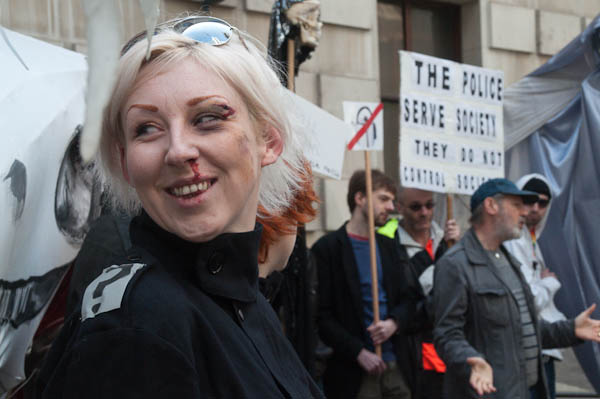
Protest Against London Police

City of London Police HQ, Wood St
Police, Shakespeare, Tamils, Dutch, LOL - 2009

The carnival-themed protest in London on April 1st was met with an extraordinary display of police violence “police chiefs and politicians had spent the previous week ramping up the temperature and predicting violence.”
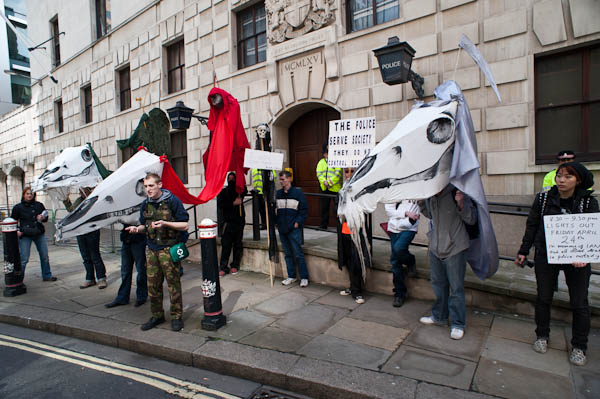
Three and a half Horsemen of the Apocalypse outside the Police Station on Wood St

As I reported on the April 1st protest: “Many of the police, particularly the TSG, came along to the event psyched up and spoiling for a fight” and their violence was not restricted to the small number of protesters who had come to cause trouble, but was also directed at the great majority of peaceful protesters – and to the press who were photographing the event.
Police, Shakespeare, Tamils, Dutch, LOL - 2009

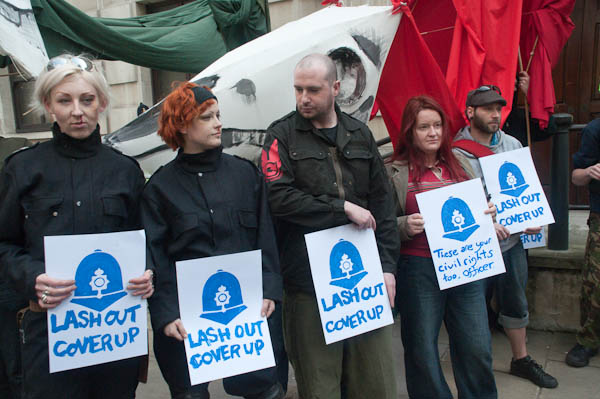
Many police officers had removed or hidden their ID numbers to avoid being identified by protesters or recorded in photographs, a clear sign that they were intending to break the law.
Police, Shakespeare, Tamils, Dutch, LOL - 2009

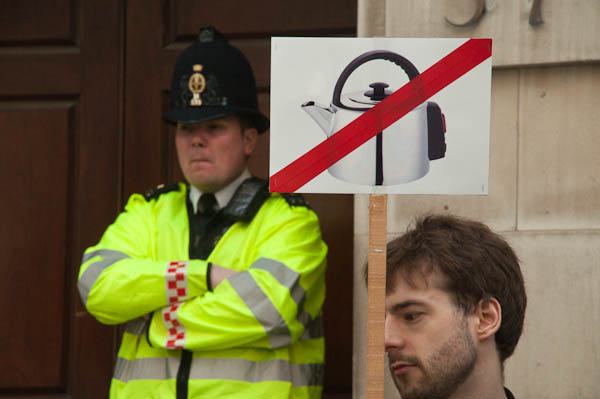
Videos taken of the police attacks on the crowds show ‘people being attacked simply holding up their arms to protect themselves as police assault them with batons and riot shields used as weapons, people standing there and chanting “We are not a riot” and “Shame, shame, shame on you.” ‘
Police, Shakespeare, Tamils, Dutch, LOL - 2009
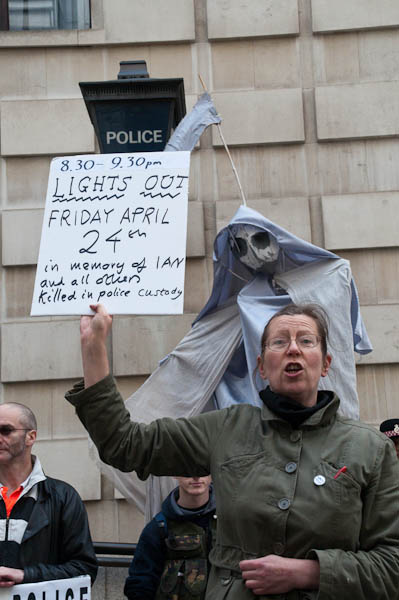
Protesters call for a “lights out” hour on Friday evening for Ian Tomlinson and all others killed in police custody

The protesters called for police to remember they are there to serve the public and for an end to the wholesale “kettling” of protests, the disbanding of the TSG and for proper training of police in handling demonstrations. They called on senior officers to enforce proper discipline and regulations and a complete end to all officers turning a blind eye when their colleagues behave illegally.
Police, Shakespeare, Tamils, Dutch, LOL - 2009
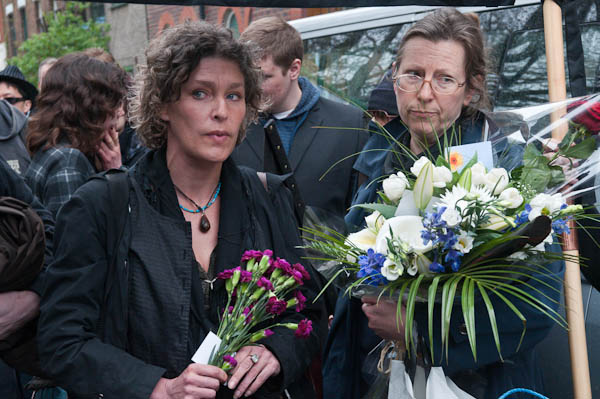
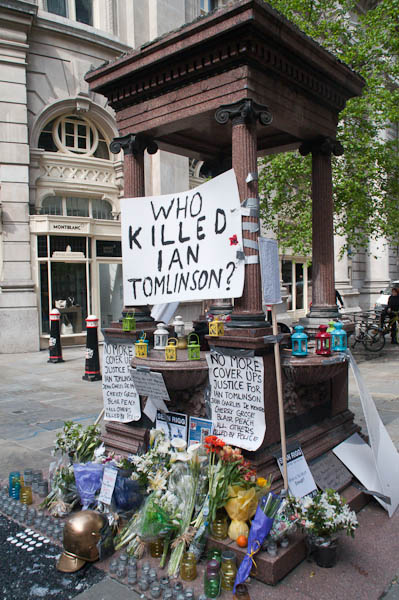
Flowers and posters remembering Ian Tomlinson around the Cornhill Fountain

More at Protest Against London Police.


Shakespeare’s Birthday Coincidence

Cornhill
Police, Shakespeare, Tamils, Dutch, LOL - 2009

At the end of the protest I walked to the display on Cornhill set up around the Cornhill Fountain a few yards from where Ian Tomlinson died, staggering there after being assaulted by a police officer while making his way home after work, with police refusing to give him medical attention until too late.
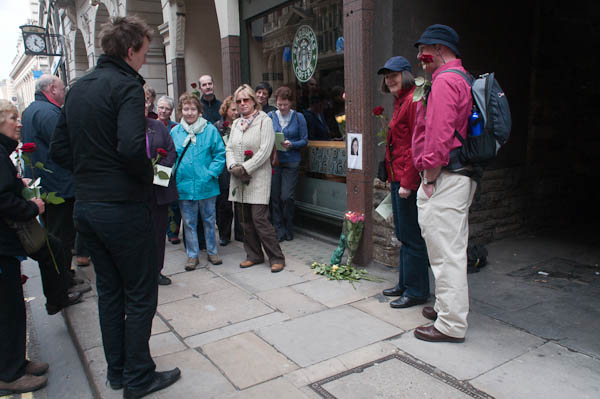
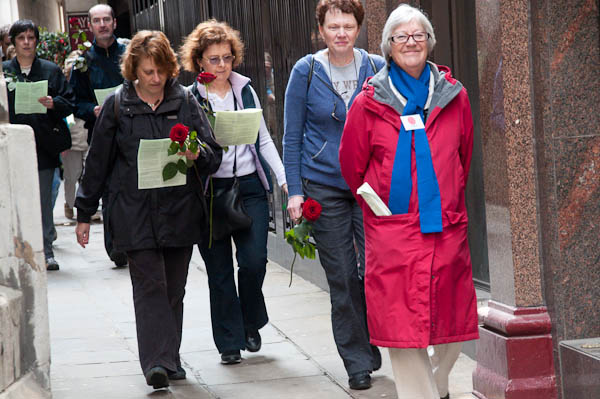
I was standing there when to my surprise a group of around 20 people, each holding a red flower came towards me, led by a woman with a badge saying ‘Steward.’ They stopped for a short performance exactly where Tomlinson died, where there was a picture of a woman and some flowers

They then stopped and a man read a short piece, which sounded vaguely familiar. As the group left I asked him about it “and found that this was one of around 20 groups each being taken on a guided walk around the city to various sites with similar performances to this of one of the sonnets to celebrate Shakespeare’s birthday next Thursday.”

Shakespeare’s Birthday Coincidence


Tamil Hunger Strike Continues

Parliament Square
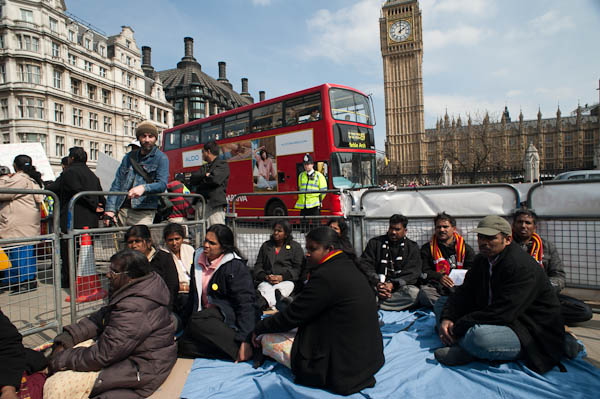
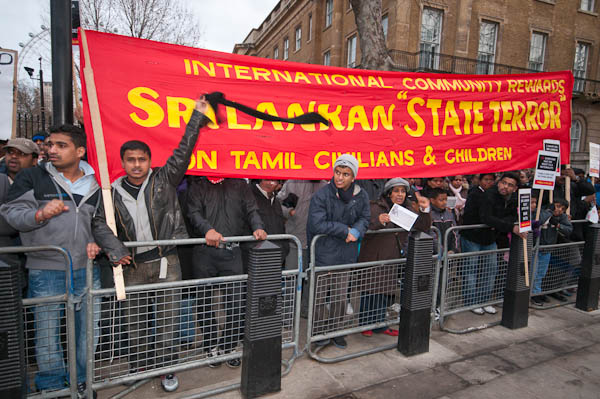
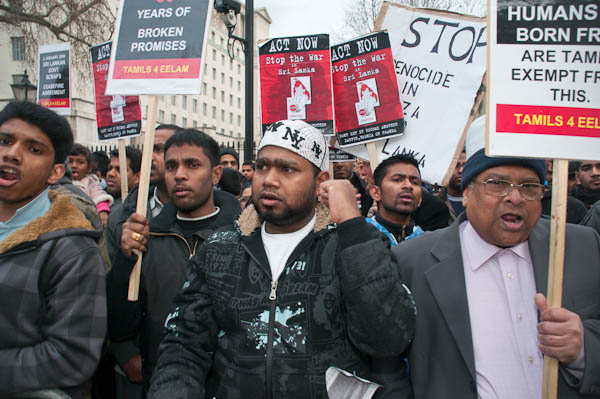
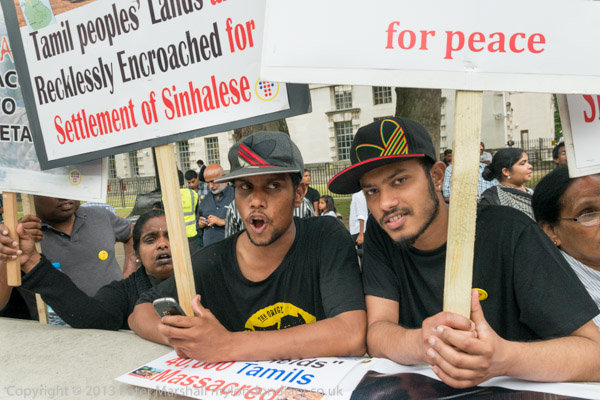
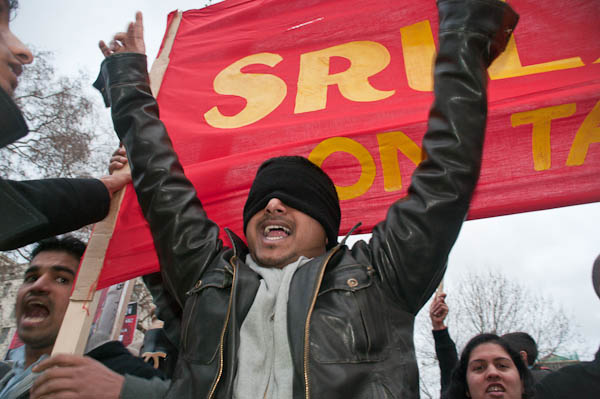
Eight days earlier I had visited the hunger strike by two young Tamil men over the ongoing genocide of Tamils in Sri Lanka. They had begun their hunger strike on 6th April and the hunger strike was still continuing on the 18th, with a dozen of so others joining them each day for a one day fast, and a crowd of around 500 more Tamils beside their pen in support.
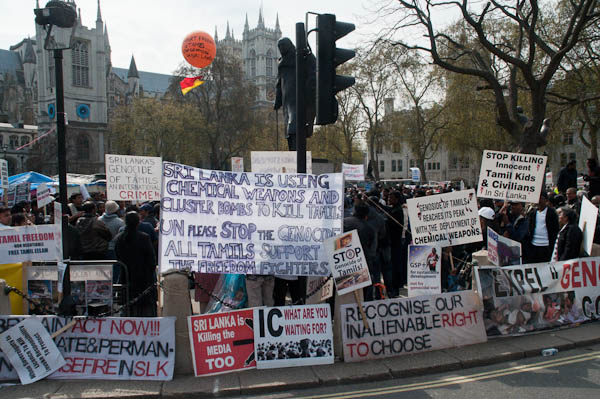
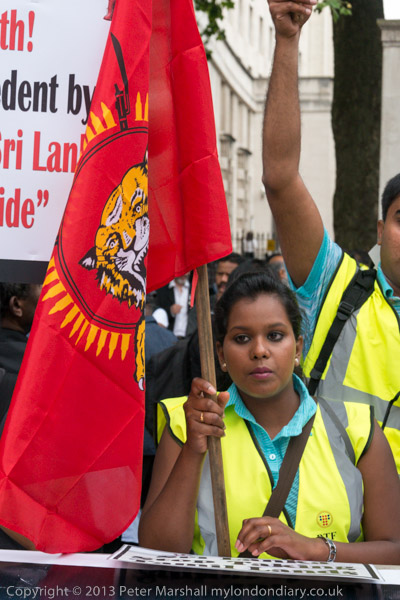
They protesters all supported the Tamil Tigers in their fight for an independent homeland and called for “an immediate and permanent ceasefire in Sri Lanka, with full access for the UN, the Red Cross and other agencies, as well as the international press, along with an opportunity for the Tamils in Sri Lanka to have a free and independently observed referendum on their future.”
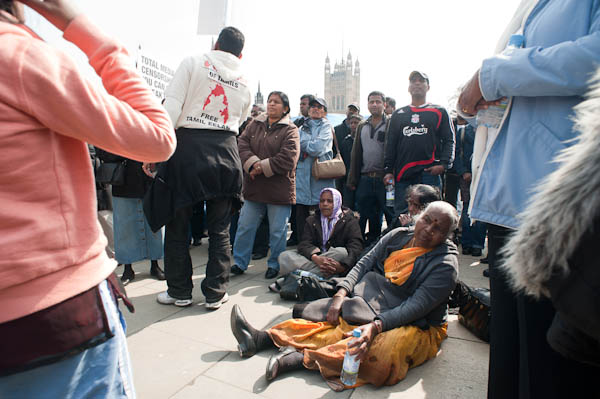
Not long after, in May 2009, the fight by the Tamil Tigers for independence ended in defeat. Since then Tamils have been subjected to continuing human rights violations although their situation is reported to have improved somewhat since 2015.

Tamil Hunger Strike Continues


Dutch Stereotypes

Trafalgar Square

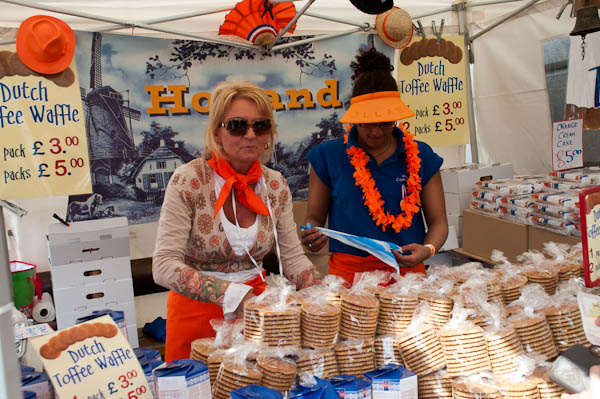
“In Trafalgar Square, the Dutch were holding a festival to prove their lack of understanding of popular music and to sell cheese, chips and beer. The cheese did look quite attractive. The only thing missing seemed to be a windmill, but I probably just didn’t look hard enough.”

Dutch Stereotypes


Loyal Orange Lodge Parade

Westminster
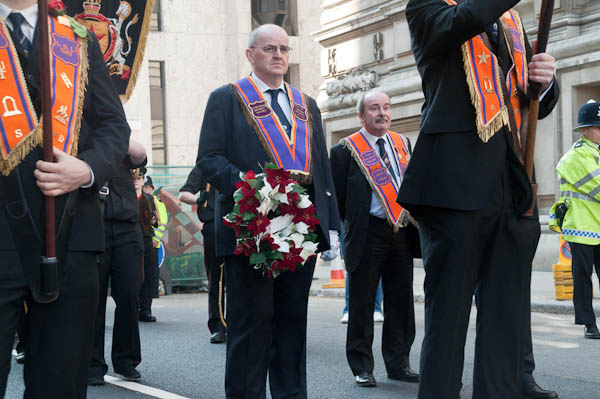
On My London Dairy you can read more about the Orange Order which takes its name “from William, Prince of Orange who landed in Devon in 1688 to restore parliamentary democracy and prevent the imposition of the Catholic religion by James II. This was the ‘Glorious Revolution’ which forced James II to flee and made William king as William III.

It led to greater freedom for dissenting nonconformist Protestants but Catholics were denied the right to vote, be MPs, become army officers or marry the monarch. That marriage is still out.
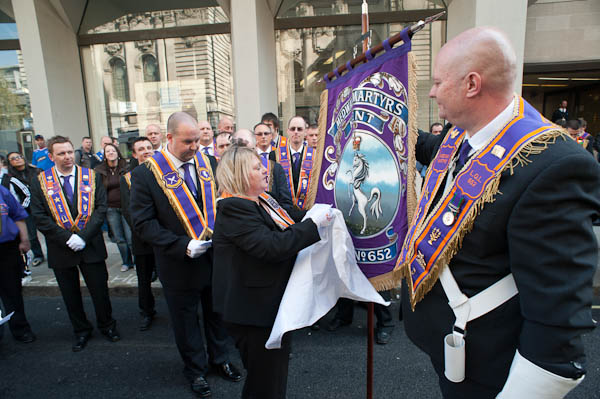
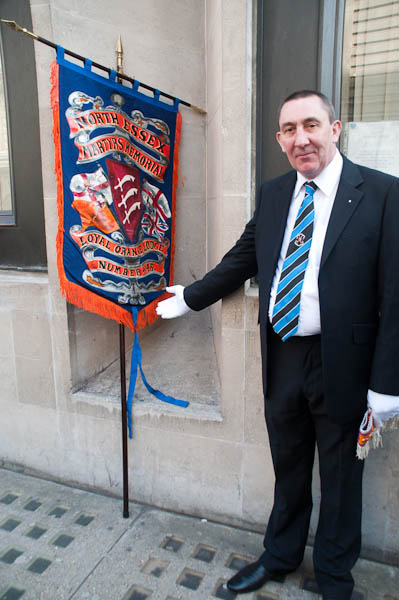
The Worthy Mistress of Corby First Ladies LOL53 unveils a new banner before the start of the march

The regular Orange marches in London are largely uncontroversial, but in Northern Ireland they still perpetuate the division between the Protestant and Catholic communities which led to the ‘troubles’.
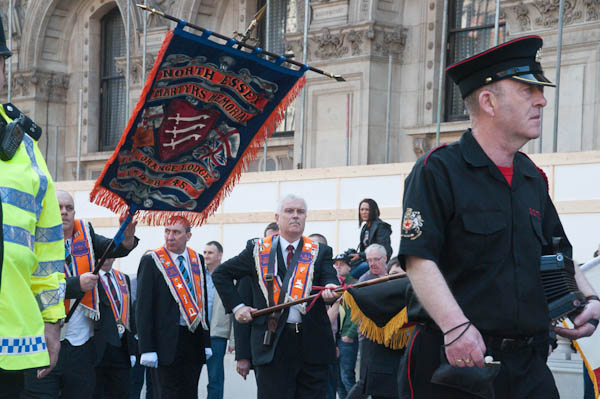
Banners are lowered as a mark of respect as they march past the Cenotaph

I photographed them laying wreaths at the Cenotaph in Whitehall and marching past but theen left as they went on to the the statue of of “King Billy” in St James’s Square.
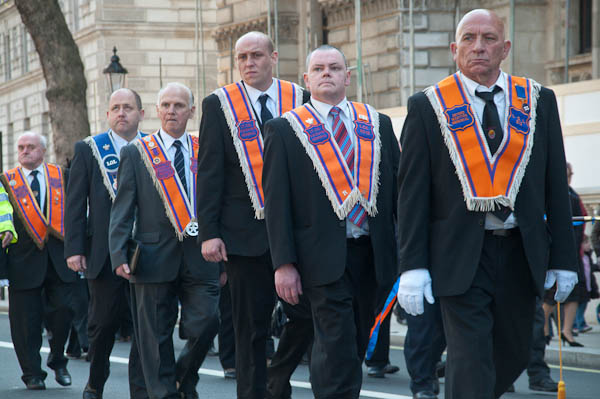
I’ve often been threatened and made unwelcome when photographing Orange marches, because of my political views or possibly those of a photographer who worked for Searchlight magazine which gathers information on the far right they have confused me with. Others taking part in Orange Order marches have congratulated me for my pictures.

More about the parade and many more pictures at Loyal Orange Lodge Parade.


FlickrFacebookMy London DiaryHull PhotosLea ValleyParis
London’s Industrial HeritageLondon Photos

All photographs on this page are copyright © Peter Marshall.
Contact me to buy prints or licence to reproduce.
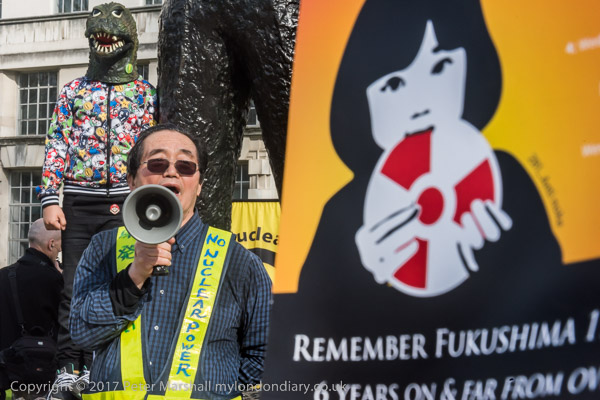
Fukushima & Million Women Rise – 2017

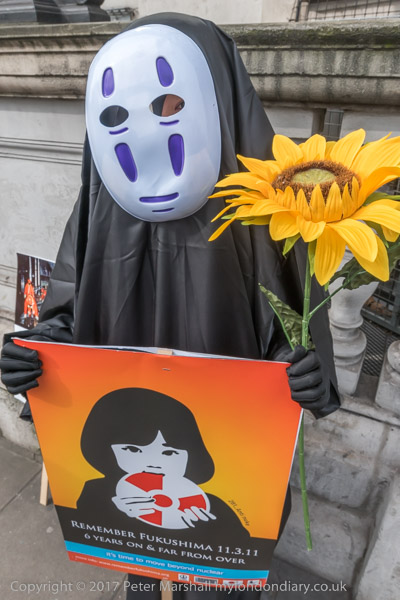
Fukushima & Million Women Rise: Saturday 11th March 2017 was the sixth anniversary of Fukushima nuclear power plant disaster in Japan and a march called for an end to nuclear power programmes around the world including in the UK. It was also the nearest Saturday to International Women’s Day and I photographed the Million Women Rise march.


Fukushima Anniversary Challenges Nuclear Future

London

Fukushima & Million Women Rise - 2017

Six years on, radiation was still leaking from the plant which was damaged by a tsunami from the Tohoku earthquake. This destroyed most of the plant’s cooling system and created the world’s worst nuclear disaster since Chernobyl.

Fukushima & Million Women Rise - 2017

Estimates of the human cost in the long-term from the radiation leaks vary considerably, but the financial cost of cleanup up has been estimated at around $180 US.

Fukushima & Million Women Rise - 2017
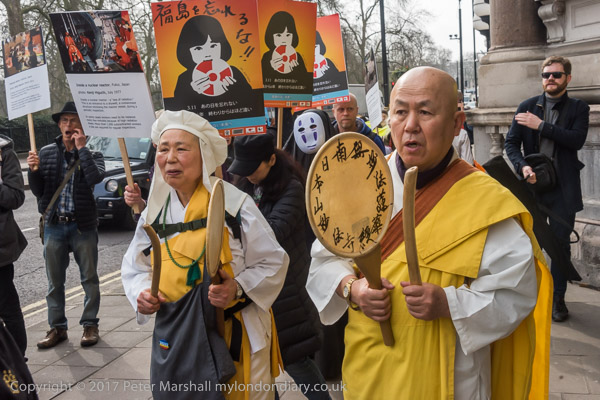
Buddhist Reverend Gyoro Nagase from Battersea and Reverend Sister Yoshie Maruta from Milton Keynes

Nuclear power has never achieved the early promises of cheap energy and remains the most expensive way of generating electricity. It is now promoted as an essential backup for renewable energy when the sun doesn’t shine and the wind doesn’t blow but its importance will fade as we exploit other continuous renewable sources and cheaper storage solutions become available. And as we move away from a grid-based power system to more local generation. Should nuclear fusion ever become feasible it promises to be a much safer, cheaper and cleaner way to generate electricity.

Fukushima & Million Women Rise - 2017

Probably the UK’s nuclear programme was never really about energy, but about our nuclear weapons programme.

Fukushima & Million Women Rise - 2017

The marchers met at the Japanese embassy on Piccadilly and marched on the pavement handing out leaflets to Downing Street. I left them on the march to photograph the start of Million Women Rise and then took to tube to Westminster for the Downing Street rally.

More on My London Diary: Fukushima anniversary challenges nuclear future.


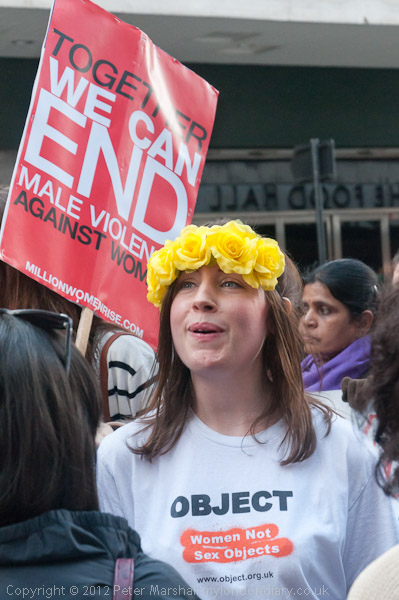
Million Women Rise Against Male Violence

Oxford St

Fukushima & Million Women Rise - 2017
Women get ready to march in Orchard St

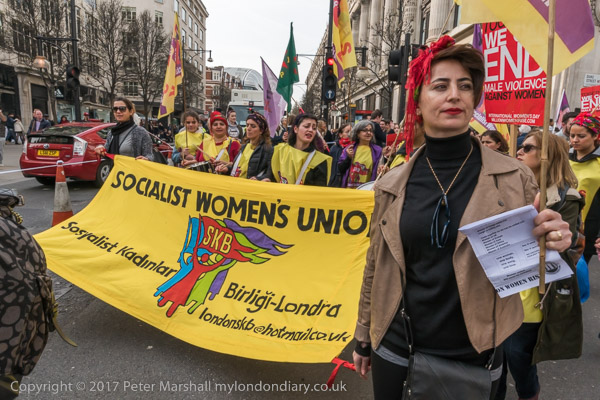
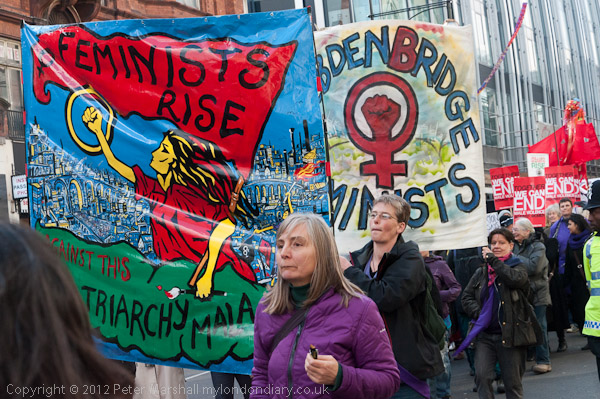
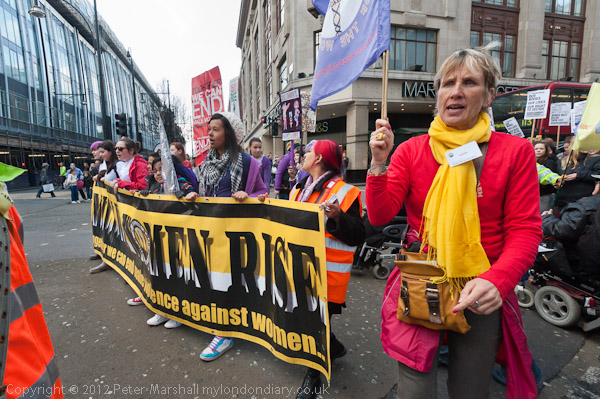
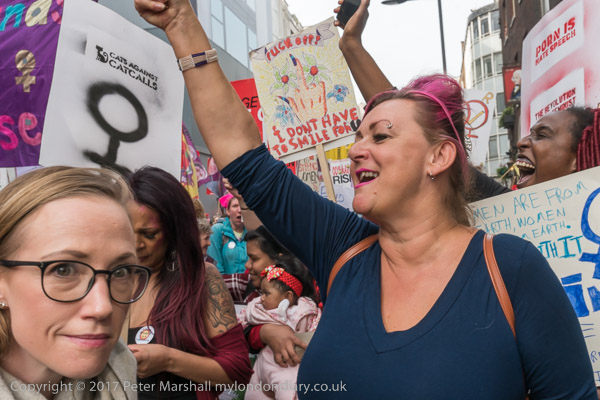
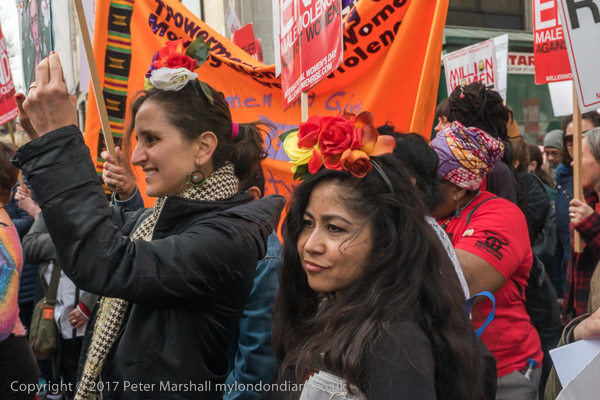
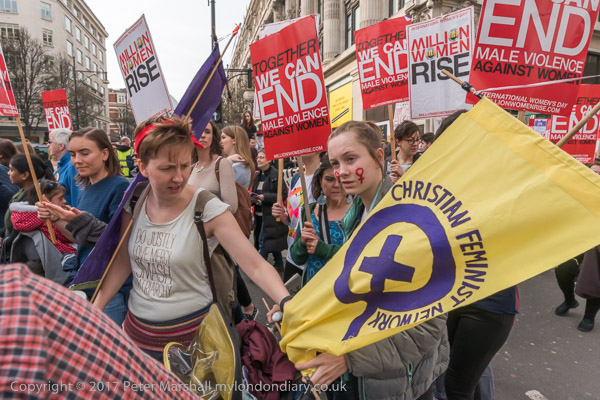
Around two or three thousand women gathered in Orchard Street to march to a rally in Trafalgar Square.

‘Women of the World Unite Against Violence’

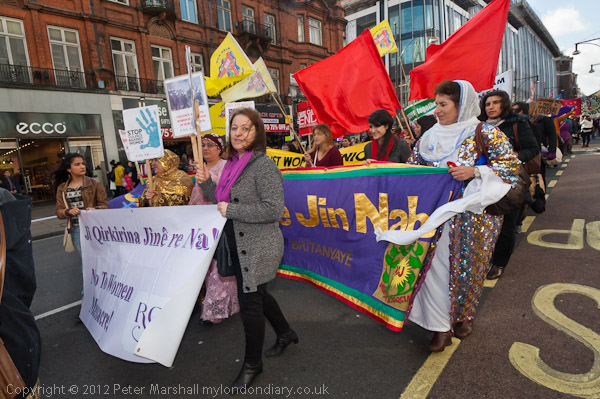
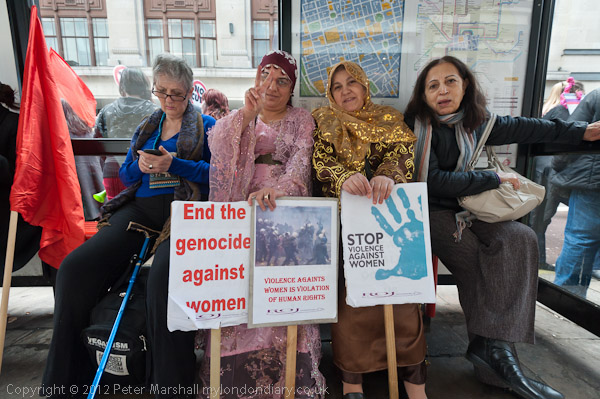
Many carried feminist placards and there were groups from various women’s organisations around the country, including from various ethnic communities.

This was a march for women only, but most of them were very happy for me to photograph them, but I was not able to mingle freely with them as I would on most marches, and my pictures were from the sidelines or in front of the march.

Violence Against Women is a Global Pandemic’

I was able to take many pictures, but not always as I would have liked. But I think they are an interesting set – and here are just a few of them.

I left as the march reached Bond Street station to go back for the Fukushima rally.

Many more pictures on My London Diary: Million Women Rise against male violence,


FlickrFacebookMy London DiaryHull PhotosLea ValleyParis
London’s Industrial HeritageLondon Photos

All photographs on this page are copyright © Peter Marshall.
Contact me to buy prints or licence to reproduce.

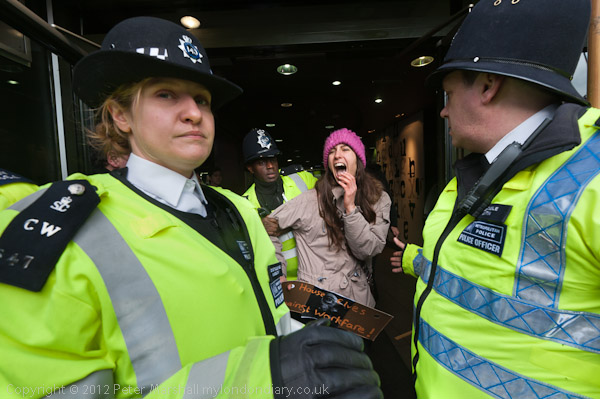
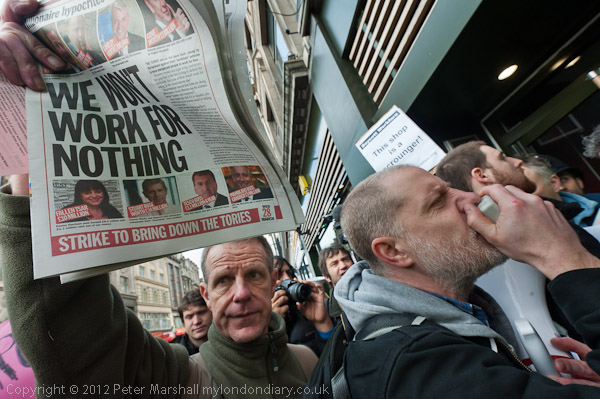
Boycott Workfare, Million Women Rise & Greece – 2012

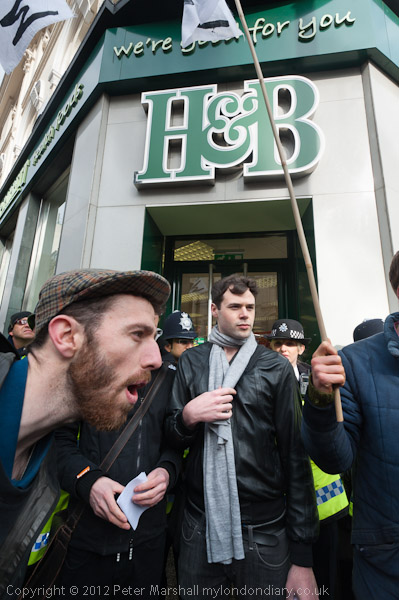
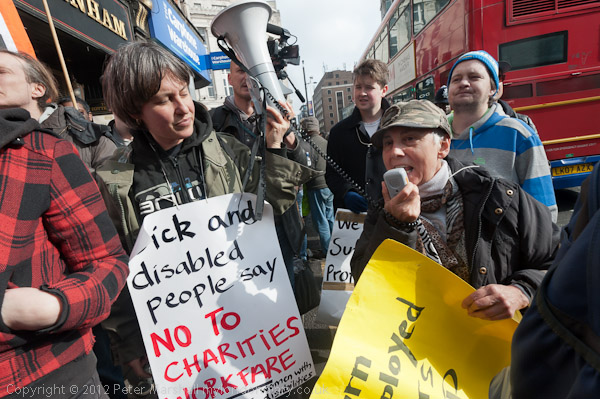
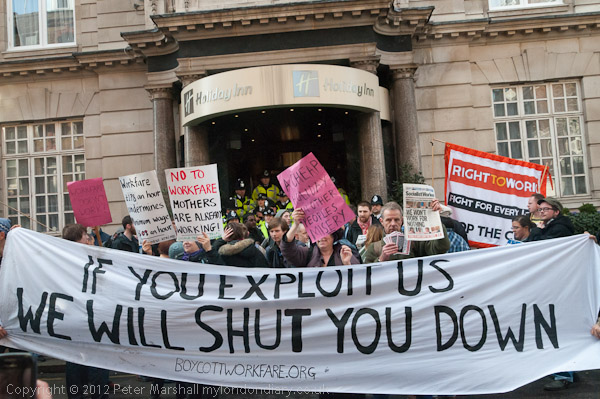
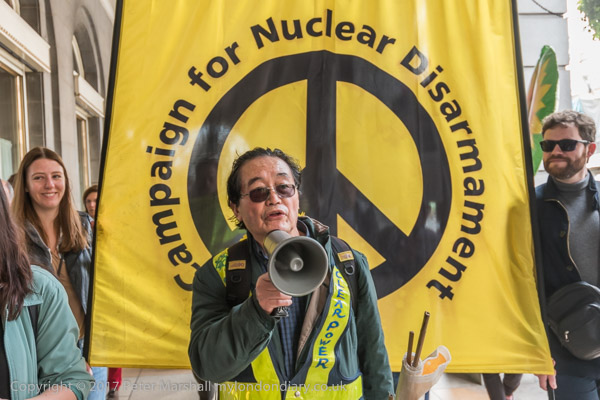
Boycott Workfare, Million Women Rise & Greece: On Saturday 3rd March 2012 I photographed a protest outside companies using people forced into free labour under the government workfare scheme, then a women-only march against male violence against women which I left to go to the Occupy meeting on the steps of St Paul’s which supported the protests in Greece against austerity measures imposed by the EU.


Boycott Workfare – Oxford St

Oxford St

Boycott Workfare, Million Women Rise & Greece - 2012

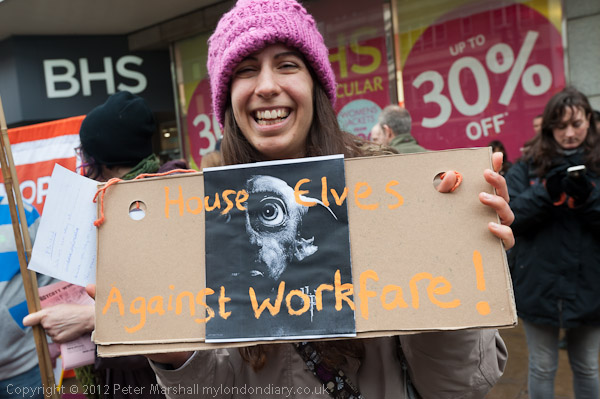
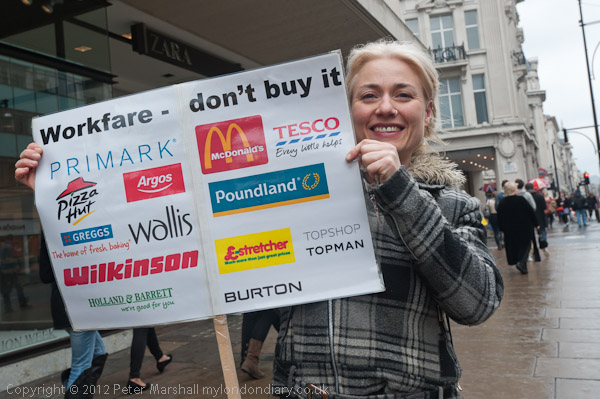
The group Boycott Workfare came to Oxford Street to lead a protest against companies who use unemployed and disabled people forced to work without pay but just a small allowance under the government workfare scheme.

Boycott Workfare, Million Women Rise & Greece - 2012

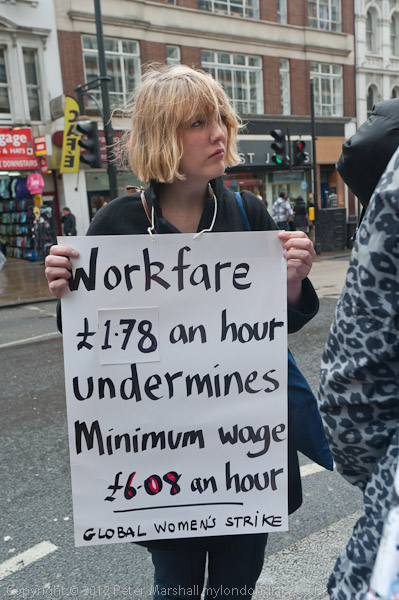
As the protesters emphasised, workfare reduces the number of real jobs available in the workplaces, giving workers to the employers by forcing the unemployed to do work at no cost to the employer on an allowance roughly one quarter of the minimum pay – and around a fifth of the London Living Wage.

Boycott Workfare, Million Women Rise & Greece - 2012

The event began with some good news when they met outside BHS near Oxford Circus by praising that company for having withdrawn from the scheme since the protest had been planned before moving off to protest elsewhere.

Boycott Workfare, Million Women Rise & Greece - 2012

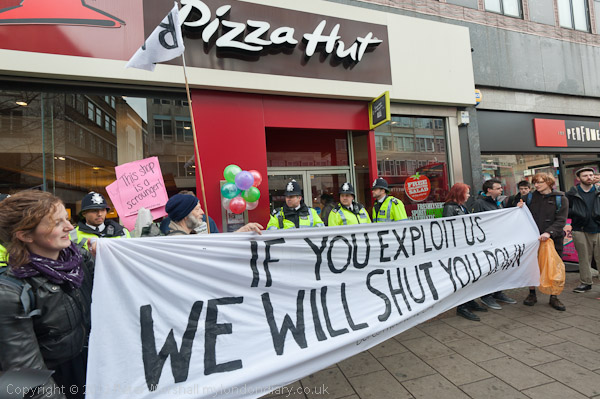
Around a hundred campaigners had arrived and were being carefully watched by police who went with them, guarding shop doorways and keeping a path along the crowded pavements clear when they stopped to protest.

Boycott Workfare, Million Women Rise & Greece - 2012

The organisers had kept their route secret and had come with two ‘Boycott Warfare’ flags on long poles, white with the letters BW, and those taking part were told to follow the flags.

Police were also guarding some shops which had previously been targeted by UK Uncut over their failures to pay tax, though most of these were not involved in workfare and so of no interest to this protest.

The first stop was a Pizza Hut, where police managed to stop any of the protesters entering – but the protest put off a number of customers entering while there were a few speeches. There we were handed a map showing the locations of some of the other businesses on Oxford Street taking part in workfare, including McDonalds, Holland and Barratt, Superdrug, WH Smith, Argos, and a little way north of Oxford St, Holiday Inn and Barnado’s.

Police just managed to arrive at Holland and Barratt before the protesters, who only paused briefly there before rushing on to McDonalds, where a few managed to go inside. Police soon ejected them into the noisy crowd protesting outside, most of whom soon moved off towards Argos, with police following them.

I soon realised that not all the protesters had left for Argos, and hurried back to see another group being ejected from McDonalds. Another small group had returned to Pizza Hut – where again they were ejected by police.

The main body of protesters turned into a shopping arcade, but were not sure which of the shops were using workfare and hesitated, allowing police to rush in and form a barrier. After a few noisy minutes they left and held a rally on a street corner with a few short speeches – including at least one by someone passing by.

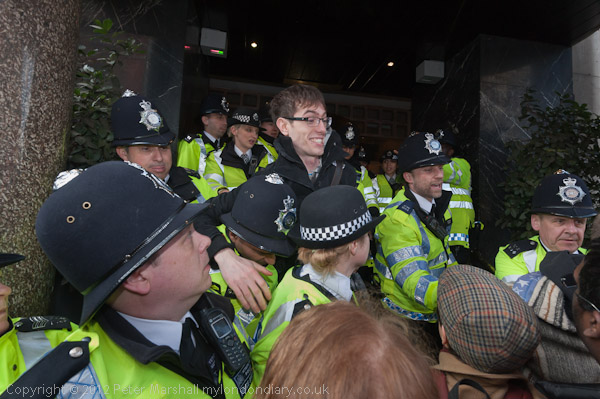
At the Holiday Inn on Wellbeck Street a few protesters again beat the police and were rather forcibly ejected.

Some at least of the police who I and the campaigners talked with clearly shared their disgust at a scheme which forces people to work without payment, and were also worried about leaked plans to part-privatise the police and other cuts, but insisted that it was their job to keep order and protect property.

More on My London Diary at Boycott Workfare – Oxford St.


Million Women Rise March

Oxford St

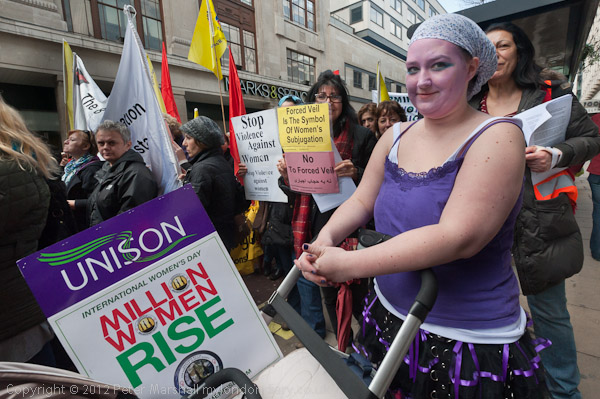
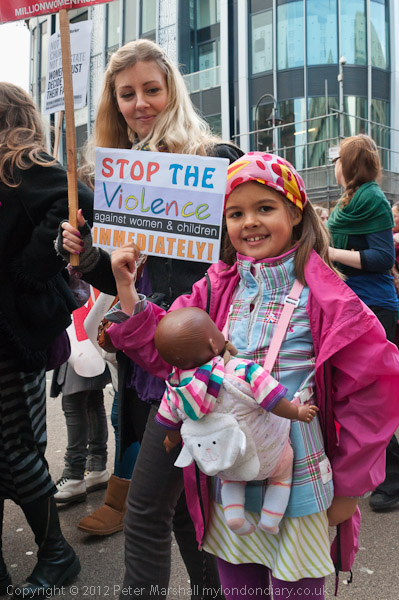
Women were gathering in the street on the west side of Selfridges to march through the centre of London calling for an end to domestic abuse, rape and commercial sexual exploitation. They called for prevention of abuse and support and protection for women.

They came from various womens groups and organisations around the country for this all-women march calling for and end to male violence against women.

Some of London’s more active women campaigning groups, including those that have been the leaders in previous celebrations around International Women’s Day were absent from the protest, and I was shocked to learn that they had been told they were not welcome at this march, despite the coalition’s aim to be non-partisan and to bring “together women who want to highlight the continuation of all forms of violence against women and demand that steps are taken to put an end to this.”

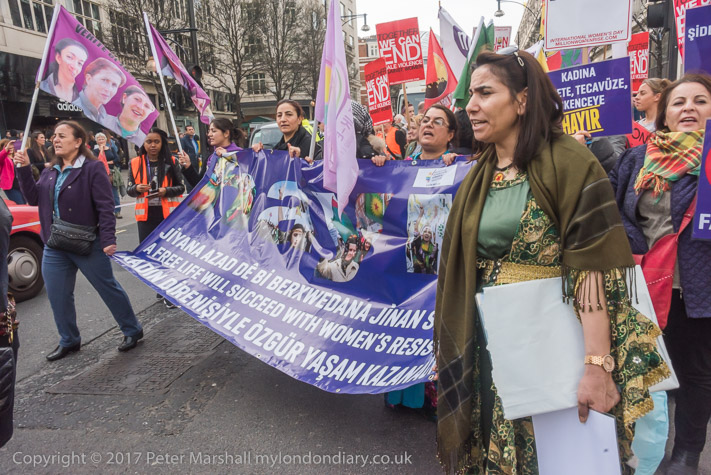
Among those marching were women from a number of political groups from London’s ethnic communities present, including Kurds, some in traditional dress and some holding posters calling for the release of their leader Abdullah Öcalan from prison in Turkey, as well as groups opposed to the Iranian regime.

The Million Women Rise Coalition has a statement of demands for government and societies here and around the world. They demand the recognise and reflect in policies the discrimination faced by all women and those from black and other minority groups in particular. They demand that domestic abuse, rape and commercial sexual exploitation are linked together in a definition of violence against women and that support is given to support organisations for women in the not-for-profit sector.

Their long statement called for support for various groups opposing violence against women, and end to child prostitution and pornography and proper support for trafficked women and children.

They called for International Women’s Day to be made a Bank Holiday in the UK and Ireland, and oppose “the continued misrepresentation, misappropriation and abuse of the female body throughout all forms of media.”

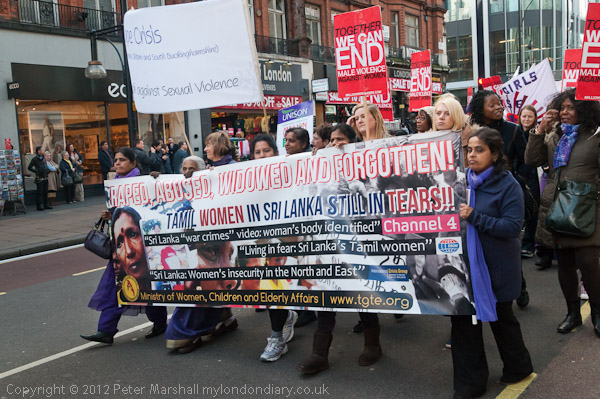
Their statement also made clear that wars and conflicts around the world perpetuate violence against women, and on the march a group carried a banner ‘Raped, Abused, Widowed and Forgotten – Tamil Women in Sri Lanka Still In Tears’ and others highlighted the ongoing abuses against women in DR Congo.

More on My London Diary at Million Women Rise March.


Greeks Protest With OccupyLSX

St Paul’s Cathedral Steps

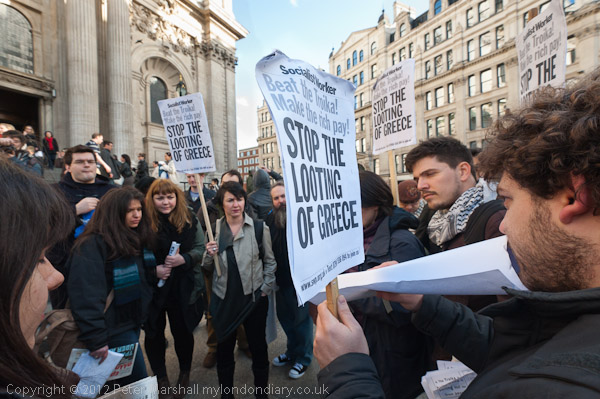
I left the march at Bond Street Station to report on a protest at St Paul’s Cathedral against the terms of the Eurozone rescue package for Greece at Occupy meeting on the steps there and to show solidarity with the protests in Greece.

Much more about this and more pictures on My London Diary at Greeks Protest At St Paul’s,


FlickrFacebookMy London DiaryHull PhotosLea ValleyParis
London’s Industrial HeritageLondon Photos

All photographs on this page are copyright © Peter Marshall.
Contact me to buy prints or licence to reproduce.

An Icy Day in Westminster, Drums for Sudan – 2010

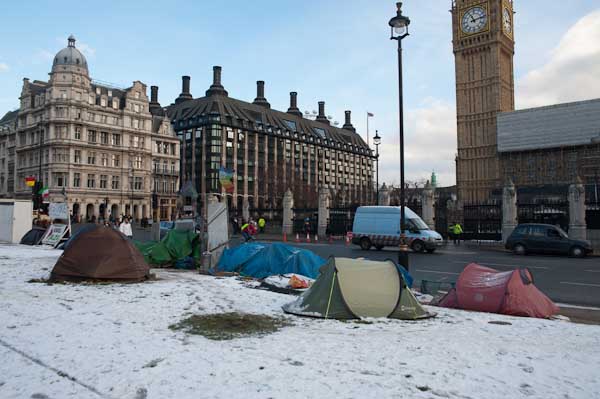
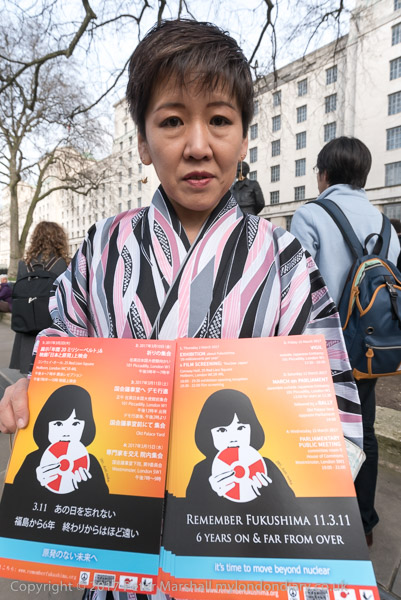
An Icy Day in Westminster, Drums for Sudan: Saturday 10th January 2010 was an icy day in Westminster with snow still lying on grassy areas and though it was bright with a little wintry sun there was a chill north-east wind and the temperature stayed around zero. But despite the weather there were a number of protests taking place and I had wrapped up well to cover them. Though the rather thin gloves I needed to let me operate my cameras failed to keep my hands warm, though I could keep them gloved in my pockets when not taking pictures.

I began by walking from Waterloo across Westminster Bridge to Parliament Square where there were a few tents of the Brian Haw’s Peace Camp, continuing since June 2001, but the protesters were sensibly keeping inside.

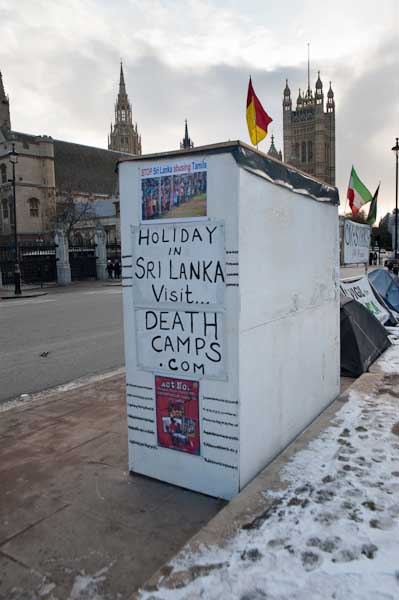
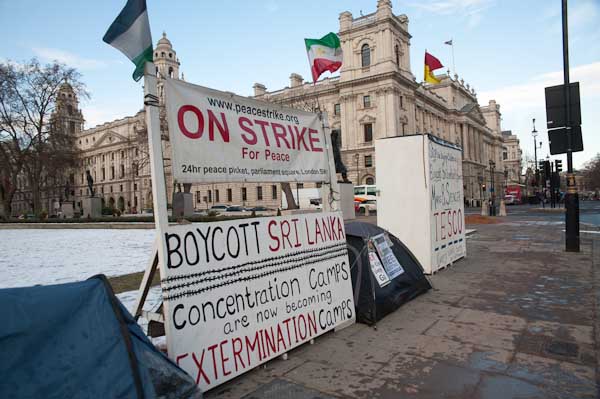
Next to them were the banners and box of the Peace Strike, then drawing attention to the killing of Tamils in Sri Lanka and calling for a boycott of Sri Lankan made garments and holidays in the country.

I didn’t disturb the protesters sheltering inside their tents but “walked up Whitehall past the government offices and the gathering demonstration over Sudan.” On my way I took a few pictures including of the 1861 former Colonial office – now the Foreign and Commonwealth Offices – “an imposing reminder of the Victorian era when Britain ruled much of the world (and then and later produced much of the mess it is now in.)”

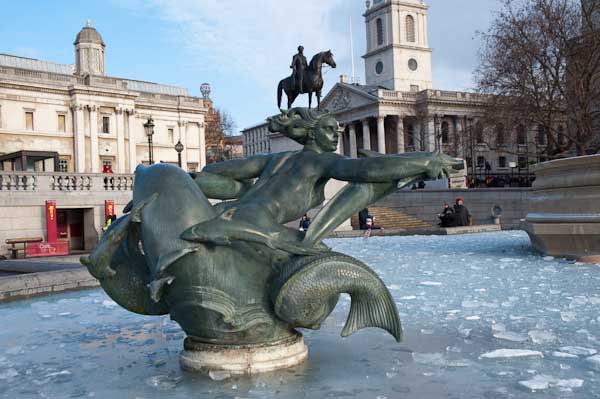
Thick ice covered the fountains in the square, with lumps of ice broken from the edges and thrown across now covering it. But despite the cold there were at least two groups of protesters on the North Terrace.

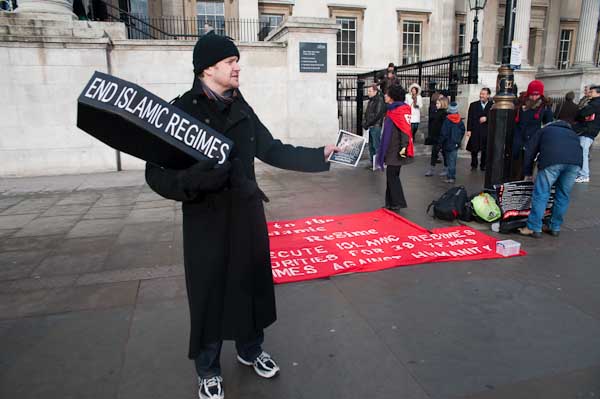
One was a regular Quaker vigil for peace in the Middle East which I didn’t photograph on this occasion. But I did take some pictures of the Iran Solidarity group who have organised daily acts of solidarity in Trafalgar Square and in other cities since Monday July 27 2009 over the killing of Iranian student Neda Agha-Soltan at a protest in Tehran, Iran on June 20, 2010.

More at Westminster – Ice & Protest

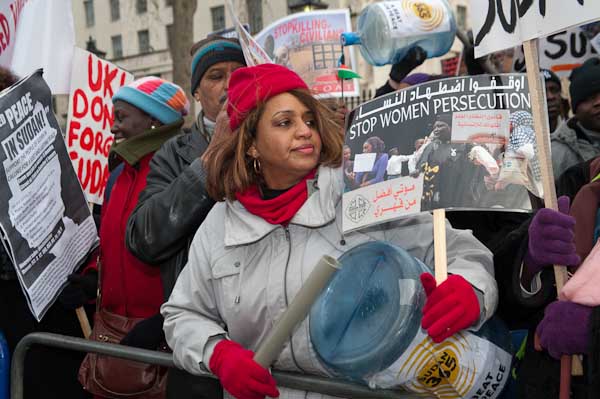
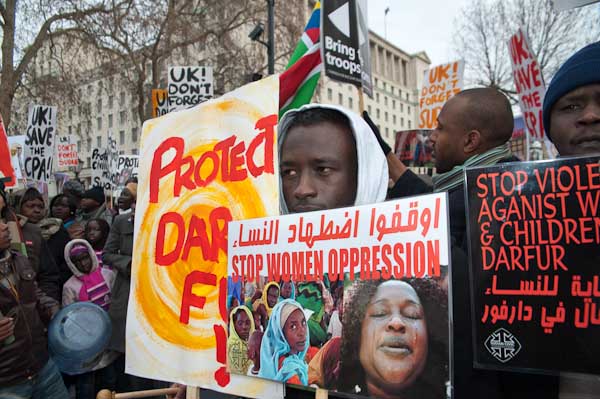
I was in a hurry to get back to the Drums for the start of the Sudan protest opposite Downing Street. This was the start of a year of the global Sudan365 campaign by a coalition of groups including the Aegis Trust, Amnesty International, Arab Coalition for Darfur, Darfur Consortium, FIDH, Human Rights Watch, Refugees International and the Save Darfur Coalition leading up to the 2011 Sudanese referendum in January 2011.

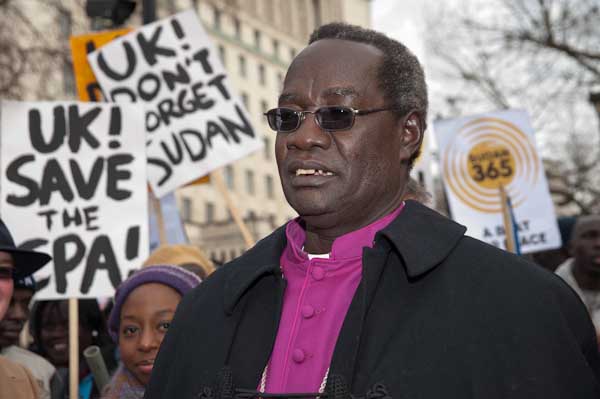
Around 200 people, mainly Sudanese, including a large contingent from Coventry, had turned up for a couple of hours of noisy drumming and some speeches, including one by Sudanese Archbishop Daniel Deng who was in London for meetings with Prime Minister Gordon Brown and Archbishop Rowan William on the following Monday.

The protesters called for peace, human rights and development for all in all regions of Sudan, with safety and security for all, as well as protection for Darfur and women’s rights. They supported the 2011 peace agreement which had called for a referendum over independence to be held in Southern Sudan in January 2011, and demanded free and fair elections in the country.

The Sudan365 campaign’s ‘Drum for Peace’ has attracted support from some of the most famous drummers from around the world, including Phil Selway of Radiohead, Stewart Copeland of The Police and Pink Floyd’s Nick Mason, who are taking part in a film in which the drum beat for peace, starting in Sudan is passed to drummers around the world, including in Brazil, Mexico, US (New York and San Francisco), UK, France, Spain, Senegal, South Africa, Ghana, Egypt, Mali, UAE, Japan, Russia and Australia.”

The 2011 referendum had over a 97.5% turnout by registered voters and over 98% of these voted in favour of independence. South Sudan became an independent state on 9 July 2011, but this was followed by seven years of civil war in 2013-20. The peace agreement called for elections in 2023, but these have been twice postponed and are due to take place in December 2026. Fighting broke out again in 2025.

More about the protest on My London Diary at Drum For Peace in Sudan.


FlickrFacebookMy London DiaryHull PhotosLea ValleyParis
London’s Industrial HeritageLondon Photos

All photographs on this page are copyright © Peter Marshall.
Contact me to buy prints or licence to reproduce.

Divided Families, Gaza, Ghouta & Sri Lanka – 2014

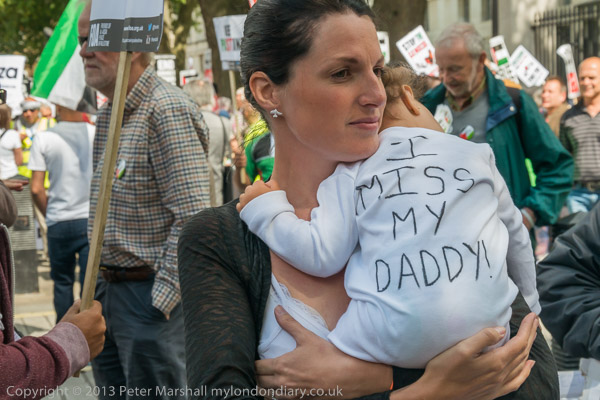
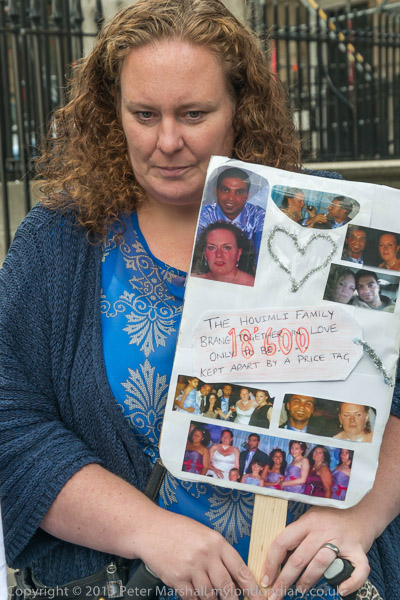
Divided Families, Gaza, Ghouta & Sri Lanka: Saturday 23rd August 2014 was a busy day for protests around Whitehall. I began at Downing Street with a protest by family members kept apart from their loved ones by Teresa May’s cruel and unfair immigration rules in a deliberate breach of the Universal Declaration on Human Rights, then photographed a protest against arms sales to Israel and an end to Israeli war crimes. Then in Trafalgar Square Syrians marked the first anniversary of The chemical massacre at Ghouta before marching to Downing Street, where Tamils were protesting the rapes and killing in Sri Lanka.


Divided Families protest over cruelty – Downing St

Divided Families, Gaza, Ghouta & Sri Lanka - 2014

The Universal Declaration on Human Rights states:

'No one shall be subjected to arbitrary interference with his privacy, family, home or correspondence, nor to attacks upon his honour and reputation. Everyone has the right to the protection of the law against such interference or attacks.'
Divided Families, Gaza, Ghouta & Sri Lanka - 2014

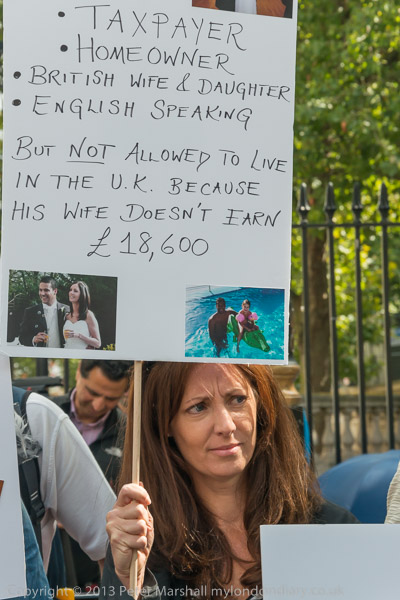
But British citizens who are married to foreign nationals from outside the EU and may have children with them can only bring their partners to the UK if they are in well-paid jobs. And even then the visas needed are expensive and there are tough English Language tests, a need to prove greater attachment to the UK than of any other country and a five year probationary period.

Divided Families, Gaza, Ghouta & Sri Lanka - 2014

The rules are complex and hard to understand and have changed since 2014, particularly by Brexit. Then those earning less than £18,600 a year were unable to bring on-EU spouses to join them – and couples with two children needed an annual income of £24,800. Visa application was also (and still is) very expensive.

More at Divided Families protest over cruelty


Gaza Protest – Stop Arming Israel – Downing St

Divided Families, Gaza, Ghouta & Sri Lanka - 2014

Back in 2014 as now people were calling for an end to UK arms sales to Israel and for an end to Israeli war crimes.

Divided Families, Gaza, Ghouta & Sri Lanka - 2014

The 2014 conflict in Gaza resulted in over 2000 Palestinians being killed including almost 1500 civilians and many more injured, leaving around a thousand children with life-changing disabilities.

Fighting lasted 50 days with many schools and health centres being damaged and over 12,600 homes being destroyed and around a further 6,500 seriously damaged. At the time of this protest UNRWA was housing around 300,000 internally displaced people in the roughly half of its school buildings which had not been destroyed or seriously damaged.

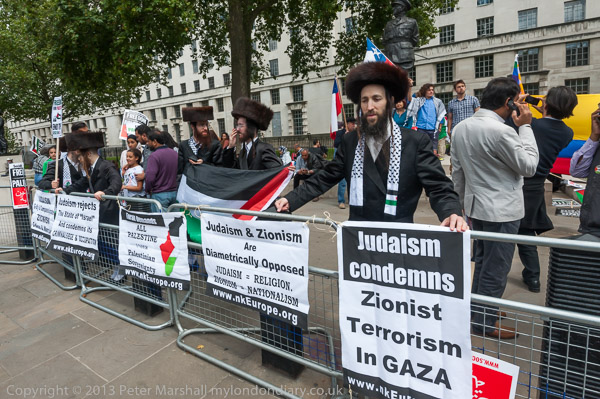
Among the protesters were several groups of Jews, including ‘Jews for Justice for Palestinians’. Also there were Neturei Karta Orthodox Jews with banners opposing Zionism and the idea of a Jewish political state; they call for all to live peacefully together in Palestine – as Jews and Arabs did before the partition and formation of Israel.

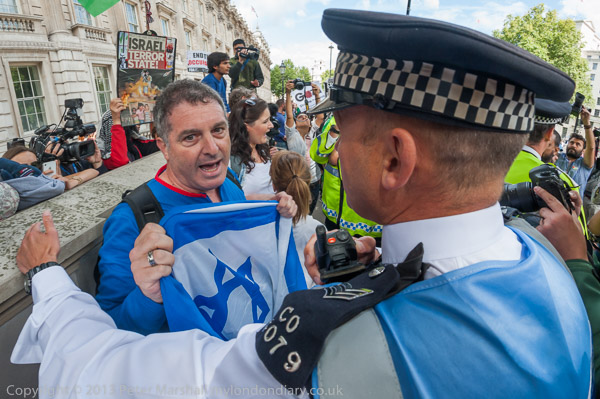
A small group of pro-Israel protesters, one dressed as Superman, tried to disrupt the protest but after a short while were led away by police.

More pictures at Gaza Protest – Stop Arming Israel.


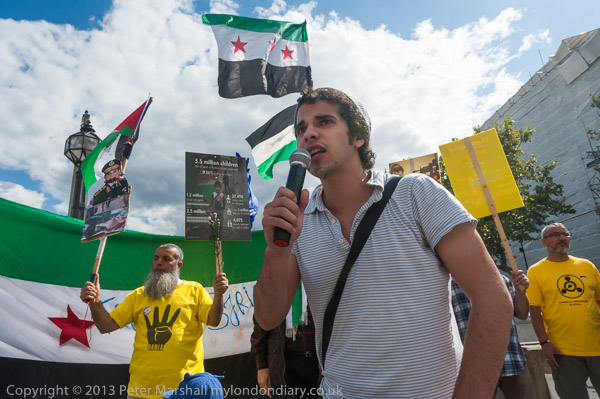
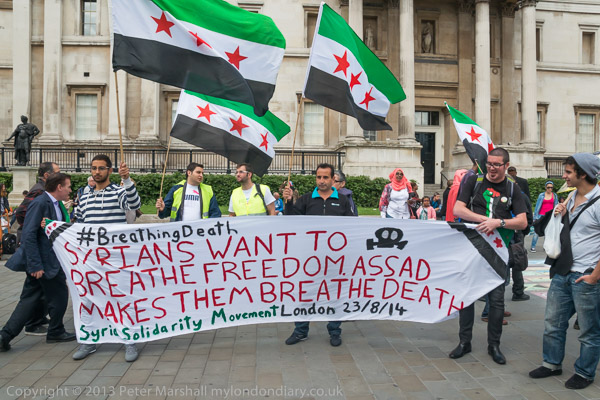
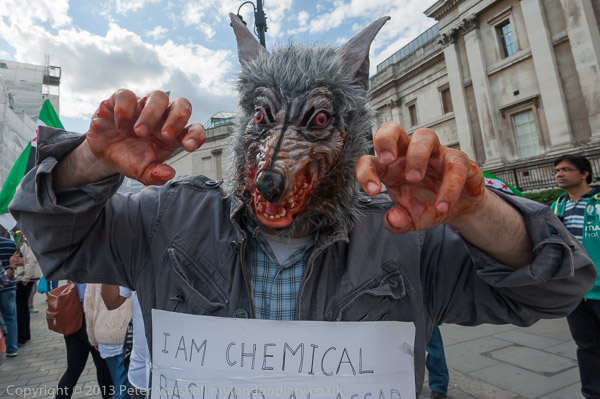
Syria Chemical Massacre Anniversary – Trafalgar Square

The chemical attack using the nerve gas Sarin by the Assad regime on Ghouta on 21st August killed 1,477 residents including over 400 children in this Damascus suburb.

Leaders in countries around the world expressed outrage at the attack, called for action to be taken. Pressure did lead to Syria agreeing to sign the Chemical Weapons Convention and the US and Russia agreed on a framework to eliminate Syria’s chemical weapons, and much of Syria’s stock was destroyed in the year following the massacre.

‘I am Chemical Bashar Al Assad and one year on I am still gassing Syrian children.
Thank you for UN veto’

But Assad continued to use chemical weapons, including many attacks with chlorine gas which was not covered by the framework because of its widespread chemical uses, as well as some attacks involving Sarin or a similar nerve gas. In 2023 the UN Security council declared that Syria’s chemical weapons declaration was incomplete and demanded full disclosure and cooperation with the Organisation for the Prohibition of Chemical Weapons.

Syria Chemical Massacre Anniversary


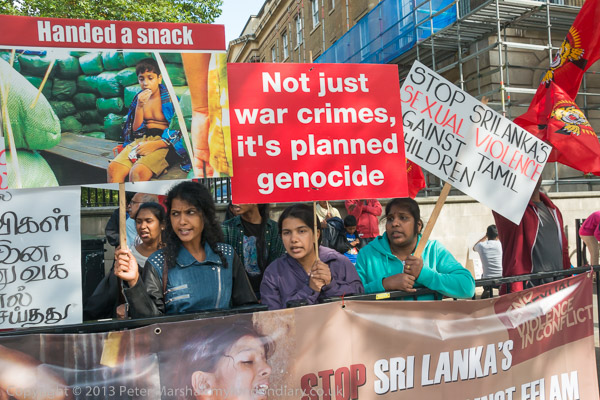
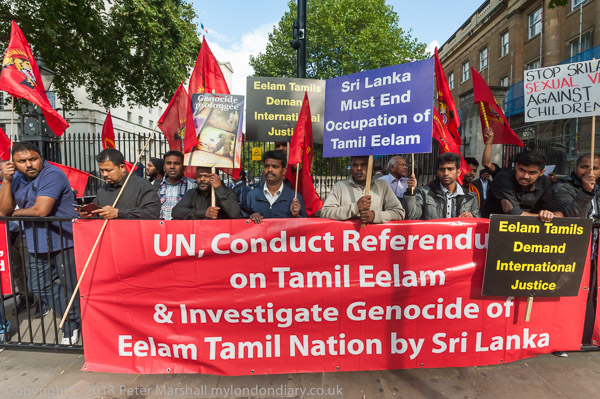
Tamils protest Sri Lankan rapes & killing – Downing St

Following the Sri Lankan military defeat of the Tamil Tigers in 2009, Tamils allege that the Tamils who make up around 11% of the population of Sri Lankan have been the subject of a continuing genocide by the government and the Sinhalese majority.

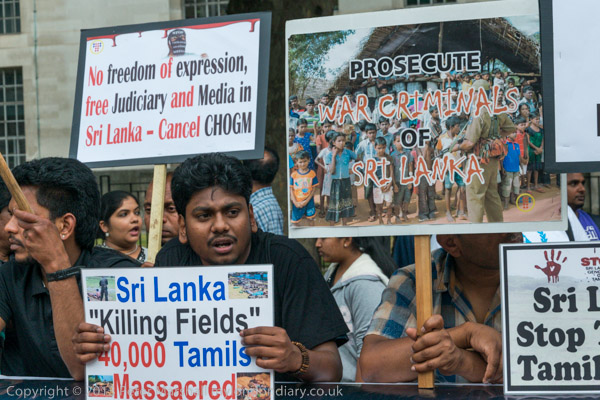
The protest called for the UN to conduct a referendum over setting up a Tamil state and investigate Sri Lankan genocide of Tamils. The Sri Lankan government had not kept the promises it made to the international community at the time of the Tamil defeat and has subjected the Tamil region to military occupation, rapes and killing.

Tamils protest Sri Lankan rapes & killing


FlickrFacebookMy London DiaryHull PhotosLea ValleyParis
London’s Industrial HeritageLondon Photos

All photographs on this page are copyright © Peter Marshall.
Contact me to buy prints or licence to reproduce.


Lord Maruga, Portugal Day & Khalistan – 2008

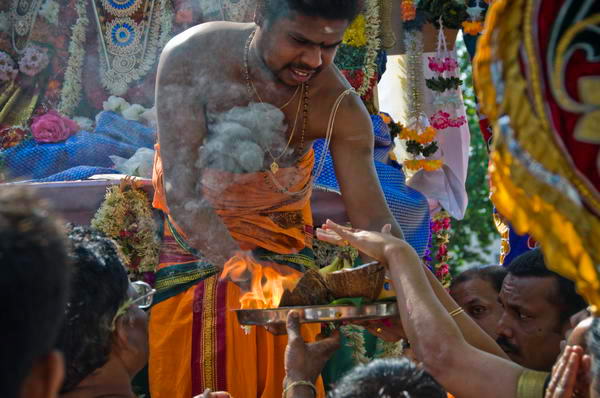
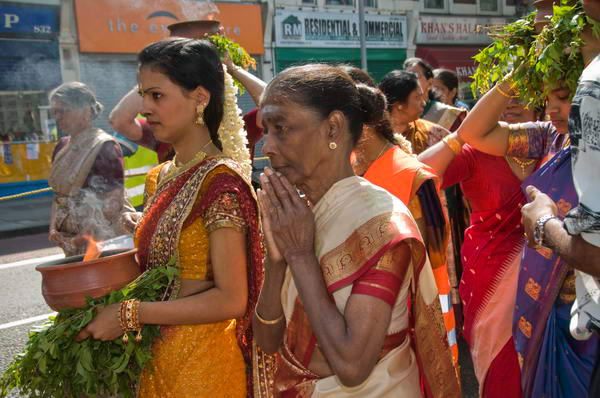
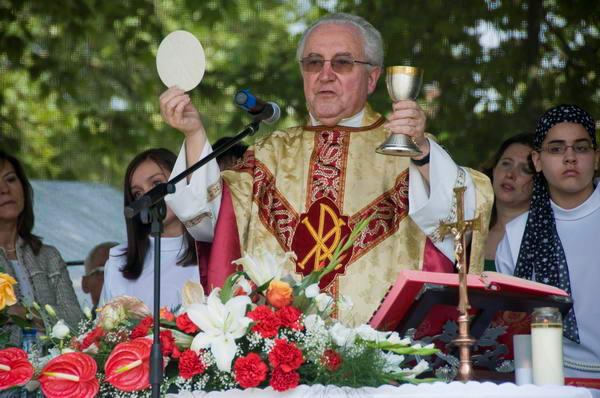
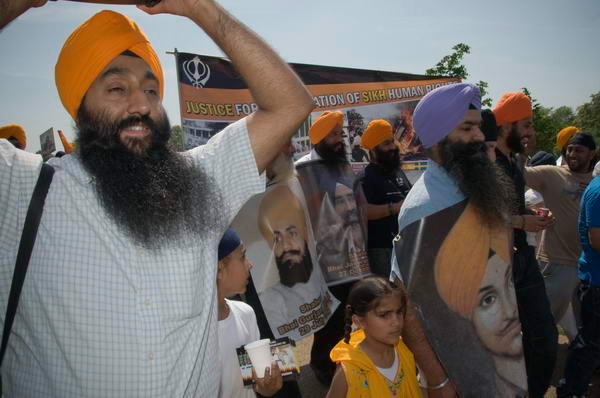
Lord Maruga, Portugal Day & Khalistan: My day on Sunday 8th June 2008 very much reflected the multicultural nature of London, beginning with a Hindu Festival in Thornton Heath, moving on to a Catholic Mass celebrating Portugal Day in Kennington and finally a march by Sikhs remembering the 1984 massacre and calling for an independent Sikh state, Khalistan.


Lord Muruga in Thornton Heath

Lord Maruga, Portugal Day & Khalistan

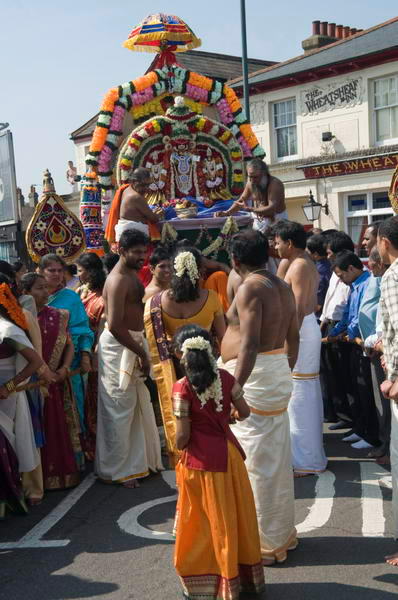
Hindu God Lord Muruga is particularly popular with the Tamils of southeast India (Tamil Nadu), Sri Lanka and Malaysia, and several hundred from the Sivaskanthagiri Murugan Temple in Thornton Heath celebrated him by pulling a chariot carrying his representation through the local streets.

The procession was led by musicians, and by women carrying pots of burning embers on their heads and in their arms. As the chariot made its way along the street, people brought offerings of good to be blessed, and these were returned to them flaming.

Lord Maruga, Portugal Day & Khalistan

Lord Muruga is the son of Agni, the fire god. He also carries a spear and a staff with a picture of a cockerel, and rides on a peacock. He is noted for the help that he gives for devotees who are in distress and the procession in particular visits those who cannot come to the temple because of their poor health or other disabilities

Lord Maruga, Portugal Day & Khalistan

The flames are from camphor, widely used in Indian rituals and thought to eliminate negative energies. This waxy white solid burns with a relatively cool flame and emit little smoke.

Many more pictures on My London Diary at Lord Muruga in Thornton Heath.


Portugal Day in Kennington Park

Lord Maruga, Portugal Day & Khalistan

Also known as Camões Day, Portugal’s National Day marks the anniversary of the death of its greatest poet and writer, Luís de Camões, on 10 June, 1580. He died in the year that Portugal became part of Spain, and the date of his death (the day of his birth around 1624 is not recorded) was celebrated as a national day after Portugal regained independence in 1640.

His great epic poem ‘The Lusaids’ centres on Vasco da Gama’s voyage to discover a sea route to India which was the foundation of the colonial explorations that brought the country great wealth and it made him a symbol of the nation.

Fascist dictator Salazar who ruled Portugal from 1932 to 1968 made the day a celebration of a fictional Portuguese ‘race’, but it is now simply a day for celebration by Portuguese communities around the world – and London has the largest Portuguese community outside Portugal, centred in Stockwell close to Kennington Park. The celebrations in the park includes entertainments and considerable eating and drinking after the initial open-air Catholic Mass I photographed.

Portugal Day in Kennington Park


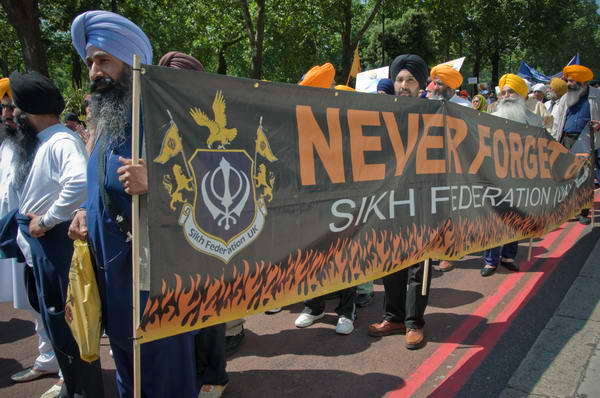
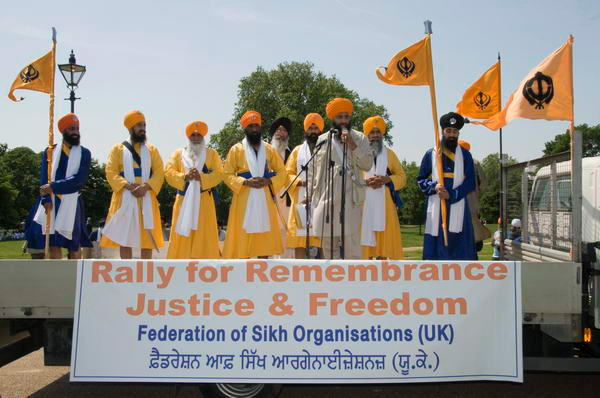
Sikh Remembrance March and Freedom Rally

Sikhs remember the massacres at Amritsar by the Indian Army and the mob killings encouraged by the Indian government following the assassination of Indira Ghandi by her Sikh bodyguards in 1984.

Sikh interests were ignored by an ignorant and incompetent British administration led by the Viceroy and Governor-General of India Lord Mountbatten who were responsible for the partition of India in 1947.

This annual rally and march in London calls for the establishment of an independent Sikh homeland, Khalistan in the Punjab and possibly incorporating some nearby areas of India and Pakistan.

Some Sikhs had been calling for an independent state since the 1930s and the movement continued to grow after partition with various militant Sikh groups including Babbar Khalsa, proscribed in the UK. Violent repression by Indian police led to a decline in the 1990s, but repression continues against Sikhs and in particular against those campaigning for separation and has increased in recent years. This makes it very difficult to determine how much popular support there is for the Khalistan movement in the area.

Data in the UK suggests that only a small fraction of British Sikhs support the establishment of Khalistan. In 2018, India asked UK to ban Sikh Federation (UK) who organise these events for its anti-India, pro-Khalistan activities, including proscribing the organisation but this has not happened.

More at Sikh Remembrance March and Freedom Rally.


FlickrFacebookMy London DiaryHull PhotosLea ValleyParis
London’s Industrial HeritageLondon Photos

All photographs on this page are copyright © Peter Marshall.
Contact me to buy prints or licence to reproduce.


Ian Tomlinson Killing & Sri Lanka Genocide – 2009

Ian Tomlinson Killing & Sri Lanka Genocide: On Saturday 11th April 2009 people marched from Bethnal Green Police Station to the spot were news vendor died after an unprovoked attack by police officer Simon Harwood. I also photographed a much larger march by Tamils against the genocide taking place in Sri Lanka.


March in Memory of Ian Tomlinson – Bethnal Green Police Station & Bank

Ian Tomlinson Killing & Sri Lanka Genocide - 2009

G20 Meltdown, the organisers of the protest at Bank on April 1st 2009 where police officer Simon Harwood attacked Ian Tomlinson leading to his death, had organised a memorial march from Bethnal Green Police Station to the place where he died a few yards away from the attack.

Ian Tomlinson Killing & Sri Lanka Genocide - 2009
Police discuss the march with Chris Knight

Tomlinson was not involved in the protest, but simply trying to make his way home after having been working, selling newspapers in the City. The protest would probably have been over by the time he was killed, but police had turned what had been intended as a carnival party into something far more sinister, kettling and then attacking many demonstrators and killing Tomlinson. There were numerous injuries and one photographer had his teeth knocked out, but I had seen the kettle coming and had left the area to cover another event.

Ian Tomlinson Killing & Sri Lanka Genocide - 2009

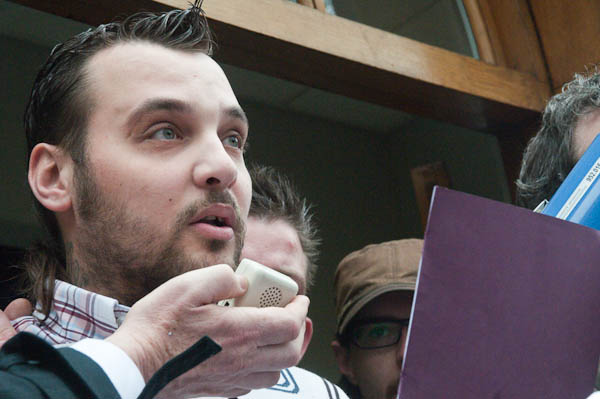
At the Tomlinson family’s request, the march was peaceful, silent and respectful. Before it started his stepson Paul King spoke briefly, describing the family’s trauma from the tragic death of his step-father, a “much-loved and warm-hearted man,” and pain at seeing the video of the assault, and he hoped that the investigation would be full and that “action will be taken against any police officer who contributed to Ian’s death through his conduct.”

Ian Tomlinson Killing & Sri Lanka Genocide - 2009
Paul King

As usual the investigation was carried out by the IPCC and the Crown Prosecution Service decided not to charge Harwood. After an inquest verdict of unlawful killing the CPS had to change their mind and charged him with manslaughter.

The sisters of Sean Rigg, murdered by police at Brixton the previous August were on the march

The jury was unable to hear evidence about his behaviour in previous incidents and was seriously misled both by some of Harwood’s own evidence and the evidence given by the first pathologist who had examined the body, Dr Freddy Patel. He had destroyed some vital evidence, puring away body fluids and had a long record of botched postmortems, having previously been suspended twice and finally was struck off the medical register in 2012.

After Harwood’s acquittal he was dismissed from the police. Tomlinson’s family took civil proceedings and in 2013, “the Metropolitan Police Service paid Tomlinson’s family an undisclosed sum and acknowledged that Harwood’s actions had caused Tomlinson’s death.

I left the march before it arrived at Bank, but returned the following day to photograph the flowers that had been left in Royal Exchange Buildings where the assault had taken place and a vigil was being held by Chris Knight, one of the G20 Meltdown organisers and a few others.

More at In Memory of Ian Tomlinson.


Tamils March – Stop Sri-Lanka Genocide – Temple to Hyde Park

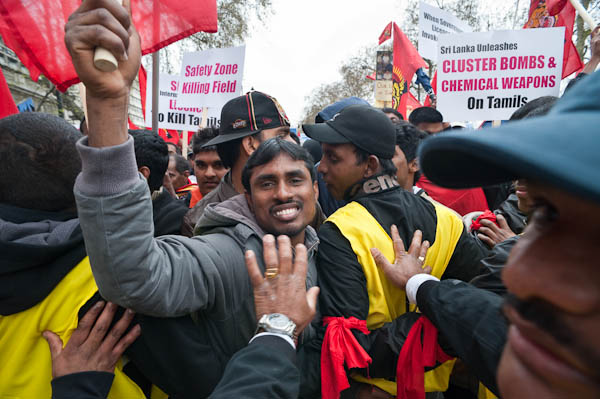
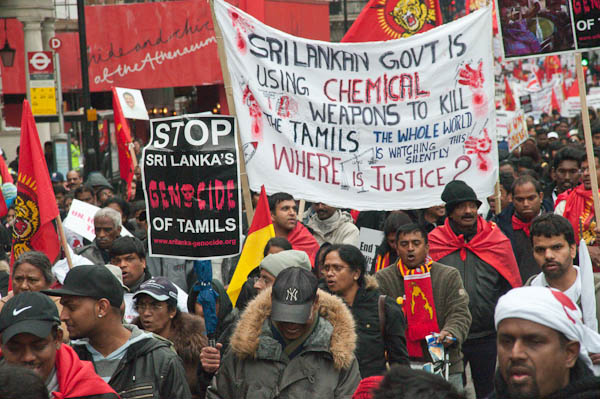
A huge crowd had assembled on the Embankment at Temple, perhaps as many as 200,000, a very high proportion of Tamils in the UK who are thought to number around 300,000, around two thirds of them of Sri Lankan origin. It was a crowd with very few white faces.

Despite the size of the protest there appeared to be very little UK media interest and I saw no photographers or TV crews from major UK media covering the march to Hyde Park. Where there are usually a crowd of photographers in front at the start of large marches in London, for this one there was just me and three other freelances, none of whom get regular work for the mass media.

By April 2009 the civil war in Sri Lanka was clearly coming to an end, with the Tamil Tigers having been pushed back into a very small area. They had been defeated at a major battle at Aanandapuram on 5th April and the final assault by the government forces came at the end of the month with Sri Lanka declaring victory on May 16th.

Many of those taking part in the march were clearly supporting the “the LTTE, the Liberation Tigers of Tamil Eelam. A few carried actual tigers, fortunately only large toys, but many more wore the colours or carried flags or portraits of the founder and leader of the Tamil Tigers, Velupillai Pirapaharan.

The LTTE was proscribed in 2000 and they were clearly committing an offence under the Terrorism Act 2000 by supporting the group or wearing clothing which arouses the “reasonable suspicion that he is a member or supporter of a proscribed organisation.” But clearly the Tamils were not intending to cause any serious trouble and police sensibly made no attempt to arrest them all. Only three arrests were reported.

The Tamils had lost in Sri Lanka and many both civilians and combatants were killed during the civil war – possibly almost 150,000 in the last 8 months of the civil war. Around 300,000 were transferred into special closed camps, described by many as concentration camps – they were slowly released and the camps were closed by the end of September 2012.

Many more pictures at Stop Sri Lanka Genocide.


FlickrFacebookMy London DiaryHull PhotosLea ValleyParis
London’s Industrial HeritageLondon Photos

All photographs on this page are copyright © Peter Marshall.
Contact me to buy prints or licence to reproduce.


Heathrow, Gaza & the Tamils – 2009

Heathrow, Gaza & the Tamils: On Saturday 17th January 2009 I took a bus to Heathrow for a flash mob against a third runway, then the tube into Westminster for a protest against Israeli attacks on Gaza in Trafalgar Square which ended with a march to protest at Downing Street, where Tamils were protesting against the genocide taking place in Sri Lanka.


No Third Runway Decision Day Flashmob – Terminal 5, Heathrow Airport

Heathrow, Gaza & the Tamils - 2009

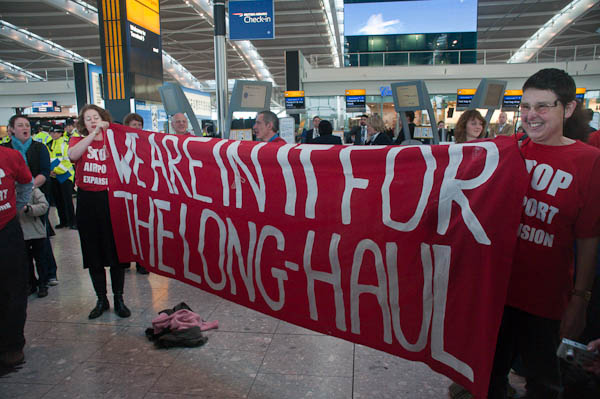
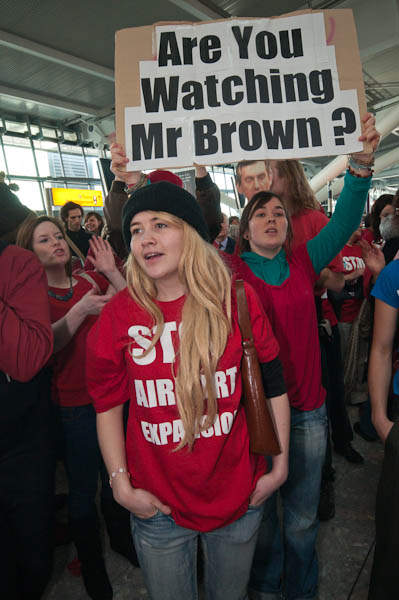
Earlier in the week the Labour government under Gordon Brown had announced they were to press ahead with airport expansion and build a third runway at Heathrow despite the environmental consequences. Several hundred people turned up at Terminal 5 for a ‘flashmob’ protest at 12 noon.

Heathrow, Gaza & the Tamils - 2009

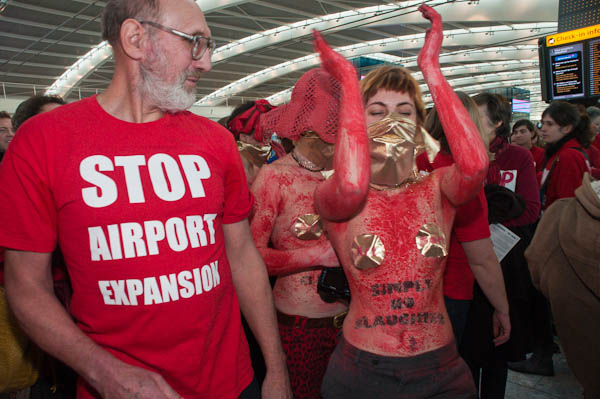
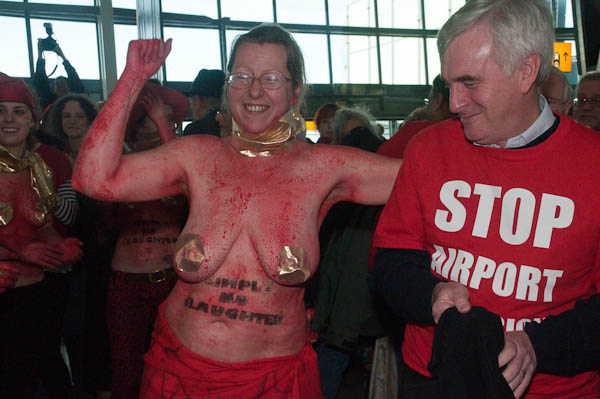
“Attracting most press attention were four brave young ladies who had saved the ten quid for a red ‘STOP AIRPORT EXPANSION’ t-shirt and instead opted for red body paint with a black message across their midriffs, ‘Simply No Slaughter‘ and a pair of strategically placed gold sticking plasters proclaiming ‘art‘ and ‘port‘ (port was indeed on the left.)”

Heathrow, Gaza & the Tamils - 2009
Local MP John McDonnell looks a little embarassed

Many local residents were there, some with their children, along with John Stewart of HACAN (Heathrow Association for the Control of Aircraft Noise) the organisers of the event, and local MP John McDonnell who was being congratulated for his seizing the mace in the House of Commons when the announcement was made.

Heathrow, Gaza & the Tamils - 2009
Prime Minister Gordon Brown had approved the airport expansion

The demonstrators chanted, thrown red balloons in the air, red tennis balls at an ‘Aunt Sally’ of Transport Secretary Geoff Hoon and conga’ed around the area while a large squad of photographers photographed and videoed.

The campaigners were surrounded in a loose ring by police and airport security who made no attempt to stop them, though police had made some searches before the event began. Some of them were clearly amused by the event as were a few passengers making their way through the departure area.

John Stewart of HACAN thanks everyone for coming

After almost three-quarters of an hour of protest John Stewart thanked everyone for coming and repeated the determination of all those involved to keep up the fight to ensure that, despite the decision, the runway will never be built. So far it has been prevented, though it seems likely that despite the increasingly obvious and critical environmental crisis our current Labour government will resurrect this enviornmental catastrophe, though it remains doubtful if the private finance required can be found.

A cheer for John McDonnell

And there was a cheer for John McDonnell’s action in Parliament and a final chance to pelt the Transport Secretary before we all left for buses or tube.

Many more pictures at No Third Runway Decision Day Flashmob.


1000 Dead and Nothing Said – End the Slaughter of Gaza – Trafalgar Square

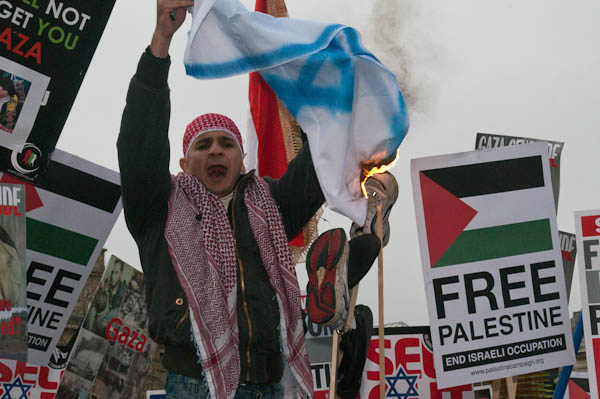
A man burns an Israeli flag in at the rally in Trafalgar Square

I was a little late arriving at the rally in Trafalgar Square but got there just in time to hear Tony Benn being announced and getting a huge greeting. As I commented he was “One of the greatest political figures of the last 50 years, [and} it’s a national tragedy that while he has so often been right on major issues, governments have seldom if ever followed his lead.”

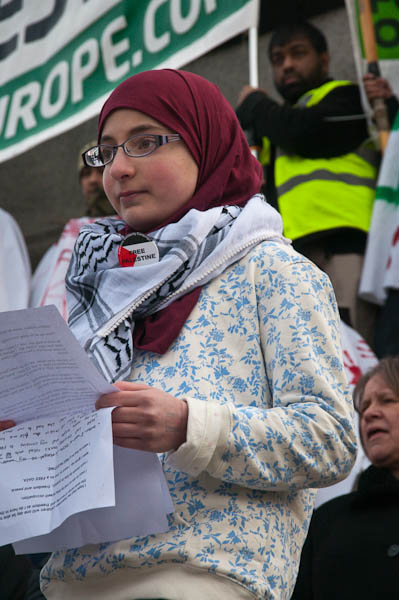
An 11 year old Palestinian girl, now living in Manchester speaks

The square was fairly full with perhaps 5-10,000 protesters though there had been a much larger national protest in London a week earlier against the attacks on Gaza in previous weeks that had killed over a thousand Palestinians including more than 300 children.

Palestinian singer Reem Kelani spoke before singing a traditional song

After some more speeches a group of children all dressed in white robes marked with bloody red handprints who had been standing on the plinth came down and went with a deputation to take a letter from the rally to Downing St, calling for an immediate ceasefire and reparations for the war damage inflicted by the Israeli attacks.

I went with them down Whitehall to Downing St, where police led them into a pen close to the gates.

While Diane Abbott, MP, PSC General Secretary Betty Hunter and Lindsay German of Stop the War with others took the letter into Downing St, the children posed for pictures, at first while standing and then lying on the ground as if the innocent victims of an Israeli attack.

But unlike those 300 childen in Gaza, these children were just playing dead.

A few hours after this protest Israel announced a ceasefire on its own terms. The end of the killing was welcome, but there was no justice for Palestine.

Much more and many more pictures at Gaza: 1000 Dead and Nothing Said.


Tamils protest Sri Lankan Genocide – Downing St

Several hundred Tamils were densely packed into a pen opposite opposite Downing Street to draw attention to the continuing attacks on Tamil civilians, schools, hospitals and churches by the Sri Lankan Army and Air Force and to call for an independent Tamil state, Tamil Eelam, in Sri Lanka.

Tamils accuse the Sri Lankan government of genocide, and claim that in the past month alone over 300,000 Tamils have been forced to move out of their homes by the bombardment.

The decades long civil war which ended in May 2009 with the defeat of the Tamil Tigers had attracted relatively little attention in the mainstream media, but the assasination of leading Sri Lankan opposition newspaper editor Lasantha Wickramatunga on his way to work a week earlier and the publication of the obituary he had written for himself, And then they came for me, was the subject of a two page article in The Guardian on the day of this protest.

Tamils protest Sri Lankan Genocide


FlickrFacebookMy London DiaryHull PhotosLea ValleyParis
London’s Industrial HeritageLondon Photos

All photographs on this page are copyright © Peter Marshall.
Contact me to buy prints or licence to reproduce.

Dangleway Revisited, Tamils Protest Killings – 2013

Dangleway Revisited, Tamils Protest Killings: On Tuesday 23rd July 2013 I revisited the Museum of Docklands and then took the DLR to Royal Victoria for another ride on the Arab Emirates cableway in a detour on my way into central London to photograph a rally by Tamils at Downing Street.


Another Dangleway Ride – Royal Victoria Dock to North Greenwich

Dangleway Revisited, Tamils Protest Killings

It was only a few weeks since my first ride on London’s cable car across the River Thames, but I was in docklands for a second visit to the ‘Estuary’ show at the Museum of Docklands. As one of those featured in the show I had been at the opening, but that was more about meeting people than seeing the work, though I had taken a short look at it all.

Dangleway Revisited, Tamils Protest Killings

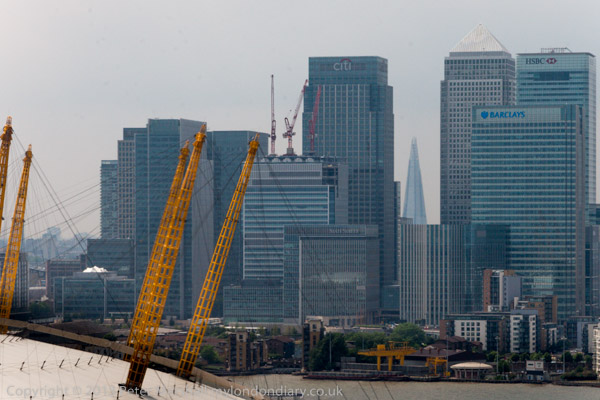
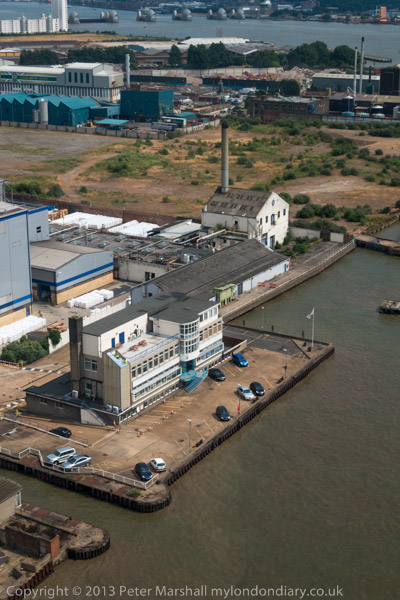
The dangleway is fairly pointless in terms of transport, but is one of London’s cheaper tourist attractions, and though short it joins two areas of some interest. I suppose the views might not be to everyone’s interest, though I found them fascinating, and its certainly the cheapest way to do a little aerial photography.

More pictures at Another Dangleway Ride.


Tamils Protest Sri Lankan Killings

Dangleway Revisited, Tamils Protest Killings

Tamils have long been the subject of discrimination in Sri Lanka, and the Civil War there from 1983 to 2009 against the Liberation Tigers of Tamil Eelam resulted in around 100,000 Tamil civilain deaths, as well as around 50,000 fighters on each side. The figures are unclear as the Sri Lankan government has always refused independent, international investigation to ascertain the full impact of the war.

Dangleway Revisited, Tamils Protest Killings

According to Wikipedia, “Since the end of the civil war, the Sri Lankan state has been subject to much global criticism for violating human rights as a result of committing war crimes through bombing civilian targets, usage of heavy weaponry, the abduction and massacres of Sri Lankan Tamils and sexual violence.”

The Tamil Tigers also became notorious for attacks on civilians, suicide bombings. assassinations and the use of child soldiers. The final stages of the war in 2006-9 were particularly bloody, and ended in a total defeat of the LTTE.

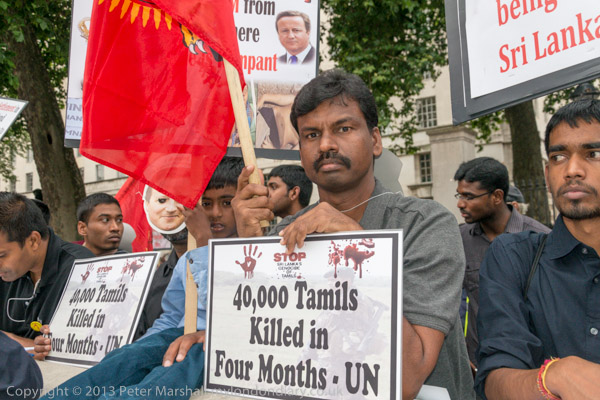
The British Tamil Forum at had come to Downing St on the 30th anniversary of the 1983 Black July when 3000 Tamils died in riots across Sri Lanka in an anti-Tamil pogrom orchestrated by the government.

This was not the first anti-Tamil pogrom, but its unprecedented frenzy of violence was a turning point after which Tamils knew they could never be safe in a state dominated by the Sinhalese.

In the four years since the Mullivaikkal Massacre of 2009 Tamils claim that an estimated 147,000 Tamils are either dead or missing, and they see the only solution as the formation of an independent Tamil state – ‘Tamil Eelam.’

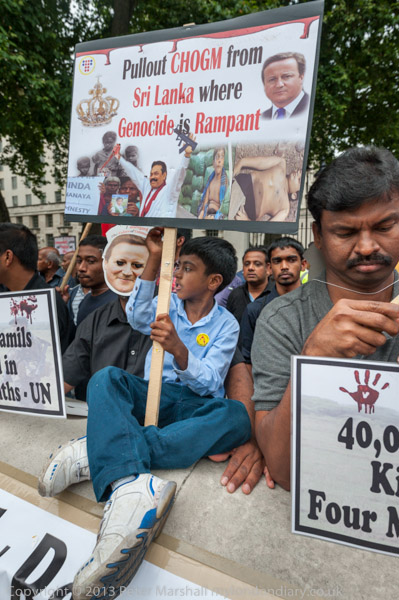
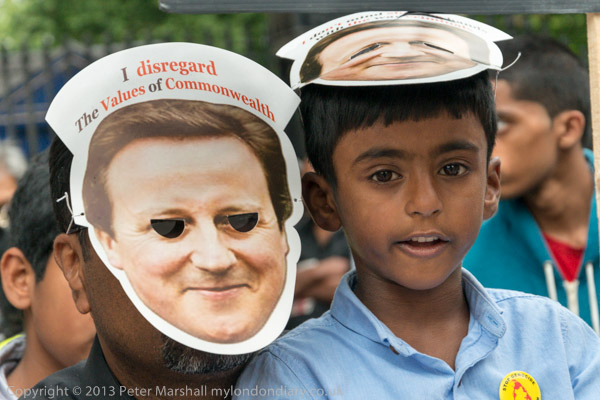
The protest called on the UK to boycott the Commonwealth Heads of Government Meeting (CHOGM 2013) in November 2013 hosted by Sri Lanka. They see this as legitimising a state which has been severley criticised by the UN and human rights organisation for the atrocities it has been committing.

People at the protest signed letters and cards calling on HRH The Prince of Wales to uphold the values of the Commonwealth and reconsider his decision to attend CHOGM 2013.

More pictures Tamils Protest Sri Lankan Killings.


FlickrFacebookMy London DiaryHull PhotosLea ValleyParis
London’s Industrial HeritageLondon Photos

All photographs on this page are copyright © Peter Marshall.
Contact me to buy prints or licence to reproduce.

Highgate Hill Murugan Chariot Festival – 2010

Highgate Hill Murugan Chariot Festival: Back in the first decade of this century my work covered a wider range of cultural events than now, including many religious events on the streets of London. The 2010 election which put into power a Tory-led government dedicated to making the poor poorer and themselves and their friends richer changed that for me, leading to 14 years dominated by covering protests – something which had only been one strand of my work before. I’m currently not sure if our recent election will change my work which for the last months has been completely dominated by Palestine.

Highgate Hill Murugan Chariot Festival

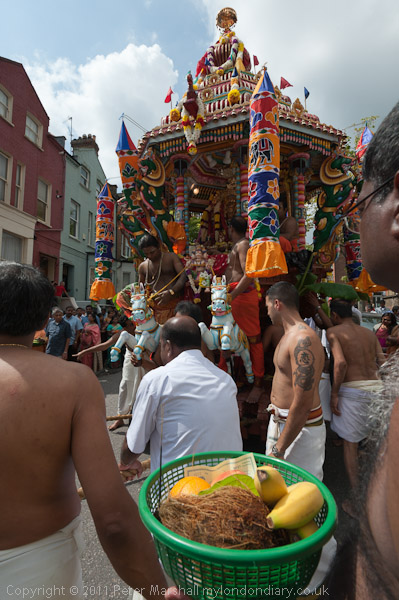
I didn’t entirely stop photographing religious festivals and on Sunday 10th July 2011 went to Highgate where the annual Highgate Hill Murugan Chariot Festival was taking place.
Highgate Hill Murugan Chariot Festival

Here I’ll copy what I wrote about it in 2011 with a few of the many pictures I made at the event. You can see more pictures on My London Diary.
Highgate Hill Murugan Chariot Festival

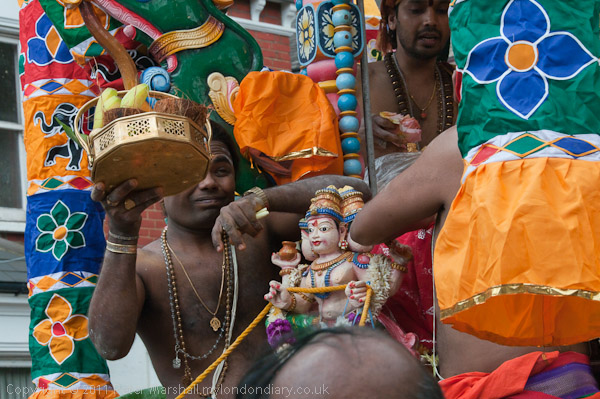
Murugan is a popular Hindu God in Tamil areas and the patronal god of the Tamil homeland Tamil Nadu. As God of war Murugan with six heads has a divine lance and other weapons and rides a peacock.

Highgate Hill Murugan Chariot Festival

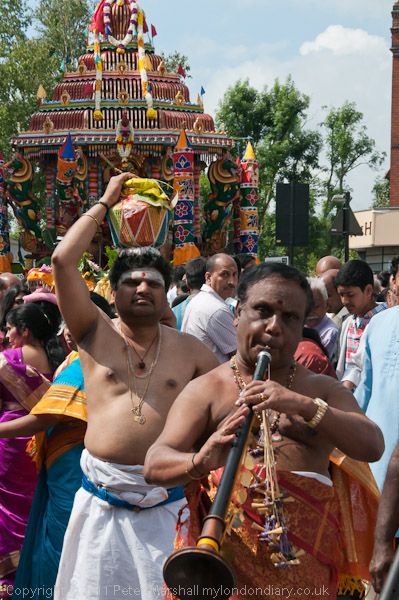
In the Chariot Festival people make offerings to Murugan of baskets of fruits, particularly coconuts, which are blessed and returned.

Men on one side and women on the other pull on the long ropes to take the chariot around the neighbourhood, while a conch shell gives an audible warning of its movement; other women carry kavadi (burdens) offered to Murugan, chanting and carrying of pots, possibly of coconut milk on their heads.

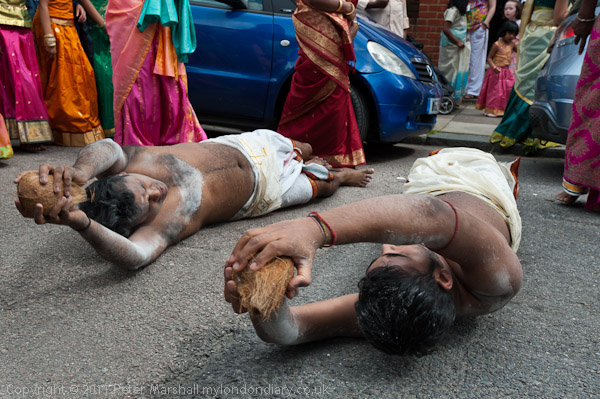
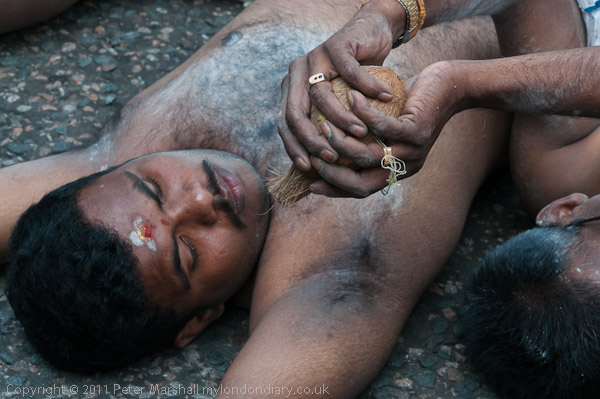
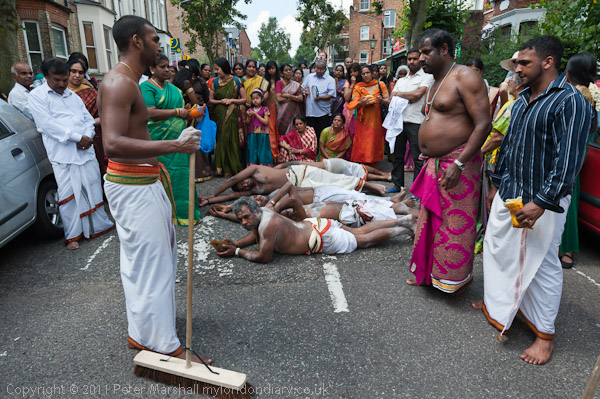
Some men roll half-naked along the ground behind the chariot holding coconuts. People sweep the road to make their progress less painful, and others anoint them with sacred ashes.

Highgate Hill Murugan Temple is one of the oldest and most famous in the UK, but the celebrations here seemed to be a little more restrained than those I’ve photographed at some other London Murugan temples.

Perhaps surprisingly, in Sri Lanka Murugan is also revered by Sinhalese Buddhists.

On the ‘History‘ page of the Highgatehill Murugan Temple web site you can read how the Hindu association of Great Britain was founded in London on 23rd October 1966, and in 1977 was able to buy a spacious freehold property at 200A, Archway Road, Highgate Hill. Here they built the Temple which includes a library, two Concert Halls, a prayer hall and a Priest’s flat which was opened in 1979, with a three storey Temple added a few years later. It was the first Sri Llankan Hindu Temple in the UK.

More Pictures: Highgate Hill Murugan Chariot Festival


FlickrFacebookMy London DiaryHull PhotosLea ValleyParis
London’s Industrial HeritageLondon Photos

All photographs on this page are copyright © Peter Marshall.
Contact me to buy prints or licence to reproduce.