Biometric ID Cards – 2008

Biometric ID Cards are now once again under consideration by Keir Starmer’s Labour government having being heavily promoted since 2023 by Tony Blair, William Hague and others including the misleadingly named ‘Labour Together‘ right-wing think tank – once directed by Morgan McSweeney who became Starmer’s campaign director – and who he appointed as Labour’s chief of staff when he became leader – and McSweeney became Downing Street Chief of Staff in October 2024.
Biometric ID Cards - 2008

Until 2008, Britain had only introduced identity cards at times of war. They were scrapped in 1919 but kept on rather longer after World War Two when they were only abolished in 1952.
Biometric ID Cards - 2008
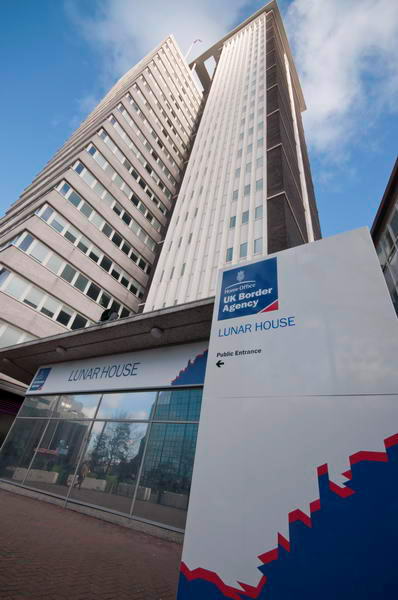
Luna House was built 1976-7 by Denis Crump & Partners and is rented by the Home Office from a Greek businessman whose company is based in Monaco. They added an R to its name.

While the British people were prepared to put up with them in wartime, identity cards were always viewed as fundamentally un-British, incompatible with our ideas of civil liberties and freedom. We contrasted our free society with others abroad where citizens could be stopped at any time on the streets and required to produce their papers – and chilling scenes of the Gestapo doing so were frequently invoked in popular culture. We were proud of not being a police state, but increasingly we are now moving more and more in that direction.
Biometric ID Cards - 2008

Now the idea is firmly back on the political agenda, there have been two major protests in London against the introduction of these ID cards. Unfortunately for different reasons I’ve not managed to cover either of them. A third protest is coming up in December and I hope to be there.

A petition to Parliament against their introduction has already received around 3 million signatures and will be debated on 8 December 2025. The initial government response is “We will introduce a digital ID within this Parliament to help tackle illegal migration, make accessing government services easier, and enable wider efficiencies. We will consult on details soon.” You can read more at Big Brother Watch.

Biometric ID Cards were introduced under the Identity Cards Act 2006, which came into force on 25th November 2008, when they became compulsory for all non-EU students and spouses applying for or renewing visas for study or marriage. They were to be required shortly for all foreign nationals in the UK and also to be rolled out to other groups including students who want a student loan by 2010. And from 2011 you were to be reqquired to have one – and have your details on that database – if you wanted to renew or get a passport.
Biometric ID Cards - 2008

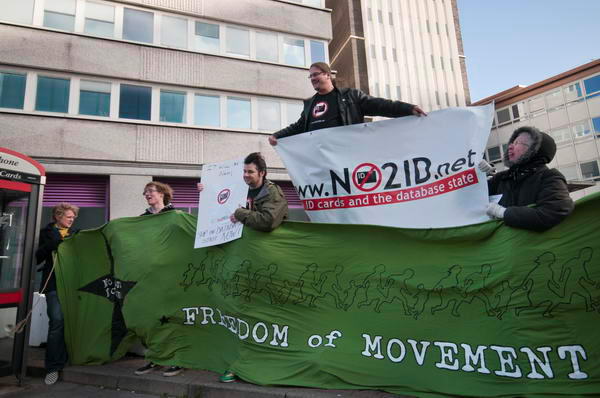
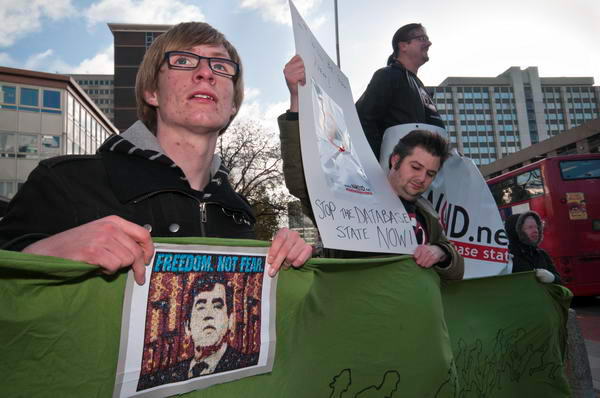
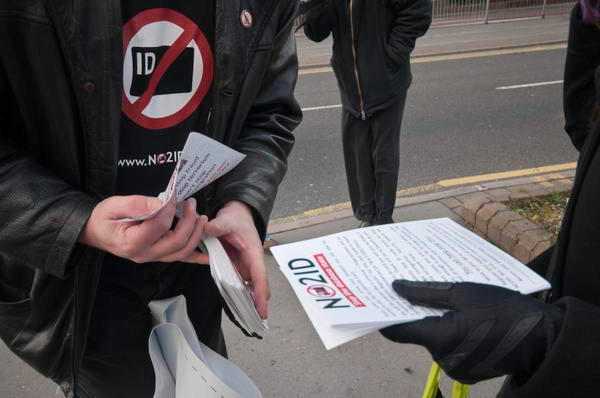
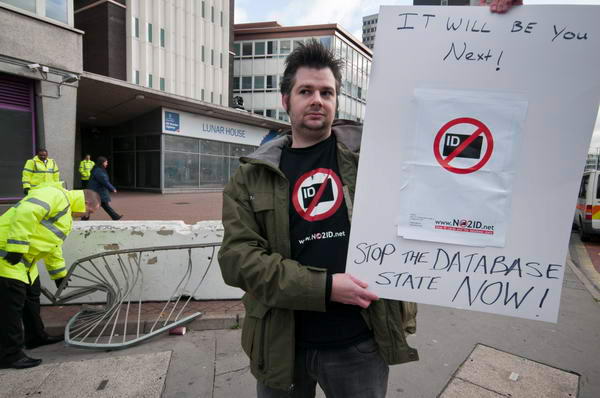
London NoBorders and NO2ID (their website I linked to in 2008 is now a gaming site) marked the occasion with a picket outside the UK headquarters of the Border and Immigration Agency at Lunar House in Croydon.

It was, as I noted, a bitterly cold day and “on Wellesley Road a biting Siberian wind seared the demonstrators outside Lunar House. It seemed appropriate that such a freezing blast should surround the UK headquarters of the Border and Immigration Agency and indeed be generated by its twenty stories of the grim early 1970s office complex. After all its raison d’être is to give would-be immigrants and asylum seeks an extremely cold reception.

Biometric ID Cards - 2008

It’s impossible to think about the introduction of ID cards without thinking of Orwell and ‘1984’ (though I also had another author in mind when I wrote of it as “a warning of things to come for all of us in a Brave New Britain of state surveillance and control whose infrastructure is increasingly with us through security cameras, the interception of mobile phone signals and electronic communications and the planned introduction of universal ID cards.“)

Although New Labour had few worries about the descent into totalitarianism, our other main political parties had clear reservations, though for the Conservatives they were intrusive but more importantly “ineffective and enormously expensive.” The Lib-Dems were also opposed to them and under the coalition the Identity Documents Act 2010 scrapped the National Identity register and the database and plans for future issues of cards, although they remained as residence permits for foreign nationals.
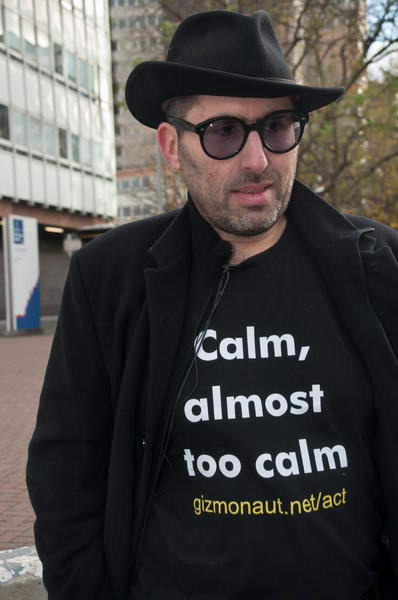
Also present at the protest was one man, David Mery, fortunate to be still alive – unlike Jean Charles de Menezes. Like that innocent Brazilian electrician six days earlier he had gone into Stockwell Underground Station in 2005 and been suspected of being a terrorist, but this time the police didn’t shoot first and ask questions later. Though having established he wasn’t carrying a bomb they still arrested him and put him through the mill rather than simply apologising on the spot and releasing him.

As I wrote, “his treatment in the months and years following the event can most favourably be described as Kafkaesque. He finally (or at least probably) succeeded in having both his fingerprints and DNA record removed from the police databases, but it took over two years of fighting. His blog and articles are essential reading for anyone who wonders why civil liberties are important.

A few more pictures at Protest at ID cards start.


FlickrFacebookMy London DiaryHull PhotosLea ValleyParis
London’s Industrial HeritageLondon Photos

All photographs on this page are copyright © Peter Marshall.
Contact me to buy prints or licence to reproduce.
11 October 2008

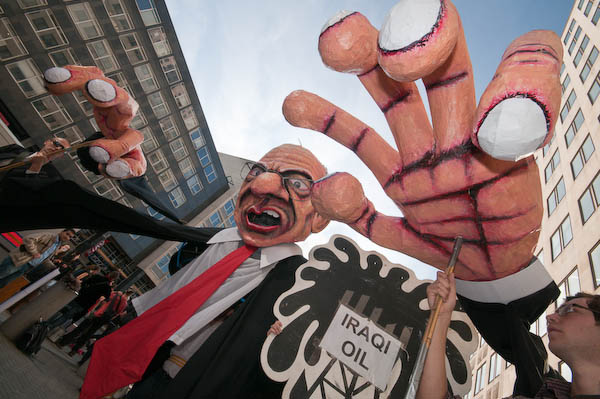
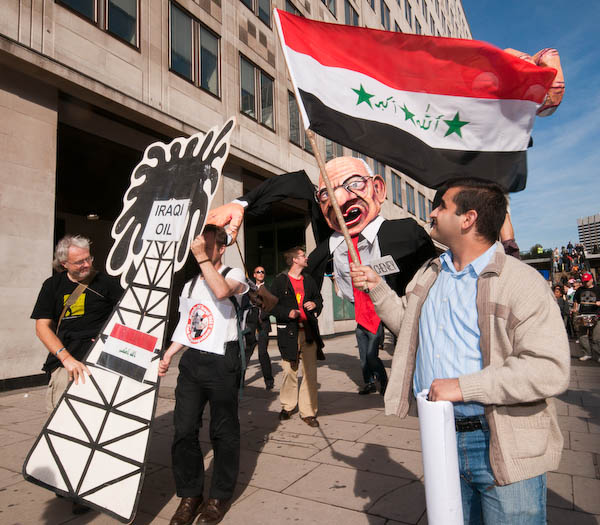
It was the start of the final 100 days of the Bush adminstration and the ‘Hands off Iraqi Oil’ coalition whose members included Corporate Watch, Iraq Occupation Focus, Jubilee Iraq, PLATFORM, Voices UK, and War on Want and was supported by the Stop the War Coalition and others had come to Shell’s UK headquarters at Waterloo to protest against plans by Britain and the USA for Iraq to hand over most of the country’s oil reserves to foreign companies, particularly Shell and BP.

Iraq had nationalised its oil by 1972, and it provided 95% of its government income. Many had seen the invasion of Iraq by the US and UK (along with Australia and Poland) as largely driven by the desire to gain control of Iraq’s huge oil reserves and the US had engaged consultants to help it write a new oil law which it got the Iraqi cabinet to approive in 2007 which would give foreign oil companies – including Shell and BP, long-term contracts within a safe legal framework. But large-scale popular opposition meant the Iraqi parliament failed to approve the new law. But in June 2008, the Iraqi Oil Ministry went ahead with short-term no-bid contracts to the major foreign oil companies – including Exxon Mobil, BP, Shell, Total and Chevron and later these and other contracts were made more favourable to the oil companies.

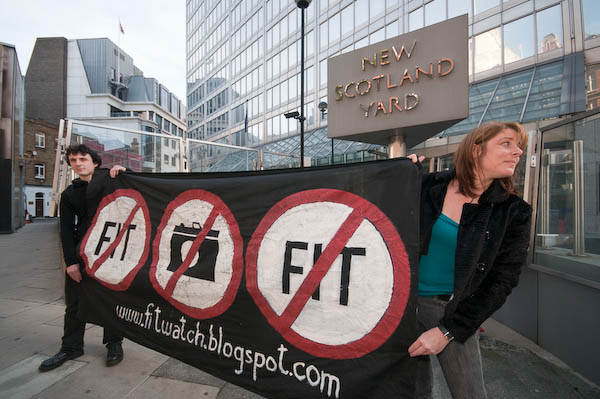
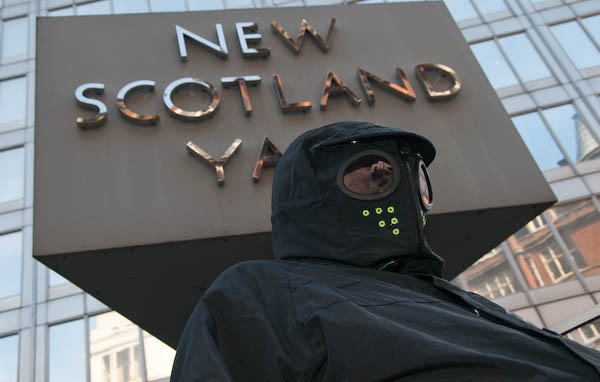
After the protest at Shell’s offices the protesters marched to protest outside the BP HQ in St James’s Square and then to the US Embassy, and I left to cover the London Freedom not fear 2008 event outside New Scotland Yard. Similar protests were taking place in over 20 countries to demonstrate against excessive surveillance by governments and businesses, organised by a broad movement of campaigners and organizations.

The London event highlighted the restrictions of the right to demonstrate under the Labour government’s The Serious Organized Crime and Police Act 2005, (SOCPA),, the intimidatory use of photography by police Forward Intelligence squads (FIT), the proposed introduction of ID cards, the increasing centralisation of personal data held by government, including the DNA database held by police, the incredible growth in surveillance cameras, ‘terrorist’ legislation and other measures which have affected our individual freedom and human rights.

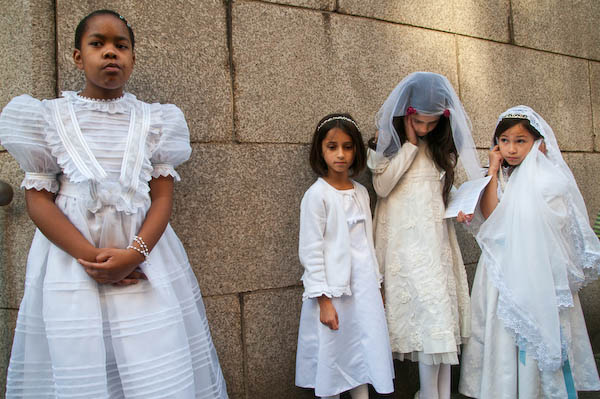
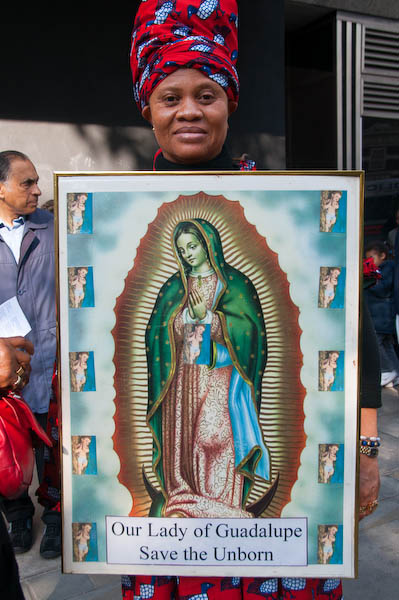
For something completely different I walked a quarter of a mile down Victoria Street to Westminster Cathedral where people were assembling for the Rosary Crusade of Reparation, one of the larger walks of public witness by Catholics in London.

This tradition began in Austria in 1947 with the roasary campaign begun by a priest praying for his country to be freed from the communist occupiers. The first annual parade with the statue of Our Lady of Fatima took place in 1948 in Vienna on the feast of the Name of Mary, Sept 12, which had been established by Pope Innocent XI in 1683 when Turkish invaders surrounding Vienna were defeated by Christian armies who had prayed to the Blessed Virgin.

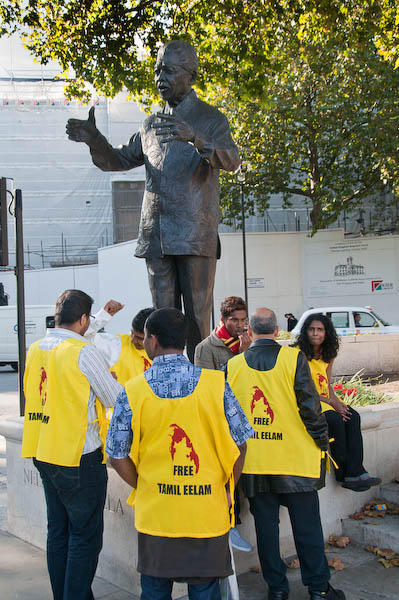
As the procession to a service at Brompton Oratory began I walked back up Victoria St to Parliament Square, where a number of other small protests were in evidence. All over the centre of London there were people giving out leaflets about the growing problems faced by Tamils in Sri Lanka, where they allege a program of ethnic cleansing is being carried out by the government. International media are banned from the Tamil areas of the country and NGOs have been ordered out of some areas, so there are few reports of the war. Worse was to come and in 2009 in the final stages of the war conservative estimates are that 70,000 civilians were killed in the the Mullivaikkal massacre.

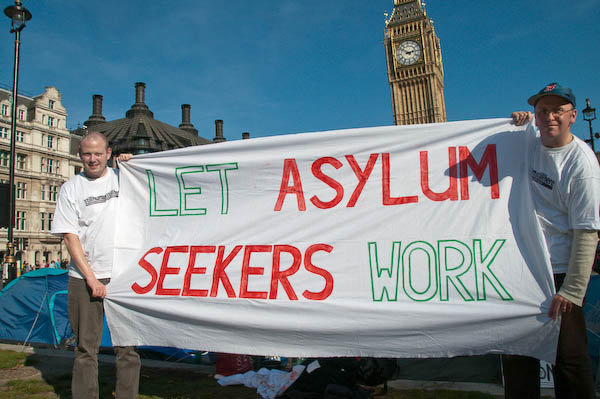
Others in the square were protesting against the UK’s scandalous treatment of asylum seekers and calling for the asylum detention centres to be closed down.

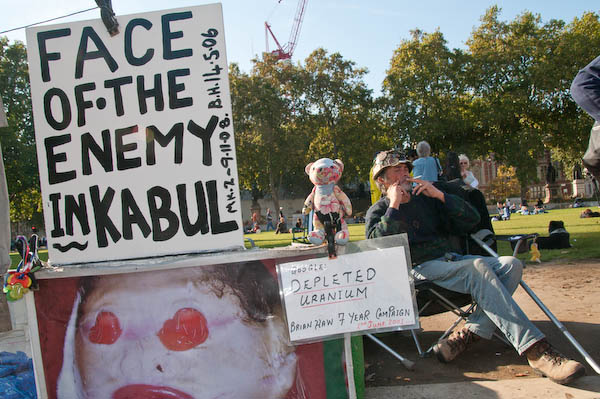
Brian Haw was still there, and I wrote:

Facing Parliament, Brian Haw‘s peace protest continues – he has been there for almost 2700 days – over 7 years – and it will soon be his 60th birthday. Brian says that now the police seem to have largely abandoned attempts to get rid of him legally there have been a number of odd attacks against him and others in the square – which the police have ignored. I took some time talking to a man who smelt of alcohol, was talking nonsense and acting unpredictably – and who then went and started to insult Brian. One of the other demonstrators stood between him and Brian who was filming him. I put down my bag as I took photographs in case I needed to step in and help, but fortunately he eventually moved away.

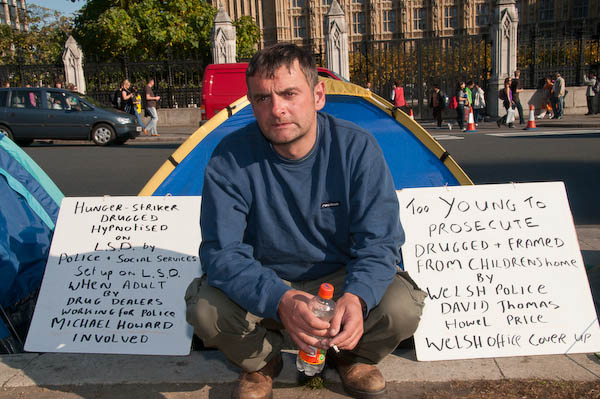
There were others protesting in Parliament Square, including one man who asked me to take his picture. He told me his name was Danny and that he had been there on hunger strike for two weeks, protesting over his failure to get his case investigated. He claimed to have been abused by police and social services following an incident in which as a seven year old child in Llanelli he was implicated in the death of a baby brother. I was unable to find any more information about his case.

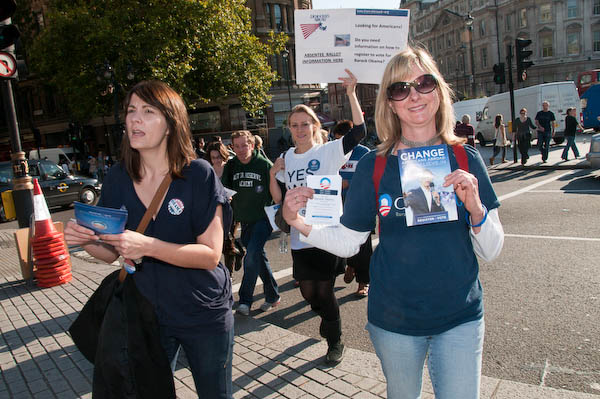
Finally I saw a group of people walking past holding leafelts with the the word CHANGE on them and rushed after them to find they were Obama supporters hoping to persuade Americans they met to register and vote in the election. It was time for me to go home.

Parliament Square
Rosary Crusade of Reparation
Freedom not Fear 2008
Bush & Cheney’s Iraq Oil Grab