12 Days of Christmas – December

12 Days of Christmas -some of my favourite pictures from those I made in December 2025.

Various minor problems prevented me from working much in December and with other committments all these pictures are from a single day, 13th December.
12 Days of Christmas – December
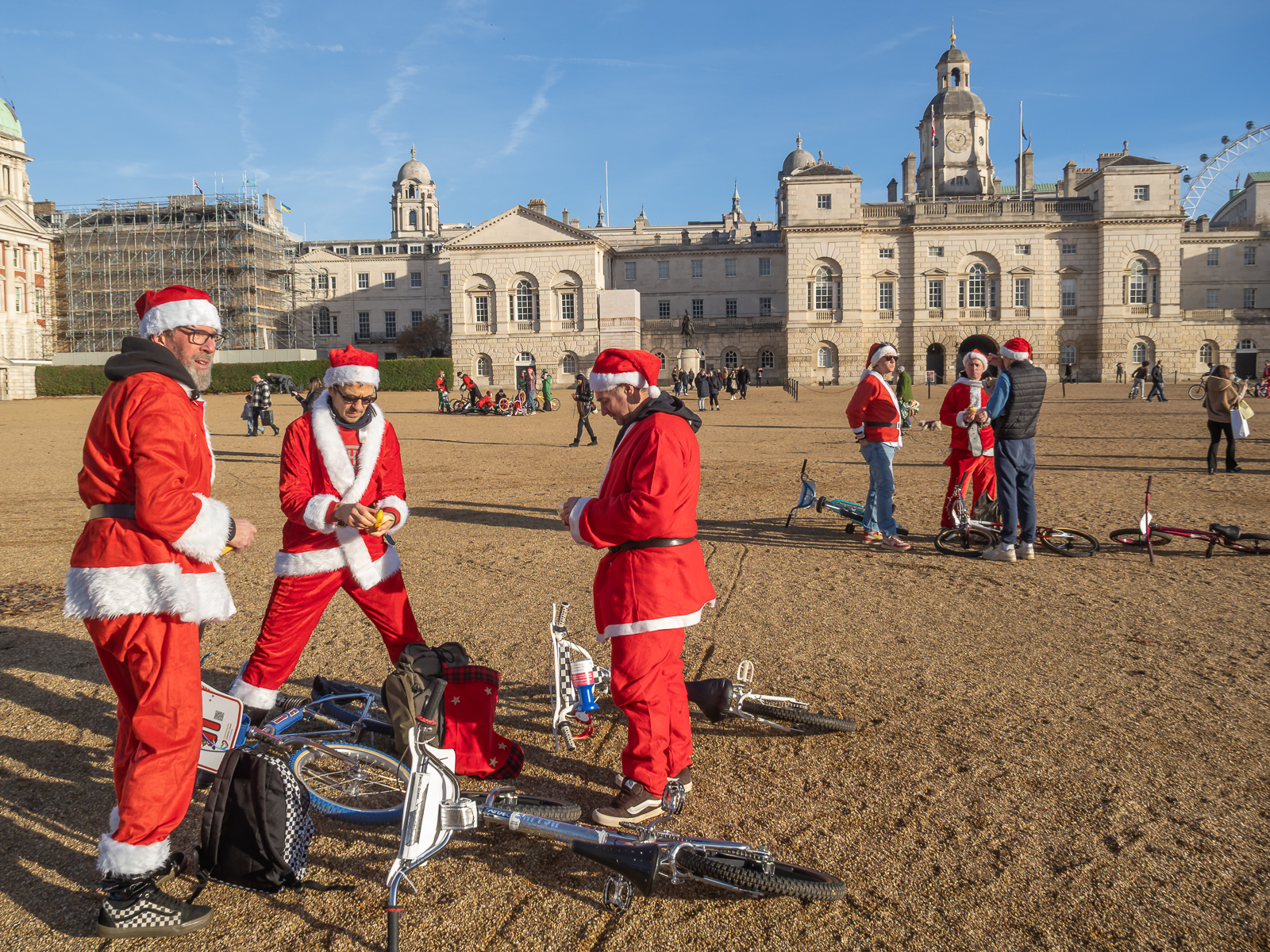
London, UK. 13th Dec 2025. Hundreds of riders took part in the 11th BMX Life Santa Cruise London dressed as Santas (with a few elves, snowmen, Christmas trees and reindeer), a charity ride to raise money for the Evelina Children’s Heart Organisation. So far BMX Life have raised over £200,000 through their rides. They stopped for lunch on Horse Guards Parade. Peter Marshall.
12 Days of Christmas – December
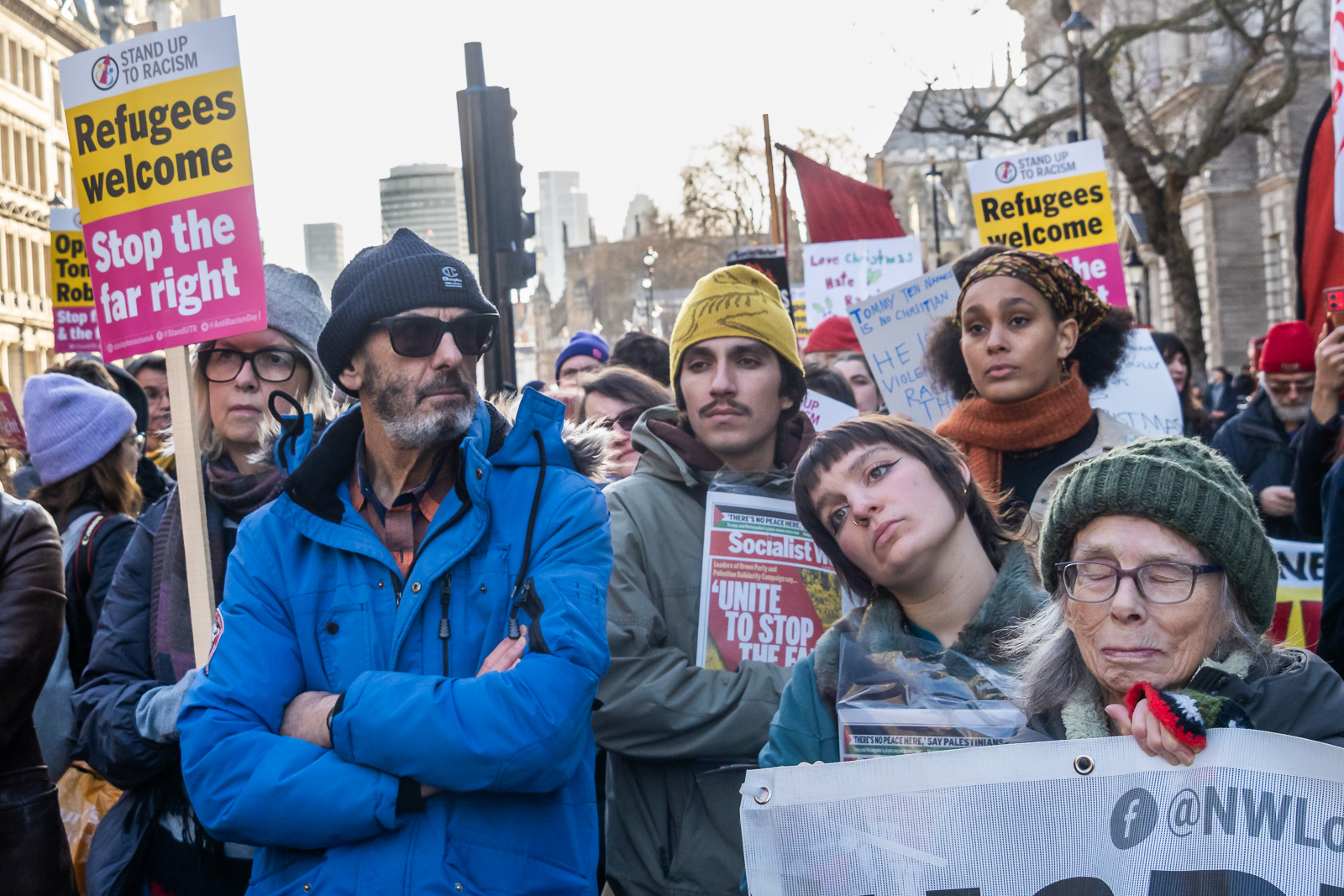
London, UK. 13th Dec 2025. Anti-racist campaigners came to Downing Street in a protest called by Stand up to Racism and Care 4 Calais to oppose Tommy Robinson and his extreme right supporters and remind us at Christmas that Jesus was a refugee and state that we are one community of love against hate and will not let the far right divide us. They say Jesus preached love not hate. Peter Marshall
12 Days of Christmas – December
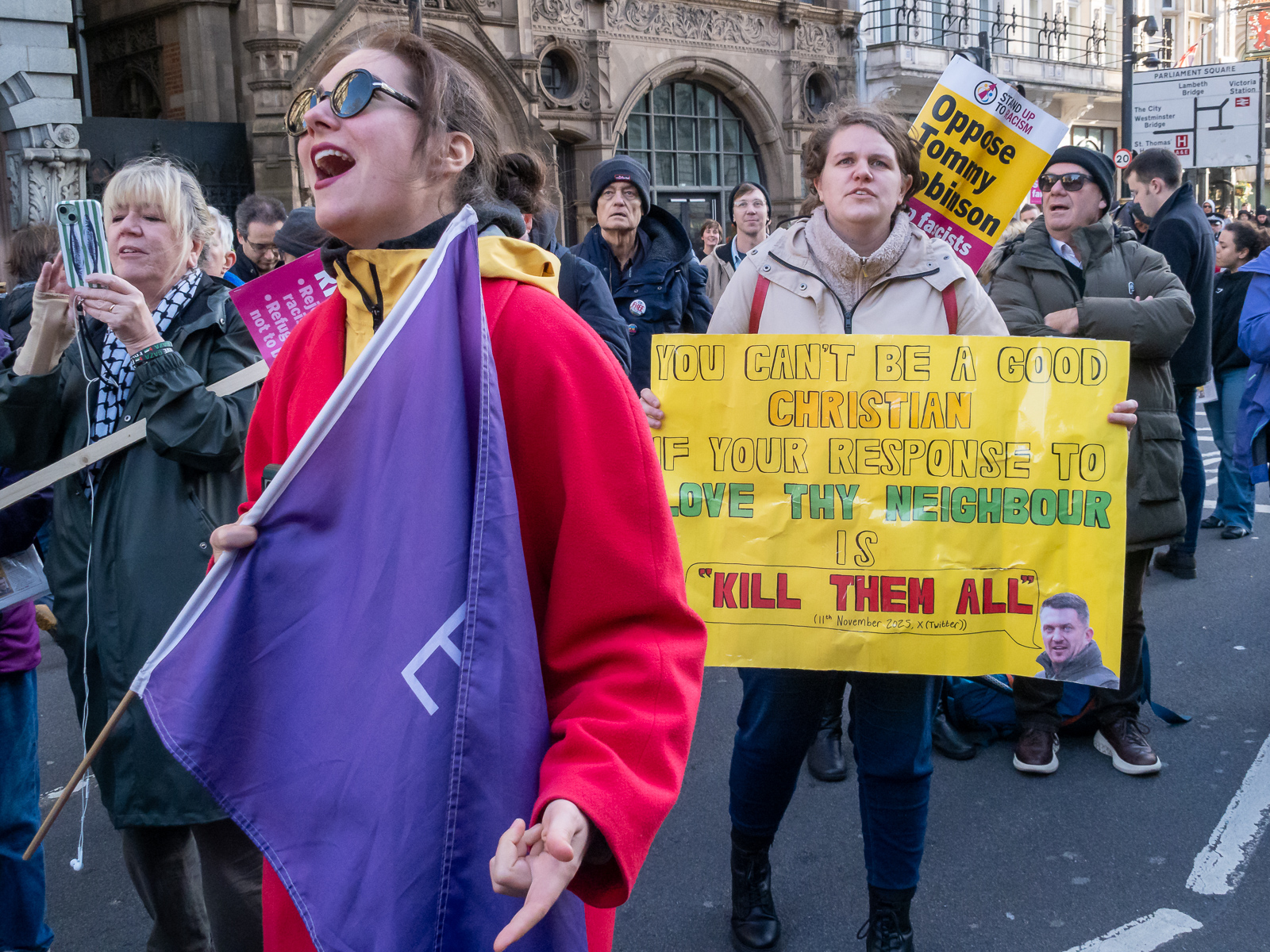
London, UK. 13th Dec 2025. People sang and some danced. Anti-racist campaigners came to Downing Street in a protest called by Stand up to Racism and Care 4 Calais to oppose Tommy Robinson and his extreme right supporters and remind us at Christmas that Jesus was a refugee and state that we are one community of love against hate and will not let the far right divide us. They say Jesus preached love not hate. Peter Marshall
12 Days of Christmas – December
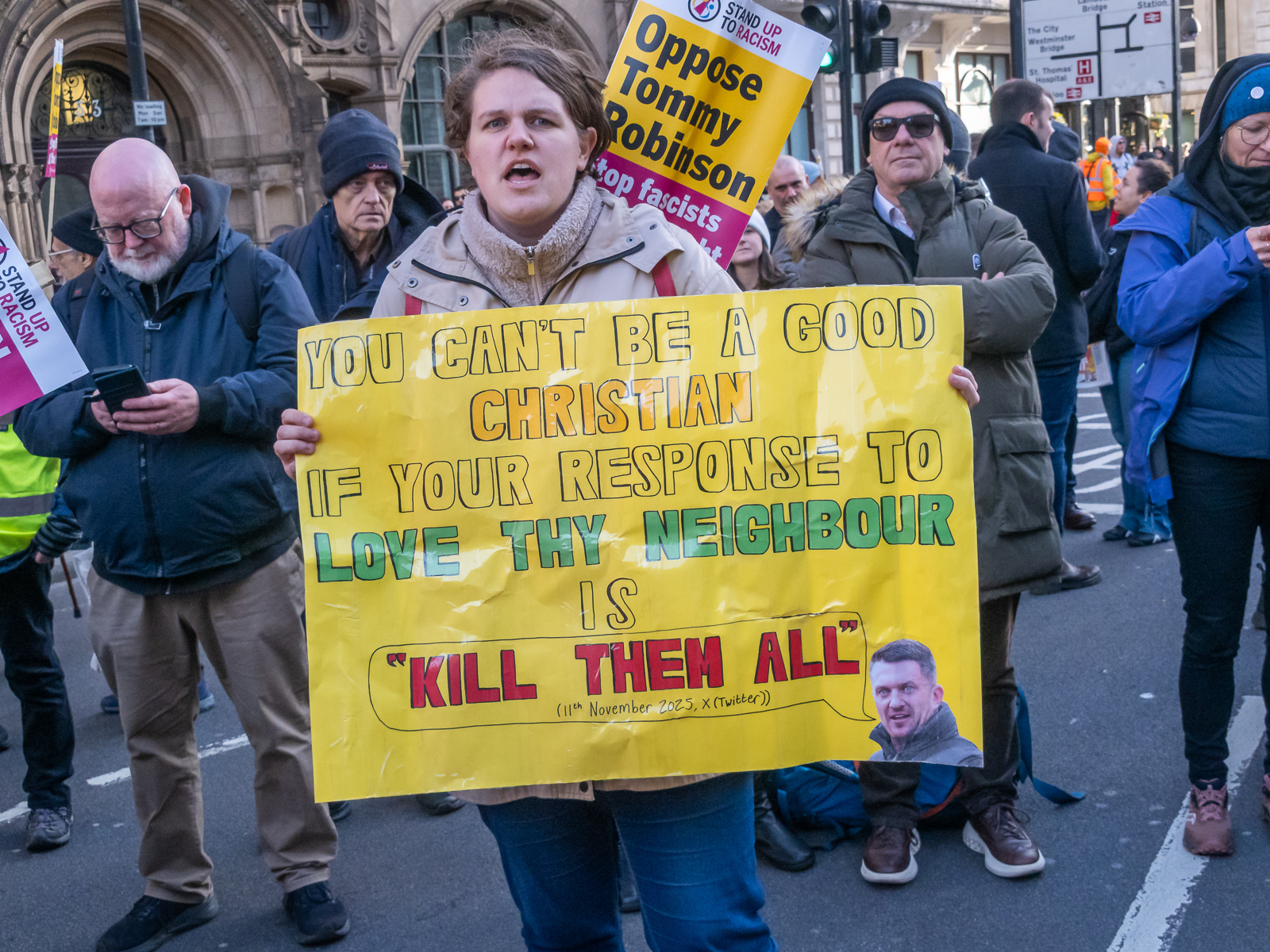
London, UK. 13th Dec 2025. You can’t be a good Christian IF… Anti-racist campaigners came to Downing Street in a protest called by Stand up to Racism and Care 4 Calais to oppose Tommy Robinson and his extreme right supporters and remind us at Christmas that Jesus was a refugee and state that we are one community of love against hate and will not let the far right divide us. They say Jesus preached love not hate. Peter Marshall
12 Days of Christmas – December
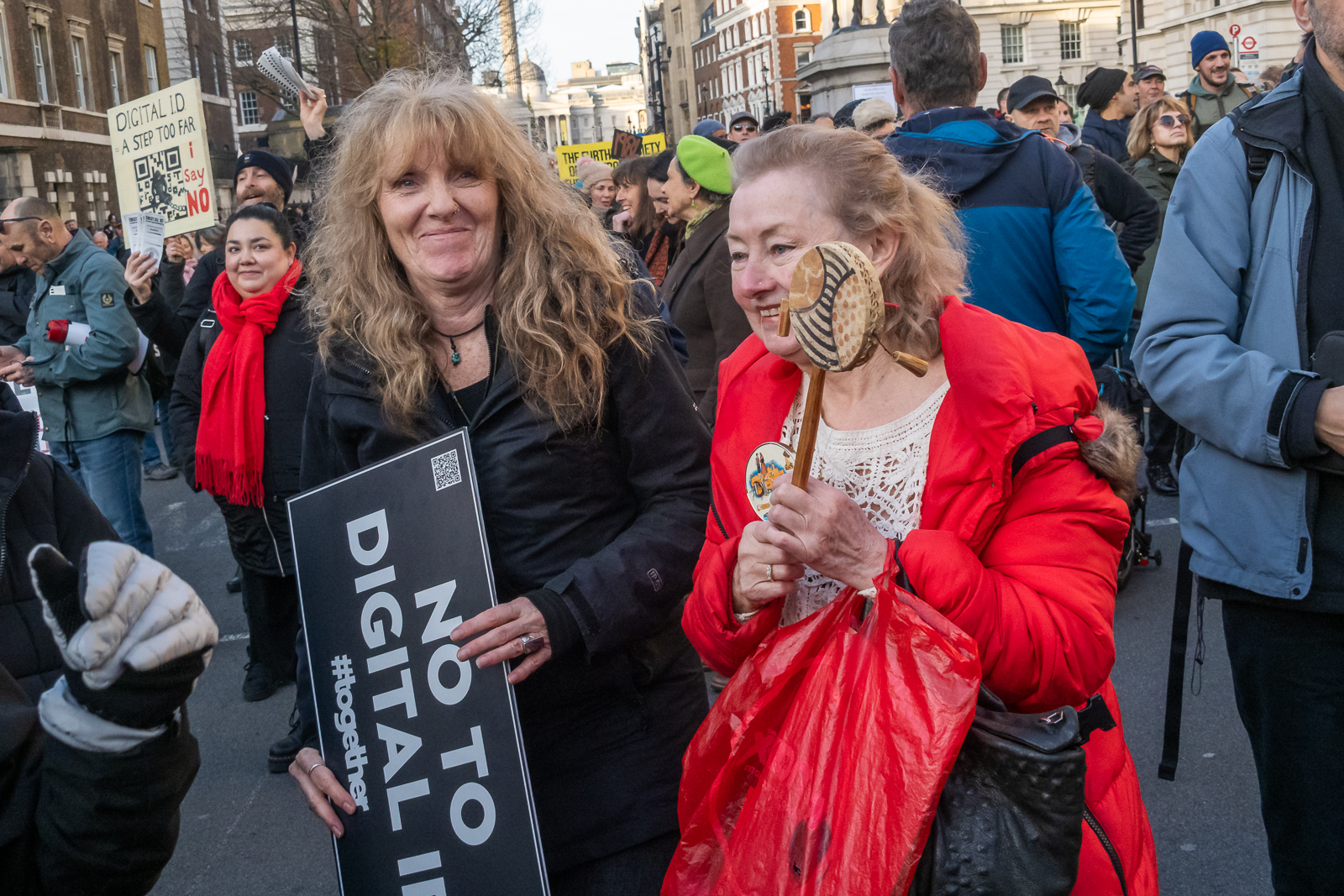
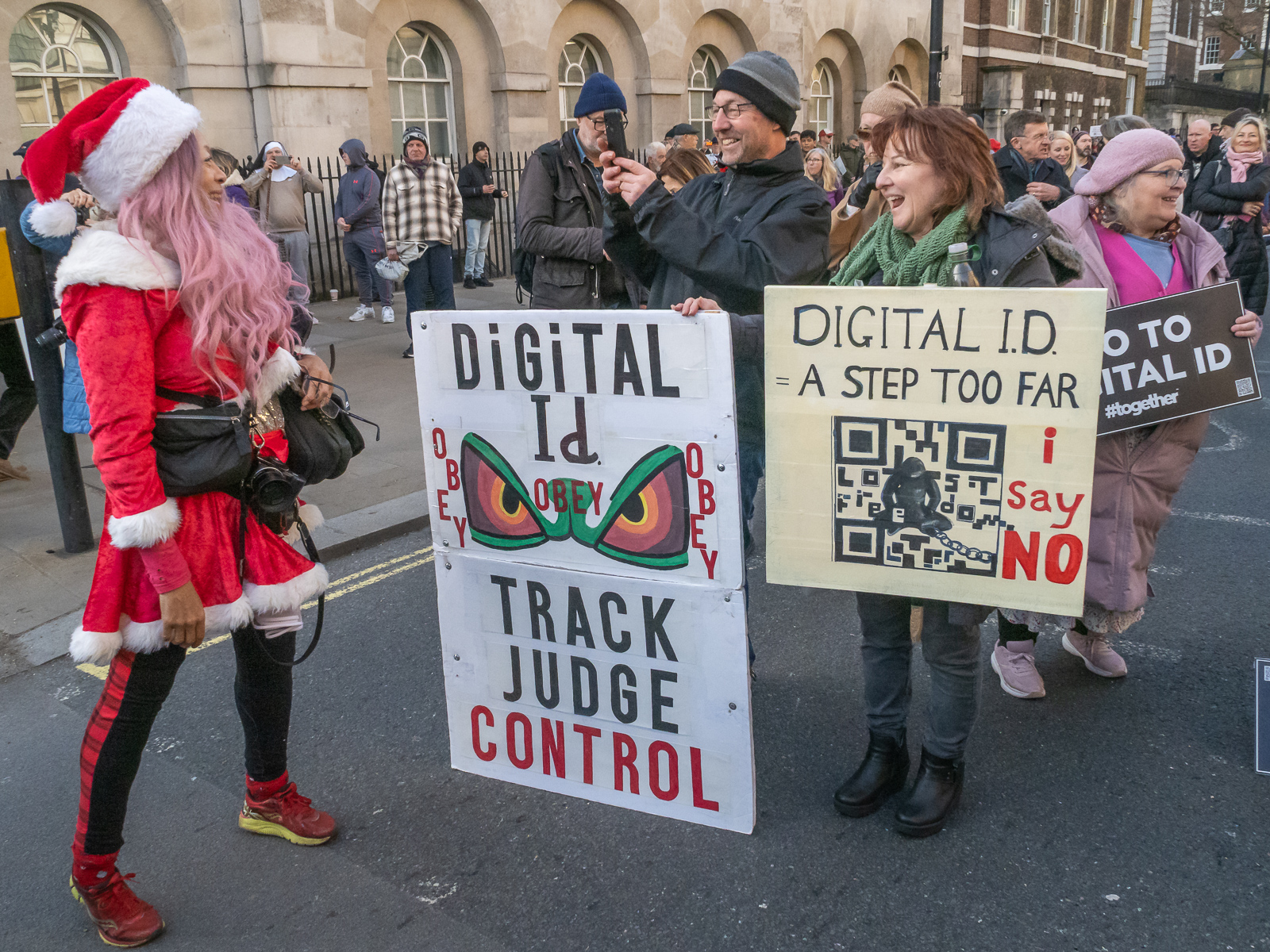
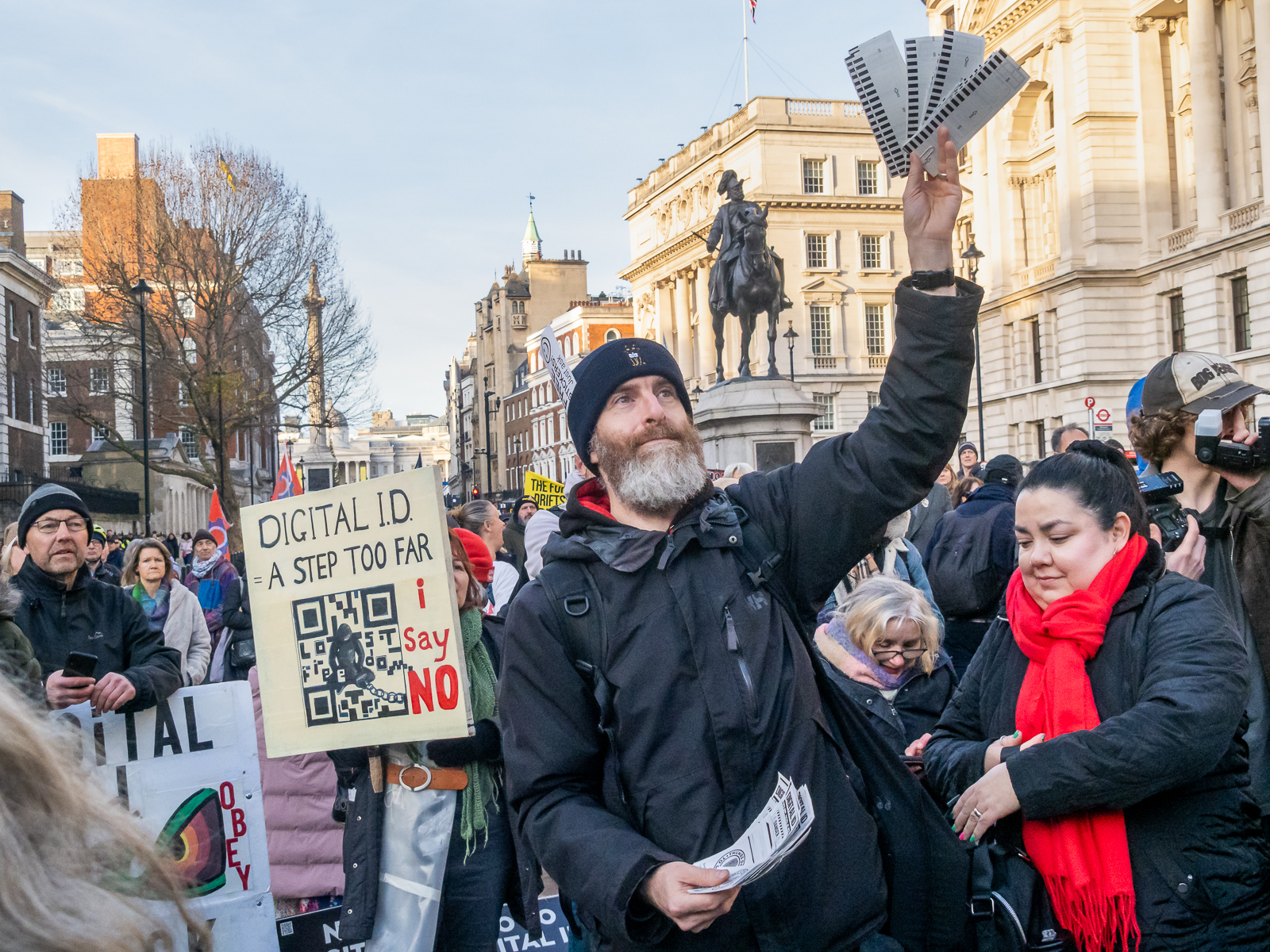
London, UK. 13 Dec 2025. A large rally in Whitehall opposes the current government’s intention to introduce digital ID. People from across the whole political spectrum say it is an attack on our rights and our autonomy, and that it could be used as an Orwellian system of total control. It would turn us into a highly controlled checkpoint society, would be open to abuse by hackers and foreign powers and discriminate against those with less access to online services. Peter Marshall
12 Days of Christmas – December
London, UK. 13 Dec 2025. A large rally in Whitehall opposes the current government’s intention to introduce digital ID. People from across the whole political spectrum say it is an attack on our rights and our autonomy, and that it could be used as an Orwellian system of total control. It would turn us into a highly controlled checkpoint society, would be open to abuse by hackers and foreign powers and discriminate against those with less access to online services. Peter Marshall
12 Days of Christmas – December
London, UK. 13 Dec 2025. A large rally in Whitehall opposes the current government’s intention to introduce digital ID. People from across the whole political spectrum say it is an attack on our rights and our autonomy, and that it could be used as an Orwellian system of total control. It would turn us into a highly controlled checkpoint society, would be open to abuse by hackers and foreign powers and discriminate against those with less access to online services. Peter Marshall

So this is the end of a little look at my photographs from 2025. If I went though them again I would quite likely come up with many difference choices. I’ve made this selection entirely from the events I’ve covered to submit work to an agency and there are also some interesting images from outings with friends and family.

All of those featured were made with either Fuji-X or an Olympus OM-D E-M5 Mark III camera. I like the Fuji-X system, but every now and then get frustrated with the cameras which seem to develop random faults. Mostly this year I’ve gone back to using the Fujifilm X-T1 rather than the XT-30, usually with the Fuji 12-24mm. If I need anything wider I do have a fisheye in my bag, but it’s become a little tricky to de-fish images since Fisheye-Hemi went out of business and their plugin no longer works.

You can still do the job – converting from a circular perspective to a Panini (Vedutismo) one – and its even possible but rather tricky event in Photograph, but it lacks the one-click simplicity of the old plugin.

24mm on the Fuji is equivalent to 36mm on full-frame. The reason for carrying the Olympus is the 14-150mm Olympus lens – equvalent to a 28-300 on full frame. It’s a remarkably small and light lens for its specifications and while not wide aperture (f4.6-5) it’s good enough when you can work digitally at higher ISO.

I seldom use very long lenses but hen I first got this lens I was about to go on a job where I knew I neede at least a 300mm. I tested this against a Nikkor lens more than twices a big and probably three times as heavy – and would give me 450mm in DX mode. Rather to my surprise it gave sharper and more detailed results than the Nikkor, and since then as been my choice for longer focal lengths.

The Olympus OM-D E-M5 Mark III camera is also perhaps the best camera I’ve ever used. It came out in 2019 and I bought it to replace the very similar Mark II which had suffered an unfortunate impact with a pavement putting it beyond economic repair. I was going to buy a secondhand version, but found a grey import cheaper than the local secondhand price. They are still sold secondhad for only a little less than I paid.

It’s also my holiday camera – with a few other lenses to go with it, depending on exactly how light I want to travel.


FlickrFacebookMy London DiaryHull PhotosLea ValleyParis
London’s Industrial HeritageLondon Photos

All photographs on this page are copyright © Peter Marshall.
Contact me to buy prints or licence to reproduce.
Biometric ID Cards – 2008

Biometric ID Cards are now once again under consideration by Keir Starmer’s Labour government having being heavily promoted since 2023 by Tony Blair, William Hague and others including the misleadingly named ‘Labour Together‘ right-wing think tank – once directed by Morgan McSweeney who became Starmer’s campaign director – and who he appointed as Labour’s chief of staff when he became leader – and McSweeney became Downing Street Chief of Staff in October 2024.

Biometric ID Cards - 2008

Until 2008, Britain had only introduced identity cards at times of war. They were scrapped in 1919 but kept on rather longer after World War Two when they were only abolished in 1952.

Biometric ID Cards - 2008
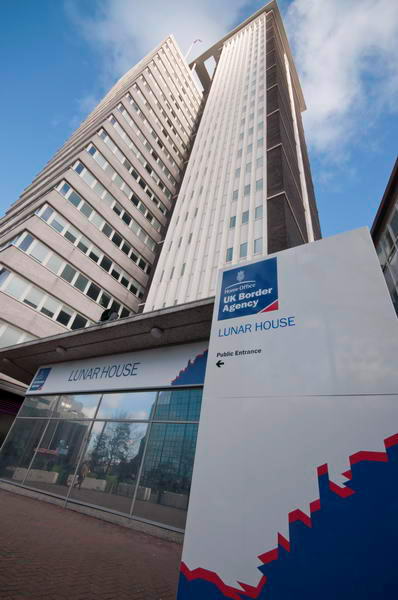
Luna House was built 1976-7 by Denis Crump & Partners and is rented by the Home Office from a Greek businessman whose company is based in Monaco. They added an R to its name.

While the British people were prepared to put up with them in wartime, identity cards were always viewed as fundamentally un-British, incompatible with our ideas of civil liberties and freedom. We contrasted our free society with others abroad where citizens could be stopped at any time on the streets and required to produce their papers – and chilling scenes of the Gestapo doing so were frequently invoked in popular culture. We were proud of not being a police state, but increasingly we are now moving more and more in that direction.

Biometric ID Cards - 2008

Now the idea is firmly back on the political agenda, there have been two major protests in London against the introduction of these ID cards. Unfortunately for different reasons I’ve not managed to cover either of them. A third protest is coming up in December and I hope to be there.

A petition to Parliament against their introduction has already received around 3 million signatures and will be debated on 8 December 2025. The initial government response is “We will introduce a digital ID within this Parliament to help tackle illegal migration, make accessing government services easier, and enable wider efficiencies. We will consult on details soon.” You can read more at Big Brother Watch.

Biometric ID Cards were introduced under the Identity Cards Act 2006, which came into force on 25th November 2008, when they became compulsory for all non-EU students and spouses applying for or renewing visas for study or marriage. They were to be required shortly for all foreign nationals in the UK and also to be rolled out to other groups including students who want a student loan by 2010. And from 2011 you were to be reqquired to have one – and have your details on that database – if you wanted to renew or get a passport.

Biometric ID Cards - 2008

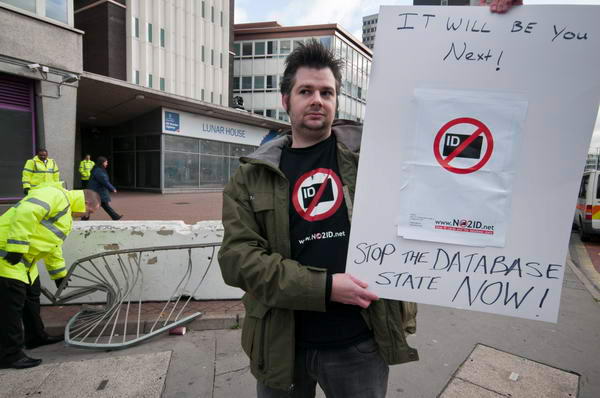
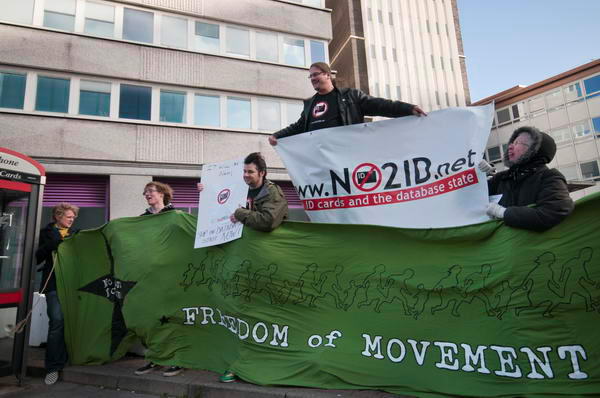
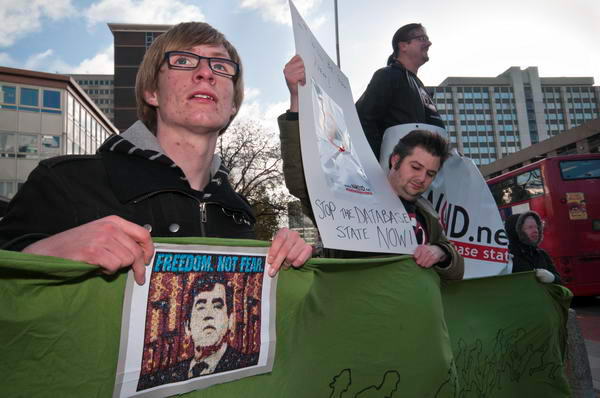
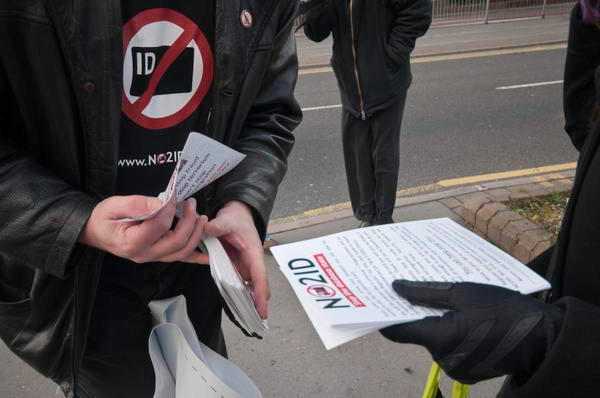
London NoBorders and NO2ID (their website I linked to in 2008 is now a gaming site) marked the occasion with a picket outside the UK headquarters of the Border and Immigration Agency at Lunar House in Croydon.

It was, as I noted, a bitterly cold day and “on Wellesley Road a biting Siberian wind seared the demonstrators outside Lunar House. It seemed appropriate that such a freezing blast should surround the UK headquarters of the Border and Immigration Agency and indeed be generated by its twenty stories of the grim early 1970s office complex. After all its raison d’être is to give would-be immigrants and asylum seeks an extremely cold reception.

Biometric ID Cards - 2008

It’s impossible to think about the introduction of ID cards without thinking of Orwell and ‘1984’ (though I also had another author in mind when I wrote of it as “a warning of things to come for all of us in a Brave New Britain of state surveillance and control whose infrastructure is increasingly with us through security cameras, the interception of mobile phone signals and electronic communications and the planned introduction of universal ID cards.“)

Although New Labour had few worries about the descent into totalitarianism, our other main political parties had clear reservations, though for the Conservatives they were intrusive but more importantly “ineffective and enormously expensive.” The Lib-Dems were also opposed to them and under the coalition the Identity Documents Act 2010 scrapped the National Identity register and the database and plans for future issues of cards, although they remained as residence permits for foreign nationals.

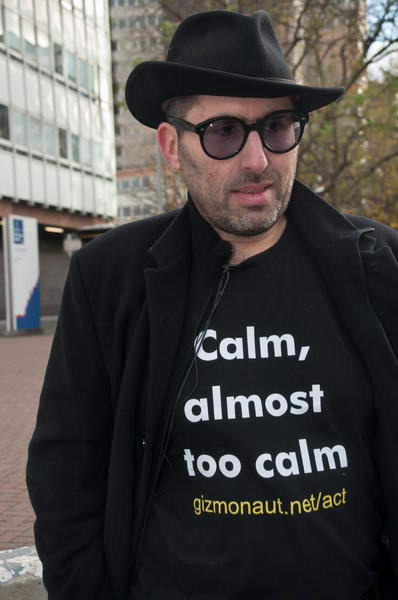
Also present at the protest was one man, David Mery, fortunate to be still alive – unlike Jean Charles de Menezes. Like that innocent Brazilian electrician six days earlier he had gone into Stockwell Underground Station in 2005 and been suspected of being a terrorist, but this time the police didn’t shoot first and ask questions later. Though having established he wasn’t carrying a bomb they still arrested him and put him through the mill rather than simply apologising on the spot and releasing him.

As I wrote, “his treatment in the months and years following the event can most favourably be described as Kafkaesque. He finally (or at least probably) succeeded in having both his fingerprints and DNA record removed from the police databases, but it took over two years of fighting. His blog and articles are essential reading for anyone who wonders why civil liberties are important.

A few more pictures at Protest at ID cards start.


FlickrFacebookMy London DiaryHull PhotosLea ValleyParis
London’s Industrial HeritageLondon Photos

All photographs on this page are copyright © Peter Marshall.
Contact me to buy prints or licence to reproduce.