National Gallery, Trayvon Martin & Dykes: Saturday 31 March 2012 I began outside the National Gallery were the Campaign Against the Arms Trade (CAAT) were demanding that the gallery stopped hosting events for the arms trade. From there I went to the US Embassy in Grosvenor Square for a protest about the US failure to prosecute the killer of black teenager Trayvon Martin. Finally I went to London’s first Dyke March since the 1980s.
Disarm The National Gallery
Trafalgar Square
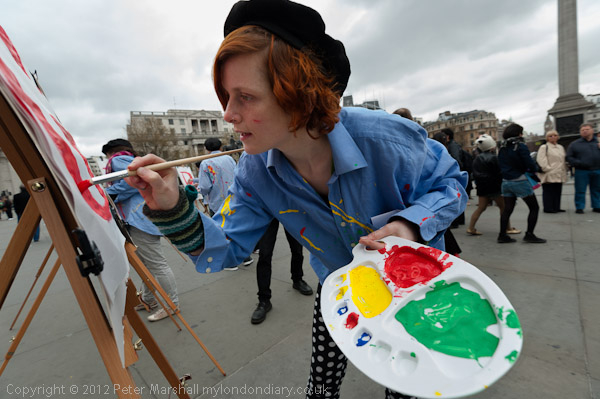
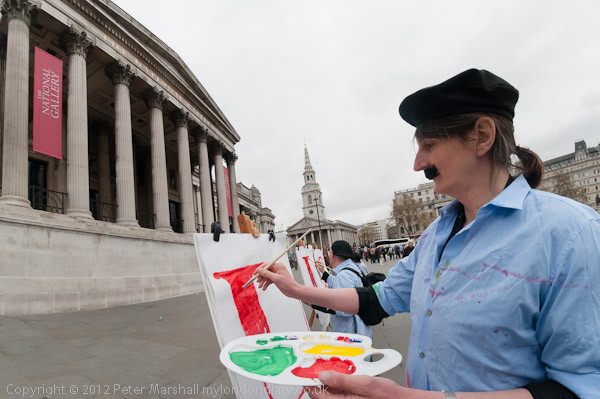
Around 20 protesters had come to Trafalgar square as ‘artists’, dressed in blue paint-stained smocks and equipped with moustaches, berets, paint brushes, palettes and easels with large sheets of paper and a smattering of Franglais.
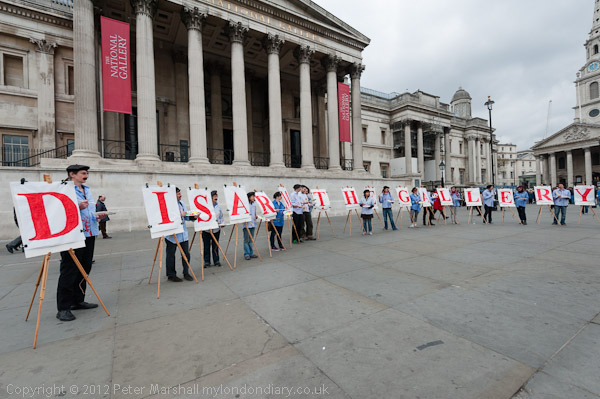
They erected their easels in a line on the North Terrace in front of the National Gallery and painted the letters D, I, S, A, R, M, T, H, E, G, A, L, L, E, R and Y anbefore standing with them in front of the gallery.
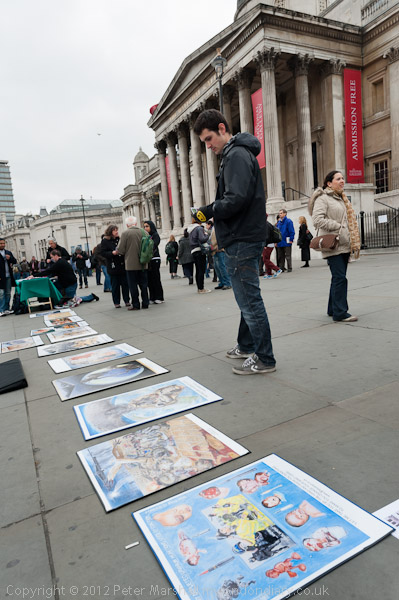
There also brought other anti-war artworks to display and handed out postcards for onlookers to sign calling on Nicholas Penny, Director of the National Gallery, to end his support of the arms trade.
The main entrances of the gallery were closed during the protest and a long queue built up at the lower entrance. Many in that line were amazed to find that an art gallery was supporting arms sales. As the postcard says – and people overwhelmingly agreed – Art and arms don’t mix.
The Disarm the Gallery protest was organised by the Campaign Against the Arms Trade (CAAT) as the during the DSEi arms fair the previous September, weapons manufacturer Finmeccanica had paid the gallery £30,000 to hold events there.
DSEi is the worlds largest arms fair with buyers and sellers from around the world including many corrupt and tyrannical regimes, selling the equipment used by dictators around the world to equip armies and police to keep order and fuelling conflicts which kill thousands if not millions.
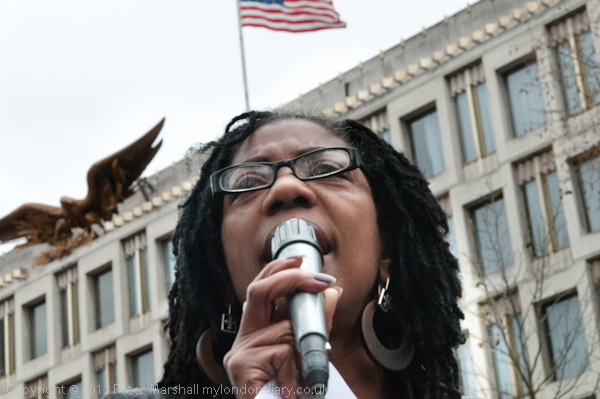
Marcia, sister of Sean Rigg, killed by police in Brixton police station speaks at the US embassy protest
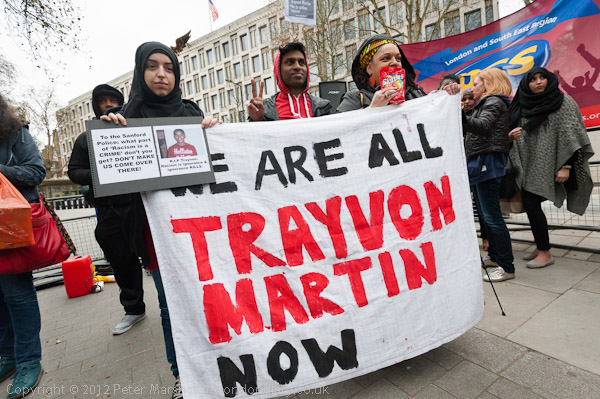
Black teenager Trayvon Martin was walking back from a local convenience store to the house in Florida where he was staying with this father when he was stopped and then shot dead by George Zimmerman, a self appointed neighbourhood watchman who claimed he had felt threatened by a black teenager wearing a hoodie.
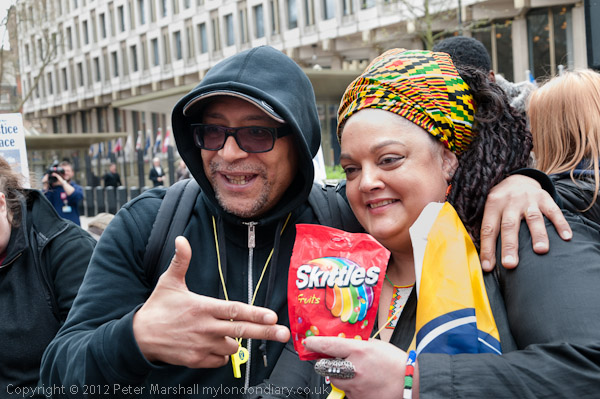
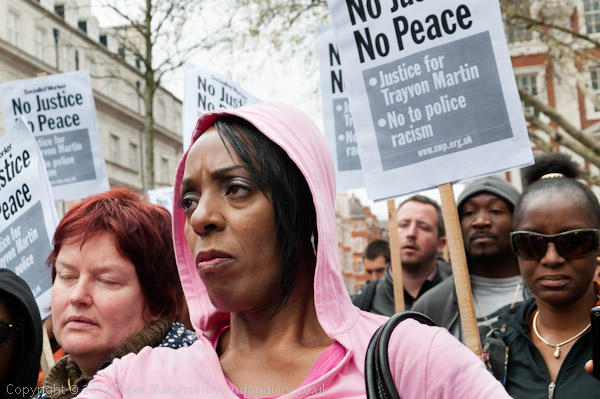
He had gone to the shop to buy a soft drink and some Skittle sweets and many at the protest wore hoodies and carried packets of Skittles and soft drinks.
Lee Jasper and Zita Holbourne of BARAC
Florida police backed Zimmerman’s story that he had acted in self-defence and refused to arrest or charge him. Later the pressure from protests like this across America and around the world led to him being brought to trial, but a Florida jury acquitted him.
People stressed that the killing of Trayvon Martin very much reflects the treatment of black people not just in the USA but elsewhere including the UK
The embassy protest was was chaired by Merlin Emmanuel, brother of Smiley Culture, killed by police in his own kitchen, and speakers included Marcia, the brother of Sean Rigg, murdered in Brixton Police Station. Other speakers also brought up cases of deaths and discriminaton by police in the UK.
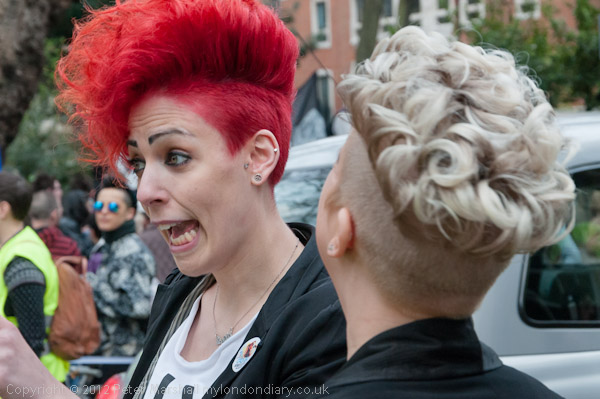
Stella and Lucy of DIVA magazine in Soho Square for the London Dyke March
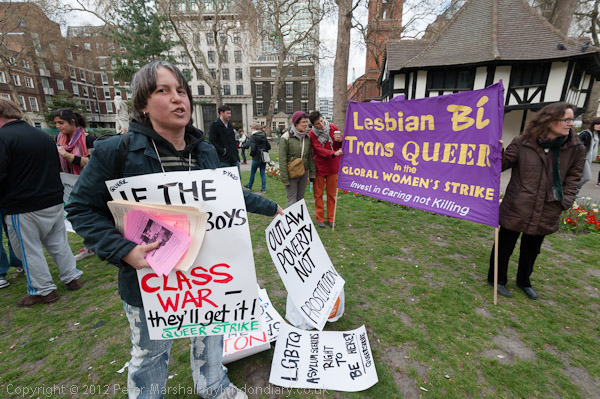
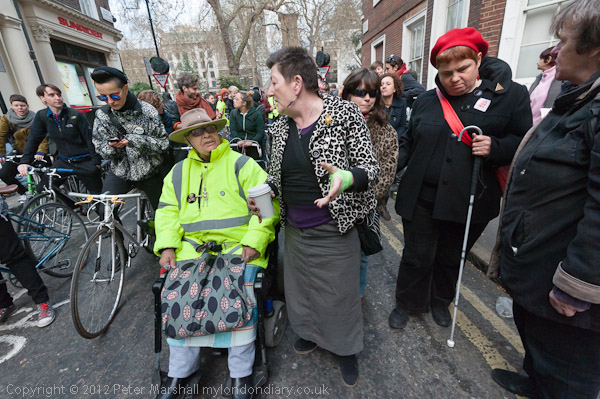
After a rally in Soho Square over 600 women marched through Soho and Trafalgar Square to the National Theatre.
The march was the first dyke march since the 1980s and set out to support dyke visibility and welcomed “dykes, queers, bisexuals, transwomen, genderqueers and allies” and “all folk who want to support dykes to march with us” in “a grassroots, non-commercial, anti-racist, community-centred, accessible, inclusive event.”
Speakers at the rally “were Kirstean Hearn, the chair of Inclusion London and someone who as a member of Equality 2005 gives disability equality advice to government, Lady Phyll Opoku, co-founder and Managing Director of UK Black Pride, journalist and founding editor of METQ magazine Paris Lees, Shi tou, an artist and film-maker who was the first lesbian to come out on Chinese TV and one of China’s most prominent lesbian activists, and Clare B Dimyon, awarded a MBE in 2010 for her work supporting LGBT people in Central and Eastern Europe.”
You can view many more pictures of the march and rally on My London Diary, including pictures of most or all of the speakers at London Dyke March 2012.
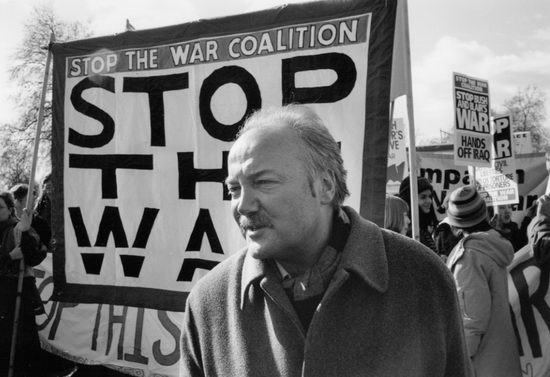
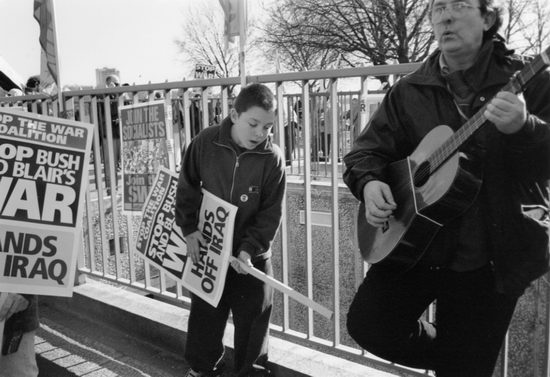
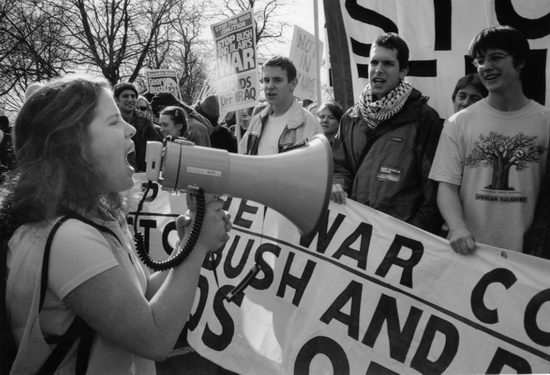
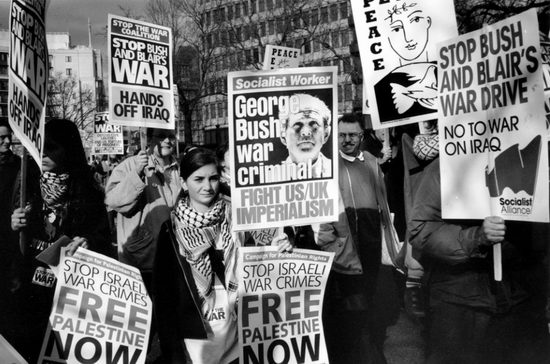
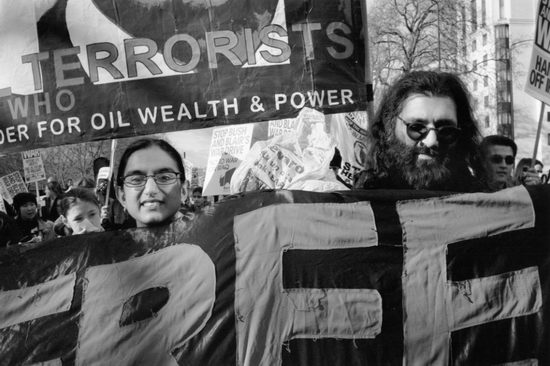
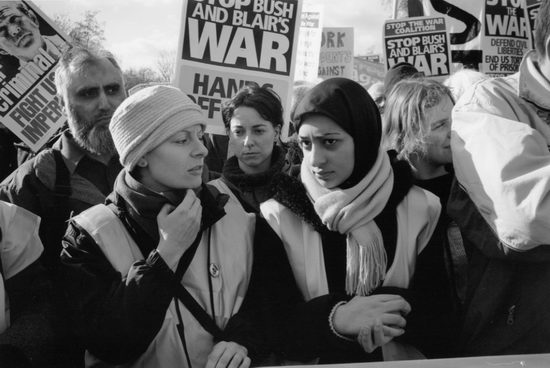
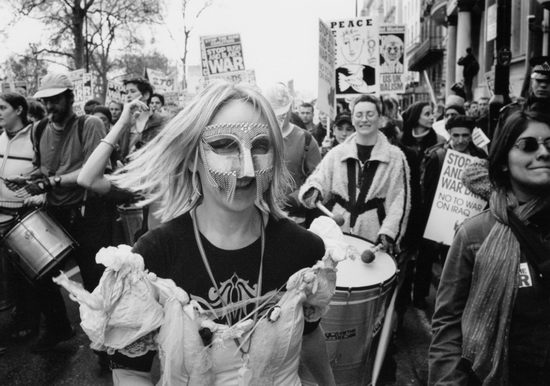
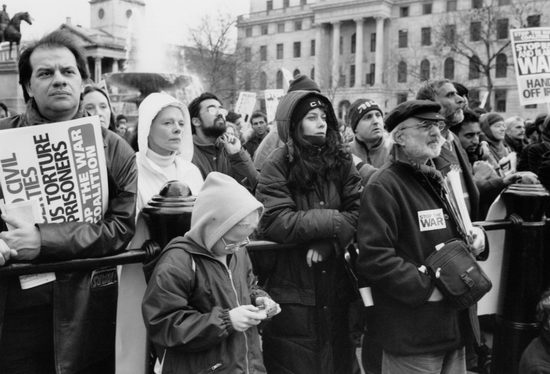
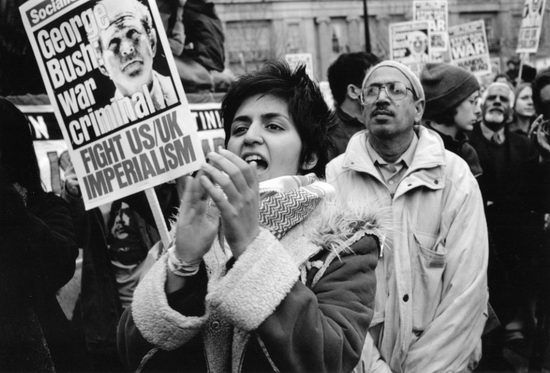
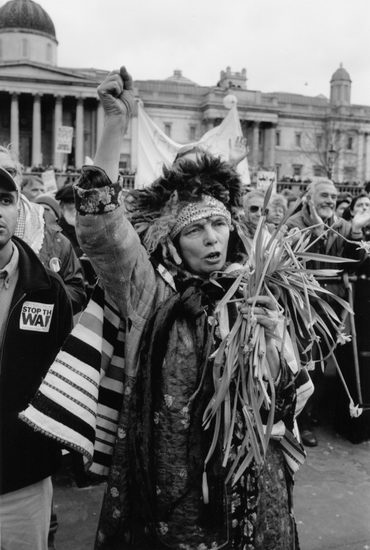
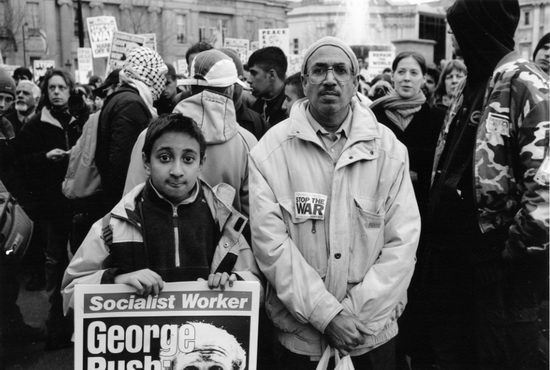
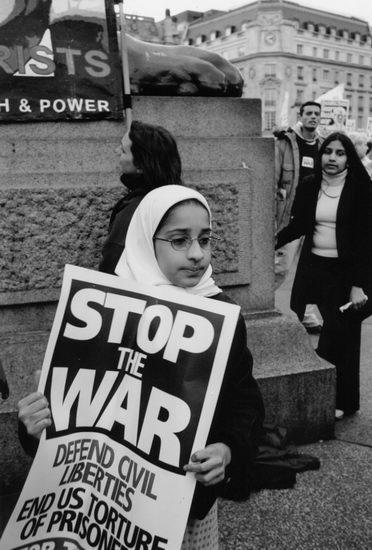
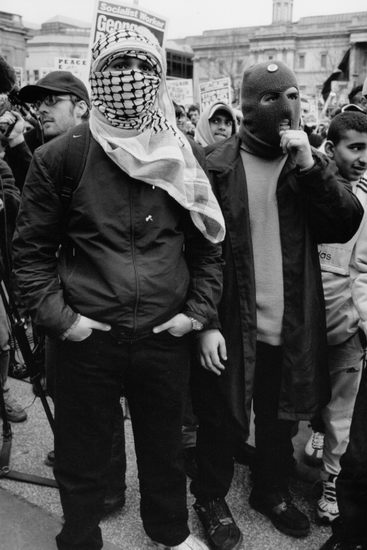
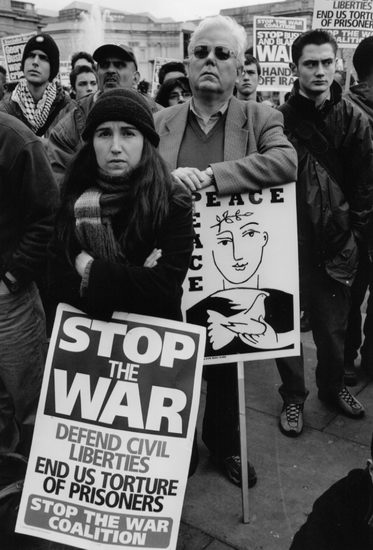
Stop The War – Hands Off Iraq: The protest in London against the US plans to invade Iraq on Saturday 30th March 2002 was I think the first of the really huge protests in London and across the world against the invasion then being planned by U.S. president George W Bush following the September 11th terrorist attacks on the United States.
George Galloway MP at the start of the march in Hyde Park
The Stop the War Coalition had been formed shortly after the 9/11 attacks and had organised this protest together with the Campaign for Nuclear Disarmament and the Muslim Association of Britain.
Air guitar – hyde park
It is hard to give any accurate estimate of the numbers taking part in protests as large as this, but I think there must have been well over a hundred thousand marching – much smaller than the well over a million that marched in London 11 months later in February 2003, but still a very significant number. It received very little coverage in the mass media and so it is now still difficult to find anything about it online.
Helen Salmon and students, Hyde Park
By March 2002 the initial huge public sympathy with the USA over the 9/ll attacks had given place to a feeling that Bush and his “war on terror” was determined to attack Iraq at all cost even though it seemed unlikely that there was any real link between Iraq and Al-Qaida, and there was little if any evidence that Iraq still possessed “weapons of mass destruction“.
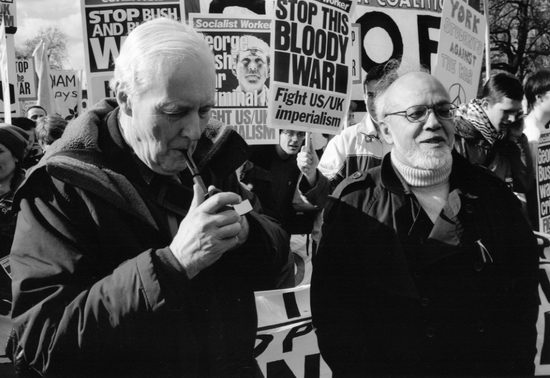
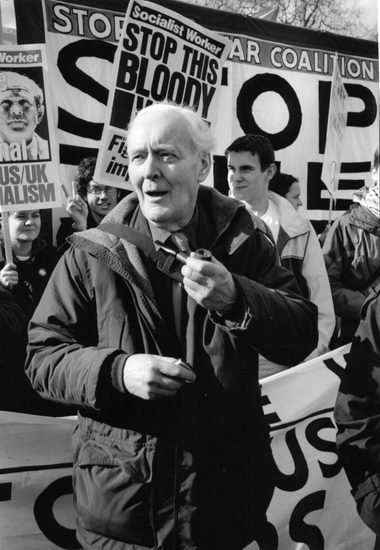
Tony Benn and Dr Siddiqui at Hyde Park
Iraq had ended work to produce biological, chemical, and nuclear weapons in the 1990s and most or all of its stockpiles had been destroyed. In November 2002 Saddam Hussein had allowed UN inspectors search Iraqi facilities for WMDs and they found none. The US alleged that Iraq had hidden them – and forged documents were produced about uranium. No WMDs were found during the US invasion and occupation of Iraq in 2003-2011 and US secretary of state Colin “Powell and George Bush eventually admitted Iraq had not had them.”
Stop The War – Hands Off Iraq – 2 Mar 02 – Park Lane
Despite then known facts, Tony Blair had decided to support the US invasion against the huge opposition from the British public. He and his government lied to parliament, most notably with the “Dodgy Dossier” and other documents. The dossier, “sexed up” by Alistair Campbell was largely plagiarised from a thesis by a graduate student at California State University, and contained many errors and unchecked statements, and contradicted much of actual evidence from intelligence sources. It should have ended the political career and any credibility for both.
PiccadillyTrafalgar Square
Back in 2002 I was working with both black and white and colour film, but it was difficult for me to digitise the colour work – and I only posted black and white images on My London Diary. I still have only digitised a few of the many colour images I made at that time.
Included in this post are all of the images I posted on My London Diary and below is the short text I wrote to go with them. The files are small and they were posted across several pages as many then still accessed the web on slow dial-up modems. They are reduced versions of the images I filed to my agency, made by scanning black and white prints.The original post is still online, but adds nothing to this post.
The Stop the War, Hands off Iraq demonstration on 2 March was a large sign of public opinion. People were still leaving Hyde Park at the start of the march when Trafalgar Square was full to overflowing two and a half hours later.
Police estimates of the number were risible as usual – and can only reflect an attempt to marginalise the significant body of opinion opposed to the war or a complete mathematical inability on behalf of the police.
Tony Benn told us it wasn’t worth taking his picture – “It won’t get in the papers unless I go and kick a policeman” but he didn’t and was quite right.
Courthouse Community Centre, 11, Garratt Lane, Wandsworth, 1990, 90-3b-42
This was built in 1858 apparently as one of the first courts under the 1846 County Courts Act and is Grade II listed.
It was alleged to be near-derelict in the 1970s when it was first Grade II listed and was handed over to Wandsworth Council, becoming a community centre for the Arndale Estate. Then it became the Wandsworth Museum but that was closed in 2008 to turn it into Wandworth Library. The museum was moved West Hill Library then closed in 2015. In 2014 the council decided to move the library and to sell or let the building . I think it is now offices.
Salvation Army Citadel, Ram St, Wandsworth, 1990, 90-3b-43
I crossed Wandsworth High Street and walked up Ram Street. stopping to take this view of the Salvation Army Citadel, built in 1907, but now replaced in 2008 by a more modern building. Doubtless a much more functional building its rounded lines have nothing of the military features of the old with its castellated tower.
The Wandsworth Gas Company gasholder is no longer visible. Gasholders such as this were still in use for storage and to regulate gas pressure for some years after the changeover to natural gas and the closure of our gas works. Once a common feature of our townscapes, most have now gone, with just a few of the guide frames of particular interest being listed and saved, some converted to contain flats.
I think this one was dismantled around 15 years ago, but at least until recently its base could be seen from the railway line to the north.
Gas Holder, Swandon Way, Wandsworth, 1990, 90-3a-54
A closer view of the gasholder which clearly shows the three sections which would be lifted up inside each other by the gas as more gas was pumped into the holder (and were known as lifts.) The first ‘telescopic’ gasholder was invented in 1824. This example was built in 1972 and was said to be the largest of its type in the UK. Gas was stored at only a little above atmospheric pressure
Gas Holder, Houses, Barchard St, Ram St, Wandsworth, 1990, 90-3b-44
Controversial plans were approved by Wandsworth council for the redevelopment of the gas works site to include a 29 storey tower – rather taller than the old gasholder. I think that the massive concrete base which held the water to seal the bottom of the gas holder is to be retained to save the huge environmental cost of its removal.
I rather liked the way the old gasholders – here and elsewhere – contributed to the townscape, and they were certainly local landmarks. But the Wandsworth Society and other objectors are correct to point out the main tower block of the development with a height of 29 storeys, “is quite ‘out of context’ next to the River Wandle. The site of the tower cannot be considered to be a ‘town centre’ site nor is it close to a ‘cluster’ of buildings of a similar nature. The application cannot be considered to ‘make a positive contribution to local character and context’“.
Gas Holder, Armoury Way, Wandsworth, 1990, 90-3b-31
A final picture of the gas holder.
Ram Brewery, River Wandle, Wandsworth High St, Wandsworth, 1990, 90-3c-12
The rest of the area north of the town centre has also seen massive redevelopment, though at least the major historic elements of the Ram Brewery have been retained – and now contain the Sambrook Brewery.
Here you can see one of the more modern parts of the brewery, which looked more like a chemical plant than how I imagine real beer being made.
The area is now covered by large bocks of around 4-7 storeys and I think the only thing visible in this image that remains is the brewery chimney. There is now a walk alongside the Wandle, but little of interest to see from it.
Ram Brewery, River Wandle, Wandsworth High St, Wandsworth, 1990, 90-3c-15
Young’s beers are now brewed by Carlsberg Marston’s Brewing Company in Bedford, though they have re-branded them to include London in their names.
River Wandle, Armoury Way, Wandsworth, 1990, 90-3b-32
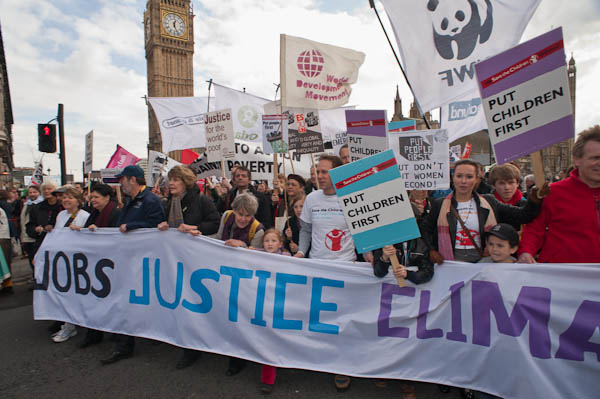
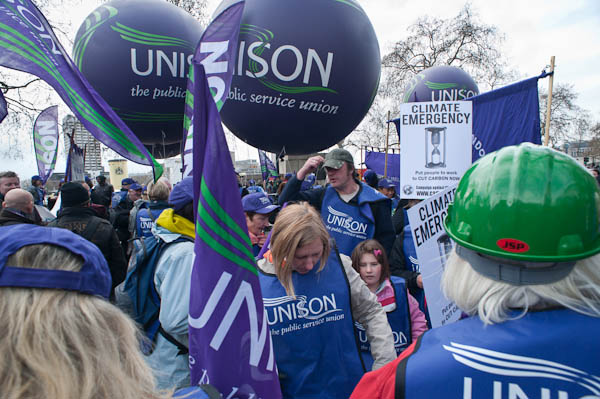
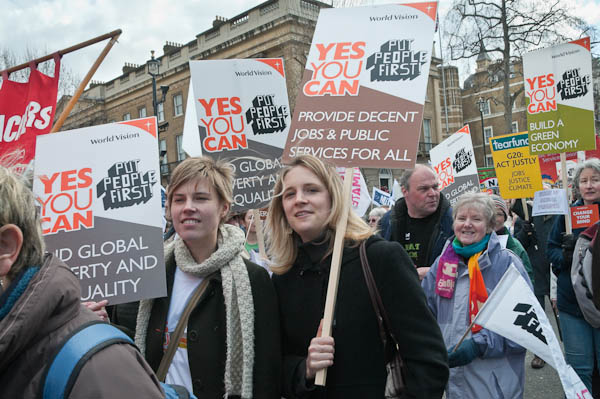
World leaders were to hold the G20 London Summit at the Excel Centre in Docklands beginning on April 1st (a date some thought highly appropriate), with the stated themes “Stability, Growth, Jobs“, and chaired by Prime Minister Gordon Brown. Countries and organisations taking part, included Argentina, Australia, Brazil, Canada, Chile, China, Ethiopia, France, Germany, India, Indonesia, Italy, Japan, Mexico, Netherlands, Russia, Saudi Arabia, South Africa, South Korea, Spain, Switzerland, Thailand, Turkey and the USA, as well as the European Union and organisations including the International Monetary Fund, World Bank and the World Trade Organisations.
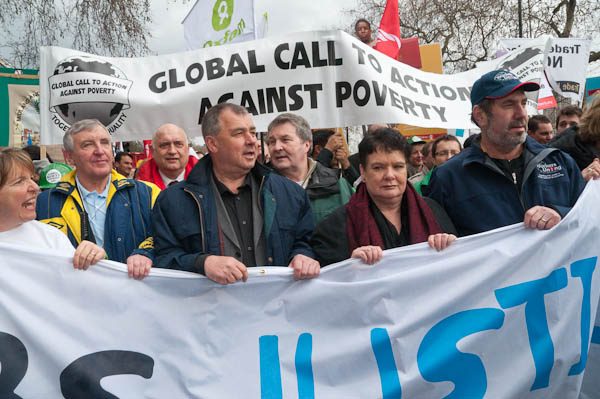
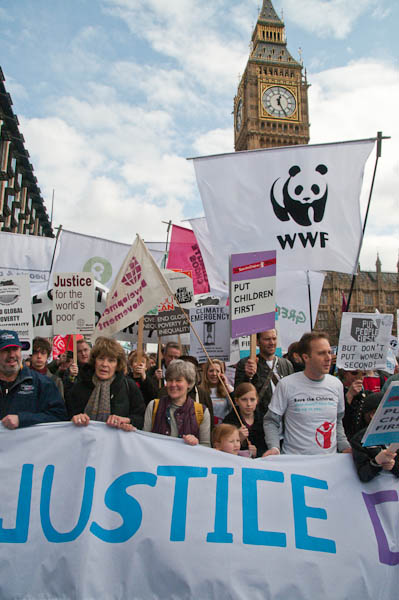
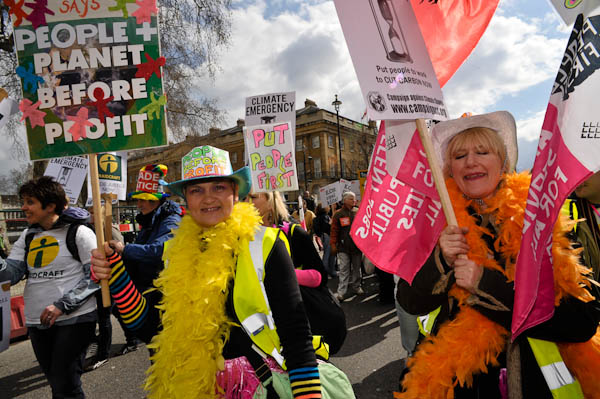
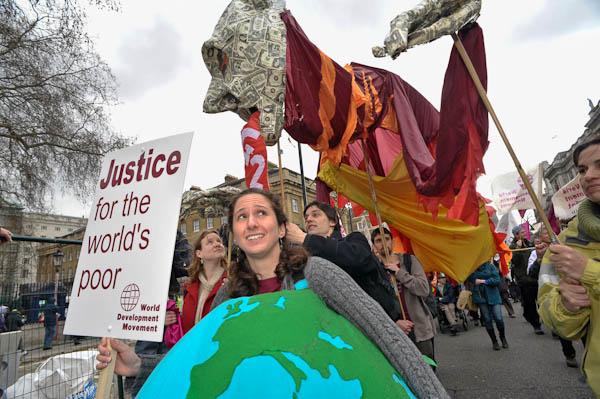
The ‘Put People First’ march was the first of several major demonstrations aimed at influencing the meeting and was backed by a very wide range of over 150 organisations, both from this country and abroad.
As well as trade unions, charities, and pressure groups there were also many other less organised groups and individuals.
Those marching were calling for a new approach to social justice for the world as a whole, and for urgency in action by world leaders not just to find a solution for the current financial problems, but to tackle the even deeper problems of global inequality and of climate crisis.
But the G20 went ahead very much to prop up the banks and financial institutions that had caused the financial crisis, though agreeing on the need for greater regulation, making none of the wider changes that this and other protests demanded. If anything it worsened those deeper problems.
Unsurprisingly it was a very large march with probably several times the official police estimate of 35,000 taking party.
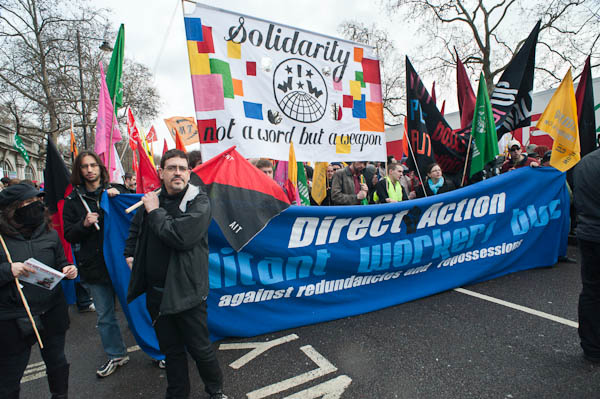
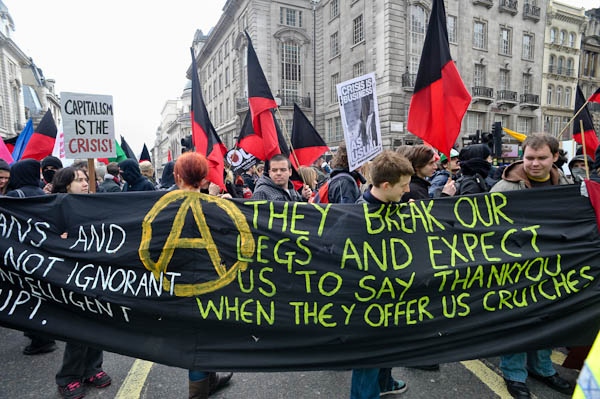
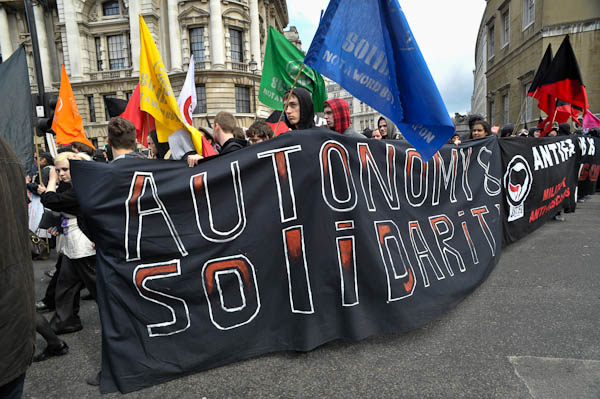
Most police attention was on a relatively small ‘autonomous’ block of around 800 people in the middle of the march which had a strong police escorted. They objected to the police behaviour, particularly very obtrusive photography by FIT teams and some sat down in the road blocking the march behind them for around half an hour.
Police had bullied the front of the march to set off at a cracking pace, hard for photographers to keep up with and the march soon spread out over much of the route.
I wanted to photograph as many of the marchers as I could, walking slowly and letting them go past me as they walked along the Embankment, up Bridge Street and Whitehall to Trafalgar Square. Then I rushed to get to the rally in time.
On My London Diary you can read more about the rally, and see pictures of many of the speakers. This protest was “a well ordered event with at times a carnival atmosphere, which made some of the police prognostications look rather silly.“
Politicicans and Businessmen are not ignorant – they are intelligent and corrupt. They break our legs and expect us to say thankyou when they offer us crutches
One of my fellow NUJ members filming the ‘autonomous’ block rally was stopped and searched, and he and others reported a mysterious ‘man in black’ rushing into this alternative rally and emptying half a dozen small tightly wrapped packages from a black bin bag at the bottom of the stepladder from which people were speaking before exiting rapidly stage left.
Someone kicked one of these packages open and found it contained a catapult, and all the packages were quickly kicked away under a fence into an area under maintenance behind the speakers. Around 20 minutes later, a policeman entered that area and collected the packages; the anarchists saw what was happening and rapidly dispersed.
As I ended my post on My London Diary: “Earlier in the week a police spokesman had given a widely broadcast media interview in which he predicted that there would be violence – and that some protesters would use catapults. It seems as if someone was determined to make this loony-sounding prophecy come true.”
Plumstead is a hilly place, rising quite steeply from the River Thames as I remember from my first visit to the area when still in short trousers, trudging up a long hill holding my mother’s hand to visit some distant relatives, whose names I no longer remember, nor exactly where they lived. Their back garden went up steeply behind the terrace house.
I don’t think it was this road was the one I walked up back then, but it was still hilly and you can see the houses going down on both sides and I think in the distance to trees and buildings on the other side of the river.
Park, Plumstead Common, Plumstead, Woolwich, Greenwich, 1994, 94-809-61
The previous picture was taken just a few yards from Winn’s Common, one of several areas also including Bleak Hill and The Slade which make up Plumstead Common. I think this is close to Lakedale Road and shows the foundations of a building with beyond it the rose garden in the next picture.
Park, Plumstead Common, Plumstead, Woolwich, Greenwich, 1994, 94-808-13
I made several other pictures on Plumstead Common, though I can’t remember exactly where on the common this was and can find no traces now of this sunken garden with walkways which must once have been covered by plants and flowers but seem to have left in a semi-derelict state, though there are still some rose bushes.
Here I deliberately tilted the panoramic camera to give a curved horizon rather than try to level it with a spirit level as I usually did, partly to include the lower edge of the bushes and small trees, but also to create a kind of enclosed space.
Across the common is a pub, the Woodman, one of the 5 Plumstead Common Idlers, ‘the Woodman who never felled a tree’ at 35 The Slade.
“The Star which doesn’t shine in the sky, the Woodman who doesn’t cut down trees, the Ship that cannot sail the seas, the Mill which doesn’t grind corn, and Who’d a Thought it!”
Radnor Crescent is some distance to the east on the edge of Winn’s Common and I’m not sure exactly which direction I was looking to make this picture, perhaps looking towreds Shooters Hill.
Waste Land, Woolwich Church St, Woolwich Ferry, River Thames, Woolwich, Greenwich, 1994, 94-807-42
From here I walked to Woolwich and the Woolwich Ferry. More pictures from Woolwich in a later post.
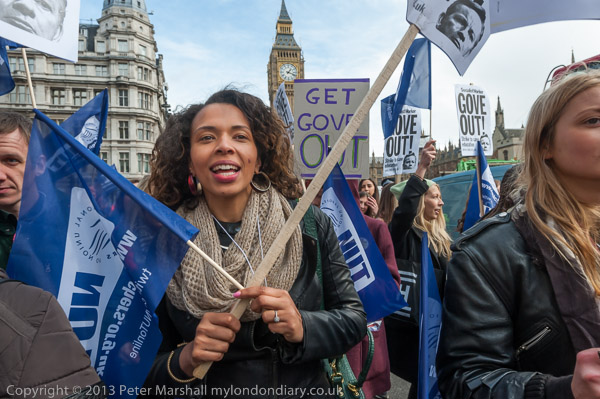
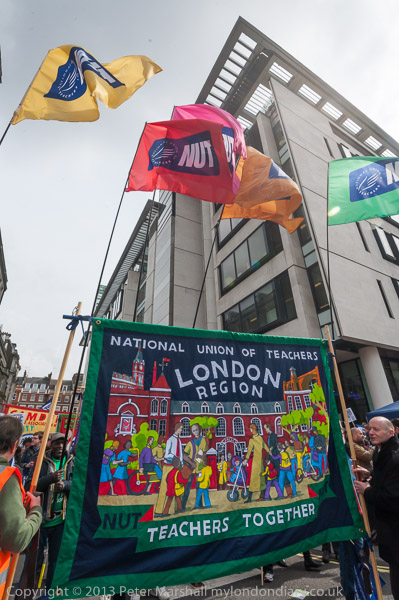
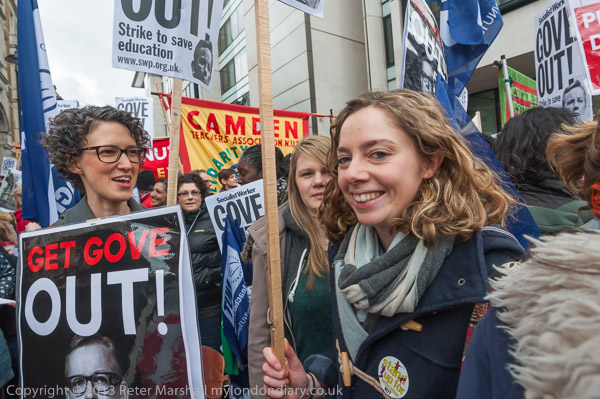
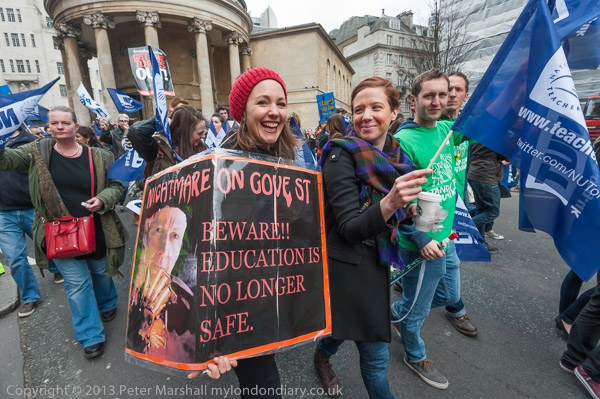
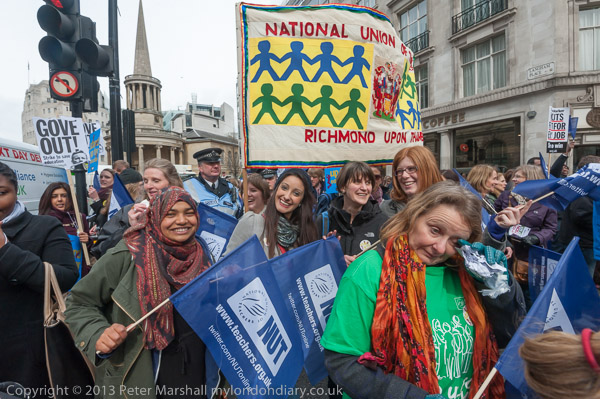
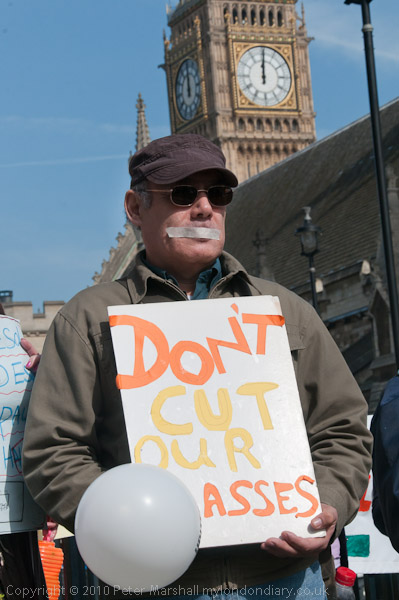
Teachers march past Parliament on their way to a rally at Central Hall Westminster
In 2024 Dr Stephen Burley wrote in ‘School Management Plus’ “The impact of the Govian education reforms has been unremittingly negative. Content heavy GCSEs have squeezed Key Stage 3, with many schools using Year 9 to cover over-burdened specifications. The EBacc, in the state sector, has devastated uptake in the creative and technical subjects, with music and DT fairing worst. Learning has narrowed to focus much more on memorisation as students cram for final exams.”
Those reforms were only a part of his ill conceived actions as Education Minister which included a rapid expansion of academies and multi-academy trusts and the introduction of ludicrous changes to the curriculum – such as ‘fronted adverbials’. He probably would have liked to see all those primary children seated in neat rows going through those ‘times tables’ as I spent so much time doing in the 1950s – and actually stated they should be learning the names and dates of the Kings and Queens of England.
He seldom if ever missed an opportunity to denigrate the work of dedicated teachers and clearly showed a fundamental distrust for the views of teachers and educationalists, relying instead in the strange and unsupported advice of a few often working outside their areas of academic competence.
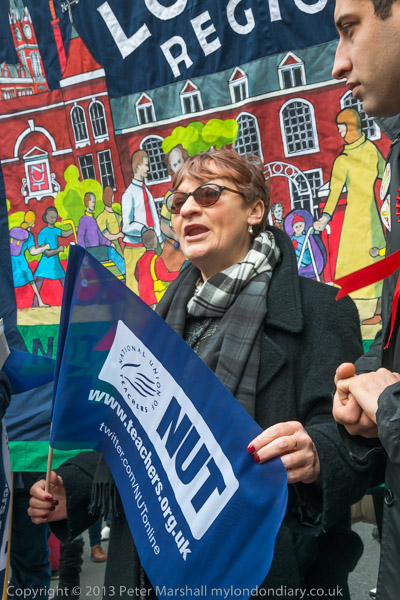
Christine Blower, NUT General Secretary
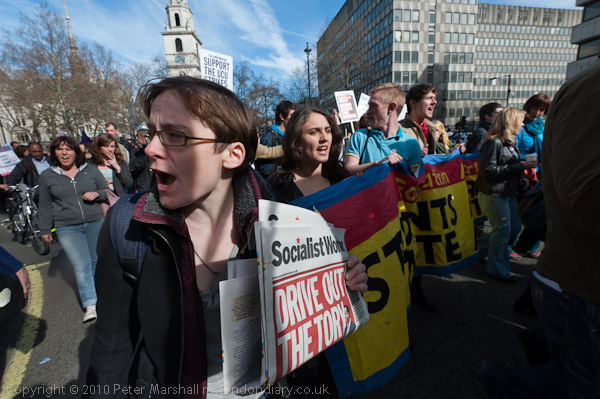
The strike on 26th March 2014 came after Gove continually refused to engage in meaningful discussions with the unions over the changes his department is pushing through over pensions, performance related pay and the dismantling of a national pay structure.
I was fortunate to have left teaching after 30 years well before Gove and in my last years to teach mainly on courses not approved by the Ministry of Education (Ofsted inspectors didn’t come to judge my teaching but had to request my permission to observe and learn) and to teach other courses that were largely or entirely teacher assessed where students learnt by doing and creating rather than regurgitating.
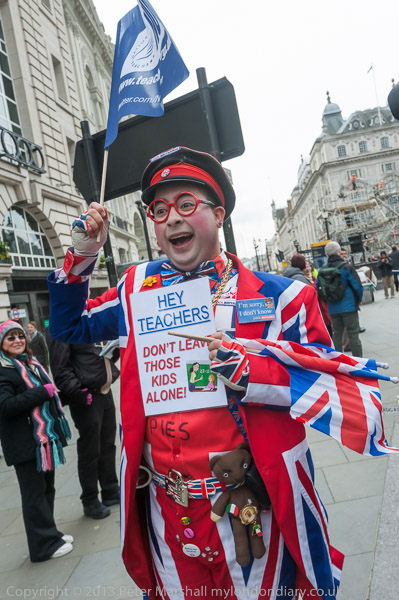
Thousands came to London on their stike day, March 26th 2014 calling for Gove to resign or his attacks on their pay, pensions, conditions and job security and his denigration and undermining for their professional status, and I felt a great deal of empathy with them.
Abolition of the Slave Trade Act: Bicentenary. Events on Sunday 25th March 2007 commemorated the 200th anniversary of the passing of an Act of Parliament to end the slave trade. The previous day I had photographed a Church of England walk of witness to mark the abolition, but on Sunday I covered events in Brixton and Clapham. Sunday was the actual anniversary of the Act which marked a change from Britain being a major partner in the slave trade to opposing slavery worldwide, though it was not until 26 years later in 1833 that slavery was abolished throughout the British Empire. The text below is basically what I wrote in 2007 accompanied by a few of the pictures I made.
Abolition of the Slave Trade Act: Bicentenary
There is no escaping that all of us who live in Britain – whatever the colour of our skin or our personal history – are now benefiting from the proceeds of the trafficking of African people and their forced labour in our colonies over around four centuries. Fortunes made from slavery helped to build many of the institutions from which we still benefit, including our many of our great galleries and museums. Slavery founded many of our banks and breweries and other great industries, and made Britain a wealthy nation.
But it is also true that the same wealthy elite that treated Africans so callously exploited the poor in Britain. My ancestors were thrown off their land and probably some were imprisoned for their religious beliefs by these same elites. Almost certainly my forebears were a part of the movement that campaigned against slavery and called for an end to the trade in human beings, although equally certainly they had little or no political power at the time, and probably no vote.
Of course that in no way diminishes the horror of the trade, but it does colour my personal attitude to the celebrations of the 200th anniversary of the abolition. The abolition movement was an important turning point in the history of our empire and the world leading to the act banning the trade in people and later in 1833 the abolition of slavery throughout the British Empire. The abolition movement changed Britain from being a country that enslaved millions in its own colonies to one that opposed slavery worldwide.
Slavery of course still exists, even in Britain, and we still need to oppose it in all its forms. Much of present day slavery here only flourishes because of our current immigration policies and their implementation, which makes many immigrants illegal, and impoverishes them, denying them human rights or making them afraid to claim them.
Clapham Commemoration Walk
One of the three groups at the probable site of the African Academy
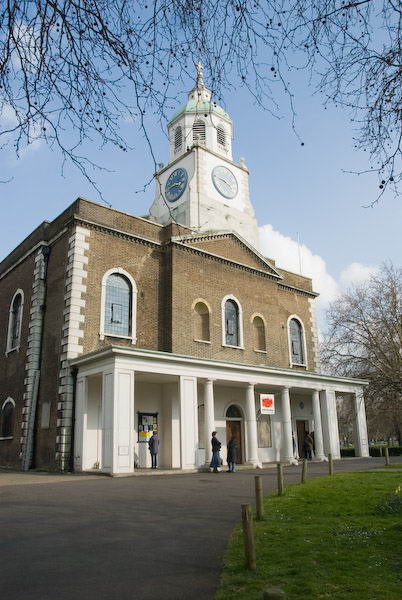
For the 200th anniversary of the passing of the Slave Trade Act on 25 March 2007, I went to Clapham, the spiritual and physical home of the abolition movement, where the London Borough of Lambeth had organised a commemoration walk. This started at Holy Trinity Church, where the Clapham Sect at the centre of the movement, including William Wilberforce, Granville Sharp, John and Henry Thornton, John Venn, Zachary Macaulay and others had worshipped.
Holy Trinity, Clapham, the home of the Clapham Sect
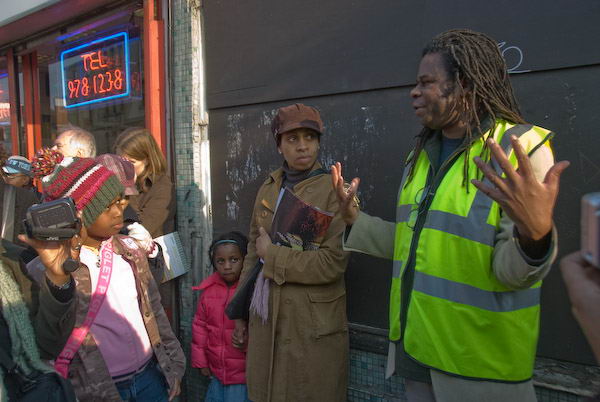
Steve Martin, our guide for the walk emphasised that Clapham was also home to many who had made fortunes from the trade and opposed the abolition, with both sides worshipping in the same parish church.
Nearby, at 5 The Pavement, now occupied by an ‘Evans’ shop, an LCC plaque marks the home of Zachary Macaulay, and also of his more famous son, Lord Macaulay.
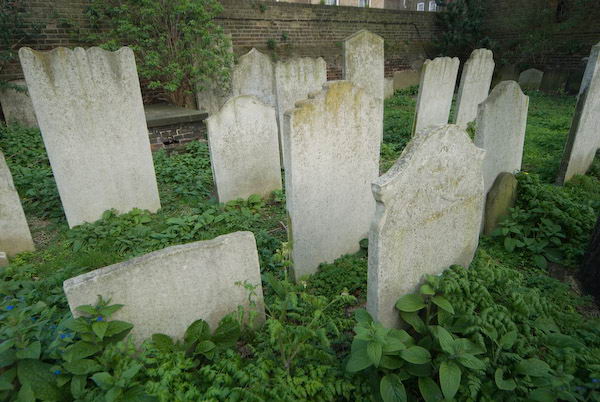
Zachary was a former plantation manager in Jamaica and governor of Sierra Leone who had become an abolitionist. As a part of a project to return freed Africans to Sierra Leone he brought 21 boys and 4 girls back from Sierra Leone and set up an African Academy in Clapham to educate them to return to run their country. The walk took us to two possible sites for this school, as well as to a nearby church cemetery, as unfortunately many of them died of measles and were buried there.
Measles killed most of the African students who were buried in this churchyard.
Down Matrimony Place we came to Wandsworth Road, and turned along it to a former brewery and the pub next door. One local family that had made considerable fortune from plantations worked by slave labour were the Barclays (later they became abolitionists and freed their slaves much to the anger of other plantation owners.) When they sold their plantations, the money went into businesses including breweries and banks.
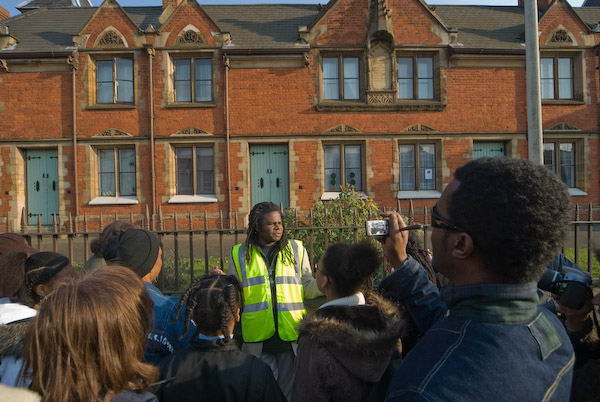
At the Hibbert Almshouses
One of those most prominent in the campaign against abolition was George Hibbert, chairman of the West India Dock Company which profited hugely as the slaving ships brought back the produce of the plantations to London. The Hibbert Almshouses on Wandsworth Road were built to house elderly poor residents of Clapham by his two daughters.
At the end of the walk there was some argument about whether the Tate fortunes depended on slavery
As we turned back up towards Clapham Common, Steve informed us that the street along which we walked had been built on what were once the back gardens of the houses of these wealthy traders in human beings who lived in the extensive houses facing the common on Clapham Northside. The tour ended outside no 29, once the home of George Hibbert (Robert Barclay lived next door at 31), a couple of hundred yards from Holy Trinity, where our walk had started.
Across the middle of the Clapham Common is of course a dividing line – between the London boroughs of Lambeth and Wandsworth. It would have prolonged our walk to take in the plaque to Wilberforce in Broomwood Road (Broomfield where he lived was demolished in 1904) or to Battersea Rise, the ‘home’ of the Clapham Sect where he lived earlier with his friend and fellow MP Henry Thornton (the house there was demolished in 1908 despite a campaign and public appeal to save it because of its connection with the abolition movement.)
I could find no mention of the bicentenary on the London Borough of Wandsworth site, although the mayor was to attend a church service at All Saints organised by the local churches on 31 march. One of the bas-reliefs on Wandsworth Town Hall shows Wilberforce with the act in his hand, next to Macaulay. Rather to my surprise I found Wandsworth Museum, instead of celebrating its contribution to abolition, was currently showing a Museum Of London travelling show, ‘Queer Is Here’ which in their words included “Peter Marshall’s dynamic black and white photographs capturing a decade of the annual London gay pride event” – which you can still see on line on My London Diary.
Brixton Commemoration – Windrush Square
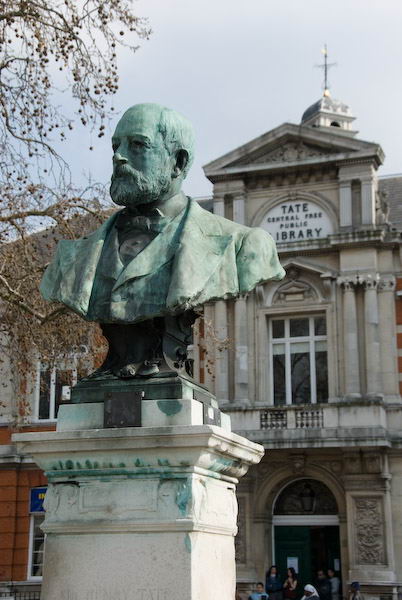
Earlier in the day I’d been at another Lambeth event, in the centre of Brixton, outside the Tate Library.
At the end of the Clapham walk there had been a fairly intense argument about whether Tate’s sugar fortunes had come, at least in part, from slave labour on Brazilian plantations after the abolition in the British Empire.
Sozo House of Praise Gospel Choir performing.
Organised by the Brixton Society, the commemoration of the abolition took place next to Windrush Square and the site of the proposed Black Cultural History Centre in Raleigh Hall. It was opened by an African drummer and singers from the Sozo House Of Praise gospel choir. There were then some speeches mainly concerned with commemorating the abolition of slavery from the Mayor of Lambeth, Cllr Liz Atkinson, local MP Keith Hill, and Superintendent Paul Wilson for Metropolitan Police in Lambeth.
A woman with a remarkable record as a foster parent speaking
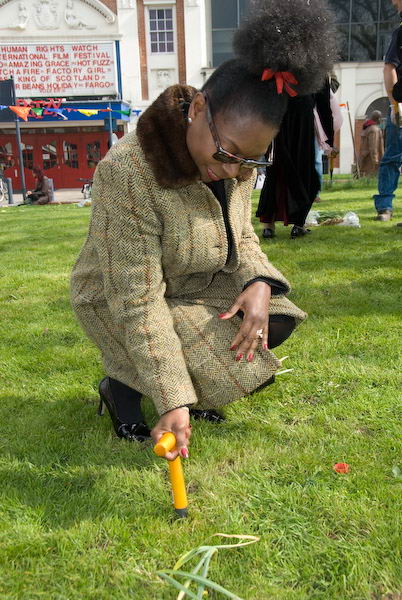
Those present were then invited to plant bulbs in the grass as a permanent memorial, after which Rev Stephen Sichel of St Matthew’s with St Judes across the road led prayers.
Dr Floella Benjamin, OBEplants a bulb
Norma Williamson, the treasurer of the Brixton Society introduced a the next section celebrating the contribution of those of Black Afro-Caribbean origin to life and culture in Britain now. Floella Benjamin, OBE gave a very powerful address particularly stressing the need for black kids to get educated to empower themselves. It was a hard act for Derrick Anderson, CBE, Lambeth’s chief executive, and Devon Thomas, the chair of Brixton Business Forum to follow.
Linda Bellos, former leader of the Labour group on Lambeth council, but rejected by the party as a candidate for a local parliamentary seat gave another powerful performance, putting the issue strongly into its political perspective. Power isn’t just about race, it’s also about class, and gender. The event closed with more fine gospel singing from the Sozo House Of Praise choir.
ESOL, Libya & UCU: On the morning of Thursday 24th March 2011 hundreds of students and teachers portested against cuts to English lnaguage courses for speakers of other languages. Then at lunchtime Libyans came to Downing Street to thank David Cameron for air strikes against Gaddaffi’s forces in Libya. Finally in the afternoon I photographed a march to Parliament by University and college lecturers from the London region protesting over pensions, jobs and pay,
ESOL Day of Action
Old Palace Yard & Downing St
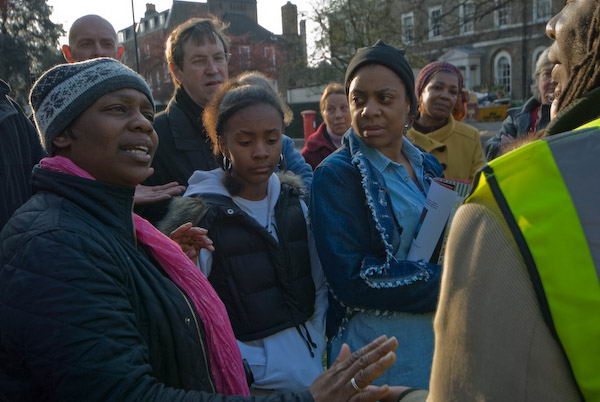
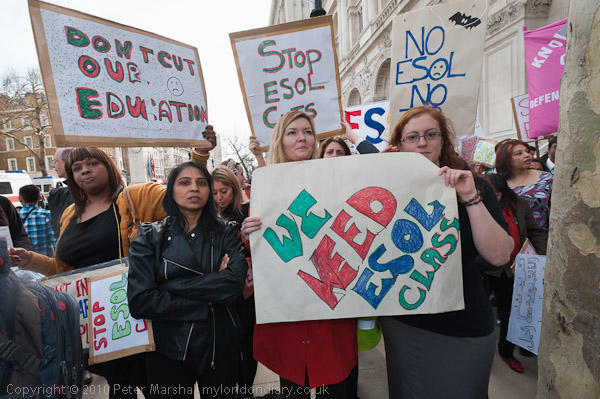
ESOL students and tutors crowd outside Downing St
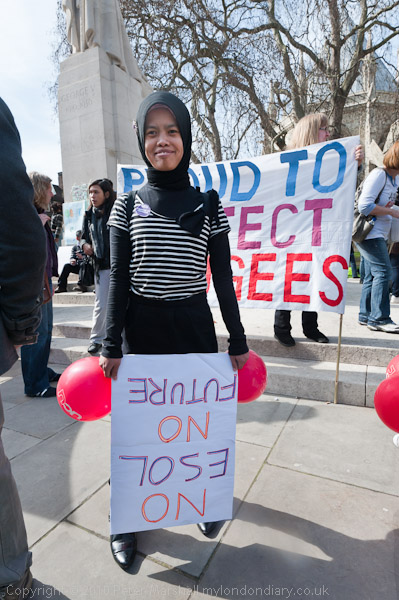
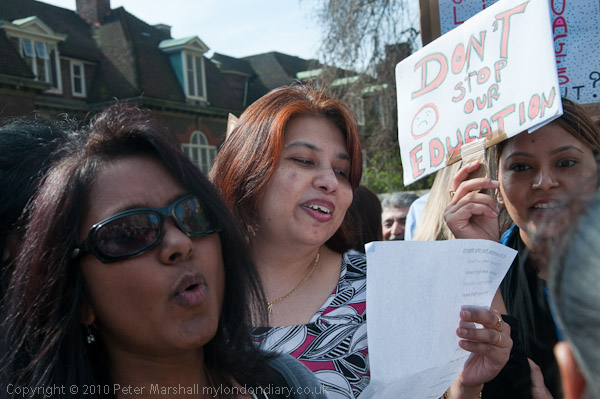
Several hundred ESOL (English for Speakers of Other Languages) students and tutors from colleges across London, including Lambeth, Hackney, Barnet, Tower Hamlets and Greenwich came to a rally opposite Parliament as a part of a nationwide day of protest against government cuts in these courses.
There were similar protests taking place in Birmingham, Brighton, Bristol, Halifax, Leeds, Newcastle, Nottingham, Rochdale, Sheffield and Warwickshire.
ESOL courses provide an essential service for “many asylum seekers and refugees. ESOL is essential for integrating refugees into the community here and enabling them to contribute fully to British society.”
The cuts were expected to mean that around 70% of current students would be unable to complete their courses and roughly the same proportion of classes across the country would close. The closure would particularly impact women who were the majority of students.
Cuts in ESOL funding have continued since 2011, making it now difficult or impossible for many recent migrants to access courses. Some Reform UK-led local authorities are now cutting these course completely.
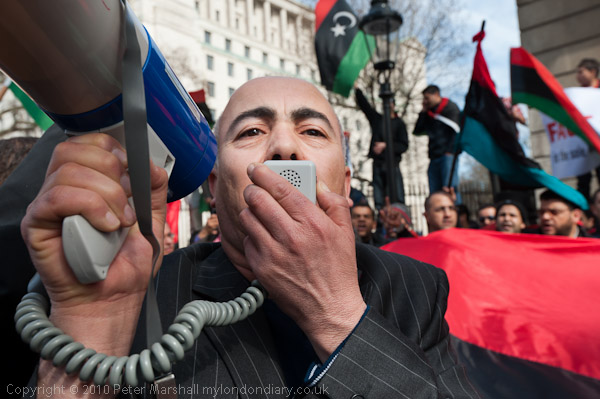
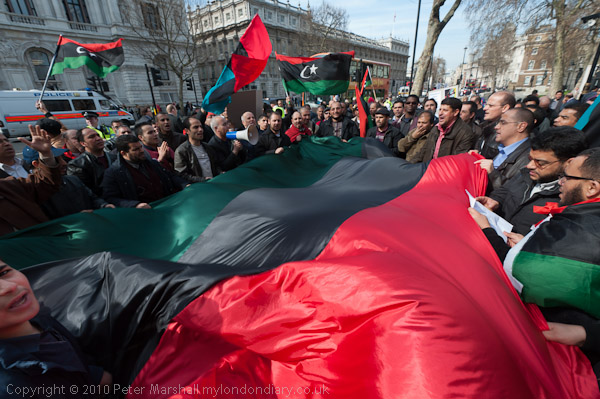
Libyans chant praise for Cameron prodding the UN into action
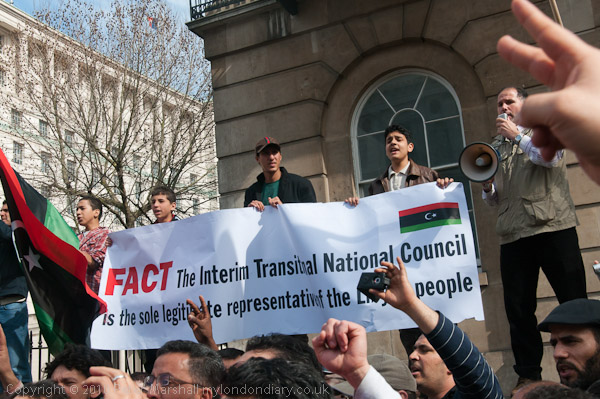
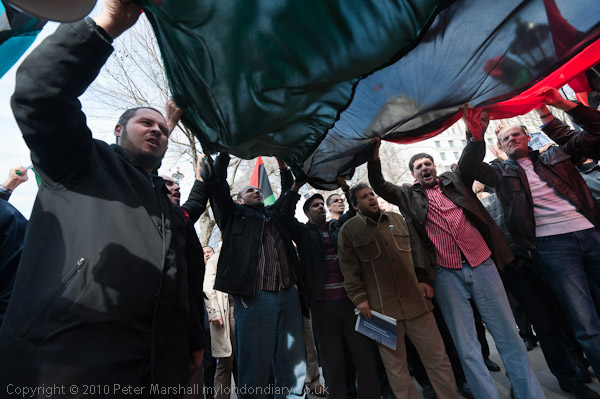
It was highly unusual for a protest to come to Downing Street to praise the Prime Minister for his actions, but around 500 Libyans were there to give thanks to David Cameron for the air strikes against Gadaffi’s forces and his leadership in establishing a ‘no-fly’ zone.
Gadaffi was of course a highly controversial figure in Libya. Supporters praised him for “combating homelessness, ensuring access to food and safe drinking water, and to dramatic improvements in education” and great improvements in medical care including a free and universal medical system. He had also done much to improve the status of women, though keeping the “sexes as “separate but equal”.’
But there was also a considerable downside, with the persecution of non-Arab Libyans, and human rights abuses. He alienated many by largely eliminating private businesses and imposed censorship. Under him Libya had no free press and no trade unions. And under him the system was highly corrupt and unemployment was high.
His brutal clampdown on protests inspired by the Arab Spring led to an uprising and the formation of the Benghazi-based National Transitional Council which this protest was supporting. Two weeks before this event France had recognised this as the “legitimate representative of the Libyan people” and Britain together with France was urging Europe to do so.
The UN had already suspended “Libya from the UN Human Rights Council, implementing sanctions and calling for an International Criminal Court (ICC) investigation into the killing of unarmed civilians” the previous month and had declared a “no-fly zone to protect the civilian population from aerial bombardment”.
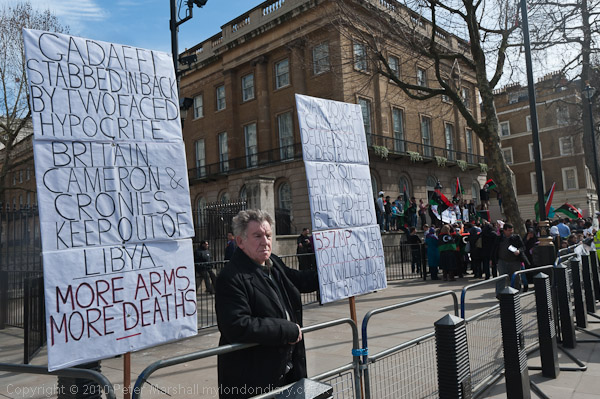
One lone protester called for an end to attacks on Libya
NATO went further and as well as enforcing this also carried out air strikes. Its actions are thought to have enabled the enabled the NTC – whose forces like Gadaffi’s also “disregarded the laws of war, committing human rights abuses, including arbitrary arrests, torture, extrajudicial executions, and revenge attacks” – to defeat Gadaffi.
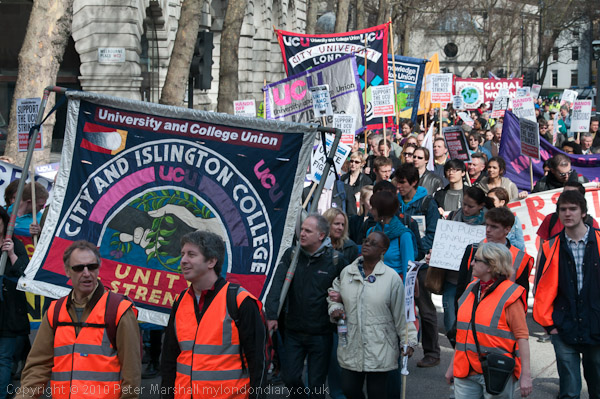
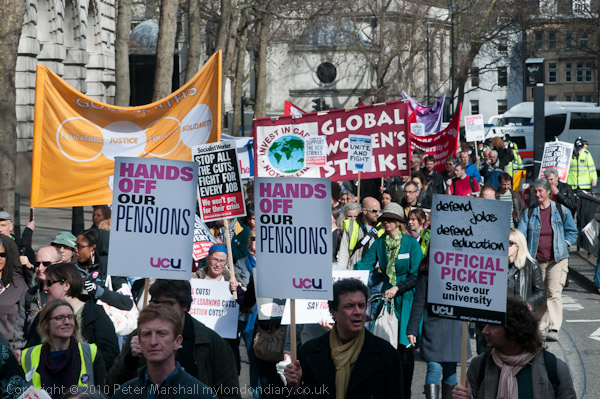
University and college lecturers had received derisive pay offers in 2010 and 2011 meaning a cut in real wages allowing for inflation of 8-10%, and those from colleges in and around London marched to Parliament to protest over pay, job cuts and pensions.
Government was threatening cuts of up to 40,000 jobs in higher education and lecturers were worried that there might be large increases in student course fees that would deter many students.
They were also angered by government claims that their pensions were ‘gold plated’ – they are actually much less generous than the government’s lies – and proposed changes to the system.
Statistics also show that lecturers are paid much less than those with similar qualifications working in private industry. And they criticise the perception encouraged by our billionaire-owned press that they enjoy lengthy holidays as college terms are short.
Lecturers around the country were taking part in a one-day strike and the march by UCU London Region was one of many events around the country.
Central Hill & Vigil Against Terror: On Thursday 23 March 2017 tenants and supporters from the Central Hill estate in Crystal Palace came to a Lambeth Council Cabinet Meeting to protest against the proposed demolition of their estate. Later I went to Trafalgar Square to a vigil following the terrorist attack in Westminster the previous day.
Stop Central Hill Estate Demolition
South Lambeth
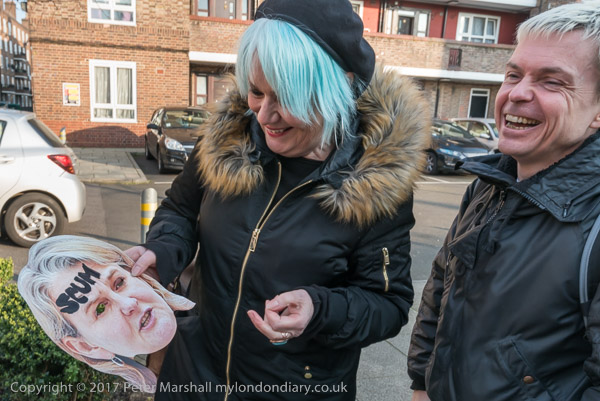
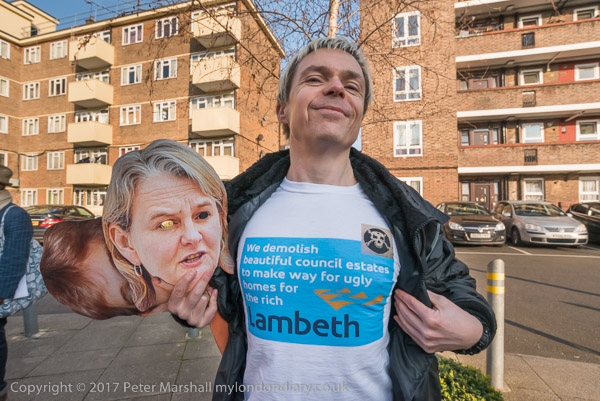
Jane Nicholl holds a mask of Lambeth Council Leader Liz Peck calling her SCUM
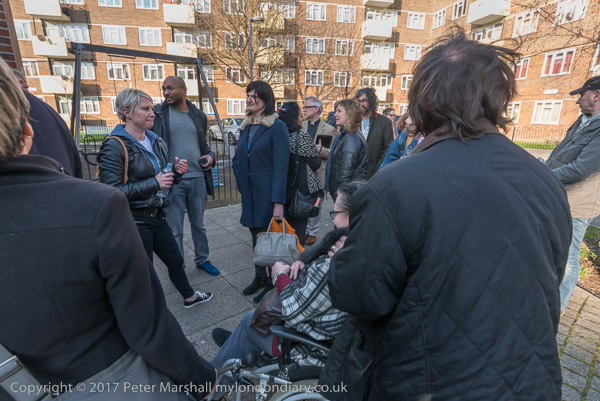
Central Hill is one of the finest council estates in London with around 450 homes built in 1966-74 on a hillside with views of London. I’ve photographed it on several occasions including in 2016, and was astounded when I heard of Lambeth’s plan to demolish it.
This is an estate that should certainly have been listed for its architectural merit but was refused I think on political grounds – as was Robin Hood Gardens in Poplar. Although in need of some refurbishment it is basically a a good condition and would last for many more years.
The council say that by demolishing the estate and working with a private developer they can put around twice as many homes on the site, though most of these would be for sale or market price rents rather than social housing.
Central Hill residents gather outside the community centre where the council are meeting
A report by Architects for Social Housing, Central Hill: A Case Study in Estate Regeneration, includes not only their “designs for the estate’s refurbishment and increase in housing capacity by up to 50 per cent without the demolition of a single existing home, but also our account of why and how these proposals were rejected by Lambeth council, which – despite being opposed by 77 per cent of the residents – in March 2017 announced its intention to demolish Central Hill estate.”
The residents had brought with them to present to the council the survey of 322 households which showed 79% of all residents were against demolition and favoured a programme of refurbishment. The survey completely contradicted the council’s assertions.
Sid shows off his T-shirt with an amended Lambeth Council mission statement: ‘We demolish beautiful council estates to make way for ugly homes for the rich – Lambeth’
I left before the meeting, but was told the councillors refused to listen to the arguments put forward by the residents and approved the decision for demolition without any real consideration. Residents and activists say the council seems to have no interest in providing housing for its current residents but is simply hoping to share in the profits of private development – and the financial opportunities this will provide for some councillors and officers.
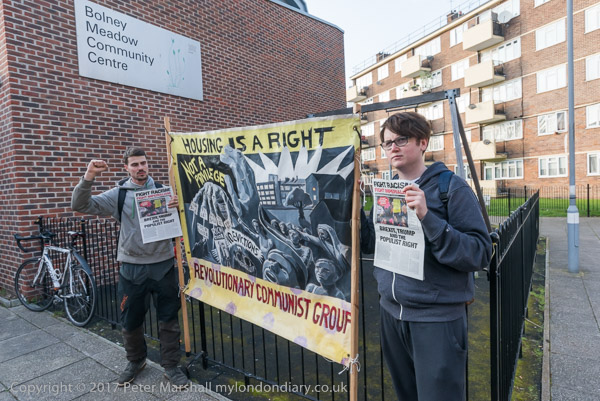
The Revolutionary Communist Group pose with their ‘Housing is A Right’ banner outside
Protests continued and the Central Hill estate is still there eight years later, although some facilities have closed. On Lambeth Council’s web site it states “We are undergoing the Options Appraisal process for your estate from July 2024. The process is now estimated to complete in late 2026.”
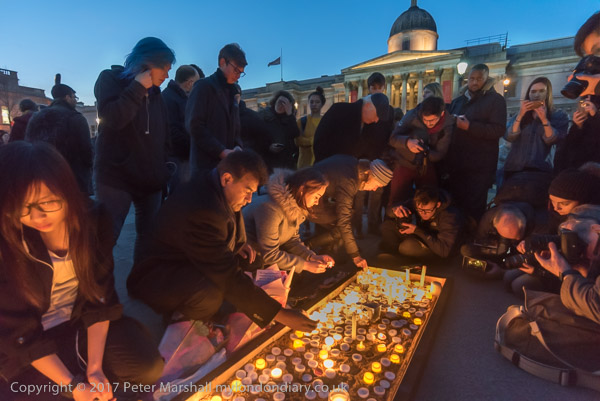
After the speeches people lit candles in the square
Thousands of Londoners including many Muslims had come to the vigil called by London Mayor Sadiq Khan to show their respect for those killed and injured in the terror attack the previous day.
Six people including the attacker died, and at least 50 people were injured when a terrorist drove a car into pedestrians on the pavement along the south side of Westminster Bridge and Bridge Street before crashing into the fence around the Houses of Parliament and jumping out to fatally stab a police officer before being himself shot and killed.
There were speeches by police, the Home Secretary and the Mayor and then a minutes silence. Three large candles on the steps were lit and people in the crowd also lit candles, bringing them to place with others as dusk fell.
Society of Friends, Quakers, Wandsworth High St, Wandsworth, 1990, 90-3b-62
My view here today would be very similar. The norices have chanted and at left there is now a large sign QUAKER MEETING HOUSE over much of the area where you can just make out a bricked up window. Even the sign for WINDOVER PIANOS – GRAMOPHONE RECORDS MUSIC – STRINGS AND SMALL GOODS – CASH OR EASY TERMS remains, though perhaps a little less visible. Then and now it is over a branch of William Hill. The bracket for a hanging sign remains empty, but the gatepost at left has gone – replaced further back for a new gate.
The Grade II listed Quaker Meeting house was built in 1778 but later enlarged and this frontage dates from 1927 with later alterations. It is the oldest Quaker Meeting House in London. Unlike much of the old High Street it survived the widening of the road, now a busy part of the South Circular.
Palace Theatre, Gaumont, For Sale, 52, Wandsworth High Street, Wandsworth, 1990, 90-3b-63
The Palace Theatre was a pupose-built cinema, architect John Stanley Coombe Beard (1890-1970) who designed many cinemas around London. It opened in 1920 and in 1958 was renamed The Gaumont, closing in 1961 and becoming a bingo club and then a church. For sale when I made this picture it was bought for use as a night club, The Theatre. It now has columns at each side of the entrance and houses a gym.
The Brewery Tap, Ram Brewery Tap, Wandsworth High Street, Wandsworth, 1990, 90-3b-64
Now called The Ram, this fine 1883 pub building on the corner of Ram Street and with a ram above its doorway at at 68 Wandsworth High Street was still in 1990 the brewery tap for the Ram Brewery. Beer has been brewed here since 1533 and from 1831 by 2006 Young’s & Co who moved out to Bedford.
When I last visited a year or two back the tradition was being continued in the Ram Brewery, now Sambrook’s Brewery – and you can go on tours, even make your own beer there, though I simply enjoyed the Sambrook’s Brewery Wandle, first brewed there in 2008.
You can see the brewery behind the pub in my picture and to the left. This Grade II* building is now ” a premium boutique bowling venue, including traditional bowling, duckpin bowling, electronic darts and shuffleboard under one roof.”
Borrodaile Rd, Wandsworth, 1990, 90-3b-66
I turned south down Garratt Lane and wnet donw an alley leading to The notice tells us that this “122 luxury one and two bedroom flats set in courtyard development, with private parking”, but those were yet to come.
Linstone Court looks to me like 1960s council flats, though many will have been bought under ‘right to buy’ and sold on.
River Wandle, Mapleton Rd, Wandsworth, 1990, 90-3b-51
The River Wandle, once an important industrial river, flows underground though the large Southside Shopping Centre south of Wandsworth High Street. I had come down Garratt Lane mainly to see the river upstream from there.
This was the view downstream from Mapleton Road with Wandsworth Medical Centre on the right.
River Wandle, Mapleton Rd, Wandsworth, 1990, 90-3b-52
And I think this is the view upstream from the same bridge or possibly the next bridge upstream. There has been considerable building around this area since 1990.
Ram Brewery, Wandsworth High Street, Wandsworth, 1990, 90-3b-41
I walked back up Garratt Lane to Wandsworth High Street and made another picture of the Ram Brewery, with its Ram on the weathervane. Then I walked back to Garratt Lane where the next post on this walk will begin.