Jobs Justice Climate – 2009

Put People First: Jobs Justice Climate

Embankment to Hyde Park
Jobs Justice Climate - 2009

World leaders were to hold the G20 London Summit at the Excel Centre in Docklands beginning on April 1st (a date some thought highly appropriate), with the stated themes “Stability, Growth, Jobs“, and chaired by Prime Minister Gordon Brown. Countries and organisations taking part, included Argentina, Australia, Brazil, Canada, Chile, China, Ethiopia, France, Germany, India, Indonesia, Italy, Japan, Mexico, Netherlands, Russia, Saudi Arabia, South Africa, South Korea, Spain, Switzerland, Thailand, Turkey and the USA, as well as the European Union and organisations including the International Monetary Fund, World Bank and the World Trade Organisations.
Jobs Justice Climate - 2009

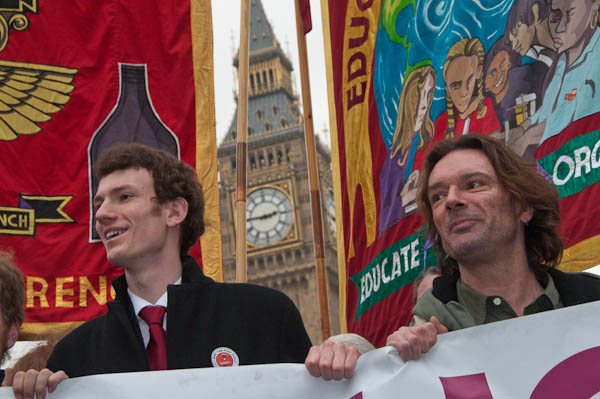
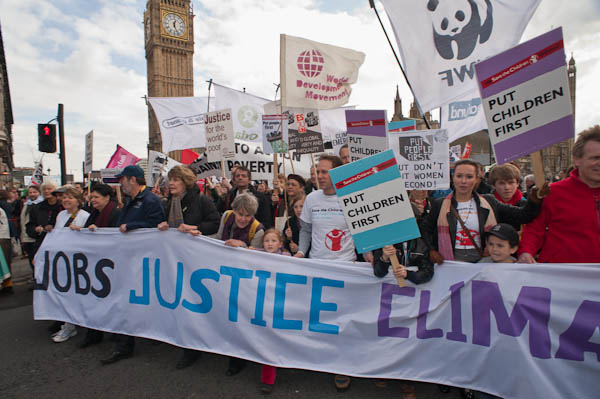
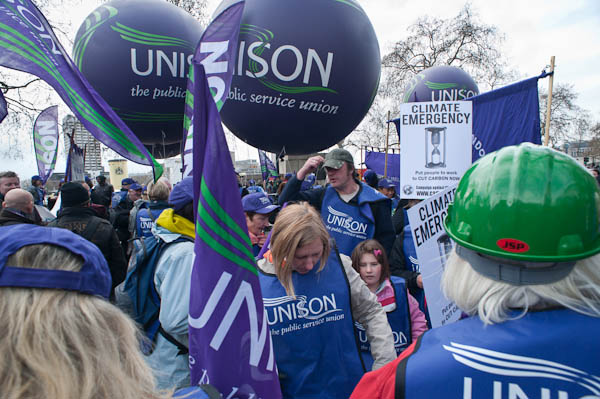
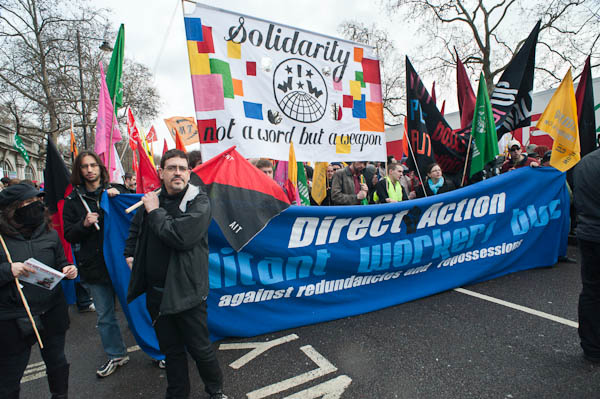
The ‘Put People First’ march was the first of several major demonstrations aimed at influencing the meeting and was backed by a very wide range of over 150 organisations, both from this country and abroad.
Jobs Justice Climate - 2009

As well as trade unions, charities, and pressure groups there were also many other less organised groups and individuals.
Jobs Justice Climate - 2009

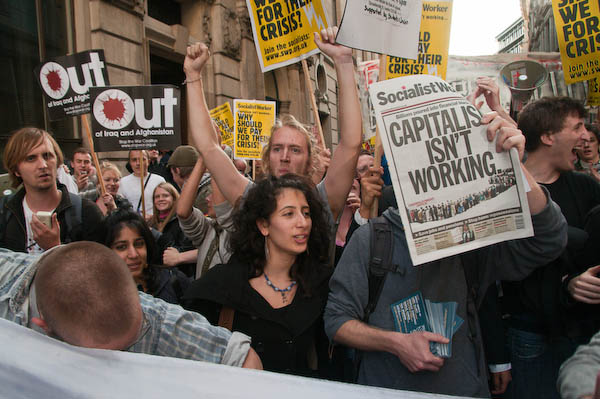
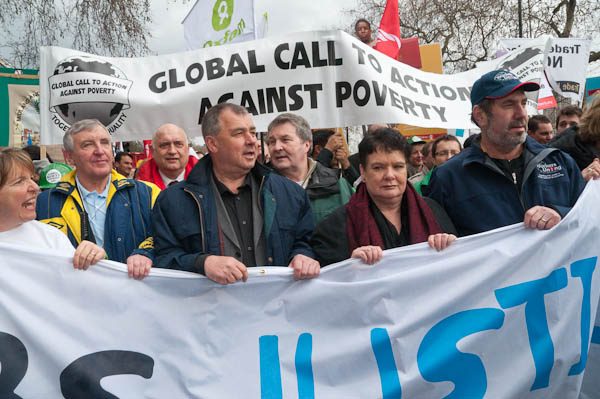
Those marching were calling for a new approach to social justice for the world as a whole, and for urgency in action by world leaders not just to find a solution for the current financial problems, but to tackle the even deeper problems of global inequality and of climate crisis.
Jobs Justice Climate - 2009

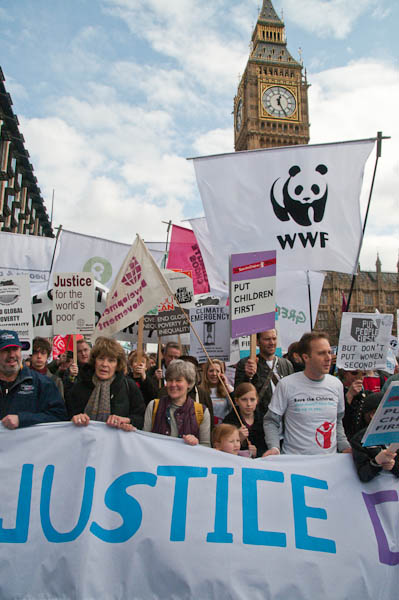
But the G20 went ahead very much to prop up the banks and financial institutions that had caused the financial crisis, though agreeing on the need for greater regulation, making none of the wider changes that this and other protests demanded. If anything it worsened those deeper problems.
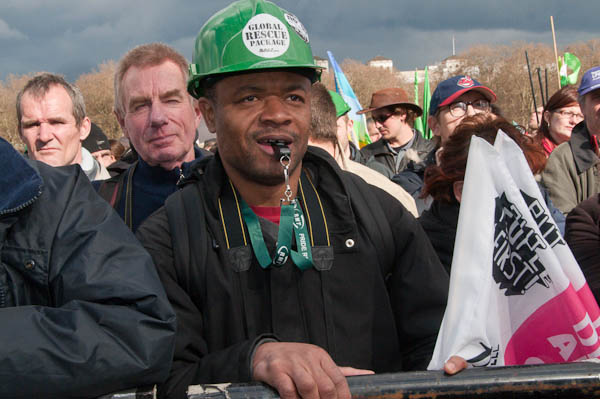
Unsurprisingly it was a very large march with probably several times the official police estimate of 35,000 taking party.
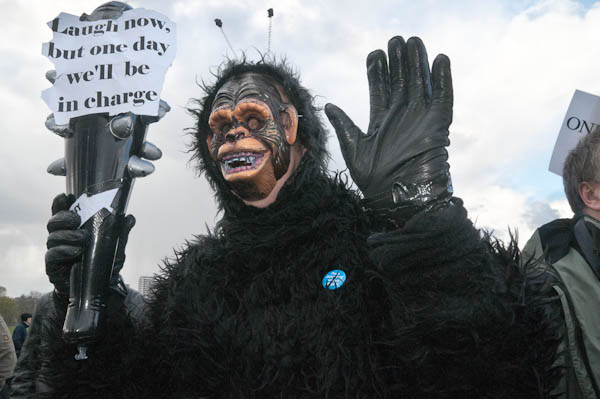
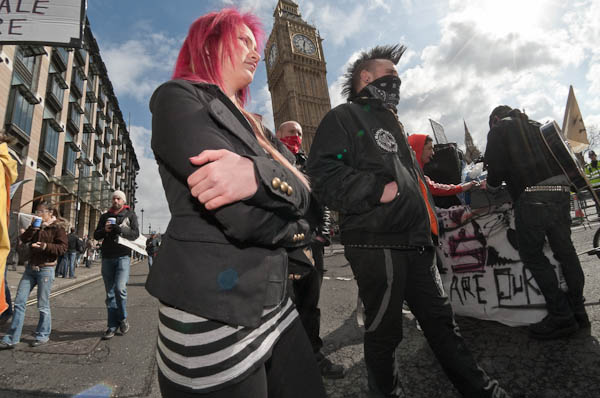
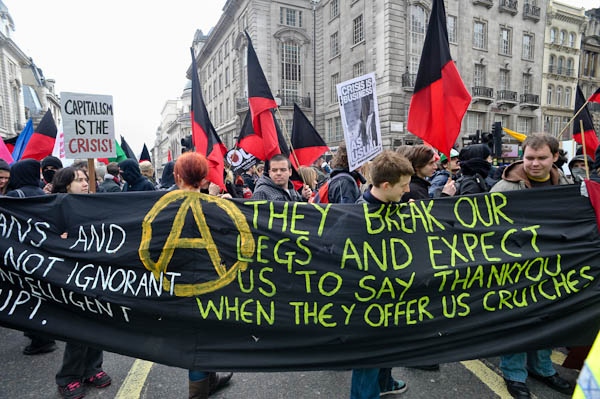
Most police attention was on a relatively small ‘autonomous’ block of around 800 people in the middle of the march which had a strong police escorted. They objected to the police behaviour, particularly very obtrusive photography by FIT teams and some sat down in the road blocking the march behind them for around half an hour.
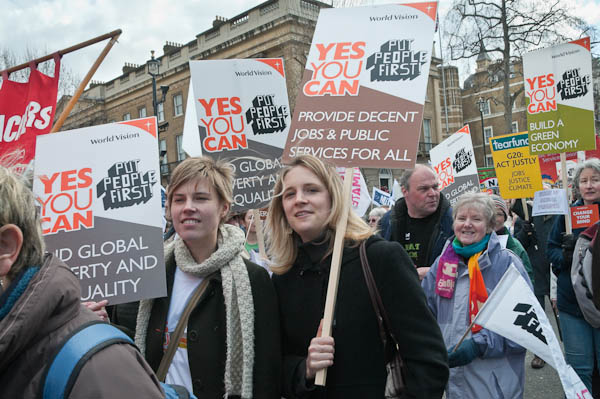
Police had bullied the front of the march to set off at a cracking pace, hard for photographers to keep up with and the march soon spread out over much of the route.
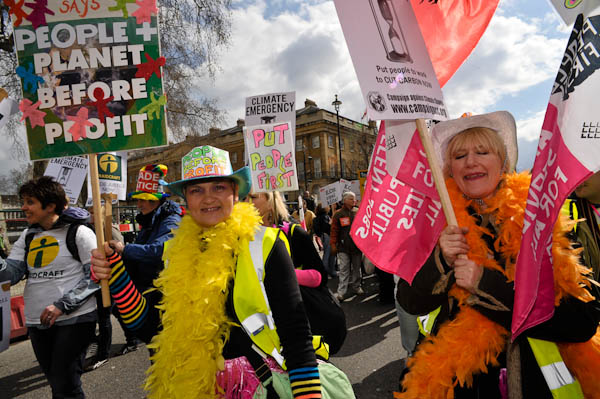
I wanted to photograph as many of the marchers as I could, walking slowly and letting them go past me as they walked along the Embankment, up Bridge Street and Whitehall to Trafalgar Square. Then I rushed to get to the rally in time.
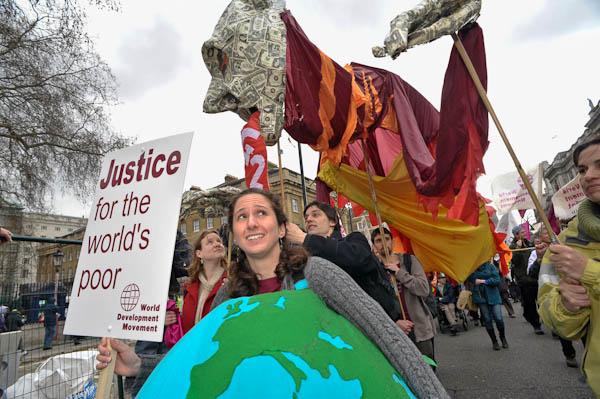
On My London Diary you can read more about the rally, and see pictures of many of the speakers. This protest was “a well ordered event with at times a carnival atmosphere, which made some of the police prognostications look rather silly.

Politicicans and Businessmen are not ignorant – they are intelligent and corrupt. They break our legs and expect us to say thankyou when they offer us crutches

One of my fellow NUJ members filming the ‘autonomous’ block rally was stopped and searched, and he and others reported a mysterious ‘man in black’ rushing into this alternative rally and emptying half a dozen small tightly wrapped packages from a black bin bag at the bottom of the stepladder from which people were speaking before exiting rapidly stage left.

Someone kicked one of these packages open and found it contained a catapult, and all the packages were quickly kicked away under a fence into an area under maintenance behind the speakers. Around 20 minutes later, a policeman entered that area and collected the packages; the anarchists saw what was happening and rapidly dispersed.
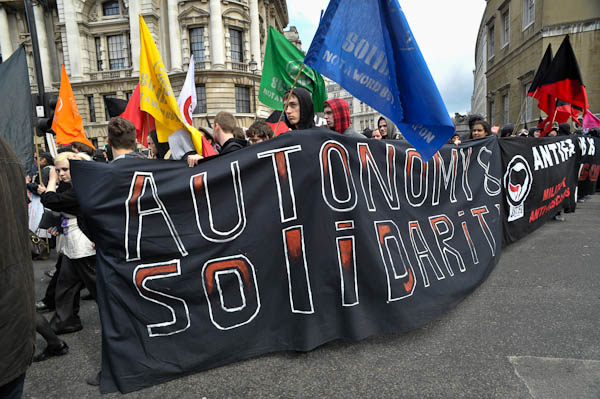
As I ended my post on My London Diary: “Earlier in the week a police spokesman had given a widely broadcast media interview in which he predicted that there would be violence – and that some protesters would use catapults. It seems as if someone was determined to make this loony-sounding prophecy come true.”

More at Put People First: Jobs Justice Climate.


FlickrFacebookMy London DiaryHull PhotosLea ValleyParis
London’s Industrial HeritageLondon Photos

All photographs on this page are copyright © Peter Marshall.
Contact me to buy prints or licence to reproduce.
Climate Rush & Cleaners 2009

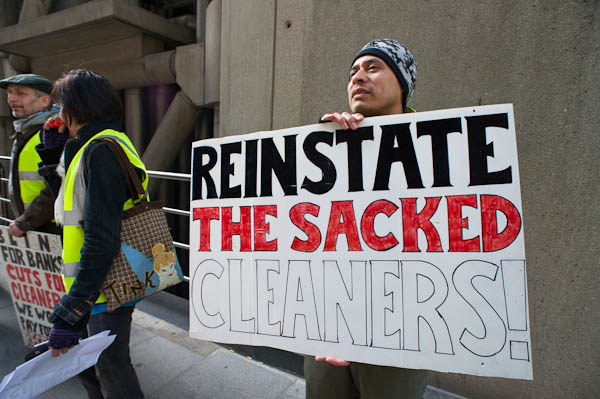
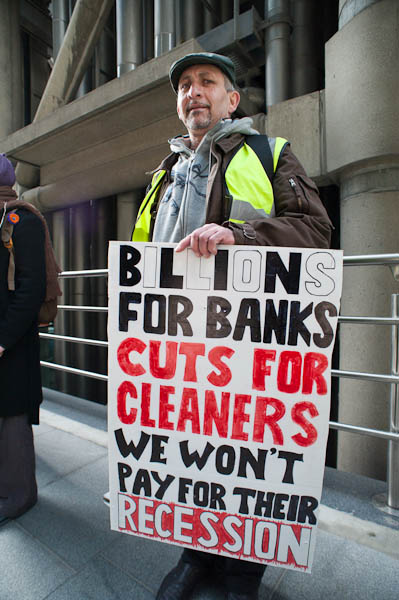
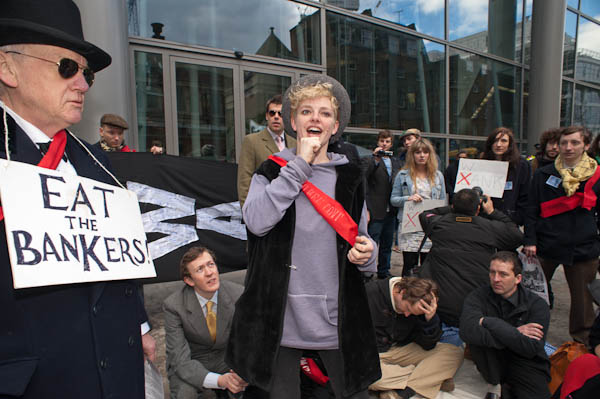
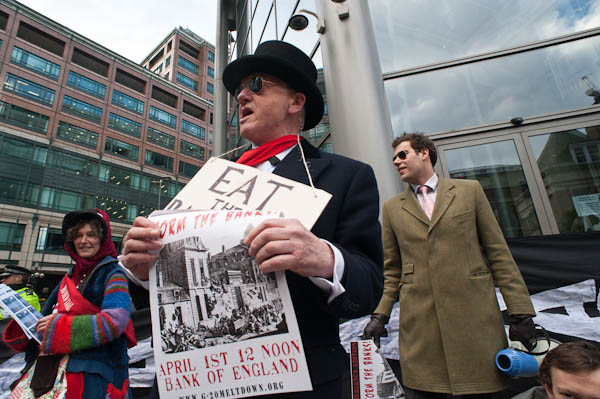
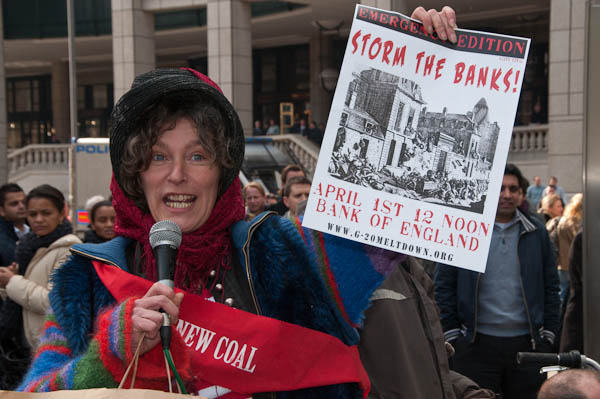
Climate Rush & Cleaners: On Thursday March 5th 2009 Climate Rush and friends staged a colourful protest against the huge support being given to the banks while the people were having to pay the price for their irresponsible and dishonest behaviour which had precipitated the financial crisis. I left their protest to photograph cleaners who were protesting at Willis Group insurance brokers demanding to be paid a living wage and better conditions of service.


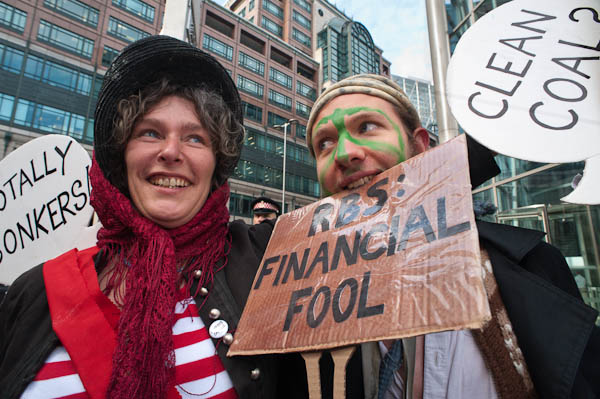
Climate Rush hits RBS HQ

RBS, 250 Bishopsgate

Climate Rush & Cleaners 2009
Tamsin Omond says ‘Give us our money back and stop trashing the planet’

Here’s what I wrote back in 2009:

“The banks would have gone bankrupt but the government stepped in and paid off the former bosses – including Sir Fred Goowin of RBS – with double gold plated platinum pension pots as a reward for their greed, incompetence and dodgy investments. But even under the new management – unfortunately not of the people who are still just ripped off – the banks continue to bankroll the trashing of the planet, backing schemes such as a coal-fired power station at Kingsnorth.

Climate Rush & Cleaners 2009

So the Climate Rush came to the HQ of the RBS in Bishopsgate to protest (and party), drawing media attention to the bank’s crimes against the planet. Around a couple of hundred protesters, some in various costumes, a cycled hauled sound system for speeches and music and some lively dancers made it an enjoyable protest for those taking part and those passing by – and a little more to remember and talk about than a simple static protest.”

Climate Rush & Cleaners 2009

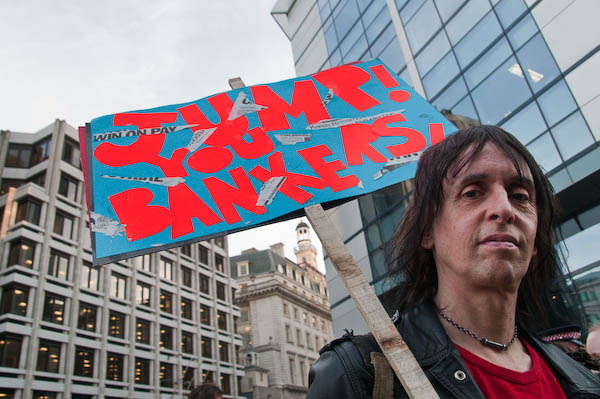
This was a piece of street theatre but the police had come out in force, obviously expecting something different, part of a growing paranoia about the coming ‘Storm The Banks‘ protest which this was advertised here and elsewhere to take place on April 1st. Obviously the police do not understand hyperbole.

Climate Rush & Cleaners 2009
A young ‘banker’ accepts the ‘RBS FInancial Fool’ award – a dead parrot – on behalf of RBS

In the lead up to April 1st, the G20 Meltdown – Financial Fools Day police (and politicians) released a number of provocative statements to try and justify the actions they were intending to take against the protesters – including the peaceful Climate Camp on Bishopsgate.

Climate Rush & Cleaners 2009

On April 1st, there was some disruptive action by protesters but the police went wild. I’d left a peaceful protest at Bank when I saw that police were beginning to kettle the protesters as I wanted to cover an event at the US Embassy. Had I stayed I too might have been assaulted by police like a fellow photographer. A police baton took out much of his teeth – he later received a large cash settlement from the police for his injuries and the cost of extensive dental treatment.

Climate Rush & Cleaners 2009

Later riot police stormed peaceful protesters in the Climate Camp who raised their hands in the air chanting “this is not a riot!” and later got they even more out of hand, wantonly smashing property and people. It was a riot, but by the police.

And Ian Tomlinson, an innocent bystander, going home through the Bank area after his work as a newsvendor, died after an unprovoked attack by a riot police officer.

On March 5th, the police simply stood and watched the protest – more a carnival, with presentations of the ‘RBS Financial Fool‘ award – a dead parrot – and the ‘No New Coal Award‘ and much music and dancing.

More pictures on My London Diary at Climate Rush at RBS.


Cleaners for Justice demonstrate at Willis

Lime St

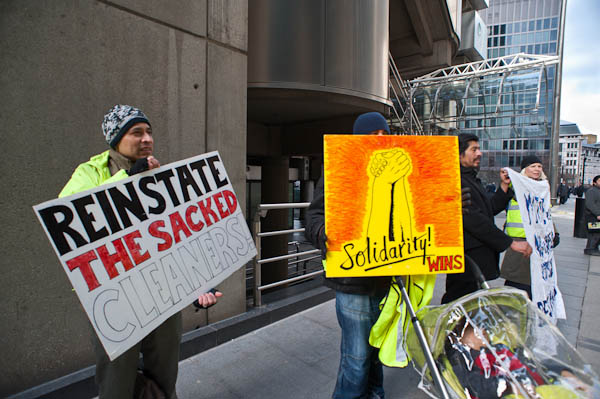
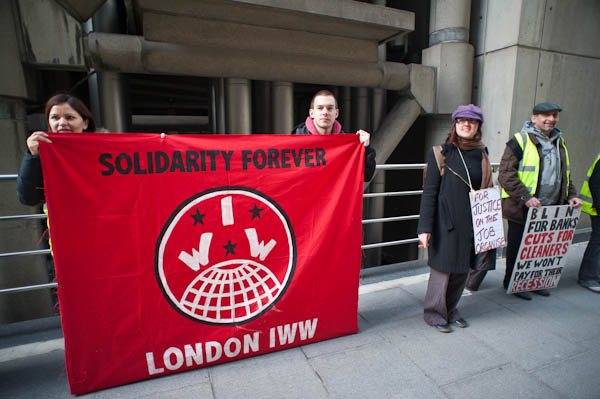
Cleaners at Willis Group, one of the City’s largest insurance brokers with offices facing those of Lloyds, were protesting outside the Willis building after five cleaners were sacked for trying to organise cleaners to take action and campaign for a living wage and better conditions of service.

Unite had been one of the unions involved in the Justice for Cleaners campaign which was launched in May 2006, but were no longer supporting the cleaners – and Unite had even agreed with the Willis management that these outsourced cleaners would not hold demonstrations outside the offices without informing them, They refused to support the sacked cleaners against their employer Mitie.

So the cleaners decided they needed a union that would support them, and went to the London branch of the Industrial Workers of the World, established in 2005 at the time of the centenary of the international IWW movement.

Later cleaners formed their own grass roots unions, the IWGB, CAIWU and the UVW who branched out to support other low paid workers, with very successful campaigns against outsourcing, low pay and harassment, gaining the London Living Wage for many of their members.

Cleaners for Justice demonstrate at Willis


FlickrFacebookMy London DiaryHull PhotosLea ValleyParis
London’s Industrial HeritageLondon Photos

All photographs on this page are copyright © Peter Marshall.
Contact me to buy prints or licence to reproduce.


March on the City 2008

March on the City: On Friday 10 October 2008 several hundred anti-capitalist protesters, mainly students, took to the streets of the City of London to say “We Won’t Bail Out the Bankers’.

March on the City 2008

The financial crisis had started in 2007, but reached a climax with the bankruptcy of Lehman Brothers on September 15 2008 which precipitated an international banking crisis.

March on the City 2008

Wikipedia sets out the causes of the crisis in some detail, but essentially US banks had been allowed to make more risky loans by changes in US laws which loosened regulations and allowed banks to take part in high risk operations such as proprietary trading and investment banking.

March on the City 2008

In the US one result of this was the proliferation of mortgage loans to people on low incomes who could really not afford the repayments and eventually defaulted. The problems with ‘subprime mortgages‘ particularly given to many in minority communities in the USA came to a head as a boom in US house prices in the early 2000s was followed by a sharp drop in the value of properties which were the security for the loans.

March on the City 2008

As Wikipedia comments, “governments deployed massive bail-outs of financial institutions and other palliative monetary and fiscal policies to prevent a collapse of the global financial system.” This resulted in the widespread feeling that those who had created the crisis were being rewarded for their failures.

In the UK, the New Labour government under George Brown made a massive financial intervention, paying £137 billion to the banks in loans and new capital, some of which was later recouped, but leaving a cost of £33 billion. While some support was necessary to avoid a total breakdown of the financial system, many felt that the government should have taken a firmer line and that those responsible should have had to pay for their mistakes and not to seem to have kept their highly paid jobs.

Both Northern Rock – the first UK bank to fail in July 2007 and Bradford & Bingley were taken into public ownership, and RBS/Nat West into majority public ownership. But RBS still ended up costing us £35.5 billion – and the leading bankers still ended up getting huge salaries and big bonuses. The Royal Bank of Scotland seemed to be getting off scot free.

Part of the problems we still see in financial markets came from changes worldwide in the way that trading now takes place. In the UK Margaret Thatcher had brought in the ‘Big Bang’ which abolished traditional practices and introduced electronic trading, greatly increasing volatility.

On My London Diary I give a fairly full account of the actual protest which started at Bank where some protesters tried to storm into the Royal Exchange – long just a prestige shopping centre – and the Bank of England but were easily stopped by police.

There then followed a slow march around parts of the City, with police attempting to stop them at various points and the marchers pushing their way through police lines.

As my pictures show, there was some rather forceful policing at times and some of the press also suffered with the protesters. As I write, “I got a few bruises and my glasses were damaged when police rushed in as I was taking pictures in Lombard St.” But there was none of the confrontational use of trained riot squads that have led to extreme violence at some protests policed by the Met. Policing here was by the City of London Police – along with a guest appearance by one French cop.

Eventually there was a short rally with a few speeches on the corner of Bishopsgate and London Wall after which the demonstrators dispersed. Police seemed fairly relaxed at the end of the protest and I saw no arrests.

I don’t think the protest got much if any coverage in the mass media and most accounts I read on-line were confused, with many suggesting it went to the Stock Exchange. While that might have been a logical place to protest, the marchers actually went in the opposite direction.

March on the City.


FlickrFacebookMy London DiaryHull PhotosLea ValleyParis
London’s Industrial HeritageLondon Photos

All photographs on this page are copyright © Peter Marshall.
Contact me to buy prints or licence to reproduce.


Palestine, Pancakes, Post, Olympics & Zombies 2009

Palestine, Pancakes, Post, Olympics & Zombies – Tuesday 24th February 2009 was a long and varied day for me and included some serious issues that are still at the forefront of current news as well as some lighter moments – and I ended the day enjoying a little unusual corporate hospitality with some free drinks for London bloggers.


Al-Haq Sue UK Government – Royal Courts of Justice

Palestine, Pancakes, Post, Olympics & Zombies

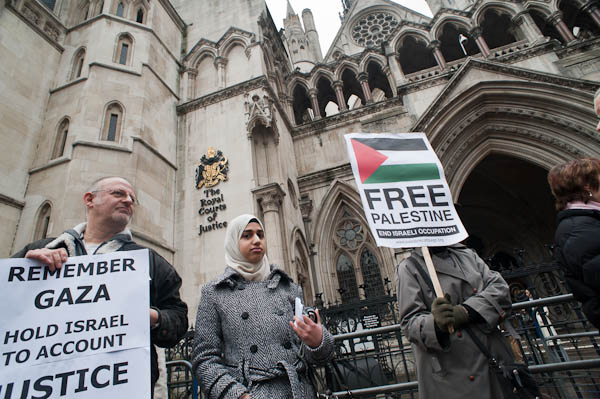
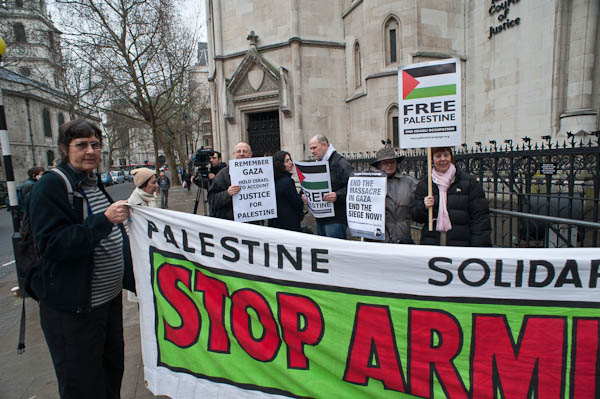
First came Palestine, with Palestinian human rights group Al-Haq filing a claim for judicial review before the High Court of England and Wales challenging the government’s failure to fulfil its obligations with respect to Israel’s illegal activities in Palestine.

They were calling on our government – then New Labour under Gordon Brown – to publicly denounce Israel’s actions in Gaza and the continuing construction of the separation wall, to suspend arms related exports and all government, military, financial and ministerial assistance to Israel and to end UK companies exporting arms and military technology.

They also asked them to insist the EU suspends preferential trading with Israel until that country complies with its human rights obligations, and for the government to give the police any evidence of war crimes committed by any Israelis who intend to come to the UK.

Palestine, Pancakes, Post, Olympics & Zombies

Of course the court refused Al-Haq’s case, declining to deal with the UK government’s compliance with its international legal obligations and stating that their claim would risk the UK’s diplomatic “engagement with peace efforts in the Middle East“, something which seemed at the time to be absolutely zero if not negative. They also refused Al-Haq any right to bring the claim because it was not a UK-based organisation and “no one in the United Kingdom has sought judicial review of United Kingdom foreign policy regarding Israel’s actions in Gaza“.

Al-Haq Sue UK Government


Worshipful Company of Poulters Pancake Race – Guildhall Yard

Palestine, Pancakes, Post, Olympics & Zombies

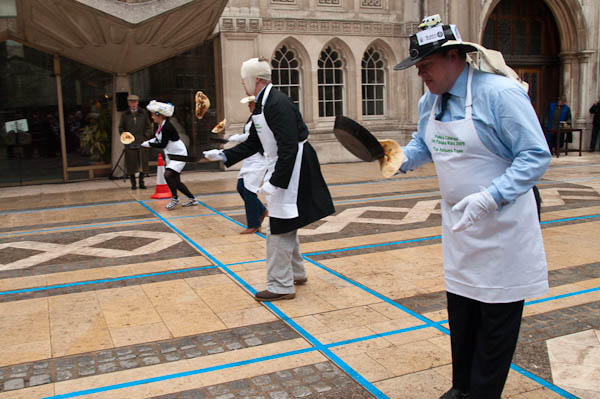
It was Shrove Tuesday and I couldn’t resist the Pancake Race organised by the Worshipful Company of Poulters, and held – with the permission of the Chief Commoner, in the Guildhall Yard.

Palestine, Pancakes, Post, Olympics & Zombies

As I said, “It’s a shame that the Pancake Race is unlikely to feature in the London 2012 Olympics, because it’s perhaps the one sport in which Britain still leads the world, and we seem to have plenty of talent in training.

Poulters Pancake Race


Keep the Post Public – Parliament Square

Postal workers came out from a rally in Methodist Central Hall against government plans to privatise Royal Mail. The government argued they needed to do this to protect pensions and modernise the service.
Postal deliveries had been deliberately made uneconomic by earlier measures which have allowed private companies to cream off the easily delivered profitable parts of the service, while leaving the Royal Mail to continue the expensive universal delivery service – including the delivery of its competitors post at low regulated prices to more difficult destinations.

The government picked up the responsibility for the pensions when the post was privatised and the privatised post office has been allowed to fail on its delivery obligations. We now get deliveries on perhaps 3 or 4 days a week rather than 6, few first class letters arrive on time, and the collection times for most pillar boxes are now much earlier in the day – now 9am rather than 4pm at our local box. While privatisation was supposed to result in more investment it largely seems to have resulted in large dividends and higher pay to managers and the Post Office is in a worse state than ever.

Keep the Post Public


London 2012 Olympic Site – Stratford

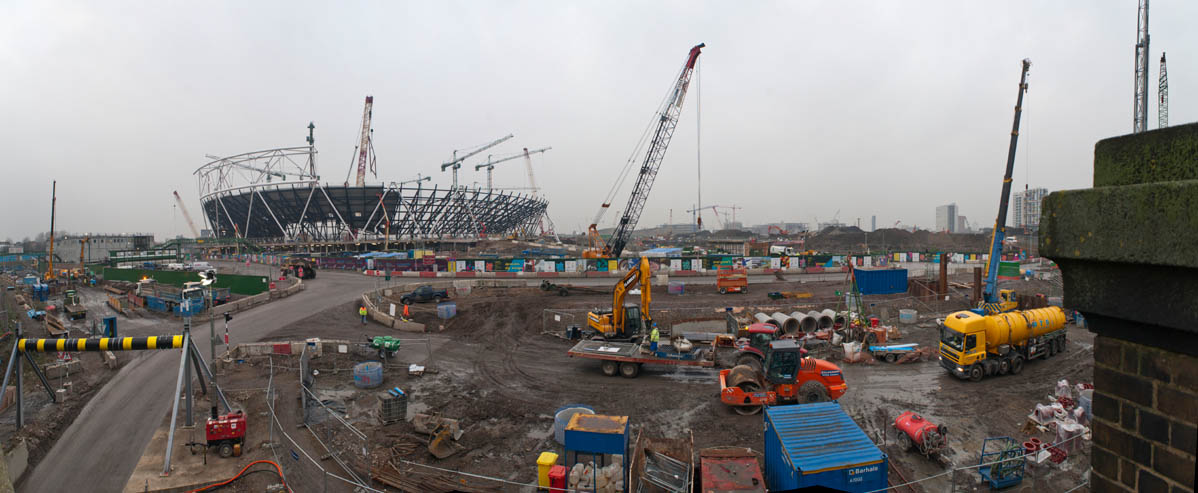
I had time for a brief visit to the publicly accessible areas in and around the Olympic site where a great deal of work was now taking place with the main stadium beginning to emerge.

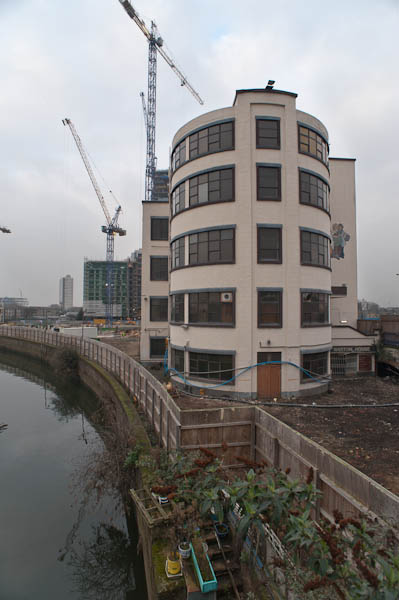
There were some reports at the time that the landmark building Warton House, once owned by the Yardley company with its lavender mosaic on Stratford High Street was to be demolished, but fortunately these turned out to be exaggerated, with only a small part at the rear of the building being lost. But all the buildings on the main part of the site had gone. Some others south of the mainline railway were also being demolished for Crossrail.

Olympic Site Report
London Olympic site pans


March of the Corporate Undead – Oxford St

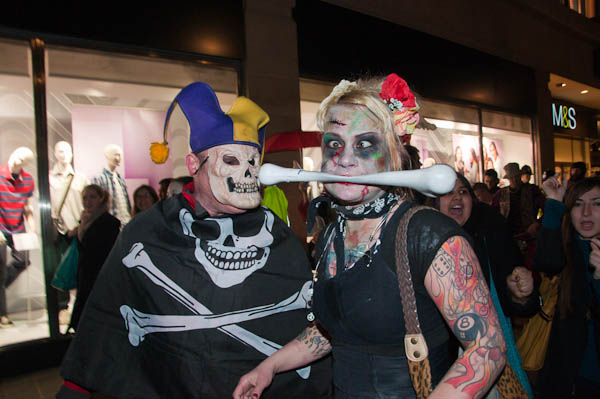
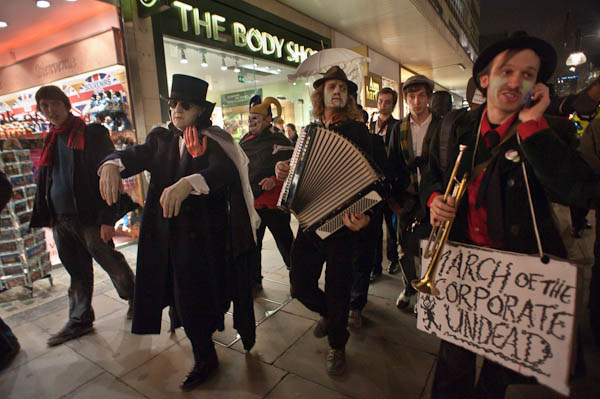
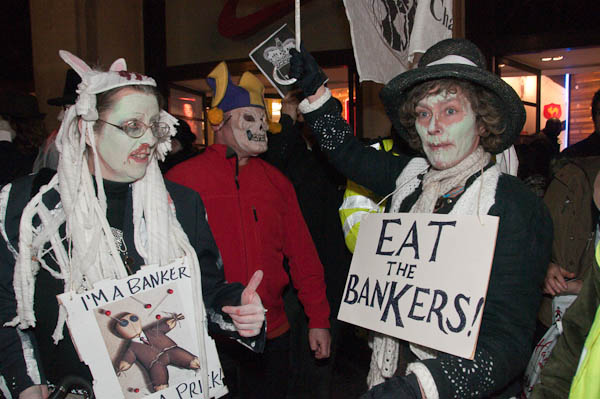
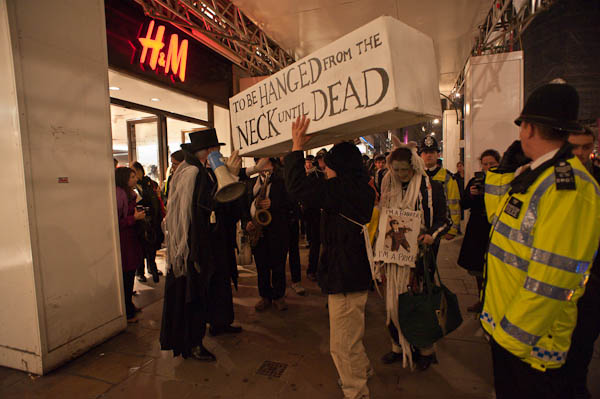
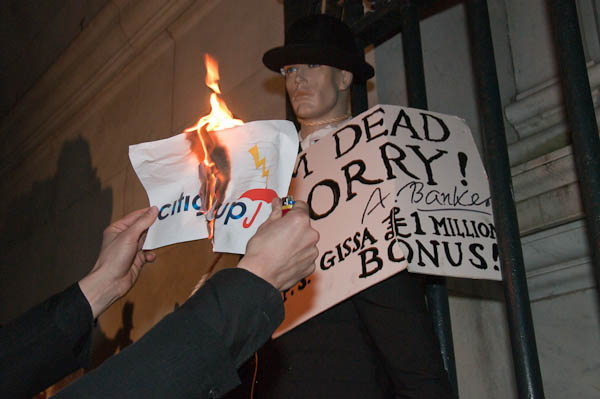
I made my way back to Oxford Circus for the ‘March of the Corporate Undead’, a Zombie Shopping Spree complete with coffins, a dead ‘banker’, posters, various members of the undead and a rather good band.

Police watched in a suitably deadpan manner (I did see one or two occasionally smile) as the group assembled and applied large amounts of white makeup before making its way along the pavement of Oxford Street, to the astonishment (and often delight) of late shoppers and workers rushing home.

We stopped off at Stratford Place, opposite Bond Street Station to toss some fried bankers brains in the frying pans and then there was a pancake race, holding up a Rolls Royce that was prevented by the police from driving through while we were there.

The parade continued, stopping for a minute or two under the bright lights of Selfridges before continuing to Tyburn, or at least Marble Arch, with more zombies joining all the time.

Hanging the already dead banker seemed a great idea, but getting a rope up over the arch was tricky. Eventually a severed hand gave sufficient weight to enable a rope to be thrown over the ornamental iron-work and the banker was soon hoisted up to dangle over the continuing revels below.

March of the Corporate Undead

This was an anticapitalist event and in particular aimed against bankers and the huge amounts of cash given to them to in the aftermath of the 2007-8 financial crisis which was seen as rewarding the very people who had caused the mess the system was in. The mass of the population was having to suffer cuts in services under a severe austerity programme while bankers were still pigs in clover. The UK has become a very unequal society over the years since 1979 when Thatcher became Prime Minister. The the top 10% got 21% of the UK income, by 2010 it was around 32%.

I left to go to a meeting of London bloggers – and enjoy a few free drinks thanks to Bacardi. The blue and green Breezers seem to me just right for zombies, though I’m afraid after tasting one I went for the beer instead. But I think the zombies on Oxford Street were more alive than those in the corporate world.


FlickrFacebookMy London DiaryHull PhotosLea ValleyParis
London’s Industrial HeritageLondon Photos

All photographs on this page are copyright © Peter Marshall.
Contact me to buy prints or licence to reproduce.