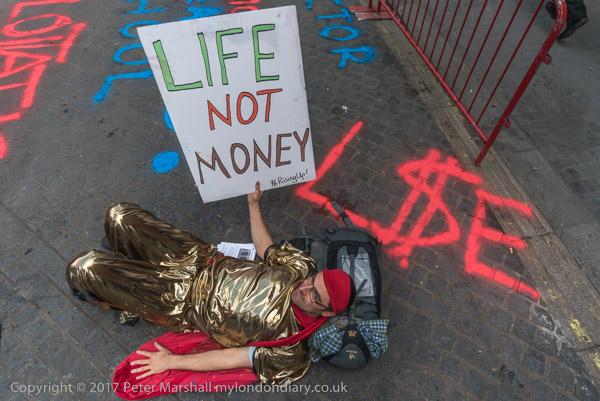
‘Life NOT Money at the LSE’ protesters chalked on the roadway and lay down, blocking the street
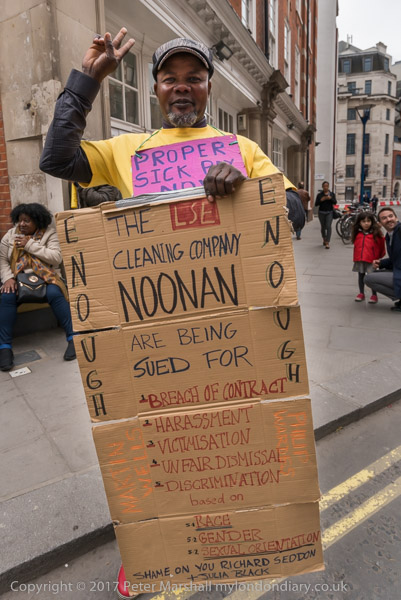
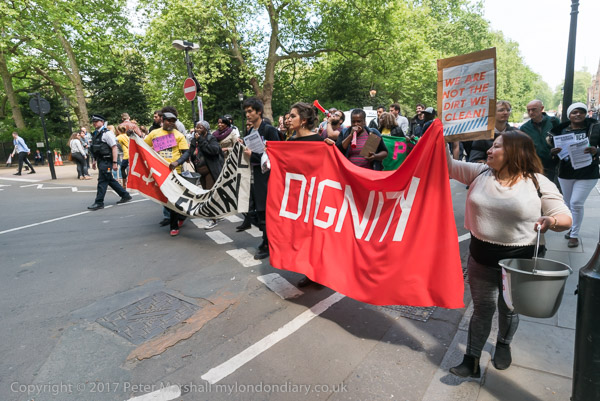
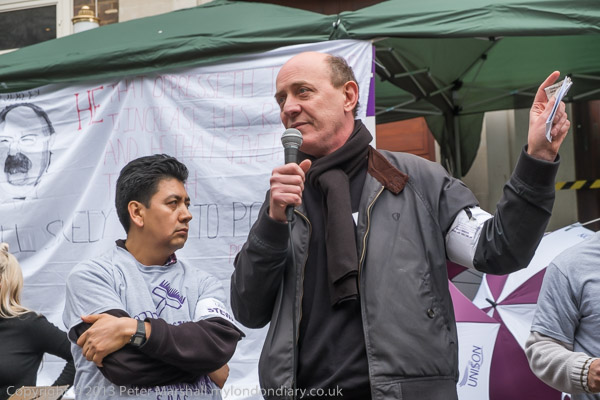
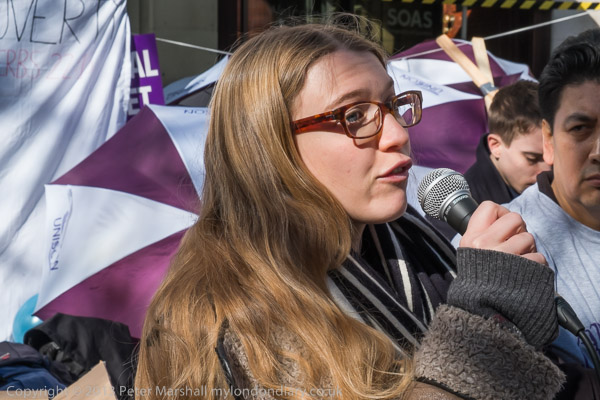
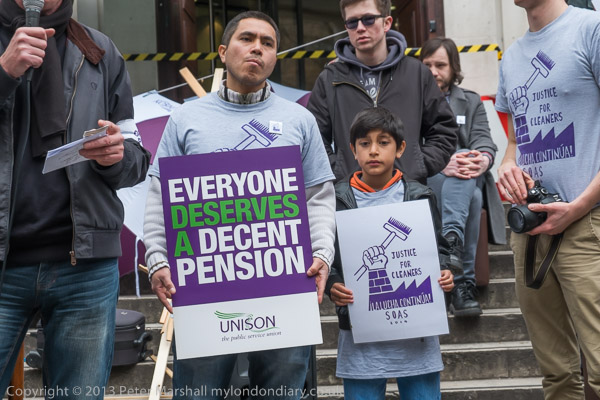
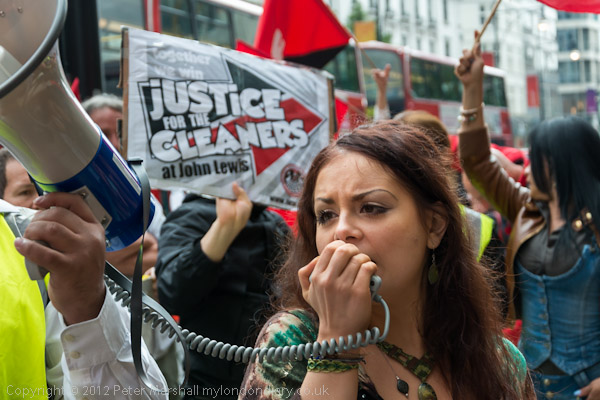
LSE Cleaners Strike For Equality And Dignity: The protest by cleaners at the LSE on Thursday 11th May 2017 was just one more in a long series of weekly one-day strikes demanding parity of terms and conditions with other staff there who were directly employed by the LSE.
The cleaning was outsourced to cleaning contractor Noonan, who employed cleaners under considerably inferior terms – pay, holidays, pensions etc – compared to those workers employed on the site by the LSE. I had been at the meeting in September 2016 when with their union, the United Voices of the World, they began their campaign for parity of treatment and had also photographed their protests.
The UVW were eventually successful after a series of strikes featuring “flashmobs, salsa, zumba, poetry, art sessions, teach-outs” and “after 10 months of struggle, and the then largest cleaners strike in UK history and the highest number of strike days of any group of outsourced workers in UK higher education – outsourcing was ended and all cleaners were brought in-house as LSE employees! Their fight against institutional racism was the first “to force a British university to end the practice of outsourcing cleaners!“
My post told the story of the event in picture and captions which describe the harassment by police and others of some of the supporters, particularly those from Class War. Here is a brief edited version.
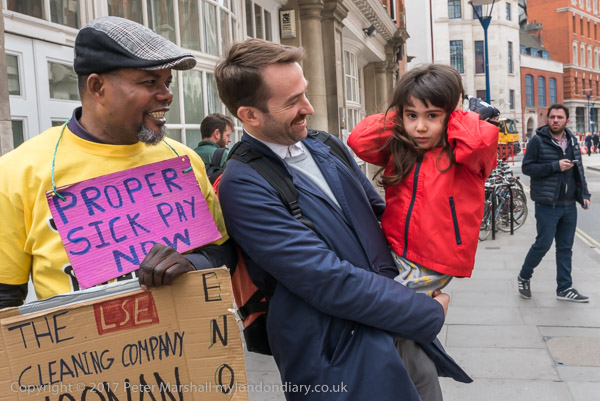
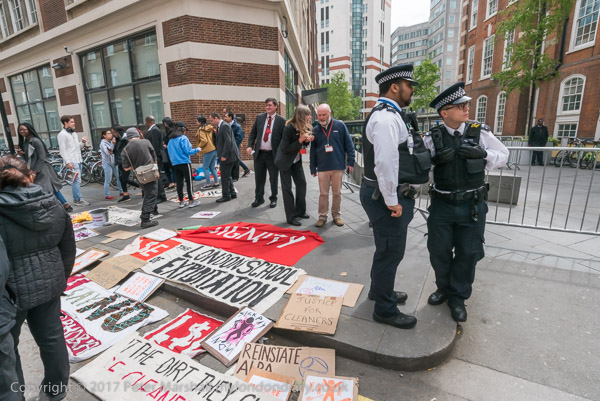
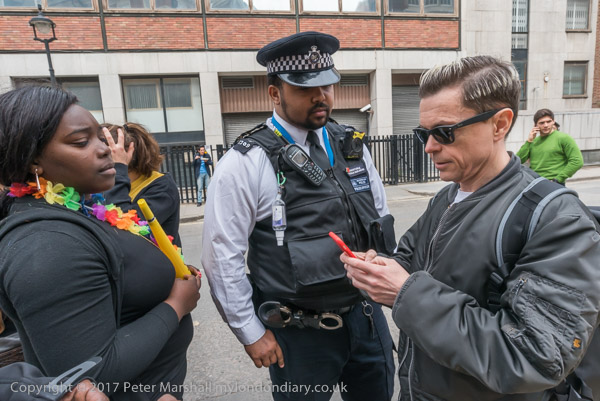
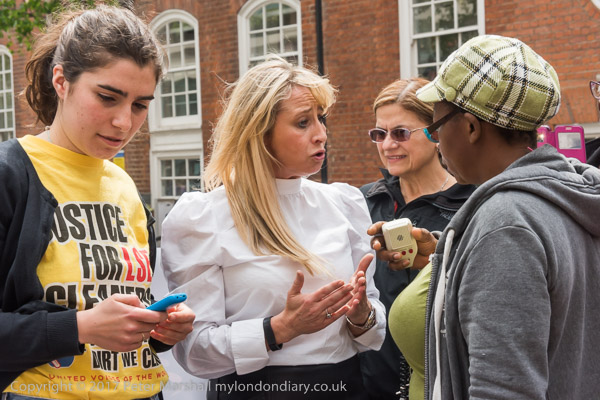
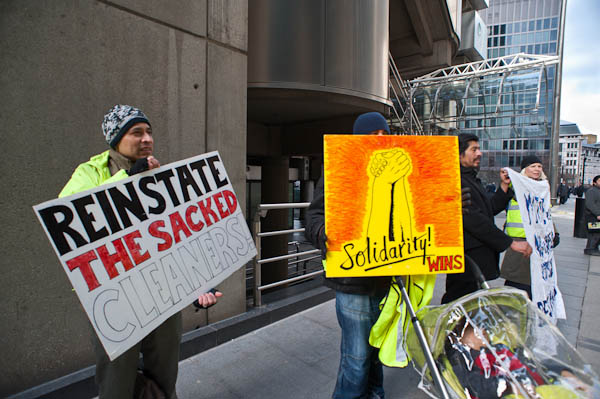
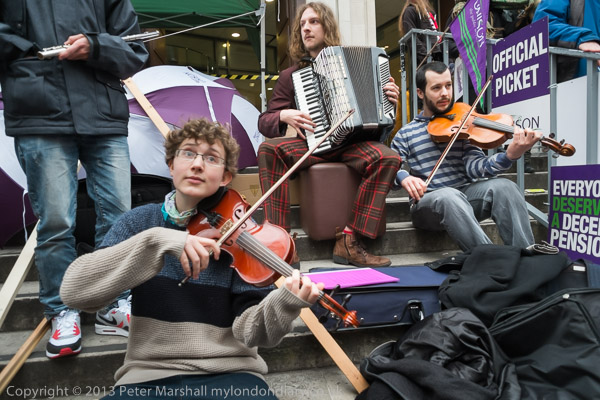
Noonan employs the cleaners at the LSE and the cleaners get low pay, low status and terrible managementThey work in the same place and deserve equal treatment. Their claims are supported by students and LSE staff. Trenton Oldfield brought his daughter with him to show solidarity with the cleaners.LSE Security have closed the area in front of the library normally open to the public. The road is a public highwayOne police officer starts harassing Sid Skill of Class War who has come to show solidarity. Sid refuses to talk to him and moves away – and eventually fled fearing arrest followed by two police officers, escaping them by jumping on a bus as the doors closedA woman who works in the LSE comes to tell the cleaners they are making a lot of noise and disturbing her day and then hugs the police officer and smiles when she sees I am photographing her. The cleaners say they have to make a lot of noise as the LSE management refuse to talk with them and their union.Cleaners make a noise – they want management to talk to them and to recognise their union. They also want to be treated with dignity and respect at work, a living wage and equal pensions, sick pay and other benefits.A man comes to complain to Class War about their support for the cleaners. He says that they don’t have any right to be there. Jane Nicholl puts him right. He seems to have no idea what class war is and no understanding of class solidarity. And as I suspect Jane put it is a stupid prick. Though she may have been less kind.The protesters march around the campus to visit a couple of other sites from brief protests in Lincolns Inn Fields and then Sardinia St before going to the Student Union, where there were speeches an poetry from Grim Chip of Poetry on the Picket Line.Meanwhile Life Not Money at the LSE had been at work, painting their message in chalk on the road and then sitting down on the Portugal St in front of Old Building, stopping lorries entering or leaving the LSE building site.
You can read the full version with more pictures and text at LSE Cleaners strike.
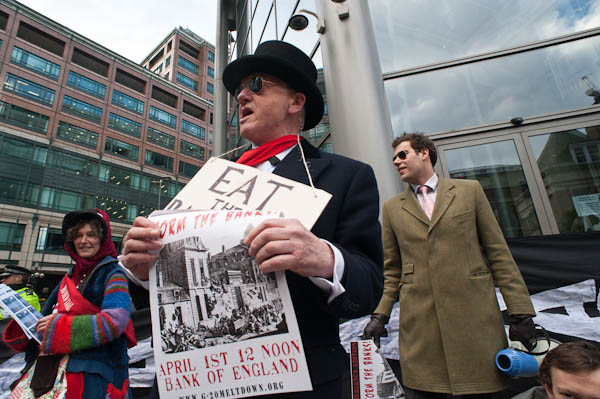
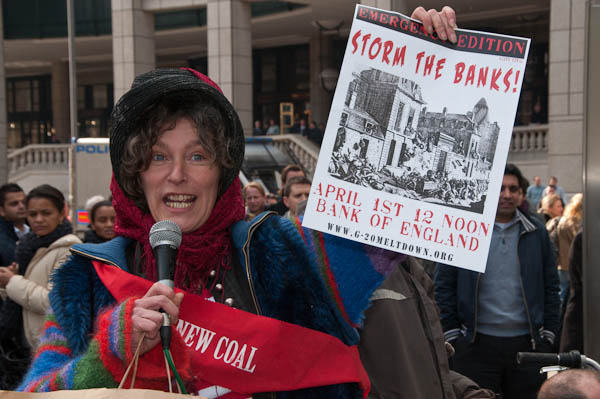
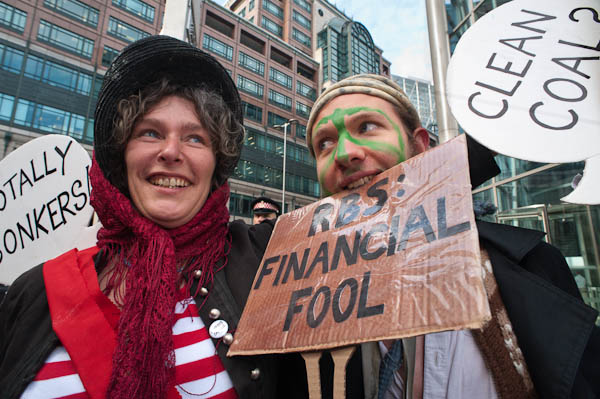
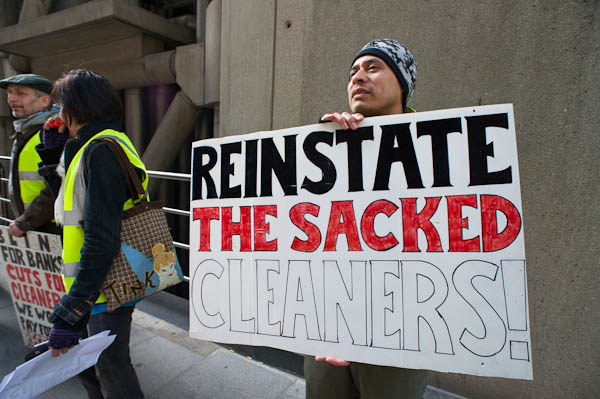
Climate Rush & Cleaners: On Thursday March 5th 2009 Climate Rush and friends staged a colourful protest against the huge support being given to the banks while the people were having to pay the price for their irresponsible and dishonest behaviour which had precipitated the financial crisis. I left their protest to photograph cleaners who were protesting at Willis Group insurance brokers demanding to be paid a living wage and better conditions of service.
Climate Rush hits RBS HQ
RBS, 250 Bishopsgate
Tamsin Omond says ‘Give us our money back and stop trashing the planet’
Here’s what I wrote back in 2009:
“The banks would have gone bankrupt but the government stepped in and paid off the former bosses – including Sir Fred Goowin of RBS – with double gold plated platinum pension pots as a reward for their greed, incompetence and dodgy investments. But even under the new management – unfortunately not of the people who are still just ripped off – the banks continue to bankroll the trashing of the planet, backing schemes such as a coal-fired power station at Kingsnorth.
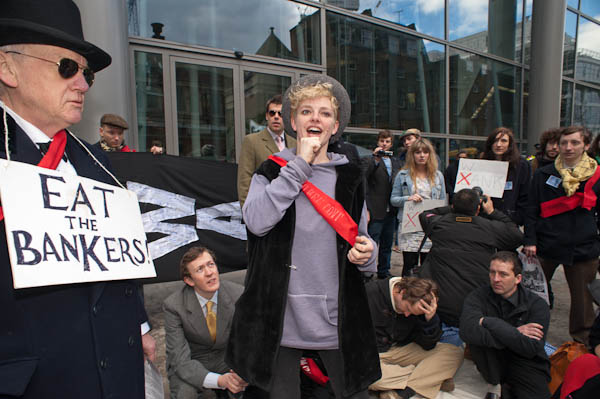
So the Climate Rush came to the HQ of the RBS in Bishopsgate to protest (and party), drawing media attention to the bank’s crimes against the planet. Around a couple of hundred protesters, some in various costumes, a cycled hauled sound system for speeches and music and some lively dancers made it an enjoyable protest for those taking part and those passing by – and a little more to remember and talk about than a simple static protest.”
This was a piece of street theatre but the police had come out in force, obviously expecting something different, part of a growing paranoia about the coming ‘Storm The Banks‘ protest which this was advertised here and elsewhere to take place on April 1st. Obviously the police do not understand hyperbole.
A young ‘banker’ accepts the ‘RBS FInancial Fool’ award – a dead parrot – on behalf of RBS
In the lead up to April 1st, the G20 Meltdown – Financial Fools Day police (and politicians) released a number of provocative statements to try and justify the actions they were intending to take against the protesters – including the peaceful Climate Camp on Bishopsgate.
On April 1st, there was some disruptive action by protesters but the police went wild. I’d left a peaceful protest at Bank when I saw that police were beginning to kettle the protesters as I wanted to cover an event at the US Embassy. Had I stayed I too might have been assaulted by police like a fellow photographer. A police baton took out much of his teeth – he later received a large cash settlement from the police for his injuries and the cost of extensive dental treatment.
Later riot police stormed peaceful protesters in the Climate Camp who raised their hands in the air chanting “this is not a riot!” and later got they even more out of hand, wantonly smashing property and people. It was a riot, but by the police.
And Ian Tomlinson, an innocent bystander, going home through the Bank area after his work as a newsvendor, died after an unprovoked attack by a riot police officer.
On March 5th, the police simply stood and watched the protest – more a carnival, with presentations of the ‘RBS Financial Fool‘ award – a dead parrot – and the ‘No New Coal Award‘ and much music and dancing.
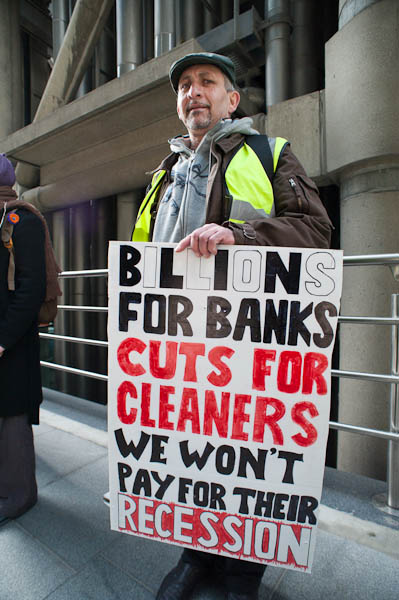
Cleaners at Willis Group, one of the City’s largest insurance brokers with offices facing those of Lloyds, were protesting outside the Willis building after five cleaners were sacked for trying to organise cleaners to take action and campaign for a living wage and better conditions of service.
Unite had been one of the unions involved in the Justice for Cleaners campaign which was launched in May 2006, but were no longer supporting the cleaners – and Unite had even agreed with the Willis management that these outsourced cleaners would not hold demonstrations outside the offices without informing them, They refused to support the sacked cleaners against their employer Mitie.
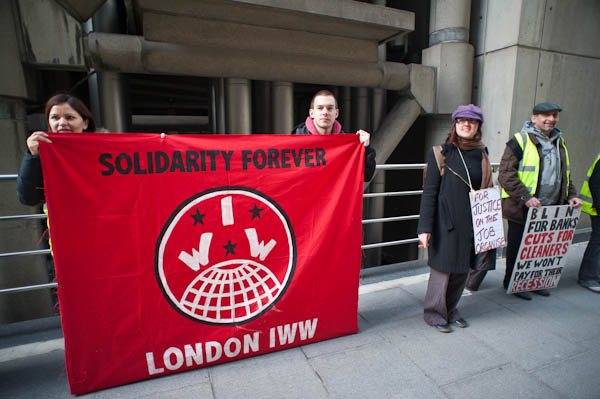
So the cleaners decided they needed a union that would support them, and went to the London branch of the Industrial Workers of the World, established in 2005 at the time of the centenary of the international IWW movement.
Later cleaners formed their own grass roots unions, the IWGB, CAIWU and the UVW who branched out to support other low paid workers, with very successful campaigns against outsourcing, low pay and harassment, gaining the London Living Wage for many of their members.
Pancakes and Pickets: Tuesday 4th March 2014 was very much a day of two halves for me, starting with the City of London at play in Guildhall Yard and going on to the School of Oriental and African Studies where cleaners were beginning a two-day strike demanding an end to bullying by their employer ISS and to be brought back into direct employment and treated with respect by SOAS management with equal rights to other employees.
City of London Pancake Races
Guildhall Yard
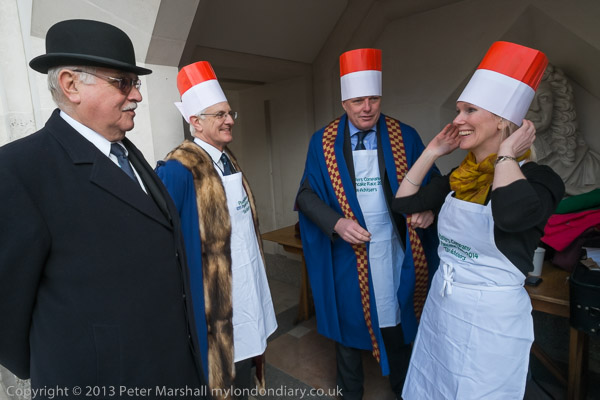
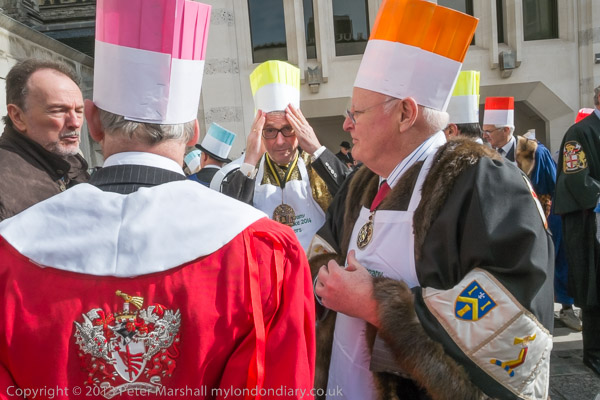
It was a toss-up whose hat was silliest
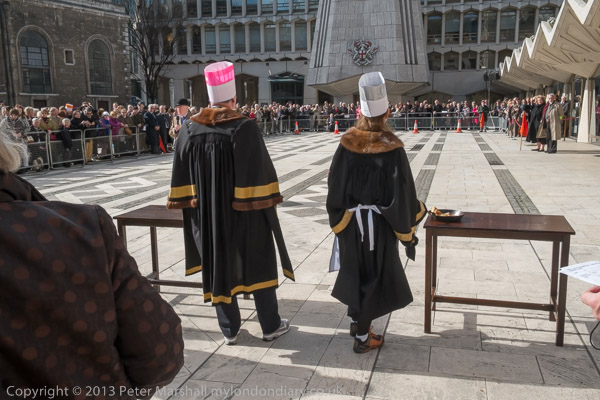
It was Shrove Tuesday and The City of London’s 10th annual pancake races took place in Guildhall Yard between teams representing the livery companies, wearing guild robes, white gloves and hats.
As might be expected in the City this is a highly organised event, complete with clipboards, stop-watches and judges, and with a series of rules about dress and behaviour, with points being lost for various infringements.
Various of the guilds contributed their expertise: Gunmakers used a small but very loud cannon to start each heat, Clockmakers timed the races, Fruiterers provided lemons, Cutlers plastic forks, Glovers white gloves to be worn by each runner, and the Poulters, who had started the event, the eggs to make the pancakes.
This event supports the annual charity Lord Mayor’s appeal, and in 2014 Fiona Woolf, the 686th Lord Mayor of London, had chosen Beating Bowel Cancer, the Princess Alice Hospice, Raleigh International and Working Chance. As well as the more formal races there is also a fancy dress competition and race with one entrant from each livery company in costumes based, some with great ingenuity, on the charities.
As I commented, “competition was extremely fierce and the regulators had plenty of work to do keeping up with the infringements. If only they had paid as much attention to what the banks and other city companies were doing!”
This was an event I photographed in several years, but I think 2014 was the final time. Like many events it had become more difficult to cover as more and more photographers came to cover it, some making rather a nuisance of themselves, leading to more restrictions. In earlier years there had only been myself and a few friends and we were welcomed and able to work freely.
Cleaners dance to Colombian music on the picket line
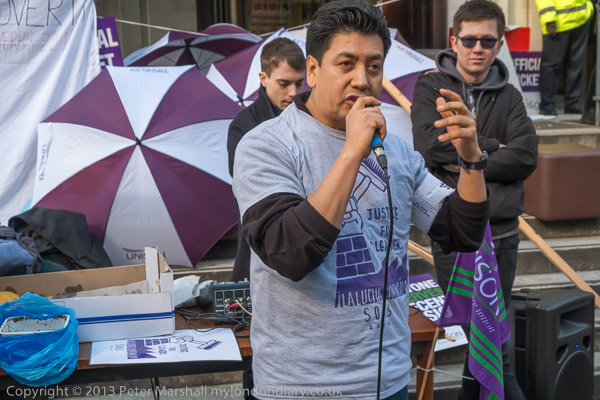
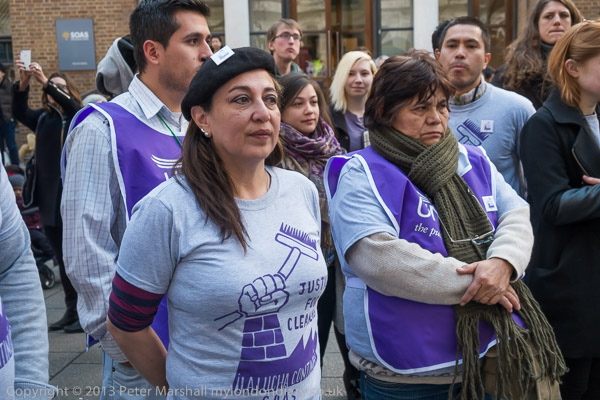
It was the start of a two-day strike by cleaners at London University’s School of Oriental and African Studies, part of a long ‘Justice For Cleaners’ campaign to be treated equally to other staff at SOAS and to be brought back ‘in house’, employed directly by the university.
They were then employed by the outsourcing cleaning contractor ISS, a multinational company with a reputation for bullying workers. The previous day some ISS managers had assaulted students who had stopped them trying to bring in scab workers to do the work of the cleaners.
ISS director Paul Cronin had also threatened to stop paying the cleaners the London Living Wage which they gained through industrial action several years ago.
SOAS UNISON Branch Secretary and union secretary for the London Higher Education Executive Sandy Nicoll
Outsourcing always results in a poorer level of service, with employers cutting hours of work and giving workers poorer conditions of service, making high profits at the expense of low paid workers.
Reputable employers could not possibly be seen to employ people on the poor pay and conditions of contracting companies, but SOAS seemed happy to benefit from the exploitation of people who work in its building by others despite the poorer service for students and others.
And as the Justice for Cleaners campaign stated “SOAS is known around the world for promoting dignity and equality. Yet, its maintenance, cleaning, security and catering all have less rights than other workers, because they are outsourced. At the moment SOAS is built on inequality and exploitation.”
The strike ballot had an over 60% turnout out and all who voted back the strike. I was told that many had arrived by 4am to start the picket and by 6am virtually the whole normal morning shift were there taking part.
I rushed away from the pancake races to get there for the lunchtime rally, where there were speeches supporting the strike from students and trade unionists. The cleaners are members of the SOAS Unison branch.
Many students and teaching staff had refused to cross the picket line; lectures and tutorials were rescheduled, no registers were taken, and library fines and deadlines were postponed. But for the following second day of the strike the cleaners had asked students and staff to work as normal so that the effect of the building not being cleaned could be seen.
After the speeches there was music and dancing, with the event going on until the picket ended at 5pm. Then the union bar which had been closed for the strike was to open for students and cleaners to have a party. But I left much earlier.
The campaign to bring the cleaners at SOAS back into direct employment continued and after ten years they were finally brought back in house in 2018.
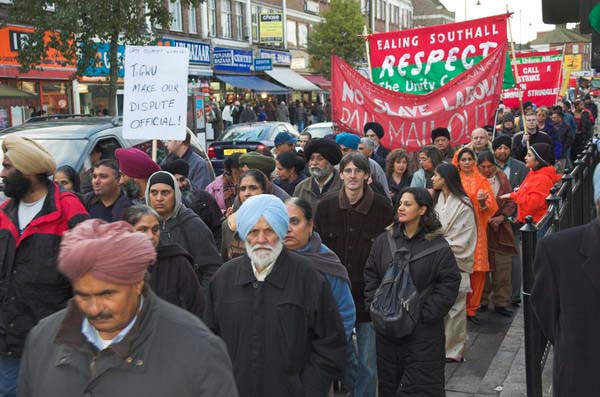
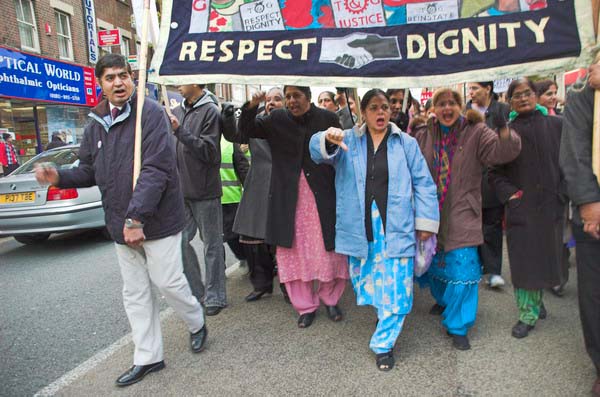
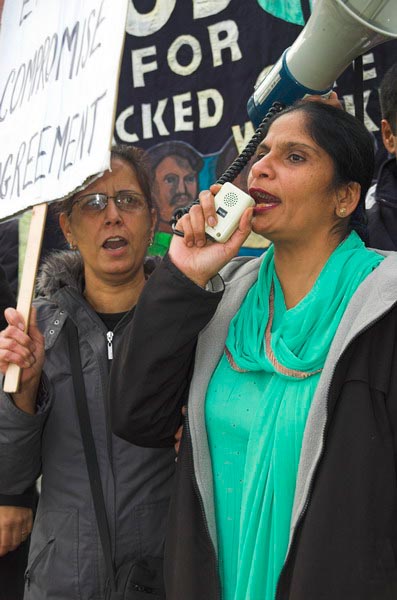
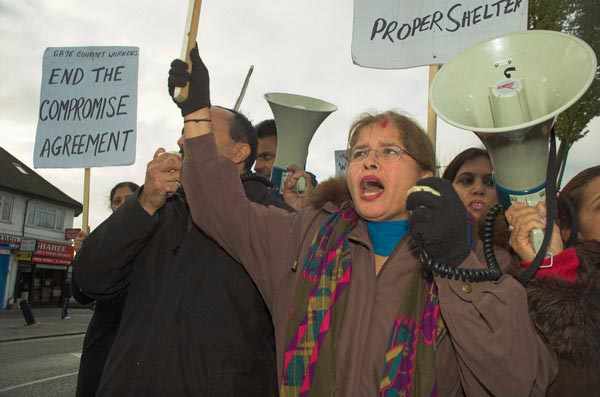
Gate Gourmet & a Bike Ride: On Sunday December 4th 2005 I got on my bike and rode the roughly 1l miles to Southall, where I locked up my bike (not the Brompton, but an old CinellI racer I’d got many years ago for my 13th birthday) and photographed a protest by workers sacked from their jobs at Heathrow airport catering firm Gate Gourmet.
There is an excellent article on the Striking Women website which gives the background to the dispute and explains why 56 women workers of South Asian origin felt betrayed by the agreement reached by the TGWU over the dispute and refused the compensation offered of between £5000 and £8000 – and refused to leave quietly – though most of the workers took the money rather than fight for justice.
The workers and their shop stewards received little support from the official trade union movement in their fight for justice and the TGWU hardship fund ended its support in January 2006, and the TGWU (by then part of UNITE) cease all support in 2009. Around a dozen of the workers – mainly those who were for various reasons not at work when Gate Gourmet locked the workers out – eventually won claims for unfair dismissal.
The dispute made very clear the extent to which union powers had been emasculated by a succession of Acts passed under Thatcher – the Employment Act 1980, Employment Act 1982, Trade Union Act 1984, Trade Union Art 1990, Employment Act 1988, Employment Act 1990. John Major continued with the Trade Union Reform and Employment Rights Act 1993 and then Blair and New Labour took over the job.
But even given all this, the TGWU ended up caving in to the employers and giving them everything they wanted in the settlement it made.
Below (with minor corrections) is the post I wrote back in 2005.
Gate Gourmet – the Struggle Continues
Southall, December 4, 2005
Gate Gourmet was split off from British Airways in 1997 to cut costs by out-sourcing their catering. It was sold to US company Texas Pacific in 2002, and they also decided to cut costs. This seems to have meant increasing workload, bringing in more managers (why?) and replacing skilled and experienced staff by unskilled workers. They went into a dispute with the TGWU (Heathrow’s major union) over layoffs and worsening conditions, then on 10 August 2005, took on 120 temporary workers.
Their aim was to provoke an unofficial walkout, which would allow them to sack the workers. The workers held a union meeting in the canteen and were told by management that if they were not back at work in 3 minutes they were all sacked. It is claimed that management had locked the doors just to make sure they didn’t return. The workers were then forcibly evicted from the premises by the private security guards the management just happened to have standing around waiting.
Britain’s anti-union laws (thanks to Mrs Thatcher) stack the odds against workers, allowing unscrupulous management to get away with most things short of murder if they put their minds to it.
The TGWU were hamstrung by a High Court injunction, which prevented them from doing much to help the workers. The only thing that helped them was illegal action by their former colleagues at BA, said to have cost that company £40 million. So eventually BA forced Gate Gourmet to come to some kind of compromise with the TGWU, but this has failed to satisfy most of the workers, who wanted their jobs back and decent working conditions. So, although all the papers reported it as over, the action still continues. When my wife flew BA from Heathrow a few days ago, she got a voucher to get sandwiches in the departure lounge rather than in-flight catering.
This is a dispute that highlights the need for proper trade union laws that give workers and unions a fair deal. It shows how union weakness has allowed the Labour Party to renege on the promises it made in opposition and to turn its back on its traditions of fair play. BA has also emerged as pretty short-sighted in its decision to out-source its catering, much as we have found out-sourcing to be a mistake over key services in hospitals and schools.
After the protest I was relieved to find my bike still in one piece where I had locked it and rode home. On my way to Southall I had time to spare and stopped to take a few pictures -and just a few more on my way home. Here is what I wrote in 2005.
I took my usual route to Southall on a push-bike – it takes me around 45 minutes if I don’t stop. but I nearly always do stop at least once to take some pictures. So here are a few pictures from around Heathrow, including a farm. Heathrow swallowed up some of the most productive arable land in the country including a number of fine orchards, but there are still a few farmed areas around its edges – cutting down the dangers of a crash, although some of the most used approaches come in low over many homes.
It was never a suitable site for a major airport, but the chances of any government biting the bullet and closing it down seem low. We should have been running it down for years, but instead have built 2 new terminals (both of which the airport authority said they would never need) and further disastrous development looks likely.
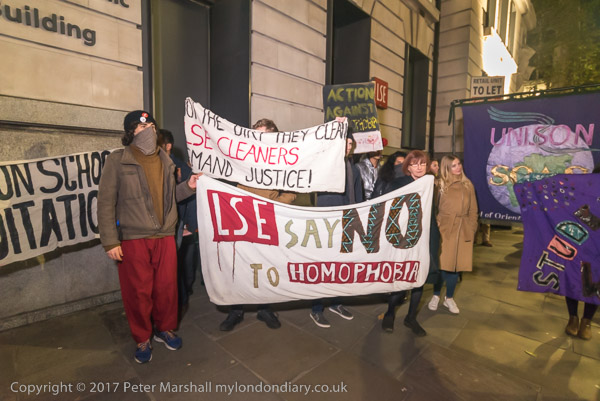
Cinema Workers Strike, LSE against Homophobia: On Monday 6th November 2017 I photographed striking Picturehouse staff picketing the cinema in Shaftesbury Avenue before going on to the LSE where students, supporters and cleaners were protesting the homophobic abuse of one of the cleaners.
Picturehouse Strike for a Living Wage
Shaftesbury Avenue
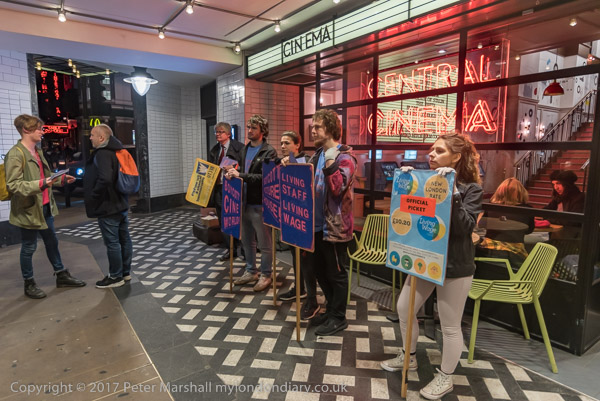
Staff working of Picturehouse cinemas in London had been campaigning for over a year to be paid a living wage, and on 6th November 2017 they were striking at Crouch End, Hackney, and East Dulwich Picturehouses and the Brixton Ritzy as well as at Picturehouse Central close to Piccadilly Circus.
It was Living Wage Week and the new London Living Wage of £10.20 per hour had been announced earlier that day. As I noted on My London Diary, while the cinema staff were living on poverty wages, “the post-tax profits of Cineworld, the parent company of Picturehouse were £93.8m last year in UK and Ireland and the CEO is paid £2.5m.”
In the short time I spent with the picket a number of people “decided not to cross the picket line. Some went to the cinema a short distance down the road instead.” The strikers were expecting more people to join the picket later when there would be more customers but I had to leave to cover a protest elsewhere.
Protesters outside the New Academic Building where ‘LGBT Rights: what next?’ was taking place
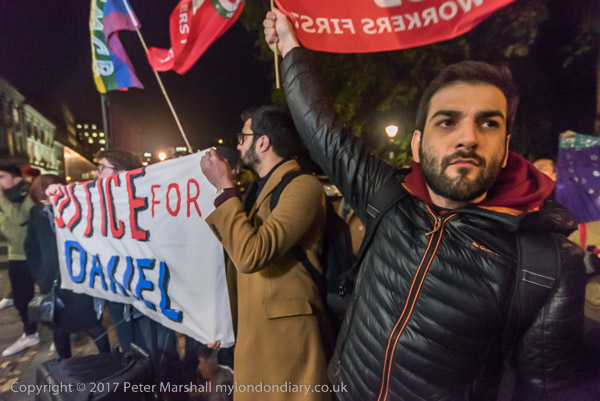
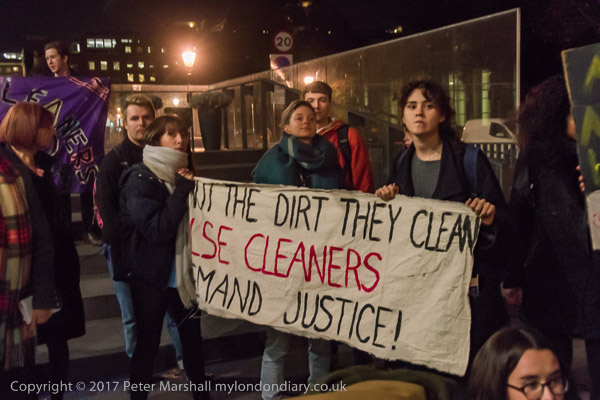
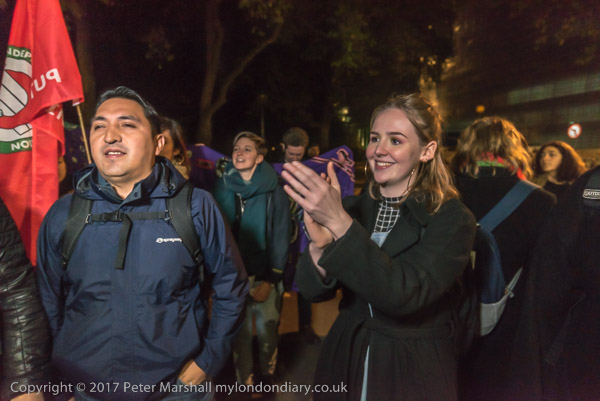
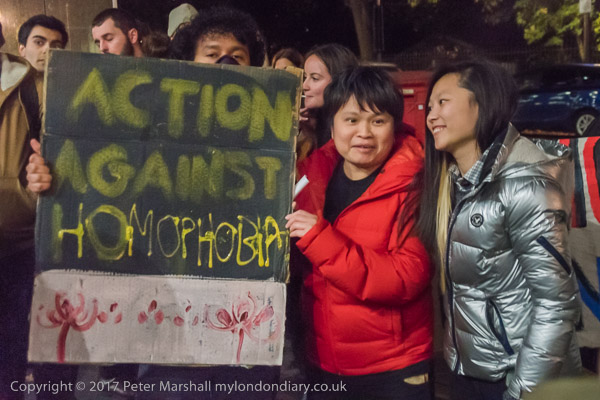
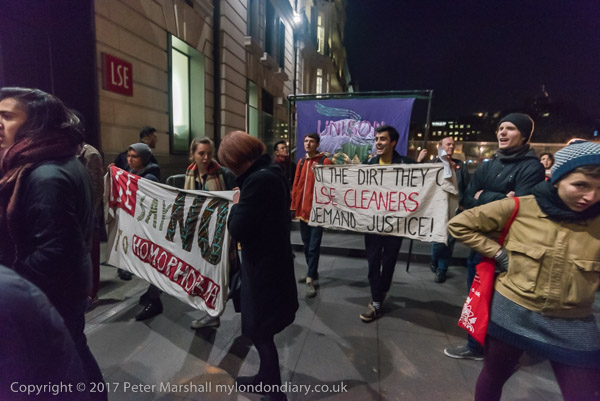
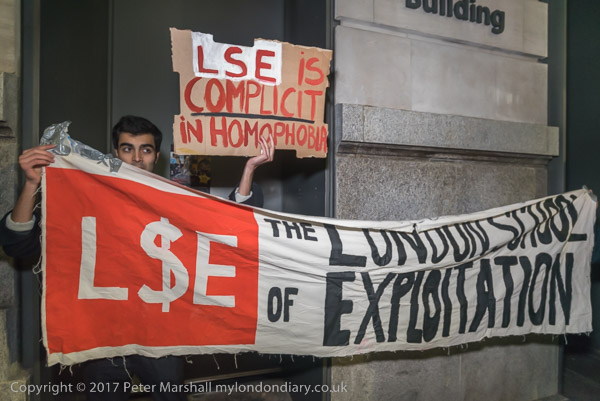
That evening the LSE were hosting a talk, “LGBT Rights: what next?” and students and others including some cleaners were protesting outside over the homophobic abuse which Daniel, one of the LSE cleaners, had been subjected to over the past 10 months.
The cleaners who work at the LSE were then not employed by the LSE but the work had been outsourced to cleaning contractor Noonan. They were eventually brought back into direct employment after over a year of protests led by their union, United Voices of the World – I photographed most of these protests beginning with the launch of the campaign – on My London Diary.
Daniel’s abuse came from his managers at Noonan. Complaints by him and his union had been brushed aside and he had been threatened with him disciplinary action for making some of them. Crowd-sourcing and support from the UVW enabled his case to go to an employment tribunal and in April 2018 it found he had been harassed on multiple occasions at the LSE merely for being homosexual.
Members of the IWGB had come in solidarity with their fellow cleaners in the UVW
The tribunal heard that Daniel had been told “homosexuals were not human“, and that he should “sleep with women to cure his problem“, and that he was “a woman” for complaining about his treatment. It found that a culture existed at the LSE that made making such comments acceptable.
The tribunal vindicated the students accusation of hypocrisy against the LSE, which while hosting talks and boasting about its promotion of gay rights had refused to take any action when confronted by a clear case of anti-gay discrimination on its site. The protest pointed out that while Noonan employed the cleaners the LSE still had full control over their hiring and firing, and Noonan would have had to take action over the complaints if they had ordered them to do so.
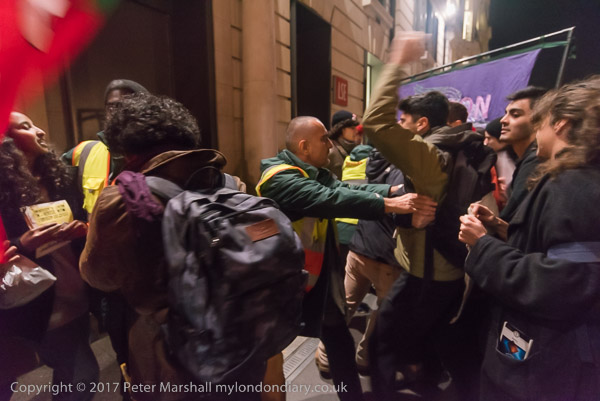
Security stop protesters entering the building
The protesters called on the LSE to apologise and commit to zero tolerance of homophobic and racist behaviour at all levels throughout the institution and to sack all homophobic bullies.
Security tried unsuccessfully to stop some protesters coming onto the site to protest, pushing the SOAS Unison banner into the road but were unable to prevent LSE students to come onto the site, though they they did a few who tried to enter the building.
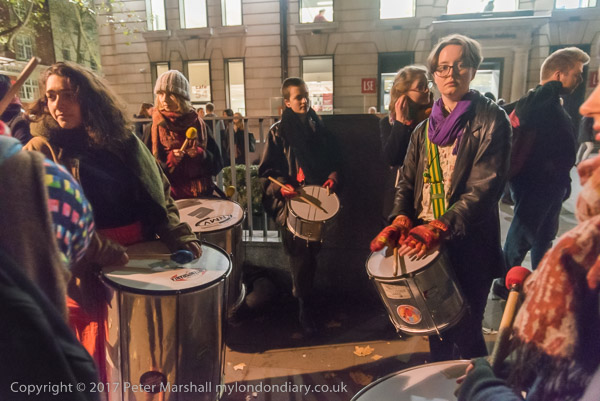
After some minutes of noisy protest the protesters marched around to the Kingsway entrance to protest there, then returned for further protests at the main entrance before moving off again to protest outside the New Academic Building.
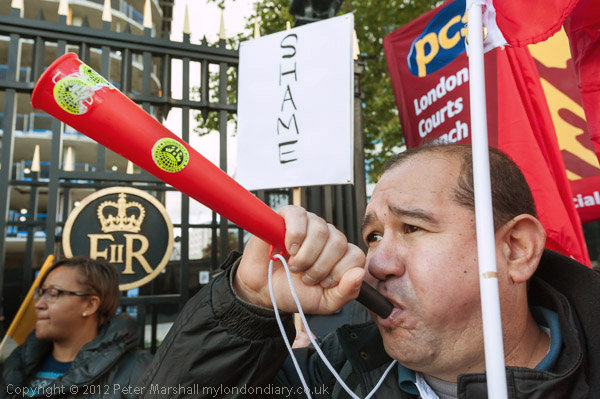
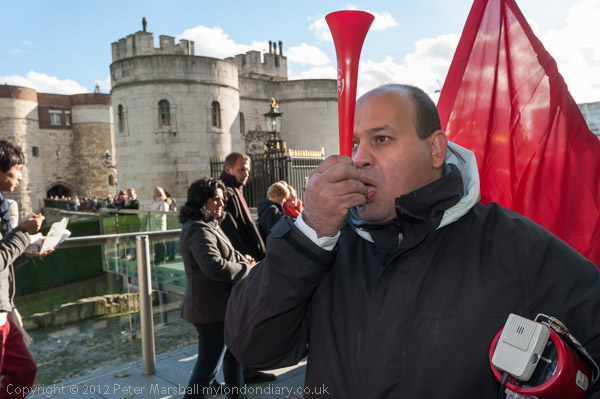
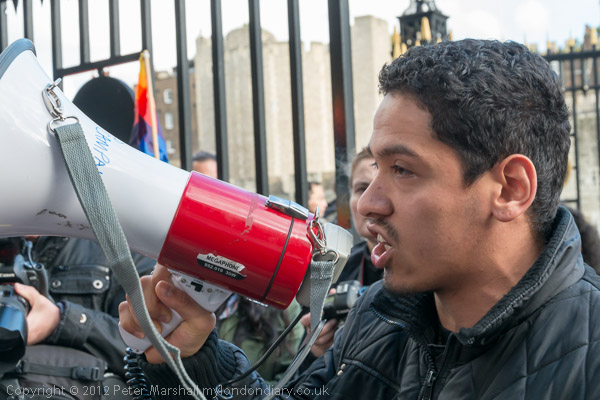
Cleaners Protest at Tower of London: On Saturday 3rd November 2012 the trade union Industrial Workers of Great Britain (IWGB) held a high profile protest outside the Tower of London as a part of their campaign to get the London Living Wage, better contracts and improved working condition and management for the workers who clean the Tower, one of London’s major tourist attractions.
The Tower of London is run by a charity, ‘Historic Royal Palaces’, which also runs other royal palaces on behalf of the Crown, but they employ no cleaners. Instead they were using the cleaning contractor MITIE to employ the workers who clean the Tower and make it fit for visitors. By outsourcing the work in this way they try to deny responsibility for the poverty wages, lousy pensions, holidays and sick pay, poor physical conditions, overworking and bad management of their workers.
The IWGB was formed by Latin American cleaners organising for better working conditions earlier in 2012 after they had become disillusioned with the lack of support for lower paid workers by some of our traditional unions as “a worker led union organising the unorganised, the abandoned and the betrayed.”
IWGB organiser Alberto Durango at the Tower
It remains a powerful grass-roots trade union, based on building workers’ power and developing leadership by its members, taking action through strikes, powerful protests and legal actions and developing solidarity across cultural and language barriers.
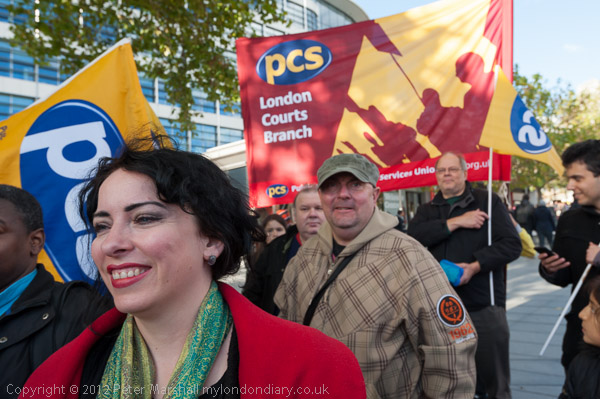
PCS members came to support the protest
The union has developed significantly since 2012 and has had many victories in its campaigns to improve the conditions of low paid workers. It now “organises couriers, cycling instructors, charity workers, yoga teachers, cleaners, security officers, video game workers, nannies, university workers, foster carers, private hire drivers and more.”
Security stop the protesters at the gate, where the protest continues
I reported on many of the protests by the IWGB and other grass-roots unions including the United Voices of the World (UVW) over the years – and you can see many of my reports on My London Diary. There had been a number of protests by cleaners before these unions were formed, but they brought a new level of activity and creativity to the protests.
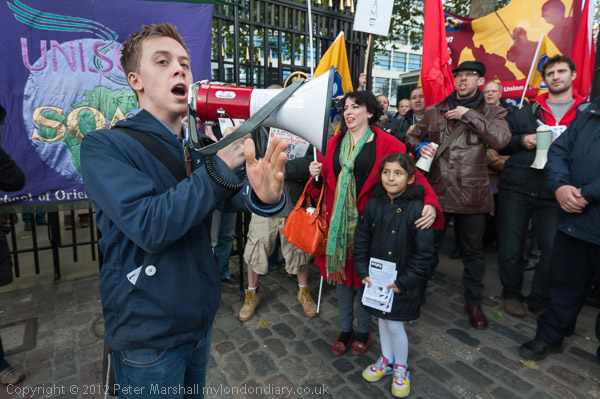
Owen Jones speaking
The campaign for a London Living Wage was started by London Citizens in 2001 and recognises the extra costs of living in the city – something that had long been recognised in professions such as teaching, where teachers in Greater London received a London allowance. The London Living Wage level is calculated independently and supported by successive Mayors of London, but companies are not obliged to pay the extra amount above the National Minimum Wage (rebranded the National Living Wage for those over 21 a few years ago.)
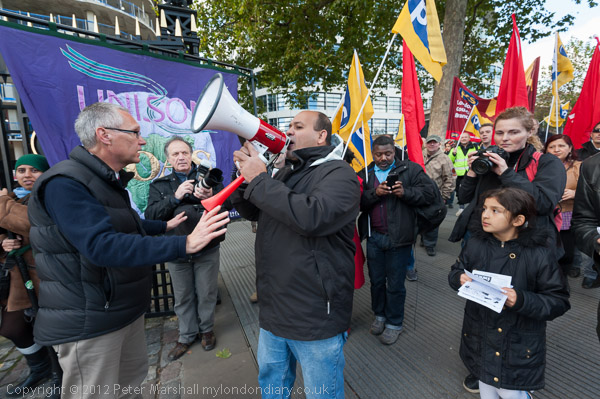
A speaker from PCS
As I wrote in 2012, the London Living Wage “still meets with bitter opposition from some of the most profitable companies around who are low pay employers, including MITIE, who last year increased their profit margins to 5.6% and had a pre-tax profit of £104.5m.”
A cleaner speaking
The IWGB’s campaign as I also wrote, is “not only about wages, but also about civil rights, dignity and respect. MITIE seems to be treating its workers and employment law with contempt. The cleaners demand justice and fair treatment, and say they are treated as medieval serfs. They are asking for:
• the London Living Wage of £8.30 per hour
• proper contracts which reflect the actual hours of work and provide
    holidays and other normal employment benefits
• adequate staffing levels to cope with the workload
• proper changing and washing facilities
• proper Health & Safety training for managers and workers, and risk
    assessments of tasks
• proper safety equipment including protective gloves etc"
MITIE’s response to the campaign was simply “to ban the IWGB. Senior HR Manager Kevin Watson-Griffin stated ‘IWGB representatives will not be permitted access to any MITIE site, including the Tower of London, Barbican etc. to support the IWGB members who are employed by MITIE.'”
After an hour or so of noisy protest it was time to go – but with the message “We’ll be back“
On My London Diary you can read more about the protest at the Tower, including what actually happened at this very public, very visible and very noisy protest which received considerable support from trade unionists from other unions involved with cleaners including the PCS, RMT and Unison. I also wrote about some of the speakers and their speeches and the photographs include most of them including journalist Owen Jones.
Gallery Protests, Sikhs, Kashmiris, Kurds, Sewol, Sotheby’s & Black Lives Matter: Saturday 15th August 2015 was probably the day I photographed more events than any other day, covering a total of 8 protests as well as taking a few pictures of London as I travelled around.
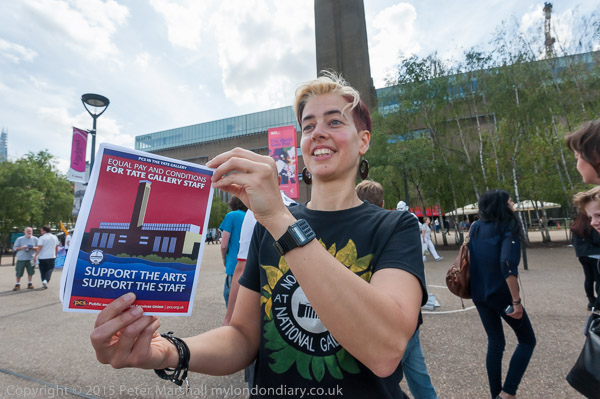
Handing out fliers at Tate Modern wearing a sunflower T-shirt supporting the National Gallery strikers
It was the 61st day of the PCS strike against privatisation at the National Gallery, and at Tate Modern staff were handing out leaflets calling for staff who had already been outsourced to get the same pay and conditions as directly employed workers.
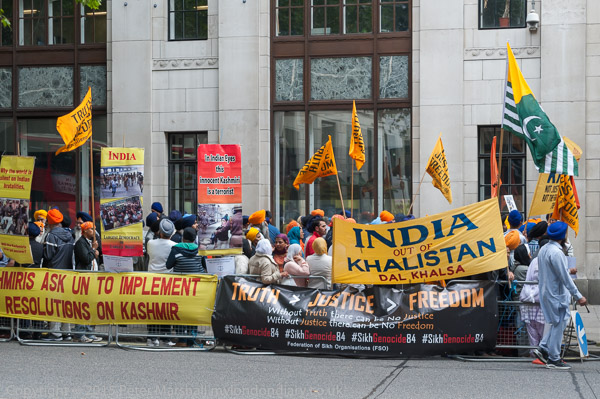
It was Indian Independence Day, and outside India House I photographed Sikhs calling for the release of political prisoners and Kashmiris calling for freedom.
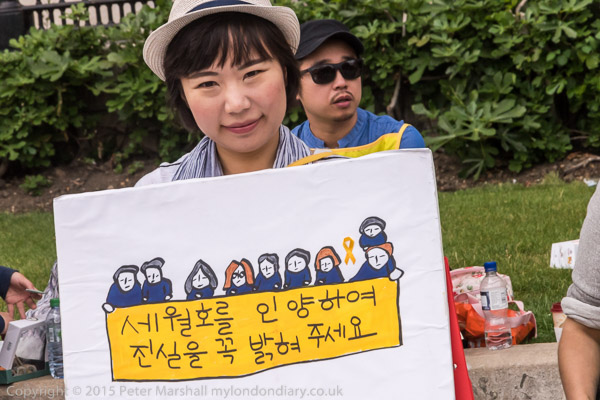
In Trafalgar Square Iranian Kurds remembered those killed in the fight for self-determination and a monthly silent protest remembered the Korean children killed when the Sewol ferry sank.
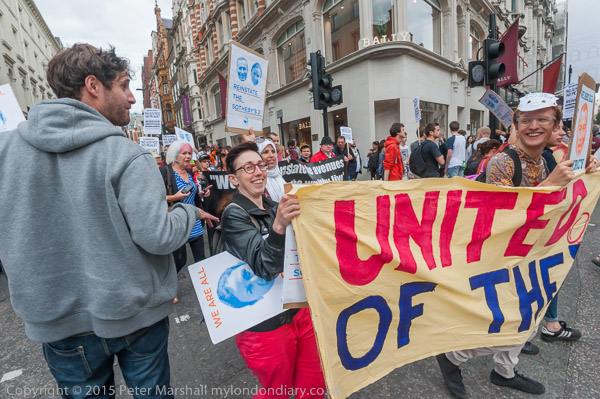
In Mayfair, United Voices of the World were protesting in the streets around Sotheby’s, calling for proper sick pay, paid holidays and pensions and demainding the reinstatement of two union members sacked for protesting.
Finally I went to Grosvenor Square for a protest close to the US embassy against the collective and systemic unlawful arrests and killings/attacks of black people in America.
You can read and see more pictures from all of these events – and a few pictures of London on My London Diary. Here I’ll post very short introductions to the events with a picture and a link.
National Gallery 61st day of Strike – Trafalgar Square
Cindy Udwin, PCS rep at the gallery, sacked for her union activities. The strikers were determined to get her re-instated – and eventually did
A short rally ended the daily picket on the 61st day of the PCS strike against privatisation at the National Gallery, with speeches and messages of support.
Vicky of Equalitate holds up their flyer calling for equal pay and conditions
Privatised visitor assistants at Tate Modern & Tate Britain get £3 an hour less than directly employed colleagues, are on zero hours contracts and do not get the same employment rights.
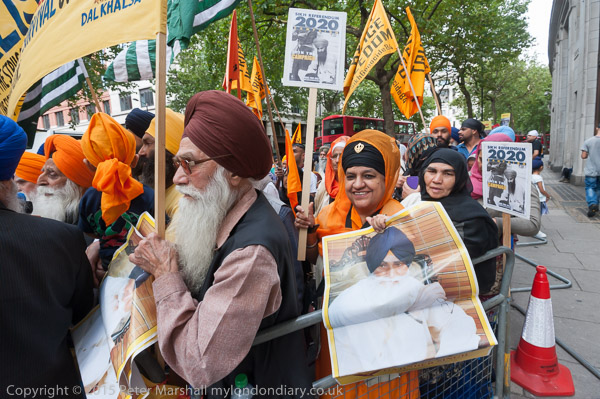
Sikhs call for release of political prisoners – Indian High Commission
On Indian Independence Day, Sikh protesters from Dal Khalsa supported the call by hunger striker Bapu Surat Singh for the release of Sikh political prisoners and for the ‘2020’ campaign for a referendum for an independent Sikh state, Khalistan.
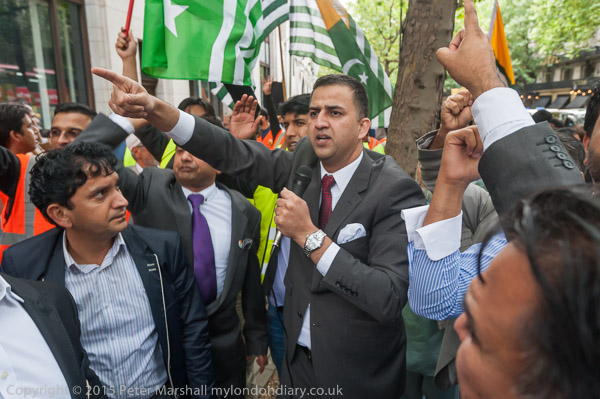
Kashimiris Indian Independence Day call for freedom – Indian High Commission
Kashmiris protested at the Indian High Commission on Independence Day, observed as ‘black day’ in Indian military occupied Kashmir. They want freedom for their country, now a disputed territory with areas occupied by India, Pakistan and China.
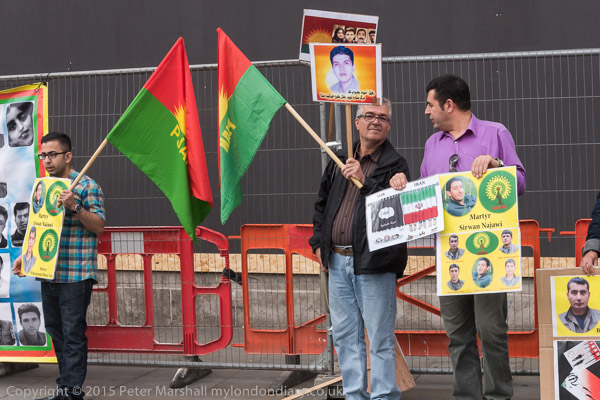
Kurdish PJAK remembers its martyrs – Trafalgar Square
Iranian Kurds from the Party of Free Life of Kurdistan (PJAK) remembered its fighters killed in the fight against Iran and ISIS for self-determination.
The monthly silent protest remembered the victims of the ferry tragedy, mainly school children who obeyed the order to ‘Stay Put’ on the lower decks as the ship went down.
United Voices – Reinstate the Sotheby’s 2 – Mayfair
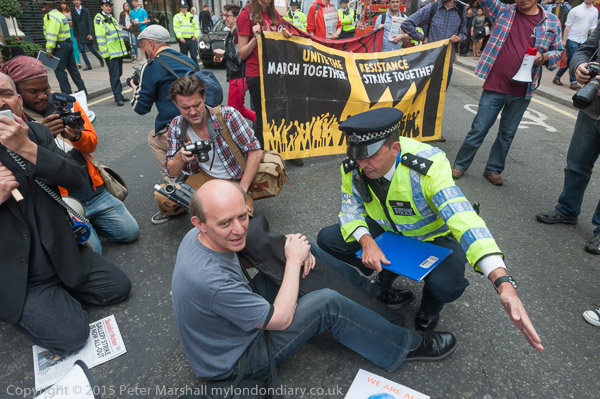
A police office tells Sandy Nicoll to get up and off the road with no success
The United Voices of the World marched noisily around the block at Sotheby’s demanding reinstatement of Barbara and Percy, cleaners sacked for protesting for proper sick pay, paid holidays and pensions. Several police attempts to clear the road and stop them failed.
BlackoutLDN solidarity with Black US victims – Grosvenor Square
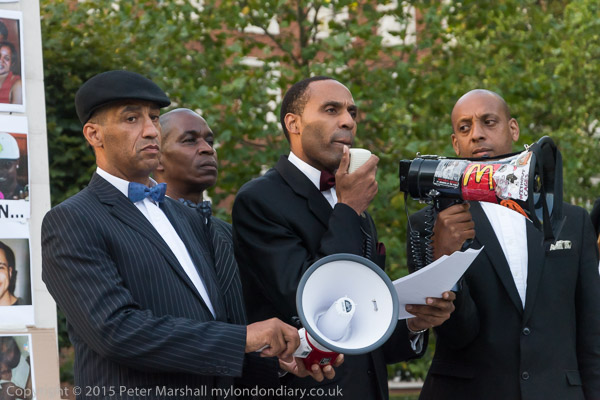
Bro Jeffrey Muhammad of the Nation of Islam speaking about police targeting attacks on the Black community in the UK
Two young women, Kayza Rose & Denise Fox, had organised a peaceful protest under the statue of Franklin Delano Roosevelt, close to the US embassy, in solidarity with events across the US against the collective and systemic unlawful arrests and killings/attacks of black people in America.
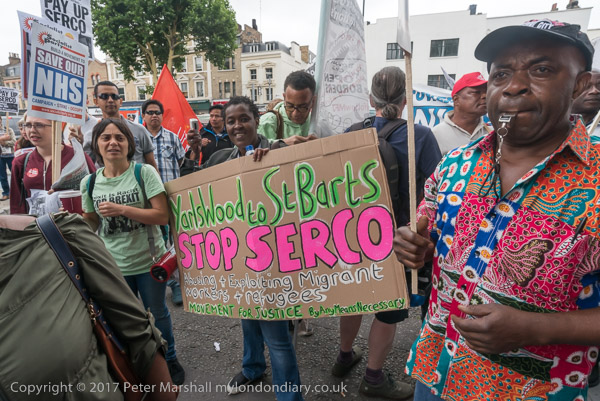
Barts NHS Cleaners march against Serco: On Saturday 15th July 2017 a rally and march in Whitechapel follow five days of strike by cleaners and porters at the Royal London Hospital and the other East London hospitals in the Barts NHS Trust – Mile End Hospital, Newham University Hospital, St Bartholomew’s Hospital and Whipps Cross University Hospital.
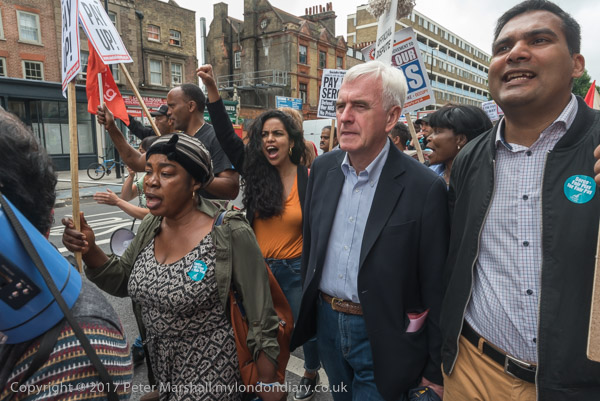
John McDonnell with others on the march down the Mile End Rd
Cleaning, portering, laundry, cleaning and security services were outsourced to Serco in 2017 and the workers involved immediately found their conditions being adversely affected. Serco’s first action was to write to them telling they were no longer allowed paid tea breaks; the workers sat in the canteen and refused to move before these were re-instated. But they accused Serco of increasing stress and workload with a climate of bullying, intimidation and fear and a failure to set up procedures for reporting problems with facilities and other issues.
When Serco refused a Unite claim for 30p per hour in line with inflation and cost of living increases in London the workers voted 99% in favour of strike action. Serco illegally brought in poorly trained agency workers to replace them and on the strike days conditions became unsanitary and many patients did not get hot meals.
Barts Trust had put these services out to tender to save money they needed to pay out £2.4million a week because of a disastrous PFI contract made under New Labour. Although It had provided a much-needed new hospital completed in 2016 but with two floors Barts didn’t have the money to fit out, it left them paying these huge sums long into the future. But Barts were attempting to save money at the expense of their workers and endangering patients.
Gail Cartmel, , Assistant General Secretary at Unite and TUC Executive member
The protest began on the busy street outside the old Royal London buildings but there were soon too many for the pavement here and we moved around to the side of the hospital for a rally, where speakers including Gail Cartmel of Unite, John McDonnell, then Shadow Chancellor and Unite pickets and other trade unionists including Victor Ramirez of United Voices of the World who spoke forcefully in Spanish – the first language of many of the cleaners – spoke from a balcony above the crowd – and I was able to take some pictures. Some brought greetings and support from other unions.
Serco employ mainly migrant workers in other public sector workplaces as well as running immigration prisons such as Yarl’s Wood where migrant women and families are daily repressed and subject to physical and sexual abuse and some had come to support the Barts workers and also to protest against their activities elsewhere.
Eventually the marchers formed up behind the banner and made there way along Mile End Road to another rally in a small park close to Mile End Hospital, where there were a few more speakers before we all dispersed.
Back in 2003 I’d spent time in several hospitals and had experienced a clear difference between the standards of cleaning and food between those with contracted out cleaners who were allowed insufficient time to clean the wards and one where the cleaners were still a part of the hospital team. It was the difference between dirt and used needles under my bed and a spotless shiny floor.
Victor Ramirez of UVW
Protests continued at Barts and in 2023 Serco withdrew early from the contract. Both Unite and Unison claimed victory for the decision by Barts to directly employ the workers under the same conditions as other existing staff.
Labour in opposition were clearly opposed to outsourcing particularly in the public services and promising to outlaw it, but the Employment Rights Bill Implementation Roadmap published this month seems to have drawn back from the earlier promise and contains no explicit reference to outsourcing.
I was pleased with the photographs I had been able to make at the event and as well as the few here there are many more you can see on My London Diary at Barts NHS Cleaners march against Serco.
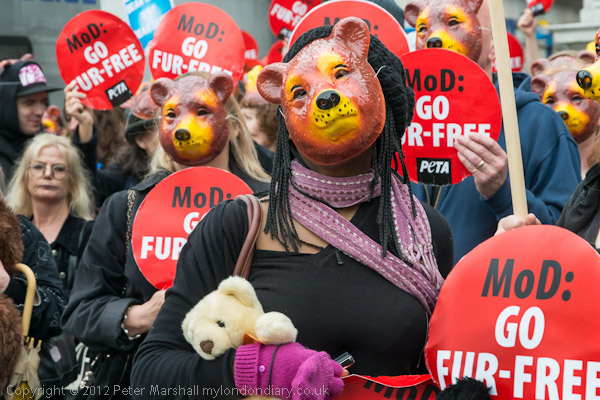
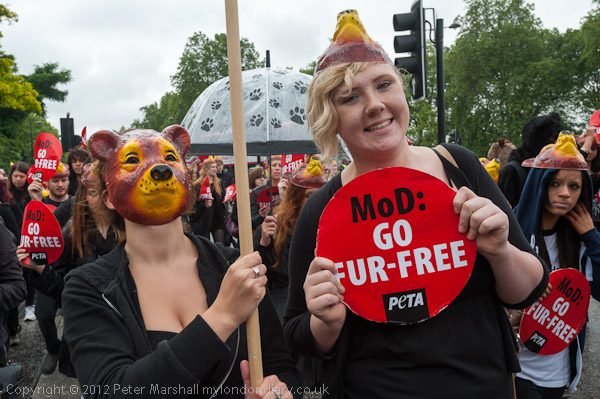
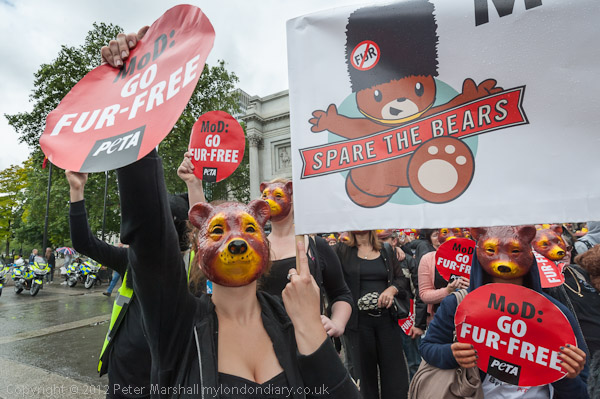
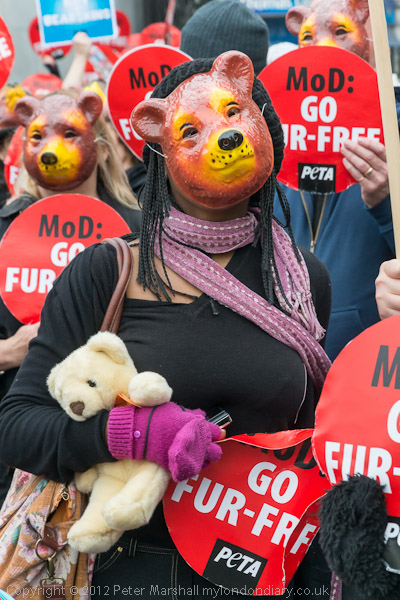
Lettings Scam, Bears, Bahrain & John Lewis: Saturday 14th July 2012 was another day I spent travelling to protests around London. On the Holloway Road Harringey Private Tenants Action Group protested against letting agents who take hundreds of pounds from people looking for homes but do nopthing for them, PETA marched from Waterloo to Marble Arch against bears being killed to make busbys for the guards, a protest at the Bahraini embassy in Belgrave Square against killing and jailing of political prisones. Finally I went to John Lewis in Oxford Street where cleaners were calling to be recognised as partners in the business and to be paid the London Living Wage.
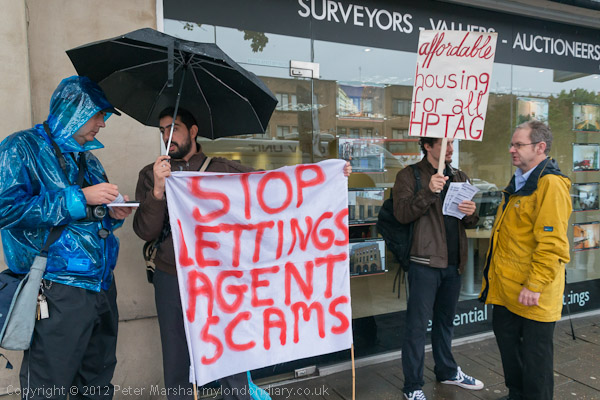
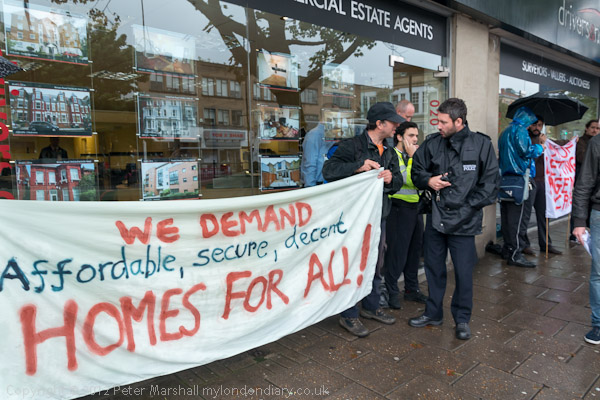
I photographed protesters standing in the rain outside letting agents Drivers & Norris on Holloway Road, condemning them for taking over £300 from home seekers and providing nothing return but refusing to return the payment.
Harringey Private Tenants Action Group stated:
Agency ‘fees’, reference ‘checks’, admin ‘fees’, leaving ‘fees’ are all costs that have been created over the past few years by and for Letting Agents like Drivers and Norris, to increase their profits and exploit the basic nee of tenants to find a home. We, as private tenants, will not accept this anymore. We have a right to really affordable, secure and decent housing just like anyone else.
Police came and tried to get the protesters to end their protest, claiming it might distract drivers on the busy main road. The protesters told the police firmly that they were simply trying to suppress lawful protest and if they considered there was any real danger they should divert traffic from the area and that instead of wasting police time here they should be investigating the Drivers & Norris scam rather than harassing protesters.
I commented that there was no real reason for any police presence as there was “unlikely to be any breach of the peace. But I suppose it was an easy number to drink tea in the estate agents“.
On My London Diary I pointed out that agents had profited enormously from high property prices in London, now well above what people on average or lower wages can afford, and that successive governments had weakened the security of private tenants and cut the provision of social housing creating the current dire housing problems. Many new developments were also being aimed at overseas investors to enable them to take advantage of the rapidly rising property prices while often leaving the properties empty.
PETA (People for the Ethical Treatment of Animals) had stated:
It can take the entire hide of one Canadian black bear to make just one cap. Bears can be shot several times before they die, and some escape and bleed to death. In some Canadian provinces, there are no restrictions on the shooting of mothers who have nursing cubs, leading to the slaughter of entire families during hunts.
We need to send a clear message to the Ministry of Defence that the slaughter of wildlife for The Queen’s Guards’ ceremonial headwear is unacceptable and that the time has come for them to go fake for the bears’ sake.
I’d called in to the start of the march next to the Shell Centre at Waterloo before going to Haringey, but hadn’t taken any pictures, deciding instead to meet them at the end of the march. It took them much longer than they had expected and I’d almost given up when I saw them coming up Park Lane and rushed to take pictures.
It was perhaps a too regimented protest with so many identical placards and bear masks provided by PETA which made it difficult for me to find anything really different to photograph.
They had also been asked to wear black clothes, but at least had been told to bring their own teddy bears.
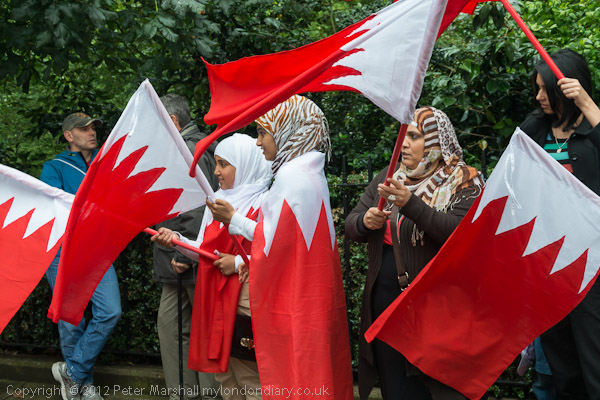
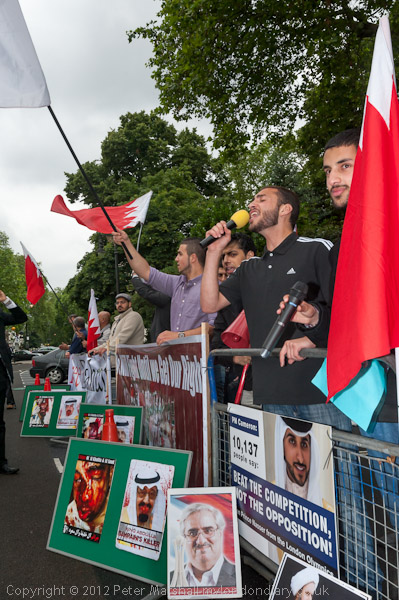
Solidarity with the Bahraini prisoners – Bahraini embassy, Belgrave Square
The Al Khalifa family has ruled Bahrain since the late 1700s and in 1820 made a treaty with Britain – since renewed on various occasions, becoming a British protectorate. The country became independent in 1971 – when the USA took over what had previously been the Royal Navy base – and the family is still in power.
Various attempts to extend democracy in Bahrain led to little change in the ruling family’s control and to an uprising in 2011 with large protests and a brutal crackdown with many protesters tortured and around 120 killed. Mohammad Rahdi Mahfoodh was one of the ‘martyrs’ and was hit by a police vehicle and died from deliberate lack of care in a military hospital and mourners at his funeral were attacked.
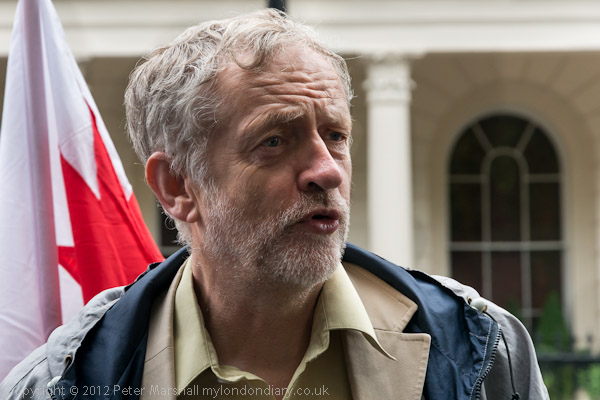
Speakers at the protest including Jeremy Corbyn were there and people were still arriving for the protest opposite the embassy which was just beginning when I had to leave for my next event.
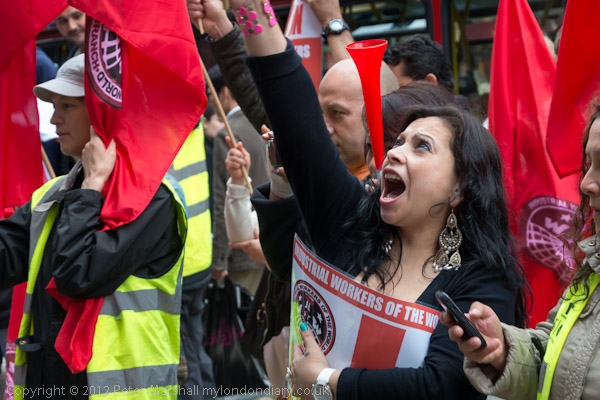
The flagship John Lewis store on Oxford Street is cleaned by people employed by Integrated Cleaning Management (ICM) who employ them on far worse conditions than if they were directly employed by John Lewis, and on the legal minimum wage, then more than two pounds an hour below the London living wage.
Unlike others who work in the store the cleaners do not take part in the bonus scheme in which John Lewis shares its profits with its workers (the ‘partners’) although their work is essential to the operation of the store.
The cleaners also complain about poor management by ICM with discrimination and abuse at work, and are currently threatened by a 50% cut in their hours.
They had been long campaigning for equality of treatment and to be directly employed by the company they actually work for – John Lewis – and had held a one-day strike the previous day which had ended with a rally and a brief invasion of the store, though had caused no damage. But this perhaps explained the large numbers of police present, with small groups around each of the shop entrances.
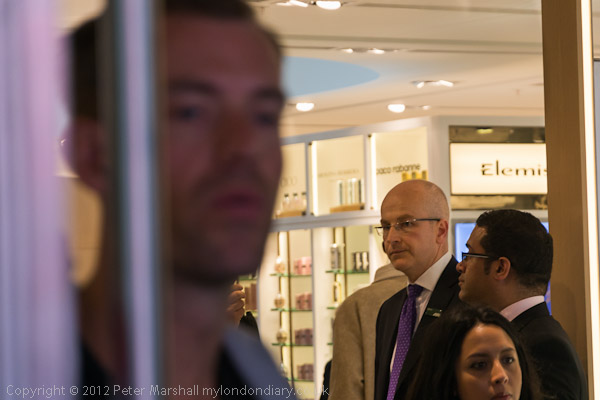
John Lewis senior management watched the noisy but peaceful protest from inside the store. The management were still refusing to talk with the cleaners Union, and another one-day strike was caused the following week.
LSE Decorated Against Inequality & Corruption: On Tuesday 25th April 2017 students and workers in the ‘Life Not Money’ campaign took part in “a colourful nonviolent direct action calling on the LSE to change from what they say is thirty years of growing neglect, cruelty and outright corporate greed towards workers and staff at the school to something beautiful and life affirming.”
The main organiser of the protest was Roger Hallam, currently serving time in jail for conspiracy to cause a public nuisance for organising protests to block the M25 motorway in 2022, sentenced to five years, but marginally reduced on appeal to 4 years. At the time of the protest he was a Ph.D student at nearby King’s College London, “researching how to achieve social change through civil disobedience and radical movements.” I knew him from photographing him carrying out practical work on the subject on a number of occasions, mainly against air pollution from London’s traffic.
Hallam, centre with protests putting ‘£50 notes’ on the wall watched at left by the LSE security manager
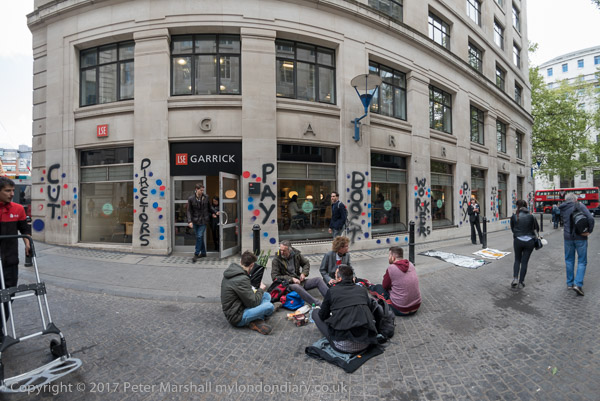
At this protest, Hallam was one of a number of people who decorated the wall of the LSE Garrick Building with water-soluble chalk including the slogan ‘CUT DIRECTORS PAY BOOST WORKERS PAY WE ALL KNOWN IT MAKES SENSE’. They also blu-tacked some small posters resembling £50 notes to the wall.
The group then sat around in a small circle on the pavement in front of their work holding a party, talking and joking and eating sandwiches. Four of them had decided they would wait and hope that they were arrested to show up the LSE and its failure to live up to its stated aims.
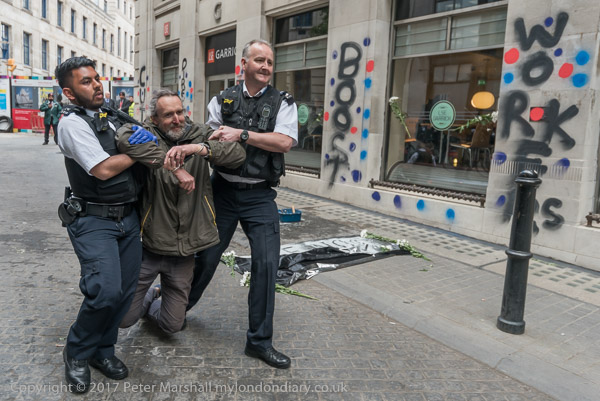
They pointed out to the police that they had caused no real damage and offered to remove the markings with the damp sponges that they had brought with them for the purpose, but the LSE security manager refused to let them touch the wall.
Police then handcuffed the four and took them away one by one. They offered no resistance, but Hallam went limp and police had to drag him away. I don’t think any of my pictures from the protest were used by the mainstream press at the time, but one of my pictures of the arrest did appear in quite a few newspapers at the time of his trial for the M25 incident and at his earlier trial after he was found with a toy drone without batteries close to Heathrow – in breach of bail conditions.
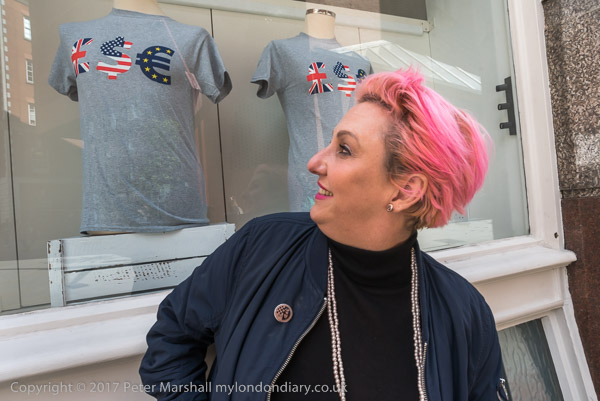
Earlier when I arrived at the LSE I met Lisa McKenzie who took me to the shop to show me the t-shirt with LSE written in currency symbols, pound, dollar and Euro, £$€.
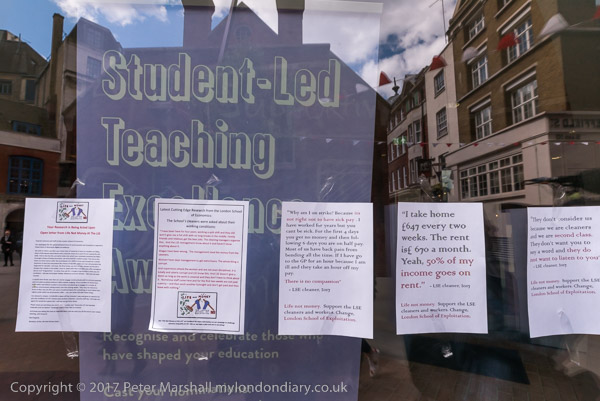
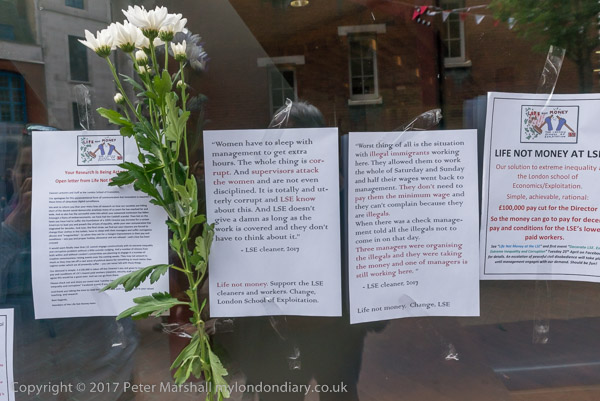
This was said by the protesters to show the true face of LSE management – an institution which values money above all else and students soon fixed posters and flowers to the shop window. After this protest the t-shirt was removed from display at the shop and is no longer on sale.
This, they said was an example of the ‘Student-Led teaching‘ the LSE prides itself on, condemning the LSE’s attitude to its key low paid workers. The also said that the cleaning contractor Noonan was an exemplar of spectacularly bad management, alleging among other things that “Women have to sleep with management to get extra hours…”
The protest was in support of the campaign launched in September 2016 by the United Voices of the World during the LSE’s 3-day ‘Resist’ Festival organised by McKenzie to bring the outsourced cleaning workers back into direct employment by the LSE.
I left shortly after the arrest, but returned 3 days later to view the alleged criminal damage, finding no trace of it but several security men guarding the wall.