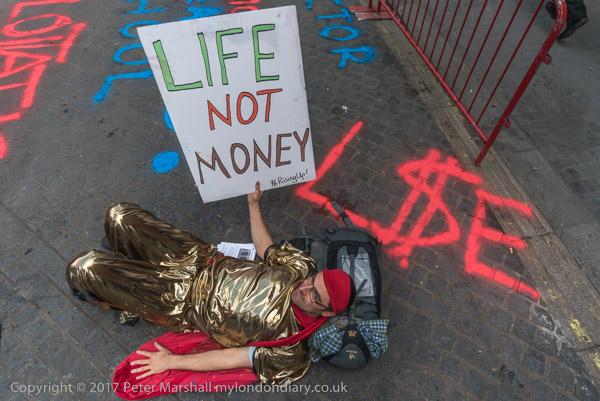
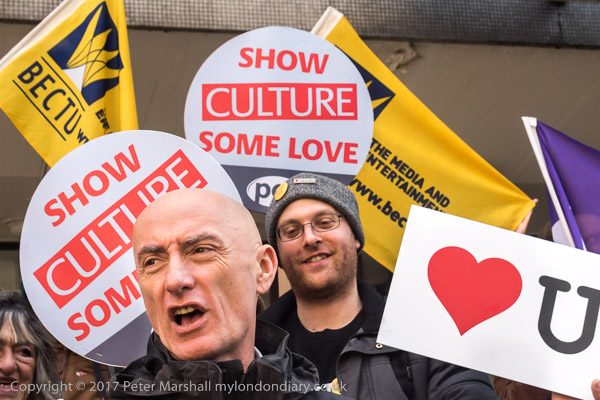
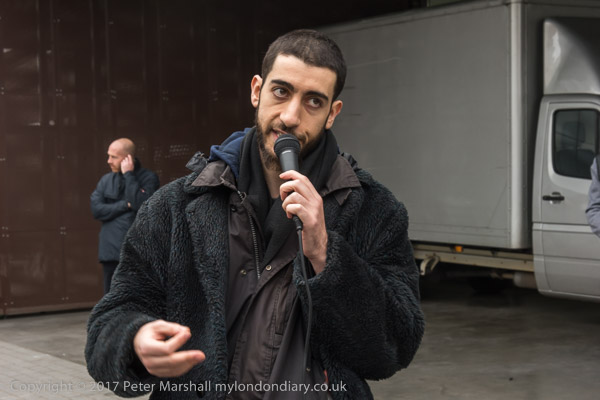
‘Life NOT Money at the LSE’ protesters chalked on the roadway and lay down, blocking the street
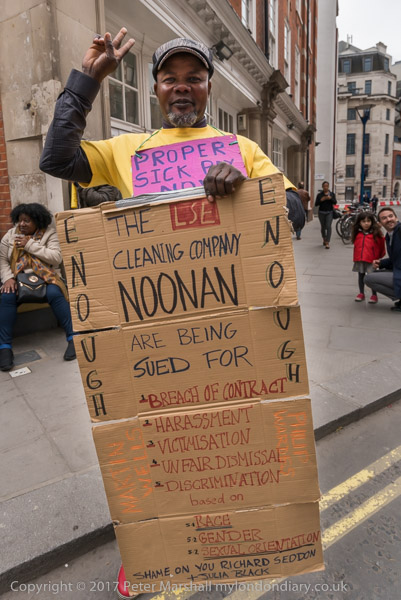
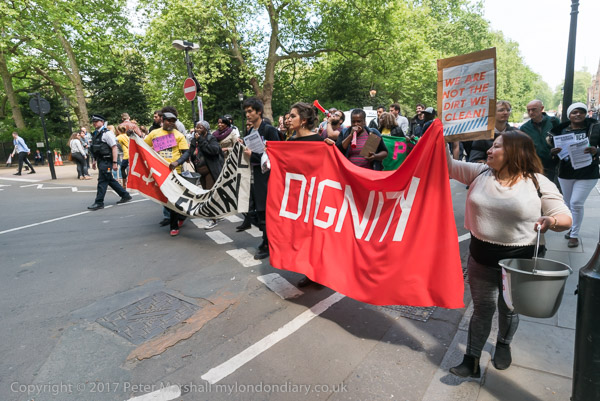
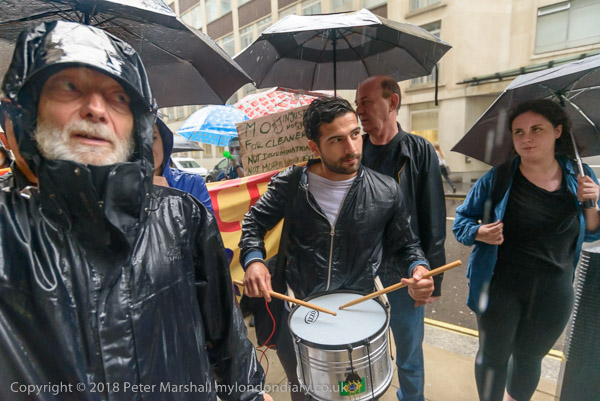
LSE Cleaners Strike For Equality And Dignity: The protest by cleaners at the LSE on Thursday 11th May 2017 was just one more in a long series of weekly one-day strikes demanding parity of terms and conditions with other staff there who were directly employed by the LSE.
The cleaning was outsourced to cleaning contractor Noonan, who employed cleaners under considerably inferior terms – pay, holidays, pensions etc – compared to those workers employed on the site by the LSE. I had been at the meeting in September 2016 when with their union, the United Voices of the World, they began their campaign for parity of treatment and had also photographed their protests.
The UVW were eventually successful after a series of strikes featuring “flashmobs, salsa, zumba, poetry, art sessions, teach-outs” and “after 10 months of struggle, and the then largest cleaners strike in UK history and the highest number of strike days of any group of outsourced workers in UK higher education – outsourcing was ended and all cleaners were brought in-house as LSE employees! Their fight against institutional racism was the first “to force a British university to end the practice of outsourcing cleaners!“
My post told the story of the event in picture and captions which describe the harassment by police and others of some of the supporters, particularly those from Class War. Here is a brief edited version.
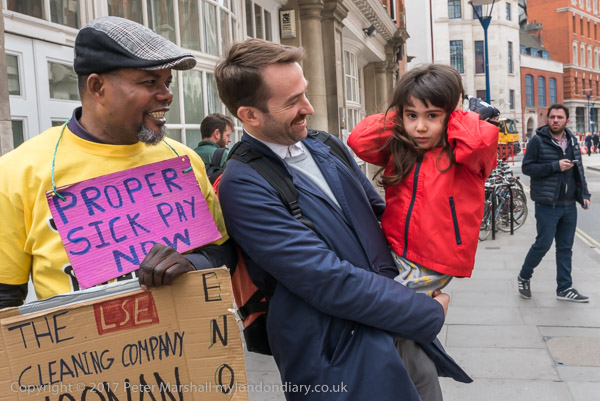
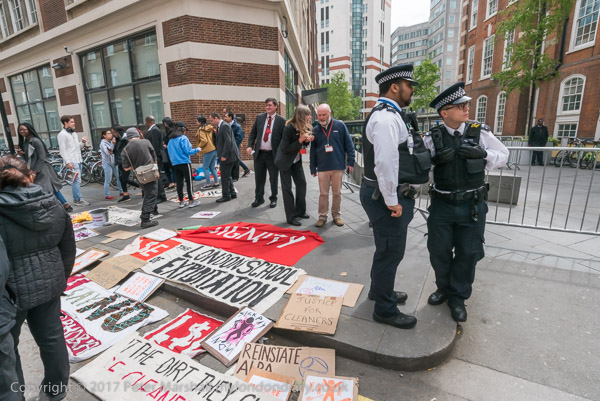
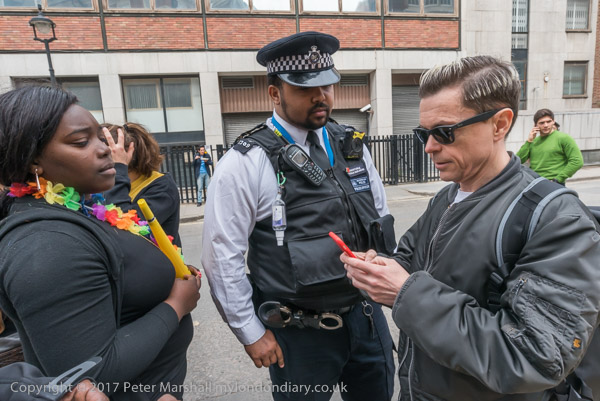
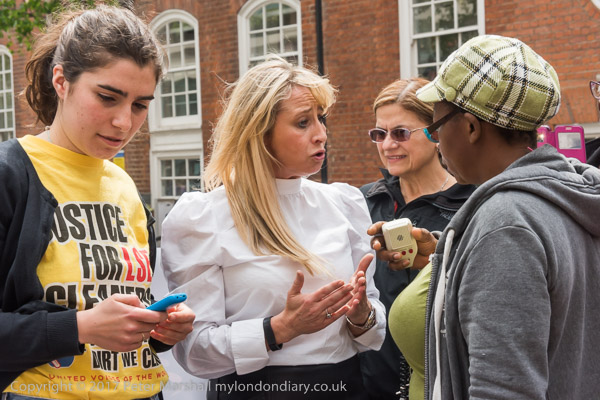
Noonan employs the cleaners at the LSE and the cleaners get low pay, low status and terrible managementThey work in the same place and deserve equal treatment. Their claims are supported by students and LSE staff. Trenton Oldfield brought his daughter with him to show solidarity with the cleaners.LSE Security have closed the area in front of the library normally open to the public. The road is a public highwayOne police officer starts harassing Sid Skill of Class War who has come to show solidarity. Sid refuses to talk to him and moves away – and eventually fled fearing arrest followed by two police officers, escaping them by jumping on a bus as the doors closedA woman who works in the LSE comes to tell the cleaners they are making a lot of noise and disturbing her day and then hugs the police officer and smiles when she sees I am photographing her. The cleaners say they have to make a lot of noise as the LSE management refuse to talk with them and their union.Cleaners make a noise – they want management to talk to them and to recognise their union. They also want to be treated with dignity and respect at work, a living wage and equal pensions, sick pay and other benefits.A man comes to complain to Class War about their support for the cleaners. He says that they don’t have any right to be there. Jane Nicholl puts him right. He seems to have no idea what class war is and no understanding of class solidarity. And as I suspect Jane put it is a stupid prick. Though she may have been less kind.The protesters march around the campus to visit a couple of other sites from brief protests in Lincolns Inn Fields and then Sardinia St before going to the Student Union, where there were speeches an poetry from Grim Chip of Poetry on the Picket Line.Meanwhile Life Not Money at the LSE had been at work, painting their message in chalk on the road and then sitting down on the Portugal St in front of Old Building, stopping lorries entering or leaving the LSE building site.
You can read the full version with more pictures and text at LSE Cleaners strike.
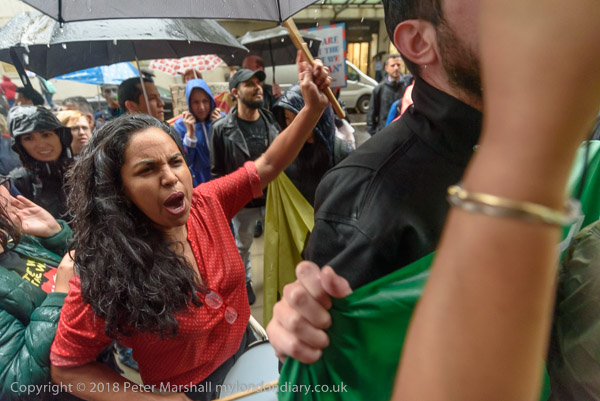
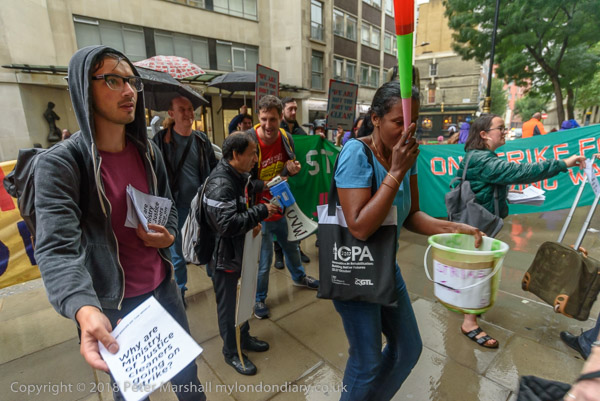
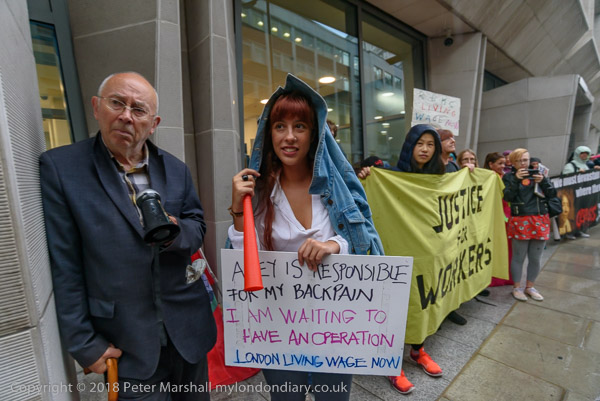
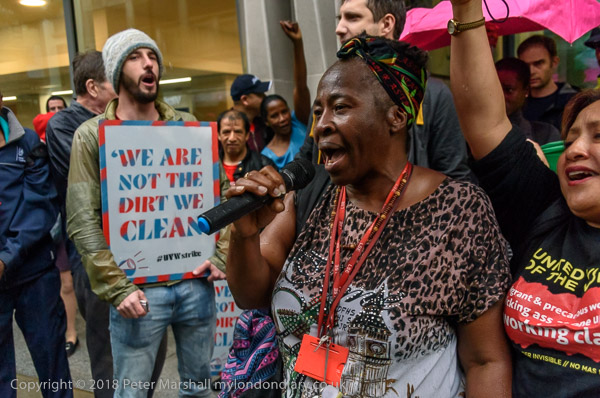
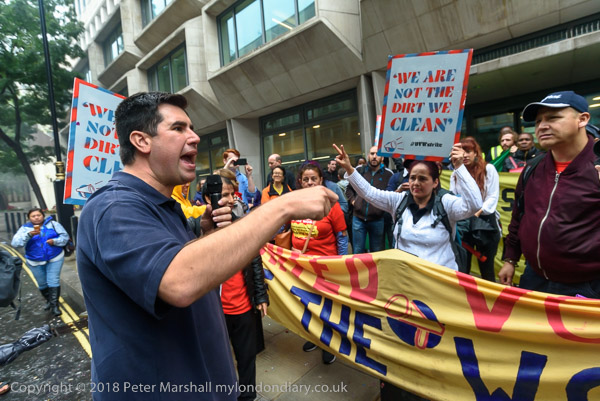
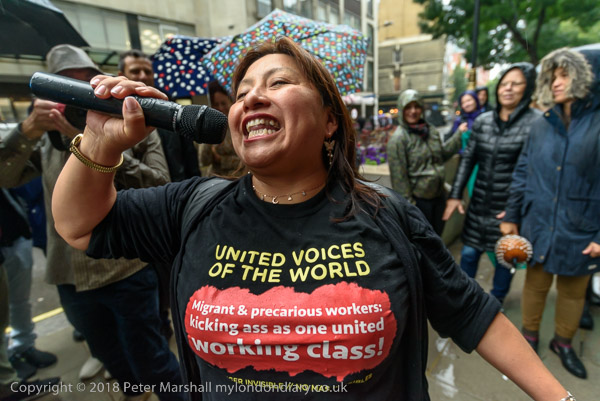
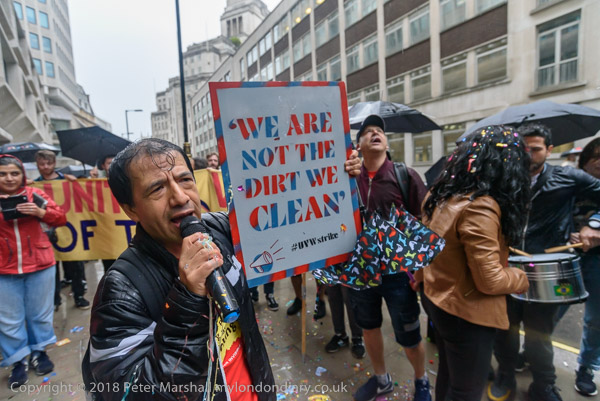
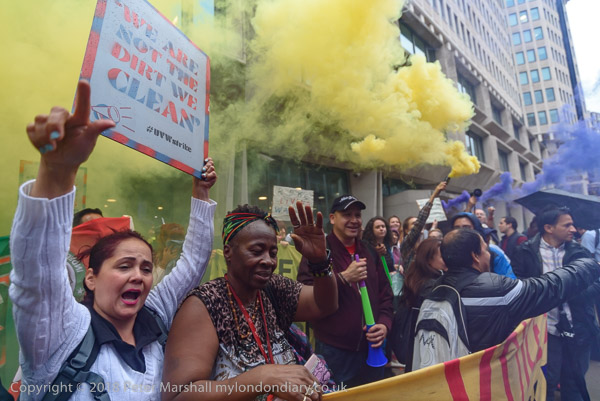
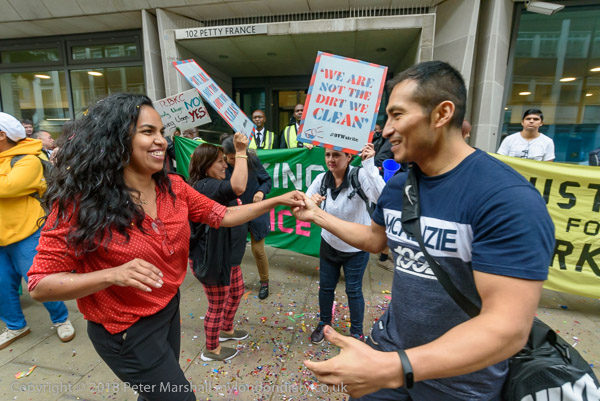
Ministry of Justice cleaners protest: On Thursday 9th August 2018 United Voices of the World (UVW) cleaners and supporters celebrated the end of their 3-day strike with a rally outside the Ministry of Justice in Petty France with a lively protest despite pouring rain.
Cleaners from the UVW had also been taking part in the 3-day strike at Kensington & Chelsea Council and hospitals and outpatient clinics in London run by Health Care America. They were all demanding the London living wage and better conditions of employment.
I’d been with them a couple of days earlier at Kensington Town Hall where, after the council had withdrawn a promise made to the cleaners earlier in the day to take them into direct employment, they interrupted a council planning committee public meeting to state their case.
The cleaners and supporters left the council offices then after they had been promised further talks the following morning, but their strike continued.
All these cleaners – like many others across the country – are not employed by the companies and organisations whose premises they clean. Instead the cleaning is outsourced to contracting companies who generally pay the minimum wage and fail to provide the kind of sick pay, pensions and other conditions of service that directly employed workers normally get. Often they are bullied by management and not treated with the dignity and respect we all deserve.
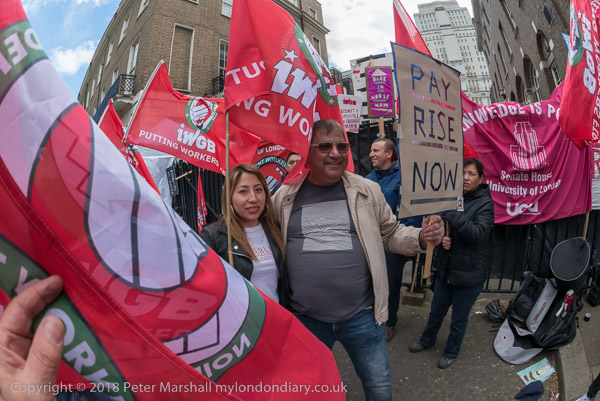
It was raining as the protesters gathered outside the Ministry of Justice, but there was a yard or so of shelter at the front of the overhanging building where people lined up with banners. But soon it was really pouring down and everybody was getting wet.
Among those coming to support the UVW were another union which fights for low-paid workers, the Independent Workers Union, IWGB, Class War and other trade unionists.
Austin Hearney of the PCS came out to give support from his members working in the Ministry of Justice, and Shadow Justice minister Richard Burgon arrived to give the Labour Party’s support.
Workers were entering and leaving the building for lunch, and most took the flyers the protesters were offering with some expressing support, though a few seemed to be angered by the protest.
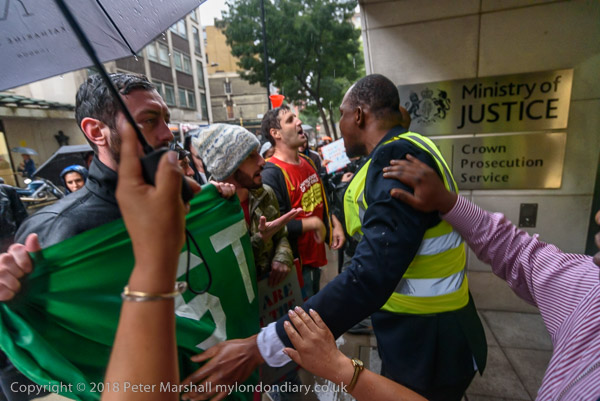
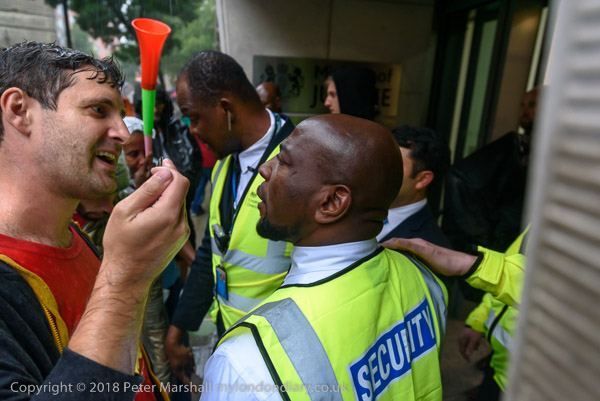
At one point when people were getting really wet, Petros Elia, co-founder and General Secretary of the UVW tried to lead the protesters into the building, but was stopped by security and police officers and the protest continued in driving rain.
I was getting very wet, and my cameras too. One of the protesters kindly held an umbrella over me for some minutes so I could continue to work. While there was space for some protesters to keep out of the worst of the rain, I had to stand in it to photograph them.
The rain eased off a little towards the end of the protest and people moved further out into the street – most of them were pretty wet already.
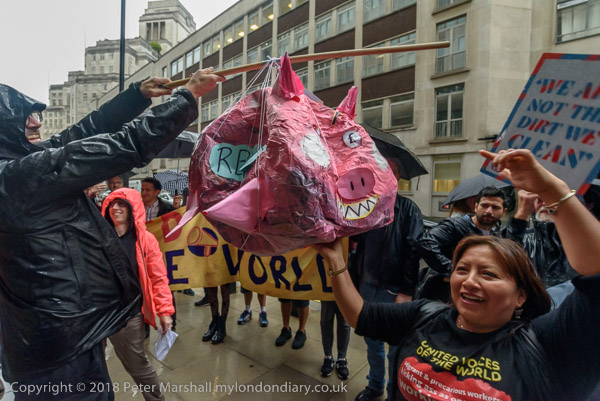
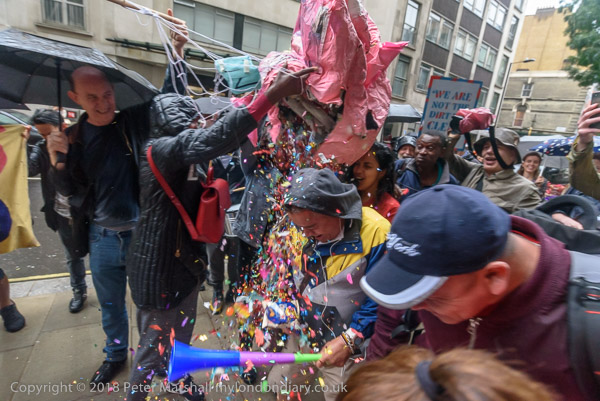
The had brought a pink pinata, a pig labelled with the initials of employers RBKC and MoJ and began hitting it with folded umbrellas and fists until it burst open releasing its multi-coloured contents onto the pavement.
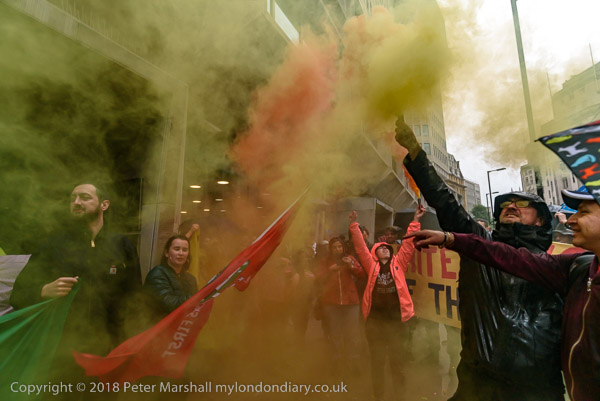
There were celebrations and several coloured flares were set off, though the effect was rather dampened by the rain. There were more speeches and more flares and poetry from one of the Poetry on the Picket Line.
By no the rain had stopped and the protesters were dancing on the pavement and in the road as the protest came to an end.
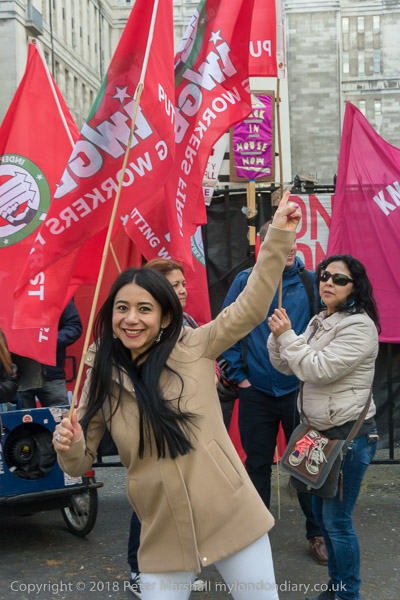
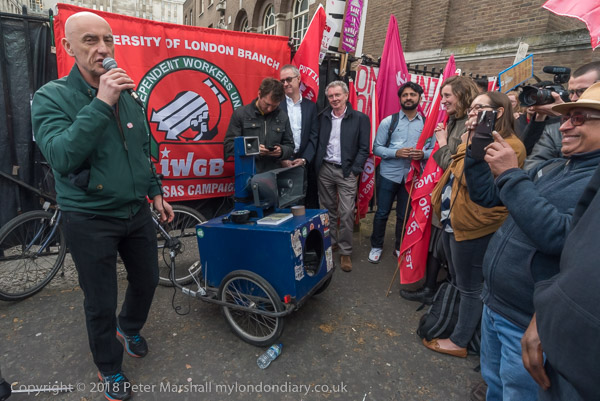
End outsourcing at University of London: Five years ago, on Wednesday 25th April 2018 I was with workers from the Independent Workers Union of Great Britain – IWGB on the first day of a two day strike at the University of London central administration by over 100 cleaners, porters, security officers, receptionists, gardeners, post room staff and audiovisual staff.
They were calling for an end to the outsourcing of their jobs in the university to various contracting companies and demanding to be directly employed by the University, and receive the same conditions and benefits as directly employed colleagues. As well as the workers, academics, students and other trade unionists came to support them in a lively rally outside the gates to Stewart House in Russell Square..
The rally was part of a successful campaign led by the IWGB which began in 2010 and ten years later the university central administration changed to directly employ porters, receptionists, post room and audio visual technicians, with cleaners following shortly after in November 2020.
The IWGB are still campaigning to bring workers in-house in other universities in London, including UCL, and they and other unions have been successful elsewhere. United Voices of the World are one of these and some of their members had come to the rally to show their support.
Cleaners and security staff at universities across London are organising for equality with directly-employed staff!
Outsourced workers suffer from far worse terms and conditions than directly-employed colleagues, facing no sick pay, bare minimum holiday entitlement and meagre pensions. Bullying, mismanagement and discrimination by unaccountable outsourced managers are common.
Workers in the IWGB union are leading the fightback. Through public campaigning and strike action we can end outsourcing at London universities!
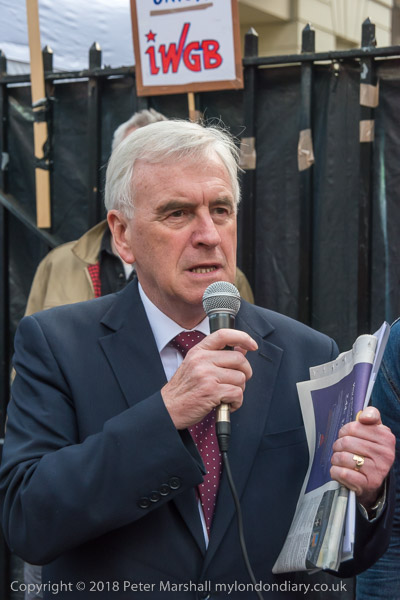
Among the speakers at the gates of Senate House was Shadow Chancellor John McDonnell who also brought support from Jeremy Corbyn and promised a Labour government would bring in new trade union laws and end the unfairness of outsourcing. Unfortunately should we now get a Labour government at the next election its policies will be more about protecting company profits than protecting workers.
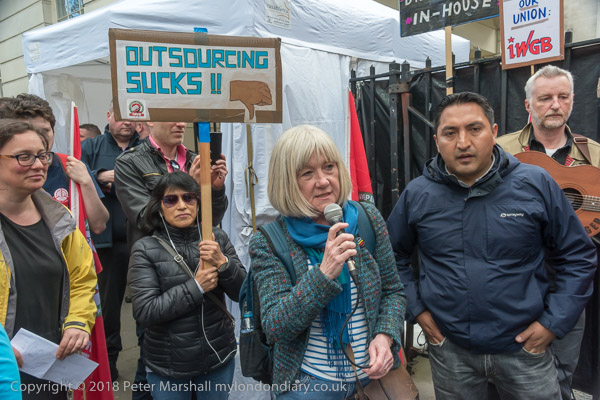
There were plenty of others as well as IWGB members who spoke, and one was a woman from UCU at Goldsmiths University who had come with a large donation from them to the strike fund.
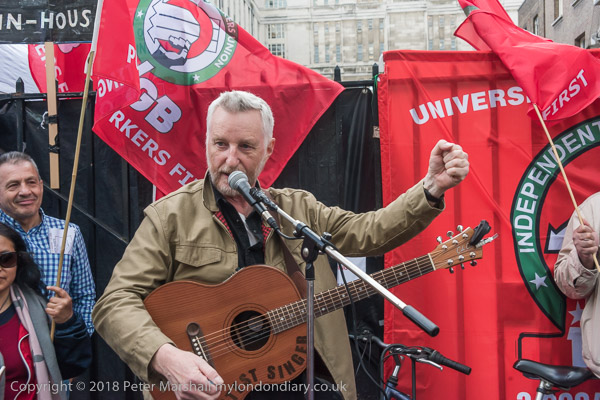
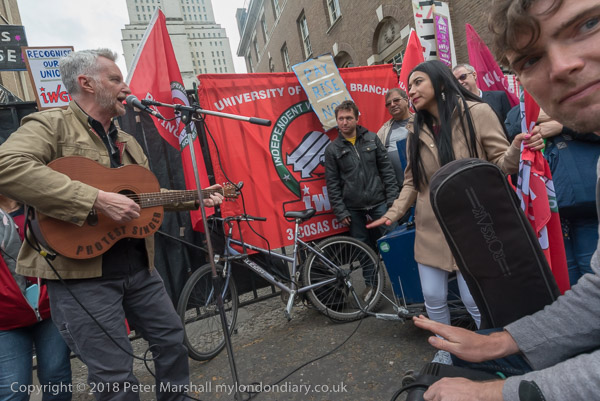
Billy Bragg came to give his support, singing three songs, and got us joining in on some of them, and Archie Shuttlebrace sang with Rebecca Wade Morris. Chip Hamer (Grim Chip) and another of the poets from Poetry on the Picket Line performed some of their work.
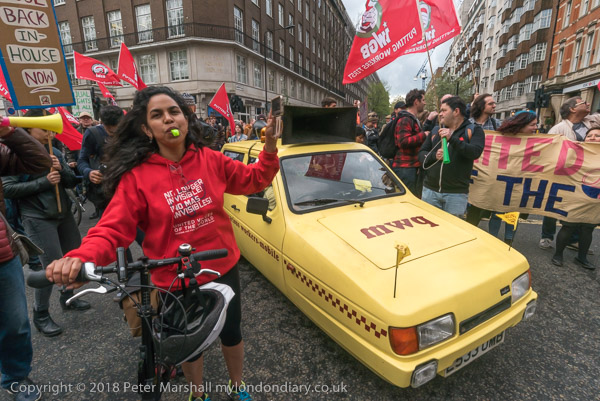
Then it was time for a march around Russell Square, with over 200 people briefly holding up traffic. The march was lead by the yellow Precarious Workers Mobile three-wheeler and a samba band.
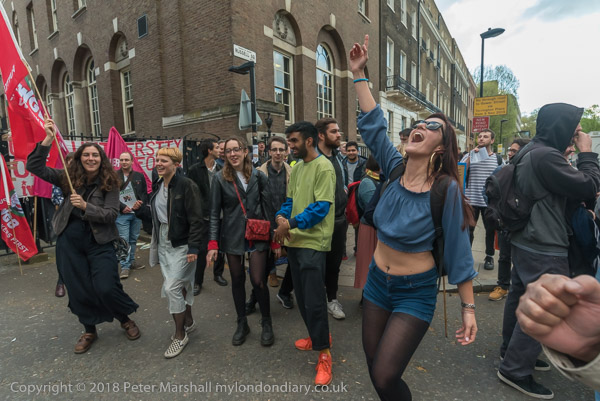
They returned to the gates of Stewart House and the rally continued with more music, poetry and dancing.
Music, Spoken Word and Protest. A week or two ago I received a Facebook invitation suggesting I listen to a monthly radio show on Riverside Radio, the Colin Crilly Takeover, a monthly show with hosts Andy Bungay and Colin Crilly. In this edition they were to “be playing SONGS with a political/social angle, and discussing the issues raised.”
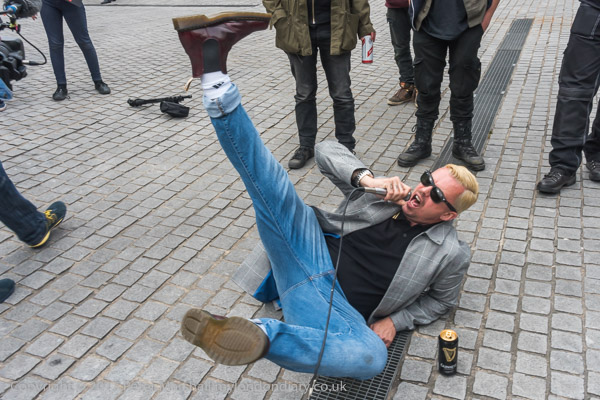
Adam Clifford performs at Class War newspaper launch, White Cub, Bermondsey, 2017
Colin Crilly is someone I’ve often met and photographed on protests in London and who has on occasion asked me to be interviewed for the show, but I’ve never done so. Radio isn’t really an ideal medium for photography.
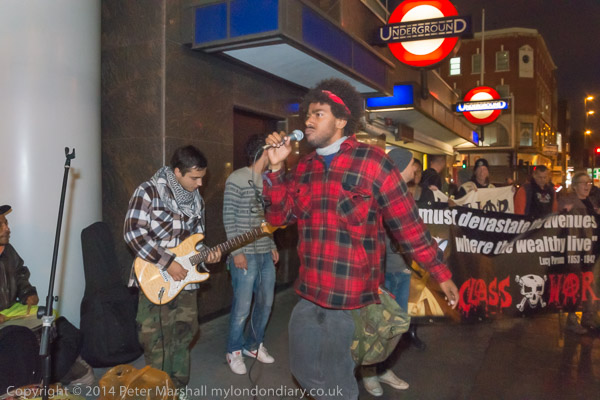
Different Moods play at Poor Doors protest, 2014
Riverside Radio is a local station covering a wide area of southwast London, mainly the boroughs of Wandsworth, Richmond and Merton but available to everyone on the web. I didn’t log on to the live show live as it airs for two hours from 11pm on a Saturday night, a time when I’m usually exhausted and only ready to fall asleep. Or if I’ve had a particularly busy day covering events I might still be editing the work.
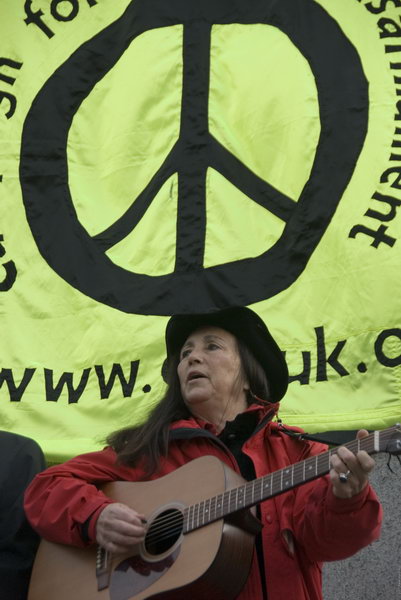
Julie Felix at CND protest, 2007
But a few days later, Colin sent me a link to a recording of the show on MixCloud and I began to listen to it. I’ve not managed to hear the whole two hours and I found MixCloud a frustrating experience as, perhaps because I haven’t subscribed, I couldn’t skip forward and when I took a rest it reverted to the start of the track. Since radio doesn’t come with pictures (except in the mind) I’ve added some of my own to this post.
Billy Bragg supports IWGB strikers 2018
It was good to hear a track by Anne Feeney, the late great US folk musician, singer-activist and lawyer who died in 2021. Her ‘Have You Been To Jail For Justice?’ and her lines “A rotten law stays on the books til folks like us defy it, The law’s supposed to serve us, and so are the police, And when the system fails, it’s up to us to speak our piece …” are very relevant now. It led to some interesting discussion by Colin and Andy, but perhaps it could have been related rather more to the approaches of groups such as Extinction Rebellion and Insulate Britain in the UK.
Sheffield Samba Band on march to Aldermaston, 2004
Next up was Paul Hardcastle’s ’19’, about the Vietnam War, but released in 1985, which apparently made a huge impression on a then-young Colin. It really was a ground-breaking release in several ways, but like the interview with John Lennon which followed – and preceded his ‘The Fool On the Hill’, did give the show seem rather an academic and historical approach to the subject.
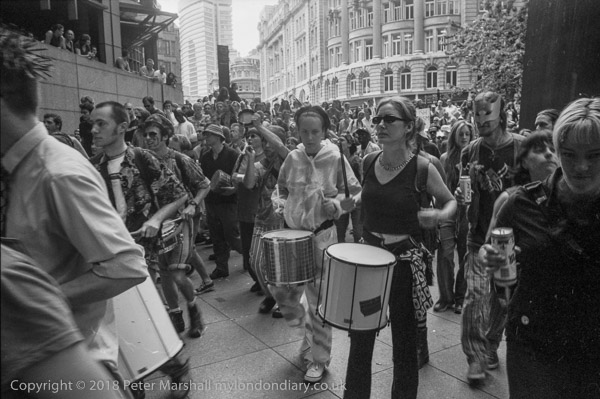
Samba band, Carnival Against Capitalism, 1999
I didn’t get much further in listening – and I think these were the only songs in the first hour of the show, though I might have fallen asleep a bit – there was a lot of long discussion. George Michael on BBC Hard Talk in 2002 came into it. It’s perhaps a shame that there wasn’t a playlist on the MixCloud page.
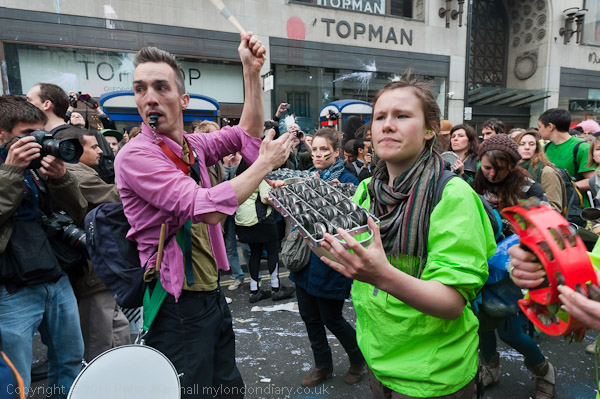
Samba – UK Uncut, 2011
Among the hashtags there was #london and I didn’t think I’d heard much about London or protests there in the part of the show I heard. Nor did I get to hear the promised Wood Guthrie, whose songs I used to play and sing badly from a much dog-eared paperbook in my youth, though fortunately seldom in public.
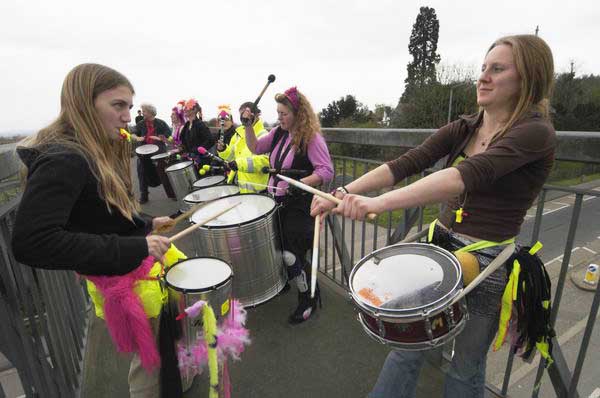
But many of the protests I’ve attended over the years have included performances by singers as well as spoken word performers, and of course the sound of almost all marches in recent years has been the samba band. How or if the recent act designed to prevent effective protest alters this remains to be seen.
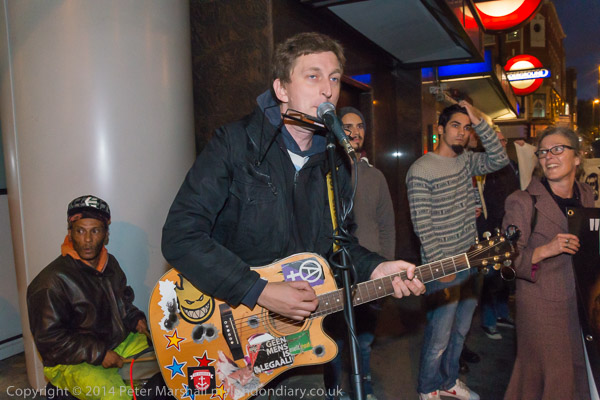
Cosmo at Poor Doors protest, 2014
I’ll just mention a few of those I’ve been impressed by – and have photographed in London. On his web site is this description of Cosmo, based in Wales as well as a number of music videos featuring him and his friends.
Cosmo is “a one-man folk-punk phenomenon.” (Miniature Music Press). Over the course of 14 albums and 30 years of touring, he has established himself as a formidable voice on the UK and international underground.
He has appeared at Glastonbury, the Edinburgh Fringe and other major UK festivals, as well as touring across the UK, Europe, North and South America and the Middle East. In that time, he has shared stages with Billy Bragg, Frank Turner, Grace Petrie, John Cooper Clarke, Mark Thomas and more. Cosmo has won awards at the Edinburgh fringe and Hay fringe festivals.
An activist as well as a musician, Cosmo has also performed at countless picket lines, protest camps, rallies and demos, as well as being involved with community organising.
I’ve photographed Cosmo several times, particularly at protests with Class War and always been impressed by the lift he gives to protesters.
Grim Chip (left) outside the TUC, 2017
Quite a few rappers and poets have also performed at events I’ve photographed. Poetry on the Picket Line does exactly what the name suggest. Poets in the group, including hip Hamer, Janine Booth, Nadia Drews, Joe Solo, Tim Watts, Tim Kiely, Owen Collins, Repeat Beat Poet, Mark Coverdale, Lantern Carrier and Michael Breen, reading their work in the spirit of solidarity on picket lines and at rallies.
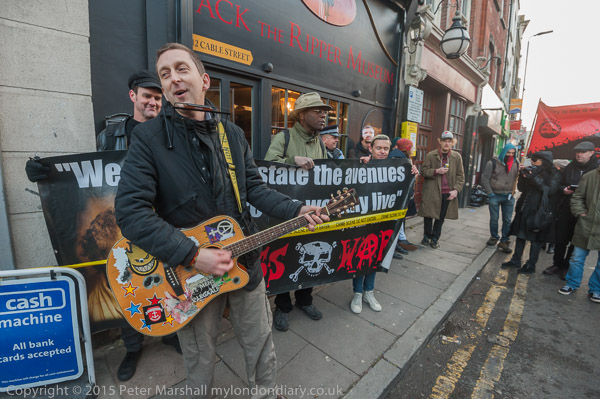
Potent Whisper performs ‘Estate Of War’ at Class War’s Newspaper Launch at the White Cube 2017
Georgie, a London based rapper and spoken word artist performs as Potent Whisper. Dog Section Press published his ‘The Rhyming Guide to Grenfell Britain‘ including the text of nine full-length pieces, I think all of which I’d heard him deliver at various demonstrations as well as in videos, including The Rhyming Guide to NHS Privatisation, Estate of War and Grenfell Britain. The book is worth getting if you can find a copy. An article by him in the New Internationalist includes a link to his ‘You’ll Never Edit Grenfell‘ and you can view more on his YouTube channel.