Grenfell – 2017 & Hong Kong

Grenfell – 2017 & Hong Kong: On Wednesday 6th December 2017 I photographed two protests outside Kensington Town Hall in both of which people demanded answers from Kensington & Chelsea council about the terrible fire at Grenfell Tower almost six months earlier.

Grenfell - 2017 & Hong Kong
A woman in the crowd listens to speeches at the Justice4Grenfell protest

The protest had been approved earlier at a public meeting and was supported by the Justice4Grenfell campaign and the Revolutionary Communist Group who both came with PA systems.

Grenfell - 2017 & Hong Kong

J4G refused to let the RCG speak at their protest and tried to persuade them to move away, but they refused.

Grenfell - 2017 & Hong Kong
Emma Dent-Coad MP

But they did pause their protest and turn off their sound system for the J4G’s main speakers, MPs Kate Osamor and Emma Dent-Coad.

Grenfell - 2017 & Hong Kong

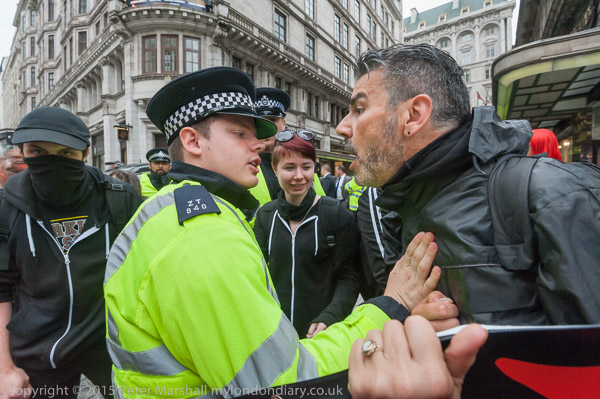
After that the RCG resumed their protes as J4G appeared to have stopped – but soon they also began again and there were two protests taking place a few yards apart. A small group from J4G came to shout angrily at the RCG, and there were threats of physical violence with one man having to be held back by his friends after he tried to start a fist fight.

Grenfell - 2017 & Hong Kong

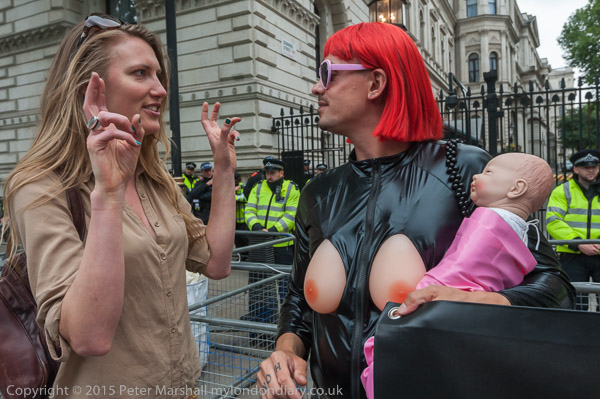
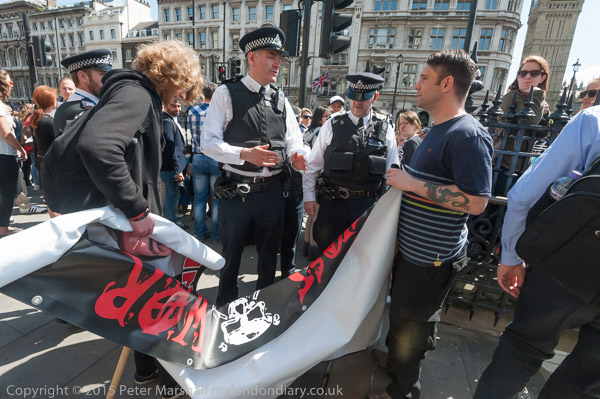
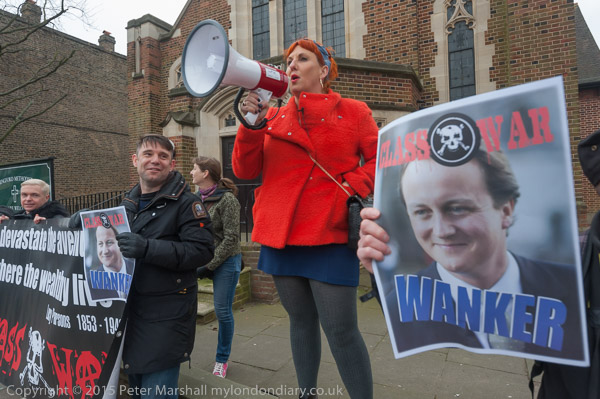
Also protesting with the RCG were some from Class War, who stood with posters of disgraced Councillor Rock Feilding-Mellen, who as deputy council leader and cabinet member responsible for housing and for the flammable cladding and other cuts which had created a disaster waiting to happen. Since the fire he had fled the area and hidden away – and under the large image of his face was the single word ‘WHERE?’

I tried hard to photograph both protests, moving between the two groups.

Both shared the same aims, both condemning the failures by the council which had led to a small fire turning rapidly into a major disaster and, after the fire its failure to respond adequately and in a timely way to the needs of the survivors, both calling for criminal charges against those responsible in Kensington and Chelsea council, the TMO and the cladding company and others.

Both calling for a real role for the local community in the official inquiry into the fire which they feel has already disrespected local residents and fear will be a cover up.

Now eight years later the inquiry has told us very little that was not already covered in the report by Architects for Social Housing published 5 weeks after the fire and there have still not been any criminal charges made against those responsible.

Moyra Samuels

There have been some related cases, with people being prosecuted who have fraudulently tried to profit from the disaster – which were discussed in a blog post by Steve Tombs of the OU, The Poor Get Prison… Grenfell as a Site of Crime?, but none for those directly responsible for the tragedy.

Kate Osamor MP

Many will have noticed the enormous contrast between this and the recent fire at the Wang Fuk Court complex in Hong Kong where Reuters report at least 156 people died in a fire rapidly spread by substandard plastic mesh and insulation foam.

The first reports in the UK media over the fire also included that police had already arrested a number of people in connection with the fire. Reuters reported 15 on suspicion of manslaughter as well as another 12 arrests in a corruption investigation.

Grenfell protests outside council meeting.


FlickrFacebookMy London DiaryHull PhotosLea ValleyParis
London’s Industrial HeritageLondon Photos

All photographs on this page are copyright © Peter Marshall.
Contact me to buy prints or licence to reproduce.
Bloody Murder at Ripper ‘Museum’ 2015

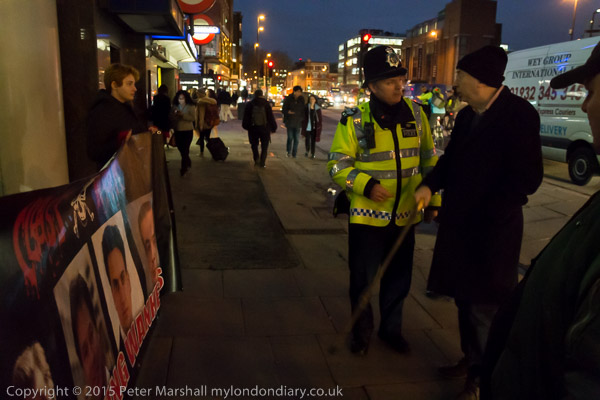
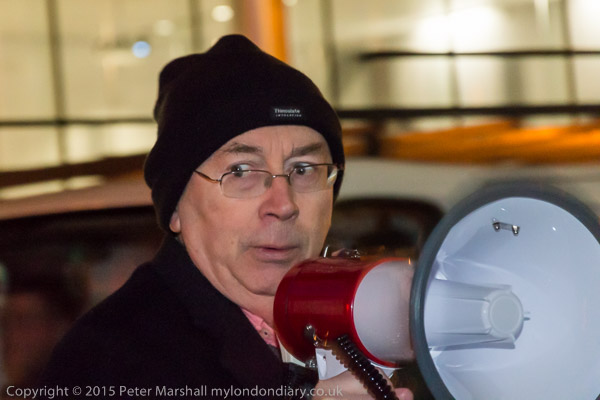
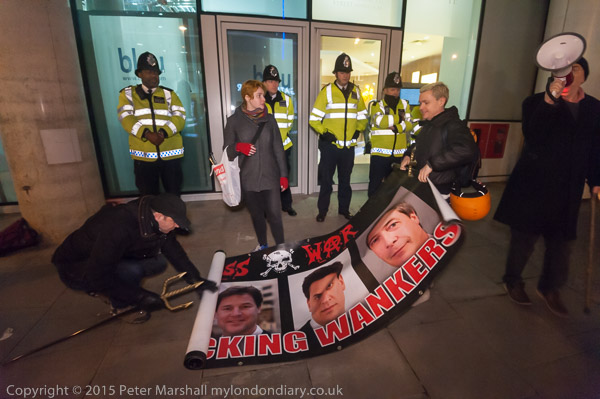
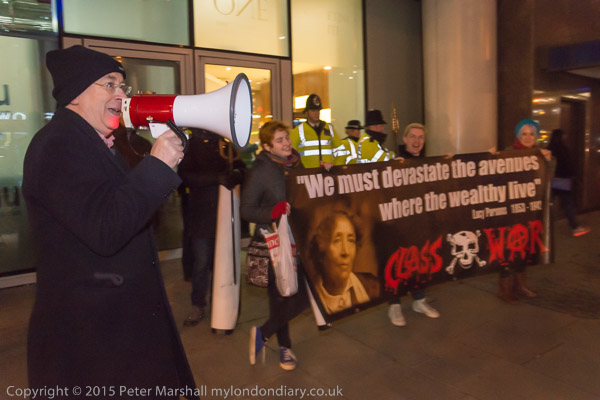
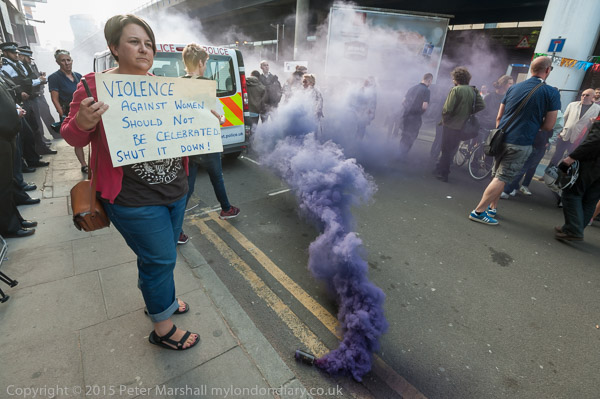
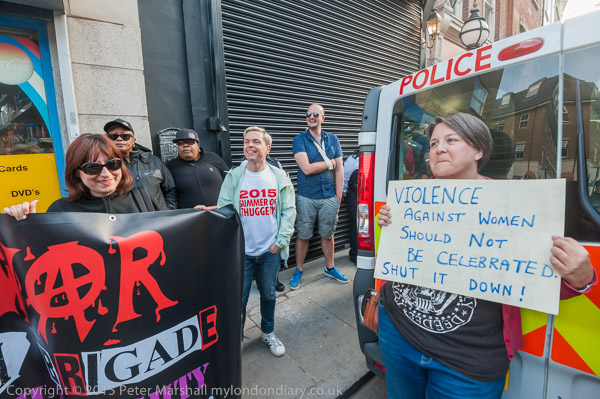
Bloody Murder at Ripper ‘Museum‘: Another of the series of protests by Class War at the so-called museum glorifying the gory murders of working-class women took place on Saturday 5th December 2015.

Bloody Murder at Ripper 'Museum' 2015
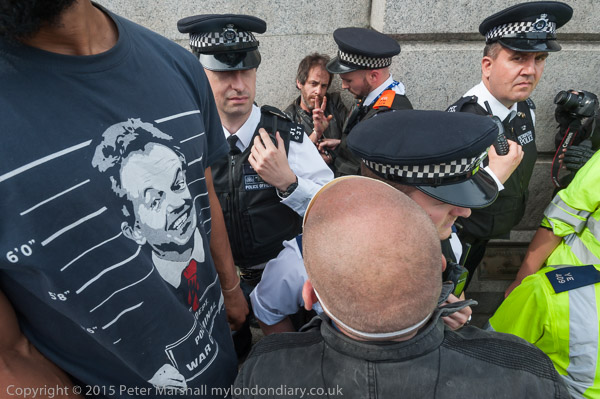
A police officer smiles while another looks fixedly away as Jane Nichol displays the bloody head

I photographed most if not all of the protests they organised in a campaign they kept up for some years, showing their disgust at this fake museum, which the owner, Mark Palmer-Edgecumbe got planning consent to open claiming it was to celebrate the powerful history of the women of London’s East end, not their bloody dismemberment by a homicidal maniac.

Bloody Murder at Ripper 'Museum' 2015
Jane Nicholl waves her grandson’s plastic cutlass (or scimitar?) at the Ripper ‘museum’

Class War were always interesting to photograph – and always fun to be with, as well as supporting important campaigns, particularly those around housing problems, bringing both a clear and informed anarchist perspective and a great deal of street theatre.

Bloody Murder at Ripper 'Museum' 2015
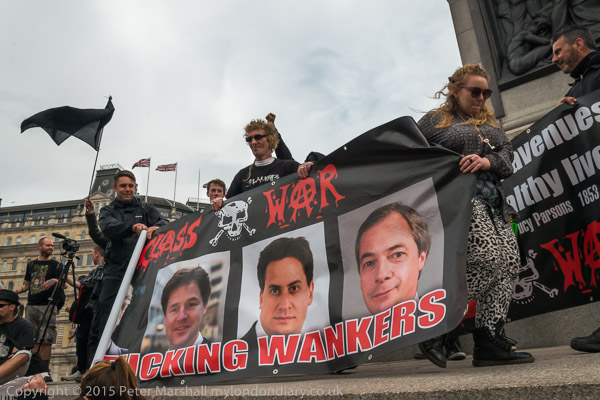
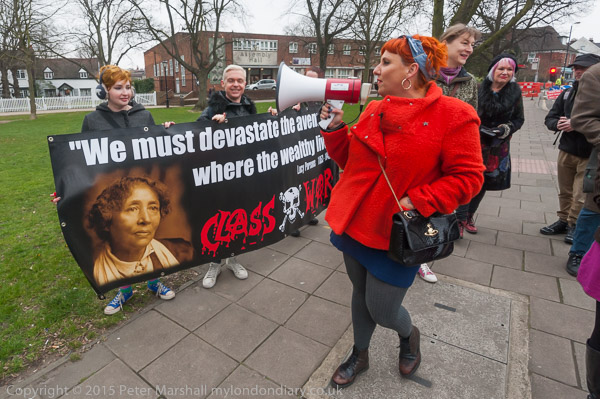
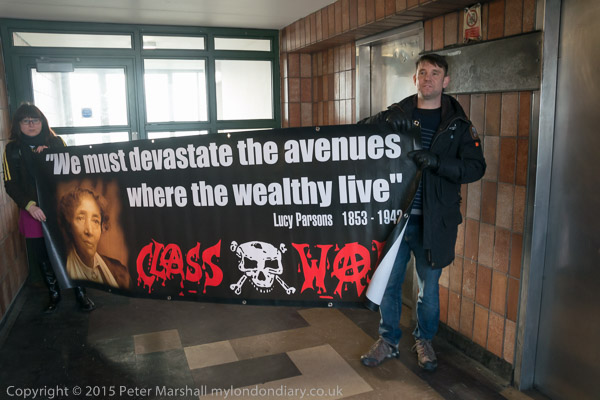
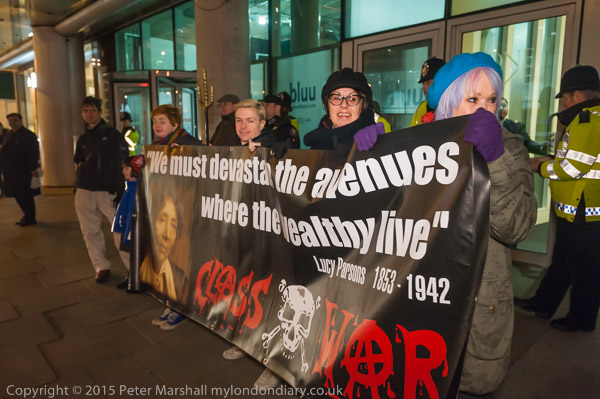
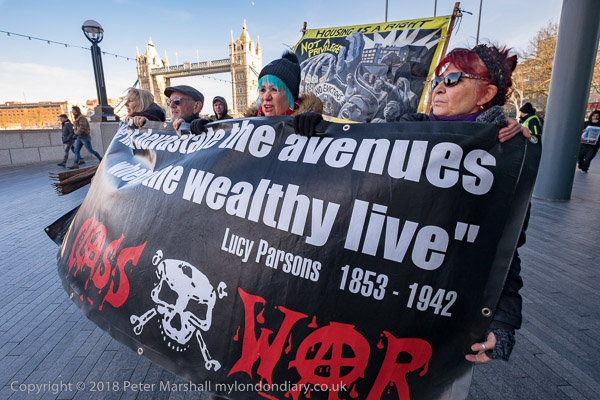
The Lucy Parsons banner. The Ripper attacks were by an upper class man on working working-class women

And their publications including the Class War magazine were always a good read, with often penetrating analysis as well as some distinctly black humour, truly black and red and read. You can see many earlier editions online at The Sparrow’s Nest.

Ian Bone’s autobiography, Bash the Rich: True Life Confessions of an Anarchist in the UK is certainly an interesting read and the 1991 Class War: A Decade of Disorder he edited comes with the ‘Publishers’ Warning! This book contains explicit language and illustration which may offend yuppies, police officers, members of the royal family and people who think the world can be changed by holding hands and singing “We shall overcome.” ‘

Bloody Murder at Ripper 'Museum' 2015

As I wrote back in 2015, “Class War re-enacted a murder outside the Jack the Ripper tourist attraction, women hacking and decapitating a dummy wearing the mask of owner Mark Palmer-Edgecumbe with a plastic scimitar and liberally spattering fake blood as others played kazoos

Bloody Murder at Ripper 'Museum' 2015
More fake blood is scattered on the Palmer-Edgecumbe ‘guy’ –
and on my trousers as I took the picture – it washed out easily

Class War is more of a loose association of like-minded people than an organisation and its actions often gain support from many others, including on this occasion and others fourth-wave feminists.

After Jane others took their turn in attacking the dummy which proved remarkably resistant to the plastic scimitar, but finally Jane could triumphantly display the bloody severed head of Palmer-Edgecumbe,

and others came to kick its body.

Women showed their bloody hands,

and Ian Bone came carrying the rolled-up banner and his walking stick to inspect the corpse.

Police wanted Class Wat to remove the Palmer-Edgecumbe ‘guy’ but they declined, saying they were donating it to the museum as one of the few genuine exhibits for their display. Police followed Class War as they walked away to the pub, and it seemed for a moment they might make and arrest – perhaps for littering – but they thought better of it and walked back to guard the shop. They were still there when I left the pub around an hour later.

Ten years later the tacky tourist attraction remains open, though my conclusion to this protest had hoped for a different conclusion:

Thanks at least in part to Class War’s publicity and vigorous protests over around five months others have taken up the fight against the so-called museum, and the fight to get a real museum celebrating the powerful history of the women of London’s East End. It’s a rich heritage with powerful and colourful figures in which the bloody murders by the Ripper are only an insignificant and entirely negative episode. Perhaps it’s now time for others to take up a long-term if probably lower-key campaign here and continue it until this bloody blot on our heritage is closed down.

More of my thoughts about the ‘museum’ and about the protest – with many more pictures – on My London Diary at Bloody Murder at Ripper ‘museum’.


FlickrFacebookMy London DiaryHull PhotosLea ValleyParis
London’s Industrial HeritageLondon Photos

All photographs on this page are copyright © Peter Marshall.
Contact me to buy prints or licence to reproduce.

Walthamstow Housing Action & Class War at the Ripper Museum – 2015

Walthamstow Housing Action & Class War at the Ripper Museum: On Saturday 21st November 2015 I spent an hour covering a lunchtime rally and march about the housing problems in the London Borough of Waltham Forest before rushing to Whitechapel where Class War were holding another of their protests outside the sensational tourist attraction celebrating the horrific acts of ‘Jack the Ripper’.


Homes for All against social cleansing

Leyton & Walthamstow

Walthamstow Housing Action & Class War at the Ripper Museum

People met in Abbots Park Leyton for a rally organised by Waltham Forest Housing Action before they marched to a longer rally in the centre of Walthamstow. over the severe housing problems faced by those living in the borough of Waltham Forest.

Walthamstow Housing Action & Class War at the Ripper Museum
Green Party Deputy Leader Dr Shahrar Ali

The council has a housing waiting list of over 20,000 families, and although there is considerable home building taking place in the borough only 400 of 12,000 homes planned in Walthamstow in the next 5 years are for low earners.

Walthamstow Housing Action & Class War at the Ripper Museum

As in most of London’s boroughs, mainly held by Labour councils, the ‘regeneration’ schemes begun under New Labour has led to the loss of social housing, pricing most local people in the many lower paid and middle-income jobs which are essential for the city to run. Regeneration has led to social cleansing with poorer residents being forced out to areas further from the centre.

Walthamstow Housing Action & Class War at the Ripper Museum

The campaigners called for an end to housing evictions in the area – then taking place at twice the average rate for London, and the capping of private rents which are on average much higher than the maximum set by housing benefit, as well as a huge increase in social housing.

Walthamstow Housing Action & Class War at the Ripper Museum

Housing benefit acts as a huge public subsidy for landlords, passing money to them. The public and those who live in rented accommodation would be much better served by money being spent of building social housing which would give a return to local councils from the rents.

Private rents allow landlords to get housing benefit and the excess rent paid by the tenants to pay off the loans they take out so they can buy property and get the benefit of increasing their capital – at our and the tenant’s expense.

Rising rents have increasingly made it impossible for many key workers – teachers, firefighters and others – to afford to live in the boroughs they serve.

Press TV interviewed one of the campaigners who holds a placard ‘I have moved 4 times in 3 years! I want secure affordable housing’

Although Press TV covered the event there was (as usual) no interest shown by mainstream UK media

Among the trade unions supporting the march were the National Union of Teachers and the Fire Brigades Union – who provided their fire engine as a platform for speakers and to lead the march.

Local politicians also came for the event along with Green Party Deputy Leader Dr Shahrar Ali. Among local groups with banners were residents of Residents of Fred Wigg and John Walsh towers on the edge of Wanstead Flats in Leytonstone., where the 234 social housing units are to be replaced by only 160 and new private flats were to be sold to raise £30 million.

I left as the march was on its way to Walthamstow to go to Whitechapel.

More on My London Diary at Homes for All against social cleansing.


Class War at the Ripper ‘Museum’

Cable St, Whitechapel

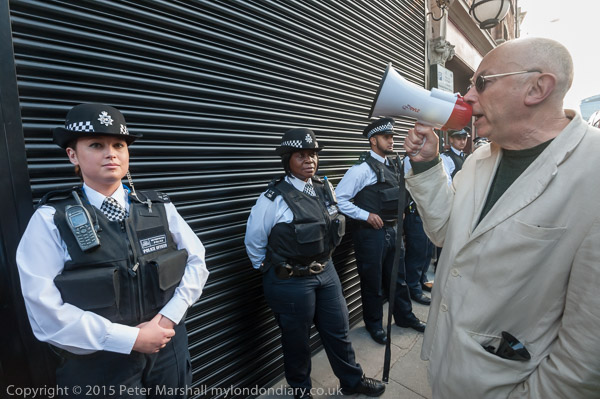
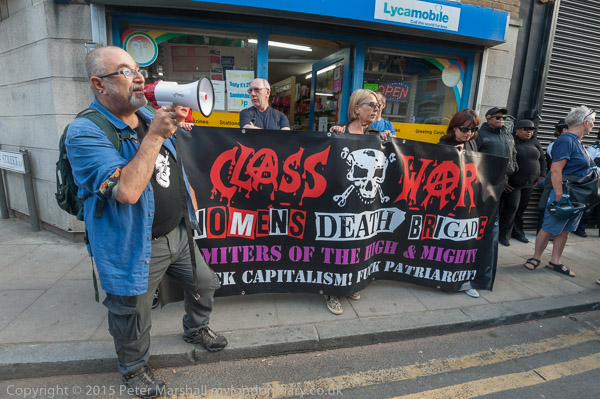
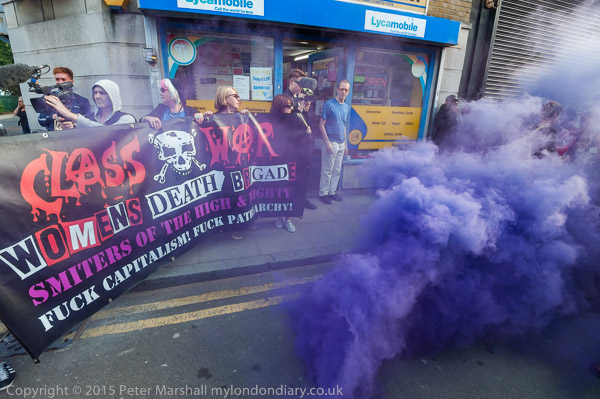
I met Class War as they arrived outside the Jack the Ripper tourist attraction in Cable St with their ‘Womens Death Brigade‘ banner for another in their series of protests against the ‘museum’ which celebrates the brutal and macabre killings of working class women in Whitechapel in 1888.

Owner Mark Palmer-Edgecumbe’s partner Julian Pino and an employee in the shop

The murderer was an insane serial killer who ripped open the bodies of his victims, removing the uterus and heart and a whole industry has arisen over trying to establish his identity, spurred on by the particularly gory details of his crimes.

An officer tells Puno to stop phoning ‘999’ as the police are already here

Although the police at the time were unable to solve the case, they appear to have given up after Montague Druitt drowned himself in the Thames shortly after the final one of these murders. But those aiming to profit from the whole series of articles, books and films have done their best to build up doubt and uncertainty, putting forward others, often very unlikely such as painter Walter Sickert, as the criminal.

Lisa McKenzie speaks her mind

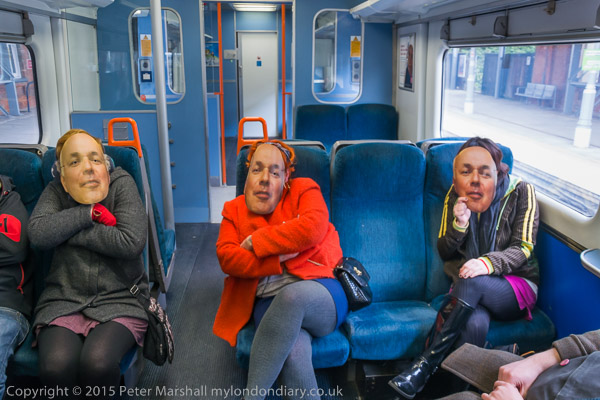
The protest was noisy but peaceful with many of those taking part wearing masks of the shop’s owner – who had lied about the site becoming a museum to celebrate women’s history to gain support and planning permission.

Jane Nicholl and Mark’s mask

It was enlivened by the arrival of activist singer/guitarist Cosmo who performed three appropriate songs which raised everyone’s spirits, and even the police obviously enjoyed the protest.

Shop owner Mark Palmer-Edgecumbe had left a shop worker and his partner Julian Pino inside the ‘museum’ to face the protesters and their was one spot of farce when a police officer went inside to tell him to stop continually phoning ‘999’ as the police were already there.

Cosmo sings

A man claiming to be a local resident and seemed to be a friend of the ‘museum’ came to complain to Class War against them protesting against a business that was bringing investment to an area that was so obviously in need of it. He was told that this kind of investmentglorified violence against women and was clearly detrimental to the area and offensive to many – including the living descendants of the victims.

It was hard to avoid the conclusion that his intervention had been prompted and possibly funded by the owner of this tacky tourist attraction, which noticeably attracted no customers while the protest was taking place.

More on My London Diary at Class War at the Ripper ‘Museum’.


FlickrFacebookMy London DiaryHull PhotosLea ValleyParis
London’s Industrial HeritageLondon Photos

All photographs on this page are copyright © Peter Marshall.
Contact me to buy prints or licence to reproduce.

Brexit Now, Save the Sunderbans, Close Ripper ‘Museum’ – 2018

Brexit Now, Save the Sunderbans, Close Ripper ‘Museum’: Saturday 10th November 2018 I began at a small protest by extreme right ‘Leave’ supporters against the lack of progress in leaving the EU. From there I went to a rally in Whitechapel which was part of a global day of protest to save the the world’s largest mangrove forest and then met Class War for another protest against the misogynist Ripper museum in Cable St.


Leave Voters say Leave Now!

Trafalgar Sq

Brexit Now, Save the Sunderbans, Close Ripper 'Museum' - 2018
Several had sticky tape over their mouths claiming they had been gagged

Only around a couple of hundred people had come to Trafalgar Square for a protest by extreme right wing groups led by what I think is the now defunct group UK Unity (their domain address is now for sale) and backed by others including the For Britain Movement and UKIP. There were faces familiar from other extreme-right protests.

Brexit Now, Save the Sunderbans, Close Ripper 'Museum' - 2018

They were angered by the lack of progress in exiting the UK and the concessions that they said Theresa May was making to the EU. This was one of five protests taking place that day, in Coventry, Norwich, Cardiff and Leeds as well as London.

Brexit Now, Save the Sunderbans, Close Ripper 'Museum' - 2018

They called for a 5 point plan:

  • Britain should leave the EU entirely without payments;
  • An end to mass immigration;
  • to properly run and fund our public services;
  • to scrap the House of Lords and reform democracy;
  • to put British Laws, British Culture and British People first.
Brexit Now, Save the Sunderbans, Close Ripper 'Museum' - 2018

Many also held posters calling for London Mayor Sadiq Khan to resign, though this appeared simply to be Islamophobia. I listened to a couple of speeches which I felt “reflected some irrational views on Brexit, fired by emotion and ignoring the realities.”

Brexit Now, Save the Sunderbans, Close Ripper 'Museum' - 2018

As I commented in 2018, “It was always the case that the kind of break with the EU that many voted for was impossible, and that if we are to leave there will be many unpalatable consequences. The best possible deal was always going to be a poor deal in many ways, and no responsible politician thinking about the future of the nation rather than their own personal fortunes would be campaigning or voting for leaving without a deal.

Leave Voters say Leave Now!


Global Day to save the Sunderbans

Altab Ali Park, Whitechapel

Brexit Now, Save the Sunderbans, Close Ripper 'Museum' - 2018

The UK branch of the National Committee to Protect Oil Gas & Mineral Resources, Bangladesh, supported by others including Fossil Free Newham were taking part in a global day of protest to save the Sunderbans, the world’s largest mangrove forest and a UNESCO World Heritage Site.

Among animals threatened with extinction is the Bengal tiger

The Bangladesh and Indian governments were building the giant Rampal coal-fired power plant, which would become the largest power station in Bangladesh. Clearly this will be disastrous for climate change, producing huge amounts of carbon dioxide, but it also threatens the nearby wetlands, and is in violation of the Ramsar Convention for the conservation of wetlands which Bangladesh has signed up to.

The power plant will take huge amounts of water from the river which flows through the Sunderbans, and release hotter water containing toxic materials which will endanger the mangroves, marine animals and the people living in the area.

The 4.72 million tons of coal per year to the plant on ships through the shallow rivers will seriously disturb the Sunderbans and will also result in considerable pollution.

The development “will also make around 50 million people more vulnerable to storms and cyclones, against which the Sunderbans serve as a natural safeguard.” Global warming and climate chaos is already making such climate events more frequent and more severe – and the extra greenhouse gases from this plant will add to this.

Bangladesh is already one of the countries most under threat from frequent flooding. There were huge protests against the plant with numbers of protesters being killed. Despite huge opposition in the country and around the world, construction at Rampal continued and the first stage of the plant was commissioned in October 2022.

More on My London Diary at Global Day to save the Sunderbans


Class War picket the Ripper Museum

Cable St, Whitechapel

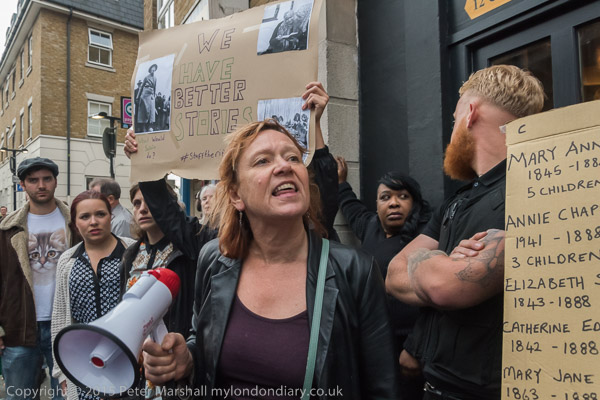
Class War had come once again to protest outside tacky misogynist tourist attraction which gained planning permission by pretending to be a museum of the history of women in London’s East End after it had failed to comply with some of Tower Hamlet’s Council’s planning decisions about its frontage.

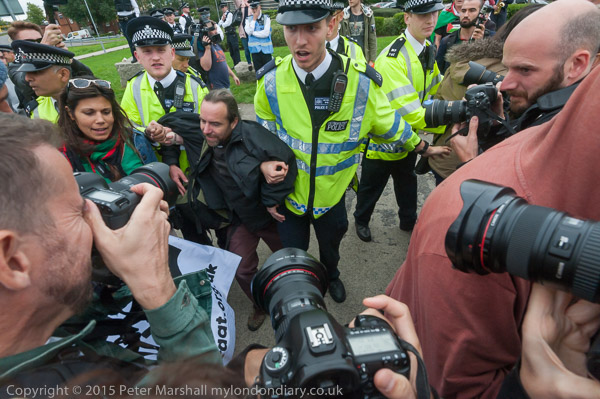
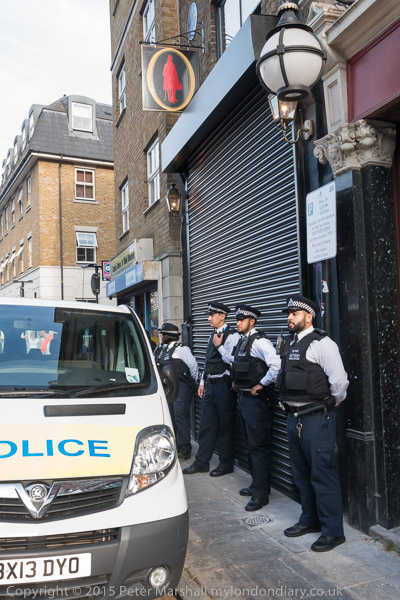
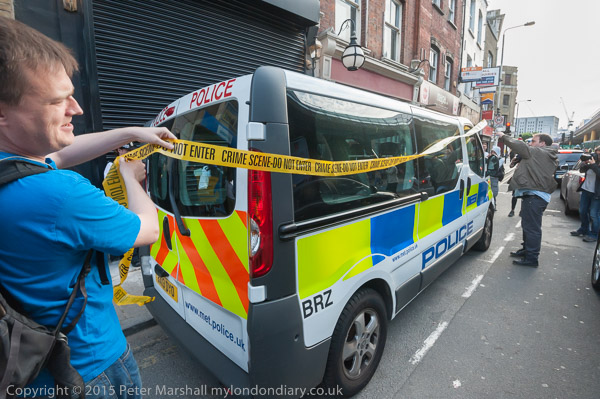
One protester walked into the shop but was pushed out by one of the shop staff and they then called the police who arrived in a few minutes, having been waiting for the protest a short distance away. An officer tried to persuade the protesters to move away from the front of the shop and hold their ‘Womens Death Brigade’ banner on the opposite side of the road, but the took no notice.

A woman officer, CE3200, her name carefully hidden, complained to Class War about their language and told them they can be arrested for swearing. They told her the law. Swearing isn’t an offence in itself, it has to offend people – and you are particularly unlikely to be found guilty of swearing at the police, who are not generally supposed to be easily shocked.

This was intended as a short protest and Class War were rolling up their banner when a small group arrived to enter the shop. Class War talked with them politely, making clear the disgusting nature of some of the displays which glorify the gory nature of the crimes and denigrate the poor working class victims in a brutally misogynist fashion, causing offence to some of their still-living relatives.

They listened, but still went into the museum, with police ensuring they could enter safely. Class War then left for a nearby pub and I went with them.

More on My London Diary at Class War picket the Ripper ‘Museum’


FlickrFacebookMy London DiaryHull PhotosLea ValleyParis
London’s Industrial HeritageLondon Photos

All photographs on this page are copyright © Peter Marshall.
Contact me to buy prints or licence to reproduce.

Battle of Cable St – 75 Years On

Battle of Cable St: On Sunday 2 October 2011 well over a thousand trade unionists and anti-fascists celebrated the 75th anniversary of the Battle of Cable Street when Mosley’s fascists were prevented from marching into London’s largely Jewish East End.

Battle of Cable St - 75 Years On
Max Levitas leads the march

Since 2011 we have seen other celebrations of this famous event and the people of the East End have also come together to stop other racist organisations marching into the East End, notably the EDL.

Battle of Cable St - 75 Years On
Some people came dressed for the 1930s

In 1936 Oswald Mosley led the ‘British Union of Fascists’, an organisation modelled on Mussolilni’s Italian fascist paramilitary groups on a march designed to intimidate the large Jewish community in the East End.

Battle of Cable St - 75 Years On

Although various groups tried to get the march banned the Home Secretary sided with the fascists insisting their democratic right to march had to be upheld by the police. The fascists were also supported by the right wing press, particularly the Daily Mail, while more liberal newspapers urged people to stay away from the counter demonstration.

Battle of Cable St - 75 Years On

The Board of Deputies of British Jews had condemned the march as anti-Semitic, and they had advised people to stay away from the march as did the Labour Party. The opposition to Mosley was led by local members of the Communist Party of Great Britain including Phil Piratin who nine ears later became Communist MP for Mile End. They eventually persuaded the party to back the counter-demonstration.

Battle of Cable St - 75 Years On

Somewhere between 100,000 and 300,000 people turned out to stop the fascists. Many were Jewish, and many were members or supporters of the Communist Party but the call brought out many others from the East End, including “Irish Catholics, Jews, Orthodox Jews, dockers and Somali seamen” in a huge mobilisation across the community.

There are three routes leading into the East End from the City of London where Mosely and people gathered at key points on them, particularly at Aldgate, where most of the fighting between police and protesters took place, particularly around Gardiner’s Corner – where a ten years ago Class War carried out their long series of Poor Doors protests against social apartheid in housing.

Police decided to try and force a way through at Cable Street a little to the south and tried to force a way through the crowds and remove the barricades they had set up.

Frances O’Grady, TUC Deputy Gen Sec

According to Wikipedia, police managed to take and dismantle the first barrier but the anti-fascists set up another a few yards down the road.

The police attempts to take and remove the barricades were resisted in hand-to-hand fighting and also by missiles, including rubbish, rotten vegetables and the contents of chamber pots thrown at the police by women in houses along the street … children’s marbles were also used to counter charges by mounted police.”

Eventually the police gave up and told Mosley to march with his followers back to the West End, where they held a rally in Hyde Park rather than those they had intended in Limehouse, Bow, Bethnal Green and Hoxton.

Seventy five years after the battle the crowd was rather smaller, but the well over a thousand who met at Aldgate included several veterans of the 1936 battle, among them 96 year old Max Levitas who led the march and spoke at the rally. He was also there and spoke at the 80th anniversary event in 2016.

The oldest person on the march was 106 year old lifelong political activist and suffragette Hetty Bower who had also been at the 1936 demonstration and was later one of the founder members of CND. I photographed her on several occasions at CND and other protests, the last at the Hiroshima Day commemoration in 2013 where she spoke briefly, a few months before her death.

Beattie Orwell, 94, was another of the veterans of 1936

You can read more about the Cable Street 75 event on My London Diary, where there are also many more pictures.
Battle of Cable St – 75 Years


FlickrFacebookMy London DiaryHull PhotosLea ValleyParis
London’s Industrial HeritageLondon Photos

All photographs on this page are copyright © Peter Marshall.
Contact me to buy prints or licence to reproduce.

Housing Crisis Protest in Stratford – 2015

Housing Crisis Protest in Stratford: Housing activists marched through Stratford on Saturday 19th September 2015, with a short occupation of estate agents Foxtons by Class War ending with a rally by Focus E15 outside the flats on the Carpenters Estate they had occupied a year earlier.


Focus E15: Rally before March – Stratford Park

Housing Crisis Protest in Stratford - 2015

Two years earlier Newham Council had tried to close the Focus E15 hostel housing young mothers in Stratford, but they had fought the eviction which would have seen them dispersed across the country into private rented flats with no security of tenure and in some cases hundreds of miles from family and friends.

Housing Crisis Protest in Stratford - 2015

The Focus E15 campaign had attracted wide support and gained national headlines when they had occupied a small block of flats on the Carpenters Estate in Stratford. They succeeded in getting rehoused in London but continued with a much wider ‘Housing For All’ campaign for proper housing for the people of London who are facing being replaced by a new and wealthy population.

Housing Crisis Protest in Stratford - 2015

The campaign has continued, with a weekly stall on Stratford Broadway and protests to stop evictions in the borough. Their actions enraged the then Mayor of Newham Robin Wales and led to various attacks by him and council officials including the issuing of penalty notices and the farcical “arrest” of the table they used as their stall. These almost certainly played a part in his downfall in 2018 when local party members in this Labour stronghold turned against him.

Housing Crisis Protest in Stratford - 2015

The march brought together housing activists from around 50 different groups around London including many from council estates under threat of development under the guise of regeneration, private tenants facing eviction or huge rent hikes, and some political groups. Fortunately not all spoke before the march. You can read a long list in my account on My London Diary at Focus E15: Rally before March.


Focus E15: ‘March Against Evictions’ Stratford

It was a large and high-spirited march from Stratford Park and around the busy centre of Stratford with banners, placards and much loud chanting, demanding Newham Council end its policy of gentrification and use local resources to house local people and an end its policy of social cleansing, moving them out of London.

Housing has always been a problem in London, at least since the industrial revolution led to a great increase in the population and enlargement of the city. From the late Victorian period various charities and philanthropically minded commercial enterprises began to construct housing – mainly blocks and estates of flats – for the working poor, and from around 1900 they were joined by local municipalities and importantly the London County Council.

After the First World War, the Addison Act in 1919 to build “homes for heroes” and later housing acts led to 1.1 million council homes being built in the years before the Second World War.

From the 1950s, London Councils led by all parties built large amounts of council housing, with many finely designed estates, providing much higher quality homes than those in the lower end of the private sector, where much of the population was housed in poorly built and maintained overcrowded slums. At least rents were relatively low – until rent control was abolished in 1988.

That was only one of the changes made under Margaret Thatcher that hugely worsened housing for the majority. Council housing, earlier seen as a way of providing decent housing at reasonable cost for that majority became seen as simply a provision for the failures in our society who were unable to get onto the “housing ladder” and buy their own homes.

Her introduction of ‘right to buy’ was a disaster for public housing and new council building was almost entirely ended – 5 million council houses were built between 1946 and 1981, but only 250,000 have been built since. And her abolition of the GLC largely ended any overall planning for housing in London.

The march stopped in front of Newham’s Housing Offices where they put up the banner ‘Newham Stop Social Cleansing – Keep us in London’ banner on Bridge House and held a short rally before continuing to the Carpenters Estate.

More pictures at Focus E15: ‘March Against Evictions’.


Class War Occupy Stratford Foxtons

Housing policy under New Labour and since has been largely determined by estate agents including Savills and Foxtons who have been leaders in the gentrification of many areas of London.

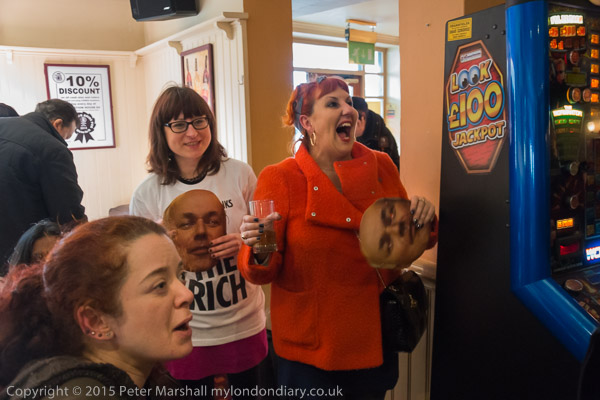
Class War seized the opportunity to rush into Foxtons as the march went past and I followed them before the police managed to stop others joining them.

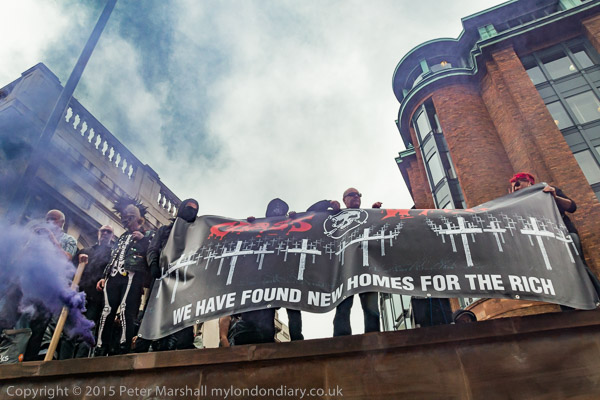
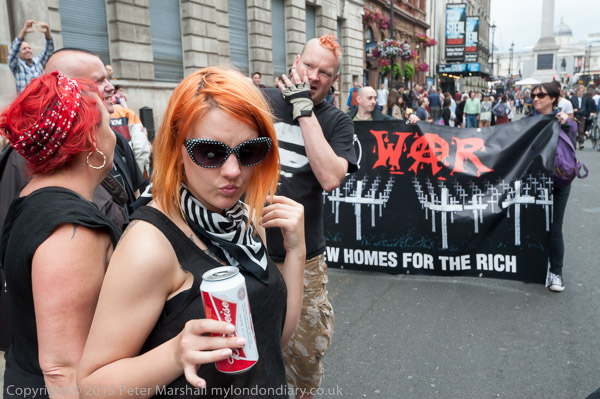
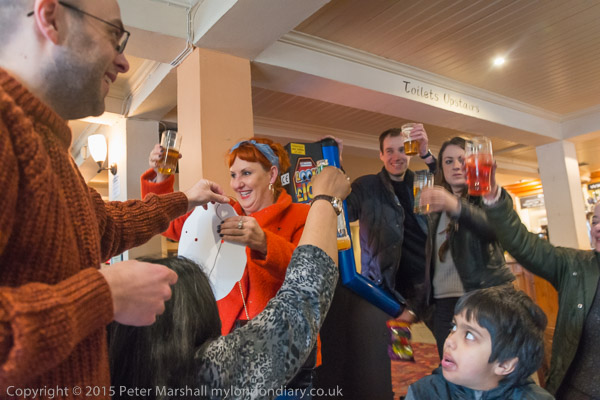
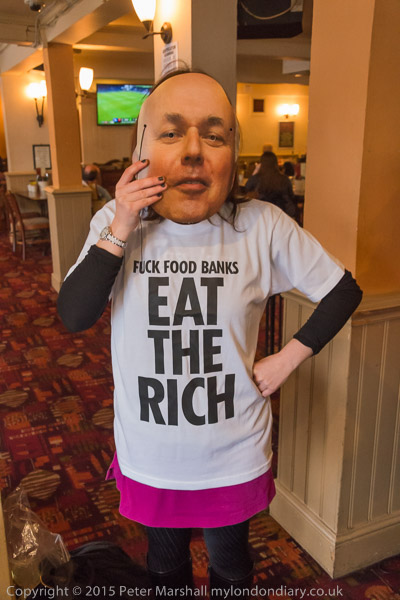
Fuck Food Banks – Eat the Rich’ and the Class War banner ‘We have found new homes for the rich’

They caused no damage and left shortly after police came inside and talked to them, rejoining the march.

More pictures at Class War Occupy Stratford Foxtons.


Focus E15: Anniversary of Carpenters Occupation

It was two years after the Focus E15 campaign had begun and a year since they occupied 4 flats on the Carpenters Estate.

For the event the pictures of people from Focus E15 put on these flats with the message ‘This home needs a family‘ in June 2014 were up again

Jasmin Stone of Focus E15 speaks at the rally

I had gone into the flats with them that afternoon and seen perfectly good properties in fine condition which had been simply closed up and left after the tenants were moved out. On one wall was a calendar from 2004 they had left behind.

Despite a huge housing shortage in the borough they had remained unoccupied for ten years. Since the occupation by Focus E15 these four flats now have residents, but only 28 empty properties on the had been re-let a year after Newham had been shamed by their action.


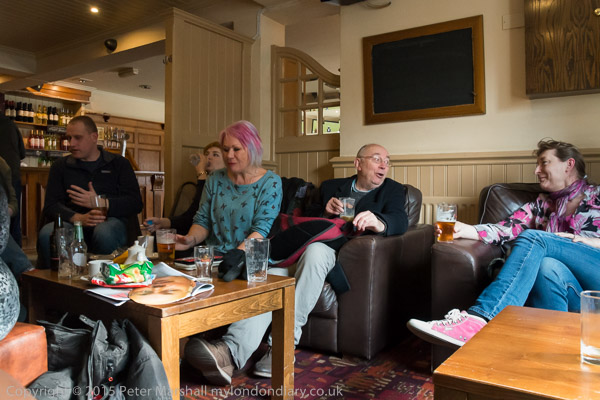
There were a few speeches and then a party began. Some people had climbed up to the roof of the shops with the ‘These people need homes’ banner, but it was time for me to go home, stopping briefly at the pub with Class War on the way.

More at Focus E15: Anniversary of Carpenters Occupation.


FlickrFacebookMy London DiaryHull PhotosLea ValleyParis
London’s Industrial HeritageLondon Photos

All photographs on this page are copyright © Peter Marshall.
Contact me to buy prints or licence to reproduce.

Isle of Dogs and Poor Doors – 2014

Isle of Dogs and Poor Doors: On Wednesday 3rd September 2014 the weather was fine with blue skies and clouds and I decided to spend the afternoon photographing in the Isle of Dogs before meeting with Class War for one of their ongoing series of protests against separate entrances for the wealthy and social housing residents of a tower block in Aldgate.


Isle of Dogs Panoramas – Island Gardens to South Quay

Isle of Dogs and Poor Doors - 2014

The main purpose of my visit to the Isle of Dogs was to make panoramas of scenes which I had photographed more conventionally over the years, including the black and white images that I included in my book ‘City to Blackwall‘ and more of them are now in my albums on Flickr.

Isle of Dogs and Poor Doors - 2014

I had gone back so make some panoramas in the area in the 1990s and early 2000s, using various panoramic film cameras, but the switch to digital had made creating panoramic images much simpler for me.

Isle of Dogs and Poor Doors - 2014

Perhaps the most important change was in accurate viewfinding – with my first panoramic film camera the most accurate way to see the extent of my pictures was by viewing along two arrows on the top of the body – much more reliable than its viewfinder. But of course digital also gave a wider range of shutter speeds and ISO.

Isle of Dogs and Poor Doors - 2014

And to do this, the camera needed to be firmly mounted on a tripod – and I carried a rather heavy Manfrotto around with me. This also enabled me – with the aid of a spirit level – to ensure that the camera was level. The Nikon I used for these panoramas had level indicators in the viewfinder and was easy to use handheld.

Isle of Dogs and Poor Doors - 2014

However to make these on digital I needed to use a fisheye lens – the 16mm Nikon fisheye. Not the kind that gives a circular image, but a full-frame fisheye where the image circle goes through the corners of the frame. This gives a 180 degree image across the frame diagonal, but rather less horizontally and vertical, with considerable curvature of straight lines.

Software – I then used PTGUi for these – than comes to the rescue, converting the spherical perspective into a cylindrical one which rendered verticals upright (there are several ways this can be done with slightly different results.) Later I moved to simpler software.

With the 36Mp Nikon D800E there were far more pixels than necessary even after this stretching and this was no longer a problem. I could work with single exposures rather than stitching together several images as I had done earlier with digital cameras.

Many more pictures at Isle of Dogs Panoramas.


Isle of Dogs – Wideangle Images

Although I had mainly gone to make panoramas I also took a Nikon D700 body and made pictures with a 16-35mm Nikon zoom. Not everything is best suited by the panoramic treatment.

Again there are many more pictures at Isle of Dogs.


Class War ‘Poor Doors’ picket Week 6 – Aldgate

A police officer watches as people walk down the alley leading to the ‘poor door’ of the luxury development

Class War and friends held their sixth weekly protest outside 1 Commercial St in Aldgate and it was a relatively uneventful one.

As the protesters arrived, two police officers came out from the building and talked with the protesters making clear that they expected the protesters not to block the doorway for people entering or leaving the building. More officers soon arrived to police the event.

There were a few heated arguments between protesters and police but nothing of any consequence. The protesters held their banner well in front of the door.

They talked and handed out leaflets to people leaving and entering the ‘rich door’ as well as to people walking past – and to at least one cyclist stopped at the traffic lights.

After keeping up the picket for an hour as intended, Class War packed up and left – until the next week.

More pictures – Class War ‘Poor Doors’ picket Week 6.


FlickrFacebookMy London DiaryHull PhotosLea ValleyParis
London’s Industrial HeritageLondon Photos

All photographs on this page are copyright © Peter Marshall.
Contact me to buy prints or licence to reproduce.

Rich Door, Poor Door – 30th July 2014

Rich Door, Poor Door - 30th July 2014

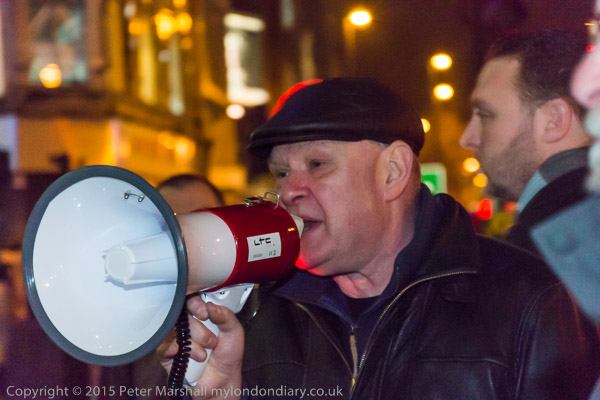
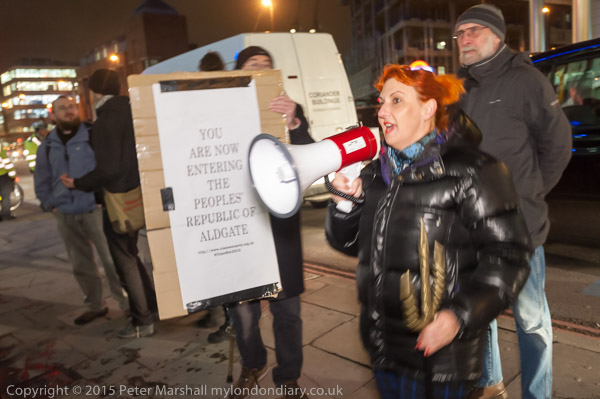
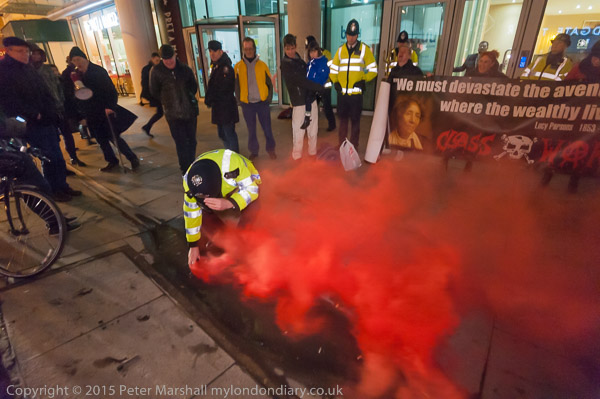
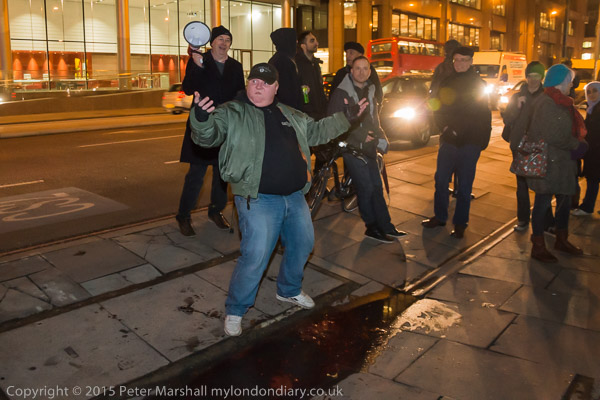
Rich Door, Poor Door: Class War’s Long series of protests against the separate and very different entrances to the tower block at One Commercial Street in Aldgate began on 30th July 2014 and weekly protests continued with some short pauses and a few extra visits until May 2015, when Class War devoted themselves to the General Election campaign.

Rich Door, Poor Door - 30th July 2014

Here is the introduction to my long post I made in 2014 about the event:

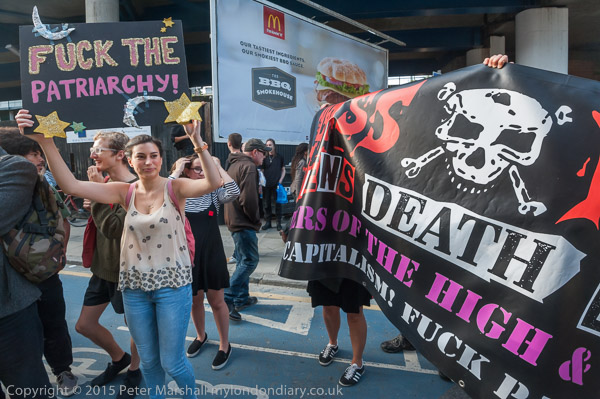
Class War, including three of their candidates for the 2015 General Election, protested at 1 Commercial St in Aldgate against London's new apartment blocks providing separate 'poor doors' for the affordable flats they have to include to gain planning permission for the development. Class War characterise this as 'social apartheid.'

Rich Door, Poor Door - 30th July 2014

You can still read the rest at Class War – Rich Door, Poor Door. At the time the building owners told us that there was “no internal connection between this part of the building and that containing the social housing” but on a later occasion I was taken by an owner of a flat in the “rich” section out of the building from her flat by the poor door – a route she took routinely when walking her dog.

Rich Door, Poor Door - 30th July 2014

I photographed almost all of the 30 events that took place in front of the building during that time, missing just a couple when I was out of London. And shortly after the protests ended I put together a ‘zine’ full of pictures from them (still available from Blurb) ‘Class War: Rich Door, Poor Door ISBN 978-1-909363-14-4′.

Rich Door, Poor Door - 30th July 2014

At the front of the zine is the text I posted on My London Diary on 30th July 2014, along with a list of the actions, and at its end a short note about how I came to photograph protests. But the bulk of the publication is simply pages of pictures with just a few short notes.

In a short conclusion I stated:

One Commercial Street still has its separate doors for rich and poor, but the campaign which had been suspended for the general election has made 'social apartheid' in housing an issue, and along with other housing campaigns has brought housing, and housing in London in particular onto the public agenda.

I should also had made it clear that Class War had taken an part in these other housing campaigns and their presence had helped to raise the profile of protests over these. In particular they had played an important part in making clear the involvement of Labour councils in London in collaborating with developers in the transfer of huge public assets into private ownership while failing to provide much-needed social housing.

Our current Labour government has still not got serious about the need to provide social housing rather than simply encourage developers to build more largely private housing (with a largely token amount of unaffordable “affordable” housing.) Perhaps if we do get a new party of the left things will change.

The preview on Blurb includes I think most or all of the publication and shows it better than the print publication. Viewing at full screen you can also read all the text, including my post from 2014 still on My London Diary. The pictures and text from all the other Poor Door protests are also still on My London Diary.

On My London Dairy for 30th July 2014: Class War – Rich Door, Poor Door

Tories Out March – 2017

Tories Out March: Around 20,000 met outside the BBC in Portland Place on Saturday 1st July 2017 to march to Parliament Square demanding an end to the Tory government under Theresa May.

Tories Out March - 2017
Class War wrap a march steward in their banner at the start of the march

Most were supporters of the Labour Party and in particular of the then Labour Leader Jeremy Corbyn, who had narrowly failed to win the recent general election, defeated not by the Tories but by sabotage within the party by the Labour right who controlled much of the party mechanism.

Tories Out March - 2017
John McDonnell with the banner at the front of the march

The Labour right had been shocked and appalled by Corbyn’s victory in the leadership contest and had done everything they could since then to get rid of him, with orchestrated cabinet resignations and the stoking up of false antisemitism claims combined with behind the scenes actions to ensure the failure of his attempts to improve the way the party tried to deal with such allegations.

Tories Out March - 2017
Rev Paul Nicolson from Taxpayers Against Poverty rings his bell

We had seen on television the relief felt by some of them as the results came out when after it had begun to look as if Labour had a chance of victory it became clear that the Tories would hang on to a small majority. The last thing they had wanted had been for Corbyn to have won.

Tories Out March - 2017
Mark Serwotka of PCS and MP Diane Abbott hold the banner at the front of the march

Theresa May had scraped in but had then had to bribe the DUP, a deeply bigoted party with links to Loyalist terrorists to give her a working majority.

Tories Out March - 2017
A Grenfell resident speaks in Parliament Square holding up some of the flammable cladding

Her austerity policies had been largely rejected by the electorate and the recent Grenfell Tower disaster had underlined the toxic effects of Tory failure and privatisation of building regulations and inspection and a total lack of concern for the lives of ordinary people.

A woman poses as Theresa May with a poster ‘We cut 10,000 fire fighter jobs because your lives are worthless’

The protesters – and much of the nation – knew that the Tories had proved themselves unfit to govern. The marchers and the people wanted a decent health service, education system, housing, jobs and better living standards for all.

East London Strippers Collective

But not all were happy with Labour policies either, although the great majority of them joined in with the sycophantic chanting in support of Corbyn. But there were significant groups who were also protesting against the housing polices being pursued by Labour-dominated local authorities, particularly in London Boroughs including Labour Southwark, Lambeth, Haringey and Newham.

Huge areas of council housing had been demolished or were under threat of demolition largely for the benefit of developers, selling off publicly owned land for the profit of the developers and disregarding the needs of the residents and of the huge numbers on council housing lists.

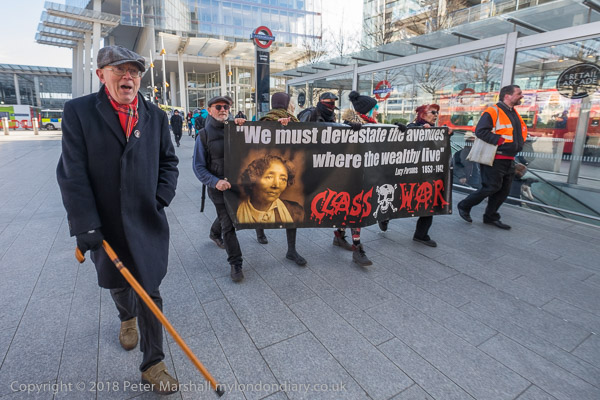
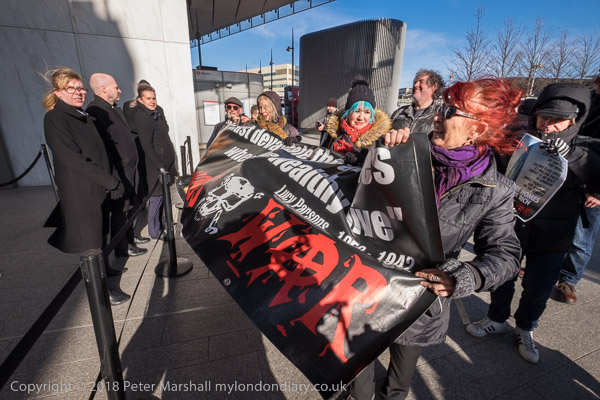
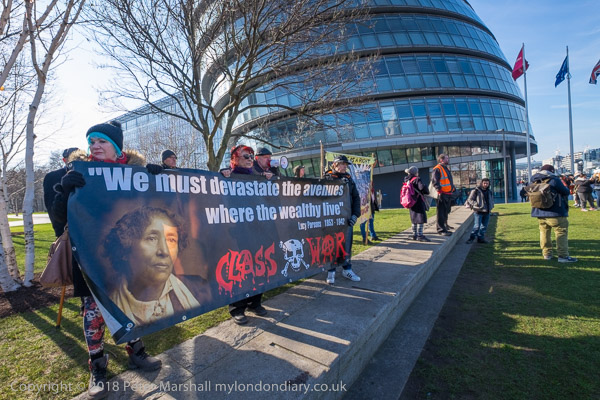
Class War protest the devastation of the estates where the poor live

One example was “the Heygate at Elephant & Castle, a well-designed estate deliberately run down by the council over at least a decade, but still in remarkably good condition. It cost Southwark Council over £51m to empty the estate of tenants and leaseholders, and in 2007 had valued the site at £150m, yet they sold it for a third of its market value to developers Lendlease for £50m.”

The estate had been home to over a thousand council tenants and another 189 leaseholders. Around 500 tenants were promised they would be able to return to to homes on the new estate – but there were just 82 social rented homes. The leaseholders were given compensation of around a third of the price of comparable homes in the new Elephant Park – and most had to move miles away to find property they could afford.

In 2017 Haringey was making plans to demolish around 5,000 council homes, roughly a third of its entire stock under what was known as the Haringey Development Vehicle (HDV) with developers Lendlease. Plans here prompted a revolt in the local area led by Labour members in the pro-Corbyn Momentum group who gained control of the council in 2018 and scrapped the HDV.

A giant-headed Theresa May outside Downing St

Among those leading protests against Labour’s Housing Policy was Class War who have been active in many of the protests over housing. I photographed them having a little fun with the march stewards, but unfortunately missed the scene at the rally in Parliament Square when Lisa Mckenzie confronted both Len McCluskey, General Secretary of Unite the Union and Labour Leader Jeremy Corbyn asking them the simple question ‘When are you going to stop Labour councils socially cleansing people out of London?’.

Class War lift up their banner in front of a police officer videoing protesters

Both men ignored her, walking past without pausing to answer and “the small Class War group was surrounded by Labour Party supporters holding up placards to hide them and idiotically chanting ‘Oh, Je-re-my Cor-byn! Oh, Je-re-my Cor-byn!’. But eight years later, now in power led by Starmer and Angela Rayner, Labour seems determined to make much the same mistakes in its housing policy.

More at Tories Out March.


FlickrFacebookMy London DiaryHull PhotosLea ValleyParis
London’s Industrial HeritageLondon Photos

All photographs on this page are copyright © Peter Marshall.
Contact me to buy prints or licence to reproduce.


Racists, Anti-Fascists, PR, Korea and a Victory Party – 2017

Racists, Anti-Fascists, PR, Korea and a Victory Party: Saturday 24th June 2017 was a long day for me, beginning with a march by the English Defence League and the anti-fascists who came to oppose it, moving on to another extreme right protest by the Football Lads Alliance on London Bridge then returning to Whitehall for a protest against the ongoing talks between Theresa May and the Ulster DUP to provide support for her minority government. In Parliament Square there was a picnic and rally against our ‘unfair first past the post’ voting system. From there I went to the US Embassy in Grosvenor Square where supporters of North Korea were calling for the US to withdraw its troops from South Korea. Finally I went to Burgess Park in South London where cleaners from the LSE were celebrating a successful end to 8 months of campaigning.


EDL march against terror – Whitehall

Racists, Anti-Fascists, PR, Korea and a Victory Party - 2017

The EDL march followed closely after the 3 June event when three Islamists drove a van into pedestrians on London Bridge killing eight people and injuring many more before being shot by police. Earlier in the year a police officer had been stabbed at the Houses of Parliament and a suicide bomber had killed 22 and injured over a thousand at the Manchester Arena.
Racists, Anti-Fascists, PR, Korea and a Victory Party - 2017
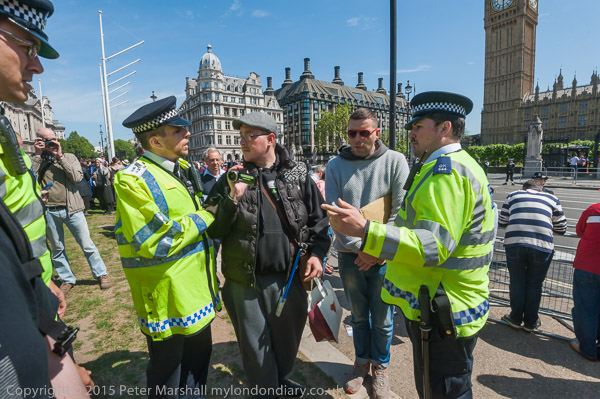
One of the protesters photographs me as I take his picture

Tempers were running high and just five days earlier a right-wing activist had driven a van into a Muslim crowd at the Finsbury Park Mosque. The Met were taking no chances and had issued strict conditions on both the EDL for their march and rally and for those who had come to oppose them, and had the police on the ground to enforce them.
Racists, Anti-Fascists, PR, Korea and a Victory Party - 2017
A member of the public hurries past the EDL

The EDL were meeting outside (and inside) the Wetherspoons close to the north end of Whitehall and I joined them on the pavement. There were quite a few police in the area and the protesters were mainly happy to talk and be photographed. Eventually they were escorted by a large group of police to the starting point of their march, the police taking them through some back streets to avoid the counter-protesters who had previously been restricted to the corner of Northumberland Avenue.

Racists, Anti-Fascists, PR, Korea and a Victory Party - 2017

EDL march against terror


Anti-fascists oppose the EDL – Northumberland Avenue

Racists, Anti-Fascists, PR, Korea and a Victory Party - 2017

Several hundred Unite Against Fascism supporters had come to protest against the EDL march but although there were a few minor scuffles as EDL protesters made their way to the pub, a large police presence kept the two groups apart.
Police again handed out copies of the conditions opposed on their protest. A small group of protest clowns taunted the police but there was no real attempt to break the police conditions. Eventually the UAF held a rally opposite Downing Street kept by police well away from the EDL rally taking place at the same time on the Embankment.

Anti-fascists oppose the EDL


Football Lads Alliance at London Bridge

Well over a thousand supporters of the recently formed Football Lads Alliance marched to the centre of London Bridge to protest what they see as the UK government’s reluctance in tackling the current extremism problem. I arrived late when the march was over but was able to photograph some of those taking part as they posed with wreaths at the centre of the bridge.

I went on to photograph the many flowers and messages that had been put their by people in the days since the attack.

Football Lads Alliance at London Bridge


Women protest DUP/Tory talks – Downing St

Back at Downing Street women concerned over abortion rights, housing activists and others had come to protest against the talks taking place with the Democratic Unionist Party and the concessions Theresa May would make to get their support for her government after the 2017 general election had resulted in a hung parliament.

Many protesters were in red for the blood of lives lost without access to reproductive rights, but others came to protest about those who lost their lives at Grenfell tower because they were considered too poor or black to need safe housing, for the disabled who have died because of cuts and unfair assessments, for innocent civilians bombed overseas and by terrorists here, for the blood shed in Northern Ireland before the peace process and for the decision to gamble the rights, health and safety of LGBT+ people.

Women protest DUP/Tory talks


Time for PR – Save Our Democracy – Parliament Square

At the end of the rally at Downing Street I walked down to Parliament Square, where Make Votes Matter and Unlock Democracy had organised a picnic and rally after the recent election had again demonstrated the unfairness of our current voting system. The rally used various colours of balloons to represent the percentage of the vote gained by different parties.

Prime Minister Theresa May had called a snap election but failed to get the 326 seats needed for an overall majority with only 317 Conservatives elected. Her party had received 42.3% of the total votes. Labour under Jeremy Corbyn had improved its position and had gained 30 seats but was still well behind at 262 seats and 40% of the total votes. They had failed to gain some key marginals where the party right had managed to stop the party giving proper support to candidates or probably the party would have won the election. By making promises to the Democratic Unionist Party, DUP who had won 10 seats in Northern Ireland, May was able to remain as Prime Minister.

Time for PR – Save Our Democracy


Withdraw US troops from Korea – US Embassy

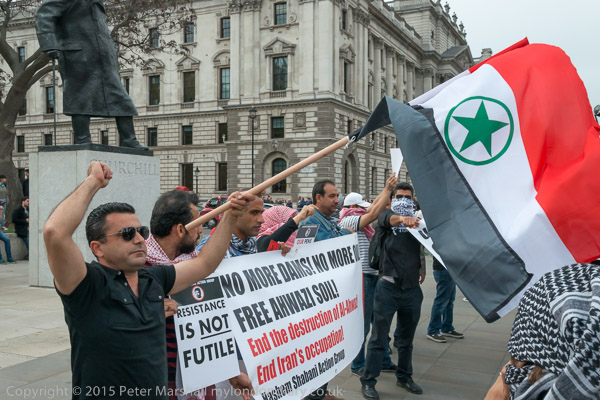
The UK Korean Friendship Association marked the 67th anniversary of the start of the Korean War, never officially ended, by a protest outside the US Embassy calling for the withdrawal of US troops from South Korea and an end to sanctions on the so-called Democratic People’s Republic of Korea, one of the least democratic countries in the world, a highly centralised authoritarian state ruled by the Kim family now for over 70 years, according to its constitution guided “only by great Kimilsungism–Kimjongilism.”

Withdraw US troops from Korea


LSE Cleaners Victory Party – Burgess Park, Southwark

Mildred Simpson shows off the ‘Masters of Arts’ certificates that were presented to the cleaners at the protest

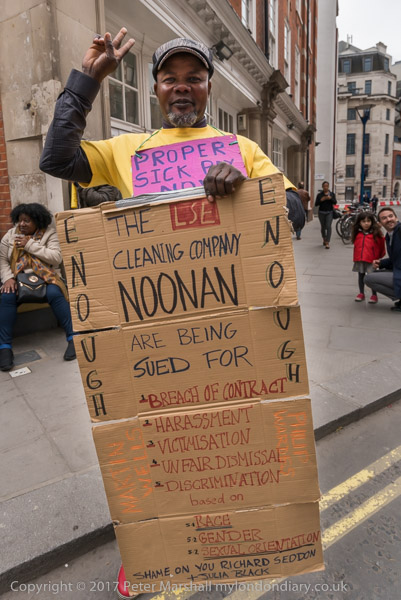
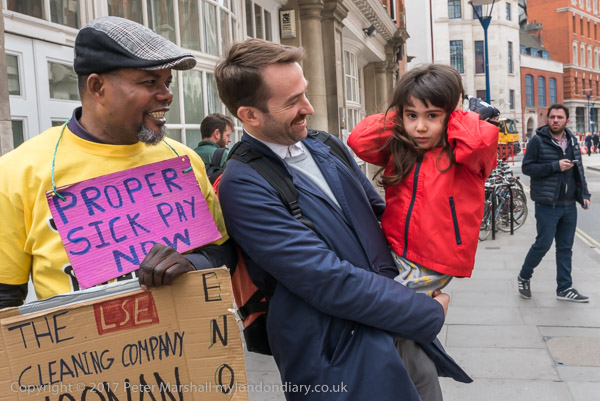
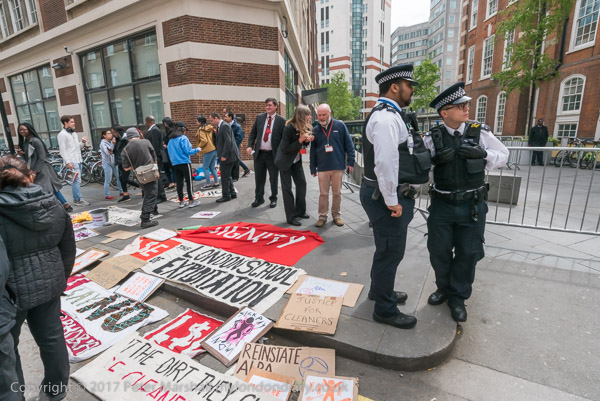
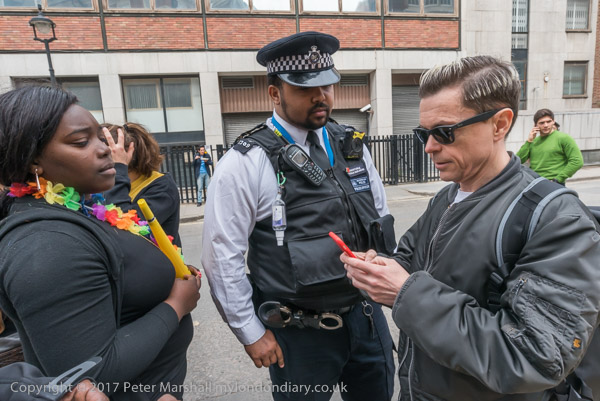
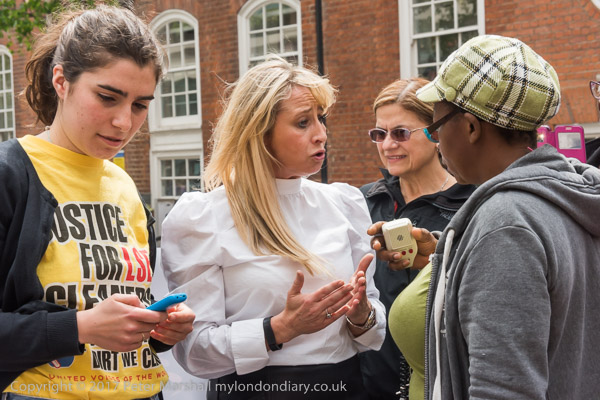
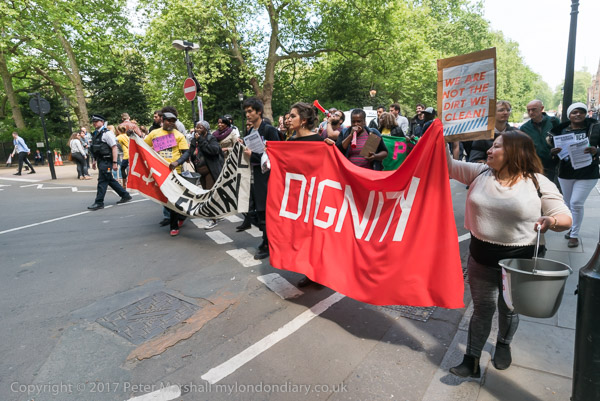
Finally it was good to meet with the cleaners from the LSE and other members and friends of the United Voices of the World and Justice 4 Cleaners who were celebrating the end of their 8 months of campaigning at the LSE. I had been at the meeting when the campaign was launched as a part of the LSE’s 3-day ‘Resist’ Festival organised by Lisa McKenzie, then a research fellow at the LSE, and had photographed many of their protests and it was great to celebrate their success with them.

Class War had supported the cleaners in their protests and some came to celebrate

Their actions, including 7 days of strike, had achieved parity of terms and conditions of employment with directly employed workers and a promise that they would be brought in-house by the Spring of 2018.

Several of the cleaners spoke at the party and the cleaners were “presented with ‘Masters of Arts’ certificates with First Class Honours in Justice and Dignity.”

Petros Elia, UVW General Secretary runs to organise everyone for a group photo

The final part of the dispute was settled a month later in July 2017 when Alba became the 5th cleaner to be reinstated at the LSE in a year with the UVW “winning a groundbreaking, precedent setting tribunal hearing today which declared Alba’s dismissal not only unlawful but profoundly and manifestly unfair.”

LSE Cleaners Victory Party


FlickrFacebookMy London DiaryHull PhotosLea ValleyParis
London’s Industrial HeritageLondon Photos

All photographs on this page are copyright © Peter Marshall.
Contact me to buy prints or licence to reproduce.