Eid Milad-Un-Nabi & End the Siege of Gaza – 2008

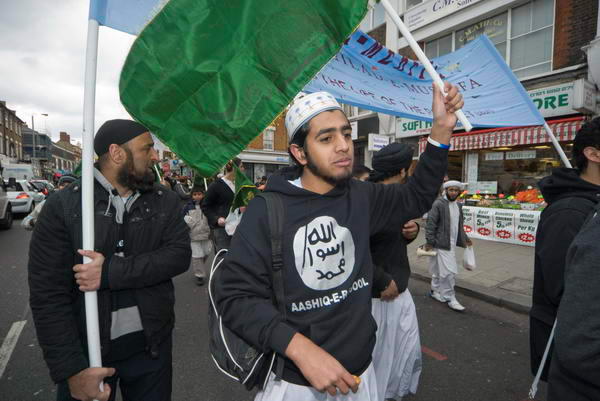
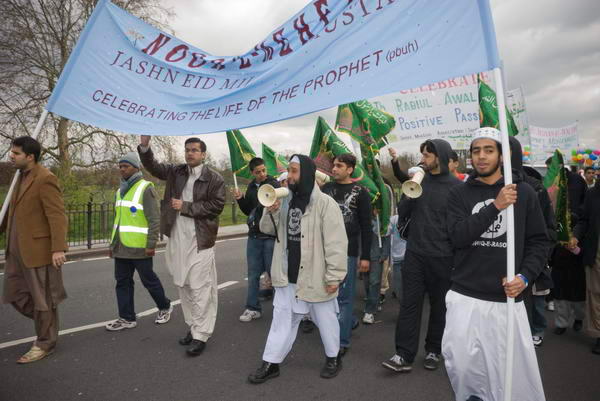
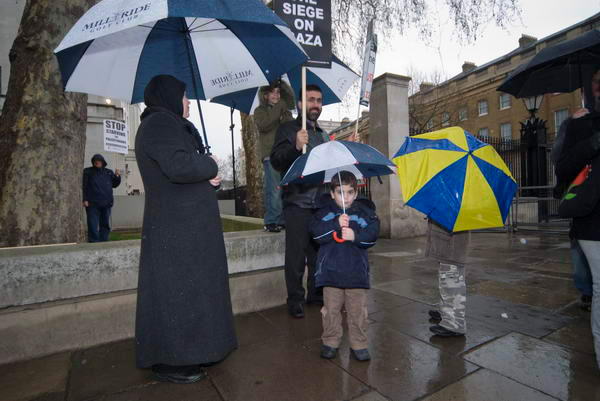
Eid Milad-Un-Nabi & End the Siege of Gaza: On Saturday 5th April 2008 was a rather frustrating day for me. I struggled to get to Tooting for the procession honouring the birthday of the Prophet as rail services to the west of London came to a halt. I finally made it but left as the procession neared its end. Thankfully the tube was working to take me into central London to view some exhibitions and photograph a protest at Downing Street calling for an end to the Israeli siege of Gaza.


Milad 2008 – Eid Milad-Un-Nabi

Procession and Community Day, Tooting

Eid Milad-Un-Nabi & End the Siege of Gaza - 2008

As usual I’d planned my journey into London carefully, intending to arrive in Tooting well before the start of the procession but a cable fire stopped all services into Waterloo with trains piling up back along the lines. Mine “came to a halt in Feltham, then crept forward slowly to Twickenham where it expired completely. Ten minutes later another service took me the few hundred yards further to St Margarets, where I abandoned rail and jumped onto a passing bus to Richmond.”

Eid Milad-Un-Nabi & End the Siege of Gaza - 2008

Then as I commented “Should you ever want a slow and frustrating ride through some of the more obscure southwest London suburbs I recommend the 493 route, which even includes a ride past Wimbledon Park and the world’s most famous tennis club before taking you past the dog track and on to Tooting.”

Eid Milad-Un-Nabi & End the Siege of Gaza - 2008

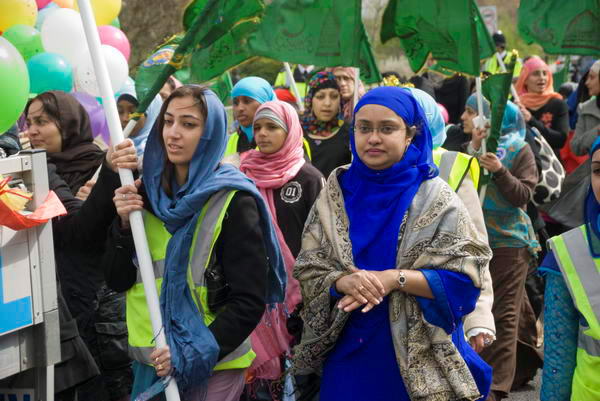
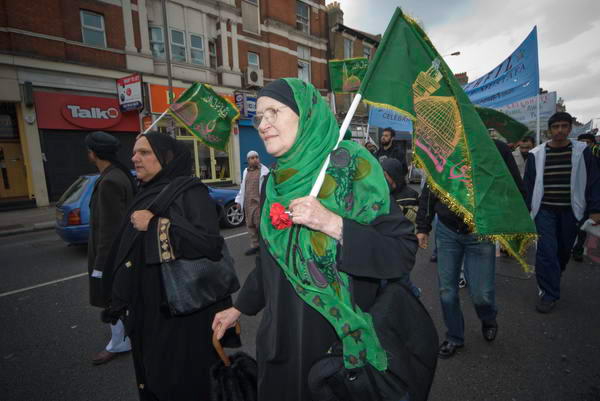
A full 50 stops and over an hour later I jumped off the bus and ran the last mile or so towards where the procession was to start on Tooting Bec Road, meeting the procession a few hundred yards from its start. Back in 2008 I wrote “half a mile” but I’ve just measured it and my run was at least double that. The Tooting Sunni Muslim Association’s procession for Eid Milad-Un-Nabi had started ‘promptly’ only around 20 minutes late so I hadn’t missed too much.

Eid Milad-Un-Nabi & End the Siege of Gaza - 2008

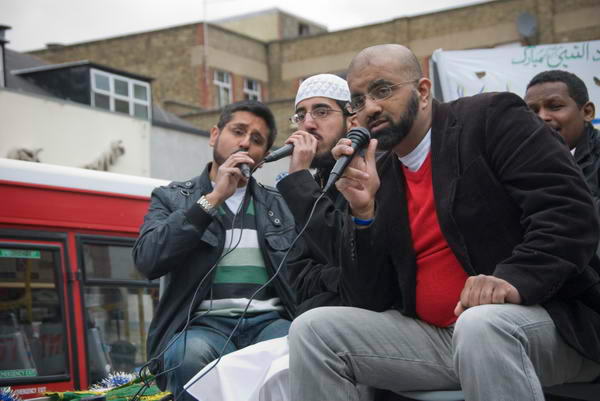
The Juloos to honour the birthday of the Prophet was part of an all-day community event and as well as the Muslims there were other local community representatives taking part including the Deputy Mayor of Wandsworth, Councillor Mrs. Claire Clay.

Eid Milad-Un-Nabi & End the Siege of Gaza - 2008

The previous year I’d gone on after the procession to the celebrations at Tooting Leisure Centre, including the impressive whirling dervishes – who I photographed again there in 2009. But in 2008 there were exhibitions I wanted to see in London – and a protest at Downing Street, so I left as the procession turned into Garratt Lane and took the tube from Tooting Broadway.

Milad 2008 – Eid Milad-Un-Nabi


End the Siege of Gaza

Downing Street

Eid Milad-Un-Nabi & End the Siege of Gaza - 2008
A demonstration on a wet Saturday afternoon at Downing St

In September 2007 the Israeli government had imposed a siege which was preventing vital medicines and other supplies from entering Gaza. This was a collective punishment against the population, illegal under international law and had by April 2008 already resulted in a number of deaths.

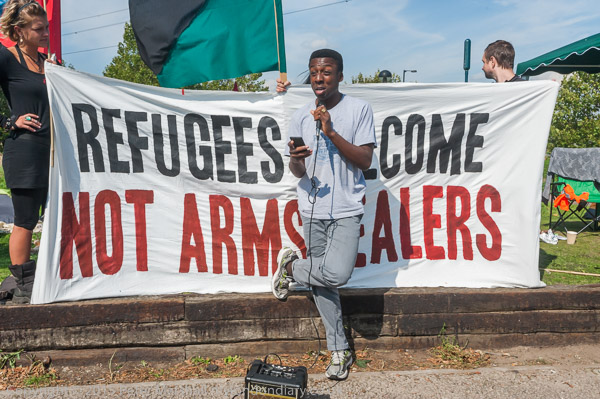
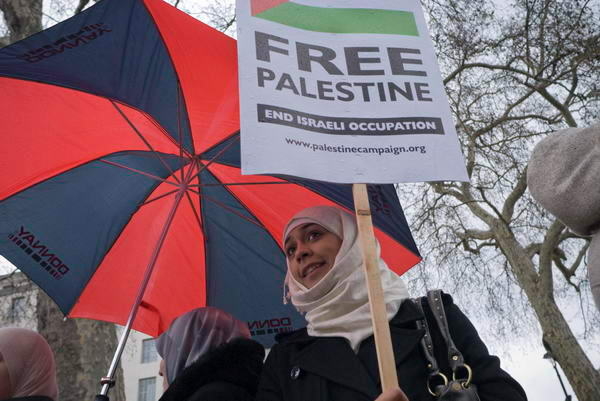
It was one of a series of protests organised by the Palestine Solidarity Campaign on a rather smaller scale than the hundreds of thousands in some more recent demonstrations, but sharing similar aims. It called on the British government to end the arms trade with Israel, and to press Israel to abide by international law, end its illegal occupation and allow the return of refugees.

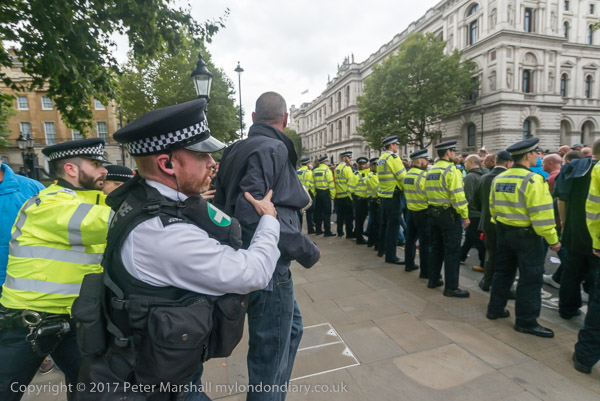
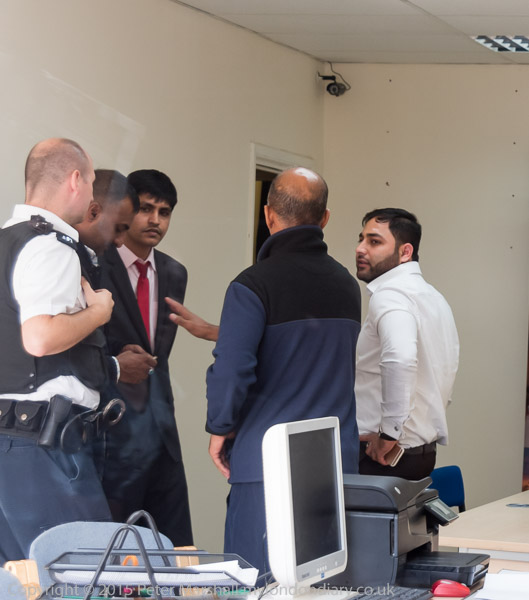
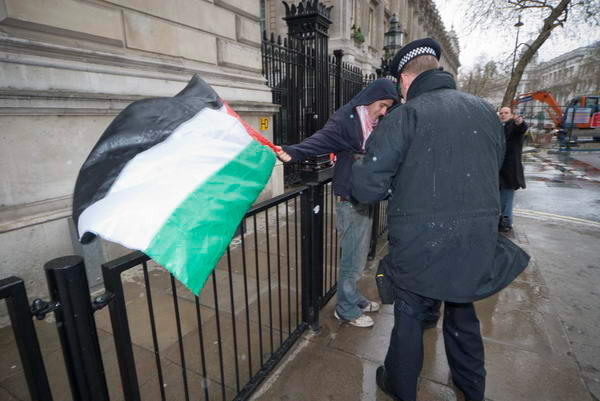
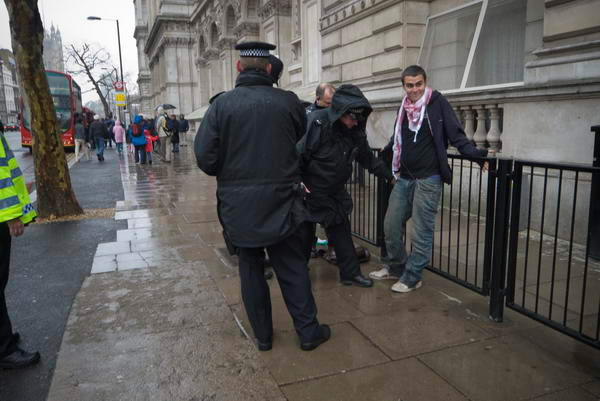
During the protest one young man with a Palestinian flag crossed the road and stood in front of the gates of Downing Street holding it. It was the police reaction to this – and their attempts to stop me photographing it that made up most of my report in 2008.

The man picks his flag up from the wet pavement and the officer shouts at him, telling him to put the f***ing flag down

Police pulled him to one side and questioned him, telling him that the SOCPA had made it a crime to protest there. They pulled his flag from his hands and dropped it on the pavement, and when he picked it up an officer swore at him, dragged it out of his hands and dropped it on the pavement again. He was then told he was being stopped and searched under the Terrorism Act 2000, though waving a flag is clearly not terrorism.

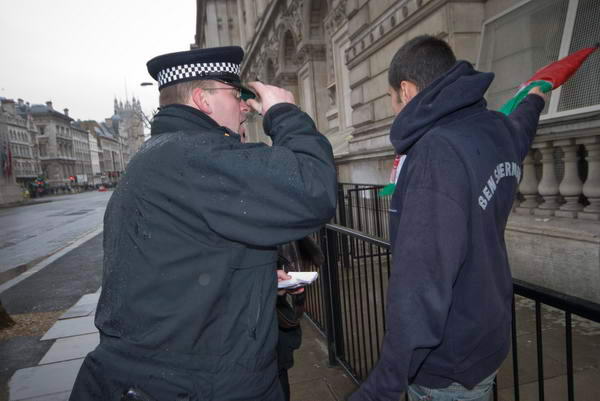
Clearly I was a already a good distance away when the officer on the left edge of this picture ordered me to move away

At this point an officer stood in front of me to stop me taking photographs. I told him I was press but he insisted I move further ways as I was “interfering with the actions of the police.” Clearly I wasn’t and I made this clear to him before moving back as ordered.

A woman officer came up and held her hand in front of my lens. I told her that this was illegal and a senior officer in the Met had told a colleague that he would consider it “a sacking offence” and she hurriedly moved off across the road and away from the area. Unfortunately I failed to get a good picture of her or to take her number.

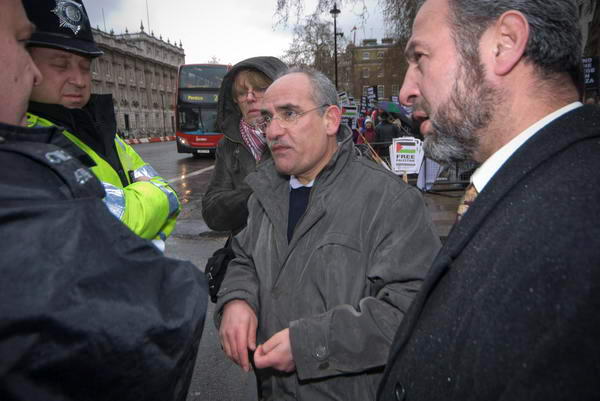
I went back across the road to continue photographing the protest. Police officers at the protest on the other side of the road were approached by the event organisers about the man being held but denied any connection with the officers on the other side of Whitehall. The officer did attempt to excuse their actions on possible grounds of security, but I didn’t feel he felt too happy about it. The man was still being held by police when I left the area.

End the Siege of Gaza


FlickrFacebookMy London DiaryHull PhotosLea ValleyParis
London’s Industrial HeritageLondon Photos

All photographs on this page are copyright © Peter Marshall.
Contact me to buy prints or licence to reproduce.
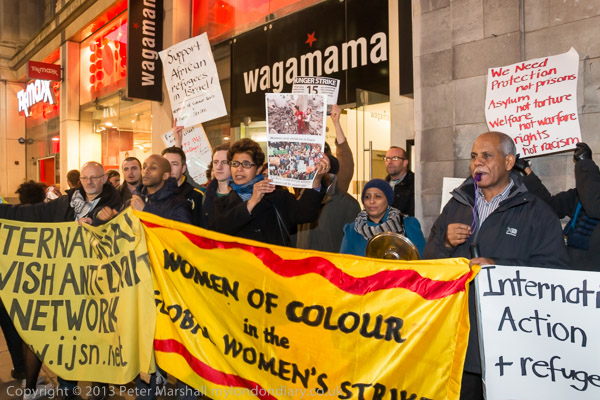
UN Anti-Racism Day & IDS Gone – 2016

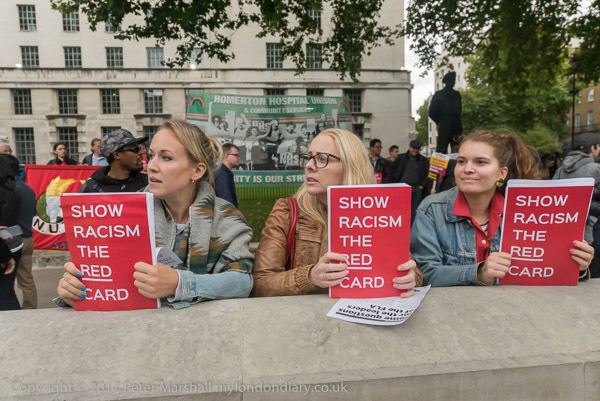
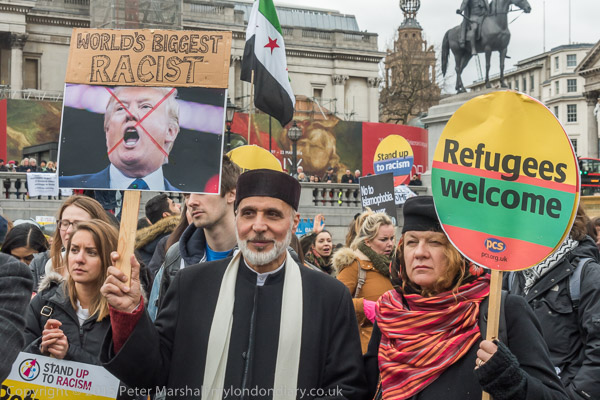
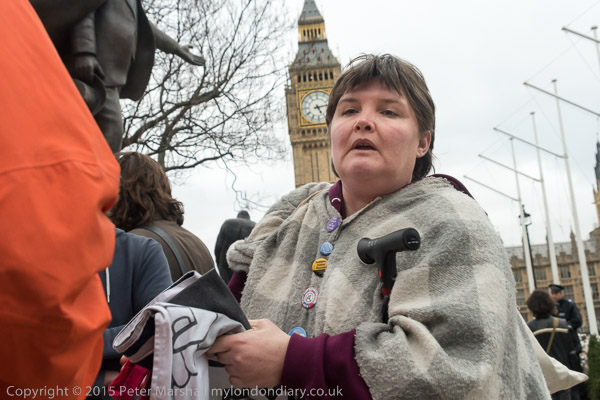
UN Anti-Racism Day & IDS Gone: Saturday 19th March 2016 was UN Anti-Racism Day and was celebrated with a Refugees Welcome march and rally, and by Australians and others protesting at the Australian High Commission in London to condemn the Australian government’s treatment of refugees. Later in Parliament Square I joined disabled people and friends celebrating the resignation of Iain Duncan Smith whose policies had caused them so much suffering and harm.


Stand Up to Racism – Refugees Welcome March

BBC to Piccadilly Circus

UN Anti-Racism Day & IDS Gone - 2016

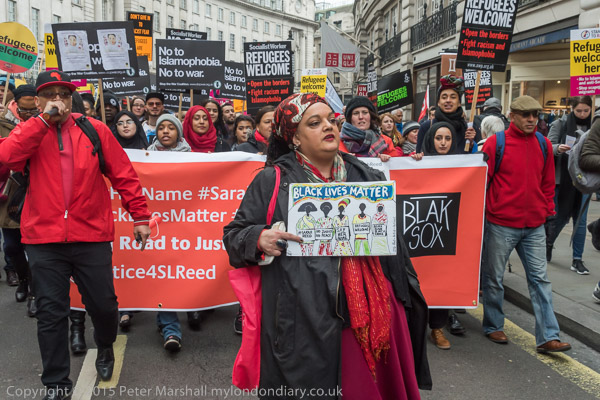
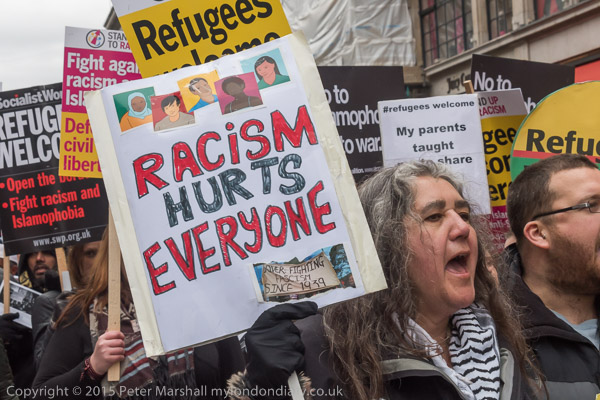
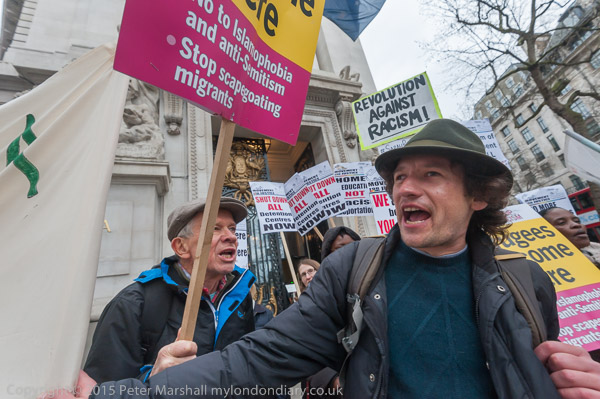
Thousands met outside the BBC for a national demonstration called by Stand Up to Racism against racism, Islamophobia, anti-Semitism and fascism and to make the point that refugees are welcome here.

UN Anti-Racism Day & IDS Gone - 2016

They had started at the BBC pointing out that it should have a much more positive attitude to refugees. It gives much air time to the views of racists and extreme right groups and personalities and fails to adequately represent the view of the majority of the British population shown in protests such as this.

UN Anti-Racism Day & IDS Gone - 2016

The BBC often minimises the positive contributions of migrants and refugees to the British economy and keeping vital services such as the NHS running and fails to criticise the increasingly racist government policies.

UN Anti-Racism Day & IDS Gone - 2016

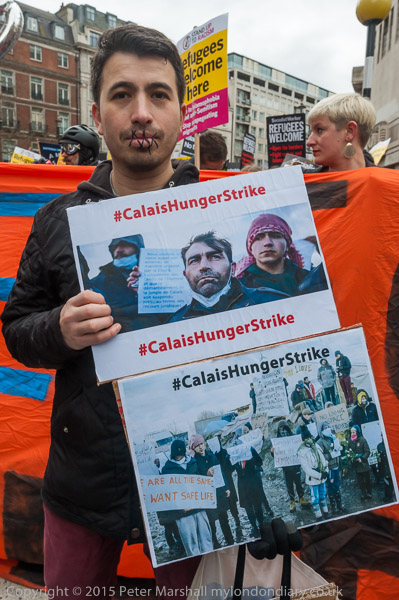
As well as a large ‘Black Lives Matter’ bloc led by Lee Jasper and Zita Holbourne, there were also groups working with refugees trapped in the camps in Calais and Dunkirk by the failure of our government to set up legal routes for refugees, demanding our government take a much more positive and humanitarian approach to refugees. Apart from a small concession for children, forced on them by Lord Dubs with massive public support, which was very grudgingly administered and prematurely ended, successive governments have responded with increasingly draconian measures.

UN Anti-Racism Day & IDS Gone - 2016

What I wrote in 2016 is now even more apposite: “Of course there are racists and bigots who oppose Britain taking in any refugees, and those who would want to abandon the Universal Declaration of Human Rights, which Britain played a major role in drawing up in 1947-8. Winston Churchill – who many on the far right look on as a symbol of all things British – proposed a European Charter of Human Rights in 1947 and we were the first country to ratify it in 1951.”

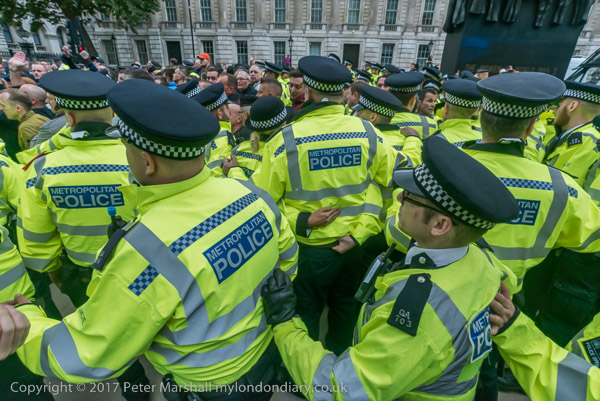
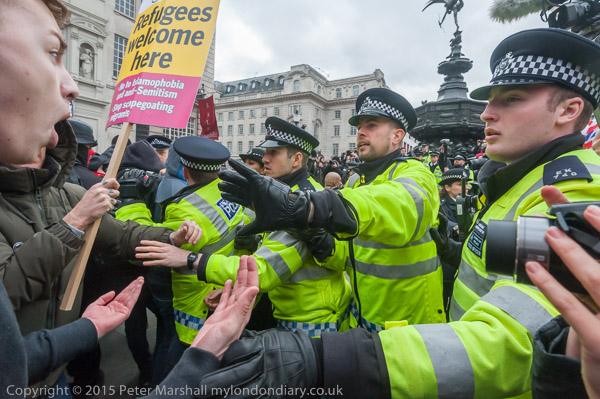
A very small group of members of the far-right group ‘Britain First’ in their para-military uniforms stood guarded by several times as many police on the steps around Eros as the march past, shouting their hate and insults and making derisory and threatening gestures. Most of the marchers simply ignored them, but a few rushed towards them but were held back by police.


Stand Up to Racism – Refugees Welcome march


Refugees Welcome Rally

Trafalgar Square

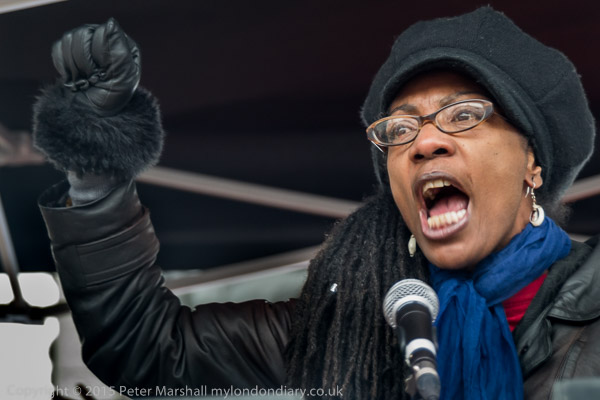
Marcia Rigg whose brother Sean Rigg was killed by Brixton police in 2008,

A long list of speakers came to the microphone in Trafalgar Square and I photographed most although I left before the end of the rally.

There are pictures of the following as well as Marcia Rigg on My London Diary:

  • Vanessa Redgrave;
  • Sabby Dhalu of Stand up to Racism;
  • Maz Saleem, daughter of Mohammed Saleem killed in a racist attack;
  • Stephanie Lightfoot, Bennett Co-Chair, United Friends and Families;
  • Dave Ward CWU General Secretary;
  • Sally Hunt UCU General Secretary;
  • Christine Blower NUT General Secretary;
  • Gary Younge Journalist;
  • Gloria Mills, Chair of the TUC Race Relations Committee;
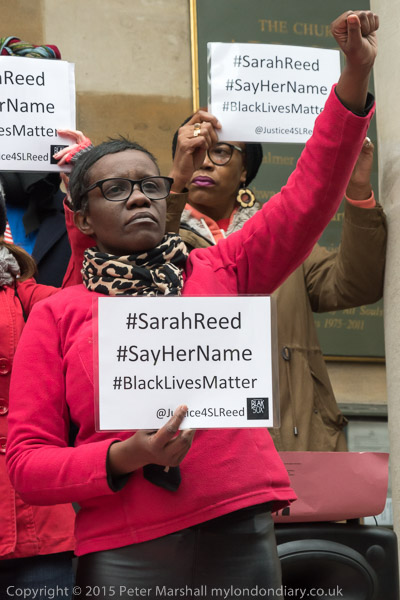
  • Marilyn Reed, the mother of Sarah Reed who died in Holloway Prison;
  • Lee Jasper, Movement Against Xenophobia and BARAC;
  • Jeremy Hardy, Comedian;
  • Diane Abbott MP;
  • Michael Rosen Children’s novelist and poet;
  • Claude Moraes MEP;
  • Jean Lambert MEP;
  • Amna, a refugee from Mosul, Iraq;
  • Talha Ahmad National Council member,Muslim Council of Britain

Refugees Welcome Rally


Australians Protest on UN Anti-Racism Day

Australia House

Australians were protesting at home & at embassies around the world against their country’s racist immigration policy.

Many who try to claim asylum in Australia are locked up and detained indefinitely in contradiction to international law on remote Pacific Islands including Manus and Nauru in detention camps run by Serco and will never be allowed to resettle in Australia.

Detainees in these camps have been sexually abused, denied proper health treatment, and in at least one case, that of a young man called Reza Berati, beaten to death by the prison guards.

Serco also run detention centres such as Yarl’s Wood in the UK, where detainees have also been mistreated, sexually abused and denied proper health treatment. The Australian protesters were joined by members of Movement for Justice, which has held many protests at UK detention centres including Yarl’s Wood and Harmondsworth.

No UK newspapers, TV or Radio media had even sent reporters to this protest. The only other photographer taking pictures at the event had been commissioned by a Sydney newspaper.

Australians protest on UN Anti-Racism day


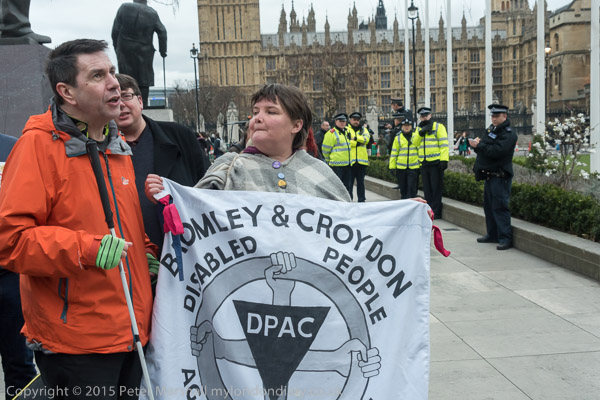
DPAC’s ‘IDS Resignation Party’

Parliament Square

IDS, Iain Duncan Smith, was Secretary of State for Work and Pensions from 2010 to 2016 and responsible for brutal cuts in welfare polices in those years.

In particular he decided to save money by making it harder for sick and disabled people to claim benefits, introducing new eligibility tests and benefit sanctions, incentivising DWP staff to strip claimants of their benefits often for trivial reasons or for matters beyond their control such as the late arrival of official letters or cancellation of buses and trains making them arrive late for appointments.

In 2015 the statistics showed that 2,380 people died in a 3-year period shortly after a work capability assessment declared them fit for work.

The poorly thought out nature of the introduction of Universal Credit also brought suffering to many, left for weeks without financial support. He introduced disastrous schemes to force the disabled into work and cut the support which had enabled some disabled people to work.

His period as a minister had combined a total lack of empathy with a peculiar incompetence and the National Audit Office accused the DWP of ‘”weak management, ineffective control and poor governance” and of wasting £34 million on inadequate computer systems.’

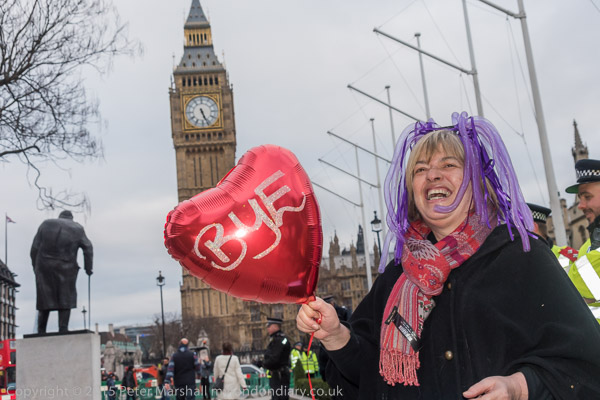
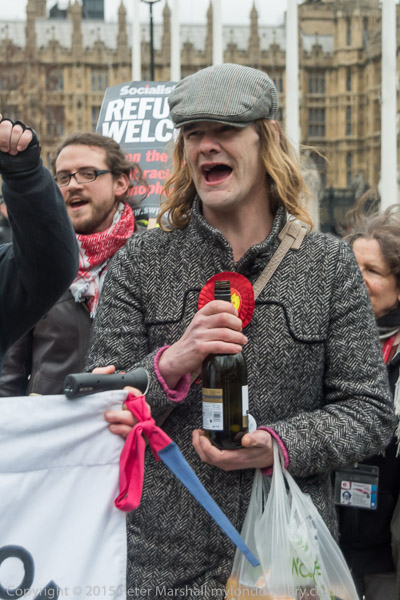
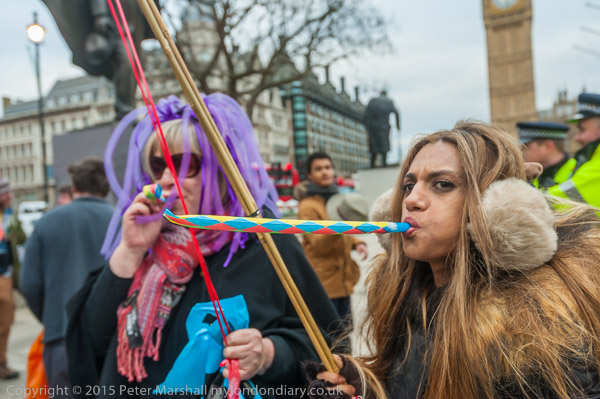
So naturally DPAC were pleased to see him go, and celebrated at this party – though with Prosecco rather than the Champagne some media reports stated. And perhaps their celebrations were a little muted by the knowledge that his successor Stephen Crabb had shown himself to be equally bigoted and lacking compassion and understanding of the needs of the poor and disabled.

Strangely, despite his long record of cutting disablity benefits, IDS’s stated reason for his resignation was that he was unable to accept the government’s planned cuts to disability benefits, later describing the policies he had spent six years putting into effect of “balancing the books on the backs of the poor and vulnerable” as divisive and “deeply unfair“.


DPAC’s ‘IDS Resignation Party’


FlickrFacebookMy London DiaryHull PhotosLea ValleyParis
London’s Industrial HeritageLondon Photos

All photographs on this page are copyright © Peter Marshall.
Contact me to buy prints or licence to reproduce.


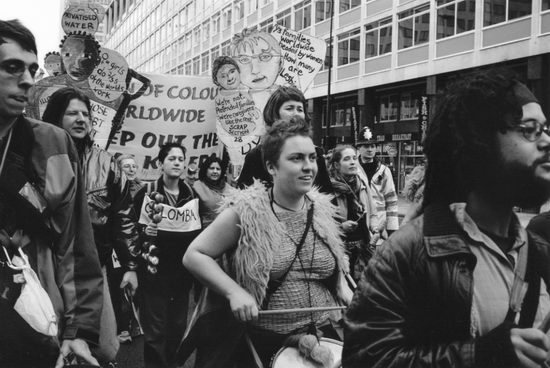
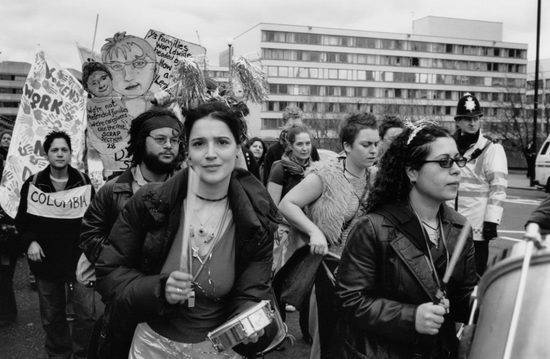
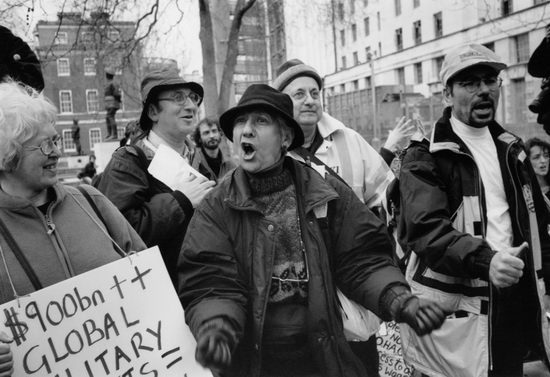
International Women’s Day – 2002

International Women’s Day - 2002

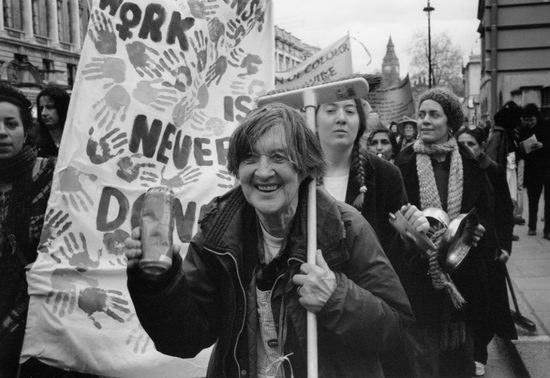
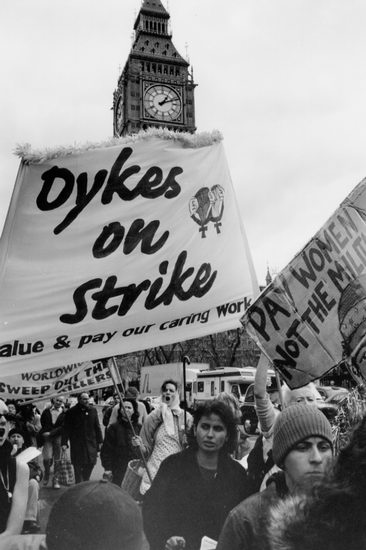
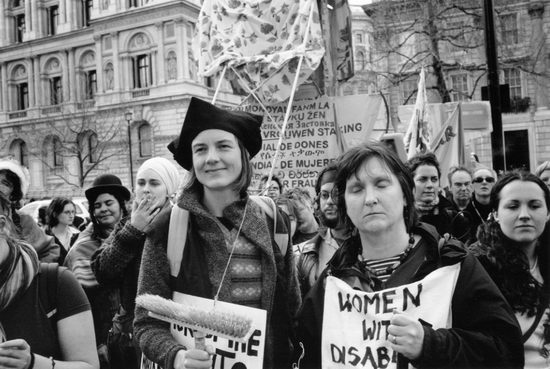
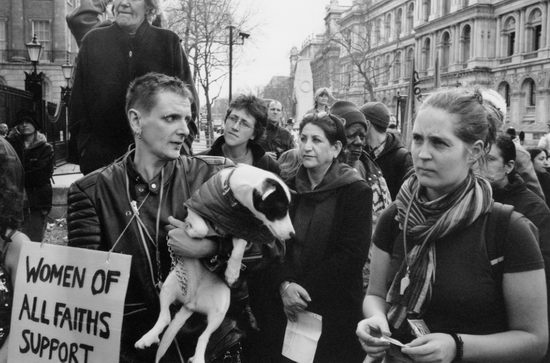
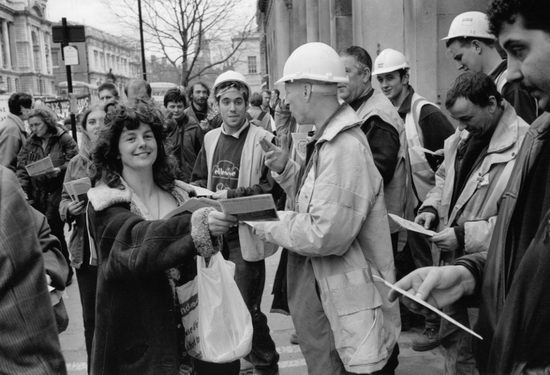
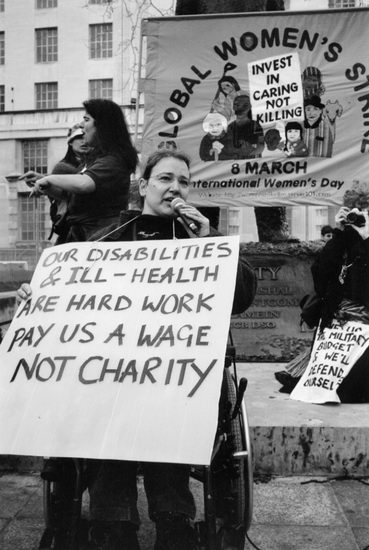
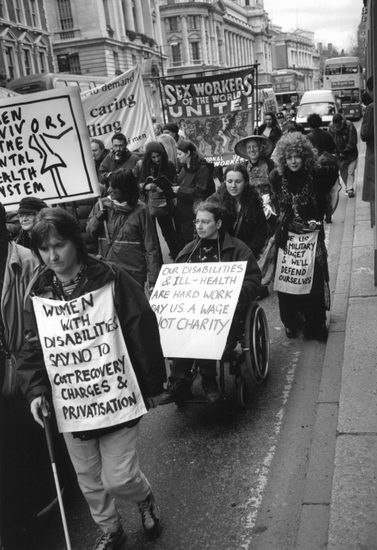
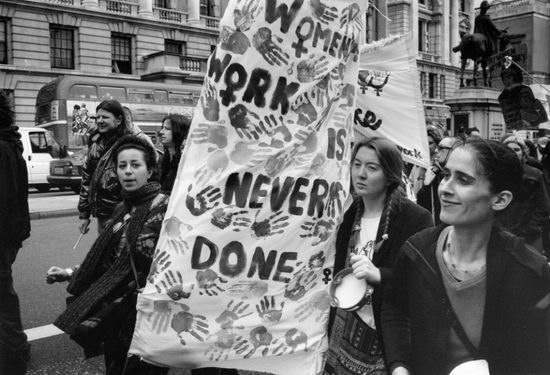
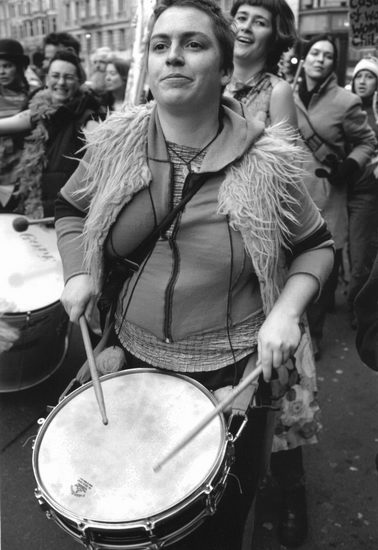
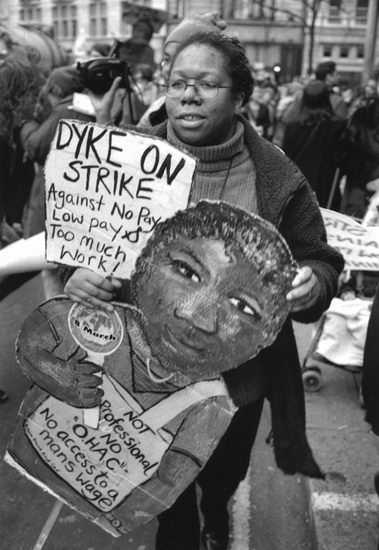
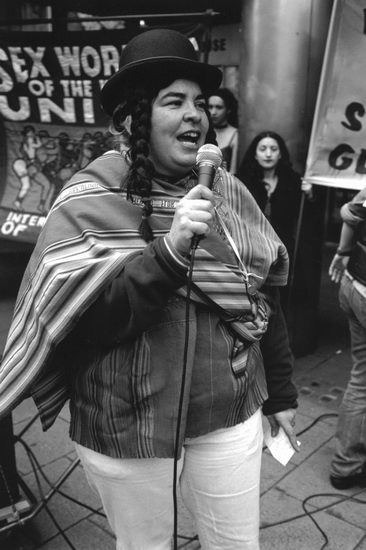
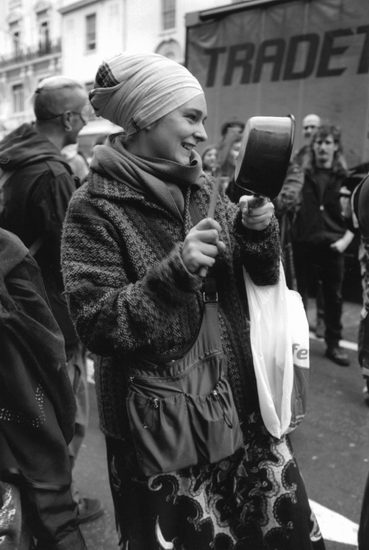
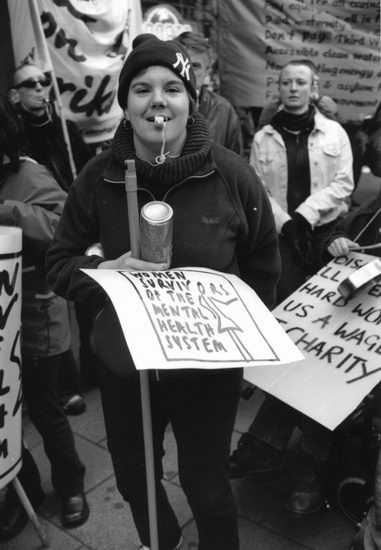
International Women’s Day: I’m not sure if this march on Friday 8th March 2002 was the first International Women’s Day event that I photographed, but it was the first that I published on My London Diary.

International Women’s Day - 2002

Back then all the pictures I published were in black and white, though I was also taking pictures in colour but was unable to easily digitise them. I still have to do so for many of the colour pictures I made on film, though I did make prints of a few of them in my darkroom.

International Women’s Day - 2002

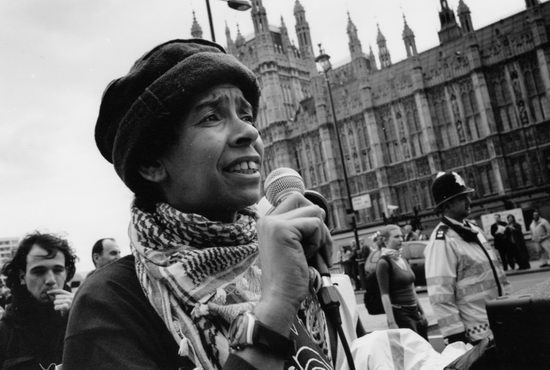
Looking through these pictures I recognise quite a few faces I still photograph at protests, among them the founder of the Global Women’s Strike and the the International Wages for Housework Campaign Selma James.

International Women’s Day - 2002 - Selma James

Selma and other women from the Crossroads Women’s Centre in Kentish Town are still there at many of the protests I photograph, with banners from some of the various women’s groups based at the centre.

International Women’s Day - 2002

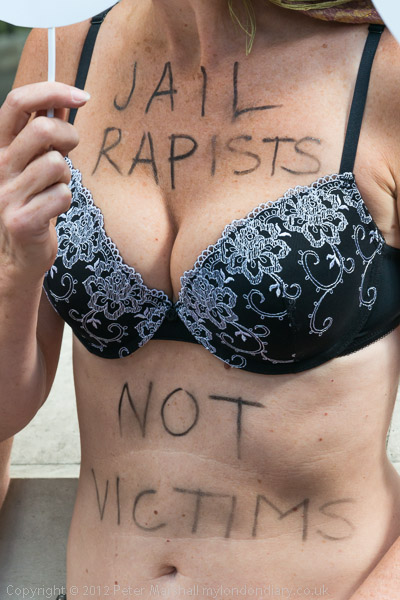
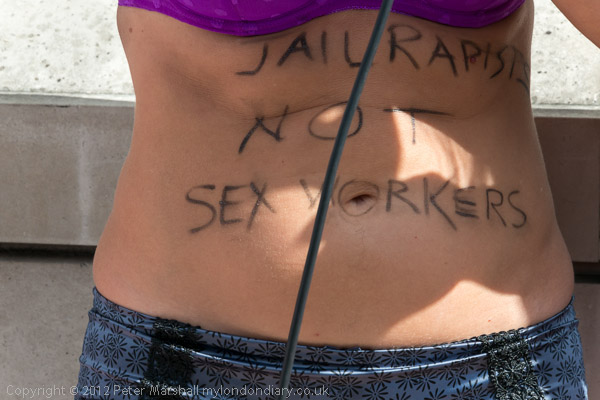
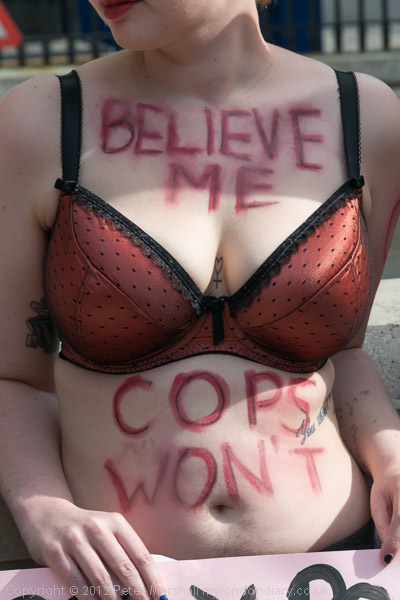
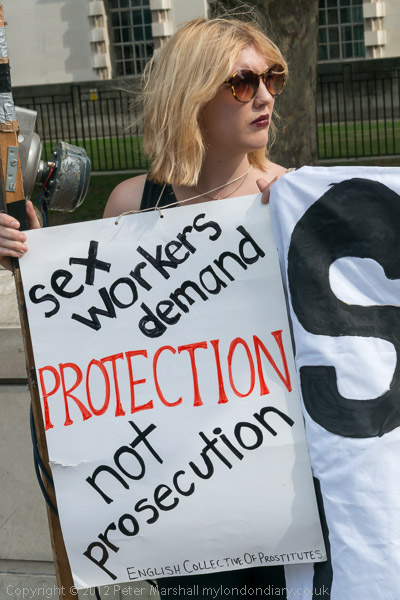
International Women’s Day seems to have become much more widely celebrated since 2002, or at least getting more media attention, though this seems still very much around the very real problems faced by middle class professionals (including of course women in the media) than those faced by by working class women, refugees, asylum seekers, poor women being targeted by social services, those with disabilities, sex workers, victims of domestic violence, rape etc which are at the centre of this event and continuing protests.

Back in 2002, I didn’t write much about this march, at least in partly due to ignorance, but also I seldom wrote much about the events I was covering as I had a full-time job writing about photograph on the web, as well as my own photography – where the pictures I submitted had only brief captions.

“The 8 March is a World Woman’s Day and was celebrated by some as a Global Women’s Strike. The march in London stopped outside key sites including the War Office and World Bank for speeches.”

This was the full set of textt and images I posted in 2002 on My London Diary.


FlickrFacebookMy London DiaryHull PhotosLea ValleyParis
London’s Industrial HeritageLondon Photos

All photographs on this page are copyright © Peter Marshall.
Contact me to buy prints or licence to reproduce.

No Borders and the West End – 2007

No Borders and the West End: On Saturday 10th February 2007 I went to photograph a protest against our racist, cruel and arbitrary detention of immigrants and asylum seekers at the neighbouring Colnbrook and Harmondsworth detention centres on the Colnbrook By-Pass immediately north of Heathrow Airport – now known as Heathrow Immigration Removal Centre. Like the first protest I covered there in April 2006 it was organised by No Borders, though several later events there were and at Yarls Wood were by Movement for Justice who were taking part in this protest with a Fight Racism! Fight Imprerialism! banner and others.

Harmondsworth (or rather Longford where both centres are located) was only a few miles bike ride from home, and after around an hour I jumped back on my bike, cycled home and took the train into London where I had arranged to meet a friend, I think probably to hand over some material.

We took a wander around Piccadilly Circus, Trafalgar Square and other parts of central London before saying goodbye and my making my way to Waterloo Station, photographing a few things on the way.

Here with the usual corrections is what I wrote about the day in 2007 on My London Diary and a few of the pictures with links more.


No Borders Demo at London Detention Centres

Colnbrook & Harmondsworth

No Borders and the West End - 2007
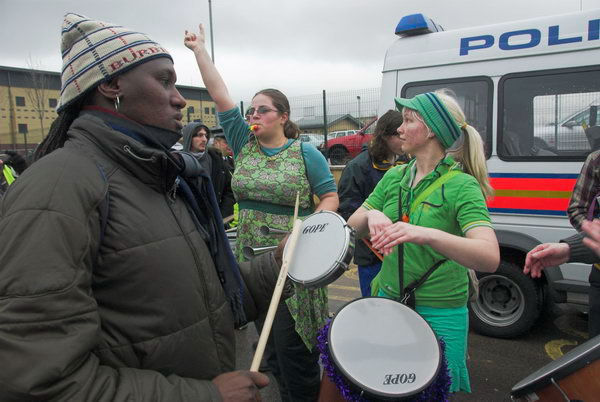
Rhythms of Resistance players outside the detention centres – Harmondsworth centre in background.

I arrived at the detention centres at Harmondsworth (Colnbrook and Harmondsworth are separated only by a narrow private road) just as the people who had come by coach from London marched onto the roadway leading to the two sites, with banners and the street band of Rhythms Of Resistance.

No Borders and the West End - 2007
Fight Racism, Fight Imperialism’

We had come to give support to migrants and refugees, and to demand the closure of detention centres, a stop to deportations and and end to immigration controls.

No Borders and the West End - 2007

Since I was last here the windows of the two detention centres seem to have been blocked off, giving them a more sinister appearance, but although those imprisoned within the blocks were not allowed to see us, I imagine they could hear the noise that was being made.

No Borders and the West End - 2007
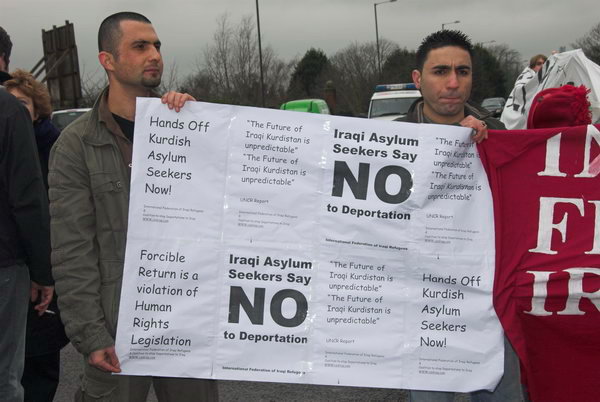
Hands off Kurdish Asylum Seekers Now

I left after around an hour, when a few people were still arriving. As well as the crowd in the road, there were also a number of people lined up along the main road in front of the two ‘prisons’.

No Borders and the West End - 2007
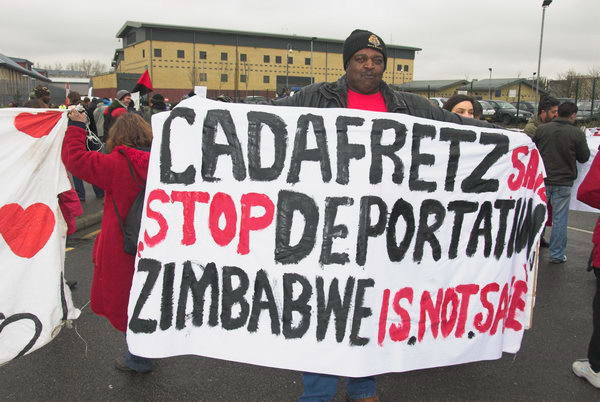
The Campaign For The Defence Of Africans Returned To Zimbabwe make the point Zimbabwe is not a safe place

There didn’t seem to be a huge police presence, although probably there were rather more on hand not far away. I left to meet a friend I’d arranged to see in the centre of London.

More pictures


London: West End

Birthday celebrations at Piccadilly Circus.

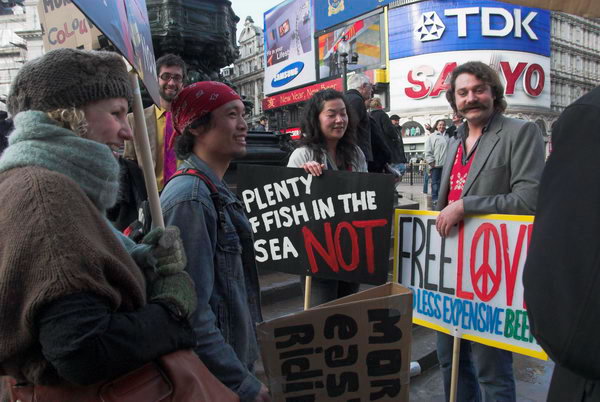
There wasn’t a great deal special happening as I walked through the streets of the West End of London. At Piccadilly Circus we bumped into some people with placards, but they were just celebrating someones birthday.

It was as boring as it looks

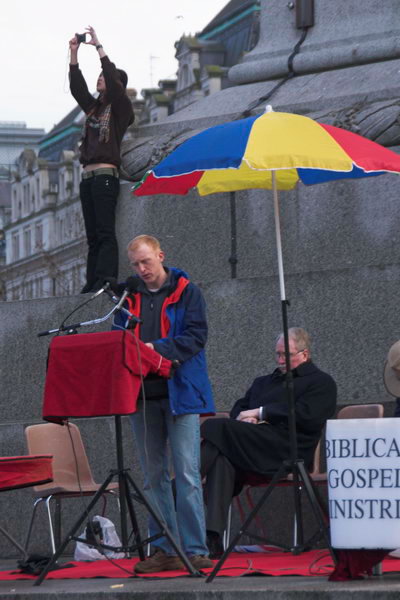
In Trafalgar Square we found the Biblical Gospel Mission preaching and handing out free bibles, though I told them I had several already at home.

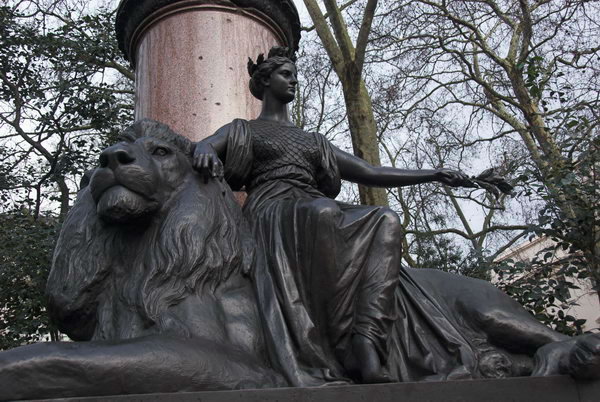
One of several sculptures and statues I photographed

More pictures from the West End


FlickrFacebookMy London DiaryHull PhotosLea ValleyParis
London’s Industrial HeritageLondon Photos

All photographs on this page are copyright © Peter Marshall.
Contact me to buy prints or licence to reproduce.

Margaretta D’Arcy, Education & African Refugees – 2014

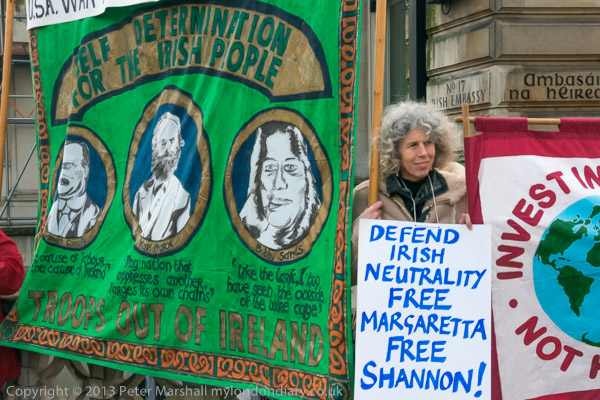
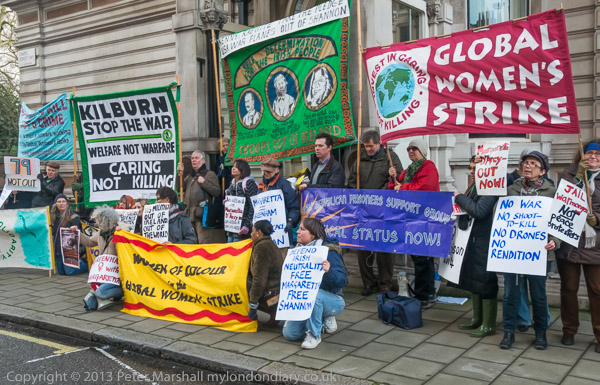
Margaretta D’Arcy, Education & African Refugees: On Wednesday 22nd January I photographed a protest at the Irish Embassy demanding the release of anti-war activist Margaretta D’Arcy before going to a peaceful march by London Universitry students for democratic, public education free from exploitation and police violence. Finally I went to a protest close to the Israeli Embassy in Kensington in solidarity with African asylum seekers in Israel who are protesting their against arbitrary arrests, imprisonment and inhumane treatment.


Release Margaretta D’Arcy Now!

Irish Embassy

Margaretta D'Arcy, Education & African Refugees - 2014
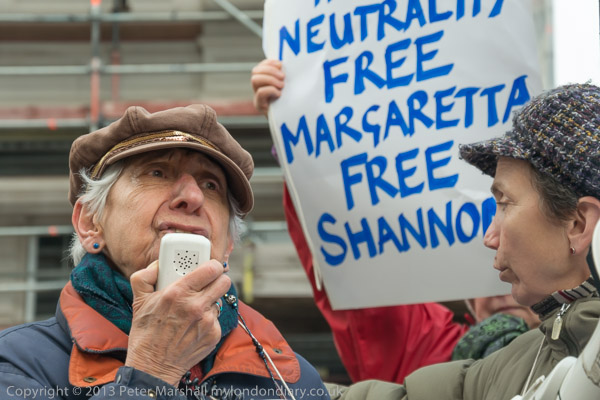
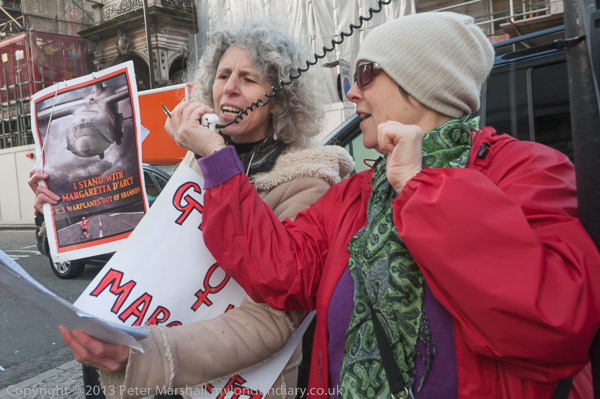
Selma James calls for the release of Margaretta D’Arcy

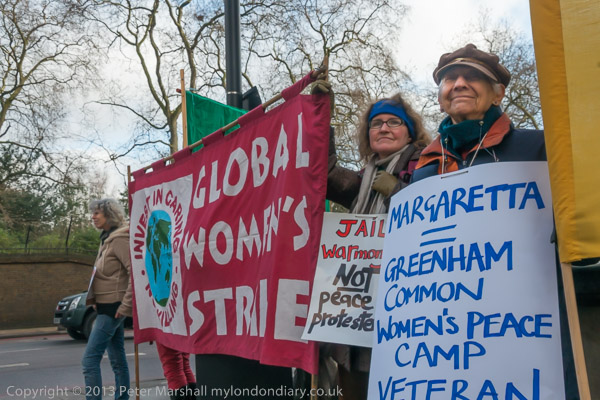
Margaretta D’Arcy (1934 – 2025) was an prominent Irish actress, writer, playwright and anti-war activist and a veteran of the Women’s Peace Camp at the US airbase on Greenham Common, where she had been a powerful member of the group at the ‘Yellow Gate’; protests by the Peace Camp eventually led to a legal challenge and the closure of the US Base with its cruise missiles.

Margaretta D'Arcy, Education & African Refugees - 2014

Earlier in 1961 D’Arcy had joined the anti-nuclear Committee of 100 and in 1981 had been imprisoned for the first time after defacing a display at the Ulster Museum. Active in many campaigns in Ireland including the Shell to Sea campaign against the Corrib gas project and the Ireland Palestine Solidarity Campaign, she was arrested in October 2012 for lying down on the runway at Shannon in a peaceful direct action by members of Galway Alliance Against War against the use since 2001 of Shannon by Galway Alliance Against War in violation of Irish neutrality.

Margaretta D'Arcy, Education & African Refugees - 2014

D’Arcy received a suspended sentence but after she had been arrested again on the runway at Shannon in September 2013 and she refused to sign a bond to keep out of restricted areas at Shannon the suspended 12-week sentence was reactivated. After serving nine and a half weeks of this she was released from Dublin prison in March 2014. She continued her activism until a few days before her death in 2025.

Margaretta D'Arcy, Education & African Refugees - 2014

The protest at the Irish Embassy in London took place a week after D’Arcy was arrested to serve her suspended sentence, and around 50 people had come with banners and posters for a protest outside the Irish Embassy in London and to deliver a petition calling for her immediate release.

Margaretta D'Arcy, Education & African Refugees - 2014

On My London Diary I list some of the many groups who supported the protest and most of those who spoke.

Release Margaretta D’Arcy Now!


Students March to Protect Education

London University & Holborn

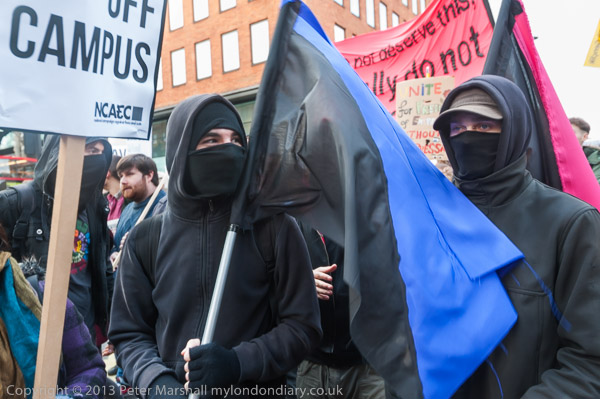
The protest by London University students took place following a number of incidents in London and elsewhere the previous term when university management had called police onto the campus or gone to the courts to prevent or oppose student protests or to harass students. This had led in December 2013 to a Cops Off Campus National Student Protest.

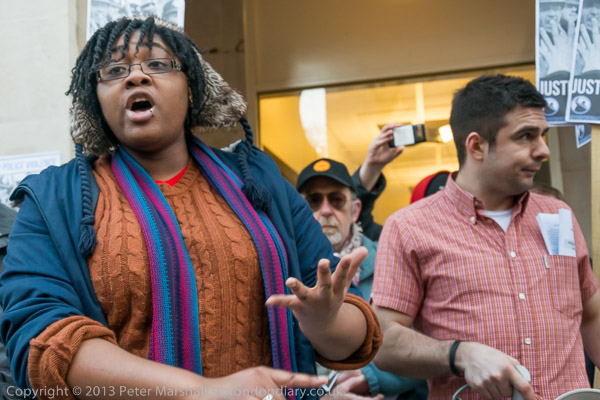
A student speaks about police violence, and in particular violence directed at the black community including the killing of Mark Duggan

The protest began outside the University of London Union which the university is closing down with a speech by ULU President Michael Chessum and also by representatives of the lecturers who were taking action that week and the cleaners, maintenance and security staff who were about to hold a 3-day strike in their ‘3 Cosas’ campaign for sick pay, holidays and pensions, as well as for recognition for their union, the ndependent Workers’ Union of Great Britain (IWGB). Another student spoke about police violence, in particular against the black community.

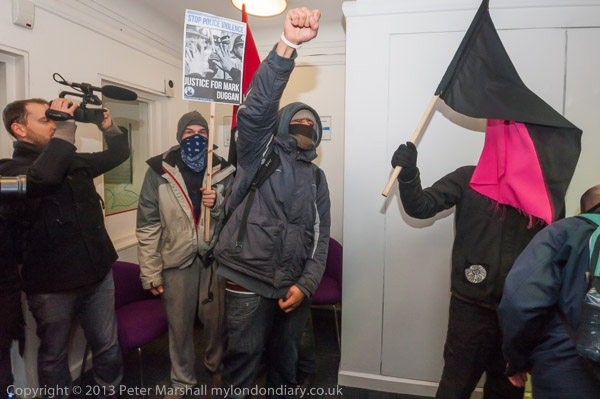
A few from the black bloc enter Woburn House, home to theUniversity & Colleges Employers Association but it was only a token gesture

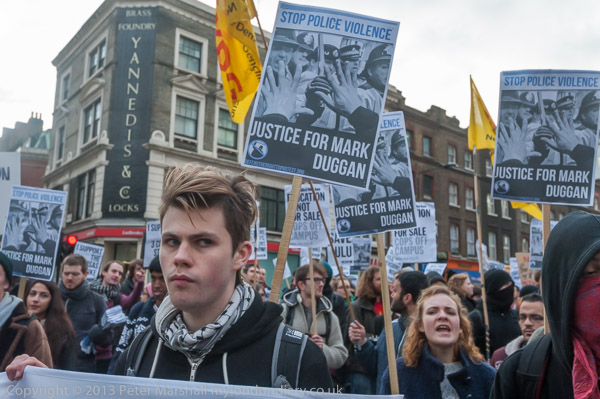
The marchers then went on a tour of key university sites including Senate House and the University & Colleges Employers Association in Tavistock Square where there was a brief token occupation of the lobby before going on to protest outside Holborn Police Station. Here as well as protesting against police violence they also protested the police execution of Mark Duggan.

They continued down Kingsway to Aldwych and the Strand, ending the march with a short rally outside the Royal Courts of Justice. The police had kept at a discreet distance while the students were in the university area but both the police station and the law courts were guarded by a line of police.

At the end of the rally Alfie Meadows suggested people might like to go on to a protest at the Royal Opera House, where the cleaners are also going on strike the next month for a living wage and proper conditions of work. About half the students then marched off with him, but I needed to leave for another event.

Students march to protect Education


Solidarity with African Refugees in Israel

Israeli Embassy, Kensington

Tens of thousands of African asylum seekers had been protesting in Israel since the start of the year holding mass rallies against their treatment by the Israeli authorities.

Protesters stand on the pavement in front of the private road in which the Israeli embassy is located

In December new laws in Israel had meant entering the country without proper papers could be held for up to a year without trial, and those already in the country could be held in indefinite detention. The detention facility in the Negev desert, like many other Israeli prisons, is run by the private security company G4S.

There were around 50,000 refugees currently living in Israel, most who had fled brutal conflicts in Sudan and Eritrea, with only a few hundred of their applications had been processed. Most keep alive by working illegally, exploited and in fear of arrest.

Recently a strike by those working as cleaners, cooks, dishwashers and other low paid workers had brought many restaurants, hotels and businesses to a standstill. They held a rally with over 20,000 in Rabin Square in the centre of Tel Aviv with banners saying ‘We are refugees, not criminals’ and demanding their rights.

The London protest was one of many around the world following a call by the African Asylum Seekers Community in Israel for international solidarity. It isn’t possible to protest outside the Israeli Embassy in London which is down a well-guarded private street, but the protesters gathered on the pavement in front of the entrance to this street, refusing police attempts to move them further away.

More pictures at Solidarity with African Refugees in Israel


FlickrFacebookMy London DiaryHull PhotosLea ValleyParis
London’s Industrial HeritageLondon Photos

All photographs on this page are copyright © Peter Marshall.
Contact me to buy prints or licence to reproduce.

Anti-fascist Solidarity Against Golden Dawn – 2013

Anti-fascist Solidarity Against Golden Dawn: Saturday 19th January 2013 was an international day of action against the fascist Golden Dawn Party in Greece, and around 500 people had come to the Greek Embassy in Holland Park in solidarity with the demonstration against the party in Athens.

Anti-fascist Solidarity Against Golden Dawn - 2013
Police keep anti-fascists away from a small pro-Golden Dawn counter-protest

Golden Dawn, now described in Wikipedia as “a far-right neo-Nazi ultranationalist criminal organisation and former political party” had its origins in 1980 but only became prominent following the 2008 Greek debt crisis which resulted from the global financial crash and crippling austerity measures imposed on Greece by the EU and IMF.

Anti-fascist Solidarity Against Golden Dawn - 2013
Tony Benn speaking

The founder of the group, Nikolaos Michaloliakos, who called himself ‘Fuhrer’, is an ardent support of Adolf Hitler and a holocaust denier, and the group adopted similar symbolism, slogans, salutes and policies to the Nazis. They wanted to return Greece to a military dictatorship such as that which had ruled the country from 1967-74.

Anti-fascist Solidarity Against Golden Dawn - 2013

Golden Dawn seized on the existing racism and Islamophobia against immigrants and refugees by forming attack squads against them in the parts of Athens where they had most support, their actions covered by the support of the police who also launched their own operation conducting large numbers of strip searches and detentions – much like the current ICE in the USA.

Anti-fascist Solidarity Against Golden Dawn - 2013
Weyman Bennett, UAF

In the Greek May and June 2012 elections Golden Dawn had got 6.9% of the vote and 18 MPs, with similar results in the 2015 elections. But by 2019 their vote had fallen below the 3% needed for them to have any representation in parliament, largely due to resistance by the working class through strikes and demonstrations and with the rise of the left-wing Syriza party.

Anti-fascist Solidarity Against Golden Dawn - 2013
Jeremy Corbyn MP

In 2020 Michaloliakos and other prominent part members were found guilty of murder, attempted murder, and violent attacks on immigrants and left-wing political opponents and were sent to prison.


The London protest was organised by Unite Against Fascism (UAF) and “similar solidarity protests were taking place around the world, including in New York, Sydney, Barcelona, Lyons, Toronto, Dublin, Vienna, Moscow, Canberra, Warsaw, Chicago, Copenhagen, Montreal, Bilbao, Milan, Finland, Slovenia, Derry, Cork, Glasgow, Edinburgh, Leeds and Bristol.”

Tony Benn & Gerry Gable

There were speeches at the protest by some leading members of the British left, including Tony Benn and Jeremy Corbyn, as well as those from various Greek organisations, and I list some of the speakers in My London Diary. Among the speakers was Gerry Gable, the editor of Searchlight, long a powerful force against racist and fascist groups, who died recently.

Police stop protesters going down the street to confront the small group of Golden Dawn supporters

Elizabeth Mantzari of Solidarity with the Greek resistance “had just begun to speak hen there was an uproar down the road, as some of the crowd rushed to protest against a small group of right-wing supporters of Golden Dawn.”

British Friends Of Golden Dawn

Police quickly formed a line to stop others following them, and then began moving the anti-fascists back behind it away from the 15 ‘British Friends Of Golden Dawn’, some of whom I recognised from former EDL protests. I tried to talk to some of them but was insulted and accused of working for Searchlight – which unfortunately I had never done.

Anarchist solidarity with the squats banner in front of the Greek Embassy

The rally opposite the Greek Embassy continued, though I had missed some of the speeches. Clearly as I ended my account, “The protest was a success for the UAF, and yet another humiliation for the extreme right.”

More about the rally and many more pictures on My London Diary at Anti-fascist Solidarity Against Golden Dawn.


FlickrFacebookMy London DiaryHull PhotosLea ValleyParis
London’s Industrial HeritageLondon Photos

All photographs on this page are copyright © Peter Marshall.
Contact me to buy prints or licence to reproduce.

Daily Mail, Kurdistan, Muslim Brotherhood & Iraq – 2013

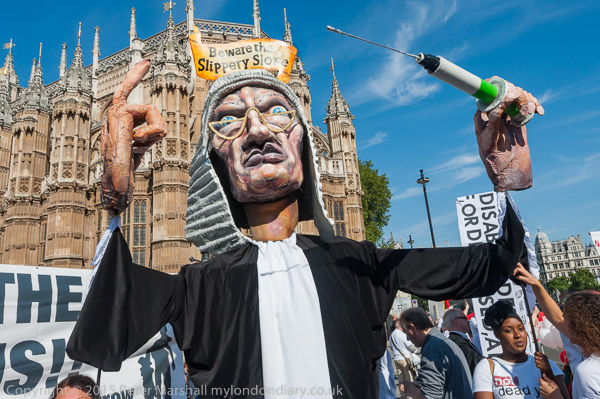
Daily Mail, Kurdistan, Muslim Brotherhood & Iraq: On Sunday 6th October 2013 I photographed a protest against the Daily Mail, Kurds marching calling for their leader to be released from Turkish jail, protests for and against the removal of President Morsi of Egypt and a protest calling for the release of hostages in Iraq.


Daily Mail You Told All the Lies – Kensington

Daily Mail, Kurdistan, Muslim Brotherhood & Iraq

The Daily Mail has a long history of publishing lies against the BBC, NHS, public sector workers, trade unionists, socialists, women, Muslims, travellers and others, but the protest came after people were outraged by their smears and distortion in an entirely unfair attack of Ralph Milliband.

Daily Mail, Kurdistan, Muslim Brotherhood & Iraq

Their campaign against the father of Ed Milliband was intended to discredit the then Labour leader and Leader of the Opposition and many felt the Daily Mail had gone over the line of what is acceptable in British politics with their headline ‘MAN WHO HATED BRITAIN’, based on an out of context adolescent observation. Of course things in our press have worsened since then, particularly in the orchestrated attacks on Jeremy Corbyn accusing him of anti-semitism.

Daily Mail, Kurdistan, Muslim Brotherhood & Iraq

Ralph Milliband had fled Belgium with his working class Polish Jewish family in 1940 aged 16 when Germany invaded the country and went on to serve in the Royal Navy during the war. He settled in London after the war and became a British subject in 1948. As a sociologist he became one of the most respected academics of the post-war period, respected by people across the political spectrum.

Daily Mail, Kurdistan, Muslim Brotherhood & Iraq

The Daily Mail had supported the Blackshirts and Hitler in the 1930s and continued after the war to express hate for most of those institutions that have truly made Britain great – like the welfare state, the NHS and the BBC and the public sector generally. And more recently it had backed French fascist Marine Le Pen.

Daily Mail, Kurdistan, Muslim Brotherhood & Iraq

The protest was organised by The People’s Assembly, a nationwide group set up in opposition to the current government’s austerity programme and to defend the provision of education, health and welfare from general taxation and available to all. Several hundred came to the show they were proud of Britain and its welfare state and there was a great deal of chanting against the Daily Mail and and some songs before two people delivered boxes of a petition to their offices and the speeches began.

Daily Mail You Told All the Lies


Freedom for Ocalan & Kurdistan – Wood Green

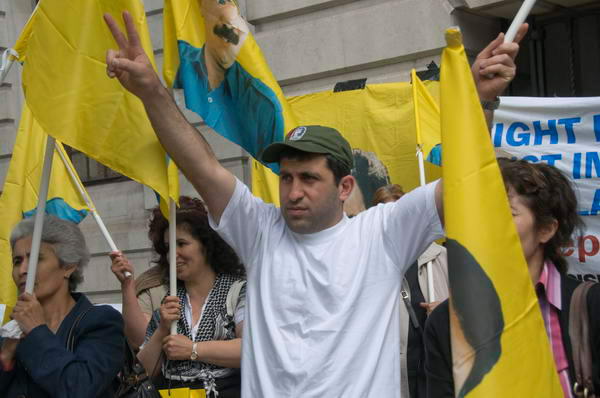
The speeches agains the Daily Mail were continuing as I rushed away to Wood Green in North London where Kurds were marching on the 15th anniversary of the kidnappping of their national leader Abdullah Ocalan by Turkey in 1998.

Since then Ocalan has been held, mainly in solitary confinement, in a Turkish prison.

I left the march as it went past Wood Green Station on its way to the Kurdish Community Centre in Haringey to make my way to Mayfair and the Egyptian Embassy

Freedom for Ocalan & Kurdistan


Egypt For & Against Muslim Brotherhood – Egyptian Embassy

Opposite the Embassy in South Street were a group of protesters supporting the Muslim Brotherhood and opposing what the military coup which had recently removed the Egyptian President Mohamed Morsi the suppression of protests in Egypt against this.

Many carried placards showing the R4BIA four finger and thumb on palm sign to show support, begun after a Muslim Brotherhood sit-in at the Rabaa Al-Adawiya Mosque in Cairo was violently attacked by the military in August 2013 – Rabaa is ‘four’ or ‘fourth’ in Arabic.

A short distance away a smaller group of Egyptians protested, many carrying pictures of Abdel Fattah El-Sisi, the Minister of Defense and Commander-in-Chief of the Egyptian Armed Forces who had led the coup and the massacres of protesters – a total of around 3,000 were killed and almost 19,000 arrested, They supported the removla of Morsi, who after a narrow win in the 2012 election had granted himself unlimited powers and issued an Islamist-backed draft constitution.

Sisi installed himself as leader and became president after elections in 2014, remaining in power as a dictator since then (including two further elections in which other candidates were barred from running or boycotted the election due to repression – said to be even worse than under Mubarak who had been forced to step down by the popular revolution in 2011.

Egypt For & Against Muslim Brotherhood


PMOI call for release of 7 Hostages in Iraq – Trafalgar Square

Finally in Trafalgar Square I photographed an elaborate display by the People’s Mojahedin Organization of Iran, the PMOI (aka MEK and MKO) which since 1986 had been exiled in Iraq (and is now in Albania.)

Photographs of the 52 killed by Iraqi forces on 1st September

After the 2003 Iraq invasion the MEK came to a ceasefire agreement with the USA, giving up their weapons – which included 19 British-made Chieftain tanks. When the USA left Iraq they were left at the mercy of the Iraqi authorities and have been subjected to a long history of attacks on their refugee camp.

Seven hostages are sill held in Baghdad

The latest of these, ordered by Iraqi Prime Minister Nouri al-Mailki, was at Camp Ashraf on September 1, 2013 and killed 52 with 7 hostages taken and held in the Baghdad Green Zone. In response hunger strikes started at Camp Ashraf and in Geneva, Berlin, Ottawa, Melbourne as well as London where they set up a camp in front of the US Embassy in Grosvenor Square.

A line of hunger strikers, on the 36 day of their strike, was seated at the front of the audience at today’s rally, holding roses and taking an active part in the event, raising their fists and shouting.

The rally called for immediate release of the seven prisoners, and for UN forces to be stationed permanently at Camp Ashraf and Camp Liberty to provide the protection the PMOI, who the UN granted asylum status.

PMOI call for release of 7 Hostages in Iraq


FlickrFacebookMy London DiaryHull PhotosLea ValleyParis
London’s Industrial HeritageLondon Photos

All photographs on this page are copyright © Peter Marshall.
Contact me to buy prints or licence to reproduce.

John Bowden, Congo & Waterloo Carnival – 2007

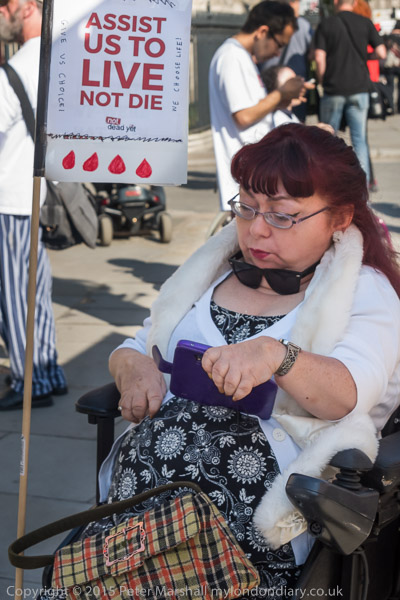
John Bowden, Congo & Waterloo Carnival: I don’t think I wrote anything on My London Diary about the three events I covered on Friday 13th July other than some captions on the pictures. The case of John Bowden in particular is one that has considerable relevance now in the UK with increasing prison over-crowding and chaos, and the conflict in the Democratic Republic of Congo is ongoing now for over three decades, but there were dramatic developments earlier this year with now some negotiations between the warring parties.


International Day of Solidarity – John Bowden – Parole Board, Westminster

John Bowden, Congo & Waterloo Carnival

In an interview on Indymedia in 2007 John Bowden stated that he grew up experiencing anti-Irish “racism as well as extreme poverty very early on in life” and committed “serious anti-social acts” including burning “a factory to the ground when I was nine!” which led to him being “systematically brutalised and de-socialised to the extent where I became a complete outsider” by the ‘criminal justice system.

He stated that by his “early twenties I had already spent the bulk of my time locked away in various prison-type institutions and had accumulated a long criminal record, composed mostly of violent offences, which were becoming increasingly more violent.”

In 1980, aged 24, he was arrested along with others for the murder and grisly dismemberment of a man at a party in a flat in Camberwell and given a life sentence. In jail he took part in taking an assistant governor hostage after a prisoner had been murdered in the hospital wing – and this got him another 10 year sentence.

During his time in years of solitary confinement he writes “I actually began to discover my true humanity and experienced a process of deep politicisation which drew me closer to my fellow prisoners and oppressed people everywhere. From a brutalised and anti social criminal I metamorphasised into a totally committed revolutionary.”

John Bowden, Congo & Waterloo Carnival

In an interview in Novara Media in 2020 he states “I committed and devoted my life not just to the personal struggle against brutality but to a wider struggle against the prison system generally, and spent almost 40 years trying to organise and mobilise prisoners.” The views he expresses on prison in this interview should be taken to heart by those to reforming our criminal justice system to create a system that works with offenders to rehabilitate rather than further damage them and make re-offending virtually inevitable.

In 2016 the International Workers of the World founded the IWW Incarcerated Workers Organising Committee and he became a member.

John Bowden, Congo & Waterloo Carnival
Some other protesters asked not to be photographed, and others were still on their way when I left.

You can see and hear Bowden in a series of short videos made for the Prisoner Solidarity Network on YouTube, Tour of the British prison estate.

While the others convicted with him were released over 20 years ago, Bowden was only granted parole in 2020, and only after taking the Parole Board to Judicial Review following their fourth rejection of his release.

It had become clear that his continued imprisonment was not because of any danger to the public “but because I was labelled an ‘anti-authoritarian’ prisoner with links to anarchist and communist groups on the outside, specifically Anarchist Black Cross and the Revolutionary Communist Group.”

International Day of Solidarity – John Bowden


No More Deportations to the Congo – Parliament Square

John Bowden, Congo & Waterloo Carnival

A group of UK residents from the Democratic Republic of Congo had come to demand an end to Britain’s racist laws and to end the harassment and detention of refugees and asylum seekers. They say all deportations to the DRC should stop as the country is unsafe.

There are just a few more pictures on My London Diary.


Waterloo Carnival – Lower Marsh, Waterloo

John Bowden, Congo & Waterloo Carnival
The carnival theme was sea creatures, here floating on the waves down Lower Marsh.

The first Waterloo Carnival took place in July 2002 as “a celebration of our community: our unity and diversity, history and future” and is backed by many locally based businesses and organisations including the Old Vic, Christian Aid and the local primary school where the procession formed up.

Local residents pose with some of the marchers
From Lower Marsh the procession went through a council estate
It ended with a picnic and events on Waterloo Millennium Green.

Many more pictures on My London Diary at Waterloo Carnival.


FlickrFacebookMy London DiaryHull PhotosLea ValleyParis
London’s Industrial HeritageLondon Photos

All photographs on this page are copyright © Peter Marshall.
Contact me to buy prints or licence to reproduce.

Against the Invasion of Iraq – April 2003

Against the Invasion of Iraq: The US and its allies had begun the invasion of Iraq on 20th March 2003, with Britain taking part despite the huge opposition of the British people. President Bush had decided months earlier that the invasion would take place and the US had manufactured fake information that Iraq had failed to abandon its weapons of mass destruction.

Against the Invasion of Iraq - April 2003

UK’s Prime Minister Tony Blair had added his own lies to this to persuade the British parliament, presenting the “dodgy dossier” together with highly misleading statements. Although 84 Labour MPs voted against (along with almost all of the Liberal Democrats and most of the smaller parties) and there were 94 mainly Labour abstentions the Labour Government won the vote easily with the support of the Conservative Party. For many of us it seemed a vote which demonstrated a complete failure of our parliamentary democracy, MPs following the party line and voting for war in clear disregard of the evidence.

Against the Invasion of Iraq - April 2003

And the BBC and mass media had failed to properly investigate and challenge the official position, with the BBC moving into an establishment role in supporting the war.

Against the Invasion of Iraq - April 2003

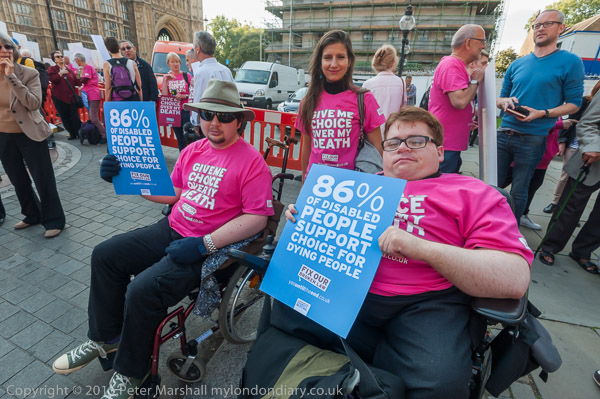
On Saturday 5th April Stop the War, CND and others organised another protest against the war and I walked with the protesters from outside Broadcasting House in Portland Place to a rally close to the US embassy in Grosvenor Square and later posted the following piece (corrected as usual) on My London Diary with some of my pictures.

Against the Invasion of Iraq - April 2003

April started with the country at war, invading Iraq together with the USA.

On Saturday 5th I went to a march to protest against this and to call for proper reporting of the events in the media, especially the BBC.

I walked to the march past the houses of parliament and a small group of protesters in whitehall who were pointing out the number of Iraqi civilians already killed by the allied forces.

The main thrust of the demonstration now was that the civilian population of Iraq should be respected. The use of weapons such as depleted uranium shells and cluster bombs will mean the deaths continue for generations after the end of the fighting.

The march started opposite the BBC building in Portland Place and went to Grosvenor Square, close to the US Embassy. There were perhaps five thousand marchers, and several hundred police surrounding them most of the time. As the speakers pointed out, it was difficult not to see the war as a US takeover of the country when plans were already in place for Americans to run the country after the war.

The killing of Iraqis must stop, and rapid progress should be made to hand control of the country back to its people.

Peter Tatchell

Iraq has still not recovered from the disastrous effects of the invasion and in particular from the failure of the USA to think beyond getting rid of Saddam Hussein and his regime. In doing so they also demolished the civil state and the internal security of the country turning it into a lawless state.

It is now clear that there were no “Weapons of Mass Destruction” and that the whole invasion was justified on what were known at the time to be lies.

The USA established a provisional authority led by US diplomat Paul Bremner which made the ridiculous decision to disband the Iraqi Army and exclude all members of Saddam’s Ba’ath party from government in Iraq rather than taking these over and using them to build a new Iraq.

Adrian Mitchell

As well as leaving the country at the mercy of a wide range of militia units this also disqualified the entire civil service at all levels from taking part in the rebuilding of the the country – including all government officials for whom party membership was simply a condition of service, even the 40,000 teachers.

Lindsay German

As Wikipedia states, in 2023, “Corruption remains endemic throughout all levels of governance while US-endorsed sectarian political system has driven increased levels of violent terrorism and sectarian conflicts within Iraq.” And although accurate estimates are difficult, probably by now over a million Iraqis have died because of the invasion and the insurgencies that followed. Around 2.4 million Iraqis have left the country as refugees and well over a million remain internally displaced inside the Iraq.

As we are now seeing under Trump, a total irresponsibility and ignorance seems to be at the heart of US foreign policy. Trump has just made this more open and obvious.

There are just a few more pictures with the original article, particularly of the speakers at the event.


FlickrFacebookMy London DiaryHull PhotosLea ValleyParis
London’s Industrial HeritageLondon Photos

All photographs on this page are copyright © Peter Marshall.
Contact me to buy prints or licence to reproduce.

Palestine & Syria – 2018

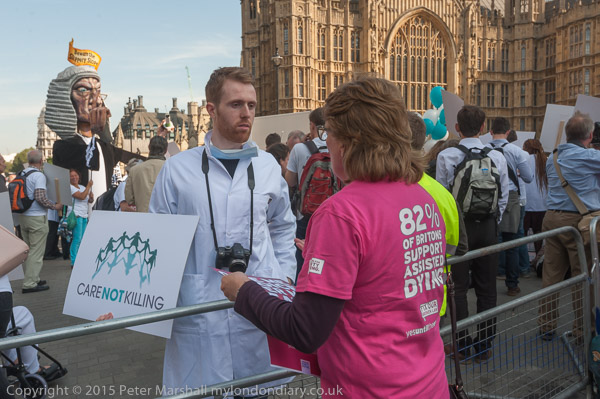
Palestine & Syria: On Saturday 13th January 2018 I photographed a protest at the London US Embassy in Grosvenor Square against the continuing imprisonment of children in Palestine and another opposite the Russian Consulate over their continuing support for the Assad regime in Syria including the bombing of civilians.


Free Ahed Tamimi & All Child Prisoners

Palestine & Syria - 2018

Teenager Ahed Tamimi was in prison in Israel for slapping an Israeli soldier who came into her family’s garden shortly after she had learnt that a relative had been shot by Israeli forces.

Palestine & Syria - 2018

Her detention made the news and prompted this protest, but she was only one of the thousands of Palestinian children have been detained by Israel since 2000 in a systematic policy which the UN has said includes abuse and ill-treatment. Many Palestinian children have been kept for many days in solitary confinement in small underground cells in Israeli jails.

Palestine & Syria - 2018

Israel is an apartheid state, with very different laws and police treatment for Palestinians in the occupied West Bank who are subject to Israeli military law and dealt with in military courts which offer little or no chance of justice. Many are held without any real trials in ‘administrative detention‘ which can be essentially indefinite, with prisoners being released at the end of one sentence and immediately re-arrested for another period of detention.
Palestine & Syria - 2018

A number of those taking part were relatives or friends of Tamimi’s family, including her father’s cousin Nana Hourriyah, or of other prisoners in Israeli jails. One man who spoke had recently spent 3 months in Palestine and had stayed with the family of another child prisoner. He had then been deported for taking part in a peaceful protest.
During the hour I stayed at the protest a single Zionist protester in a pen at the end of the street waved an Israeli flag, shouting insults at the protesters and accusing them of supporting Hamas, which they firmly denied.

More at Free Ahed Tamimi.


Stop the Massacres in Syria

Protesters lined the street opposite the Russian Consulate calling for an end to the massacres taking place in Syria. Protests are not allowed in the private road a few yards away outside the Embassy.

Russia and Assad’s forces were bombing civilians in Idlib, Hama and Eastern Ghouta, specifically targeting medical workers and facilities, with 8 hospitals in Idlib bombed since the start of December.

Many of those still living in Idlib had fled there from other towns and cities previously bombed by Assad and his Russian allies who were attempting to complete the destruction of all groups opposed to the Assad regime and bomb or starve to death the civilian population in areas held by opposition forces.

Only now after the fall of the Assad regime has the full scale of their human rights abuses become widely known with over 150,000 people thought to have been tortured and killed in his infamous prisons. As many as 620,000 were killed in the 14 years of civil war – around 1 in 35 of its prewar population, with around half these being civilians.

More than 14 million – almost two thirds of the Syrian population – were forced to leave their homes in the civil war. Half remained elsewhere in Syria, around 5.5 million in surrounding countries. Around a fifth of the countries pre-war population made their way to Europe, with the majority of these going to Germany. The UK set up a scheme to take Syrians but the numbers here remain relatively small at around 40,000.

Stop the Massacres in Syria


FlickrFacebookMy London DiaryHull PhotosLea ValleyParis
London’s Industrial HeritageLondon Photos

All photographs on this page are copyright © Peter Marshall.
Contact me to buy prints or licence to reproduce.