End the War on Rojava – 2026

End the War on Rojava: Last Saturday, 25th January 2026, I photographed thousands of Kurds and supporters marching from the BBC towards Downing Street in an attempt to break the world’s silence as the Trump/USA supported Al Qaeda Islamist Syrian government forces destroy much of the autonomous mainly Kurdish region of Rojava.
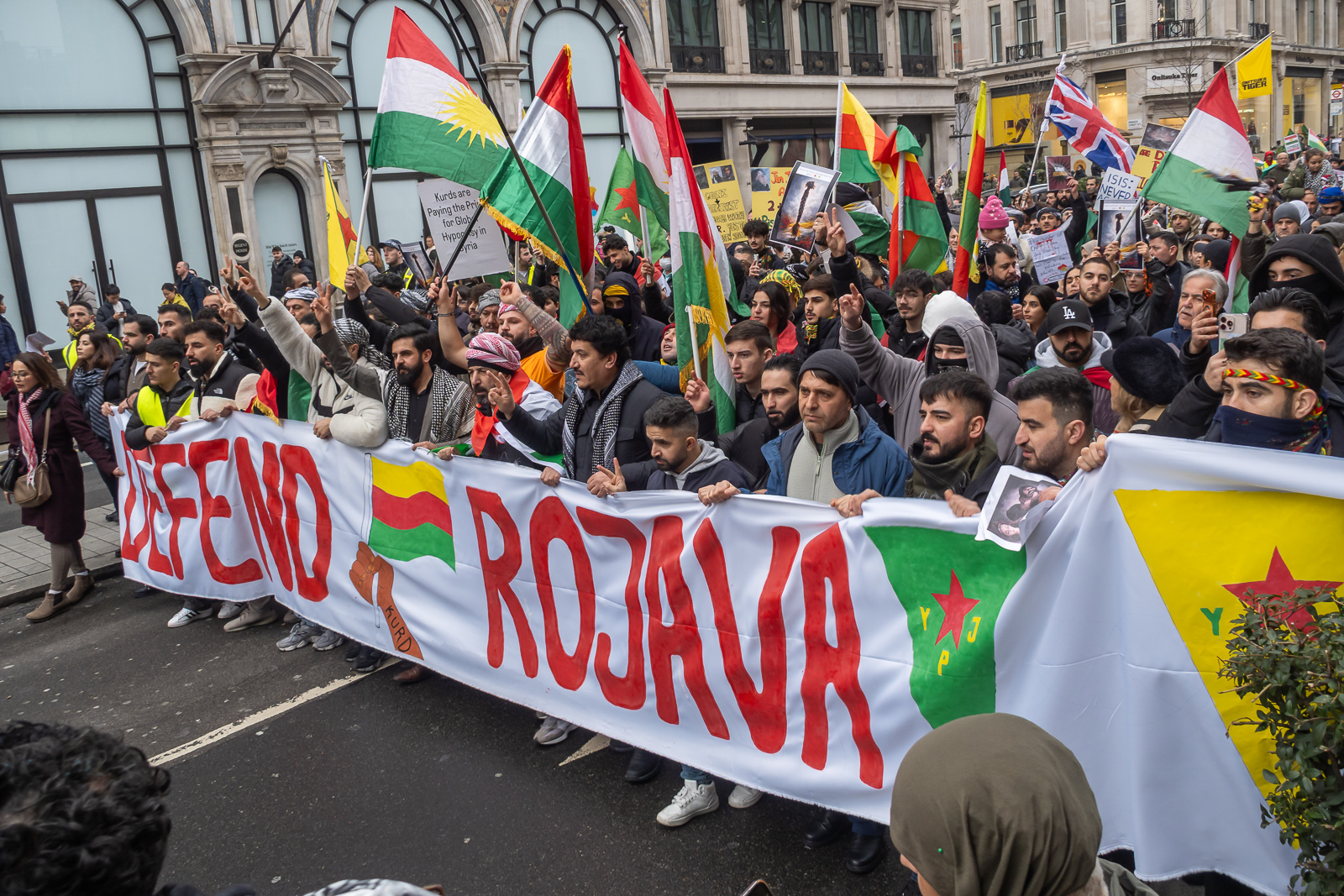
End the War on Rojava - 2026
London, UK. 25 Jan 2026. Thousands of Kurds and supporters marched from the BBC to Downing Street

After the Syrian revolution began with mass protests against the brutal Assad regime in 2011, on July 19th 2012, three predominantly Kurdish-inhabited areas of north-east Syria declared their autonomy, becoming the democratic ‘Autonomous Administration of North and East Syria’ (AANES), better known as Rojava, although this later grew to include a third of Syrian territory and nearly a fifth of its population.
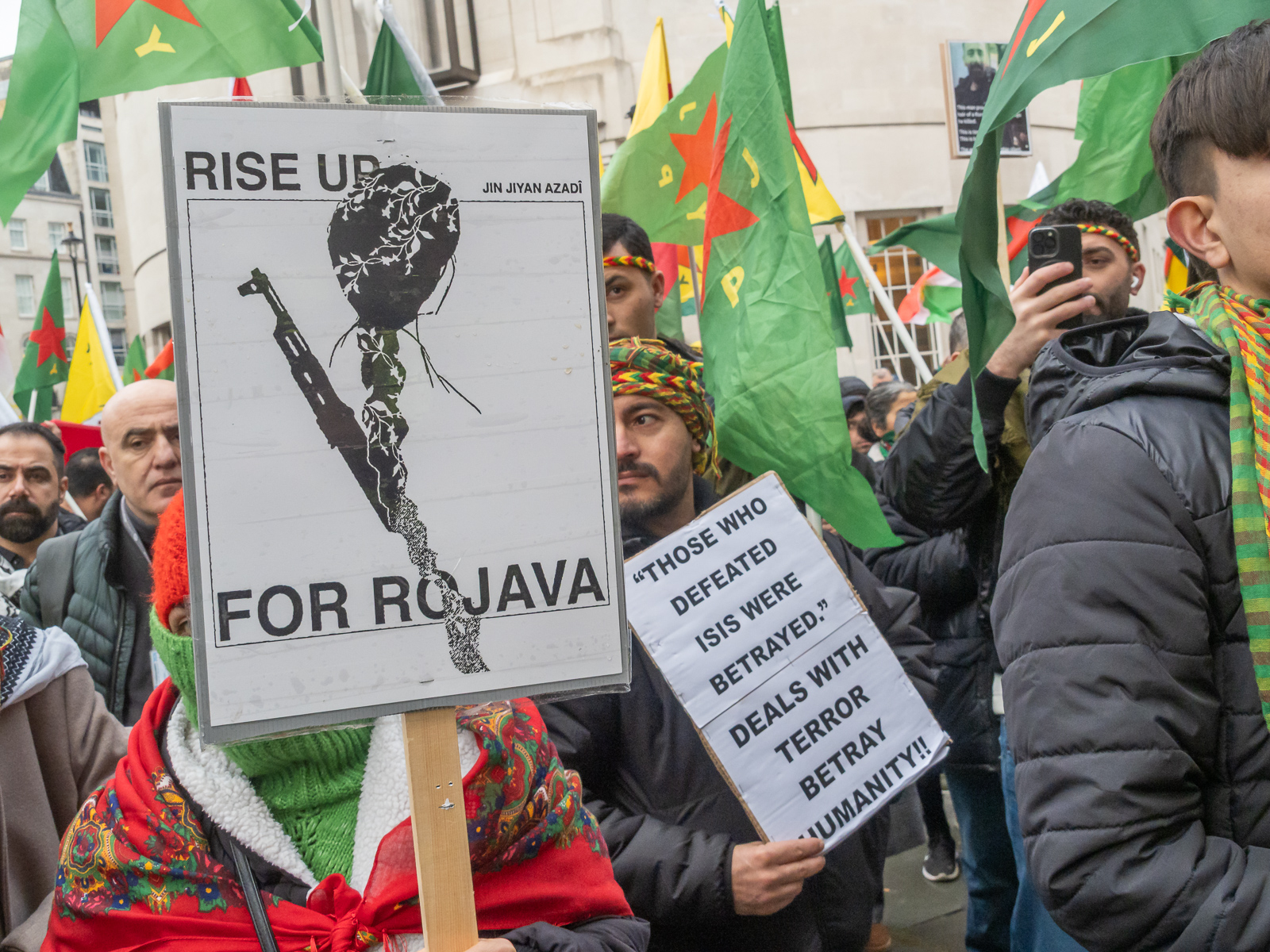
End the War on Rojava - 2026

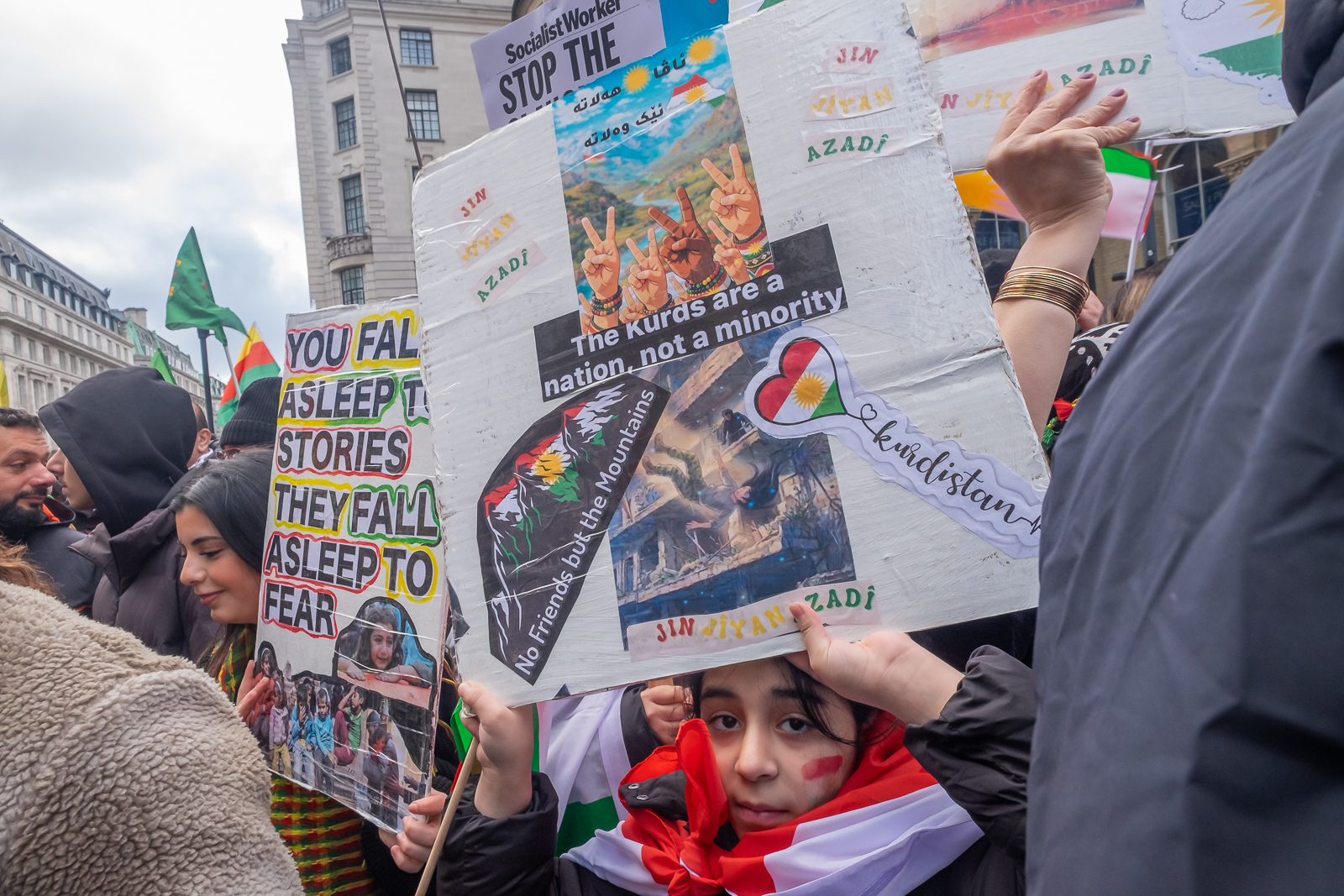
The area remained committed to the ideas of the Arab Spring and set up a democratic constitution with equality for all ethnic groups. It embodied the the slogan “Jin, Jiyan, Azadî” – “Women, Life, Freedom” and many of the banners and placards on the protest reflected this.
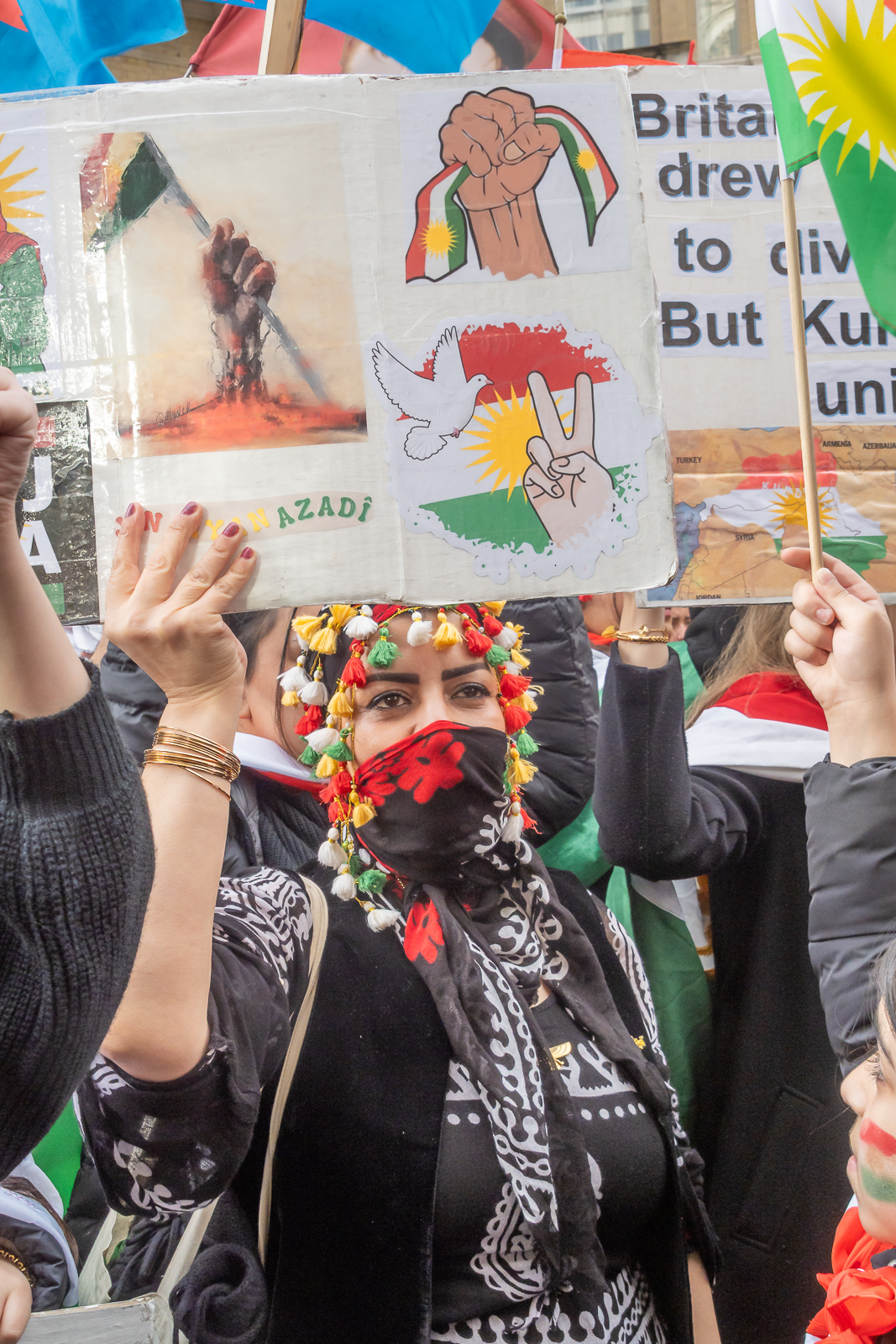
End the War on Rojava - 2026

Turkey has for many decaades discriminated against its Kurdish communities, with a denial of Kurdish identity attempting to violently assimilate Kurds. In 1978 Kurds founde the Kurdistan Workers’ Party, PKK, which in 1984 began a militant insurgency against the Turkish state. Following pressure from NATO member Turkey, the New Labour government in 2001 proscribed this as a terrorist organisation, making support of it illegal in the UK.
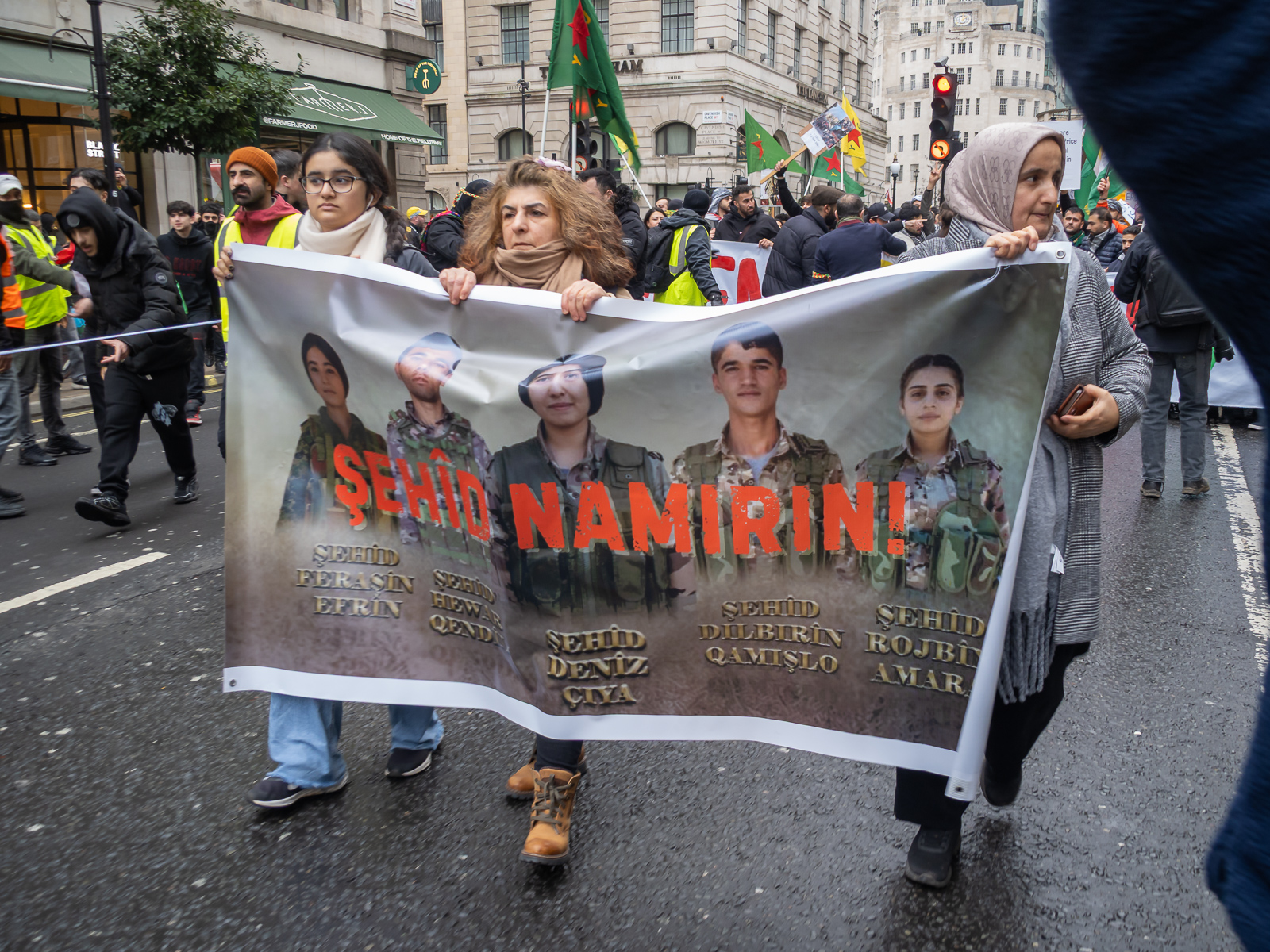
End the War on Rojava - 2026
London, UK. 25 Jan 2026. “Martyrs Are Immortal!

In a political show trial now taking place at the Old Bailey, six members of London’s Kurdish community are charged with being members of the banned PKK. The trail, largely unreported in the mass media, is a sign of Turkey’s increasing attempt to crush the Kurds and the UK’s further collaboration with its fellow NATO member and in line with an increasing use of terrorism charges to oppose political demonstrations – such as those by supporters of Palestine Action and others who oppose the actions of the Zionist state.
End the War on Rojava - 2026
“Jin, Jiyan, Azadî” / “Women, Life, Freedom”

The PKK in 2025 announced an end to its military insurgency, ceremonially burnt some of its weapons and officially disbanded in an attempt by Kurds to make peace with Turkey. But the Turkish response has been to carry out military attacks in predominantly Kurdish areas of Syria and to persuade its NATO allies to take a harder line against the Kurds.
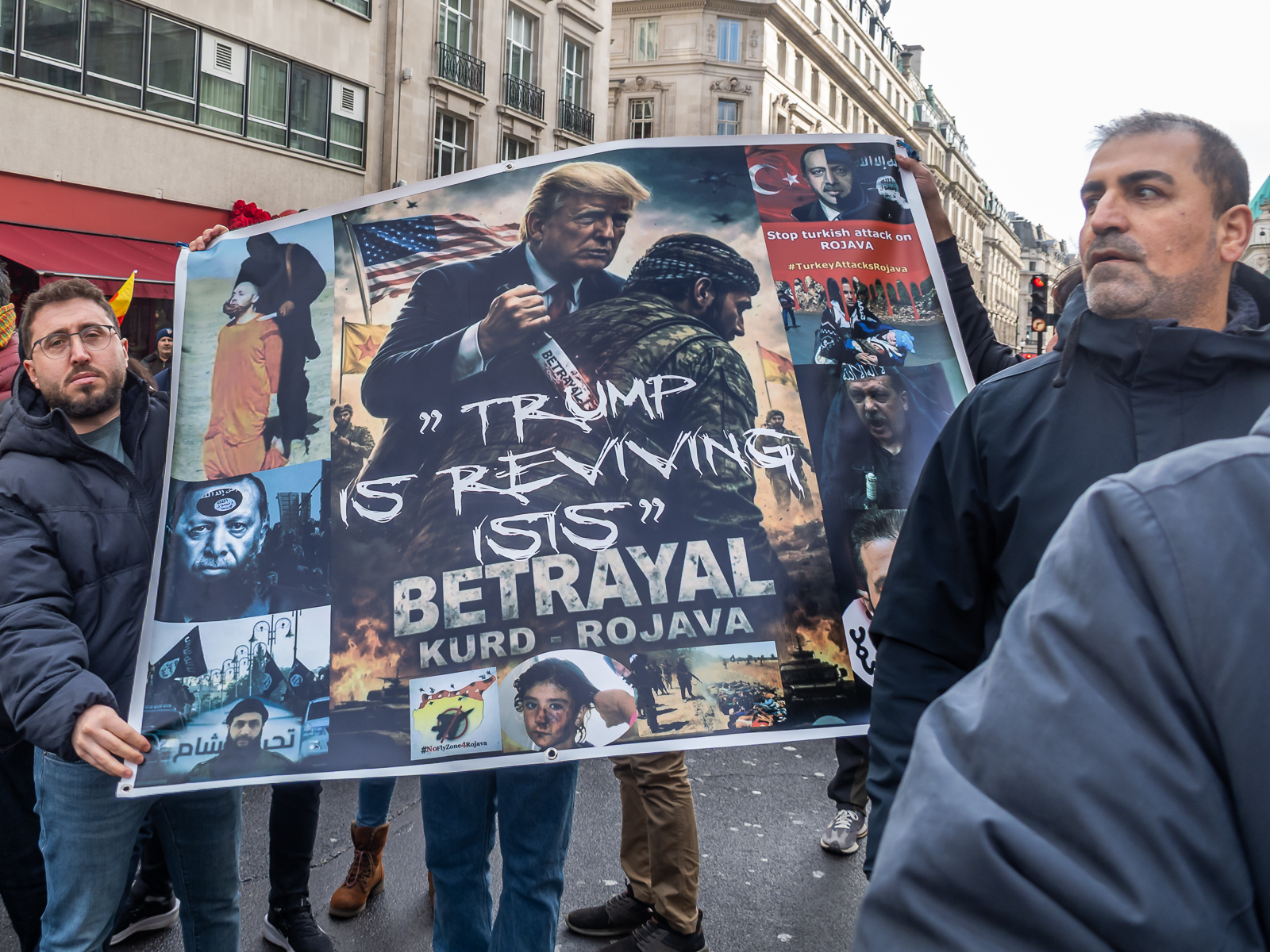
For some years the Kurds had been backed by USA air support in leading the fight on the ground against the Islamic state (ISIS) in Syria, largely ending their control of the area – and the UK had played a part in this too. But the situation changed after an Islamist group succeeded in overturning Assad and becoming the new government of Syria. And Trump and his advisers see Rojava as dangerously socialist if not communist – and would prefer any more conservative regime. The USA has a long record of support for dictators.
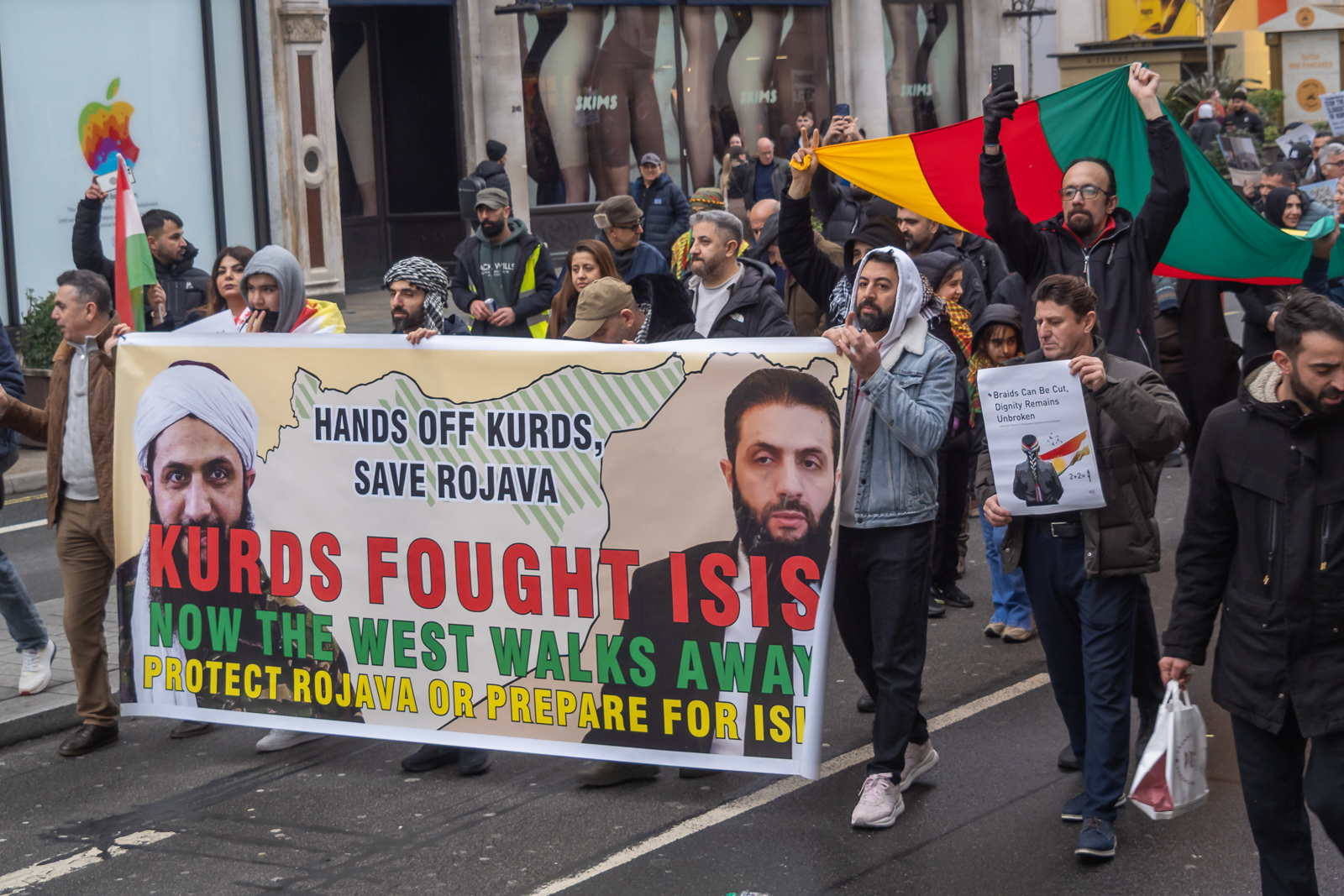
Since then the autonomous region has engaged with the government to come to agreement so that the advances in the area particularly in the relations between different ethnic groups and the hugely increased freedom for women can be retained. But it seems now that the government is attempting to put the clock back and impose its Islamist ideas across the country, and to fight – with the aid of Turkey -to do so.
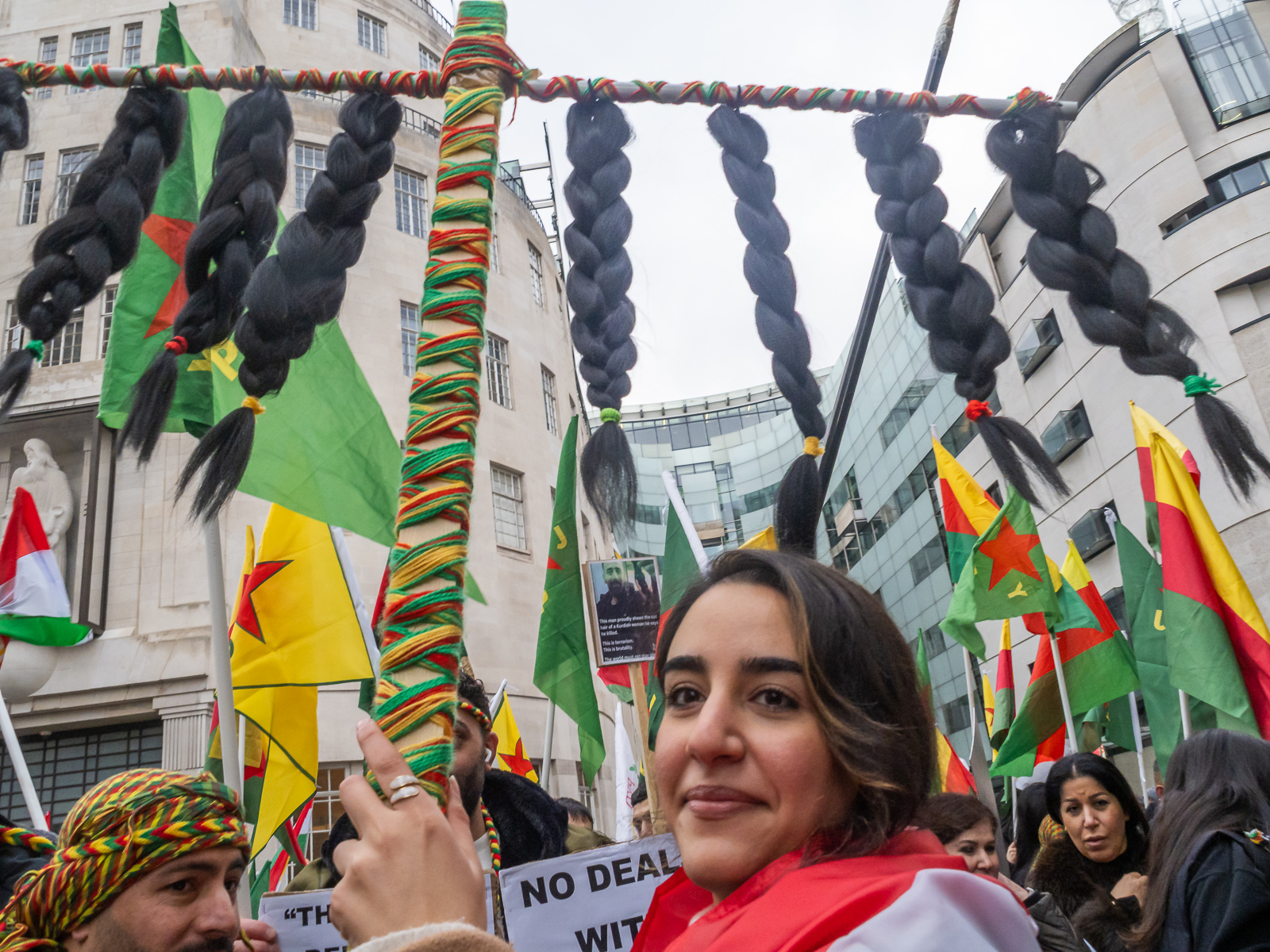
Following a video showing a Syrian soldier proudly holding the braid of a slain Kurdish woman fighter, Kurdish women began braiding their hair in solidarity as an unusual form of protest. In London some carried hair braids and posters with the message “keziya me rimetame” – Our hair is a crown.
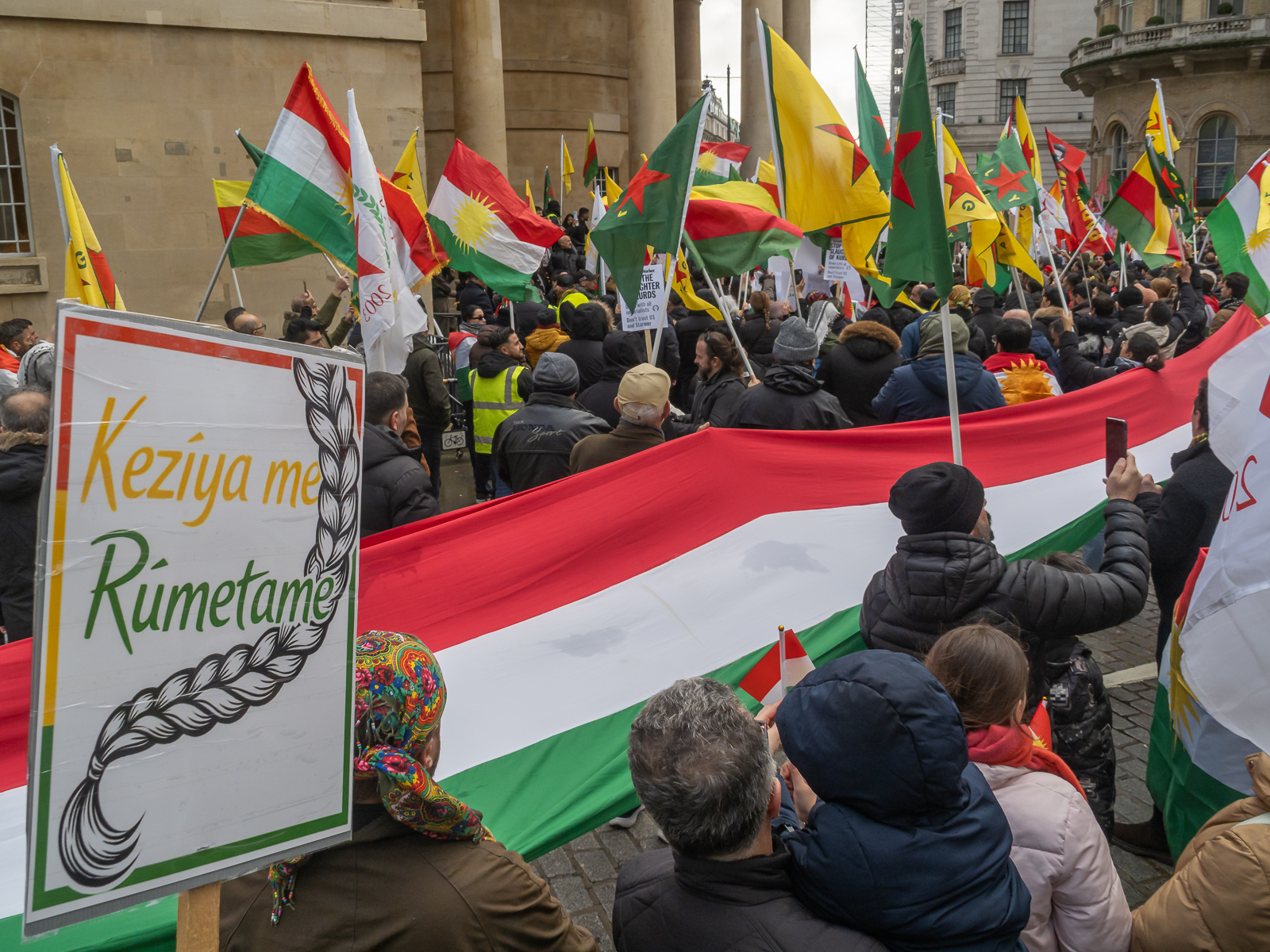
“Our hair is a crown”.

Other posters carried the message “2 + 2 = 1” – After the end of the First World War in treaties largely determined by England and France, the Kurdish areas were split between four countries – Turkey, Syria, Iran and Iraq and they were denied their own country, Kurdistan which the slogan states is a single people and country.
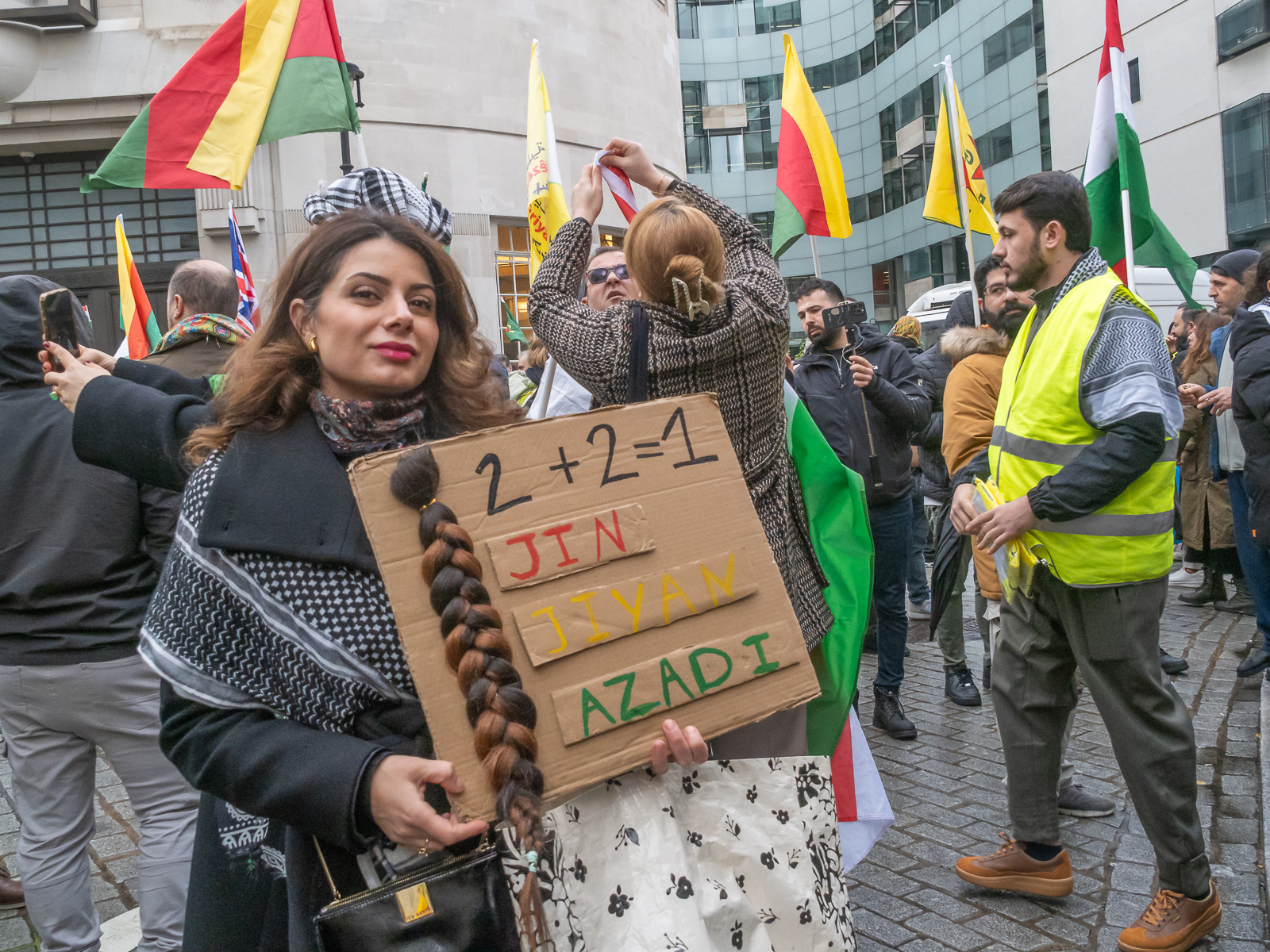
London, UK. 25 Jan 2026. 2+2=1 – Kurdistan is in Turkey, Syria, Iraq and Iran

Many more pictures in an album on Facebook and available for editorial use on Alamy.


FlickrFacebookMy London DiaryHull PhotosLea ValleyParis
London’s Industrial HeritageLondon Photos

All photographs on this page are copyright © Peter Marshall.
Contact me to buy prints or licence to reproduce.


Bonnington Square and Kennington Lane – 1989

Bonnington Square and Kennington Lane – The final set of pictures from my walk on 19th July 1989 which began with Stockwell Park, Bus Garage, Tower and Mason. It continues from my post More From Stockwell & South Lambeth.

Bonnington Square, Vauxhall, Lambeth, 1989 89-7h-31
Vauxhall Grove, Bonnington Square, Vauxhall, Lambeth, 1989 89-7h-31

At the end of Langley Road I came to a remarkable area of Vauxhall. Built in the 1870s for railway workers Bonnington Square was in the late 1970s compulsorily purchased by the GLC who intended to demolish it and build a school. But one resident, a Turkish shopkeeper, took legal action to prevent the demolition and eventually the GLC gave up. Squatters moved in to occupy almost a hundred emptied properties, setting up a vegetarian cafe, a wholefood shop and bars and a community garden.

Bonnington Square, Vauxhall, Lambeth, 1989 89-7h-32

The squatters formed a housing co-op and eventually negotiated a lease and in 1998 were able to buy the buildings from Lambeth Council. Most are now still owned by low-rent housing cooperatives. A few are privately owned, I think including some where the GLC had not managed to get residents to move out. The gardens are still collectively run, as was the café.

Bonnington Square, Vauxhall, Lambeth, 1989 89-7h-33

The story is told in The Mavericks of Bonnington Square which also includes a 20 minute film produced around 2011 which gives an interesting view of the area and the incredible transformation made by those who moved in, and also includes many of their photographs from the early days. People had more or less to rebuild many of the properties and developed an incredible community spirit in doing so. The area is now described as a “botanical oasis hidden in the midst of Vauxhall” and includes two community gardens, one on an area destroyed by wartime bombing.

Bonnington Square, Vauxhall, Lambeth, 1989 89-7h-31

I went to Bonnington Square quite a few times, often taking a short wander through on my way from visiting friends who lived in a council flat close to the Oval to Vauxhall Station, not to take pictures but just because it was an interesting diversion if I had a few minutes before my train came, and I also went to some of the festivals there.

St Peters, Vauxhall, Kennington Lane, Vauxhall, Lambeth, 1989 89-7h-26

I often walked past St Peters Church and went inside a few times, including to a service led by a trendy young cleric in black leathers. Now I think worhips there is rather different. The Grade II* listed church built in 1863-4 was the first major town church by the renowned British Gothic Revival architect John Loughborough Pearson. It has magnificent interior and a fine exterior; shortages of cash meant the church was rather plainer than Pearson’s orginal plans, probably much to its advantage. The site was given free by the developer of Vauxhall Gardens on the provision that all seats in the church should be free and not rented. It has a fine acoustic and now hosts concerts as well as services.

Around the corner linked to the side of the church are the schools built a few years earlier (also designed by Pearson) to train local children to be draughtsmen and artists for Maudslay’s engineering works and Doulton’s pottery factory nearby. The wall at the left of the picture is of another building by Pearson, though you can see little of it in this picture, his St Peter’s Orphanage and Training College for the daughters of clergy and professionals and also Grade II* listed, now converted into flats as Herbert House.

Shops, Kennington Lane, Vauxhall, Lambeth, 1989 89-7h-25

A lively row of small shops is still present here on Kennington lane, although now rather less useful and perhaps a little more run-down. I stood regularly at the bus stop here for buses to Camberwell and Peckham as well as walking past on another longer route to see my friends or to take my cameras in for repair at Fixation down the road, and made a few photographs here over the years.

Window display, Kennington Lane, Vauxhall, Lambeth, 1989 89-7h-11

This was part of the window display in one of those shops in July 1989., including two Edward Weston posters of Clark Gable and Grouch Marx. The Marilyn Monroe image was her first of her to appear on the cover of LIFE on April 7, 1952, taken by Philip Halsman, and it was later published widely, including again inside LIFE in 1962 at the time of her death.

Happy Birthday Nicaragua, Harleyford Rd, Kennington Lane, Vauxhall, Lambeth, 1989 89-7h-24

On the corner of a very busy traffic junction just yards southeast of Vauxhall Station this white wall was a good site for graffiti, though in my picture it is partly obscured by the street furniture. I think I chose the viewpoint to make sure that the message ‘Happy Birthday Nicaragua – 10 years of liberation – (and a long way from Thatcher)’ was clear.

The Sandinistas took power in Nicaragua in July 1979, ending long years of dictatorhsip by the Samoza family who had been put into power there by the US who occupied the country from 1912 until 1933. Thatcher was only prime minister from 1979 until 1990 but it seemed much longer and caused a decisive shift to the right and towards an emphasis on individual greed rather than social responsibility that continues to this day.


Refugees, Sharia and Islamophobia

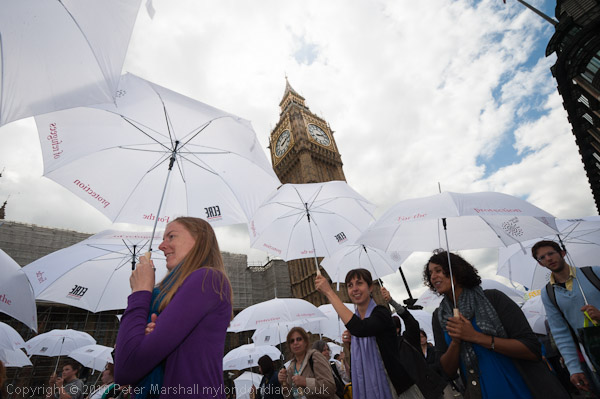
Refugees, Sharia and Islamophobia: In 2000 the UN June General Assembly declared that June 20th every year is World Refugee Day on which, as the UNHCR web site puts it, ‘the world celebrates the strength and courage of people who have been forced to flee their home country to escape conflict or persecution. The 2023 theme of World Refugee Day is “hope away from home.”’

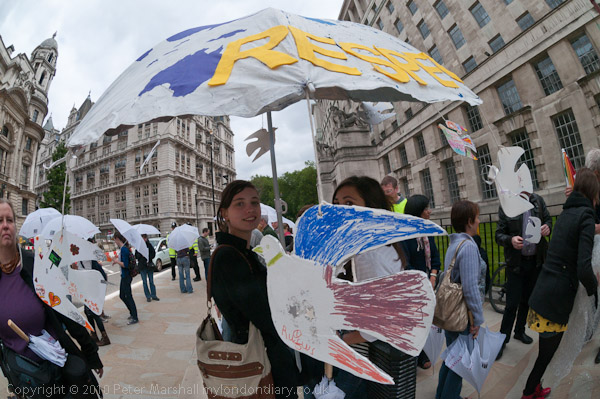
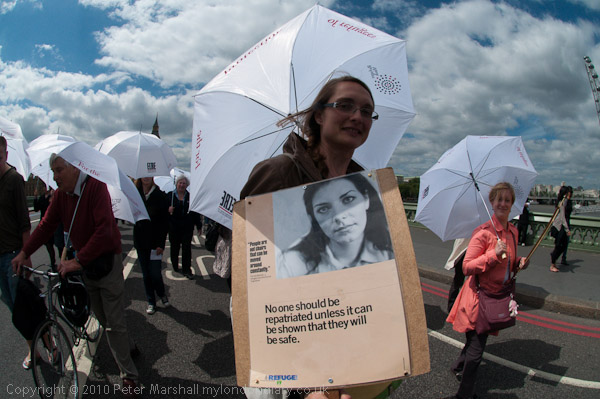
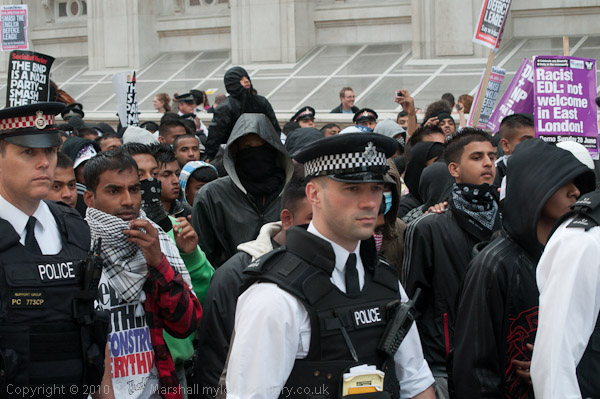
Back in 2010 it was celebrated with parades including one in London. Also on Sunday 20th June there was a rally by One Law For All calling for an end to Sharia and other religious laws, opposed by a small group of Islamic extremists, who were opposed by Islamophobic EDL supporters, in turn opposed by largely Asian East Londoners.


Umbrella Parade for Refugees – Whitehall to Geraldine Mary Harmsworth Park.

Refugees, Sharia and Islamophobia

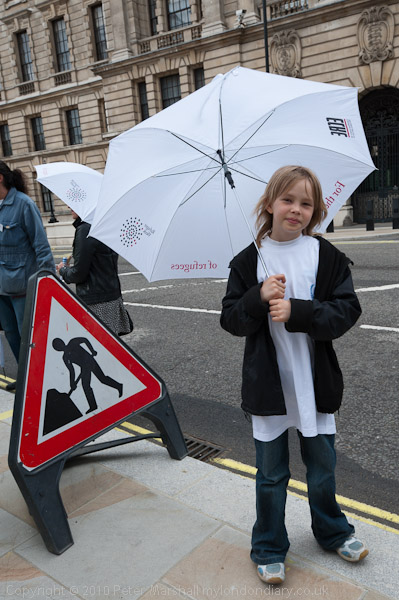
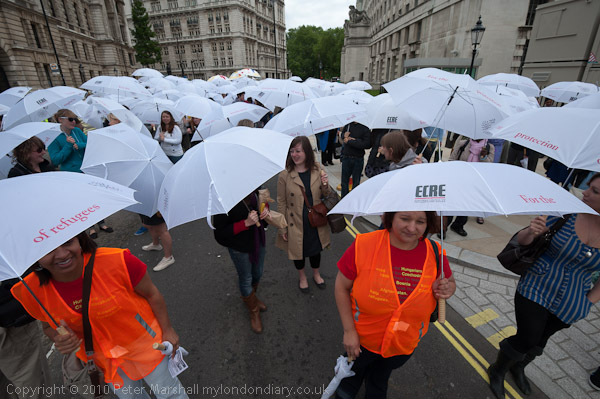
The London Umbrella Parade for refugees was organised by a partnership of groups including Amnesty International, British Red Cross, Oxfam, Refugee Action and Student Action for Refugees working with ECRE, the European Council on Refugees and Exiles, and the United Nations High Commissioner for Refugees.

Refugees, Sharia and Islamophobia

The umbrella was “a symbol of care and shelter, representing our proud tradition of offering safety to those in need of international protection,” a tradition that was then clearly under threat from the UK Borders Agency, with forced deportation flights in which refugees are returned to an uncertain future in Iraq, with beatings on the flight and on arrival.

Refugees, Sharia and Islamophobia

Since then we have seen successive Home Secretaries racheting up increasingly racist anti-refugee policies, now clearly and deliberately flouting international laws. The UK once had proud tradition and well-deserved reputation for upholding human rights, playing a leading role in establishing these human rights laws it is now breaking.

Refugees, Sharia and Islamophobia

IN 2010 I wrote “Competition between the political parties to be even tougher on immigration and appease the right-wing press have serious eroded the chances of refugees and asylum seekers receiving humane treatment and proper consideration in the UK.” Things have travelled much further only this inhumane path since then.

I walked with the campaigners from the Defence Ministry in Horseguards Avenue down Whitehall, past the Houses of Parliament and across Westminster Bridge. The march ended with a picnic in Geraldine Mary Harmsworth Park outside the Imperial War Museum. The start and finishing places were chosen appropriately as most refugees and asylum seekers are a result of war.

More pictures at Umbrella Parade for Refugees.


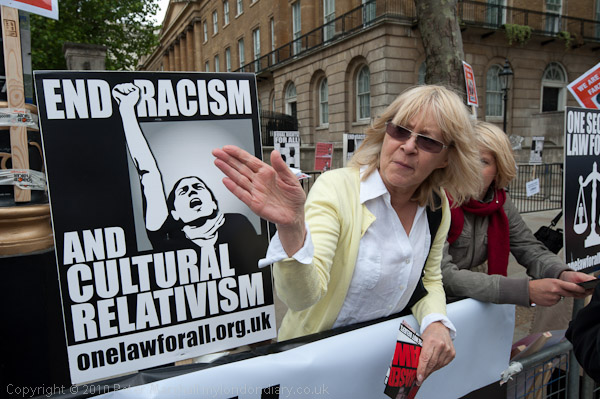
No Sharia – One Law For All – Whitehall

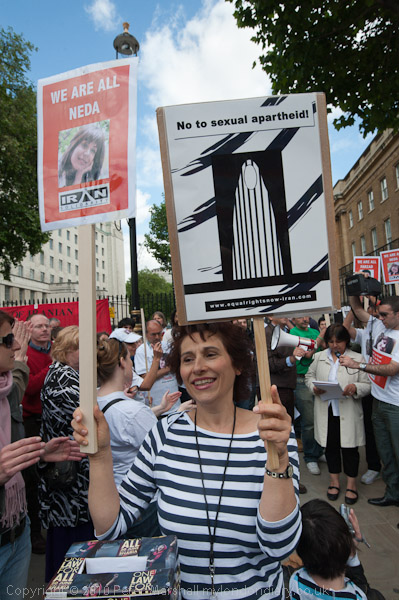
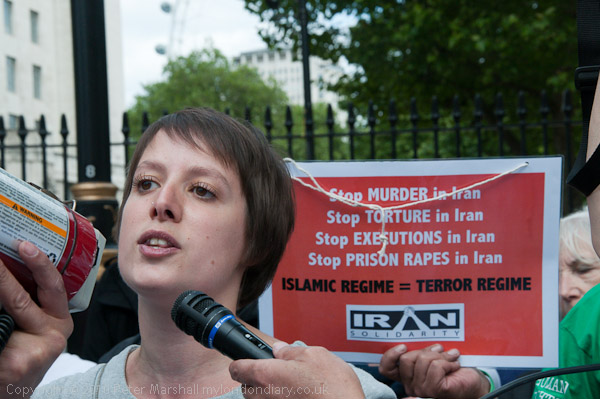
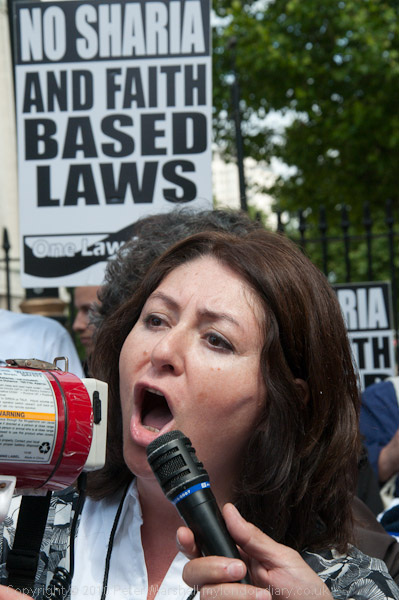
Maryam Namazie speaking opposite Downing St

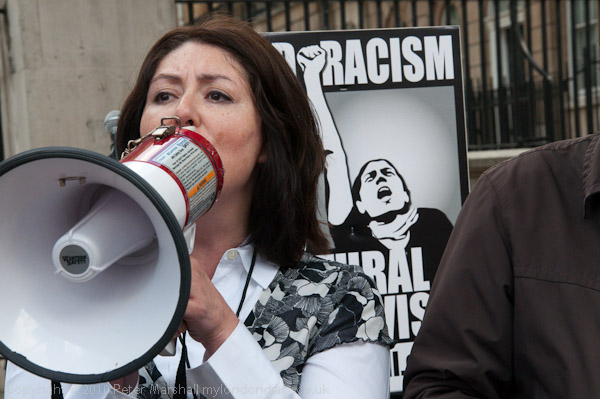
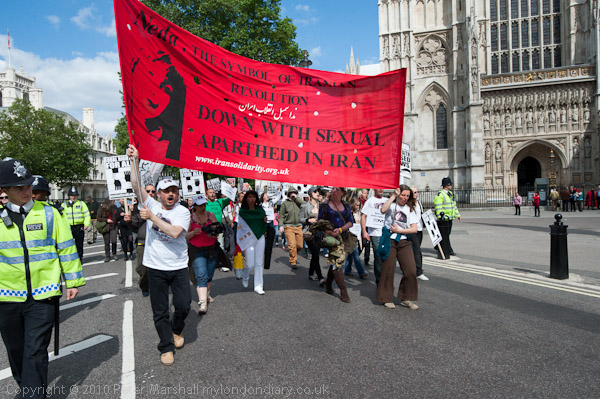
One Law for All campaigns against Sharia and religious arbitration in the UK, Iran and across the globe. They say these religious laws are discriminatory against and promote violence against women and have no place in the 21st century.

They want to end “religious laws and theocracy and promote secularism and the separation of religion from the state, education, law and public policy as a minimum precondition for the respect of human, women and LGBT rights.”

They have have campaigned for an end to Islamic regimes in Iran and Afghanistan, and have recently been involved in the Woman, Life, Freedom protests in London and elsewhere, promoting the Woman, Life, Freedom Charter.

Their rally opposite Downing St on 20th June 2010 came on the anniversary of the the killing of Neda Agha-Soltan in Iran, and after the rally the several hundred taking part marched to the Iranian Embassy in Kensington.

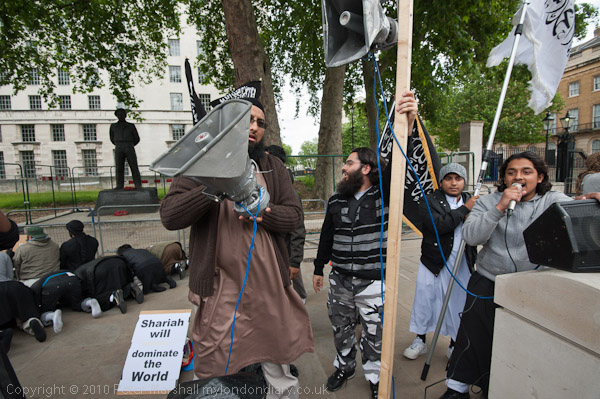
A short distance away were a group of mainly young Muslim men dressed in black and holding posters and flags. The called themselves ‘Muslims Against the Crusades’ or ‘Muslims Against Crusaders’ widely thought to be a reincarnation of the banned ‘Islam4UK’ (itself a relaunch of the banned Al-Muhajiroun.) One of their banners proclaimed ‘Sharia Will Dominate The World’.

In my 2010 account I quote from Maryam Namazie of One Law for all, writing on the Iran Solidarity blog:

“The battle against Sharia law is a battle against Islamism not Muslims, immigrants and people living under Sharia law here or elsewhere. So it is very apt for the Islamists to hold a counter-demonstration against our rally. This is where the real battleground lies. Anyone wanting to defend universal rights, secularism and a life worthy of the 21st century must join us now in order to push back the Islamists as well as fringe far Right groups like the English Defence League and the British National Party that aims to scapegoat and blame many of our citizens for Islamism.”

My London Diary

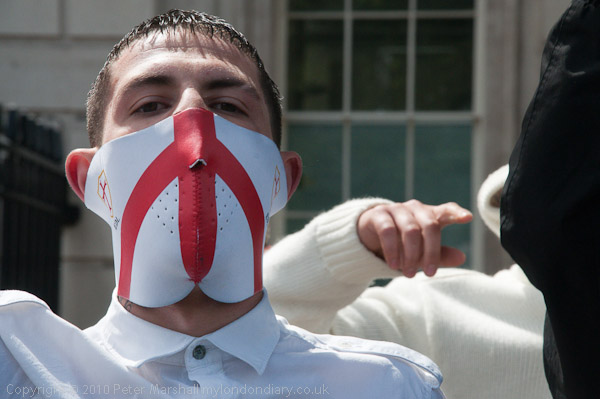
During the rally police escorted a small group of EDL supporters along Whitehall to opposite the Muslim protesters where they shouted insults and threat at both them and the photographers who went to take their pictures. After a few minutes they were led away to a penned protest area further south of the One Law For All rally.

A second much larger group were then brought down Whitehall, much more carefully surrounded by police, making them hard to photograph. Some carried Unite Against Fascism placards and most of the several hundred were young British Asians. Earlier the UAF and United East End had marched frpm Stepney Green to a rally at Whitechapel against the EDL and this group had marched to confront them in Westminster. But by the time they arrived the One Law for All rally had ended and the Muslims Against the Crusades had left.

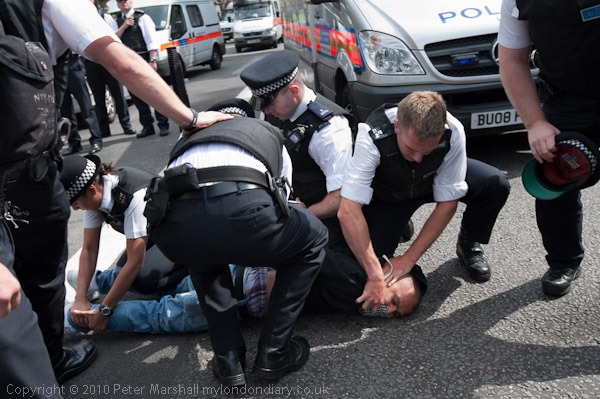
After some minutes photographing the young Asians, including one man being rather forcefully arrested, mainly having to work over the heads or between their police escorts, I rushed after the One Law For All marchers to take more pictures.

I didn’t make it to the Iranian embassy. By the time the march was passing Victoria Station I decided I was tired and had taken enough pictures and got on a train to begin my journey home.

I wrote about this and posted pictures of the One Law for All campaigners at No Sharia – One Law For All but separated out the photographs of the other protesters into posts at Muslim Crusaders For Sharia, EDL Oppose Muslims Against Crusades amd UAF Arrive to Oppose EDL


London Crowns 100th May Queen

London Crowns 100th May Queen – Hayes, Kent.

On Saturday 12 May 2012 I went by invitation from the family of the 100th May Queen to photograph her crowning on Hayes Common. Earlier I had photographed and written about the festival and other May Queen Festivals. Below is the text from my report on the event in My London Diary, with just a few minor corrections along with a few of the pictures. You can find more pictures on the web site.

London Crowns 100th May Queen

The Merrie England and London May Queen Festival was started by Joseph Deedy, usually described as a ‘Dulwich schoolmaster’ in 1913, and moved to its current location on Hayes Common soon after. Surprisingly it continued throughout both world wars, although in a somewhat truncated version, with no procession around the village. It was also felt that holding the ceremony in the open air would present too tempting a target for the enemy, and so it was moved from the common to the parish church. But continue it did, and every year since 1913, one girl has been crowned as the London May Queen, making this year’s Festival and Queen the 100th.

London Crowns 100th May Queen

Whitelands College in London started its May Queen festival rather earlier in 1881 at the prompting of John Ruskin, and this still continues at the college (now part of the University of Roehampton) although since the college now admits men, some years they have a May King in place of a queen. Talking to one of the organisers of the event yesterday I learnt that Deedy had worked at Whitelands – contrary to the published information on him, including that I retold in my own book and PDF on the festival. [You can read a little more about this book on >Re:PHOTO which also has has an e-pub link.) Copies of this and my other Blurb books are usually available to UK addresses more cheaply direct from me.

The London May Queen sits in her carriage

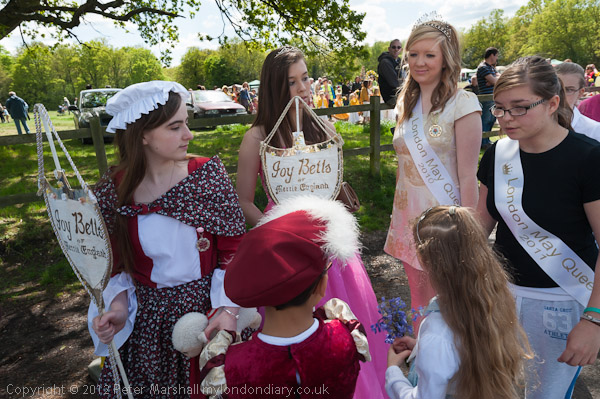
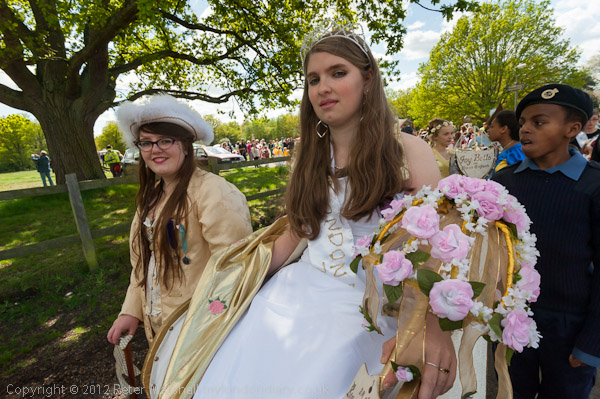
The ceremonies take place in a large roped off arena on Hayes Common, with the May Queens and their groups from various places on the fringes of south east London taking their places around it in alphabetical order. Each group has its own colour for the dresses and its own flower, and girls who may join as young as three make their way up through the various roles in the group until, if they remain long enough, they become the May Queen of their local realm. After this they can move on to join the London May Queen group, and again take the various roles by seniority until finally – usually when they are around 16 – they become London May Queen. As well as taking part in May Queen activities, May Queens and their groups also appear at various charity events in their local areas.

London Crowns 100th May Queen
Beckenham May Queen and retinue

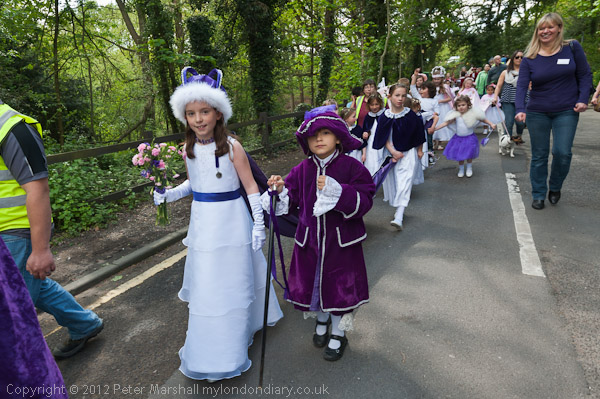
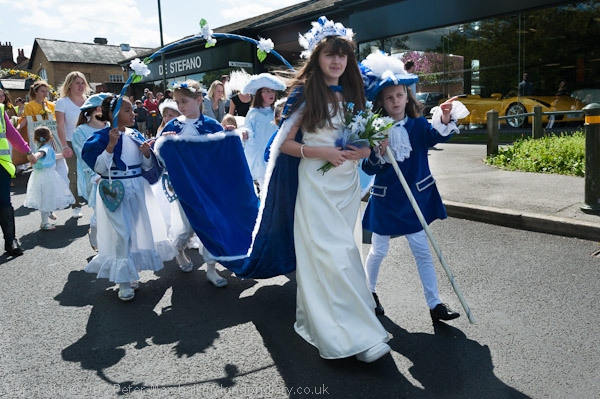
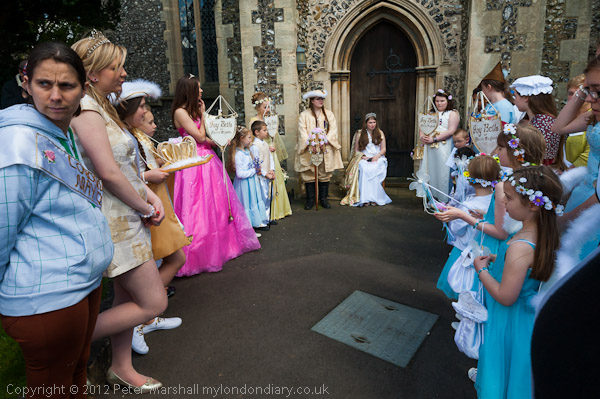
I arrived just as the procession around Hayes was starting, with the uncrowned queen in a lightweight carriage pulled by Sea Cadets with the Prince of Merrie England walking beside her and preceded by a bagpiper. Behind her were the members of London May Queen, including the Joy Bells celebrating Music, Company, Life, Beauty, Flowers as well as the Fairy Queen, Bo-Peep, Robin Hood and several others.

London Crowns 100th May Queen
Bromley Common Queen and retinue

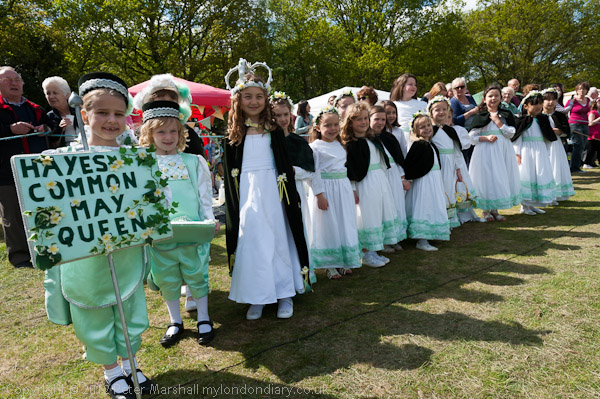
Behind them came the May Queen realms in alphabetical order – Beckenham, Beddington, Bletchingly, Bromley Common, Caterham, Chislehurst, Coney Hall, Downe, Eden Park, Elmers End, Green St Green, Hayes, Hayes Common, Hayes Village, Orpington, Petts Wood, Shortlands, Wallington, Warlingham and West Wickham. In the heyday of the event in the 1920s and 30s there were as many as 100 groups, and the event made the national newspapers and the cinema newsreels.

Little Sanctum - London Crowns 100th May Queen
At Hayes Parish Church for Little Sanctum

At the parish church, the London May Queen group made their way into the churchyard for a short service written by Deedy which he called ‘Little Sanctum’, before joining back on the end of the procession around the village and back to the common.

London Crowns 100th May Queen

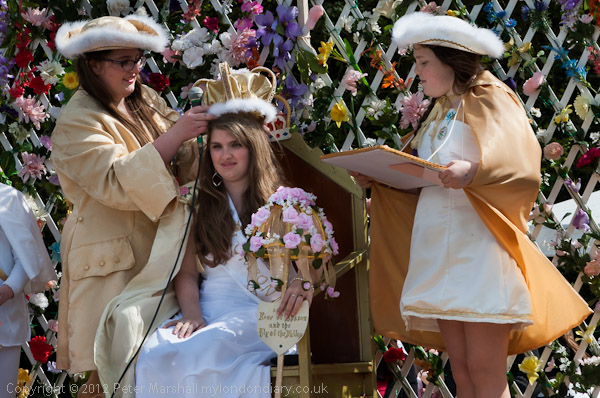
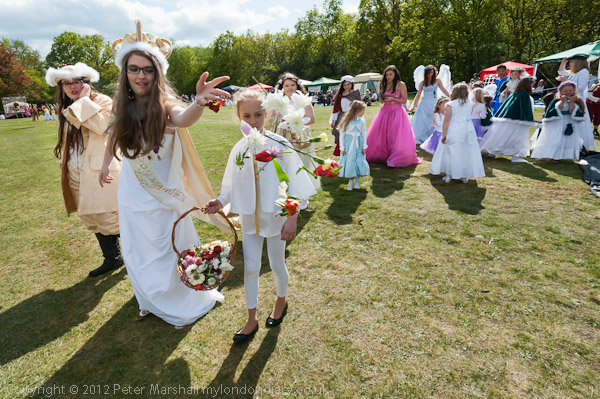
There the 100th May Queen was crowned and the further pageant witten by Deedy performed, ending with the May Queen being led around the arena by BoPeep and scattering flowers towards the seated May Queen realms.

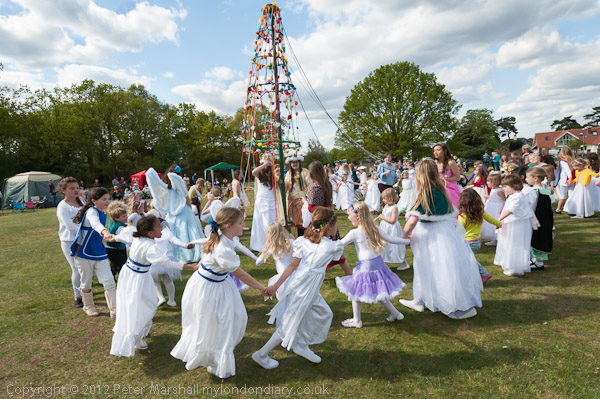
Many of the younger girls were quite tired by the walk around the village and were busy eating ice cream and sandwiches, which revived them considerably, and after the Chislehurst May Queen group had given a demonstration of ribbon dancing, all of the Merrie England children – including a few young boys who mainly take part as pages – came and took part in a lively circle dance around the large maypole.

All that was left was for the May Queen to draw the tickets for the raffle which helps to cover the expenses.

London Crowns 100th May Queen


You can read more about this and other May Queen ceremonies in London both in reports of the various events on My London Diary and from my book mentioned above. I had hoped that this would be followed by a major exhibition and a more scholarly work illustrated by my pictures but as yet this has not been possible.