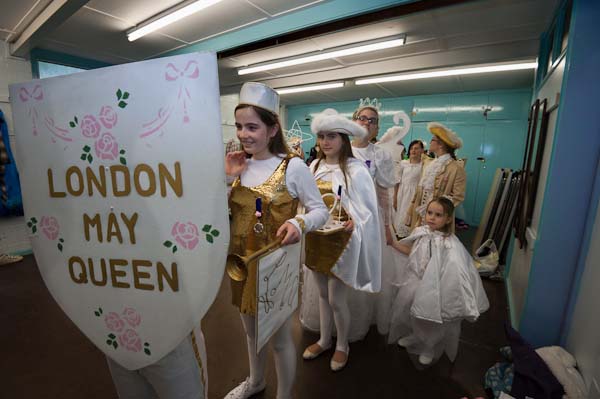
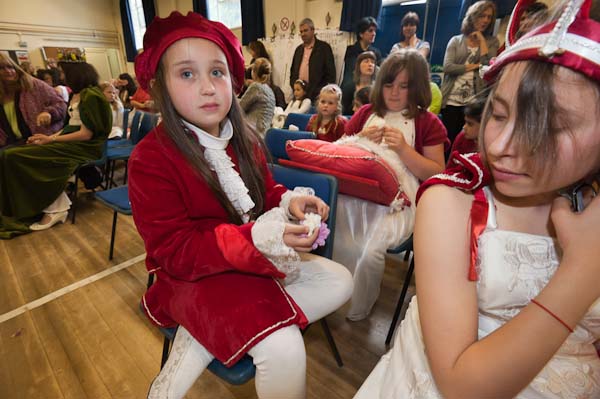
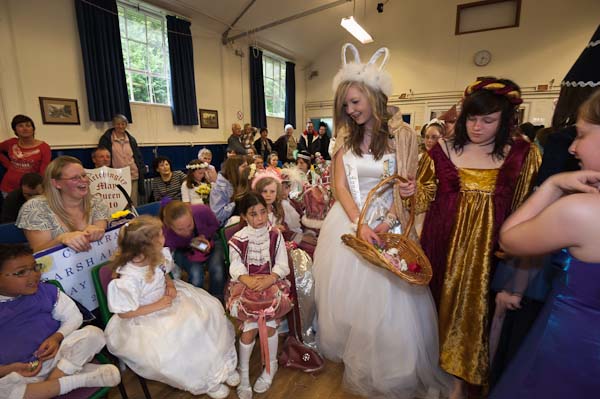
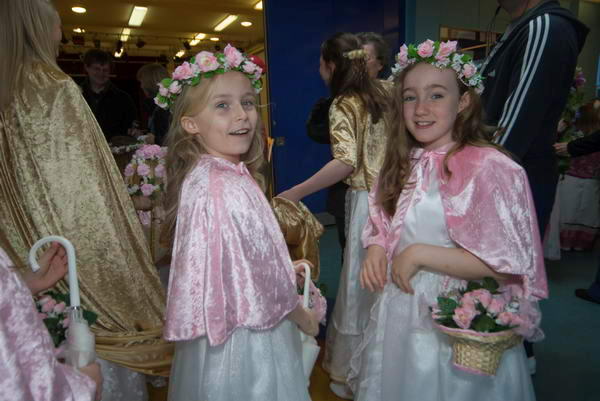
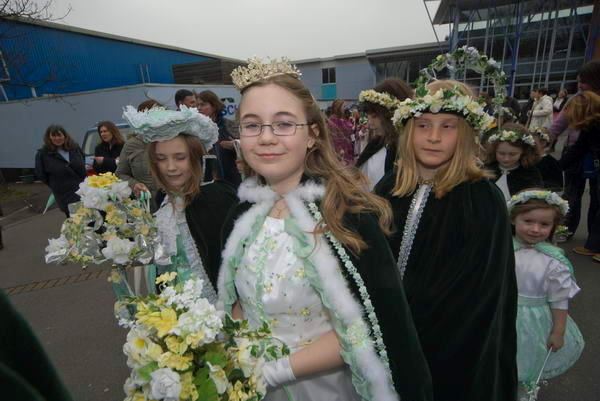
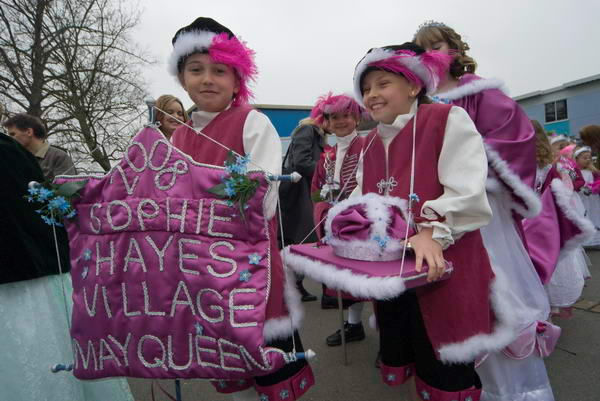
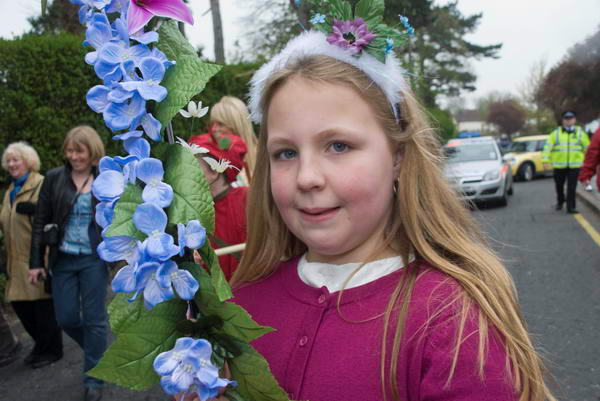
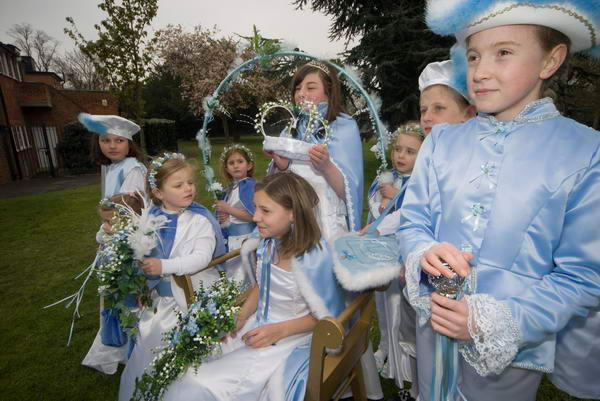
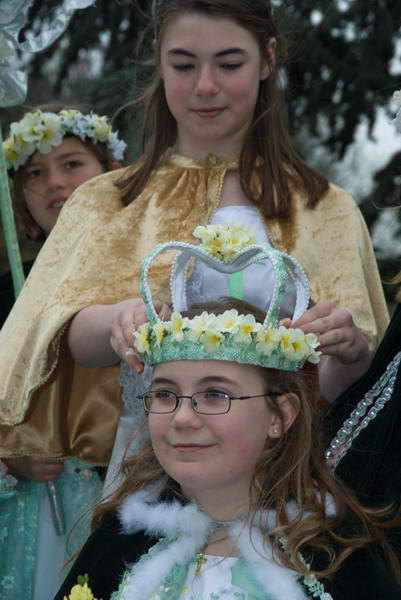
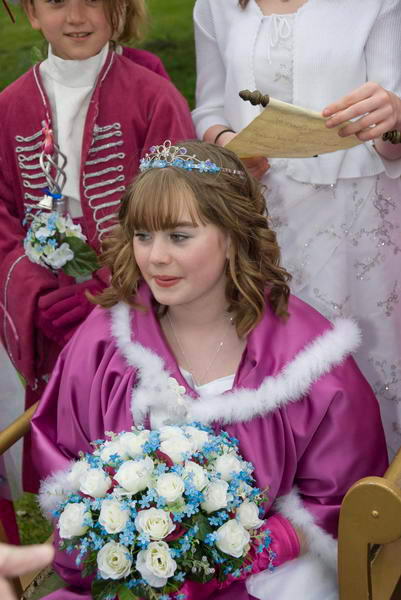
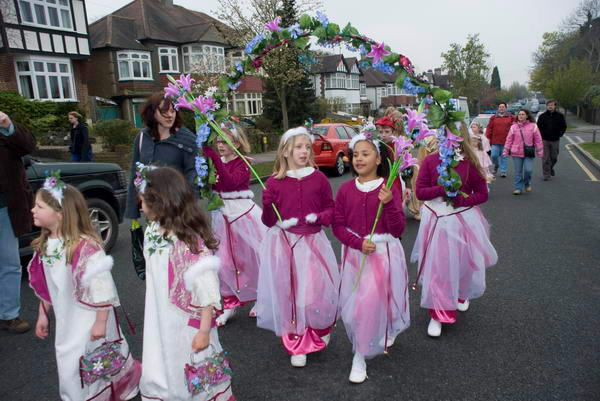
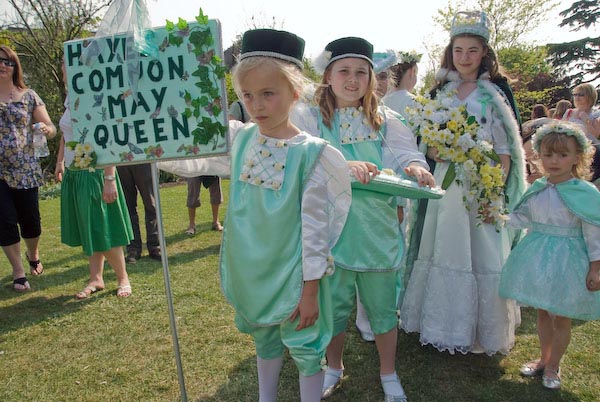
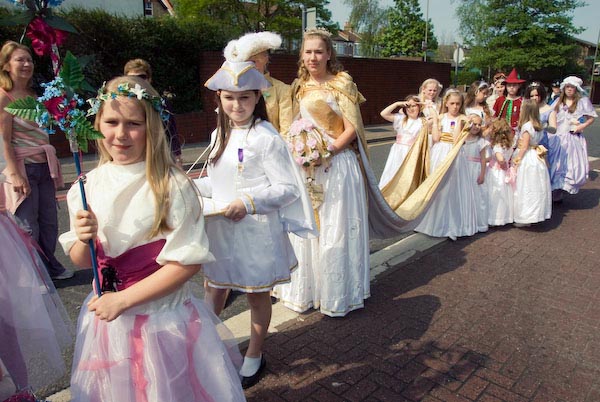
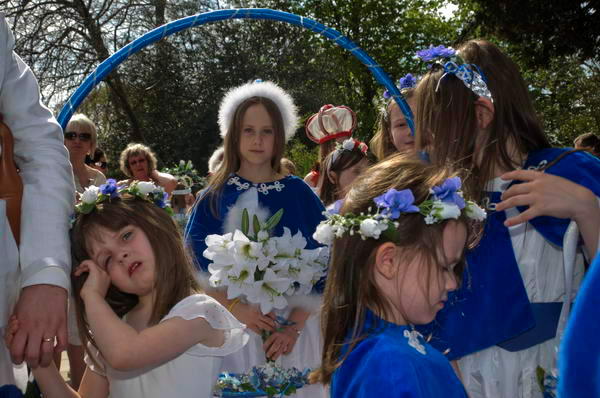
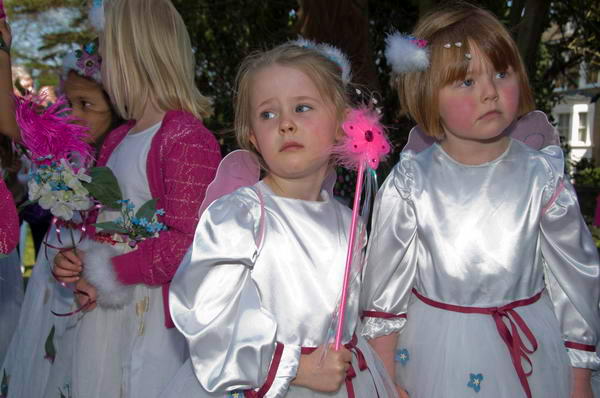
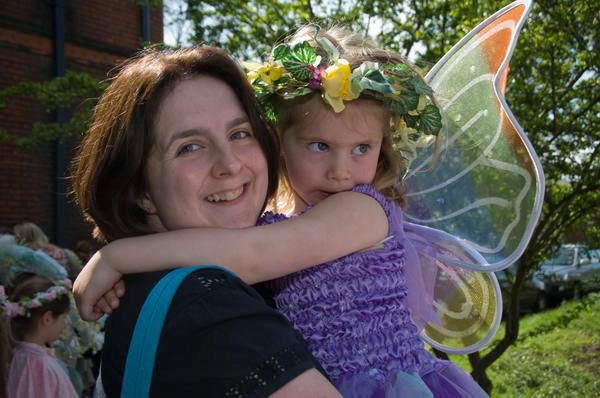
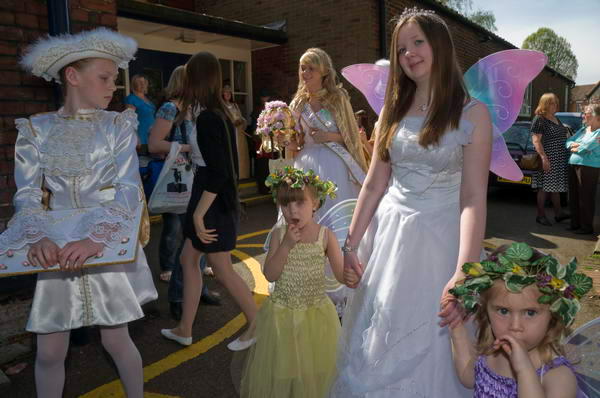
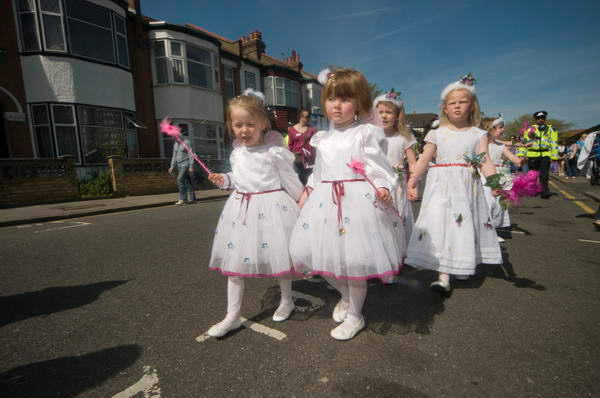
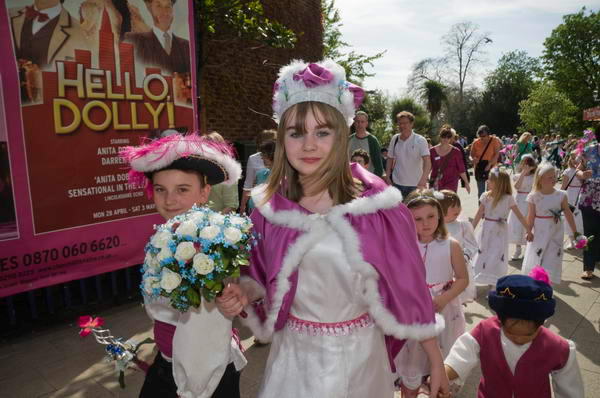
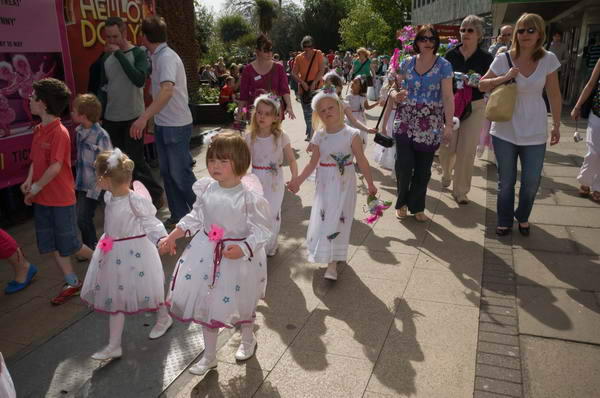
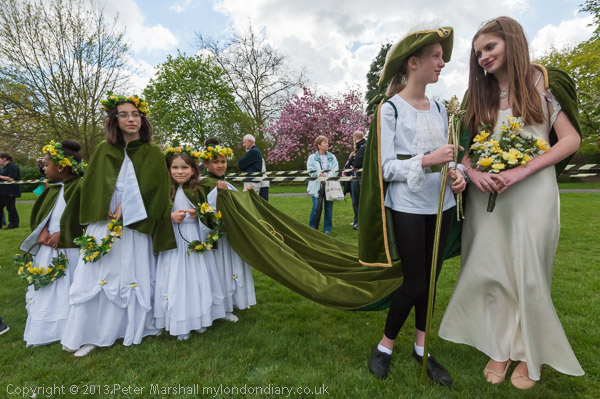
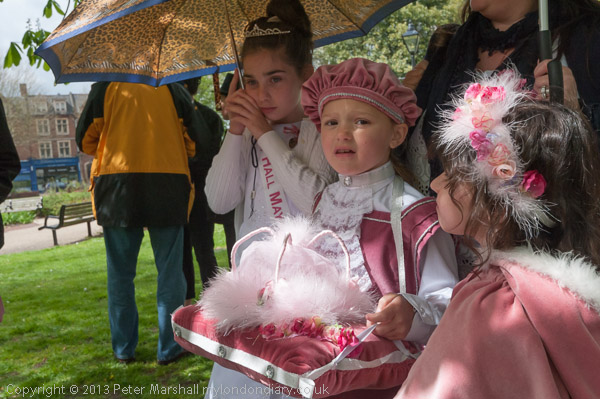
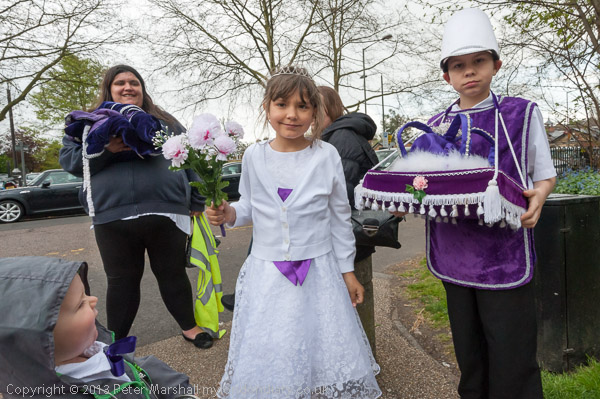
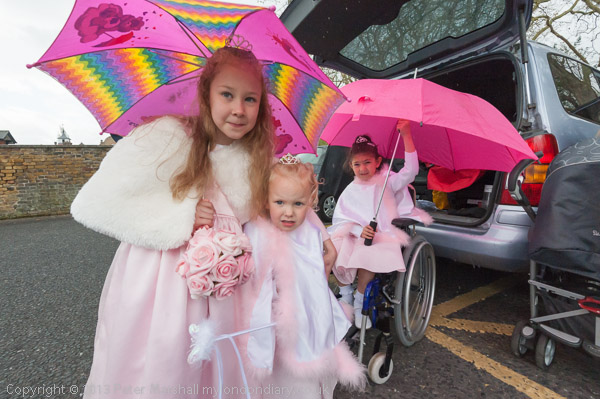
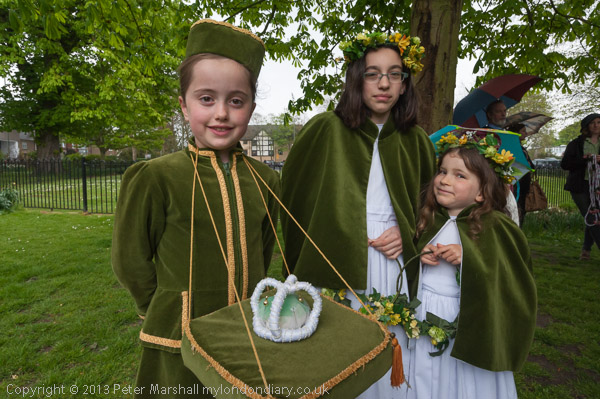
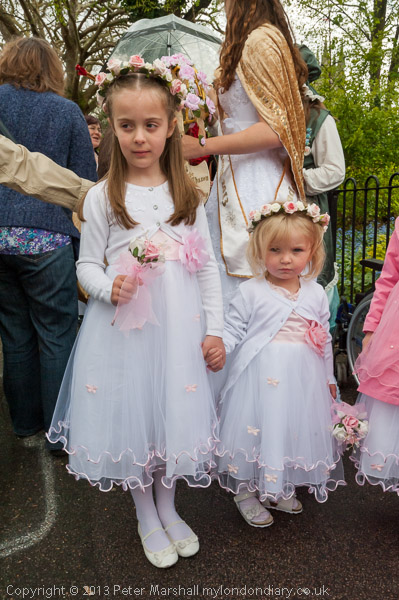
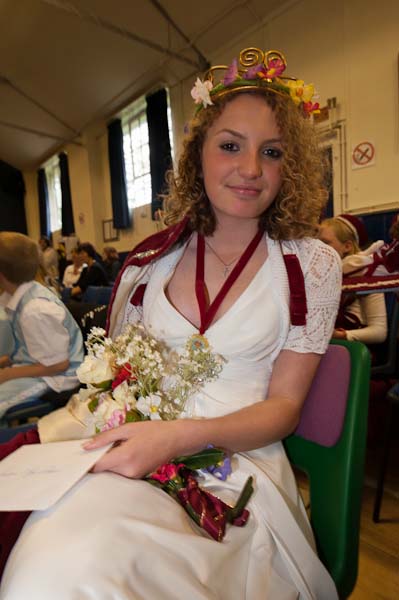
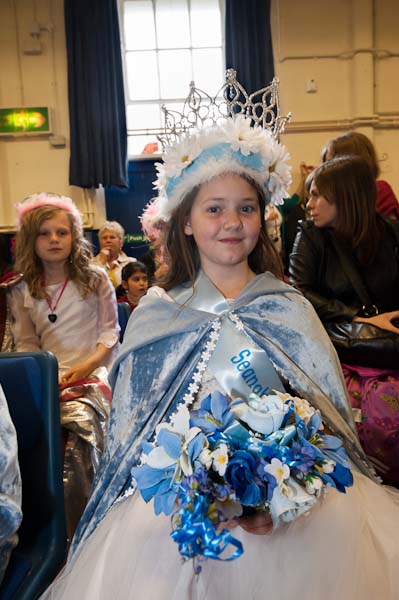
Rain Hit May Queen Festival: Saturday 8th May 2010 was a day of cold rain in southeast London, and the organisers of the London May Queen Festival had to abandon the usual procession by several hundred girls around the village of Hayes.
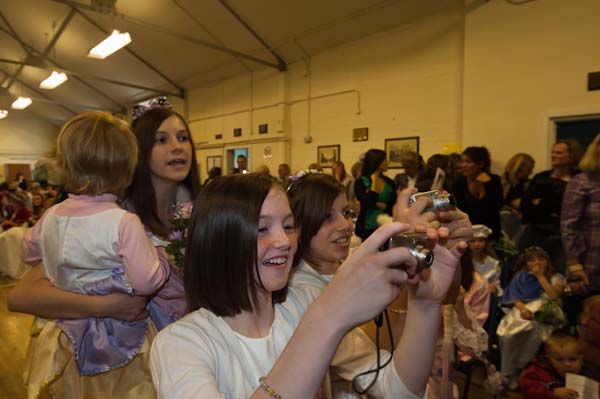
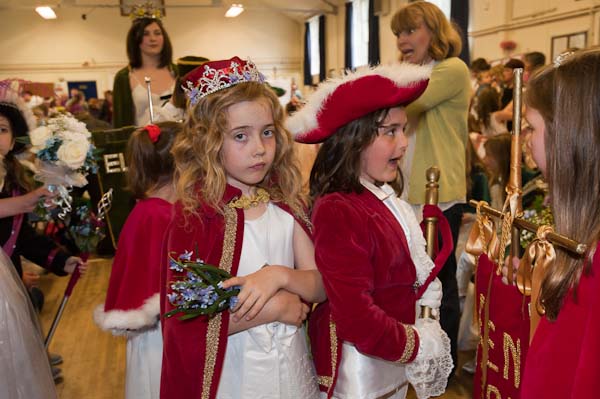
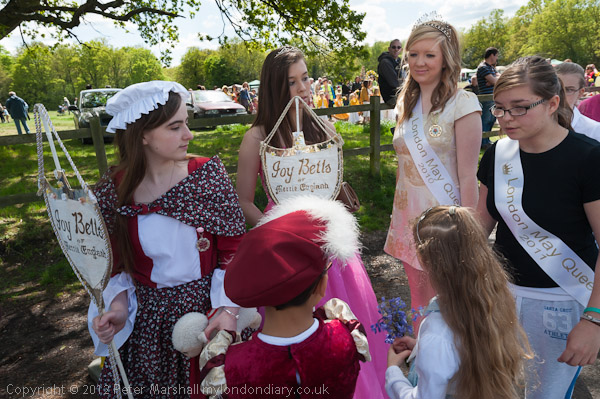
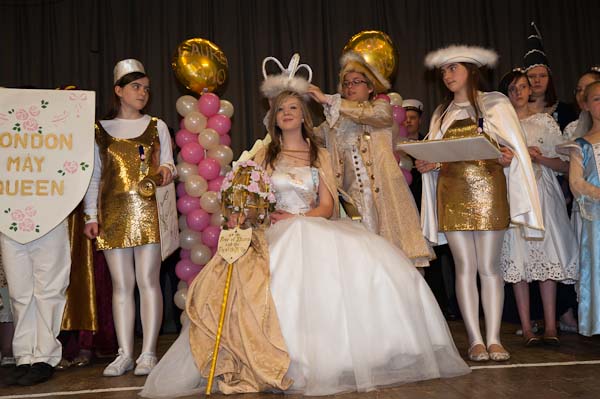
Instead the ceremonies went on in a crowded Hayes Village Hall, though there was room only for the London May Queen’s retinue, the 26 realm queens and small groups of their attendants, along with their family members. I’d photographed a number of previous events had been invited by one of the mothers to come and take photographs.
Photography was a little of a challenge as the light was fairly low and rather mixed, with cloudy daylight coming through the windows of the hall and long fluorescent tubes coming down from the roof of the hall. Though I did take some pictures by available light, the great majority of these were made using flash as the main source. Fortunately the Nikon SB-800 Speedlight with its i-TTL through the lens metering was an incredible advance on older flash systems and performed (with a little help from me) admirably.
Because we were packed into the hall, most of the time I was working very close to at least some of the people I was photographing and using my Nikon wide-angle zoom. This creates problems with uneven lighting – a person 1 metre away from the flash will receive 9 times the light of someone 3 metres away.
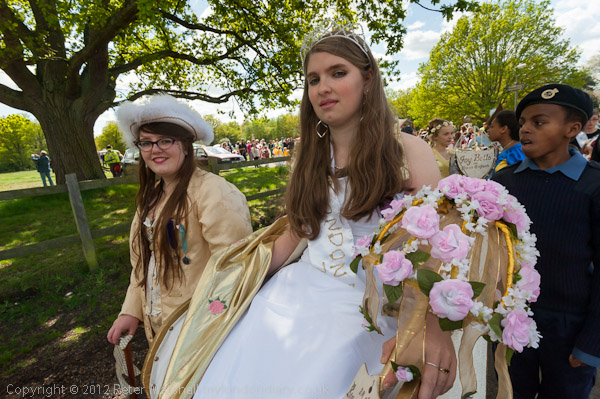
The main hall didn’t have a ceiling I could use to bounce light from (I could in some side rooms), but I did have a small diffuser and sometimes was able to angle the flash away from the near subject to give greater illumination on people further away. Edge fall-off from flash is normally a problem in wide-angle pictures, but sometimes you can put it to use.
I wasn’t the only photographer
Nowadays it is far easier to apply some compensation for uneven lighting in post-processing, but then it was still rather tedious and I don’t think I did so on any of these. As usual I took all pictures as RAW images, adjusting them in software (Lightroom) for contrast, colour balance and exposure. I think all are uncropped; it isn’t a religion for me, but I do like to get things framed right when I expose.
Hayes in the south-east corner of Greater London in the London Borough of Bromley is at the centre of a tradition that goes back over a hundred years, the London May Queen. At its height in the inter-war period this attracted great publicity and was filmed by Pathé News for showing in cinemas around the country – you can watch some of those films on their site.
The event began in a local school
I came to the May Queens from the posthumous book of photographs by British photographer Tony Ray-Jones ‘A Day Off’, published in 1974 soon after his tragically early death which contained a handful of his pictures from May Queen festivals taken in the late 1960s.
One of these, not one of his better photographs and I wondered why it had made the book, was ”May Queen Gathering, Sittingbourne, 1968‘, which shows around 30 young women all wearing crowns in three rows in front of a maypole. I wasn’t impressed by his picture but thought it seemed an intriguing event to photograph. The location in the caption (written after his death by a colleague) was corrected in a later publication and he had taken it at the annual London May Queen festival at ‘Hayes, Kent’ in London.
The London May Queen festival still follows the design and pattern laid down at its inception by schoolmaster Joseph Deedy in 1913. The Hayes festival at which the London May Queen is crowned is simply the peak of a series of events by various May Queen ‘realms’ each with their own May Queens and retinues from various communities in this area of south and south-east London.
Each realm has its own colour and flower
I’ve often written at greater length about the organisation including several posts on this site such as Ray-Jones & London May Queen – 2005. My work with the May Queens was encouraged by a major London museum who promised me a show – but this was cancelled at the last minute for financial reasons, I think a victim of the 2008 financial crisis. I had hoped we would bring out a book to accompany the show, but in the end I self-published this, bringing out a second edition with minor corrections in 2012, a year before the crowning of London’s 100th May Queen.
The London May Queen at this event
The book preview at the link above shows the whole book, including my fairly lengthy texts and over 70 pictures, mainly from London May Queen.
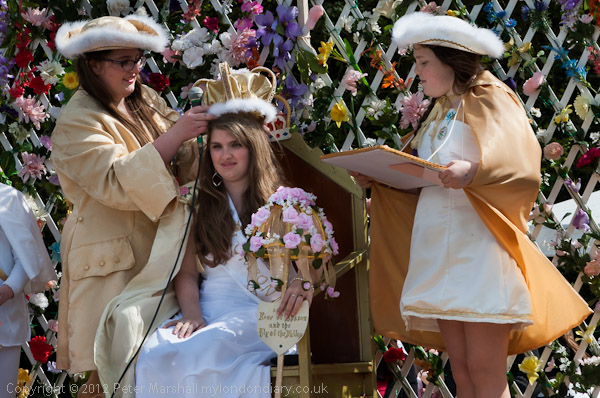
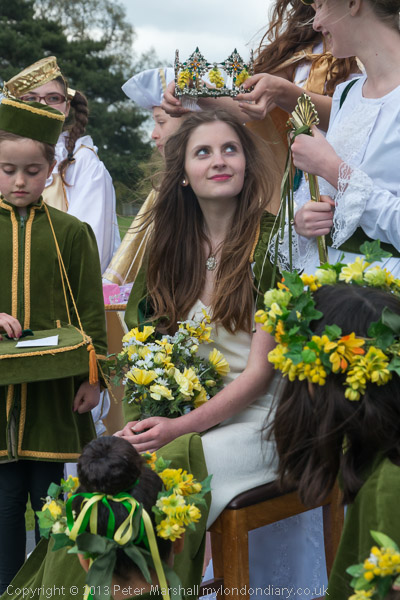
Crowning the Hayes May QueenThe Hayes Common May Queen is crownedThen came the Hayes Village May Queen
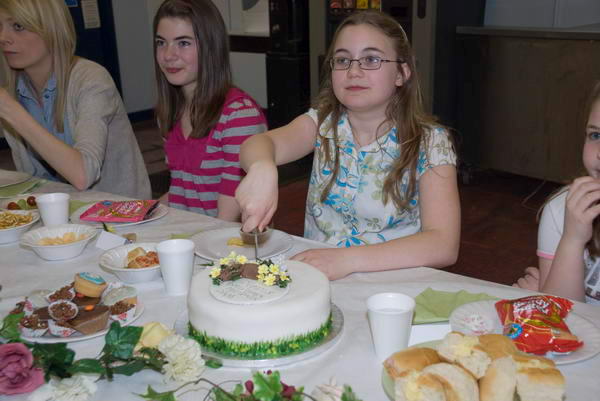
Although the event may seem rather quaint with queens, pages and other positions in the realms, the activities are designed to be fun for the young girls but also to develop their confidence and self reliance. And there are teas with cake.
Some girls drop out as they get older, and progress through the various levels of the realms and of the London May Queen group to which the realm queens move up is determined solely by seniority in the organisation.
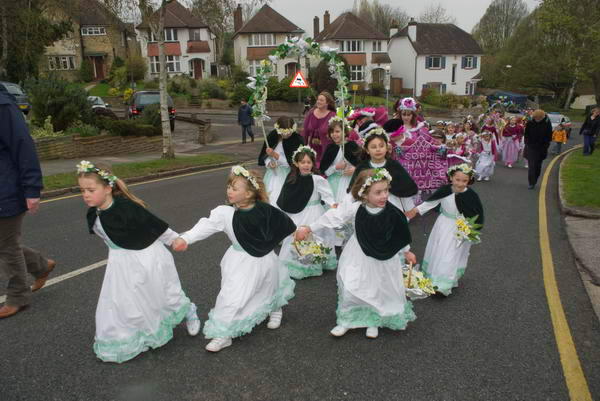
Altogether for the project I took over 12,000 pictures, adding a few more when I was later invited back to photograph her crowning by one of the later May Queens. All the pictures with this post are from 19th April 2008 in Hayes.
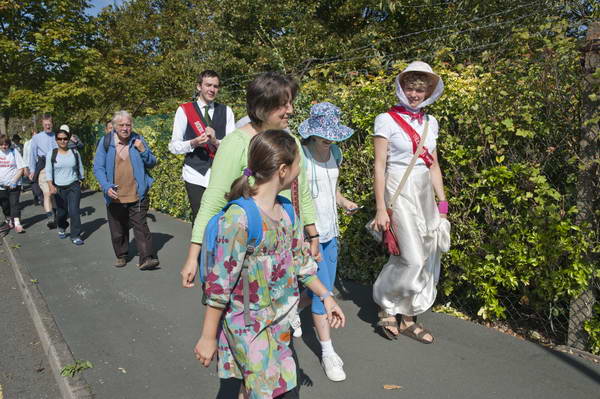
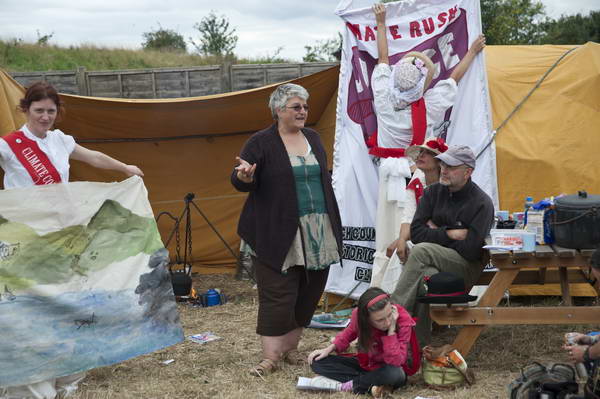
Climate Rush in Hayes & Sipson: On Saturday 5th September 2009 I went to Hayes to join a small group of Climate Rushers at a service at the start of a walk by the London Churches Environmental Network. We joined the marchers for the first part of their walk to the Sipson Airplot, set up to oppose plans for a third runway at Heathrow, rushing back there to prepare for the Celebration of Community Resistance which took place in the afternoon.
Climate Rush on the Run – Hayes & Sipson
On My London Diary you can read more about the Climate Rush, a group of women who had come together to celebrate the centenary of the 1908 ‘Suffragette Rush‘. In 1908 more than 40 women were arrested in an attempt to rush into the Houses of Parliament, and on 13 Oct, 2008, at the end of a rally in Parliament Square Climate Rush again tried to rush in.
Their protest in 2008 called for “men and women alike” to stand together and support three key demands:
* No airport expansion.
* No new coal-fired power stations.
* The creation of policy in line with the most recent climate science and research.
The walk begins
Since then Climate Rush had organised and taken part in various other climate protests and in September 2009 were taking part in “a rollicking tour of South West England“, staging events, supporting campaigns and “entertaining the towns, villages and hamlets” on their route with “16 Climate Suffragettes, 3 horses and 2 glorious caravans“. The Airplot at Sipson was their starting point and I’d photographed their procession to Heathrow the previous day, and later photographed them at a Green Fayre in Aylesbury.
After a service at St Anselm’s Church, Hayes attended by several Climate Rushers we set off with the the London Churches Environmental Network to walk back to Sipson. We left the marchers at Cranford Park to take a shorter route to get back to the Airplot to prepare for the Celebration of Community Resistance taking place there in the afternoon.
Climate Rush: Celebration of Community Resistance – Sipson
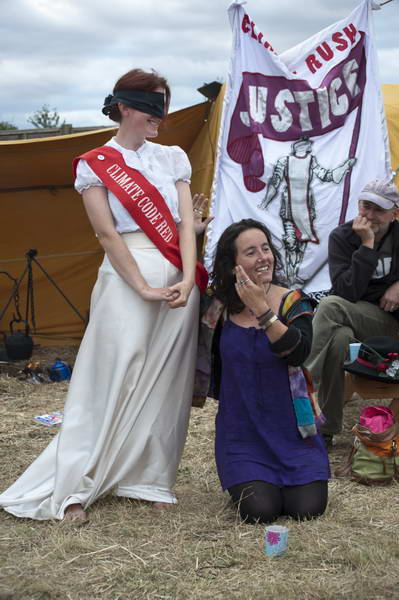
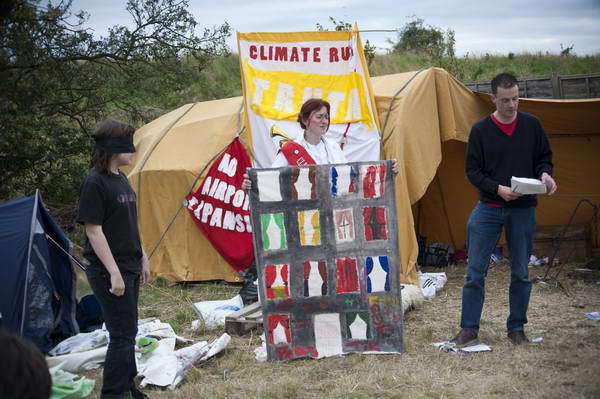
Tamsin plays the villain BAA while Geraldine talks about the NoTRAG campaign
Greenpeace had the idea of setting up the Airplot, an orchard in the centre of the village of Sipson, one of those under threat from Heathrow’s plans for expansion. They bought the site and created one metre square plots of land there and invited the public to become “beneficial owners“, I think paying one pound for the privilege and receiving a certificate of ownership. Somewhere I may still have mine, but here is one on Wikimedia.
It had seemed a good idea which would make the development more complex, though I suspect would have had little or no effect in practice, but it was never put to the test as plans for the third runway were scrapped by the government in 2010 on environmental grounds – though they have since been revived.
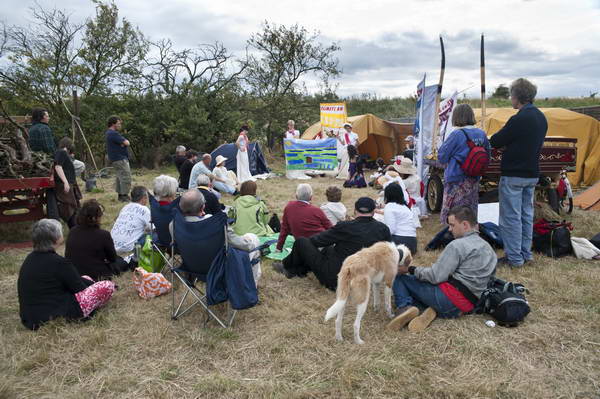
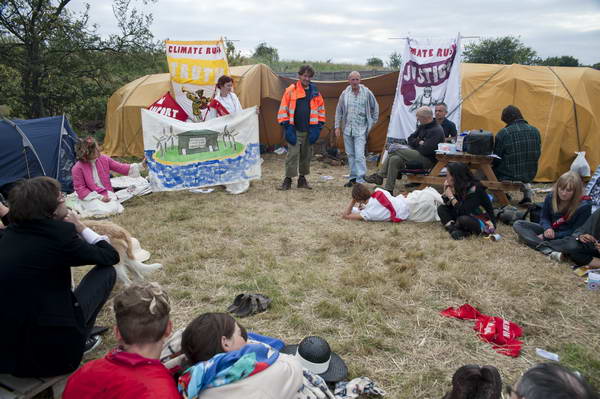
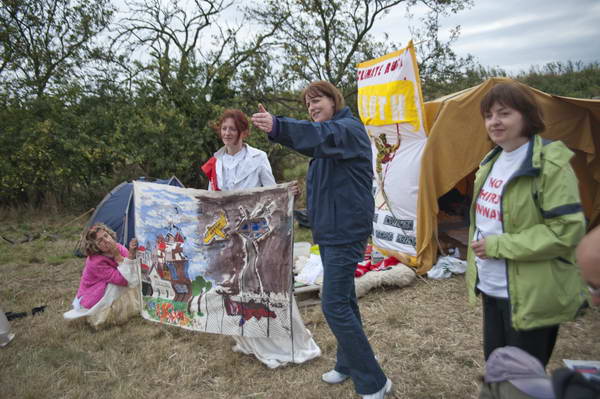
The Airplot was the first stop on the Climate Rush tour and for the Celebration of Community Resistance they had invited activists from around the country to come and give short presentations on their campaigns.
The first example of community resistance we heard about was Radley Lakes at Didcot which npower wanted to fill in with pulverised fuel ash. Although some lakes had been filled, the campaign managed to save three of them. You can see more about them on the Radley Lakes Trust web site.
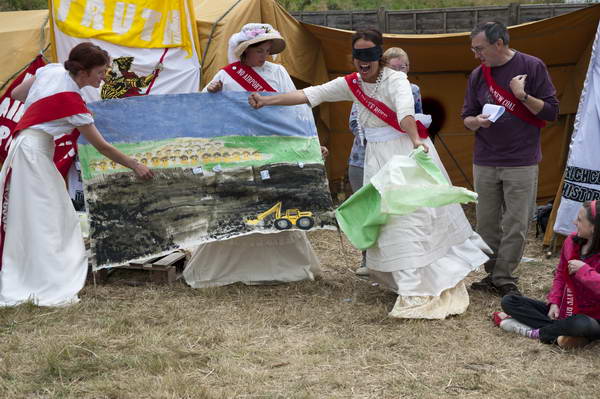
Next we heard about the scandal of opencast mining at Ffos-y-Fran, common land at Merthyr Tydfil. I photographed a Campaign Against Climate Change demonstration against this mine at the London offices of Argent Group plc in April 2008.
“Argent form half of Miller-Argent who run the UK’s largest opencast coal mine, Ffos-y-Fran in Merthyr Tydfil, South Wales. Just 36 metres from the nearest houses, extraction will continue for more than 15 years (perhaps as along as 40 years), producing coal that will add at least 30 million tons of CO2 to to our atmosphere. Scottish safety standards demand a minimum gap of 500 metres from housing, but the implementation of a 350 metres limit by the Welsh office has been delayed – allegedly to allow the Merthyr working to go ahead.”
Coal mining continued here until November 2023, and local residents say that the plans for the future of the site represent the “ultimate betrayal“.
Protesters had come earlier in the year from County Mayo in Ireland for a St Patrick’s Day protest at the Shell building against the Corrib Gas Project. We heard how the Rossport Solidarity Camp and the Shell to Sea campaign were fighting this against a corrupt government and thugs who protect the oil companies interest by illegal methods. While the protests failed to stop the project, the environmental groups involved continue to highlight related issues.
Cathy McCormack, a community activist in Glasgow Easterhouse was unable to attend but a colleague came to read her views on poverty and the financial crisis, and in particular the part played by the World Bank and the IMF.
Next we heard from two former Vestas workers who sat in their factory in Newport on the Isle of White when the company proposed the closure of what was then the UK’s only major wind turbine production site. Unfortunately they failed to prevent the closure.
The last group to talk were the No Third Runway Action Group (NoTRAG), and Geraldine described how they had opposed the BAA plans for airport expansion.
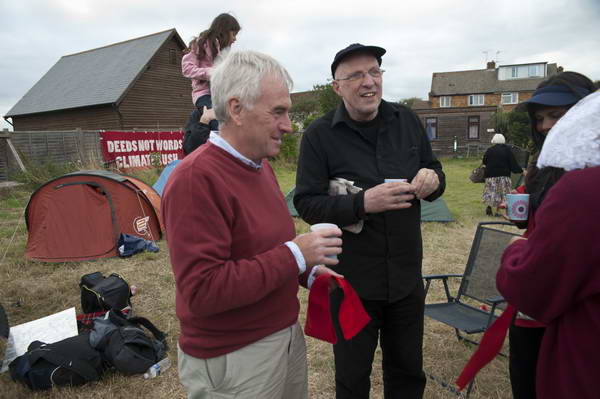
In the audience watching the presentation were local MP John McDonnell and airport campaigner John Stewart of HACAN. The campaigners won that round against Heathrow’s plans – and we celebrated in 2010, but today there are new plans – and a government which only plays lip-service to the coming environmental diaster seems sure to back either Heathrow’s own proposals or that from the Arora group, and the fight is on again.
Punch, Morris, Nakba & London May Queen: Saturday 12th May 2012 was an unusually busy day for me, rushing from Covent Garden to Westminster and then out to Hayes Common. There were two very different events I was determined not to miss, the Nakba Day protest at Downing Street remembering the anniversary of the eviction of around 750,000 Palestinians from their homes by Israeli forces in 1948 and the crowning of London’s 100th May Queen taking place on Hayes Common on the edge of London, around a hour’s travel away. And a couple of other events I could fit in too.
I wrote all of these up on My London Diary and you can read those accounts there on the links in this post – as well as finding many more pictures, so I won’t repeat myself too much here.
Punch Celebrates 350th Birthday – Covent Garden
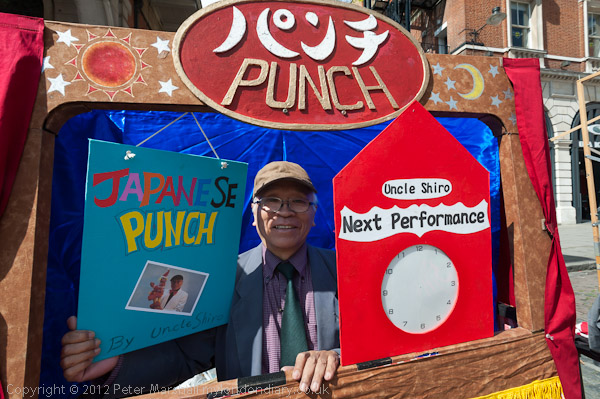
‘Professors’ had come from around the world including Uncle Shiro the only Japanese Punch
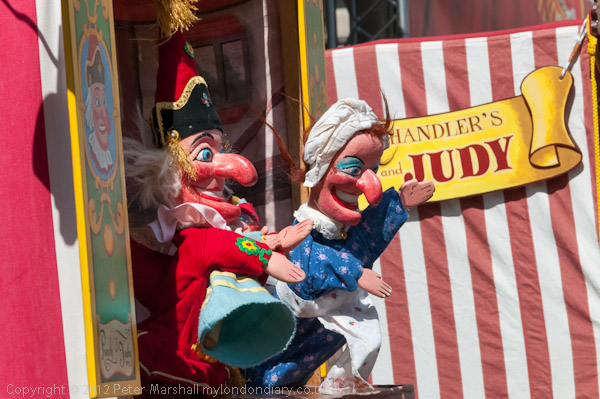
Punch and Judy professors from around the country and around the world brought their booths to Covent Garden this weekend to celebrate 350 years since Samuel Pepys first recorded a performance there in his diary.
His was the first recorded performance of the “Italian puppet play” and though Punch was then called Pulcinella and has obvious earlier roots in Italy it is regarded as the start of Punch and Judy in England.
The fun was only just starting when I left for more serious matters in Westminster. More about the day and many more pictures at Punch Celebrates 350th Birthday
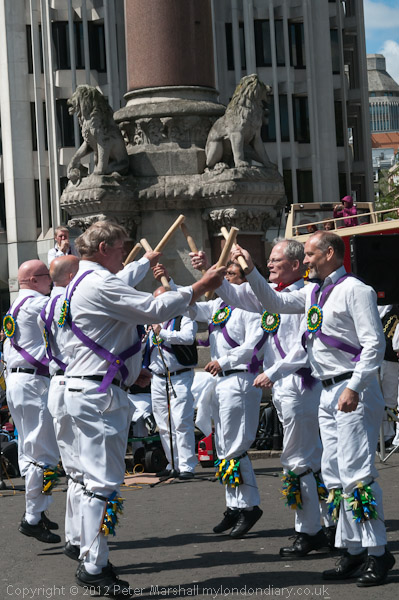
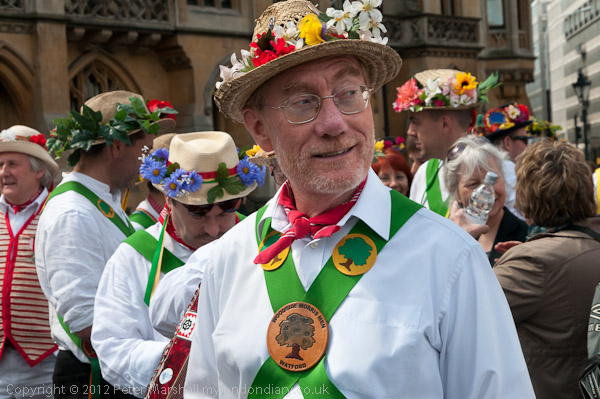
Morris Men Occupy Westminster
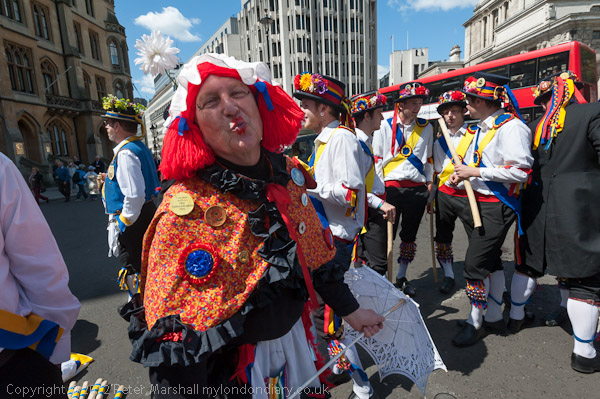
A Morris dancer dressed as a woman, who plays the fool, blows me a kiss
Pavements across Westminster were filled with gaily dressed men with bells on them leaping and dancing as twelve Morris sides performed in around twenty sets over the day in Central London on the Westminster Day of Dance.
The performances were taking place at various locations in the City of Westminster, including the Victoria Embankment, St Margarets Westminster, Westminster Cathedral and Tate Britain, with the various Morris sides rotating between them throughout the day.
I left as the morning sessions ended and the Morris Men had a break for a doubtless mainly liquid lunch (dancing really is thirsty work) before the afternoon sessions which, after a euphemistically named ‘Tea Break’ were to conclude with a mass performance south of the river in Lambeth by the National Theatre.
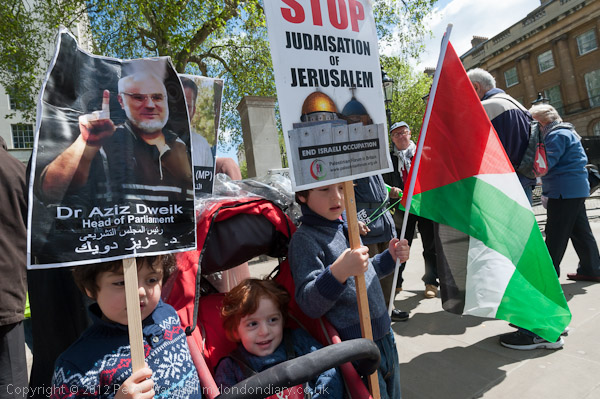
Nakba Day Protest at Downing St
This was a family protest – young protesters hold a Palestinian flag and placards
Nakba Day is generally commemorated on 15 May and remembers the eviction of around 750,000 Palestinians from their homes by Israel forces in 1948. This London protest opposite Downing St was on the nearest Saturday.
At the time of the protest around 2000 Palestinians were on hunger strike in Israeli jails in protest against ‘administrative detention’ which allows them to be detained for consequtive periods of up to six months without any charge or trial.
Israel was still displacing Palestinians from their homes – and is currently in 2025 planning to clear them entirely from Gaza, either killing them through starvation, bombing or military eviction. Back in 2012 they were planning to forcibly displace around 40,000 Palestinian Bedouin from the Naqab desert, threatening to demolish the homes of around 85,000 Palestinians in East Jerusalem and to forcibly evict 2,000 from the West Bank.
Unfortunately I had to rush away while people were still arriving for the protest as I had promised to photograph the crowning of London’s 100th May Queen and was only able to take very few pictures to accompany the text.
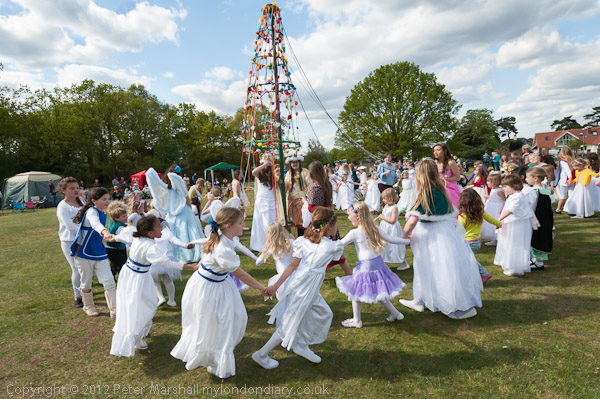
The Merrie England Children Dance around the maypole with the newly crowned Queen at its centre
The 100th London May Queen was crowned at the Merrie England and London May Queen Festival on Hayes Common, Kent, part of an unbroken tradition stretching back to 1913. 20 other Queens and their realms took part.
The ceremonies at Hayes Common, now a part of the London Borough of Bromley, continued even during both World Wars, though they were then carried out inside the local church as it was feared the procession around the village might attract unwanted attention from the German air force.
I’ve written often here and elsewhere about the London May Queen organisation and events, including a long account in my book London’s May Queens. [You can read a little more about this book – also available much more cheaply as an e-book – on >Re:PHOTO and can read the text and see many of the pictures at the book link.]
But there is one section of my post in 2012 which adds something to the story, so I’ll repeat it here.
“Whitelands College in London started its May Queen festival rather earlier in 1881 at the prompting of John Ruskin, and this still continues at the college (now part of the University of Roehampton) although since the college now admits men, some years they have a May King in place of a queen. Talking to one of the organisers of the event yesterday I learnt that Deedy had worked at Whitelands – contrary to the published information on him.”
Fortunately I arrived at Hayes Common just in time – though rather out of breath having run from Hayes Station – for the start of the procession around the village before the crowning.
May Queens in April: Most years on April 28th I’ve photographed events around one the the more important but largely overlooked by media occasions of the year – International Workers Memorial Day – which remembers those who have died in the workplace, with the slogan ‘Remember the dead – fight for the living‘. You can read a number of accounts of some of these events on My London Diary – such as this one from 2013.
But some years – and this year, 2025 is another – I have other commitments on April 28th and have not been able to cover International Workers Memorial Day. In 2007 I was working hard on a project on London’s May Queens for a museum exhibition (unfortunately cancelled at the final stage due to financial constraints) and needed to be in south-east London to work on that. My day on Saturday 28 April began in Chislehurst and then moved on to Bromley where a number of local May Queens were crowned.
After the exhibition was cancelled I put together some of the pictures from these events in a book, London’s May Queens, still available. It’s perhaps important to say that these events are not beauty competitions but activities to raise the confidence and abilities of the girls who take part, including in public speaking and performance and that the various roles in the local groups and the London May Queen group to which they can move on are assigned solely on their length of membership. It still follows the structures and texts from its founding years.
All of the rather detailed text from the second edition of the book both about the history of May Queens, this and other May Queen events around London and around half of its pictures can be viewed in the book preview on-line. Here is the text about the book on Blurb:
2012 saw the crowning of the London’s 100th May Queen. The first Merrie England and London May Queen festival was held in 1913 and it has continued every year since, still on the same lines. In the 1920s and 30s it was a major event, covered by cinema newsreels and competitions in daily newspapers, but now it is known to few outside the over 20 local realms that take part in the annual event. The 72 pictures in this work give a unique insight into this community event.
Here with the usual corrections are the two posts I wrote in 2007 on My London Diary. The pictures here are all from that day and you can see more at the links below each post.
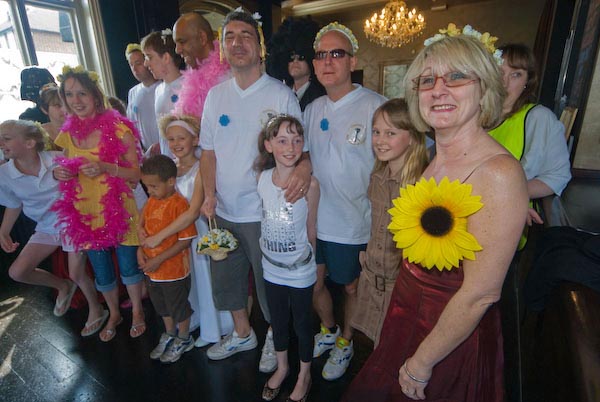
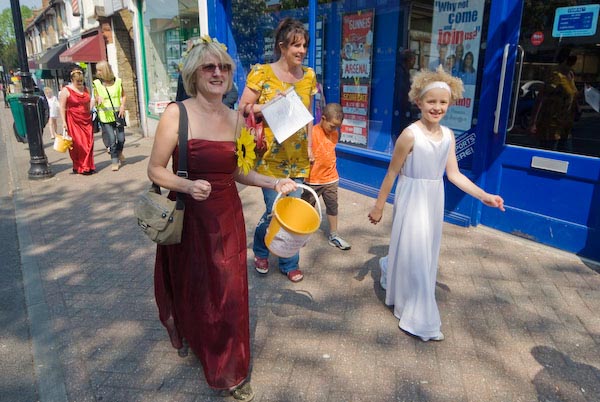
Chislehurst May Queen Society – Fund-Raising Pub Crawl
Chislehurst isn’t far from the central London but is surrounded by woods and commons and feels very different to Hither Green a couple of stations closer to the centre. Even as a suburb it feels very rural, with what looks like a large village pond and village green.
Chislehurst is one of the ‘realms’ in the London May Queen Festival, but is finding it hard to keep going and attract new young girls to carry on the tradition (see London May Queen 2005 and Chislehurst May Queen 2006) for more pictures of them.
So getting publicity in the local area is very important. They need people to notice them and the May Queen Festival, and to bring their daughters and grand-daughters along to take part in the fun. Obviously the girls who do take part are enjoying it, but it is also a commitment and takes hard work to practice the maypole dances and so on.
To get some publicity the week before the May Queen Festival they organised a sponsored fancy-dress pub crawl. I met up with them at The Lounge, a fairly newly refurbished bar at the top of the hill to the north of the town centre, with an interesting decor.
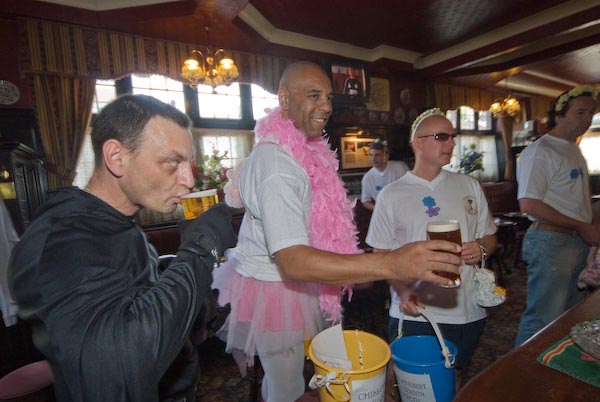
From there we went down into the centre of Chislehurst, letting people know about the May Queen and collecting money both on the street and in the pubs we visited.
I was sorry to have to leave after the third pub, when perhaps things were beginning to warm up a little, but it was fun, and I hope will help to raise the profile of the May Queen group in the area. more pictures
London May Queen: Bromley May Queens
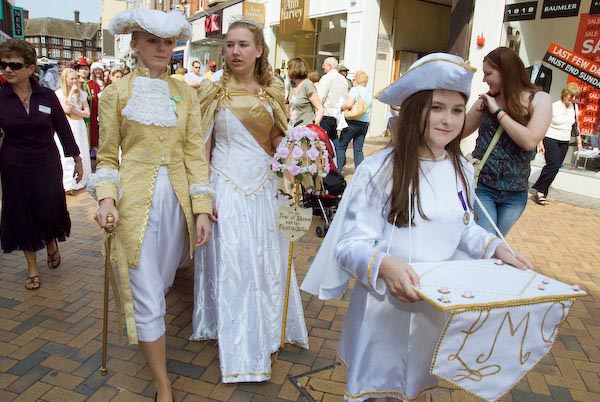
I’d promised this year’s London May Queen, Erin, that I would try to photograph her, and unfortunately I had to be elsewhere for her actual crowning at Hayes in May. So Bromley seemed a good place to catch up with her and take some pictures, as there she would be appearing with five local may queens from groups around the area – Bromley Common, Shortlands, Hayes, Hayes Common and Hayes Village.
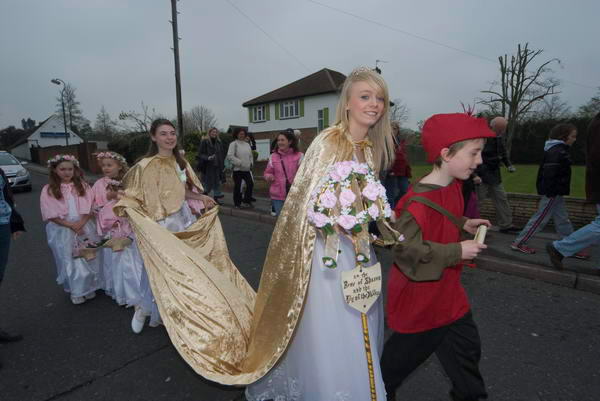
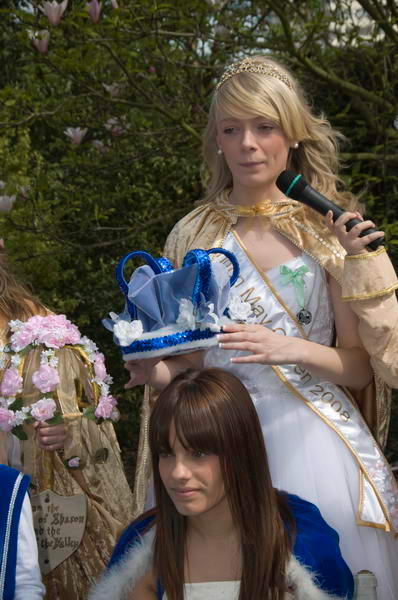
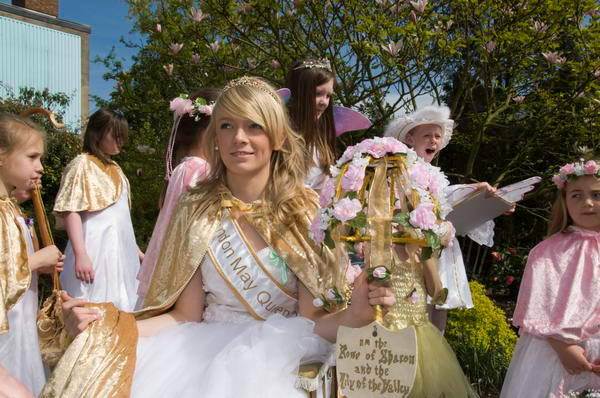
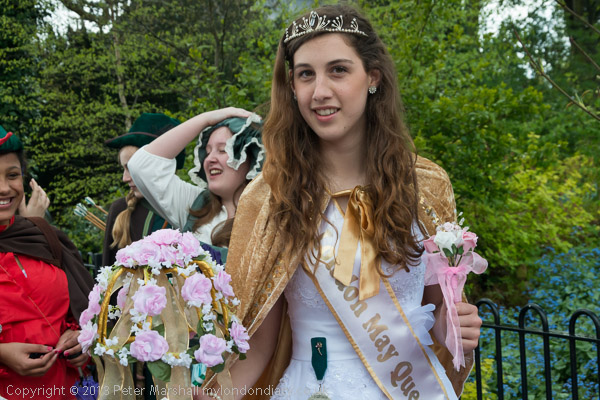
Erin, the 2007 London May Queen, is easy to recognise in my pictures as she is carrying a frame with pink roses and white flowers that says ‘I am the Rose of Sharon and the Lily of the Valley‘, as well as a sash saying ‘London May Queen‘.
Unfortunately we got on the wrong bus to get to Bromley and enjoyed a long tour of most of the outer reaches of south-east London before finally arriving there. It didn’t help that the address I had for the start was rather vague, but finally we met up with the procession almost exactly where we had got off the bus 15 minutes of wandering earlier, and walked with the procession through the centre of the town to the gardens.
It was a shame that the police had apparently insisted that the procession rush through the town centre. It was led by the band of T S Endeavour, playing ‘When The Saints Go Marching In’ (and other popular tunes) and I’m sure they could have marched at half the pace without causing great traffic chaos – much of the centre is in any case pedestrianised.
Some of the younger girls taking part really had to run to keep up through the town centre. Events such as this enliven towns (and Bromley could do with an awful lot of enlivening, being total shopping hell) adding colour and individuality, and it seems far more important to celebrate them to the maximum than worry excessively about traffic flow.
At the gardens things were more relaxed, and the London May Queen was able to crown those of the other queens who had not already been crowned at their own local ceremonies, and there were many pictures taken by me and the mothers and fathers.
Again it’s a shame that Bromley doesn’t have a maypole and there wasn’t any singing or dancing or acting. But it was a nice summery afternoon and everyone seemed to be enjoying themselves.
Bromley May Queens Crowning – On Saturday 19th April I went to Bromley to photograph the crowning ceremony of the May Queens from Bromley Common and Shortlands in an event also attended by May Queen groups from West Wickham, Hayes, Hayes Village and Hayes Common. This is the largest of the May Queen events before the annual crowning of the London May Queen in May.
Although in recent years my photography has largely been around protests, with the occasional walk thrown in, back in the first decade of this century I was also photographing a wide range of cultural events in London, including a number of religious festivals and other celebrations. And one of the lengthier projects I engaged in was on May Queen festivals in London.
Although I’d grown up in London and lived near it for most of my adult life (and still do) I had never come across May Queen festivals, though perhaps I may have seen some of the old newsreels from pre-war days I thought they were a thing of the past.
In a post written earlier in April 2008 I described how I came to find out more and to start a project which led to me finding out more and starting a project on them in 2005:
It was the work of Tony Ray-Jones that first attracted me to May Queens, with his posthumous ‘A Day Off’, published in 1974 containing half a dozen of his pictures from May Queen festivals (though only four really connected with May Queens.) One of these – certainly the least interesting image – showed around 30 young women in three rows in front of a maypole, all wearing crowns. Despite the misleading caption, ‘May Queen Gathering, Sittingbourne, 1968’, in a later publication it was identified correctly as a picture of the annual London May Queen festival at Hayes, Kent.
Although I didn’t think it one of his better pictures it struck me as an interesting event, and even more so when I went to photograph it in 2005, and started to look up a little of its history.
Eventually I had enough pictures to publish a book, and had been promised an exhibition at a major museum – though this never materialised. The book, London May Queens ISBN: 978-1-909363-06-9 is still available from Blurb, either as an expensive print version or as a PDF, and the work has also been featured on other web sites including Lensculture.
Here is the Blurb blurb: “2012 saw the crowning of the London’s 100th May Queen. The first Merrie England and London May Queen festival was held in 1913 and it has continued every year since. In the 1920s and 30s it was a major event, covered by cinema newsreels and competitions in daily newspapers, but now it is known to few outside the over 20 local realms that take part in the annual event. The 72 pictures in this work give a unique insight into this community event.“
It’s worth going to the Blurb link to see the extensive preview of the work, which includes all of the text of the book as well as many of my favourite images from the project.
Girls generally join their local May Queen group at an early age and progress through the various roles in the group as they get older – and if they stay long enough become their group May Queen, after which they can join the London May Queen group and similarly progress to become London May Queen. As well as practising for the festival events the groups also have other activities – and teas etc.
The Bromley area May Queens Crowning is one of the larger events in the May Queen Season, with a number of local May Queen groups processing through the centre of Bromley to Church House Gardens next to the Churchill Theatre where some of the May Queens were crowned. The previous week I’d been to another event where three of them had previously been crowned and the following week there was another crowning festival in Beckenham a week before the final crowning of the London May Queen at Hayes.
At the end of the ceremony the girls process back to a church hall for a tea, but I was too tired to go with them and felt in need of something stronger.
Elmers End May Queen and her retinue before the crowning
I’ve attended and photographed quite a few coronations, but will be having absolutely nothing to do with events this coming weekend. It appears to me an obscene waste of money, totally unnecessary spending which could be directed towards something far more worthwhile on a medieval relic that the country should have abandoned or hugely reformed years ago.
I do remember the 1953 event, when we spent rather boring hours crammed into our neighbours front room facing a 9 inch screen on the black and white television their elder son had built from a kit. And a few days later our school’s classes were trooped along to the local cinema – appropriately The Regal – to watch it in colour. It had rained for the event and I think we also got wet queueing to be let in. I think few found the film of much interest.
Of course there was a lot of ballyhoo back in 1953, but nothing like the prolonged media assault we are now seeing – our media have changed, and largely for the worst. And while some people held street parties I don’t think there were any in our London suburb.
There was certainly a lot of talk then about a new “Elizabethan Era” but little came of it, though we were still slowly emerging from wartime austerity. For most children in the UK the more significant event of the Coronation year had been the end of sweet rationing several months earlier, though sugar, meat and some other foods remained on ration.
Back in 2004 or 2005 four pictures in the posthumous Tony Ray Jones book ‘A Day Off’ of May Queen festivals had come to my attention and I decided it might be an interesting area for a photographic project if these events were still taking place. A little research, mainly on-line told me that there were still some in various parts of London and that the picture showing young girls dancing around the maypole was, despite an incorrect caption, actually from the London May Queen event taking place annually on Hayes Common.
So in May 2005 I went to Hayes Common, very uncertain about what I would find, and also about how I would be received. Old men photographing young girls was by then a rather suspect activity, but I talked with some of the organisers and if not immediately gained their confidence. It was the start of a project over several years that attracted interest from the Museum of London, though in the end they pulled out from the show at late stage, though I think they did buy a few pictures.
It took several years of attending various crownings and other May Queen events, including a few unconnected with the London May Queen for me to build up a body of work and I extended the project a little longer than was necessary to include the crowning of the 100th London May Queen in 2012, publishing my book London’s May Queens later that year. Being publishing on demand this is now ridiculously expensive but the PDF version is reasonably priced. The preview there contains my short article about May Queens and quite a few pictures.
By 2013 I had finished the project, but was still receiving invitations to return to take pictures, and was pleased I had time to do so, not just for the Beckenham May Queens on Sataturday 4th May 2013, from which the pictures here come, but for the crowning of London’s 101st May Queen at Hayes the following Saturday. I think this was the last coronation I attended.
On Saturday 12 May 2012 I went by invitation from the family of the 100th May Queen to photograph her crowning on Hayes Common. Earlier I had photographed and written about the festival and other May Queen Festivals. Below is the text from my report on the event in My London Diary, with just a few minor corrections along with a few of the pictures. You can find more pictures on the web site.
The Merrie England and London May Queen Festival was started by Joseph Deedy, usually described as a ‘Dulwich schoolmaster’ in 1913, and moved to its current location on Hayes Common soon after. Surprisingly it continued throughout both world wars, although in a somewhat truncated version, with no procession around the village. It was also felt that holding the ceremony in the open air would present too tempting a target for the enemy, and so it was moved from the common to the parish church. But continue it did, and every year since 1913, one girl has been crowned as the London May Queen, making this year’s Festival and Queen the 100th.
Whitelands College in London started its May Queen festival rather earlier in 1881 at the prompting of John Ruskin, and this still continues at the college (now part of the University of Roehampton) although since the college now admits men, some years they have a May King in place of a queen. Talking to one of the organisers of the event yesterday I learnt that Deedy had worked at Whitelands – contrary to the published information on him, including that I retold in my own book and PDF on the festival. [You can read a little more about this book on >Re:PHOTO which also has has an e-pub link.) Copies of this and my other Blurb books are usually available to UK addresses more cheaply direct from me.
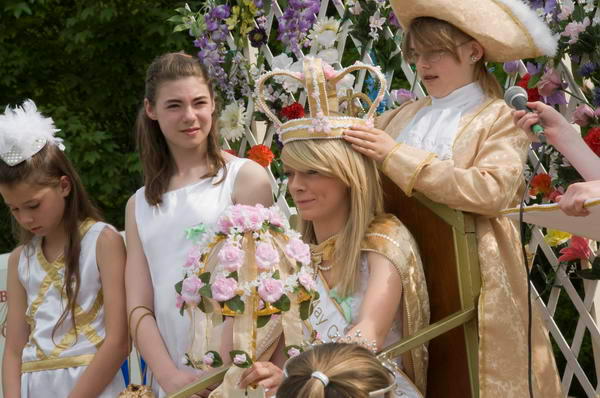
The London May Queen sits in her carriage
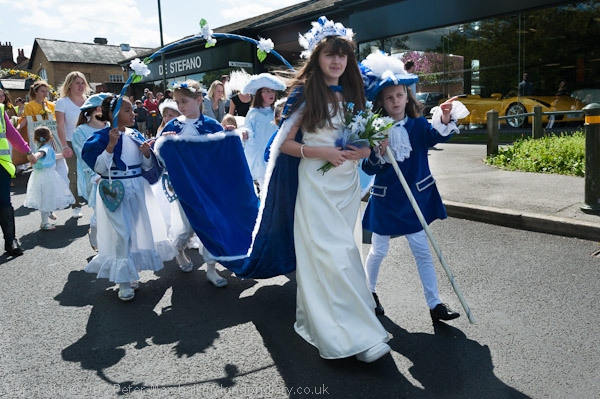
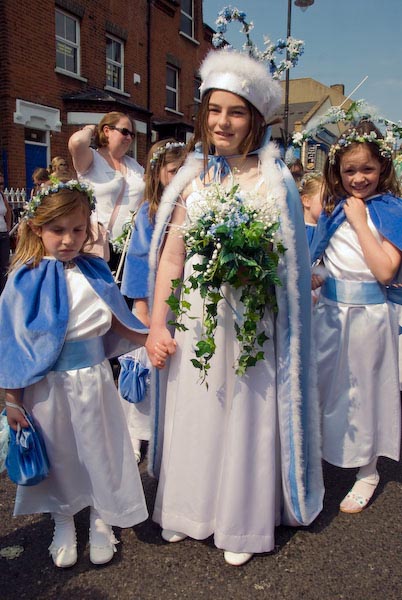
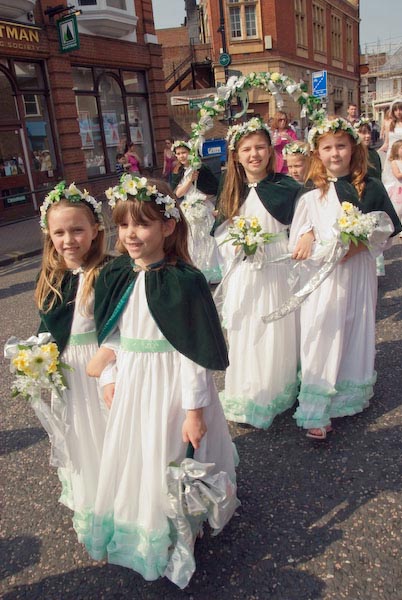
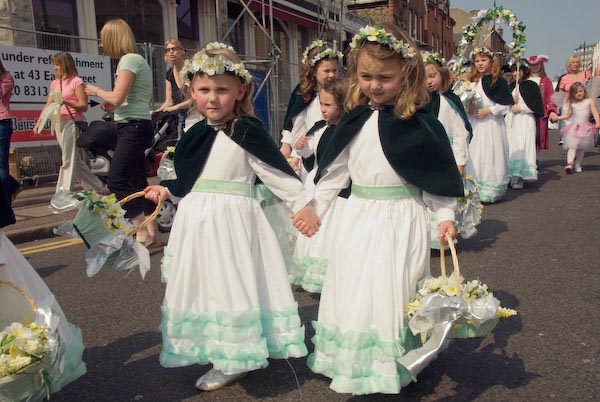
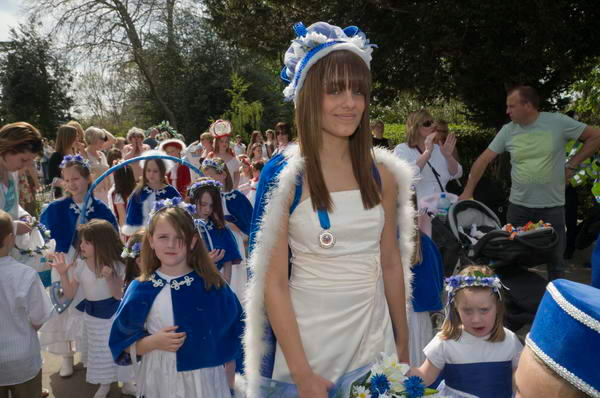
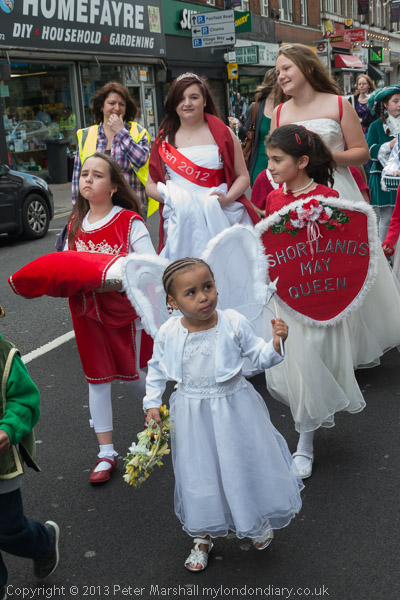
The ceremonies take place in a large roped off arena on Hayes Common, with the May Queens and their groups from various places on the fringes of south east London taking their places around it in alphabetical order. Each group has its own colour for the dresses and its own flower, and girls who may join as young as three make their way up through the various roles in the group until, if they remain long enough, they become the May Queen of their local realm. After this they can move on to join the London May Queen group, and again take the various roles by seniority until finally – usually when they are around 16 – they become London May Queen. As well as taking part in May Queen activities, May Queens and their groups also appear at various charity events in their local areas.
Beckenham May Queen and retinue
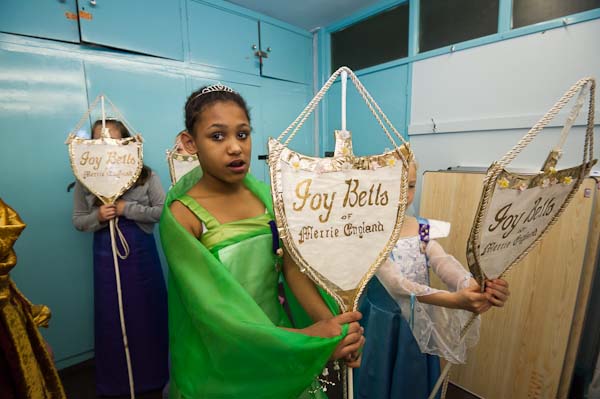
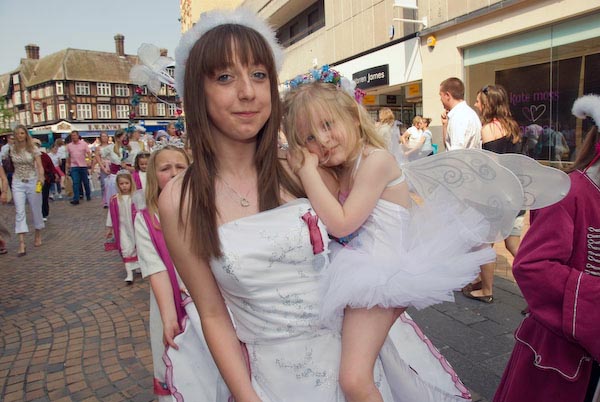
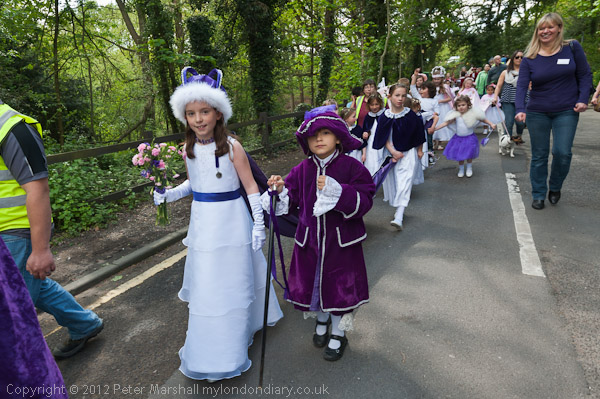
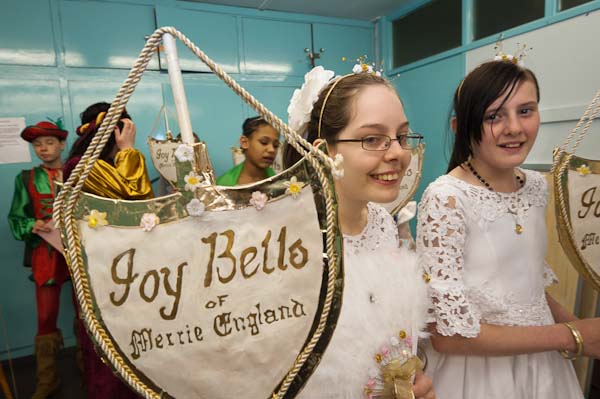
I arrived just as the procession around Hayes was starting, with the uncrowned queen in a lightweight carriage pulled by Sea Cadets with the Prince of Merrie England walking beside her and preceded by a bagpiper. Behind her were the members of London May Queen, including the Joy Bells celebrating Music, Company, Life, Beauty, Flowers as well as the Fairy Queen, Bo-Peep, Robin Hood and several others.
Bromley Common Queen and retinue
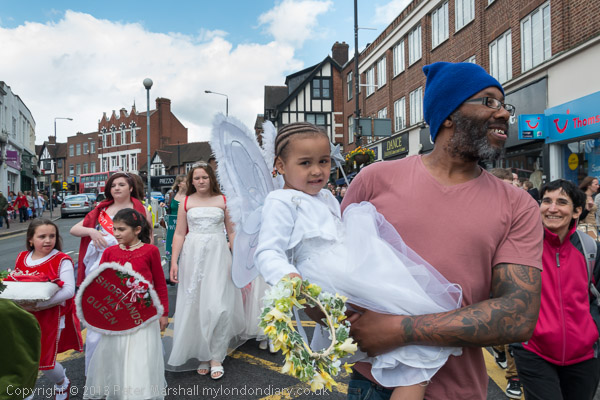
Behind them came the May Queen realms in alphabetical order – Beckenham, Beddington, Bletchingly, Bromley Common, Caterham, Chislehurst, Coney Hall, Downe, Eden Park, Elmers End, Green St Green, Hayes, Hayes Common, Hayes Village, Orpington, Petts Wood, Shortlands, Wallington, Warlingham and West Wickham. In the heyday of the event in the 1920s and 30s there were as many as 100 groups, and the event made the national newspapers and the cinema newsreels.
At Hayes Parish Church for Little Sanctum
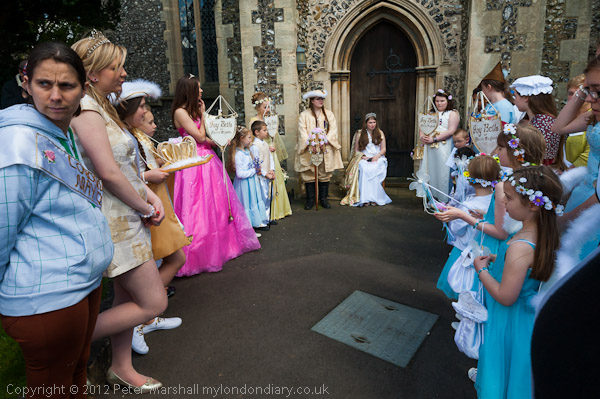
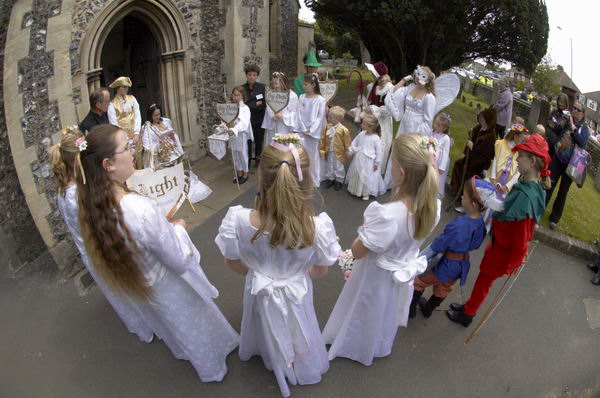
At the parish church, the London May Queen group made their way into the churchyard for a short service written by Deedy which he called ‘Little Sanctum’, before joining back on the end of the procession around the village and back to the common.
There the 100th May Queen was crowned and the further pageant witten by Deedy performed, ending with the May Queen being led around the arena by BoPeep and scattering flowers towards the seated May Queen realms.
Many of the younger girls were quite tired by the walk around the village and were busy eating ice cream and sandwiches, which revived them considerably, and after the Chislehurst May Queen group had given a demonstration of ribbon dancing, all of the Merrie England children – including a few young boys who mainly take part as pages – came and took part in a lively circle dance around the large maypole.
All that was left was for the May Queen to draw the tickets for the raffle which helps to cover the expenses.
You can read more about this and other May Queen ceremonies in London both in reports of the various events on My London Diary and from my book mentioned above. I had hoped that this would be followed by a major exhibition and a more scholarly work illustrated by my pictures but as yet this has not been possible.
I sat for some time wondering what to write about today. Perhaps the obvious choice would be to point out that this is the 76th anniversary of VE Day – and I did attend some events to mark the 60th anniversary back in 2005, both on Saturday May 7th in Ilford and May 8th in Bromley. Sixty years on from the event itself, this was probably the last occasion when a significant number of actual veterans were still around in their 80s and 90s and able to take part.
‘Little Sanctum’, Hayes, 2005
But looking at the pictures I found it too depressing – and things now have got even worse when with none left who actually fought in WW2 to provide some realism celebrations related to the war have grown more militaristic and jingoistic, more based more on the propaganda of films and TV series and the claim “two world wars and one world cup” than the reality of a fight against fascism – and where Little Englander views have defeated the vision of a united Europe, particularly in the Brexit campaign.
Hayes, 2010
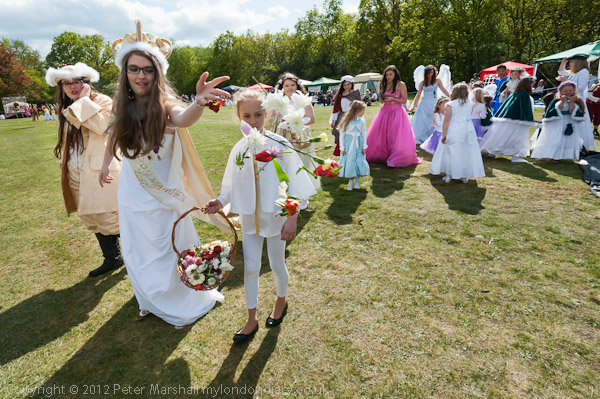
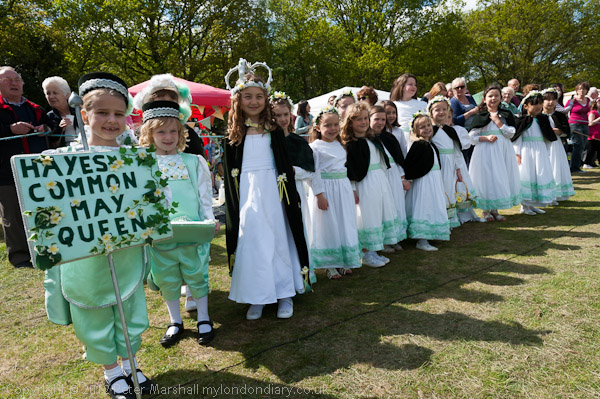
I needed something to cheer me up a little, so instead some pictures from the London May Queen crowning which takes place around this time of year on the second Saturday in May, which in 2010 was May 8th. It was an unusual year in that the weather was terrible, with cold driving rain making the usual outdoor ceremonies on Hayes Common and the parade around the village impracticable, and the event took place with a smaller number taking part inside the crowded village hall. So I’ve added a couple of pictures from other years which show a more normal view of the day.
Hayes, 2010
I’ve written about the event – with help from some of those involved – in various posts on My London Diary, and also in the book, London May Queens, still available as a reasonably priced download or expensively in print from Blurb. Getting to know some of the organisers and taking an interest in the history of the event enabled me to overcome some of the now inevitable suspicions around a male photographer photographing young girls and I was there in 2008 by invitation of some of the mothers involved.
Hayes, 2010
May Queens have a long history, although the traditional May festivities were rather different and bacchanalian. Like many English traditions, this was revived in a bowdlerised form by the Victorians, largely as a festival for children and young people. The ‘Merrie England And London May Queen Festival’ came a little later, founded in 1913 by Joseph Deedy, a master at Dulwich School, and at its peak, I think in the 1930s, involved 120 ‘realms’ from different areas mainly around south London each with their own May Queen, with well over a thousand children coming together for the crowning of the London May Queen at Hayes.
Hayes, 2010
Deedy wrote some rather quaint texts which are still used in the various stages of the ceremonies around Hayes, as well as setting the general principles and rules for the realms and the event. Girls work their way up through the organisation based on length of service, progressing though various roles, first in the local realms, and then in the London May Queen group. They can join from age three, and can remain involved until they are 18. Organisers see it as a way of encouraging social skills and developing self-confidence in the girls who take part. They often take part in local fetes, visits to care homes, and other activities as well as enjoying tea parties. The crowning of the London May Queen is the culmination of a series of events on previous Saturdays when the different realms crown their own Queens.
Hayes, 2010
Working inside the crowded hall in 2008 was difficult, but I was pleased to have the opportunity, and it provided some variety in my coverage of the event – as did the various crowning events in some of the local realms. Covid will doubtless have prevented the 2010 and 2021 events taking place but I hope it will resume for 2022. It’s a charming survival from an earlier age and one which invokes a community spirit which enriches local life.
Hayes, 2008
There are too many posts on My London Diary featuring May Queen Events between 2005 and 2013 to list them all, but you can find them easily on the web site as they are all on the pages from April and May. Here are just a few of them.
All photographs on this and my other sites, unless otherwise stated, are taken by and copyright of Peter Marshall, and are available for reproduction or can be bought as prints.