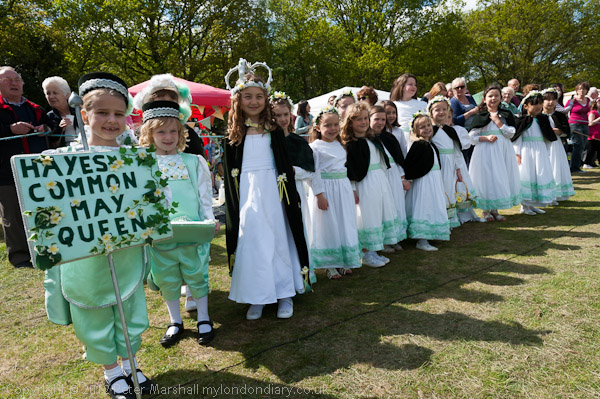
Hayes in the south-east corner of Greater London in the London Borough of Bromley is at the centre of a tradition that goes back over a hundred years, the London May Queen. At its height in the inter-war period this attracted great publicity and was filmed by Pathé News for showing in cinemas around the country – you can watch some of those films on their site.
The event began in a local school
I came to the May Queens from the posthumous book of photographs by British photographer Tony Ray-Jones ‘A Day Off’, published in 1974 soon after his tragically early death which contained a handful of his pictures from May Queen festivals taken in the late 1960s.
One of these, not one of his better photographs and I wondered why it had made the book, was ”May Queen Gathering, Sittingbourne, 1968‘, which shows around 30 young women all wearing crowns in three rows in front of a maypole. I wasn’t impressed by his picture but thought it seemed an intriguing event to photograph. The location in the caption (written after his death by a colleague) was corrected in a later publication and he had taken it at the annual London May Queen festival at ‘Hayes, Kent’ in London.
The London May Queen festival still follows the design and pattern laid down at its inception by schoolmaster Joseph Deedy in 1913. The Hayes festival at which the London May Queen is crowned is simply the peak of a series of events by various May Queen ‘realms’ each with their own May Queens and retinues from various communities in this area of south and south-east London.
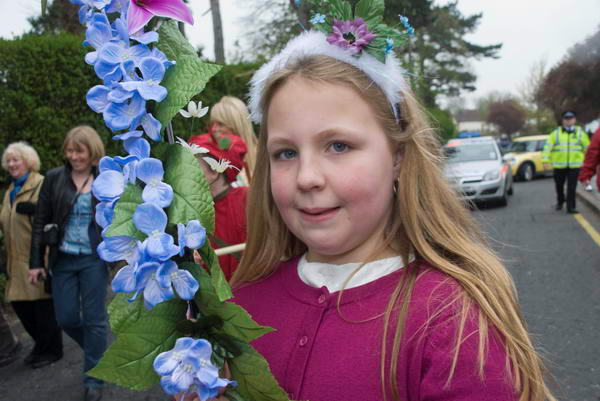
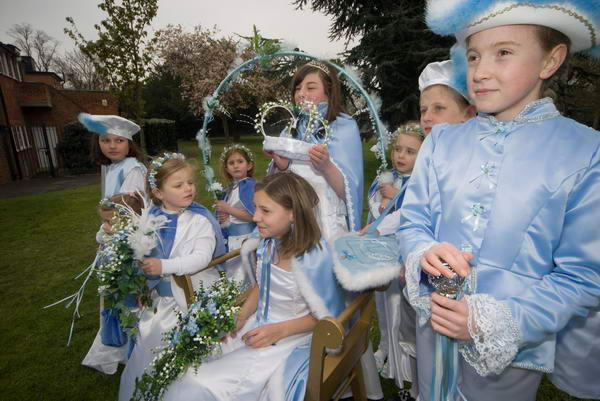
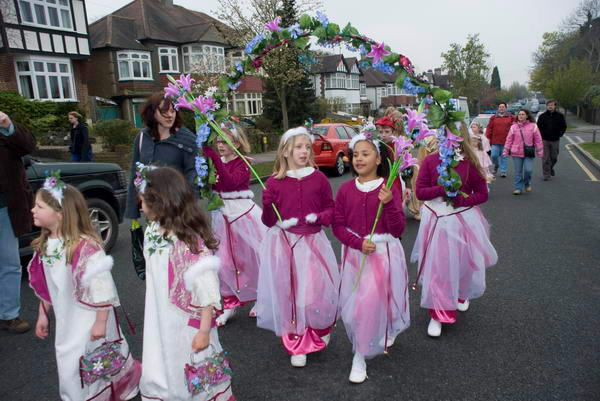
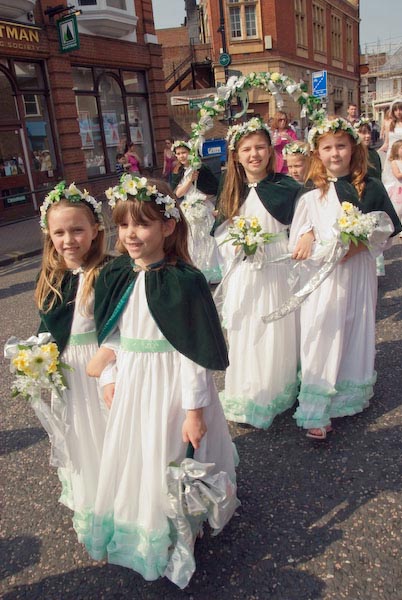
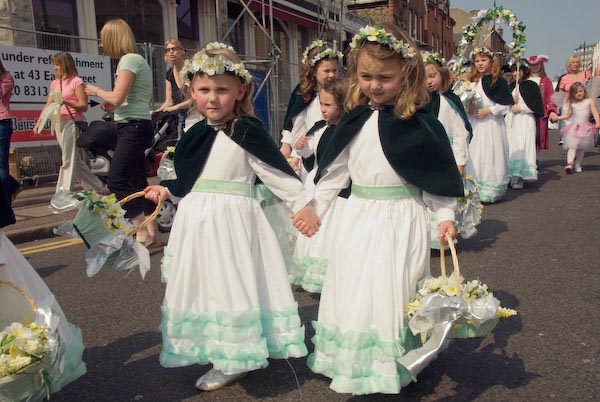
Each realm has its own colour and flower
I’ve often written at greater length about the organisation including several posts on this site such as Ray-Jones & London May Queen – 2005. My work with the May Queens was encouraged by a major London museum who promised me a show – but this was cancelled at the last minute for financial reasons, I think a victim of the 2008 financial crisis. I had hoped we would bring out a book to accompany the show, but in the end I self-published this, bringing out a second edition with minor corrections in 2012, a year before the crowning of London’s 100th May Queen.
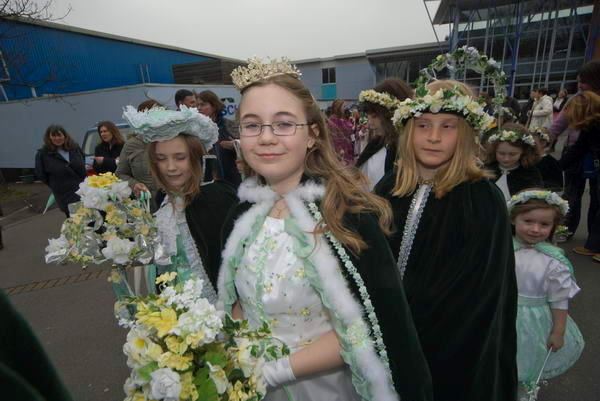
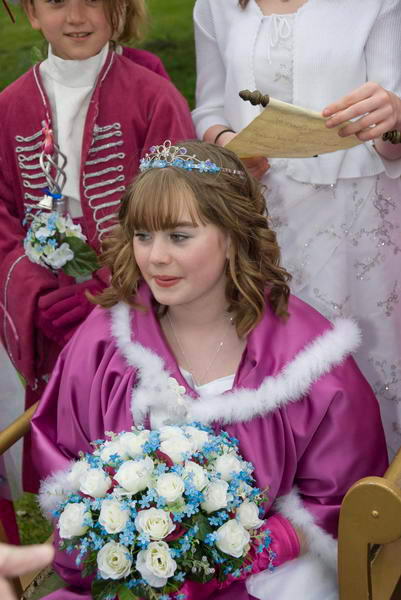
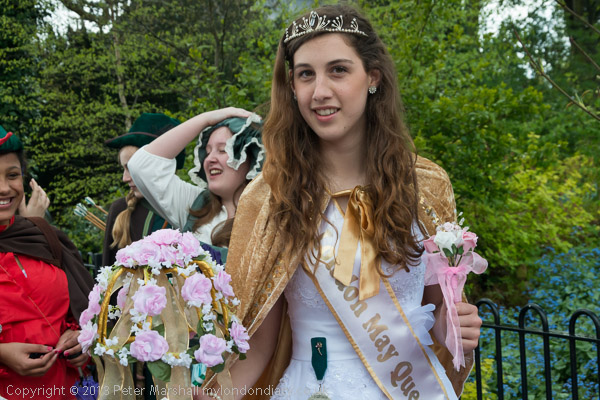
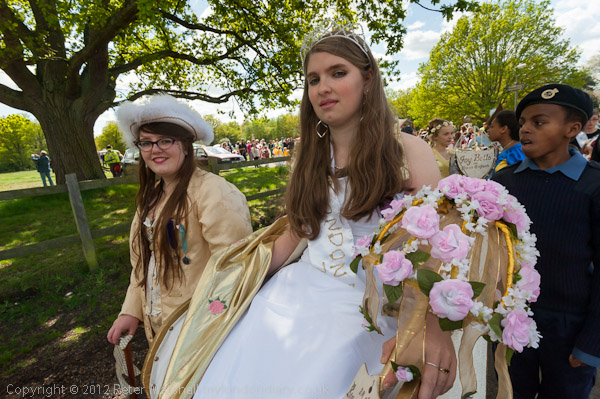
The London May Queen at this event
The book preview at the link above shows the whole book, including my fairly lengthy texts and over 70 pictures, mainly from London May Queen.
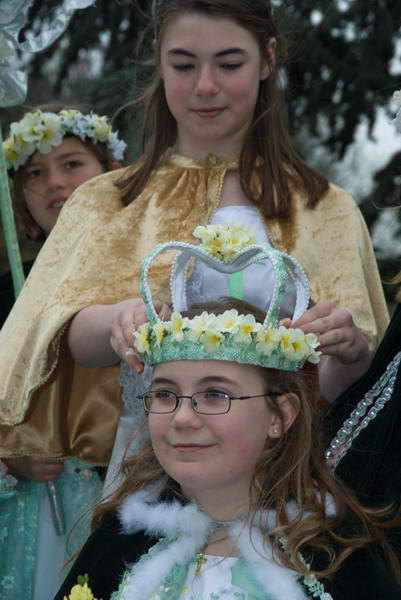
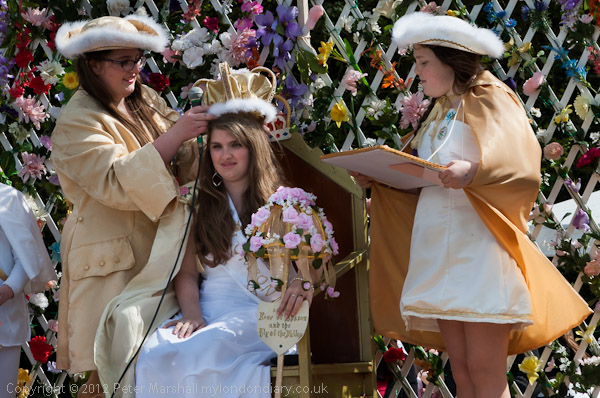
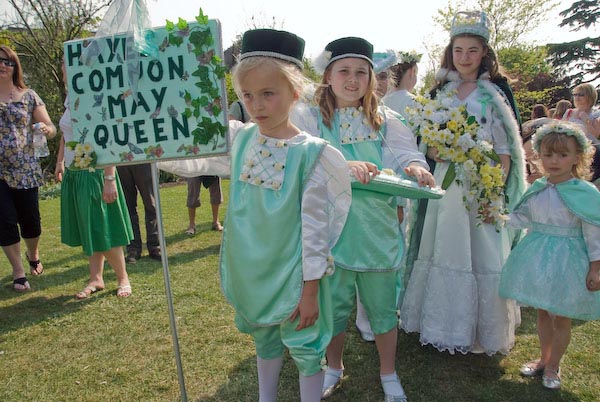
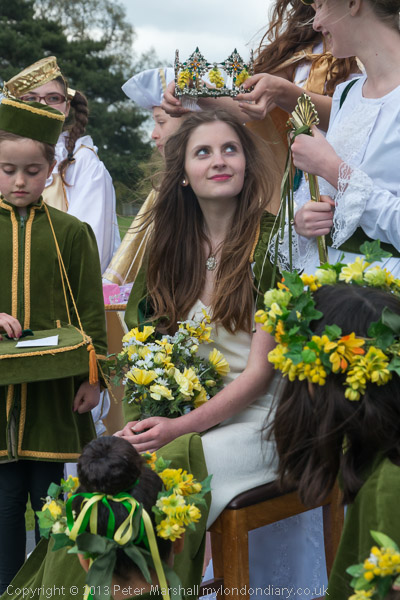
Crowning the Hayes May QueenThe Hayes Common May Queen is crownedThen came the Hayes Village May Queen
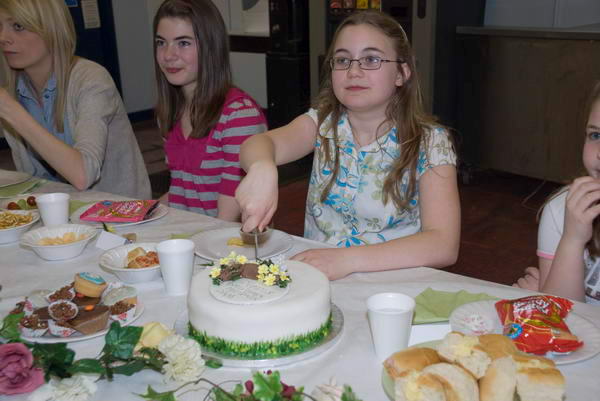
Although the event may seem rather quaint with queens, pages and other positions in the realms, the activities are designed to be fun for the young girls but also to develop their confidence and self reliance. And there are teas with cake.
Some girls drop out as they get older, and progress through the various levels of the realms and of the London May Queen group to which the realm queens move up is determined solely by seniority in the organisation.
Altogether for the project I took over 12,000 pictures, adding a few more when I was later invited back to photograph her crowning by one of the later May Queens. All the pictures with this post are from 19th April 2008 in Hayes.
Ray-Jones & London May Queen: The very first London May Queen event I photographed was on Saturday 14th May 2005. Previously I had thought that such events had died out years earlier. They had been recorded in the late 1960s and 1970s by photographers including the late Tony Ray-Jones whose work in his book ‘A Day Off‘ published posthumously in 1974 (and earlier publications in Creative Camera magazine and elsewhere) had a great influence on myself and other young photographers in the UK.
The Queen’s carriage is pulled by the Girls Brigade. All photographs here by Peter Marshall
Ray-Jones had won a scholarship to the USA to study design at Yale in 1961 and there he had been greatly influenced by the work of Robert Frank in his book ‘The Americans’ published in France in 1958 and in the USA the following year as well as the work of a younger generation of American photographers Frank’s work had inspired. After Yale Ray-Jones worked for several years in the USA and attended workshops with the legendary art directory Alexey Brodovitch.
He returned to the UK and as well as taking photographs promoted his US-acquired views on photography with an evangelistic fervour. In this he found an ally in the Bronx-born photographer John Benton-Harris, another ‘Brodovitch Boy’ who had settled in London – who I later became friends and worked with. After Ray-Jones died tragically young from Leukaemia in 1972 it was Benton-Harris who made the prints that were used in ‘A Day Off’, printed very much in the style of the time.
Among the several images in the ‘Summer Carnivals’ section of the book were several from May Queen festivals, including a large group photograph of over twenty young girls all wearing crowns in front a maypole. The caption ‘May Queen gathering, Sittingbourne, still used on the Getty site, 1968′ was incorrect (as were some others as the photographer was no longer alive and they were captioned by others.) Possibly the least characteristic image of the book it was actually from the crowning of the 1968 London May Queen on Hayes Common in the London Borough of Bromley.
From two of my close photographic friends following in the footsteps of Ray-Jones and Benton-Harris photographing English Carnivals with an Arts Council grant I found that these events were still taking place and I decided to find out more. It was hard to find information but I was finally able to find the date and time of the 2005 crowning.
I arrived at Hayes Common with some trepidation. Since Ray-Jones had taken his pictures there had been several decades of warnings from the government and media over “stranger danger” and panic over men pointing cameras at young girls was rife. Although this was a public event, before taking any pictures I went to find the organisers and explained what I hoped to do. I had for some years been part of a group of photographers, London Documentary Photographers, organised by Mike Seaborne at the Museum of London and had ID from them as well as a Press card which, unusually for me, wore visibly on my jacket for the event. This possibly wasn’t a good idea as the organisers were worried that some of the older girls taking part might be embarassed to have their pictures in the local press. They were less worried about me posting them on the web or elsewhere.
The children – many girls but with a few brothers among them – were almost all eager to have their pictures taken, and their mothers (and there were a few fathers too) were also happy to have a record of the day. From this first event I got requests to photograph other events in the London May Queen cycle the following year and for years later, though I was often busy elsewhere and unable to do so.
A few days after the event I put the pictures on-line with a long explanation about the event and an invitation to the mothers to ask me if I had other pictures of their children and for larger files they could use to make prints. I’d also given out copies of my business card to many of thembut made it clear I would be happy to provide digital images without charge.
Here – with minor corrections – is what I wrote in 2005.
Merrie England and London May Queen Festival Hayes Common and Hayes Village, Kent, 14 May 2005
The ‘Merrie England And London May Queen Festival’ was founded by a master at Dulwich School, Joseph Deedy in 1913, making this year’s festival the 93rd. [Later I was told he was from Whitelands College where John Ruskin had started a May Queen festival in 1881 – still continuing at Roehampton University as a May Monarch.]
The tradition of May Queens is much older, coming from pre-Christian times, as the Goddess Of The Spring, who the Romans called Flora. It was a traditional time for young women to come to the villages from the farms to find a husband, and the maypole is a symbol of virility.
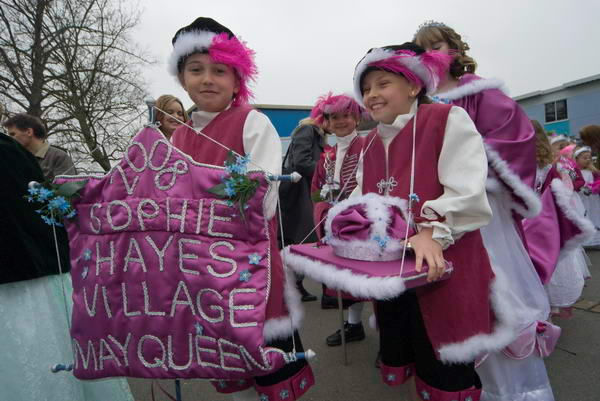
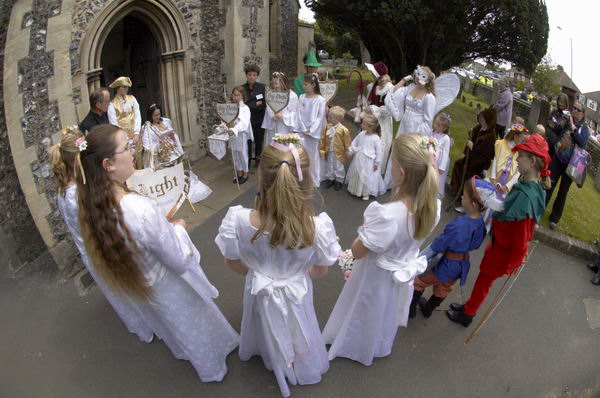
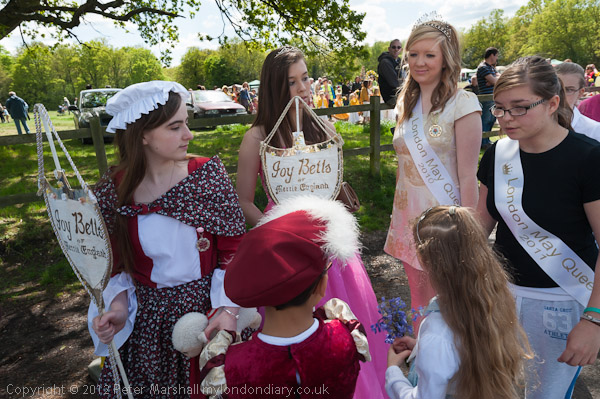
Deedy’s folklorique version is rather different from this with an uplifting script, still read by the participants as a part of the festival. Some of the texts are on the back of the signs carried by the attendants of the London May Queen, the ‘Joy Bells Of Merrie England’ representing ‘Music’, ‘Company’, ‘Beauty’, ‘Light’…
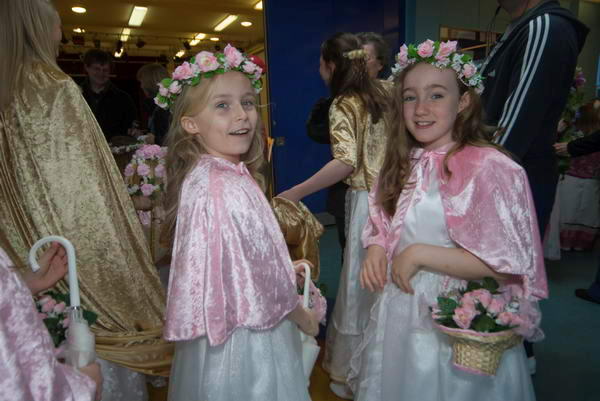
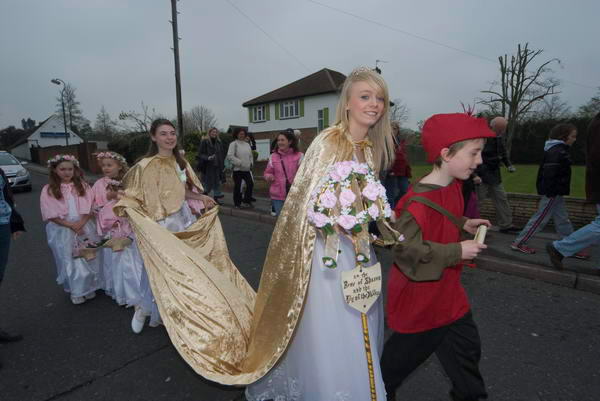
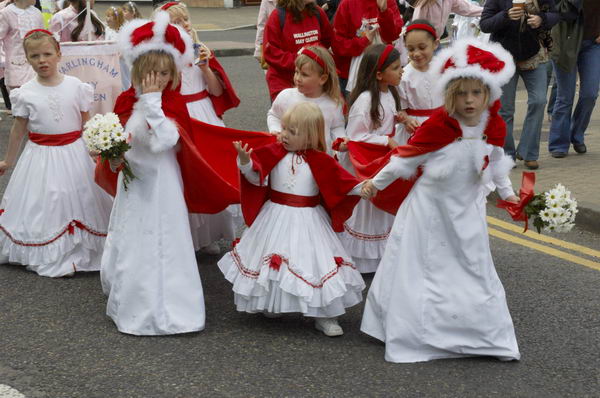
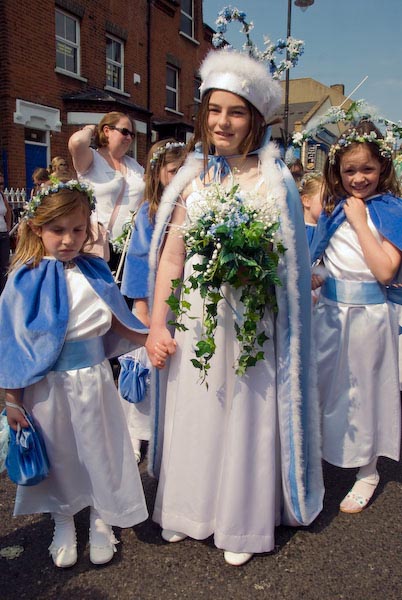
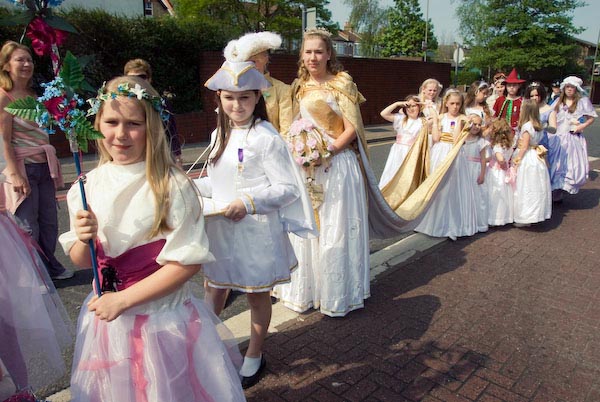
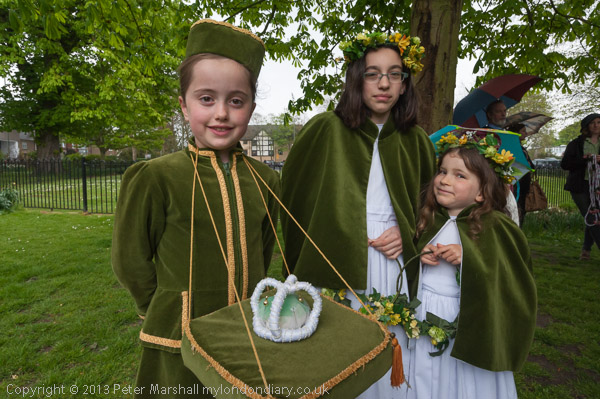
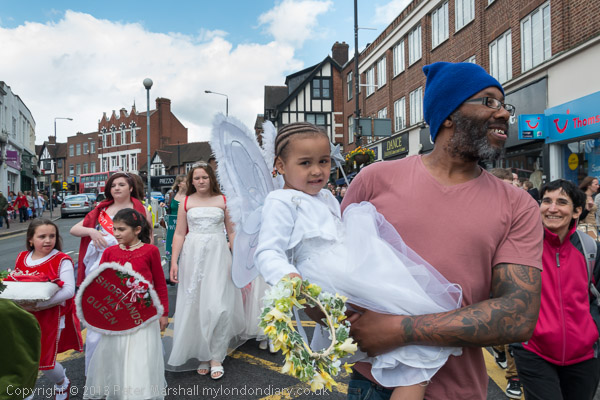
The London May Queen is also attended by ‘The Prince Of Merrie England‘ (also female) along with the Fairy Queen, Bo-Peep and Robin Hood. The event is also attended by a couple of dozen ‘Realm Queens’ each also with her attendants: a Prince, Banner Bearer, Crown Bearer, Pages, Fairies and Flower Girls, from half a dozen to twenty or more girls, all dressed in the particular Realm Colours and with their own Realm Flower. At its peak in the 1920s and 1930s there were 120 realms with well over a thousand children taking part in the event on Hayes Common.
The various positions are decided entirely by seniority in the organisation – children can join when they are three and continue until their sixteenth birthday. Many of the mothers I talked to at this and later May Queen events had been May Queens or taken part in the ceremony in their childhood; one of the organisers was May Queen in 1932 and her grandchildren were taking part in 2005.
As well as the Hayes festival, there is another a week earlier in Beckenham, where most of the realm queens are crowned. The queens and realms also take part in other fêtes and carnivals, take flowers to the elderly and attend flower services in churches in their areas. Almost all the realms come from the surrounding areas in surburban Kent and Surrey (now mainly in Greater London.)
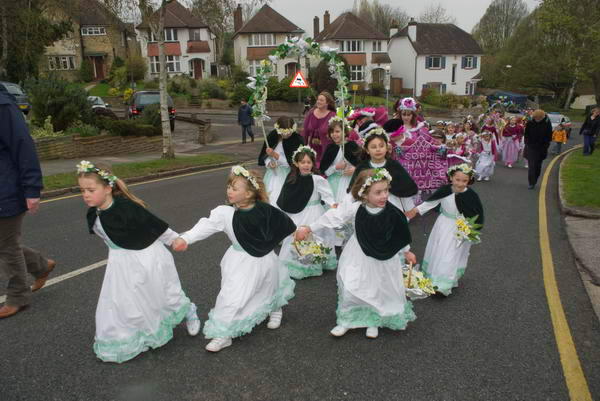
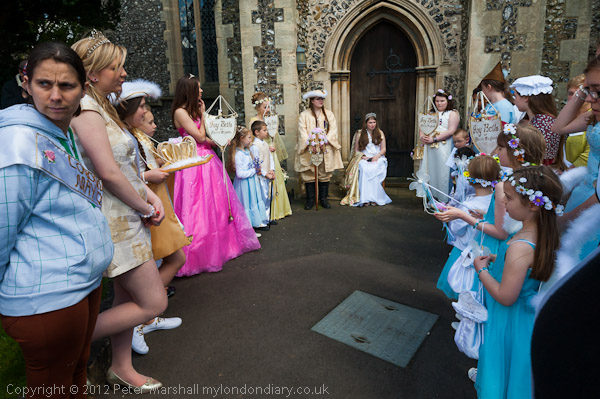
The children process, [in their realms in alphabetical order] from the Common to Hayes village, where there is a short ceremony, ‘Little Sanctum’ outside the village church.
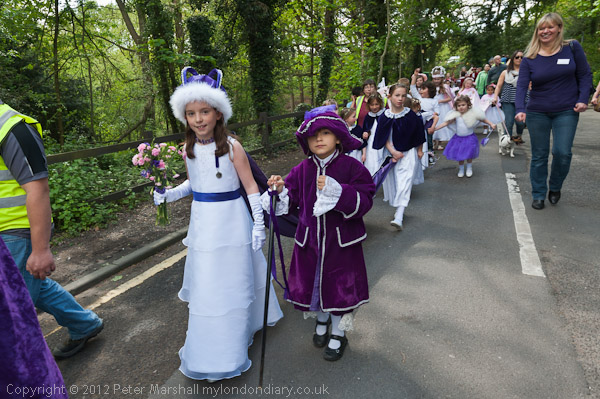
The procession then continues around Hayes, returning to the Common. This is rather a long walk for some of the younger children.
Back at the Common there is a short ceremony using Mr Deedy’s words read by the Fairy Queen, Bo-Peep, Robin Hood and others, before the London May Queen is crowned by the Prince Of Merrie England. The realm queens are then presented to the London May Queen, and have their pictures taken as a group in front of the maypole [as in that Ray-Jones picture.]
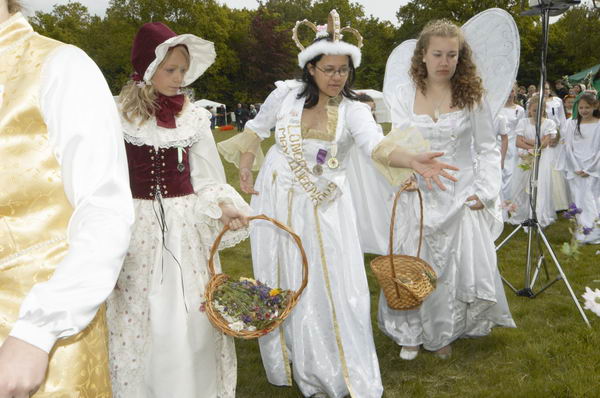
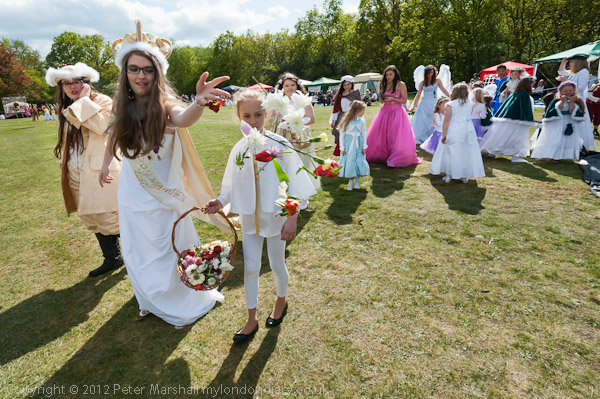
The London May Queen then goes around the field with her main attendants as Flora, with baskets of flowers which she throws to the realm children.This is followed (after the rather lengthy raffle draw) by dancing round the maypole in a fairly energetic and undisciplined fashion.
Punch, Morris, Nakba & London May Queen: Saturday 12th May 2012 was an unusually busy day for me, rushing from Covent Garden to Westminster and then out to Hayes Common. There were two very different events I was determined not to miss, the Nakba Day protest at Downing Street remembering the anniversary of the eviction of around 750,000 Palestinians from their homes by Israeli forces in 1948 and the crowning of London’s 100th May Queen taking place on Hayes Common on the edge of London, around a hour’s travel away. And a couple of other events I could fit in too.
I wrote all of these up on My London Diary and you can read those accounts there on the links in this post – as well as finding many more pictures, so I won’t repeat myself too much here.
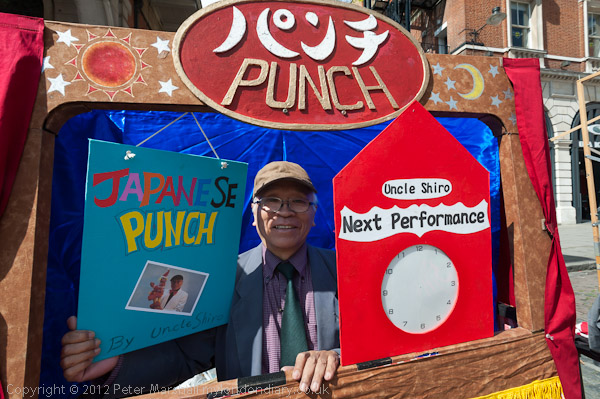
Punch Celebrates 350th Birthday – Covent Garden
‘Professors’ had come from around the world including Uncle Shiro the only Japanese Punch
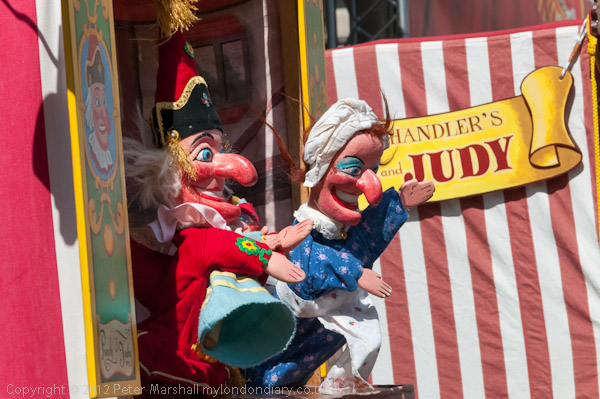
Punch and Judy professors from around the country and around the world brought their booths to Covent Garden this weekend to celebrate 350 years since Samuel Pepys first recorded a performance there in his diary.
His was the first recorded performance of the “Italian puppet play” and though Punch was then called Pulcinella and has obvious earlier roots in Italy it is regarded as the start of Punch and Judy in England.
The fun was only just starting when I left for more serious matters in Westminster. More about the day and many more pictures at Punch Celebrates 350th Birthday
Morris Men Occupy Westminster
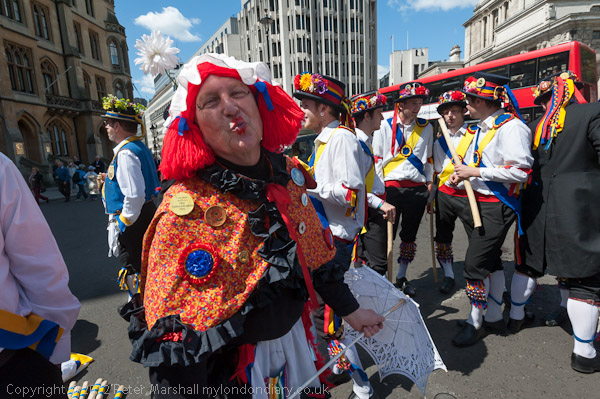
A Morris dancer dressed as a woman, who plays the fool, blows me a kiss
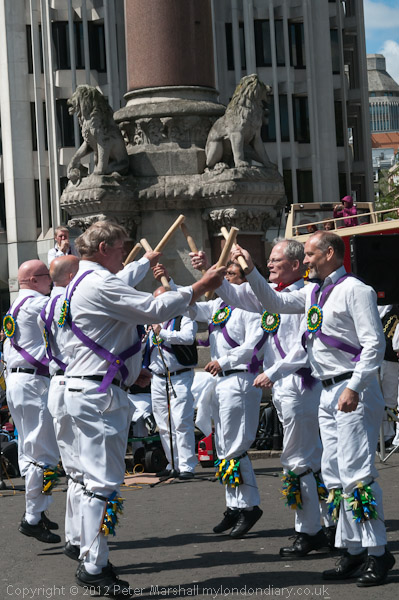
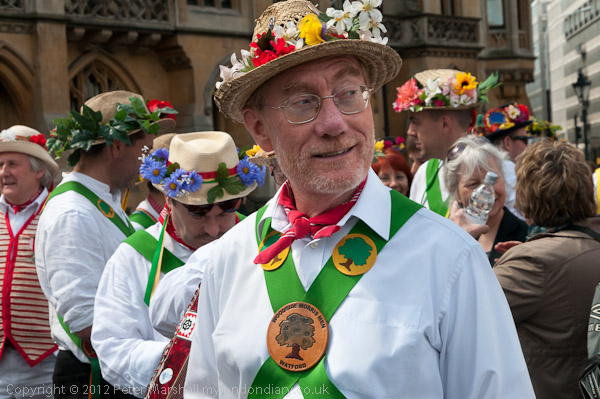
Pavements across Westminster were filled with gaily dressed men with bells on them leaping and dancing as twelve Morris sides performed in around twenty sets over the day in Central London on the Westminster Day of Dance.
The performances were taking place at various locations in the City of Westminster, including the Victoria Embankment, St Margarets Westminster, Westminster Cathedral and Tate Britain, with the various Morris sides rotating between them throughout the day.
I left as the morning sessions ended and the Morris Men had a break for a doubtless mainly liquid lunch (dancing really is thirsty work) before the afternoon sessions which, after a euphemistically named ‘Tea Break’ were to conclude with a mass performance south of the river in Lambeth by the National Theatre.
Nakba Day Protest at Downing St
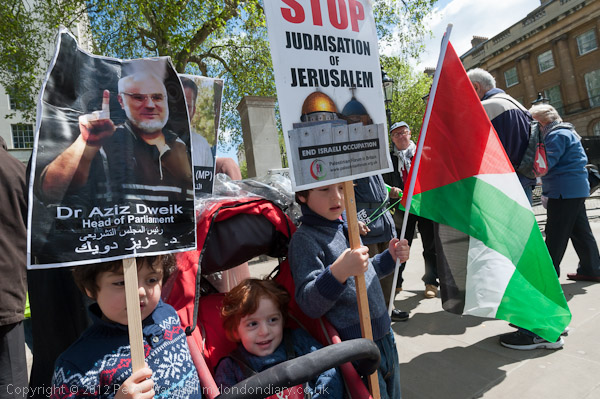
This was a family protest – young protesters hold a Palestinian flag and placards
Nakba Day is generally commemorated on 15 May and remembers the eviction of around 750,000 Palestinians from their homes by Israel forces in 1948. This London protest opposite Downing St was on the nearest Saturday.
At the time of the protest around 2000 Palestinians were on hunger strike in Israeli jails in protest against ‘administrative detention’ which allows them to be detained for consequtive periods of up to six months without any charge or trial.
Israel was still displacing Palestinians from their homes – and is currently in 2025 planning to clear them entirely from Gaza, either killing them through starvation, bombing or military eviction. Back in 2012 they were planning to forcibly displace around 40,000 Palestinian Bedouin from the Naqab desert, threatening to demolish the homes of around 85,000 Palestinians in East Jerusalem and to forcibly evict 2,000 from the West Bank.
Unfortunately I had to rush away while people were still arriving for the protest as I had promised to photograph the crowning of London’s 100th May Queen and was only able to take very few pictures to accompany the text.
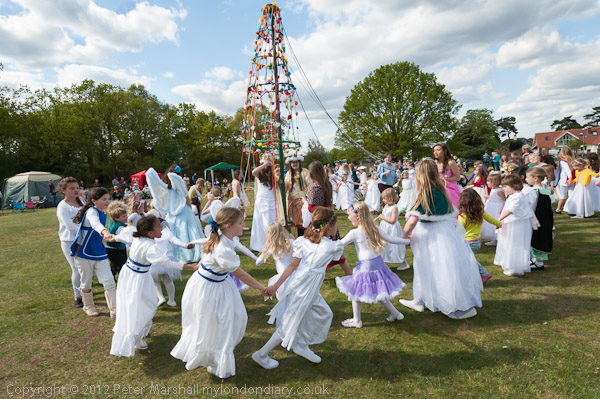
The Merrie England Children Dance around the maypole with the newly crowned Queen at its centre
The 100th London May Queen was crowned at the Merrie England and London May Queen Festival on Hayes Common, Kent, part of an unbroken tradition stretching back to 1913. 20 other Queens and their realms took part.
The ceremonies at Hayes Common, now a part of the London Borough of Bromley, continued even during both World Wars, though they were then carried out inside the local church as it was feared the procession around the village might attract unwanted attention from the German air force.
I’ve written often here and elsewhere about the London May Queen organisation and events, including a long account in my book London’s May Queens. [You can read a little more about this book – also available much more cheaply as an e-book – on >Re:PHOTO and can read the text and see many of the pictures at the book link.]
But there is one section of my post in 2012 which adds something to the story, so I’ll repeat it here.
“Whitelands College in London started its May Queen festival rather earlier in 1881 at the prompting of John Ruskin, and this still continues at the college (now part of the University of Roehampton) although since the college now admits men, some years they have a May King in place of a queen. Talking to one of the organisers of the event yesterday I learnt that Deedy had worked at Whitelands – contrary to the published information on him.”
Fortunately I arrived at Hayes Common just in time – though rather out of breath having run from Hayes Station – for the start of the procession around the village before the crowning.
May Queens in April: Most years on April 28th I’ve photographed events around one the the more important but largely overlooked by media occasions of the year – International Workers Memorial Day – which remembers those who have died in the workplace, with the slogan ‘Remember the dead – fight for the living‘. You can read a number of accounts of some of these events on My London Diary – such as this one from 2013.
But some years – and this year, 2025 is another – I have other commitments on April 28th and have not been able to cover International Workers Memorial Day. In 2007 I was working hard on a project on London’s May Queens for a museum exhibition (unfortunately cancelled at the final stage due to financial constraints) and needed to be in south-east London to work on that. My day on Saturday 28 April began in Chislehurst and then moved on to Bromley where a number of local May Queens were crowned.
After the exhibition was cancelled I put together some of the pictures from these events in a book, London’s May Queens, still available. It’s perhaps important to say that these events are not beauty competitions but activities to raise the confidence and abilities of the girls who take part, including in public speaking and performance and that the various roles in the local groups and the London May Queen group to which they can move on are assigned solely on their length of membership. It still follows the structures and texts from its founding years.
All of the rather detailed text from the second edition of the book both about the history of May Queens, this and other May Queen events around London and around half of its pictures can be viewed in the book preview on-line. Here is the text about the book on Blurb:
2012 saw the crowning of the London’s 100th May Queen. The first Merrie England and London May Queen festival was held in 1913 and it has continued every year since, still on the same lines. In the 1920s and 30s it was a major event, covered by cinema newsreels and competitions in daily newspapers, but now it is known to few outside the over 20 local realms that take part in the annual event. The 72 pictures in this work give a unique insight into this community event.
Here with the usual corrections are the two posts I wrote in 2007 on My London Diary. The pictures here are all from that day and you can see more at the links below each post.
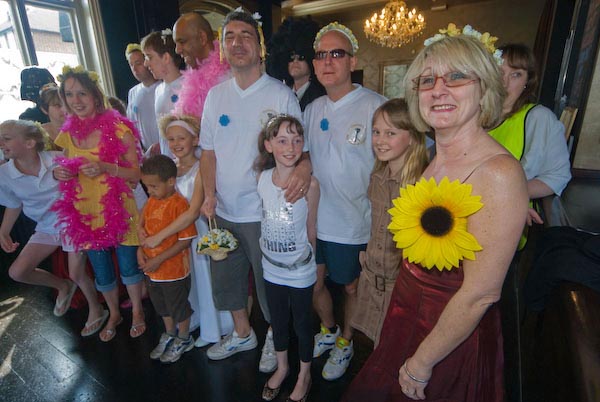
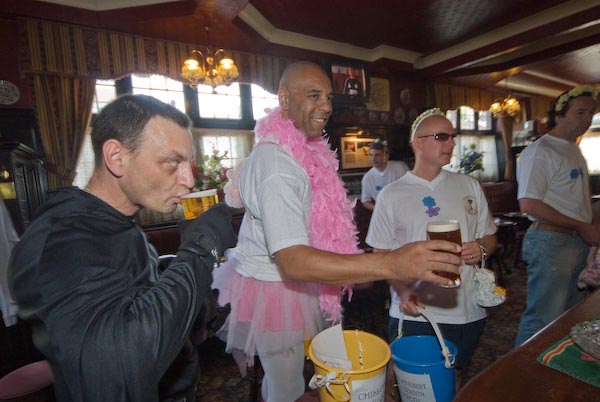
Chislehurst May Queen Society – Fund-Raising Pub Crawl
Chislehurst isn’t far from the central London but is surrounded by woods and commons and feels very different to Hither Green a couple of stations closer to the centre. Even as a suburb it feels very rural, with what looks like a large village pond and village green.
Chislehurst is one of the ‘realms’ in the London May Queen Festival, but is finding it hard to keep going and attract new young girls to carry on the tradition (see London May Queen 2005 and Chislehurst May Queen 2006) for more pictures of them.
So getting publicity in the local area is very important. They need people to notice them and the May Queen Festival, and to bring their daughters and grand-daughters along to take part in the fun. Obviously the girls who do take part are enjoying it, but it is also a commitment and takes hard work to practice the maypole dances and so on.
To get some publicity the week before the May Queen Festival they organised a sponsored fancy-dress pub crawl. I met up with them at The Lounge, a fairly newly refurbished bar at the top of the hill to the north of the town centre, with an interesting decor.
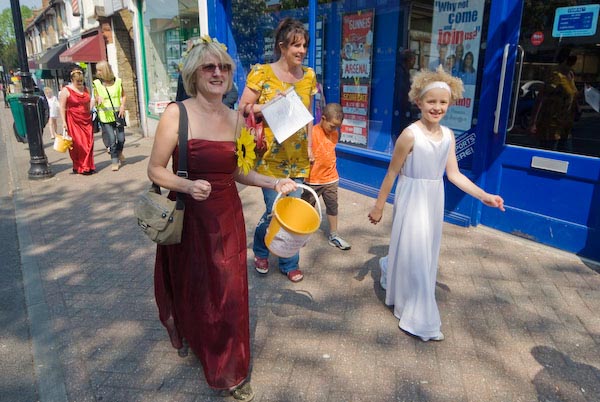
From there we went down into the centre of Chislehurst, letting people know about the May Queen and collecting money both on the street and in the pubs we visited.
I was sorry to have to leave after the third pub, when perhaps things were beginning to warm up a little, but it was fun, and I hope will help to raise the profile of the May Queen group in the area. more pictures
London May Queen: Bromley May Queens
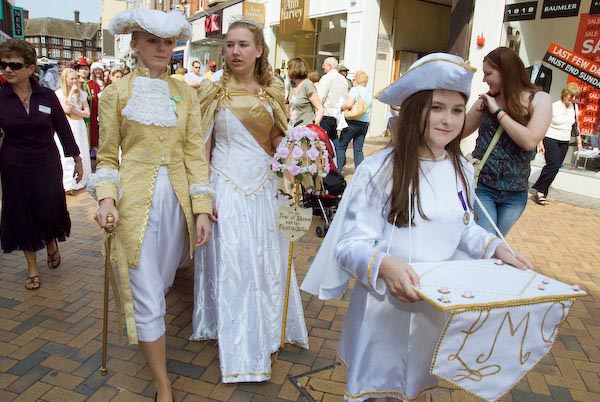
I’d promised this year’s London May Queen, Erin, that I would try to photograph her, and unfortunately I had to be elsewhere for her actual crowning at Hayes in May. So Bromley seemed a good place to catch up with her and take some pictures, as there she would be appearing with five local may queens from groups around the area – Bromley Common, Shortlands, Hayes, Hayes Common and Hayes Village.
Erin, the 2007 London May Queen, is easy to recognise in my pictures as she is carrying a frame with pink roses and white flowers that says ‘I am the Rose of Sharon and the Lily of the Valley‘, as well as a sash saying ‘London May Queen‘.
Unfortunately we got on the wrong bus to get to Bromley and enjoyed a long tour of most of the outer reaches of south-east London before finally arriving there. It didn’t help that the address I had for the start was rather vague, but finally we met up with the procession almost exactly where we had got off the bus 15 minutes of wandering earlier, and walked with the procession through the centre of the town to the gardens.
It was a shame that the police had apparently insisted that the procession rush through the town centre. It was led by the band of T S Endeavour, playing ‘When The Saints Go Marching In’ (and other popular tunes) and I’m sure they could have marched at half the pace without causing great traffic chaos – much of the centre is in any case pedestrianised.
Some of the younger girls taking part really had to run to keep up through the town centre. Events such as this enliven towns (and Bromley could do with an awful lot of enlivening, being total shopping hell) adding colour and individuality, and it seems far more important to celebrate them to the maximum than worry excessively about traffic flow.
At the gardens things were more relaxed, and the London May Queen was able to crown those of the other queens who had not already been crowned at their own local ceremonies, and there were many pictures taken by me and the mothers and fathers.
Again it’s a shame that Bromley doesn’t have a maypole and there wasn’t any singing or dancing or acting. But it was a nice summery afternoon and everyone seemed to be enjoying themselves.
Elmers End May Queen and her retinue before the crowning
I’ve attended and photographed quite a few coronations, but will be having absolutely nothing to do with events this coming weekend. It appears to me an obscene waste of money, totally unnecessary spending which could be directed towards something far more worthwhile on a medieval relic that the country should have abandoned or hugely reformed years ago.
I do remember the 1953 event, when we spent rather boring hours crammed into our neighbours front room facing a 9 inch screen on the black and white television their elder son had built from a kit. And a few days later our school’s classes were trooped along to the local cinema – appropriately The Regal – to watch it in colour. It had rained for the event and I think we also got wet queueing to be let in. I think few found the film of much interest.
Of course there was a lot of ballyhoo back in 1953, but nothing like the prolonged media assault we are now seeing – our media have changed, and largely for the worst. And while some people held street parties I don’t think there were any in our London suburb.
There was certainly a lot of talk then about a new “Elizabethan Era” but little came of it, though we were still slowly emerging from wartime austerity. For most children in the UK the more significant event of the Coronation year had been the end of sweet rationing several months earlier, though sugar, meat and some other foods remained on ration.
Back in 2004 or 2005 four pictures in the posthumous Tony Ray Jones book ‘A Day Off’ of May Queen festivals had come to my attention and I decided it might be an interesting area for a photographic project if these events were still taking place. A little research, mainly on-line told me that there were still some in various parts of London and that the picture showing young girls dancing around the maypole was, despite an incorrect caption, actually from the London May Queen event taking place annually on Hayes Common.
So in May 2005 I went to Hayes Common, very uncertain about what I would find, and also about how I would be received. Old men photographing young girls was by then a rather suspect activity, but I talked with some of the organisers and if not immediately gained their confidence. It was the start of a project over several years that attracted interest from the Museum of London, though in the end they pulled out from the show at late stage, though I think they did buy a few pictures.
It took several years of attending various crownings and other May Queen events, including a few unconnected with the London May Queen for me to build up a body of work and I extended the project a little longer than was necessary to include the crowning of the 100th London May Queen in 2012, publishing my book London’s May Queens later that year. Being publishing on demand this is now ridiculously expensive but the PDF version is reasonably priced. The preview there contains my short article about May Queens and quite a few pictures.
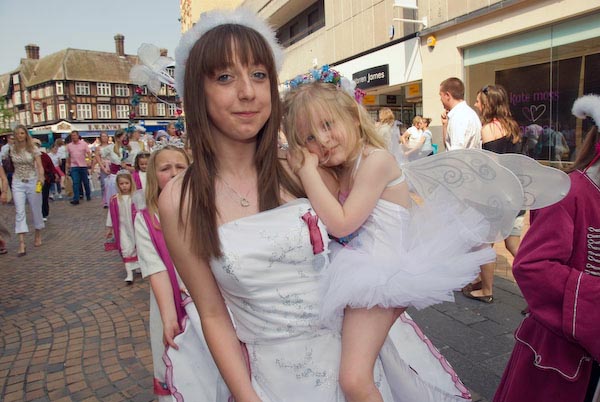
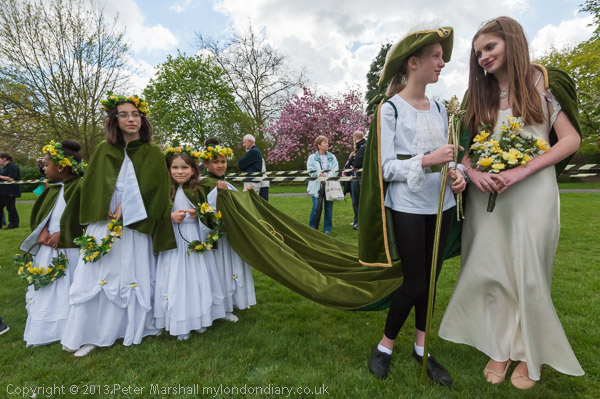
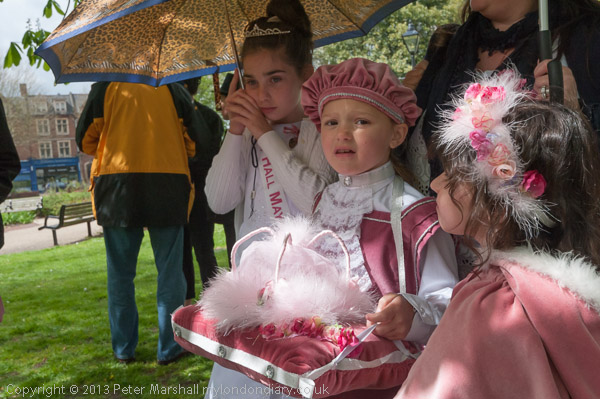
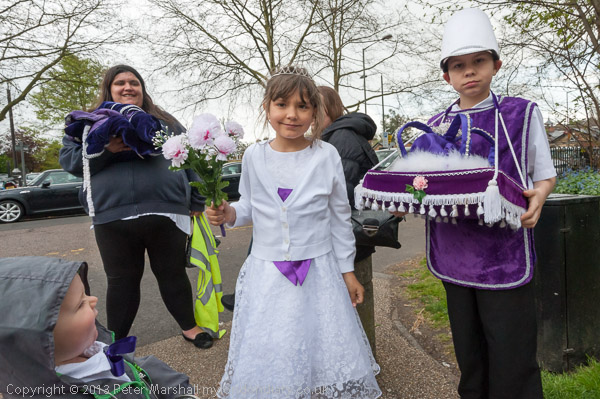
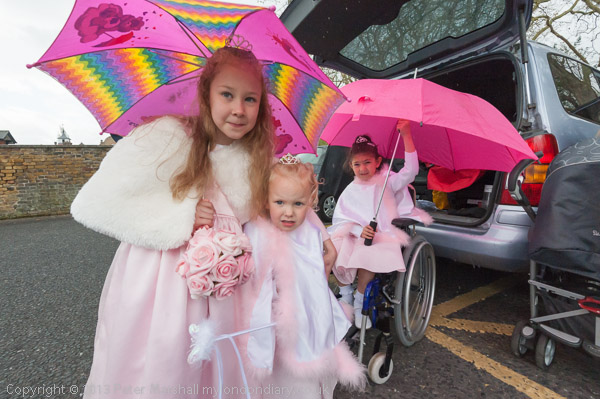
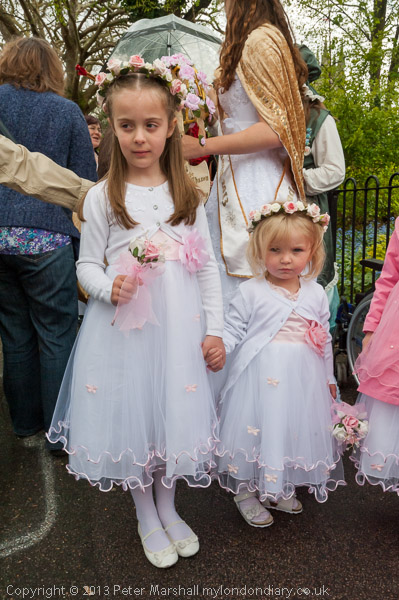
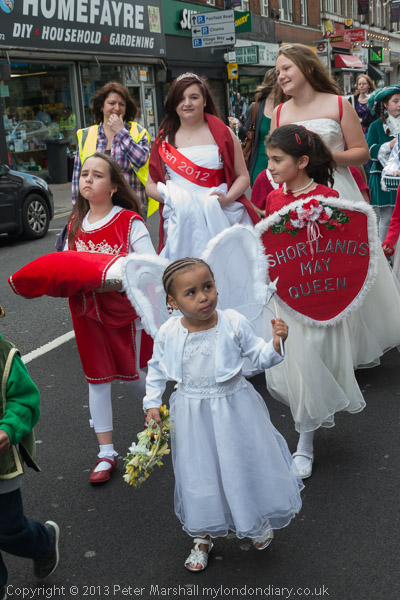
By 2013 I had finished the project, but was still receiving invitations to return to take pictures, and was pleased I had time to do so, not just for the Beckenham May Queens on Sataturday 4th May 2013, from which the pictures here come, but for the crowning of London’s 101st May Queen at Hayes the following Saturday. I think this was the last coronation I attended.
On Saturday 12 May 2012 I went by invitation from the family of the 100th May Queen to photograph her crowning on Hayes Common. Earlier I had photographed and written about the festival and other May Queen Festivals. Below is the text from my report on the event in My London Diary, with just a few minor corrections along with a few of the pictures. You can find more pictures on the web site.
The Merrie England and London May Queen Festival was started by Joseph Deedy, usually described as a ‘Dulwich schoolmaster’ in 1913, and moved to its current location on Hayes Common soon after. Surprisingly it continued throughout both world wars, although in a somewhat truncated version, with no procession around the village. It was also felt that holding the ceremony in the open air would present too tempting a target for the enemy, and so it was moved from the common to the parish church. But continue it did, and every year since 1913, one girl has been crowned as the London May Queen, making this year’s Festival and Queen the 100th.
Whitelands College in London started its May Queen festival rather earlier in 1881 at the prompting of John Ruskin, and this still continues at the college (now part of the University of Roehampton) although since the college now admits men, some years they have a May King in place of a queen. Talking to one of the organisers of the event yesterday I learnt that Deedy had worked at Whitelands – contrary to the published information on him, including that I retold in my own book and PDF on the festival. [You can read a little more about this book on >Re:PHOTO which also has has an e-pub link.) Copies of this and my other Blurb books are usually available to UK addresses more cheaply direct from me.
The London May Queen sits in her carriage
The ceremonies take place in a large roped off arena on Hayes Common, with the May Queens and their groups from various places on the fringes of south east London taking their places around it in alphabetical order. Each group has its own colour for the dresses and its own flower, and girls who may join as young as three make their way up through the various roles in the group until, if they remain long enough, they become the May Queen of their local realm. After this they can move on to join the London May Queen group, and again take the various roles by seniority until finally – usually when they are around 16 – they become London May Queen. As well as taking part in May Queen activities, May Queens and their groups also appear at various charity events in their local areas.
Beckenham May Queen and retinue
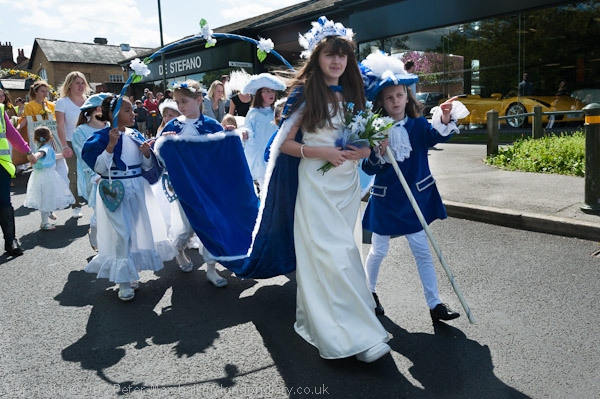
I arrived just as the procession around Hayes was starting, with the uncrowned queen in a lightweight carriage pulled by Sea Cadets with the Prince of Merrie England walking beside her and preceded by a bagpiper. Behind her were the members of London May Queen, including the Joy Bells celebrating Music, Company, Life, Beauty, Flowers as well as the Fairy Queen, Bo-Peep, Robin Hood and several others.
Bromley Common Queen and retinue
Behind them came the May Queen realms in alphabetical order – Beckenham, Beddington, Bletchingly, Bromley Common, Caterham, Chislehurst, Coney Hall, Downe, Eden Park, Elmers End, Green St Green, Hayes, Hayes Common, Hayes Village, Orpington, Petts Wood, Shortlands, Wallington, Warlingham and West Wickham. In the heyday of the event in the 1920s and 30s there were as many as 100 groups, and the event made the national newspapers and the cinema newsreels.
At Hayes Parish Church for Little Sanctum
At the parish church, the London May Queen group made their way into the churchyard for a short service written by Deedy which he called ‘Little Sanctum’, before joining back on the end of the procession around the village and back to the common.
There the 100th May Queen was crowned and the further pageant witten by Deedy performed, ending with the May Queen being led around the arena by BoPeep and scattering flowers towards the seated May Queen realms.
Many of the younger girls were quite tired by the walk around the village and were busy eating ice cream and sandwiches, which revived them considerably, and after the Chislehurst May Queen group had given a demonstration of ribbon dancing, all of the Merrie England children – including a few young boys who mainly take part as pages – came and took part in a lively circle dance around the large maypole.
All that was left was for the May Queen to draw the tickets for the raffle which helps to cover the expenses.
You can read more about this and other May Queen ceremonies in London both in reports of the various events on My London Diary and from my book mentioned above. I had hoped that this would be followed by a major exhibition and a more scholarly work illustrated by my pictures but as yet this has not been possible.