Tour de France, More Cyclists & Flowers – 2007

Tour de France, More Cyclists & Flowers: On Sunday 8th July 2007 I began work in Woolwich where briefly cyclists flashed past me in the Tour de France, a few minutes from the start in Greenwich. From there I went to Hyde Park for another cycling event before meeting a friend to go to Hampton Court to photograph people leaving the flower show there.


Tour de Woolwich

Tour de France, Woolwich

Tour de France, More Cyclists & Flowers - 2007

After a time trial around London on Saturday, which I missed because I was at college, the Tour de France started for real at Greenwich on Sunday morning, after the cyclists had warmed up a little with a ride from central London.

Tour de France, More Cyclists & Flowers - 2007

I decided I’d like to see the real race, and chose Woolwich, just a few miles from the start as offering some decent viewpoints and also the background of the Thames for at least some of my pictures. [Though not those of the Tour itself.]

Tour de France, More Cyclists & Flowers - 2007

I arrived an hour or so before the riders, and found there were already people by the roadside sitting and waiting, building up to a fair crowd by the time the race reached us around 8 minutes after the start.

Tour de France, More Cyclists & Flowers - 2007

From the time I first saw the riders in the distance to when the last rider passed was 28 seconds, so I didn’t get a great deal of time to take pictures, although I soon ran out of space in the 21 raw shot buffer and had then to wait a second or so between shots.

Tour de France, More Cyclists & Flowers - 2007

Then the cyclists were gone, followed by car after car with spare bikes and it was time to go elsewhere

[I took a few pictures as I walked from Woolwich Arsenal station to the roadside point I had decided to view the race from, including of people waiting to see the race.

I was working with the Nikon D200, a great camera but with hindsight should have switched from RAW mode to jpeg when I would have been able to take many more frames as the cyclists flashed past. The pictures of the cyclists were made with my zoom telephoto lens at or close to its longest focal length at 200mm.

In retrospect perhaps I should not have pretended to be a sports photographer and gone instead for a single image looking down on whole the event from the hill above.]

More pictures on My London Diary: Tour de France, Woolwich


The Peoples’ Village

Hyde Park
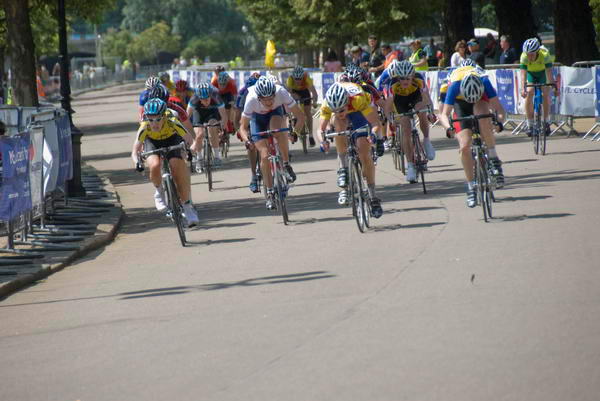
Back in Hyde Park, another cycling event, the Peoples’ Village was taking place, with various events on a loop of track around the Serpentine and the southern edge of the park.
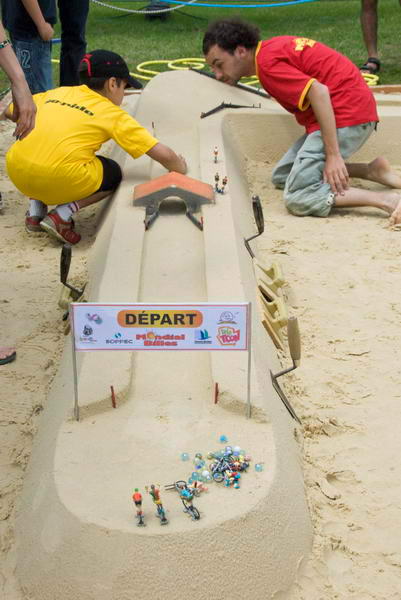
The marbles version of the Tour

There were also a number of stalls and a giant screen showing the Tour.
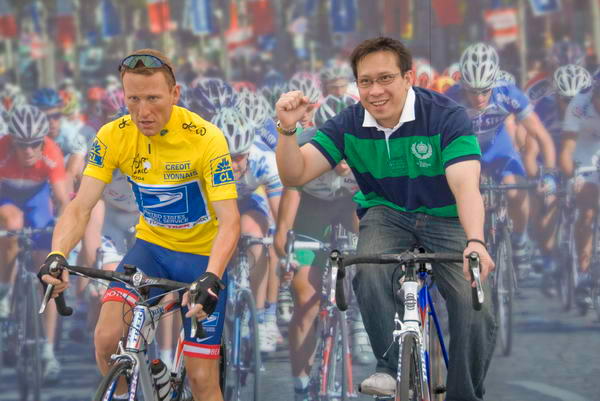
For a fiver, you could have your picture taken with a wax Lance Armstrong

I ate my sandwiches on the grass watching [the screen], though just as I sat down the peleton decided it was time for a ‘natural break’.

Peoples’ village


Hampton Court Flower Show

Hampton Court
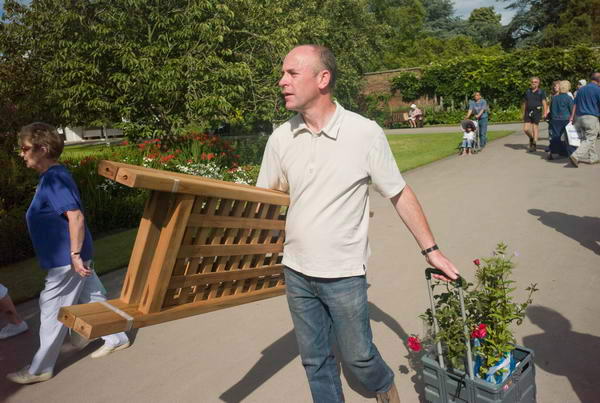
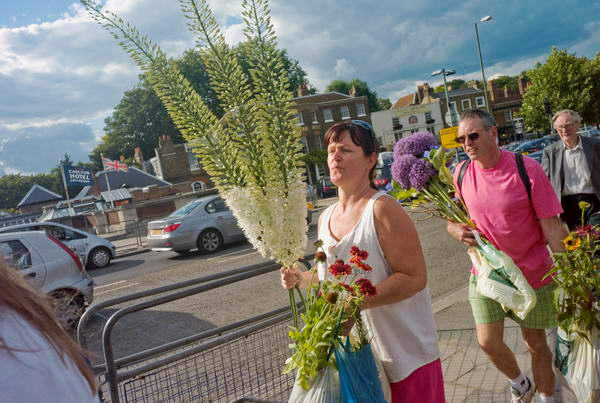
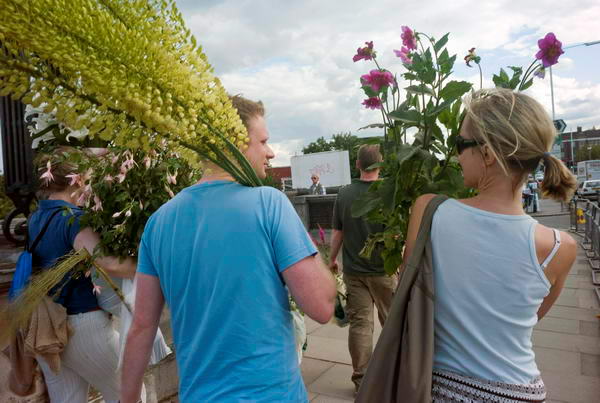
From Hyde Park I made my way down Oxford St to meet Paul, and we took the train [from Waterloo, after a pint or two in a pub] to Hampton Court to take some pictures of people leaving the Hampton Court Flower Show, carrying plants of various colours and sizes.
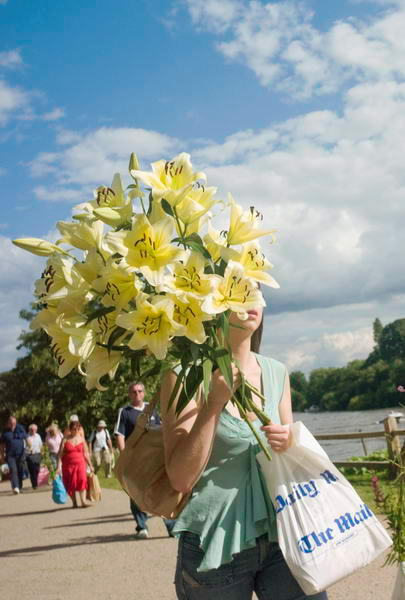
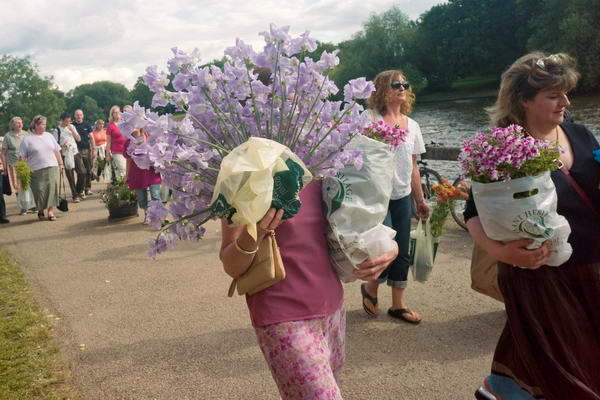
More at Hampton Court Flower Show.


FlickrFacebookMy London DiaryHull PhotosLea ValleyParis
London’s Industrial HeritageLondon Photos

All photographs on this page are copyright © Peter Marshall.
Contact me to buy prints or licence to reproduce.

Rathayatra, Roller Skates & the World Cup – 2006

Rathayatra, Roller Skates & the World Cup: I began Sunday 18 June 2006 by photographing the annual Rathayatra chariot festival in Hyde Park and on its way to Trafalgar Square, before going to Parsons Green where I found the West London Green Fair rather disappointing but did briefly meet a large crowd on roller skates on a ride around London.

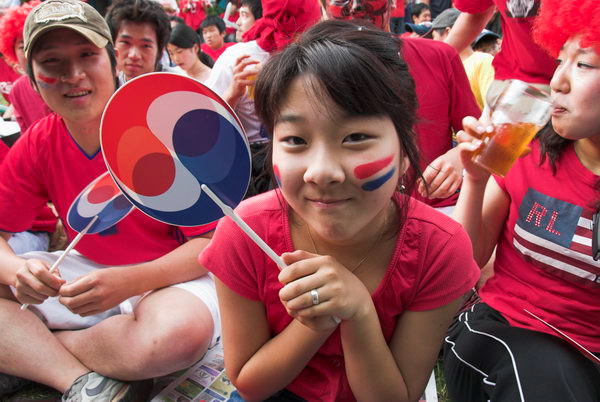
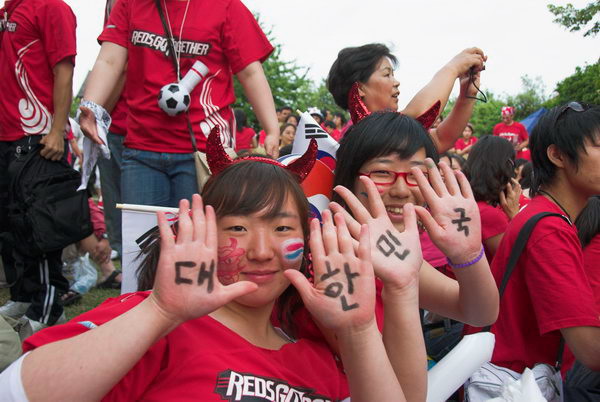
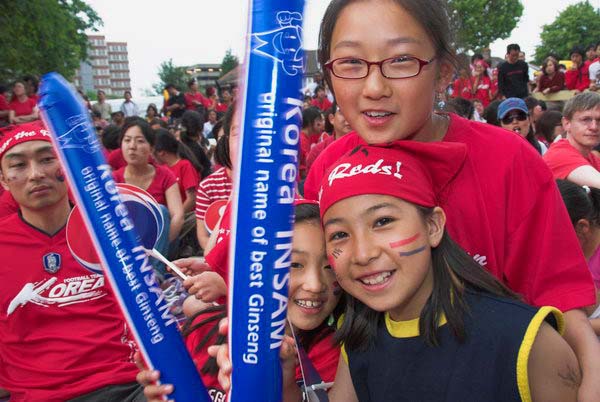
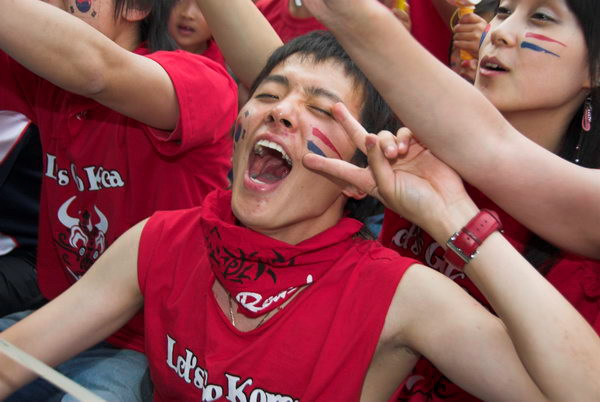
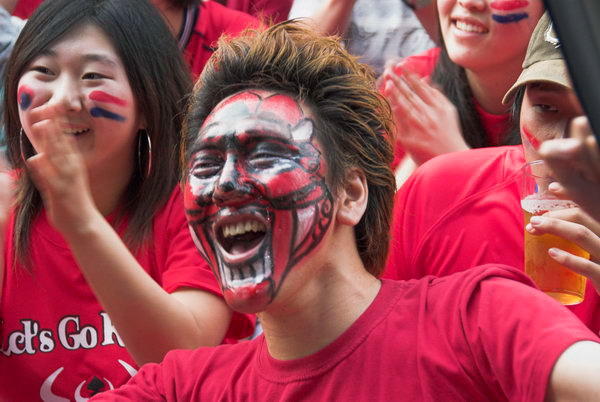
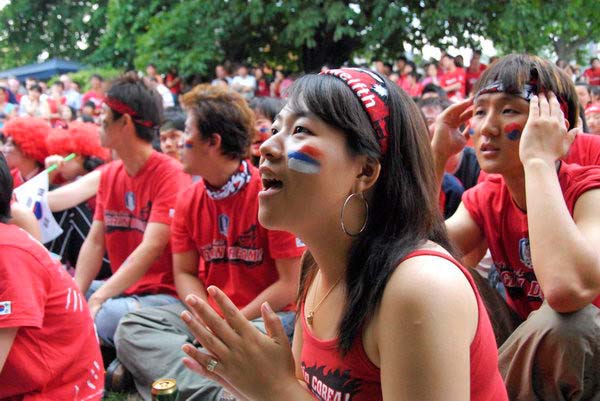
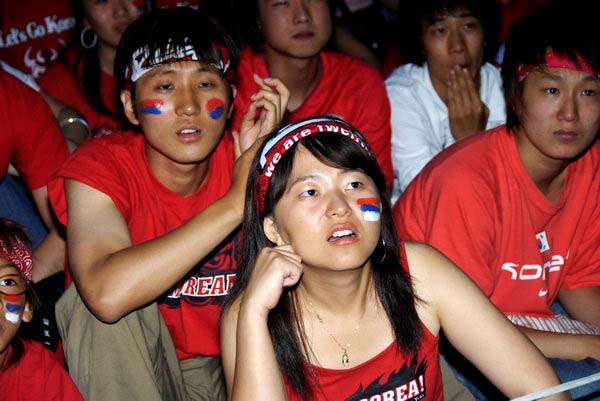
Later I went to New Malden to meet a friend and photograph Koreans who had gathered at a local pub to watch South Korea playing France in Leipzig in Group G of the 2006 World Cup. South Korea had earlier beaten Togo, and drew with France but a few days later lost to Switzerland and so failed to progress to the knockout phase of the cup. Below is what I wrote in 2006 (with the usual corrections) and links to more pictures from the day.


Hare Krishna: Rathayatra Festival

Hyde Park to Trafalgar Square

Rathayatra, Roller Skates & the World Cup - 2006

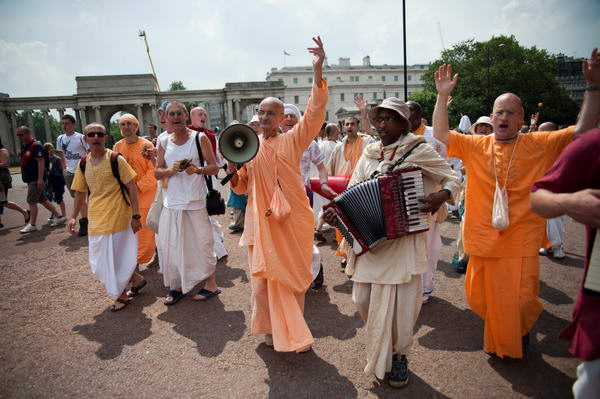
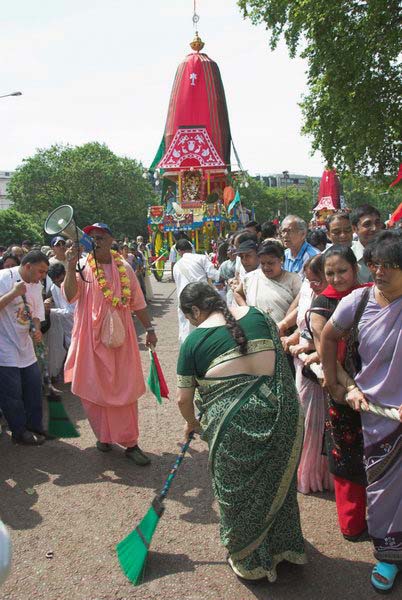
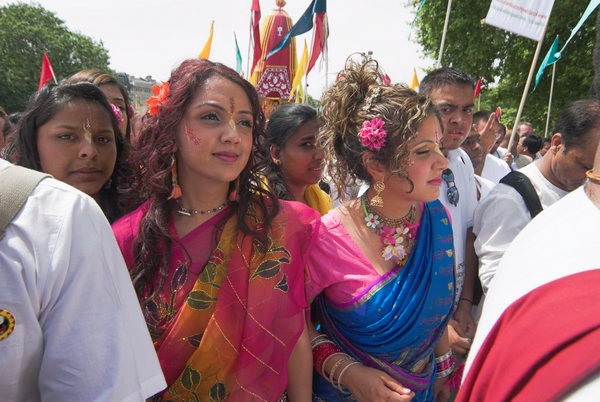
One of London’s more colourful annual events is the Rathayatra or Chariot Festival organised by the Hare Krishna movement. The three chariots carry representations of three deities, Lord Jagannatha (Krishna, the Lord of the Universe), Lady Subhadra and Lord Balarama, and pulling the ropes grants eternal service at the end of life in the spiritual world.

Rathayatra, Roller Skates & the World Cup - 2006

The ceremony dates back around 5000 years in the ancient holy city of Jagannath Puri in Orissa, India, but was only established in London rather more recently in 1969.

Rathayatra, Roller Skates & the World Cup - 2006

The chariots are accompanied by musicians and dancers, and there is free food for all at Trafalgar Square where the procession ends.

Rathayatra, Roller Skates & the World Cup - 2006

This year’s festival also celebrated the 108th anniversary of the birth of A C Bhaktivedanta Swami Prabhupada (1896-1977), who in 1966 founded the Hare Krishna movement.

Many more pictures here on My London Diary.


West London Green Fair

Parsons Green

I called in briefly at the West London Green Festival at Parson’s Green on my way to New Malden, but there didn’t seem to be much happening there.

The Skate Rollerstroll called in briefly, but didn’t stop for long.


Korea v France

The Fountain Pub, New Malden

Korean Face painting in New Malden
I’m about to have two stripes painted on my cheeks by this young woman

I was on my way to New Malden, where I met up with Paul Baldesare to go and photograph Korean supporters watching the Korea v France match at one of the local pubs.

Both inside the pub and in the garden were a whole lot of large screens, with Koreans coming to watch the game.

We got there quite a while before the start when everyone was just starting to get into the mood. Soon we both had red and blue stripes painted on our faces.

It was very much a community event, with everyone enjoying themselves, and emotions obviously ran high once the game had started.

Along with the hundreds of Koreans there were a few non-Korean locals, and one French woman with a France t-shirt. I talked to her briefly before the game began, but couldn’t find her later when I went to take some photographs in the crowd. So everyone in my pictures is a Korea supporter.

When I left, a few minutes into the second half, Korea were trailing 1-0. I missed the equaliser, and the after-match celebrations when the High Street was full of Koreans celebrating the draw.

Many more pictures here on My London Diary.


FlickrFacebookMy London DiaryHull PhotosLea ValleyParis
London’s Industrial HeritageLondon Photos

All photographs on this page are copyright © Peter Marshall.
Contact me to buy prints or licence to reproduce.

Carnival, Political Prisoners & Naked Bike Ride – 2008

Carnival, Political Prisoners & Naked Bike Ride: On Saturday 14th June 2008 I called in at Hampton Hill on my way into London for the 30th annual Hampton Hill & Hampton Carnival Parade, but it turned out to be a rather small event. In Trafalgar Square there was a protest outside South Africa House calling for the release of political prisoners held in prisons around the world and after this I went to Hyde Park for the start of the London World Naked Bike Ride.


Hampton & Hampton Hill 30th Anniversary Parade

Hampton Hill

Carnival, Political Prisoners & Naked Bike Ride - 2008

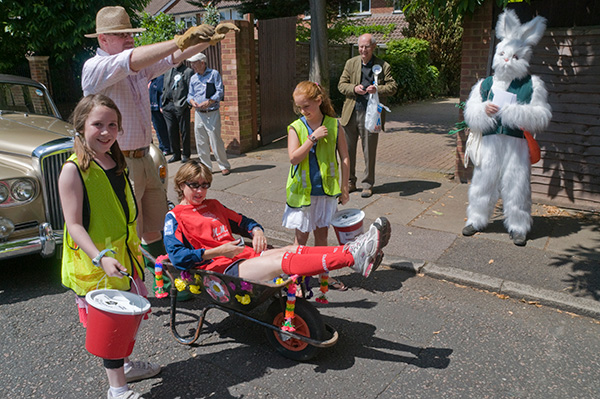
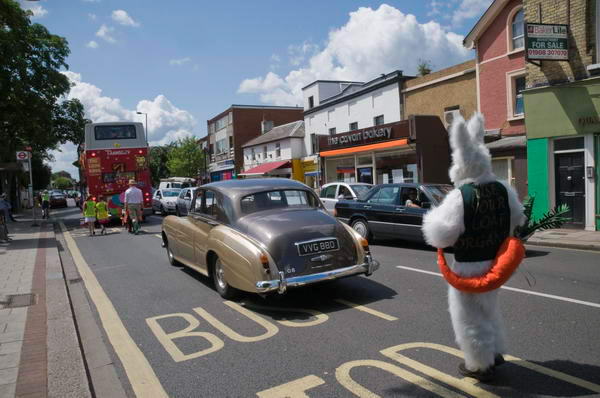
In Hampton Hill I found cows on the High Street and a large rabbit as well as a few cars and some people on foot including a gardener with a wheelbarrow, but it was a small and rather disappointing parade and I left to continue my journey to London as it made its way towards Hampton.

Hampton & Hampton Hill 30th Anniversary Parade


Free Political Prisoners – Break the Chains

South Africa House

Carnival, Political Prisoners & Naked Bike Ride - 2008

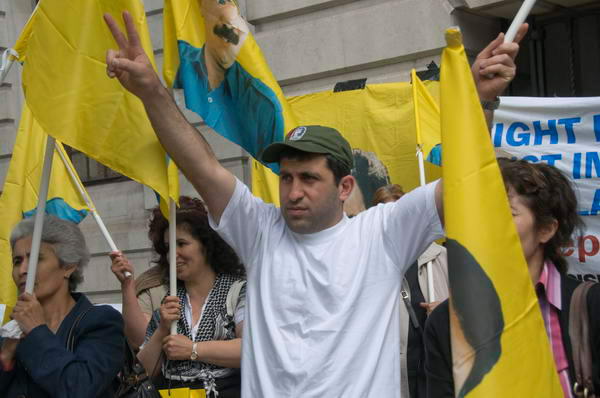
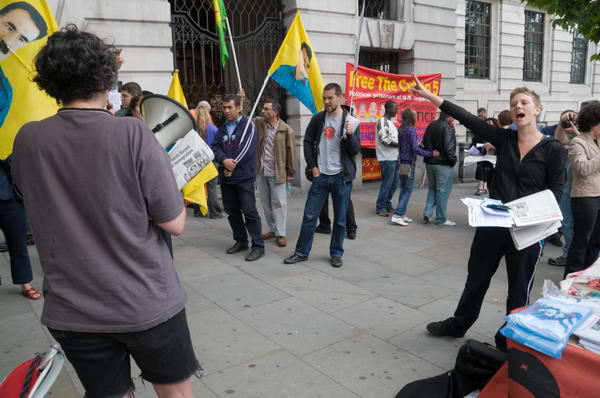
The protest here was also rather smaller than I had hoped but included a group of Kurds calling for the release of their leader, Abdullah Ocalan from a Turkish jail.

Carnival, Political Prisoners & Naked Bike Ride - 2008

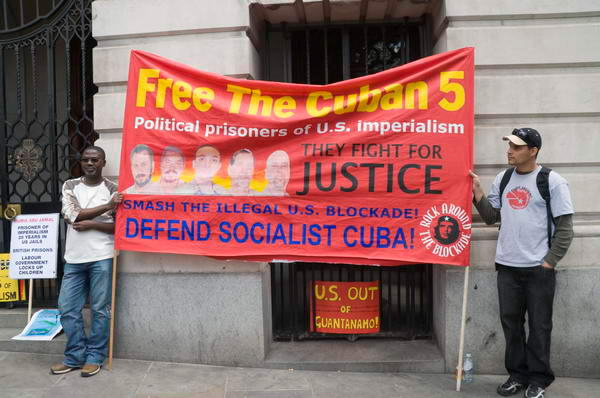
Others called for the release of the Miami Five, Cubans who came to Miami to disrupt terrorist raids made by right-wing Cuban exiles living there against Cuba and imprisoned by the USA.


There were also calls for the closure of the illegal US prison camp at Guantanamo Bay and for an end to the continuing torture there and release of refugees and asylum seekers locked in detention centres in the UK.

Break the Chains -Free Political Prisoners


World Naked Bike Ride

London

Carnival, Political Prisoners & Naked Bike Ride - 2008

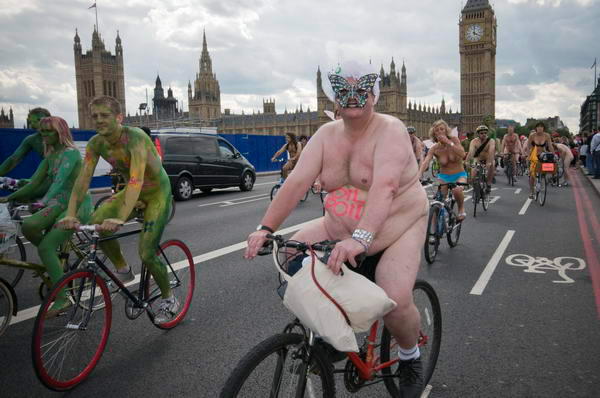
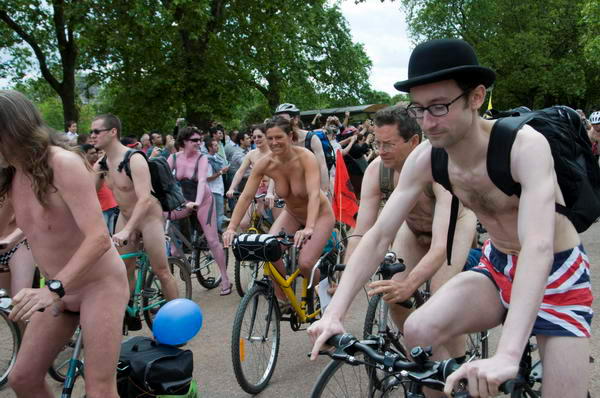
In 2008 the London World Naked Bike Ride began in Hyde Park, and I went there to photograph the riders getting ready and setting off. The start was very crowded mainly with tourists eager to view the spectacle.

Carnival, Political Prisoners & Naked Bike Ride - 2008

When all had left I took the tube to Westminster to photograph the ride going over Westminster Bridge and then as the ride regrouped I rushed to the footbridge into Waterloo Station (now demolished) for pictures from above as it came down York Road. As the last cyclist passed below me I walked into the station to catch my train home.

Carnival, Political Prisoners & Naked Bike Ride - 2008

As I commented “while bodies are very much on display environmental messages seemed at times to be rather well-hidden, leaving many of the public along the route bemused.” And on My London Diary I recount briefly the reactions of some of the people I talked to and heard as we watched the event.

Those organising the ride say it is a “peaceful, imaginative and fun protest against oil dependency and car culture. A celebration of the bicycle and also a celebration of the power and individuality of the human body. A symbol of the vulnerability of the cyclist in traffic.”

The annual ride continues to take place in London and in other cities. The 2026 London ride is today, Sunday 14th June 2026. Riders are starting from Clapham Junction, Croydon, Deptford, Hackney Wick, Kew Bridge, Regents Park, Tower Hill, Hyde Park Corner and all meeting up close to the south end of Westminster Bridge to ride together around Central London.

More on My London Diary at World Naked Bike Ride, London 2008.


FlickrFacebookMy London DiaryHull PhotosLea ValleyParis
London’s Industrial HeritageLondon Photos

All photographs on this page are copyright © Peter Marshall.
Contact me to buy prints or licence to reproduce.


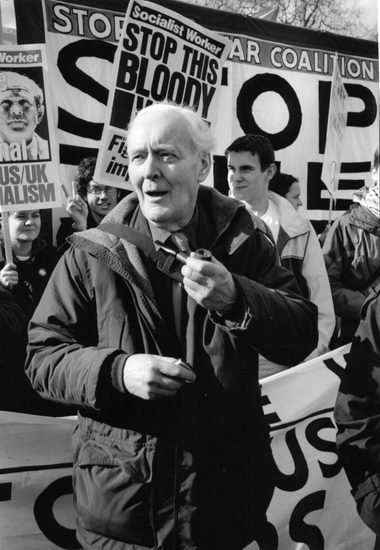
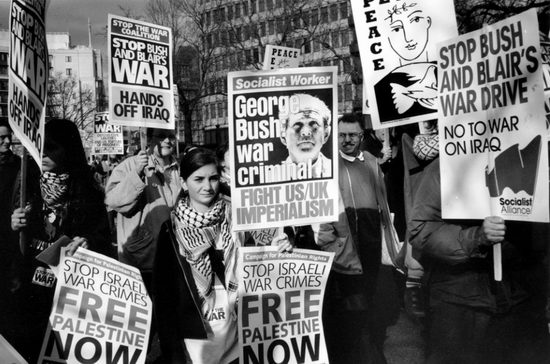
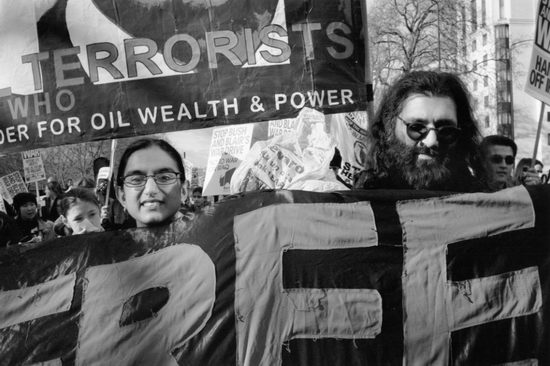
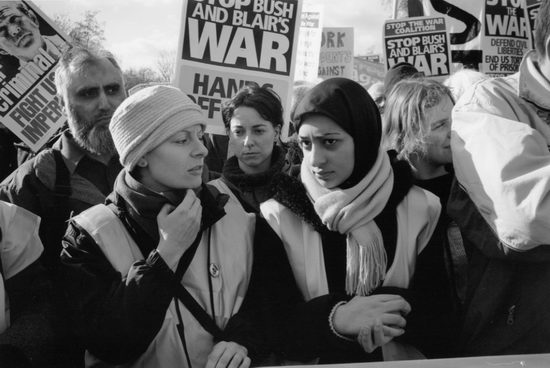
Stop The War – Hands Off Iraq – 2002

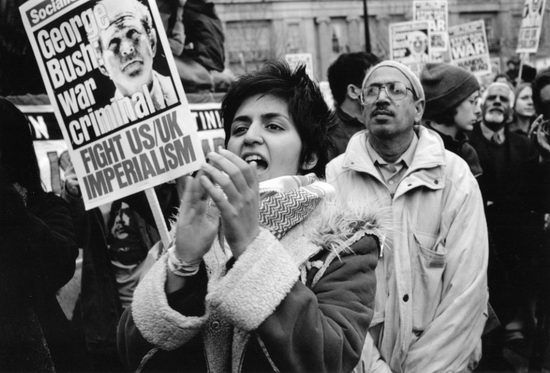
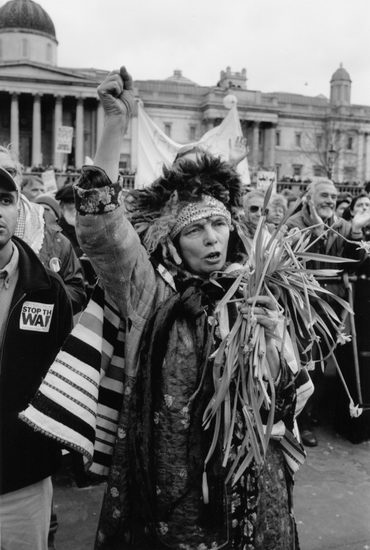
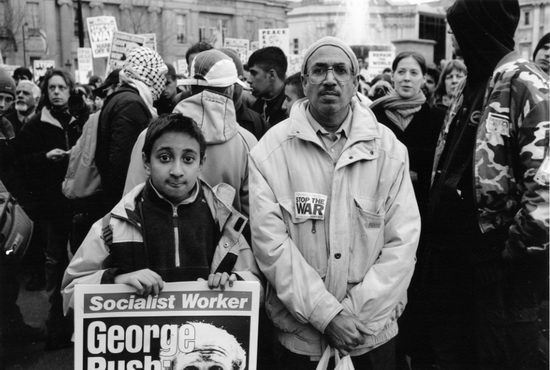
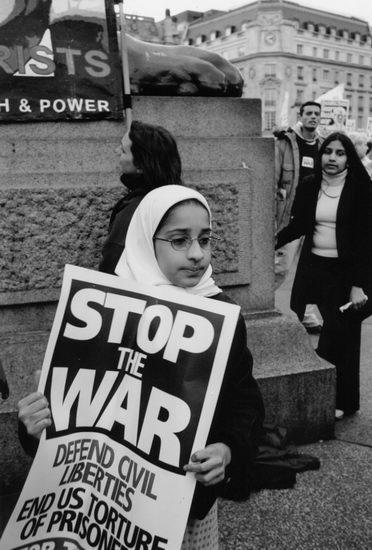
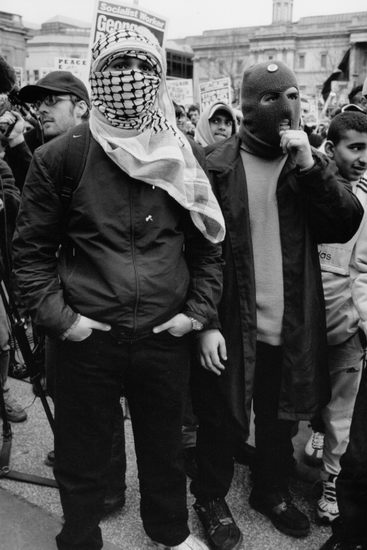
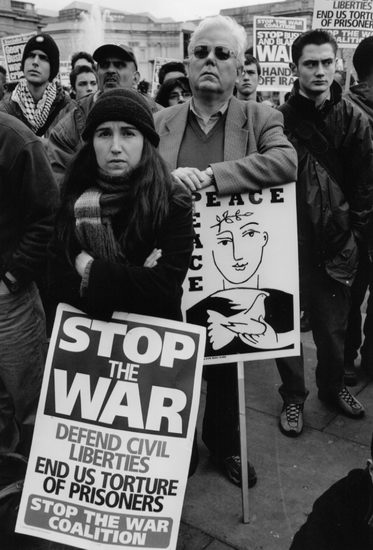
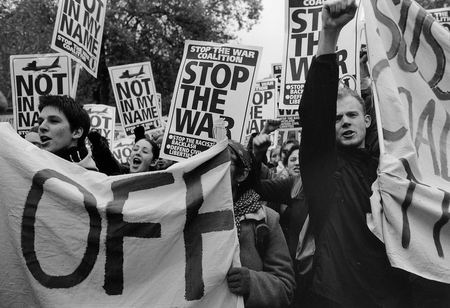
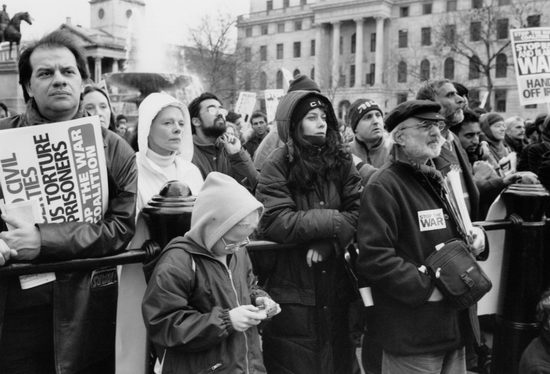
Stop The War – Hands Off Iraq: The protest in London against the US plans to invade Iraq on Saturday 30th March 2002 was I think the first of the really huge protests in London and across the world against the invasion then being planned by U.S. president George W Bush following the September 11th terrorist attacks on the United States.

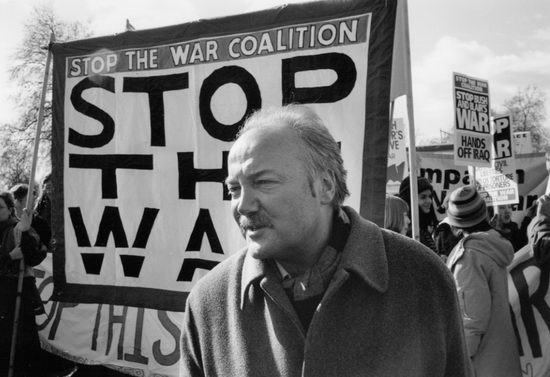
George Galloway MP at the start of the march in Hyde Park

The Stop the War Coalition had been formed shortly after the 9/11 attacks and had organised this protest together with the Campaign for Nuclear Disarmament and the Muslim Association of Britain.

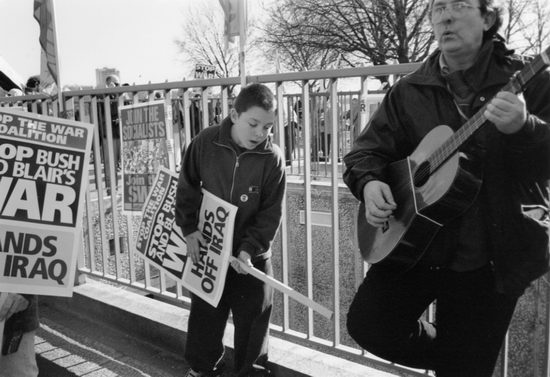
Air guitar – hyde park

It is hard to give any accurate estimate of the numbers taking part in protests as large as this, but I think there must have been well over a hundred thousand marching – much smaller than the well over a million that marched in London 11 months later in February 2003, but still a very significant number. It received very little coverage in the mass media and so it is now still difficult to find anything about it online.

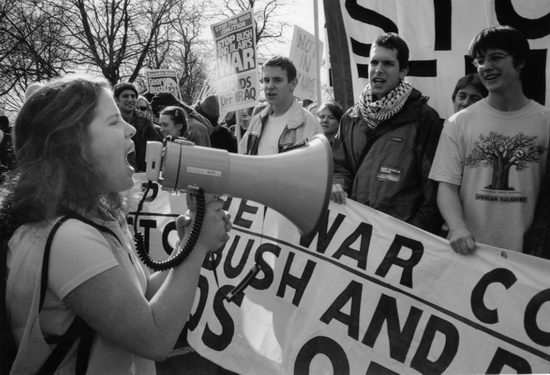
Helen Salmon and students, Hyde Park

By March 2002 the initial huge public sympathy with the USA over the 9/ll attacks had given place to a feeling that Bush and his “war on terror” was determined to attack Iraq at all cost even though it seemed unlikely that there was any real link between Iraq and Al-Qaida, and there was little if any evidence that Iraq still possessed “weapons of mass destruction“.

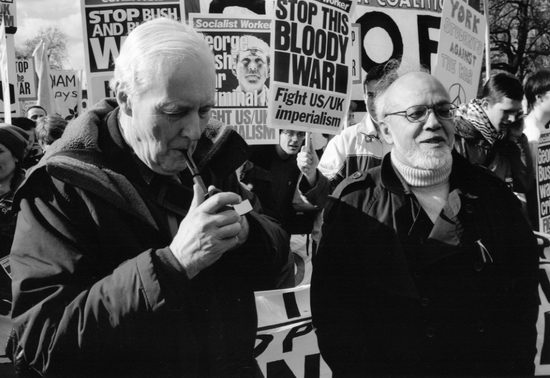
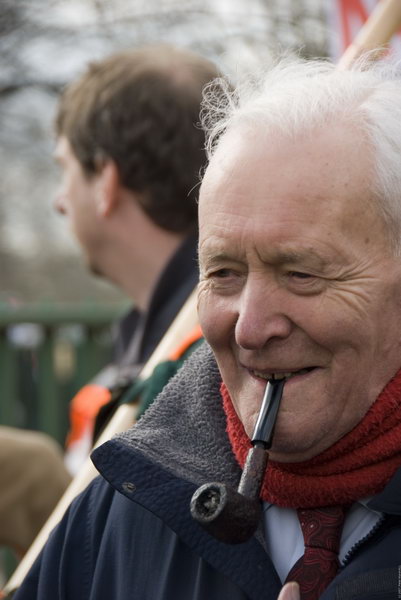
Tony Benn and Dr Siddiqui at Hyde Park

Iraq had ended work to produce biological, chemical, and nuclear weapons in the 1990s and most or all of its stockpiles had been destroyed. In November 2002 Saddam Hussein had allowed UN inspectors search Iraqi facilities for WMDs and they found none. The US alleged that Iraq had hidden them – and forged documents were produced about uranium. No WMDs were found during the US invasion and occupation of Iraq in 2003-2011 and US secretary of state Colin “Powell and George Bush eventually admitted Iraq had not had them.”

Stop The War – Hands Off Iraq – 2 Mar 02 – Park Lane

Despite then known facts, Tony Blair had decided to support the US invasion against the huge opposition from the British public. He and his government lied to parliament, most notably with the “Dodgy Dossier” and other documents. The dossier, “sexed up” by Alistair Campbell was largely plagiarised from a thesis by a graduate student at California State University, and contained many errors and unchecked statements, and contradicted much of actual evidence from intelligence sources. It should have ended the political career and any credibility for both.

Piccadilly
Trafalgar Square

Back in 2002 I was working with both black and white and colour film, but it was difficult for me to digitise the colour work – and I only posted black and white images on My London Diary. I still have only digitised a few of the many colour images I made at that time.

Included in this post are all of the images I posted on My London Diary and below is the short text I wrote to go with them. The files are small and they were posted across several pages as many then still accessed the web on slow dial-up modems. They are reduced versions of the images I filed to my agency, made by scanning black and white prints.The original post is still online, but adds nothing to this post.


The Stop the War, Hands off Iraq demonstration on 2 March was a large sign of public opinion. People were still leaving Hyde Park at the start of the march when Trafalgar Square was full to overflowing two and a half hours later.

Police estimates of the number were risible as usual – and can only reflect an attempt to marginalise the significant body of opinion opposed to the war or a complete mathematical inability on behalf of the police.

Tony Benn told us it wasn’t worth taking his picture – “It won’t get in the papers unless I go and kick a policeman” but he didn’t and was quite right.


FlickrFacebookMy London DiaryHull PhotosLea ValleyParis
London’s Industrial HeritageLondon Photos

All photographs on this page are copyright © Peter Marshall.
Contact me to buy prints or licence to reproduce.


London St Patrick’s Day Parade – 2006

London St Patrick's Day Parade - 2006

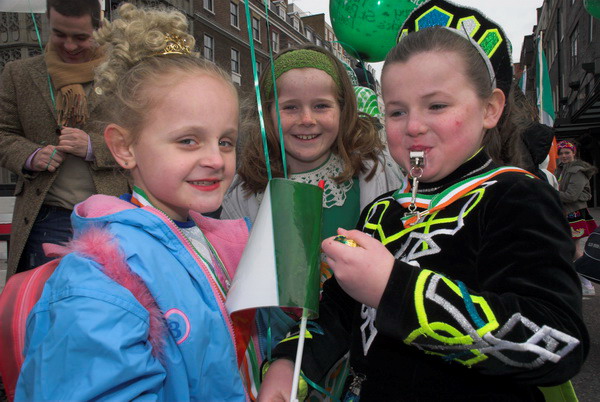
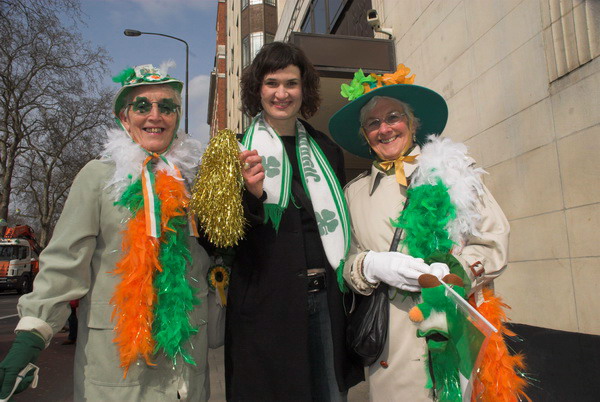
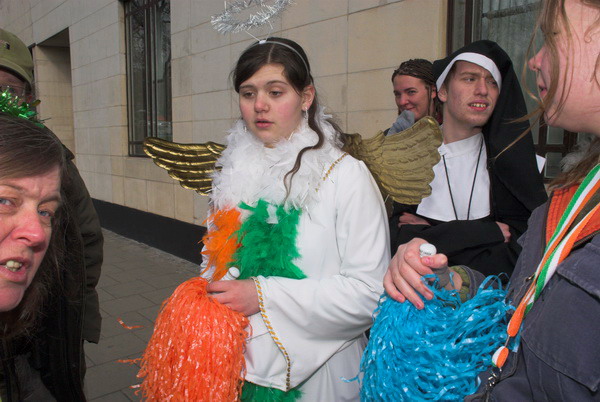
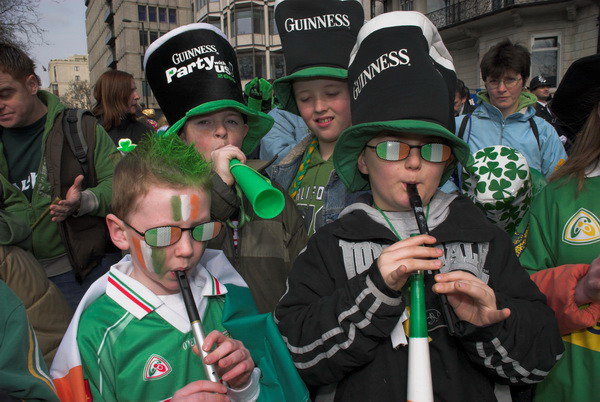
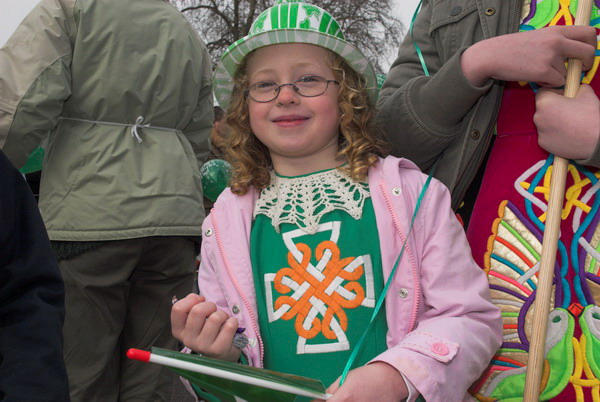
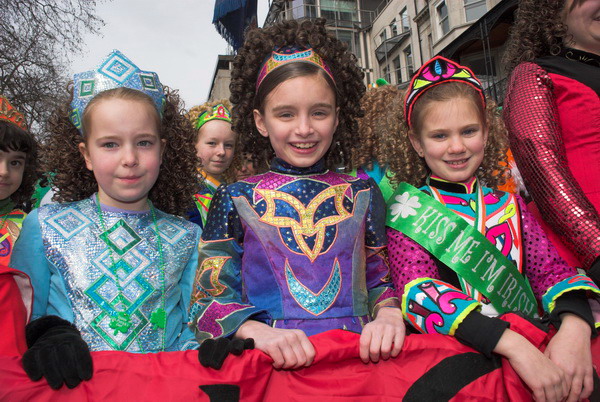
London St Patrick’s Day Parade: I used to enjoy St Patrick’s Day in London, particularly the parade in Willesden Green on the actual day itself. The main London celebrations take place the Sunday before this, and I made these pictures on Sunday 12th March 2006.

London St Patrick's Day Parade - 2006

This annual London parade had begun in 2002 when Ken Livingstone, London’s first elected mayor. Though a Londoner, he had long been a supporter of a united Ireland and from 1987 to 2001 was MP for Brent East, a constituency with a large Irish population.

London St Patrick's Day Parade - 2006

In his years as the leader of the Greater London Council from 1981 until its abolition by Thatcher in 1986 Livingstone had done much to change attitudes in London towards women and minority communities, and on being elected as London Mayor he began his victory speech saying “As I was saying before I was so rudely interrupted 14 years ago…” and continued these and other policies from his years at the GLC.

London St Patrick's Day Parade - 2006

One small part of his legacy to London was the opening up of Trafalgar Square to various Community celebrations – though there is much more, including changes to London’s transport begun under the GLC which made much of my photography of London much easier. His successor took the credit for Livingstone’s ‘Boris Bikes’ though Ken was not responsible for the multiple bikes for hire that now litter our pavements in a rather mad private developments of this.

London St Patrick's Day Parade - 2006

I photographed the first London St Patrick’s Day Parade in 2002. All the pictures here are from the 2006 Parade and below is the short text I wrote for this.

London now has one of the larger celebrations of St Patricks Day, held on the Sunday before the actual day, with a parade from Hyde Park to Trafalagar Square and events there as well as in Leicester Square and Covent Garden.

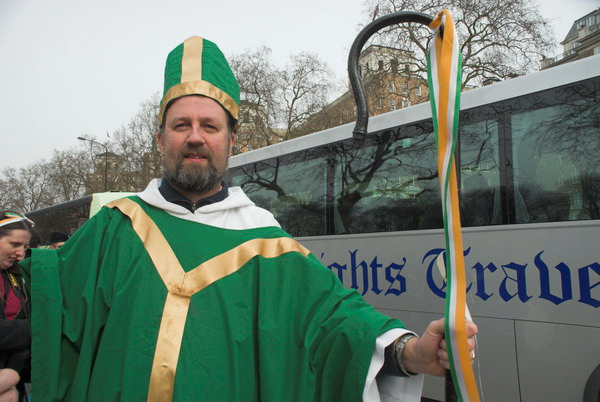
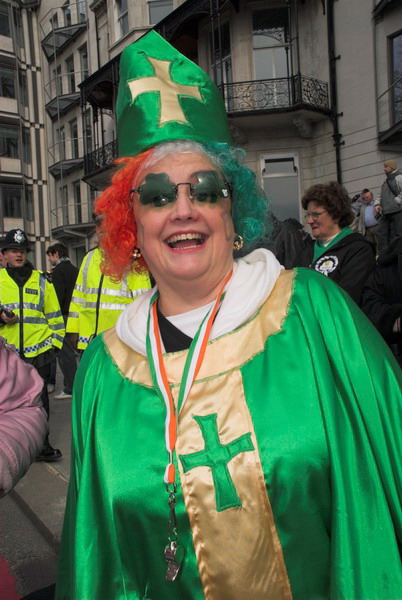
The parade celebrates the enormous contribution the Irish have made to the capital – approximately 400,000 people of Irish descent form the largest minority group in London. Paraders come from various community associations and other Irish groups and cultural organisations in the London Boroughs, including Irish dancing, music and sports. There are also some groups from Ireland.

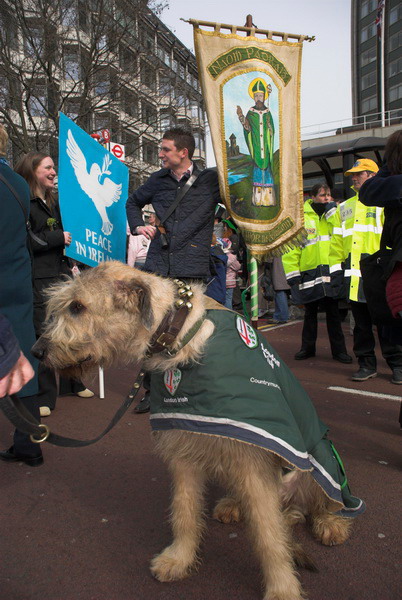
Leading the parade is an Irish Wolfhound, the mascot of the London Irish team, along with various Irish leaders and of course the Mayor of London, Ken Livingstone, more green than red on this occasion.


Unfortunately government cuts under the coalition’s austerity programme meant the Brent council could no longer support the St Patrick’s Day parade in Willesden Green and I last photographed a rather smaller event there in 2013. The London St Patrick’s Parade and St Patrick’s Festival at Trafalgar Square are on Sunday 15 March 2026, but like so many events is much more organised and for me less interesting, and its years since I last went.

More pictures from 2006 on My London Diary


FlickrFacebookMy London DiaryHull PhotosLea ValleyParis
London’s Industrial HeritageLondon Photos

All photographs on this page are copyright © Peter Marshall.
Contact me to buy prints or licence to reproduce.


Stop The War March, November 2001

Stop The War March: Although I’ve usually posted events from the past on the actual anniversary, this post comes a day late as by the time I remembered this I had already written a post for yesterday. So although I’m publishing this on 19th November, the march organised by Stop The War took place on November 18th 2001. It was a large one, although as I wrote the reports by police severely under-counted the numbers taking part.

Stop The War March, November 2001

The Stop the War Coalition had been founded in September 2001 in the weeks following 9/11 after George W. Bush had announced the “war on terror”. At first its protests were mainly directed against the war in Afghanistan, but later it opposed the the US-led military invasion of Iraq and since then has campaigned against other wars against Libya, in Syria and elsewhere.

Stop The War March, November 2001

In recent years it has been one of the groups involved in the many protests, small and large against the genocide taking place in Gaza along with CND and the Palestine Solidarity Campaign.

Stop The War March, November 2001

I had covered their first major march by Stop the War in October 2001 and have continue to photograph many of their events to the present day, though for medical reasons had to miss the largest public demonstration in British history on 15th February 2003 shortly before the invasion of Iraq on 20 March 2003.

Stop The War March, November 2001

Back in 2003 the coalition was a huge one. Wikipedia states “Greenpeace, the Liberal Democrats, Plaid Cymru and the Scottish National Party (SNP) were among the 450 organisations which had affiliated to the coalition, and the coalition’s website listed 321 peace groups.”

Stop The War March, November 2001

The Socialist Workers Party has always played a leading role in Stop the War and the Muslim community has been important from the start with the coalition recognising “a war against Afghanistan would be perceived as an attack on Islam and that Muslims, or those perceived as being Muslim, would face racist attacks in the United Kingdom if the government joined the war.” The Muslim Association of Britain was closely involve in organising this and other protests.

Stop The War March, November 2001

In 2001 I was still photographing using film, both black and white and colour, and all of the pictures I contributed to picture libraries were in black and white, as are those on My London Diary. Back then the demand from newspapers and magazines was still mainly for black and white and was still reproduced largely from prints.

Occasionally I would print images taken on colour negative as black and white prints to submit but mainly I had sufficient pictures taken as black and white. There are some people who now convert their colour digital images into black and white, feeling I think that it somehow makes them more ‘authentic’. It does occasionally make images stronger but mostly it simply makes them less descriptive and often confused.

Below is the post I wrote for My London Diary. It says nothing about why the protest was taking place, which would have been obvious to viewers at the time that it was against the war in Afghanistan.

“November 18 we were back again marching to stop the war. Two hours after the march started there were still marchers leaving Hyde Park, and we were getting messages that Trafalgar Square was full. The police estimate of 20,000 was pathetically low and even the organisers’ figure of 50,000 might have been on the low side. It’s always difficult to count such things (I usually give up counting around the one thousand mark when I’m covering demonstrations and make a guess above that, but this was certainly on a similar scale to the countryside march which is the largest event in recent years.

The march was more split up into factions than most, although the start was fairly mixed. There were large organised male and female sections of Muslims for Justice in the middle of the march and a big group of younger marchers, including anarchists, towards the end. Actually I didn’t manage to see the end of the march, and people were still arriving in Trafalgar Square when I left.”

A few more pictures on My London Diary


FlickrFacebookMy London DiaryHull PhotosLea ValleyParis
London’s Industrial HeritageLondon Photos

All photographs on this page are copyright © Peter Marshall.
Contact me to buy prints or licence to reproduce.


Chariot Festival, Plumstead & Woolwich – 2009

Chariot Festival, Plumstead & Woolwich: Sunday 28th June 2009 I photographed the Hare Krishna Chariot Festival from Hyde Park to Trafalgar Square then travelled to Plumstead Common for short visit to the annual Mela there. But I didn’t find much to interest me and instead took a walk down to the Thames at Thamesmead West and then back alongside the river to Woolwich. On My London Diary I wrote at some length about the walk, which turned out to be surprisingly interesting and about how I thought the area could be improved.


Sri Jagannatha Rathayatra Festival – Hyde Park to Trafalgar Square

Chariot Festival, Plumstead & Woolwich - 2009
Musicians in the procession as it leaves Hyde Park

I didn’t write much about the chariot festival on My London Diary in 2009 as I had written at some length about it the previous year – and I won’t say much here either as I posted about the 2012 Rathayatra festival a few days ago.

Chariot Festival, Plumstead & Woolwich - 2009
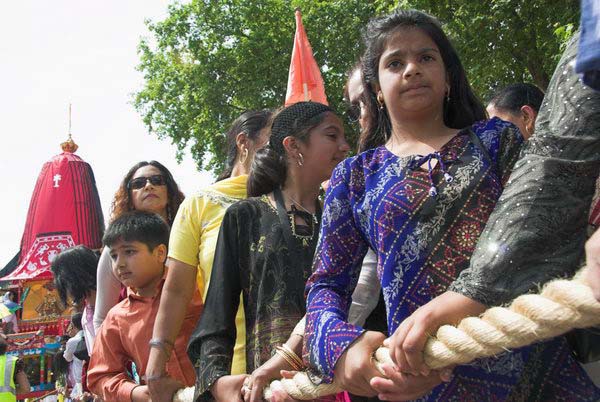
The three giant chariots are pulled by people on large ropes

In 2009 I concentrated mainly on the people rather than the chariots.

More pictures at Sri Jagannatha Rathayatra.


Plumstead & Woolwich – Plumstead, Thamesmead West, River Thames

Chariot Festival, Plumstead & Woolwich - 2009

It was a long walk up the hill from Plumstead station to the common where the Mela is held and I arrived rather tired and was disappointed to find the the event seemed to be only just starting. But I’d stopped to take a few pictures on the way, and found several things of interest on the walk.

Chariot Festival, Plumstead & Woolwich - 2009

So after a short time at the Mela I decided it was too hot to wait around longer and to take a walk instead.

Chariot Festival, Plumstead & Woolwich - 2009

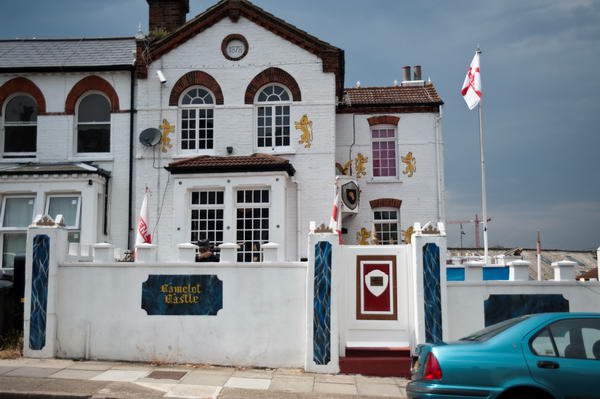
I walked down to Camelot Castle, home of self-proclaimed “celebrity gangster Dave Courtney“, who was made bankrupt in May 2009, owing £400,000 including an estimated £250,000 to HM Revenue & Customs.

Shouldn’t, I mused looking at the St Georges flags, patriots be pleased to pay taxes? I photographed the house and then onto the gates with a giant knuckleduster at their centre. Courtney also awarded himself a blue plaque with the text ‘Dave Courtney OBE lived here’ where the OBE stands for “One Big Ego”.

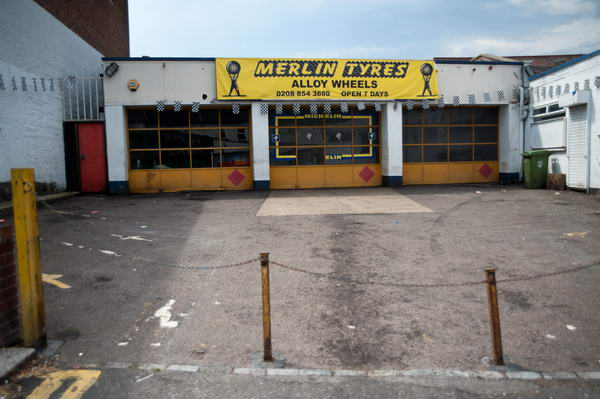
Soon after I came across Merlin Tyres. Is it coincidence that Merlin was one of the six main characters of Camelot?

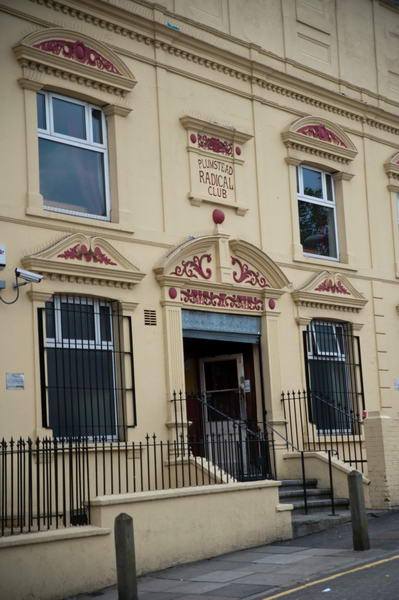
The Plumstead Radical Club is a working mens club formed by local Liberals who later became members of the Labour party, but most working mens clubs lost any real political connection, though they still sell cheap beer to members. From Plumstead I walked into Thamesmead.

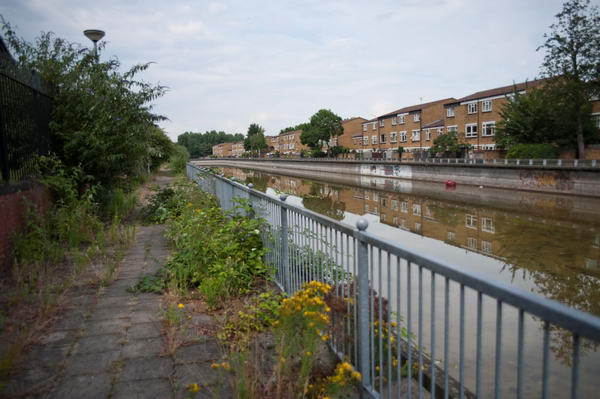
This part of Thamesmead West had failed to make good use of its location and what should have become a vibrant area at Broadwater was derelict and depressing.

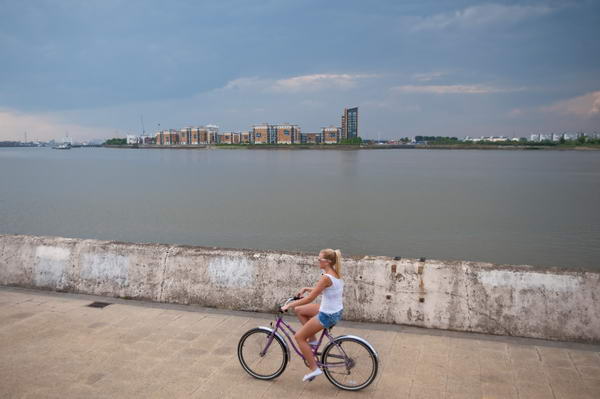
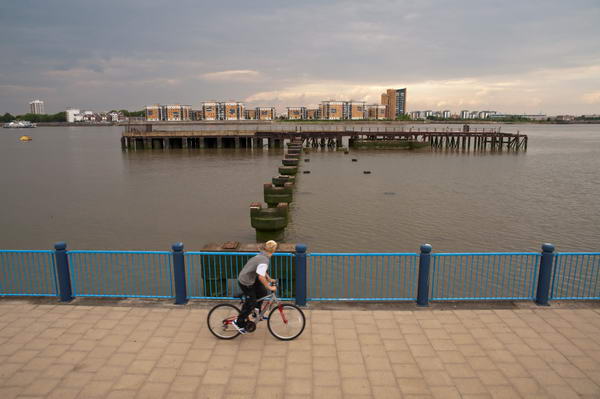
But soon I reached the Thames path and photographed this woman cycling along it with the recent flats of North Woolwich around a third of a mile away on the opposite bank of the wide river.

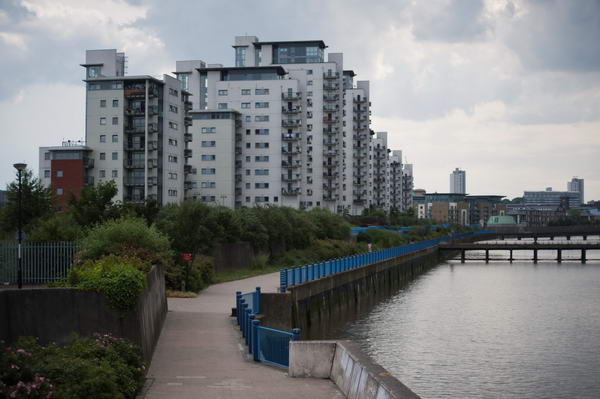
And there are plenty of new riverside flats on the south bank too, with residents enjoying riverside views. These flats are perhaps less of an eyesore than some.

Woolwich Arsenal had three piers – this was the one in the middle, known as the Iron Pier, and you can see why from my picture. To the east was the Coal Pier, the lower parts of which still remain – built in 1917-20 it was used to bring in around 1500 tons of coal a week and is fenced off as a dangerous structure, The largest of the three piers, the T Pier has I think gone completely though there is now a Uber Boat pier.

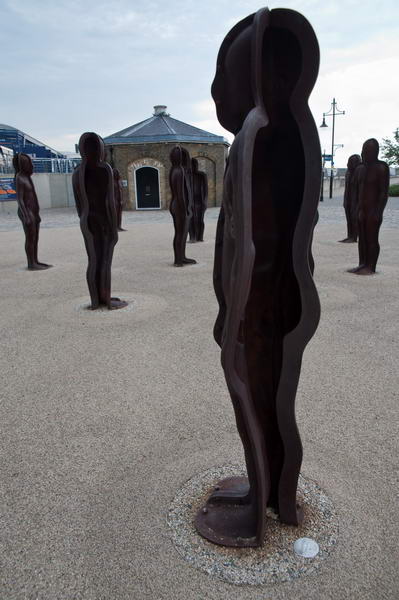
In the Woolwich Arsenal site I came across a group of aliens, ‘Assembly’ by Peter Burke (b1944) placed here in 2004. I stopped to photograph them before heading to Woolwich Arsenal station for a train.

More on My London Diary at Plumstead & Woolwich.


FlickrFacebookMy London DiaryHull PhotosLea ValleyParis
London’s Industrial HeritageLondon Photos

All photographs on this page are copyright © Peter Marshall.
Contact me to buy prints or licence to reproduce.


Stand Up to Racism & Kites Not Drones – 2014

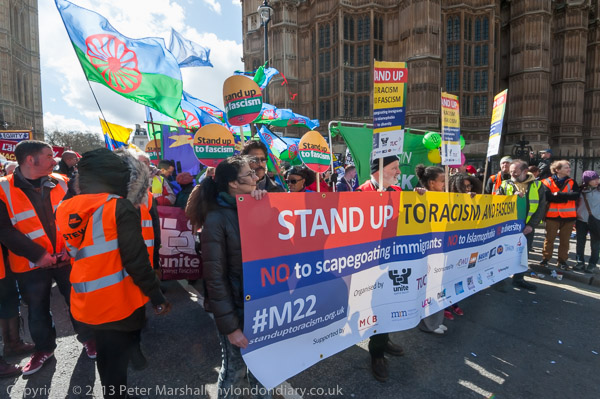
Stand Up to Racism & Kites Not Drones: On Saturday 22 March 2014, the day following UN Anti-Racism Day (chosen to remember the 69 people killed by police in the Sharpeville massacre in South Africa on 21 March 1960), the TUC and Unite Against Fascism organised a march and rally as a part of a European day of action against racism.

Stand Up to Racism & Kites Not Drones - 2014

Thousands – perhaps as many as 20,000 – turned up to march the short distance from Old Palace Yard opposite parliament to a long rally in Trafalgar Square – on My London Diary I list 19 speakers, though I think there were a few more on the day, but I didn’t stop to listen to all of them, going instead to Hyde Park where a smaller protest by peace activists tried without much success to fly kites in in solidarity with the people of Afghanistan.


Stand Up to Racism – Westminster

Stand Up to Racism & Kites Not Drones - 2014
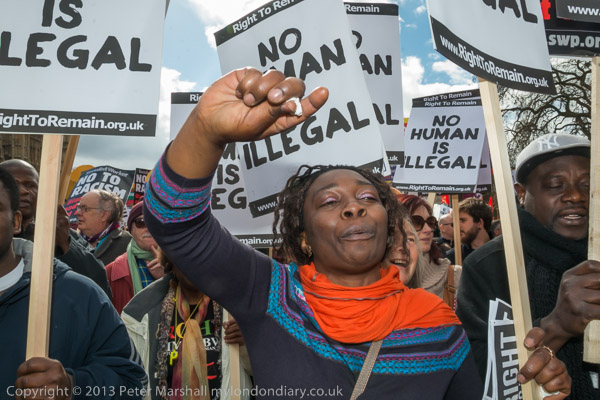
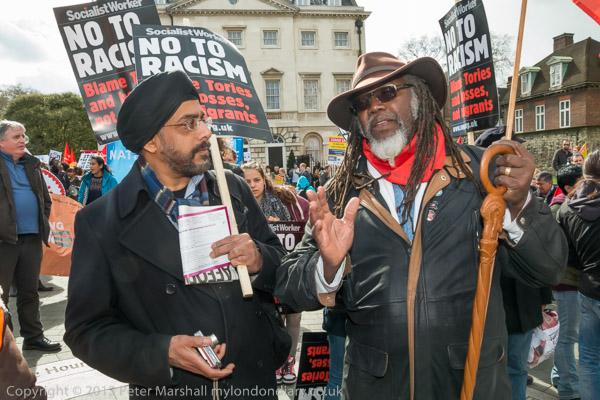
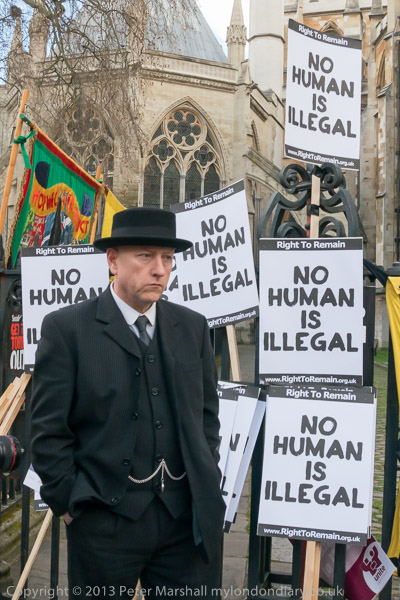
No Human is Illegal’ – protesters from the National Coalition of Anti-Deportation Campaigns

This protest stood out for the wide range of people and organisations who had come to join it, “many of whom are sickened by the anti-immigrant policies of successive governments and opposition parties who have long been engaged in trying to outdo each other in the ‘toughness’ of their immigration policies, and have recently moved even further to the right in an effort to neutralise the political threat of UKIP and Nigel Farage.”

Stand Up to Racism & Kites Not Drones - 2014

And since 2014 the main parties have kept moving to the right. We continue to see this scapegoating of immigrants in the policies both of the current government and its recent Tory predecessors, particularly in the campaigns and legislation against those who cross the channel in small boats, but also in restrictions on those who claim asylum here and the harassment being suffered by many who have made their lives here and contributed to our society but are now threatened by deportation, dragging them away from families and friends. Still we have not set up safe routes for asylum seekers to come to Britain, still we have not offered amnesties to those who have worked here and made useful and essential contribution here for years.

Stand Up to Racism & Kites Not Drones - 2014

I photographed many of the marchers in Parliament Square, where the march had been planned to start close to the statue of Nelson Mandela who had celebrated “the ideal of a democratic and free society in which all persons live together in harmony and equal opportunities” as the aim of the fight for freedom and equality in South Africa.

A man taking part in unusual dress for a protest

Some posed in front on the grass with ‘Big Ben’ in the background, a name I like to use as it annoys pedants, but is what everyone except them still calls the clock tower which Wikipedia describes as “one of the most prominent symbols of the United Kingdom and parliamentary democracy.”

Among those taking part were people from our Roma and Muslim communities who bear no responsibilities for our country’s current problems and suffer more than most from them while at the same time being blamed by the racist right for them.

“In particular we have seen many promoting fear and hate of Muslims associating the whole community with the acts of a tiny few. Islamophobia is rife and has led to more attacks on the Muslim population, including murder and violent attacks on mosques. “

More from 2014 on My London Diary at Stand Up to Racism.


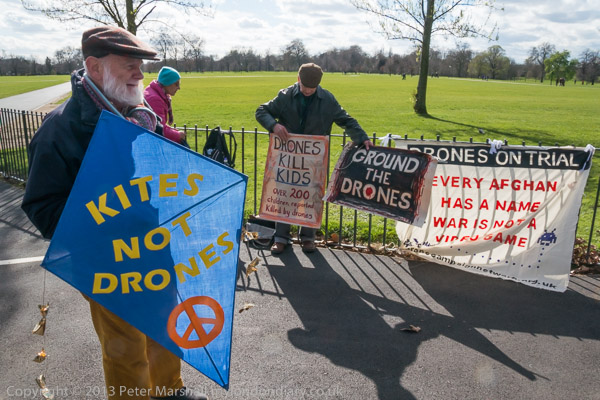
Kites Not Drones Solidarity with Afghanistan – Hyde Park

This protest by peace activists was part of a weekend of solidarity with the Afghan people who traditionally celebrate their New Year (Now Ruz) on the Spring Equinox by flying kites. (Until 1752 the New Year began at around the same time in Britain and its colonies on Lady Day March 25th.)

Peace activist Maya Evans ties up the Drones on Trial banner ‘EVERY AFGHAN HAS A NAME, WAR IS NOT A VIDEO GAME’

In 2014 I quoted the organisers statement:

‘Kite flying has become synonymous with Afghanistan as a well loved pursuit which was banned under the Taliban, now Afghans are more used to the presence of UK armed and surveillance drones flying overhead.’

‘We are encouraging peace groups, Afghans in the UK and the Muslim community to fly kites in solidarity with Afghans who now have to live under the mental pressure and physical destruction which British drones (currently operated from RAF Waddington, Lincoln) now reap upon Afghanistan.’

None of those taking part appeared to have had any previous experience in actually flying kites, and although the photographers present helped, the gusty conditions only allowed some short and erratic flights, with one kite getting stuck up a tree. For once a police officer was sympathetic, and having come across to tell the protesters that flying kites was not allowed in this or the other Royal Parks told them that so long as they stayed in this empty area of the park and were not a nuisance to others he would not stop them.

More at Kites Not Drones Solidarity with Afghanistan.


FlickrFacebookMy London DiaryHull PhotosLea ValleyParis
London’s Industrial HeritageLondon Photos

All photographs on this page are copyright © Peter Marshall.
Contact me to buy prints or licence to reproduce.


Stop Trident, Troops out of Iraq – 2007

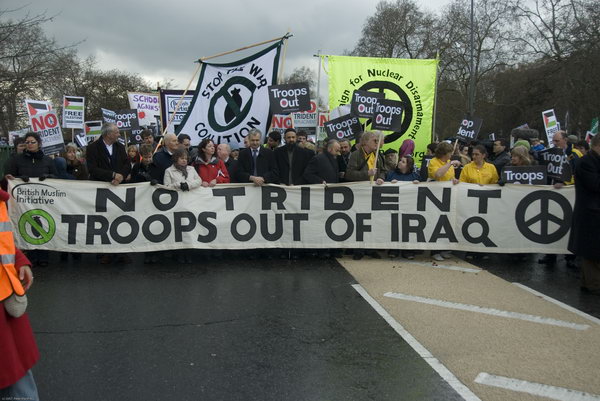
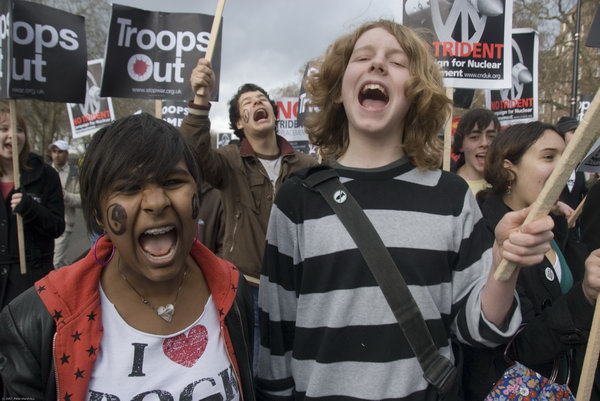
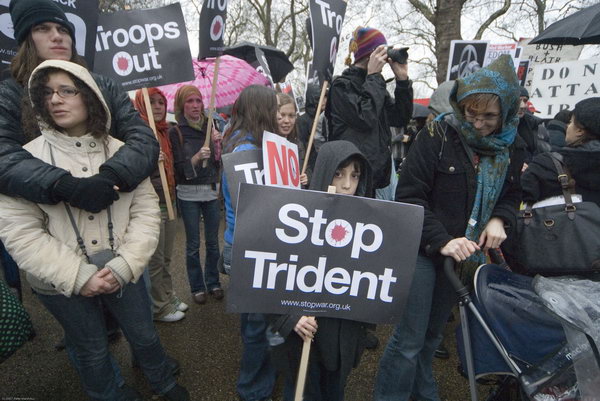
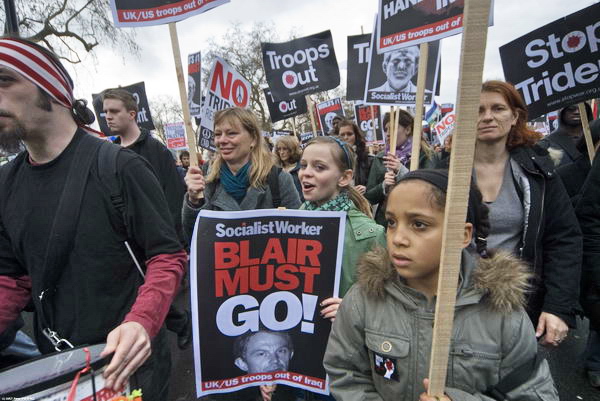
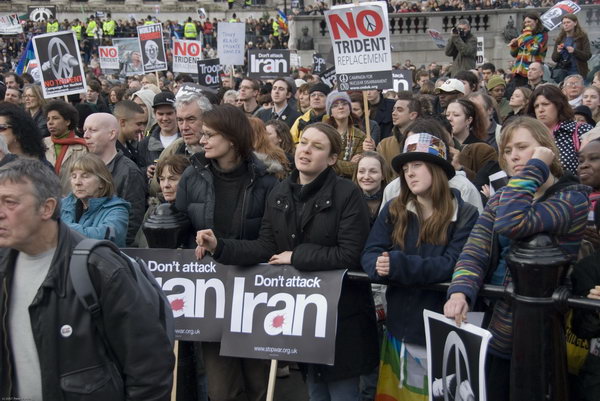
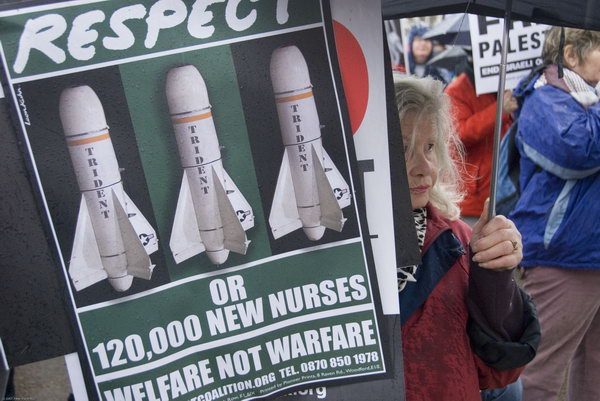
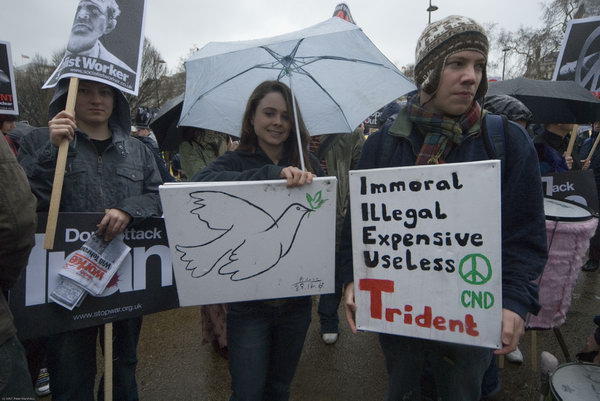
Stop Trident, Troops out of Iraq: On Saturday 24th February 2007 I photographed the march and rally organised by Stop The War, The Campaign For Nuclear Disarmament and The British Muslim Initiative to call for British troops to be brought back from Iraq and for an end to the deployment of Trident nuclear missiles and their proposed expensive replacement.

Stop Trident, Troops out of Iraq - 2007

The marchers met in Hyde Park around Speakers’ Corner and marched to a rally in Trafalgar Square.

Stop Trident, Troops out of Iraq - 2007

I wrote a slightly long text to go with the pictures which I’ll repeat in a more normal form below with normal capitalisation. It includes an explanation of how I arrived at an rough estimate for the numbers taking part for this and other protests – often very significantly greater than that then given by the police to the press and usually rather less than that of the organisers.

Stop Trident, Troops out of Iraq - 2007

Stop Trident, Troops out of Iraq – Stop the War/CND/BMI Demo

Stop Trident, Troops out of Iraq - 2007

I’ve for many years been opposed to the so-called independent British nuclear weapons. Even at the height of the Cold War they were never credible as an independent deterrent. If they have ever had any justification it was that they made the USA feel less guilty, although American guilt at its huge nuclear arsenal and at being the only country ever to have used nuclear weapons has always been an incredibly stunted growth.

Stop Trident, Troops out of Iraq - 2007

I was also firmly against the invasion of Iraq. It was always clear to those who didn’t want to be deluded that the so-called ‘intelligence’ on weapons of mass destruction was laughable.

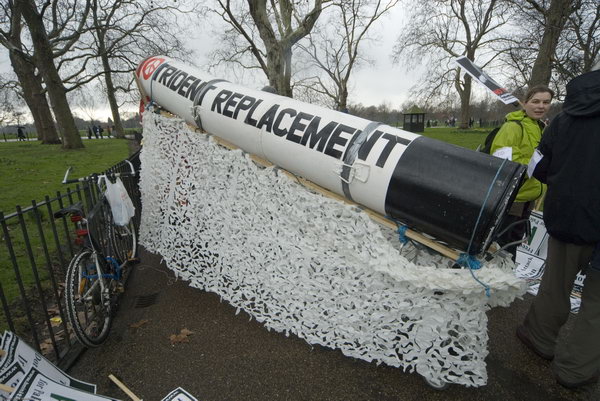
A cheaper alternative to Trident, and at least as effective. The bicycle & trailer costs rather less than a nuclear sub too.

Blair was either a liar or a fool as he misled a minority of the British people and a majority of their MPs. Or most probably both. (Saddam may also have been deluded and certainly was an evil dictator, but we had long failed those who tried to oppose him.) The invasion was criminal, but the lack of planning for the occupation that inevitably followed even more so.

Tony Benn

So Saturday’s march, organised by Stop The War, The Campaign For Nuclear Disarmament and The British Muslim Initiative against both of these had my whole-hearted support (although i would have photographed it anyway.)

George Galloway beseiged by the Press

It is hard to be sure of numbers on events such as this, but the police estimate is laughable (the first figure they gave to the press, of 4000, was totally ludicrous.)

Blair and Bush on the march

It took around 90 minutes for the march to pass me in Park Lane, and although there were a few short gaps, there were plenty of times when the wide street was too crowded to really take pictures. My estimate of the average number of people passing me per minute is 200-600, giving a total of 18,000-50,000 marchers from Hyde Park.

A reminder of Guantanamo Bay

You can add to these figures perhaps another 10-20% who for various reasons go direct to the rally or join the march closer to Trafalgar Square, giving a total that could be between 20,000 and 60,000.

After photographing the marchers, I took the tube to get to the rally in time to hear some of the speeches (marchers were still arriving almost up to the end of the rally.) As I arrived, there were many people already leaving, and the square was filled, with people spilling out at both the northeast and northwest corners.

So where are the Weapons of Mass Destruction? In the American arsenals of course.

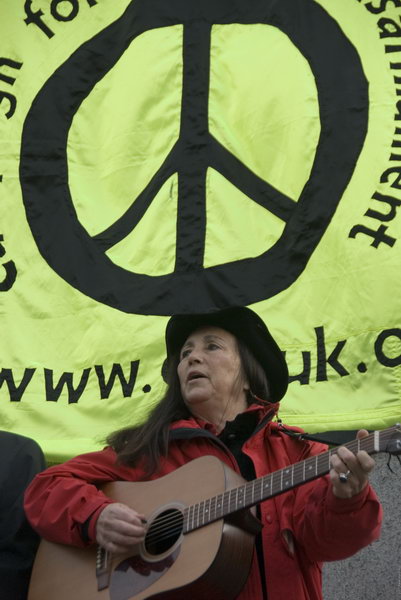
I wasn’t there in time to hear Ken Livingstone, MPs John Mcdonnell and John Trickett, MEPs Caroline Lucas and Jill Evans, playwright David Edgar, Paul Mackney of the University & College Union or some of the other speakers, but I did hear the co-chair of the US ‘United For Peace And Justice’ Judith Leblanc, Lindsey German, George Galloway, and Augusto Montiel, a Venezuelan MP, as well as several Muslim speakers, trade unionists and singers including Julie Felix. I didn’t catch all of their names.

Julie Felix

For me the most moving speech was from Rose Gentle, whose son Gordon was killed in Iraq. Together with others from ‘military families against the war’ she is camping out over the weekend opposite Downing Street.

Six of her colleagues stood with her as a group while she addressed the crowd, lending their support. She was simple, direct, emotional.

The final speaker (I think) was Jeremy Corbyn, MP, and it started to rain again as he began speaking, so I headed for the Underground and home.

Many – too many – more pictures on My London Diary.


FlickrFacebookMy London DiaryHull PhotosLea ValleyParis
London’s Industrial HeritageLondon Photos

All photographs on this page are copyright © Peter Marshall.
Contact me to buy prints or licence to reproduce.


Corbyn Victory & Refugees Welcome – 2015

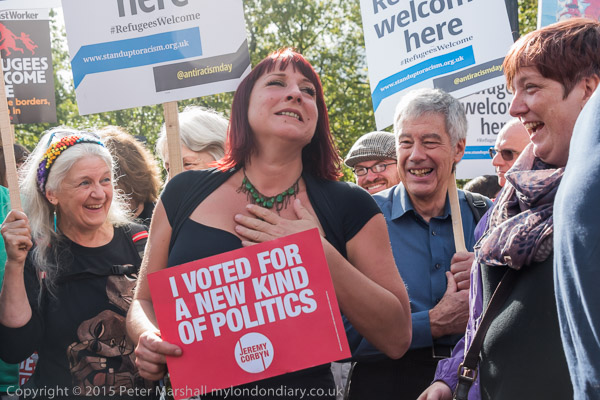
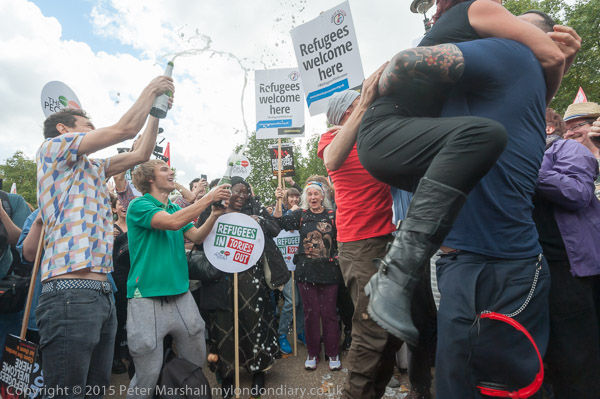
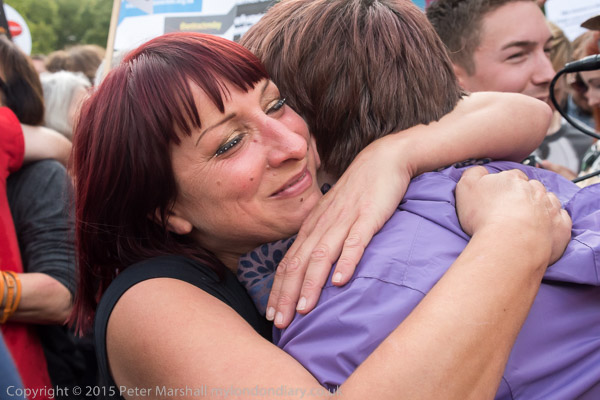
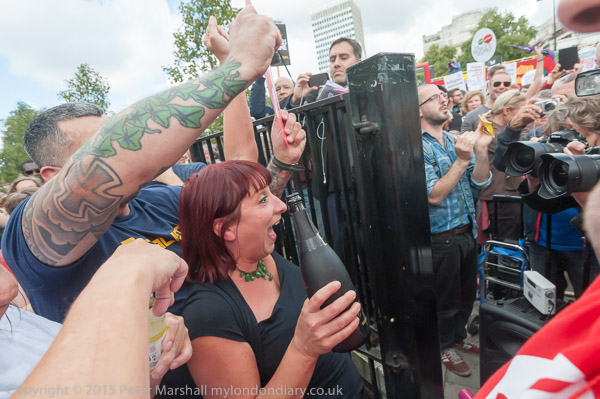
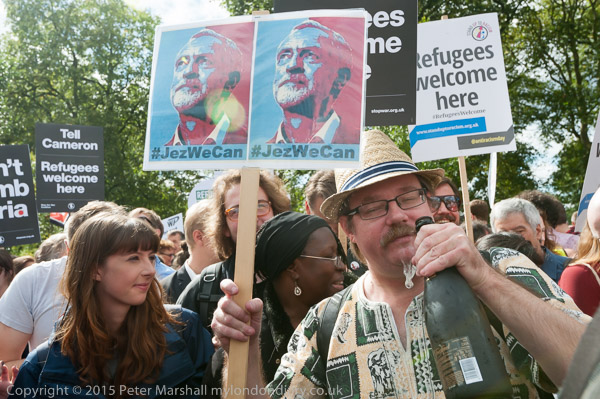
Corbyn Victory & Refugees Welcome: Saturday 12th September 2015 was a day of hope when Jeremy Corbyn won the Labour leadership election with a landslide victory, getting more than three times the vote of his nearest rival, Andy Burnham. Several hundred Corbyn supporters met at Speakers’ Corner before the Refugees Welcome march to listen to the results of the Labour Leadership election.


Victory Party for Jeremy Corbyn – Speakers’ Corner, Hyde Park,

Corbyn Victory & Refugees Welcome

Tension built as the Deputy Leader results came and then erupted with Jeremy Corbyn’s first round victory.

Corbyn Victory & Refugees Welcome

Corbyn had only been able to stand in the election because some Labour MPs who did not support him were prepared to nominate him so that the Labour left would have a candidate in the ballot and not feel it was rigged against them. They thought he would only get a miserably low percentage of the votes.

Corbyn Victory & Refugees Welcome

According to Wikipedia, the release of opinion polls before the election which showed Corbyn in the lead prompted “high-profile interventions by a number of prominent Labour figures including Gordon Brown, Tony Blair, Jack Straw, David Miliband, and Alastair Campbell, among others” who felt Labour with Corbyn as leader would be unelectable.
Corbyn Victory & Refugees Welcome

These interventions almost certainly increased support for Corbyn, and although these and other Labour figures such as Peter Mandelson, along with most of the media and press did their best to try to get rid of Corbyn, including various plots and mass resignations from the Shadow Cabinet, he remained popular in the country.
The 2017 election turned out to be a much closer contest than most had imagined, and it was only due to deliberate sabotage by Labour party officials that Corbyn lost. A leaked report in 2020 which demonstrated this led to the setting up of the Forde report into Labour party factionalism which although it called the earlier report “factional” confirmed many of its suspicions and conclusions – as well as criticising both sides in the party – remained secret until July 2022.

What shocked many of us was the evident relief shown by some leading members of the party as the 2017 election results were coming out that their party had lost. And the witch-hunt against the left in the party continues unabated.

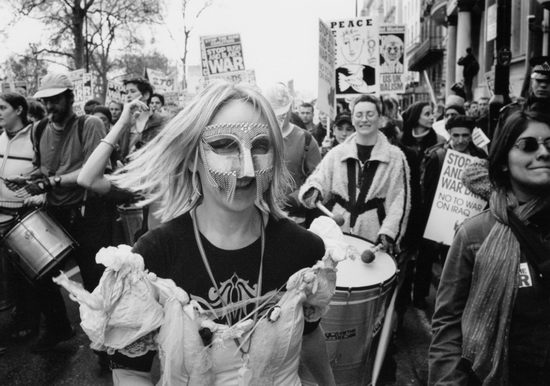
On the 12th September 12th 2015 there was much more media interest in the few hundred celebrating Corbyn’s victory than in the huge Refugees Welcome march which followed, and in the media scrum I got knocked flying and my equipment scattered, but managed to gather it up and continue work.

Victory Party for Jeremy Corbyn


Refugees Welcome Here Rally & March

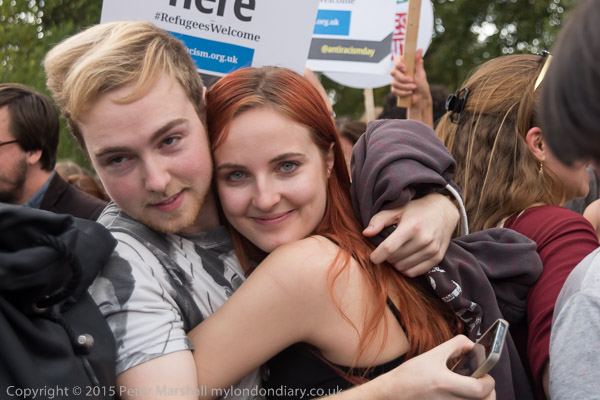
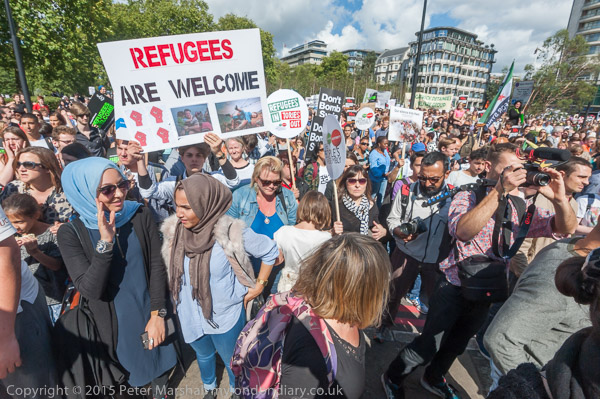
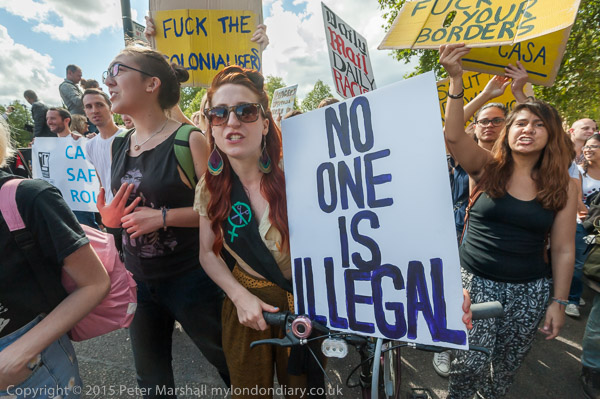
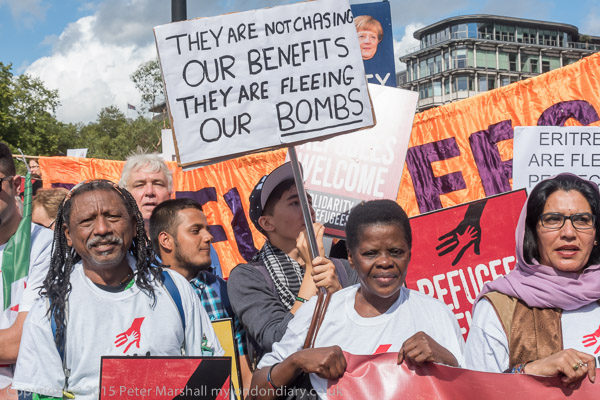
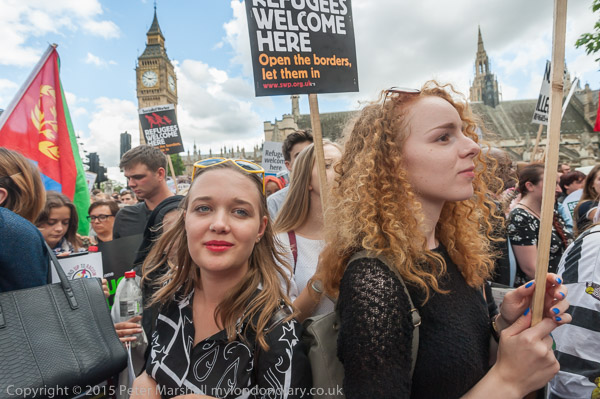
From Speakers Corner I joined the huge crowd – at least 50,000 – filling Park Lane as far as I could see. This national march was a response to the many reports of refugees fleeing war and persecution, with people wanting to show their support for refugees facing death and hardship and their disgust at the lack of compassion and inadequate response of the British government.
On My London Diary is a list and photographs of some of the speakers before the march set off. I photographed the front of the march as it set up at the southern end of Park Lane and went with it for the first couple of hundred yards into Piccadilly, where I stopped to photograph the rest of the march as it came past.

The marchers were fairly densely packed and spread across the whole of the roadway (and sometimes on to the pavement too) and it took exactly an hour to go past me.

There were many at the protest who were not the usual protesters, people who said this was the first protest they had ever attended, as well as those that I knew from previous protests, and there were many interesting placards and banners to photograph – and many more pictures on My London Diary.

As the end of the march passed me I rushed into Green Park Station and took the tube to Westminster, arriving on Whitehall as it went very noisily past Downing Street.

I ran back to Parliament Square, and this soon filled up with people and banners. I sat down on the wall close to the Churchill statue, realising I was rather tired and hungry.

Many marchers left rather than stay and listen to the speeches, though the square was still crowded and I decided I would leave too.

More on My London Diary:
Rally Says Refugees Welcome Here
Refugees are welcome here march
Refugees Welcome march reaches Parliament


FlickrFacebookMy London DiaryHull PhotosLea ValleyParis
London’s Industrial HeritageLondon Photos

All photographs on this page are copyright © Peter Marshall.
Contact me to buy prints or licence to reproduce.