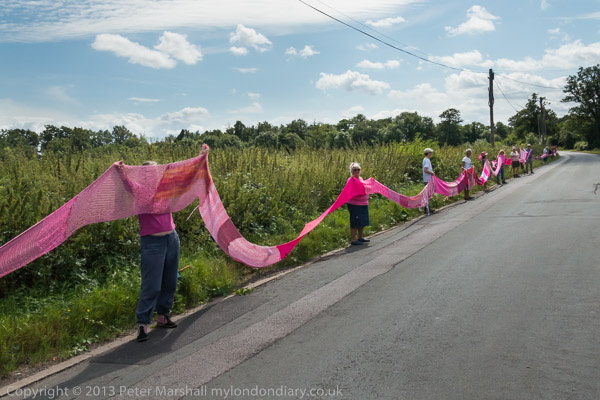
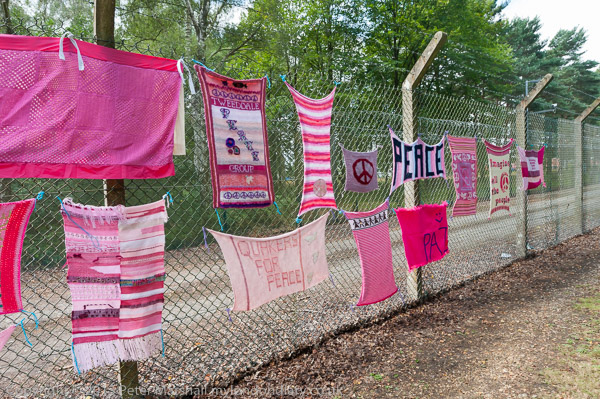
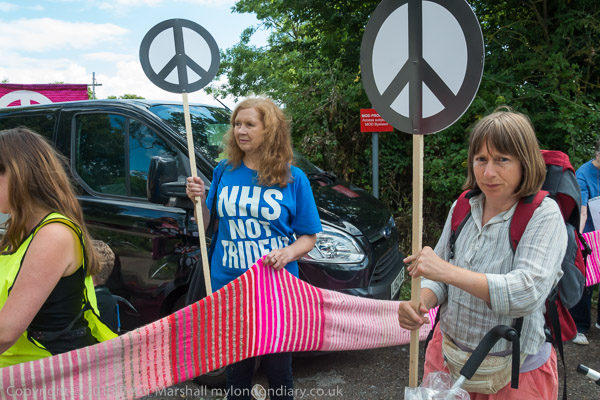
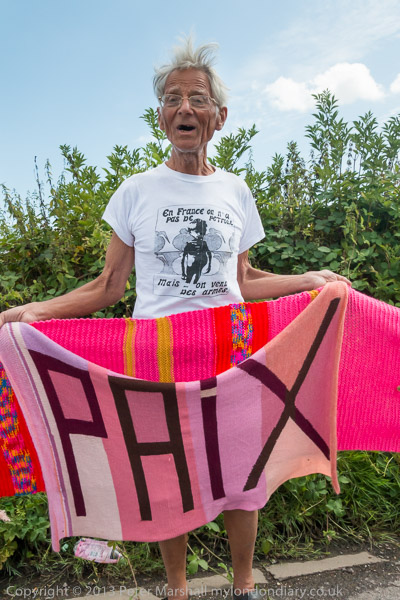
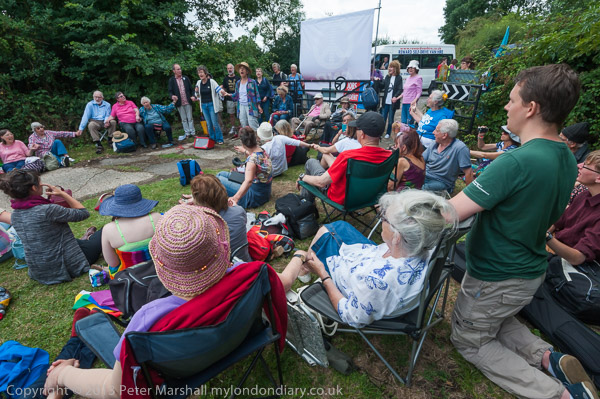
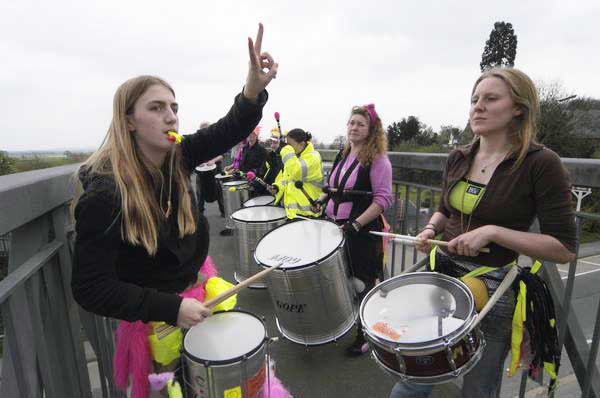
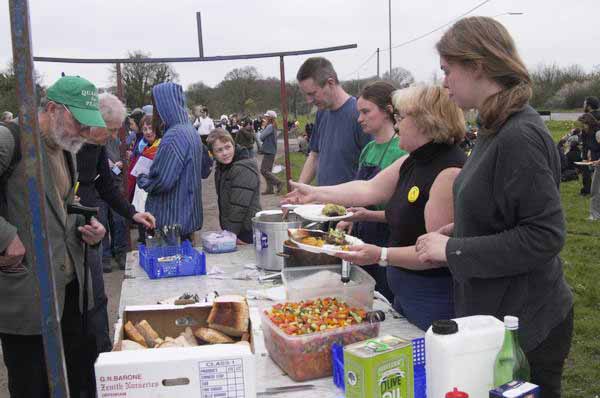
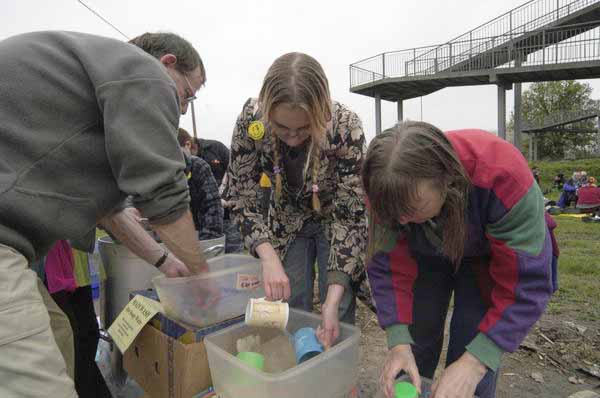
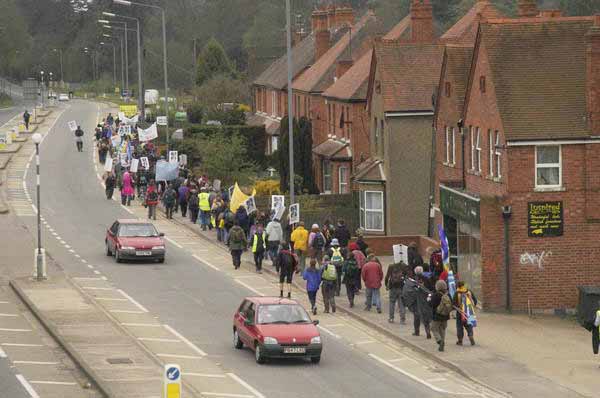
There were 7 miles of pink scarf along the roads between the two atomic bomb factories – and some to spare.
Wool Against Weapons; On Saturday 9th August 2014, the 69th anniversary of the dropping of the atomic bomb on Nagasaki – three days after the nuclear bomb devastated Hiroshima, CND organised a large-scale protest against nuclear weapons, stretching a line of pink knitting seven miles to link the bomb factory at Burghfield with the Atomic Weapons Establishment (AWE) at Aldermaston.
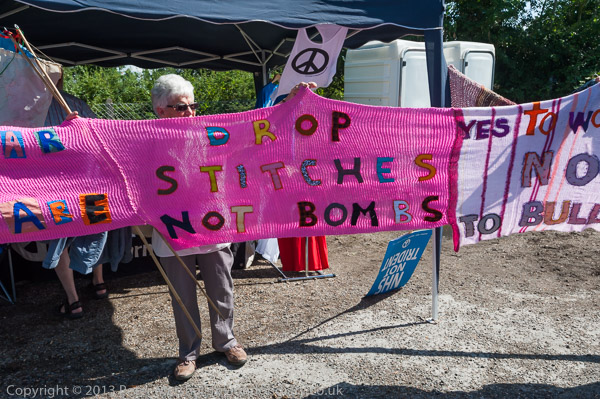
Some sections had fancy designs, others had slogans – ‘Knitwear Not Warfare’‘Drop Stitches Not Bombs’
The protest came well ahead of a parliamentary vote expected in 2016 to allow the government to spend over £100 billion on a new nuclear weapons system to replace Trident.
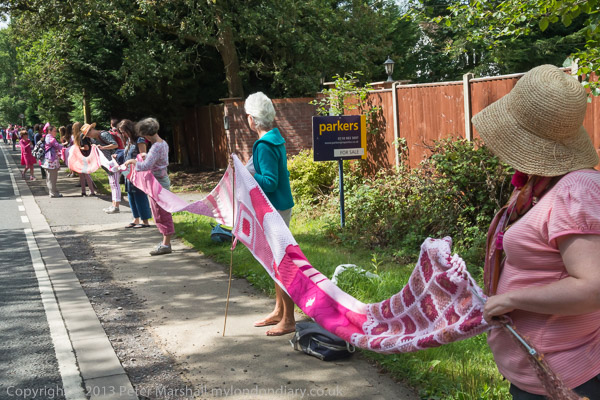
People were sewing the lengths of scarf togetherStretching out the lengths
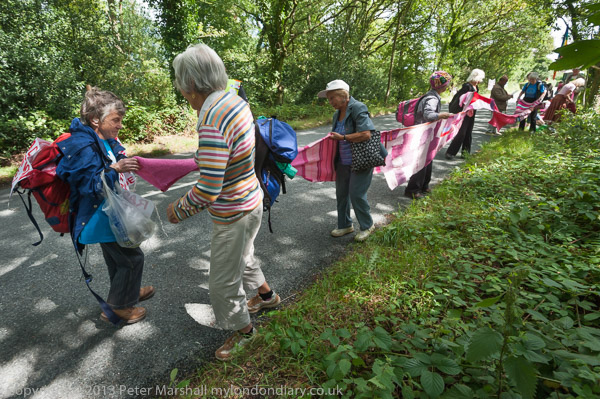
Groups from all over the country (and some in France) had been busy knitting and crocheting lengths of pink scarves and joining these into rolls that could be brought to their designated point on the 7 mile route, unrolled and joined up with others to complete the scarf.
The project brought together a large number of people many who had not previously protested against nuclear weapons but were appalled at the amount of money that would be wasted on a Trident replacement which could be much better spent in other ways – such as keeping the NHS running.
Extra knitting on the fence of AWE Aldermaston
I had decided the only sensible way to cover this protest would be on a bicycle, and got up to go with my bike on an early train to Reading, from where I cycled to Burghfield, arriving shortly before 10.30. This gave me two and a half hours before the whole scarf was scheduled to be joined up at 1pm.
People wait to hear that the scarf is linked
After photographing at this end of the scarf, I cycled slowly along the route, jumping off my bike to take pictures where people were busy laying out the rolls of scarf and joining them up. Eventually I reached Aldermaston and after taking some pictures there rode quickly back to Burghfield to be there well before the joining was complete at 1pm.
Waiting for the the signal that the scarf is linked along all 7 miles
At 1pm protesters held up the now joined 7 mile scarf and rang bells – and I ran almost a mile along it taking photographs. I think it was held up for around 10 minutes before people took it down and began to come to a rally at Burghfield which began a little after 1.30pm.
And people rang the bellsOne person was getting a little boredOne of the French protesters
There was music and poetry and speeches, including from Walter Wolfgang and Kate Hudson. It was still continuing after I left to ride back to Reading and take the train home.
Budget Day: Tuesday 22nd June 2010 came after the May general election which had resulted in a hung Parliament, with the Tories winning 306 votes, 20 short of the number needed to for a majority. It had been a defeat for New Labour, in power since 1997, who only achieved 258 MPs. The Lib-Dems were the third party with 57 seats. Theoretically an anti-Tory coalition might have achieved a small but workable majority, but instead Nick Clegg decided to join a coalition government with the Tories which would have a clear majority – and lasted until the 2015 General Election.
Their decision resulted in a programme of austerity and cuts along with increases in tax which began with George Osborne’s budget on 22nd June. This included a rise in VAT from 17.5% to 20%, cuts in public services and a 2 year pay freeze for workers in the public sector, freezing of child benefit for 3 years, pegging state benefits and public service pensions to a lower price index, capping of housing benefit , cutting research and development and more.
PCS outside the Treasury
Most of these changes had been widely signposted before the budget speech and opponents had made clear that they were likely to stifle growth and to have a disproportionate effect on the poor, women, disabled people and ethnic minorities. It was the most controversial budget in recent history and so it was unsurprising that so many came out to protest. And later the changes it introduced were probably a major factor in both the disastrous Brexit vote and the succession of hopeless Tory governments that led to the 2024 Labour landslide.
‘Can’t Pay Won’t Pay’s funeral procession with coffin, widow and gravestones
Brian Haw’s Parliament Square Peace Campaign was also still in Parliament Square, although Brian himself was in court on the morning of the budget. But they had been joined there at the start of the previous month by the Democracy Village who were still camping there, and though relations between the two groups were not positive, both were still protesting, and on Budget Day others including the PCS union, ‘Can’t Pay Won’t Pay’, Stop the War and CND also came to protest at Westminster too.
I missed what was probably the largest protest of the day opposite Downing Street, having been held up photographing the Democracy Camp calling for an end to the war in Afghanistan.
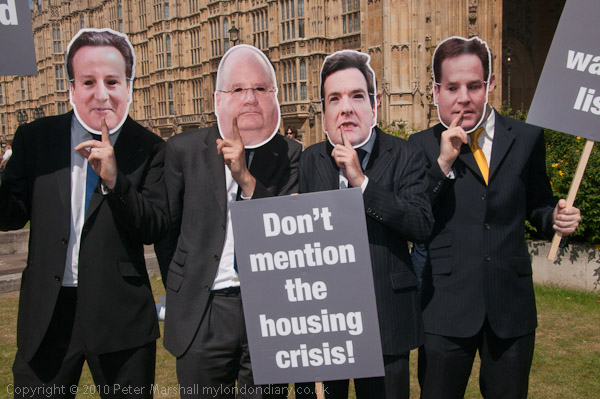
‘Cameron’ and ‘Clegg’
The PCS were protesting outside the Treasury. Democracy campers went with their banner to the media village. ‘Can’t Pay Won’t Pay’ campaigners arrived with a coffin and a little street theatre (it even got them a short mention on the BBC) and I followed them back to Parliament Square, missing two attempts to make citizens arrests on Labour politicians.
You can read more about the events on My London Diary, as well as a police incident involving gun violence campaigner ‘King David’ who was holding a brass ornamental pistol – clearly not a weapon – but was stopped and searched under terrorist legislation.
King David was searched under the Terrorism act for holding this brass ornament
More protesters arrived with placards and masks protesting about the housing crisis and the lack of affordable homes, and there was a man with a megaphone lampooning the whole thing and getting some attention from the police who today seemed clearly did not want to make arrests.
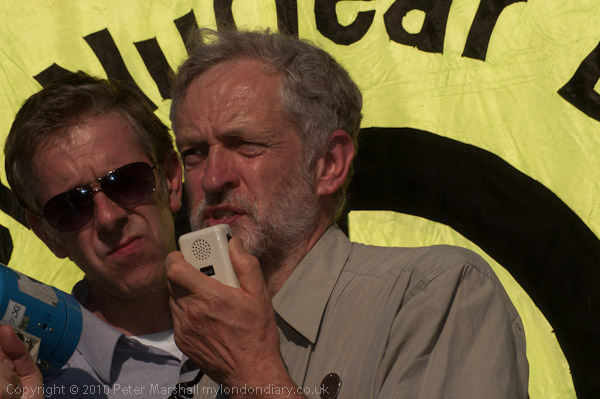
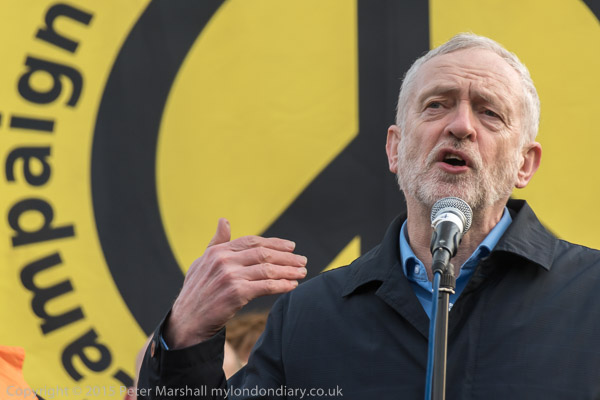
Jeremy Corbyn
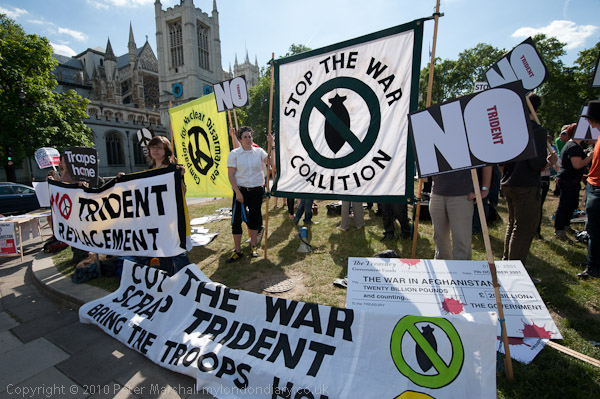
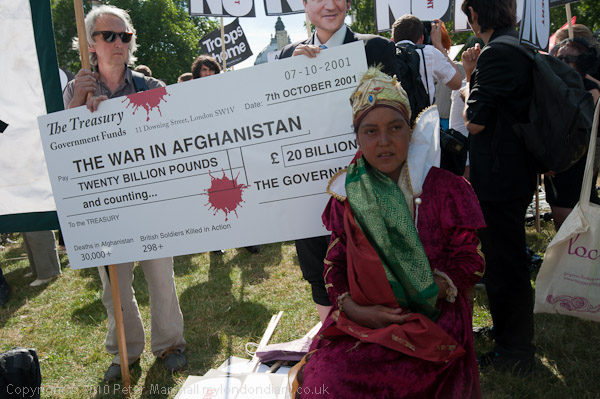
The final event I photographed before leaving Parliament Square was by Stop the War and CND, pointing out that the war in Afghanistan had cost more than £20 billion, and that a large saving could be made by deferring or cancelling the replacement of our Trident nuclear deterrent, for which there was no longer any possible military justification.
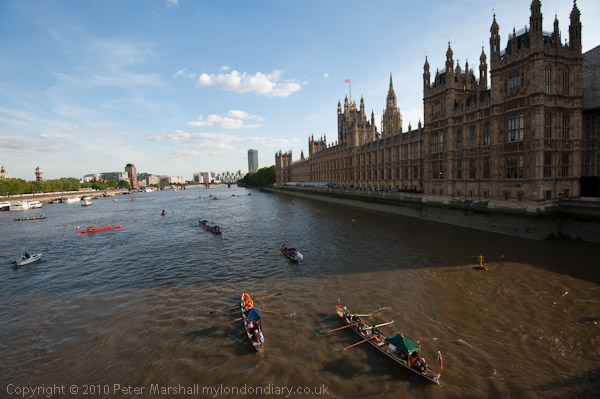
The race starts in several waves from outside the Houses of Parliament
As I walked back across Westminster Bridge towards Waterloo Station I noticed a number of boats being rowed upriver in what appeared to be a race.
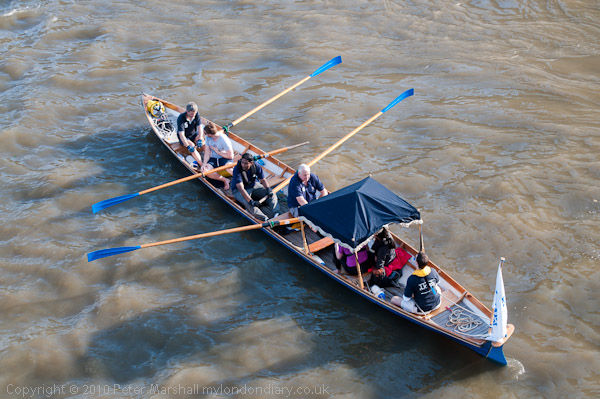
The Admiral of the Port’s Challenge, a “historic tradition”, appears to have started around 2008 by the London livery companies, liverymen rowing “traditional” Thames Waterman’s Cutters, 34 feet long and 4 feet 6 inches wide, with fixed seats for 4 rowers and a canopy over 2 passengers, to the rear of which the cox sits. The boats start in waves from outside the Hoses of Parliament and row around a mile and a third to a boat club in Pimlico.
These boats, though based on those shown in 18th century paintings, are actually a modern design, adapted and built to be fast and stable for modern use for the Thames ‘Great River Race’ which started in the 1980s. Unlike modern racing craft they can cope with choppy waters on the river or even in coastal waters. And at the end of the race there is a champagne reception for those taking part.
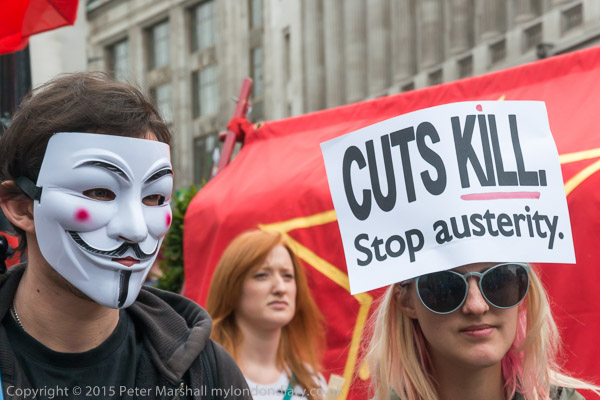
End Austerity Now & Class War: On Saturday 20th June 2015 I sent to photograph the march organised by the People’s Assembly Against Austerity from the Bank of England to Parliament Square. Class War came to protest calling for direct action rather than marches which changed nothing and after photographing them in the City I went with them to Downing Street – and they paused for a brief protest at the Savoy on the way.
End Austerity Now at Bank
Bank
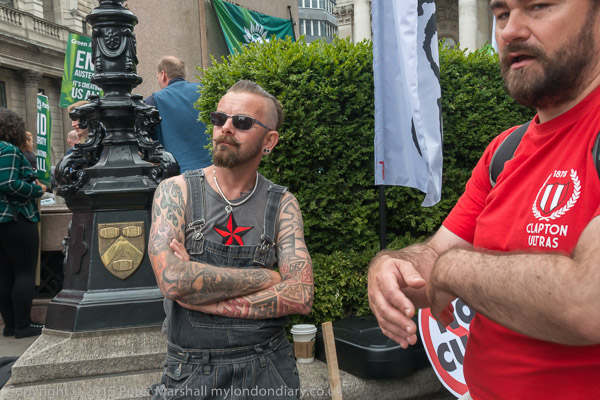
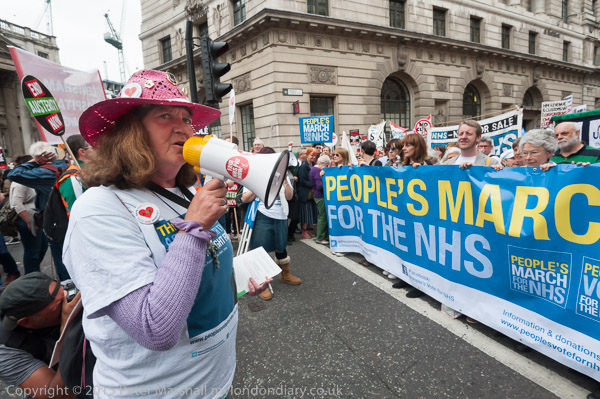
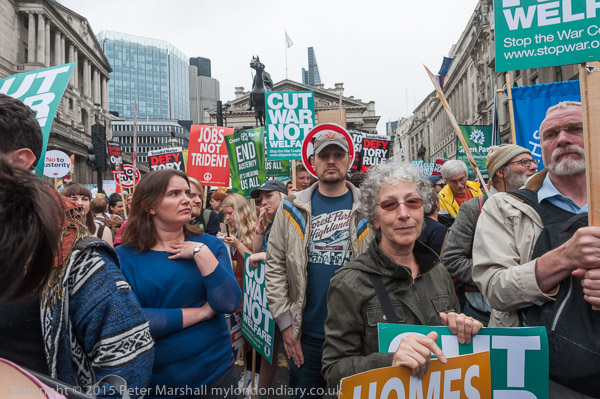
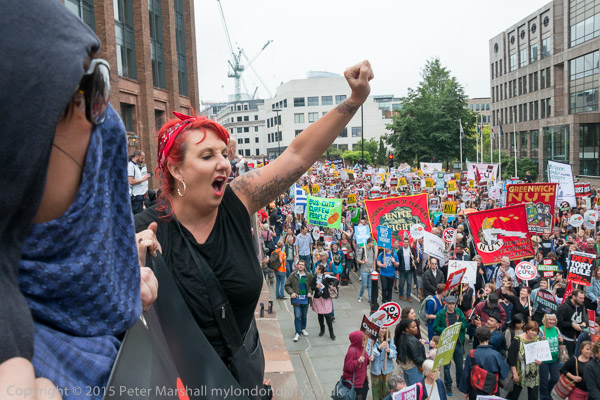
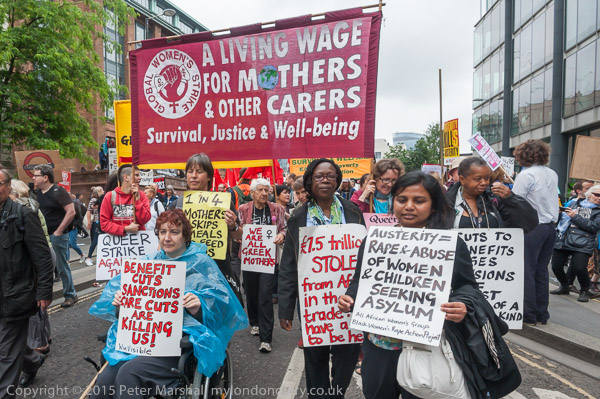
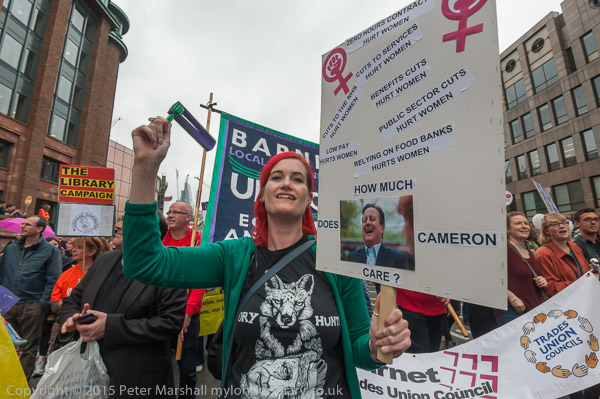
Large crowds gathered around the Bank of England for the start of a massive march against austerity organised by the People’s Assembly Against Austerity and supported by many groups including CND, the Green Party, People’s March for the NHS, Global Women’s Strike, Basic Income, Revolutionary Communist Group, Clapton Ultras and many other groups and individuals from around the country.
Clapton Ultras -“Football for all. Good times, good songs and Polish lager. Always antifascist.”
So many were being affected by the cuts which had forced down incomes, cut benefits and the welfare state, cut education, destroyed youth services, made massive cuts to the NHS and public services while supporting the bankers whose actions had led to the crisis.
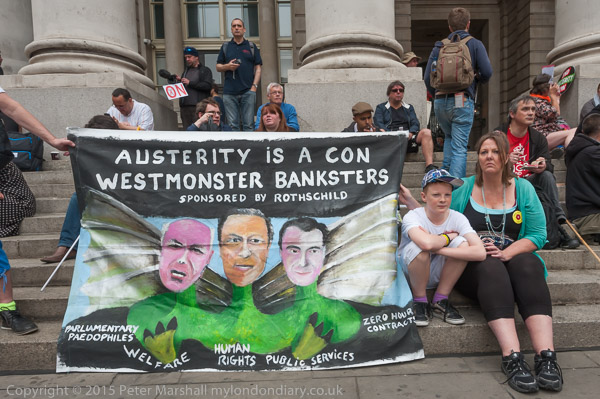
Austerity is a Con – Westmonster Banksters sponsored by Rothschild
The programme of austerity introduced by the coalition government and continued under the Tories had seriously harmed the country and slowed its recovery from the financial crisis and seemed to be a punishment for the crimes of others, which had been made possible by the changes to the banking system introduced under Thatcher in 1986.
As usual estimates of the number of marchers varied hugely, with the organisers claiming a quarter of a million, while the BBC contented itself with ‘”thousands”. From the time it took and the density of the crowds I think it was at least a hundred thousand. Parliament Square was well filled with others still arriving, but like many others I went home rather than listen to the speeches.
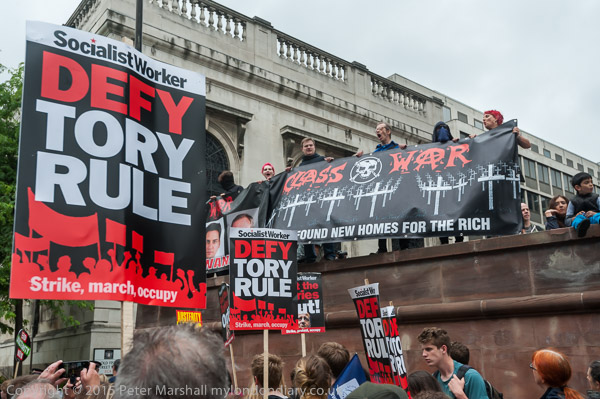
Class War held their banner on a footway overlooking the march
Class War had come to the protest to call for end of A to B marches to rallies and call for direct action. They succeeded in diverting several hundred of the marchers to make their way to protest at a squatted pub near the Elephant which Foxtons want to open as an estate agents.
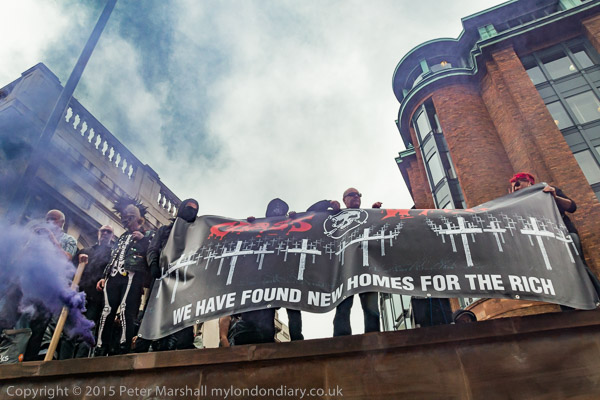
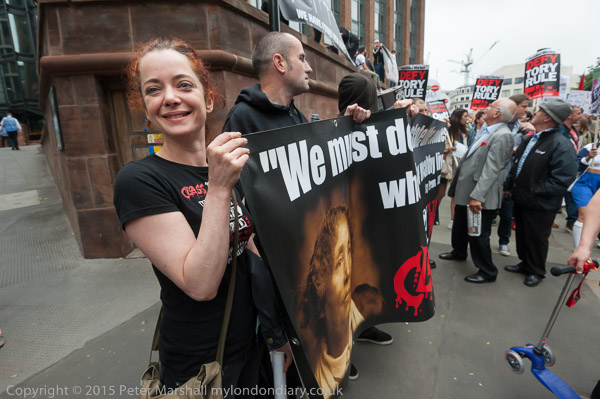
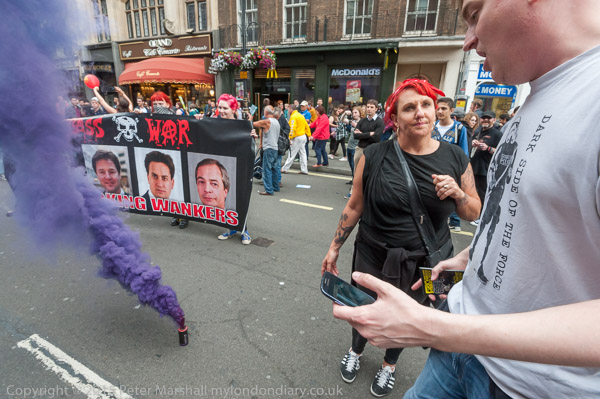
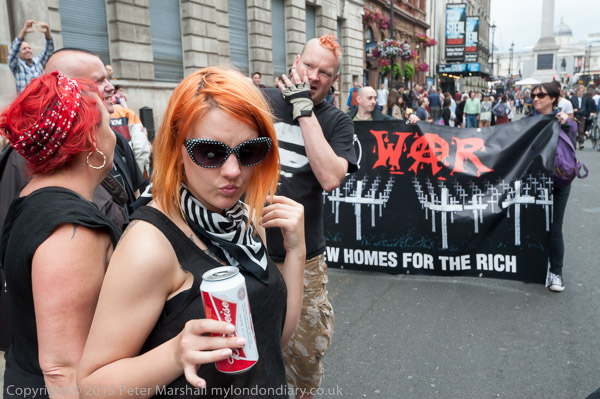
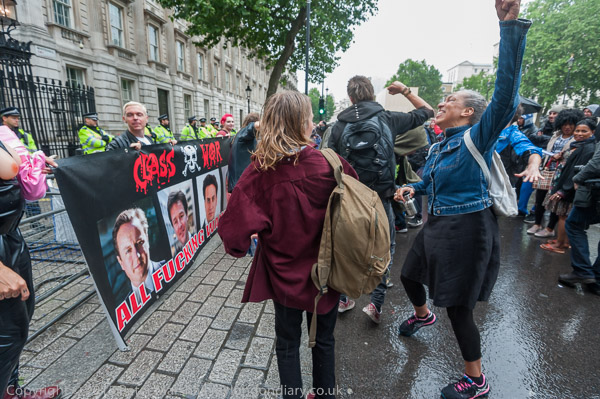
Class War had brought several banners including the ‘Political Leaders’, a new version of that seized by police at a ‘Poor Doors’ protest, the ‘Lucy Parsons banner with its quote “We must devastate the avenues where the wealthy live” and ‘We have found new homes for the rich‘, with its rows of crosses on graves extending into the distance which police were then still pressing charges against Lisa McKenzie over.
Lisa McKenzieAdam Clifford
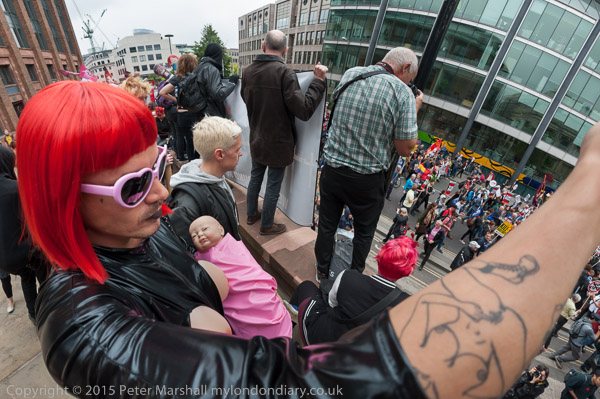
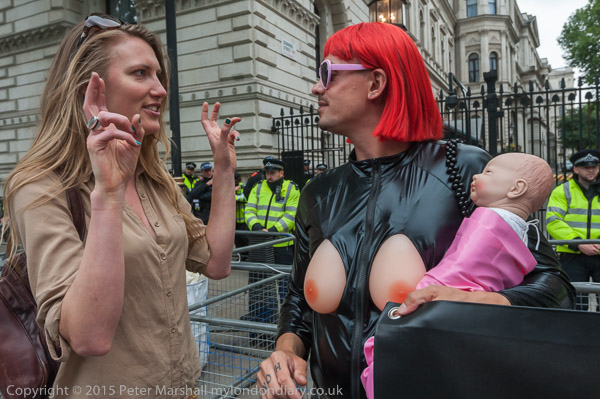
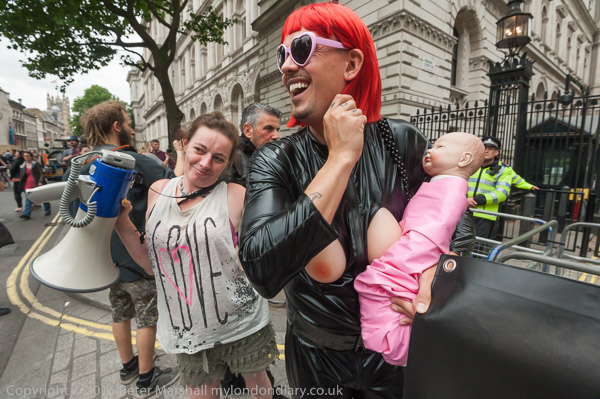
Lisa was there along with the others including Adam Clifford who stood for Class War in the Westminster constituency, today wearing a top with fake exposed breasts and holding a fairly lifelike looking baby. As well as those above the protest others protested on the side of the street below.
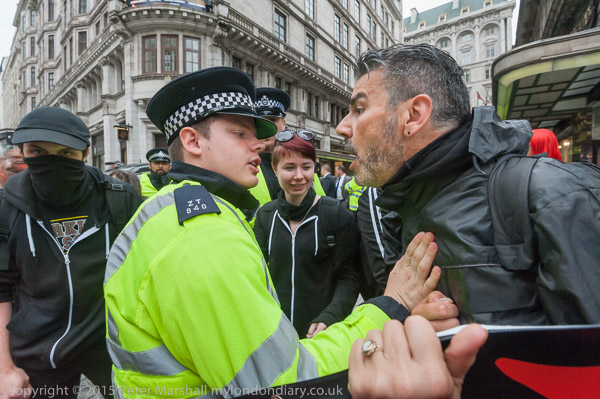
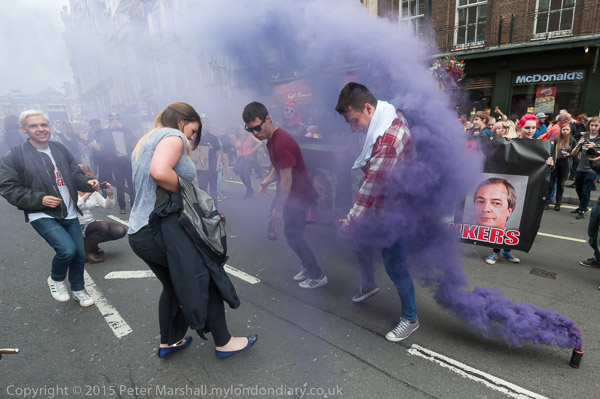
Many marchers raised fists and shouted in solidarity with Class War as they passed, though some shook their heads, while others tried to ignore them. This wasn’t easy as they made a fair amount of noise and let off several smoke flares.
Around 30 police gathered around them at one point and it looked very much if they were going into action, but after a discussion between several senior officers on the scene, most rapidly walked away.
I stayed in the area either with them above the march or down below on the densely crowded wide street for around an hour, making many pictures both of Class War and the marchers.
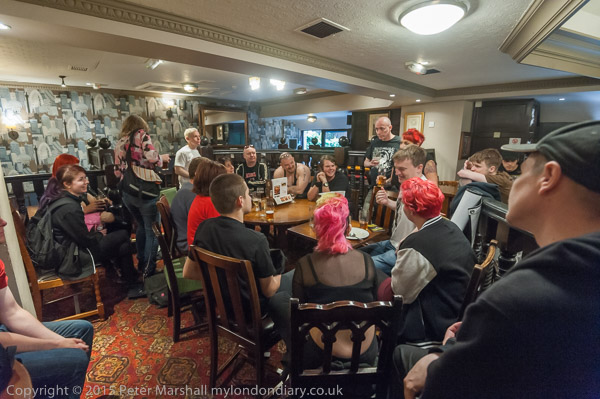
They sit in the pub and police wait for them outside
When the end of the march appeared to reach them they joined in for a couple of hundred yards then peeled off to go to the Olde London pub on Ludgate Hill
Class War insist on the right to protest outside the Savoy
After a rest in the pub Class War walked down towards Westminster with their police escort to carry out more protests.
Approaching the Savoy Hotel some broke out into a run to get ahead of their escorts but found that there were more police already waiting there.
But they unrolled their banners again and briefly blocked the entrance with ‘New Homes for the Rich’ and ‘Lucy Parsons’ banners. After minor scuffles and arguments with police they marched on.
A woman talks to Adam Clifford of Class War holding a baby and a banner outside the gates of Downing St
Class War continued their protests in Whitehall, displaying their banners, setting off flares and dancing with others to a sound system which joined them briefly.
They then moved off towards Downing Street where they posed for photographs with all three banners – and threw a flare over the gate.
Their protest continued there with short speeches and more dancing. People were still coming down the street to join the People’s Assembly Against Austerity protest in Parliament Square and some stopped briefly to join in.
Eventually Class War decided it was time to roll up the banners and leave before police intervened – and it was time to go to the pub again. But for me it was time to go home.
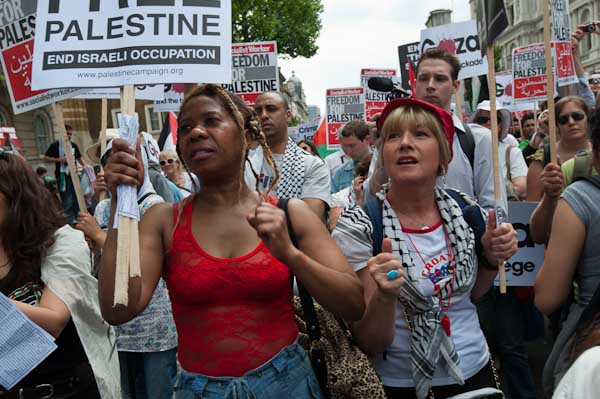
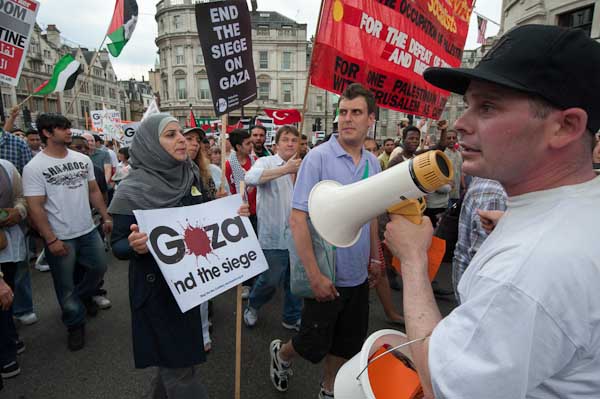
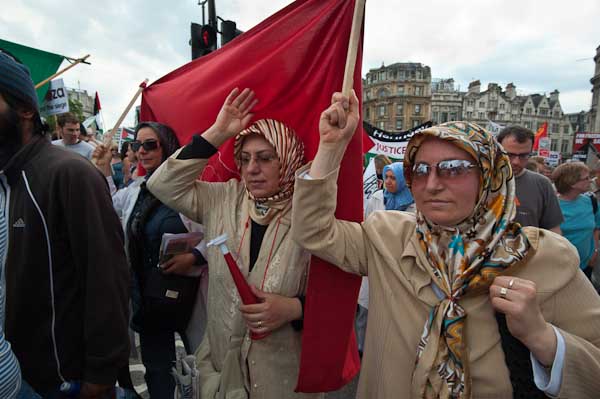
End Child Detention, Gaza Flotilla Atrocity: I covered two protests on Saturday 5th June 2010, a carnival against the holding of children in immigration detention centres, and rallies and a march following the killing by Israel of on 31st May of peace protesters who were on a flotilla attempting to break the illegal blockade of Gaza, carrying humanitarian aid and construction materials. As last month, the ships were illegally intercepted in international waters, A UNHRC report on the incident concluded Israel acted with “an unacceptable level of brutality“. Nine protesters were killed and 30 seriously injured, with another dying later from his wounds.
Gaza Flotilla Atrocity Protest
Whitehall – Israeli Embassy
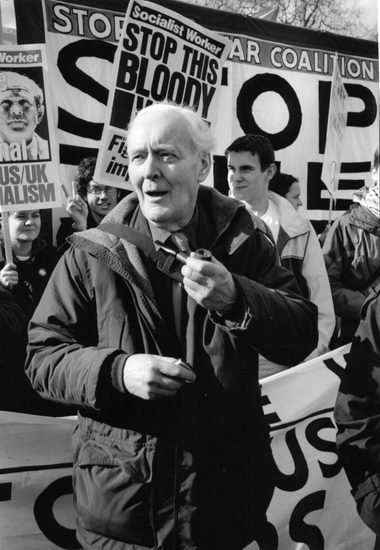
Around 20,000 people flooded Whitehall for a rally at Downing Street before marching to protest close to the Israeli Embassy following the murder days earlier of peace protesters by Israeli forces. They called for international action against Israel and an end to the illegal blockade.
The protest called by Stop the War Coalition, Palestine Solidarity Campaign, British Muslim Initiative, CND, Friends of Al-Aqsa, Viva Palestina and Palestinian Forum of Britain had the official support of the trade union movement.
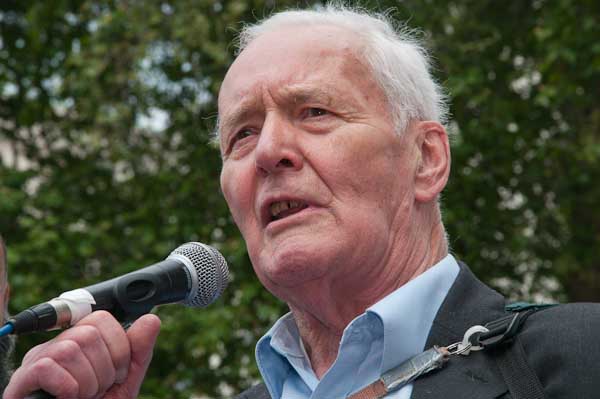
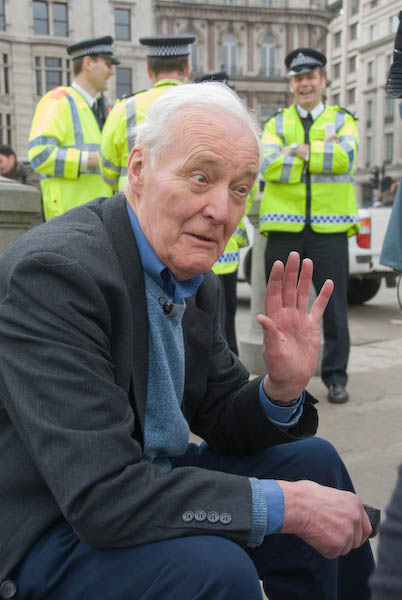
Tony Benn
There were speeches from politicians, activists and flotilla survivors both in Whitehall and after the march on Kensington High Street – and I name many and posted their pictures on My London Diary.
Although independent media reports had made clear that some of those killed had been shot multiple times in the head at close range in what appeared to be more or less random executions, the BBC had been broadcasting again and again the same lies from the same Israeli apologist defending their killings.
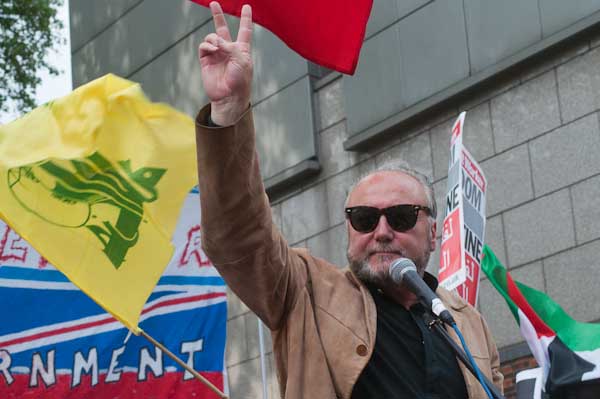
George Galloway
On the evening news they did mention this protest but reported that only 2,000 people took part, when clearly the actual number was at least five or ten times as many. As I commented “This is not an isolated error – there is a consistent policy by the BBC to play down the scale of protest.”
We have seen this playing down of pro-Palestine protests in particular in recent years, as well as a continuing and academically well-documented pro-Israel bias in their overall reporting. At least now there are now some interviewers who do try to question the Israeli spokespeople despite the overall editorial imbalance – but also allow them to keep repeating their lies.
SOAS Detainee Support Group had organised the ‘Release Carnival’ which called for an end to the practice of holding families and children in immigration detention centres.
The Children’s Commissioner for England, Sir Al Aynsley-Green had stated “Detention is harmful to children and therefore never likely to be in their best interests” and he argued “that detention of children for immigration control should cease“.
Although the UK Border’s Agency claimed “treating children with care and compassion is a priority for the UK Border Agency. Whenever we take decisions involving children their welfare comes first” the reality was very different, as you can read in many publications including the highly detailed report ‘State Sponsored Cruelty‘.
Detention centres are run by private contractors such as Serco and G4 whose main concern is profit, with little or no proper monitoring. Official inspections as well as many media investigations have made clear the real lack of proper care and maltreatment of detainees.
Christian Aid, Mordechai Vanunu & Mass Lone Demos. My photography on Saturday 21st April 2007 began with a small event close to home with music and tree planting celebrating 50 years of Christian Aid. I then rushed into London for the start of the Mass Lone Demo initiated by Mark Thomas as a protest against SOCPA, the Serious Organised Crime and Police Act which greatly restricted the right to protest in the area around Parliament.
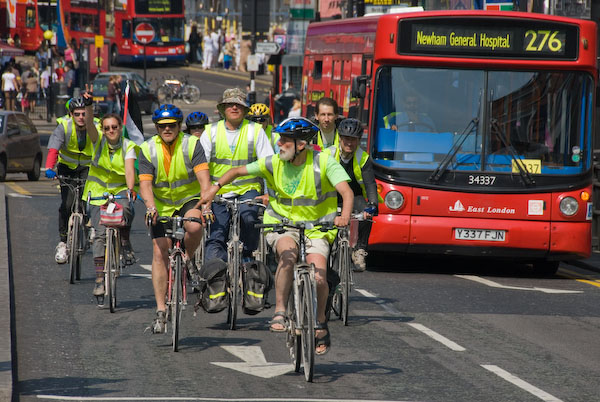
After a short while there I travelled to Hackney where cyclists, some who had begun at the Faslane nuclear submarine base on the Clyde, were beginning the final leg of the Vanunu Freedom Ride. After they had set off I returned to take more pictures of the Mass Lone Demo, then took the tube to meet the cyclists again close to the IsraelI Embassy in Kensington.
Below is what I wrote in 2007, with the usual minor corrections and links to more pictures from the day on My London Diary.
Christian Aid: Tree Planting – Celebrating 50 Years
Staines, Middlesex
Saturday was another beautiful day, sunny, warm but not too hot, and the quintet with a fine singer created a mellow atmosphere as we gathered to plant two apple trees to celebrate 50 years of Christian Aid. the music included several of my Ellingtonian favourites, there were some interesting home-made cakes, and it was great to relax for a while in the sun.
One of the 2 apple trees planted at Staines to celebrate 50 years of Christian Aid gets watered in.
The trees were given and planted by Colin Squire of Squires Garden Centres, and as he commented, the Cox’s Orange Pippin was an appropriate choice, as not only is it a fine apple, but was first grown by Richard Cox just three miles away at Colnbrook in 1830.
The two trees are in a public area, and we hope that in years to come the public will come and help themselves and enjoy their crop.
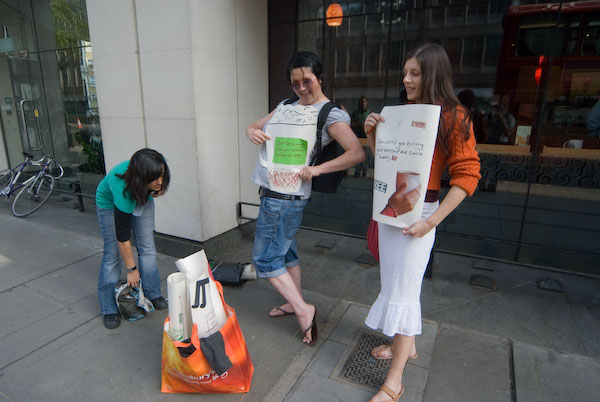
Starbucks in Victoria St – 3 of the over 2000 demonstrations
Mark Thomas’s latest twist to the Mass Lone Demo was for demonstrators to set out a list of 20 demonstrations they would eaach hold in the SOCPA area on Saturday and to apply for permission for each of them. He was aiming for 2000 demonstrations (and hoping for an entry in the Guinness Book Of Records.) The police figure for the number of demonstrations that permission was applied for was 2,486, but it was actually quite hard to find many of them.
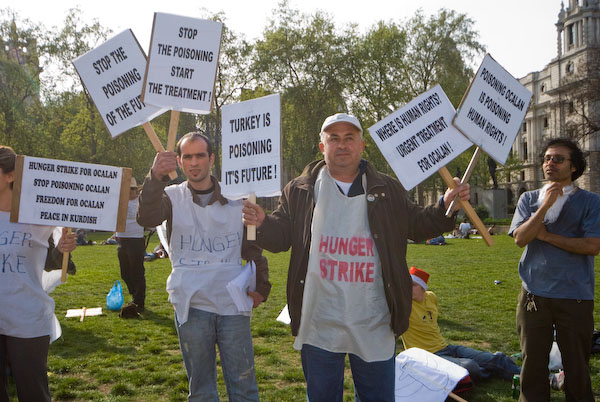
I’d hoped to photograph people at such highly desirable sites for demos as the Mothers Union, the Adam Smith Institute and the Embassy of the Republic of Slovenia, but nobody was there when I looked. However I did find a few, [and also some Kurds who were not part of the Lone Demos] but unfortunately had to miss the final event to get to Kensington.
Kurds declare a hunger strike, demanding an end to the poisoning of Ocalan and his freedom
Freedom Riders in Hackney – they rode from Faslane nuclear base near Glasgow
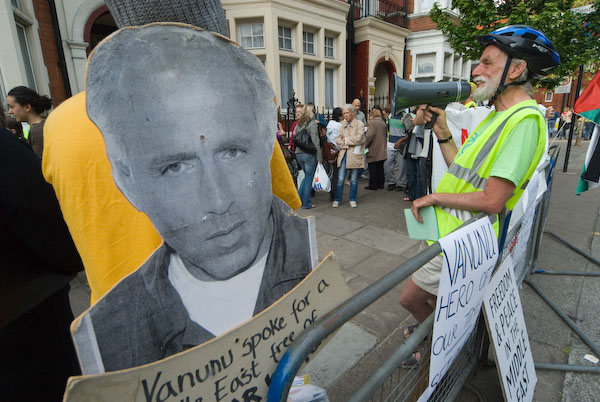
Mordechai Vanunu told the world about Israel’s nuclear weapons – still denied, still secret and still not subject to any international inspection. He worked on the program for 9 years until 1985, and in 1986 blew the whistle, talking to the press. Days later he was lured to Italy and kidnapped from there by the Israeli Secret Service. Convicted of treason in Israel he spent 18 years in jail, 12 of them in solitary.
Released in 2004 he has been under severe restrictions on movement, who he can meet and what he can say. He would like to leave srael but it seems likely he will be sent back to prison. The ride demanded his freedom, the setting up of a nuclear-free Middle East as well as freedom for Palestine.
‘Vanunu’ at Hackney
The riders started at the Faslane base to the west of Glasgow where daily demonstrations are taking place outside the base of the ridiculous UK nuclear deterrent (ridiculous to have it, and in no way independent as we need us permission to use the weapons.) The ride stopped at many places on the way to demonstrate and hold meetings, including Menwith Hill spy station and Lakenheath USAF base.
A rally at the end of the ride at Notting Hill Gate, not far from the Israeli embassy
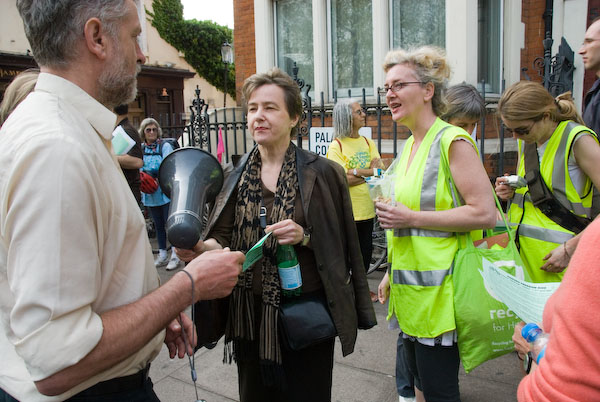
They were met at Hackney Town Hall by members of Hackney & Islington CND and CNF vice-chair Sophie Bolt. From Hackney they cycled on via Downing Street to Kensington, where there was a rally at which Jeremy Corbyn MP, Kate Hudson, CND chair and Louise Richards of War On Want were among the speakers.
The Israeli embassy in London is on a private street with security lodges at each end. cyclists are not allowed in the street, and demonstrations are certainly not tolerated.
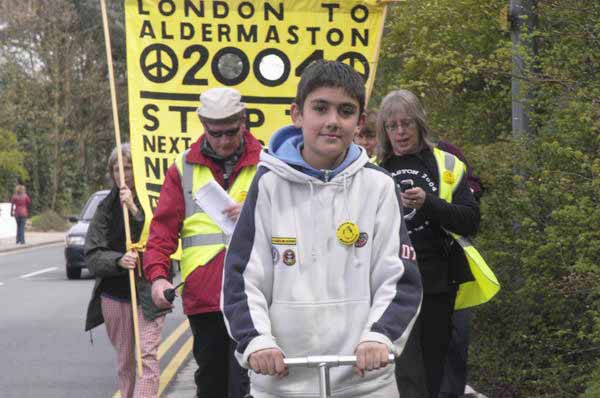
Aldermaston2004 – Sunday: I took part in and photographed the 2004 London to Aldermaston march against the next generation of nuclear weapons, though I only marched part of the way. I photographed the rally in Trafalgar Square on Good Friday and marched the short distance to Kensington before leaving.
I had other commitments the following day when the marchers went on from Southall to Slough, but got on my bike on Sunday morning to meet them as they came into Maidenhead on their way to Reading. And on the Monday I marched with them from Reading to Aldermaston. Below are some of the pictures I took on the Sunday, with text from 2004 on My London Diary and links to the pictures from Friday and Monday.
Aldermaston March 2004
I met the marchers on Sunday morning as they came into Maidenhead
Aldermaston2004 was jointly organised by CND, the Aldermaston Women’s Peace Campaign and Slough4Peace.
There was a rest and refreshments outside Maidenhead Methodist church
The ‘Stop The Next Generation Of Nuclear Weapons’ march from London to Aldermaston started on Good Friday, 9 April 2004, from Trafalgar Square, where there was a ‘No New Nukes’ rally.
The March heads out of Maidenhead towards Reading
Aldermaston and nearby Burghfield are at the centre of the UK’s atomic weapon programme, and the march was a protest against the development of a new generation of nuclear weapons. In 1958 the dangers of nuclear war were clear to most of us, and almost fifty years of the proliferation of weapons of mass destruction among members of the ‘nuclear club’ make them even more of a danger now.
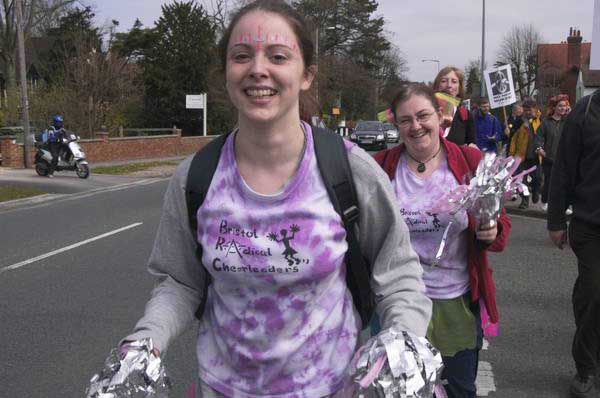
Bristol Radical Cheerleaders keeping our spirits up
Since 1958 we have seen another almost 50 years of lies and deception dressed up as security and national interest. For example we still haven’t been told of the nuclear warheads kept by our American allies at Lakenheath.
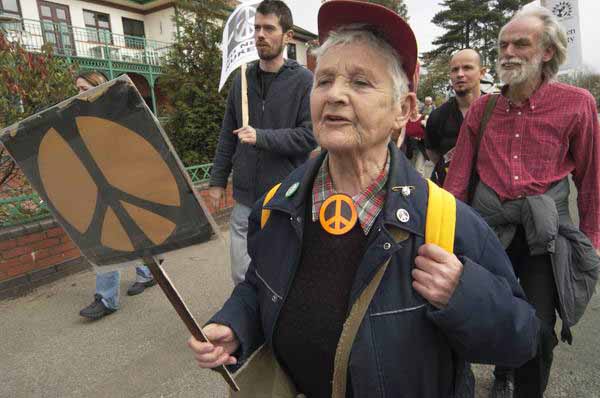
Pat Arrowsmith with vintage CND placard and CND badges, striding along the road in Maidenhead
Saturday, the march continued from Southall to Slough via Uxbridge. I had other things to do in the East End, but managed to catch up with the march on Sunday morning at Maidenhead Bridge with some furious bike riding.
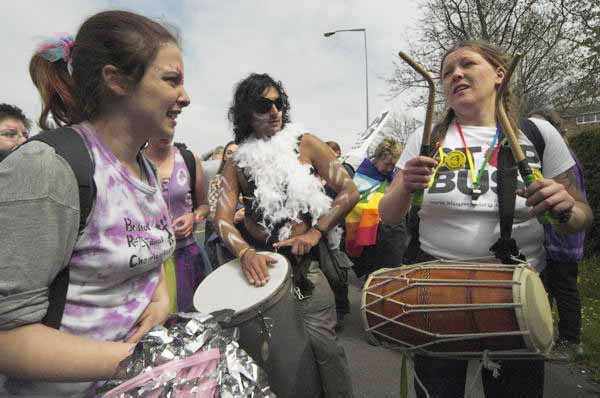
Bristol Radical Cheerleaders and Sheffield Samba Band
By then, some problems with Thames Valley Police had emerged, with the police trying to force the march on to the pavement, while some marchers insisted on keeping to the road. In the end a compromise emerged, with the police tolerating those who wanted to stay on the road walking close to the edge of the pavement.
Sheffield Samba Band plays the march into lunch at Knowl Hill
From Maidenhead it seemed a long walk to Knowl Hill for a rather late lunch stop. There we were greeted from a distance by the sounds of the Sheffield Samba Band who piped the march in to lunch.
I regretted not bothering to pick up my meal tickets, but was really too busy to stop to eat. I photographed the column of marchers setting off for Reading and then started a more lonely walk back to Maidenhead and my bike.
Washing up
The pictures in this post are all from my walk with the marchers from Maidenhead to Knowl Hill on Sunday 11th – there are a few more here.
The march heads off from Knowl Hill with around 9 miles to go to Reading
More about the 2004 Aldermaston March on My London Diary with many more pictures from both the ‘No Nukes Rally’ and the final day of the march on Monday 12 April: Friday’s pictures in London Reading to Aldermaston
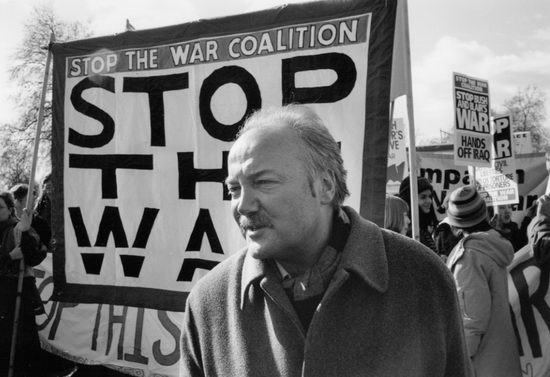
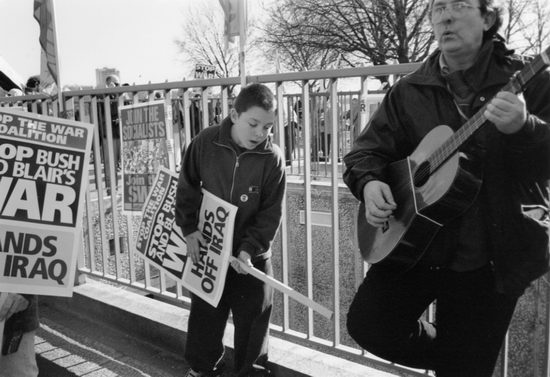
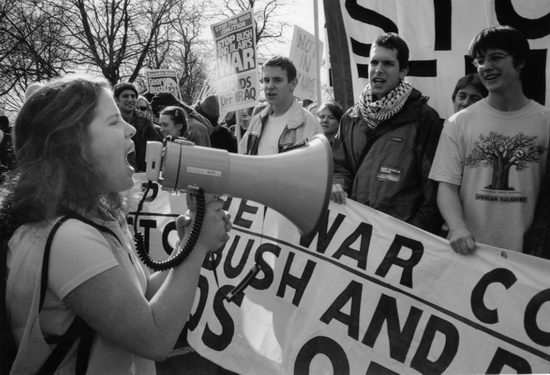
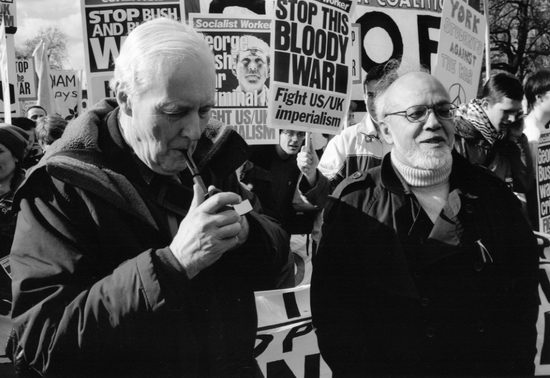
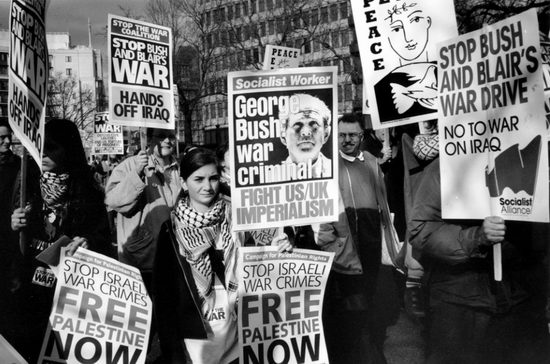
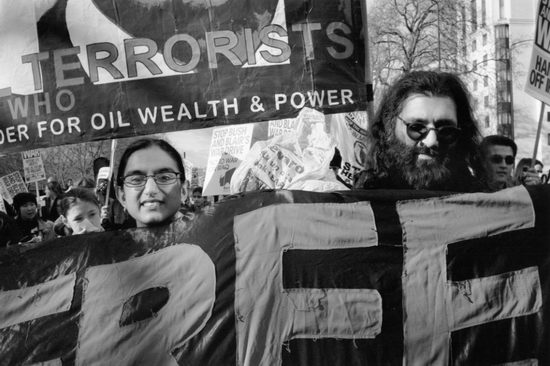
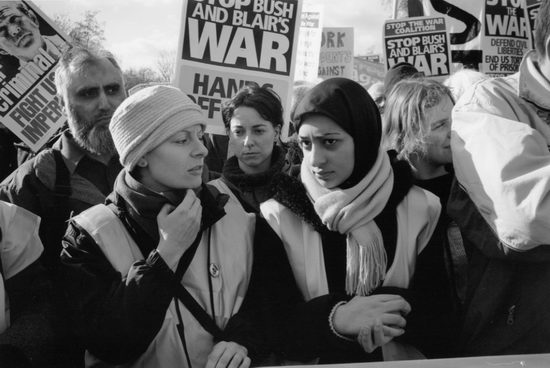
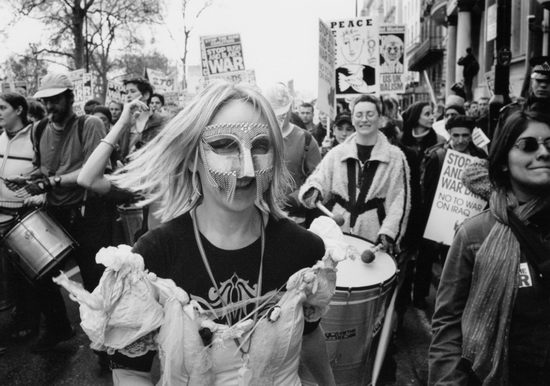
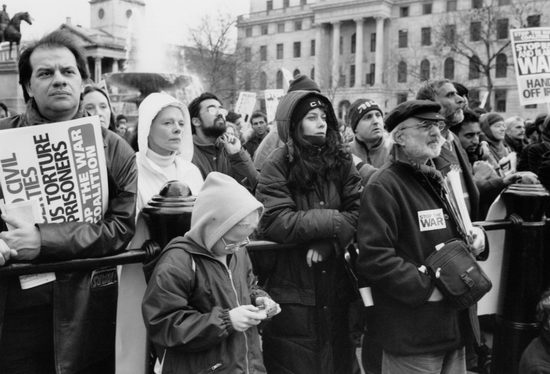
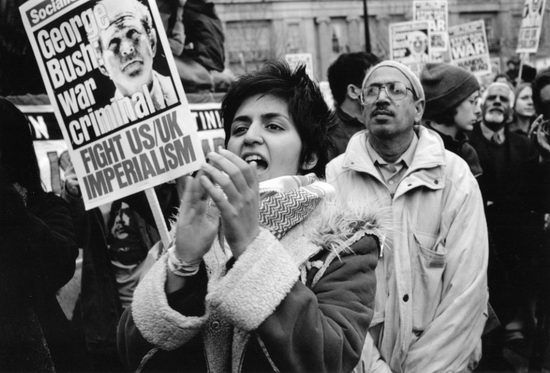
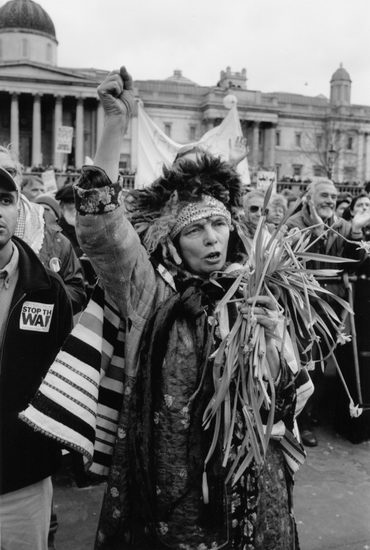
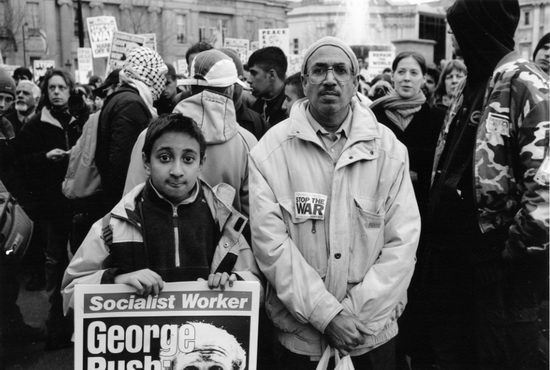
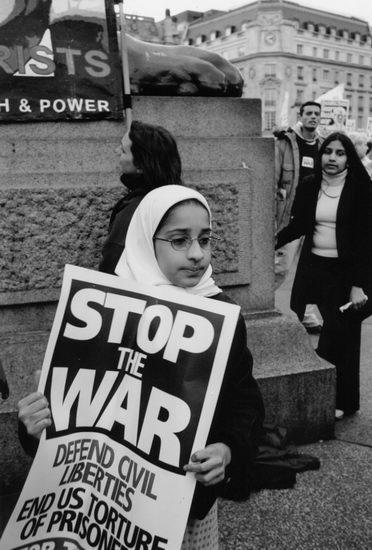
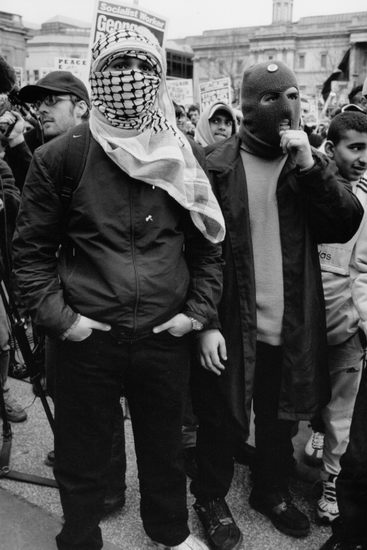
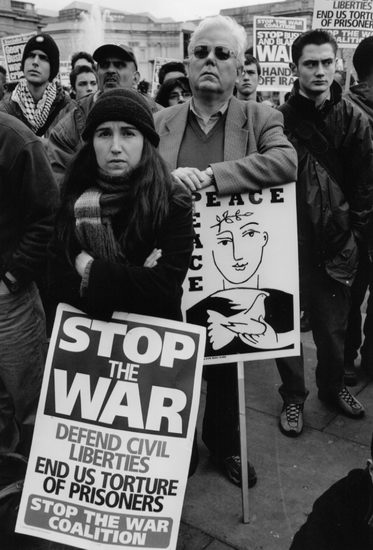
Stop The War – Hands Off Iraq: The protest in London against the US plans to invade Iraq on Saturday 30th March 2002 was I think the first of the really huge protests in London and across the world against the invasion then being planned by U.S. president George W Bush following the September 11th terrorist attacks on the United States.
George Galloway MP at the start of the march in Hyde Park
The Stop the War Coalition had been formed shortly after the 9/11 attacks and had organised this protest together with the Campaign for Nuclear Disarmament and the Muslim Association of Britain.
Air guitar – hyde park
It is hard to give any accurate estimate of the numbers taking part in protests as large as this, but I think there must have been well over a hundred thousand marching – much smaller than the well over a million that marched in London 11 months later in February 2003, but still a very significant number. It received very little coverage in the mass media and so it is now still difficult to find anything about it online.
Helen Salmon and students, Hyde Park
By March 2002 the initial huge public sympathy with the USA over the 9/ll attacks had given place to a feeling that Bush and his “war on terror” was determined to attack Iraq at all cost even though it seemed unlikely that there was any real link between Iraq and Al-Qaida, and there was little if any evidence that Iraq still possessed “weapons of mass destruction“.
Tony Benn and Dr Siddiqui at Hyde Park
Iraq had ended work to produce biological, chemical, and nuclear weapons in the 1990s and most or all of its stockpiles had been destroyed. In November 2002 Saddam Hussein had allowed UN inspectors search Iraqi facilities for WMDs and they found none. The US alleged that Iraq had hidden them – and forged documents were produced about uranium. No WMDs were found during the US invasion and occupation of Iraq in 2003-2011 and US secretary of state Colin “Powell and George Bush eventually admitted Iraq had not had them.”
Stop The War – Hands Off Iraq – 2 Mar 02 – Park Lane
Despite then known facts, Tony Blair had decided to support the US invasion against the huge opposition from the British public. He and his government lied to parliament, most notably with the “Dodgy Dossier” and other documents. The dossier, “sexed up” by Alistair Campbell was largely plagiarised from a thesis by a graduate student at California State University, and contained many errors and unchecked statements, and contradicted much of actual evidence from intelligence sources. It should have ended the political career and any credibility for both.
PiccadillyTrafalgar Square
Back in 2002 I was working with both black and white and colour film, but it was difficult for me to digitise the colour work – and I only posted black and white images on My London Diary. I still have only digitised a few of the many colour images I made at that time.
Included in this post are all of the images I posted on My London Diary and below is the short text I wrote to go with them. The files are small and they were posted across several pages as many then still accessed the web on slow dial-up modems. They are reduced versions of the images I filed to my agency, made by scanning black and white prints.The original post is still online, but adds nothing to this post.
The Stop the War, Hands off Iraq demonstration on 2 March was a large sign of public opinion. People were still leaving Hyde Park at the start of the march when Trafalgar Square was full to overflowing two and a half hours later.
Police estimates of the number were risible as usual – and can only reflect an attempt to marginalise the significant body of opinion opposed to the war or a complete mathematical inability on behalf of the police.
Tony Benn told us it wasn’t worth taking his picture – “It won’t get in the papers unless I go and kick a policeman” but he didn’t and was quite right.
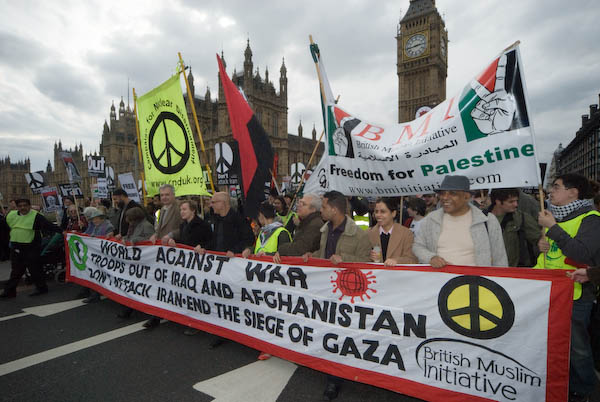
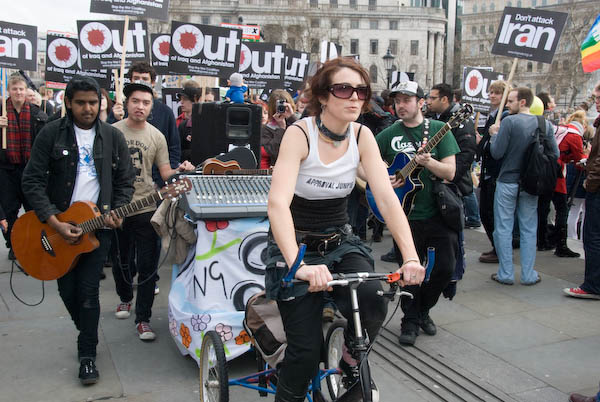
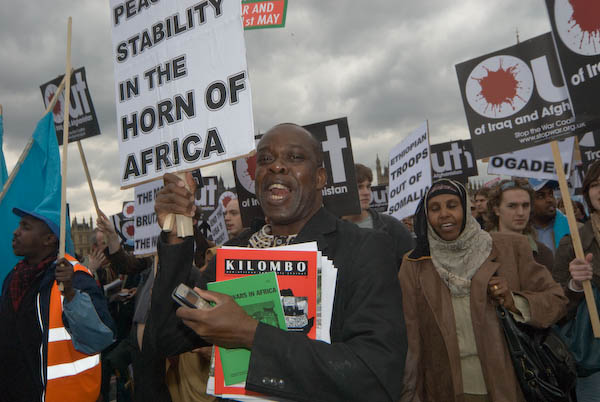
Stop the War – Troops Out: The protest organised by Stop the War, CND and British Muslim Initiative on Saturday 15th March, 2008 was an impressive one, with around 50,000 marchers calling for the withdrawal of our troops from Iraq and Afghanistan, no attack on Iran and a free Palestine, as well as many other groups drawing attention to other issues around the world including the genocide in Somalia.
Tony Benn
It began with a rally in Trafalgar Square where speakers included Tony Benn and Bruce Kent and then took a roundabout route across Westminster Bridge and then back over the Thames on Lambeth Bridge and up Millbank to Parliament Square. Those at the rear of the march were still passing the corner of the square when those at the front arrived back there.
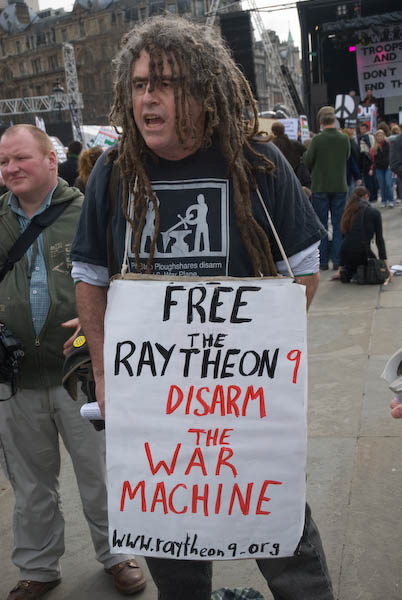
It was an event that included many issues still relevant now, particularly over Iran and Palestine, but also on direct action, with a reminder of the then upcoming trial of the Raytheon 9, anti-war activists who had entered the Raytheon factory in Derry in August 2006 after learning that Raytheon missiles were being used by Israel in their 2006 invasion of Lebanon.
Occupying the offices for eight hours before they were arrested they destroyed computers and documents, and six were tried for criminal damage and affray in May 2008. One man was found guilty of stealing two computer disks but they were all acquitted on all other charges.
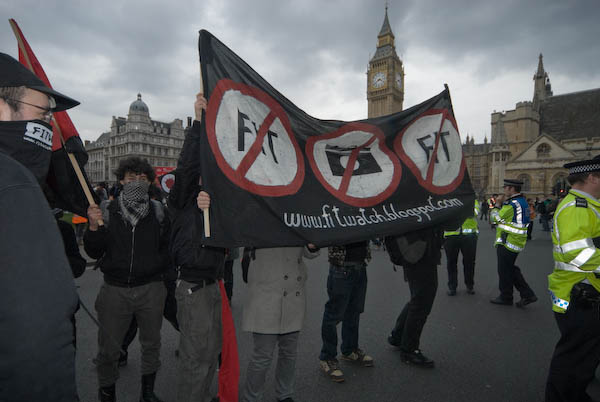
The police took a great deal of interest in the protest, with FIT teams who photograph protesters (and journalists, particularly photographers) took an unusual interest in anarchist protesters from Class War, the Anarchist Federation and FITwatch who use their banner to try to prevent the police taking photographs and video.
I missed seeing four of the FITwatch protesters arrested, apparently for intimidating the police. As I commented, “Since a couple of weeks ago one of their photographers and his minder had been seen taking flight and seeking refuge up the steps of the National Gallery when pursued by a polite and always well behaved woman with a shopping trolley and free cakes – much to the amusement of other police present – intimidating the FIT doesn’t seem too difficult.“
But this – like the many large pro-Palestine protests since ‘September 7th’ – was an entirely peaceful protest, calling for peace in many areas around the world and for an end to UK involvement in wars and oppression.
It was a lively protest, with samba band, sound systes, street theatre and dancing. People laid flowers at Nelson Mandela’s statue and Brian Haw – still permanently camped in Parliament Square despite the attempts to remove him by passing SOCPA – joined the protest.
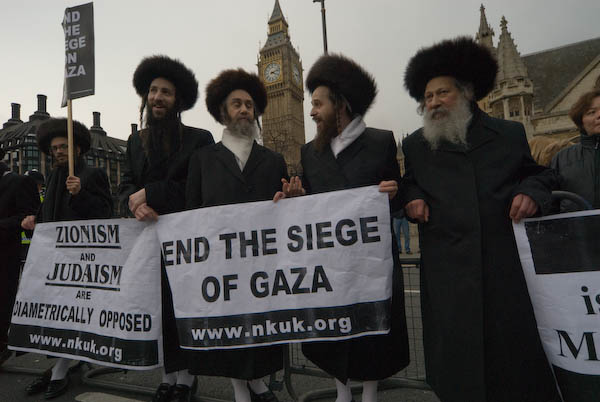
And like all of these marches it also included many Jewish marchers including the Neturei Karta ultra-orthodox anti-Zionists.
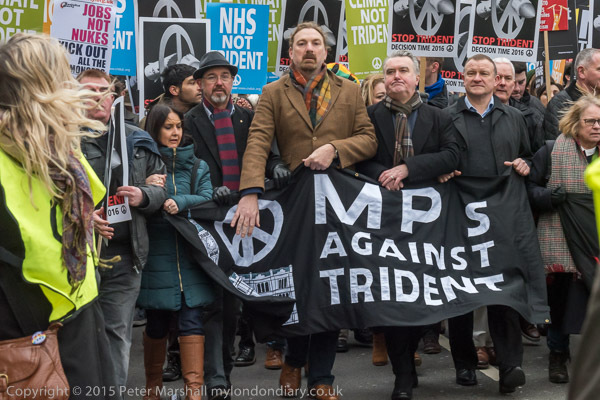
Stop Trident March & Rally: Britain first deployed submarines carrying nuclear missiles in the Polaris programme from 1968, and these were replace by Trident in 1994-6. In 2006 Tony Blair won a vote on the principle of renewing the Trident system in the House of Commons with the support of the Tory opposition, though 95 Labour MPs rebelled.
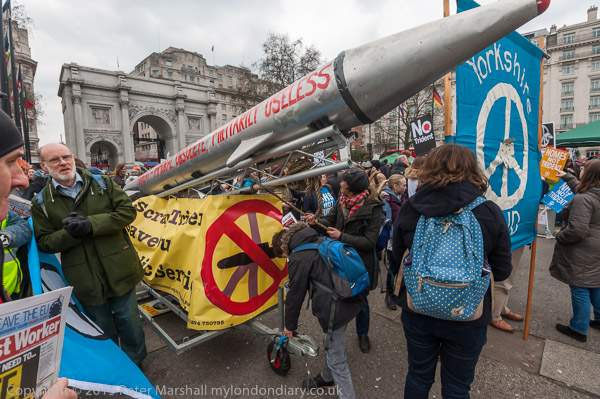
People from Bradford had arrived with their own Trident missile, painted with the message ‘Trident – Immoral, Obsolete, Militarily Useless’
Research into the replacement continued and this march came a few months before a House of Commons vote in July 2016. Again there was a significant Labour revolt, with 41 MPs voting against and 41 not voting, but 140 Labour MPs backed the Conservatives and it passed by a large majority.
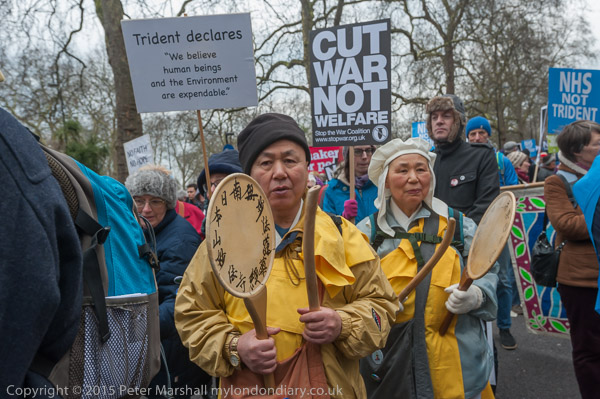
Rev Gyoro Nagase and another from the Nipponzan Myohoji order at Battersea’s Buddhist Peace Pagoda
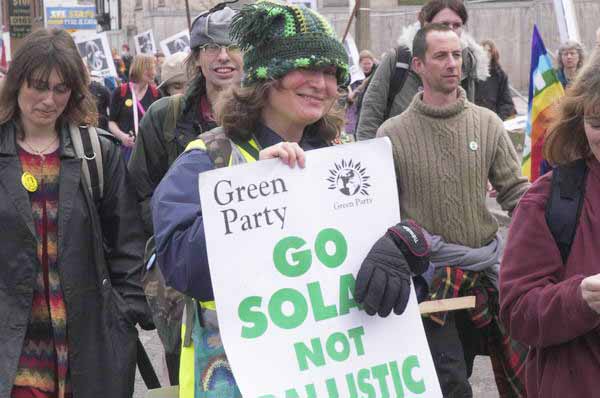
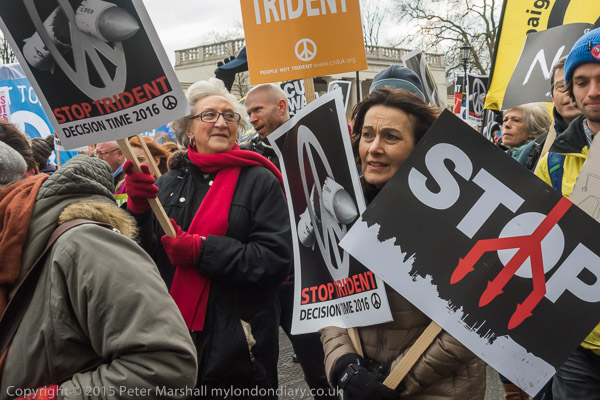
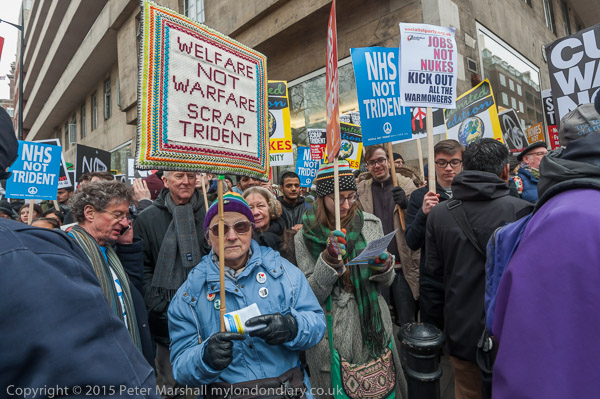
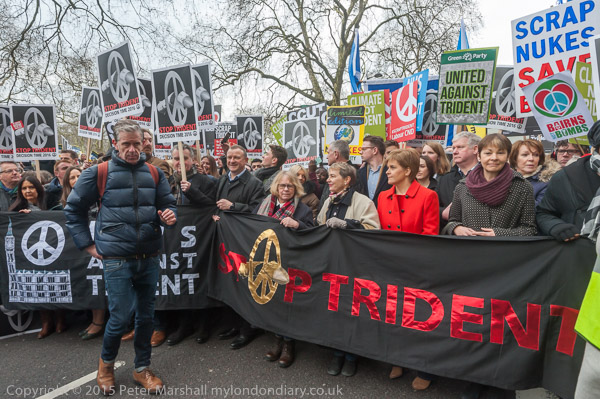
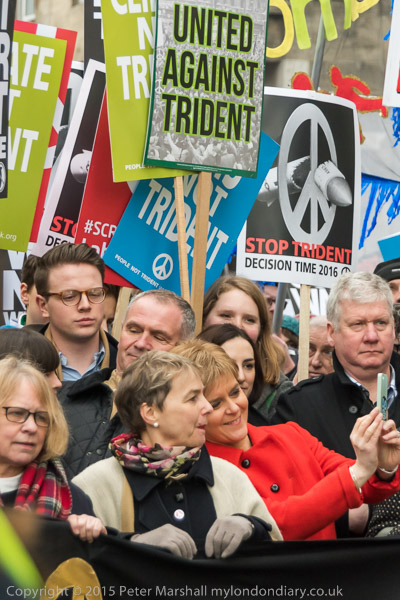
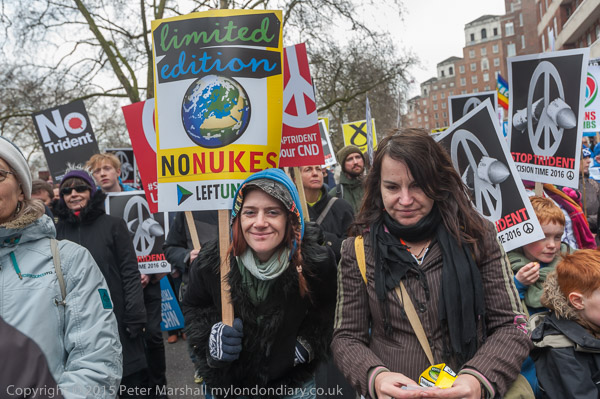
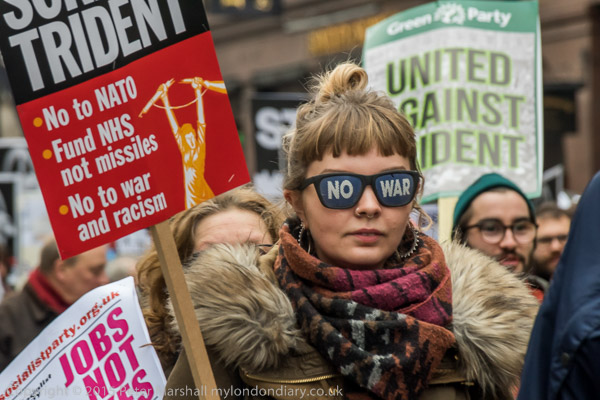
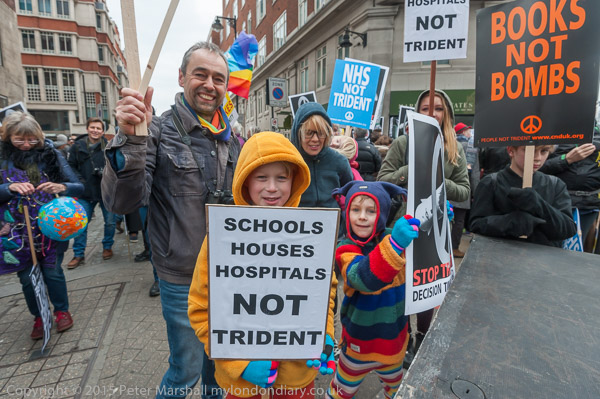
Around 60,000 marched through London on Saturday 27th Feb 2016 to a mass rally in Trafalgar Square against the plans to replace the UK’s Trident nuclear weapons at a cost of £180 billion or more.
They say Trident is immoral and using it would cause catastrophic global damage with a global nuclear war possibly bringing all human life on the planet to an end. These weapons of mass destruction don’t keep us safe, though they do hugely enrich the arms companies and their shareholders.
Lindsey German, Stop the War, Kate Hudson, CND General Secretary, Nicola Sturgeon, SNP First Minister, Scotland and Green Party MP Caroline Lucas
Many argued that the use of nuclear weapons was illegal under international law, and a year after the decision to update Trident was taken the UN adopted the Treaty on the Prohibition of Nuclear Weapons (TPNW).
Nicola Sturgeon takes a ‘selfie’ of herself with Kate Hudson
So far 74 countries have signed up to the TPNW which “prohibits the development, testing, production, stockpiling, stationing, transfer, use and threat of use of nuclear weapons” and for those already possessing them it gives “a time-bound framework for negotiations leading to the verified and irreversible elimination” of their nuclear weapons.
Of course no countries which currently have nuclear weapons have so far signed the treaty, and Britain continues on its program to extend its capabilities. In June 2025 Keir Starmer announced the RAF is to buy at least 12 new F-35A fighter jets which can drop nuclear bombs as a part of its commitment to NATO.
As well as increasing the risk of nuclear war, these new nuclear aircraft hugely divert more much needed money from essential spending on services like the NHS, schools and housing.
Costs of the Trident replacement over its 30 year lifetime are currently estimated to be at least £205 billion and the MoD estimate for the F-35 programme of £57 billion is bound to be subject to the usual huge cost overruns.
There was a long list of speakers at the rally, too many to list here, and I think I photographed most or all of them and put them on-line.
You can read more about the 2016 march and see many more pictures from the march and the rally on My London Diary at Stop Trident Rally and Stop Trident March.
Tower House, 149, Fonthill Rd, Finsbury Park, Islington, 1990, 90-2c-32
The Tower House it at the south end of a late Victorian terrace at 141-9 Fonthill Road close to the junction with Seven Sisters Road. This was the factory and showroom for Witton, Witton & Co. In an advertisement in Musical Opinion & Music Trade Review they describe it as ‘BRITAIN’S FINEST FACTORY’ producing ‘”THE IDEAL BRITISH PIANO” Specially made for Variable Climates’. According to the Pianoforte-makers in England web site the company was formed in 1874, although earlier Wittons had made pianos from 1838. They held two patents related to pianos. The name continued in use after production went abroad in the 1930s. Their grand pianos are said to be not well made.
By 1990 the tower had lost its top floor topped by a cupola. Like much of Fonthill Road the building was mainly in use by clothing manufacturers and wholesalers in 1990.
Goodwin St, Finsbury Park, Islington, 1990, 90-2c-35
The 3 storey house in this picture is still present on Goodwin Street, a turning off Fonthill Road which now leads through City North House to Finsbury Park Station. This is 11 Goodwin St, owned by the Trustees of Peace News and the home of CND, the Campaign Against Arms Trade as the hanging sign above the double door indicates, along with various other groups. I think the right hand door was number 13, though the numbering around here seems rather random.
Shops, Fonthill Rd, Finsbury Park, Islington, 1990, 90-2c-36
The rather strangely staggered roofline is still there at 138 Fonthill Road and all the shops are still in the clothing trade, though I think all the names are changed. Photographer Don McCullin grew up in the area in the 1940s and described the area as “a battlefield” and later he was to photograph on many real ones, including in Cyprus.
It was the Cyprus emergency with the UK fighting EOKA in the the late fifties and the later war between Greeks and Turks that led to many Cypriots to come to live in North London – and a number of them set up clothing factories and wholesale businesses here – and others from Turkey, the Caribbean and Africa came too. At first shops here were simply wholesale, but then many began to open on Saturdays for retail sales, and the street was crowded with people – mainly women – buying real bargains.
Fonthill Metal Co, Fonthill Rd, Finsbury Park, Islington, 1990, 90-2c-21
I don’t think any trace remains of the Fonthill Metal Co or the garage next door on Fonthill Road which were almost at the end of Fonthill Road close to Tollington Park. There used to be many similar small scrap metal dealers who would pay cash on the spot for non-ferrous metals – Copper, Brass, Lead, Zinc and Ali – aluminium.
BRAIZERY here means copper pipes and other material which has been soldered and so contains small amounts of other metals, particularly tin and lead. If you have a decent load of this you can probably get around £6 a kilo for it – but no longer on Fonthill Road.
Velvet Touch, Fonthill Rd, Finsbury Park, Islington, 1990, 90-2c-22
Later retail clothes shops elsewhere in the country found they could buy clothing cheaper abroad than garments made in the UK, and manufacturing here started to fall away. Slowly more and more wholesalers welcomed retail customers and many new wholly retail shops opened.
More recently the retail trade has fallen away too as the area becomes increasingly gentrified. Most of the clothes still on sale are now made abroad, particularly in Turkey.
Velvet Touch at 1 Fonthill Road was at the far end to the other clothing manufacturers, wholesalers and importers and although you can still read that line of their shopfront, (rather faded now) their name and the large sign on the side wall are long gone and I think the building is now residential. The very small window on the first floor is still bricked up.
St Mellitus, RC, Church, Tollington Park, Finsbury Park, Islington,, 1990, 90-2c-23
Built as the New Court Chapel in 1871 by Congregationalists from New Court, Carey St, Lincoln’s Inn Field after their chapel had been demolished to build the Royal Courts of Justice.
The Neo-classical church, designed by C G Searle seated 1,340 and in the early years was often full in the early years, but after the war congregations dropped away. It was sold to the Catholic Church in 1959, becoming St Mellitus RC Church. St Mellitus was the first Bishop of London in 604CE and later in 619CE became Archbishop of Canterbury.
House, Tollington Park, Finsbury Park, Islington, 1990, 90-2c-24
Tollington Park was one of the first streets in this northern part of Islington in Finsbury Park (estate agents like to call it Stroud Green, but that seems rather a stretch too far) to be laid out and its grand semi-detached villas date from the 1830’s and 40’s.
Before that cows had grazed its fields to supply milk to London across north Islington which had what was claimed to be the largest dairy farm in the country, run by Welsh dairy farmer Richard Laycock.
By WW2 the area had deteriorated and become a poor working-class area. It was heavily bombed in WW2 and much still remained in a mess twenty years later. By the 1970s it was home to many migrants from across the world, including “Welsh, Irish, Jamaican, and others from all over the world.”
House, Tollington Park, Finsbury Park, Islington, 1990, 90-2c-26
Many of the damaged properties and some others were demolished in 1970 to form a park, Wray Crescent, and gentrification of the area set in. The Friends of Wray Crescent history page contains a number of pictures of Tollington in the 1960s and 1970s, taken by Leslie William Blake when “local campaigners and the Tollington Park Action Group began to fight to preserve some of the buildings, including the creation of the local conservation zone.”
Houses like those in my picture are now all or almost all a number of flats. Only 4 houses in Tollington Park are Grade II listed (along with the two churches) but many are locally listed including these two at 104 and 106, thought to have been built in 1840.