CETA, Iraq, Highwalks & HP – 2014

CETA, Iraq, Highwalks & HP: On Friday 26th September 2014 I photographed a protest against the finalising of CETA, a trade agreement between Canada and the EU negotiated in secret which would allow large companies to challenge democratic decisions taken by governments. After this I went to College Green, until recently listed as a public park but now often closed by police to stop protesters appearing in TV interviews there of politicians, where people were attempting to protest against the bombing of Iraq.

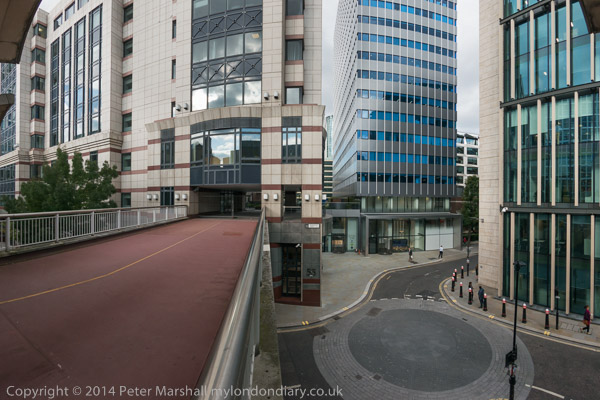
From Westminster I went into the City of London and had time for a walk taking panoramic pictures mainly of the highwalks which are under threat of demolition to allow a higher density of commercial development before photographing a picket at Hewlett-Packard’s offices against their major role in IT support of the Israeli war machine.


CETA Trade Deal Threat to Democracy

Dept Business, Innovation & Skills
CETA, Iraq, Highwalks & HP - 2014
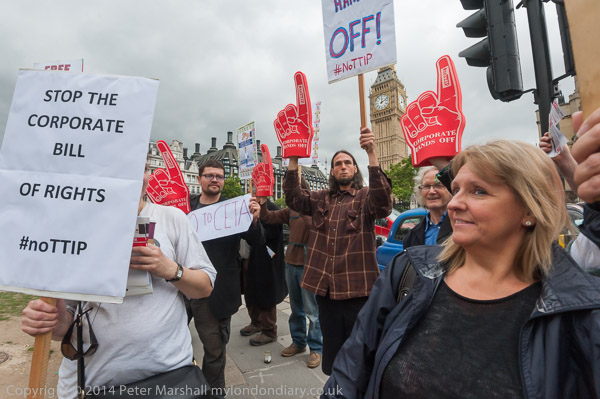
Protesters pose in front of Big Ben on their way from the BIS to Europe House

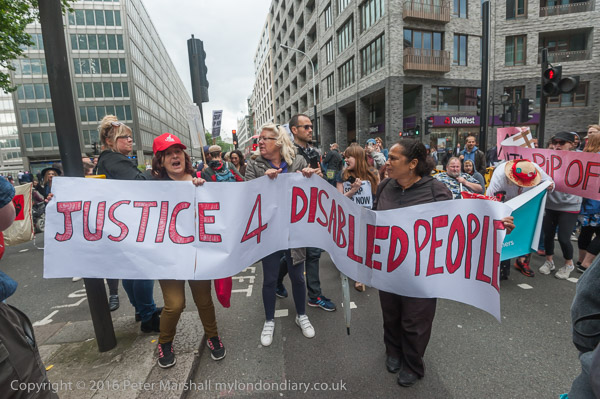
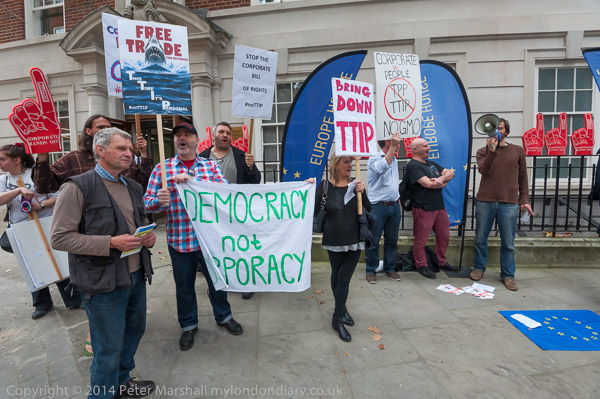
War on Want, the World Development Movement, Occupy London and others came to protest when it became known that the EU and Canada were today to initial the CETA Treaty which would hand over unchallengeable powers to big business to override governments and democracy, and put company profits above all other interests. This was a small emergency protest called at very short notice in advance of a #noTTIP day of action to take place in London on 11th October 2014.
CETA, Iraq, Highwalks & HP - 2014
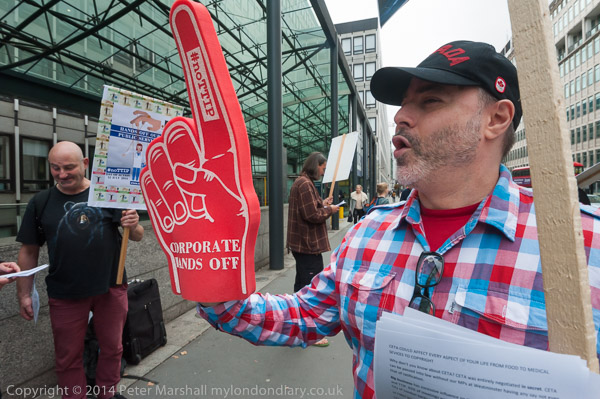
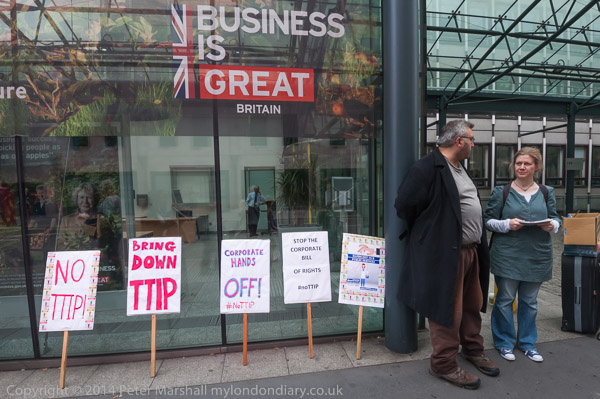
Outside the Dept of Business, Industry and Skills (BIS)

Negotiations over the treaty, the Canada and European Union (EU) Comprehensive Economic and Trade Agreement) and its wider equivalent TTIP (Transatlantic Trade and Investment Partnership) had been carried out in strict secrecy, with the documents on them to be locked away for thirty years.
CETA, Iraq, Highwalks & HP - 2014
Protesters came at short notice to the BIS when they heard the CETA deal was being initialled in secret

The treaties include the process known as ISDS (Investor-State Dispute Settlement) which greatly affects the ability of governments to make legislation, with legal action bypassing UK and other national courts to be decided by international arbitration tribunals where the loss of potential profits come above any consideration of public interest.
CETA, Iraq, Highwalks & HP - 2014

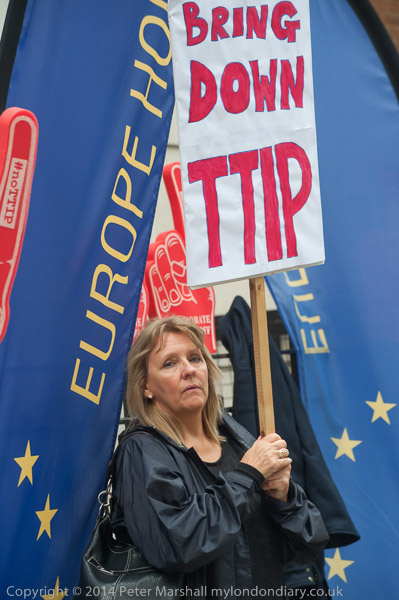
In 2014 there were already around 500 documented cases of big companies attempting to use ISDS powers to challenge democratic decisions around the world, including A Swedish company suing Germany for phasing out nuclear power and a French company suing Egypt because they have increased the minimum wage and introduced other measures to improve the conditions of workers. The UK had dropped proposals for plain packaging for cigarettes as the companies had threatened they would sue as it would cut cigarette sales and so their profits.
CETA, Iraq, Highwalks & HP - 2014
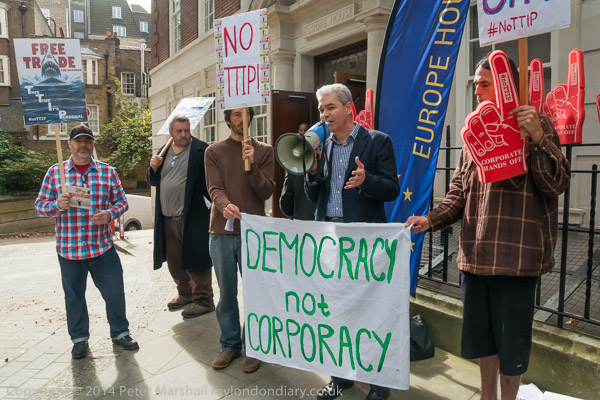
Outside Europe House

ISDS allows big business to challenge food safety regulation, green legislation and other vital measures, and curb protests against fracking and dirty energy, GMO, the arms trade and any other profitable corporate activities. It would also stop efforts to prevent the privatisation of the NHS.

The protest began outside the Dept of Business, Industry and Skills and went on to the London base of the European Parliament, stopping briefly outside the Houses of Parliament and handing out leaflets against the corporate power grab.
CETA, Iraq, Highwalks & HP - 2014

CETA was provisionally introduced in 2017 and has eliminated almost all existing tariffs and increased transatlantic trade but has not been ratified by ten EU states. The French Senate voted against it in 2024. Talks are now taking place on a replacement. Since Brexit is no longer applies in the UK and a new trade agreement with Canada came into force on 1 April 2021. ISDS continues under various other trade agreements.

CETA Trade Deal Threat to Democracy


Don’t bomb Iraq

Westminster
CETA, Iraq, Highwalks & HP - 2014
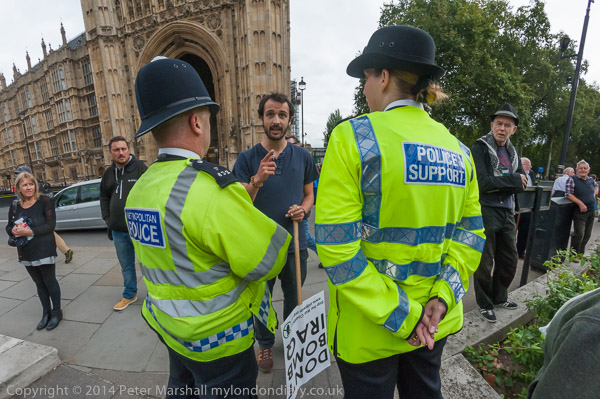
Police stop a protester from joining others on College Green

TV news often interview politicians on College Green, long always open to the public and housing a well-known Henry Moore statue, an small groups of protesters have often gone their to be seen and heard in the background of these interviews. And a few had come today when Parliament was debating the bombing of ISIS in Iraq
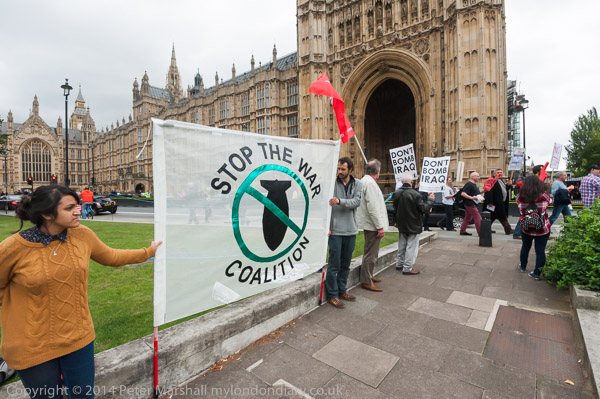
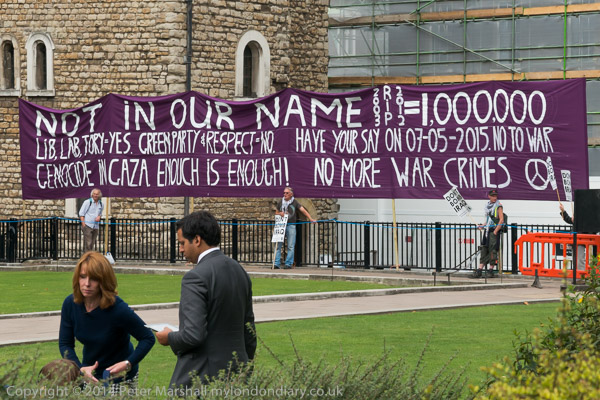
Protesters on College Green
A large banner along the edge of College Green

Until recently it had been listed as a public park by Westminster Council but in 2014 new notices were put up stating it was a part of the Parliamentary estate, and they reserve the right to close the area to the public at any time. The area is now often completely closed to the public and police stop protesters entering it while TV crews are working there.
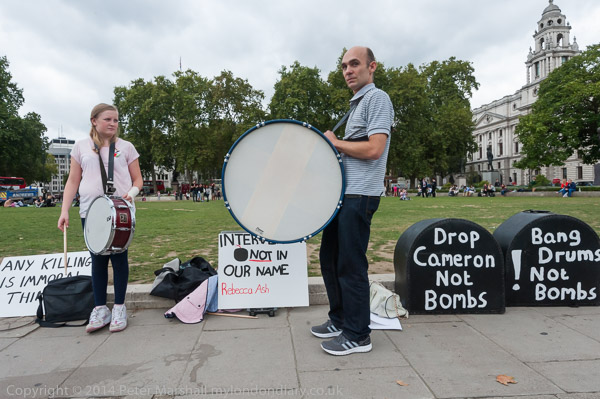
There was also a small group against the bombing protesting on the pavement in Parliament Square.

Don’t bomb Iraq


City Walk, High Walk

City of London

Basinghall St and the fenced off Bassetlaw Highwalk

Planners for the rebuilding of the City of London after the devastation of the Second World War had created an ambitious plan for the separation of pedestrians and traffic in much of the city with a series of ‘highwalks’.

But it was only ever implemented in limited areas of the City in particular around London Wall and the Barbican and where a new road, Upper and Lower Thames Street cut through the old City close to the River Thames. Despite the extensive bomb damage, much of the old London remained firmly at Street level.
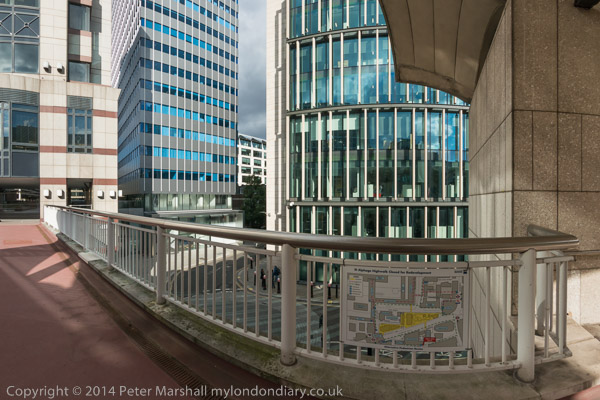
Basinghall St and Bassetlaw Highwalk

Back in the 1980s and 1990s I had photographed extensively from these highwalks and in the 90s made a number of panoramic images which were exhibited and published.

In 2014 much of the highwalks south of London Wall and a large area directly to the north were being demolished to allow a higher density of commercial development in the area and I took a short walk to photograph some of what remained. In the 1990s I had worked with specialised swing-lens panoramic film cameras, but now I was able to work much more easily with a digital camera and software.
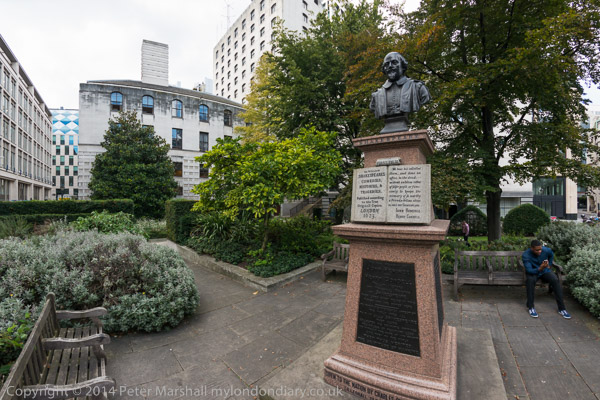
Shakespeare bust in St Mary Aldermanbury Garden, Love Lane

As well as on the highwalks I also made images at street level, particularly in the area around the Guildhall. The digital panoramas have a much wider vertical angle of view than my earlier film images and are here shown in full in a normal 3:2 aspect ratio, though usually I have cropped them top and bottom to a more panoramic format such as 16:9.
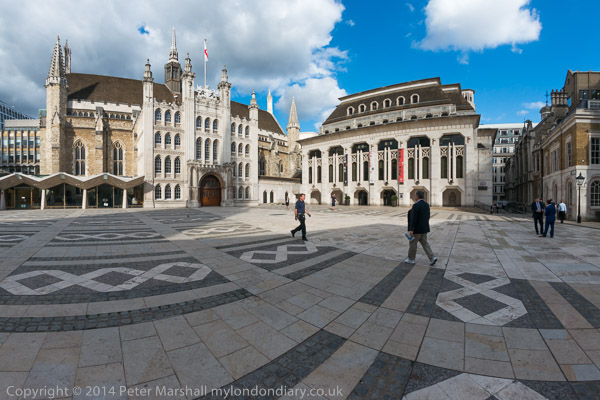
Guildhall Yard

More at City Wall, High Walk.


Hewlett Packard Stop Supporting Israeli Military

Wood St, City
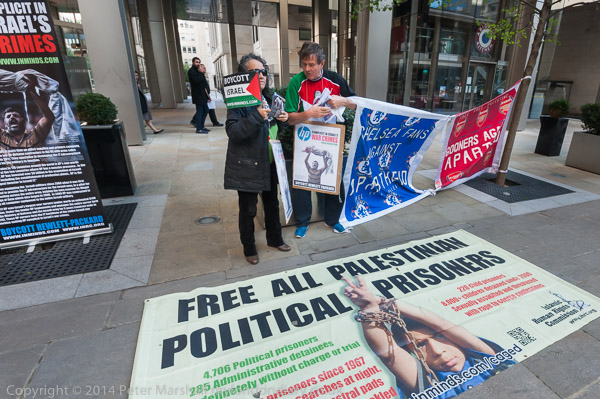
Protesters with banners opposite HP’s offices on Wood St

I had previously photographed protests by the Inminds human rights group Palestinian Prisoners Campaign outside the offices of security firm G4S, where 2 years of pickets perhaps played a part in their decision to pull out of Israeli prisons.
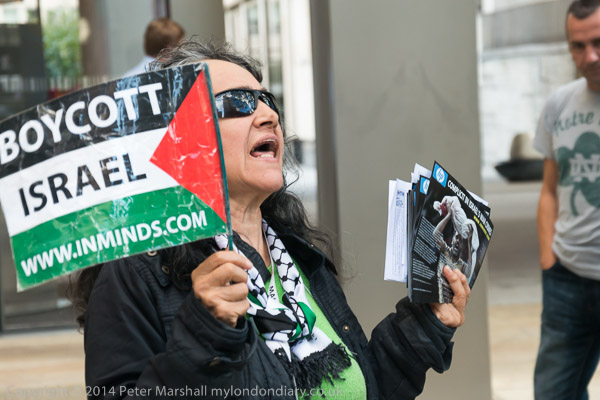
They had decided now to picket at Hewlett-Packard which boasts of ‘a massive presence’ in Israel and are the IT backbone for the Israeli war machine.

More pictures: HP told Stop Supporting Israeli Military.


Flickr – Facebook – My London Diary – Hull Photos – Lea Valley – Paris
London’s Industrial Heritage – London Photos

All photographs on this page are copyright © Peter Marshall.
Contact me to buy prints or licence to reproduce.
PIP, NHS, Trident & Cleaners – 2016

PIP, NHS, Trident & Cleaners: Wednesday 13th July 2016 was a busy day for me, covering two protests in the ‘#PIPFightback’ National Day of Action against the Personal Independence Payments, a rally in favour of a parliamentary bill to stop the ongoing privatisation of the NHS, a party against plans to spend huge amounts on new nuclear weapons and ending with a rally supporting cleaners in the longest running industrial dispute in the history of the City of London.


PIP Fightback – Vauxhall & Westminster

PIP, NHS, Trident & Cleaners

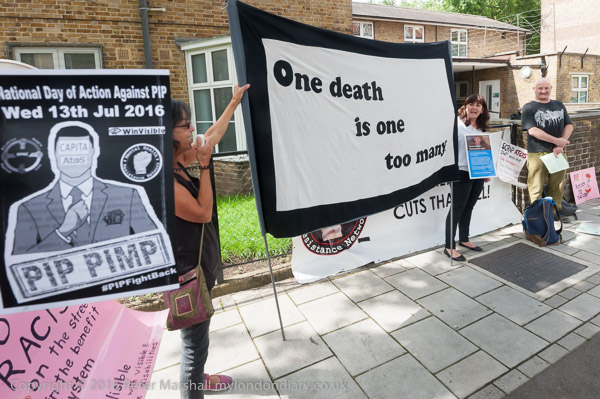
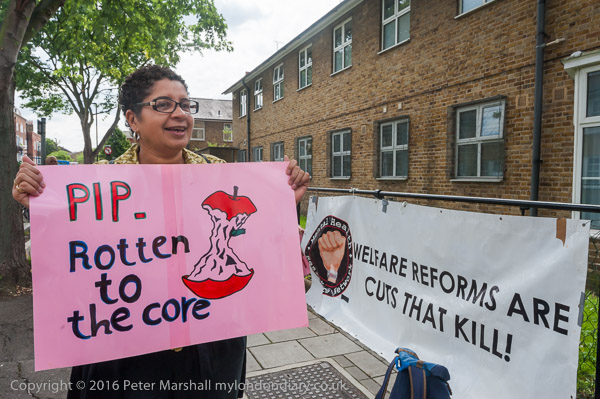
On this day there were around 20 actions by disabled protesters and their supporters as a ‘#PIPFightback’ National Day of Action against PIP, the Personal Independence Payments which have been a totally inadequate replacement for the Disabled Living Allowance which had previously provided support to enable disabled people to work and live on more even terms with the rest of the community.

I began at the Vauxhall PIP Consultation Centre in Vauxhall where ATOS carry out sham Personal Independence Payments ‘assessments’ on behalf of the DWP. These are carried out without without proper consideration of medical evidence and with ATOS haing a financial incentive to fail claimants.

PIP, NHS, Trident & Cleaners

Many genuine claimants have lost essential benefits for months before these are restored by tribunals on appeal. The temporary loss of finance has resulted in some being taken into hospitals and some commiting suicide.

PIP, NHS, Trident & Cleaners

Other claimants lose benefits as job centres ‘sanction’ them, often for trivial or unfair reasons such as arriving late for interviews due to bus or train delays – or because they have not received a letter about the appointment.

PIP, NHS, Trident & Cleaners

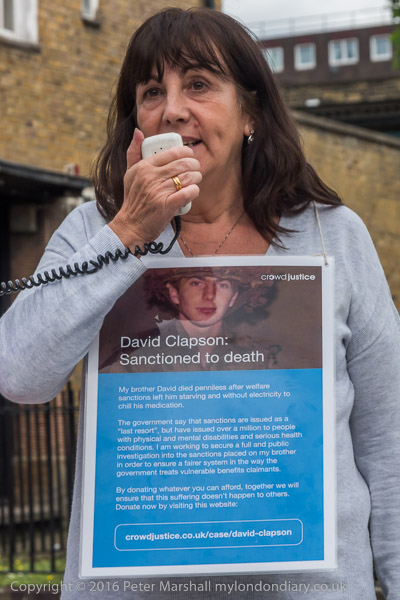
Among those taking part in this protest was Gill Thompson, whose brother David Clapson, a diabetic ex-soldier died in July 2013 after his benefits were ‘sanctioned’. He was left starving without money for food or electricity to keep the fridge containing his insulin running. She carried a banner with the names and a few pictures of around 100 claimants known to have died because of sanctions. This appears to be a relatively small fraction of the total which runs into thousands.

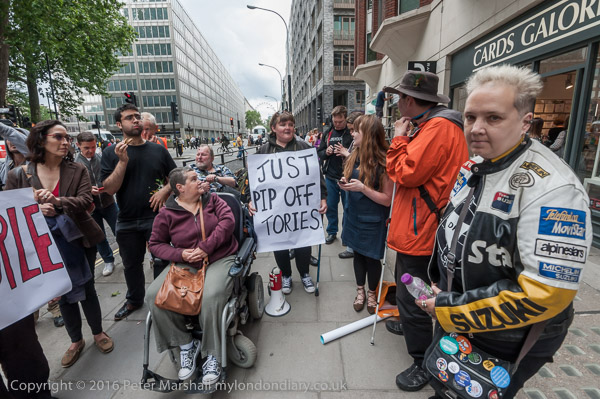
Later I joined a larger protest with members of the Mental Health Resistance Network (MHRN), Disabled People Against Cuts (DPAC) and Winvisible (Women with Invisible and Visible Disabilities) and others in Westminster outside the Victoria Street offices of Capita who also carry out these shoddy assessments.

There were speeches on the pavement there before the protesters moved onto the busy road blocking traffic in both directions, though they quickly moved aside to let a ambulance through.

After a few minutes Paula Peters of DPAC announced it was time to move on and the protesters marched along the road past the Met Police HQ at New Scotland Yard and on the the DWP offices at Caxton House.

Here they blocked the road for some more speeches before moving on to Parliament where there was another short rally on the road before they moved on to the media village on College Green where politicians were being interviewed on TV over the appointment of a new Prime Minister, Theresa May.

Police blocked them from going onto the Green, but soon some went past them and refused police requests to move; eventually they were allowed to stand on a path in the middle of the area. Although all the TV crews present could see and hear the protest, only one or two bothered to come across and find out what was happening – and I think these were from foreign news agencies.

Disabled PIP Fightback blocks Westminster
PIP Fightback at Vauxhall


NHS Bill protest at Parliament

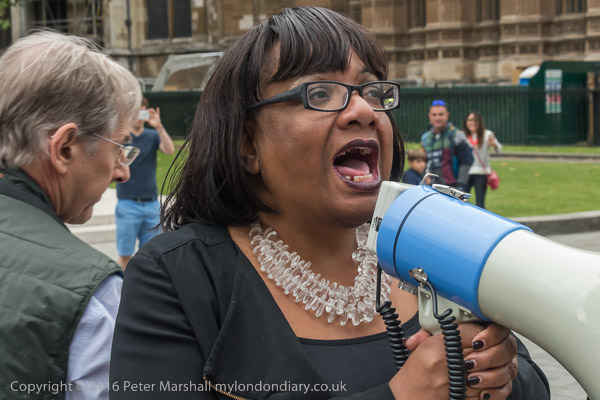
Protesters from various campaigns to save the NHS held a protest in support as Labour MP for Wirral West Margaret Greenwood presented a ‘Ten Minute Rule Bill’ with cross-party support to stop the privatisation of the NHS and return it to its founding principles. Labour Shadow Health Secretary Diane Abbott came out to speak in support at the protest.

More pictures: NHS Bill protest at Parliament


Trident Mad Hatters Tea Party – Parliament Sq

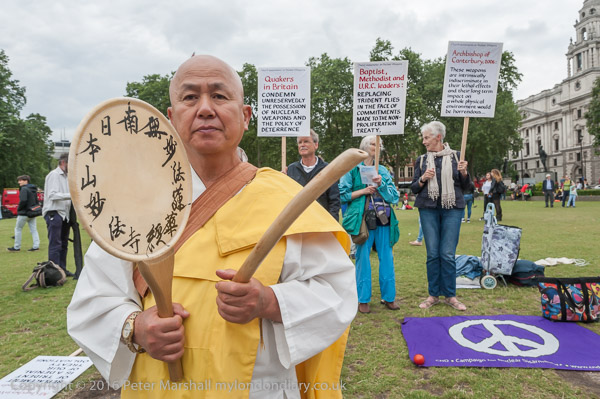
CND members were lobbying MPs at Parliament against plans to replace Trident at a cost of at least £205 billion.

And on the square facing the Houses of Parliament was a ‘Mad Hatters Tea Party’, as well as Christians with placards stating the opposition by churches of the different denominations to the replacement.

Trident Mad Hatters Tea Party


Solidarity for Wood St cleaners – City of London

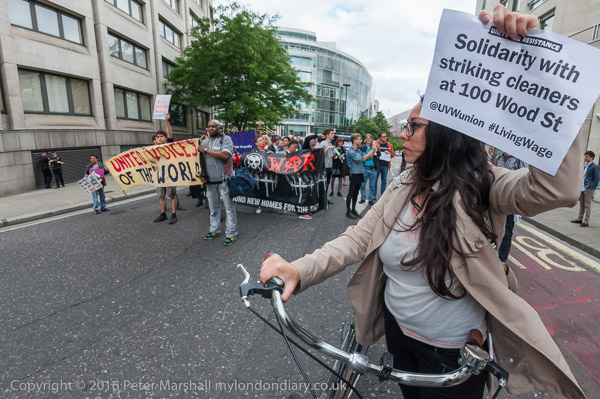
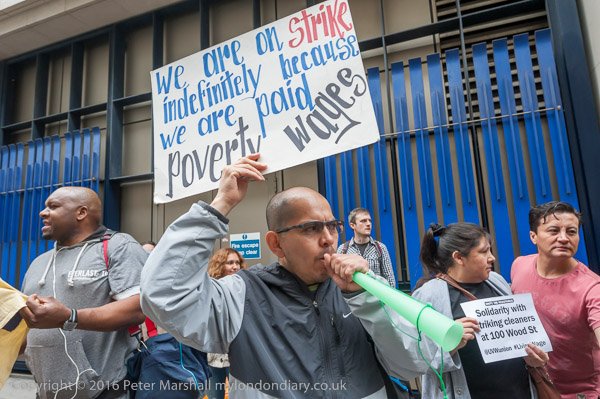
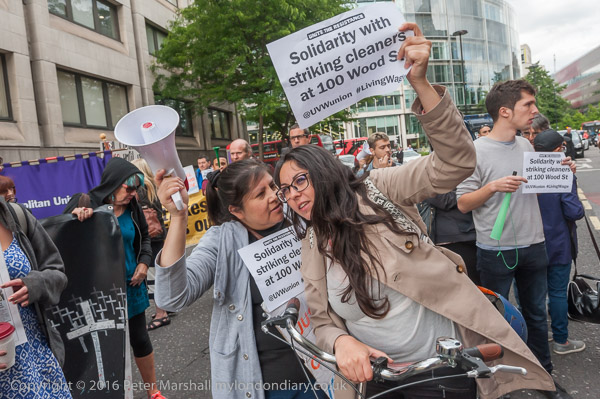
The strike by cleaners at the 100 Wood St offices managed by CBRE was now the longest running industrial dispute in the history of the City of London.

The cleaners belong to the United Voices of the World union and are employed by anti-union cleaning contractor Thames Cleaning.

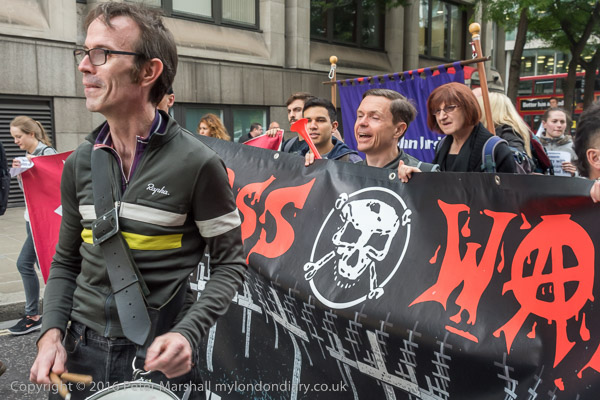
Unite the Resistance, the Haldane Society of Socialist Lawyers, Class War and others had come to support the United Voices of the World. After a rally opposite the Wood Street offices, then marched around the block and then went on hold a rally blocking the street outside the CBRE offices at St Martin’s Court.

Solidarity for Wood St cleaners


Flickr – Facebook – My London Diary – Hull Photos – Lea Valley – Paris
London’s Industrial Heritage – London Photos

All photographs on this page are copyright © Peter Marshall.
Contact me to buy prints or licence to reproduce.

Election Day 2010

Thursday 6th May was also an election day in 2010 with a UK general election that saw Labour losing over 90 seats to end with 48 fewer MPs than the Conservatives. But back then we still had a Lib-Dem party with 57 MPs who, after five days of horse-trading agreed to form a coalition government with the Tories – a decision that condemned them to oblivion, losing all but 8 seats in the 2015 election.

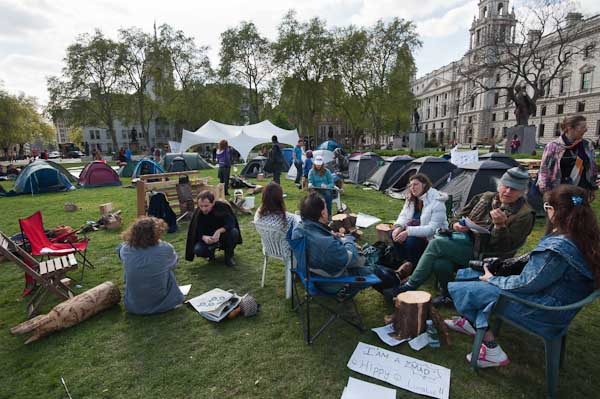
I spent most of election day – after voting in the early morning – in and around Parliament Square, where there was also considerably politics taking place. Three distinct group were camping in the square.

Brian Haw

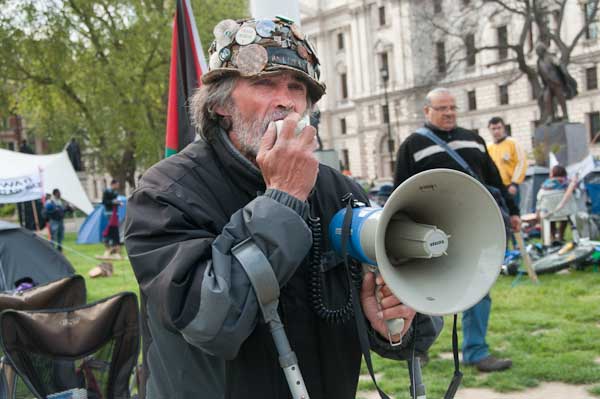
Brian Haw and the Parliament Square peace campaign had been there for 3260 days since 2nd June 2001 and was still there despite an Act of Parliament designed to remove him, attacks by individuals with connections to the police and security services, illegal police raids, provocations, assaults and arrests by police officers and more.

Barbara Tucker

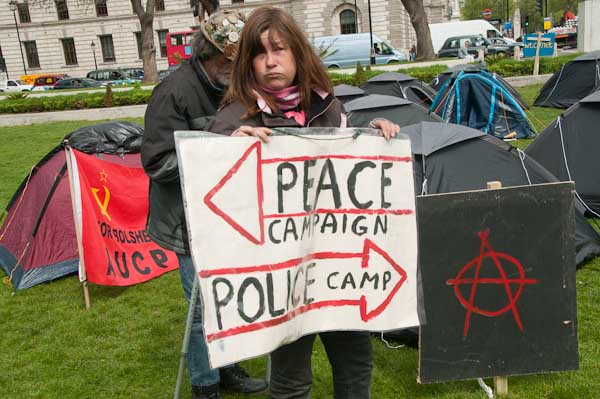
A year earlier Haw had dissociated his Parliament Square Peace Campaign (PSPC) from the ‘Peace Strike’ protest in the adjoining area of the square led by Maria Gallestegui “by mutual consent”, wanting to end any confusion between the two campaigns. The Peace Strike had not been harassed by police to the same extent and was allowed a greater physical presence in the square, and were regarded by some, probably incorrectly, as being partners with the establishment to discredit the PSPC.

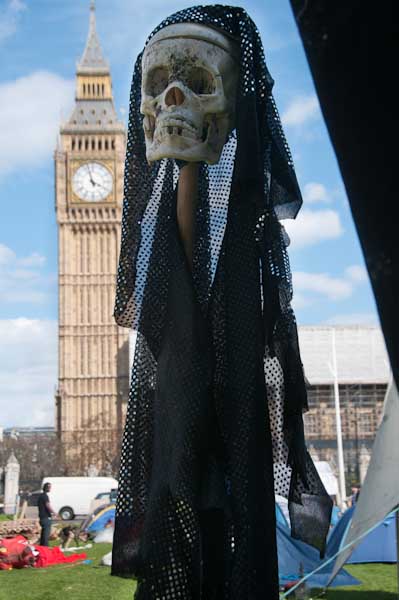
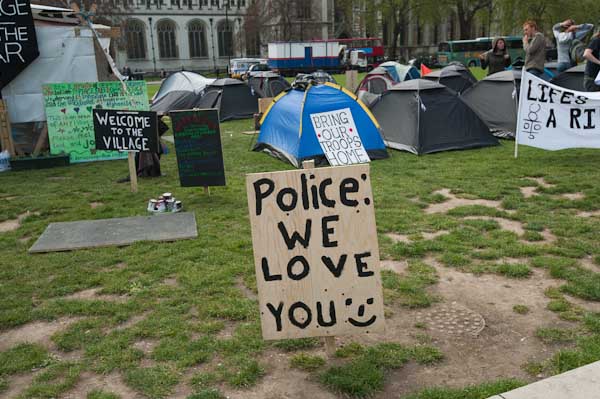
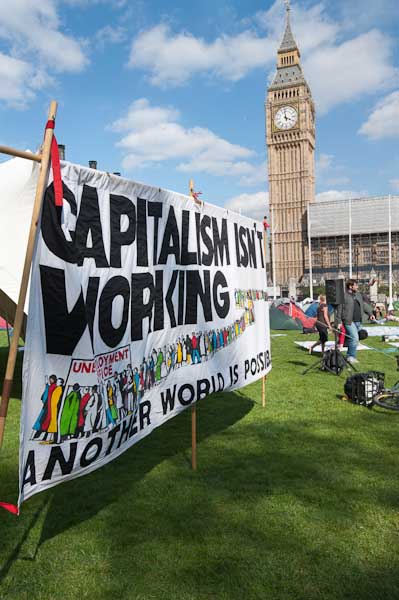
Since May Day the square had also been home to ‘Occupy Democracy’ who saw themselves as supporting the PSPC by their presence. But the PSPC suspected some of them too of being agent provocateurs in police pay to provide a pretext for more draconian police action against them. Certainly some of these more temporary occupiers were breaking the rules against drinking alcohol in Parliament Square, despite the Democracy Camp notices banning this.

In my account I wrote:

“At one point the dispute between the camp and the PSPC deteriorated with a man on the camp’s sound system making what were possibly intended as humorous put-downs of Barbara Tucker who was then attacking the Tory Party for the backing it receives from the oil giants. Clearly some of the campers were distressed by this and he was asked to desist, and some of those present tried to calm the situation.
But generally the camp’s activities were more positive, and while I was there considerable work was taking place making banners and placards, as well as people discussing and dancing.”

Election Day in Parliament Square

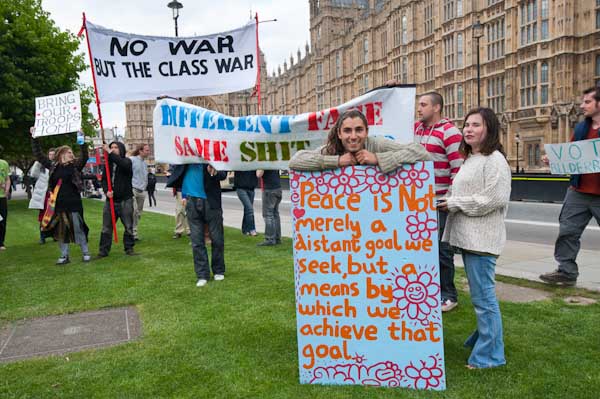
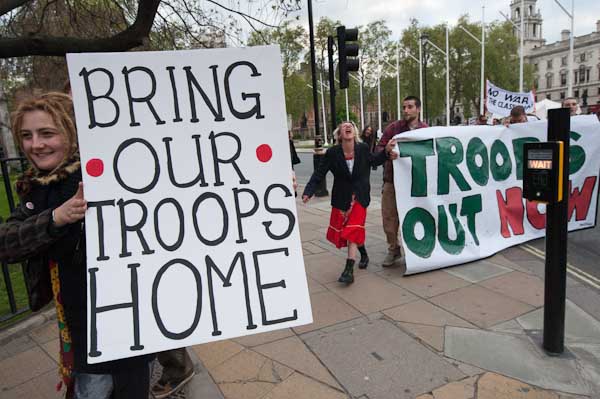
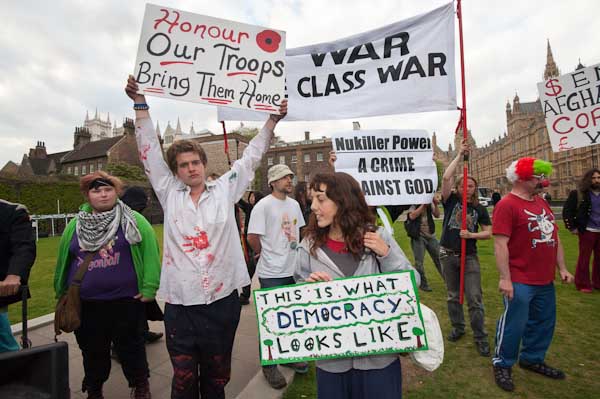
Shortly before I left around 6pm, people from Democracy Village walked with placards to College Green where the TV media have their tents and cameras to cover political events and had been conducting interviews about the election. There had been little if any media coverage of Democracy Village or the peace campaigns and they wanted to make a point of this. But most of the media simply ignored the protesters, and eventually police came to talk with them and they returned to Parliament Square.

Protests in the UK are almost never seen by the mass media as news – unless police are injured or property destroyed and they can run negative stories. Occasionally if a celebrity takes part they may get a mention, or some particularly quirky and preferably non-political event captures their whimsy. But political protests are largely only news if they take place overseas against regimes which our government disapproves of.

The government that resulted from the election was led by a party that got just under a third of the votes and once again demonstrated the iniquities of our first past the post electoral system. A year later we had a referendum on an alternative voting system, but this was largely scuppered by Conservative opposition and a lack of real support from Labour.

The 2010 election had left the Tories holding the whip hand in the coalition, and they certainly made use of it, both through imposing drastic and ill-considered cuts on public and in particular local authority expenditure and in attacks on protests such as those in Parliament Square. The current Police, Crime, Sentencing and Courts Bill takes these attacks on human and civil rights, the right to protest, migrants and Gypsy, Roma and Traveller people to new levels, incompatible with any free society.

Election Day in Parliament Square


All photographs on this and my other sites, unless otherwise stated, are taken by and copyright of Peter Marshall, and are available for reproduction or can be bought as prints.