CETA, Iraq, Highwalks & HP – 2014

CETA, Iraq, Highwalks & HP: On Friday 26th September 2014 I photographed a protest against the finalising of CETA, a trade agreement between Canada and the EU negotiated in secret which would allow large companies to challenge democratic decisions taken by governments. After this I went to College Green, until recently listed as a public park but now often closed by police to stop protesters appearing in TV interviews there of politicians, where people were attempting to protest against the bombing of Iraq.

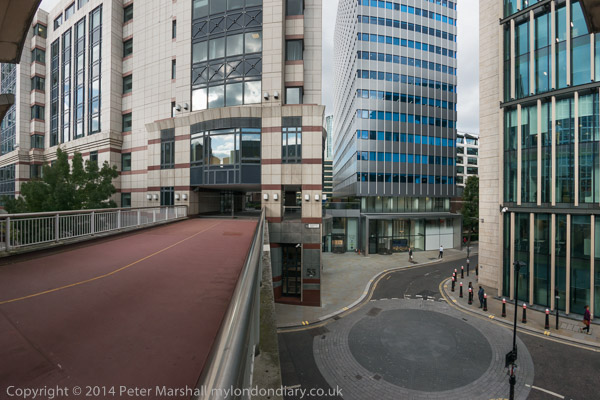
From Westminster I went into the City of London and had time for a walk taking panoramic pictures mainly of the highwalks which are under threat of demolition to allow a higher density of commercial development before photographing a picket at Hewlett-Packard’s offices against their major role in IT support of the Israeli war machine.


CETA Trade Deal Threat to Democracy

Dept Business, Innovation & Skills
CETA, Iraq, Highwalks & HP - 2014
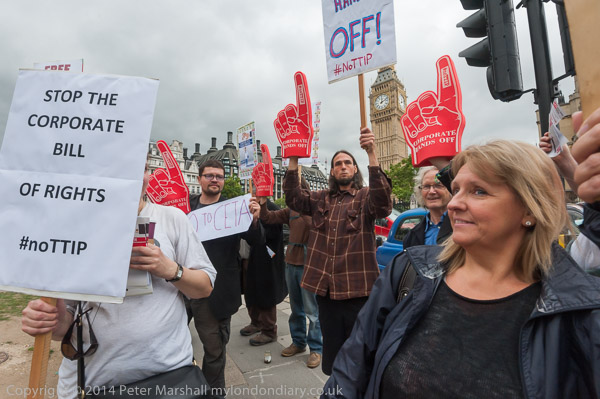
Protesters pose in front of Big Ben on their way from the BIS to Europe House

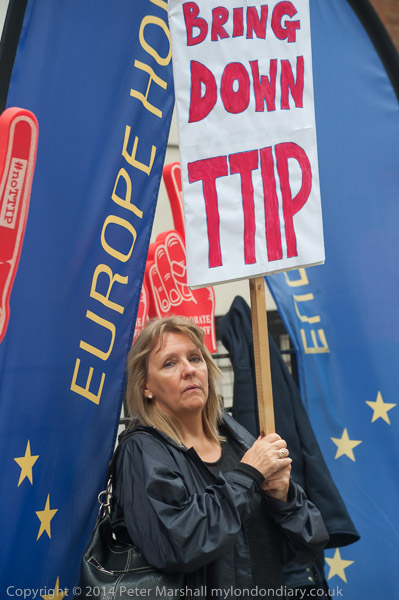
War on Want, the World Development Movement, Occupy London and others came to protest when it became known that the EU and Canada were today to initial the CETA Treaty which would hand over unchallengeable powers to big business to override governments and democracy, and put company profits above all other interests. This was a small emergency protest called at very short notice in advance of a #noTTIP day of action to take place in London on 11th October 2014.
CETA, Iraq, Highwalks & HP - 2014
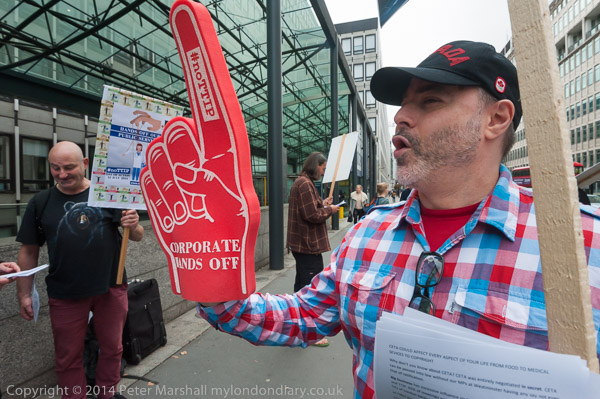
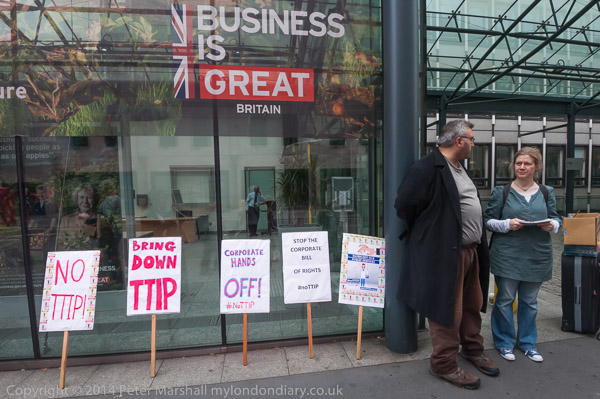
Outside the Dept of Business, Industry and Skills (BIS)

Negotiations over the treaty, the Canada and European Union (EU) Comprehensive Economic and Trade Agreement) and its wider equivalent TTIP (Transatlantic Trade and Investment Partnership) had been carried out in strict secrecy, with the documents on them to be locked away for thirty years.
CETA, Iraq, Highwalks & HP - 2014
Protesters came at short notice to the BIS when they heard the CETA deal was being initialled in secret

The treaties include the process known as ISDS (Investor-State Dispute Settlement) which greatly affects the ability of governments to make legislation, with legal action bypassing UK and other national courts to be decided by international arbitration tribunals where the loss of potential profits come above any consideration of public interest.
CETA, Iraq, Highwalks & HP - 2014

In 2014 there were already around 500 documented cases of big companies attempting to use ISDS powers to challenge democratic decisions around the world, including A Swedish company suing Germany for phasing out nuclear power and a French company suing Egypt because they have increased the minimum wage and introduced other measures to improve the conditions of workers. The UK had dropped proposals for plain packaging for cigarettes as the companies had threatened they would sue as it would cut cigarette sales and so their profits.
CETA, Iraq, Highwalks & HP - 2014
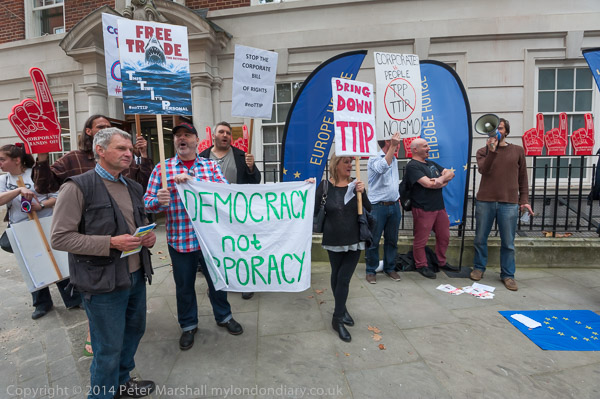
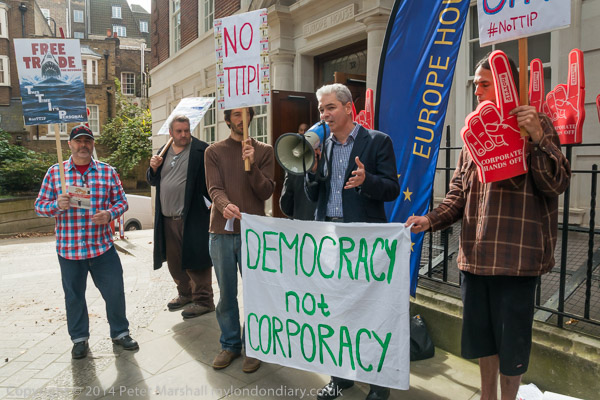
Outside Europe House

ISDS allows big business to challenge food safety regulation, green legislation and other vital measures, and curb protests against fracking and dirty energy, GMO, the arms trade and any other profitable corporate activities. It would also stop efforts to prevent the privatisation of the NHS.

The protest began outside the Dept of Business, Industry and Skills and went on to the London base of the European Parliament, stopping briefly outside the Houses of Parliament and handing out leaflets against the corporate power grab.
CETA, Iraq, Highwalks & HP - 2014

CETA was provisionally introduced in 2017 and has eliminated almost all existing tariffs and increased transatlantic trade but has not been ratified by ten EU states. The French Senate voted against it in 2024. Talks are now taking place on a replacement. Since Brexit is no longer applies in the UK and a new trade agreement with Canada came into force on 1 April 2021. ISDS continues under various other trade agreements.

CETA Trade Deal Threat to Democracy


Don’t bomb Iraq

Westminster
CETA, Iraq, Highwalks & HP - 2014
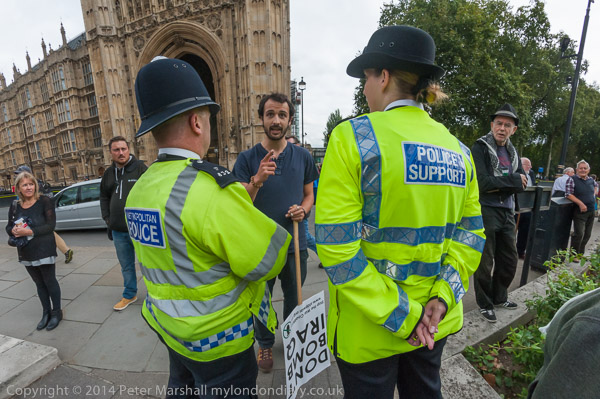
Police stop a protester from joining others on College Green

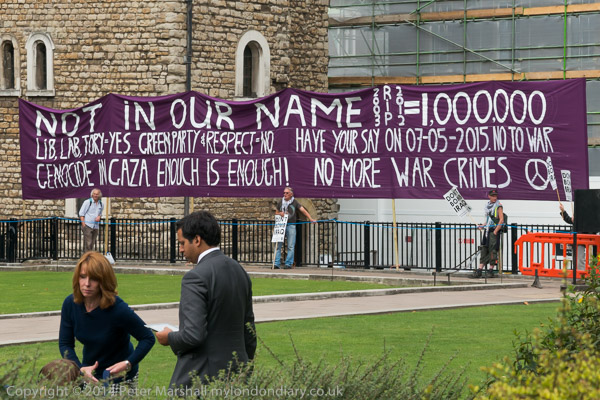
TV news often interview politicians on College Green, long always open to the public and housing a well-known Henry Moore statue, an small groups of protesters have often gone their to be seen and heard in the background of these interviews. And a few had come today when Parliament was debating the bombing of ISIS in Iraq
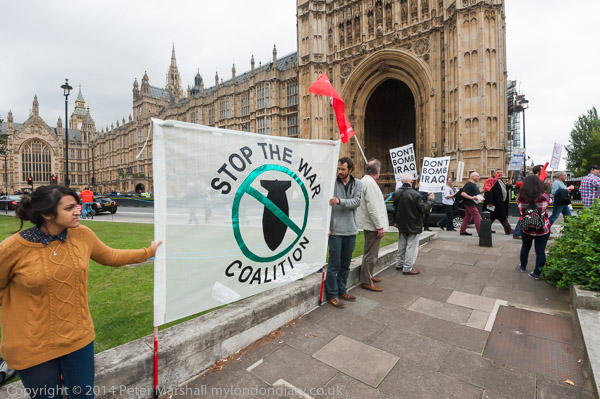
Protesters on College Green
A large banner along the edge of College Green

Until recently it had been listed as a public park by Westminster Council but in 2014 new notices were put up stating it was a part of the Parliamentary estate, and they reserve the right to close the area to the public at any time. The area is now often completely closed to the public and police stop protesters entering it while TV crews are working there.
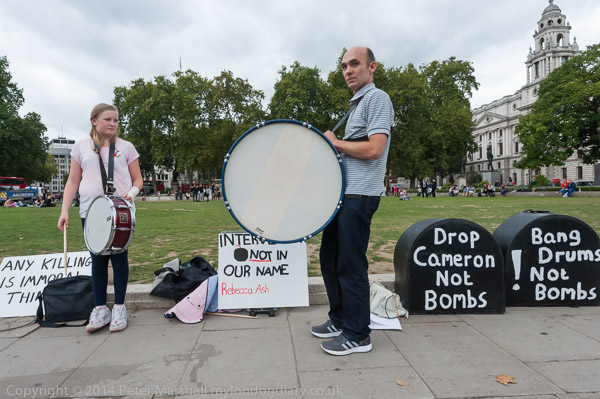
There was also a small group against the bombing protesting on the pavement in Parliament Square.

Don’t bomb Iraq


City Walk, High Walk

City of London

Basinghall St and the fenced off Bassetlaw Highwalk

Planners for the rebuilding of the City of London after the devastation of the Second World War had created an ambitious plan for the separation of pedestrians and traffic in much of the city with a series of ‘highwalks’.

But it was only ever implemented in limited areas of the City in particular around London Wall and the Barbican and where a new road, Upper and Lower Thames Street cut through the old City close to the River Thames. Despite the extensive bomb damage, much of the old London remained firmly at Street level.
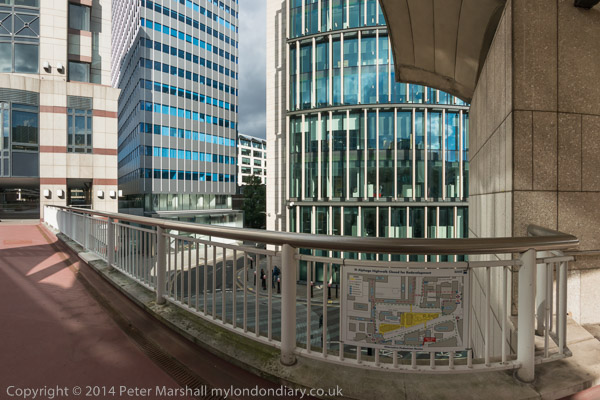
Basinghall St and Bassetlaw Highwalk

Back in the 1980s and 1990s I had photographed extensively from these highwalks and in the 90s made a number of panoramic images which were exhibited and published.

In 2014 much of the highwalks south of London Wall and a large area directly to the north were being demolished to allow a higher density of commercial development in the area and I took a short walk to photograph some of what remained. In the 1990s I had worked with specialised swing-lens panoramic film cameras, but now I was able to work much more easily with a digital camera and software.
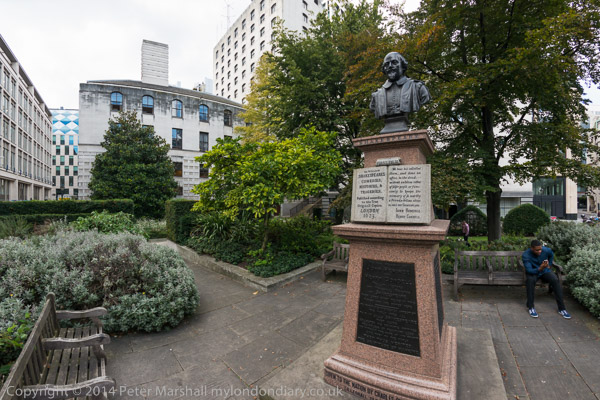
Shakespeare bust in St Mary Aldermanbury Garden, Love Lane

As well as on the highwalks I also made images at street level, particularly in the area around the Guildhall. The digital panoramas have a much wider vertical angle of view than my earlier film images and are here shown in full in a normal 3:2 aspect ratio, though usually I have cropped them top and bottom to a more panoramic format such as 16:9.
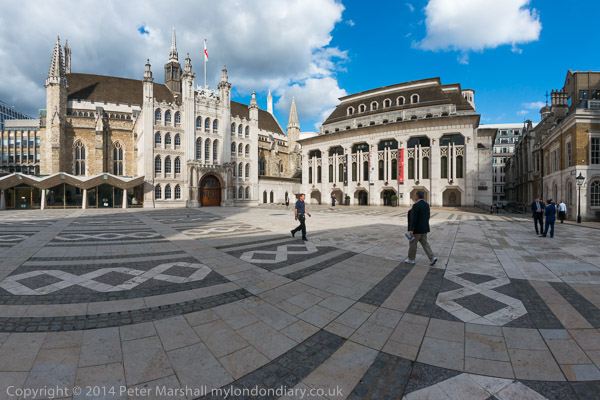
Guildhall Yard

More at City Wall, High Walk.


Hewlett Packard Stop Supporting Israeli Military

Wood St, City
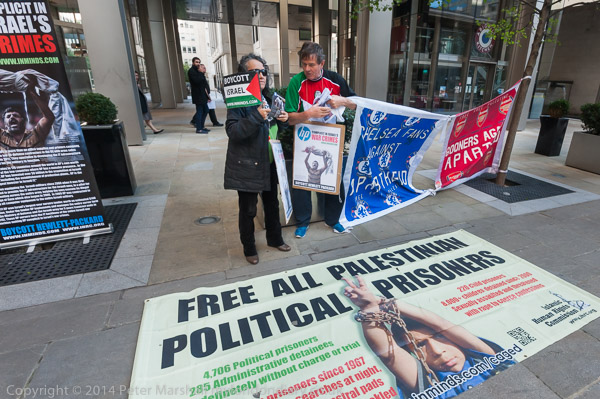
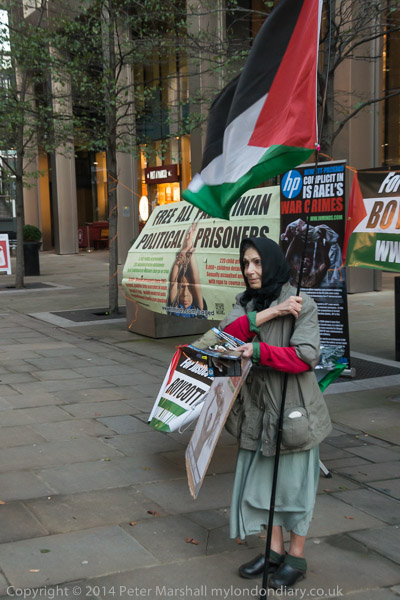
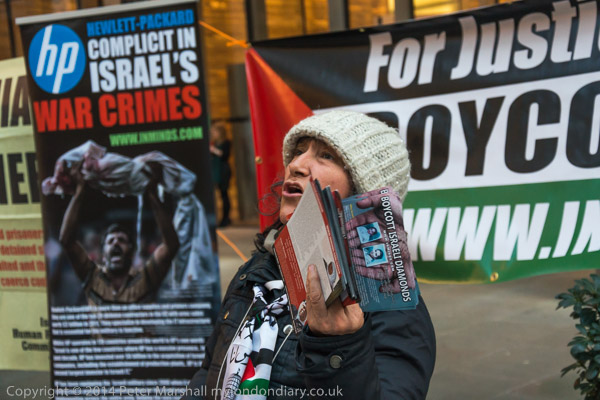
Protesters with banners opposite HP’s offices on Wood St

I had previously photographed protests by the Inminds human rights group Palestinian Prisoners Campaign outside the offices of security firm G4S, where 2 years of pickets perhaps played a part in their decision to pull out of Israeli prisons.
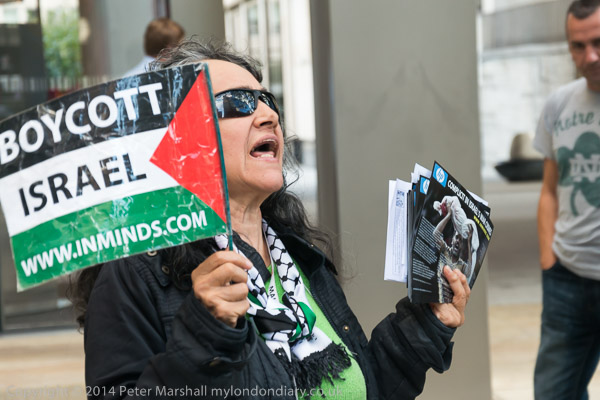
They had decided now to picket at Hewlett-Packard which boasts of ‘a massive presence’ in Israel and are the IT backbone for the Israeli war machine.

More pictures: HP told Stop Supporting Israeli Military.


Flickr – Facebook – My London Diary – Hull Photos – Lea Valley – Paris
London’s Industrial Heritage – London Photos

All photographs on this page are copyright © Peter Marshall.
Contact me to buy prints or licence to reproduce.

Palestinian Prisoners’ Day – 2014

Palestinian Prisoners’ Day: In 1974 the Palestinian National Council approved April 17th as Palestinian Prisoners’ Day, choosing the date as the anniversary of the first prisoner exchange between Palestine and Israel – when Fatah militant Mahmoud Bakr Hijazi who had been captured by Israel six years earlier was released.

In 2008 the 20th Arab Summit adopted it for all Arab countries as a day in solidarity with Palestinian and Arab prisoners detained by Israel. Human rights organisations say many prisoners are denied visits, subjected to mental and physical tortures and denied proper medical care. Many are held without trial under ‘administrative detention‘ while Palestinians “are tried by Israel’s military courts and often held in Israel, in conditions that violate international humanitarian and human rights conventions“.

In 2014 the World Council of Churches had issued a Palestinian Prisoners Day call to churches worldwide to pray and act for justice which “resolutely confirms our solidarity with the nearly 5000 Palestinian men, women and children languishing in Israeli prisons” and called for churches to press UN Member States to put pressure on Israel to end arbitrary detention, meet its obligations over human rights, provide apt medical care and end athe use of torture.


Bill Gates End Support Of Israeli Child Torture

Cardinal Place, Victoria

Palestinian Prisoners' Day - 2014

On 27th April 2014 I photographed the Palestinian Prisoners’ Day protest in Westminster, where protesters met on the plaza outside Westminster Cathedral for a ‘mystery protest’.

Palestinian Prisoners' Day - 2014

There they put together a mock prison cell and gave a briefing that the protest was to be at the Europe and Middle East Office of the Bill and Melinda Gates Foundation, in Portland House, just across the road inside the Cardinal Place shopping centre.

Palestinian Prisoners' Day - 2014

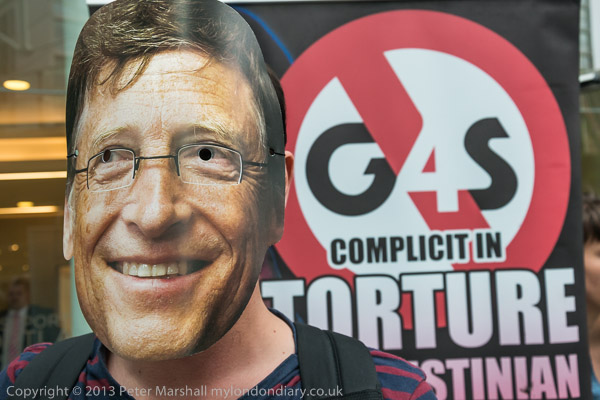
We crossed the road with the prison cell and some protesters, one with a Bill Gates mask and they tried to deliver a petition from the Addameer Prisoner Support and Human Rights Association, a Palestinian NGO based in Ramallah which monitors and provides legal support to Palestine prisoners in Israeli and Palestinian jails.

Palestinian Prisoners' Day - 2014

“By holding shares in G4S, the Bill and Melinda Gates Foundation is complicit in Israel’s detention without trial and torture of Palestinians.

As people that share your belief that every life has equal value, we call on you to divest from G4S immediately.”

Palestinian Prisoners' Day - 2014

The Gates Foundation is one of the biggest shareholders in G4S and Addameer say it “is legitimising and profiting from Israel’s use of torture, mass incarceration and arbitrary arrest to discourage Palestinians from opposing Israel’s apartheid policies.”

Addammer point out that their investment makes a mockery of the foundation’s aim to use its investments to fund projects that “help all people lead healthy, productive lives“.

A few protesters who tried to enter the building were quickly ejected by security and the protest continued outside with speeches, chanting and music. They promised to leave after someone came down from the Gates Foundation office to receive the petition, but no one came in the 20 minutes while I was there before leaving to cover another Palestinian Prisoners’ Day protest at the G4S offices a short walk away.

More at Bill Gates end support of Israeli child torture.


G4S Occupied on Palestinian Prisoners Day

Victoria St

The Inminds Palestinian Prisoners Campaign – which began twice-monthly London protests against companies supporting Israel’s prisons in 2012 – had arrived outside the G4S offices before me and set up their banners. They were handing out leaflets about the terrible conditions under which prisoners are held and calling for the release of all Palestinian political prisoners in Israeli jails.

British multinational G4S is the worlds largest security contractor and provides security services for many prisons in Israel where Palestinian men, women and children are tortured and caged.

After around 25 minutes we were joined by some of the protesters who had been at the Gates Foundation and their cage.

After a few minutes some of the protesters walked into the foyer of the offices and I followed them to take photographs.

They brought in the ‘cage’ as well.

And there was soon a prisoner in the cage with a smiling ‘Bill Gates’ and another protester holding it. There were some short speeches about why they were there protesting against G4S and some chanting, but the foyer is large and the protest did not interfere with people entering and leaving the building – which contains other offices as well as that of G4S.

Eventually a couple of police arrived, and took a look at what was happening and decided just to watch. More protesters arrived and some brought their banners into the foyer.

Outside the protest also continued, with people handing out detailed leaflets about the conditions in ‘G4S Israeli Dungeons’ in which men, women and children are tortured.

You can read some of the details and in particular about the case of the 5 Hares boys on My London Diary.

G4S Occupied on Palestinian Prisoners Day


Flickr – Facebook – My London Diary – Hull Photos – Lea Valley – Paris
London’s Industrial Heritage – London Photos

All photographs on this page are copyright © Peter Marshall.
Contact me to buy prints or licence to reproduce.


A Busy 10th October – 2014

Solidarity for Care UK Strikers

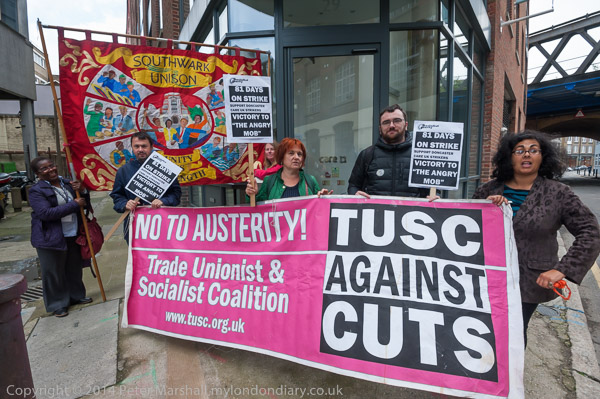
NSSN, TUSC and Southwark Unison protested at the Care UK offices in Southwark during the nation-wide day of solidarity with Doncaster Care UK workers who had been on strike for 81 days after huge cuts in pay and services by a private equity company taking over a part of the NHS, part of the continuing largely hidden privatisation of our NHS.

This protest was one of many around the country outside offices of Care UK and Bridgepoint, the private equity firm that owns Care UK, as well as at shops including branches of Fat Face and Pret a Manger also owned by Bridgepoint. As I wrote:

Their strike is not just about their own cuts in wages, but a stand against the principles involved and the whole idea of a values-based health service. The workers at Care UK are no longer able to proudly address the needs of those with learning disorders in their own community, but are simply required to meet minimum needs at the lowest possible cost – and the greatest profit to Bridgepoint and the company to which they will be sold on once the private equity company has slimmed services and pay to the bone.

Solidarity for Care UK Strikers

Free Ghoncheh Ghavami – SOAS action

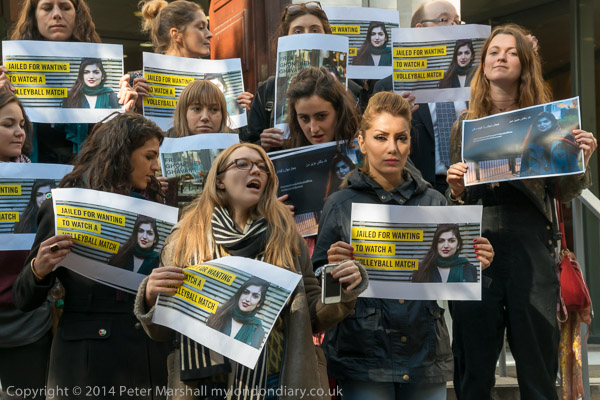
Protesters at outside SOAS called for the release of former SOAS Law student Ghoncheh Ghavami, held in prison for 104 days and on hunger strike for 10 days after being detained in Iran with other women after she went to watch a volleyball match. Among those who spoke at the protest was Ghavami’s brother.

According to Wikipedia, “Ghavami was released on bail on 23 November 2014. She was sentenced to a one-year jail term and a two-year travel ban.”

Free Ghoncheh Ghavami – SOAS action

City Panoramas

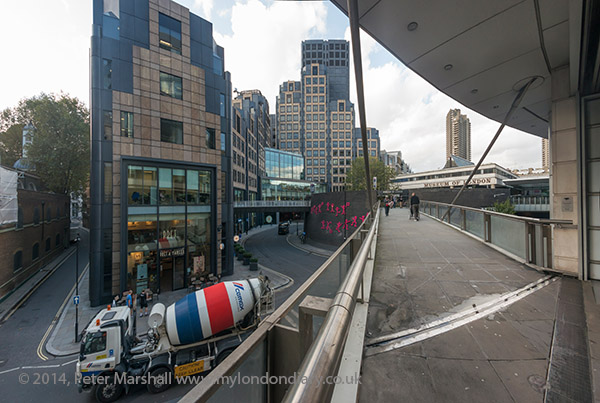
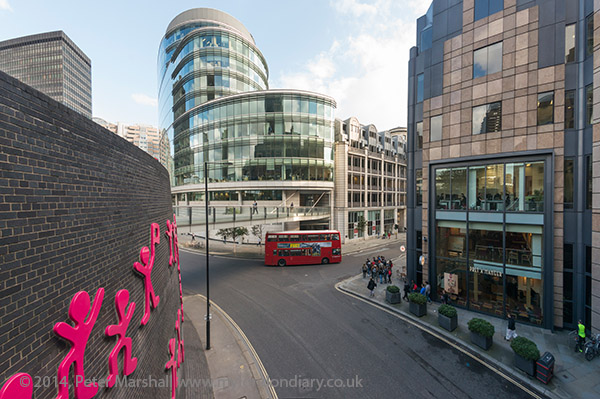
I had a little time to spare between events and took a short walk in the City, including along one of the remaining areas of ‘highwalk’ at the southwest of the Barbican site, part of the post-war plan to segregate pedestrians from traffic.

The Museum of London had decorated the wall at left with characters related to an exhibition about Sherlock Holmes.

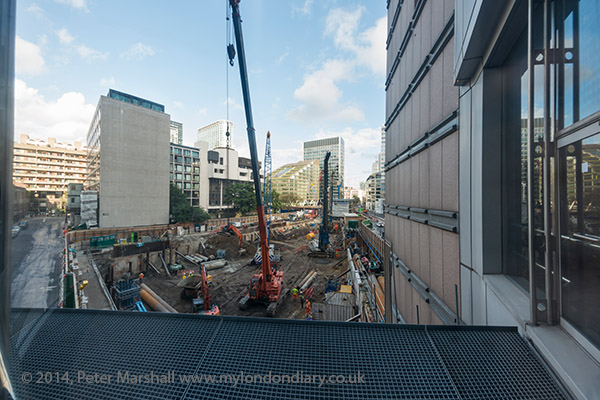
This large building site was on what used to be St Alphage Highwalk. The ambitious post-war plans to separate pedestrians from traffic in the City were never really practical on a large scale and large sections such as this have been demolished, although there are still some highwalks including throughout the large Barbican estate.

City Panoramas

Palestine protest at Hewlett Packard

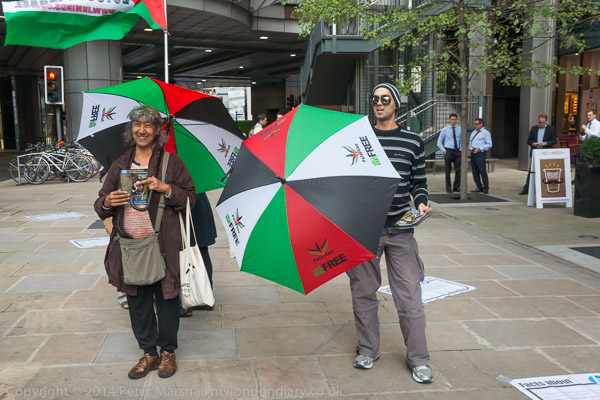
The Palestinian Prisoners Campaign continued their campaign against Hewlett-Packard, which boasts of ‘a massive presence’ in Israel and are the IT backbone for the Israeli war machine with a picket outside their London offices in Wood St in the City.

Palestine protest at Hewlett Packard

Solidarity with the Umbrella Revolution

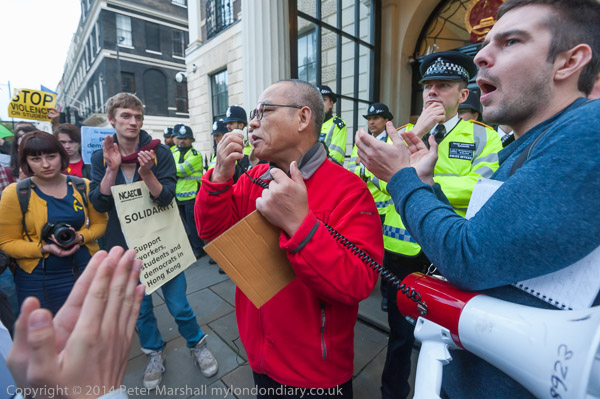
The National Campaign Against Fees and Cuts organised a protest at the Chinese Embassy in solidarity with the ‘umbrella revolution’ of the students and workers of Hong Kong in their fight for democracy. Many of the protesters carried umbrellas and others had small yellow paper umbrellas as well as their posters and placards.

Solidarity with the Umbrella Revolution


November 2014 (3)

Fortunately there was nothing in my diary for the last Thursday in November 2014, as I think it was probably past 2am before I had finished editing and filing my pictures from the two events on Wednesday evening. But on Friday it was another early start for me, though not very early, catching the first train on which I can travel at reduced – but still excessive – rail fares.

I’m fortunate to be reasonably well-off, largely thanks to pension contributions paid during 30 years of full-time employment, though by no means rich. More importantly I live in a house which we finished paying for around 25 years ago, and which, though not grand serves its purpose. It means that we can afford both to eat and to keep warm – though I’m typing this with an extra jumper on in a room that is sometimes cold enough for me to wear a woolly hat.

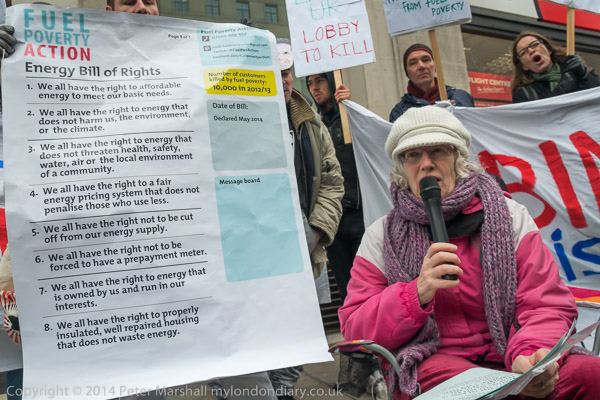
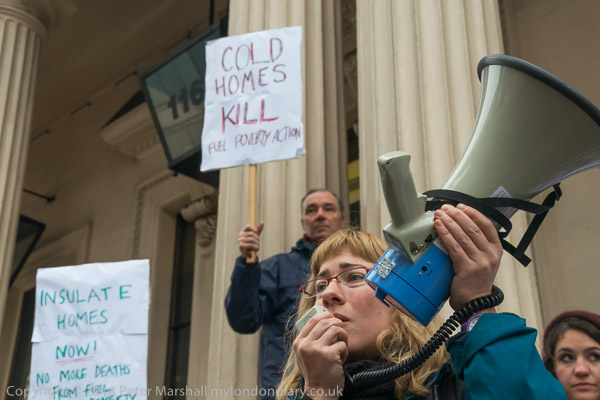
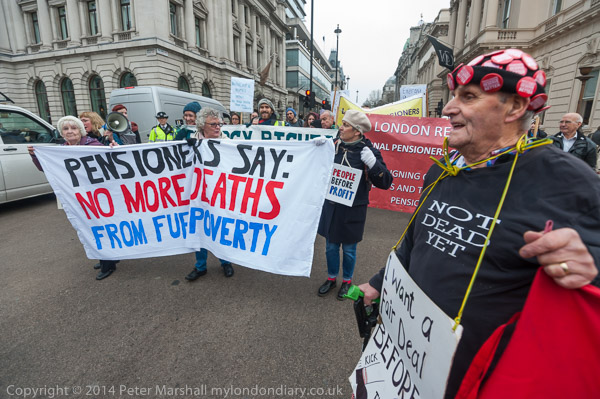
But for many – and particularly many who are elderly and disabled – the choice between keeping warm and eating is a desperate one, eased only slightly by the annual ‘Winter Fuel Payment’ of £200 per household. As I wrote in 2014, ‘The official statistics show that in the year 2012/2013 over 10,000 people died from fuel poverty, including thousands of people in London, and figures for last winter are likely to be higher.’

The protest by pensioners, Fuel Poverty Action and No Dash for Gas was against Energy UK, the lobbying organisation of the Big Six energy companies who together made profits of £3.7 billion in 2012/3, and they marched from Charing Cross Station to their Regent St offices, stopping on the way for a short action outside the Institute of Directors on Pall Mall.

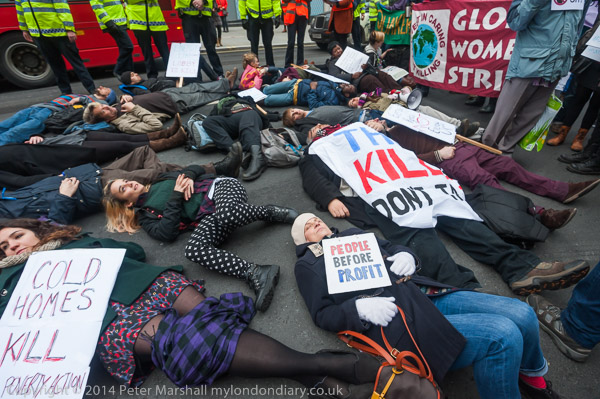
They then held a 15 minute die-in stopping traffic on the road outside the Energy UK offices before continuing with a rally.


Later in the day I joined the Palestinian Prisoners Campaign for a protest outside the City offices of Hewlett Packard. Saturday was the ‘UK Stop Arming Israel’ day of action, but they came on Friday as the HP offices are closed at the weekend. HP is one of the 20 top US armaments companies and has a $6 billion investment in Israel where they provide the IT backbone for the entire Israeli war machine – from the army, to the navy, to the Ministry of Defense, as well as for the prisons and intelligence services, backing up the repression, imprisonment and torture of Palestinians.

The group protests regularly at companies providing support for the Israeli regime, and includes a number of Palestinian and Jewish protesters and is supported by the Islamic Inminds Human Rights Group which has links with Iran.


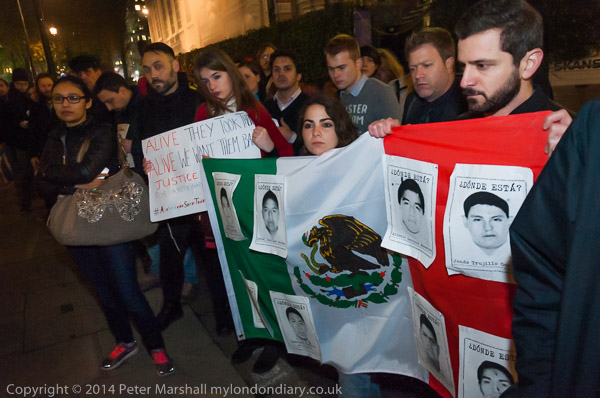
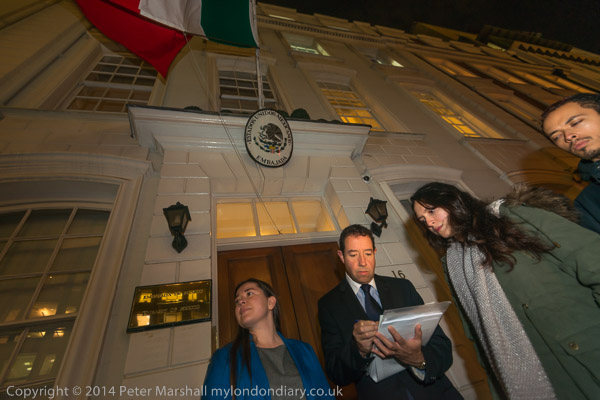
Finally I made my way to the Mexican Embassy in Mayfair for a protest over the disappearance and almost certain massacre of 43 Ayotzinapa college students in Iguala on 26 September who appear to have been arrested by police and handed over by the local mayor to the local crime syndicate Guerreros Unidos (“United Warriors”) to be murdered.

It was now quite dark and the street was badly lit – with most of what light there was coming from the windows of the buildings around. Many held posters with pictures of the missing students and asking in Spanish ‘Where are they now?’ but in seems very unlikely that any are still alive. Although the scale of this massacre caught the attention of the Mexican people – and briefly that of the world – unfortunately similar murders are not unusual in Mexico.

Two embassy staff came out to receive a letter to the Mexican government from the protesters and spent some minutes on the steps listening to the speeches.


More about all three events on My London Diary:
Solidarity with Mexican students
Stop Arming Israel protest at HP
No More Deaths from Fuel Poverty


All photographs on this and my other sites, unless otherwise stated, are taken by and copyright of Peter Marshall, and are available for reproduction or can be bought as prints.