City Panoramas – Highwalks & the River – and an eagle in the City. More panoramas I made in March 1993 on a project on the City for a joint exhibition later in the year. All were taken using a swing lens camera which gave a horizontal angle of view of over 130 degrees – just over a third of the whole circle of vision from the camera position. I ended up with far more good pictures than the dozen or so that went into the show. Perhaps enough for a book one day.
Careful levelling of the camera was needed to keep all vertical lines in the picture straight and upright, but the cylindrical perspective meant that horizontals curved increasingly away from the centre of the image. Careful choice of viewpoint was needed to prevent this effect being too dominant in the images.

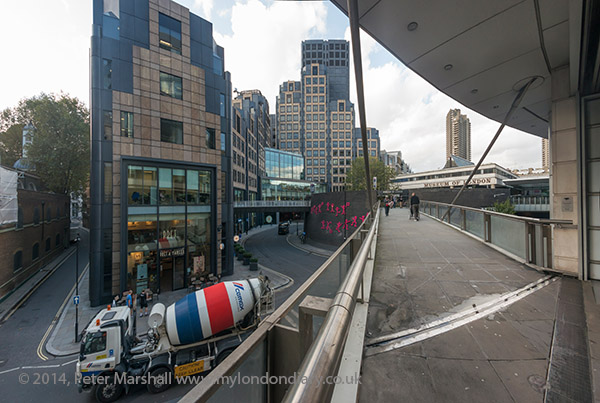
Perhaps the most successful image of the series, this picture taken on one of the City highwalks was used by the Museum of London on one of its annual reports. Strong verticals across the image help and I think the image curvature actually helps, particularly in the lower right of the image, emphasising the sweep of the roadway.
The lighting from behind me creates shadows near both edges leading the eye towards the centre of the image and is even across the frame and the prominent rail leads the viewer into the image.
As always with colour film the colours are not entirely accurate but the Fuji film used produces a pleasing effect with just a little more warmth than the eye – or a digital camera.

One of very few interiors in this project, taken through the window of this café on the highwalk with the camera handheld to the glass and not quite level. The window counter at the lower edge of the image was in reality straight and its curvature comes from the camera perspective – and serves to hold the image in to the the centre.
There was a large difference in the amount of light at the windows and away from them inside the café , and a considerable amount of dodging and burning was needed in making a print, rather easier in this digital rendition from the negative. Fuji film does a better job than most avoiding odd colour hue differences in the shadow and sunlight areas of the scene giving here just a natural-looking slight warming.
In the background through the door and windows you can see part of the Barbican Estate.

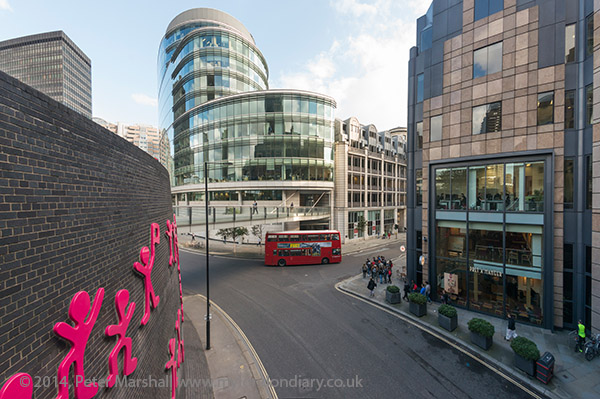
Another picture from my favourite highwalk, with yellow daffodils and a blue tower, as well as the strange triangles which give natural lighting to the room (unfortunately not the beach) underneath the pavement.

The building at left is Girdlers’ Hall. The first Girdlers’ Hall was built here in 1431, but burnt down in the Great Fire in 1666. A new hall was built and this was in turn destroyed by bombing in December 1940. It took some time for a new hall to be built and it was only completed in 1961. It remains on site, though was extended with an extra floor on top in 2008.
The steps here lead up from Coleman Street Garden and the building at right is Austral House, built in 1959-61 by Gunton and Gunton and was the first new building on what became London Wall. It was built as the headquarters for the National Mutual Life Association of Australasia.
Austral House was demolished in 2005 and the new building, One Coleman Street completed in 2007 as the London HQ for Legal and General.

At the south of the City there were more highwalks, sections of which survive. Stairs lead down to the riverside walkway here, with London Bridge going across most of the image to Adelaide House at the right edge. There is still a public terrace here at Magnus House with river views.
Here I was looking directly into the sun, but had hidden it behind the central structure, though there is still some flare at the top of the image. Still the contrasts here were a little too much for film, and the polished granite gives some rather odd reflections making it seem like an actual building.

Looking downriver from the public terrace towards Tower Bridge and HMS Belfast with Billingsgate on the left just beyond the blue glass of the Northern & Shell Building. There is something very strange about the colour of this image, which I think was rather underexposed.

Some more slightly strange colour in this image again taken from the highwalk bridge over Lower Thames Street, with the King William Street approach to London Bridge a couple of hundred yards away. At left it the church of St Magnus the Martyr, dedicated to the Earl of Orkney, killed on 16 April 1118. The church narrowly escaped destruction by fire in 1633, but was one of the first to go in the Great Fire in 1666.
Rebuilding began in 1668 with Sir Christopher Wren in charge; one of his most expensive churches it was completed in 1687 having cost £9,579 19s 10d.

One of few panoramas I made with the camera deliberately tilted I think probably to include more of the flowers in lower left corner and the bottom of the central tree.
After the site was cleared of houses and offices and became one of the City’s many bomb sites in the Blitz, city worker Joseph Brandis decided to turn this hillside into a garden, bringing plants from his own garden in Walthamstow and planting them in mud from the River Thames.
It became a popular spot for those working in the area to sit and eat their sandwiches (as I did back in 1993) and was adopted by the City. In the 1980s it was re-landscaped and named Cleary Garden after Fred Cleary who as Chairman of the Metropolitan Public Gardens Association had done much to encourage tree planting and gardens in the City.

Little Somerset Street is close to the east edge of the City in Aldgate. The pub here opened in 1820 though the building was I think older, beginning life as a private house in a small back street full of butchers – located here to avoid paying the fee to drive animals through the city.
Little Somerset Street was then officially Harrow Alley, but locals knew it as ‘Blood Alley’ as it ran with the blood of the slaughtered cattle and sheep. The street got its current name in 1925.
It is thought that the ‘Star’ in its name was for a brewery, probably the Star Brewery in Romford, 14 miles down the road, founded in 1708 which later became a part of Ind Coope, only closing in 1983, and the ‘Still’ was because it had a still on its upper floor distilling spirits.
It seems to have been the only pub of this name in the country. I went there again in late 2017 but found the pub shuttered and locked and in 2024 permission was granted for its demolition.

A rather frail-looking gangway leads down to Regalia, a three-deck floating pub, bar, and restaurant built in 1980 and permanently moored at Swan Pier. It closed around 2011 and the gangway went with it.
Regalia went downriver and is now rotting on the Swale at Queenborough, though offered for sale as a “redevelopment opportunity”, yours for around £50,000. There are a couple more pictures at Swan Pier in the album on Flickr.

Another image where I deliberately tilted the frame, though this time with the camera on my tripod. Here I wanted to fill the frame with the buildings rather than empty roadway. I think the tilt also adds to the impression of the eagle at left being about to swoop down.
The camera viewfinder only gave a rough impression of exactly what would appear in the frame, and I think I probably hope to get the complete word ‘EAGLE’ of Eagle Star in at the bottom left corner. My camera position was carefully chosen to get the reflection of the eagle in the building on the opposite corner – just visible at the top of the ladder.
There are a few more panoramas in the City I made in March 1993 and another batch I made later in April which I’ll return to later, but my next post in this series will look at some of the other images I made in March, some also in the City.
Flickr – Facebook – My London Diary – Hull Photos – Lea Valley – Paris
London’s Industrial Heritage – London Photos
All photographs on this page are copyright © Peter Marshall.
Contact me to buy prints or licence to reproduce.