City Panoramas – Highwalks & the River – 1993

City Panoramas – Highwalks & the River – and an eagle in the City. More panoramas I made in March 1993 on a project on the City for a joint exhibition later in the year. All were taken using a swing lens camera which gave a horizontal angle of view of over 130 degrees – just over a third of the whole circle of vision from the camera position. I ended up with far more good pictures than the dozen or so that went into the show. Perhaps enough for a book one day.

Careful levelling of the camera was needed to keep all vertical lines in the picture straight and upright, but the cylindrical perspective meant that horizontals curved increasingly away from the centre of the image. Careful choice of viewpoint was needed to prevent this effect being too dominant in the images.

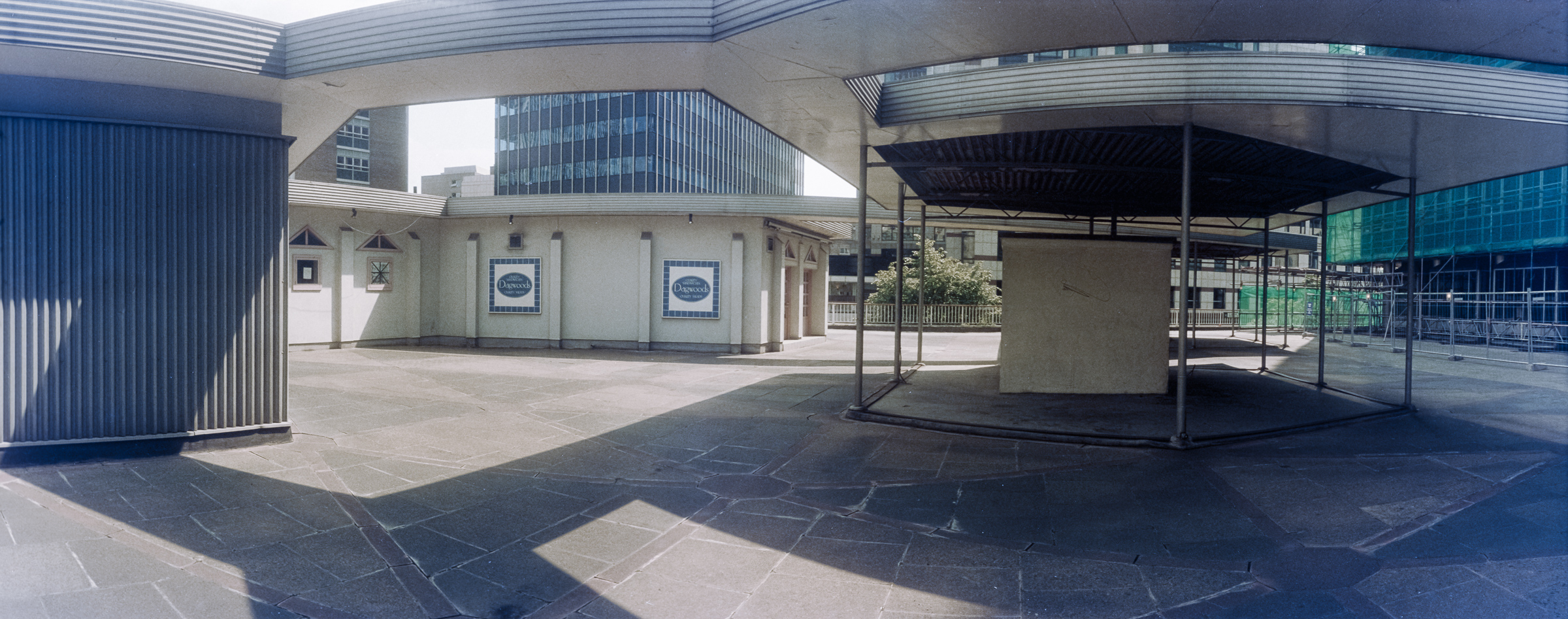
Bassishaw Highwalk, Basinghall St, City, 1993, 93c03-07-31

Perhaps the most successful image of the series, this picture taken on one of the City highwalks was used by the Museum of London on one of its annual reports. Strong verticals across the image help and I think the image curvature actually helps, particularly in the lower right of the image, emphasising the sweep of the roadway.

The lighting from behind me creates shadows near both edges leading the eye towards the centre of the image and is even across the frame and the prominent rail leads the viewer into the image.

As always with colour film the colours are not entirely accurate but the Fuji film used produces a pleasing effect with just a little more warmth than the eye – or a digital camera.

London Wall, City, 1993, 93c03-07-13

One of very few interiors in this project, taken through the window of this café on the highwalk with the camera handheld to the glass and not quite level. The window counter at the lower edge of the image was in reality straight and its curvature comes from the camera perspective – and serves to hold the image in to the the centre.

There was a large difference in the amount of light at the windows and away from them inside the café , and a considerable amount of dodging and burning was needed in making a print, rather easier in this digital rendition from the negative. Fuji film does a better job than most avoiding odd colour hue differences in the shadow and sunlight areas of the scene giving here just a natural-looking slight warming.

In the background through the door and windows you can see part of the Barbican Estate.

Bassishaw Highwalk, City, City, 1993, 93c03-07-32
Bassishaw Highwalk, City, 1993, 93c03-07-32

Another picture from my favourite highwalk, with yellow daffodils and a blue tower, as well as the strange triangles which give natural lighting to the room (unfortunately not the beach) underneath the pavement.

Basinghall Avenue, City, 1993, 93c03-07-61

The building at left is Girdlers’ Hall. The first Girdlers’ Hall was built here in 1431, but burnt down in the Great Fire in 1666. A new hall was built and this was in turn destroyed by bombing in December 1940. It took some time for a new hall to be built and it was only completed in 1961. It remains on site, though was extended with an extra floor on top in 2008.

The steps here lead up from Coleman Street Garden and the building at right is Austral House, built in 1959-61 by Gunton and Gunton and was the first new building on what became London Wall. It was built as the headquarters for the National Mutual Life Association of Australasia.

Austral House was demolished in 2005 and the new building, One Coleman Street completed in 2007 as the London HQ for Legal and General.

93c03-08-11-Edit
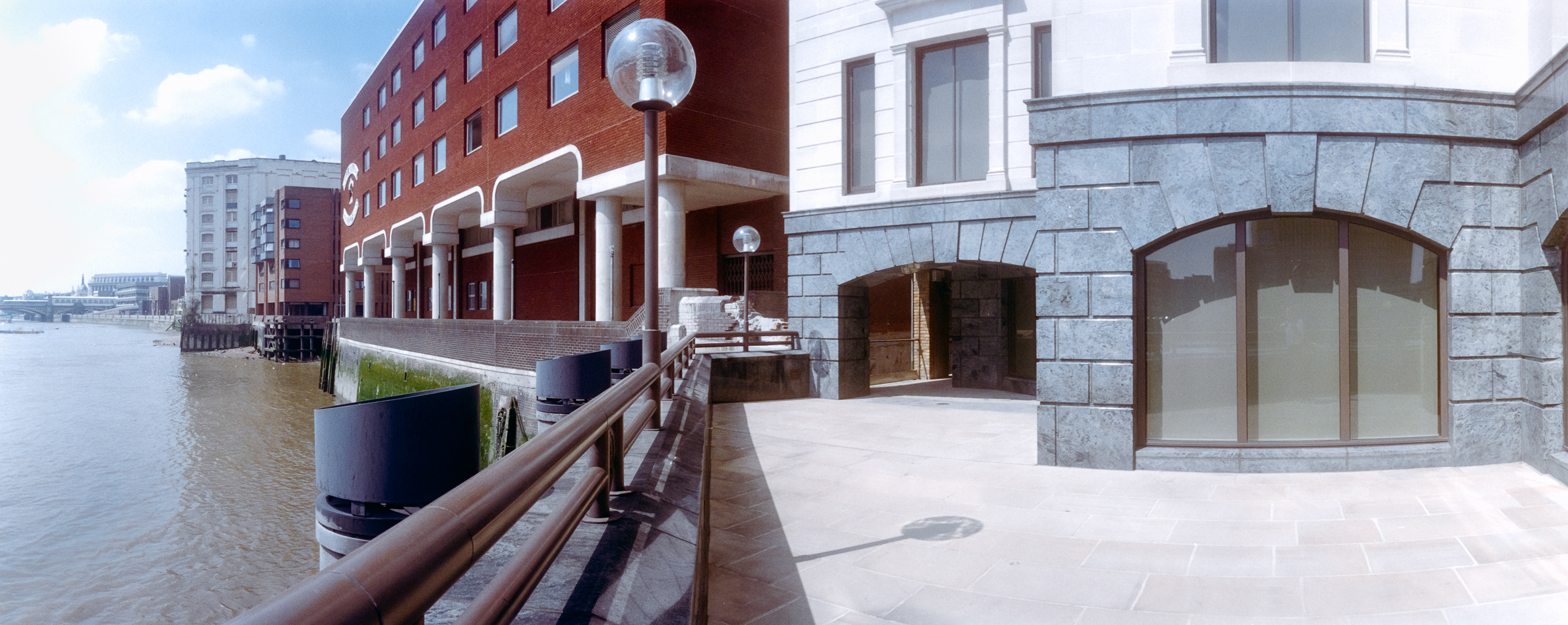
Highwalk, Grants Quay Walk, River Thames, City, 1993, 93c03-08-11

At the south of the City there were more highwalks, sections of which survive. Stairs lead down to the riverside walkway here, with London Bridge going across most of the image to Adelaide House at the right edge. There is still a public terrace here at Magnus House with river views.

Here I was looking directly into the sun, but had hidden it behind the central structure, though there is still some flare at the top of the image. Still the contrasts here were a little too much for film, and the polished granite gives some rather odd reflections making it seem like an actual building.

River Thames, City, 1993, 93c03-08-32

Looking downriver from the public terrace towards Tower Bridge and HMS Belfast with Billingsgate on the left just beyond the blue glass of the Northern & Shell Building. There is something very strange about the colour of this image, which I think was rather underexposed.

Lower Thames Street, City, 1993, 93c03-08-33

Some more slightly strange colour in this image again taken from the highwalk bridge over Lower Thames Street, with the King William Street approach to London Bridge a couple of hundred yards away. At left it the church of St Magnus the Martyr, dedicated to the Earl of Orkney, killed on 16 April 1118. The church narrowly escaped destruction by fire in 1633, but was one of the first to go in the Great Fire in 1666.

Rebuilding began in 1668 with Sir Christopher Wren in charge; one of his most expensive churches it was completed in 1687 having cost £9,579 19s 10d.

Cleary Garden, Queen Victoria St, City, 1993, 93c03-09-33

One of few panoramas I made with the camera deliberately tilted I think probably to include more of the flowers in lower left corner and the bottom of the central tree.

After the site was cleared of houses and offices and became one of the City’s many bomb sites in the Blitz, city worker Joseph Brandis decided to turn this hillside into a garden, bringing plants from his own garden in Walthamstow and planting them in mud from the River Thames.

It became a popular spot for those working in the area to sit and eat their sandwiches (as I did back in 1993) and was adopted by the City. In the 1980s it was re-landscaped and named Cleary Garden after Fred Cleary who as Chairman of the Metropolitan Public Gardens Association had done much to encourage tree planting and gardens in the City.

Still & Star, Pub, Little Somerset St, City, 1993, 93c03-10-31

Little Somerset Street is close to the east edge of the City in Aldgate. The pub here opened in 1820 though the building was I think older, beginning life as a private house in a small back street full of butchers – located here to avoid paying the fee to drive animals through the city.

Little Somerset Street was then officially Harrow Alley, but locals knew it as ‘Blood Alley’ as it ran with the blood of the slaughtered cattle and sheep. The street got its current name in 1925.

It is thought that the ‘Star’ in its name was for a brewery, probably the Star Brewery in Romford, 14 miles down the road, founded in 1708 which later became a part of Ind Coope, only closing in 1983, and the ‘Still’ was because it had a still on its upper floor distilling spirits.

It seems to have been the only pub of this name in the country. I went there again in late 2017 but found the pub shuttered and locked and in 2024 permission was granted for its demolition.

Swan Lane Pier, London Bridge, River Thames, City, 1993, 93c03-10-61

A rather frail-looking gangway leads down to Regalia, a three-deck floating pub, bar, and restaurant built in 1980 and permanently moored at Swan Pier. It closed around 2011 and the gangway went with it.

Regalia went downriver and is now rotting on the Swale at Queenborough, though offered for sale as a “redevelopment opportunity”, yours for around £50,000. There are a couple more pictures at Swan Pier in the album on Flickr.

Eagle Star, Bevis Marks, City, 1993, 93c04-02-11

Another image where I deliberately tilted the frame, though this time with the camera on my tripod. Here I wanted to fill the frame with the buildings rather than empty roadway. I think the tilt also adds to the impression of the eagle at left being about to swoop down.

The camera viewfinder only gave a rough impression of exactly what would appear in the frame, and I think I probably hope to get the complete word ‘EAGLE’ of Eagle Star in at the bottom left corner. My camera position was carefully chosen to get the reflection of the eagle in the building on the opposite corner – just visible at the top of the ladder.

There are a few more panoramas in the City I made in March 1993 and another batch I made later in April which I’ll return to later, but my next post in this series will look at some of the other images I made in March, some also in the City.


Flickr – Facebook – My London Diary – Hull Photos – Lea Valley – Paris
London’s Industrial Heritage – London Photos

All photographs on this page are copyright © Peter Marshall.
Contact me to buy prints or licence to reproduce.


Around the Highwalks – Wood Street 1994

Around the Highwalks – Wood Street: London’s ambitious series of ‘highwalks’, aimed at separating movement on foot from traffic began after World War 2 when the City began to rebuild after extensive war damage – a process that really sprung into action on a large scale in the 1950s.

Highwalk, Wood St, City, 1994, 94-708-21

As Wikipedia states, “In 1947 architect Charles Holden and planner William Holford” had put forward a blueprint for “a network of first-floor walkways that would connect buildings across the City.”

Wood St, Escalator, London Wall, City, 1994, 94-709-12, 1994, 94-709-31
Wood St, Escalator, London Wall, City, 1994, 94-709-31

The City of London Pedway Scheme was later adopted by the City of London Corporation and to get planning permission by the 1960s all new developments were required to include first floor access to walkways. It worked where there had large areas destroyed by bombing – such as the Barbican, but elsewhere these walkways were often dead ends leading nowhere.

Wood St, Escalator, London Wall, City, 1994, 94-709-12

Although London had suffered greatly from the bombing, much survived – and many damaged buildings had been restored in the immediate aftermath of the war. Although some of the city’s older buildings were demolished there was an increasing recognition of the value of many of them. The 1944 Town and Country Planning Act had given the government power to create a statutory list of buildings of special architectural interest – and those powers were increased in the 1947 Act.

Green Cuisine, Highwalk, Wood St, London Wall Citry, 1994, 94-709-21

Listing of buildings began seriously after this, and many buildings in the City gained some protection from demolition – and a resurvey in 1968 began to add more to the lists. It became increasingly clear that the Pedway scheme would never be able to produce a really coherent scheme over most of the City and by the mid-1980s it was effectively discontinued.

Highwalk, St Alphage Highwalk, London Wall, City, 1994, 94-710-22

Since then some parts of the walkway system have been lost, while some areas still remain. Around London Wall while some parts of it were closed. The part of the St Alphage Highwalk in these pictures had been demolished but it was partly replaced by a new section during redevelopment around 2017.

Highwalk, St Alphage Highwalk, London Wall, City, 1994, 94-710-12

Another problems with the Pedway is that London’s transport systems – buses and Underground largely leave passengers at street level. Getting to the highwalks generally requires going up steps and most people would prefer to simply continue to their destination at street level.

Highwalk, St Alphage Highwalk, London Wall, City, 1994
Highwalk, St Alphage Highwalk, London Wall, City, 1994, 94-710-11

For those with disabilities which make steps difficult or impossible this is a real barrier. There were very few places where escalators were provided to ease the problems as these were expensive.

More panoramic images from the City Highwalks in a later post.


Flickr – Facebook – My London Diary – Hull Photos – Lea Valley – Paris
London’s Industrial Heritage – London Photos

All photographs on this page are copyright © Peter Marshall.
Contact me to buy prints or licence to reproduce.


More City Panoramas – 1994

More City Panoramas: I spent several days wandering around the City of London – the “Square Mile” in July and August 1994, I think in prepaation for a group show in which I had decided this would be my contribution.

More City Panoramas - 1994
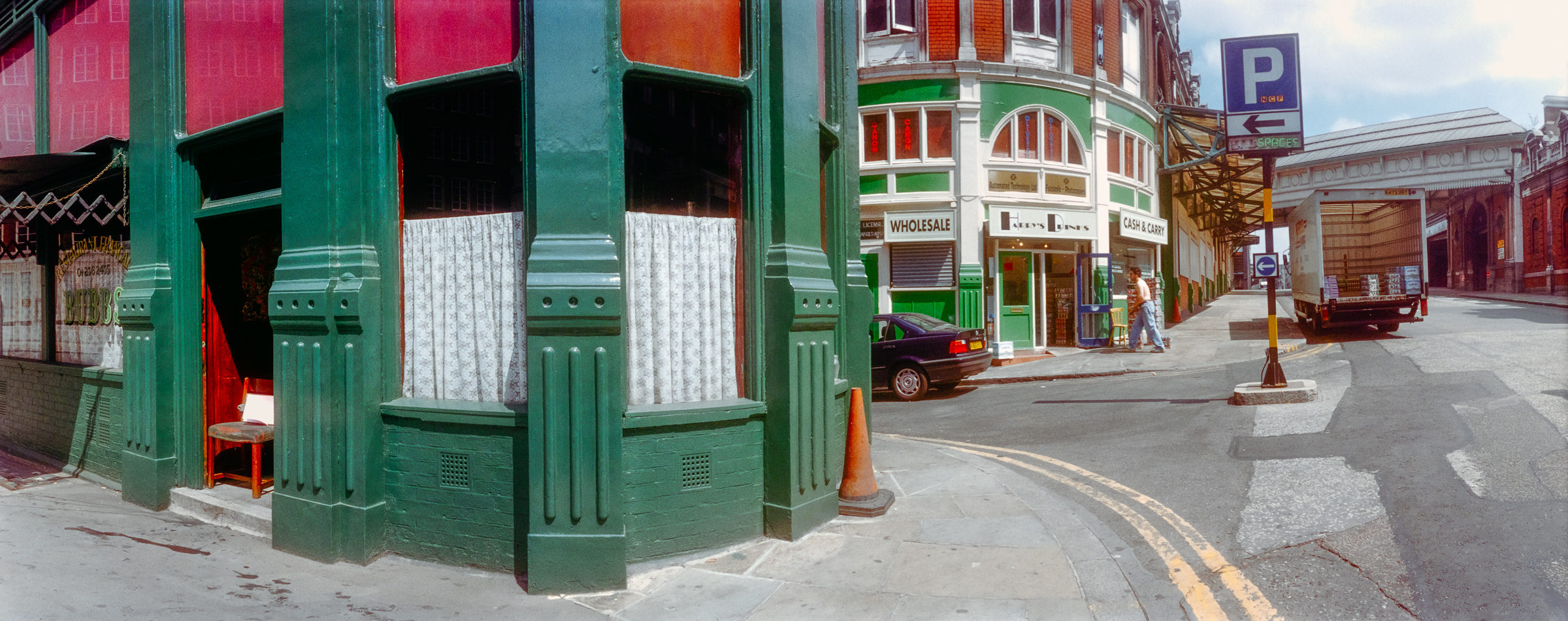
Bubbs, Restaurant Francais, Farringdon Rd, West Smithfield, City, 1994, 94-702-43

Bubb’s Le Restaurant Francais with the address Central Market, Farringdon Street is long closed, but a listing states that they served “a variety of traditional French dishes at their restaurant and can cater for private parties of up to 30 guests upon request.” There are still several French restaurants in the area.

A little further down West Smithfield was the London Central Market with on the corner a wholesale Cash and Carry and Harry’s Drinks and in the distance a covered way across the road between market buildings.

I photographed this corner on several occasions, making a similar panorama here in 1992, perhaps why I have not put this on Flickr.

More City Panoramas - 1994
River Thames, Thames Path, Vintners Hall, Paul’s Walk, City, 1994, 94-703-52

Looking west along the river to Bull Wharf, Queenhithe and beyond. Bull Wharf proudly states it was REBUILT 1980 and it looks to me exceedingly ugly, probably why I didn’t upload this picture to Flickr. My picture perhaps makes the red brickwork event more virulent – the building looks much better to me in a black and white non-panoramic image I made at the same time from more or less the same spot.

Car Park, Smithfield St, City, 1994, 94-704-51

Slightly out of focus in the distance I can just make out Lady Justice on the roof of the Old Bailey and to her right more clearly the tower of Holy Sepulchre Church at the east end of Holborn Viaduct.

I think this car park probably extended to Hosier Lane and is now filled with the shops and offices of 12 Smithfield Street, built in 2004 and now described on Buildington as “an outdated office block that has suffered from poor environmental performance, limited architectural merit, and inefficient servicing. Its ground floor lacks engagement with the surrounding public realm, and its dated façade no longer reflects the character of the conservation area” and being refurbished and extended.

St Mary Somerset Church, Upper Thames St, City , 1994, 94-704-13

A rather dark rendering of this high contrast scene with deep shadow the block of St Paul’s Vista (or 1 High Timber St, now One Millennium Bridge) straddles Upper Thames Street with the bright sky above. My picture was made from the footbridge of Fye Foot Lane carrying a section of the CIty’s Highwalk across Upper Thames Street and Castle Baynard Street and on to Queen Victoria Street.

St Mary Somerset Church was one of those destroyed in the Great Fire of London in 1666 and like 50 others rebuilt by the office of Sir Christopher Wren. The tower remains between Lambeth Hill and Castle Baynard Street but the rest of the church was demolished in 1871 when like other redundant churches the land was sold to build churches in the rapidly expanding suburbs of London. The tower was a Ladies toilet before the Second World War, Damaged by bombing, it was restored by the city in 1956 and has now been converted into a private residence.

More City Panoramas - 1994
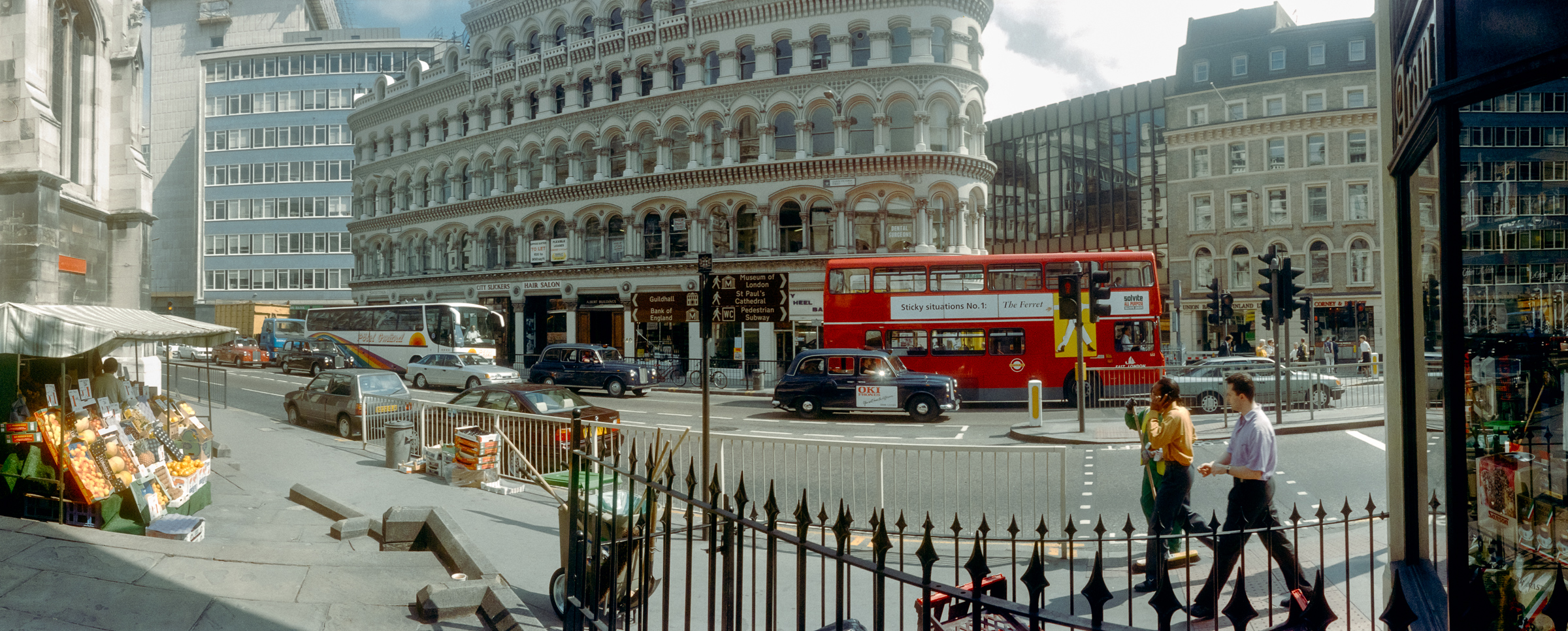
Highwalk, Footbridge, Huggin Hill, Upper Thames St, City, 1994, 94-705-41

A fruit and vegetable stall on the pavement in Front of St Mary Aldermary (another rebuilt by Wren after the Great Fire) on busy Queen Victoria Street which you can see at extreme left. I think the extremely low stone wall on the pavement and the railings mark the former edge of its churchyard.

I liked the range of architectural age and style across the upper half of this image, and particularly admired the ornate Victorian block in the centre of the picture. As well as a bus and a coach there are 5 London taxis in the picture, an aspect of London’s traffic congestion long overdue for reform.

Highwalk, Footbridge, Queen Victoria St, City, 1994, 94-705-31
Highwalk, Footbridge, Huggin Hill, Upper Thames St, City, 1994, 94-705-31

This was taken from a now-closed section of Highwalk across Upper Thames Street and the church at left is St Mary Somerset. The alley at right is Huggin Hill with a view of the distinctive building on the block between Queen Victoria St, Bread Lane and Cannon Street, 30 Cannon St built for Crédit Lyonnais between 1974 and 1977.

Highwalk, London Wall, City, 1994, 94-706-51

So many buildings have changed around here since 1994. The building right of centre is Standard Chartered on the corner of Aldermanbury and Aldermanbury Square and was remodelled around 2010 and the building left of centre is Brewer’s Hall, now with a roof extension. I think this section of the highwalk led up at Brewers Hall Gardens

More from July 1994 in the City later.


Flickr – Facebook – My London Diary – Hull Photos – Lea Valley – Paris
London’s Industrial Heritage – London Photos

All photographs on this page are copyright © Peter Marshall.
Contact me to buy prints or licence to reproduce.


A Busy 10th October – 2014

Solidarity for Care UK Strikers

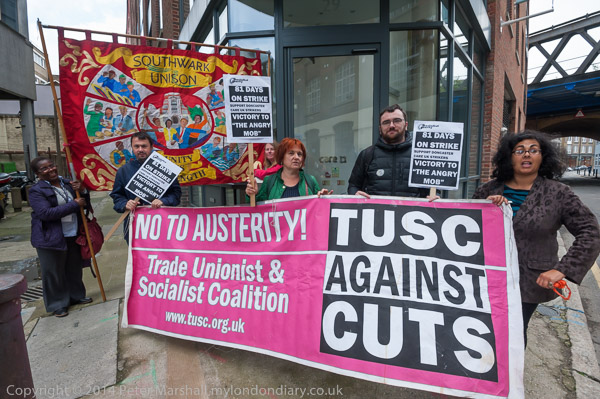
NSSN, TUSC and Southwark Unison protested at the Care UK offices in Southwark during the nation-wide day of solidarity with Doncaster Care UK workers who had been on strike for 81 days after huge cuts in pay and services by a private equity company taking over a part of the NHS, part of the continuing largely hidden privatisation of our NHS.

This protest was one of many around the country outside offices of Care UK and Bridgepoint, the private equity firm that owns Care UK, as well as at shops including branches of Fat Face and Pret a Manger also owned by Bridgepoint. As I wrote:

Their strike is not just about their own cuts in wages, but a stand against the principles involved and the whole idea of a values-based health service. The workers at Care UK are no longer able to proudly address the needs of those with learning disorders in their own community, but are simply required to meet minimum needs at the lowest possible cost – and the greatest profit to Bridgepoint and the company to which they will be sold on once the private equity company has slimmed services and pay to the bone.

Solidarity for Care UK Strikers

Free Ghoncheh Ghavami – SOAS action

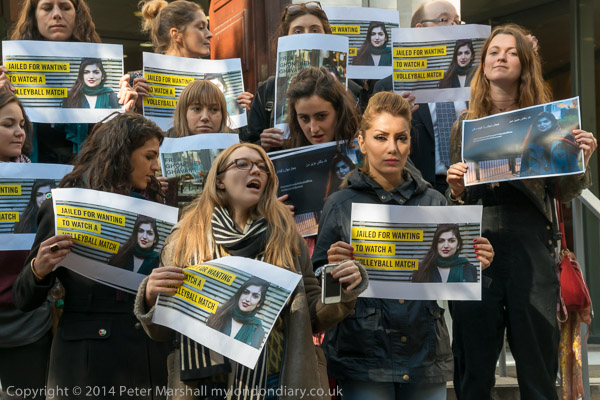
Protesters at outside SOAS called for the release of former SOAS Law student Ghoncheh Ghavami, held in prison for 104 days and on hunger strike for 10 days after being detained in Iran with other women after she went to watch a volleyball match. Among those who spoke at the protest was Ghavami’s brother.

According to Wikipedia, “Ghavami was released on bail on 23 November 2014. She was sentenced to a one-year jail term and a two-year travel ban.”

Free Ghoncheh Ghavami – SOAS action

City Panoramas

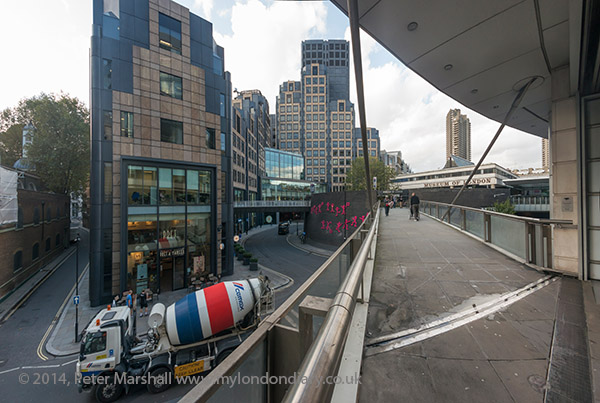
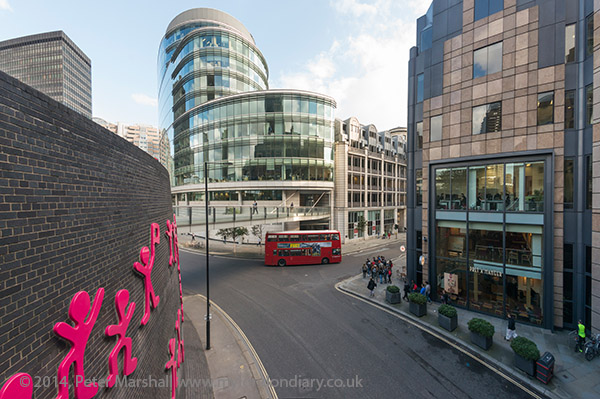
I had a little time to spare between events and took a short walk in the City, including along one of the remaining areas of ‘highwalk’ at the southwest of the Barbican site, part of the post-war plan to segregate pedestrians from traffic.

The Museum of London had decorated the wall at left with characters related to an exhibition about Sherlock Holmes.

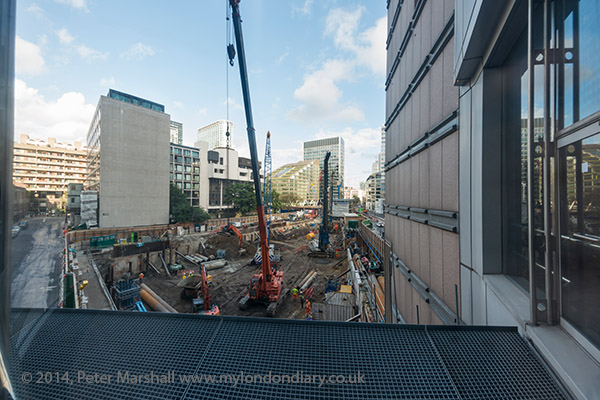
This large building site was on what used to be St Alphage Highwalk. The ambitious post-war plans to separate pedestrians from traffic in the City were never really practical on a large scale and large sections such as this have been demolished, although there are still some highwalks including throughout the large Barbican estate.

City Panoramas

Palestine protest at Hewlett Packard

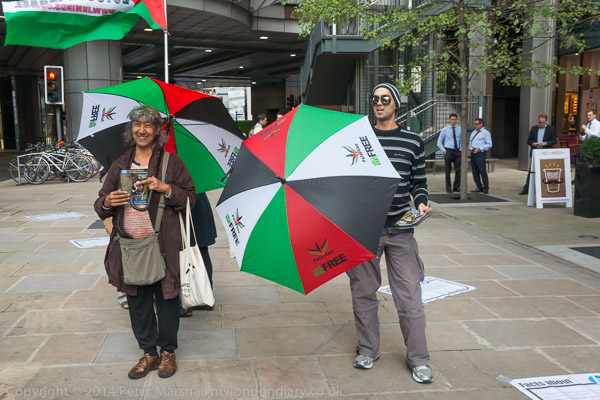
The Palestinian Prisoners Campaign continued their campaign against Hewlett-Packard, which boasts of ‘a massive presence’ in Israel and are the IT backbone for the Israeli war machine with a picket outside their London offices in Wood St in the City.

Palestine protest at Hewlett Packard

Solidarity with the Umbrella Revolution

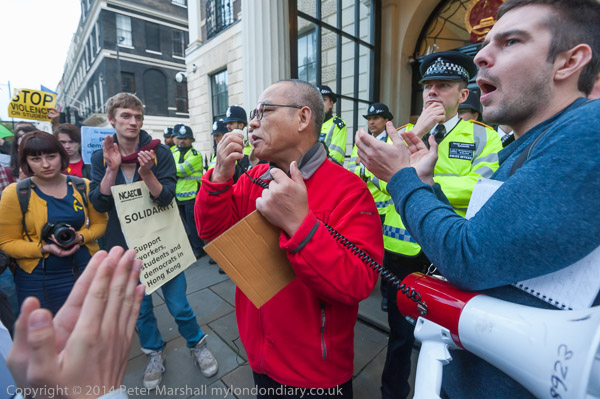
The National Campaign Against Fees and Cuts organised a protest at the Chinese Embassy in solidarity with the ‘umbrella revolution’ of the students and workers of Hong Kong in their fight for democracy. Many of the protesters carried umbrellas and others had small yellow paper umbrellas as well as their posters and placards.

Solidarity with the Umbrella Revolution


1987 – In the City

St Botolph's Church Hall, Bishopsgate Churchyard, City, 1987 87-11a-15-positive_2400
St Botolph’s Church Hall, Bishopsgate Churchyard, City, 1987

St Botolph’s Church Hall in Bishopsgate Churchyard has changed little since I took this picture over 30 years ago and the churchyard is still a place you can stroll though away from the noise and fumes of Bishopsgate a few yards away.

Old Broad St, City, 1987 87-11a-21-positive_2400
Old Broad St, City, 1987

Back in 1987 you could walk through a considerable part of the City on the High Walks, pedestrian walkways above the streets, one of which could be accessed at the western end of Bishopsgate Churchyard and gave elevated views of the buildings on Old Broad St opposite. Boston House appears to be the name of the the block on Old Broad Street between London Wall and New Broad St, and to be made up of two similar buildings; this one, on the corner of London Wall appeared to me the more satisfactory.

Highwalk, view, St Botolph's Churchyard, City, 1987 87-11a-22-positive_2400
Highwalk, view, St Botolph’s Churchyard, City, 1987

This was the view from the highwalk looking back down Bishopsgate Churchyard. Much of the the highwalk has since been closed to the public.

Highwalk, View, Old Broad St, City, 1987 87-11a-24-positive_2400
Highwalk, View, Old Broad St, City, 1987

Perhaps surprisingly this view from the north end of the highwalk looked little different until recently, though I don’t think there is any public access to enable you to see it from my 1987 viewpoint. At far left is the corner of Broad Street Avenue and the building, 76-80 Old Broad Street, dates from around 1860 and is Grade II listed. The UBS building at 100 Liverpool St was completed in 1988, but UBS moved out a few years ago (to an even more hideous building in Broadgate, nominated for the Carbuncle Cup) and others moved in, but the building has been treated to a facelift, with a new skin over the old structure.

Highwalk, View, London Wall, Old Broad St, City, 1987 87-11a-34-positive_2400
Highwalk, View, London Wall, Old Broad St, City, 1987

Although the bridge across Wormwood Street from which I took this picture is still in place (or was last time I walked by before lockdown) the stairs leading to it were firmly blocked. It shows the junction between Old Broad St and the east end of London Wall, with Boston House, shwon in a picture above, on the corner at right.

Angel Court, City, 1987 87-11a-41-positive_2400
Angel Court, City, 1987

Angel Court is an alley in the centre of London’s finanacial district between Throgmorton St and Copthall Avenue, now leading between tall buldings.

Throgmorton Gardens, City, 1987 87-11a-43-positive_2400
Throgmorton Gardens, City, 1987

A little to the east of Angel Court, this garden is at the corner of Austin Friars and Copthall Avenue and was I think closed to the public, and my photograph was taken through the fence looking south from Austin Friars.

More from the CIty of London in a later post. All these pictures are in my Flickr album 1987 London Photos.


All photographs on this and my other sites, unless otherwise stated, are taken by and copyright of Peter Marshall, and are available for reproduction or can be bought as prints.