More City of London Panoramas – 1994

More City of London Panoramas: This is the final set of picturesI’ll post from those I made while working on a personal project on the City of London in July 1994. Of course I took many which I’ve not digitised, spending several days walking the City and making over 300 exposures. The camera I used makes negatives on standard 35mm film which are wider than normal and a ’36 exposure’ film only gets around 20 or 21 panoramic frames. Film loading is also trickier as the film has to go around a curve.

Each exposure took a few minutes to select a viewpoint, set up my tripod, level the camera, use a handheld lightmeter to check exposure and finally press the cable release. Most of those not uploaded are similar to those I have posted with just minor changes to the view.

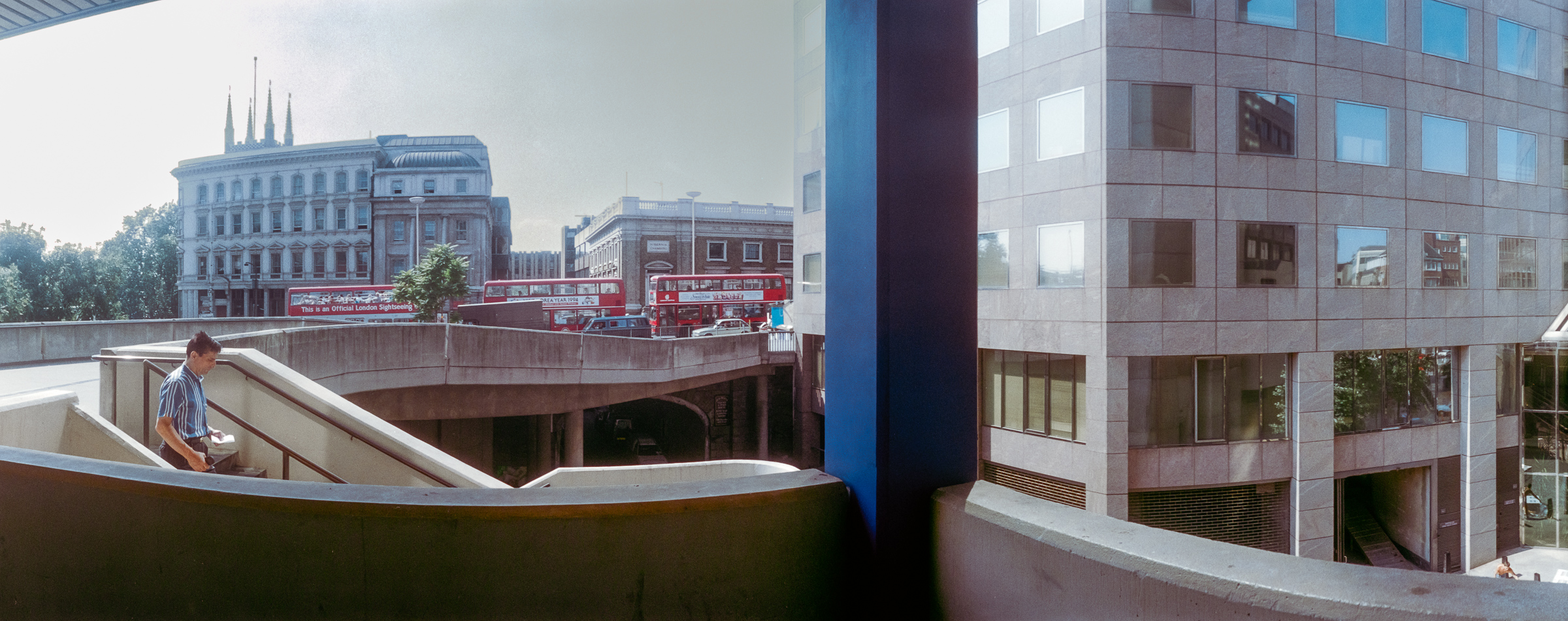
London Bridge Walk, Tooley St, Borough High St, Southwark, 1994, 94-711-52

Not quite in the City, but made as I made my way from London Bridge Station to London Bridge along London Bridge Walk. The road in the background is Borough High Street which leads on to London Bridge and the City boundary is in the middle of the river. You can just see the pinnacles on the top of the tower of Southwark Cathedral.

After the operation of the Waterloo & City underground line from Network South East to London Underground in April 1994 I could no longer use my ‘London Terminals’ ticket on this route, and my cheapest journey became to go to London Bridge on this and walk across to the City.

This is one of a few pictures I had digitised but missed when I was uploading these images to Flickr.

High Walk, Wood St, City, 1994, 94-713-42

Another exposure from the highwalk at Wood Street, leading south along the east side of the street away from London Wall. In the centre of the picture is the City of London Police Headquarters, with two white police vans at bottom right. Steps lead down from the walkway to Wood Street but the highwalk also continued straight on at extreme left – though with more steps.

In the centre of Wood Street at right is the tower of St Alban Wood Street. The medieval church was destroyed in the Great Fire and rebuilt by Sir Christopher Wren. The church was largely destroyed in the Blitz in 1940. The tower remained and was Grade II* listed in 1950 and is now a private house; the remains of the rest of the church were demolished in 1965.

Lower Thames St, King William St, City, 1994, 94-711-12

Again on my way from London Bridge Station to the centre of the City, this is made from where London Bridge joins to King William Street and goes across Lower Thames Street. You can see a highwalk bridge going across Lower Thames street a couple of hundred yards to the east, still there in 2025.

Until around 1970 Thames Street was a fairly narrow street, just wide enough to allow a single lane of traffic in both directions. It was then turned into a major road and divided at London Bridge into Lower and Upper Thames Street. At the left you can clearly see where older buildings were cut through to widen the road.

Bank Junction, City, 1994, 94-712-33

The heart of the City. I made the picture close to the corner of Mansion House Street and Princes Street with the Underground entrance on the corner. At left is a corner of the Bank of England and the main modern building towering above it is the Stock Exchange Tower, home to the Stock Exchange until 2004.

Towards the centre is the Royal Exchange, I think then still home to the International Financial Futures Exchange rather than just an upmarket shopping mall. Two buildings full of banks and insurance companies book-end Hawksmoor’s St Mary Woolnuth and at the extreme right is the edge of the Mansion House with a gilded lamp on its steps.

Milton Court, Silk Street, City, 1994, 94-713-21

Another section of highwalks ran from close to Moorgate Station to the Barbican Estate and these last four pictures show sections of this, which could also be accessed from Ropemaker Street. This northern section has now been lost.

Milton Court was designed by Chamberlin, Powell & Bon and built as a part of the Barbican development in 1959 for various City services – “a fire station, Coroner’s Court, mortuary, office of weights and measures and a civil defence school.”

It was arguably London’s most outstanding single post-war building and English Heritage wanted to list it in 2001, but the government’s Department of Culture, Media and Sport objected and in 2007 Secretary of State James Purnell granted it immunity from listing. In a sad act of cultural vandalism this remarkable building was demolished in 2008.

Milton Court, Silk Street, City, 1994, 94-713-12

The building which replaced Milton Court was also given the same name but is a much more bland modern structure. The bridge which linked to the northern section of highwalk disappeared.

The new 115m tall Milton Court is described on its builders Sir Robert McAlpine web site: “Climbing to 36 storeys, Milton Court redefines luxury living in the Square Mile. In addition to a graceful residential tower, the development is home to a spectacular new annexe to the Guildhall School of Music & Drama.” But to me it looks like just another tall city office block.

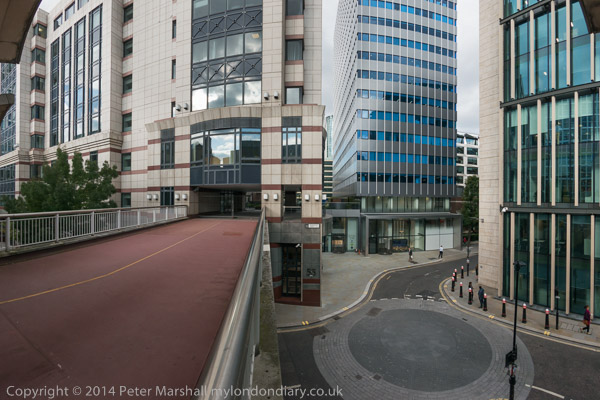
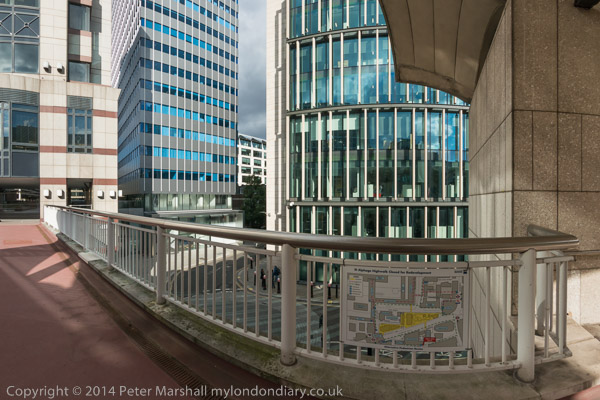
Highwalk, Ropemaker St, City, 1994, 94-715-52

This enclosed section of highwalk ran from Ropemaker Street to the bridge across Silk Street to the Speed Highwalk still there along the north side of Speed House.

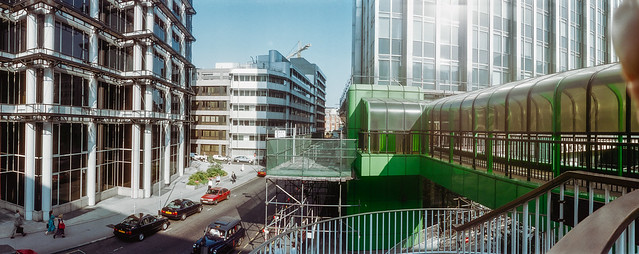
Ropemaker St, Islington, City, 1994, 94-715-32

Remarkably I think none of the buildings in this picture looking east along Ropemaker Street has ssurvived. Even the building at left, Ropemaker Place, a 60m high block which I photographed while it was being built in 1986 and was completed in 1987 and which I thought was one of the more attractive modern buildings in (or rather a few feet outside) didn’t last long and was demolished only 18 years later in 2005.

More colour from 1994 in later posts.


FlickrFacebookMy London DiaryHull PhotosLea ValleyParis
London’s Industrial HeritageLondon Photos

All photographs on this page are copyright © Peter Marshall.
Contact me to buy prints or licence to reproduce.

More Around the City

Bassishaw High Walk, City, 1987 87-11c-16-positive_2400
Bassishaw High Walk, City, 1987

There is still a section of the pedestrian route above traffic level here, leading from the yard behind the Guildhall and to a bridge across London Wall, though the bridge is now a more recent construction a little further west and crossing at an angle and leading on to the high walks that were built into the Barbican Estate. This area next to City Tower looks rather different now. Britannic House, one of the original six towers built along the new London Wall was refurbished in 1990 and renamed City Tower.

Highwalk, Moor Lane, City, 1987 87-11c-21-positive_2400
Highwalk, Moor Lane, City, 1987

Looking down Moor Lane with the Barbican at the right on a section of the high walk that has now gone, but which used to lead from close to Moorgate station. I think this gateway was roughly above the junction with Silk St. Empty when I took this picture (possibly on a Sunday) it was sometimes quite crowded during the rush hours with office workers making their way to the tube. The high walks were useful routes, avoiding the often dangerous traffic on the streets and also providing good vantage points for photographers, and I’m saddened at their loss. But I think they took up space that could be sold expensively as offices.

Ropemaker St, Islington, 1987 87-11c-31-positive_2400
Ropemaker St, Islington, 1987, City

This building on Ropemaker St was one of my favourite examples of modern office architecture when it was built, and I photographed it on several occasions. I suppose it doesn’t quite belong in this post as it was on the north side of the road and thus in Islington rather than the City, where I was standing on a section of high walk to take the picture.

Ropemaker Place, a 60m high block was completed in 1987 shortly before I made this picture. It didn’t last long and was demolished only 18 years later in 2005.

Holland House, Bury St, City, 1987 87-11c-51-positive_2400
Holland House, Bury St, City, 1987

Holland House in Bury St has lasted rather longer and is protected by its Grade II* listing. The only London building by leading Dutch architect Hendrik Petrus Berlage it was built in 1916 for the Dutch company Wm H Müller & Co, complete with a granite prow by Dutch sculptor J. Mendes da Costa.

More recently when I’ve photographed here I’ve stepped a little to the left to bring the ‘Gherkin’ into view – but construction of 30 St Mary Axe only began in 2001.

Cutler St area, City, 1987 87-11c-53-positive_2400
Cutler St area, City, 1987

I think this is a part of Devonshire Square, a private area of the City which was developed by the East India Company, then sold to St Katharine’s Dock and bought in 1909 by the Port of London Authority. The warehouses here were used to store the more valuable commodities imported from across the empire. The site was acquired by Standard Life Assurance together with Greycoat Estates Ltd in 1978 and became offices, but still remained something of a private enclave, if no longer used for the secure storage of “Ostrich feathers, chinaware, oriental carpets, cigars, tortoiseshell, silks, mother of pearl, clocks, watches, cameras, drugs, spices, musical instruments, perfumes, tea and other prized artefacts.”

Baltic Exchange, St Mary Axe, City, 1987 87-11c-63-positive_2400
Baltic Exchange, St Mary Axe, City, 1987

The Provisional IRA left a van packed with explosives outside the Baltic Exchange in St Mary Axe shortly before 9pm on 10 April 1992, and then made a call to the police warning them that a bomb was about to explode at the Stock Exchange – 370 metres away in direct line, but about half a mile by road. The bomb wrecked this facade and caused a total of £800 million worth of damage to this and surrounding buildings.

Perhaps the bombers were confused and looking for the old Stock Exchange building in Capel Court, off Bartholomew Lane, just to the east of the Bank of England, while the Stock Exchange had moved in 1972 to a new tower on Old Broad St.

21 New St, Cock Hill, City, 1987 87-11c-55-positive_2400
21 New St, Cock Hill, City, 1987

This listed archway with a Merino Ram was built in 1863 for Cooper’s Wool Warehouse. By the 1900s the wool storage business had largely moved further east closer to London Docks and in 1907 the warehouse was sold and used for other storage. It was converted into offices in 1981.

Newsprint, Bouverie St, City, 1987 87-11d-01-positive_2400
Newsprint, Bouverie St, City, 1987

Some newspapers were still being printed in ‘Fleet Street’ and the picture shows a lorry delivering newsprint to one of the printing works on Bouverie St.

The Seven Ages of Man, Richard Kindersley, sculpture, Baynard House, Queen Victoria St, City, 1987 87-11d-41-positive_2400
The Seven Ages of Man, Richard Kindersley, sculpture, Baynard House, Queen Victoria St, City, 1987

This sculpture stands in front of one of London’s bleaker Brutalist buildings, and for once its hard to disagree with Pevsner over a modern building, when he describes this a “acutely depressing.” But it does include a section of high-level pedestrian walkway with seating and this rather fine sculpture based on ‘As You Like It’. And it’s a pleasant enough place to sit and read a newspaper with a view of St Andrew by the Wardrobe, the last city church rebuilt by Sir Christopher Wren after the Great Fire of London.

All from Page 7 of my 1987 London Photos.


All photographs on this and my other sites, unless otherwise stated, are taken by and copyright of Peter Marshall, and are available for reproduction or can be bought as prints.


1987 – In the City

St Botolph's Church Hall, Bishopsgate Churchyard, City, 1987 87-11a-15-positive_2400
St Botolph’s Church Hall, Bishopsgate Churchyard, City, 1987

St Botolph’s Church Hall in Bishopsgate Churchyard has changed little since I took this picture over 30 years ago and the churchyard is still a place you can stroll though away from the noise and fumes of Bishopsgate a few yards away.

Old Broad St, City, 1987 87-11a-21-positive_2400
Old Broad St, City, 1987

Back in 1987 you could walk through a considerable part of the City on the High Walks, pedestrian walkways above the streets, one of which could be accessed at the western end of Bishopsgate Churchyard and gave elevated views of the buildings on Old Broad St opposite. Boston House appears to be the name of the the block on Old Broad Street between London Wall and New Broad St, and to be made up of two similar buildings; this one, on the corner of London Wall appeared to me the more satisfactory.

Highwalk, view, St Botolph's Churchyard, City, 1987 87-11a-22-positive_2400
Highwalk, view, St Botolph’s Churchyard, City, 1987

This was the view from the highwalk looking back down Bishopsgate Churchyard. Much of the the highwalk has since been closed to the public.

Highwalk, View, Old Broad St, City, 1987 87-11a-24-positive_2400
Highwalk, View, Old Broad St, City, 1987

Perhaps surprisingly this view from the north end of the highwalk looked little different until recently, though I don’t think there is any public access to enable you to see it from my 1987 viewpoint. At far left is the corner of Broad Street Avenue and the building, 76-80 Old Broad Street, dates from around 1860 and is Grade II listed. The UBS building at 100 Liverpool St was completed in 1988, but UBS moved out a few years ago (to an even more hideous building in Broadgate, nominated for the Carbuncle Cup) and others moved in, but the building has been treated to a facelift, with a new skin over the old structure.

Highwalk, View, London Wall, Old Broad St, City, 1987 87-11a-34-positive_2400
Highwalk, View, London Wall, Old Broad St, City, 1987

Although the bridge across Wormwood Street from which I took this picture is still in place (or was last time I walked by before lockdown) the stairs leading to it were firmly blocked. It shows the junction between Old Broad St and the east end of London Wall, with Boston House, shwon in a picture above, on the corner at right.

Angel Court, City, 1987 87-11a-41-positive_2400
Angel Court, City, 1987

Angel Court is an alley in the centre of London’s finanacial district between Throgmorton St and Copthall Avenue, now leading between tall buldings.

Throgmorton Gardens, City, 1987 87-11a-43-positive_2400
Throgmorton Gardens, City, 1987

A little to the east of Angel Court, this garden is at the corner of Austin Friars and Copthall Avenue and was I think closed to the public, and my photograph was taken through the fence looking south from Austin Friars.

More from the CIty of London in a later post. All these pictures are in my Flickr album 1987 London Photos.


All photographs on this and my other sites, unless otherwise stated, are taken by and copyright of Peter Marshall, and are available for reproduction or can be bought as prints.