Anti-Capitalist Carols in the City – 2012

Anti-Capitalist Carols in the City - 2012
Anti-Capitalist Carols in the City

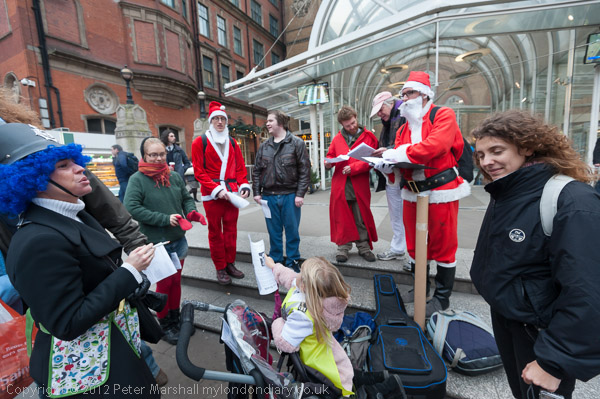
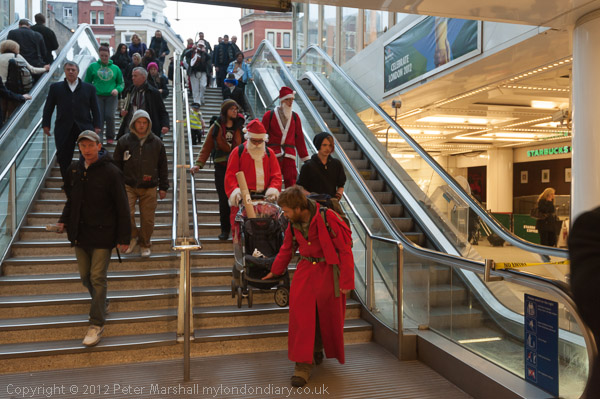
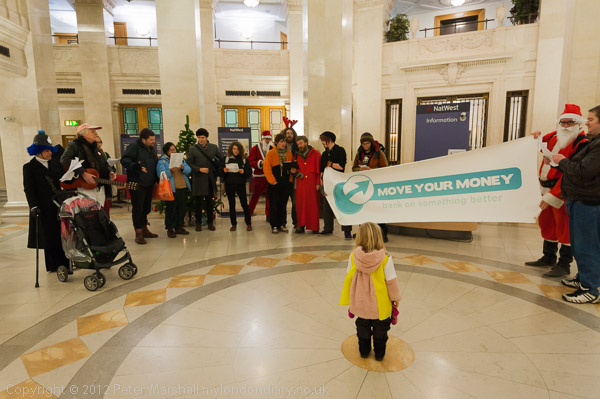
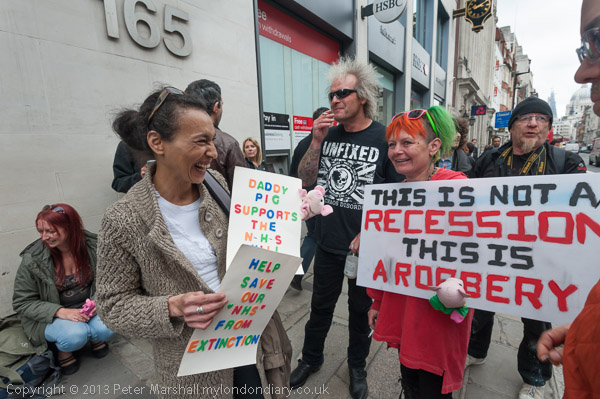
On Tuesday 18th December 2012 I met a small group of anti-capitalist protesters from the St Paul’s Cathedral Occupy London camp at 3pm at Liverpool Street Station.

Anti-Capitalist Carols in the City - 2012

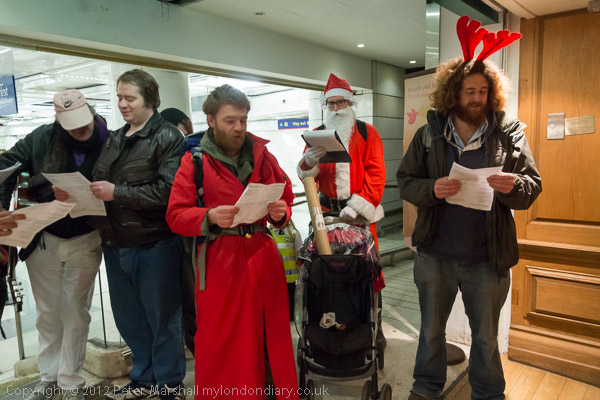
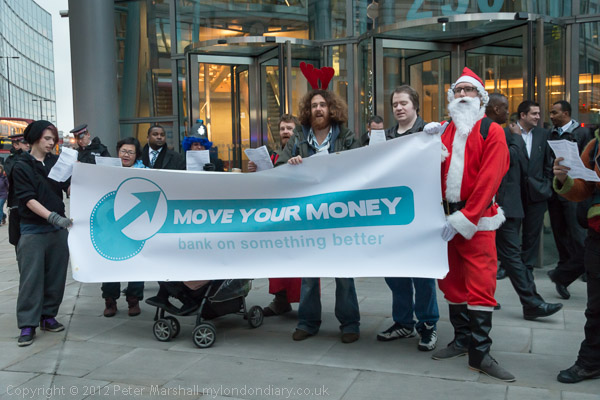
For the next couple of hours I went with them as they visited businesses and banks around the city to sing anti-capitalist carols against tax avoiders, bailed out banks and others in a peaceful and seasonal protest.

Anti-Capitalist Carols in the City - 2012

They had a special song for Starbucks – to the tune of ‘Let It Snow’ with the first verse::

Oh the cost of living's frightful
Some relief would be delightful
So don't leave us in the muck
Tax Starbucks, tax Starbucks, tax Starbucks
Anti-Capitalist Carols in the City - 2012
Signing a carol to customers inside Starbucks

There were another three verses, reminding us and Starbucks and the customers sitting drinking their coffee that corporate and elite tax evasion costs the nation £33 billion a year.

Anti-Capitalist Carols in the City - 2012

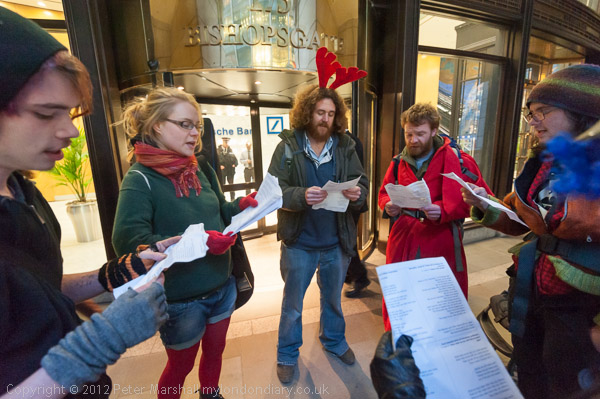
We walked out onto Bishopsgate and they gave their next performance outside the doors to the bankers offices at 125 Bishopsgate where security were not showing a happy Christmas spirit.

Away in the Caymnans, the Plutocrats wept
Because, we the people
are listing their debts
We're no longer fooled by
Divide and delay, we're planting the seeds,
But they're making hay...

The group moved cross the street to the RBS, reminding them the government supported the banks with an unimaginable £1.162 trillion. The several carols there, included:

Silent debt, holy debt
All is owed, all is wrecked
Round on poor; father, mother and child
public services tendered and priced
sleep in poverty please

There were similar performances outside the various other banks as we made our way through the city towards the Bank of England. There was a another carol for Ramsay Health Care, a company involved in the creeping privatisation of the NHS, on Old Broad Street:

What shall we do with our public services
Shall we sell off our public services
That's where Thatcher left it!

When we got to HSBC on the corner of Old Broad St and London Wall everyone walked inside to sing, including some of the police who were by now taking part – if silently – in the proceedings. After a couple of carols – and some posed photographs – the group went out.

On Old Broad Street there was another Starbucks – and again the carollers went inside to entertain and inform the customers.

Next it was time to visit another bank – the RBS on Threadneedle St – and by now a few more singers had joined the group.

We walked up to the Guildhall – the medieval centre of the City, which had its own carol, to the tune of Good King Wenceslas:

Bad George Osborne last looked out
In the Autumn budget
Nothing to be proud about
So he had to fudge it
Said though things don't look that great
We are on the right track
Bullshit George, NHS you hate
Now it's time to fight back.

On the way back towards the Royal Exchange there was another Starbucks to enter and treat to a carol and couple more banks to sing outside – Lloyds stopped them from entering.

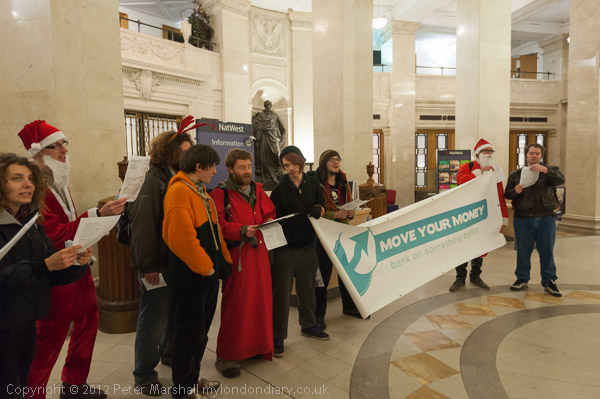
But the finest performance of the day came inside the grand banking hall of the NatWest on Poultry, where bank staff seemed quite amused by the performance, and some from the upper floors came to the balconies to watch and listen. I’d not been inside the building before and was pleased to be able to see it – and to take a few pictures.

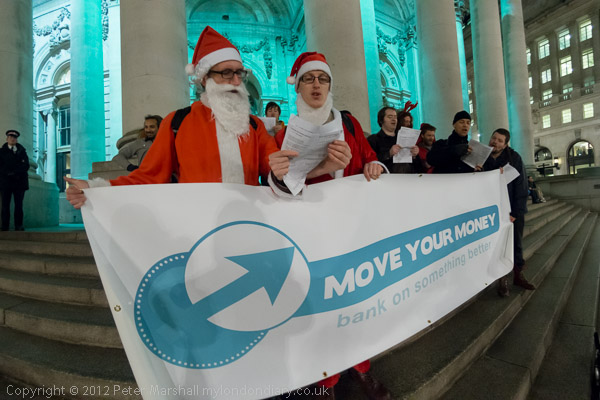
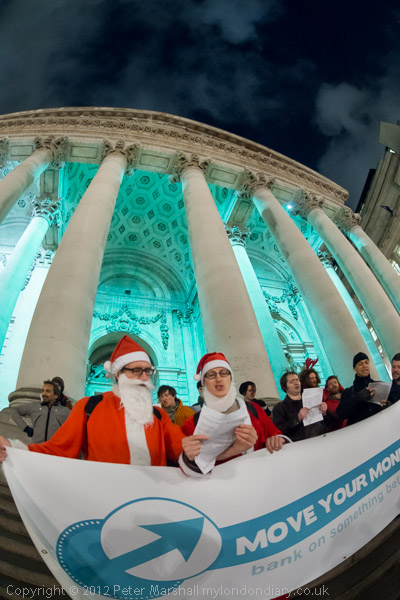
Again after a couple of carols the group left quietly and crossed to the Royal Exchange where they performed on the steps as city workers rushed by to Bank tube station.

By then I was getting a little tired and cold, having been mainly on the street for a couple of hours. The carol singers had decided to split into two groups now their numbers had grown to visit more places, but I decided to get on a bus and start my journey home.

More pictures at Anti-Capitalist Carols in the City.


FlickrFacebookMy London DiaryHull PhotosLea ValleyParis
London’s Industrial HeritageLondon Photos

All photographs on this page are copyright © Peter Marshall.
Contact me to buy prints or licence to reproduce.

More City of London Panoramas – 1994

More City of London Panoramas: This is the final set of picturesI’ll post from those I made while working on a personal project on the City of London in July 1994. Of course I took many which I’ve not digitised, spending several days walking the City and making over 300 exposures. The camera I used makes negatives on standard 35mm film which are wider than normal and a ’36 exposure’ film only gets around 20 or 21 panoramic frames. Film loading is also trickier as the film has to go around a curve.

Each exposure took a few minutes to select a viewpoint, set up my tripod, level the camera, use a handheld lightmeter to check exposure and finally press the cable release. Most of those not uploaded are similar to those I have posted with just minor changes to the view.

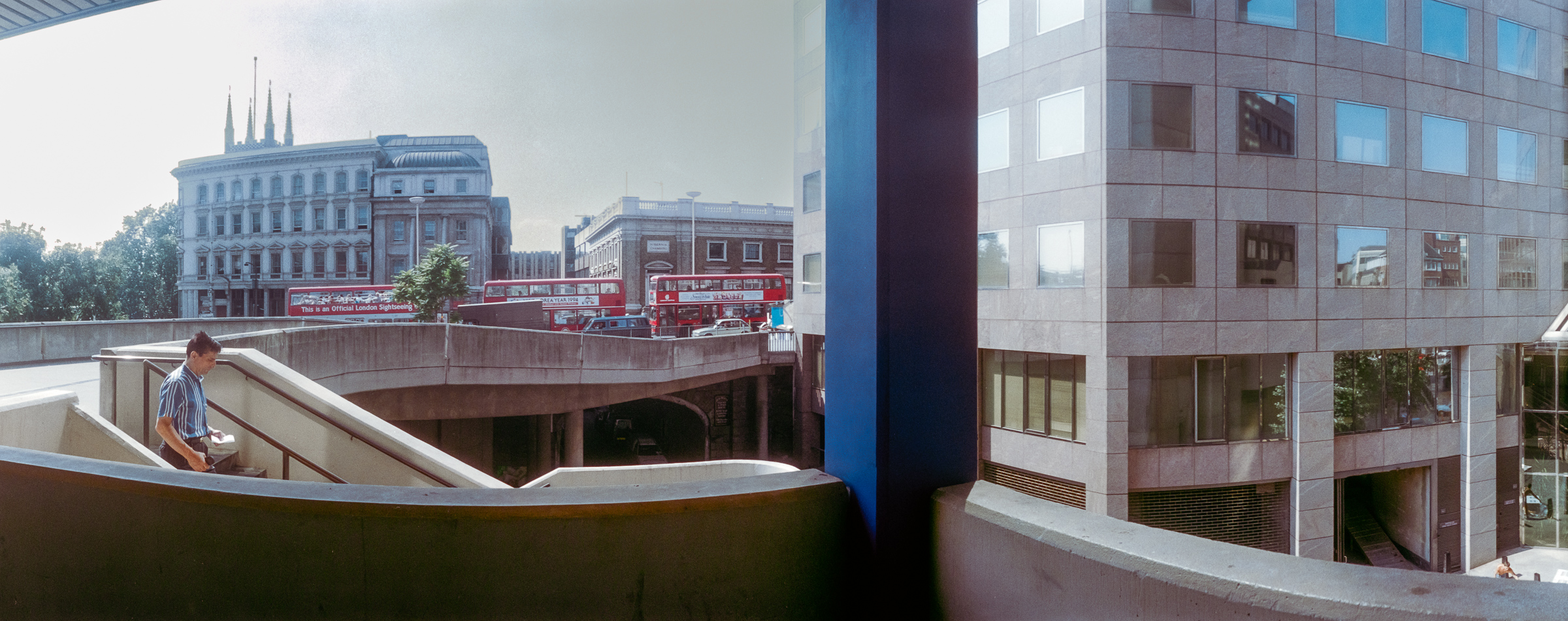
London Bridge Walk, Tooley St, Borough High St, Southwark, 1994, 94-711-52

Not quite in the City, but made as I made my way from London Bridge Station to London Bridge along London Bridge Walk. The road in the background is Borough High Street which leads on to London Bridge and the City boundary is in the middle of the river. You can just see the pinnacles on the top of the tower of Southwark Cathedral.

After the operation of the Waterloo & City underground line from Network South East to London Underground in April 1994 I could no longer use my ‘London Terminals’ ticket on this route, and my cheapest journey became to go to London Bridge on this and walk across to the City.

This is one of a few pictures I had digitised but missed when I was uploading these images to Flickr.

High Walk, Wood St, City, 1994, 94-713-42

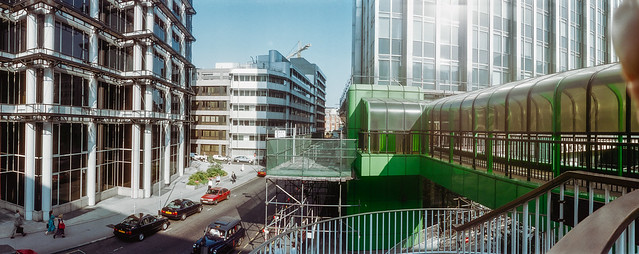
Another exposure from the highwalk at Wood Street, leading south along the east side of the street away from London Wall. In the centre of the picture is the City of London Police Headquarters, with two white police vans at bottom right. Steps lead down from the walkway to Wood Street but the highwalk also continued straight on at extreme left – though with more steps.

In the centre of Wood Street at right is the tower of St Alban Wood Street. The medieval church was destroyed in the Great Fire and rebuilt by Sir Christopher Wren. The church was largely destroyed in the Blitz in 1940. The tower remained and was Grade II* listed in 1950 and is now a private house; the remains of the rest of the church were demolished in 1965.

Lower Thames St, King William St, City, 1994, 94-711-12

Again on my way from London Bridge Station to the centre of the City, this is made from where London Bridge joins to King William Street and goes across Lower Thames Street. You can see a highwalk bridge going across Lower Thames street a couple of hundred yards to the east, still there in 2025.

Until around 1970 Thames Street was a fairly narrow street, just wide enough to allow a single lane of traffic in both directions. It was then turned into a major road and divided at London Bridge into Lower and Upper Thames Street. At the left you can clearly see where older buildings were cut through to widen the road.

Bank Junction, City, 1994, 94-712-33

The heart of the City. I made the picture close to the corner of Mansion House Street and Princes Street with the Underground entrance on the corner. At left is a corner of the Bank of England and the main modern building towering above it is the Stock Exchange Tower, home to the Stock Exchange until 2004.

Towards the centre is the Royal Exchange, I think then still home to the International Financial Futures Exchange rather than just an upmarket shopping mall. Two buildings full of banks and insurance companies book-end Hawksmoor’s St Mary Woolnuth and at the extreme right is the edge of the Mansion House with a gilded lamp on its steps.

Milton Court, Silk Street, City, 1994, 94-713-21

Another section of highwalks ran from close to Moorgate Station to the Barbican Estate and these last four pictures show sections of this, which could also be accessed from Ropemaker Street. This northern section has now been lost.

Milton Court was designed by Chamberlin, Powell & Bon and built as a part of the Barbican development in 1959 for various City services – “a fire station, Coroner’s Court, mortuary, office of weights and measures and a civil defence school.”

It was arguably London’s most outstanding single post-war building and English Heritage wanted to list it in 2001, but the government’s Department of Culture, Media and Sport objected and in 2007 Secretary of State James Purnell granted it immunity from listing. In a sad act of cultural vandalism this remarkable building was demolished in 2008.

Milton Court, Silk Street, City, 1994, 94-713-12

The building which replaced Milton Court was also given the same name but is a much more bland modern structure. The bridge which linked to the northern section of highwalk disappeared.

The new 115m tall Milton Court is described on its builders Sir Robert McAlpine web site: “Climbing to 36 storeys, Milton Court redefines luxury living in the Square Mile. In addition to a graceful residential tower, the development is home to a spectacular new annexe to the Guildhall School of Music & Drama.” But to me it looks like just another tall city office block.

Highwalk, Ropemaker St, City, 1994, 94-715-52

This enclosed section of highwalk ran from Ropemaker Street to the bridge across Silk Street to the Speed Highwalk still there along the north side of Speed House.

Ropemaker St, Islington, City, 1994, 94-715-32

Remarkably I think none of the buildings in this picture looking east along Ropemaker Street has ssurvived. Even the building at left, Ropemaker Place, a 60m high block which I photographed while it was being built in 1986 and was completed in 1987 and which I thought was one of the more attractive modern buildings in (or rather a few feet outside) didn’t last long and was demolished only 18 years later in 2005.

More colour from 1994 in later posts.


FlickrFacebookMy London DiaryHull PhotosLea ValleyParis
London’s Industrial HeritageLondon Photos

All photographs on this page are copyright © Peter Marshall.
Contact me to buy prints or licence to reproduce.

St Pauls and around Guildhall – 1994

St Pauls and around Guildhall: More panoramas from my days wandering the City of London in July 1994. Most of these pictures are in my Flickr album 1994 London Colour.

Cathedral Steps, St Paul's Churchyard, City, 1994, 94-706-12
Cathedral Steps, St Paul’s Churchyard, City, 1994, 94-706-12

I took relatively few pictures of St Paul’s Cathedral, and here it is only visible in deep shadow at right. In the centre are the rather bland blocks of Juxon House, built in 1963 rather a long time after much of the area was destroyed by German bombs and subject to a long campaign (with Royal support) for demolition along with others when Paternoster Square was redeveloped.

Unfortunately its replacement – and Juxon House was worse. Icannot better the description by Jonathan Glancey in The Guardian when the new block was completed in 2003 who called it “A mockery of the language of classical architecture, this Paternoster office block is kitsch writ gross, a kind of two fingers up to Wren and Hawksmoor, who worked so hard to create the peerless dome and west towers of St Paul’s.” In his article he also gives some of the reasons that led to this new carbuncle.

Aldermanbury, City, 1994, 94-707-42

The area around the Guildhall was fascinating in many ways in the 1990s, in part for its contrasting architectural styles which you can see here. At left is One Love Lane, a 1989 building refurbished in 2015-6. In the centre is the back of One Aldermanbury Square, built for Standard Chartered Bank in 1990, but significantly remodelled after they left in 2013. The Insurance Hall, 20 Aldermanbury, has the inscription by its door ‘THIS BUILDING WAS OPENED BY HIS MAJESTY KING GEORGE V ACCOMPANIED BY HER MAJESTY QUEEN MANY ON THE TWENTY EIGHT DAY OF JUNE MCMXXXIV THE TWENTY FIFTH YEAR OF HIS MAJESTY’S REIGN’. It was home to the Chartered Insurance Institute until 2018.

Guildhall Piazza, City, 1994, 94-707-32

Looking towards the The North Wing (formerly known as the North Block) of the Guildhall, constructed in 1955-58 to a 1930s design by Sir Giles Gilbert Scott. At right is the back of the Insurance Hall. At left the 1972 sculpture ‘Beyond Tomorrow‘ by Karin Jonzen (1914-1998); her parents were Swedish but she was born in London and studied at the Slade.

The piazza was a pleasant place to sit on sunny days and I sometimes ate my sandwiches there. The back of the North Wing and that end of the piazza were modified around 2006 to improve access and create more office space.

Beyond Tomorrow, Karin Jonzen, Guildhall Piazza, City, 1994, 94-707-31

A closer view of Karin Jonzen’s sculpture and beyond it one of my favourite modern London buildings, the Grade II listed former exhibition hall, magistrates court and offices at 65 and 65a Basinghall Street designed by Richard Gilbert Scott (1923-2017) of Sir Giles Gilbert Scott, Son and Partner and built in 1966-69. He was the “fourth generation of Britain’s best-known architectural dynastyaccording to the listing text, which for once is very informative about the architect and the building.

As the listing says, his “stylish use of pre-cast concrete shell vaulting at the Guildhall was a response to the existing Gothic architecture of the site” – where he had been involved with his father Sir Giles in rebuilding the bomb-damaged Gothic Guildhall.

Bassishaw Highwalk, Basinghall St, City, 1994, 94-707-11

Just to the north, seen from the Highwalk just as it emerges from under Richard Gilbert Scott’s building is one of my favourite views in the City, again showing different architectural styles.

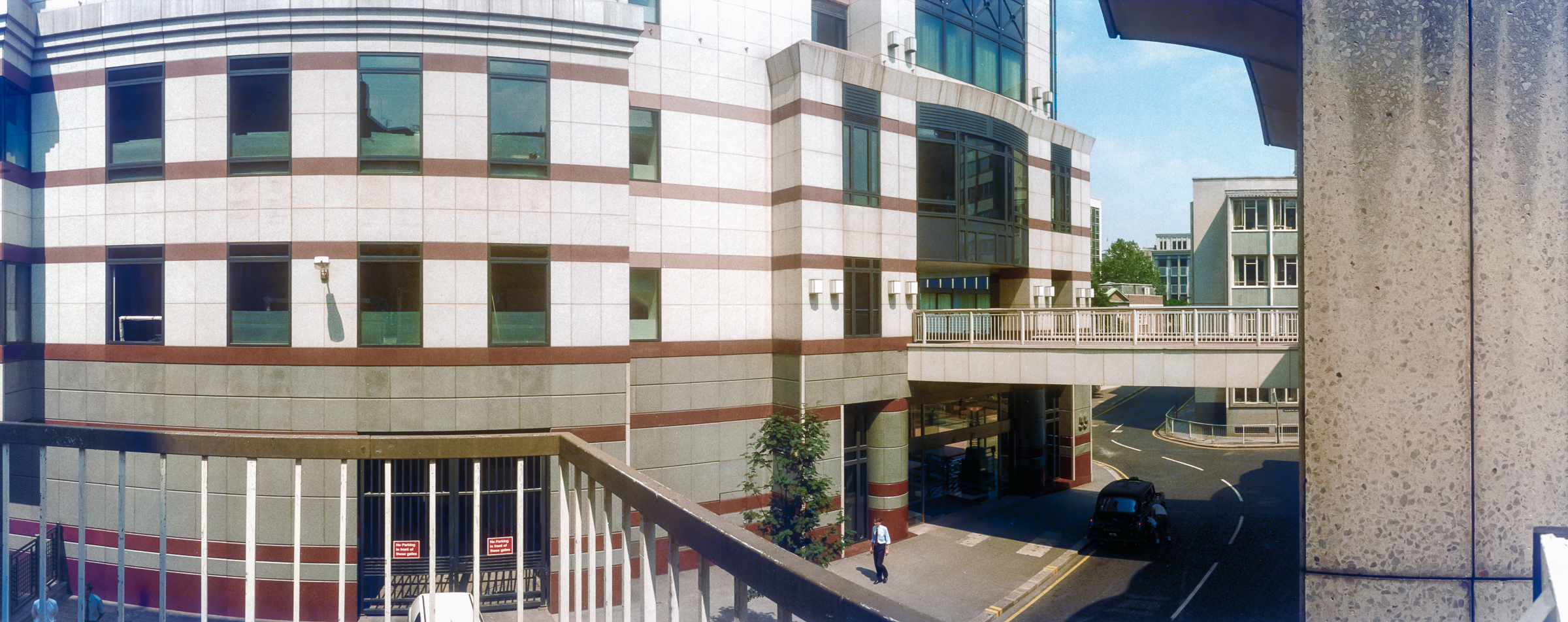
At left is 55 Basinghall St, City Place House, a substantial post-modern building from 1988-1992 by Swanke Hayden Connell. Work began on its demolition in 2021 for the building of a 13-storey office block by Allies & Morrison, which also involved the “partial demolition, reconfiguration and refurbishment of the basement, lower ground, ground and mezzanine floors of 40 Basinghall Street” – City Tower in my picture.

Basinghall St, Bassishaw Highwalk, City, 1994, 94-707-22

A second view from another section of Highwalk shows the same corner looking along Basinghall Street.

More from this part of the City in a later post.


FlickrFacebookMy London DiaryHull PhotosLea ValleyParis
London’s Industrial HeritageLondon Photos

All photographs on this page are copyright © Peter Marshall.
Contact me to buy prints or licence to reproduce.


Limehouse and the City – Panoramas 1994

Limehouse and the City – Panoramas 1994: I made one panorama at the end of my trip to Limehouse in June which is on a film processed in July which I overlooked when posting pictures to Flickr.

DLR Viaduct, Limehouse, Tower Hamlets, 1994, 94-701-51

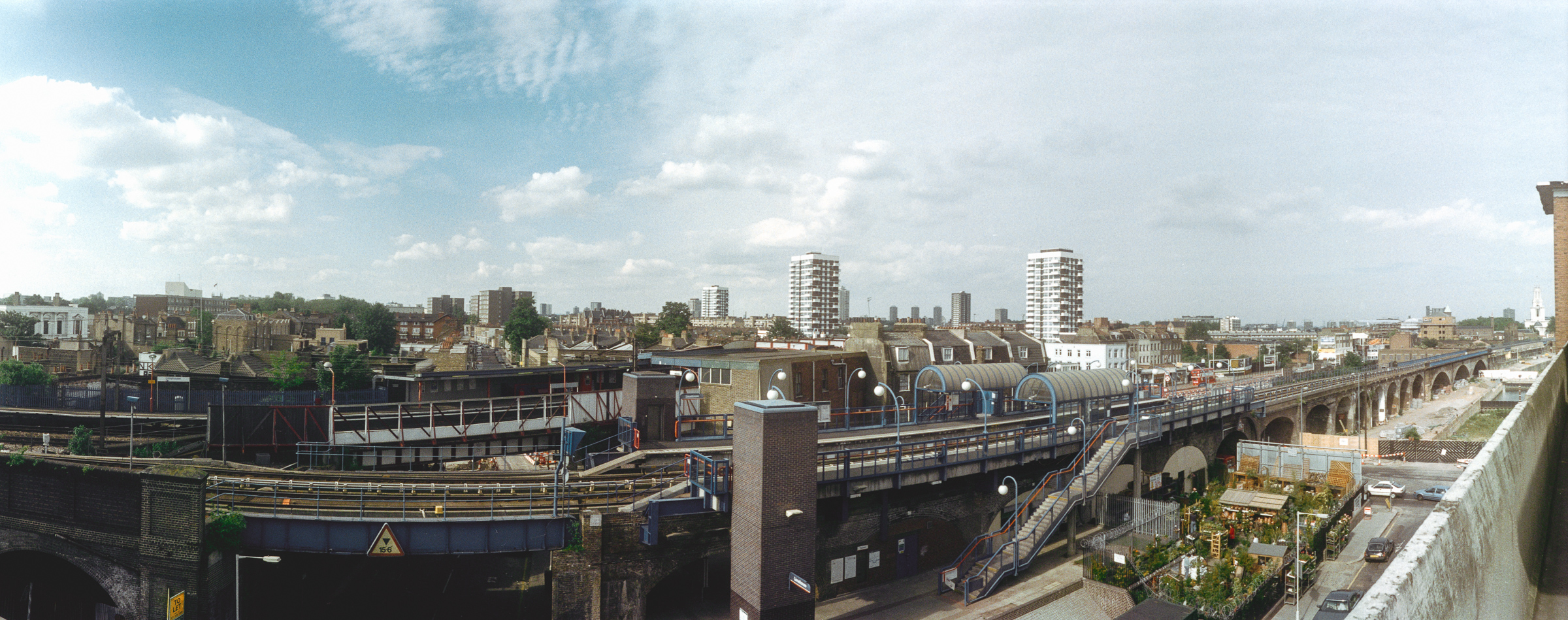
This was taken from the top floor of John Scurr House on Ratcliffe Lane where there are open balconies leading to the flats it shows both the National Rail and DLR Limehouse stations with the DLR viaduct leading east, with the white tower of St Anne’s Limehouse just visible at extreme right before the top of the brickwork of the stairs.

You can also just see the north side of Limehouse Basin on the other side of Branch Road, and lower right of centre is a small but packed garden centre. A bus goes along Commercial Road and you can see the houses and flats of Limehouse and Bow beyond. Like all the other pictures in this post it was taken with a swing-lens panoramic camera with a horizontal angle of view of over 120 degrees.

Blackfriars Rail Bridge, Blackfriars Bridge, River Thames, Southwark, 1994, 94-701-42

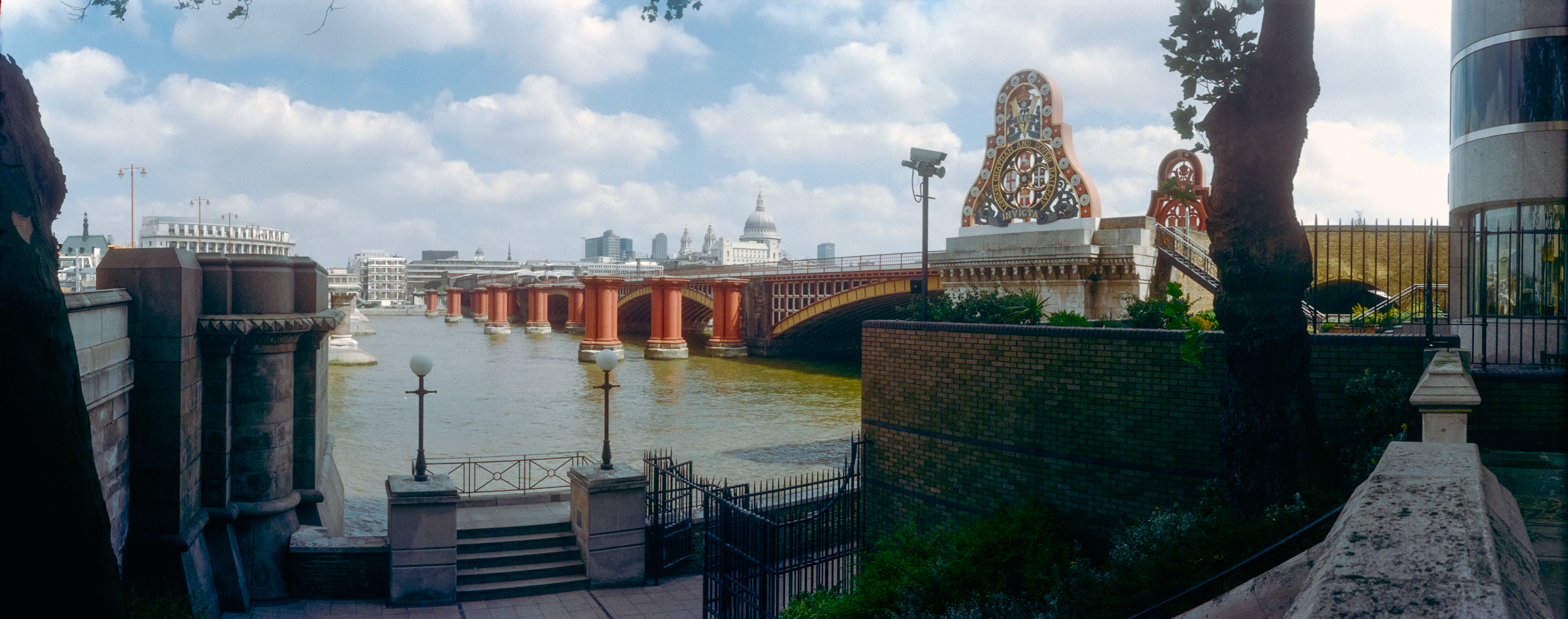
Early in July I took a train to Waterloo and walked into the City from there, pausing before I crossed Blackfriars Bridge to make this panorama. This is the only place where the City comes ‘South of the River’ and where I was standing in Rennie Garden I was already in the City of London, though the wall at right and half the rail bridge past it is in Southwark.

While the City boundary for the other bridges is in the centre of the river, for some reason the Blackfriars and Southwark Bridges Act 1867 put the full length and its southern end within the city’s borders, in the parish of St Anne Blackfriars.

The garden here Rennie Garden is named after John Rennie (1761 – 1821) the engineer who built several of London’s bridges but not this one, which was by by Joseph Cubitt, also responsible for the dismantled railway bridge whose red piers remain.

This was the site of the Albion Flour Mills designed by Samuel Wyatt on this site in 1786 to house the machinery of Matthew Boulton and steam engine of James Watt – and it was this steam-powered corn mill, the first major factory in London, which is thought to be the inspiration for William Blake’s ‘dark satanic mills’.

The Albion Mill died by its own hand, burnt down in 1791 by a fire probably caused by poor maintenance when a bearing overheated, but four years earlier Robert Barker had sent his son Henry Aston Barker to sit on the roof of the building to make the sketches for his ‘London from the roof of the Albion Mills‘ which he then added detail, “greatly enlarged and painted in distemper on canvas.” He coined the name ‘panorama’ and in 1787 patented the idea. His panorama, first shown at the Albion Mill shortly before it was burnt down and then shown in various galleries in London.

Sets of aquatints were made by Frederick Birnie which toured Europe and went to the United States and while these survive in various collections the original panorama is lost.

Puddle Dock, Queen Victoria St, City, 1994, 94-701-33

Puddle Dock was a dock and also a sewer outfall and was filled in during the comprehensive reclamation and redevelopment of the area between 1962 and 1972 which created Upper Thames Street as a major road and Puddle Dock linking this to Queen Victoria Street underneath part of Baynard House, a Brutalist office block built for BT and completed in 1979.

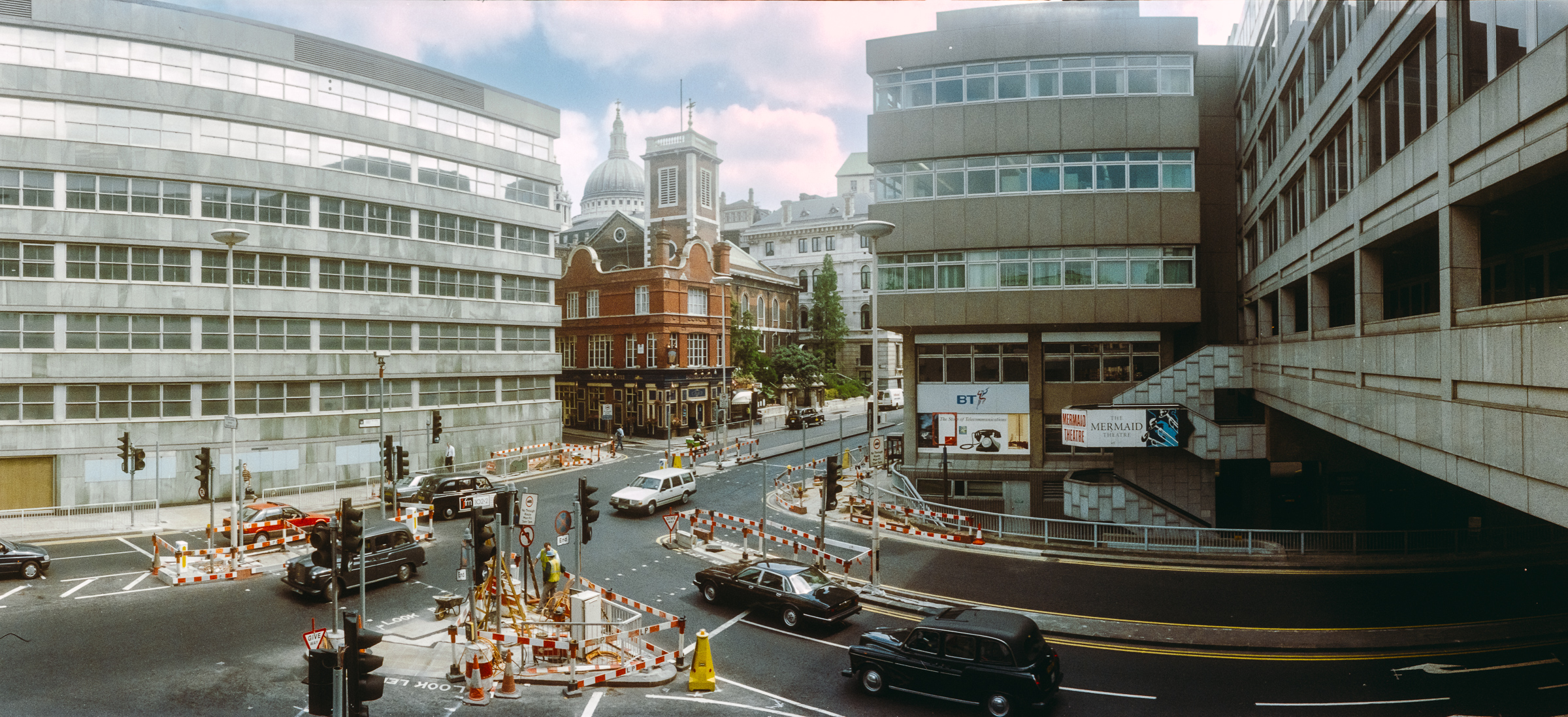
As a part of plans to separate vehicle and pedestrian movement in the City it included a walkway leading to Blackfriars Station from which I made this panorama. The dome of St Paul’s can be seen just to the left of the tower of St Andrew by the Wardrobe.

Sculpture, Farringdon Rd, Holborn Viaduct, City, 1994, 94-702-51

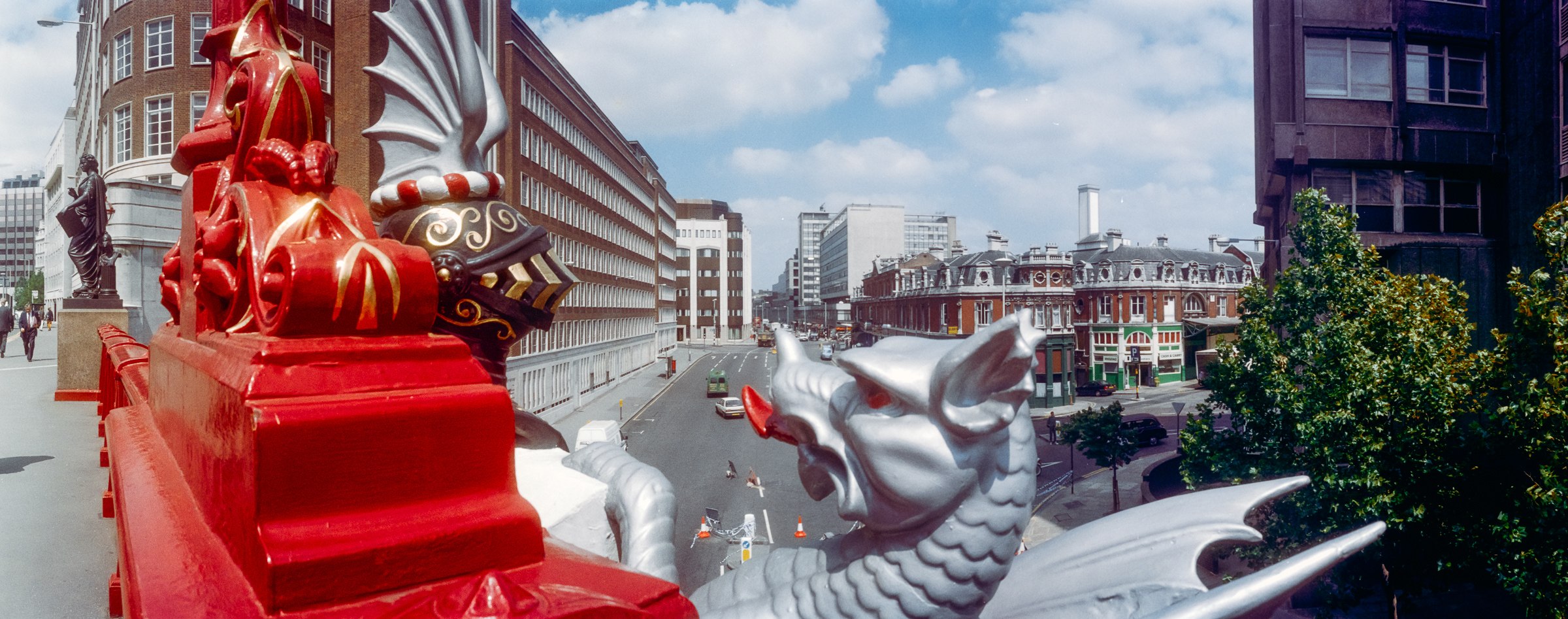
Holborn Viaduct was London’s first flyover, connecting the City with Holborn over the deep valley of the River Fleet, which had be culverted here in the 18th century, in part for the building of New Bridge Street. Built in 1863-69 it links Holborn Circus with Newgate Street and was a major redevelopment ‘”the most ambitious and costly improvement scheme of the [nineteenth] century” (White 47), and it involved some outstanding feats of Victorian engineering.

Over the years I’ve made quite a few panoramas on and of the viaduct and written about it at some length – here are a few from 1994. You can read a detailed account on the Victorian Web site.

Sculpture, Farringdon Rd, Holborn Viaduct, City, 1994, 94-702-52
Sculpture, Farringdon Rd, Holborn Viaduct, City, 1994, 94-703-11

More from July 1994 in the City later.


FlickrFacebookMy London DiaryHull PhotosLea ValleyParis
London’s Industrial HeritageLondon Photos

All photographs on this page are copyright © Peter Marshall.
Contact me to buy prints or licence to reproduce.


Vedanta AGM Protest – 2010

Vedanta AGM Protest: Westminster, Wednesday 28 July 2010

Vedanta AGM Protest

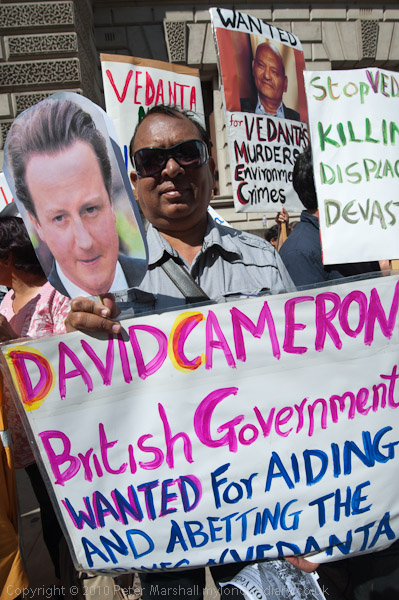
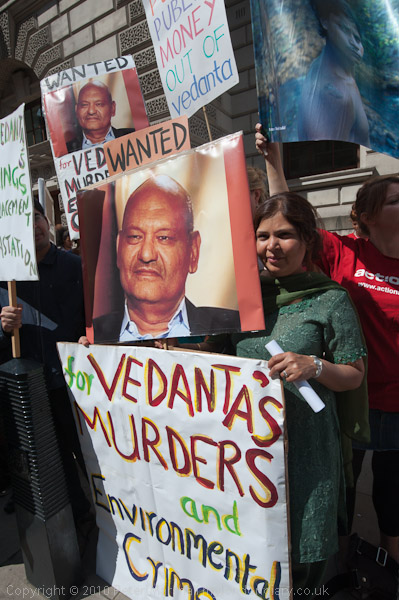
The protest outside Vedanta’s AGM held in Westminster on Wednesday 28th July 2010 was the first time I really became aware of the company and its mining activities. This protest concentrated on its plans to displace and wipe out an ancient civilisation in the Niyamgiri Hills of Orissa, India by bauxite mining.

Vedanta AGM Protest

The hills which would have been destroyed by their mining are sacred to the region’s Adivasis, primarily the Dongria Kondh tribes. By 2010 Foil Vedanta who organised the protest were saying that Vedanta had caused more than 100 deaths in the area though accidents, police shooting, forced displacement, injury and illness.

Vedanta AGM Protest

More than a thousand people have already been displaced, with 8000 under threat, moved away from their traditional sources of income and dumped into shanty towns where there is no work. Thousands of acres of fertile agricultural land have been destroyed, rivers and streams disrupted and drinking water contaminated by fly ash and toxic red mud.

Vedanta AGM Protest
Anil Agarwal is CEO of Vedanta

Vedanta Resouces is an Indian company founded and still run by the Agarwal family, but in 2003 was listed on the London Stock Exchange following a two year ban by the Securities Exchange Board of India from accessing capital markets after they were found guilty of cornering shares and rigging share prices.

Vedanta AGM Protest
Police push back security who assaulted activists who tried to enter the building

A damning report, Vedanta’s Billions: Regulatory failure, environment and human rights‘, issued by Foil Vedanta in 2018 accuses “the City of London and the Financial Conduct Authority” of minimising the risks associated with Vedanta’s legal violations and human rights and environmental abuses’ and failing to investigate or penalise any London listed mining company on these grounds.”

Among other crimes, the report names Vedanta as “the latest in a string of London listed mining companies linked to the murder or ‘massacre’ of protesters, including Lonmin, Glencore, Kazakhmys, ENRC, Essar, GCM Resources, Anglo Gold Ashanti, African Barrick Gold and Monterrico Metals.”

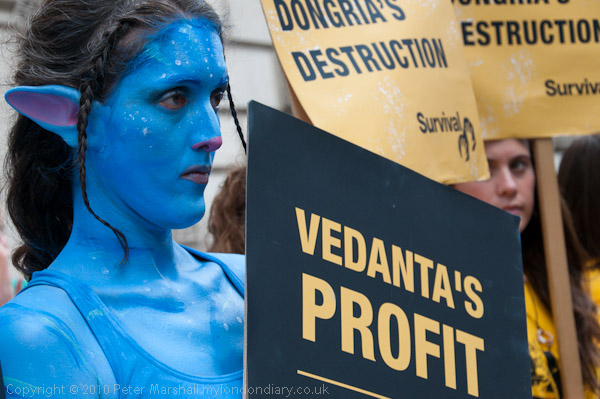
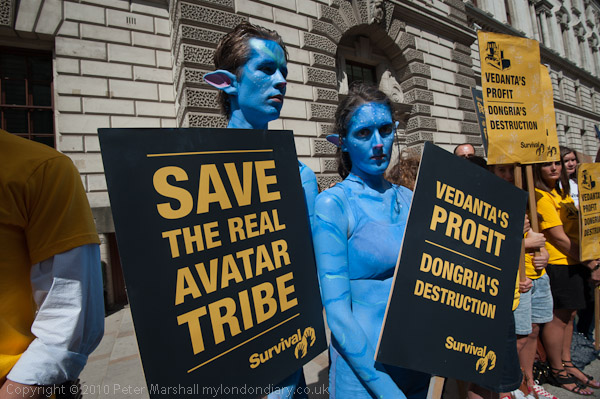
As well as Foil Vedanta the campaign against them was supported by Amnesty International, Survival International and Action Aid, and a number of campaigners had become shareholders so they could attend the meeting and attempt to question the company’s activities – and these included Bianca Jagger. Her presence and that of two bright blue aliens from the tribe destroyed in the James Cameron film ‘Avatar’ ensured that the protest for once got some press coverage. Also supporting the protest were the South Asia Solidarity Group, South Asian Alliance, Brent Refugee and Migrant Forum and London Development Education Centre.

The campaign against Vedanta had already been successful in getting various shareholders to end their investment, including the Church of England, the Joseph Rowntree Trust and the Dutch pensions company in ending their investments due to concerns about its approach to human rights and the environment. And continued protests by Foil Vedanta undoubtedly played a part in the company’s decision to de-list from the London Stock Exchange in 2018.

The company was helped to list in London by the British Government’s Department of Trade and Industry and the Department for International Development (DfID), and was getting continued support from the DfID Building Partnerships for Development programme and the Orissa ‘Drivers for Change’ research project, and former British Ambassador to Saudi Arabia and High Commissioner of India David Gore-Booth had been a directory.

Its billionaire CEO Anil Agarwal was said to have close links with the extremist umbrella group for Indian Hindu right-wing organistions, Sangh Parivar, said to be responsible for many attacks on Muslim and Christian communities in Orissa, Gujurat and other parts of India.

The Foil Vedanta report has a “special focus on illegal mining in Goa, pollution and tax evasion in Zambia, as well as illegal expansion and pollution in Thoothukudi, Tamil Nadu, industrial disaster at Korba in Chhattisgarh, land settlement and pollution issues in Punjab, displacement and harassment of activists in Lanjigarh, Odisha, and a mineral allocation scam in Rajasthan.

You can see and read more about the 2010 protest on My London Diary at Vedanta AGM Protest.


FlickrFacebookMy London DiaryHull PhotosLea ValleyParis
London’s Industrial HeritageLondon Photos

All photographs on this page are copyright © Peter Marshall.
Contact me to buy prints or licence to reproduce.

Legal Aid Funeral & Daddy’s Pig – 2013

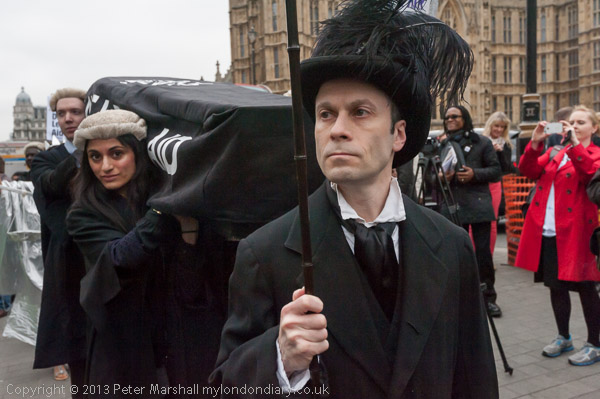
Legal Aid Funeral & Daddy’s Pig: On Wednesday 22nd May 2013 lawyers held a mock funeral and rally against government proposals for further changes to legal aid proposed by Justice Secretary Chris Grayling. Legal aid had already been greatly restricted by the Civil Legal Aid (Remuneration) Regulations 2013 which had come into effect earlier in the year. I rushed away at the end of the rally to join Artist taxi-driver Mark McGowan who was pushing his Daddy’s Pig from Downing Street three miles to the Bank of England.


Lawyers Funeral for Legal Aid – Old Palace Yard, Westminster

Legal Aid Funeral & Daddy's Pig - 2013
The coffin of Legal Aid

Justice Secretary Chris Grayling having made huge cuts in legal aid was now proposing to end the right of legal aid clients to chose their solicitor with the work going to the lowest bidder in ‘price competitive tendering’, PCT. This would be open to “to large non-legal companies, including Eddie Stobart and Tesco, and remove the ability of those in need of legal aid to chose appropriate specialists in the legal area involved.”

Legal Aid Funeral & Daddy's Pig - 2013

The short funeral procession to Parliament Square by the London Criminal Courts Solicitors’ Association was led by a marching jazz band, followed by robed and wigged figures carrying the coffin of Legal Aid and a woman dressed as the Scales of Justice.

Legal Aid Funeral & Daddy's Pig - 2013

As well as lawyers others joined the protest including Women from Winvisible, Women Against Rape, Defend The Right To Protest, Liberty and more. The proposed changes would particularly effect women involved in domestic violence and rape cases, and immigrants fighting for asylum.

Legal Aid Funeral & Daddy's Pig - 2013

There were many excellent speakers and on My London Diary I gave a partial list on My London Diary:

Labour MPs Sadiq Khan, Jeremy Corbyn and his fellow Islington MP Emily Thornberry, Natalie Bennett of the Green Party and senior figures involved with the law from both Tories and Lib-Dems. There were those who had been involved with legal aid over cases of injustice, including Gerry Conlan, one of the Guildford 4, a member of the family of Jean Charles De Menzes, Susan Matthews, mother of Alfie Meadows and Breda Power, the daughter of Billy Power, one of the Birmingham 6. Solicitors who spoke included Clive Stafford Smith, the founder of Repreive, and Blur drummer Dave Rowntree, and notable among the QCs, Helena Kennedy. There were many memorable quotes (almost all of which I’ve forgotten) with Gerry Conlan making clear “Back in the 1970s they sent innocent people to jail by the van load. But if these cuts go through they’ll be sending them in by the Eddie Stobart truckload“.

The rally ended with “a summary by leading barrister John Cooper QC after which the whole assembly delivered its verdict on Grayling, guilty as charged.”

The plans for PCT were dropped in September 2013 but didn’t go away entirely with new plans to introduce it in 2016, and it took a High Court ruling in 2018 to quash proposals to use PCT for Housing Possession Court Duty schemes.

Legal aid remains unfairly restricted and in only the very wealthy and those of the very poor who are able to access legal aid are almost “equal under the law”, with the great majority of us being able to afford it. And of course the wealthy are able to use much greater legal resources than legal aid will ever provide.

True equality under the law would only become possible if we made a huge systemic change to essentially nationalise our whole justice system, making it entirely a public service.

More on My London Dairy at Lawyers Funeral for Legal Aid.


Daddy’s Pig heads for the Trough – Downing St to Bank

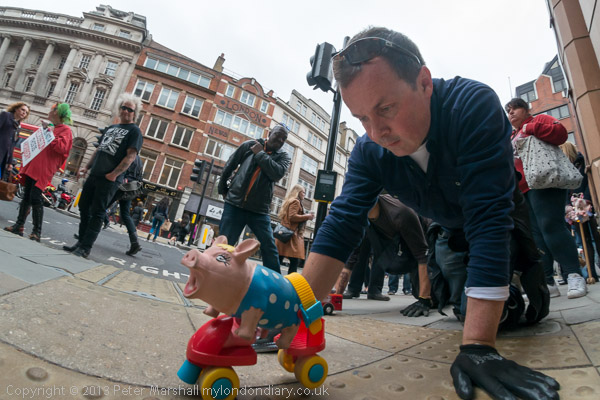
Artist taxi-driver Mark McGowan pushed his Daddy’s Pig, accompanied by another protester pushing a fire engine, the three miles from Downing St to the Bank of England, hoping to present it to the governor for services to austerity and the criminal activities of the City of London.

McGowan had a small group of supporters with him as he undertook the second stage of his gruelling journey on hands and knees, pushing the pig on its plastic roller skate.

A few days earlier, he had pushed the pig from from Kings College hospital in Camberwell where he is receiving cancer treatment to Downing street as a protest against the privatisation of the NHS which is being driven by the bankers and private equity firms.

I walked with him and his pig on part of the second half of his painful slow route, joining him at the Royal Courts of Justice and leaving him and his colleague with the fire engine as they rested briefly before reaching Ludgate Circus. Even with knee pads and gloves the going was tough and Mark was struggling to meet his appointment with a banker at 3pm.

Daddy’s Pig heads for the Trough


FlickrFacebookMy London DiaryHull PhotosLea ValleyParis
London’s Industrial HeritageLondon Photos

All photographs on this page are copyright © Peter Marshall.
Contact me to buy prints or licence to reproduce.

Circle The City – 2014

Circle The City: On Sunday 18th May 2014 I accompanied my wife who was taking part in a sponsored walk around churches in the City of London to raise money for Christian Aid, part of the activities in Christian Aid Week. The 2025 Christian Aid Week ended yesterday (17 May 2025) but it isn’t too late to donate towards their work with local partners and communities in countries around the world “to fight injustice, respond to humanitarian emergencies, campaign for change, and help people claim the services and rights they are entitled to.”

Circle The City - 2014
Hawksmoor’s St Mary Woolnuth

Christian Aid is one of the better aid charities, currently working through local grass roots organisations in some of most vulnerable communities in 29 countries in Africa, Asia, the Middle East, Europe and Latin America and the Caribbean. They don’t give money to governments and the projects they support are organised and managed by local people – with robust procedures to ensure the money is spent effectively. Some of those they support are Christian but many are not – something which has led to some churches failing to support their work.

Circle The City - 2014
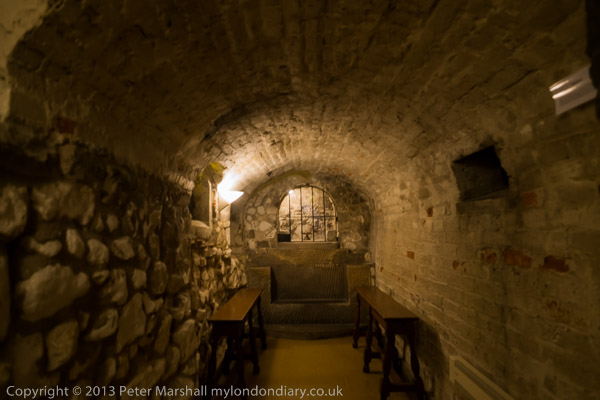
The crypt of All Hallows by the Tower
Circle The City - 2014
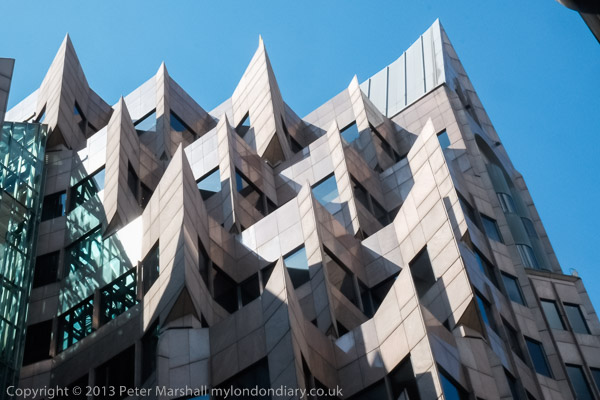
Minster Court, Mark Lane

Other churches have decided against supporting Christian Aid because of their political campaigning, “pressing for policies that can best help the poor…. All we care about is eradicating poverty and injustice and the causes of these.” Compared to some other large charities they are more efficient, with 84p in every pound donated “working for long-term change, responding to humanitarian emergencies and using our voice to call for global change“.

Circle The City - 2014
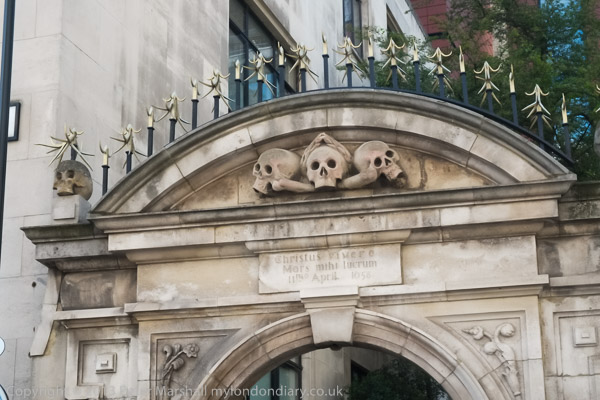
Gateway to “the churchyard of Saint Ghastly Grim”, St Olave Hart St.
St Olave Hart St
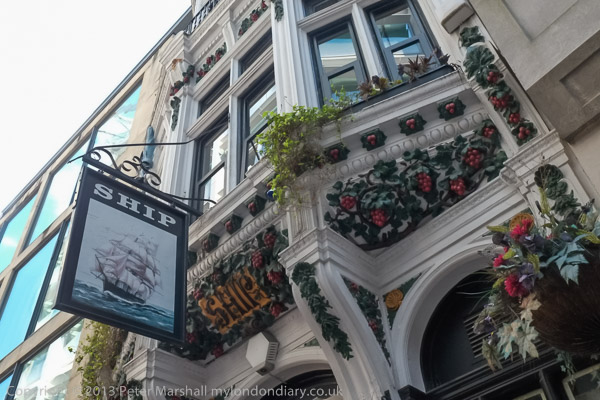
The Ship, Hart St

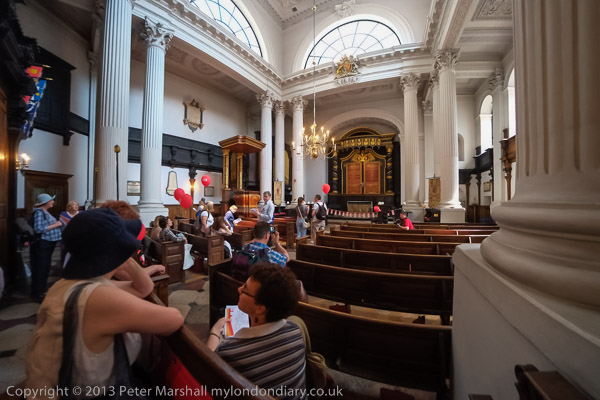
The event was extremely well organised, with those taking part getting maps and directions at St Mary-le-Bow on Cheapside where there was a service before the walk. People also collected red helium-filled balloons to carry on the walk, and some of these were tied to mark the route and the various points – mainly churches where marchers could get their sponsorship forms signed as they walked around which also had Christian Aid bunting.

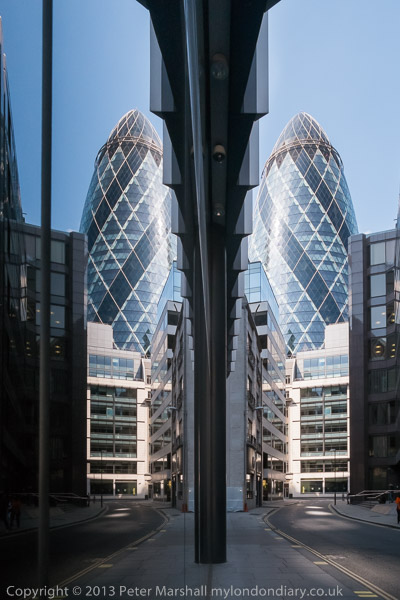
A double Gherkin
Bevis Marks Synagogue is the oldest synagogue in Great Britain, built in 1701

Most of the churches were open for people to walk around and some had refreshments and toilets. It would have been hard to get lost, but some people have zero sense of direction and find it difficult to hold a map the right way up and my presence was helpful. But I had really gone along to keep my wife company – and of course to take some pictures, some of which appeared in her church magazine.

A yurt at the rear of St Ethelburga-the-Virgin within Bishopsgate

I’d visited most of the City churches before and photographed inside them, but there are a few that are seldom open to the public but opened up for the occasion, and I also took other pictures as we walked around. Most of them, even those of other buildings include other marchers and some of the churches were crowded with them. Those red balloons didn’t always improve my pictures, but I also ate more cake than on my other city walks.

Saint Sepulchre-Without-Newgate

There are many more pictures in the post on My London Diary at Christian Aid Circle the City.


FlickrFacebookMy London DiaryHull PhotosLea ValleyParis
London’s Industrial HeritageLondon Photos

All photographs on this page are copyright © Peter Marshall.
Contact me to buy prints or licence to reproduce.

Smiley Culture & Orange Order – 2011

Smiley Culture & Orange Order: On Saturday 16th April I photographed two very different marches in London. The first was by several thousand people, mostly black, in protest over the death of reggae star Smiley Culture during a police drugs raid on his home and later I took pictures of the annual parade in Westminster by the City of London District Loyal Orange Lodge.


Who Killed Smiley Culture?

Smiley Culture & Orange Order - 2011

On 15th March 2011 police raided the South Croydon home of reggae star Smiley Culture at around 7am, apparently in relation to a drugs charge on which he was due to appear in court shortly. An hour and a half after their arrival, he is alleged to have been allowed to go into his kitchen alone to make a cup of tea, and to have killed himself with a single stab to the heart.

Smiley Culture & Orange Order - 2011

As many commented, it seemed a most unlikely story. Surely police would “not have allowed a man they had arrested to go alone into his own kitchen, where apart from the possibility of escape they would also know there would be dangerous weapons. And killing oneself with a single stab wound to the heart is not an easy task. His family and friends are sure there was no reason why he should have wanted to commit suicide.”

Smiley Culture & Orange Order - 2011

In April 2011 the case was being investigated by the Independent Police Complaints Commission and their report went to the coroner. At the inquest in 2013 the jury were unable to reach a unanimous verdict but the coroner accepted a majority verdict that the death had been suicide, while criticising the police for their lack of care and the IPCC for faults in their investigation.

Smiley Culture & Orange Order - 2011

Wikipedia reports that at the request of the coroner the IPCC report “was neither made public nor made available to Emmanuel’s family” and questions remain about the actual circumstances of his death and of the IPCC’s statement “that there was neither criminal conduct by officers, nor individual failings by officers that might amount to misconduct.

As I pointed out in my post, “Deaths in police custody are unfortunately not rare, and according to Inquest, in the twenty one years since 1990 there have been a total of 930, with 247 of these in the Met area.

I went on to say that few of these cases get “more than a short paragraph in the local press” unless as in this case they involve celebrities or take place in public with witnesses and often videos of the event; “most of them take place in the secrecy of the police station or other premises with police officers as the only witnesses.

Among those taking part in this march were families whose sons and brothers also died while in police custody, and in my post on My London Diary I mentioned some of these. The march took place on the “anniversary of the death of David Oluwale, killed in the first known incident of racist policing in 1969; his death remains the only case in British history that police officers have been found guilty of criminal offences leading to the death of a suspect, although they were found guilty only of assaults, the judge ordering the charge of manslaughter to be dropped.”

The death of Smiley Culture was one of several cases identified as a contributing factor to the riots later in the year after the police shooting of Mark Duggan by a study led by the LSE and The Guardian.

In February 2025 a blue plaque was unveiled outside Smiley Culture’s home from 1976-1980 on the Wandsworth Road, close to where this march began, celebrating his contributions to music and culture.

More about the march and rally and many more pictures on My London Diary at Who Killed Smiley Culture?.


Orange Parade in London

The City of London District Loyal Orange Lodge (L.O.L.) led their annual parade through London with lodges and bands from around the country taking part.

Founded in 1796 to uphold the Protestant religion, the Orange Order was was revived in the early twentieth century to oppose Home Rule for Ireland, and still plays a powerful role in Northern Ireland politics and government, embedded in Unionist politics.

Parades in Northern Ireland are still controversial and seen by many Catholics as deliberately provocative, while many Orangemen regard the Parades Commission, set up to regulate these events as discriminating against them. But here in London they have little political significance and are a colourful celebration of the Irish Protestant tradition.

From Millbank the parade marched around Parliament Sqaure and then on to the Cenotaph where wreaths were laid in memory of the fallen and former comrades by the City of London Lodge, two lodges from Glasgow and the Maine Flute Band from Ballymena.

I left them opposite Downing Street where some had gone in to deliver a letter to the Prime Minister before the parade moved on to its end at statue of the Duke of York in Waterloo Place.

More at Orange Parade in London.


FlickrFacebookMy London DiaryHull PhotosLea ValleyParis
London’s Industrial HeritageLondon Photos

All photographs on this page are copyright © Peter Marshall.
Contact me to buy prints or licence to reproduce.

Visteon, City & Fashion Victims – 2009

Visteon, City & Fashion Victims: On Saturday 4th April 2009 I went to protest in support of the Visteon factory occupation in Enfield, came back the the City but missed a protest over the police murder of newsvendor Ian Tomlinson and then photographed a fashion show protest on Oxford Street against the slave-like labour of workers in Bangladesh producing cheap clothes for Primark.


Solidarity at Visteon Enfield

Visteon, City & Fashion Victims - 2009

I wrote a few days ago about the Visteon pensions scandal where former Ford workers who were transferred to parts manufacturer Visteon, ‘An Enterprise of Ford Motor Company‘, in 2000 had lost up to half of their pensions when Visteon went into administration on 31st March 2009 when administrators KPMG immediately closed the company down.

Visteon, City & Fashion Victims - 2009
An Enterprise of Ford Motor Company, Limited

Together with workers at the Visteon Belfast site, the workers at Visteon Enfield had occupied their factories and were refusing to leave until Visteon and Ford made good on the firm promises made in 2000 they had that they would receive the same pensions and redundancy arrangements they had enjoyed previously.

Visteon, City & Fashion Victims - 2009
Workers on the roof demand the terms promised by Ford when the business was sold off

Workers in Belfast had occupied their factory immediately after a 5 minute meeting had told them they had lost their jobs and that they had an hour to take any personal possessions and leave work immediately – without pay. Enfield workers occupied their factory the following day.

Visteon, City & Fashion Victims - 2009

KPMG’s response was to go to the courts and secure a court order for repossession, while Ford simply denied all responsibility in the matter (though five years later were eventually forced by Unite to pay some compensation.)

I went to the factory at Ponders End, Enfield along with several hundred other trade unionists and others for a rally outside the plant to show our support for their case. A number of those who spoke at the rally had organised collections for the occupiers in their workplaces, reporting unanimous support for the dismissed workers, and others had also brought practical support – sleeping bags, food and money – to enable the occupation to continue.

More at Solidarity at Visteon Enfield


City Walk – Bank and Bishopsgate.

I was later than I had hoped by the time my train from Ponders End reached Liverpool Street and had missed the rally at Bank in memory of the news vendor Ian Tomlinson who died of a heart attack minutes after being attacked and violently pushed to the ground in an unprovoked attack by a riot policeman, dieing from a heart attack minutes after. The murder had been captured on video by an onlooker and The Guardian had published the video – still on their web site.

After the rally the protesters had marched away – and I could see and hear a police helicopter following them on the way towards Bethnal Green. I didn’t have time to try and catch up with them, but wandered through some of the streets in the City, including some that Tomlinson had wandered through as he tried to make his way home through the area where police were kettling and attacking the April 1st Financial Fools Day G20Meltdown protesters. On 4th April those streets were empty.

More pictures at City Walk.


Primark – Fashion on the Cheap from Sweatshops

War on Want and No Sweat were drawing attention to Primark profiting from selling clothes made by sweated labour in Bangladesh with a ‘fashion show’ outside the company’s flagship Oxford Street store.

Models used the pavement as a catwalk, walking in chains “to symbolise the slave labour conditions of the Bangladeshi workers who make the cut-price fashions on sale at Primark. Workers who make the clothes earn as little as 7p an hour and work up to 80 hours a week.”

The Primark store opened here in 2007 and flourished as the recession made people turn to cheaper suppliers with their profits in the year to September 2008 up by up by 17% at £233 million.

Notices in the store windows claimed they “care about the conditions of the workers who make their clothes, but the reports by War on Want tells a very different story. These clothes are only cheap because those who make them get poverty pay, work long hours and get sacked if they try to organise or ask for improvements in their dangerous and unhealthy working conditions.”

Although the links on the My London Diary post are now out of date, War on Want are still campaigning for garment workers around the world including in Bangladesh, as are No Sweat.

In 2009 I commented:

Primark and others could still have a moral and reasonably profitable business if they restrained their greed and ensured that the workers who make their clothes worked in reasonable conditions and got a living wage – which in Bangladesh is only around £45 a month. But that is over three times what workers making clothes for Primark are currently paid.

Primark’s profits continue to rise, and although it claims it has “improved working conditions and implemented ethical initiatives, reports and investigations suggest that worker exploitation in its supply chain, including issues like low wages and unsafe working conditions, unfortunately still persists” according to Google’s Generative AI.

More at Primark – Fashion from Sweatshops.


FlickrFacebookMy London DiaryHull PhotosLea ValleyParis
London’s Industrial HeritageLondon Photos

All photographs on this page are copyright © Peter Marshall.
Contact me to buy prints or licence to reproduce.

Pancakes in the City – 2012

Pancakes in the City: Tuesday 21st February 2012 was Shrove Tuesday – Pancake Day – and there were a number of pancake races taking place around London. I photographed two of these with very different ethos.

Pancakes in the City

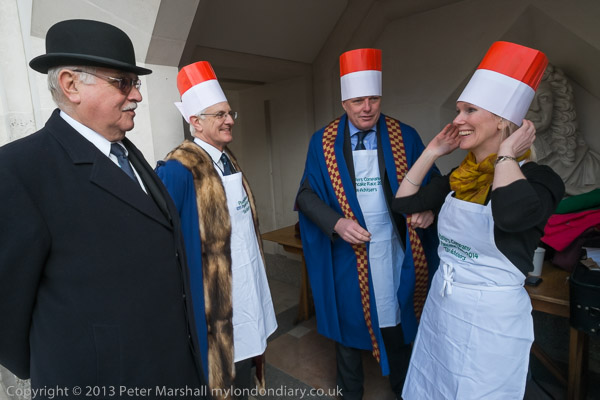
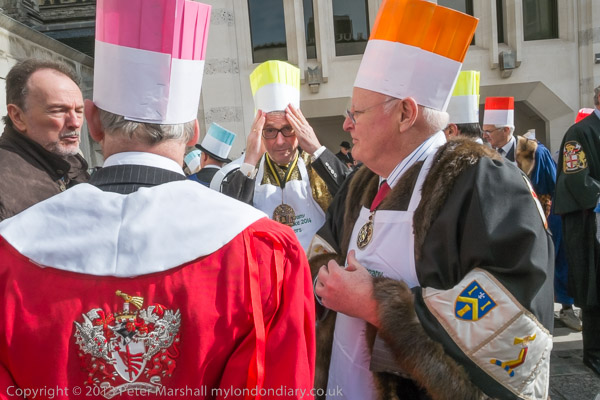
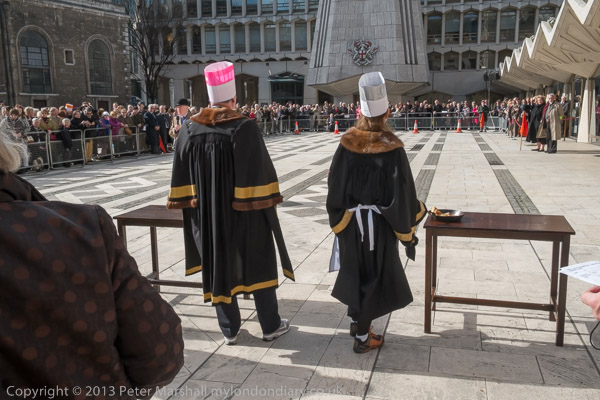
At the heart of the City in Guildhall Yard the various City of London Livery companies showed the City at its most competitive in what has now became a tradition of inter-livery pancake races on Shrove Tuesday, organised by the Worshipful Company of Poulters since 2004.

Pancakes in the City

Here there were carefully drawn up rules and practices.

“The Gunmakers start each heat using a miniature cannon (which can make a very loud bang), the Clockmakers hold stopwatches to time the races , the Fruiterers provide lemons, the Cutlers plastic forks, the Glovers white gloves required to be worn by each runner, while the Poulters provide the eggs essential to make the pancakes.”

Pancakes in the City

This is a highly organised event raising funds for the annual Lord Mayor’s charity – in 2012 the Barts and The London Charity, on behalf of the Trauma Unit at The Royal London Hospital.

Pancakes in the City

This was the first year in which women taking part in the Ladies events were allowed to wear trousers – previously they had been required to have skirts reaching below the knee. And there are many other rules including the wearing of special hats for the occasion.

Pancakes in the City

This is the City having fun in their own rather circumscribed and very serious way.

I photographed this event for a number of years, but haven’t done so for a while, partly because it became difficult to work at it without prior accreditation which I couldn’t be bothered with, but mainly because I thought I had got everything I could out of it and I was just repeating myself.

I left before the final races to photograph a very different event taking place in Leadenhall Market, along a much more restricted course and between ad-hoc teams from various businesses in and around the market.

There were far fewer rules, just those needed to outline the races, with teams carrying and tossing the pancakes in this relay event. The narrow space available limited the heats to two teams at a time.

The shoe polishers kept working between races

There were prizes provided by The Lamb Tavern in the market, who also fielded a team along with outers including the cheese shop and the shoe shiners who fought it out in the final.

Or at least they did when after an initial run when the cheese shop team simply walked the course as they preferred the second prize – a bottle of champagne and a £50 bar tab at the Lamb – to the first of a restaurant voucher.

“Some haggling followed and a re-run was demanded – and after the Lamb had agreed both teams would get the bar money there was a close-fought battle for the honour of winning, won narrowly for the second year in the short history of the race by the team from the shoe stall.”

Pancakes in the City – Leadenhall Market
Pancakes in the City – Guildhall


FlickrFacebookMy London DiaryHull PhotosLea ValleyParis
London’s Industrial HeritageLondon Photos

All photographs on this page are copyright © Peter Marshall.
Contact me to buy prints or licence to reproduce.