City Panoramas – Highwalks & the River – 1993

City Panoramas – Highwalks & the River – and an eagle in the City. More panoramas I made in March 1993 on a project on the City for a joint exhibition later in the year. All were taken using a swing lens camera which gave a horizontal angle of view of over 130 degrees – just over a third of the whole circle of vision from the camera position. I ended up with far more good pictures than the dozen or so that went into the show. Perhaps enough for a book one day.

Careful levelling of the camera was needed to keep all vertical lines in the picture straight and upright, but the cylindrical perspective meant that horizontals curved increasingly away from the centre of the image. Careful choice of viewpoint was needed to prevent this effect being too dominant in the images.

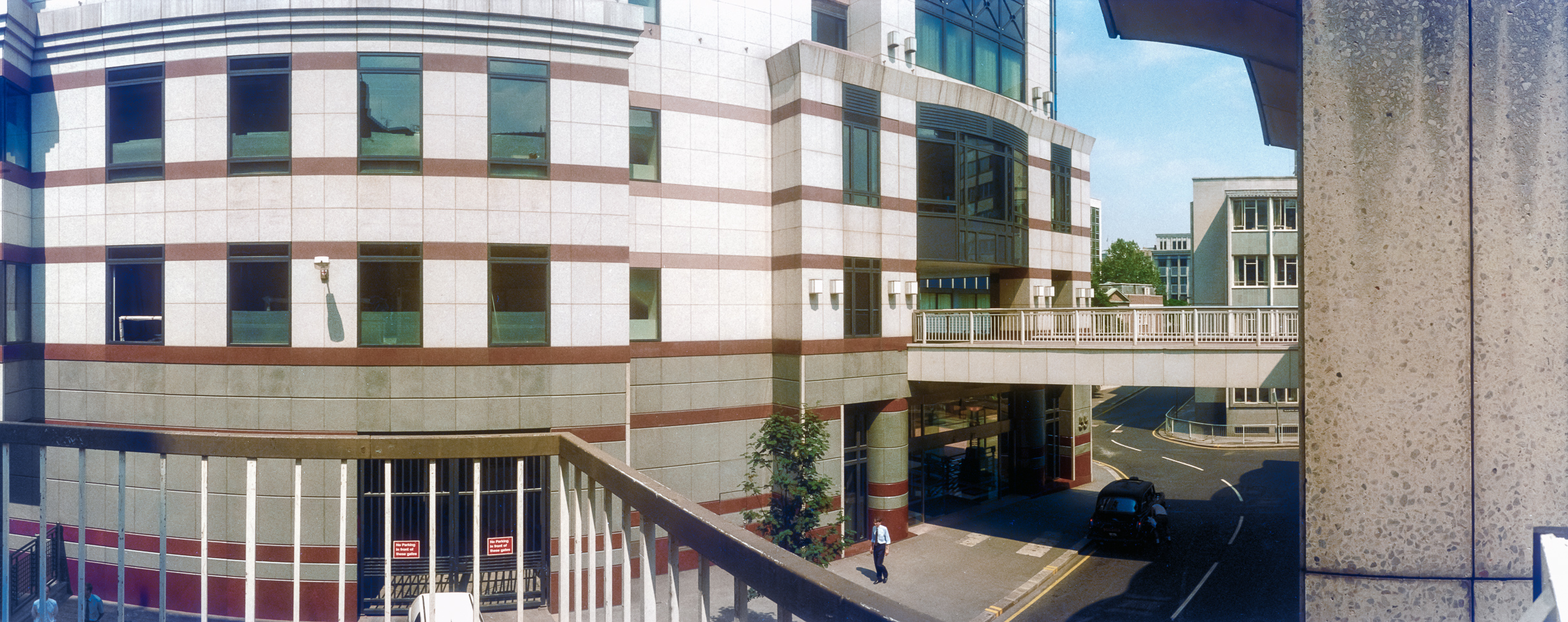
Bassishaw Highwalk, Basinghall St, City, 1993, 93c03-07-31

Perhaps the most successful image of the series, this picture taken on one of the City highwalks was used by the Museum of London on one of its annual reports. Strong verticals across the image help and I think the image curvature actually helps, particularly in the lower right of the image, emphasising the sweep of the roadway.

The lighting from behind me creates shadows near both edges leading the eye towards the centre of the image and is even across the frame and the prominent rail leads the viewer into the image.

As always with colour film the colours are not entirely accurate but the Fuji film used produces a pleasing effect with just a little more warmth than the eye – or a digital camera.

London Wall, City, 1993, 93c03-07-13

One of very few interiors in this project, taken through the window of this café on the highwalk with the camera handheld to the glass and not quite level. The window counter at the lower edge of the image was in reality straight and its curvature comes from the camera perspective – and serves to hold the image in to the the centre.

There was a large difference in the amount of light at the windows and away from them inside the café , and a considerable amount of dodging and burning was needed in making a print, rather easier in this digital rendition from the negative. Fuji film does a better job than most avoiding odd colour hue differences in the shadow and sunlight areas of the scene giving here just a natural-looking slight warming.

In the background through the door and windows you can see part of the Barbican Estate.

Bassishaw Highwalk, City, City, 1993, 93c03-07-32
Bassishaw Highwalk, City, 1993, 93c03-07-32

Another picture from my favourite highwalk, with yellow daffodils and a blue tower, as well as the strange triangles which give natural lighting to the room (unfortunately not the beach) underneath the pavement.

Basinghall Avenue, City, 1993, 93c03-07-61

The building at left is Girdlers’ Hall. The first Girdlers’ Hall was built here in 1431, but burnt down in the Great Fire in 1666. A new hall was built and this was in turn destroyed by bombing in December 1940. It took some time for a new hall to be built and it was only completed in 1961. It remains on site, though was extended with an extra floor on top in 2008.

The steps here lead up from Coleman Street Garden and the building at right is Austral House, built in 1959-61 by Gunton and Gunton and was the first new building on what became London Wall. It was built as the headquarters for the National Mutual Life Association of Australasia.

Austral House was demolished in 2005 and the new building, One Coleman Street completed in 2007 as the London HQ for Legal and General.

93c03-08-11-Edit
Highwalk, Grants Quay Walk, River Thames, City, 1993, 93c03-08-11

At the south of the City there were more highwalks, sections of which survive. Stairs lead down to the riverside walkway here, with London Bridge going across most of the image to Adelaide House at the right edge. There is still a public terrace here at Magnus House with river views.

Here I was looking directly into the sun, but had hidden it behind the central structure, though there is still some flare at the top of the image. Still the contrasts here were a little too much for film, and the polished granite gives some rather odd reflections making it seem like an actual building.

River Thames, City, 1993, 93c03-08-32

Looking downriver from the public terrace towards Tower Bridge and HMS Belfast with Billingsgate on the left just beyond the blue glass of the Northern & Shell Building. There is something very strange about the colour of this image, which I think was rather underexposed.

Lower Thames Street, City, 1993, 93c03-08-33

Some more slightly strange colour in this image again taken from the highwalk bridge over Lower Thames Street, with the King William Street approach to London Bridge a couple of hundred yards away. At left it the church of St Magnus the Martyr, dedicated to the Earl of Orkney, killed on 16 April 1118. The church narrowly escaped destruction by fire in 1633, but was one of the first to go in the Great Fire in 1666.

Rebuilding began in 1668 with Sir Christopher Wren in charge; one of his most expensive churches it was completed in 1687 having cost £9,579 19s 10d.

Cleary Garden, Queen Victoria St, City, 1993, 93c03-09-33

One of few panoramas I made with the camera deliberately tilted I think probably to include more of the flowers in lower left corner and the bottom of the central tree.

After the site was cleared of houses and offices and became one of the City’s many bomb sites in the Blitz, city worker Joseph Brandis decided to turn this hillside into a garden, bringing plants from his own garden in Walthamstow and planting them in mud from the River Thames.

It became a popular spot for those working in the area to sit and eat their sandwiches (as I did back in 1993) and was adopted by the City. In the 1980s it was re-landscaped and named Cleary Garden after Fred Cleary who as Chairman of the Metropolitan Public Gardens Association had done much to encourage tree planting and gardens in the City.

Still & Star, Pub, Little Somerset St, City, 1993, 93c03-10-31

Little Somerset Street is close to the east edge of the City in Aldgate. The pub here opened in 1820 though the building was I think older, beginning life as a private house in a small back street full of butchers – located here to avoid paying the fee to drive animals through the city.

Little Somerset Street was then officially Harrow Alley, but locals knew it as ‘Blood Alley’ as it ran with the blood of the slaughtered cattle and sheep. The street got its current name in 1925.

It is thought that the ‘Star’ in its name was for a brewery, probably the Star Brewery in Romford, 14 miles down the road, founded in 1708 which later became a part of Ind Coope, only closing in 1983, and the ‘Still’ was because it had a still on its upper floor distilling spirits.

It seems to have been the only pub of this name in the country. I went there again in late 2017 but found the pub shuttered and locked and in 2024 permission was granted for its demolition.

Swan Lane Pier, London Bridge, River Thames, City, 1993, 93c03-10-61

A rather frail-looking gangway leads down to Regalia, a three-deck floating pub, bar, and restaurant built in 1980 and permanently moored at Swan Pier. It closed around 2011 and the gangway went with it.

Regalia went downriver and is now rotting on the Swale at Queenborough, though offered for sale as a “redevelopment opportunity”, yours for around £50,000. There are a couple more pictures at Swan Pier in the album on Flickr.

Eagle Star, Bevis Marks, City, 1993, 93c04-02-11

Another image where I deliberately tilted the frame, though this time with the camera on my tripod. Here I wanted to fill the frame with the buildings rather than empty roadway. I think the tilt also adds to the impression of the eagle at left being about to swoop down.

The camera viewfinder only gave a rough impression of exactly what would appear in the frame, and I think I probably hope to get the complete word ‘EAGLE’ of Eagle Star in at the bottom left corner. My camera position was carefully chosen to get the reflection of the eagle in the building on the opposite corner – just visible at the top of the ladder.

There are a few more panoramas in the City I made in March 1993 and another batch I made later in April which I’ll return to later, but my next post in this series will look at some of the other images I made in March, some also in the City.


Flickr – Facebook – My London Diary – Hull Photos – Lea Valley – Paris
London’s Industrial Heritage – London Photos

All photographs on this page are copyright © Peter Marshall.
Contact me to buy prints or licence to reproduce.
CETA, Iraq, Highwalks & HP – 2014

CETA, Iraq, Highwalks & HP: On Friday 26th September 2014 I photographed a protest against the finalising of CETA, a trade agreement between Canada and the EU negotiated in secret which would allow large companies to challenge democratic decisions taken by governments. After this I went to College Green, until recently listed as a public park but now often closed by police to stop protesters appearing in TV interviews there of politicians, where people were attempting to protest against the bombing of Iraq.

From Westminster I went into the City of London and had time for a walk taking panoramic pictures mainly of the highwalks which are under threat of demolition to allow a higher density of commercial development before photographing a picket at Hewlett-Packard’s offices against their major role in IT support of the Israeli war machine.


CETA Trade Deal Threat to Democracy

Dept Business, Innovation & Skills

CETA, Iraq, Highwalks & HP - 2014
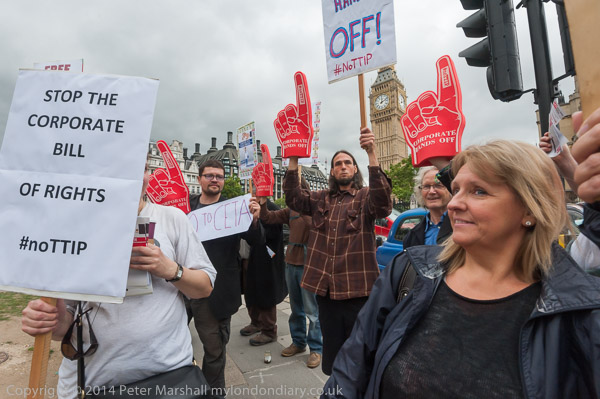
Protesters pose in front of Big Ben on their way from the BIS to Europe House

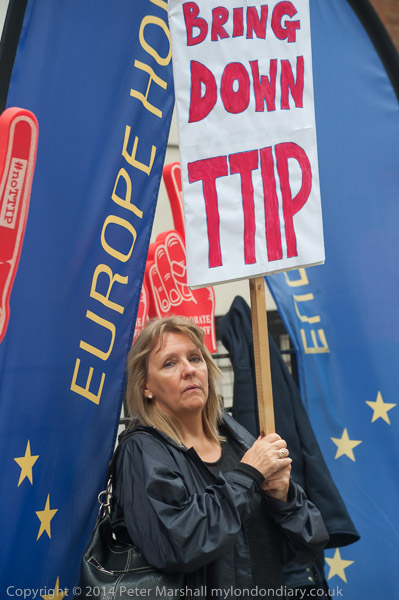
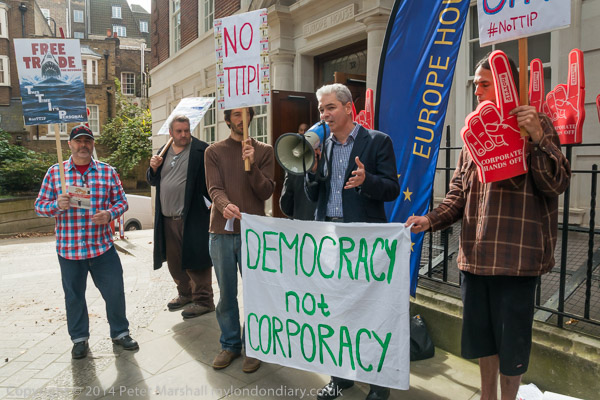
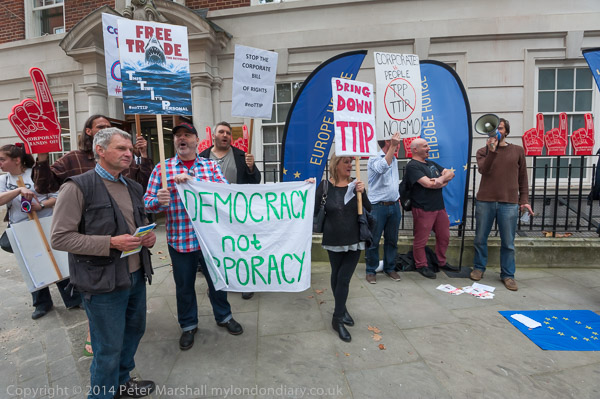
War on Want, the World Development Movement, Occupy London and others came to protest when it became known that the EU and Canada were today to initial the CETA Treaty which would hand over unchallengeable powers to big business to override governments and democracy, and put company profits above all other interests. This was a small emergency protest called at very short notice in advance of a #noTTIP day of action to take place in London on 11th October 2014.

CETA, Iraq, Highwalks & HP - 2014
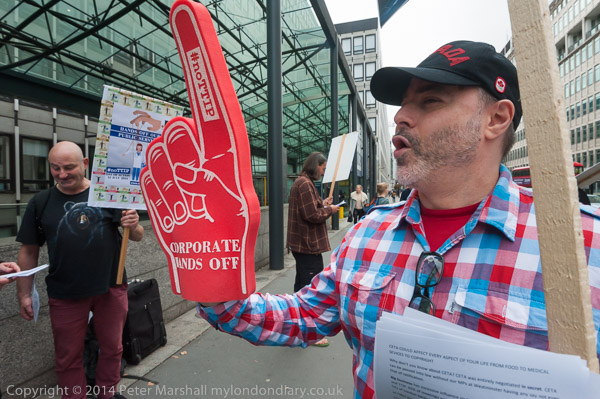
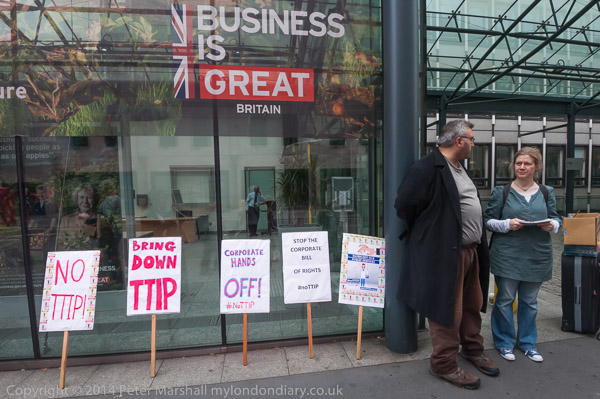
Outside the Dept of Business, Industry and Skills (BIS)

Negotiations over the treaty, the Canada and European Union (EU) Comprehensive Economic and Trade Agreement) and its wider equivalent TTIP (Transatlantic Trade and Investment Partnership) had been carried out in strict secrecy, with the documents on them to be locked away for thirty years.

CETA, Iraq, Highwalks & HP - 2014
Protesters came at short notice to the BIS when they heard the CETA deal was being initialled in secret

The treaties include the process known as ISDS (Investor-State Dispute Settlement) which greatly affects the ability of governments to make legislation, with legal action bypassing UK and other national courts to be decided by international arbitration tribunals where the loss of potential profits come above any consideration of public interest.

CETA, Iraq, Highwalks & HP - 2014

In 2014 there were already around 500 documented cases of big companies attempting to use ISDS powers to challenge democratic decisions around the world, including A Swedish company suing Germany for phasing out nuclear power and a French company suing Egypt because they have increased the minimum wage and introduced other measures to improve the conditions of workers. The UK had dropped proposals for plain packaging for cigarettes as the companies had threatened they would sue as it would cut cigarette sales and so their profits.

CETA, Iraq, Highwalks & HP - 2014
Outside Europe House

ISDS allows big business to challenge food safety regulation, green legislation and other vital measures, and curb protests against fracking and dirty energy, GMO, the arms trade and any other profitable corporate activities. It would also stop efforts to prevent the privatisation of the NHS.

The protest began outside the Dept of Business, Industry and Skills and went on to the London base of the European Parliament, stopping briefly outside the Houses of Parliament and handing out leaflets against the corporate power grab.

CETA, Iraq, Highwalks & HP - 2014

CETA was provisionally introduced in 2017 and has eliminated almost all existing tariffs and increased transatlantic trade but has not been ratified by ten EU states. The French Senate voted against it in 2024. Talks are now taking place on a replacement. Since Brexit is no longer applies in the UK and a new trade agreement with Canada came into force on 1 April 2021. ISDS continues under various other trade agreements.

CETA Trade Deal Threat to Democracy


Don’t bomb Iraq

Westminster

CETA, Iraq, Highwalks & HP - 2014
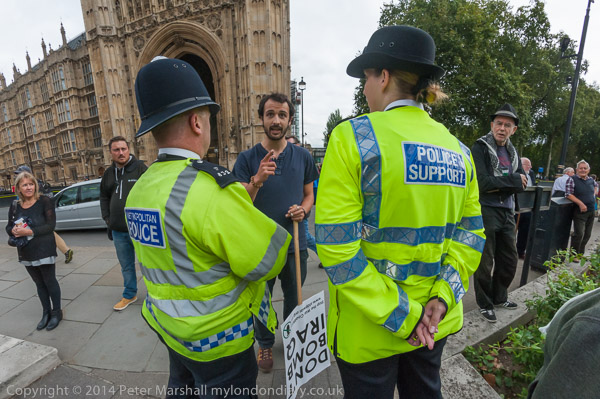
Police stop a protester from joining others on College Green

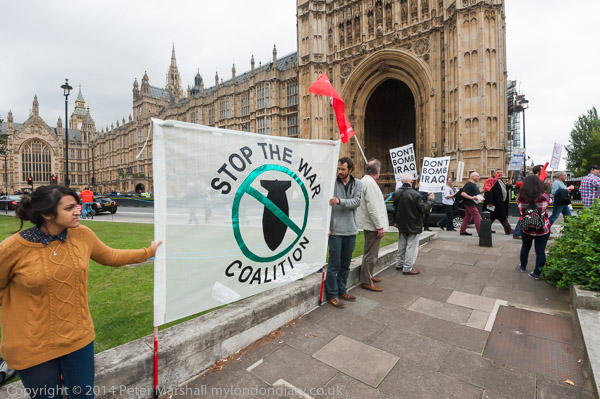
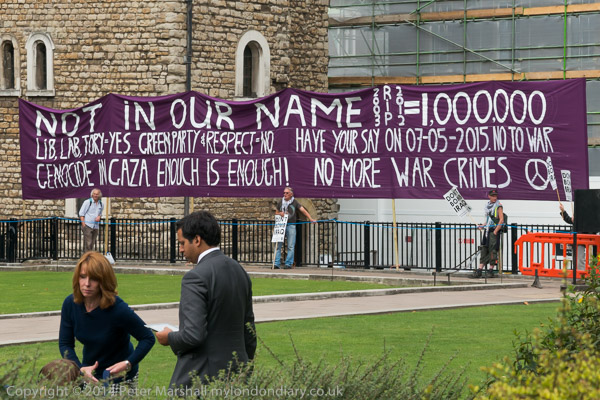
TV news often interview politicians on College Green, long always open to the public and housing a well-known Henry Moore statue, an small groups of protesters have often gone their to be seen and heard in the background of these interviews. And a few had come today when Parliament was debating the bombing of ISIS in Iraq

Protesters on College Green
A large banner along the edge of College Green

Until recently it had been listed as a public park by Westminster Council but in 2014 new notices were put up stating it was a part of the Parliamentary estate, and they reserve the right to close the area to the public at any time. The area is now often completely closed to the public and police stop protesters entering it while TV crews are working there.

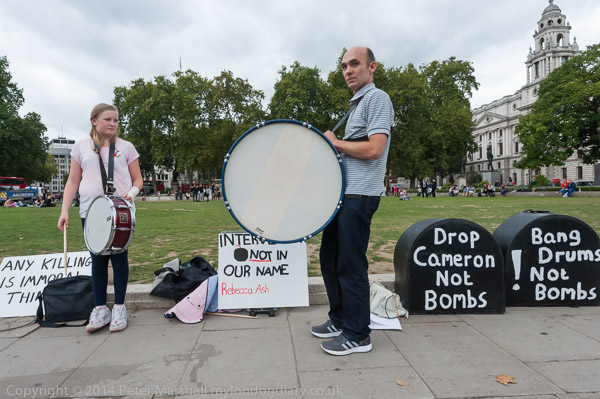
There was also a small group against the bombing protesting on the pavement in Parliament Square.

Don’t bomb Iraq


City Walk, High Walk

City of London

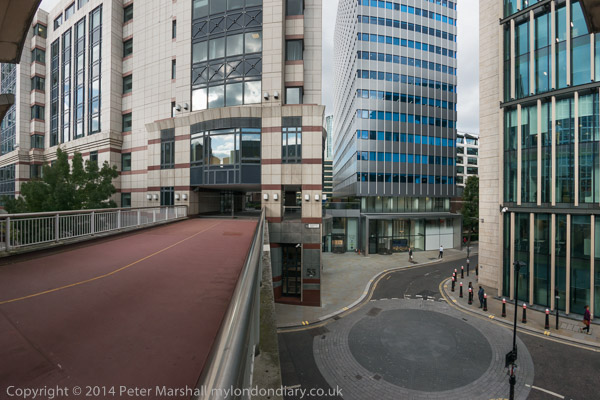
Basinghall St and the fenced off Bassetlaw Highwalk

Planners for the rebuilding of the City of London after the devastation of the Second World War had created an ambitious plan for the separation of pedestrians and traffic in much of the city with a series of ‘highwalks’.

But it was only ever implemented in limited areas of the City in particular around London Wall and the Barbican and where a new road, Upper and Lower Thames Street cut through the old City close to the River Thames. Despite the extensive bomb damage, much of the old London remained firmly at Street level.

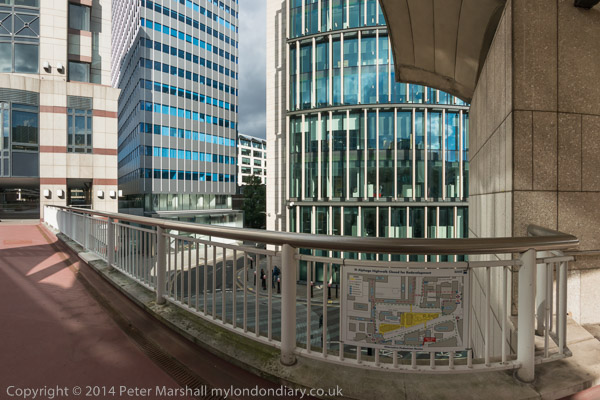
Basinghall St and Bassetlaw Highwalk

Back in the 1980s and 1990s I had photographed extensively from these highwalks and in the 90s made a number of panoramic images which were exhibited and published.

In 2014 much of the highwalks south of London Wall and a large area directly to the north were being demolished to allow a higher density of commercial development in the area and I took a short walk to photograph some of what remained. In the 1990s I had worked with specialised swing-lens panoramic film cameras, but now I was able to work much more easily with a digital camera and software.

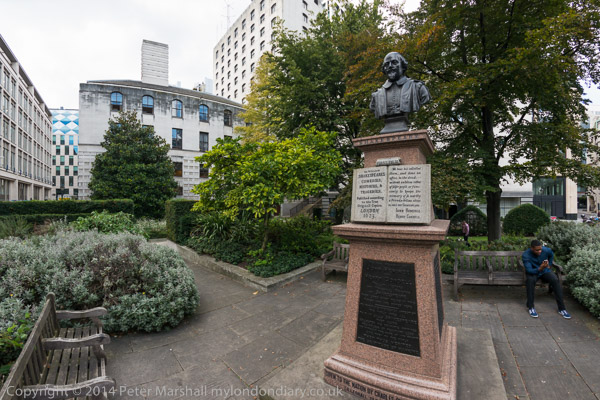
Shakespeare bust in St Mary Aldermanbury Garden, Love Lane

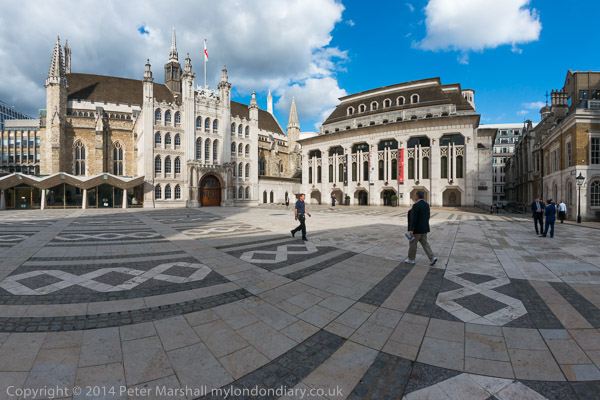
As well as on the highwalks I also made images at street level, particularly in the area around the Guildhall. The digital panoramas have a much wider vertical angle of view than my earlier film images and are here shown in full in a normal 3:2 aspect ratio, though usually I have cropped them top and bottom to a more panoramic format such as 16:9.

Guildhall Yard

More at City Wall, High Walk.


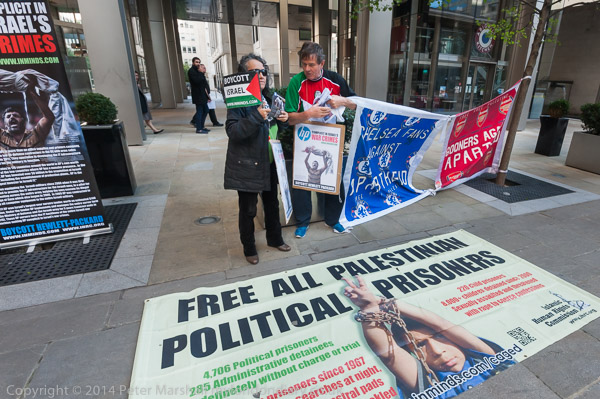
Hewlett Packard Stop Supporting Israeli Military

Wood St, City

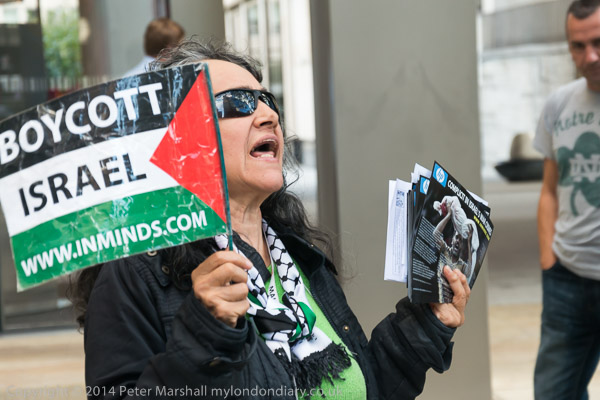
Protesters with banners opposite HP’s offices on Wood St

I had previously photographed protests by the Inminds human rights group Palestinian Prisoners Campaign outside the offices of security firm G4S, where 2 years of pickets perhaps played a part in their decision to pull out of Israeli prisons.

They had decided now to picket at Hewlett-Packard which boasts of ‘a massive presence’ in Israel and are the IT backbone for the Israeli war machine.

More pictures: HP told Stop Supporting Israeli Military.


Flickr – Facebook – My London Diary – Hull Photos – Lea Valley – Paris
London’s Industrial Heritage – London Photos

All photographs on this page are copyright © Peter Marshall.
Contact me to buy prints or licence to reproduce.

St Pauls and around Guildhall – 1994

St Pauls and around Guildhall: More panoramas from my days wandering the City of London in July 1994. Most of these pictures are in my Flickr album 1994 London Colour.

Cathedral Steps, St Paul's Churchyard, City, 1994, 94-706-12
Cathedral Steps, St Paul’s Churchyard, City, 1994, 94-706-12

I took relatively few pictures of St Paul’s Cathedral, and here it is only visible in deep shadow at right. In the centre are the rather bland blocks of Juxon House, built in 1963 rather a long time after much of the area was destroyed by German bombs and subject to a long campaign (with Royal support) for demolition along with others when Paternoster Square was redeveloped.

Unfortunately its replacement – and Juxon House was worse. Icannot better the description by Jonathan Glancey in The Guardian when the new block was completed in 2003 who called it “A mockery of the language of classical architecture, this Paternoster office block is kitsch writ gross, a kind of two fingers up to Wren and Hawksmoor, who worked so hard to create the peerless dome and west towers of St Paul’s.” In his article he also gives some of the reasons that led to this new carbuncle.

Aldermanbury, City, 1994, 94-707-42

The area around the Guildhall was fascinating in many ways in the 1990s, in part for its contrasting architectural styles which you can see here. At left is One Love Lane, a 1989 building refurbished in 2015-6. In the centre is the back of One Aldermanbury Square, built for Standard Chartered Bank in 1990, but significantly remodelled after they left in 2013. The Insurance Hall, 20 Aldermanbury, has the inscription by its door ‘THIS BUILDING WAS OPENED BY HIS MAJESTY KING GEORGE V ACCOMPANIED BY HER MAJESTY QUEEN MANY ON THE TWENTY EIGHT DAY OF JUNE MCMXXXIV THE TWENTY FIFTH YEAR OF HIS MAJESTY’S REIGN’. It was home to the Chartered Insurance Institute until 2018.

Guildhall Piazza, City, 1994, 94-707-32

Looking towards the The North Wing (formerly known as the North Block) of the Guildhall, constructed in 1955-58 to a 1930s design by Sir Giles Gilbert Scott. At right is the back of the Insurance Hall. At left the 1972 sculpture ‘Beyond Tomorrow‘ by Karin Jonzen (1914-1998); her parents were Swedish but she was born in London and studied at the Slade.

The piazza was a pleasant place to sit on sunny days and I sometimes ate my sandwiches there. The back of the North Wing and that end of the piazza were modified around 2006 to improve access and create more office space.

Beyond Tomorrow, Karin Jonzen, Guildhall Piazza, City, 1994, 94-707-31

A closer view of Karin Jonzen’s sculpture and beyond it one of my favourite modern London buildings, the Grade II listed former exhibition hall, magistrates court and offices at 65 and 65a Basinghall Street designed by Richard Gilbert Scott (1923-2017) of Sir Giles Gilbert Scott, Son and Partner and built in 1966-69. He was the “fourth generation of Britain’s best-known architectural dynasty” according to the listing text, which for once is very informative about the architect and the building.

As the listing says, his “stylish use of pre-cast concrete shell vaulting at the Guildhall was a response to the existing Gothic architecture of the site” – where he had been involved with his father Sir Giles in rebuilding the bomb-damaged Gothic Guildhall.

Bassishaw Highwalk, Basinghall St, City, 1994, 94-707-11

Just to the north, seen from the Highwalk just as it emerges from under Richard Gilbert Scott’s building is one of my favourite views in the City, again showing different architectural styles.

At left is 55 Basinghall St, City Place House, a substantial post-modern building from 1988-1992 by Swanke Hayden Connell. Work began on its demolition in 2021 for the building of a 13-storey office block by Allies & Morrison, which also involved the “partial demolition, reconfiguration and refurbishment of the basement, lower ground, ground and mezzanine floors of 40 Basinghall Street” – City Tower in my picture.

Basinghall St, Bassishaw Highwalk, City, 1994, 94-707-22

A second view from another section of Highwalk shows the same corner looking along Basinghall Street.

More from this part of the City in a later post.


Flickr – Facebook – My London Diary – Hull Photos – Lea Valley – Paris
London’s Industrial Heritage – London Photos

All photographs on this page are copyright © Peter Marshall.
Contact me to buy prints or licence to reproduce.