Solidarity With Fergusson & Talha Ahsan -2017

Solidarity With Fergusson & Talha Ahsan. Sunday 17th August 2014 I photographed a protest outside the US Embassy, then still in Grosvenor Square, in solidarity with the people of Ferguson, Missouri where there had been huge community protests after police shot unarmed black teenager Michael Brown. Later a party outside the UK Home Office celebrated the release of poet and translator Talha Ahsan from a US prison while condemning UK Prime Minister Theresa May for having allowed his extradition despite his diagnosis of Asperger syndrome.


Solidarity with Ferguson

US Embassy, Grosvenor Square

Solidarity With Fergusson & Talha Ahsan

After an altercation on the street in Ferguson, Missouri, on August 9, 2014,police officer Darren Wilson chased and shot Michael Brown, killing him. Some witnesses claimed that Brown had turned to face the officer with his hands up, shouting “Don’t shoot” . Six bullets hit the front of his body, including one to his head which was immediately fatal. Wilson claimed that Brown had charged at him but witnesses dispute this.

Solidarity With Fergusson & Talha Ahsan
Hands Up, Don’t Shoot

The slogan “Hands Up, Don’t Shoot!” became widely used in the protests over the killing. There were immediate widespread protests in Ferguson, mostly peaceful but some which led to violence and looting; it was an area were there were “longstanding racial tensions between the minority-black population and the majority-white city government and police.

NUS Black students banner lists just a few of the Black people who have been murdered by the police
Solidarity With Fergusson & Talha Ahsan
People hold up posters ‘London to #ferguson’ in front of the US embassy badge

There were widespread protests in cities across America and around the world – including this one in London. The anger at the killing was amplified by a media campaign which portrayed Brown as a ‘thug’ and labelled the community protests as riots.

Solidarity With Fergusson & Talha Ahsan

Later there were more protests after a grand jury decided not to indict Wilson, following an extended examination of a vast body of evidence,. Many felt the unusual way it had been conducted had influenced the jury’s decision.

Solidarity With Fergusson & Talha Ahsan

The shooting and its aftermath attracted so much attention that Amnesty International for the first time ever sent a team to investigate Ferguson, finding significant human rights abuses. Their report “cited the use of lethal force in Brown’s death, racial discrimination and excessive use of police force, imposition of restrictions on the rights to protest, intimidation of protesters, the use of tear gas, rubber bullets, and long range acoustic devices, restrictions imposed on the media covering the protests, and lack of accountability for law enforcement policing protests.”

Solidarity With Fergusson & Talha Ahsan
Carole Duggan, the aunt of Mark Duggan, unarmed and surrendering to police when they shot him

In the UK many saw a parallel to the police killing of Mark Duggan in 2011, also unarmed and surrendering when killed by police (and where a gun was apparently planted later by an officer some yards away.) His aunt, Carole Duggan spoke at the vigil.

The London vigil was organised by ‘London Black Revolutionaries’, a recently formed group of militant black activists who called “for the US to stop violently oppressing, Black People and Black Protests” – and for an end to similar oppression in the UK. Earlier known as B.B.R.S (I think Black British Revolutionary Socialists) they were Black British and British Asian youths who had split away from the Socialist Workers Party some months before this protest and were largely based in Brixton.

Those at the vigil were from across London’s communities although a majority were black. There was some audible dissent from all sides when one of the speakers suggested that the struggle for justice was one that only black people could understand and that they should fight it alone.

More pictures on My London Diary: Solidarity with Ferguson.


Shame on You Theresa May

Home Office

Talha Ahsan, a poet and translator, had been arrested in London in July 2006 following a n extradition request made by the USA. He was held here in maximum security for over 6 years without trial or charge while a number of appeals were heard against his extradition, until this was finally rejected by the European Court of Human Rights. He and five others had argued that the charges should be heard in the UK, but the court decided they could all be extradited.

Posters showing Home Secretary Teresa May who agreed the extradition of Talha Ahsan despite his diagnosis of Asperger syndrome – and the lack of any credible evidence against him

The US authorities had requested his extradition alleging that in London in 1997-2004 he had worked for a London company on material for a series of websites, hosted on a server in the United States, “designed to designed to incite readers to violent jihad and to provide material support to terrorist related entities“.

Hamja Ahsan, Talha’s brother

Theresa May, Home Secretary at the time, approved his extradition despite his suffering from Asperger syndrome which it was argued would make it extremely difficult for him to cope with the shocking changes this would cause. May stopped another extradition request for another Asperger’s sufferer, Gary McKinnon, and the different treatment led to widespread accusations of double standards.

Bruce Kent speaking next to a caricature of Teresa May

Talha Ahsan had been released by a judge following a plea bargain in the US courts, but at the time of this party was still held in the USA, coming back shortly after.

He agreed to admit to charges of conspiracy and providing material support for groups in in Chechnya & Afganistan – although as in many similar cases, there was probably little substance in the allegations – but the bargain released him from other charges for which he could have spent the rest of his life in solitary. And because of the time he had already served he was due for release.

Zita Holborne reads a poem – with ‘Teresa May’ looking over her shoulder

A number of people came to speak and read poems – including some by Talya – at the event and you can see pictures of most of them on My London Dairy at Shame on You Theresa May,


FlickrFacebookMy London DiaryHull PhotosLea ValleyParis
London’s Industrial HeritageLondon Photos

All photographs on this page are copyright © Peter Marshall.
Contact me to buy prints or licence to reproduce.
Reservoir, Castle & Lordship Lane – 1990

Reservoir, Castle & Lordship Lane: My walk on April 1st 1990 began at Finsbury Park Station and the first post, Brownswood Park Finsbury Park – 1990, ended on Green Lanes where this post begins.

Reservoir, Green Lanes, Stoke Newington, Hackney, 1990, 90-4a-45

The New River Path leads from Green Lanes immediately north of the ‘Castle’ and I think I walked from this path to the bank of the West reservoir to make this picture. There have been considerable changes in the area and I can no longer identify the trees or buildings in my view.

The West Reservoir next to the New River dates from 1833, and I think this section of fencing probably dates from when it was enlarged in the 1850s or a little later. The associated filter beds have been built on, but a vigorous local ‘Save the Reservoirs’ campaign in the 1980s saved the reservoirs, with the West used for water sports and the East as a nature reserve.

Reservoir, Green Lanes, Stoke Newington, Hackney, 1990, 90-4a-46

I think this was a part of the filter beds which have now gone. I liked the shadow of the fence and the wheel which presumably operated a valve to control the flow of water, perhaps to the pumping station.

Sand in the filter beds was first used to effectively removed most particles from the water but it was later realised that the slime which grew on top of the sand was very effective in killing bacteria to increase the safety of the water and sand filtration still plays an important role in producing our clean drinking water.

Reservoir, Green Lanes, Stoke Newington, Hackney, 1990, 90-4a-32

I think the man in the picture is a bird-watcher rather than a photographer and is holding up binoculars to his eyes. Many migrating species take a rest at our reservoirs and birders flock to watch them.

The Castle, Waterworks,  Green Lanes, Stoke Newington, Hackney, 1990, 90-4a-21
The Castle, Waterworks, Green Lanes, Stoke Newington, Hackney, 1990, 90-4a-21

The gothic fantasy waterworks, built to house massive steam-powered beam engines in 1854–1856 seen from close by – I needed a very wide lens to include the whole height of the tower. According to Industrial History OnlineThe original six beam engines, two by Watt & Co and 4 by Simpson were removed in 1953.” I think these were then scrapped. You can see similar beam engines in the highly recommended London Museum of Water & Steam in Brentford.

House, Waterworks, Lordship Park, Stoke Newington, Hackney, 1990, 90-4a-24

On Green Lanes I walked south and turned down Lordship Park. Here I got a view of the Castle. I think the tower at right is a disguised chimney and the square section on top of that at the left may have held the tank that water was pumped into to give the pressure for supply to customers.

Man Reading, House, Lordship Park, Stoke Newington, Hackney, 1990, 90-4a-13

Another picture in Lordship Park shows the very solid looking houses built there dating from around 1865. These are three storeys with a basement, the steps rising to an elevated ground floor, built in a Victorian Gothic style with the entrances recessed with a side window giving a somewhat clerical look; they have is some nice ornamental brickwork but in a fairly restrained fashion.

There are quite a few of these houses on both sides of thee street and I picked this view because of the man sitting reading the Sunday Mirror on the steps.

Lion, Brothers of Islam, Lordship Park, Stoke Newington, Hackney, 1990, 90-4a-16

A final picture on this street shows the passageway between two houses with a small flowerbed looked over by a lion, and on the post at right in the freely written message ‘Brothers of ISLAM’.

My walk, now in Stoke Newington, continued – more later.


FlickrFacebookMy London DiaryHull PhotosLea ValleyParis
London’s Industrial HeritageLondon Photos

All photographs on this page are copyright © Peter Marshall.
Contact me to buy prints or licence to reproduce.

Brownswood Park Finsbury Park – 1990

Brownswood Park Finsbury Park: My walk on April 1st 1990 began at Finsbury Park Station. I walked a short distance past the gates to the park and then turned right down Queens Drive.

Queen's Drive, Finsbury Park, Hackney, 1990, 90-3m-13
Queen’s Drive, Finsbury Park, Hackney, 1990, 90-3m-13

Queen’s Drive was laid out and developed from 1869, the same year that the park, misleadingly named Finsbury Park despite being a couple of miles from Finsbury, was opened, just a few years after the opening of Seven Sister Road station in 1861. In 1870 the station was renamed Finsbury Park. Most of the street was built up by the 1871 census, largely with substantial and well decorated four-storey terraces.

Queen’s Road – later renamed Queen’s Drive – was built as the ‘best road’ in a new select suburb then known as Brownswood Park, developed at first by John Brookes Porter in 1862. You can read more of its history in the Brownswood Conservation Area Appraisal.

Like many such areas it went downhill over the years. Wartime bombing including a V2 rocket damaged and destroyed a number of houses in it and nearby streets. By the 1950s most of the houses were in multiple occupation by “students, migrants, and the working class.”

This picture is of the rear of the Pembury Hotel which is on the corner of Queen’s Drive and Seven Sisters Road, just a few yards down the road and is a post war addition.

Houses, Princess Crescent,  Finsbury Park, Hackney, 1990, 90-3m-15
Houses, Princess Crescent, Finsbury Park, Hackney, 1990, 90-3m-15

Princess Crescent, also in Browsnwood Park, is not a crescent but two straight lengths of road at an angle joining Queen’s Drive and Gloucester Drive. The houses here were rather smaller than those in Queen’s Road. The other section of road has a two large blocks of council flats, St John’s Court on one side and a primary school on the other. From 1934 until 1960 the Finsbury Park Synagogue was there.

I walked back onto Queen’s Drive and continued to Brownswood Road, turning east and crossing Green Lanes into Lordship Park – not a park but a street.

Lordship Park, Stoke Newington, Hackney, 90-4a-01

Taken on Lordship Park and looking up Allerton Road towards the ‘castle’ designed by architect William Chadwell Mylne for the New River Company on Green Lanes, to house steam engines to pump water which had been cleaned in the adjoining reservoirs and filter beds to consumers.

The water was pumped to a large tank at the top of the main structure and then gravity fed to consumers. The towers and turrets disguise the huge industrial engines inside, initially giant single cylinder steam engines linked to pumps. These were later replaced in the 1930s by diesel and electric pumps. The gothic fantasy was felt to be more acceptable in this then select suburb than an industrial-looking building.

When the water board closed down this facility in 1971 it was saved from demolition by Grade II* listing and three years later converted into a climbing centre.

House, Tree, Lordship Park, Stoke Newington, Hackney, 1990, 90-4a-03

A pollarded tree in front of semi-detached houses on Lordship Park. The two story houses have some fine decoration on their doorways and windows. There are larger houses close to Green Lanes.

House, Cars, Green Lanes, Brownswood Park, Hackney, 1990, 90-4a-61

Notices on the house say ‘NO BALL GAMES; and NO PARKING’ but there seems to be some kind of car scrap business running here in front of once fine derelict houses.

House, Cars, Green Lanes, Brownswood Park, Hackney, 1990,, 1990, 90-4a-64

I think these houses were just to the north of Portland Rise on the west side of Green Lanes and have since been demolished and replaced by to modern blocks of flats at 291 and 293 Green Lanes. The building at extreme left is still there.

House, Cars, Green Lanes, Brownswood Park, Hackney, 1990,, 1990, 90-4a-54

Unusually I took 11 frames here and there are six of them on Flickr – but I’ll only post three here.

These houses were a short walk from the West Reservoir where my my next post from this walk will begin.


FlickrFacebookMy London DiaryHull PhotosLea ValleyParis
London’s Industrial HeritageLondon Photos

All photographs on this page are copyright © Peter Marshall.
Contact me to buy prints or licence to reproduce.

Greyfriars and More – Edinburgh 2013

Greyfriars and More – Edinburgh: I’ve only once been to the annual festival in Edinburgh and that was in 2013. I enjoyed the week there but really decided it wasn’t for me and once was enough. Better if I go there again to go outside that week and enjoy the city.

Wednesday 14th August was one of the more interesting days and we spent much of it in Greyfriars Churchyard, where we had gone to watch a play, Eugenie Grandet, based on the tragic and dramatic 1833 novel by Honoré de Balzac.

Greyfriars and More - Edinburgh 2013
George Heriot’s School (aka Hogwarts)

Our walk there from the flat we were sharing with a group of friends had taken us past the school which was the inspiration for Hogwarts and the various monuments at Greyfriars were perhaps in keeping with the mood of the excellently performed play.

Greyfriars and More - Edinburgh 2013
George Heriot’s School on wall of Greyfriars Kirk
Greyfriars and More - Edinburgh 2013

We lunched in the Mosque – a good cheap curry, before going on to Scotland’s most haunted pub in the underground vaults in the heart of the old town, the Banshee Labyrinth. We were there for a performance of ‘Evie and the Perfect Cupcake‘ an hour long poetic spoken word monologue by Tina Sederholm, a warning against the dangers of beauty and success. It was a fine performance. The cellars are dark and musty and I took no pictures.

Greyfriars and More - Edinburgh 2013

For the evening we had booked on the City of the Dead tour which was suprisingly interesting. Our tour began at the monument to ‘Greyfriars Bobby’ but our guide led us to the fake grave of Greyfriars Bobbby, from which he extracted the coins left by tourists. He then told us neither the dog nor his master were buried in Greyfriars and that the dog came to his master’s grave came not out of loyalty but for pies and offal dumped there and his body when he died was probably thrown into an unknown ditch.

Greyfriars and More - Edinburgh 2013
The covenanters were locked into this area, closed to the public when I took this

Earlier in the day I’d photographed the locked area of Greyfriars cemetery though the gate. It was getting late and rather dark when our guide unlocked the gate and took us through into the area where around 1200 covenanters were left to more or less starve open to the elements in what he called the ‘first concentration camp‘. Locked there by ‘Bluidy Mackenzie‘ the Lord Advocate, some were executed and hundreds died of malnutrition and exposure. Mackenzie’s own tomb is a few yards away.

Greyfriars and More - Edinburgh 2013

According to our guide, Greyfriars had begun as a pit, and the hill on which were were standing was formed by the thousands of bodies piled there since it became a cemetery in 1561. It and the Banshee Labyrinth where we had been earlier were said to be the most haunted places in the city.

By now it was getting quite dark and our guide got our a small torch to light himself as he talked, telling us that this area was now kept locked because many visitors there – including some on earlier City of the Dead tours – had been attacked by an unseen force, feeling as if they are being strangled, and thrown to the ground. Many others had felt strange temperature drops during their visits and had reported strange bruising.

As he stood in front of Bluidy Mackenzie’s tomb we were treated to an animated retelling of the story of a homeless man who in 1999 had broken into a tomb to shelter on a stormy night, our guide illuminating his face with a torch in true horror-film lighting. You can read more of the story on My London Diary. It got us fully into the mood for when one of the guide’s colleagues jumped out of darkness dressed as a ghost and screaming.

And as we sat down to dinner with our friends back in the flat I looked down at my hands and saw I had a small strange black bruise on my first finger after the tour…

More here on My London Diary.


FlickrFacebookMy London DiaryHull PhotosLea ValleyParis
London’s Industrial HeritageLondon Photos

All photographs on this page are copyright © Peter Marshall.
Contact me to buy prints or licence to reproduce.

Marikana, Bangladesh, Bahrain & Lula – 2018

Marikana, Bangladesh, Bahrain & Lula: Monday August 13th 2018 was a day of protests around London concerned with overseas events, though also about the freedom to protest here. There is a very long history of political movements across the world, particularly from the British Empire protesting here, often when protests were not permitted in their home countries, now mainly carried on by those from them who have settled here.


Justice For Marikana – 6th Anniversary Protest

City of London

Marikana, Bangladesh, Bahrain & Lula - 2018

The mining industry in southern Africa was largely developed by British companies and much is still owned and financed by companies based in the City of London, which also provides financial services including insurance.

Marikana, Bangladesh, Bahrain & Lula - 2018

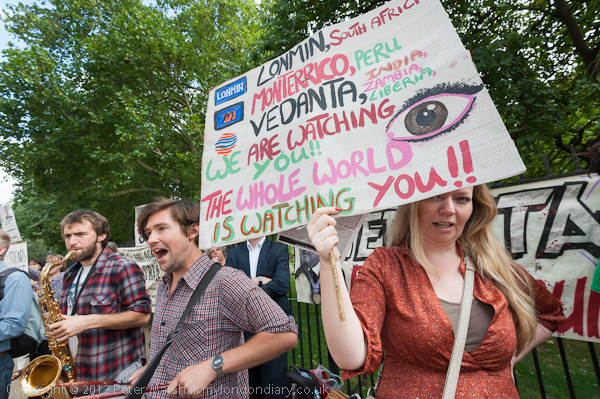
The London and Rhodesian Mining and Land Company Limited was set up in London in 1909, and later became Lonhro and later Lonmin, still listed on the London Stock Exchange on 16th August 2012 when 34 striking miners were shot dead by South African police at its Marikana platinum mine.

Marikana, Bangladesh, Bahrain & Lula - 2018

The miners were striking for better wages and living and working conditions and were trying to disperse and hide when they were shot; another 10 had been killed previously since the strike began. Among those who encouraged the police violence against strikers was Lonmin board member Cyril Ramaphosa, a former mining union leader who since 2018 has been president of South Africa.

Marikana, Bangladesh, Bahrain & Lula - 2018
People carried large photographs of some of those who were killed by the police shooting

I photographed a tour of City of London investors, insurers and shareholders who profited from the violence against people and nature in Marikana. It stopped outside each of the offices for speeches giving details of their involvement and about the colonial roots of the huge wealth of the City of London. There were brief protests outside Majedie, Schroders, Investec, Legal & General and BASF, the major customers for Marikana’s platinum.

Marikana, Bangladesh, Bahrain & Lula - 2018

There had been no compensation for the victims’ families or for the injured mineworkers. The protest by the Marikana Solidarity Collective supported the demands of women’s organisation Sikhala Sonke and victims’ representatives that Lonmin must fulfil a social covenant with the community instead, including reparations, releasing the imprisoned mineworkers, prosecuting the physical and intellectual authors of the massacre, and taking responsibility for the environmental destruction in Marikana.

Marikana, Bangladesh, Bahrain & Lula - 2018

The international outcry over the massacre eventually led to Lonmin being acquired in 2019 by multinational mining and metal processing group Sibanye-Stillwater.

More pictures on My London Diary at Justice For Marikana – 6th Anniversary.


Release Bangladeshi opposition leader Khaleda Zia

Downing St

Protesters from the Bangladeshi Nationalist Party UK called for the release of their party leader, Begum Khaleda Zia, jailed in February for five years for embezzlement of international funds donated to Zia Orphanage Trust.

The BNP claim the charges are politically motivated, though there appeared to be many charges and a great deal of evidence against the woman who became Bangladesh’s first female head of government from 1991-6 after the BNP won the country’s first democratic election in 20 years, and served as prime minister later in 2001-6. Her sentence was later increased to 10 years.

In 2020 she was released from prison on medical grounds and was later acquitted on some charges and in 2025 allowed to go to London for medical treatment. She died in Dhaka as the end of December 2025.

Some Bangladeshi friends tell me there was little to chose between the her and her political rival Sheikh Hasina Wazed and their parties, and that both are corrupt and neither represented the interests of the people of their country.

More pictures at Release Bangladeshi opposition leader.


Against attack on Bahrain Embassy hunger striker

Bahrain Embassy, Belgrave Square

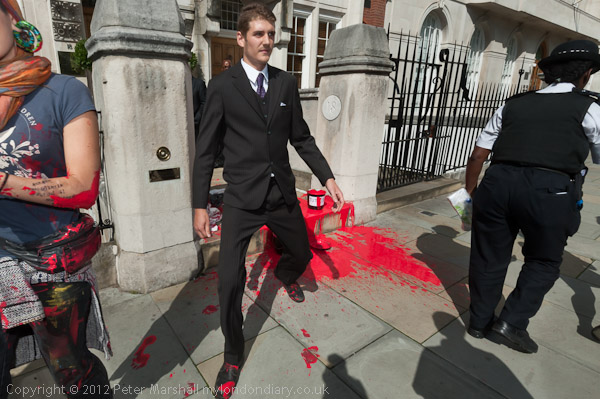
Islamic human rights group Inminds came to protest outside the Bahrain Embassy on Monday after hunger striker Ali Mushaima who was protesting outside there had been attacked early on Sunday morning by staff inside the embassy. A bucket of an unknown liquid was thrown on him from the ambassador’s balcony.

Mushaima’s hunger strike, which had begun on August 1st, was calling for his 70-year old father in prison in Bahrain to be given urgently needed medical care, family visits (stopped 18 months ago), and access to books.

Hassan Mushaima and other human rights defenders and opposition leaders were abducted in March 2017, brutally tortured and given life sentences in mock trials for calling for democracy in Bahrain.

The cast included Theresa May, with the Butcher of Bahrain Hamad Khalifa and Little Stooge Fawaz Khalifa

Inminds called for his release along with that of around 5,000 other Bahraini prisoners of conscience languishing in the Al-Khalifa regimes jails, as well as an end to UK complicity in the Al Khalifa dictatorship and Saudi crimes against the Bahraini people.

Britain sells arms which are used to shoot Bahraini people

The attack had been reported to police who had failed to investigate it fully, but did come to harass the protesters, telling them they could not protest on the pavement outside the embassy.

The International Criminal Court arrived and the members of the criminal regime were brought to justice.

Inminds refused to move and continued their protest with some street theatre in which Theresa May sold arms to the Bahraini dictator which he used to shoot protesters, who were then chained up. Unlike in real life the International Criminal Court came to their rescue, released them and condemned the Bahraini regime for their crimes against humanity.

More at Attack on Bahrain Embassy hunger striker.


Free Lula – Brazilians for Democracy & Justice

Brazilian Embassy, Cockspur St

Finally I joined protesters outside the Brazilian Embassy calling for the release of Lula – Luiz Inacio Lula da Silva – a former trade union leader who was President of Brazil for two terms from 2003-11- to enable him to stand for election again in October.

Lula had announced in late 2017 that he would stand in the 2018 presidential election against right-wing incumbent President Jair Bolsonaro and opinion polls showed him clearly in the lead. But in April 2018 he was finally imprisoned on charges of having taken bribes to help an engineering firm gain contracts from the state oil company.

Despite his imprisonment he was kept as the Worker’s Party candidate although being in prison made him ineligible to take part in the election. Brazil ignored the protests and a suggestion from the UN Human Rights Committee that he be allowed to stand and Lula withdrew shortly before the vote in which Bolsonaro won another term.

All convictions against Lula were annulled in 2021 and in October 2022 he was elected for a third term as president.

More pictures


FlickrFacebookMy London DiaryHull PhotosLea ValleyParis
London’s Industrial HeritageLondon Photos

All photographs on this page are copyright © Peter Marshall.
Contact me to buy prints or licence to reproduce.

Class War protest Ripper ‘museum’ again – 2015

Cable St, London. Wednesday 12th August 2015

Former Google diversity chief Mark Palmer-Edgecumbe had applied to Tower Hamlets Council for planning permission to open a “Museum of Women’s History” meant to celebrate suffragettes, equal-pay campaigners, and local social struggles, and got a number of historians, academics and others to advise on the project.

It was a shock when the building renovations were completed and those involved as well as the council saw from the frontage that it was instead to be a tourist trap celebrating the gruesome Victorian murders of ‘Jack the Ripper’.

Ian Bone asks “Would you protect it if it glorified the killing of police officers”

Many local residents, and others including descendants of the poor working class victims of the sadistic murderer where shocked, and even Tower Hamlets Council was moved to protest following its opening. Unfortunately the council found it had no power to close down what was described as a ‘sick horror attraction’.

We have better stories’ says a poster with some images of women who should be celebrated rather than celebrating a brutal and deranged upper-class killer who attacked working class women

But the most sustained protests came from anarchist organisation Class War who carried out a series of colourful protests outside the so-called ‘museum’, including this one in which they were joined by Action East End and Fourth Wave and other feminists.

When protesters came to the tourist attraction they found it was hidden behind a heavy metal shutter, with police standing in front guarding it, erected since the previous protest a week ago. This was in breach of planning regulations and they were some time later foreced to remove it.

Among those who spoke at the protest was East End historian David Rosenberg who spoke about the real history of women in the East End, as well as Class War’s Ian Bone and Lisa McKenzie.

After the speeches and a couple of smoke flares the protesters, including some local residents blocked the road for some time though leaving the cycle path open. Police attempted to move them with no success, the women protesting asking them whether they would defend a museum celebrating the murders of police officers.

My final comment in 2015 was:
“Protests will continue until the museum closes down or turns into what was promised, a museum of women’s history rather than of women’s degradation and brutal slaughter. It sensationalises the tragic fate of the working class victims at the hands of a deranged upper class murderer, presenting a voyeuristic experience that sickens anyone with any decency and humanity.”

Unfortunately it remains open.

Many more pictures at Class War protest Ripper ‘museum’ again.


FlickrFacebookMy London DiaryHull PhotosLea ValleyParis
London’s Industrial HeritageLondon Photos

All photographs on this page are copyright © Peter Marshall.
Contact me to buy prints or licence to reproduce.

South Africa Crime & I Love Peckham – 2007

South Africa Crime & I Love Peckham: On Saturday 11 August 2007 I photographed a march against crime in South Africa and then went to Peckham for the third ‘I Love Peckham’ festival. I wrote at some length about both events on My London Diary and reproduce that text in full (capitalised and spelling corrected etc) below with links to more pictures on that site.


ACT4SA March Against Crime in South Africa

Westminster

South Africa Crime & I Love Peckham - 2007
The march paused in front of South Africa House

On Sat 11th there was a march organised by ‘Against Crime Together for South Africa’ through London from Temple Gardens next to Temple Underground Station to Whitehall Place. Most of those taking part were young and white, but there were just a few darker and older faces.

South Africa Crime & I Love Peckham - 2007
A quote from Mandela led the march through London

ACT4SA is a ‘Facebook’ group of expatriate South Africans living in London, and their aim is to be a non-political group actively working for a safer South Africa. Their attempt, particularly this march, has attracted both praise and criticism from both other expats in Britain and people back home.

South Africa Crime & I Love Peckham - 2007

Some in South Africa have suggested they should either come back to the country to help in the fight against crime or keep a decent silence about it abroad. A stated aim of the march was to support the South African Police, but at least one police superintendent there has spoken out against it.

South Africa Crime & I Love Peckham - 2007

After Mark Joubert was murdered in a Durban restuarant in May this year, around 15 of his friends living in London decided they would get together and do something to oppose the violence in their home country. Shannon Joubert, Mark’s sister, addressed marchers briefly at the start of the march, and a minutes silence was observed by the over 600 marchers at the end of the route in Whitehall Place in honour of mark and the “the 50 other South Africans murdered on average every day” in the country.

More pictures


I Love Peckham

Peckham

South Africa Crime & I Love Peckham - 2007
Astronauts claim Peckham for America

‘I Love Peckham’ is a festival backed by Southwark Council and based around the centre of Peckham. Although Peckham has had a bad press – particularly over the murder of young Damilola Taylor in November 2000, and more recent violence on the streets, many parts of it are pleasant streets and vibrant shopping areas. Recent investment – particularly since that murder – has led to a number of improvements.

Sitting on an already rather full sofa in front of the beach

One of the more successful regeneration projects has been in the Bellenden Road area which is home to a number of artists including Tom Phillips and Antony Gormley, both of whom have been involved in brightening up the streets.

One of the more bizarre sofas

But there are still estates with corners that can hide dangers, and times when its wise to cross the road to avoid the dealers in their cars. It’s an area where it pays to be streetwise.

As well as the activities in the square by the Library and at the top of Rye Lane there were also other events, including a series of shop window displays.

Like the other folks carrying built-in cameras on their latest mobile phones I did photograph some of these, but often felt that some of the other windows which had their normal displays were more interesting. But then I’ve always had an interest in shop windows, which feature strongly in my projects such as ‘Café Ideal , Cool Blondes and Paradise‘.

Samba on the stage


On the main stage by Peckham Library were performances by Indian musicians, a samba group and some young dancers from Peckham. Around the square were a number of sofas specially decorated for the occasion, many of which were greatly appreciated.

Local Radio in Rye Lane, Peckham

This was the third annual I Love Peckham festival, but the previous ones had been blighted by British weather; today the sun shone on us at least most of the time, and the beach at times looked almost tropical.

I stopped off on the way home at the South London Gallery, where the installation of Isa Suarez’s Human Rights Jukebox was coming to an end with a party. I was pleased I’d stopped by to watch the video of the event and to have a beer and talk to a few of those involved with the project, including Isa herself. I still find it mildly amusing to see myself on film, and there were glimpses of me (mainly my back) taking pictures, walking in the march, generally scurrying around and rather too lengthy a shot as I munched on a wholemeal sandwich.

Despite these few moments, it was interesting to see the event again and from a different viewpoint. I was sorry I had to rush off to be home with friends.

Many more pictures on My London Diary at i love peckham.


FlickrFacebookMy London DiaryHull PhotosLea ValleyParis
London’s Industrial HeritageLondon Photos

All photographs on this page are copyright © Peter Marshall.
Contact me to buy prints or licence to reproduce.

Shops and More – October 1994

Pictures from the first dozen or so frames of a film taken as I moved around London near the start of October 1994, working on other things. I only recorded locations for two of these but perhaps someone may recognise where the others were taken.

Chinese, Fish & Chips, London Rd, Norbury, Croydon, 1994, 94-101-63

I think this is perhaps a Chinese takeaway rather than a fish and chip shop, though this counter could be a fish fryer and there does seem to be vinegar and salt on the counter. This is one of the few images in this section of the film that gives a location. Probably this was a corner shop as I seem to have taken the picture through a side window.

Re-Upholstery, Furniture, London, 1994, 94-101-65

A workshop in shop premises facing thee street which provides an advert for the re-upholstery service and a convenient location to bring in your chairs to be re-upholstered.

We have had some of our chairs re-upholstered in recent years at a rather more orderly workshop than this and it made them as good as new. Good chair frames on older chairs were made to last, though re-upholstering them cost us more than buying cheap new chairs. Two frames after the previous image this could too have been in Norbury – but I could also have been on the other side of London. Please comment if you recognise it.

Greengrocers, London, 1994, 94-101-66

Perhaps had I taken this on medium or large format instead of 35mm I would be able to find more about the location from the local newspaper at right or the lable on the wheelie-bin. But all I can tell you is that it was somewhere in London.

It looks rather crudely fitted out as a shop, perhaps converted from some other use. At right is a blurred image of my hand, held to largely avoid reflections as I took this though a glass front window.

Blue Pallets London, 1994, 94-101-51

A side street, perhaps a market area off a high street somewhere in London. The blue palletsd look more substantial than some and are marked with the letter C as well as a short message illegible in my photo. The building they are in front of has a metal shutter, probably hiding a shopfront, and has some bright green paint which contrasts with the brown above that, as well as the oddly sloping straight drainpipes from its roof.

Shops, Pembroke Rd, Erith Rd, Erith, Bexley, 1994, 94-101-52

Thee very next frame after the blue pallets is of a street corner in Erith with a small parade of shops, probably built in the 1920s or 30s. Most were derelict by 2008 though only demolished in 2014. Three shops at the Pembroke Road end of the terrace were still there in 2025 but nothing had been built to replace those demolished.

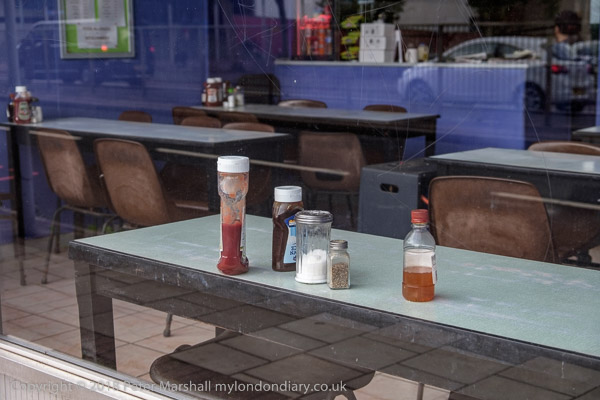
Reflections, Café Window,  London, 1994, 94-101-56
Reflections, Café Window, London, 1994, 94-101-56

An image where I liked the reflection and the ambiguity it introduces into the image. I think there may be two sets of reflections here. My focus was on the shel which ruans across the middle of the image with bottles – the leftmost is opf Table Salt, the next probably vinegar. Under it some pies are keeping warm but apparently also in a passing car while to their right are some kind of controls on equipment I don’t recognise and a boy riding a bike, given a red cap perhaps by a bottle label. I can see no trace of myself reflected in the image, susggesting I made it at an angle to the glass.

Shop Window, London, 1994, 94-101-41

And for a final mystery (at least for today) a shop window with Chinese items in it as well as a fluorescent fitting without its tube. At the top I think is a parasol and hanging below it a short-sleeved top. I wonder now if this picture was taken through tinted glass as I cannot really find a convincing colour balance. My shadow taking the image appears at bottom right.

More colour work from 1994 shortly.


FlickrFacebookMy London DiaryHull PhotosLea ValleyParis
London’s Industrial HeritageLondon Photos

All photographs on this page are copyright © Peter Marshall.
Contact me to buy prints or licence to reproduce.

Wool Against Weapons

Burghfield to Aldermarston, Berkshire.

Wool Against Weapons

Burghfield to Aldermarston, Berkshire.
There were 7 miles of pink scarf along the roads between the two atomic bomb factories – and some to spare.

Wool Against Weapons; On Saturday 9th August 2014, the 69th anniversary of the dropping of the atomic bomb on Nagasaki – three days after the nuclear bomb devastated Hiroshima, CND organised a large-scale protest against nuclear weapons, stretching a line of pink knitting seven miles to link the bomb factory at Burghfield with the Atomic Weapons Establishment (AWE) at Aldermaston.

Wool Against Weapons

Burghfield to Aldermarston, Berkshire.
Some sections had fancy designs, others had slogans – ‘Knitwear Not Warfare’
Wool Against Weapons

Burghfield to Aldermarston, Berkshire.
‘Drop Stitches Not Bombs’

The protest came well ahead of a parliamentary vote expected in 2016 to allow the government to spend over £100 billion on a new nuclear weapons system to replace Trident.

Wool Against Weapons

Burghfield to Aldermarston, Berkshire.
People were sewing the lengths of scarf together
Wool Against Weapons

Burghfield to Aldermarston, Berkshire.
Stretching out the lengths

Groups from all over the country (and some in France) had been busy knitting and crocheting lengths of pink scarves and joining these into rolls that could be brought to their designated point on the 7 mile route, unrolled and joined up with others to complete the scarf.

Wool Against Weapons

Burghfield to Aldermarston, Berkshire.

The project brought together a large number of people many who had not previously protested against nuclear weapons but were appalled at the amount of money that would be wasted on a Trident replacement which could be much better spent in other ways – such as keeping the NHS running.

Extra knitting on the fence of AWE Aldermaston

I had decided the only sensible way to cover this protest would be on a bicycle, and got up to go with my bike on an early train to Reading, from where I cycled to Burghfield, arriving shortly before 10.30. This gave me two and a half hours before the whole scarf was scheduled to be joined up at 1pm.

People wait to hear that the scarf is linked

After photographing at this end of the scarf, I cycled slowly along the route, jumping off my bike to take pictures where people were busy laying out the rolls of scarf and joining them up. Eventually I reached Aldermaston and after taking some pictures there rode quickly back to Burghfield to be there well before the joining was complete at 1pm.

Waiting for the the signal that the scarf is linked along all 7 miles

At 1pm protesters held up the now joined 7 mile scarf and rang bells – and I ran almost a mile along it taking photographs. I think it was held up for around 10 minutes before people took it down and began to come to a rally at Burghfield which began a little after 1.30pm.

And people rang the bells
One person was getting a little bored
One of the French protesters

There was music and poetry and speeches, including from Walter Wolfgang and Kate Hudson. It was still continuing after I left to ride back to Reading and take the train home.

Many more pictures on My London Diary at Wool Against Weapons.


FlickrFacebookMy London DiaryHull PhotosLea ValleyParis
London’s Industrial HeritageLondon Photos

All photographs on this page are copyright © Peter Marshall.
Contact me to buy prints or licence to reproduce.

Close Down Yarl’s Wood -2015

Close Down Yarl’s Wood: On Saturday 8th August I went with around a thousand protesters to Yarl’s Wood Immigration prison, in the middle of the countryside around 5 miles north of Bedford.

Close Down Yarl's Wood -2015

There were coaches from around the country but I travelled by train to Bedford, where organisers Movement of Justice had arranged for a bus to pick up epole from the station. The prison is on a wartime aerodrome at the top of a hill and a relatively remote location.

Close Down Yarl's Wood -2015

Even after the coaches had dropped us off at the front of the estate, there was then a walk of a little over a mile along the road and then along a public bridleway to the field sloping up from the 20 ft prison fence on the north side. There is a road for official visitors leading to the other side of the site.
Close Down Yarl's Wood -2015

I had missed an earlier protest which I had been invited to cover as I thought I was ill-equipped and other photographers would have more suitable gear than me. Most of my work is made with wide-angle lenses and to photograph though the mesh top half of the 20 foot fence the women at the windows inside was a challenge for me.
Close Down Yarl's Wood -2015

But this time I borrowed a 300mm Nikon lens from a friend and used it with my Nikon D700 in DX mode, which made it equioalvent to a 450mm lens, and it did a reasonable job, though ideally I would have had something even longer and faster. Most of the pictures taken with it are cropped.

Close Down Yarl's Wood -2015

Most of the pictures were made with a wideangle Nikon 16-35mm zoom, but a few with my usual longest lens, a Nikon 18-105mm, and even fewer with a Nikon fisheye. As well as the D700 I was also using a D810 at the event.

Close Down Yarl's Wood -2015

On My London Diary I list around 25 groups supporting the protest – and probably missed quite a few more. There is a very widespread feeling of disgust and shame at the way this country treats asylum seekers in a racist system that detains so many for long periods without trial, locking them away in detention centres such as these run for profit by private companies where they are always mistreated and often subjected to real abuse and sexual harassment.

Yarls Wood was then used to hold women asylum seekers, though there were also some families held there. When we arrived and they could hear the shouts and some could see us through the upper windows there “was a rapturous welcome from the women inside the prison, who came to the windows, shouting and waving and holding up signs. Protests like this really give the prisoners hope, and show them they have support and are not forgotten. Together, inside and out people chanted slogans ‘Shut Down Yarls Wood’, ‘Detention Centres, Shut them Down’ and more.”

The solid metal lower half of the 20 ft fence makes a loud noise when hit or kicked and the protesters made the most of this, with others writing slogans on them – though these were not visible to the women inside.

Although the detainees are prisoners they are treated differently to those in normal jails and have to be allowed some contact with the outside world to organise their cases – including mobile phones. They held up signs with their phone numbers so that we could see them – and then ring them up so that they could speak to the public address system the protesters had brought.

Many of those outside who spoke during the protest had spent some time in this or other detention prisons, and some were speaking to friends still inside. Detention is open-ended with people having no idea of when they would be released – or, if their applications failed, deported. One detainee was only released one day before having spent three years here.

There are many more pictures on My London Diary. Here’s how I ended my piece: “Too soon we had to leave. And they had to stay. As I walked away to catch the coach back to Bedford station I felt ashamed at the way that my country treats asylum seekers. They deserve support and humanity and get treated worse than criminals.”


FlickrFacebookMy London DiaryHull PhotosLea ValleyParis
London’s Industrial HeritageLondon Photos

All photographs on this page are copyright © Peter Marshall.
Contact me to buy prints or licence to reproduce.