Gunnersbury Park & Brentford – 2018

Gunnersbury Park & Brentford - 2018
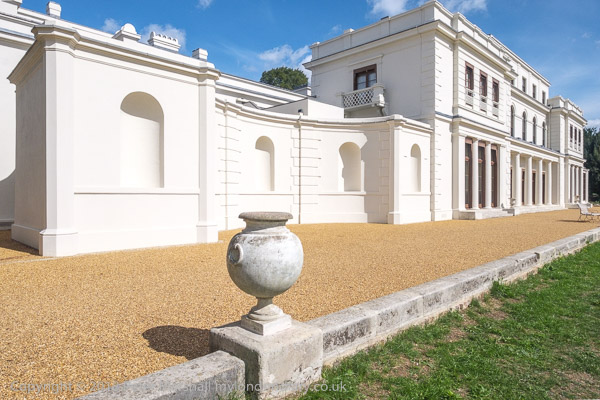
Gunnersbury House Museum – the ‘Large Mansion

Gunnersbury Park & Brentford: Another family outing on Friday 24th August 2018 took us to Gunnersbury House Museum, a free museum jointly owned by the London Borough of Hounslow and the London Borough of Ealing. It turned out to be considerably more interesting than I expected.

Gunnersbury Park & Brentford - 2018
Lionel Road – now the site of Brentford Community Stadium

The 200 acre Gunnersbury estate was bought in 1925 from the Rothschild family by Ealing Borough Council and Acton Borough Council for £130,000, although it was all actually just outside their areas and in Brentford Urban District. They wanted to build over it, but the Rothschilds stipulated that all except a small part of it it was only to be used for leisure and recreation and it was opened to the public as a park by Neville Chamberlainn, then Minister of Health, in 1926.

Gunnersbury Park & Brentford - 2018
The elevated section of the M4 above the Great West Rd

Development of the site as a ‘country estate’ on the outskirts of London had begun in the late 17th century when the first large mansion, Gunnersbury House was built around 1663. The estate passed through various hands including wealthy merchant and MP Henry Furnese who had noted landscape designer William Kent give the park a makeover. Next Princess Amelia, favourite daughter of George II, had further changes made to the grounds for her famous parties there, including building a bathhouse.

Gunnersbury Park & Brentford - 2018
The temple is the only 18th century building remaining on site

The first mansion was demolished in 1801 and the estate was split into two adjoining estates each with a new mansion.

Gunnersbury Park & Brentford - 2018
A long series of rooms faces the garden in the ‘Large mansion’

The Grade II* listing for the ‘Large Mansion’ states it was built in “1801-28 by and for Alexander Copland; remodelled 1836 by Sydney Smirke for Nathan Mayer Rothschild, the City financier and Frankfurt-born founder of the British branch of this famous international Jewish banking dynasty.”

Gunnersbury Park & Brentford - 2018
The ‘Small Mansion’ still in rather poor condition

Next door the “Small Mansion”, on the site of the former mansion was built in 1801-1802 for Stephen Cosser according its Grade II listing, though other sources place it a few years later. It was extended with a service wing in 1837-44 by eccentric “Rogue Gothic” architect Joseph Peacock (1821–1893).
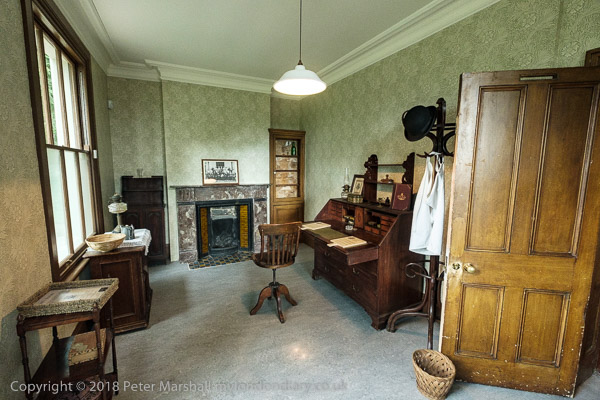
The Rothschilds had two French chefs who shared this office

The Rothschilds bought the Large Mansion (now the museum) and its gardens and park in 1835, adding the Small Mansion and its grounds in 1889 to recreate the now Grade II* listed Gunnersbury Park.

Large prints from Leopold de Rothschild’s Autochromes show the place as it was over a hundred years ago – with flamingos

I walked with Linda to the park from Kew Bridge Station along Lionel Road “with some difficulty as it is now a building site and crossed the Great West Road under the overhead M4, a Ballardian trek past the old and closed castellated gate to the park to enter into a sylvan wilderness, walking past the Potomac lake and its gothic folly.”

The garden slopes down from the house to a lake

Older members of our party took a shorter walk from the underground at Acton Central. Lionel Road is now overlooked by Brentford Community Stadium opened in 2020.
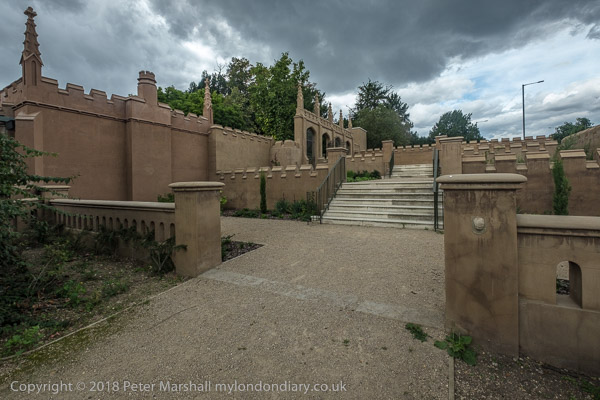
Princess Amelia’s Bath House

The park is certainly worth a visit and on My London Diary you can read more about what were for me the two highlights.These were the huge Rothschild’s kitchens where meals, not generally kosher, were prepared under the supervision of two French chefs, and a display of large prints from the Autochromes taken by Leopold de Rothschild using the first practical colour photography process patented by the Lumiere brothers in 1903 and sold to the public from 1907.
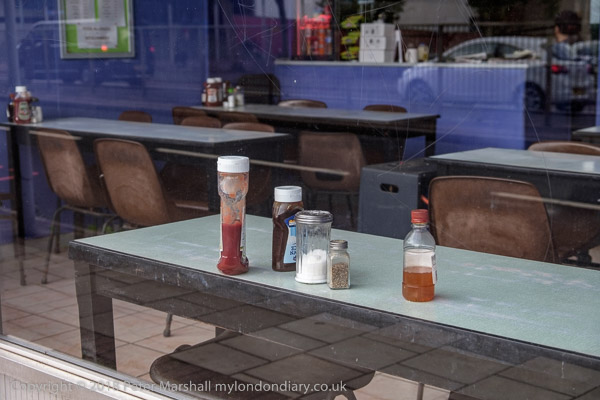
I made a new picture as we passed a cafe I photographed almost 30 years earlier on our way to Kew Bridge

We ate, not from those kitchens but from the modern park café, “tasty but rather insubstantial, and if you visit and are hungry, I’d advise a side order of chips” – or a short walk to a cheaper place near Acton Town station.
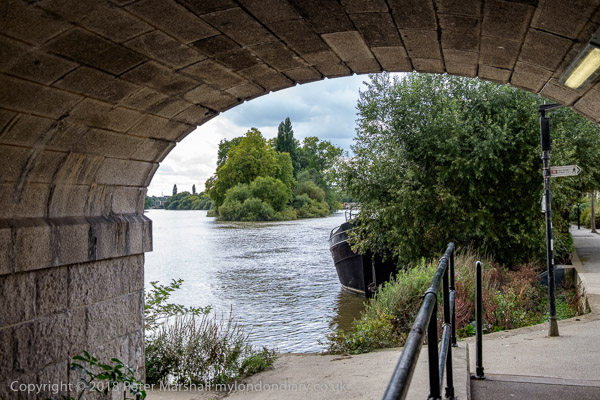
The Thames and Brentford Ait from under Kew Bridge

After the meal we said goodbye to the others and took a longer walk around the park before walking back to Kew Bridge station. With almost half and hour to wait for the next train we took a short walk by the River Thames to Brentford High Street and back.
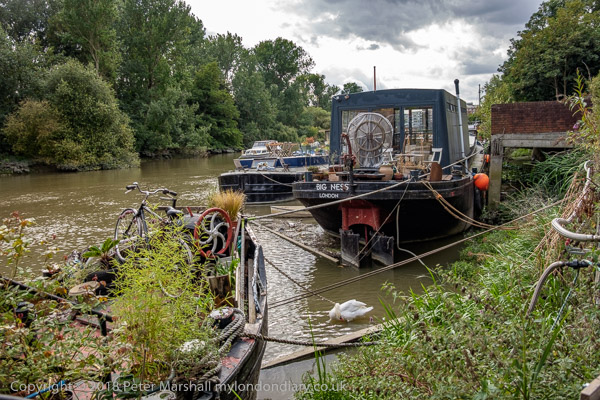
Mooring on The Hollows

You can read more about our trip to the park and the museum and see many more pictures from the day on My London Diary at Gunnersbury Park & Brentford.


FlickrFacebookMy London DiaryHull PhotosLea ValleyParis
London’s Industrial HeritageLondon Photos

All photographs on this page are copyright © Peter Marshall.
Contact me to buy prints or licence to reproduce.


Chapel, Gothic House, the Globe and Great West Road – 1990

Chapel, Gothic House, the Globe and Great West Road: Continuing my walk on Sunday 7th January 1990 – the previous post was The Great West Road and a Missing Lion – Brentford.

Jubilee Chapel, Primitive Methodist, New Rd, Brentford, Hounslow, 1990, 90-1f-26

Built in 1897, the year of Queen Victoria’s Diamond Jubilee, the church closed in 1964 when a new church opened in Clifden Rd. The Primitives had joined with the Wesleyans and United Methodists in 1932. The building is a rather curious design laid out along the road with a tower like this at each end and five bays between, the central one with what looks as it should be an entrance with taller brickwork and a triangular pediment above a large oval-topped window. You can see a little of the interesting brickwork in my photograph. The windows now have some delicate metal protection in front of them and the building is still in use, I think by an Electrical contactor. It is locally listed for its architectural and social significance.

House, Hamilton Rd, Brentford, Hounslow, 1990, 90-1f-11

This Gothick style house at 17 Hamilton Road stands head and shoulders above its neighbours with a basement, steps up to a grand doorway and the fine decoration below its distinctive oriel window. It is capped on one side with an attic gable, making it three and a half storeys. Locally listed.

Performance, Windmill Rd, Great West Rd, Brentford, Hounslow, 1990, 90-1f-13
Performance Cars Ltd, Windmill Rd, Great West Rd, Brentford, Hounslow, 1990, 90-1f-13

Although it might gain no stars for its uncompromising 1930s architecture this building for Performance Cars had a blunt and striking appearance and I was sad to see it was about to be demolished, one of many losses of buildings along the Great West Road. It’s a shame it was not saved, although the adjoining workshops were no great loss. Most of its site is now empty or parking for another motor dealer. I took this picture from underneath the elevated M4.

The Globe, Boston Park Rd, Windmill Rd, Brentford, Hounslow, 1990, 90-1f-15
The Globe, Boston Park Rd, 104, Windmill Rd, Brentford, Hounslow, 1990, 90-1f-15

The Globe pub on the corner of Boston Park Road and Windmill Road is still open and is a popular traditional pub which still has some original features.Though it is no longer run by Fullers you may still be able to get a pint of London Pride. My picture just shows a little of the large globe let into the parapet above the corner of the building.

The pub was built in the 1880s and acquired by Fuller Smith & Turner in 1908. It is named in an impressive series of reviews of Brentford’s pubs written by ‘Wandering Tom’ and published in the County of Middlesex Indepent in 1996 but he tells us nothing mopre than its name. Unearthed by Vic Rosewarne as part of extensive research into Brentford’s pubs, these notes have been re-published as part of the Brentford High Street project.

Macleans,  Great West Rd, Brentford, Hounslow, 1990, 90-1f-16
Macleans Toothpaste, Great West Rd, Brentford, Hounslow, 1990, 90-1f-16

Finally two pictures – more to follow later – of another and more important loss of the 1920’s factories that lined the Brentford section of the new Great West Road. This was Maclean’s Toothpaste factory, opened in 1932 and together with the neighbouring Trico was demolished in 1992.

Trico Products Windscreen Wiper factory, No. 980 Great West Road, opened in 1928. The Trico business relocated to Pontypool, South Wales in 1992 and the building was demolished.

Macleans, Great West Rd, Brentford, Hounslow, 1990, 90-1g-01
Macleans, Boston Manor Rd, Brentford, Hounslow, 1990, 90-1g-01

Initially the Macleans site, along with the adjoining former Trico factory next to the Grand Union Canal was to be a UK headquarters for Samsung, but plans fell through with an Asian financial crisis and instead building a new headquarters of GlaxoSmithKline was begun in 1998 and completed in 2001. Designed by Hillier with RHWL and Swanke Hayden Connell it was the biggest single commercial development of the time, and one of the few more interesting new buildings on the Great West Road.

GSK announced they were selling it in 2021 and the last of their staff left the building in 2014. There are now plans being made for what will probably be the largest ever development in Brentford.

More from Macleans and Trico in a later post.


FlickrFacebookMy London DiaryHull PhotosLea ValleyParis
London’s Industrial HeritageLondon Photos

All photographs on this page are copyright © Peter Marshall.
Contact me to buy prints or licence to reproduce.


The Great West Road and a Missing Lion – Brentford 1990

The Great West Road and a Missing Lion – Brentford: Continuing my walk on Sunday 7th January 1990 – the previous post was Chiswick Cottage and Lionel Road Brentford – 1990.

Vantage London, Great West Rd, M4, Brentford, Hounslow, 1990, 90-1f-45

Built around 1970 as the 12 storey headquarters of Beecham Pharmaceuticals it was no longer needed after they became part of Glaxo Smith Kline and was refurbished as as Vantage London with offices let to a number of companies. The building was again refurbished in 2016 and in 2019 was sold to a Luxembourg based company for £30 million.

In 2024 a planning application was made by Resolution Property for its conversion into 178 flats. It was approved following some modifications in April 2025.

The elevated section of the M4 runs on top of the Great West Road in front of the building. The strucvture in the foreground is I think a gritting bin.

Great West Rd, M4, Brentford, Hounslow, 1990, 90-1f-35

Taken under the elevated M4 where slip roads link the A4 Great West Road with the motorway. One project I was working on at the time was inspired by J G Ballard’s 1973 novel ‘Crash’, key scenes of which were set in this area – although the 1996 film of the book by Cronenberg was made in Canada. Ballard who lived not far away in Shepperton obviously knew the area well.

Crash centres around a car crash victim who finds himself aroused by car accidents but my project was more simply about the domination of our culture by the car and I felt threatened by the powerfully enclosed architecture here which is perhaps a modern equivalent of the Roman coliseums, and was rather choked by the fumes.

Beechams, Clayponds Lane, Brentford, Hounslow, 1990, 90-1f-21

On previous occasions I had photographed the iconic moderne 1930s buildings along the Great West Road, and this at right shows Beechams, which had this side entrance a few yards down Clayponds Lane. The factory building continues in a more utilitarian fashion but with a tall window, probably lighting a staircase which reflects the style.

Flats, Carville Hall, Carville Hall Park, Brentford, Hounslow, 1990,90-1f-22

The Carville Hall Estate was bought by Middlesex County Council in 1919 for the construction of the Great West Rd, and they sold the parts on both sides of the new road to Brentford UDC as a park, which opened in 1923. The house, orginally known as Clayponds, is now called Simmonds House. Originally built in the late 18th century, the front was re-modelled in the 19th century. It is locally listed.

The park is off Clayponds Lane and parts of it were once dug for clay, leaving ponds, marked as ‘Fishponds’ on the 1871 OS Map.

Lion, flats, Carville Hall Park, Brentford, Hounslow, 1990, 90-1f-23

Beyond the lion and the park are the tall blocks of the Brentford Towers Estate built for Hounslow Council in 1968-72.

The house here had extensive grounds and there is now a park on both sides of the A4/M4. The park to the north of the roads is larger than this but of little interest.

The house is thought to have been built for the “wealthy distiller and brewer David Roberts (c1733-97)” and was later home to “coal and horse racing magnate William Lancalot Redhead (c1853-1909) and his daughter“. It was later converted into flats.

Lion,  Carville Hall, Carville Hall Park, Brentford, Hounslow, 1990, 90-1f-24
Lion, Carville Hall, Carville Hall Park, Brentford, Hounslow, 1990, 90-1f-24

The fate of the lion appears to be a mystery. I was surprised on a later visit to find it no longer there and I’ve not been able to find what happened to it. The most I’ve come across is a suggestion that it was stolen.

I thought that it was probably a Victorian garden ornament made from artificial stone – Coade or Portland Stone etc – and would have been fairly heavy, so the thief would have needed a lorry with appropriate lifting gear.

More from my walk to follow.


FlickrFacebookMy London DiaryHull PhotosLea ValleyParis
London’s Industrial HeritageLondon Photos

All photographs on this page are copyright © Peter Marshall.
Contact me to buy prints or licence to reproduce.