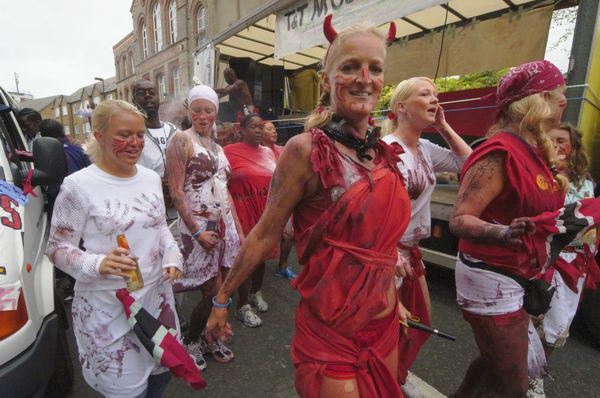
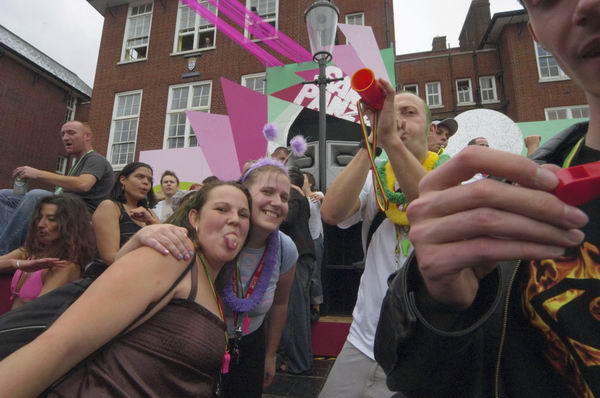
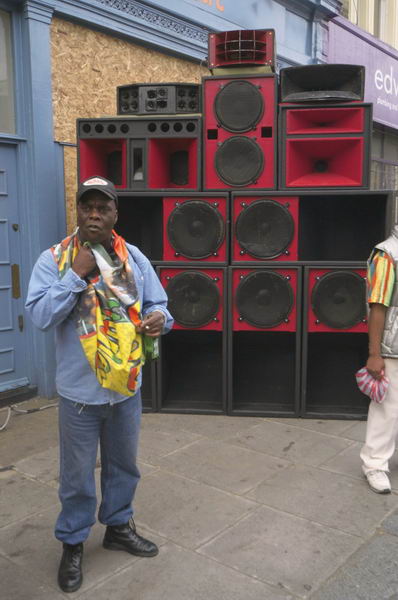
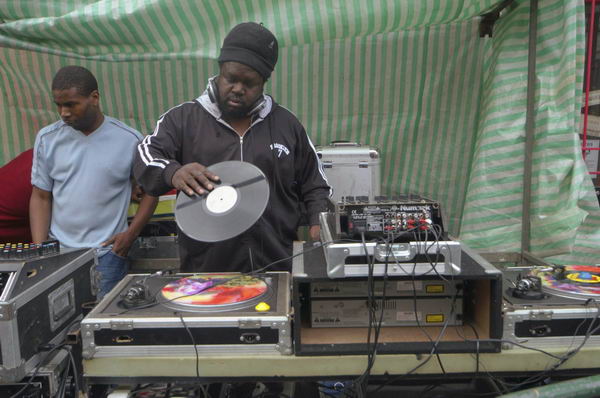
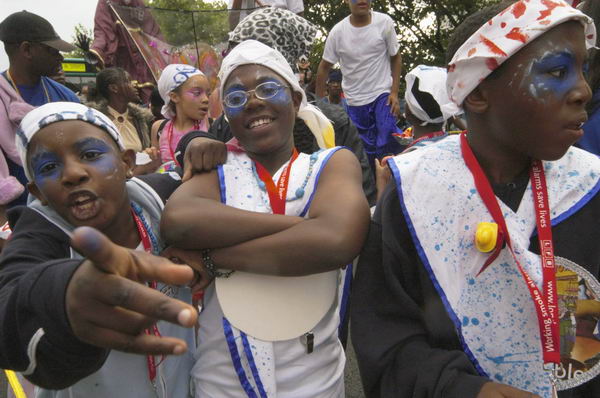
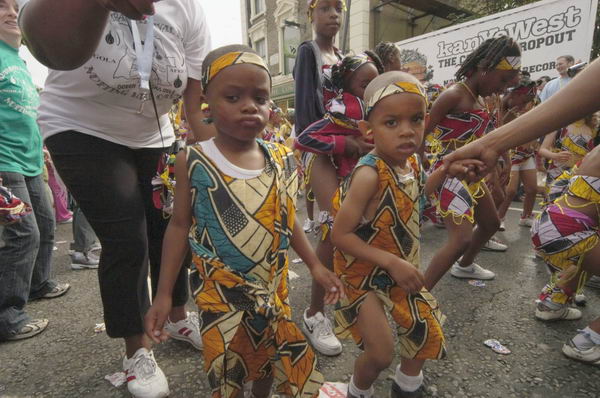
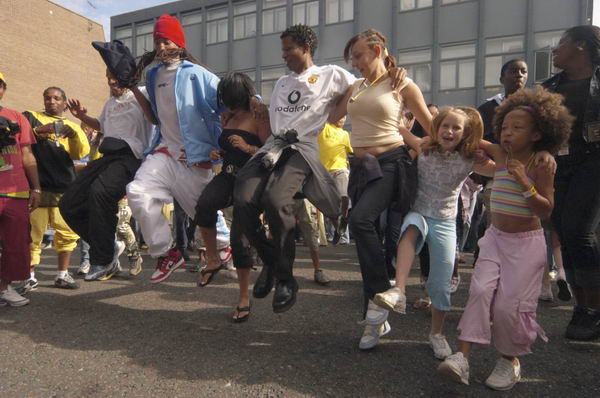
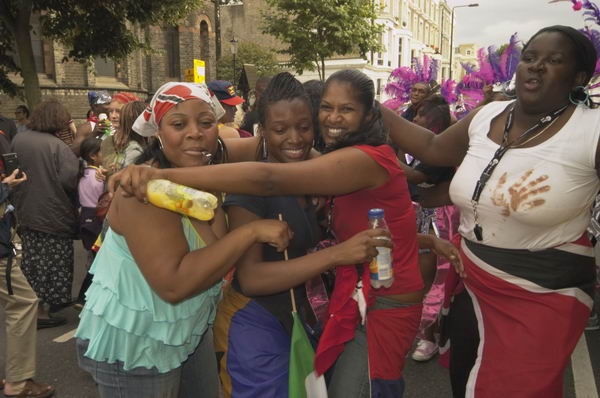
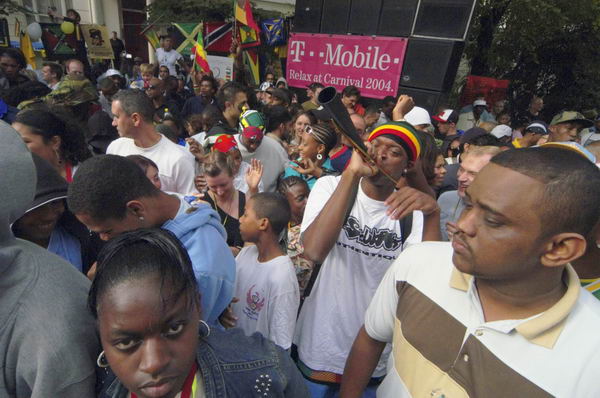
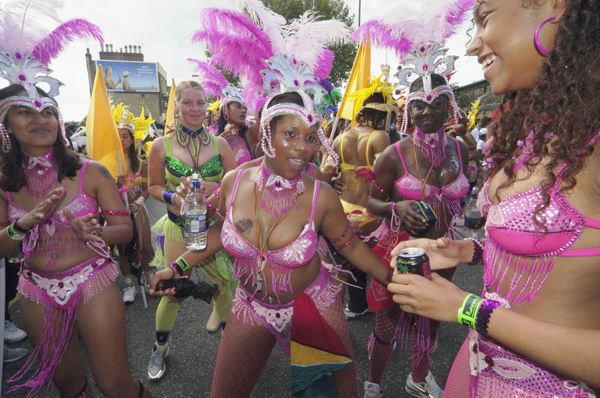
Childrens Day, Notting Hill Carnival: Sunday 29th August 2004 was Children’s Day at Notting Hill Carnival and back in 2004 I wrote just two short paragraphs to go with a large number of pictures.
“I don’t know whose wallet it was in the hand I caught as it reached into my pocket in Cambridge Gardens, but it wasn’t mine. It wasn’t the time or place to argue much, so I let the youth wriggle away.”
“The 40th Notting Hill Carnival was living up to its reputation, in this and also in the friendliness of most of the participants. This was Children’s Day, so I took my son, and will embarrass him with a couple of pictures of him dancing. But mostly it was what we have come to expect, and a little dull weather and the odd shower didn’t mar the celebrations”
I didn’t take my wallet to Notting Hill, but in a densely-packed crowd found a hand putting an empty one back into my left front trouser pocket. Perhaps he thought he had earlier taken it from that same pocket before removing the contents and was trying to replace it, or did he just want an easy way to get rid of the evidence.
I think I probably went to carnival on around twenty or thirty days over the years, though I’ve not been recently. Apart from this rather odd incident I saw very little criminality apart from the widespread smoking of weed – and I picked up enough secondary smoke some days to make me rather high.
But generally there were many more pickpockets on crowded underground trains and much more violence in the crowds around football stadiums. Press reports always greatly exaggerated the negative sides of the event and I never felt unsafe. When there were reports of trouble it was usually late in the day when I had gone home.
But I did take some simple precautions – taking a couple of notes and some coins rather than my wallet and credit cards, and being more careful than usual with my photo gear. I carried less than usual and kept it in a small ex-military shoulder bag – though in crowds I carried this around my neck and in front of my body.
Attitude is also important. Some photographers seem to me to be rather confrontational but I followed my normal friendly nature, smiling, talking and at times dancing with people. Like most of the others at the event I was there to have a good time. And to have just a can or two of Red Stripe – and some of my free annual malt fix.
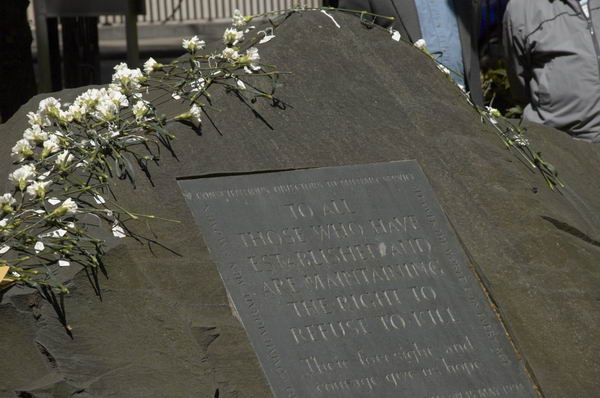
Conscientious Objectors, Cannabis Education & Bengali New Year: Three unrelated events on 15th May 2005 in London. May 15th has been observed in Europe as Conscientious Objectors’ Day since 1982 and became International in 1985 when it was adopted by War Resisters’ International. A ceremony is held every year on the day in Tavistock Square at the site of the massive slate Conscientious Objectors’ Commemorative Stone which has the inscriptions:
TO COMMEMORATE MEN & WOMEN
CONSCIENTIOUS OBJECTORS TO MILITARY SERVICE
ALL OVER THE WORLD & IN EVERY AGE

TO ALL THOSE WHO HAVE
ESTABLISHED AND
ARE MAINTAINING
THE RIGHT TO
REFUSE TO KILL

Their foresight and
courage give us hope

THIS STONE WAS DEDICATED ON 15 MAY 1994
INTERNATIONAL CONSCIENTIOUS OBJECTORS' DAY
I left before the end of the ceremony and hurried to Russell Square for the start of the annual march calling for the legalisation of cannabis, walking with this to Trafalgar Square and then taking the tube to go to Brick Lane for the Bengali New Year Festival. Below is what I wrote in 2005.
The Right to Refuse to Kill – International Conscientious Objectors Day
Tavistock Square
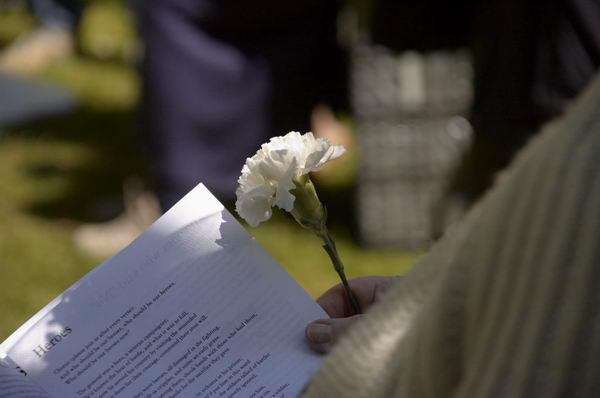
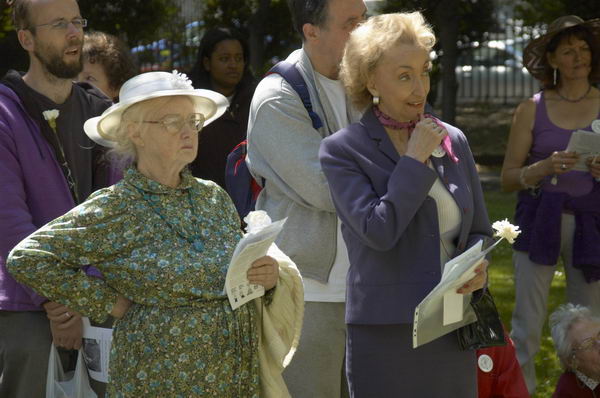
May 15th was International Conscientious Objectors’ Day, and the ‘right to refuse to kill’ group of people from the Peace Pledge Union, Conscience, The Unitarian Peace Fellowship, Christian CND, The Anglican Pacifist Fellowship, Pax Christi, The Women’s International League For Peace And Freedom And Dances Of Universal Peace had organised a ceremony at the Commemorative stone in Tavistock Square. After a brief introduction by Tony Kempster of the Anglican Pacifist Fellowship, Sue Gilmurray sang her song ‘Heroes’ and then Angela Sinclair who was a conscientious objector in the Second World War told her story and spoke about the right not to take part in war.
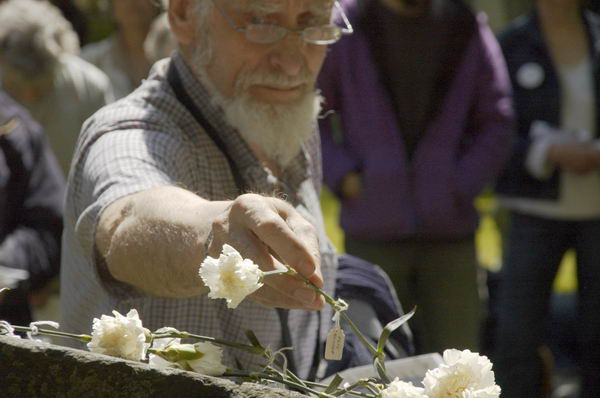
After a speaker from Amnesty and another from Conscience, the names of almost seventy conscientious objectors, many of who had died for their beliefs, were read out. The organisers had given out white flowers labelled with their names, and as each name was read, the person holding their flower came and placed it on the stone. After a one minute silence the commemoration continued with another song and then dancing, but I had to leave at this point.
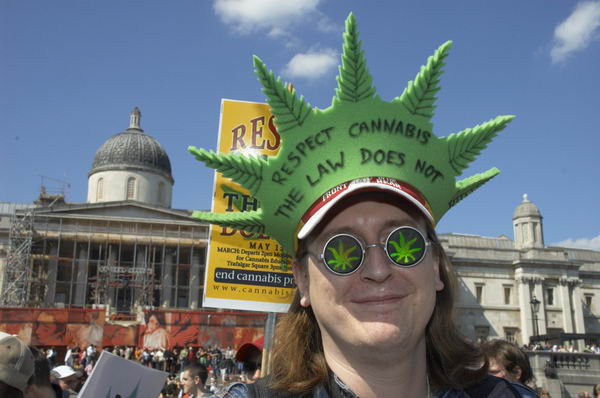
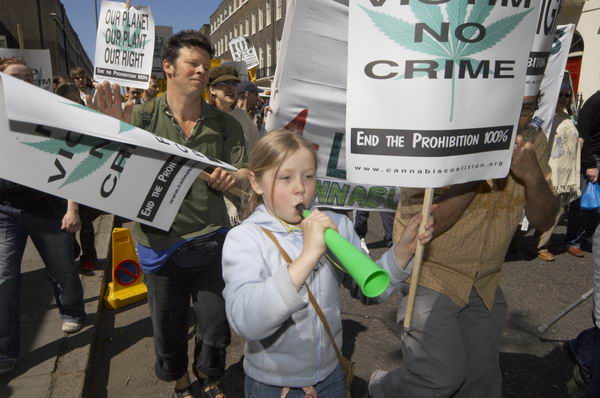
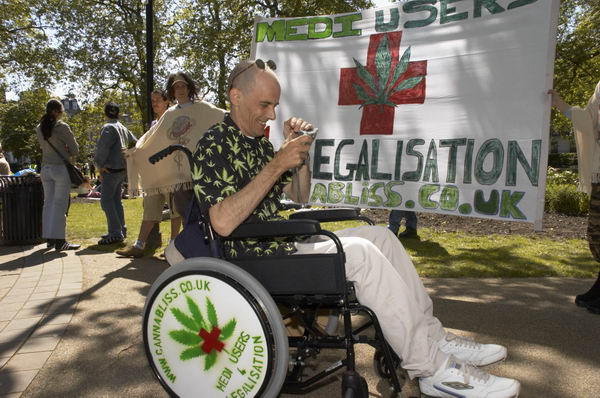
The annual march to demand the legalisation of cannabis had to be postponed and moved to a central London location after Lambeth council had refused to allow it to use Brockwell Park. Probably for this reason, the numbers seemed well down on previous years.
The last year had seen both an increasing recognition of the value of cannabis in relieving pain for some conditions, and also in revealing the mental health problems it causes some users. Despite these, the existing anti-drugs policies are more and more discredited, leading to increasing crime and addiction, and also greatly increasing the probability of cannabis users moving on to more dangerous and addictive drugs.
Cannabis needs to be taken out of the hands of drug dealers, and into some form of legalised supply chain which would cut out the drug dealers, allow better supervision of the product and create a total separation between cannabis and other more dangerous substances.
It would also allow the creation of a tax revenue, some of which could be spent on the rehabilitation of drug users.
I went with the march to Trafalgar Square and stayed to listen to a couple of the speakers, but soon lost interest and got on the District Line to go up to Brick Lane for the Bengali New Year Festival.
When I got there it was just too crowded; after walking around for a few minutes I gave up and came home.
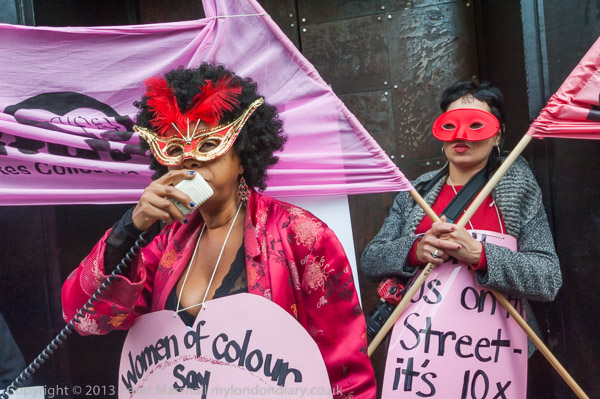
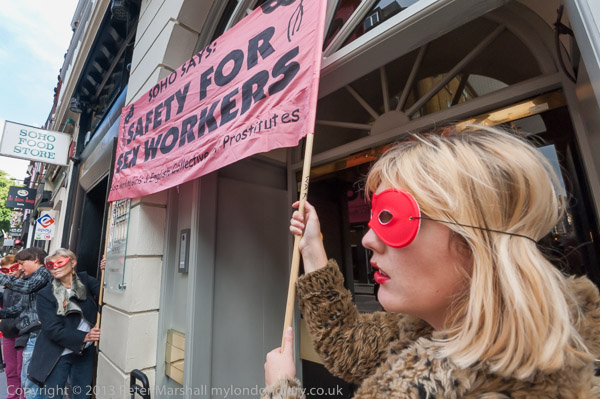
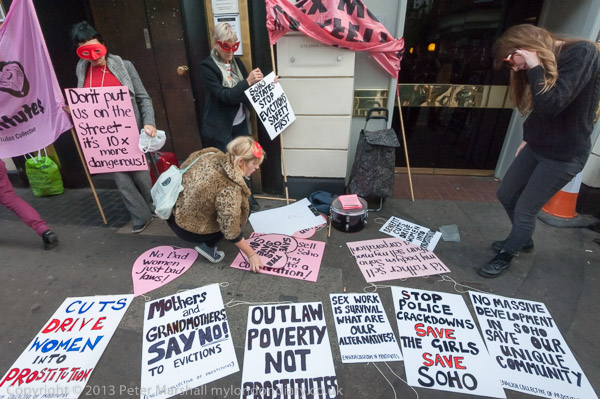
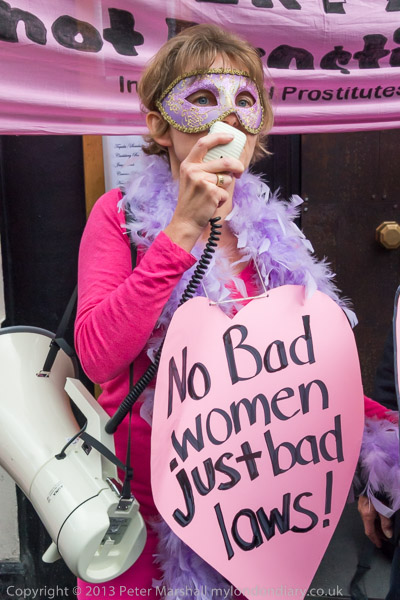
Although the immediate cause of this protest was the eviction of sex workers from flats in Romilly Street where they were operating within our laws restricting prostitution, the evictions were not at base about the activities of the women concerned but a result of property developers seeing enormous profits to be made by emptying properties in the area and redeveloping them.
Soho is particularly at risk from hugely profitable development as hotels and luxury flats because of its reputation and unique ambiance, which has largely derived in the past from its association with such risqué activities as strip clubs and models offering personal services as well as its restaurants and shops offering foreign delicacies unknown in the UK outside its boundaries.
Of course times have changed, and much of Soho is now Chinatown, but still its old reputation and some of those old activities remain, though many are fast disappearing. And while the tourists flock in, much of what attracts them is no longer there.
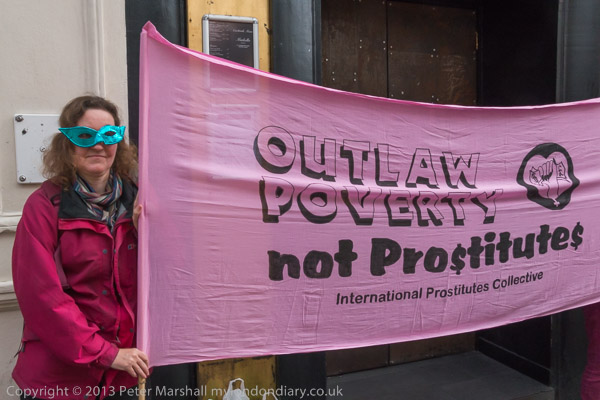
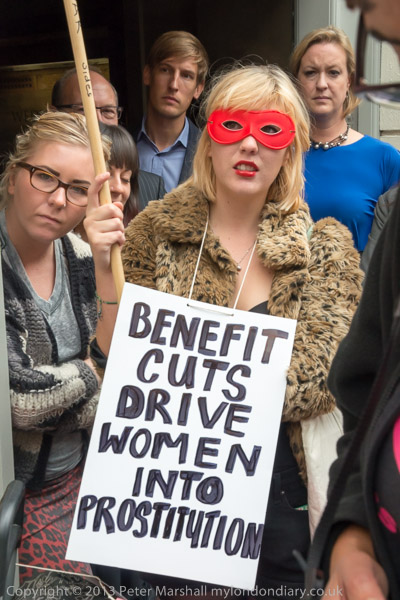
Sex remains a powerful attraction, and it was noticeable that there was far more media attention to this protest than most. Most of the masked women taking part in the protest were supporters of the ‘working girls’ from groups including the organisers of the event, Women Against Rape and the English Collective of Prostitutes (ECP) who I knew from other protests.
The police who issued notices to the property owners alleging that the properties were brothels are widely seen as working on behalf of the prospective developers, and owners Soho Estates whose managing director came out to speak at the event also have a financial interest. They could have stood up to the police intimidation and investigated the situation so they could assure the police that the activities in the flats were within the law, but failed to do so.
A speaker from the Soho Society told the protest that the activities of the women were one of the oldest traditions of the area, and were causing no problems with their neighbours and the many other trades of the area. Previous similar evictions have attracted local petitions signed by thousands and the ECP press release stated “Many express fears that gentrification is behind attempts to close these flats and that if sex workers are forced out it will lead the way for other small and unique businesses and bars to be drowned out by major construction, chain stores and corporations.”
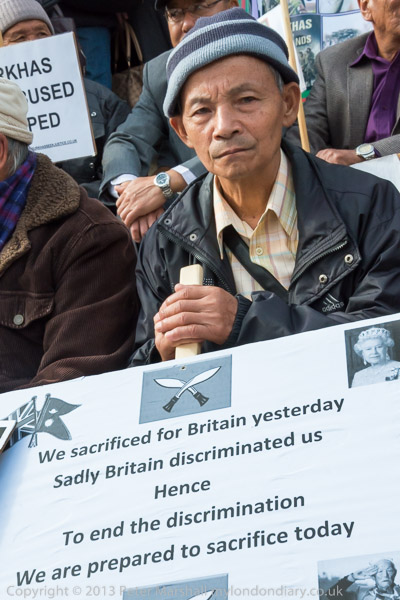
Gurkha Veterans Demand Justice – Old Palace Yard, Westminster
Elderly Gurkha veterans living in the UK did not benefit from earlier campaigns for fair treatment and most living here are in extreme poverty.
This was one of a number of protests every Wednesday and Thursday opposite the Houses of Parliament inviting the government to hold talks with them and if there was no progress by later in October they said they would begin a programme of nonviolent resistance (Satyagraha) with hunger strikes, beginning with a “13 days relay hunger strike in the name of the 13 Ghurka VCs which would then be followed by a fast-unto-death” if there was no progress.
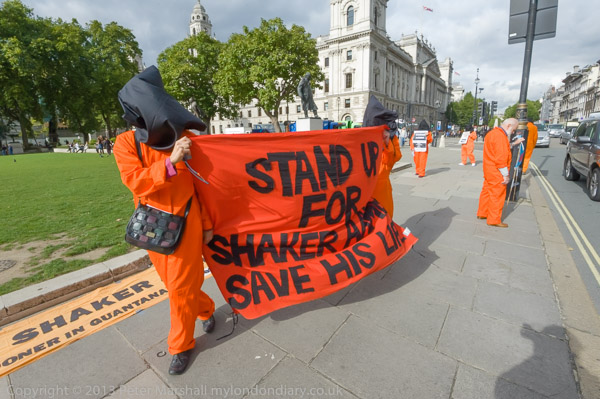
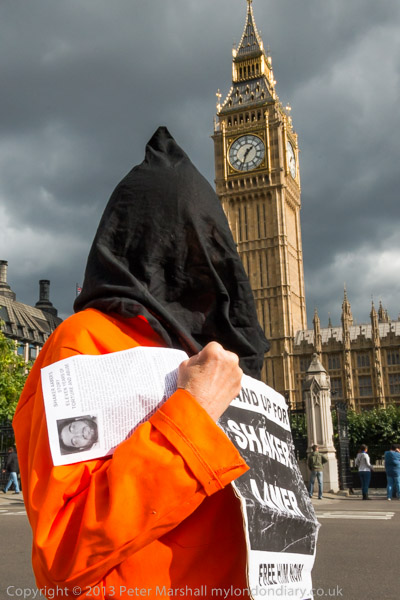
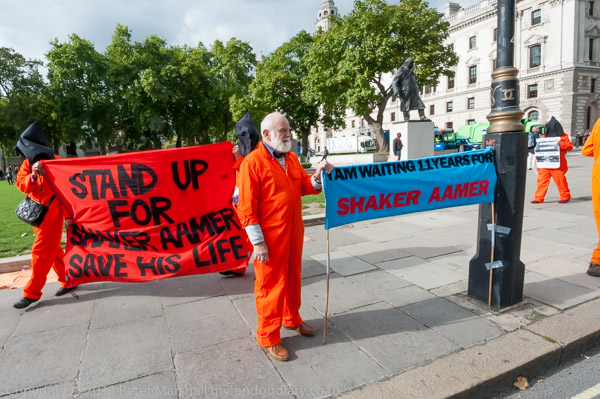
I paid a short visit to the campaigners from the Save Shaker Aamer Campaign who earlier in the year been holding a lunchtime protest on the pavement in Parliament Square facing the Houses of Parliament, standing out in their orange jumpsuits and black hoods on every day parliament was in session.
Shaker Aamer, a British resident still then held at Guantánamo was one of the first to be sent there after having been handed over the the US authorities for a cash reward. Although there was no evidence against him he had suffered years of torture in which the UK intelligence services had been implicated. Despite being cleared for release in 2007 and again in 2010 he was still being held, probably because his testimony when released would cause severe embarrassment to both US and UK intelligence agencies.
This protest was the start of a new series of regular weekly vigils seeking to draw attention to the failures of both President Obama and David Cameron, as well as demanding a full Parliamentary debate about Shaker’s case.
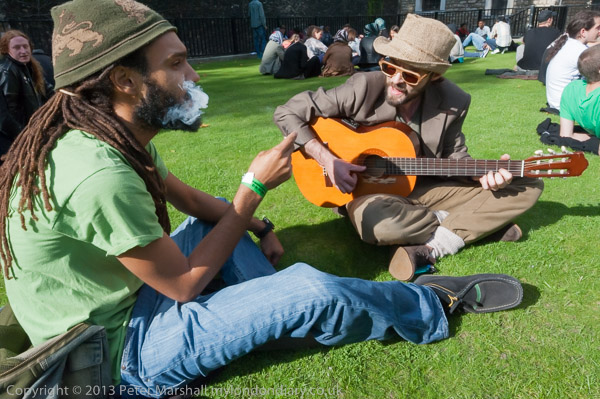
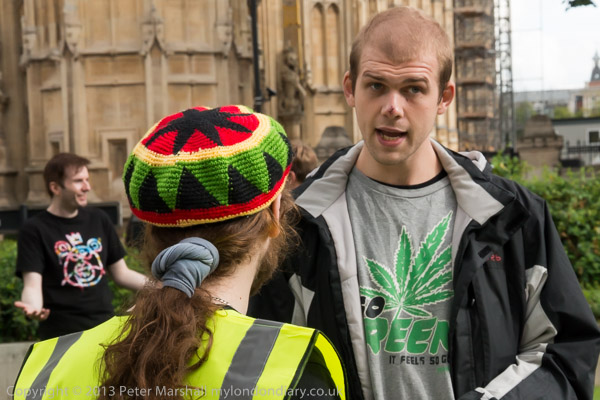
Campaigners had come to College Green, close to the Houses of Parliament to call for reform of the laws about cannabis, in particular to allow its medical use for MS sufferers. Legal medical cannabis is mainly available here to MS sufferers who can afford to pay its very high price.
Unsurprisingly it was a rather laid back protest, beginning rather late and not really getting started the whole 90 minutes I was there before giving up and going home as they were still waiting for the megaphone or PA system to arrive.
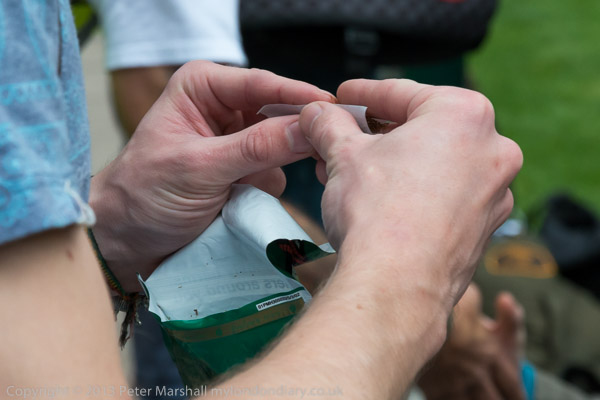
By the time I left there were quite a few people sitting around on the grass smoking. As I commented in a caption, the photographs don’t show what they were smoking, but the smell was unmistakable, and after I while I began to feel just a little unusual. Perhaps the two police officers who strolled over to take a look had no sense of smell or perhaps they simply felt that there was little point in taking any action.
Years ago I had to give lessons against drug use to 16-18 year olds as a part of a ‘personal and social education’ programme, and was aware that many of them had rather more experience in the area than me. But the materials from the Home Office that I relied on made clear that cannabis was considerably less harmful than alcohol or tobacco. Addiction to anything is a bad thing, but so too is the criminalisation that results from our current drug laws, which also fuel an illegal and highly profitable drug business. Appropriate reform, which would certainly include easier access for medicinal use, is long overdue.