Gunnersbury Park & Brentford – 2018

Gunnersbury Park & Brentford - 2018
Gunnersbury House Museum – the ‘Large Mansion

Gunnersbury Park & Brentford: Another family outing on Friday 24th August 2018 took us to Gunnersbury House Museum, a free museum jointly owned by the London Borough of Hounslow and the London Borough of Ealing. It turned out to be considerably more interesting than I expected.

Gunnersbury Park & Brentford - 2018
Lionel Road – now the site of Brentford Community Stadium

The 200 acre Gunnersbury estate was bought in 1925 from the Rothschild family by Ealing Borough Council and Acton Borough Council for £130,000, although it was all actually just outside their areas and in Brentford Urban District. They wanted to build over it, but the Rothschilds stipulated that all except a small part of it it was only to be used for leisure and recreation and it was opened to the public as a park by Neville Chamberlainn, then Minister of Health, in 1926.

Gunnersbury Park & Brentford - 2018
The elevated section of the M4 above the Great West Rd

Development of the site as a ‘country estate’ on the outskirts of London had begun in the late 17th century when the first large mansion, Gunnersbury House was built around 1663. The estate passed through various hands including wealthy merchant and MP Henry Furnese who had noted landscape designer William Kent give the park a makeover. Next Princess Amelia, favourite daughter of George II, had further changes made to the grounds for her famous parties there, including building a bathhouse.

Gunnersbury Park & Brentford - 2018
The temple is the only 18th century building remaining on site

The first mansion was demolished in 1801 and the estate was split into two adjoining estates each with a new mansion.

Gunnersbury Park & Brentford - 2018
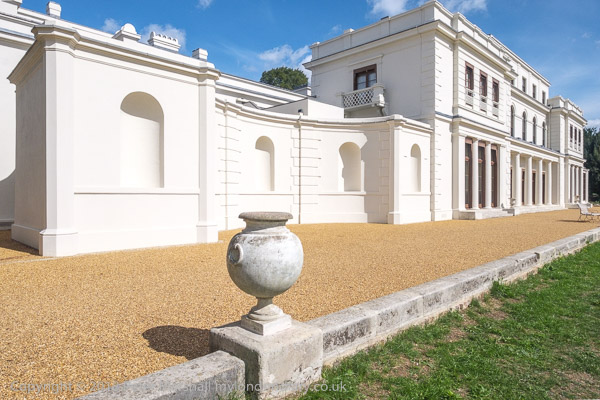
A long series of rooms faces the garden in the ‘Large mansion’

The Grade II* listing for the ‘Large Mansion’ states it was built in “1801-28 by and for Alexander Copland; remodelled 1836 by Sydney Smirke for Nathan Mayer Rothschild, the City financier and Frankfurt-born founder of the British branch of this famous international Jewish banking dynasty.”

Gunnersbury Park & Brentford - 2018
The ‘Small Mansion’ still in rather poor condition

Next door the “Small Mansion”, on the site of the former mansion was built in 1801-1802 for Stephen Cosser according its Grade II listing, though other sources place it a few years later. It was extended with a service wing in 1837-44 by eccentric “Rogue Gothic” architect Joseph Peacock (1821–1893).
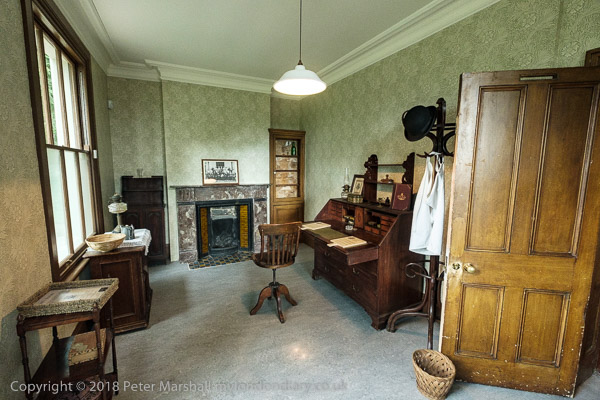
The Rothschilds had two French chefs who shared this office

The Rothschilds bought the Large Mansion (now the museum) and its gardens and park in 1835, adding the Small Mansion and its grounds in 1889 to recreate the now Grade II* listed Gunnersbury Park.

Large prints from Leopold de Rothschild’s Autochromes show the place as it was over a hundred years ago – with flamingos

I walked with Linda to the park from Kew Bridge Station along Lionel Road “with some difficulty as it is now a building site and crossed the Great West Road under the overhead M4, a Ballardian trek past the old and closed castellated gate to the park to enter into a sylvan wilderness, walking past the Potomac lake and its gothic folly.”

The garden slopes down from the house to a lake

Older members of our party took a shorter walk from the underground at Acton Central. Lionel Road is now overlooked by Brentford Community Stadium opened in 2020.
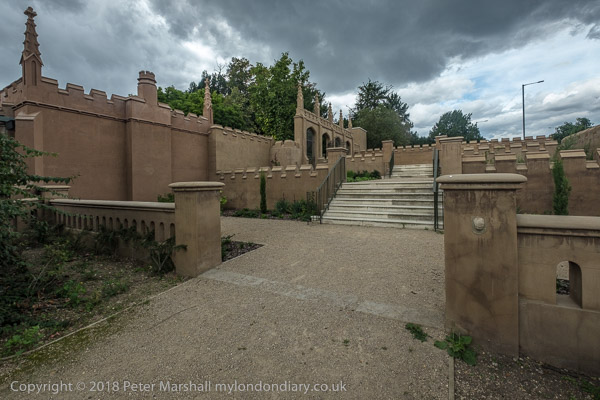
Princess Amelia’s Bath House

The park is certainly worth a visit and on My London Diary you can read more about what were for me the two highlights.These were the huge Rothschild’s kitchens where meals, not generally kosher, were prepared under the supervision of two French chefs, and a display of large prints from the Autochromes taken by Leopold de Rothschild using the first practical colour photography process patented by the Lumiere brothers in 1903 and sold to the public from 1907.
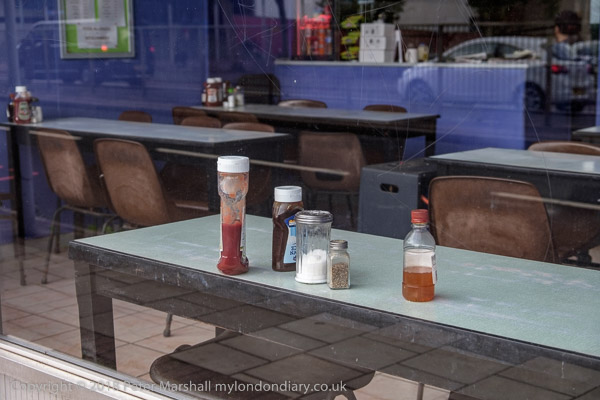
I made a new picture as we passed a cafe I photographed almost 30 years earlier on our way to Kew Bridge

We ate, not from those kitchens but from the modern park café, “tasty but rather insubstantial, and if you visit and are hungry, I’d advise a side order of chips” – or a short walk to a cheaper place near Acton Town station.
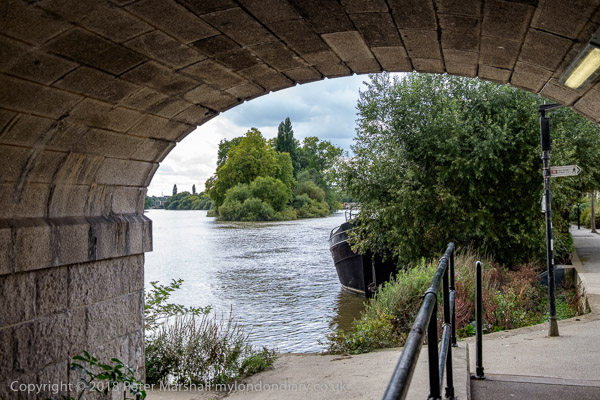
The Thames and Brentford Ait from under Kew Bridge

After the meal we said goodbye to the others and took a longer walk around the park before walking back to Kew Bridge station. With almost half and hour to wait for the next train we took a short walk by the River Thames to Brentford High Street and back.
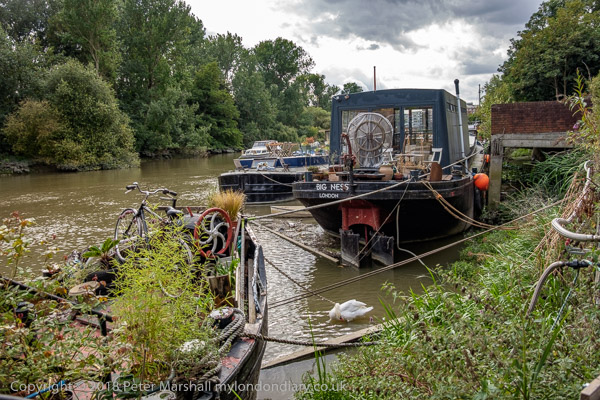
Mooring on The Hollows

You can read more about our trip to the park and the museum and see many more pictures from the day on My London Diary at Gunnersbury Park & Brentford.


FlickrFacebookMy London DiaryHull PhotosLea ValleyParis
London’s Industrial HeritageLondon Photos

All photographs on this page are copyright © Peter Marshall.
Contact me to buy prints or licence to reproduce.


Chiswick Cottage and Lionel Road Brentford – 1990

Chiswick Cottage and Lionel Road Brentford: The previous post from my walk on Sunday 7th January 1990 was BHS, Rolls-Royce, Pubs & Funerals, Hammersmith – 1990

St Alban's Cottage, 164, Duke Rd, Chiswick, Hounslow, 1990, 90-1e-43
St Alban’s Cottage, 164, Duke Rd, Chiswick, Hounslow, 1990, 90-1e-43

I can’t now remember how I got to Duke Road from Hammersmith – either by walking through some of the back streets or by taking a bus to Hogarth Lane where a footpath, Devonshire Passage, leads to Duke Road by the side of St Alban’s Cottage, a detached house dating from 1871.

This is on the Glebe Estate, formerly an open filed providing an income to the vicar of St Nicholas Church, Chiswick and owned by the Ecclesiastical Commissioners and St Paul’s Cathedral who let it for building in 1869. As Gillian Clegg remarks, “That charming little enclave of Victorian cottages between Duke Road and Devonshire Road, Glebe Street and Fraser Street has become one of the most desirable, not to say expensive, places in which to live, which is somewhat ironic since the houses were built as homes for Chiswick’s less affluent.” And this is probably the most charming of the cottages in the area.

RSR Fasteners, Station House, Lionel Rd, Kew Bridge, Brentford, Hounslow, 1990, 90-1e-45

I went up Duke Road to the Chiswick High Road in Turnham Green and I think probably jumped on another bus to Kew Bridge.

Lionel Road South runs from beside Kew Bridge Station to the Great West Road and is now dominated by Brentford Football Club’s Gtech Community Stadium. RSR Fasterners in Station House was close to the corner with Kew Bridge Road. All of the land in this area had been railway land and was important for bringing passengers and coal from the north of England in the 1850s. In 1990 this building was still on the edge of the station’s freight yard as the sign directing deliveries indicates. The company RSR Fasteners was founded in 1948 and moved here the following year. The business is now based in Hayes.

Signage, Lionel Rd, Kew Bridge, Brentford, Hounslow, 1990, 90-1e-31

At the back of the signs here for Tunnel Cement, Brentford Commercials and others is a sign for the British Rail Freight Yard, although some sources say the goods yard closed in 1967. In the background you can see Kearney’s large shed and beyond it the Agfa building on the Great West Road.

Rydal Engineering, Agfa, Lionel Rd, Kew Bridge, Brentford, Hounslow, 1990, 90-1e-35

The Agfa building was extensively refurbished and became 27 West but the rest was swept away with the development of the new Brentford stadium. There are now further plans for the development of the area.

I’m not sure that the rather rusted vehicle here was a good advert for the servicing provided by the Tony Western Garage.

Rydal Engineering, Agfa, Lionel Rd, Kew Bridge, Brentford, Hounslow, 1990, 90-1e-36

Another view of Rydal Engineering and to the right of the Volvo lorry is Kearneys, with the Agfa building again in the background.

Agfa were one of the pioneers of colour negative film, introducing Agfacolor in 1932 and I’d occasionally used Agfa film, but they had failed to keep up with others and almost all of the colour I have put online was taken on Fujicolor – and when I made prints in the darkroom they were all on Fuji paper – except for the project ‘German Indications’ which I printed from transparencies on outdated Agfa reversal paper.

Flats, Green Dragon Lane from Lionel Rd, Kew Bridge, Brentford, Hounslow, 1990, 90-1f-55

Looking across Lionel Road was a parking yard protected by a tall fence, The railway line is lower down and out of sight beyond this, and the four tall blocks of flats are on Green Dragon Lane. Here is what I wrote about when they appeared in a picture from an earlier walk:

Six 23 storey blocks were built here as the Brentford Towers Estate in 1968 to 1972 by the London Borough of Hounslow.

Green Dragon Lane apparently got its name from a 17th century pub but there appears to be no record of where this was, though there are or were around 40 other pubs of that name elsewhere in the country. The name is usually thought either to have come from the Livery Badge worn by servants of the Herbert family, the Earl of Pembroke, which showed a bloody arm being eaten by a dragon or a reference to King Charles II’s Portuguese Catholic queen, Catherine of Braganza whose family badge was the Green Wyvern.

More from Brentford later.


FlickrFacebookMy London DiaryHull PhotosLea ValleyParis
London’s Industrial HeritageLondon Photos

All photographs on this page are copyright © Peter Marshall.
Contact me to buy prints or licence to reproduce.