Gunnersbury Park & Brentford – 2018

Gunnersbury Park & Brentford - 2018
Gunnersbury House Museum – the ‘Large Mansion

Gunnersbury Park & Brentford: Another family outing on Friday 24th August 2018 took us to Gunnersbury House Museum, a free museum jointly owned by the London Borough of Hounslow and the London Borough of Ealing. It turned out to be considerably more interesting than I expected.

Gunnersbury Park & Brentford - 2018
Lionel Road – now the site of Brentford Community Stadium

The 200 acre Gunnersbury estate was bought in 1925 from the Rothschild family by Ealing Borough Council and Acton Borough Council for £130,000, although it was all actually just outside their areas and in Brentford Urban District. They wanted to build over it, but the Rothschilds stipulated that all except a small part of it it was only to be used for leisure and recreation and it was opened to the public as a park by Neville Chamberlainn, then Minister of Health, in 1926.

Gunnersbury Park & Brentford - 2018
The elevated section of the M4 above the Great West Rd

Development of the site as a ‘country estate’ on the outskirts of London had begun in the late 17th century when the first large mansion, Gunnersbury House was built around 1663. The estate passed through various hands including wealthy merchant and MP Henry Furnese who had noted landscape designer William Kent give the park a makeover. Next Princess Amelia, favourite daughter of George II, had further changes made to the grounds for her famous parties there, including building a bathhouse.

Gunnersbury Park & Brentford - 2018
The temple is the only 18th century building remaining on site

The first mansion was demolished in 1801 and the estate was split into two adjoining estates each with a new mansion.

Gunnersbury Park & Brentford - 2018
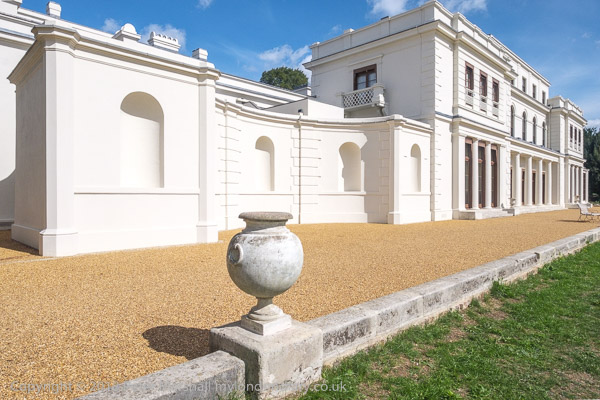
A long series of rooms faces the garden in the ‘Large mansion’

The Grade II* listing for the ‘Large Mansion’ states it was built in “1801-28 by and for Alexander Copland; remodelled 1836 by Sydney Smirke for Nathan Mayer Rothschild, the City financier and Frankfurt-born founder of the British branch of this famous international Jewish banking dynasty.”

Gunnersbury Park & Brentford - 2018
The ‘Small Mansion’ still in rather poor condition

Next door the “Small Mansion”, on the site of the former mansion was built in 1801-1802 for Stephen Cosser according its Grade II listing, though other sources place it a few years later. It was extended with a service wing in 1837-44 by eccentric “Rogue Gothic” architect Joseph Peacock (1821–1893).
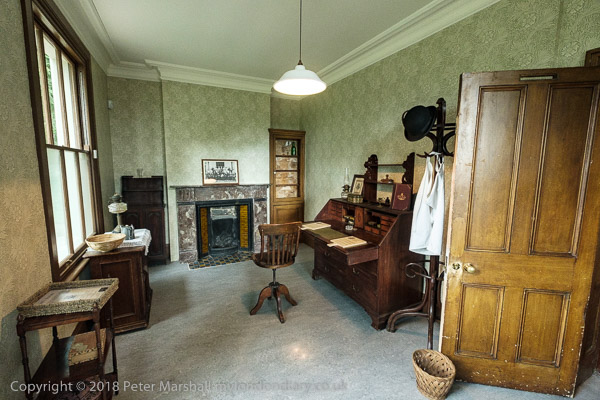
The Rothschilds had two French chefs who shared this office

The Rothschilds bought the Large Mansion (now the museum) and its gardens and park in 1835, adding the Small Mansion and its grounds in 1889 to recreate the now Grade II* listed Gunnersbury Park.

Large prints from Leopold de Rothschild’s Autochromes show the place as it was over a hundred years ago – with flamingos

I walked with Linda to the park from Kew Bridge Station along Lionel Road “with some difficulty as it is now a building site and crossed the Great West Road under the overhead M4, a Ballardian trek past the old and closed castellated gate to the park to enter into a sylvan wilderness, walking past the Potomac lake and its gothic folly.”

The garden slopes down from the house to a lake

Older members of our party took a shorter walk from the underground at Acton Central. Lionel Road is now overlooked by Brentford Community Stadium opened in 2020.
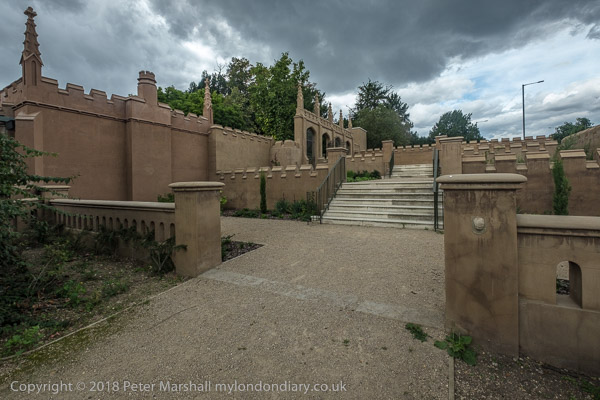
Princess Amelia’s Bath House

The park is certainly worth a visit and on My London Diary you can read more about what were for me the two highlights.These were the huge Rothschild’s kitchens where meals, not generally kosher, were prepared under the supervision of two French chefs, and a display of large prints from the Autochromes taken by Leopold de Rothschild using the first practical colour photography process patented by the Lumiere brothers in 1903 and sold to the public from 1907.
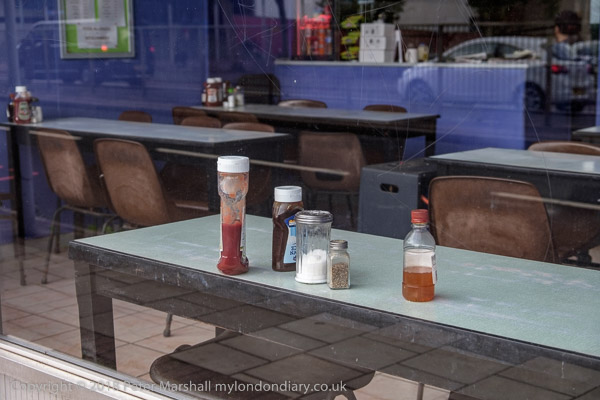
I made a new picture as we passed a cafe I photographed almost 30 years earlier on our way to Kew Bridge

We ate, not from those kitchens but from the modern park café, “tasty but rather insubstantial, and if you visit and are hungry, I’d advise a side order of chips” – or a short walk to a cheaper place near Acton Town station.
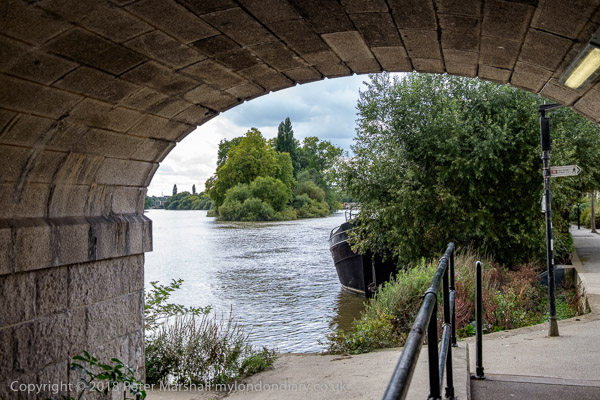
The Thames and Brentford Ait from under Kew Bridge

After the meal we said goodbye to the others and took a longer walk around the park before walking back to Kew Bridge station. With almost half and hour to wait for the next train we took a short walk by the River Thames to Brentford High Street and back.
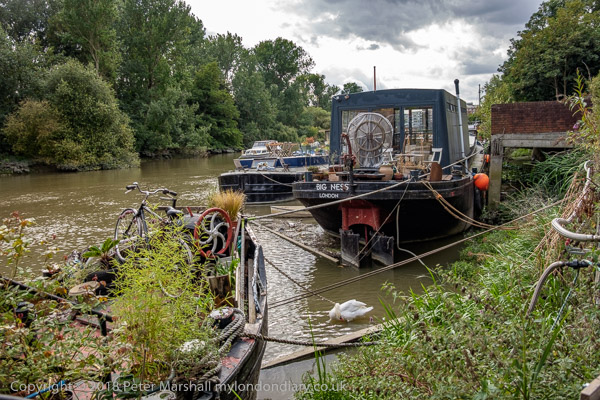
Mooring on The Hollows

You can read more about our trip to the park and the museum and see many more pictures from the day on My London Diary at Gunnersbury Park & Brentford.


FlickrFacebookMy London DiaryHull PhotosLea ValleyParis
London’s Industrial HeritageLondon Photos

All photographs on this page are copyright © Peter Marshall.
Contact me to buy prints or licence to reproduce.


Kew Bridge & Gunnersbury 1989

Kew Bridge & Gunnersbury 1989: I didn’t get our for a walk again in 1989 until the 10th of December, probably partly because of the weather with drizzle, mist, fog and some very cold days. But it was just a little warmer and I decided to go out. But at this time in London sunset is before 4pm and so I decided to take pictures fairly close to home so I could make an earlier start. Kew Bridge station is only around a half hour journey from my home.

Brentford, from Footbridge, Kew Bridge Station, Kew Bridge, Hounslow, 1989 89-11i-42

I made my first picture from the footbridge in the station taking me to the station exit. As you can see the station buildings were in pretty poor condition. The view includes the local landmark water pumping tower and the top of the engine house of Kew Bridge Engines, opened as a remarkable museum in 1975 (now renamed as London Museum of Water & Steam) and the tower blocks further down Green Dragon Lane. Six 23 storey blocks were built here as the Brentford Towers Estate in 1968 to 1972 by the London Borough of Hounslow.

Green Dragon Lane apparently got its name from a 17th century pub but there appears to be no record of where this was, though there are or were around 40 other pubs of that name elsewhere in the country. The name is usually thought either to have come from the Livery Badge worn by servants of the Herbert family, the Earl of Pembroke, which showed a bloody arm being eaten by a dragon or a reference to King Charles II’s Portuguese Catholic queen, Catherine of Braganza whose family badge was the Green Wyvern.

Kew Bridge station gets rather crowded at times now, as Brentford’s new football stadium is next door.

Spenklin House, Gunnersbury Avenue, Gunnersbury, Hounslow, 1989 89-11i-46

I walked up to Gunnersbury Avenue where on the north-east corner of the Chiswick roundabout was this magnificently derelict former works of Spenklin Ltd. They appear to have made Power-operated work clamping devices and other engineering tools including boosters, clamps, cylinders and hydraulic ram heads. The company name was a contraction of Spencer Franklin. I think the next factory along – demolished by the time I took this – had been Permutit water softeners.

I think this building probably dates from around 1925 when the Brentford Bypass – soon better known as the Great West Road – was opened. The roundabout here came later along with its flyover in 1959.

Spenklin House, Gunnersbury Avenue, Gunnersbury, Hounslow, 1989 89-11i-31

A closer view of the entrance with its boards showing it had been acquired by Markheath Securities PLC a London property developer, though 49 per cent owned by The Adelaide Steamship Co Ltd. They appear to have been responsible for several developments in the area and to have made Section 106 contributions to Hounslow Council for improvements to nearby Gunnersbury Park.

National Tyres, Gunnersbury Avenue, Gunnersbury, Hounslow, 1989 89-11i-33

My memory – often false – tells me that this was on the west side of Gunnersbury Avenue (the North Circular Road) to Spenklin House and I think is probably from the same era. At least it is clear what the business of the National Tyre Service was and the building has a rather fine squad of Michelin men.

Chiswick Rd, Acton Lane, Chiswick Park Station, Chiswick Park, Houslow, Ealing, 1989 89-11i-36

Quite a long walk along Chiswick High Road took me to Acton Lane where I took this picture on the corner of Chiswick Road. A station was built here in 1879 when the District Railway was extended from Turnham Green to Ealing Broadway, but clearly that in the distance here is from the 1930s.

On the corner we have a rather unremarkable post-war building but with some rather remarkable Christmas decorations. The long shop front is now divided into separate shops.

Chiswick Park Station, Chiswick Park, Ealing, 1989 89-11i-23

A closer view of Chiswick Park Station, one of many characteristic stations by architect Charles Holden for London Underground and built in 1931-2. Holden’s first complete Underground stations were built on the Northern Line southern extension from 1926, but he later designed many more. This station remains almost as it was built and shares its features with many of his others. It was Grade II listed in 1987.

Chiswick Park Station, Chiswick Park, Ealing, 1989 89-11i-1

The interior of the tall drum-shaped ticket hall with a shop, Midas Gold Exchange at right. Useful signs above the exit tell the way to buses and to Acton Green, while the lower advertising panels are all for Underground posters. The Underground were pioneers in various ways in advertising – not least in the tall tower at this and other stations whose main if not only purpose was to carry their branding with the trade-mark roundel and station name.

I think the brick building at left which I think housed the ticket office was perhaps a later addition to the building which otherwise has been altered little.

To be continued.


FlickrFacebookMy London DiaryHull PhotosLea ValleyParis
London’s Industrial HeritageLondon Photos

All photographs on this page are copyright © Peter Marshall.
Contact me to buy prints or licence to reproduce.


South Ken, Earls Court and further west

The final selection of images from my black and white photographs of London in 1987, taken in December.

Collingham Gardens,South Kensington, Kensington & Chelsea, 1987  87-12f-62-positive_2400
Collingham Gardens,South Kensington, Kensington & Chelsea, 1987

A couple of doorways from the area largely built in the 1880s to the varied designs of George and Peto, with motifs borrowed from a range of cities across Europe.

Collingham Gardens,South Kensington, Kensington & Chelsea, 1987 87-12f-63-positive_2400
Collingham Gardens,South Kensington, Kensington & Chelsea, 1987

You can read more about the architects in my previous post on the area.

Bolton Gardens, South Kensington, Kensington & Chelsea, 1987  87-12f-44-positive_2400
Bolton Gardens, South Kensington, Kensington & Chelsea, 1987

A LCC blue plaque records that Sir Edwin Arnold (1832-1904) lived and died at 31 Bolton Gardens. He spent five years in India as a college principal and return in 1861 to work as a journalist on the Daily Telegraph, later becoming its editor, and he, together with the New York Herald sent explorer H M Stanley, who had three years earlier discovered David Livingstone, to explore the course of the Congo River.

But he was best known in the Victorian era for his book of eight poems, The Light of Asia, an Indian epic about Prince Gautama of India, the founder of Buddhism, along with other poetic works on India and the far east. Mahatma Gandhi admired his poetic English translation of the Bhagavad Gita, The Song Celestial and invited him to be vice-president of the UK Vegetarian Society. Widely decorated at the time, Arnold and his work are now largely and probably deservedly forgotten.

Barkston Gardens, South Kensington, Kensington & Chelsea, 1987  87-12f-32-positive_2400
Barkston Gardens, Earls Court, Kensington & Chelsea, 1987

Barkston Gardens a short walk from Earls Court station was built from 1886 as a part of the Gunter estate, with houses by several developers. These flats have shops on the Earls Court Rd on their west side and on the east the long still private communal garden around which Barkston Gardens was developed. Previously this had been the site of Earl’s Court House.

Hogarth Place, Earl's Court, Kensington & Chelsea, 1987  87-12e-64-positive_2400
6 Hogarth Place, Earls Court, Kensington & Chelsea, 1987

Hogarth Place is directly opposite the Earls Court Road exit from Earls Court Station, and seems to integrate seamlessly with Hogarth Road for its first section. Although there are still shops along here, the cacophony of signage is now considerably muted, though the New Asia is still there.

Cromwell Rd, South Kensington, Kensington & Chelsea, 1987 87-12f-13-positive_2400
Hotels, Cromwell Rd, South Kensington, Kensington & Chelsea, 1987

Cromwell Road is the busy A4, and perhaps not the quietest place for a hotel, but there are still many along it. I think this is now the Crown Plaza near Gloucester Rd station.

Sales Office, Cromwell Rd, South Kensington, Kensington & Chelsea, 1987  87-12f-22-positive_2400
Sales Office, Point West, Cromwell Rd, South Kensington, Kensington & Chelsea, 1987

Until the end of 1973 passengers for British European Airways (BEA) flights from Heathrow could check in at the West London Air Terminal on Cromwell Road, from where coaches would take them along the A4 to the airport. The terminal was built where a short disused section of railway line called the Cromwell Curve had connected the District Line close to Gloucester Road station to allow trains to go to High Street Kensington avoiding a section of Metropolitan Line track. The building, by Sir John Burnet, Tait and Partners was opened in 1963 replacing a temporary facility and had six floors of BEA offices above the concourse. After the closure part of the building became a Sainsbury’s Superstore and the rest was converted into flats, including many now used for short-term rentals by tourists.

Cromwell Rd, South Kensington, Kensington & Chelsea, 1987  87-12f-12-positive_2400
Cromwell Rd, South Kensington, Kensington & Chelsea, 1987

Christmas was coming and the Lorenzaccio Club was offering Christmas Parties ‘Lorenzo’s Way’ with a fine winged lion and a curious crescent moon sign supporting a rather sad-looking hanging basket. I didn’t go in to enquire.

Latimer Rd, Notting Hill, Kensington & Chelsea, 1987 87-12e-61-positive_2400
Latimer Rd, Notting Hill, Kensington & Chelsea, 1987

The view from the west end of the platform at Latimer Rd Station as I waited for a train to Hammersmith.

Wellesley Rd, Gunnersbury, Hounslow, 198787-12e-62-positive_2400
Wellesley Rd, Gunnersbury, Hounslow, 1987

You can still see this row of houses with unusual facades topped by a faux balustrade reminding me of icing on a cake on Wellesley Rd though I think one of those shown here has since lost its topping.

There are a few more photographs I haven’t featured here on page 8 of my 1987 London Photos.