CETA, Iraq, Highwalks & HP: On Friday 26th September 2014 I photographed a protest against the finalising of CETA, a trade agreement between Canada and the EU negotiated in secret which would allow large companies to challenge democratic decisions taken by governments. After this I went to College Green, until recently listed as a public park but now often closed by police to stop protesters appearing in TV interviews there of politicians, where people were attempting to protest against the bombing of Iraq.
From Westminster I went into the City of London and had time for a walk taking panoramic pictures mainly of the highwalks which are under threat of demolition to allow a higher density of commercial development before photographing a picket at Hewlett-Packard’s offices against their major role in IT support of the Israeli war machine.
CETA Trade Deal Threat to Democracy
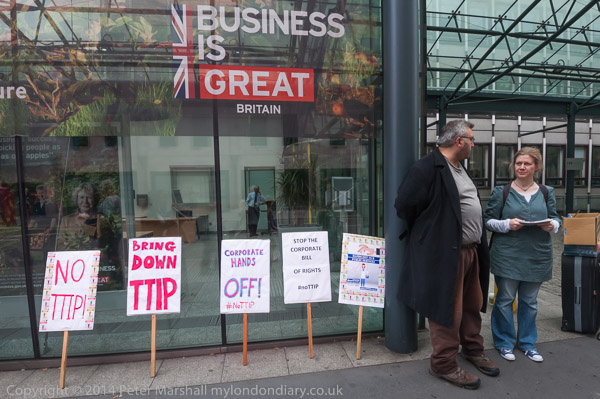
Dept Business, Innovation & Skills
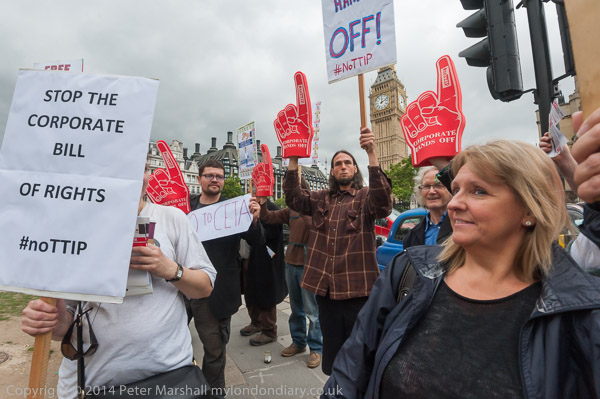
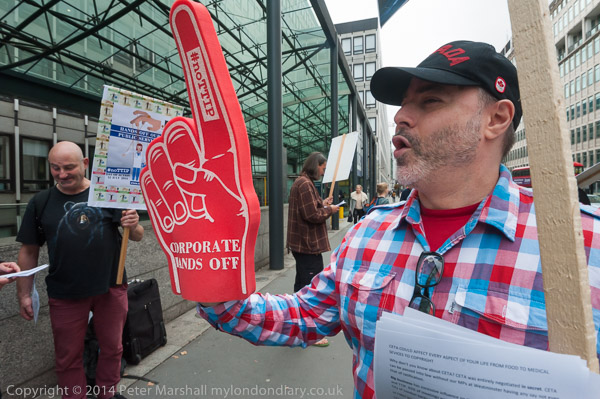
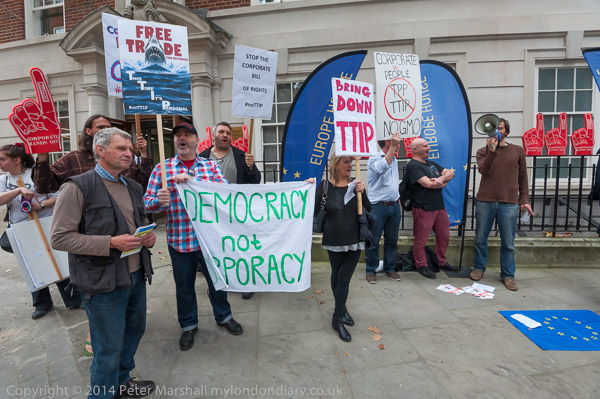
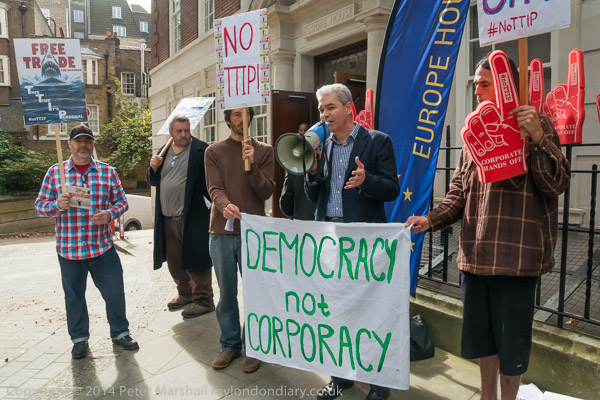
War on Want, the World Development Movement, Occupy London and others came to protest when it became known that the EU and Canada were today to initial the CETA Treaty which would hand over unchallengeable powers to big business to override governments and democracy, and put company profits above all other interests. This was a small emergency protest called at very short notice in advance of a #noTTIP day of action to take place in London on 11th October 2014.
Negotiations over the treaty, the Canada and European Union (EU) Comprehensive Economic and Trade Agreement) and its wider equivalent TTIP (Transatlantic Trade and Investment Partnership) had been carried out in strict secrecy, with the documents on them to be locked away for thirty years.
The treaties include the process known as ISDS (Investor-State Dispute Settlement) which greatly affects the ability of governments to make legislation, with legal action bypassing UK and other national courts to be decided by international arbitration tribunals where the loss of potential profits come above any consideration of public interest.
In 2014 there were already around 500 documented cases of big companies attempting to use ISDS powers to challenge democratic decisions around the world, including A Swedish company suing Germany for phasing out nuclear power and a French company suing Egypt because they have increased the minimum wage and introduced other measures to improve the conditions of workers. The UK had dropped proposals for plain packaging for cigarettes as the companies had threatened they would sue as it would cut cigarette sales and so their profits.
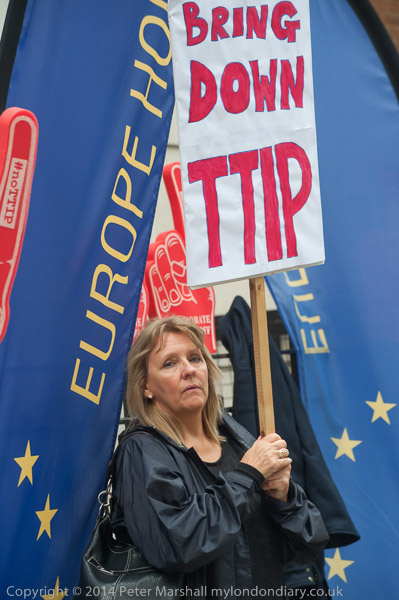
ISDS allows big business to challenge food safety regulation, green legislation and other vital measures, and curb protests against fracking and dirty energy, GMO, the arms trade and any other profitable corporate activities. It would also stop efforts to prevent the privatisation of the NHS.
The protest began outside the Dept of Business, Industry and Skills and went on to the London base of the European Parliament, stopping briefly outside the Houses of Parliament and handing out leaflets against the corporate power grab.
CETA was provisionally introduced in 2017 and has eliminated almost all existing tariffs and increased transatlantic trade but has not been ratified by ten EU states. The French Senate voted against it in 2024. Talks are now taking place on a replacement. Since Brexit is no longer applies in the UK and a new trade agreement with Canada came into force on 1 April 2021. ISDS continues under various other trade agreements.
CETA Trade Deal Threat to Democracy
Don’t bomb Iraq
Westminster
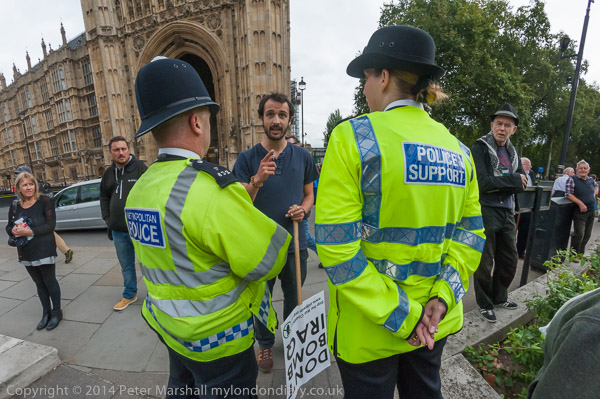
TV news often interview politicians on College Green, long always open to the public and housing a well-known Henry Moore statue, an small groups of protesters have often gone their to be seen and heard in the background of these interviews. And a few had come today when Parliament was debating the bombing of ISIS in Iraq
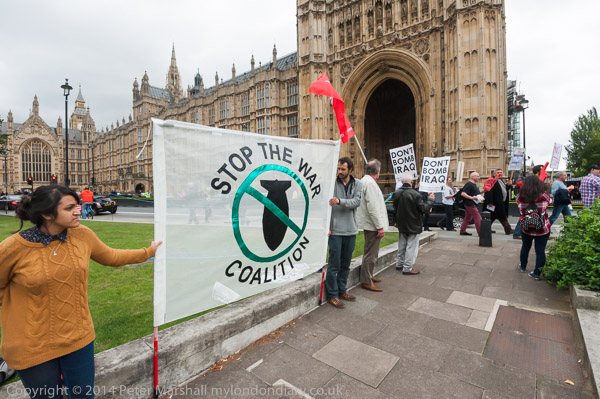
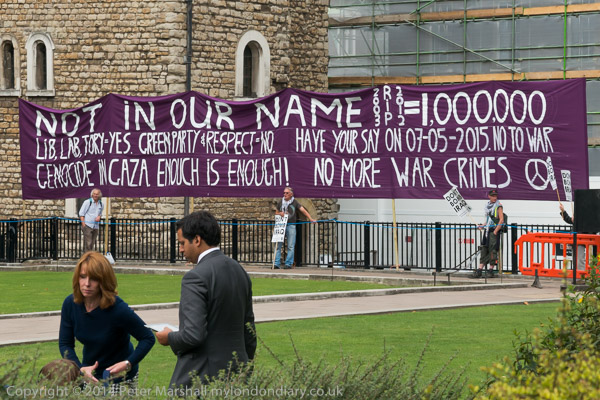
Until recently it had been listed as a public park by Westminster Council but in 2014 new notices were put up stating it was a part of the Parliamentary estate, and they reserve the right to close the area to the public at any time. The area is now often completely closed to the public and police stop protesters entering it while TV crews are working there.
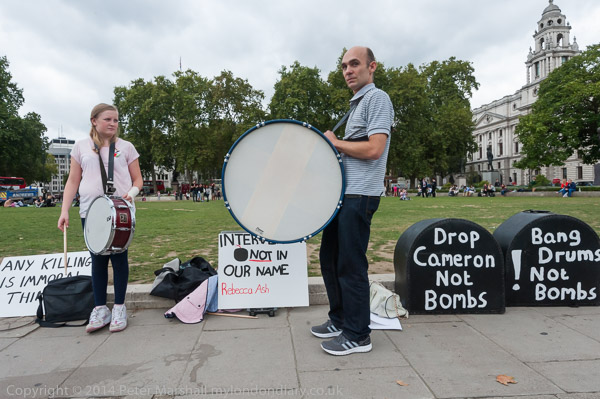
There was also a small group against the bombing protesting on the pavement in Parliament Square.
City Walk, High Walk
City of London
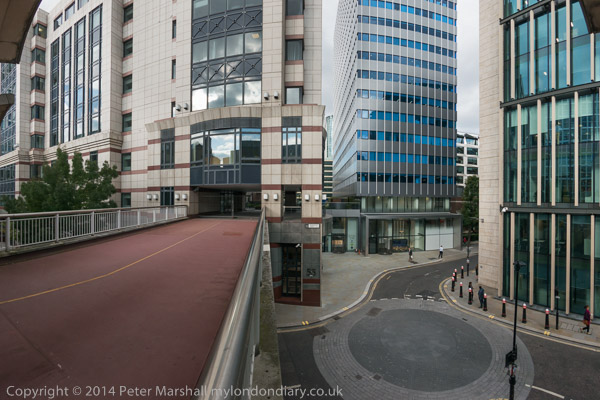
Planners for the rebuilding of the City of London after the devastation of the Second World War had created an ambitious plan for the separation of pedestrians and traffic in much of the city with a series of ‘highwalks’.
But it was only ever implemented in limited areas of the City in particular around London Wall and the Barbican and where a new road, Upper and Lower Thames Street cut through the old City close to the River Thames. Despite the extensive bomb damage, much of the old London remained firmly at Street level.
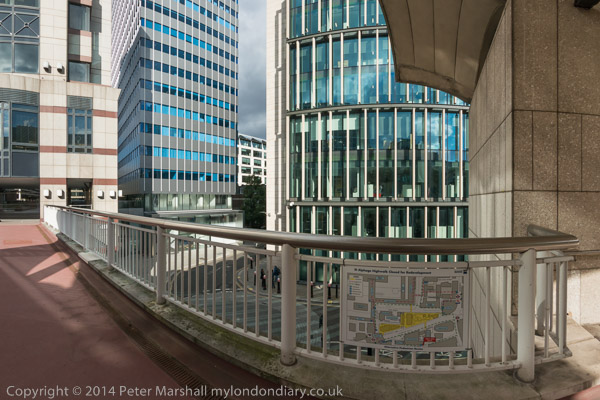
Back in the 1980s and 1990s I had photographed extensively from these highwalks and in the 90s made a number of panoramic images which were exhibited and published.
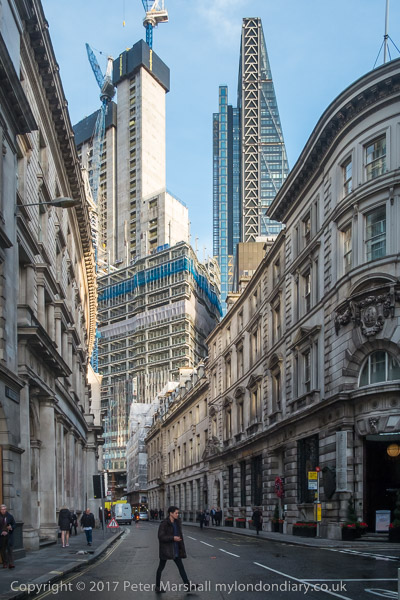
In 2014 much of the highwalks south of London Wall and a large area directly to the north were being demolished to allow a higher density of commercial development in the area and I took a short walk to photograph some of what remained. In the 1990s I had worked with specialised swing-lens panoramic film cameras, but now I was able to work much more easily with a digital camera and software.
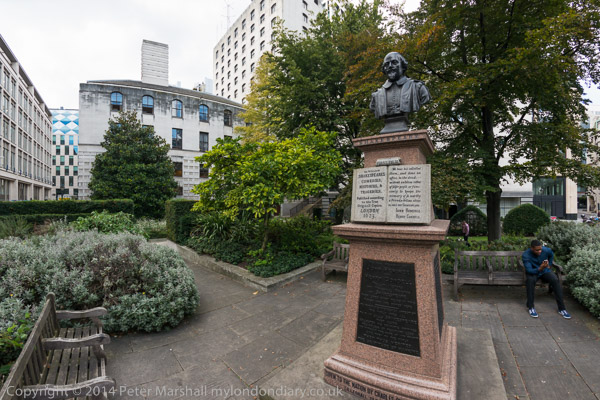
As well as on the highwalks I also made images at street level, particularly in the area around the Guildhall. The digital panoramas have a much wider vertical angle of view than my earlier film images and are here shown in full in a normal 3:2 aspect ratio, though usually I have cropped them top and bottom to a more panoramic format such as 16:9.
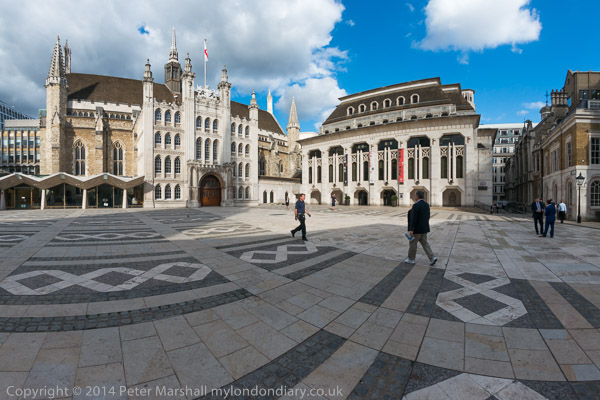
More at City Wall, High Walk.
Hewlett Packard Stop Supporting Israeli Military
Wood St, City
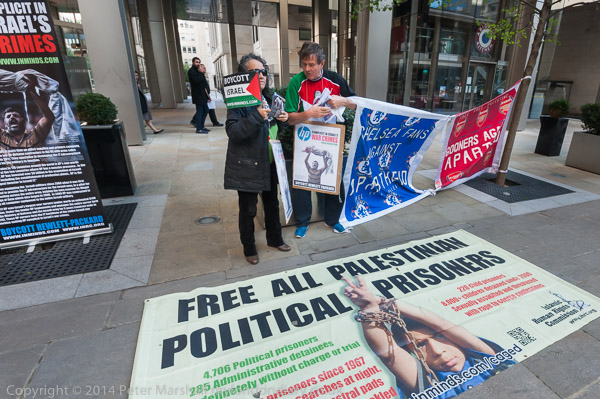
I had previously photographed protests by the Inminds human rights group Palestinian Prisoners Campaign outside the offices of security firm G4S, where 2 years of pickets perhaps played a part in their decision to pull out of Israeli prisons.
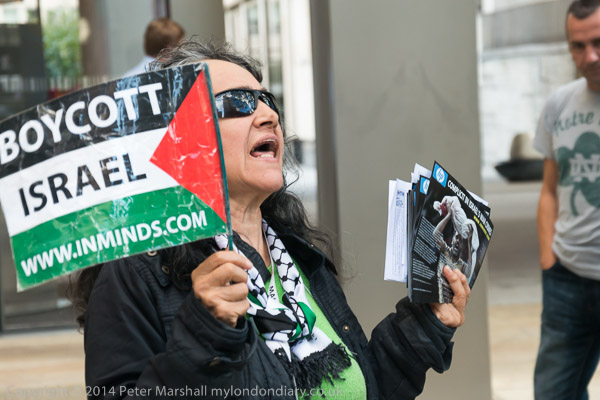
They had decided now to picket at Hewlett-Packard which boasts of ‘a massive presence’ in Israel and are the IT backbone for the Israeli war machine.
More pictures: HP told Stop Supporting Israeli Military.
Flickr – Facebook – My London Diary – Hull Photos – Lea Valley – Paris
London’s Industrial Heritage – London Photos
All photographs on this page are copyright © Peter Marshall.
Contact me to buy prints or licence to reproduce.