More City of London Panoramas – 1994

More City of London Panoramas: This is the final set of picturesI’ll post from those I made while working on a personal project on the City of London in July 1994. Of course I took many which I’ve not digitised, spending several days walking the City and making over 300 exposures. The camera I used makes negatives on standard 35mm film which are wider than normal and a ’36 exposure’ film only gets around 20 or 21 panoramic frames. Film loading is also trickier as the film has to go around a curve.

Each exposure took a few minutes to select a viewpoint, set up my tripod, level the camera, use a handheld lightmeter to check exposure and finally press the cable release. Most of those not uploaded are similar to those I have posted with just minor changes to the view.
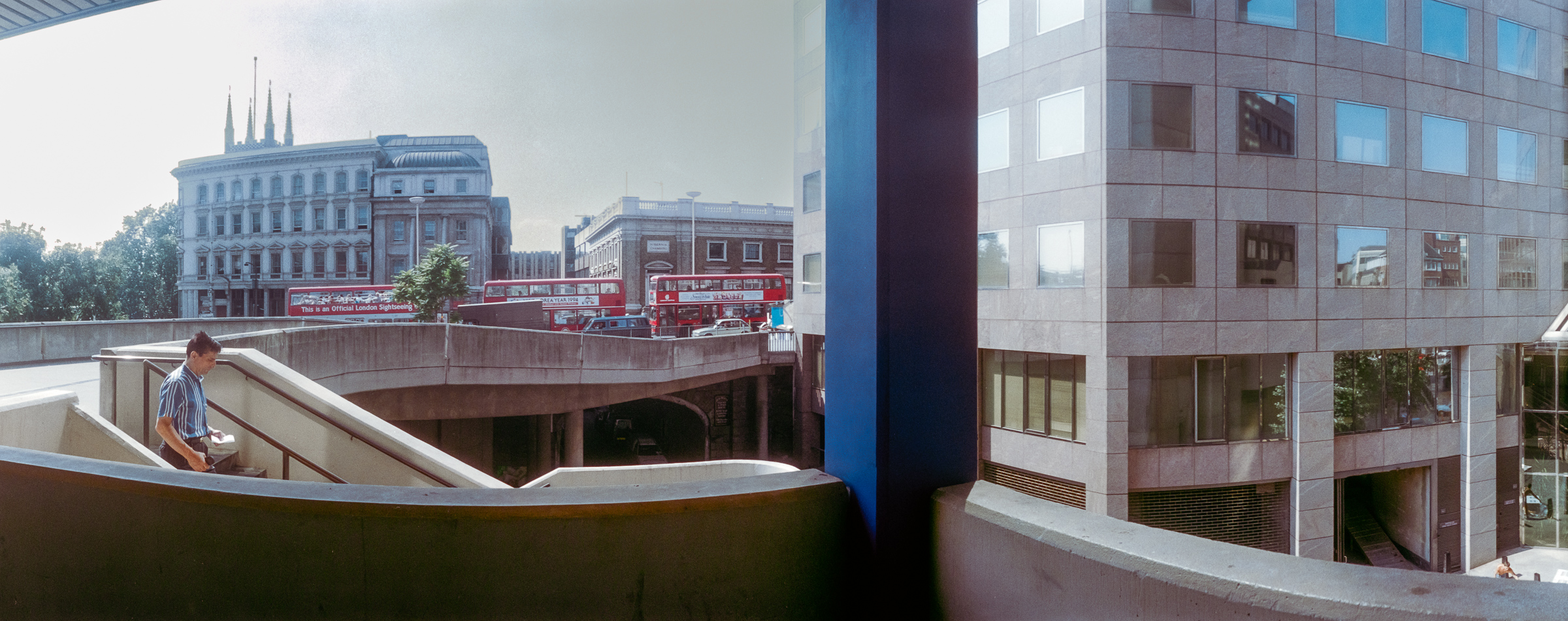
London Bridge Walk, Tooley St, Borough High St, Southwark, 1994, 94-711-52

Not quite in the City, but made as I made my way from London Bridge Station to London Bridge along London Bridge Walk. The road in the background is Borough High Street which leads on to London Bridge and the City boundary is in the middle of the river. You can just see the pinnacles on the top of the tower of Southwark Cathedral.

After the operation of the Waterloo & City underground line from Network South East to London Underground in April 1994 I could no longer use my ‘London Terminals’ ticket on this route, and my cheapest journey became to go to London Bridge on this and walk across to the City.

This is one of a few pictures I had digitised but missed when I was uploading these images to Flickr.

High Walk, Wood St, City, 1994, 94-713-42

Another exposure from the highwalk at Wood Street, leading south along the east side of the street away from London Wall. In the centre of the picture is the City of London Police Headquarters, with two white police vans at bottom right. Steps lead down from the walkway to Wood Street but the highwalk also continued straight on at extreme left – though with more steps.

In the centre of Wood Street at right is the tower of St Alban Wood Street. The medieval church was destroyed in the Great Fire and rebuilt by Sir Christopher Wren. The church was largely destroyed in the Blitz in 1940. The tower remained and was Grade II* listed in 1950 and is now a private house; the remains of the rest of the church were demolished in 1965.

Lower Thames St, King William St, City, 1994, 94-711-12

Again on my way from London Bridge Station to the centre of the City, this is made from where London Bridge joins to King William Street and goes across Lower Thames Street. You can see a highwalk bridge going across Lower Thames street a couple of hundred yards to the east, still there in 2025.

Until around 1970 Thames Street was a fairly narrow street, just wide enough to allow a single lane of traffic in both directions. It was then turned into a major road and divided at London Bridge into Lower and Upper Thames Street. At the left you can clearly see where older buildings were cut through to widen the road.

Bank Junction, City, 1994, 94-712-33

The heart of the City. I made the picture close to the corner of Mansion House Street and Princes Street with the Underground entrance on the corner. At left is a corner of the Bank of England and the main modern building towering above it is the Stock Exchange Tower, home to the Stock Exchange until 2004.

Towards the centre is the Royal Exchange, I think then still home to the International Financial Futures Exchange rather than just an upmarket shopping mall. Two buildings full of banks and insurance companies book-end Hawksmoor’s St Mary Woolnuth and at the extreme right is the edge of the Mansion House with a gilded lamp on its steps.

Milton Court, Silk Street, City, 1994, 94-713-21

Another section of highwalks ran from close to Moorgate Station to the Barbican Estate and these last four pictures show sections of this, which could also be accessed from Ropemaker Street. This northern section has now been lost.

Milton Court was designed by Chamberlin, Powell & Bon and built as a part of the Barbican development in 1959 for various City services – “a fire station, Coroner’s Court, mortuary, office of weights and measures and a civil defence school.”

It was arguably London’s most outstanding single post-war building and English Heritage wanted to list it in 2001, but the government’s Department of Culture, Media and Sport objected and in 2007 Secretary of State James Purnell granted it immunity from listing. In a sad act of cultural vandalism this remarkable building was demolished in 2008.

Milton Court, Silk Street, City, 1994, 94-713-12

The building which replaced Milton Court was also given the same name but is a much more bland modern structure. The bridge which linked to the northern section of highwalk disappeared.

The new 115m tall Milton Court is described on its builders Sir Robert McAlpine web site: “Climbing to 36 storeys, Milton Court redefines luxury living in the Square Mile. In addition to a graceful residential tower, the development is home to a spectacular new annexe to the Guildhall School of Music & Drama.” But to me it looks like just another tall city office block.

Highwalk, Ropemaker St, City, 1994, 94-715-52

This enclosed section of highwalk ran from Ropemaker Street to the bridge across Silk Street to the Speed Highwalk still there along the north side of Speed House.
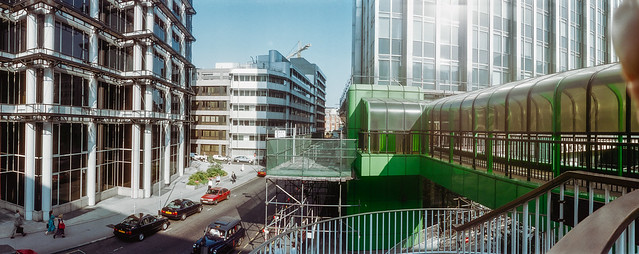
Ropemaker St, Islington, City, 1994, 94-715-32

Remarkably I think none of the buildings in this picture looking east along Ropemaker Street has ssurvived. Even the building at left, Ropemaker Place, a 60m high block which I photographed while it was being built in 1986 and was completed in 1987 and which I thought was one of the more attractive modern buildings in (or rather a few feet outside) didn’t last long and was demolished only 18 years later in 2005.

More colour from 1994 in later posts.


FlickrFacebookMy London DiaryHull PhotosLea ValleyParis
London’s Industrial HeritageLondon Photos

All photographs on this page are copyright © Peter Marshall.
Contact me to buy prints or licence to reproduce.


Shops, Soup Kitchen, Spitalfields 1989

Continuing my posts about my London walk which began with A Walk In the City – March 1989. The previous post was Men At Work, Cherubs, Trees and More.

Intercity (East) Ltd, Clothing, Shop, City, Tower Hamlets, 1989 89-3e-42

I was on my way to the East End, and I’m no longer sure where this shop was located, although my contact sheet has Cutler Street, it also has a question mark in front of this. I will have marked up the contact sheets while I still remembered my route (and had probably marked this on a map more or less after I got home) so I will have walked this way towards Leyden Street where I made the next picture. But all I can find on Google about Intercity (East) Ltd is not about clothing stores but trains.

Cutler Street begins on Houndsditch and I think both corners there have been demolished and rebuilt since 1989. It has two more corners where it turns 90 degrees to the right in front of Cutlers Gardens, again both now occupied by more recent buildings.

Cobb St, Spitalfields, Tower Hamlets, 1989 89-3e-43
6-10 Cobb St, Spitalfields, Tower Hamlets, 1989 89-3e-43

From Cutler Street I went up Harrow Place and crossed over Middlesex Street into Cobb Street, going out from the City of London into Tower Hamlets. Much of the area I went through has since been redeveloped but unfortunately I took no pictures.

Blue Bird, Childrens Wear, Cobb St, Spitalfields, Tower Hamlets, 1989, 89c03-04-71

Blue Bird, a wholesale children’s clothing cash and carry was a shopfront I also photographed in colour on this same walk. This building remains, though was extensively renovated internally around 2020 and 6 at right, Dunmow Trading, is again apparently in the clothing trade, though perhaps the renewed shopfront is a nod to the past hiding some completely different activities.

Brune St, Spitalfields, Tower Hamlets, 1989 89-3e-22

This was a frontage I passed and photographed several times over the years, but never went inside. Founded in 1854 in Leman St, the Soup Kitchen for the Jewish Poor moved to Brune Street (then Butler St) in 1902 and eventually closed in 1992, its work being carried on by Jewish Care in Beaumont Grove, Stepney. I had assumed it was now longer operating when I took this picture in 1989.

Shopfront, Fournier St, Spitalfields, Tower Hamlets, 1989 89-3e-11

Another shopfront I photographed on several occasions and in colour, and it was hard to decide which if any of the businesses were still in operation. Now the whole area has been tidied up and shops like these converted to slightly twee ‘period’ residential properties.

This early 18th century Grade II listed terrace house was sold in 1998 for £236,000, probably just before or after conversion, and in 2021 sold for £3.5million.

Christ Church, Fournier St, Spitalfields, Tower Hamlets, 1989 89-3e-13

The fine row of houses on the south side leading up to Christ Church was still I think occupied and possibly in use by firms in the clothing trade, with M Lustig & Co, Manufacturers of Superior Mens Clothing, Dilal Fashions at No 10 and Gale Furs at 8. Though their days were clearly numbered and all are now high priced residential properties and maintained in considerably better condition. I think all of the street is Grade II listed.

Christ Church is one of Hawksmoor’s masterpieces, built 1723-9 and Grade I listed.

J Minksy, Fashion St, Spitalfields, Tower Hamlets, 1989 89-3e-16

Established in 1902 and supplying textiles and trimmings to the fashion trade, in 1998 J Minsky sold its warehouse premises and began to focus on property investment, selling the textile business in 2005. This was 48 Fashion Street, which is a part of a listed building, but it is very difficult to recognise in this picture, which managed to avoid its more distinctive features, with just the slightest hint on its upper edge.

This walk will be concluded in a further post. The first post on this walk was A Walk In the City – March 1989.


Spitalfields & Wapping 1987

Spitalfields 87-7m-12-positive_2400
Interior, Christ Church, Commercial St, Spitalfields, Tower Hamlets, 1987

I think I had gone to Liverpool St to see off some visitors from Germany who had been staying with us and we arrived at the station long before their train was due to leave for Harwich, so I took them to see Christ Chruch, which was then in the middle of building works. The air was rather dusty and the light a little dim, but the structure was still impressive, and we were greeted by one of the clergy who gave us a short conducted tour.

Christ Church, Commercial St,  Spitalfields, Tower Hamlets, 198787-7m-22-positive_2400

One of Nicholas Hawksmoor’s great pentagram of London churches much celebrated in the writings of Iain Sinclair, Peter Ackroyd and others it is a building I find more satisfying seen close too and at and angle as in this picture than in more prosaic and distant views.

Peach, Fashion, Commercial St,  Spitalfields, Tower Hamlets, 1987 87-7m-21-positive_2400

Close to the church in Commercial Rd was this builidng, housing Peach and several other fashoion and clothing firms as well as The Colour Assembly litho printers. But I didn’t have long to take pictures as our visitors had a train to catch and we made our way back to Liverpool Street.

St Katharine's Way, Wapping, Tower Hamlets, 1987 87-7n-23-positive_2400
St Katharine’s Way, Wapping, Tower Hamlets, 1987

Afterwards I walked down to St Katherine’s Way, where some of the old warehouse buildings were being gutted and turned into flats, while keeping the basic facades. Miller’s Wharf dates from 1865, but once beyond the front wall is mostly from 1989. A 2 bed flat with a river view is currently for sale at £1.6m should you be looking to move.

Tower Bridge, River Thames, Thames Path, Wapping, Tower Hamlets, 1987 87-7n-36-positive_2400
Tower Bridge, River Thames, Thames Path, Wapping, Tower Hamlets, 1987

Just a few yards east is a part of the Thames Path from which you can get similar views (though only at ground level) without the huge price tag. Somewhere around this time I went with a group walking along the north bank of the river with the person from Tower Hamlets responsible for footpaths and we found then a number of places where there was supposed to be public access to the river had their gates locked. More recently when I’ve walked along here I think I have been able to access most or all of them.

River Thames,  Rotherhithe, Wapping New Stairs,Wapping, Tower Hamlets, 1987 87-7n-31-positive_2400

I think this picture, which has police launches moored in the foreground is taken from Wapping New Stairs – which are of course very old.

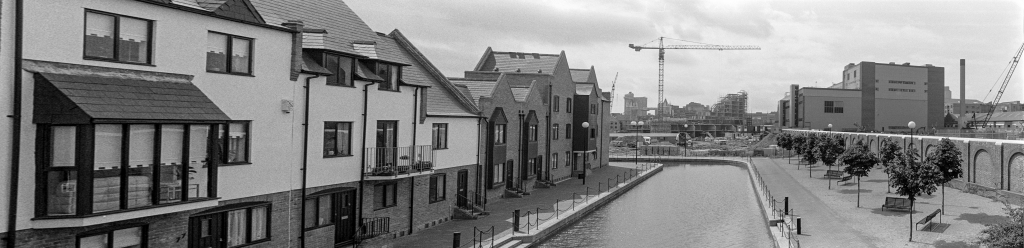
Discovery Walk, Wapping Lane,  Wapping, Tower Hamlets, 1987  87-7n-53-positive_2400

Little remains of the old London Docks, with new housing covering much of the area, here alongside the ornamental canal which I think includes some sections of the old dock wall. I took two pictures from the road overlooking the canal, one concentrating on the south and the other the north side.

Ornamental canal, News International, Print Works, Wapping, Tower Hamlets, 1987 87-7n-55-positive_2400

The two pictures actually overlap and can be joined to make a narrow panorama, though I don’t think I particular intended this when I took them.

The right of the picture is dominated by the large Wapping printing works of News International, the site of a protests for over a year from 1986-7 by the print unions against Murdoch. The strike ended in what seemed an inevitable defeat for the unions who were trying to prevent the introduction of new technology, moving away from the hot metal of Fleet St which employed several thousand type setters to litho printing which allowed journalists to directly input there stories.

More pictures on page 6 of 1987 London Photos.


All photographs on this and my other sites, unless otherwise stated, are taken by and copyright of Peter Marshall, and are available for reproduction or can be bought as prints.