St Johns Lewisham: More pictures from my walk on 18th March 1990. The previous post on this walk was More From Brockley.
I walked up Malpas Rd, taking a few pictures on my way that I’ve not digitised, and on to Lewisham Way, where I turned into Friendly Street, wondering how it got that name. No one seems to know. There is also a Friendly Place in Lewisham, some distance away.
F H Pierce, Friendly Upholstery, Friendly St, St Johns, Lewisham, 1990, 90-3f-16
Friendly Street was built as a part of the Deptford New Town development which had begun in around 1795, though the earliest existing buildings in Friendly Street (earlier named Dog Kennel Row and then George Street) date from 1806 and most from the 1840s. Its name was apparently officially changed from George Street in the early years of the twentieth century to avoid confusion with other George Streets in London.
Friendly Upholstery at No 2 and Boot Repaier F H Pierce at No 4 have long closed. No 2 still has the shopfront but that at 4 has been replaced and both properties are now residential.
This property at 3 Friendly Street is still standing though that on the left has been replaced by a new building. The open area to the right is Friendly Gardens, an area cleared after bomb damage in the Second World War.
The Deptford New Town estate was developed on land owned by the Lucas family, who grew rich from building and running rice mills in the USA. Many of the early residents were shipbuilders and sailors. The opening of the railway in 1836 with a station at New Cross Gate in 1839 with trains to London Bridge prompted further development in the area as a commuter suburb. St Johns got its church in 1855 and its own station in 1873.
Bank, Lewisham Way, Friendly St, St Johns, Lewisham, 1990, 90-3g-63
The former bank at 293 Lewisham Way was acquired by Barclays in 1918. The building was Grade II listed in 1994 and according to this: “The London and South Western Bank – New Cross Branch at 293 Lewisham Way was acquired by Barclays in 1918. ” and was “designed in 1885 and built in about 1886 by J and J S Edmeston.”
It appeared to have closed as a bank by the time I made my picture and has been converted into residential apartments.
Stone House, Lewisham Way, St Johns, Lewisham, 1990, 90-3g-64
Grade II* listed house built 1771 – 1773 designed by architect George Gibson the Younger (or possibly his father, also George Gibson) as built as his own residence, it was known in the 19th century as the Comical House for its unusual design.
House, 70, Loampit Hill, St Johns, Lewisham, 1990, 90-3g-53
One of four similar highly ornamented houses built late 1850s by local architect Alfred Cross who also built one for himself at No 62, now particularly notable for its vibrant colour scheme – and which I photographed on several occasions in colour.
House, Loampit Hill, St Johns, Lewisham, 1990, 90-3g-55
A closer view of one of the houses, largely hidden by greenery shows a little of the decorations.
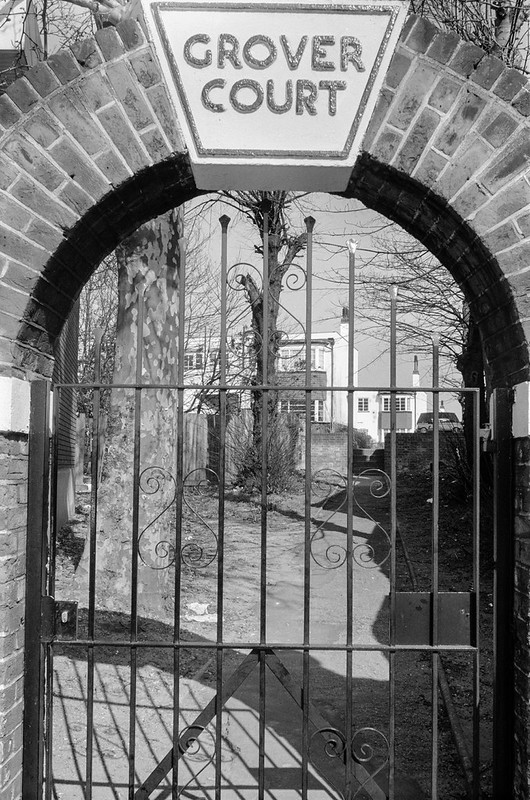
Grover Court, Loampit Hill, Lewisham, 1990, 90-3g-42
Grover Court, Loampit Hill, Lewisham, 1990, 90-3g-44
Grover Court was built as a luxury Art Deco estate of 51 residential flats in 1938, on the site of Ellerslie House, built in the 1790s for the brothers John and Henry Lee who owned the neighbouring brickworks. A large house, after the Lee family moved out in 1860 it became a private girls preparatory school.
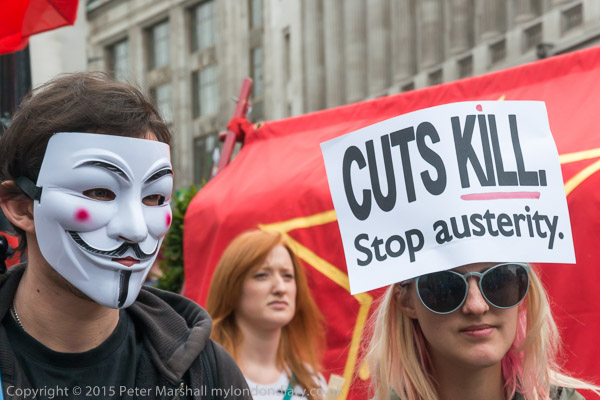
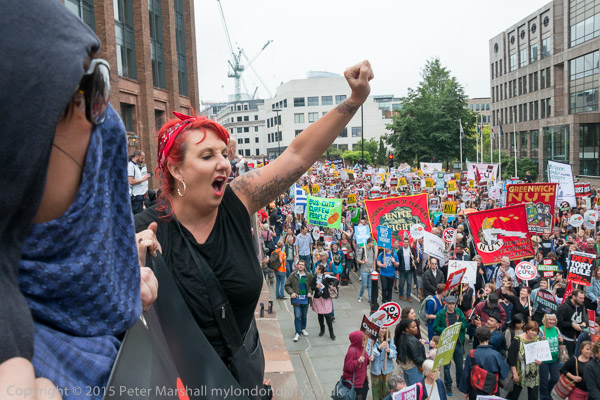
End Austerity Now & Class War: On Saturday 20th June 2015 I sent to photograph the march organised by the People’s Assembly Against Austerity from the Bank of England to Parliament Square. Class War came to protest calling for direct action rather than marches which changed nothing and after photographing them in the City I went with them to Downing Street – and they paused for a brief protest at the Savoy on the way.
End Austerity Now at Bank
Bank
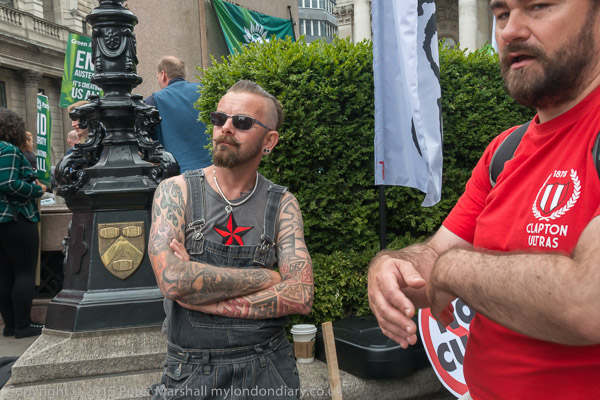
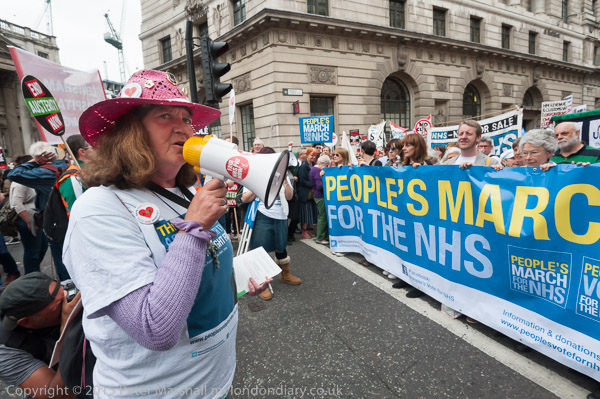
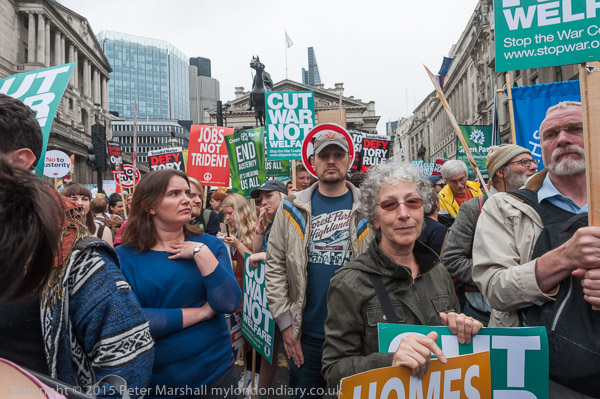
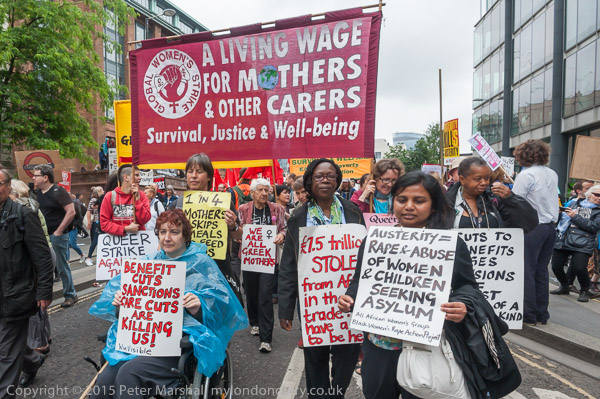
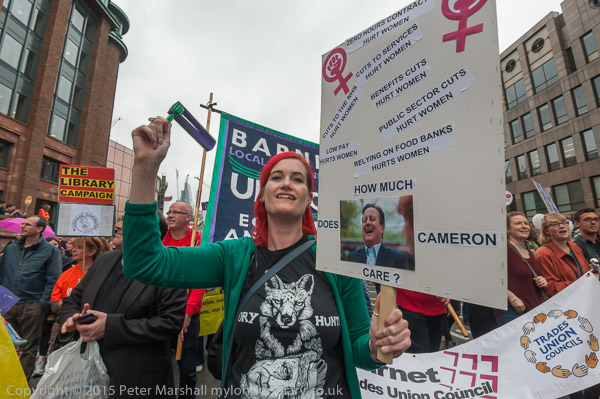
Large crowds gathered around the Bank of England for the start of a massive march against austerity organised by the People’s Assembly Against Austerity and supported by many groups including CND, the Green Party, People’s March for the NHS, Global Women’s Strike, Basic Income, Revolutionary Communist Group, Clapton Ultras and many other groups and individuals from around the country.
Clapton Ultras -“Football for all. Good times, good songs and Polish lager. Always antifascist.”
So many were being affected by the cuts which had forced down incomes, cut benefits and the welfare state, cut education, destroyed youth services, made massive cuts to the NHS and public services while supporting the bankers whose actions had led to the crisis.
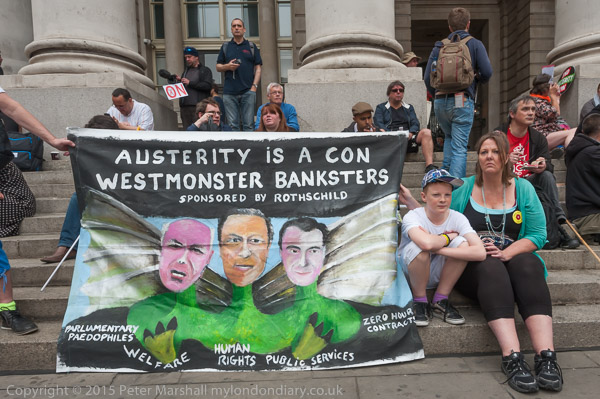
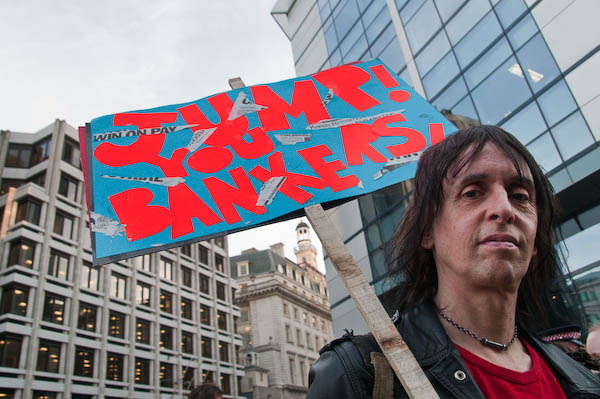
Austerity is a Con – Westmonster Banksters sponsored by Rothschild
The programme of austerity introduced by the coalition government and continued under the Tories had seriously harmed the country and slowed its recovery from the financial crisis and seemed to be a punishment for the crimes of others, which had been made possible by the changes to the banking system introduced under Thatcher in 1986.
As usual estimates of the number of marchers varied hugely, with the organisers claiming a quarter of a million, while the BBC contented itself with ‘”thousands”. From the time it took and the density of the crowds I think it was at least a hundred thousand. Parliament Square was well filled with others still arriving, but like many others I went home rather than listen to the speeches.
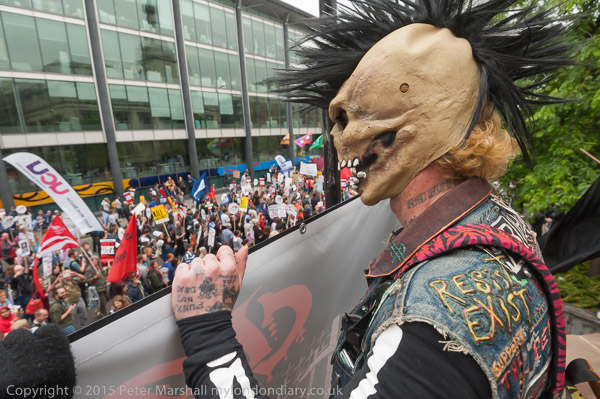
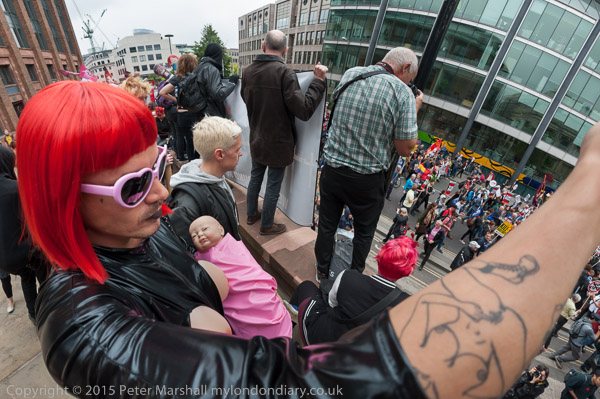
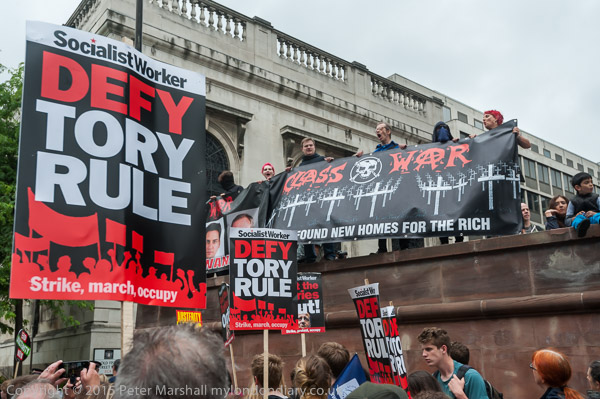
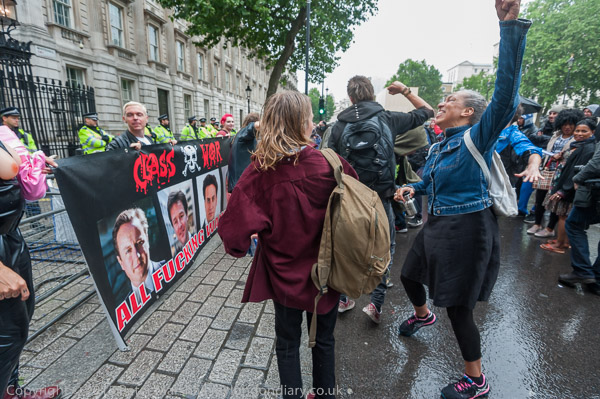
Class War held their banner on a footway overlooking the march
Class War had come to the protest to call for end of A to B marches to rallies and call for direct action. They succeeded in diverting several hundred of the marchers to make their way to protest at a squatted pub near the Elephant which Foxtons want to open as an estate agents.
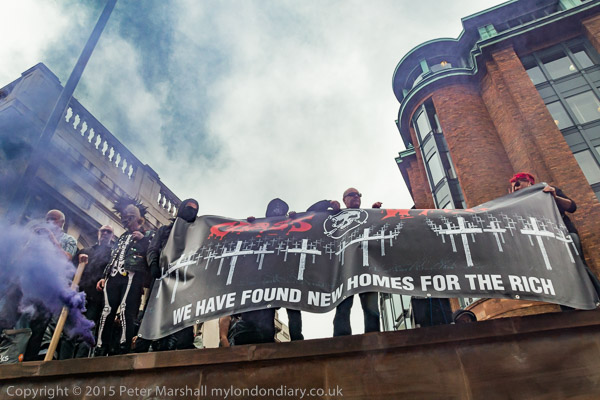
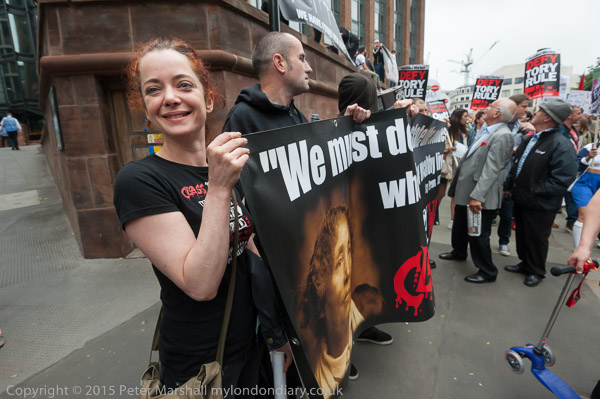
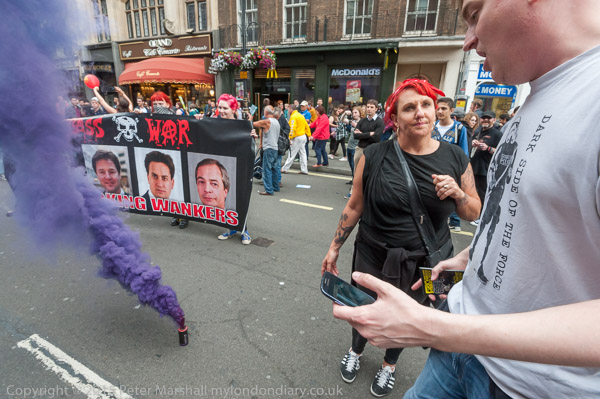
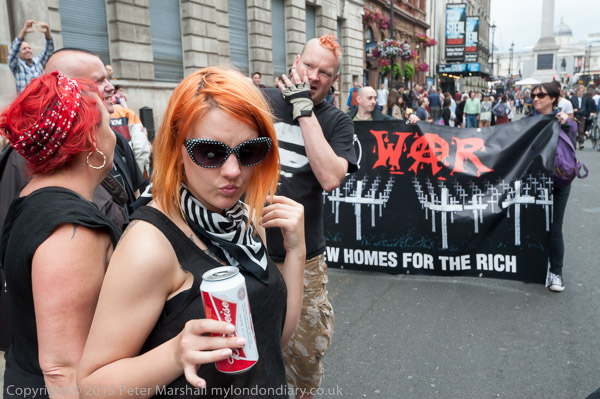
Class War had brought several banners including the ‘Political Leaders’, a new version of that seized by police at a ‘Poor Doors’ protest, the ‘Lucy Parsons banner with its quote “We must devastate the avenues where the wealthy live” and ‘We have found new homes for the rich‘, with its rows of crosses on graves extending into the distance which police were then still pressing charges against Lisa McKenzie over.
Lisa McKenzieAdam Clifford
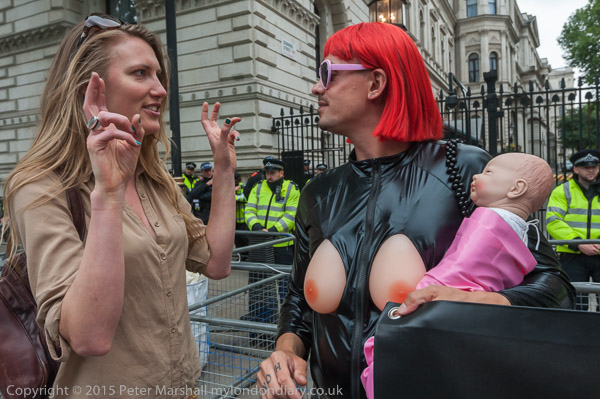
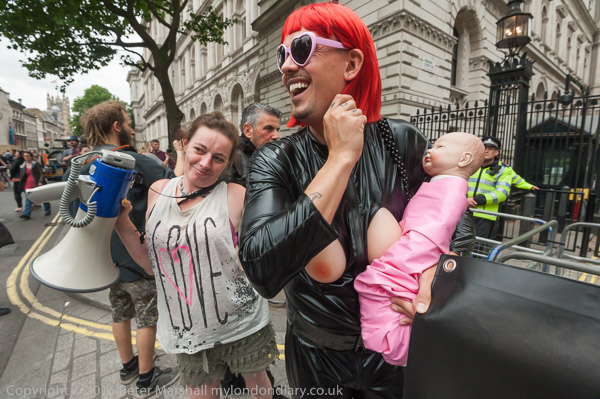
Lisa was there along with the others including Adam Clifford who stood for Class War in the Westminster constituency, today wearing a top with fake exposed breasts and holding a fairly lifelike looking baby. As well as those above the protest others protested on the side of the street below.
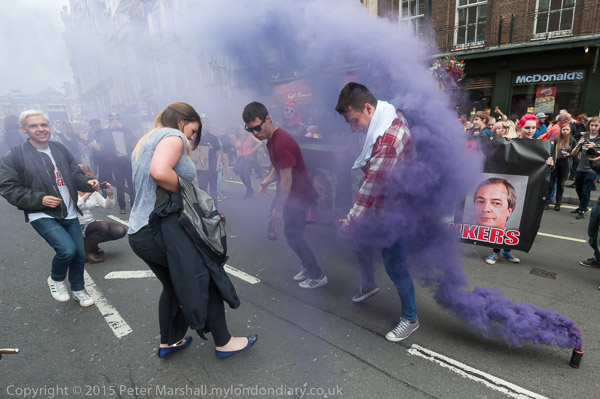
Many marchers raised fists and shouted in solidarity with Class War as they passed, though some shook their heads, while others tried to ignore them. This wasn’t easy as they made a fair amount of noise and let off several smoke flares.
Around 30 police gathered around them at one point and it looked very much if they were going into action, but after a discussion between several senior officers on the scene, most rapidly walked away.
I stayed in the area either with them above the march or down below on the densely crowded wide street for around an hour, making many pictures both of Class War and the marchers.
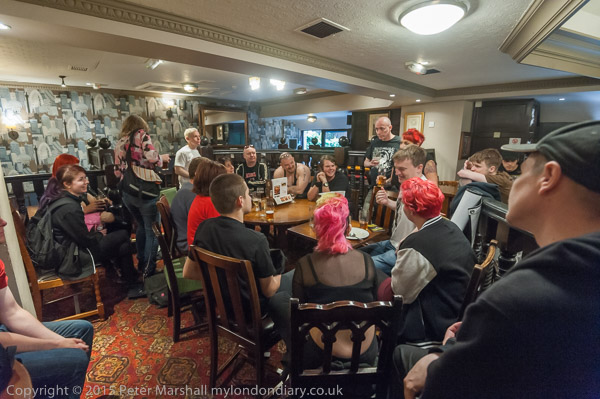
They sit in the pub and police wait for them outside
When the end of the march appeared to reach them they joined in for a couple of hundred yards then peeled off to go to the Olde London pub on Ludgate Hill
Class War insist on the right to protest outside the Savoy
After a rest in the pub Class War walked down towards Westminster with their police escort to carry out more protests.
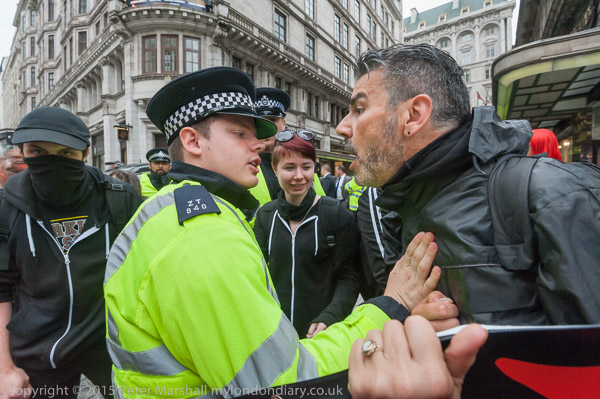
Approaching the Savoy Hotel some broke out into a run to get ahead of their escorts but found that there were more police already waiting there.
But they unrolled their banners again and briefly blocked the entrance with ‘New Homes for the Rich’ and ‘Lucy Parsons’ banners. After minor scuffles and arguments with police they marched on.
A woman talks to Adam Clifford of Class War holding a baby and a banner outside the gates of Downing St
Class War continued their protests in Whitehall, displaying their banners, setting off flares and dancing with others to a sound system which joined them briefly.
They then moved off towards Downing Street where they posed for photographs with all three banners – and threw a flare over the gate.
Their protest continued there with short speeches and more dancing. People were still coming down the street to join the People’s Assembly Against Austerity protest in Parliament Square and some stopped briefly to join in.
Eventually Class War decided it was time to roll up the banners and leave before police intervened – and it was time to go to the pub again. But for me it was time to go home.
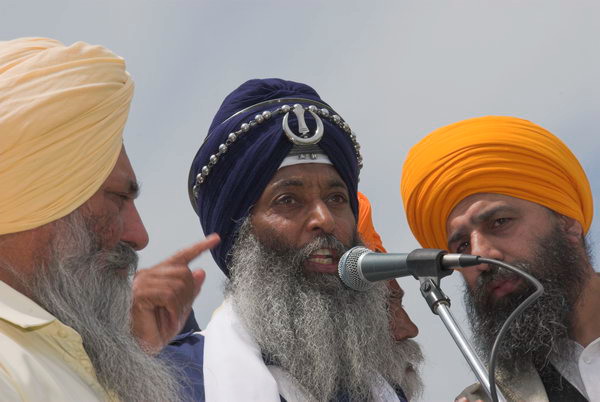
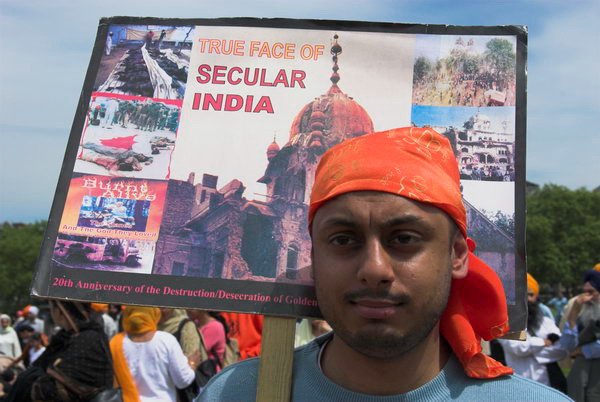
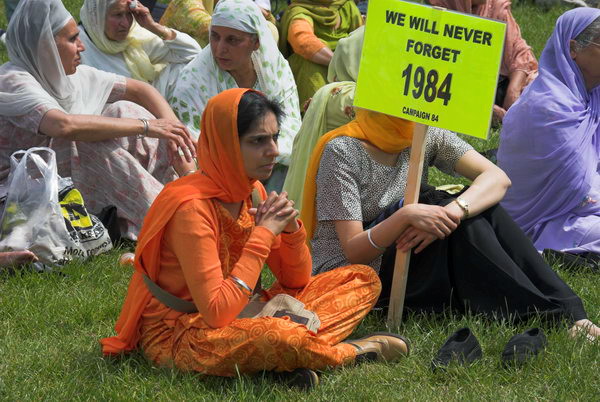
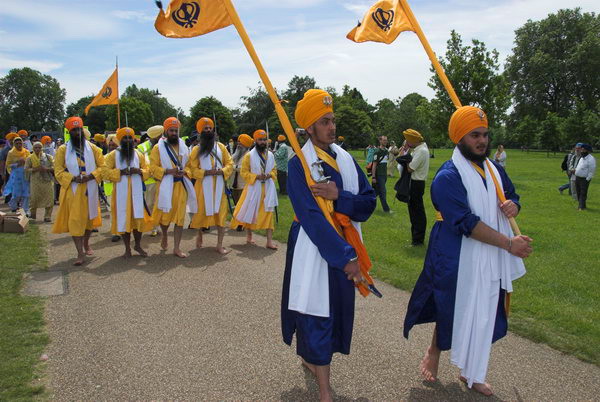
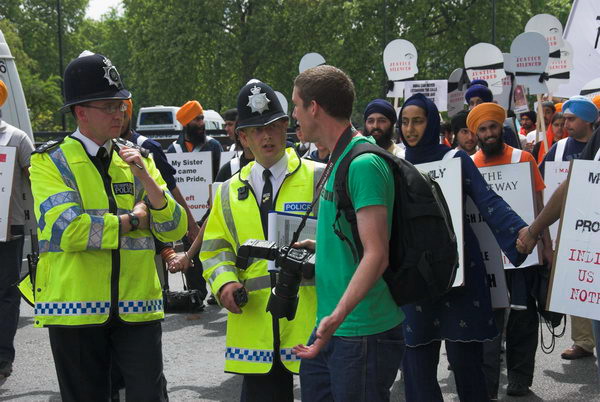
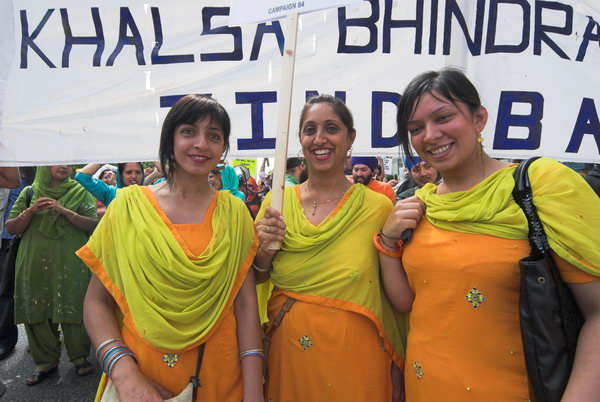
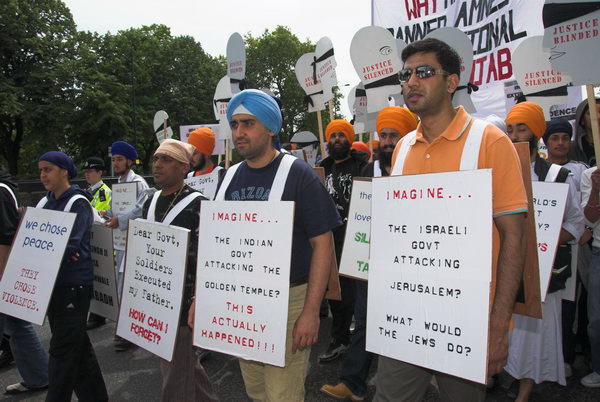
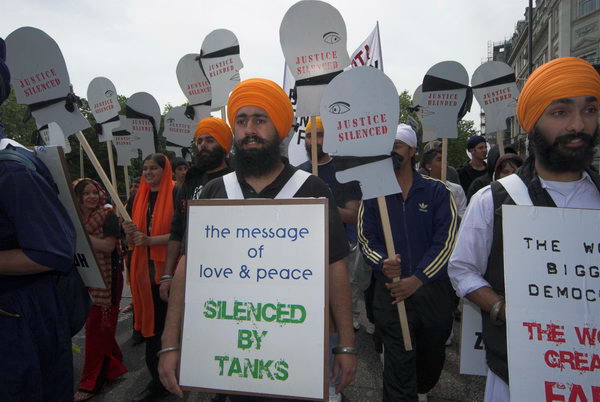
Old Comrades, Women for Life & Sikhs: Sunday 4th June 2006 was a day for marching and running on the streets of London. In the City, the London Regiments were remembering their fallen comrades, and several thousand women were raising funds for cancer research. In Hyde Park I joined several thousand Sikhs at a rally before they marched in memory of the martyrdom of the Fifth Guru and the Indian genocide of Sikhs, calling for the release of political prisoners and the formation of an independent Sikh state.
I wrote a rather longer piece than usual, ending with a complaint about the police harassment of photographers during the Sikh march. There do seem to be some officers who really have a very negative attitude towards photographers, and at times in particular towards those with UK Press Cards. Though formally these are recognised by all police forces in the UK, that recognition too often means nothing on the street. Below is what I wrote in 2006 – with the usual minor corrections.
London Old Comrades
Bank of England
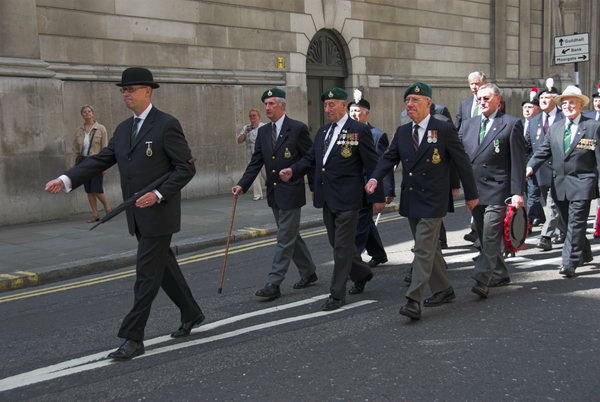
Early Sunday the centre of the real City, around the Bank Of England is generally pretty empty, but today things were going on. Immediately north of the bank a small group of ‘old comrades’ from the London Regiments were preparing to march and lay poppy wreaths at the monument to their fallen comrades in front of the Royal Exchange. Some of those I spoke to had fought in the second world war, though there were also some younger people there. It’s a remembrance that has taken place twice a year since 1919.
It was a solemn and ceremonial occasion, impressive and colourful, with a well-disciplined smoothness. The monumental architecture of the Bank made a good setting, although the area on top of Bank Station itself is too fussy and cluttered.
Towards the end of the event, when the numbers had thinned out a bit, London Wall was still fairly full.
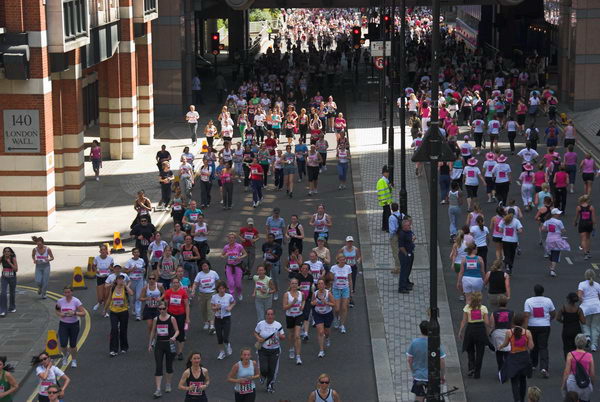
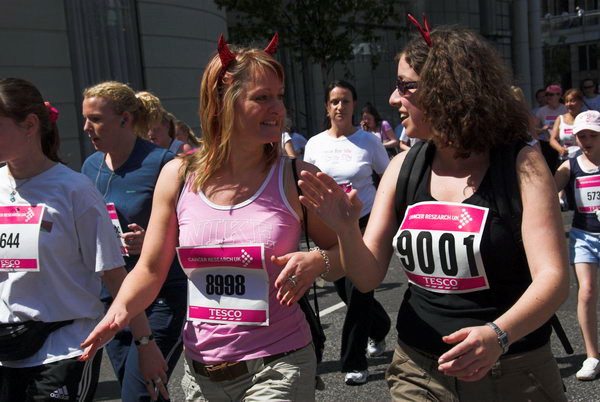
As they marched off, I peeled left in search of 750,000 women, or rather that fraction who were taking part in the Central London event. ‘Race For Life’ for Cancer Research UK, is the UK’s largest women-only nationwide fund-raising day. There certainly were a lot of them, [around 10,000], at times packing even the wider streets full from side to side, making it hard to walk along Cornhill.
Women of all ages, shapes, sizes, races and speeds running, walking or limping or wheel-chairing around the 5km course. There were fewer serious runners than I’d expected and less fancy-dress, but the sheer numbers were impressive.
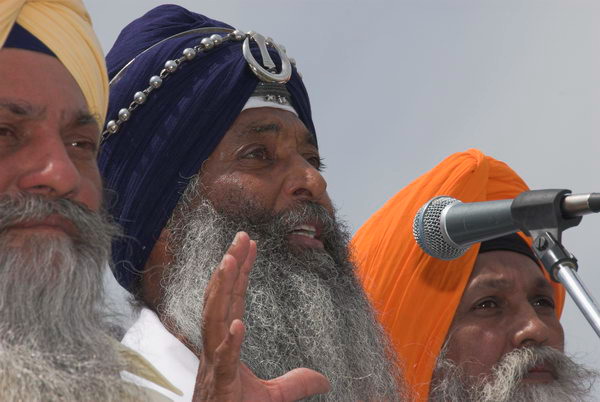
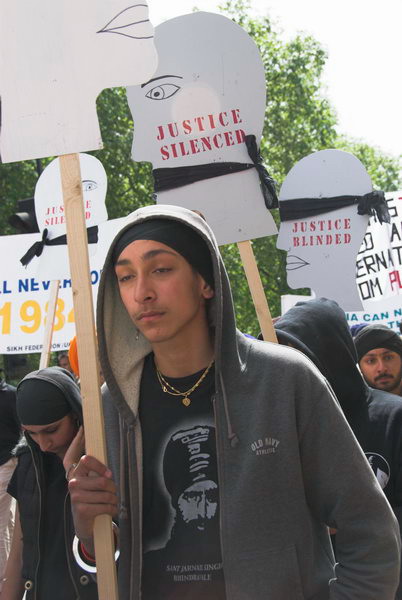
The Sikh Remembrance March and Freedom Rally commemorated the martyrdom of the fifth guru, Sri Guru Arjan Dev Ji 400 years ago, as well as the events of 1984.
Guru Arjan Dev Ji compiled the first version of the Sikh holy book, the Guru Granth Sahib, in 1604, writing many of the hymns within it. He was arrested in Lahore in 1606 on the orders of Mogul Emperor Jehangir, tortured for 5 days and martyred on the banks of the River Riva.
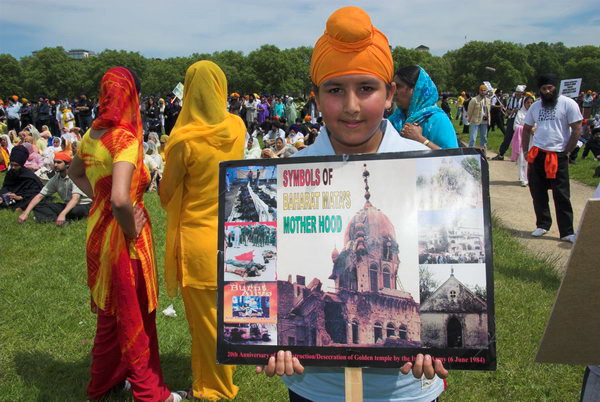
Punjabi speakers at the rally in Hyde Park described the events of 1984. The marchers demanded an acknowledgement of the Indian genocide of Sikhs, the release of Sikh political prisoners held in Indian jails, and for the establishment of an independent secular state of Khalistan in the Punjab.
During the annual celebration of the death of Sri Guru Arjan Dev Ji in 1984, Indira Ghandi sent her troops to attack Sikh militants in the Golden Temple at Amritsar. Many innocent pilgrims – men, women and children – were killed in the brutal assault. Thousands more died around the Punjab, particularly in the riots incited by government TV and radio stations after the October assassination of Indira Ghandi by her Sikh bodyguards.
After the speeches came prayers, and then the march set off for Trafalgar Square and another rally. This was a serious event, with strongly felt grievances, and an impressive display of Sikh tradition and feelings.
The marchers were pleased to find photographers taking an interest in their cause, with many of them encouraging me and thanking me for my presence. Some had heard of this web site [My London Diary] too.
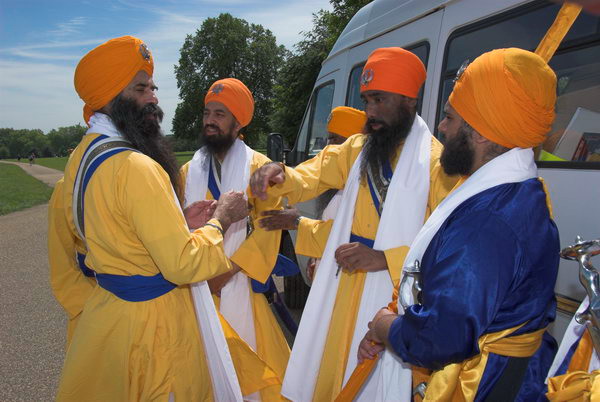
The march sets off in Hyde Park, with five men representing the original Panj Piare (Five Beloved Ones.)
Until we were close to Hyde Park Corner, the police were helpful and in good humour too, but then along came one of the rotten apples, someone who just wanted to push photographers around. He came and told me to get off the road, as I was stopping the demonstration. This was clearly absolute nonsense, and I tried to tell him, but reason held no interest for him.
Police harass a photographer trying to do his job. I and other photographers got the same treatment
Other photographers got harassed too. You can see one of them in my picture. We are accused of holding up the march, generally nonsense as most of us want to capture action in our images, and if people even slow down, will wave them on.
Of course it’s those at the actual front of the march who would have any effect on its progress. Further back where we were working, small gaps develop and are closed up all the time without affecting the overall progress.
I have respect for the police – some at least of their work is essential, but this kind of petty and stupid behaviour simply makes their job harder for no reason.
It also makes the work of photographers impossible. I can’t work unless I can stand in the right place to take pictures, and that is seldom on the sidelines. At the highest level, the police realise this; it’s about time they got some of the little dictators in the middle to put it into practice.
The message of love & peace SILENCED BY TANKS
Of course the policing of many marches is over the top. There were probably ten times the number needed for this event, which was predictably well ordered, good natured and essentially self-policing. Traffic control was really all that was required. Perhaps harassing photographers makes these surplus guys on overtime think they have a purpose.
Twenty minutes later, along with several of the other photographers, I was on my third warning from this guy and he was getting redder and more and more tense. I was interested in how the situation might develop, but I was also tired and it was time for me to go elsewhere.
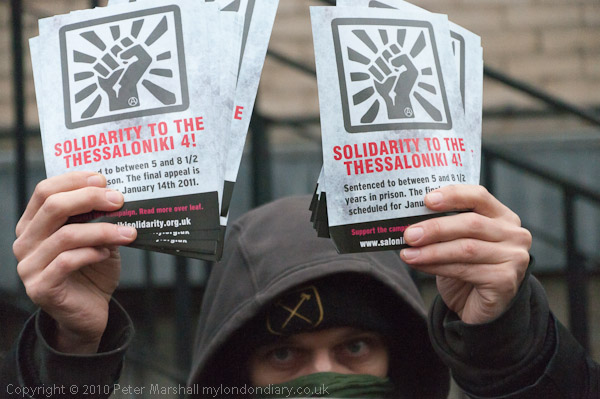
Dance Against Cuts & Solidarity With the Thessalonaki 4: Two protests on Friday 14th January 2011 had little in common except that both were in part against the violence, lies and deception of the authorities, both here in the UK and in Greece.
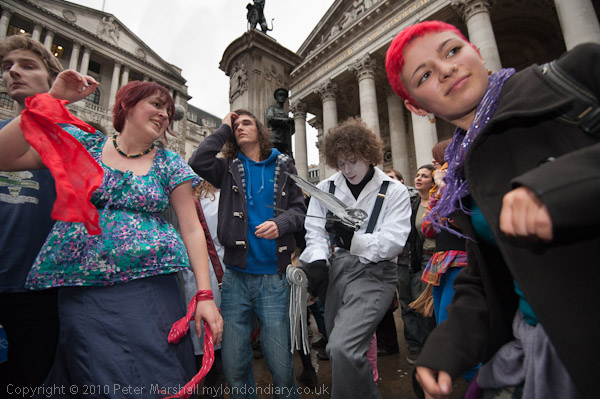
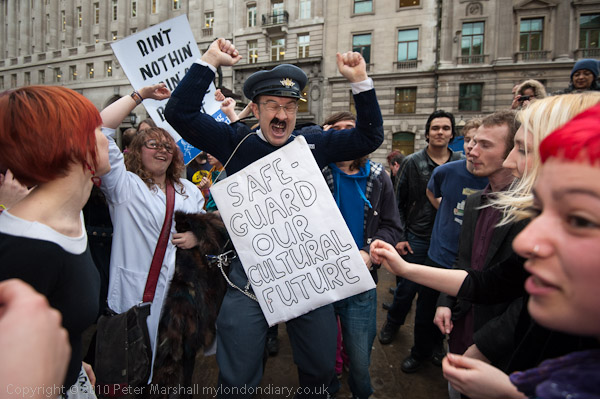
Dance Against The Deficit Lies
Royal Exchange, Bank
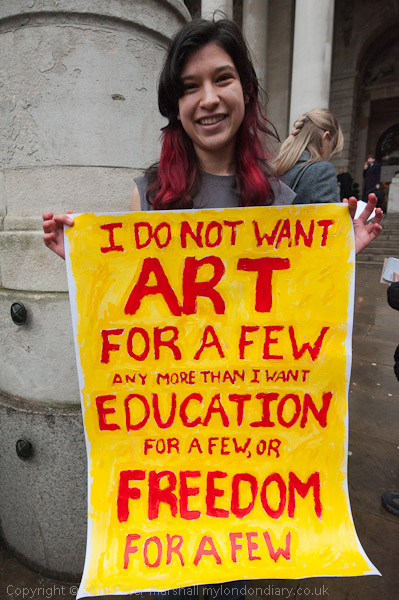
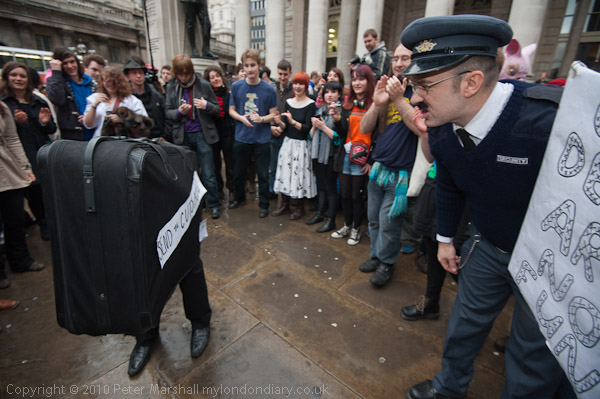
Campaigners against the savage cuts in arts and community funding by the Tory-led coalition government in the UK came to perform outside the Royal Exchange and Bank of England in a way deliberately planned to avoid confrontation with police, limiting their protest to exactly and hour and making it “playful with purpose, (so) that any aggression whatsoever (police kettles or the tiny few protesters who throw stuff) will simply look preposterous.”
The location was one “with resonances for many protesters, where some of the worst excesses of police violence and over-reaction took place at the protests against the G20, and close to where Ian Tomlinson was attacked by a police officer and died.”
At the centre of the City of London it was also appropriate for cuts that reflected the huge rescue package given to bail out the banks after their irresponsible behaviour, and to protest about their continuing excessive salaries and indecent bonuses.
It was a relatively small protest, with almost as many spectators and photographers as the hundred or so taking part, and enlivened by performances and dance rather than angry chanting. And the police for once simply stood back and watched.
The organisers pointed out that Britain is still revered for around the world, and that it brings in money to the country. “Cuts to the arts are idiotic and short sighted.” They questioned why the levy on banks was “being reduced, and why the government is not imposing measures such as the Tobin or Robin Hood tax on financial transactions that would not only being in much-needed income to reduce the deficit but would provide a beneficial stability by dampening speculation.”
Back in June 2003, a number of protesters were arrested in a violent police attack on an anti-capitalist protest against an EU summit in Thessaloniki, Greece. They included the English anarchist, Simon Chapman, a supporter of various anarchist groups including Class War.
Seven of them, including Chapman, had later gone on hunger strike against their arrests and were finally released at the end of November 2023, following a huge solidarity campaign across Europe. Among those calling for their release were 28 EU MPs and Amnesty International. All charges against the prisoners were dropped and Simon came home to England.
Photographic and film evidence proved beyond and doubt that Chapman had been framed, charged with having three black bags containing Molotoff cocktails and dangerous weapons (a hammer and a pickaxe handle.) Photographs showed that when arrested he was carrying a blue bag, and a film clearly showed Greek police planting these black bags on him after his arrest.
But despite this the Greek state was not prepared to drop the cases, and after “repeated appeals from the Greek state prosecutor the charges against four of the original seven were re-instated.” And despite the evidence in 2008 all of these four were found guilty.
“Under the threat of a European Police Warrant … Simon was forced to return to Thessaloniki in 2010 to appeal the conviction.” But this time the evidence resulted in all the major charges being thrown out, with all four instead being found guilty of a “minor defiance of authority” to justify the time they had previously spent in jail. And Chapman came back to England and Class War.
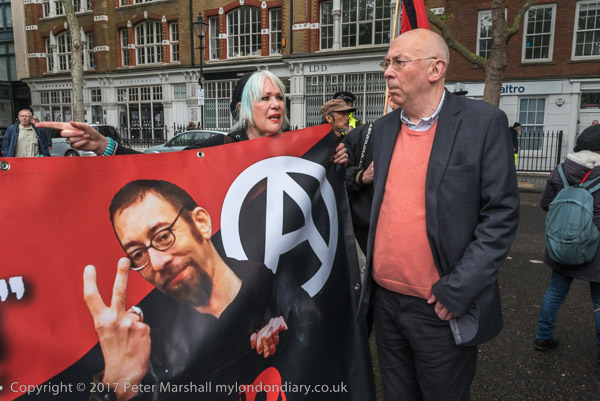
But the Greek experience had scarred Chapman and he never really recovered from being arrested and his treatment in prison, and the health effects of the lengthy hunger strike, dying at only 40 in 2017.
Class War with their banner in memory of Simon Chapman – May 1 2017
Class War came to the May Day march that year at Clerkenwell Green with a new banner in his memory, and also copies of a new Class War newspaper to sell. When the march set off for Trafalgar Square they “marched only the few yards back to the pub, where I joined them later” to celebrate Simon’s life.
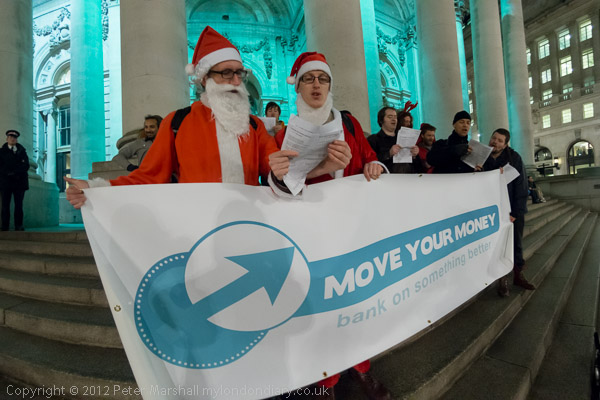
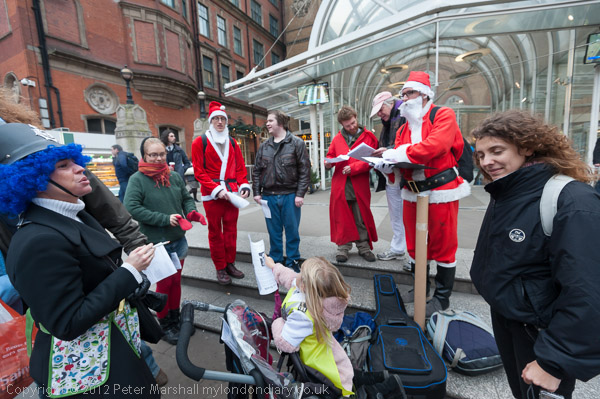
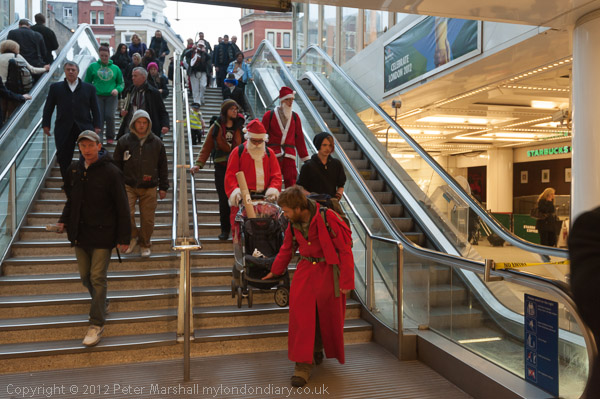
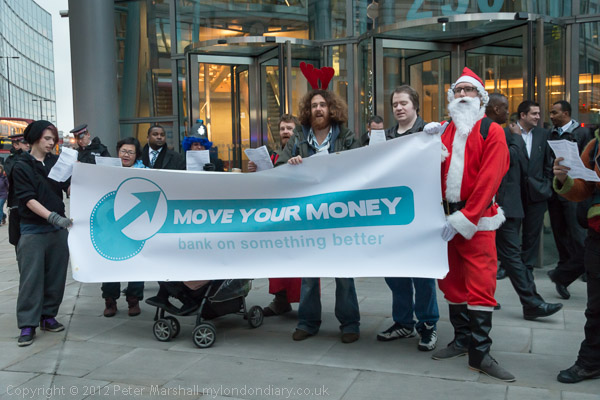
On Tuesday 18th December 2012 I met a small group of anti-capitalist protesters from the St Paul’s Cathedral Occupy London camp at 3pm at Liverpool Street Station.
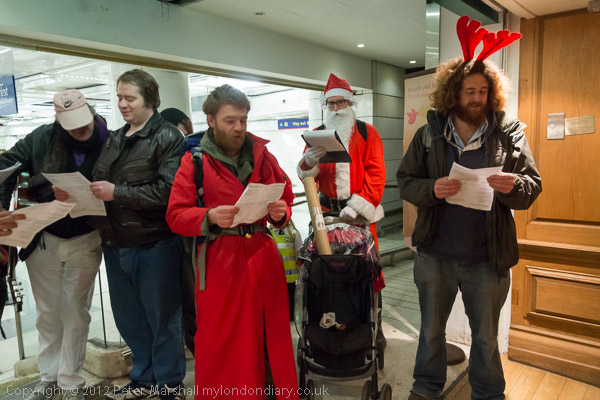
For the next couple of hours I went with them as they visited businesses and banks around the city to sing anti-capitalist carols against tax avoiders, bailed out banks and others in a peaceful and seasonal protest.
They had a special song for Starbucks – to the tune of ‘Let It Snow’ with the first verse::
Oh the cost of living's frightful
Some relief would be delightful
So don't leave us in the muck
Tax Starbucks, tax Starbucks, tax Starbucks
Signing a carol to customers inside Starbucks
There were another three verses, reminding us and Starbucks and the customers sitting drinking their coffee that corporate and elite tax evasion costs the nation £33 billion a year.
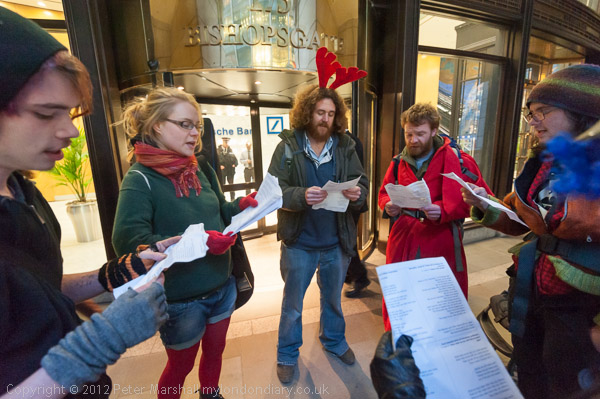
We walked out onto Bishopsgate and they gave their next performance outside the doors to the bankers offices at 125 Bishopsgate where security were not showing a happy Christmas spirit.
Away in the Caymnans, the Plutocrats wept
Because, we the people
are listing their debts
We're no longer fooled by
Divide and delay, we're planting the seeds,
But they're making hay...
The group moved cross the street to the RBS, reminding them the government supported the banks with an unimaginable £1.162 trillion. The several carols there, included:
Silent debt, holy debt
All is owed, all is wrecked
Round on poor; father, mother and child
public services tendered and priced
sleep in poverty please
sleep in poverty please
There were similar performances outside the various other banks as we made our way through the city towards the Bank of England. There was a another carol for Ramsay Health Care, a company involved in the creeping privatisation of the NHS, on Old Broad Street:
What shall we do with our public services
What shall we do with our public services
Shall we sell off our public services
That's where Thatcher left it!
When we got to HSBC on the corner of Old Broad St and London Wall everyone walked inside to sing, including some of the police who were by now taking part – if silently – in the proceedings. After a couple of carols – and some posed photographs – the group went out.
On Old Broad Street there was another Starbucks – and again the carollers went inside to entertain and inform the customers.
Next it was time to visit another bank – the RBS on Threadneedle St – and by now a few more singers had joined the group.
We walked up to the Guildhall – the medieval centre of the City, which had its own carol, to the tune of Good King Wenceslas:
Bad George Osborne last looked out
In the Autumn budget
Nothing to be proud about
So he had to fudge it
Said though things don't look that great
We are on the right track
Bullshit George, NHS you hate
Now it's time to fight back.
On the way back towards the Royal Exchange there was another Starbucks to enter and treat to a carol and couple more banks to sing outside – Lloyds stopped them from entering.
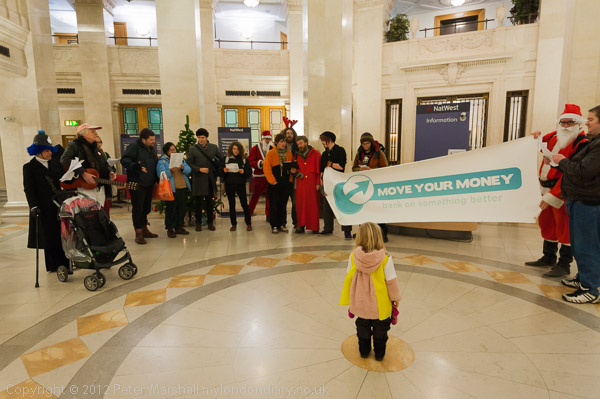
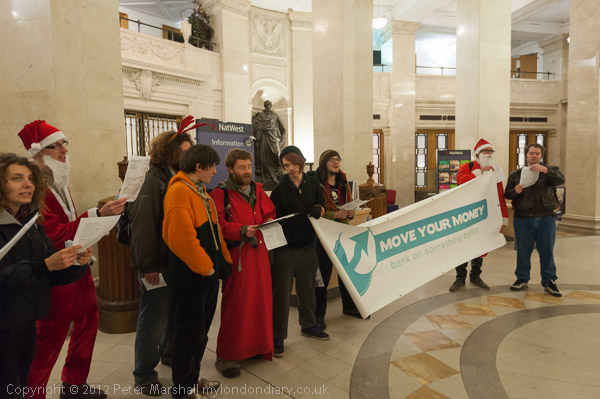
But the finest performance of the day came inside the grand banking hall of the NatWest on Poultry, where bank staff seemed quite amused by the performance, and some from the upper floors came to the balconies to watch and listen. I’d not been inside the building before and was pleased to be able to see it – and to take a few pictures.
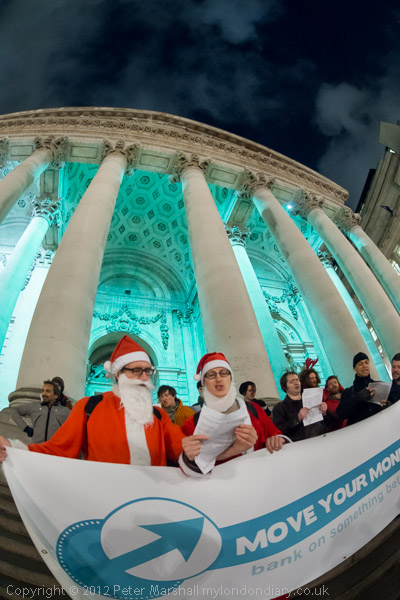
Again after a couple of carols the group left quietly and crossed to the Royal Exchange where they performed on the steps as city workers rushed by to Bank tube station.
By then I was getting a little tired and cold, having been mainly on the street for a couple of hours. The carol singers had decided to split into two groups now their numbers had grown to visit more places, but I decided to get on a bus and start my journey home.
Just Shares, Riverside & No to the Crook, the Toff, The Fascist or Cop: Friday 2nd May 2008 was the day the results came out for the election for London Mayor and it turned out to be a sad day for London. Earlier I’d covered a protest calling on the City of London to move away from its unjust economic prcarices and then gone to an exhibition and walked along the riverside while I waited for the mayoral declaration, though it came after I had given up and left for home
Just Shares Take On The Bank – Royal Exchange, Bank
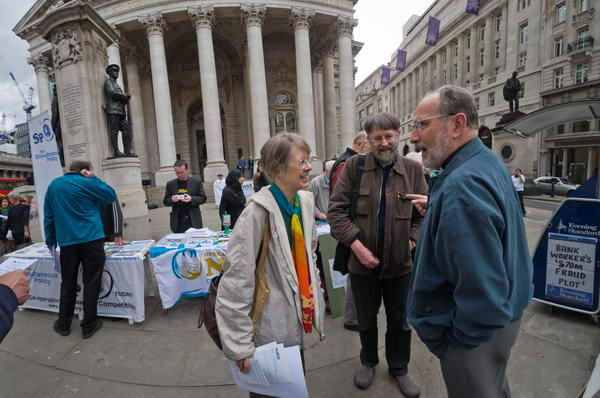
Other speakers listen as Ann Pettifor speaksat Royal Exchange. Larry Elliott at right.
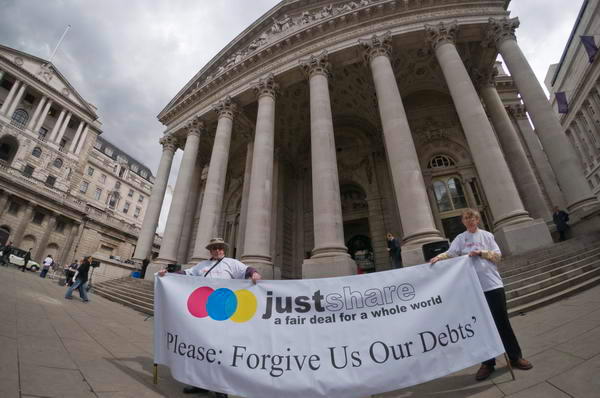
‘Just Share’, “a coalition of churches and development agencies seeking to engage with the City of London on issues of global economic injustice” and to “address the widening gap between rich and poor in the global economy” based at St Mary-le-Bow church in Cheapside had organised a protest in the heart of the City, in front of the Royal Exchange and at the side of the Bank of England.
I don’t think anyone at the Bank was listening to Ann Pettifor, Guardian economist Larry Elliott or the others as they spoke on the steps of the Royal Exchange, or took seriously the seminar later by Pettifor in one of Hawksmoor’s finest churches, St Mary Woolnoth, where former slave captain John Newton, writer of ‘Amazing Grace‘, preached his last 28 years.
She argued that current global debt-based financial systems are unsustainable and that structural change is necessary which gives proper regard to actual production, and the rediscovery of the insights of earlier Christian (and of course Muslim) traditions.
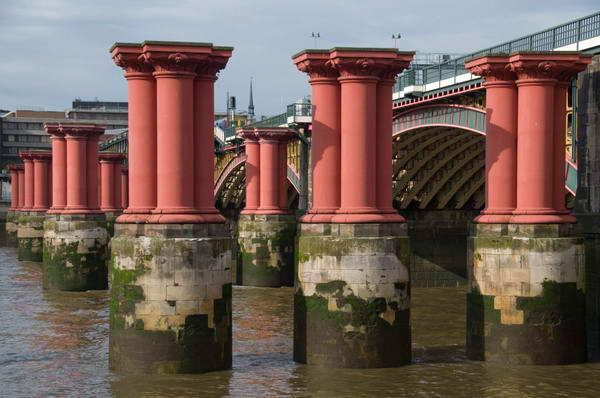
After visiting an exhibition at the Hayward Gallery on the South Bank next to Waterloo Bridge I walked slowly along the riverside and took a few pictures.
I was on my way to London’s City Hall, then close to Tower Bridge, owned by the government of Kuwait. In 2021 City Hall moved to a GLA-owned property in Newham, some miles to the east. The results of the London Mayoral Election were expected to be announced there in the early evening.
No to the Crook, the Toff, The Fascist or Cop -City Hall, Southwark
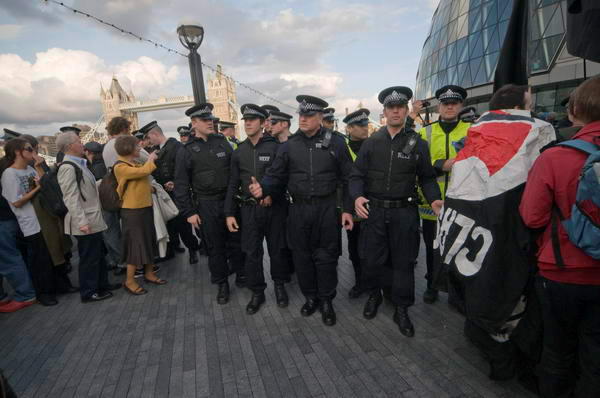
I sat on a wall close to City Hall reading John Updike’s novel ‘Terrorist’ which is perhaps why I attracted quite so much attention from a Metropolitan police FIT team (Forward Intelligence Team) photographer who took a number of photographs of me sitting there. I don’t object to being photographed, but was a little surprised when later I put in a Freedom of Information request to find the Met claimed they had no pictures of me, despite having photographed me working at many protests.
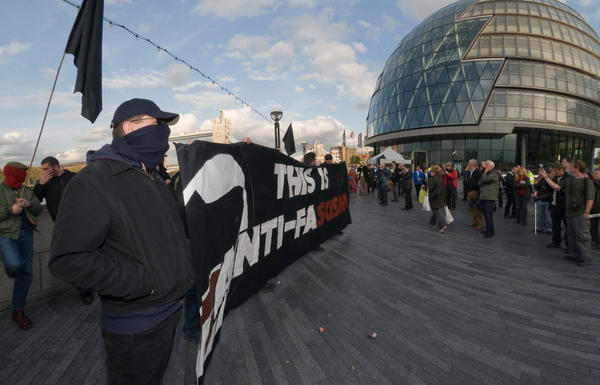
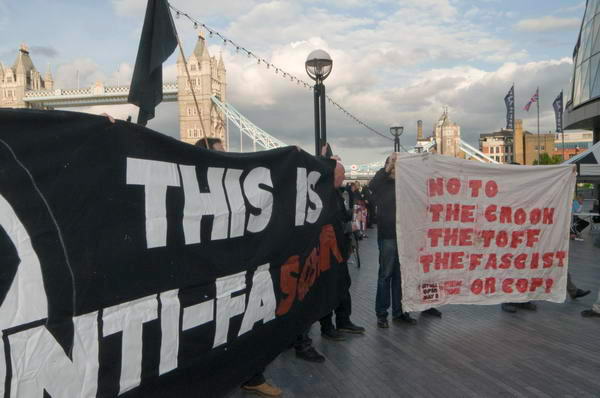
Protesters from various anarchist groups including Class War had come to City Hall to wait for the new London Mayor to be announced, though they were clear that they were against all the candidates – who they described as the Crook, the Toff, The Fascist and the Cop (there were six others also standing including Green Party candidate Sian Berry who got more votes than “the fascist” BNP candidate.
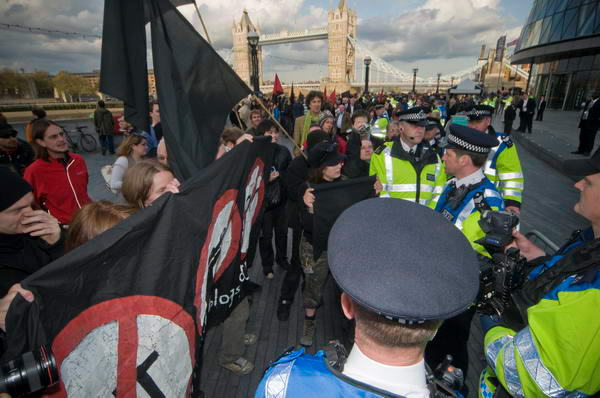
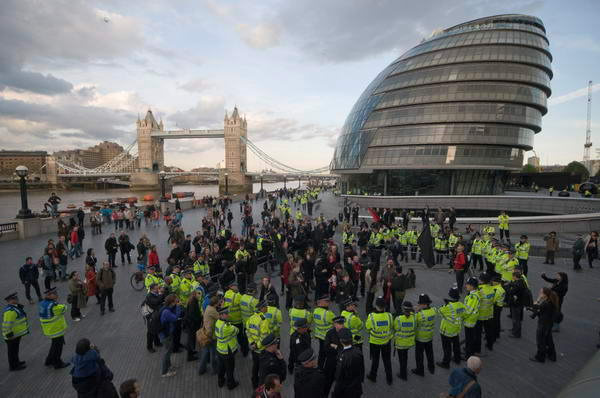
The protesters were allowed to protest in front of City Hall for around 35 minutes until Fitwatch went into action to frustrate the FIT teams (who could really use a little more intelligence) enclosing one of them in their banner.
Police called up their waiting reinforcements and the TSG arrived four minutles later and began to push the demonstrators, along with some bystanders, mainly tourists, towards the waiting pen which had been set up a short distance away.
One French woman was bemused. “But why are they just letting themselves be pushed” she asked me as I took photographs. “Because this is England and not France” I replied.
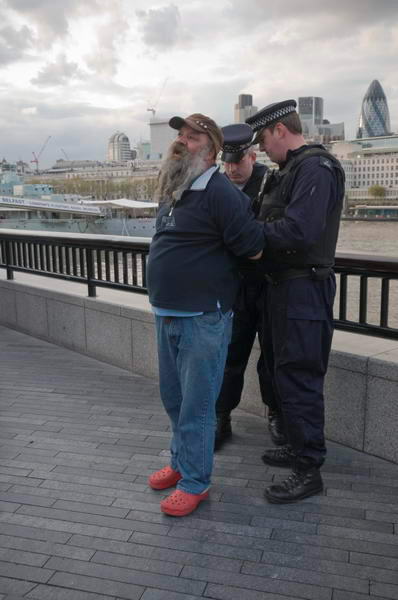
I watched as police told a man leaning peacefully on the river wall watching that he had to move as he was “obstructing the highway“. Clearly he wasn’t (though the police were) and he refused to move. They dragged him from the wall, claimed he was struggling (visibly he wasn’t), handcuffed him and led him away to one of the over 40 police vans parked nearby.
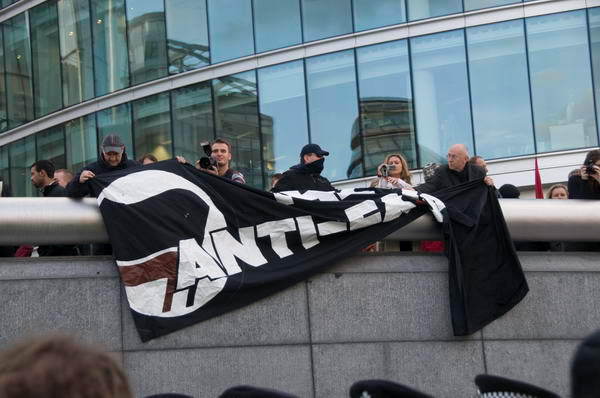
I showed my press card and for once was allowed through the police line obstructing the riverside path and made my way to a public balcony overlooking the area. “Cannier protesters had moved away faster, and were able to display their banner” for a couple of minutes but as I arrived they saw the police coming after them and made a run for a nearby pub.
“The police obviously couldn’t be bothered to chase them, and contented themselves with moving the innocent public away from the balcony, and after a short time, also moving the press.” I joined the protesters in the pub for a drink before leaving for home.
By the time I arrived home Boris Johnson (the Toff) had been announced as the winner and London suffered from a dysfunctional mayor for the next 8 years as he was again elected in 2012. Later those the police had penned were allowed to go home.
Workers, May Day March & Police Party: May 1st is of course May Day, International Workers’ Day, and I will be at Clerkenwell for the annual May Day march in London, and perhaps some other events to celebrate the day. For Catholics it is also dedicated to Saint Joseph the Worker, the husband of Mary, the mother of Jesus and approopriately in 2006 my day started outside Westminster Cathedral with the launch of the London Citizens Workers’ Association. Here is what I posted back on May Day in 2006 – with the usual corrections and links to more pictures on My London Diary.
London Citizens Workers’ Association – Westminster Cathedral
May 1st saw the launch of the London Citizens Workers’ Association, a new organisation to support low-wage and migrant workers across London, backed by faith organisations, trade unions and social justice organisations. May 1 is the feast of St Joseph the Worker and the event began with a procession into the cathedral and a ‘Mass For Workers’, but I didn’t bother to get up in time for that.
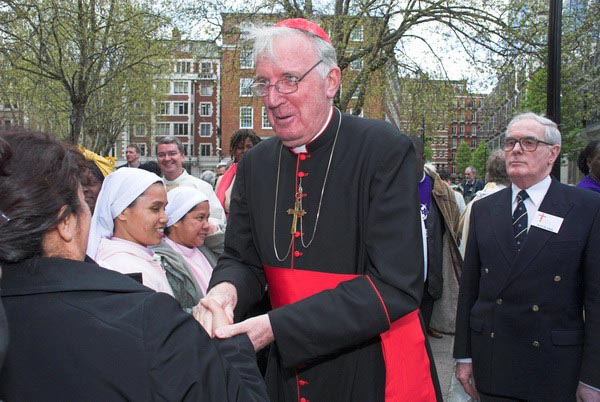
After the mass was a ‘Living Wage rally’ outside the cathedral, with speakers including Cardinal Cormac Murphy O’Connor (then leader of the Catholic Church in England & Wales), Sir Iqbal Sacranie (Secretary General, Muslim Council of Britain), and Jack Dromey (General Secretary of the TGWU) along with representatives of other unions and faiths, and of the new association.
The association aims to fight a campaign for a living wage for low paid workers as well as training them to organise and campaign and providing free advice on rights at work and legal support. Workers in low paid jobs often also lack decent working conditions and there was in 2006 little trade union representation*. It will also provide english classes.
Several large employers who have already taken steps to improve conditions were awarded ‘Living Wage Employers awards’ at the rally, but I didn’t wait around for this. more pictures
[* Since 2006 we have seen the rise of several grass roots trade unions taking a strong stance for the rights of low paid workers, particularly migrant workers, including the United Voices of the World and the Independent Workers’ Union of Great Britain.]
London May Day March – Clerkenwell
Around half of London’s tube network seemed to be down for planned engineering works, and getting around was a bit like playing Mornington Crescent to some very special rules. But the Victoria Line and Thameslink got me to Farringdon well before the start of the annual May Day parade.
This seemed larger than in previous years, with a few more trade unions there, with particularly strong support from the RMT, but many others also took part, including my own – the NUJ (and there were many of us members covering the event as well.)
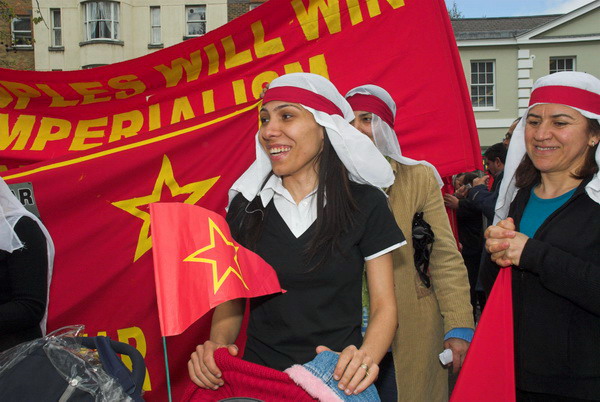
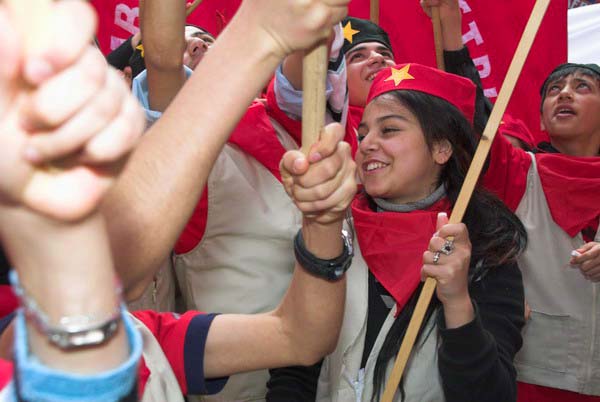
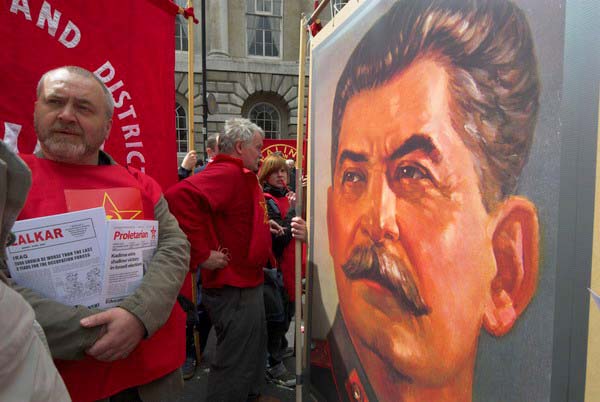
As usual, the most colourful aspect of the march was provided by the various Turkish communist parties, with strong youth wings. MKLP (and its KGO youth), the DHKC, the TIKB, the TKP/ML and probably more. There were some powerful reminders of the repression in Turkey in the portraits of some of those who have died in terrorist actions or death fasts.
Movements in a number of other countries were also represented, including Iraq, Iran Greece and Sri Lanka as well as the Kurds. Also taking part was the African Liberation Support Campaign Network.
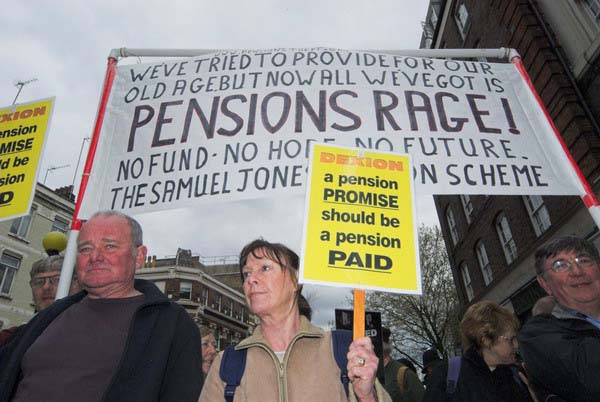
Gate Gourmet strikers marching behind their banner chanted “Tony Woodley – out out!” denouncing the attempts of the TGWU to force them to sign the compromise agreement which waives their rights to further work or legal redress. Others demanded that Remploy factories be kept open. There were protests over the Dexion and Samuel Jones pension outrages, and other causes.
More or less bringing up the rear of the march were around 500-1000 in the Autonomous Bloc, an anti-capitalist grouping marching against ‘precarity’, the working environment of late capitalism.
Increasingly there is a polarisation of the employment market in our service-based economies, characterised at one end by poor conditions, lack of job security, temporary employment, use of migrant labour at one extreme, and at the other by increasing encroachment of work into the private lives of more highly paid employees, making them into company property in exchange for their security.
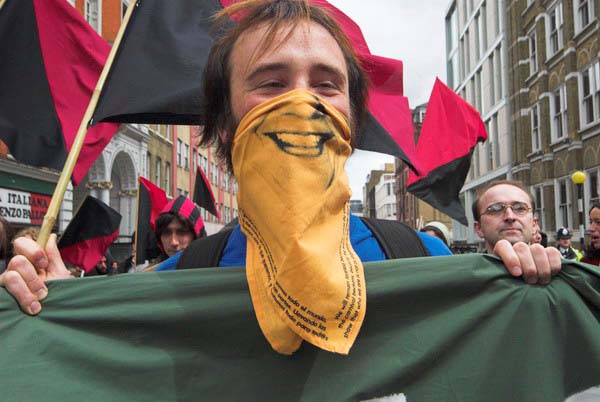
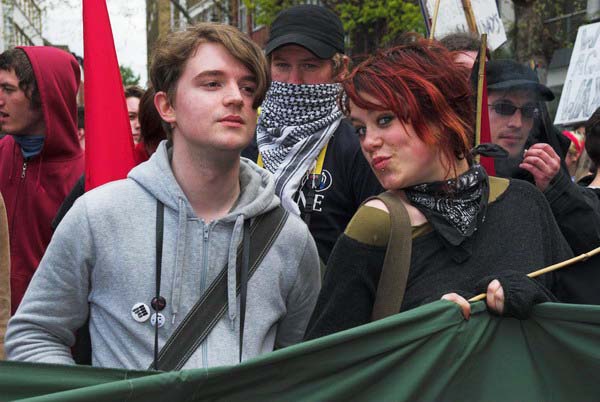
In contrast to the relatively low-profile police presence for the rest of the event, this bloc was flanked on both sides by a line of uniformed police. Many of the marchers in this section wore scarves covering the lower half of their faces, and some carried anarchist flags. Leading the block were a number of bicycles, and a pedal powered sound system.
The march continued on its way to Trafalgar Square, where people stood around mainly looking pretty bored. I didn’t catch much of the speeches but if what I heard was typical I could understand why.
When the Autonomous Bloc arrived at the square, the police barred their entry on the grounds of public order and seized the sound system. More than half those marching left at this point, with the police making little attempt to stop individuals who wandered into the square.
The rest of the bloc stayed on the road, with a few short speeches over a loud hailer, then moved up the side of the square towards the national gallery, where there was another short meeting. This was interrupted by the news that the police tactical support group was on its way, and they soon surrounded the relatively small group who had decided to stay.
I walked through the police line at this point, and they seemed to be making little attempt to stop anyone leaving, or at least didn’t detain them for more than a few minutes.
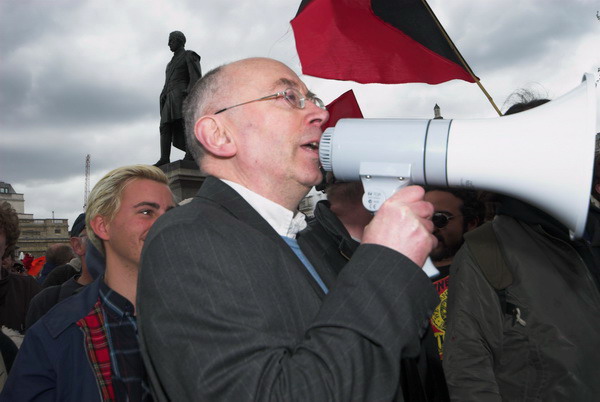
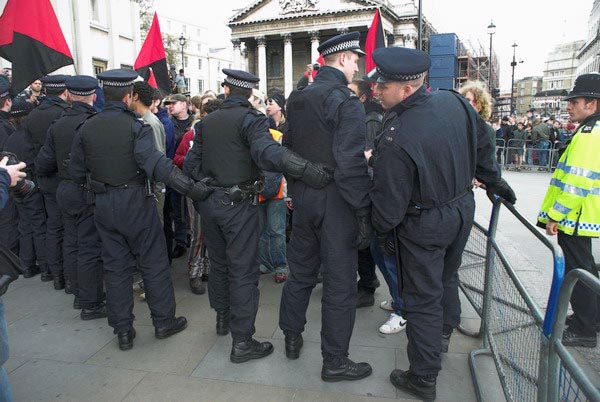
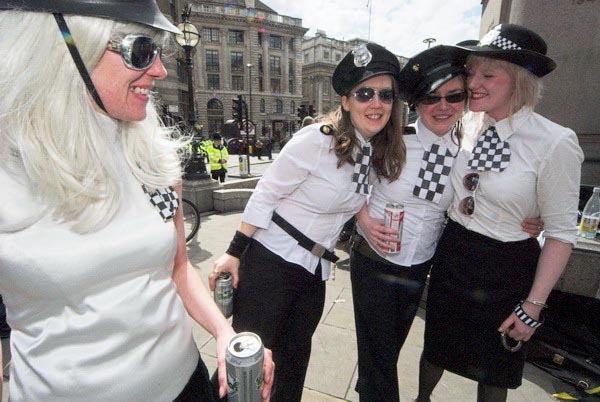
While the marchers were walking to Trafalgar Square, I took what was left of the tube to Bank and the ‘Police Victory Party‘ organised on their behalf by the Space Hijackers.
There I watched Tony Blair and some rather more attractive than usual police (and with pink fluffy hand-cuffs) being watched by some other police. A couple of the latter walked away when asked if they would mind being photographed, but some others seemed to be rather amused by the proceedings.
Of course, the police (both lots) were taking lots of pictures of the events too, and I can imagine some of them causing amusement at section house parties.
There was a ‘pin the blame on the anarchist’ game, a pinata (ta for the mini Mars bar) and some dancing before I had to rush off to make the gig at Trafalgar Square. Where the politics were perhaps less serious.
Ian Tomlinson Killing & Sri Lanka Genocide: On Saturday 11th April 2009 people marched from Bethnal Green Police Station to the spot were news vendor died after an unprovoked attack by police officer Simon Harwood. I also photographed a much larger march by Tamils against the genocide taking place in Sri Lanka.
March in Memory of Ian Tomlinson – Bethnal Green Police Station & Bank
G20 Meltdown, the organisers of the protest at Bank on April 1st 2009 where police officer Simon Harwood attacked Ian Tomlinson leading to his death, had organised a memorial march from Bethnal Green Police Station to the place where he died a few yards away from the attack.
Police discuss the march with Chris Knight
Tomlinson was not involved in the protest, but simply trying to make his way home after having been working, selling newspapers in the City. The protest would probably have been over by the time he was killed, but police had turned what had been intended as a carnival party into something far more sinister, kettling and then attacking many demonstrators and killing Tomlinson. There were numerous injuries and one photographer had his teeth knocked out, but I had seen the kettle coming and had left the area to cover another event.
At the Tomlinson family’s request, the march was peaceful, silent and respectful. Before it started his stepson Paul King spoke briefly, describing the family’s trauma from the tragic death of his step-father, a “much-loved and warm-hearted man,” and pain at seeing the video of the assault, and he hoped that the investigation would be full and that “action will be taken against any police officer who contributed to Ian’s death through his conduct.”
Paul King
As usual the investigation was carried out by the IPCC and the Crown Prosecution Service decided not to charge Harwood. After an inquest verdict of unlawful killing the CPS had to change their mind and charged him with manslaughter.
The sisters of Sean Rigg, murdered by police at Brixton the previous August were on the march
The jury was unable to hear evidence about his behaviour in previous incidents and was seriously misled both by some of Harwood’s own evidence and the evidence given by the first pathologist who had examined the body, Dr Freddy Patel. He had destroyed some vital evidence, puring away body fluids and had a long record of botched postmortems, having previously been suspended twice and finally was struck off the medical register in 2012.
After Harwood’s acquittal he was dismissed from the police. Tomlinson’s family took civil proceedings and in 2013, “the Metropolitan Police Service paid Tomlinson’s family an undisclosed sum and acknowledged that Harwood’s actions had caused Tomlinson’s death.
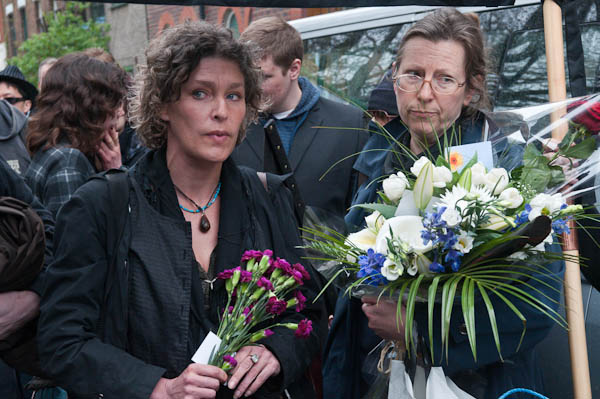
I left the march before it arrived at Bank, but returned the following day to photograph the flowers that had been left in Royal Exchange Buildings where the assault had taken place and a vigil was being held by Chris Knight, one of the G20 Meltdown organisers and a few others.
Tamils March – Stop Sri-Lanka Genocide – Temple to Hyde Park
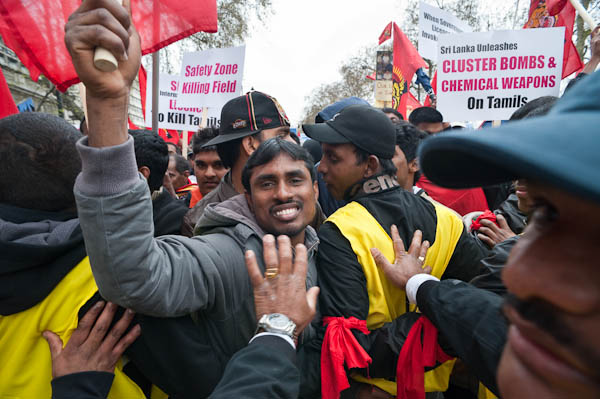
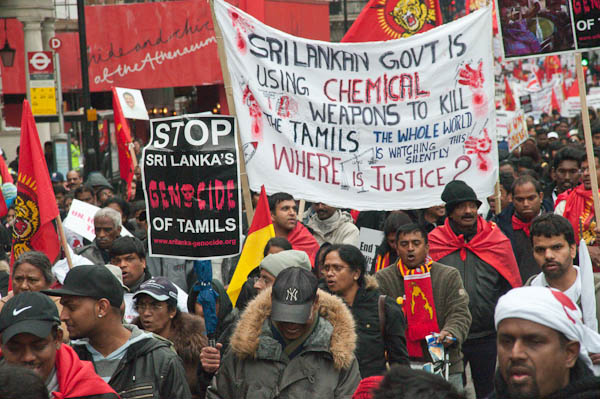
A huge crowd had assembled on the Embankment at Temple, perhaps as many as 200,000, a very high proportion of Tamils in the UK who are thought to number around 300,000, around two thirds of them of Sri Lankan origin. It was a crowd with very few white faces.
Despite the size of the protest there appeared to be very little UK media interest and I saw no photographers or TV crews from major UK media covering the march to Hyde Park. Where there are usually a crowd of photographers in front at the start of large marches in London, for this one there was just me and three other freelances, none of whom get regular work for the mass media.
By April 2009 the civil war in Sri Lanka was clearly coming to an end, with the Tamil Tigers having been pushed back into a very small area. They had been defeated at a major battle at Aanandapuram on 5th April and the final assault by the government forces came at the end of the month with Sri Lanka declaring victory on May 16th.
Many of those taking part in the march were clearly supporting the “the LTTE, the Liberation Tigers of Tamil Eelam. A few carried actual tigers, fortunately only large toys, but many more wore the colours or carried flags or portraits of the founder and leader of the Tamil Tigers, Velupillai Pirapaharan.“
The LTTE was proscribed in 2000 and they were clearly committing an offence under the Terrorism Act 2000 by supporting the group or wearing clothing which arouses the “reasonable suspicion that he is a member or supporter of a proscribed organisation.” But clearly the Tamils were not intending to cause any serious trouble and police sensibly made no attempt to arrest them all. Only three arrests were reported.
The Tamils had lost in Sri Lanka and many both civilians and combatants were killed during the civil war – possibly almost 150,000 in the last 8 months of the civil war. Around 300,000 were transferred into special closed camps, described by many as concentration camps – they were slowly released and the camps were closed by the end of September 2012.
Fire Station Cottage, North Rd, Highgate, Haringey, 1989 89-11f-45
I continued along North Road. Fire Station Cottage dates from 1906 and as the name suggests was built as a fire station. According to British History Online, “A room in North Road, Highgate, was hired in 1882 and a portable fire station was opened in 1887” with a fire engine manned by volunteers. This building was built as a replacement. It had closed as a fire station before World War Two but was reopened for use in the Blitz.
Highgate School, North Rd, Highgate, Haringey, 1989 89-11f-34
Taken from beside The Old Gate House pub at 1 North Road, a 1930s faux antique timber framed building with only its sign in my picture, I was looking across to Highgate School, founded by Roger Cholmeley in 1565, and formally ‘Sir Roger Cholmeley’s School at Highgate’. The current school fees for Years 7-13 are £8,830 per term and with VAT at 20% that comes to almost £32,000 a year. The per-student annual cost of public education in the UK in 2023-4 was £7,600.
The Grade II listed chapel was designed by Frederick Pepys Cockerell and built in 1865-6 and has an unusually long description in the official listing text.
Pond Square, Highgate, Camden, 1989 89-11f-35
Pond Square is certainly not a square, but a strangely shaped quadrilateral one side of which is South Grove. I rather liked the atmospheric nature of this image taken into the light which nicely illuminates what must surely be a gas lamp, as well as the many fallen sycamore leaves. The building on the right is 6 Pond Square and the church in the distance is St Michael’s Church, Highgate.
As well as not being a square, Pond Square does not have a pond, but rather more usefully does have public conveniences. There had been two man-made ponds here, the first apparently dug out as a hobby by a local hermit in the fourteenth century. Both were filled in by the local council in 1864 as unsanitary.
Highgate Literary & Scientific Institution, South Grove, Highgate, Camden, 1989 89-11f-22
South Grove forms the southern side of Pond Square and the Highgate Literary & Scientific Institution is at Number 11 on its junction with Swains Lane. It was founded in 1839 to enlighten the local population about the new developments in science and industry that were revolutionising the country. It still continues to do so.
It moved to this Grade II listed building in 1840 and remodelled it both then and later in that century. According to the listing it had previously been in use as a school for Jewish boys, and other sources suggest it may have been built on the cellars “of the Swan, Highgate’s first alehouse dating from the fifteenth century“.
The Angel, Pub Sign, Barclays Bank, High St, Highgate, Camden, Haringey, 1989 89-11f-25
There was a brewery and pub on this site at least by 1610, but it was given a new frontage in 1880 and then completely rebuilt in 1928-30. But though I liked the sign I was more impressed by the Barclays Bank and the adjoining building on the opposite of the street.
Barclays closed the bank at 54 High Street in 2020, selling it for £1.8 million and Highgate no longer has a bank. I think these buildings probably date from the late 1890s.
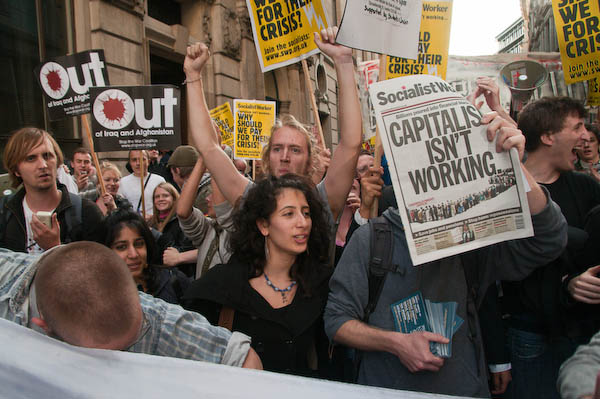
March on the City: On Friday 10 October 2008 several hundred anti-capitalist protesters, mainly students, took to the streets of the City of London to say “We Won’t Bail Out the Bankers’.
The financial crisis had started in 2007, but reached a climax with the bankruptcy of Lehman Brothers on September 15 2008 which precipitated an international banking crisis.
Wikipedia sets out the causes of the crisis in some detail, but essentially US banks had been allowed to make more risky loans by changes in US laws which loosened regulations and allowed banks to take part in high risk operations such as proprietary trading and investment banking.
In the US one result of this was the proliferation of mortgage loans to people on low incomes who could really not afford the repayments and eventually defaulted. The problems with ‘subprime mortgages‘ particularly given to many in minority communities in the USA came to a head as a boom in US house prices in the early 2000s was followed by a sharp drop in the value of properties which were the security for the loans.
As Wikipedia comments, “governments deployed massive bail-outs of financial institutions and other palliative monetary and fiscal policies to prevent a collapse of the global financial system.” This resulted in the widespread feeling that those who had created the crisis were being rewarded for their failures.
In the UK, the New Labour government under George Brown made a massive financial intervention, paying £137 billion to the banks in loans and new capital, some of which was later recouped, but leaving a cost of £33 billion. While some support was necessary to avoid a total breakdown of the financial system, many felt that the government should have taken a firmer line and that those responsible should have had to pay for their mistakes and not to seem to have kept their highly paid jobs.
Both Northern Rock – the first UK bank to fail in July 2007 and Bradford & Bingley were taken into public ownership, and RBS/Nat West into majority public ownership. But RBS still ended up costing us £35.5 billion – and the leading bankers still ended up getting huge salaries and big bonuses. The Royal Bank of Scotland seemed to be getting off scot free.
Part of the problems we still see in financial markets came from changes worldwide in the way that trading now takes place. In the UK Margaret Thatcher had brought in the ‘Big Bang’ which abolished traditional practices and introduced electronic trading, greatly increasing volatility.
On My London Diary I give a fairly full account of the actual protest which started at Bank where some protesters tried to storm into the Royal Exchange – long just a prestige shopping centre – and the Bank of England but were easily stopped by police.
There then followed a slow march around parts of the City, with police attempting to stop them at various points and the marchers pushing their way through police lines.
As my pictures show, there was some rather forceful policing at times and some of the press also suffered with the protesters. As I write, “I got a few bruises and my glasses were damaged when police rushed in as I was taking pictures in Lombard St.” But there was none of the confrontational use of trained riot squads that have led to extreme violence at some protests policed by the Met. Policing here was by the City of London Police – along with a guest appearance by one French cop.
Eventually there was a short rally with a few speeches on the corner of Bishopsgate and London Wall after which the demonstrators dispersed. Police seemed fairly relaxed at the end of the protest and I saw no arrests.
I don’t think the protest got much if any coverage in the mass media and most accounts I read on-line were confused, with many suggesting it went to the Stock Exchange. While that might have been a logical place to protest, the marchers actually went in the opposite direction.