State Opening of Parliament 2015

State Opening of Parliament: I wasn’t of course attending the Queen’s Opening of Parliament on Wednesday 27 May 2015, but it was a day for protests in Westminster. Class War had come to protest against the monarchy and the political system and were hounded by police, Compassion in Care protested in support of whistle-blowers, students in the National Campaign against Fees and Cuts had organised a rally and march and others including Disco Boy and Ahwazi protesters came to join in. The day ended with a People’s Assembly rally at Downing Street but I was too tired to cover this properly and went home. I wrote about all these in My London Dairy and uploaded quite a few pictures – you can read and view more by following the links in the brief introductions below.


Class War protest Queen’s speech

Parliament Square
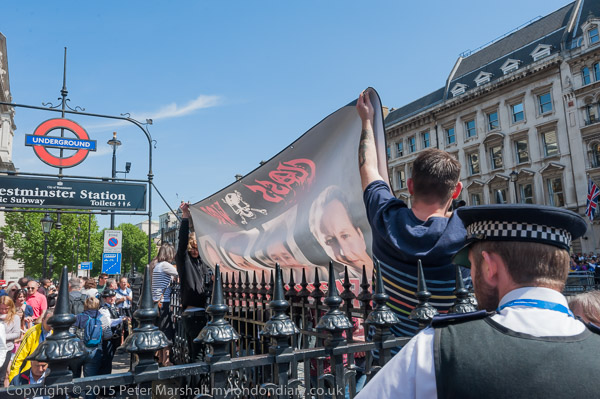
Class War only managed to display their ‘political leaders’ banner on the corner of Parliament briefly before police forced them to put it away. Around 50 officers then followed most of them as they went to a nearby pub and continued to watch them from the opposite side of the street for several hours.
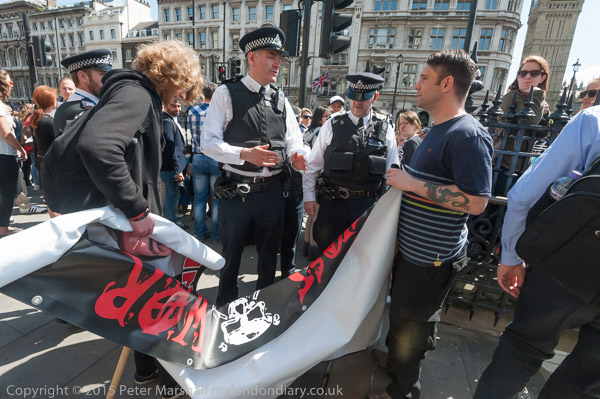
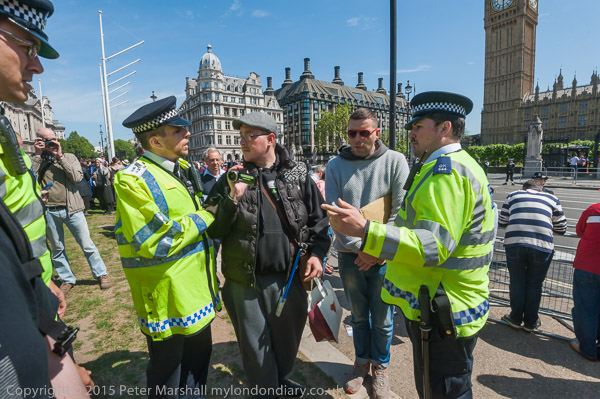
Police arrested two other men for simply standing in the square, one holding a video camera and the other a rolled up poster. They were released without chanrge some hours later.
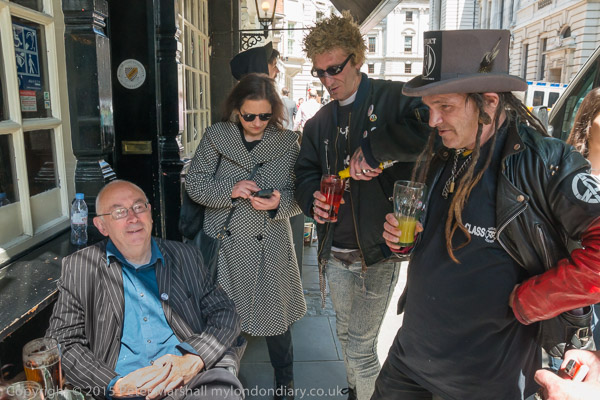
More at Class War protest Queen’s speech.


I am Edna’ – protect whistle-blowers

Downing St
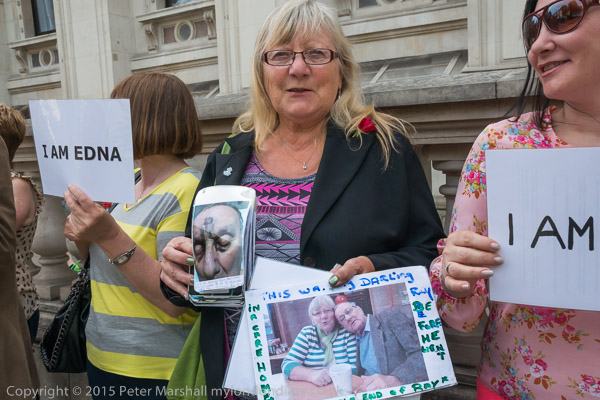
A woman holds a photograph of her husband who died because of his mistreatment in a care home

A line of people held up posters and shouted ‘I am Edna’ at Downing St calling for a law which would make it an offence not to act on the genuine concerns of a whistleblower and to protect those revealing scandals in social care and other sectors.

More at ‘I am Edna’ – protect whistle-blowers.


Police arrest man in Trafalgar Square

Trafalgar Square
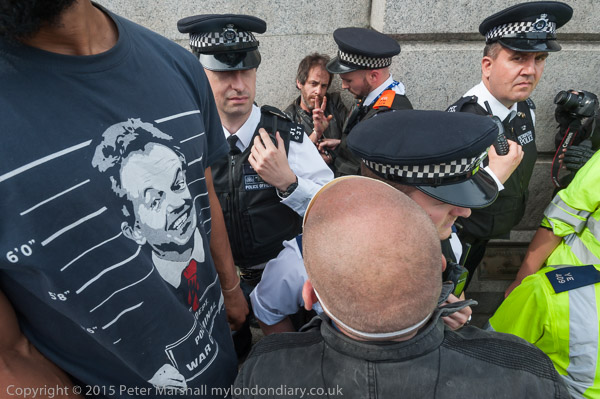
As people gathered for the National Campaign against Fees and Cuts a police squad rushed in and arrested a man. They were surrounded by a crowd who grew angry when police refused to give them any explanation for the arrest and pushed some away roughly

Police pushed a young man standing on the pavement near the police van roughly out of their way, and when he complained, he was assaulted by an officer then arrested for assault.

Later police announced that the arrest in the square was in no way related to the gathering protest but to an earlier offence. Had they made that clear to the crowd when they made the arrest the problems could have been avoided.

More pictures Police arrest man in Trafalgar Square.


Disco Boy plays Trafalgar Square
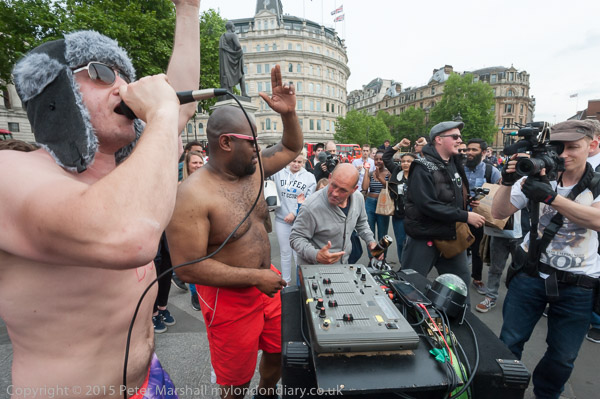
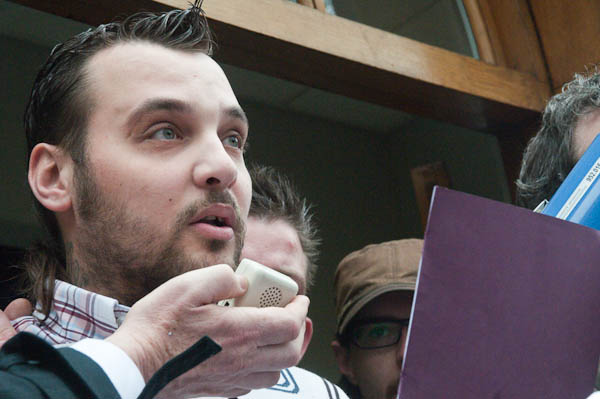
Disco Boy at the mike with his mobile rig and crew in Trafalgar Square

Disco Boy’ Lee Marshall from Kent who runs discos at local events and carries out stunts to be videod and posted on social media brought a mobile rig to Trafalgar Square before the NCAFC protest there and had people dancing around the square before going on to perform elsewhere, including outside Downing St.

Disco Boy plays Trafalgar Square


NCAFC rally in Trafalgar Square
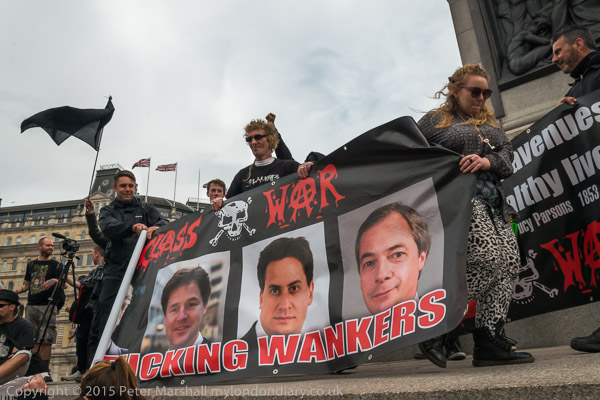
Class War’s controvesial banner got loud cheers from the crowd

Students and other supporters of the National Campaign against Fees and Cuts met in Trafalgar Square, and there were a few short speeches before they set off on a march.
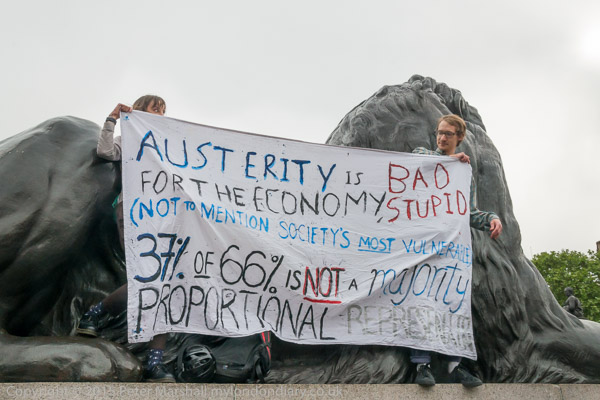
A banner points out that less than a quarter of the population had voted for the Tory government and called for proportional representation.

Protesting with them were Class War, with several banners including a replacement for their ‘Political Leaders’ banner’ which had been taken by Bethnal Green Police the previous month (and police ‘lost’ it) and also the Hashem Shabani group of Ahwazi Arabs, who later held their own protest

NCAFC rally in Trafalgar Square.


NCAFC March against ‘undemocratic’ government
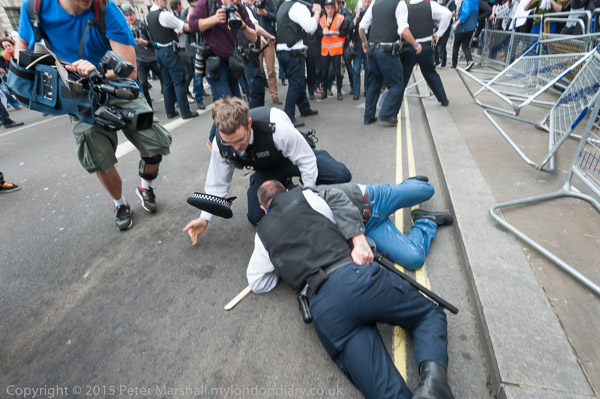
The National Campaign Against Fees & Cuts set off down Whitehall with police making ineffectual attempts to stop them, arresting several forcefully.

The rest of the protesters remained peaceful and simply walked through the huge gaps in the police line, made larger as they made the few arrests. There seemed to be no reason for the police attempting to stop them.
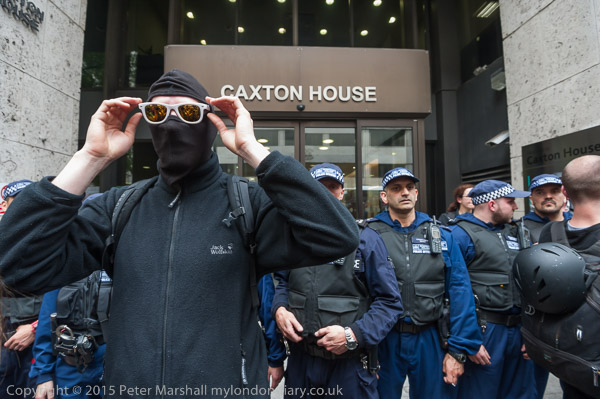
The protesters complained to police about the violent attacks and arrests. They went to protest outside the DWP and then marched past the now heavily protected Tory Party HQ back to a People’s Assembly rally opposite Downing Street. Some stayed there, others marched on and I went home. It had been a long day.

More pictures at NCAFC March against ‘undemocracy’.


Ahwazi Arabs protest Iran’s war on them
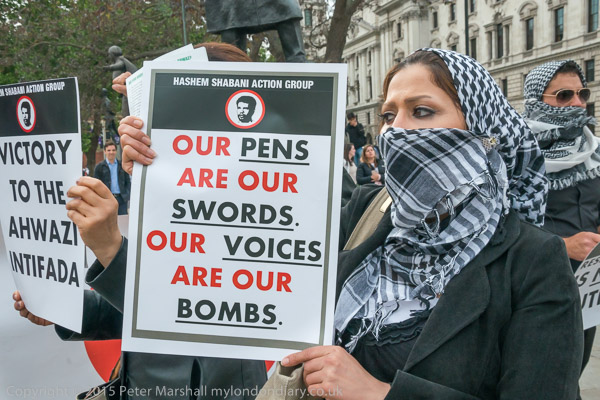
Our Pens Are Our Swords. Our Voices Are Our Bombs

Ahwazi protesters joined the mainly student anti-austerity National Campaign Against Fees & Cuts protesters in London to call for an end to the Iranian attacks on their heritage and identity. Their homeland, which includes most of Iran’s oil, was occupied by Iran in 1925
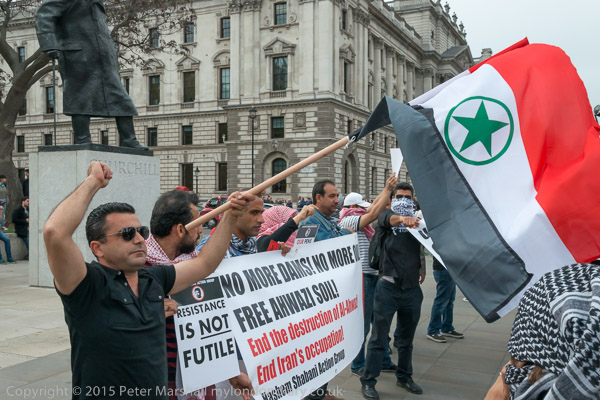
I photographed them in Trafalgar Square with the NCAFC and later when they left the march as it went through Parliament Square to hold a separate protest there.

More pictures: Ahwazi Arabs protest Iran’s war


FlickrFacebookMy London DiaryHull PhotosLea ValleyParis
London’s Industrial HeritageLondon Photos

All photographs on this page are copyright © Peter Marshall.
Contact me to buy prints or licence to reproduce.

Ian Tomlinson Killing & Sri Lanka Genocide – 2009

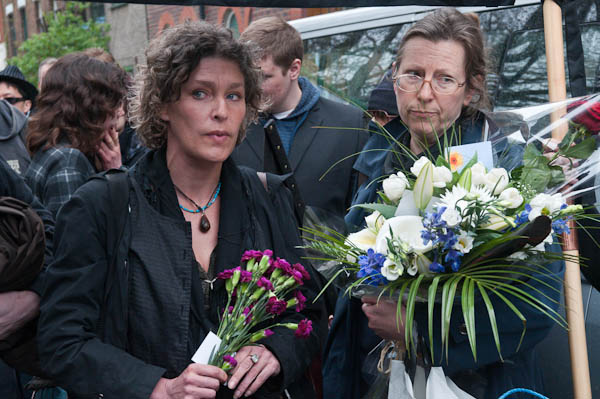
Ian Tomlinson Killing & Sri Lanka Genocide: On Saturday 11th April 2009 people marched from Bethnal Green Police Station to the spot were news vendor died after an unprovoked attack by police officer Simon Harwood. I also photographed a much larger march by Tamils against the genocide taking place in Sri Lanka.


March in Memory of Ian Tomlinson – Bethnal Green Police Station & Bank

Ian Tomlinson Killing & Sri Lanka Genocide - 2009

G20 Meltdown, the organisers of the protest at Bank on April 1st 2009 where police officer Simon Harwood attacked Ian Tomlinson leading to his death, had organised a memorial march from Bethnal Green Police Station to the place where he died a few yards away from the attack.

Ian Tomlinson Killing & Sri Lanka Genocide - 2009
Police discuss the march with Chris Knight

Tomlinson was not involved in the protest, but simply trying to make his way home after having been working, selling newspapers in the City. The protest would probably have been over by the time he was killed, but police had turned what had been intended as a carnival party into something far more sinister, kettling and then attacking many demonstrators and killing Tomlinson. There were numerous injuries and one photographer had his teeth knocked out, but I had seen the kettle coming and had left the area to cover another event.

Ian Tomlinson Killing & Sri Lanka Genocide - 2009

At the Tomlinson family’s request, the march was peaceful, silent and respectful. Before it started his stepson Paul King spoke briefly, describing the family’s trauma from the tragic death of his step-father, a “much-loved and warm-hearted man,” and pain at seeing the video of the assault, and he hoped that the investigation would be full and that “action will be taken against any police officer who contributed to Ian’s death through his conduct.”

Ian Tomlinson Killing & Sri Lanka Genocide - 2009
Paul King

As usual the investigation was carried out by the IPCC and the Crown Prosecution Service decided not to charge Harwood. After an inquest verdict of unlawful killing the CPS had to change their mind and charged him with manslaughter.

The sisters of Sean Rigg, murdered by police at Brixton the previous August were on the march

The jury was unable to hear evidence about his behaviour in previous incidents and was seriously misled both by some of Harwood’s own evidence and the evidence given by the first pathologist who had examined the body, Dr Freddy Patel. He had destroyed some vital evidence, puring away body fluids and had a long record of botched postmortems, having previously been suspended twice and finally was struck off the medical register in 2012.

After Harwood’s acquittal he was dismissed from the police. Tomlinson’s family took civil proceedings and in 2013, “the Metropolitan Police Service paid Tomlinson’s family an undisclosed sum and acknowledged that Harwood’s actions had caused Tomlinson’s death.

I left the march before it arrived at Bank, but returned the following day to photograph the flowers that had been left in Royal Exchange Buildings where the assault had taken place and a vigil was being held by Chris Knight, one of the G20 Meltdown organisers and a few others.

More at In Memory of Ian Tomlinson.


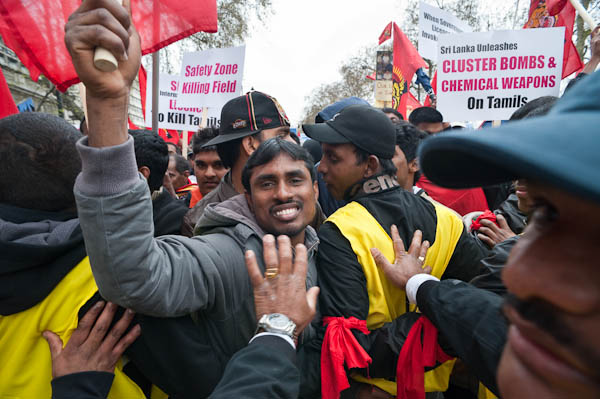
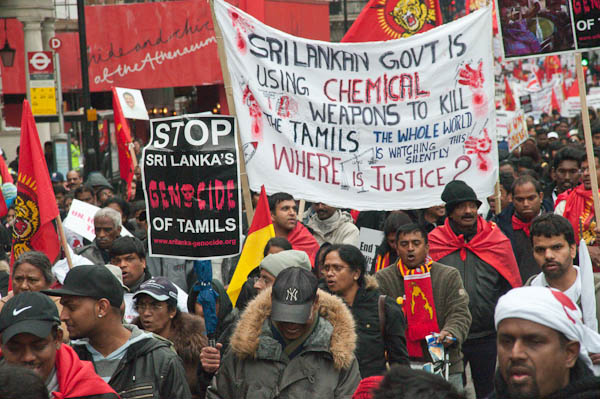
Tamils March – Stop Sri-Lanka Genocide – Temple to Hyde Park

A huge crowd had assembled on the Embankment at Temple, perhaps as many as 200,000, a very high proportion of Tamils in the UK who are thought to number around 300,000, around two thirds of them of Sri Lankan origin. It was a crowd with very few white faces.

Despite the size of the protest there appeared to be very little UK media interest and I saw no photographers or TV crews from major UK media covering the march to Hyde Park. Where there are usually a crowd of photographers in front at the start of large marches in London, for this one there was just me and three other freelances, none of whom get regular work for the mass media.

By April 2009 the civil war in Sri Lanka was clearly coming to an end, with the Tamil Tigers having been pushed back into a very small area. They had been defeated at a major battle at Aanandapuram on 5th April and the final assault by the government forces came at the end of the month with Sri Lanka declaring victory on May 16th.

Many of those taking part in the march were clearly supporting the “the LTTE, the Liberation Tigers of Tamil Eelam. A few carried actual tigers, fortunately only large toys, but many more wore the colours or carried flags or portraits of the founder and leader of the Tamil Tigers, Velupillai Pirapaharan.

The LTTE was proscribed in 2000 and they were clearly committing an offence under the Terrorism Act 2000 by supporting the group or wearing clothing which arouses the “reasonable suspicion that he is a member or supporter of a proscribed organisation.” But clearly the Tamils were not intending to cause any serious trouble and police sensibly made no attempt to arrest them all. Only three arrests were reported.

The Tamils had lost in Sri Lanka and many both civilians and combatants were killed during the civil war – possibly almost 150,000 in the last 8 months of the civil war. Around 300,000 were transferred into special closed camps, described by many as concentration camps – they were slowly released and the camps were closed by the end of September 2012.

Many more pictures at Stop Sri Lanka Genocide.


FlickrFacebookMy London DiaryHull PhotosLea ValleyParis
London’s Industrial HeritageLondon Photos

All photographs on this page are copyright © Peter Marshall.
Contact me to buy prints or licence to reproduce.