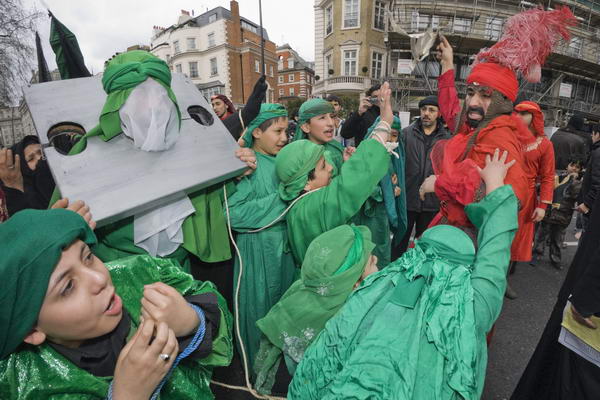
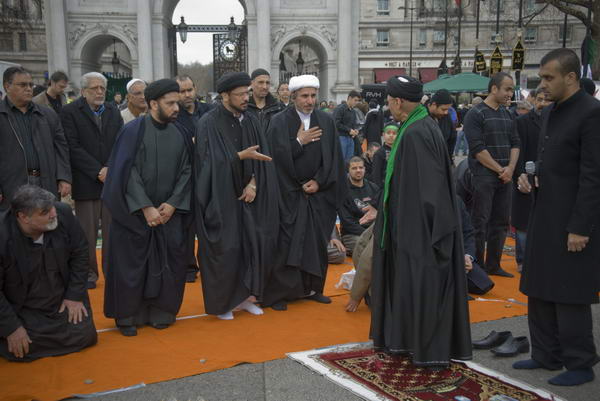
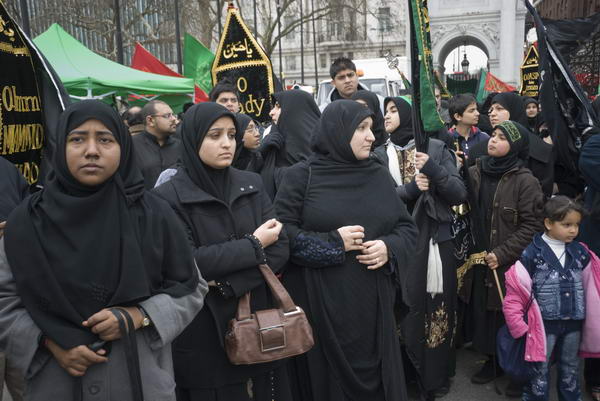
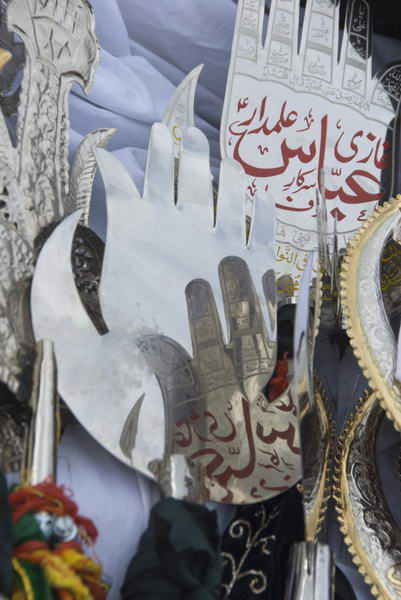
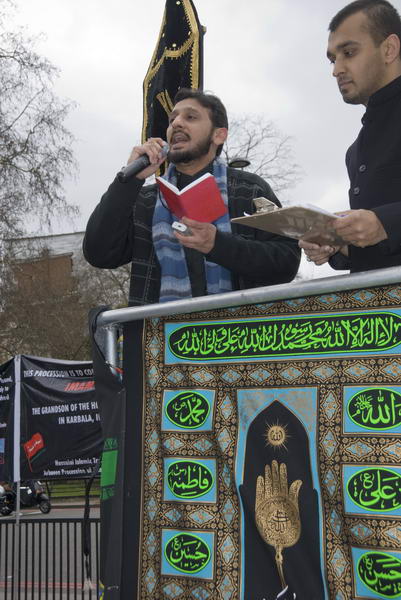
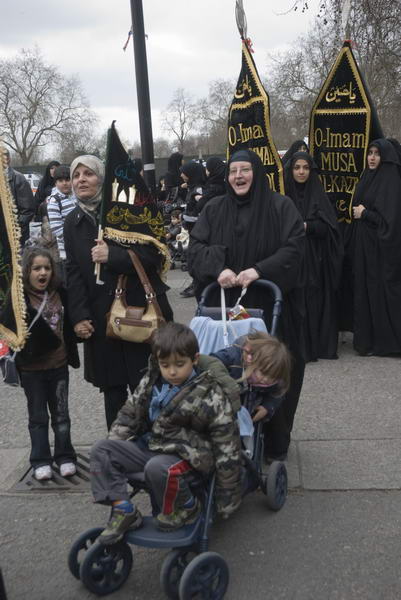
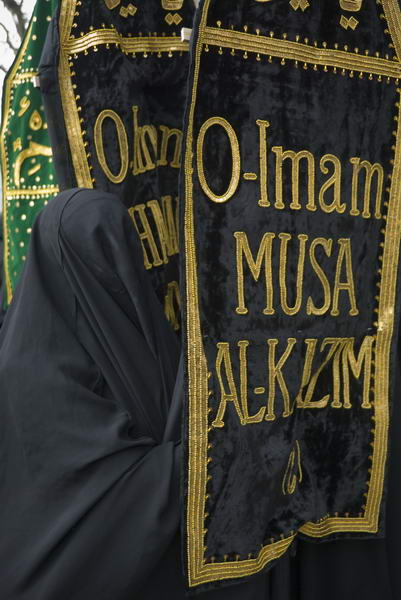
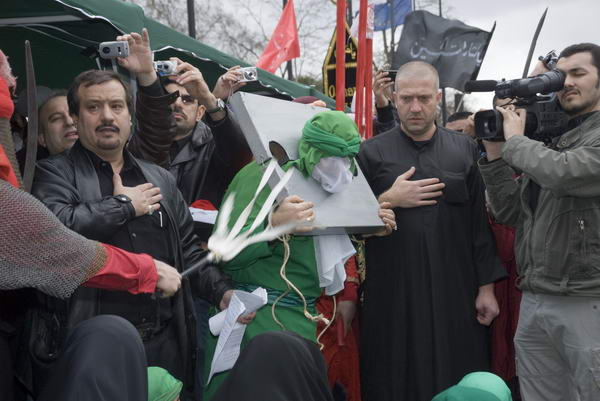
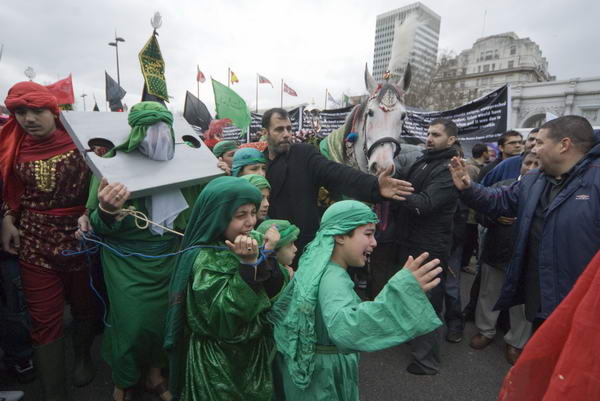
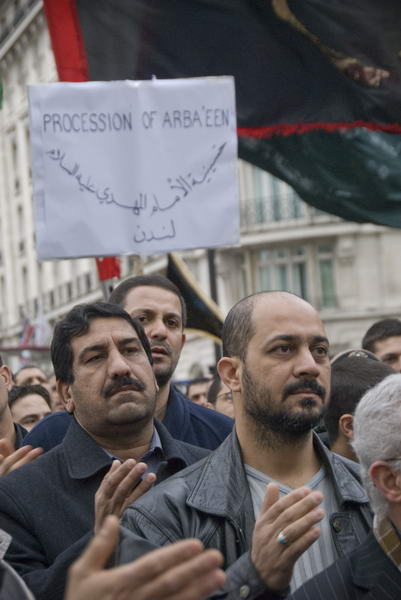
Arbaeen in London: On Sunday 2nd March 2008 I again photographed the Arbaeen Procession by Shia Muslims in London. It was one of various religious events on the streets of London that interested me – along with other processions and events by other major religions – Christians, Sikhs, Hindus etc in public on the streets of London, many of which you can find recorded on My London Diary.
These pictures were a part of my celebration of the multicultural nature of London which has turned what was the rather drab post-war austerity of my youth into a much more vibrant place to live and work. Immigration has enriched our nation culturally and in so many other ways, though it has also produced a racist backlash that has poisoned much of our politics.
Arbaeen is a major event for Shia Muslims around the world, coming at the end of the annual 40 days of mourning for the massacre of the prophet Mohammed’s grandson, Imam Hussain, together with 72 companions at Karbala. Millions take part in the pilgrimage in Karbala, Iraq which was banned by Saddam Hussein but revived after his downfall.
Shia Muslims regard the Karbala massacre as “the greatest sacrifice make by mankind, for humanity” and the “ultimate standoff between ‘good and evil’“. Hussain had refused to pledge allegiance to the ruler – “Death in honour is preferable to life in humiliation” – and his small band of followers fought to the death against an army of 40,000.
After the slaughter of the men, their women and children were taken captive and paraded through towns and cities on a 750 mile journey to Damascus, along with the decapitated heads of the martyrs, impaled on spears.
As a part of the procession in London there are reenactments of some of the events, prayers of mourning, and expression of grief in various ways including the beating of breasts.
Several thousand Muslims come from across the country to take part in this annual event, organised by the Hussaini Islamic Trust UK, which is the largest Arbaeen procession in Europe.
Stop Starving Palestine Pan Protest: Last Friday evening thousands of us came to Whitehall shocked by the news and photographs coming out of Gaza, where much of the population is now suffering from malnutrition and over a thousand have already died of starvation.
The famine there is entirely due to the actions of the Israeli government and their army, the IDF. Over the past months they have denied access to the normal humanitarian supplies of foods and essential items to Gaza.
Israel has also disrupted the well-established channels through which food was distributed in Gaza through the UN and humanitarian agencies. Together with the USA they have set up an alternative way to supply food which has operated at only four centres; the amount of food supplied has been vastly inadequate and over a thousand of those queueing for it have been killed by the IDF.
A holocaust survivor speaks outside the Foreign & Commonwealth Office.
The world has been shocked by the pictures coming out from Gaza, and by well-documented stories from medical staff that snipers and not only target those queueing for food but ‘gaming’ by targeting different parts of the anatomy on different days. One day hospitals treated many who had been shot in their testicles.
For months we have been appalled by the accounts of the shelling and bombing of hospitals, medical facilities and the arrests and interrogation of medical staff, some of whom have clearly been tortured.
L
Large areas of Gaza are now covered with the rubble of people’s homes and people forced to flee and living in makeshift tents, often in so-called ‘safe areas’ have been killed by the military.
The attack began after an attack by Hamas across the border into Israel in which over a thousand died – including some by Israeli military fire and hundreds were kidnapped as hostages. But it has continued for over 600 days, with the killing of many, many thousands of innocent Palestinians, men, women and children in what has clearly become a series of war crimes.
Some Israeli ministers have clearly stated their intention to entirely rid Gaza of Palestinians, and Donald Trump has supported them, with plans to turn the area into a holiday resort. Israel clearly wants to settle the area with Israelis.
From the rest of the world we have seen words of condemnation, but little or no real action, with the USA using its veto in the UN. The UK has banned some of its arms exports and is nowmaking plans for air drops of food – but these will only be a small – and dangerous – drop in the ocean of desperate need.
On Friday evening I travelled up to London with my wife – carrying a large pan and a wooden spoon to bang it with in a protest calling on our government to take effective action.
I began by photographing a rally outside the Foreign & Commonwealth office by the International Jewish Anti-Zionist Network UK who began weekly protests in October 2023 against the Israeli Ambassador to the UK who had called for the illegal annexation of the West Bank and for “every school, every mosque, every second house” in Gaza to be destroyed. Their protests have been hounded by police, banned first from being outside her residence and then from Swiss Cottage.
Among the speakers I photographed there was a woman holocaust survivor who received tremendous support with people banging their pans and was unable to continue for several minutes. This was also one of the few parts of the evening of protest where many people had also come with placards.
A few yards up Whitehall there were crowds of protesters banging pans on both sides of Whitehall. Police tried to keep them on the pavement but when they appeared to be trying to arrest one of those who refused to move, crowds surged around them and occupied the whole of the highway.
There were a couple of speeches from in front of the gates to Downing Street, but many of those present were too far away to hear them and people kept up the banging of pans.
Eventually the organisers asked people to come and leave their pans in front of Downing Street and start moving towards Trafalgar Square. Some did, but many others still needed them to cook with. A thin police line held up the movement towards the square for around ten minutes – though the protesters could easily have broken through they waited patiently and then marched on to the square where I left them.
End the Genocide, Stop Arming Israel: Last Saturday, 19th July 2025, the weather forecast for London was dire. Thunderstorms and heavy rain until clearing a little later in the afternoon, with up to several inches of rain leading to some localised flooding. In the event it was a bit under two inches, with small rivers running along the side of some streets.
London, UK. 19 July 2025. Many thousands march in pouring rain in London
In this account I intend to write about my personal experiences and working as a photographer on the day rather than my views on the terrible situation in Palestine and the reprehensible actions of the Israeli government and army – and Hamas. I’ve often written about the need for peace and justice, for an end to occupation and destruction and for the release of hostages and prisoners.
London, UK. 19 July 2025.
Linda and I were determined to go out and join the national demonstration, to show our support for the people of Gaza, to demand our government stop selling arms to Israel and to call on the Israeli government to end its terrible destruction and genocidal attacks and to allow humanitarian aid for the people of Gaza, many now starving. A little rain was not going to stop us.
As usual I checked online for our trains, only to find that our services into London were subject to delay and cancellation due to signalling problems. We dropped everything and hurried to get an earlier train than we had intended – and which actually was more punctual than usual – only two or three minutes late into Waterloo.
It was raining fairly heavily as we walked out of the station and by the time we’d crossed the Jubilee bridge to the Embankment where the march was gathering we were already quite wet.
As the forecast was for afternoon temperatures in the low to mid twenties I’d grabbed a lightweight waterproof jacket on my way out, which was a mistake. It did keep the water off to start with but was soon getting soaked through in places. I realised too late that I should have worn my poncho – or a heavier jacket that although too warm would have kept me dry. At least I’d had the sense to put on my truly waterproof walking boots rather than my usual trainers.
We joined the large crowd that was sheltering under the bridge carrying the rail lines into Charing Cross and I started to take photographs. It was dry – so long as you avoided the areas where water was leaking down from above – but rather dark.
I was working with my Olympus OM-D E-M5 Mark III (what a crazy mouthful of a name) a camera that came out over 5 years ago. It’s a Micro 43 camera with a sensor only around half the size of full-frame, but that does mean it can be significantly smaller and lighter – something increasingly important to me as I get less able to carry heavy camera bags. And, vitally important today, it is a camera that has good weather protection.
I also had my Fuji X-T30 in my camera bag, with a 10-24 zoom fitted. Had I not rushed out I might have chosen a more suitable body and wide angle for use in wet weather. Neither that camera or lens are weather sealed (the more recent 10-24mm is) and for most of the day they stayed in my bag. I did take them out a couple of times when the rain had eased off, but hardly any of the pictures I took with them were usable.
Under the bridge light was low, but the Olympus has good image stablisation and the main problem was subject movement, as people shouted slogans, jumped up and down, banged drums and more. Being very crowded also meant people were often banging into me as I was working.
I also use small and light lenses – in the case the Olympus 14-150mm F4-5.6 – equivalent to 28-300mm on full frame, going from a decent but not extreme wide-angle to a long telephoto. Its a small, light and incredibly versatile lens, but not one at its best in low light with its rather small aperture.
I started off working with the lens on the P setting, the programme choosing suitable shutter speed and aperture – with the lens wide open and shutter speeds of around 1/15 to 1/25 second. But I soon realised to stop action I would need a faster speed and switched to manual, deliberating underexposing at 1/100th second, f5.0 and at ISO 3200. The RAW images were dark but I knew that I could get Lightroom to make them look fine – if sometimes lacking in shadow detail.
Eventually people began to move out into the rain and march and I went with them, holding my camera under my jacket and only taking it out quickly to take pictures. I looked in my bag for the chamois leather I usually hold to dry and hold in front of the lens filter and it wasn’t there – I’d left it back home in the pocket of the jacket I was wearing when it last rained while I was taking pictures. I had to make do with a handkerchief instead, giving the protective filter a quick wipe before each exposure.
Outside it was a little brighter and I was able to increase the shutter speed to something more sensible, and was using manual settings of 1/160 f5.6 with auto-ISO giving me correct exposure. I was mainly working at the wider focal lengths of the lens and f5.6 gave me enough depth of field.
I hadn’t got out my umbrella, but of course many others were carrying them to keep dry. I find it hard to work with one hand while holding an umbrella in the other. But other people’s umbrellas were a little of a nuisance, with water often pouring from them onto me as I took pictures, adding to the effect of the rain.
So I was getting increasing wet – and soon retreated to the sheltered area under the bridge where different groups were now coming through. Keeping close to the end of the sheltered area I was able to keep working at the same settings, with the ISO now 3200.
London, UK. 19 July 2025. Stephen Kapos and another holocaust survivor on the march.
After a while I went out into the wet again – the rain had eased off slightly, and took more pictures. Then I noticed the banner for the Jewish holocaust survivors and their descendants and went over to greet Stephen Kapos, photograph him and another survivor as they set off on the march.
Shortly after I decided I would move to Westminster Bridge to take pictures of the marchers with the Houses of Parliament in the background, and walked as quickly as I could to there. Crowds of marchers and tourists watching the march slowed my progress somewhat.
The bridge is open to light and I was now using 1/250 second, but still with the Olympus lens at its wide-angle lens there was no need to stop down and I was working at around ISO 640.
I think around half of the march had gone over the bridge before I got there and I stayed taking pictures around halfway across the bridge for around half an hour, only leaving when I could see the end of the march coming on to the bridge. Fortunately the rain had eased off, but I was still getting wet.
I then hurried taking a short cut to get to Waterloo Bridge, taking just a few pictures where hurried past the march again on York Road. I took more photographs as people came onto Waterloo Bridge and then saw that a large group had stopped in the shelter underneath the railyway bridge and were having a spirited protest there – so I went to photograph them. When they marched off I went with them to Waterloo Bridge.
I looked at my watch. I had thought about taking the tube to Westminster and then going to photograph the rally in Whitehall, but decided it was perhaps too late to bother. I’d taken a lot of photographs and was rather wet and also hungry and decided it was time to go home.
I went to Waterloo and got on a train. Eventually, 15 minutes late, it decided to leave, and with a few stoppages at signals got me home around 25 minutes later than it should. Fortunately I’d packed some sandwiches and was able to eat them sitting at Waterloo, though the view wasn’t interesting. I’d edited and filed my pictures by the time Linda arrived home.
Support Ukraine, Bring the Children Home: Last Saturday, 24th May 2025, I photographed three events in London, and you can see albums of pictures from all of them on Facebook – and they are also should be available to see (and purchase for editorial use) rather less conveniently on my Alamy Portfolio page should you not have a Facebook account. I’ll post links for the Facebook albums for all three at the bottom of this post. All the pictures in this post are from the third event I attended, a rally and march by Ukrainians.
London, UK, 24 May 2025.
My work began on Kensington High Street, close to the Israeli Embassy which is tucked away out of site around 80 metres up a private road, Palace Green. Barricades and a line of police officers – with further police vans parked on that street prevent today’s – or any other protest – ever taking place there.
London, UK, 24 May 2025.
In the past, protests had always been allowed opposite the entrance to Palace Green on the opposite side of Kensington High Street, but today the police had set up the protest pen on the pavement outside Kensington Gardens around 200 metres away and forced the protesters into it under threat of arrest.
London, UK, 24 May 2025.
Among the usual banners and placards calling for and end to the genocide in Gaza was one reading reading “WHY ARE 40 (FICTIONAL) ISRAELI BABIES MORE IMPORTANT THAN 14000 PALESTINIAN ONES”, referring to the continual re-iteration by Israelis from the Prime Minister down of some of the more sensational and long discredited claims made about the October 7 events. And of course they never refer to the scorched earth “Hannibal” policy the IDF were directed to adopt which was responsible for at least some of the Israeli deaths on that tragic day.
London, UK, 24 May 2025.
What was perhaps missing from this FRFI protest compared to the other protests for Palestine that I’ve covered was a call for the hostages to be freed. But they were calling for ‘Peace, though clearly for ‘Peace With Justice’ and for freedom for Palestine, and making clear their demand that the UK ends its complicity in genocide and cuts all military, financial, diplomatic, and cultural ties with the Zionist state.
London, UK, 24 May 2025
From close to the Israeli embassy I made my way to Marble Arch where I spent a few minutes photographing a very formal and managed event organised by the PMOI/MEK calling for an end to the executions of political prisoners in Iran.
London, UK, 24 May 2025.
Following the forced end of the Iran-Iraq war in 1988 an enraged Khomeini issued a fatwa ordering the massacre of political prisoners and some 30,000 MEK supporters – then Iran’s main opposition to the clerical dictatorhip – were hanged. The executions and torture of any political opposition in Iran still continue.
London, UK, 24 May 2025.
At Hyde Park Corner, around the Wellington Arch I joined a crowd of Ukraininans, many men and women in embroiderd traditional dress. Obviously they had come to support their country in the war against the Russian invaders but the main theme of the afternoon was a call for the return of the stolen children.
London, UK, 24 May 2025.
According to Wikipedia, since 2014 Russia has “forcibly transferred … Ukrainian children to areas under its control, assigned them Russian citizenship, forcibly adopted them into Russian families, and created obstacles for their reunification with their parents and homeland.” Figures from 2022 claim that over 300,000 Ukrainian children had been taken to Russia. Russia has passed laws to make it very difficult for any of them to be returned.
London, UK, 24 May 2025.
Many Ukrainian children of all ages at the protest were in traditional dress andmany took part in performances by their schools at the event, along with a few speeches, prayers by “our Bishop” and a theatrical protest involving a figure entirely in black leading children by red ribbons representing Russia and death leading children by red ribbons who eventually overpower and and escape.
London, UK, 24 May 2025.
Much of the event was in Ukrainian and I may have missed much of the nuances, but perhaps the most emotional part was the singing together, hands on hearts, of the national anthem. It was perhaps the most un-English part of the ceremony; back in my youth, not long after the war the main place I heard our terrible anthem was in the cinema where it was a signal for a stampede to the exits, with just a handful of angry looking middle-class men left standing to attention at their seats.
London, UK, 24 May 2025.
There were so many children taking part in the performances that the procession began around 45 minutes late and I had to leave it well before it reached the St Volodymyr Monument at Holland Park.
National March for Palestine: On 30th November 2024 I photographed yet another large march through London calling for an end to the continuing attacks by Israel in Gaza, Lebanon and the occupied West Bank.
As usual there was a strong Jewish presence on the march – and it was opposed by a much smaller counter-demonstration by largely Jewish protesters, many calling for the release of the hostages still held in Gaza.
Many of those on the main march also want the hostages to be released, but see the only way to acheive this is not to continue the devastation and genocide in Gaza, but a ceasefire with serious negotiations towards a long-term peace in Palestine and Israel.
Last week over 200 Israelis living in the UK signed a letter to Keir Starmer and David Lammy urging them to impose sanctions on Israeli ministers Itamar Ben Gvit and Bezalel Smotrich, asking others living in the UK with Israeli citizenship to add their signatures.
In part this stated their opposition to the hateful and dangerous rhetoric of these two miniters which they say “endangers lives, obstructs the possibility of a hostage deal , and endorses calls for ethnic cleansing.”
Reported here in the Jewish press but I think ignored by the BBC and the rest of the UK press, the letter accuses the two ministers of “doing all they can to prevent a hostage and ceasefire deal and instead focusing their entire energies on their messianic aims: annexing the West Bank and settling the Gaza strip.”
The letter makes clear that the two “do not speak for us” and that opinion “polls in Israel reveal that the majority of the public supports a hostage deal and seeks an end to the war.”
Earlier the Jewish News had reported on a campaign by British Jewish organisation “Yachad, who advocate for peace and equality for Israelis and Palestinans“, also calling for sanctions against the two men, and the media more widely covered both David Cameron stating his government had been planning sanctions against these ministers and on Starmer and Lammy “mulling over” sanctions. By now these seem well overmulled.
As with all the previous marches and events calling for an end to the attacks on Gaza, the protest was entirely peaceful, with a complete absence of any antisemitism – unless you define calling for freedom for Palestine and Palestinians as antisemitic.
I wrote in my captions “As the death toll from Israel’s attacks in Gaza is now over 43,000 and many now face starvation with every hospital having been bombed and with virtually no medical supplies, and the UK is still complicit in the genocide, thousands including many Jews, marched in yet another entirely peaceful mass protest in solidarity. They call for an immediate ceasefire with the release of hostages and prisoners and for negotiations to secure a long-term just peace in the area.“
That figure of 43,000 is sadly out of date and the true figure is now considerably higher, with many bodies still buried under rubble and an increasing number of deaths from the disease and starvation caused by the continuing attacks and the deliberate denial of food, fuel and medicine. Israeli forces have destroyed much of the infrastructure as well as the organisation of society which was of course largely provided by Hamas.
We are witnessing – despite the banning of the international press from any effective access to Gaza – the large scale collective punishment of the entire population of Gaza. And the detailed reported and conclusion “that following 7 October 2023, Israel committed and is committing genocide against Palestinians in Gaza” by Amnesty International confirms what has been clear to almost everyone for many months
All the pictures here are from the march through London on 30th November 2024. You can see many more here in my album on the event.
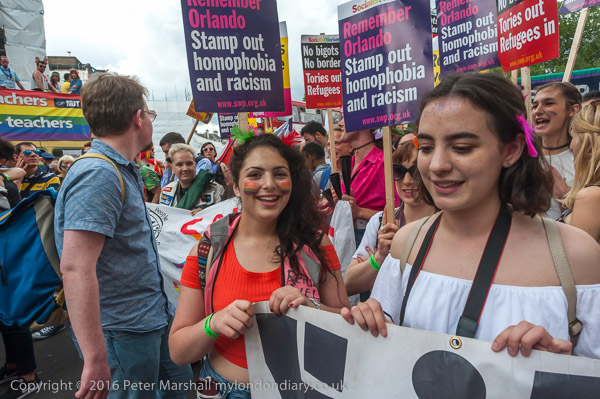
Pride and Migrant Rights & Anti-Racist Pride: Saturday 25th June was I think the last time that Pride was an open event where people who wanted to take part in Pride as a protest could just turn up and join in.
When I first photographed Pride in 1993 it was much smaller and very definitely a protest. Over the years it has become a parade with many corporate groups taking part and dominating the event attracting huge audiences to watch it on the route through the West End.
And now to be in the parade you need a wristband, free for LGBT+ Community Groups but cotsing between £7.50 and £35 for others – and the media centre is insistent we call it Pride in London rather than ‘London Pride’ or ‘gay pride’, hashtag #PrideInLondon.
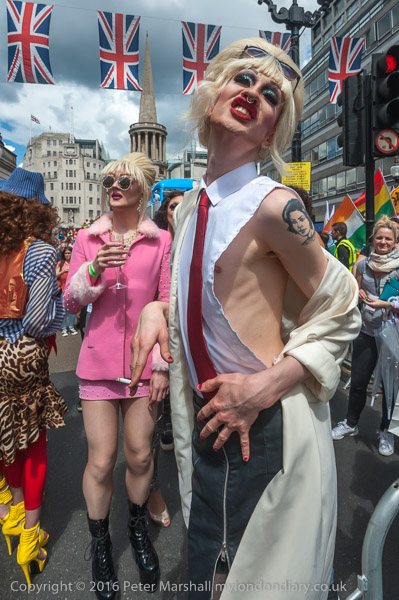
I can’t remember if I had bothered to get official accreditation for the event in 2016, I certainly did some years and suspect by 2016 it was needed to be able to walk around and take photographs as people were preparing for the parade. And they wanted to be photographed.
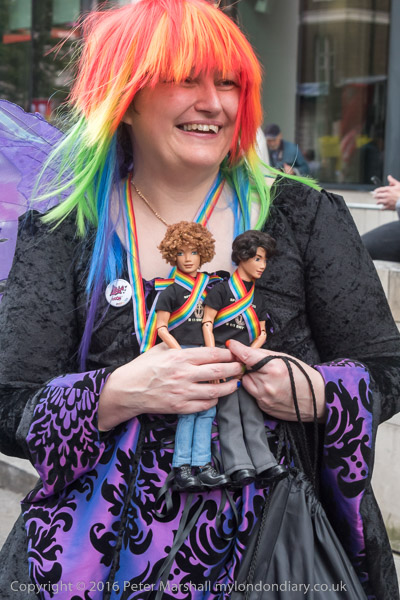
In my pictures I concentrated on those who I felt were continuing the tradition of Pride as a protest, including many I had photographed at other protests. But there were others I couldn’t ignore.
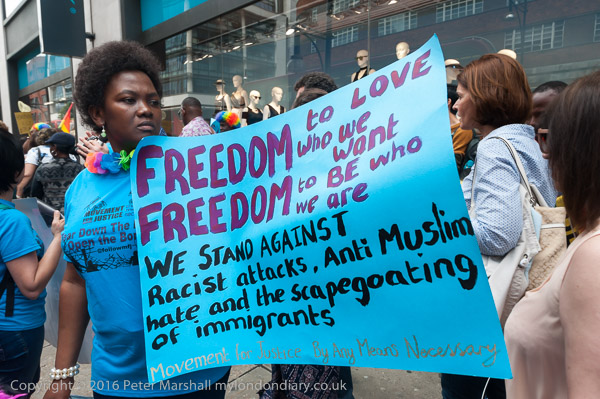
I left the official area where the parade was setting up with its corporate floats and walked down Oxford Street to where people were meeting for a Migrant Rights and Anti-Racist Pride march to join the main parade.
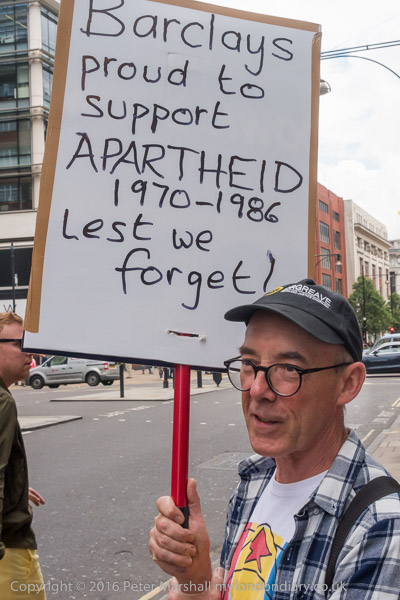
Movement for Justice who had organised this were joined by other protesters including London in Solidarity with Istanbul LGBTI Pride protesting the banning of Istanbul Pride, Lesbians and Gays Support the Migrants and other protesters who feel the official event has been taken over by corporate sponsors such as Barclays and BAE systems and is a parade rather than a protest, no longer representing its roots.
They marched up Oxford Street and Regent Street past the front of the main parade and went to its rear where they joined other protest groups relegated to the extreme end of the Pride parade. They tried to do this again the following year but were prevented by Pride stewards and ended up maching ahead of the main procession past cheering crowds along the main route.
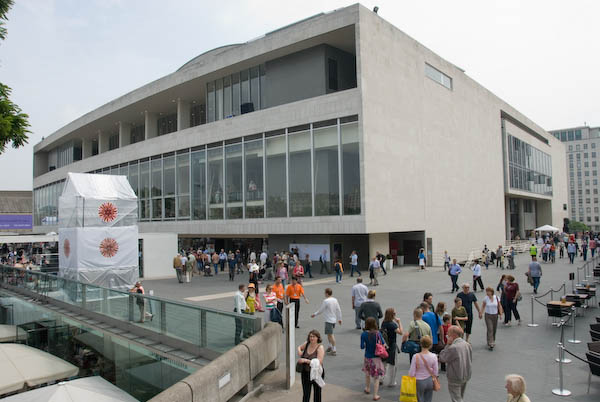
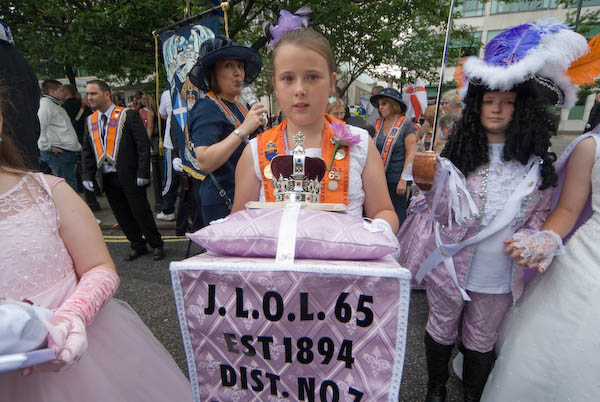
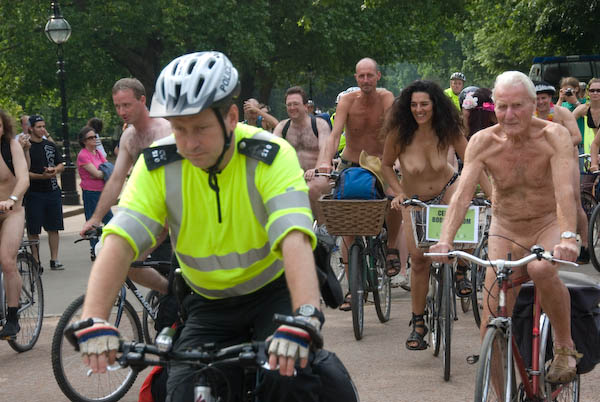
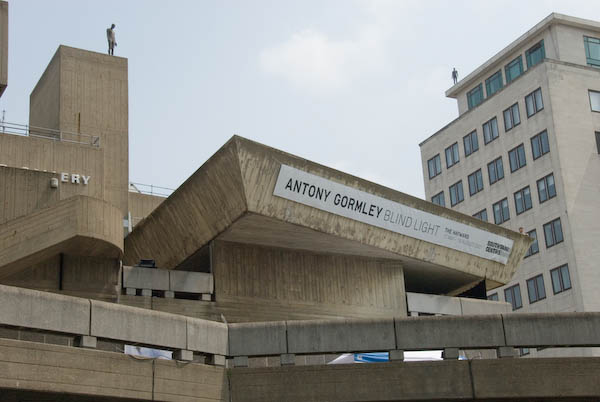
Palestine, Orange Order, Naked Cyclists & RFH: On Saturday 9th June 2007 I photographed a protest against the occupation of Palestine,the Orange Order celebrating 200 years of parades, the London World Naked Bike Ride and the re-opening of the Royal Festival Hall.
End the occupation – Palestine
The largest of these events was part of an international day of action marking the 40th anniversary of the 1967 six day war which had ended in complete and massive military victory for Israel, and a shameful defeat for not just the Arab nations but also the UN and the rest of the world.
And, as I commented then “in the longer term it is proving a disaster for Israel too, chaining them to a policy of brutal oppression of their Palestinian neighbours.” I continued; “Over the past few months, reading and hearing eye-witness reports of life in the occupied areas have shocked me, just as the reports from South Africa under apartheid did. And just as in South Africa, in time these things must come to an end with peace and reconciliation. War doesn’t settle things, it just prolongs the agonies.”
Seventeen years later we are seeing things that are orders of magnitude more shocking still happening in Gaza, witnessing the genocide of the Palestinian people.
Two members of the Palestinian government who had been invited to speak at the event were unable to come as they in jail in Israel. As usual until recently there was little coverage of this event or Israels apartheid policies in the UK media. Now their is considerable international interest in what is happening in Gaza but reporting is severely hampered as the international press are not allowed access other than in a few very limited Israeli army led tours.
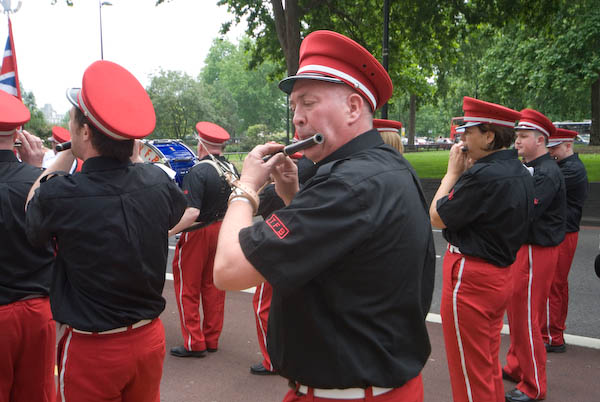
Orange Order celebrates 200 Years of Parades – Park Lane
The Grand Lodge 200th Anniversary Parade marked 200 years since the first recorded Orange Parade by the Portadown Lodge of the Orange Order, Loyal Orange Lodge No. 1 (LOL 1), on 1 March 1807.
Although King William III, Prince Of Orange had successfully invaded England in what was later known as the Glorious Revolution in 1688 and the first Orange Association was founded a few days after his landing in Brixham when he reached Exeter, organised parades are only known to have started 119 years later.
This anniversary event was an impressive display with several thousand marching including lodges from all our major cities. The Orange Order still has a strong following in some former protestant working class areas but as I commented, despite “own protestant roots … such sectarian solidarity now seems a relic of ancient enmities, a throwback to a less civilised age.”
I arrived in Hyde Park a little late but was able to photograph the riders setting off on their ride around London and went with them along Piccadilly before taking the tube to wait for them to reach the Houses of Parliament at Westminster.
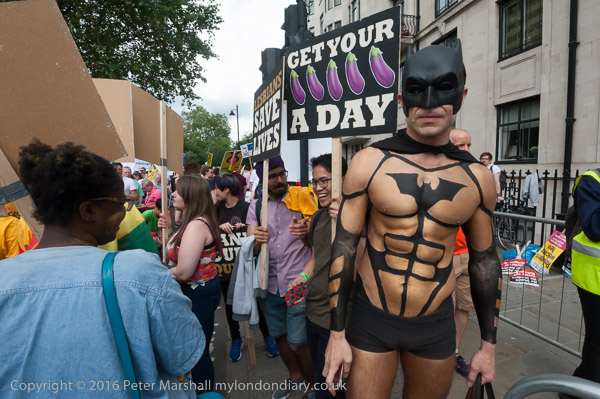
You can read my thoughts about the ride which I think rather fails to get its message across although causing a great stir on the busy streets it goes through, as few of the riders have anything on their bodies or bikes to state its purpose on My London Diary.
For most who see it, this is simply an unusual spectacle of nudity, and an illustration of the great variety of the human form rather than the very limited body types which we see on advertising hoardings and other images of the fully or partly unclothed om the press or elsewhere.
This was the one event of those I covered that was widely covered in the media, making the national news that evening, though I think there was little attention to why the ride was taking place.
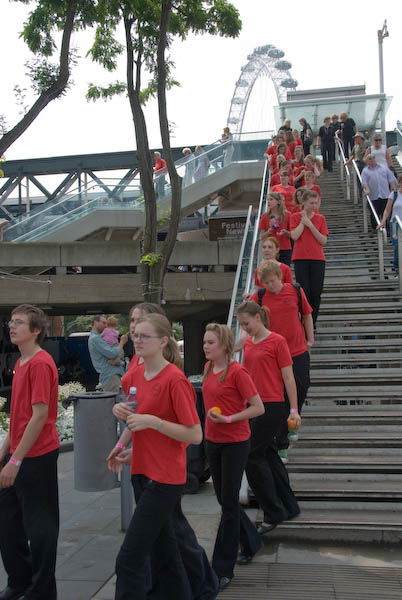
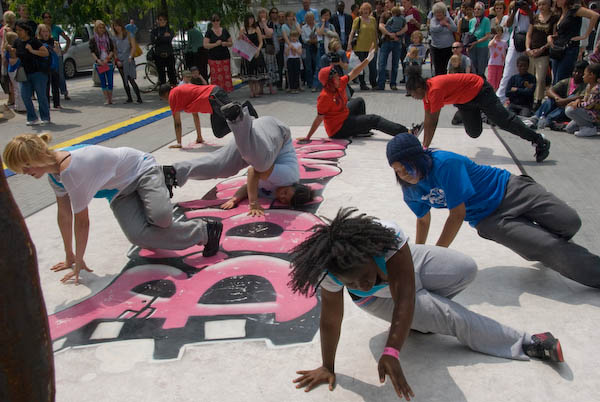
The Southbank centre was staging a weekend of events across its site marking the reopening of the Royal Festival Hall after a considerable refurbishment which began in June 2005 and I managed to take a few photographs of these across the day.
The foyers inside the building were opened up more but I think the main purpose was to provide more commercial space to provide an income for the centre. The Royal Festival Hall was built as part of the Festival of Britain in 1951 and was funded and managed by the London County Council and their successors, the Greater London Council until that was abolished by Thatcher in 1988.
The Southbank Centre states on its web site that it “does not receive any funding from the Government to run and maintain its 11-acre national heritage site. All essential repair and maintenance work to our buildings and site has been funded from our own commercial revenues or from fundraising.“
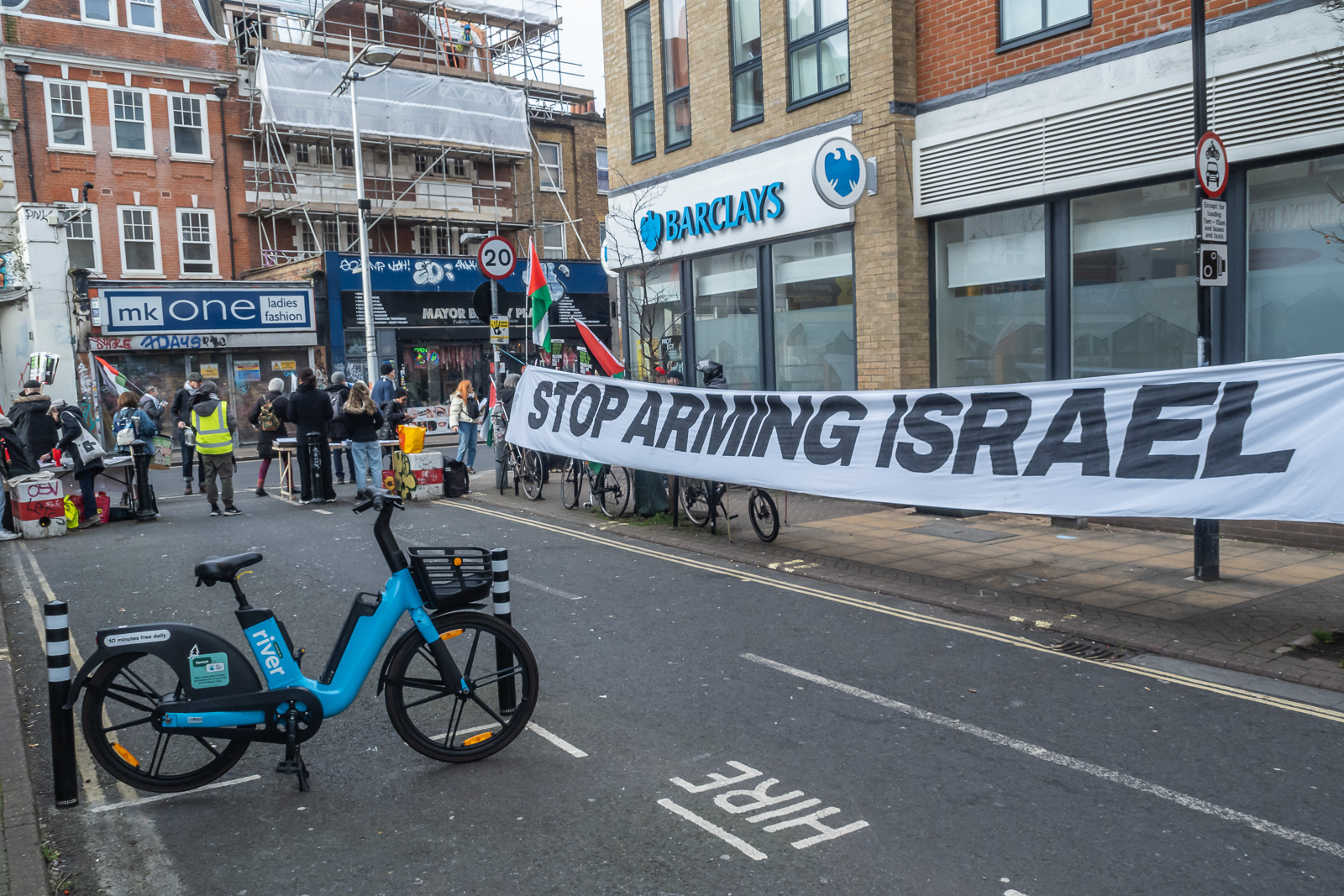
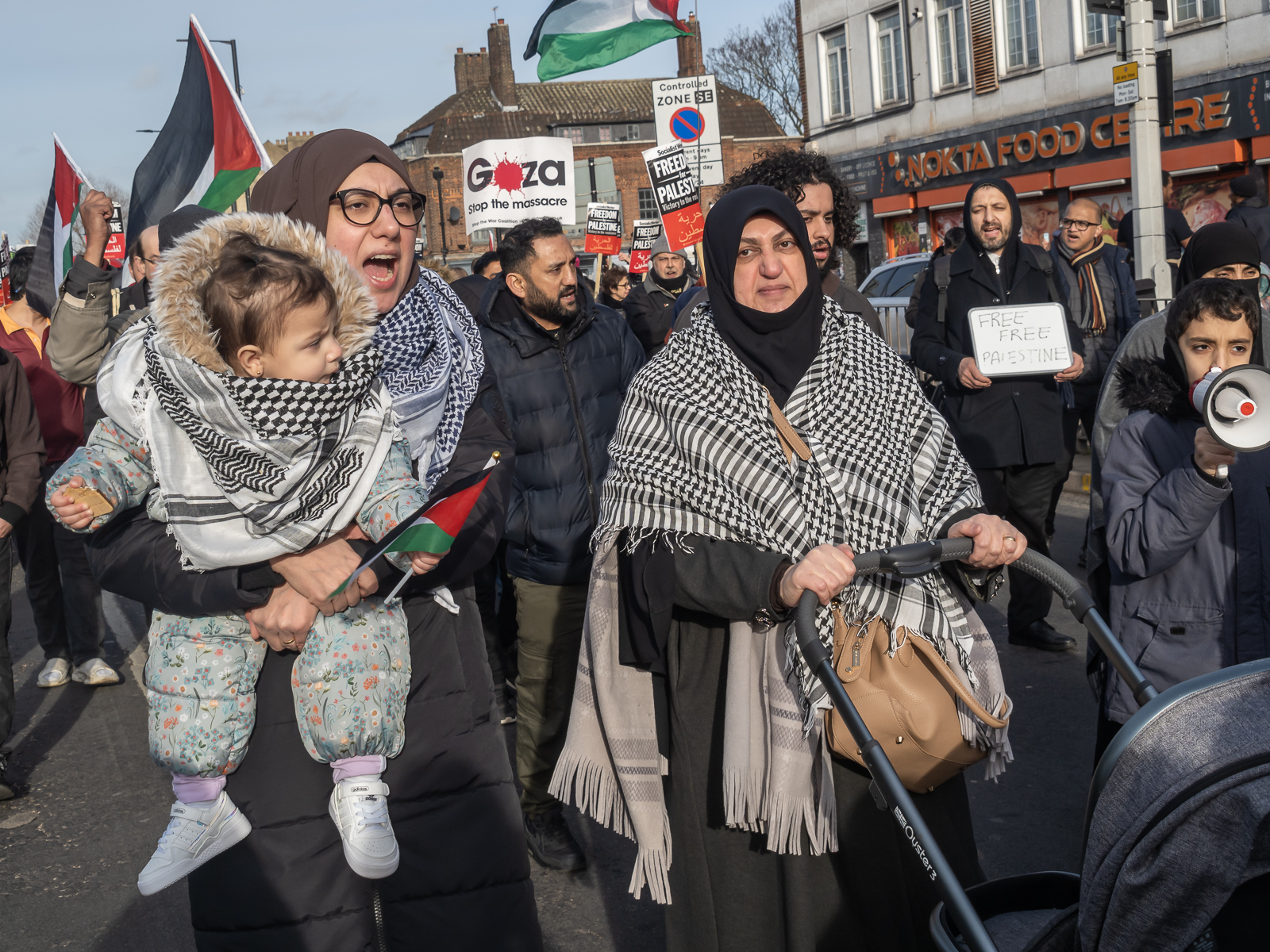
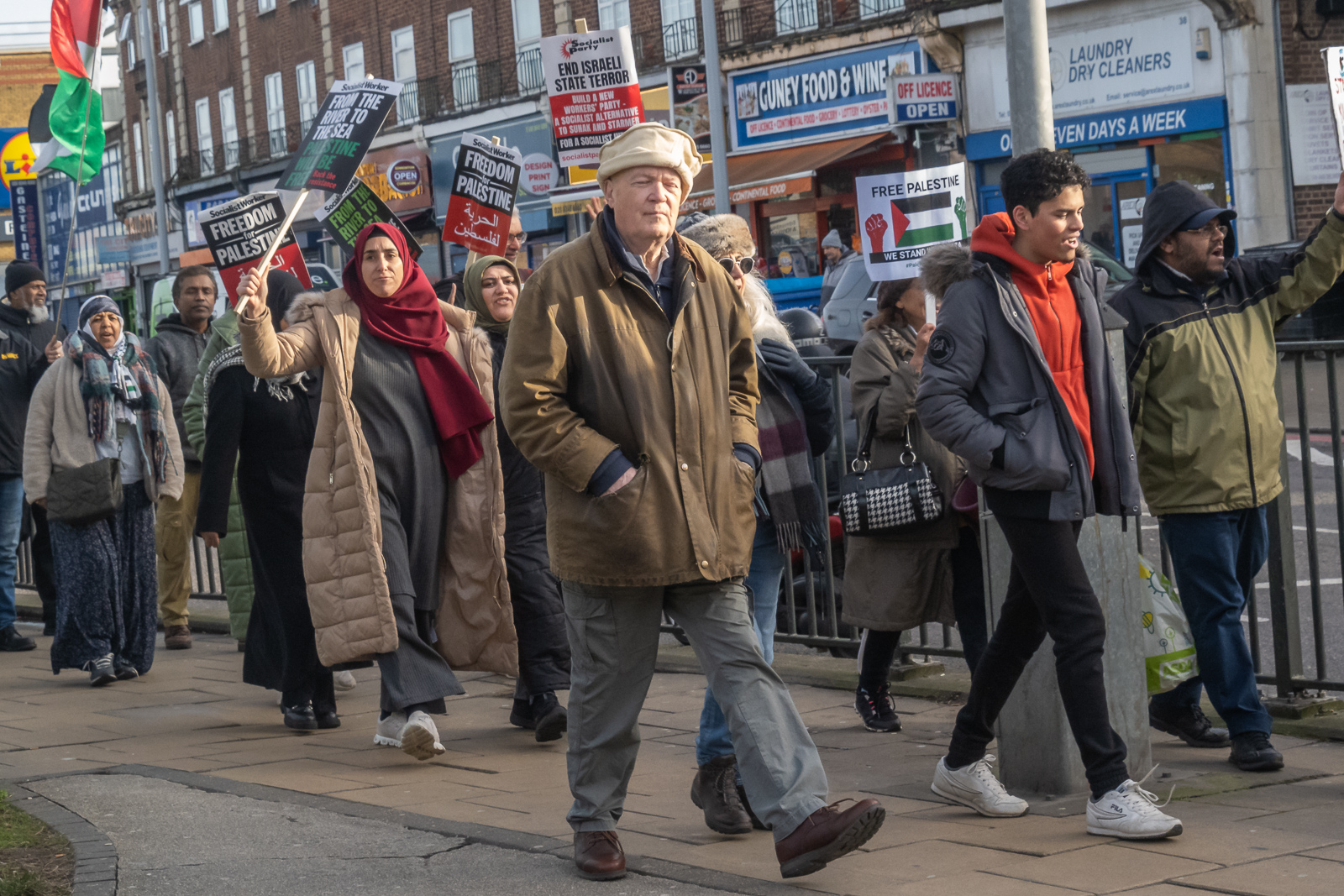
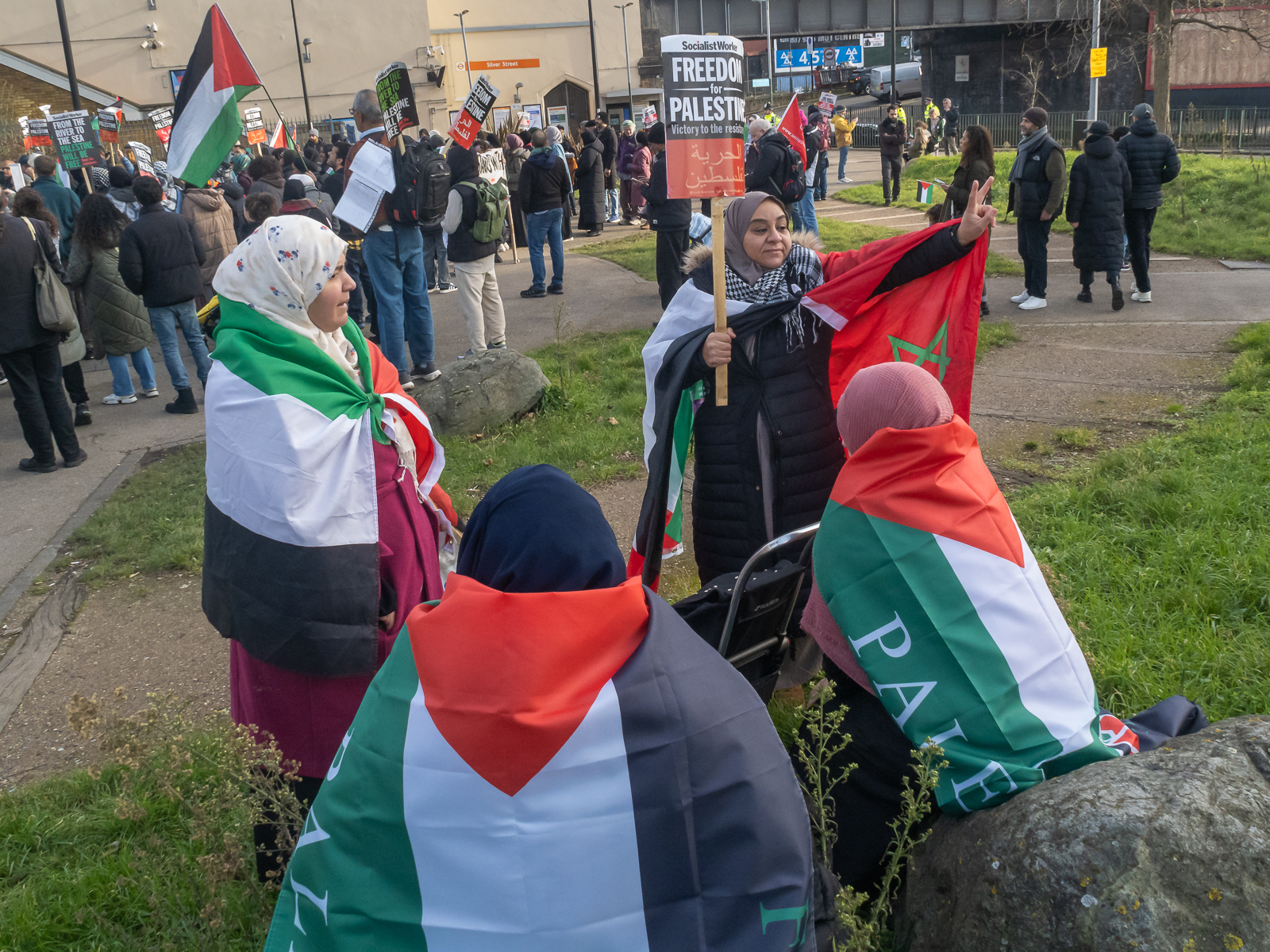
More Support to Gaza: Local actions took place across the country last weekend calling for an end to the genocide in Gaza and for an immediate ceasefire and freedom and a just peace in Palestine.
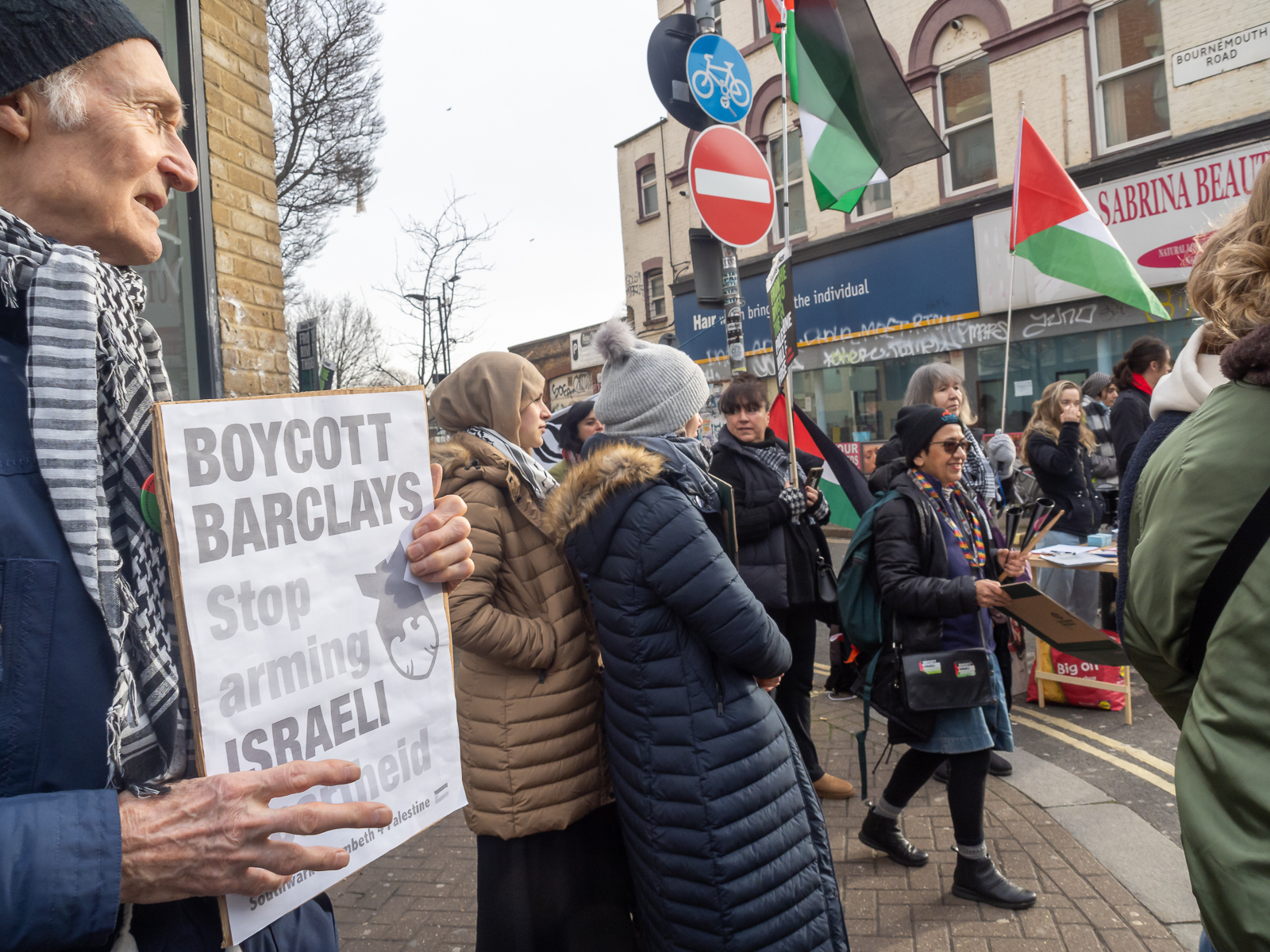
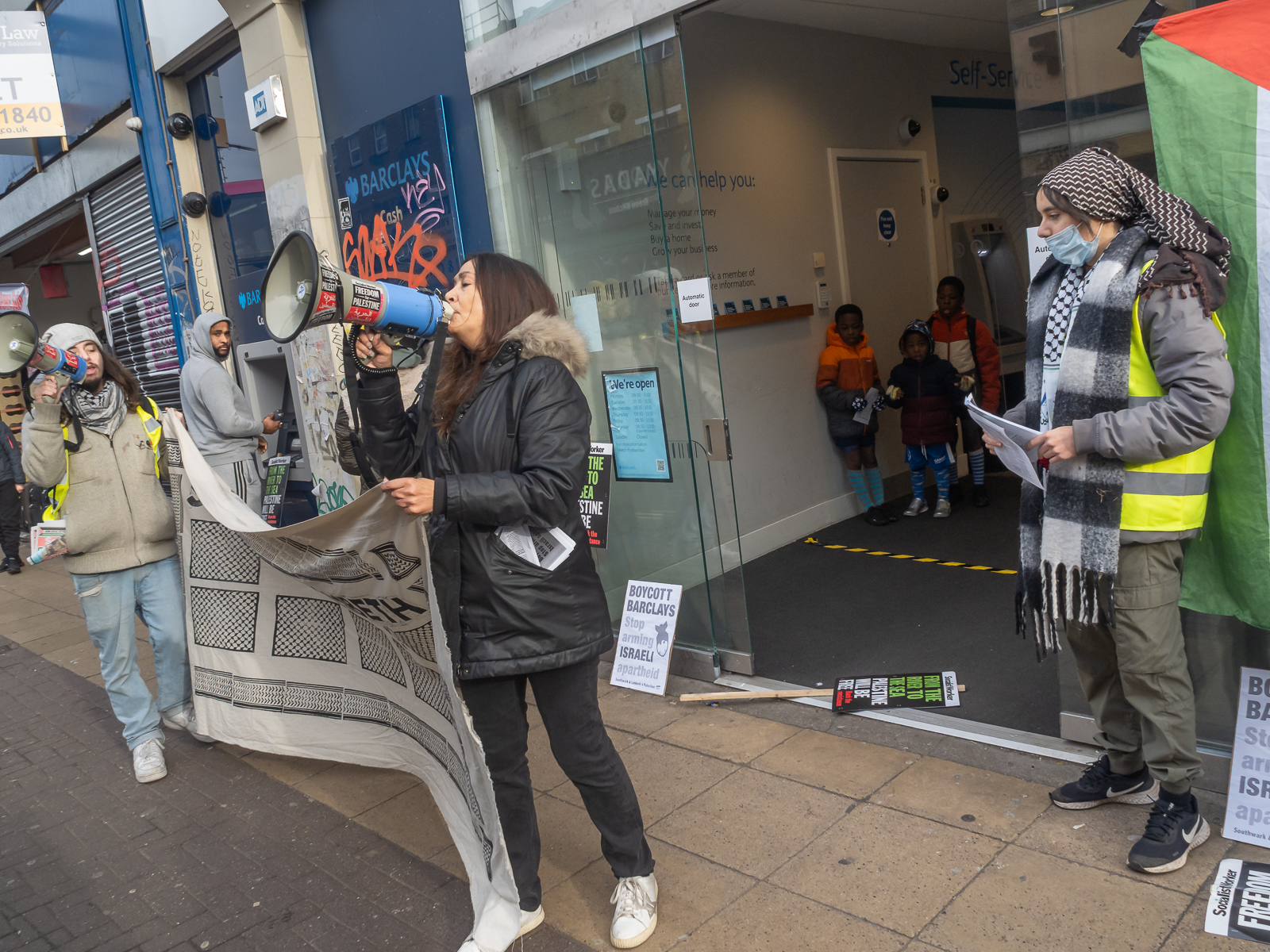
Barclay’s Peckham branch
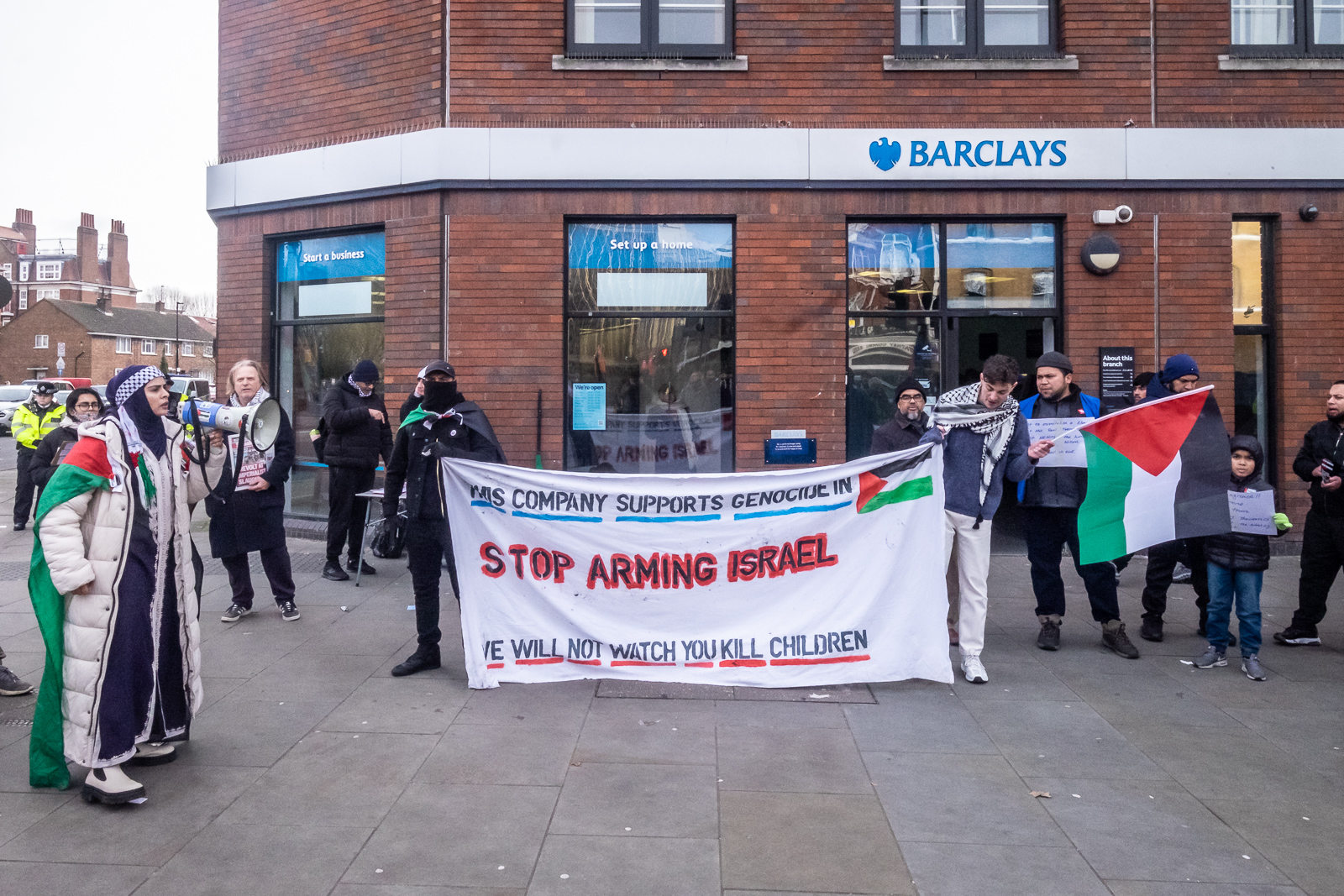
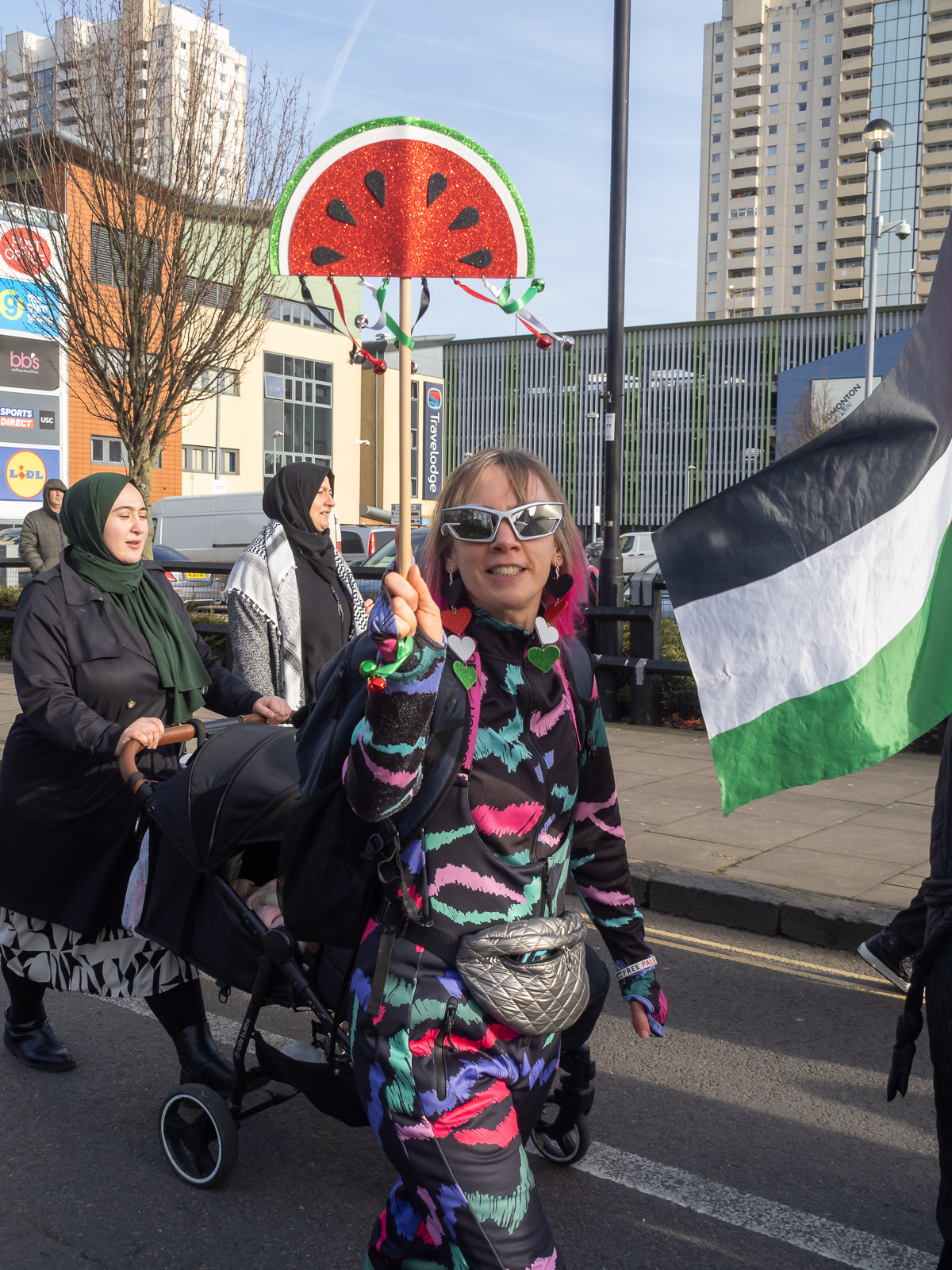
Most of the protests last Saturday were directed against local branches of Barclays Bank, demanding they stop bankrolling Israel’s attacks on Palestinians and calling customers to boycott the bank. Barclays has investments in weapons companies BAE Systems, Boeing, Elbit Systems, Raytheon all producing weapons and systems used in Gaza and Caterpiller whose bulldozers are used to demolish Palestinian homes, schools and civilian infrastructure.
Barclay’s Peckham branch
The protests came the day after the International Court of Justice (ICJ) at The Hague, the UN’s top court, had ruled that there was a plausible case against Israel under the 1948 Genocide Convention, and that the Palestinian population in Gaza was at real risk of irreparable damage.
Barclay’s Peckham branch
The ICJ stopped short of ordering an Israeli ceasefire and instead directed Israel to take every measure possible to avoid genocide while also ensuring humanitarian aid. The six provisional measures the court voted on to protect Palestinians from “irreparable” damage were all passed by overwhelming votes by the 17 judges, with even an Israeli judge supporting two of them, while a Ugandan judge voted against them all (although the Ugandan government issued a statement backing the ICJ).
Barclay’s Whitechapel branch
Media reports here in the UK have generally been rather lacking in detail and have underplayed the ICJ judgement. You can read it on the ICJ web site in full or as their lengthy unofficial summary. The court demanded that Israel must:
take all measures in its power to prevent all acts against Palestinians in Gaza violating the Genocide Convention;
ensure its military does not commit any acts of genocide;
punish all incitements to commit genocide;
take immediate and effective steps to provide basic services and humanitarian assistance in Gaza;
take effective measures to preserve evidence related to allegations of genocide;
report to the ICJ within one month on actions it has taken over these orders.
The ICJ has no powers to enforce its decisions and statements from Israeli government and military have been defiant, while the UK and USA governments seem determined to continue their support for genocide and to continue giving support to Israel, including supplying weapons
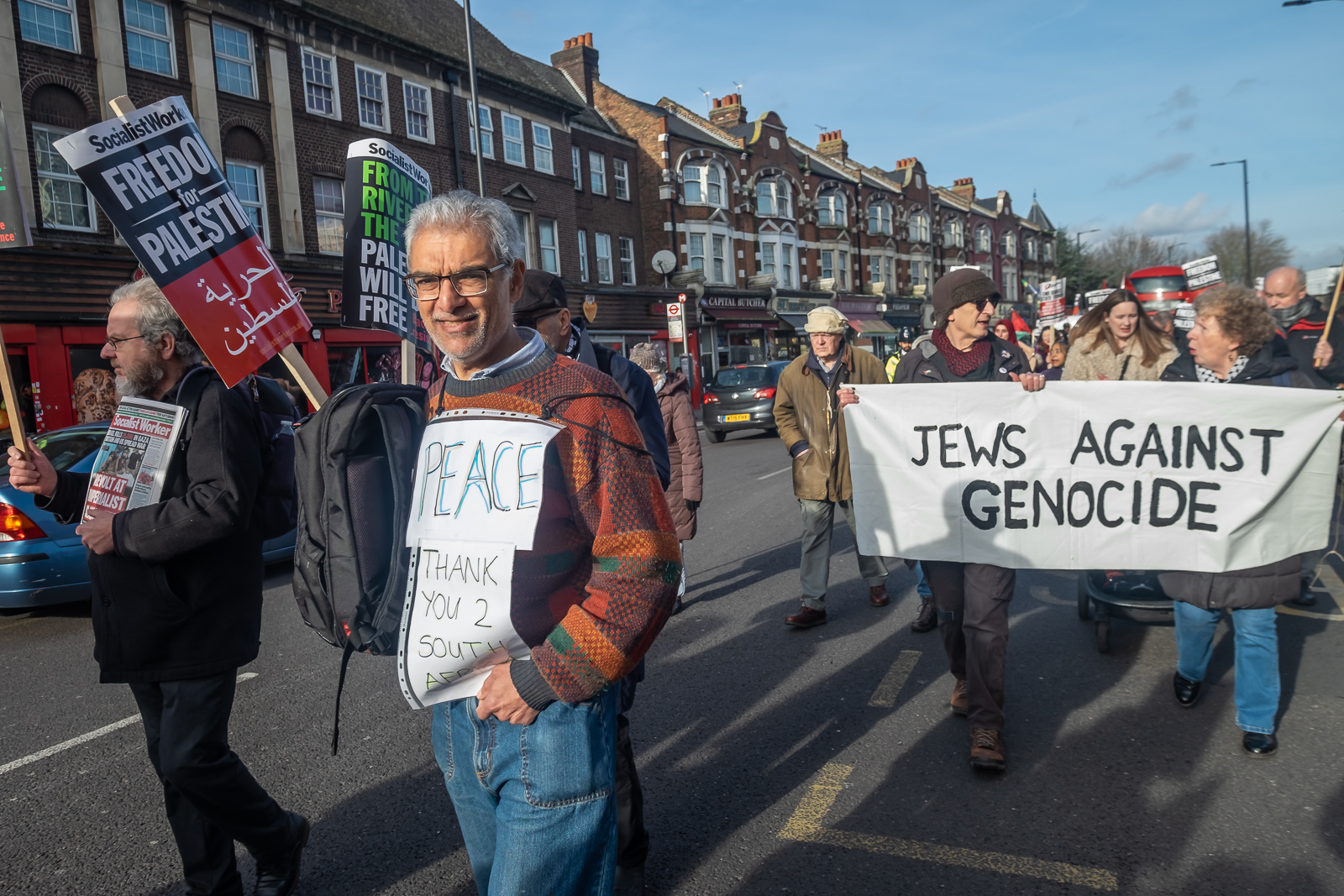
Edmonton Green march to a rally at Silver St
The ICJ decision came after South Africa brought the case, but protesters around the world have been clear that this is genocide. And in December the Lemkin Institute for Genocide Prevention, continuing the work of Raphael Lemkin, the Polish lawyer of Jewish descent who coined the term genocide and campaigned to establish the Genocide Convention, issued a statement explaining “the reasons why we believe the Israel-Palestine situation constitutes an instance of genocide.”
Edmonton Green march to a rally at Silver St
The killing in Gaza continues, with over 26,000 Palestinians now known to be killed including over 10,000 children. More than 8,000 are missing, probably most of them buried under the rubble, and over 65,000 are severely injured.
Edmonton Green march to a rally at Silver St
A BBC report states that more than half of all buildings in Gaza have been destroyed or damaged by the Israeli assault. There are also said to be almost 20,000 children in Gaza who have been orphaned or separated from their families. Other reports suggest that around three-quarters of Hamas fighters are men who became orphans, and so the current attacks are likely to be a powerful recruiting ground for future militants against Israel.
Edmonton Green march to a rally at Silver St
The whole Israeli policy over the years has been counter-productive. Peace in the region requires a thriving Palestine, not an area subjected to military occupation, under an apartheid system and subjected to destructive attacks – and certainly will not be achieved by genocide.
Edmonton Green march to a rally at Silver St
It’s very hard to see how any positive outcome can emerge now for Israel and Palestine, but perhaps the ICJ ruling is a small glimmer of hope – as years ago was Oslo. But hope then was soon defeated by Israel’s determination not to accept peace.
Edmonton Green march to a rally at Silver St
Last Saturday made my way around London on National Rail, Overground, Underground and Elizabeth Line to visit several pickets outside Barclays branches and then to Edmonton Green.
Edmonton Green march to a rally at Silver St
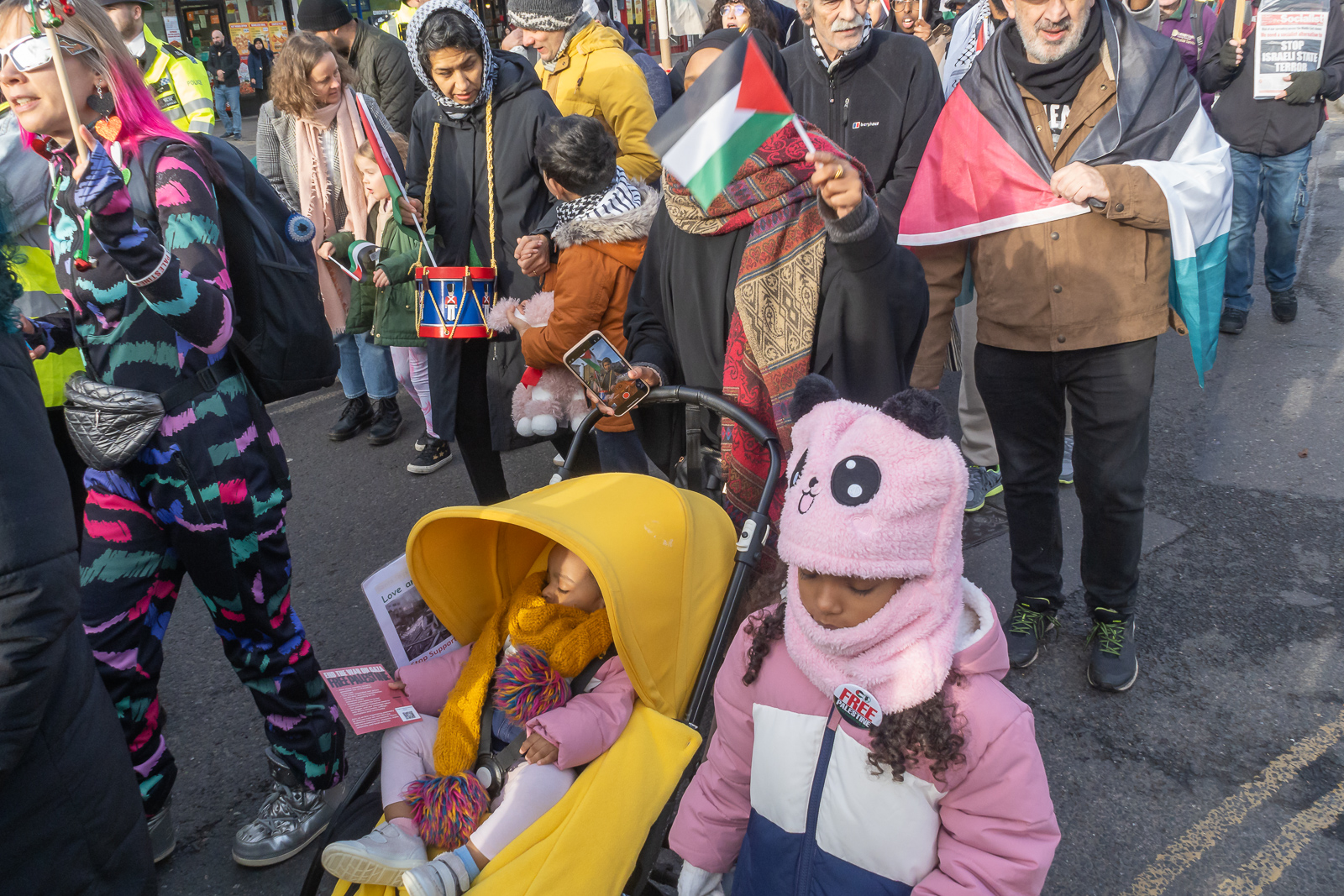
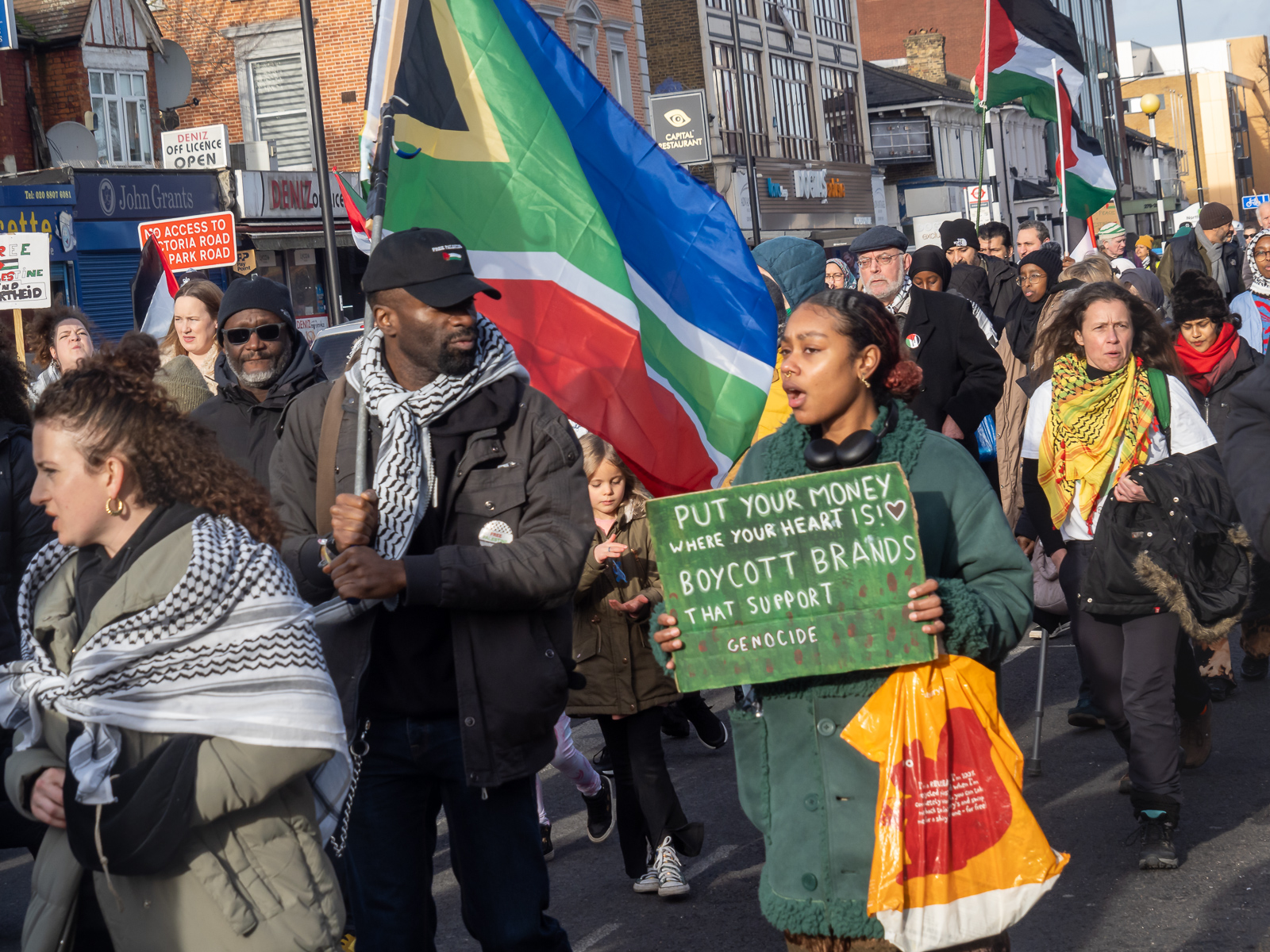
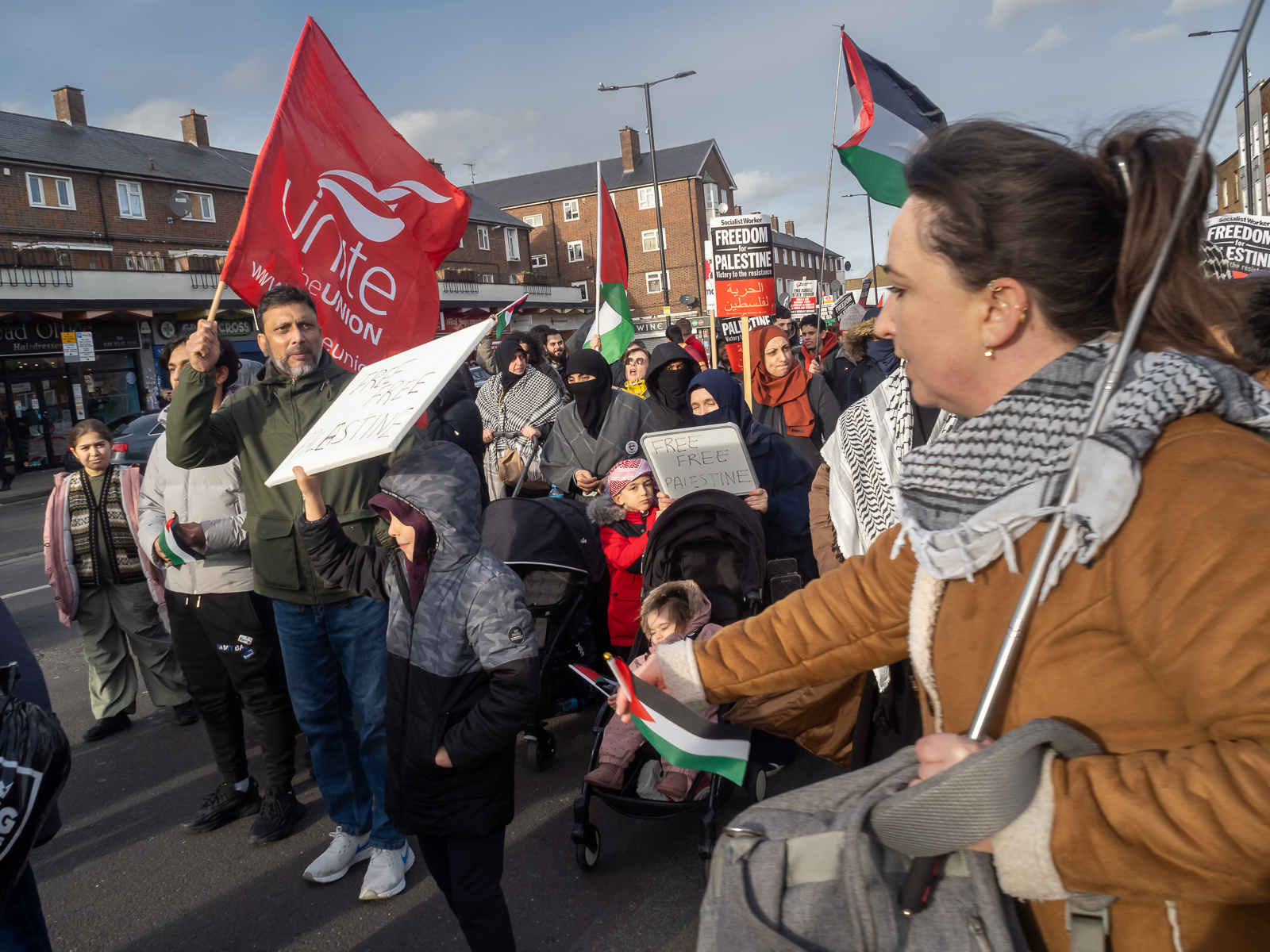
I arrived at Edmonton Green just in time for the march organised by the Enfield branch of the Palestine Solidarity Campaign to a rally at Silver Street. They demanded Israel ends its genocidal attack on Gaza, calling for an immediate ceasefire and an urgent programme of humanitarian aid to end famine and provide shelter, medicine and water. They praised South Africa for taking Israel to court for genocide and called for a just peace with freedom for Palestine.
Armistice Day Protests – Today I hope to be photographing a huge protest calling for a ceasefire in Gaza and peace in the Middle East as it makes its way from Hyde Park to the US Embassy. It’s an event some Tory politicians have tried to arouse controversy around, aided by some of the media in their lies. Armistice Day has always been an occasion for protests for peace and making it out as some huge national celebration we all share in is untrue as this post shows.
Both the BBC and the Tories seized on the fact that some people at a protest in London shouted ‘Jihad!’ but lie in saying it was an offshoot from the huge march taking place in London calling for peace and justice for Palestine.
It’s a lie that the BBC continues to let them promulgate without question, although their journalists must surely know that this was at an entirely separate protest organised by Hizb ut-Tahrir Britain, an Islamic fundamentalist political organisation dedicated to the establishment of an Islamic caliphate, whose lead banner at their protest read “Muslim Armies! Rescue the People of Palestine!”.
I’ve photographed many protests by Hizb ut-Tahrir in London since I first came across them in 2004 and they are very different and entirley separate from those organised by mainstream Muslim organisations, Stop The War, CND and the others now leading the protests by hundreds of thousands across the country calling for an end to the killing of civilians – whether Palestinian or Israelis – in Palestine and Israel. Most are particularly enraged by the killing of so many children in Gaza by air strikes which Israel claims are targeted, but are targeted on places where many people live and so die in them.
I think most of us who march – and the many more who support the marches but are unable to attend – want peace and the justice that can only come if there is a thriving country where Palestinians can live normal lives in peace and not under military rule and an apartheid regime.
Probably that can only come about with a two-state solution and a massive world aid programme to restore the incredible damage in Gaza as well as establishing rational borders for Palestine with the removal of many of the illegal settlements.
I grew up in a largely working class area on the outskirts of London in the 1950s, and then I think it was true that virtually the whole of the country paused to celebrate and commemorate the armistice, joining in with the minute’s silence in schools, shops, works and offices and traffic on the roads coming to a halt.
But even then relatively few joined in the military style parades on Remembrance Sunday, with most of my friend’s parents who had fought in WW2 having had more than enough of that kind of thing. My attendance was compulsory as a Wolf Cub and Boy Scout but I resented it and my freezing legs as cold November winds blew up my shorts – and the derision from friends who weren’t members. And by the time I was a Senior Scout we collectively refused to take part.
The idea that Armistice Day is not a suitable day for a peaceful protest calling for an end to the fighting and peace in the Middle East seems to me to be beyond absurd – yet again is taken seriously and promoted by the BBC. Armistice Day has I think always seen protests for peace – and November 11th 2006 was no exception.
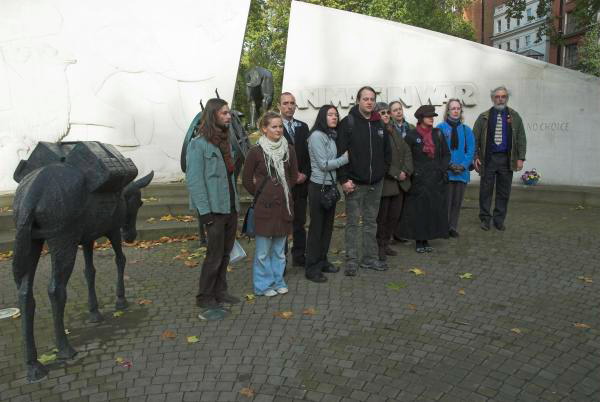
On that day I began on Park Lane, where there was a brief ceremony in front of the sculpture commemorating animals who died in war in the central area there at 11 am. There were only a small group there, wearing poppies they described as purple, though to me they seemed more lilac or mauve. In 2018, the Peace Pledge Union sold 122,385 white poppies: more than any year since white poppies were first worn in 1933, and many keep their white poppies to wear in following years, as unlike the red poppies their sale is not intended to raise funds but they are simply worn as a symbol of remembrance and peace.
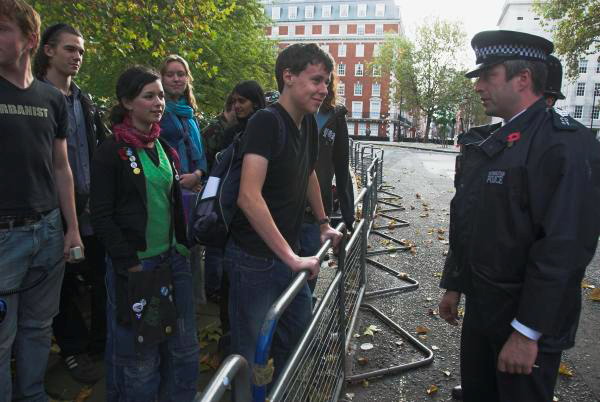
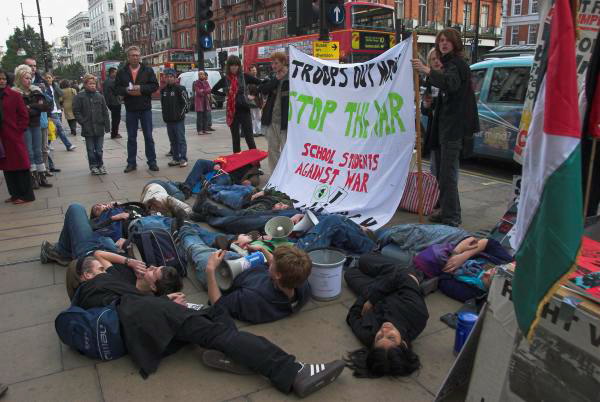
I moved on to Grosvenor Square and the US Embassy where School Students Against The War had scheduled a ‘die-in’. Unfortunately only around 20 had turned up for it – probably now many work on Saturdays or prefer to enjoy a lie-in at home.
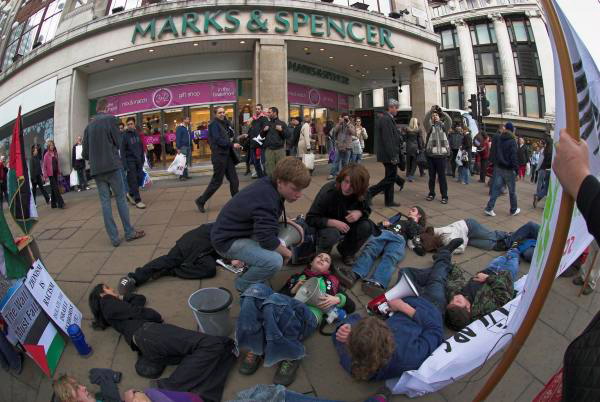
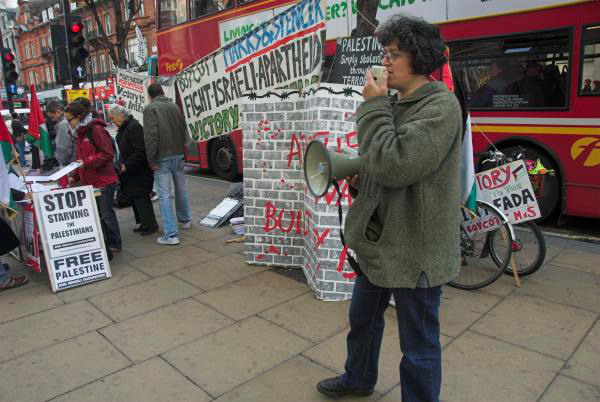
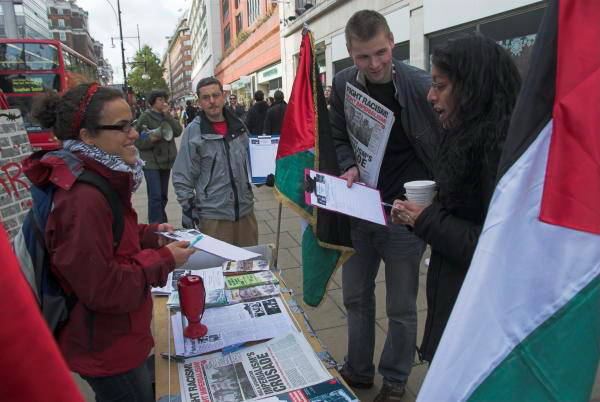
Another short walk took me to Marks & Spencer on Oxford Street, where a protest was taking place as a part of the fourth International Week of Action against the Apartheid Wall in Palestine.
Fight Racism, Fight Imperialism who had organised this event also hold regular vigils outside M&S every Thursday evening, calling for a boycott of the company as part of a wider Boycott Israel campaign. M&S sell goods including those coming illegally from the occupied territories of Palestine and give financial and moral support to Israel.
School Students Against The War came from the US Embassy to join them and staged their die-in on the wide pavement in front of M&S. This certainly generated a great deal of attention and they made some short speeches to the the crowds milling past M&S before marching off down Oxford Street with their megaphones and banner. They staged a second ‘die-in’ further down the street, again attracting the attention of shoppers, although perhaps surprisingly, not the police none of whom seemed to be around.
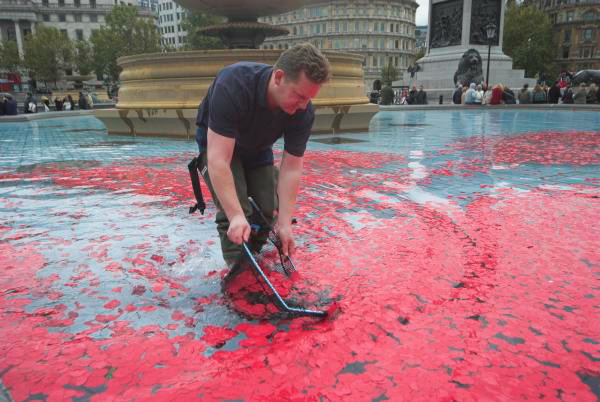
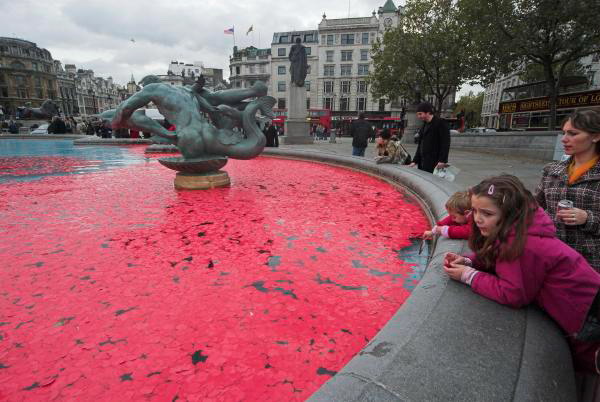
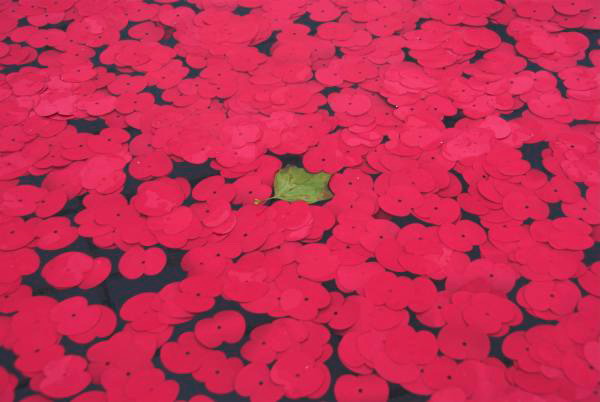
I went on to Trafalgar Square where I hoped to photograph the fountains filled with red poppies, but I arrived a little late to find a man in waders fishing them out with a shrimp net. It was bizarre if not surreal, although not quite what I’d been hoping for.
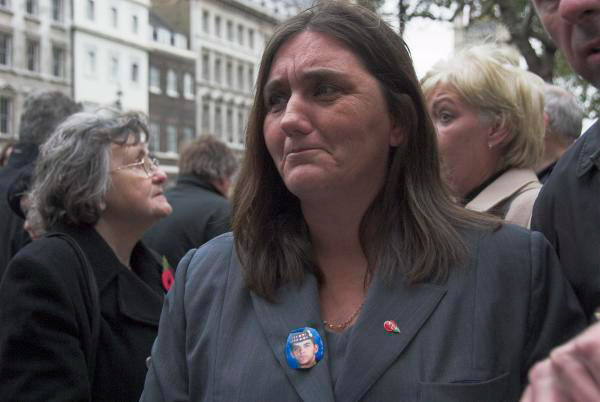
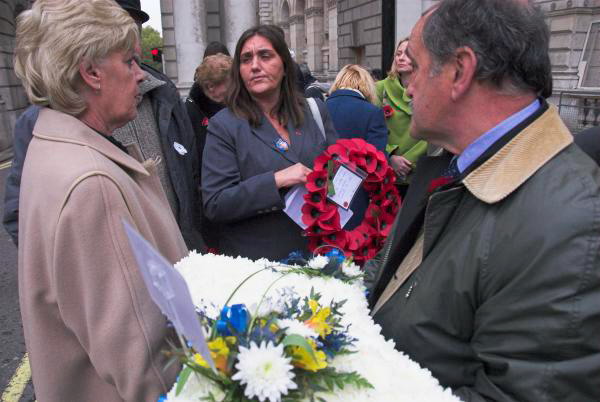
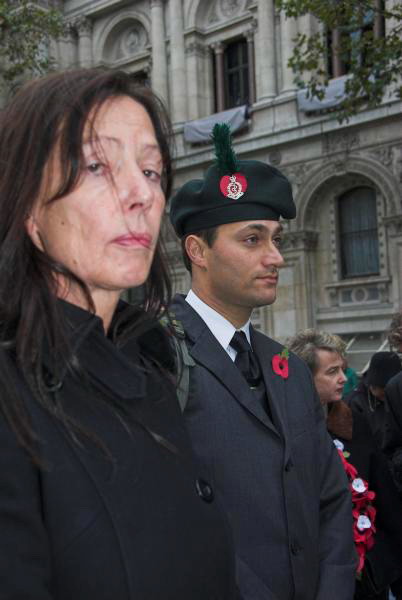
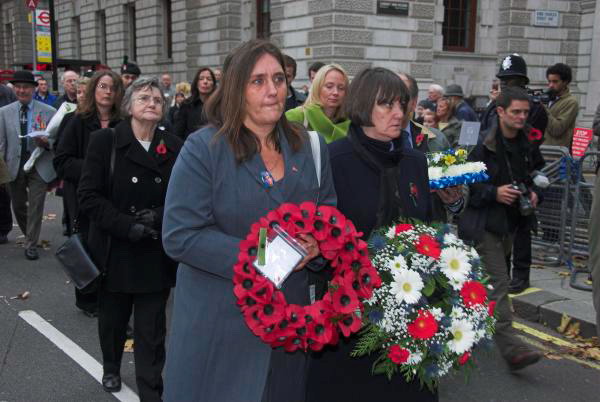
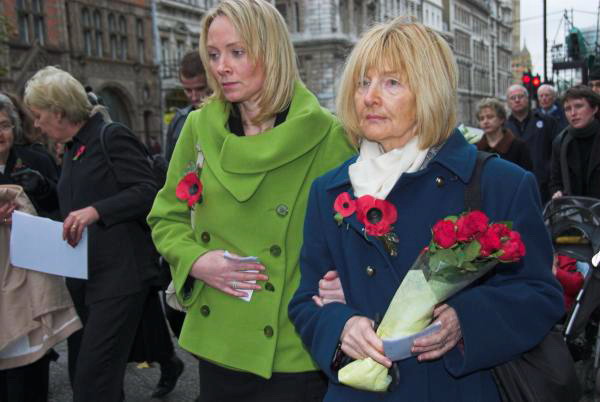
My main event of the day was taking place on Whitehall, at the Cenotaph. Not the military parade ‘at the eleventh hour‘ which I had refused to cover, but a commemoration by some of the families of servicemen killed in Iraq.
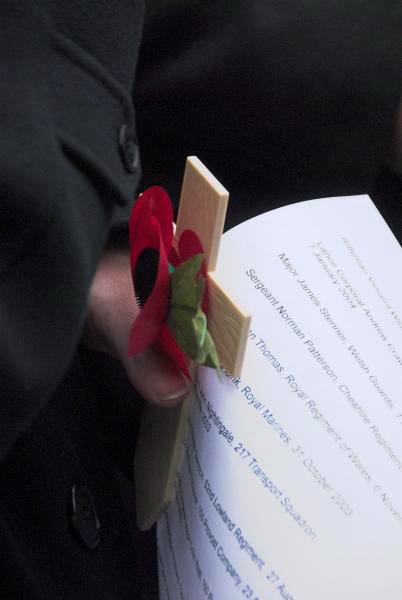
Led by a piper they marched solemnly to stand in front of it, while they came up to read out the names of the 121 dead British servicemen killed in the Iraq war. A small selection of names of Iraqi civilians killed was also read out. It’s difficult to estimate the exact number who have died, and more deaths have occured since 2006. The US Brown University Watson Institute now states “we know that between 280,771-315,190 have died from direct war related violence caused by the U.S., its allies, the Iraqi military and police, and opposition forces from the time of the invasion through March 2023.”
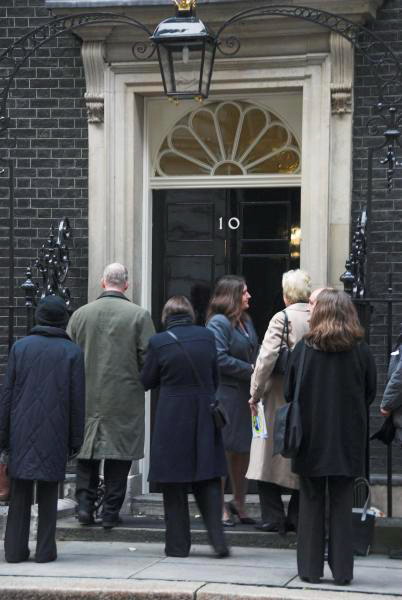
A deputation then took a letter in to Downing Street for Prime Minister Tony Blair who had misled parliament and ignored the largest protest ever seen in the UK to take the country into a misguided invasion together with the USA.
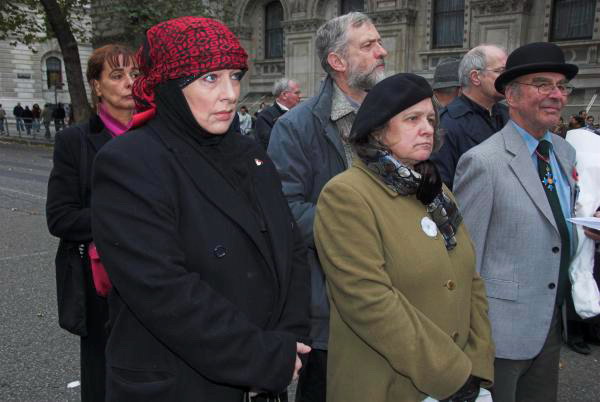
Among those taking part in what was an extremely moving ceremony were Rose Gentle of Military Families Against The War, and others who have lost sons or partners in Iraq, including Ann Lawrence, Roger Bacon, Natasha Mclellan, Maureen Bacon as well as Lance Corporal George Solomou, from the London Regiment of the Territorial Army who refused to go to fight in Iraq. Families of some serving soldiers also took part.
Also there and supporting the event among others were Kate Hudson of CND, Yvonne Ridley and Lindsey German of Respect and Stop The War, fashion designer Katherine Hamnett, and Jeremy Corbyn MP.
This was an event that attracted considerable media attention; there is a delicate balance between intruding on private grief, but those there had chosen to make their grief public, and we had to record it for them.
More Pictures on My London Dairy – Scroll down the page there for links.
Palestine, Syria & the NHS – 2018: I’m not really a superstitious person and though five years ago it was Friday 13th April 2018 this didn’t worry me at all and I worked exactly as usual, photographing protests in London.
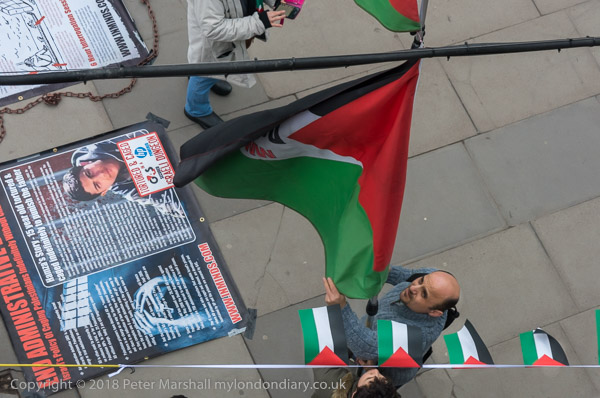
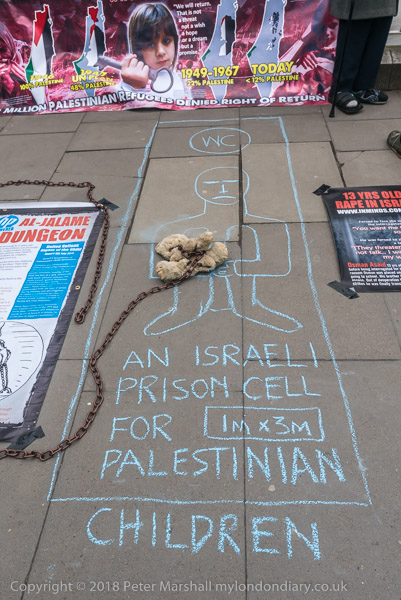
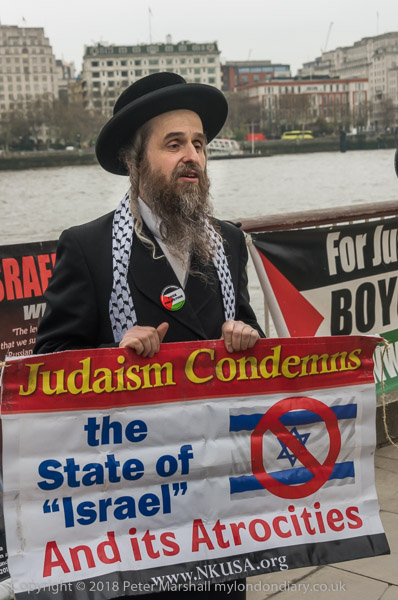
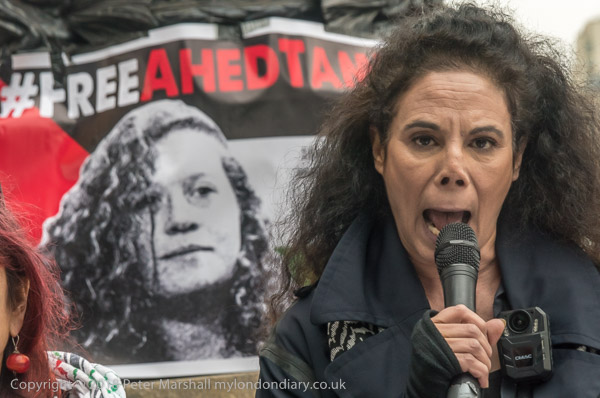
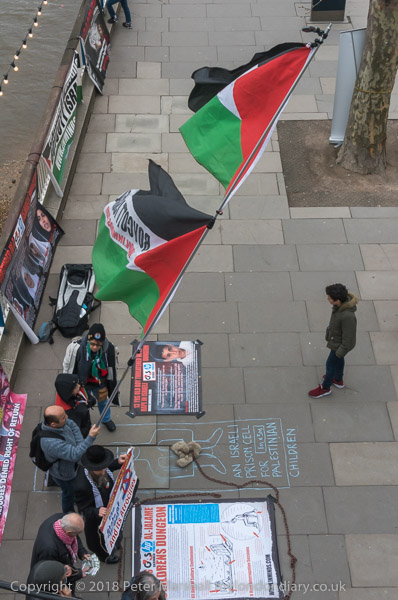
Palestinian Prisoners Day protest – South Bank
Palestinian Prisoners Day, established by the Palestinian National Council in 1974 as a national tribute in solidarity with the thousands of Palestinian prisoners held in Israeli occupation prisons and supporting their legitimate right to freedom is actually 17th April every year. This protest was held on the closest Friday to that date.
The location on the South Bank made this rather more visible to visitors and tourists who walk along by the river and visit attractions such as the National Theatre and the Royal Festival Hall where this vigil was taking place.
Some of those taking part were those who regularly protest with the organisers, the Inminds human rights group, outside companies that support the Israeli state, including G4S and HP who are both heavily involved in running prisons in Israel, but for this event they were joined by a number of others, speaking, handing out leaflets, holding flags and banners and talking with people about the situation in Palestine.
Under Israel’s ‘apartheid’ system, Palestinians are not tried by the Israeli civil courts but by military tribunals with a 99.74% conviction rate. Since 1967, roughly 1 in 5 of the entire Palestinian population have been held in prison at some time. Physical torture during interrogation is standard practice, even for children, and many are sexually abused; since 1967, 72 prisoners have been tortured to death.
In two months this year alone 1319 were imprisoned, including 274 children, 23 women and four journalists. Over 500 of these prisoners are currently held indefinitely without charge or trial under administrative detention orders.
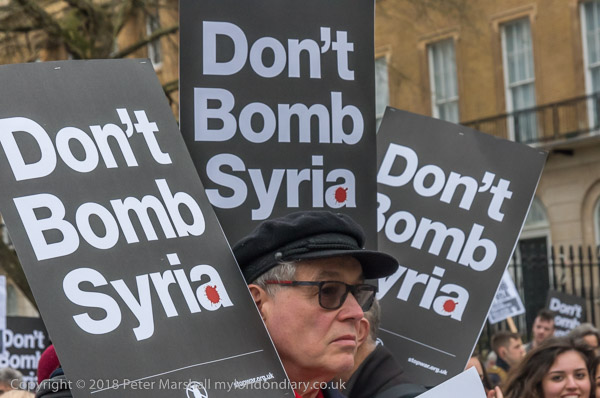
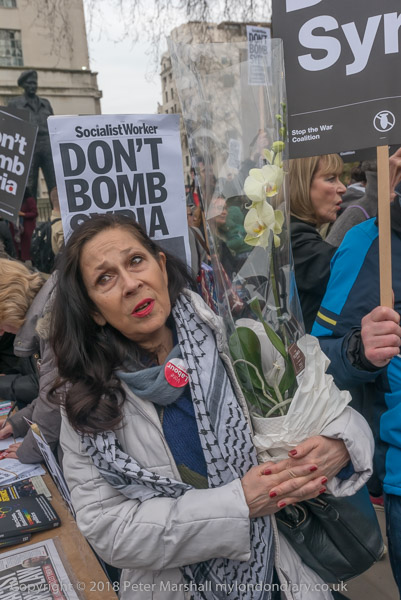
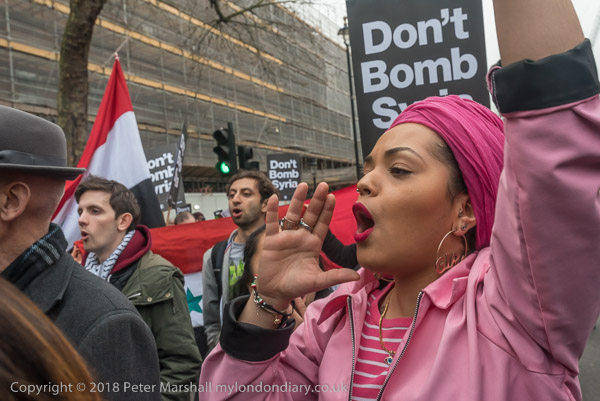
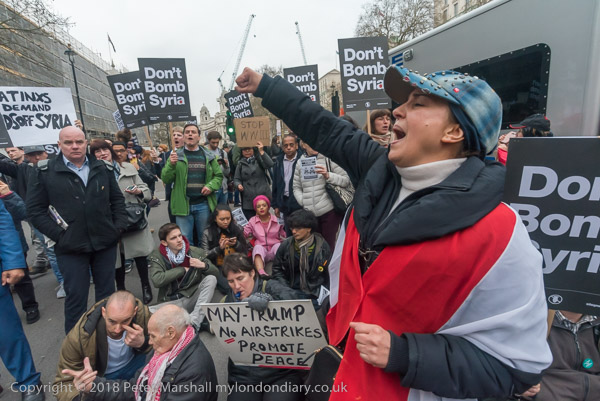
There were a number of protests here against the UK’s plans, along with the USA and France, to bomb Syria after the Assad regime had carried out chemical attacks there.
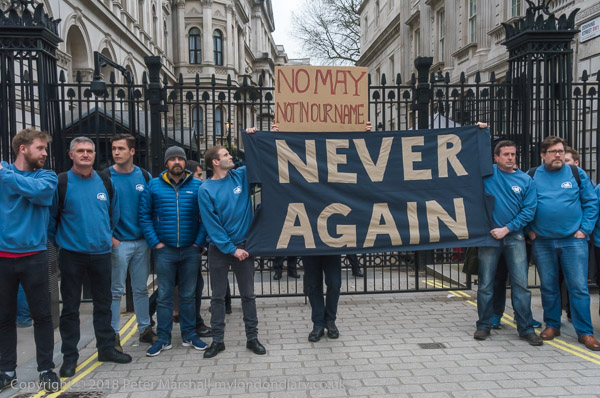
Stop the War were joined in a rally by other activists, including some from CND and Veterans for peace. They had come with a letter signed by MPs, trade unionists and others to hand in at Downing St, but they were refused entry at the gate. Only Kensington MP Emma Dent Coad was allowed through the gate as an MP to deliver the letter.
After the Stop the War rally ended people from the South Bank Palestinian Prisoners Day vigil who had arrived at the protest provided provided a PA system for the protest to continue.
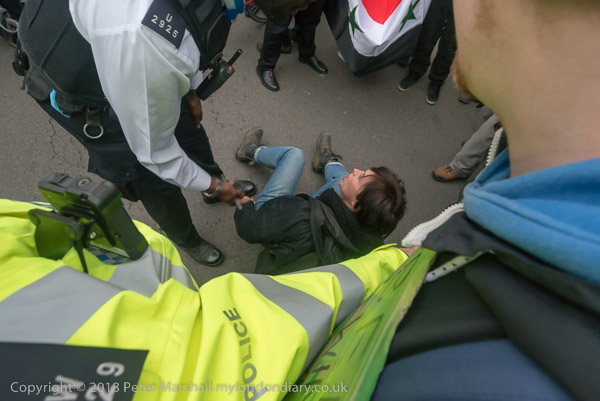
Syrians began to arrive early for a protest organised by a UK based Syrian surgeon which was due to start at 6pm and joined them. Protesters crossed to the gates of Downing Street and then briefly blocked traffic in Whitehall in both directions. Police fairly quickly cleared the south-bound carriageway, and the Syrians were eventually forced onto the pavement but other protesters continued to block the road, sitting down on it.
The road was still blocked when I left, but many more police had arrived and it looked as if the road would soon be cleared.
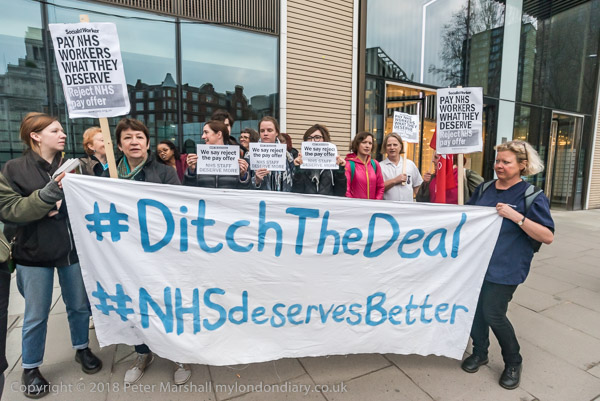
Ditch the Deal say NHS Staff – Department of Health
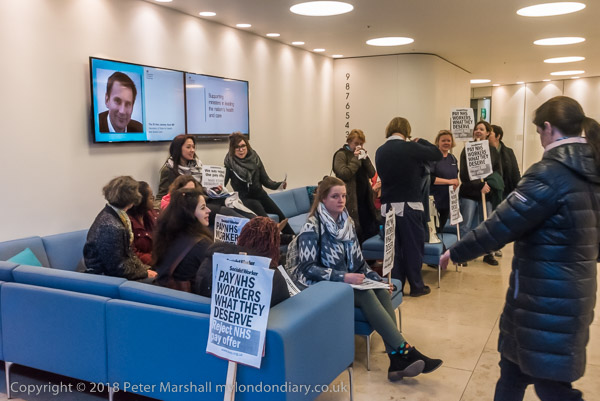
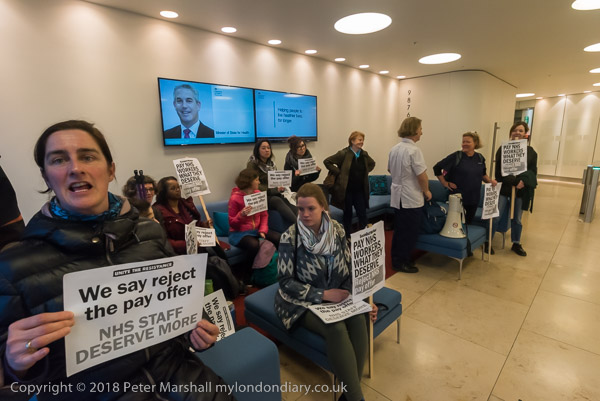
I left Whitehall although the protests were continuing there as I was late for a protest with NHS staff from hospitals across London at the Department of Health in Victoria St. Despite running most of the half-mile there I arrived just in time to see them in the distance walking into the foyer and followed them in.
They were being told they could not protest inside the building – but they were doing so – and although I was almost certainly told I couldn’t take pictures, I did. Though perhaps they would have been better had I been less out of breath.
They were protesting against the proposed NHS pay deal for all staff except doctors, dentists and very senior managers which will mean a pay rise well below expected inflation levels, while also bringing in a new appraisal process before staff can progress to their next pay point. The proposals have also been criticised by shadow chancellor John McDonnell and shadow health secretary Jonathan Ashworth.
After sitting in the foyer for a few minutes they posed in front of pictures on the screens in the foyer of Health Minister Jeremy Hunt and then left for more photos on the pavement outside.