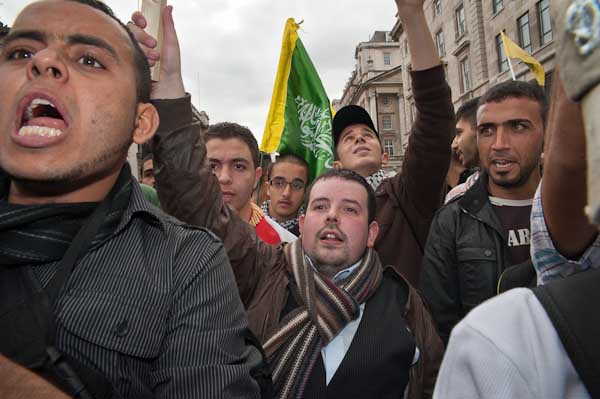
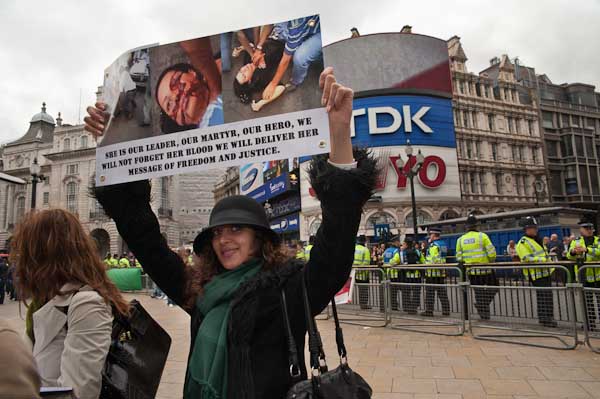
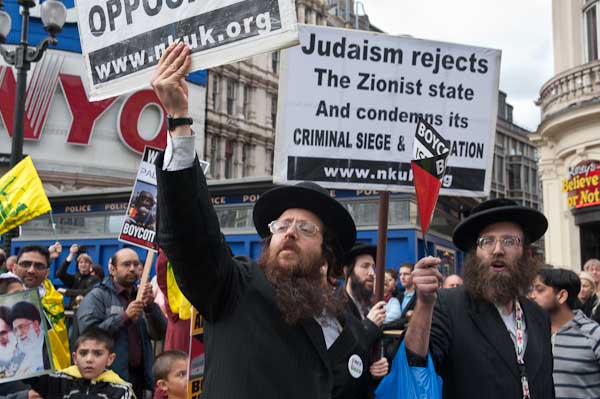
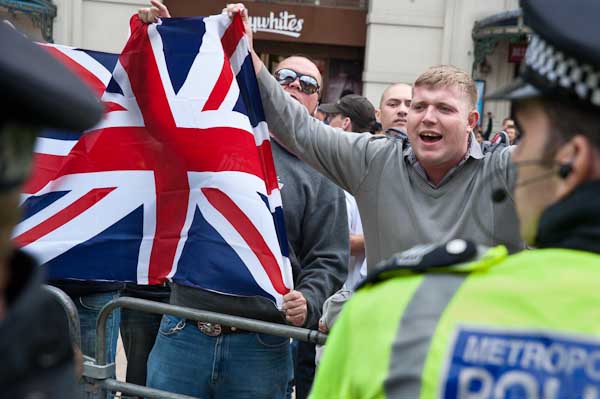
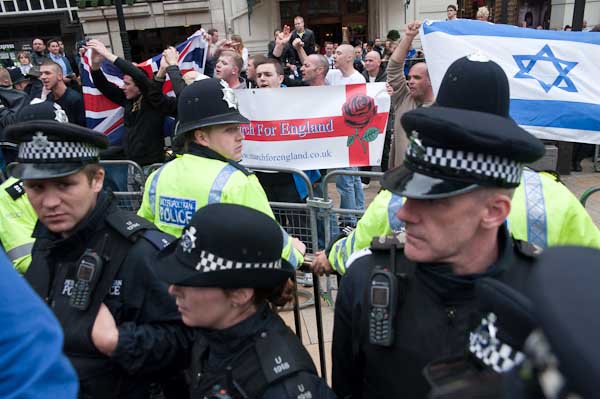
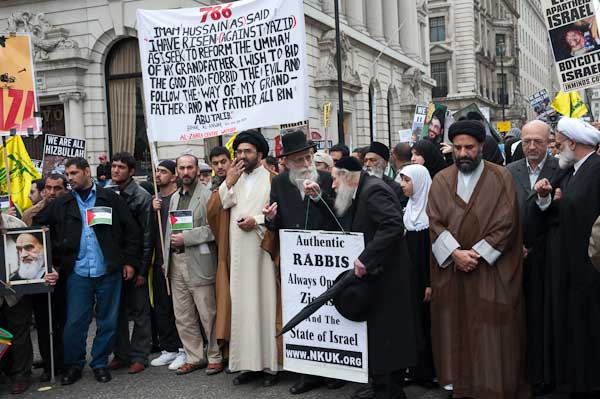
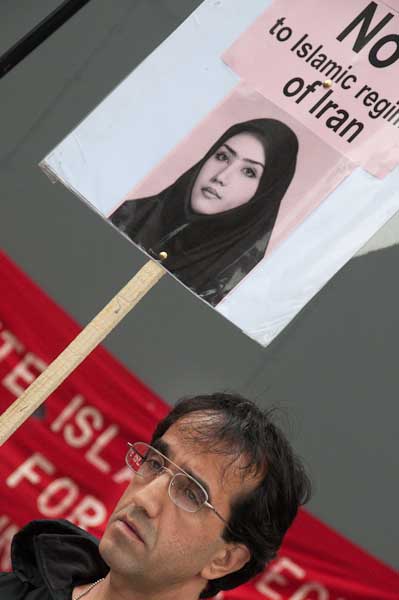
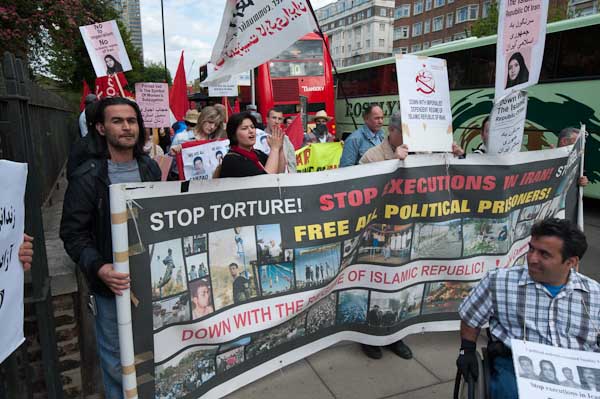
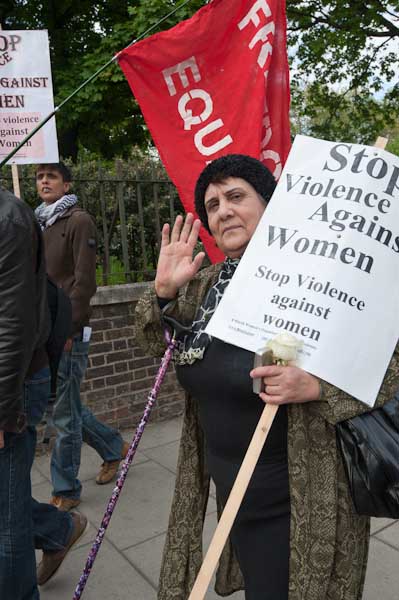
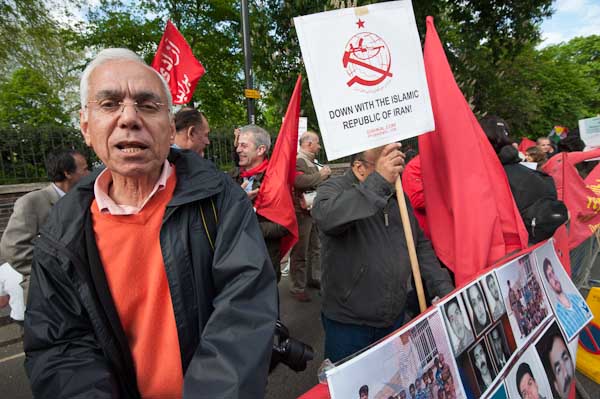
The annual Al Quds Day (Jerusalem Day) march in London as usual attracted controversy, with various groups coming out to protest against it. In 2009 these included Iranian democrats, royalists and socialists as well as far right groups including the English Defence League and March For England, but there seemed to be few organised Zionists on the streets.
Al Quds Day was initiated by Ayatollah Khomeini when he became Supreme Leader of Iran in 1989 as a day on the last Friday of Ramadan (the London march is on the following Sunday) to oppose the Israeli occupation and control of Jerusalem, and at least one of the groups involved in organising the event is said to received funding from the Iranian authorities – which accounts for the Iranian protesters.
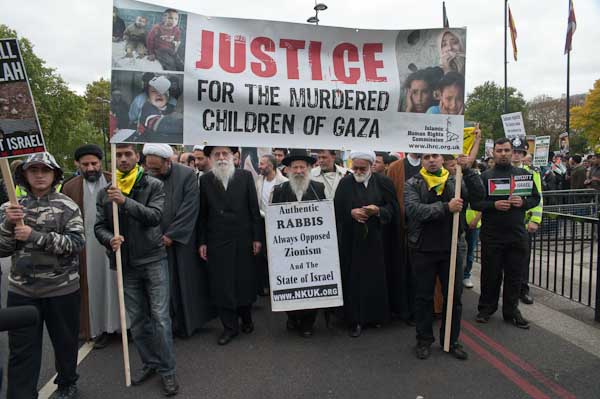
The march starts under the main banner ‘Justice for the Murdered Children of Gaza’
The march has become a wider protest calling for freedom for Palestine and an end to the Israeli occupation of land which for many centuries was Palestine. For many of the marchers this also means support for those fighting against Israeli occupation, both in Palestine and Lebanon.
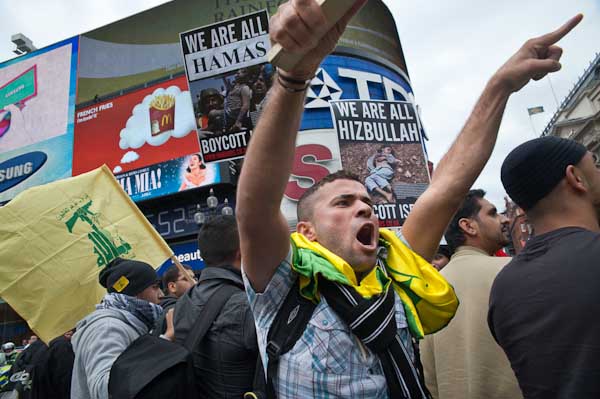
A few of the marchers carried Hezbollah flags, the flag of both the Lebanese Shia political party and its military wing. The military wing had been proscribed in the UK in 2008, but it was only in 2019 that this ban was extended to cover the political wing, making carrying the flag an offence. You can see a few of these yellow flags in my pictures. There are also some placards supporting Hezbollah and Hamas for their resistance to Israel.
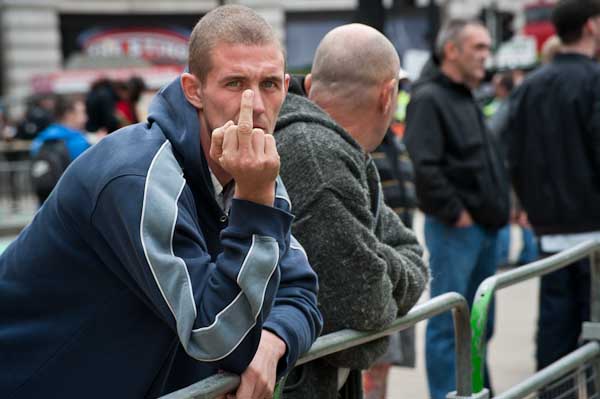
Demonstrators against the march were gathering earlier at Piccadilly CircusThey included Iranians as well as right wing football supporters
In 2009 the march was carefully policed to keep the marchers and protesters against the march from coming into contact and I saw some from both groups being stopped and searched in the area around Marble Arch where the march gathered.
Neturei Karta marchers
People come to the march in coaches from mosques around the country and many come as families. Although there were separate men’s and women’s blocs the organisers announced that those who wanted to march as families were welcome to do so, and many, particularly the younger marchers, took advantage of this.
Rabbi Ahron Cohen who spoke at the rally at the end of the march
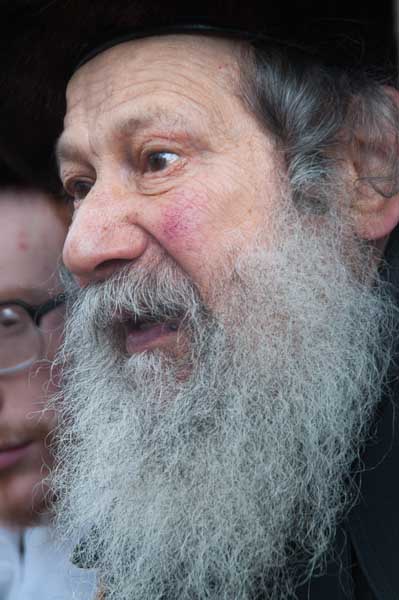
At the front of the march were Muslim clerics and two Neturei Karta Jewish leaders. These ultra-orthodox Jews are anti-Zionist and believe that Jews are forbidden from establishing a Jewish state until the arrival of the Messiah and support the peaceful dismantling of the state of Israel to become a part of Palestine.
The main counter-protest came at Piccadilly Circus, with most of those taking part encircled around ‘Eros’ by a double line of police. They protested noisily as the march went by but most of the marchers followed the advice of the march stewards and ignored them. Some held up their posters and there were minor scuffles when a few marchers tried to leave the march and approach them.
As well as shouting insults at the Muslims, the counter-protesters were also making threats, gestures and shouting at the photographers, and I was glad not to be too close although the police bodies between made taking pictures difficult.
Police had also told the march organisers that they could not march to Trafalgar Square but must end with a rally in the much smaller area of Waterloo Place, which became extremely crowded. I left after listening to the first few speakers.
More Support to Gaza: Local actions took place across the country last weekend calling for an end to the genocide in Gaza and for an immediate ceasefire and freedom and a just peace in Palestine.
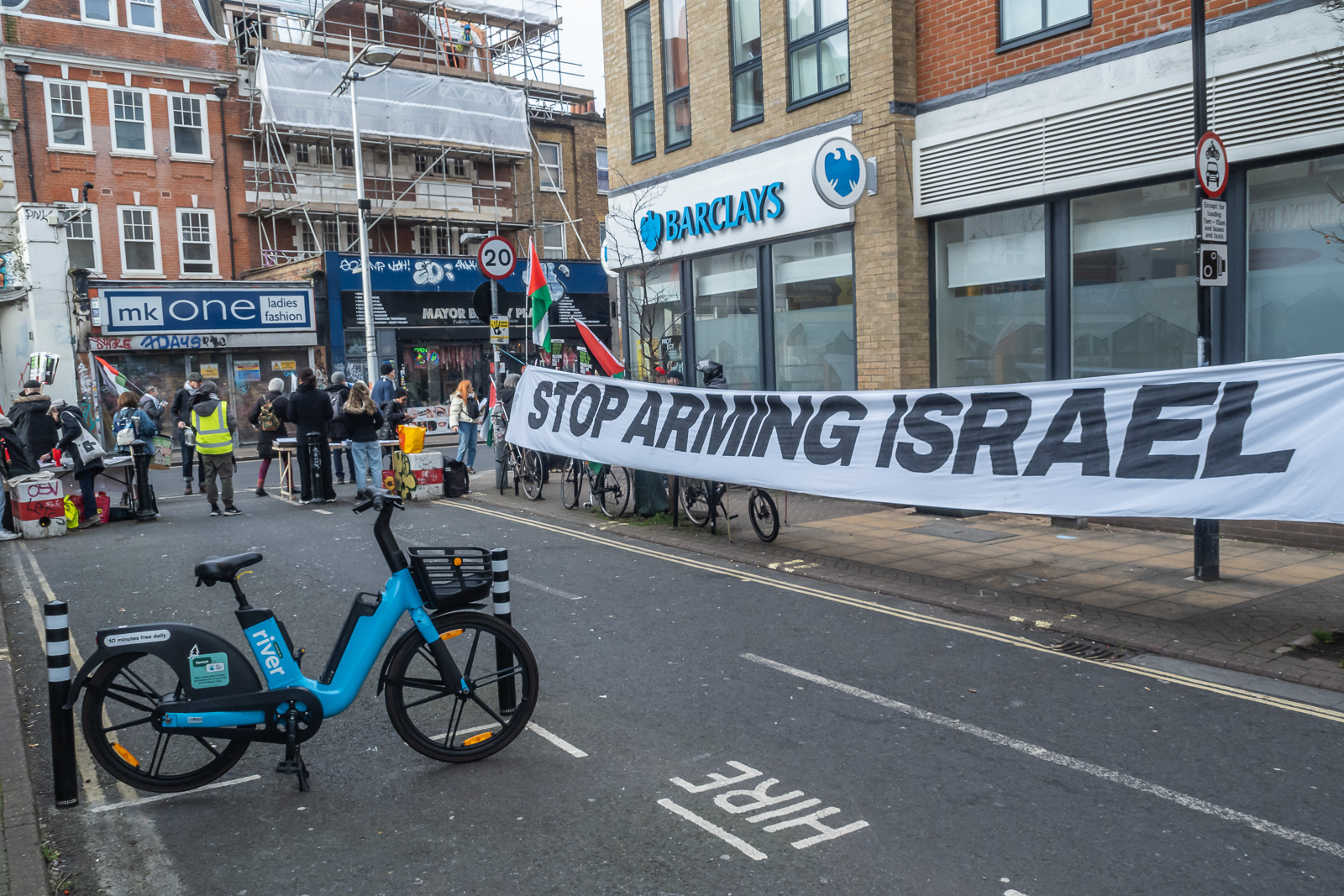
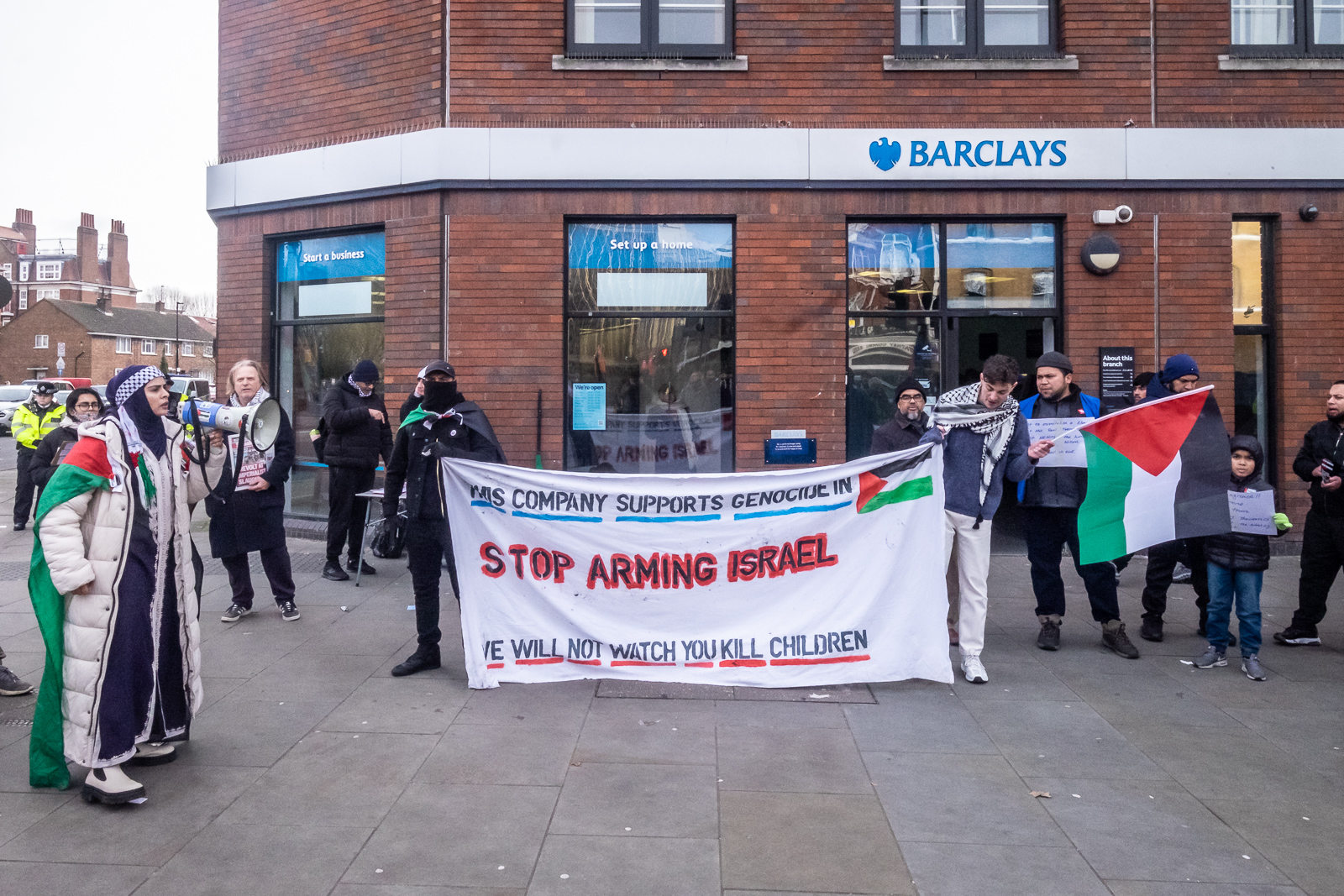
Barclay’s Peckham branch
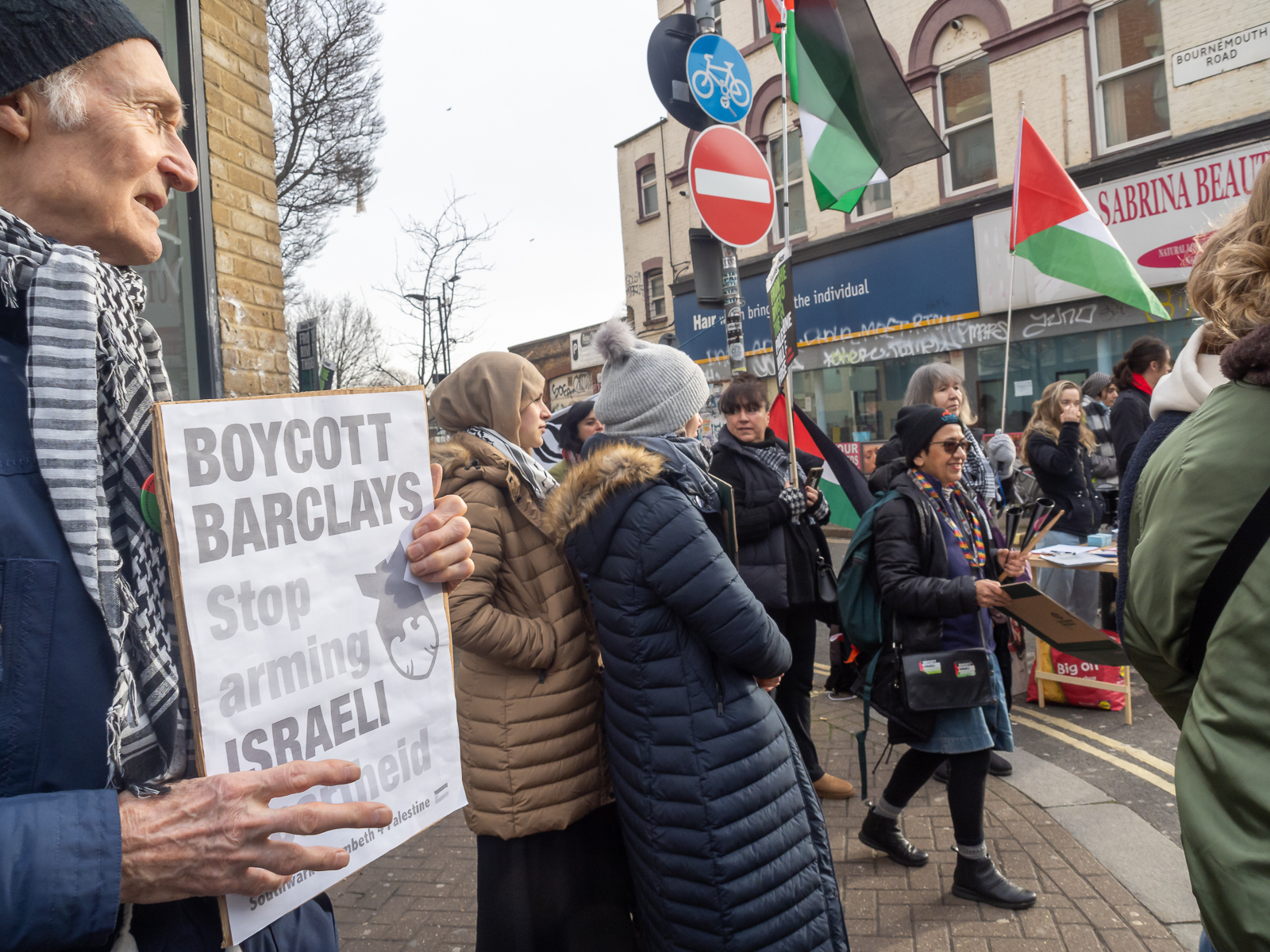
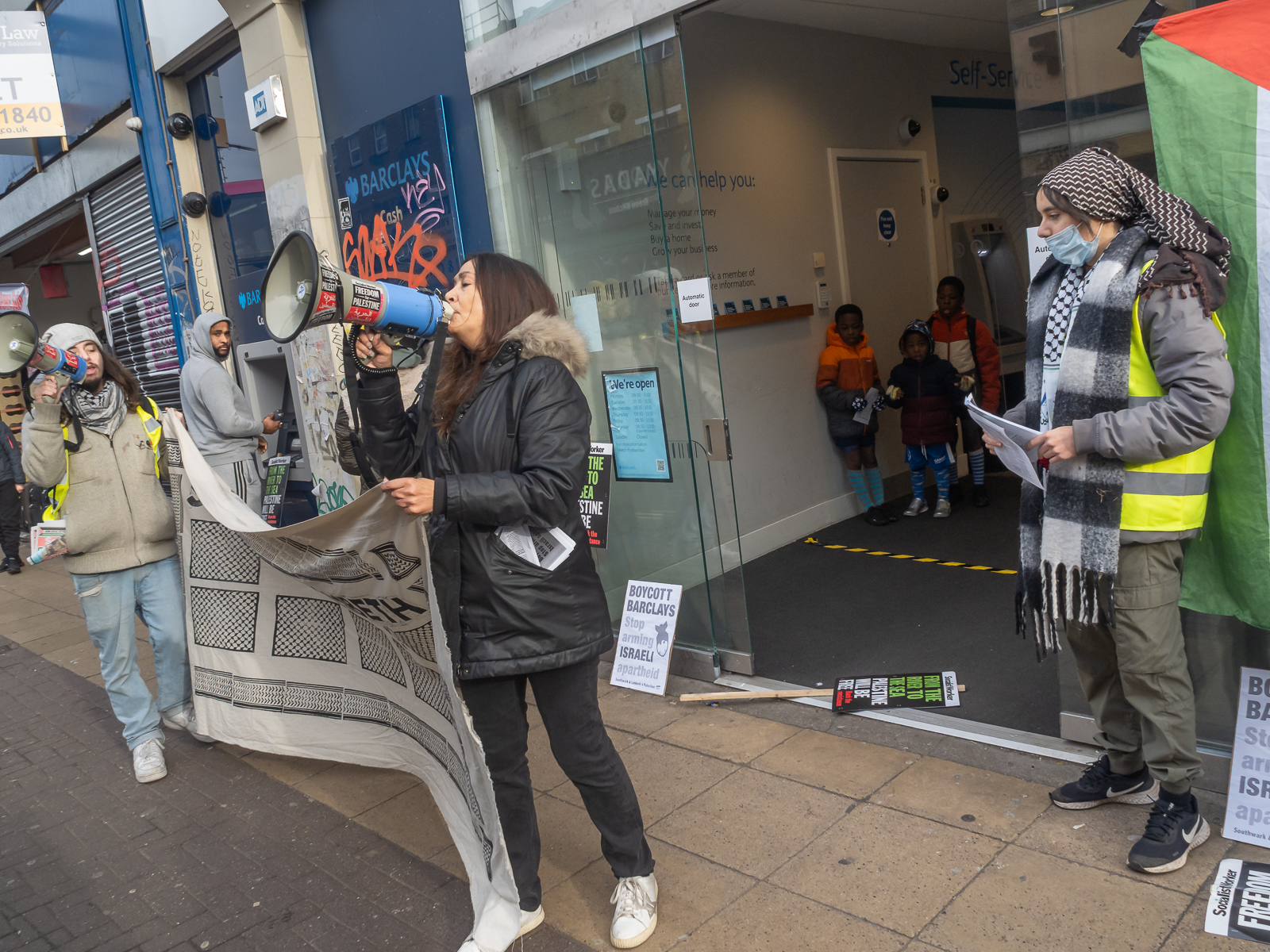
Most of the protests last Saturday were directed against local branches of Barclays Bank, demanding they stop bankrolling Israel’s attacks on Palestinians and calling customers to boycott the bank. Barclays has investments in weapons companies BAE Systems, Boeing, Elbit Systems, Raytheon all producing weapons and systems used in Gaza and Caterpiller whose bulldozers are used to demolish Palestinian homes, schools and civilian infrastructure.
Barclay’s Peckham branch
The protests came the day after the International Court of Justice (ICJ) at The Hague, the UN’s top court, had ruled that there was a plausible case against Israel under the 1948 Genocide Convention, and that the Palestinian population in Gaza was at real risk of irreparable damage.
Barclay’s Peckham branch
The ICJ stopped short of ordering an Israeli ceasefire and instead directed Israel to take every measure possible to avoid genocide while also ensuring humanitarian aid. The six provisional measures the court voted on to protect Palestinians from “irreparable” damage were all passed by overwhelming votes by the 17 judges, with even an Israeli judge supporting two of them, while a Ugandan judge voted against them all (although the Ugandan government issued a statement backing the ICJ).
Barclay’s Whitechapel branch
Media reports here in the UK have generally been rather lacking in detail and have underplayed the ICJ judgement. You can read it on the ICJ web site in full or as their lengthy unofficial summary. The court demanded that Israel must:
take all measures in its power to prevent all acts against Palestinians in Gaza violating the Genocide Convention;
ensure its military does not commit any acts of genocide;
punish all incitements to commit genocide;
take immediate and effective steps to provide basic services and humanitarian assistance in Gaza;
take effective measures to preserve evidence related to allegations of genocide;
report to the ICJ within one month on actions it has taken over these orders.
The ICJ has no powers to enforce its decisions and statements from Israeli government and military have been defiant, while the UK and USA governments seem determined to continue their support for genocide and to continue giving support to Israel, including supplying weapons
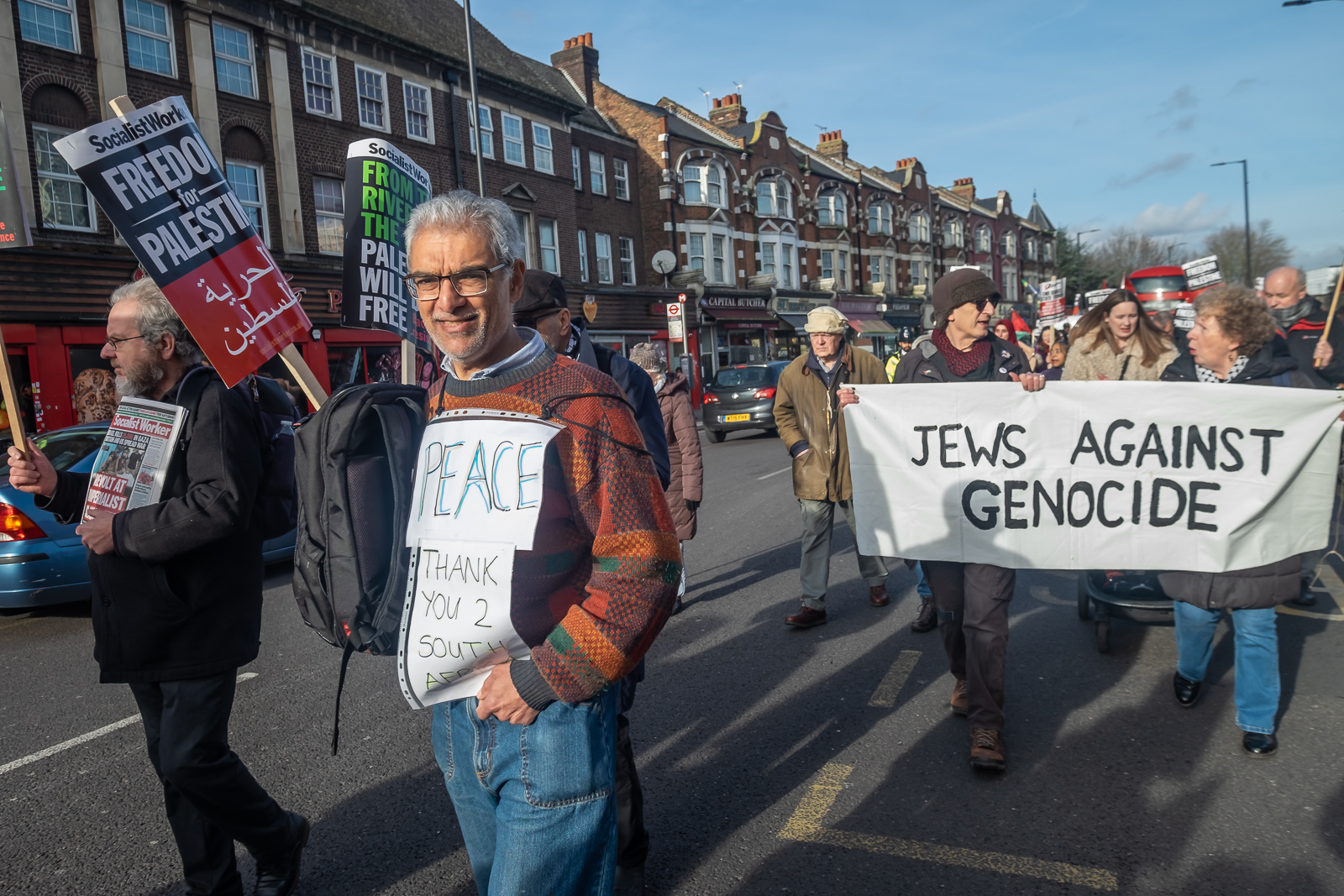
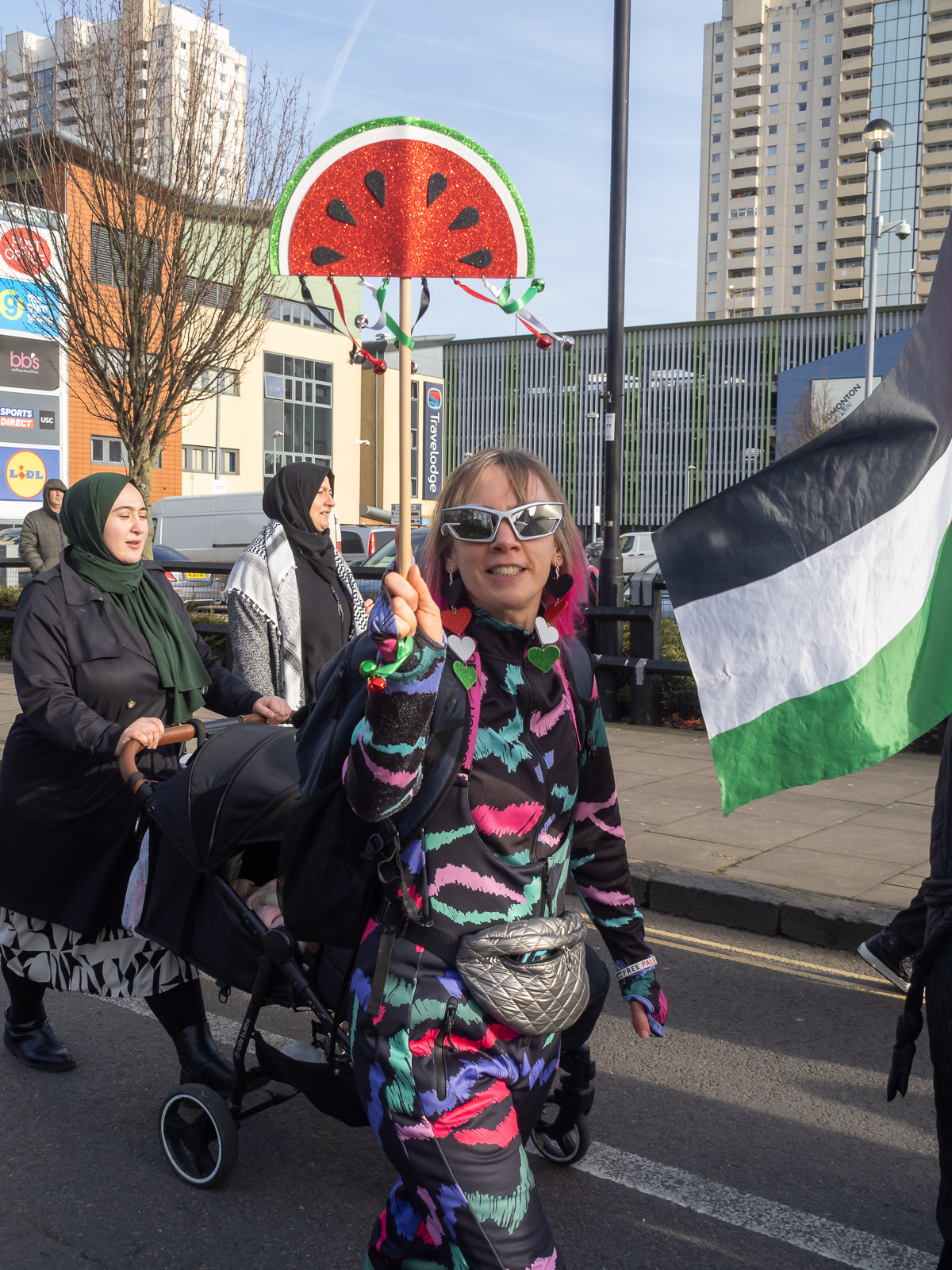
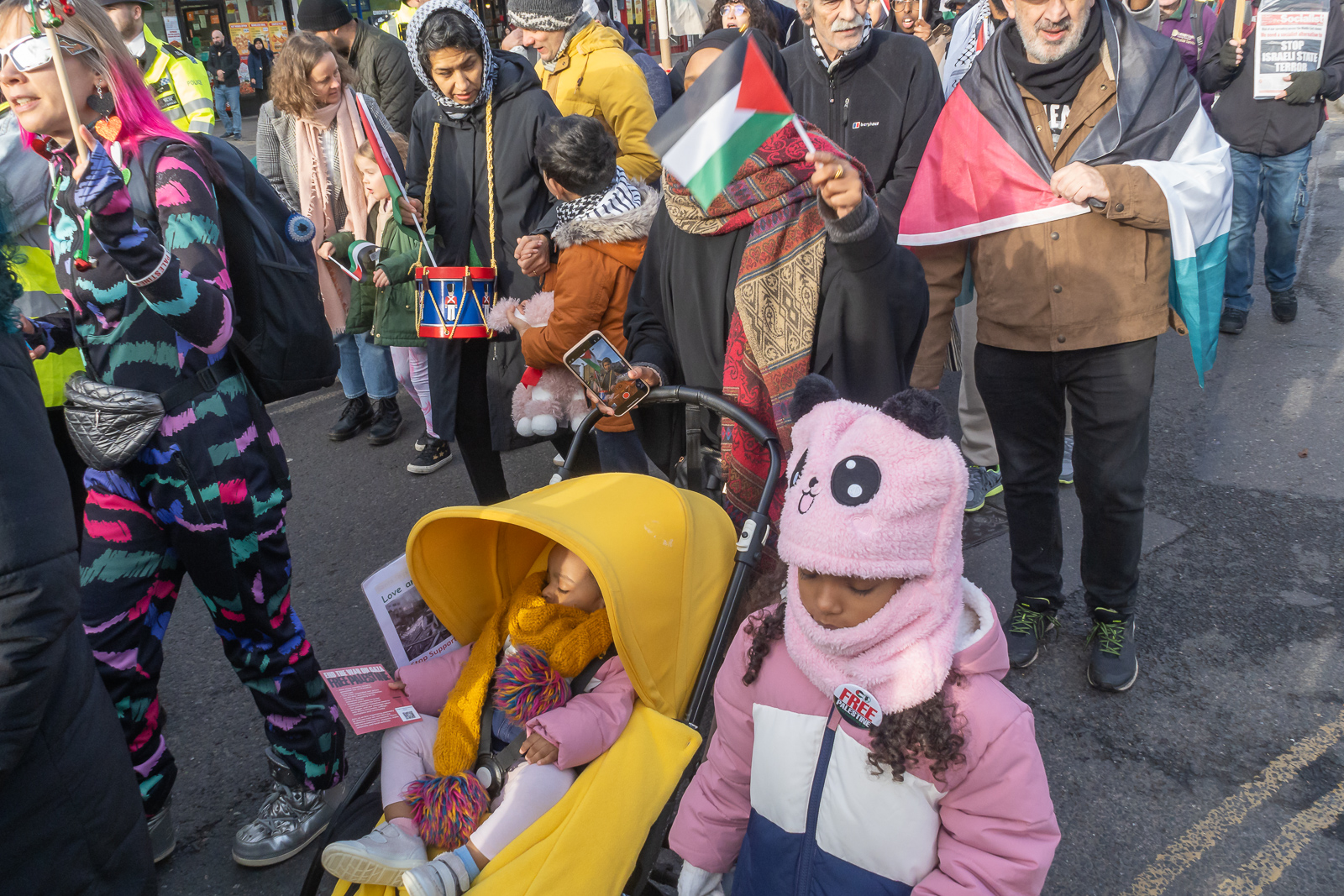
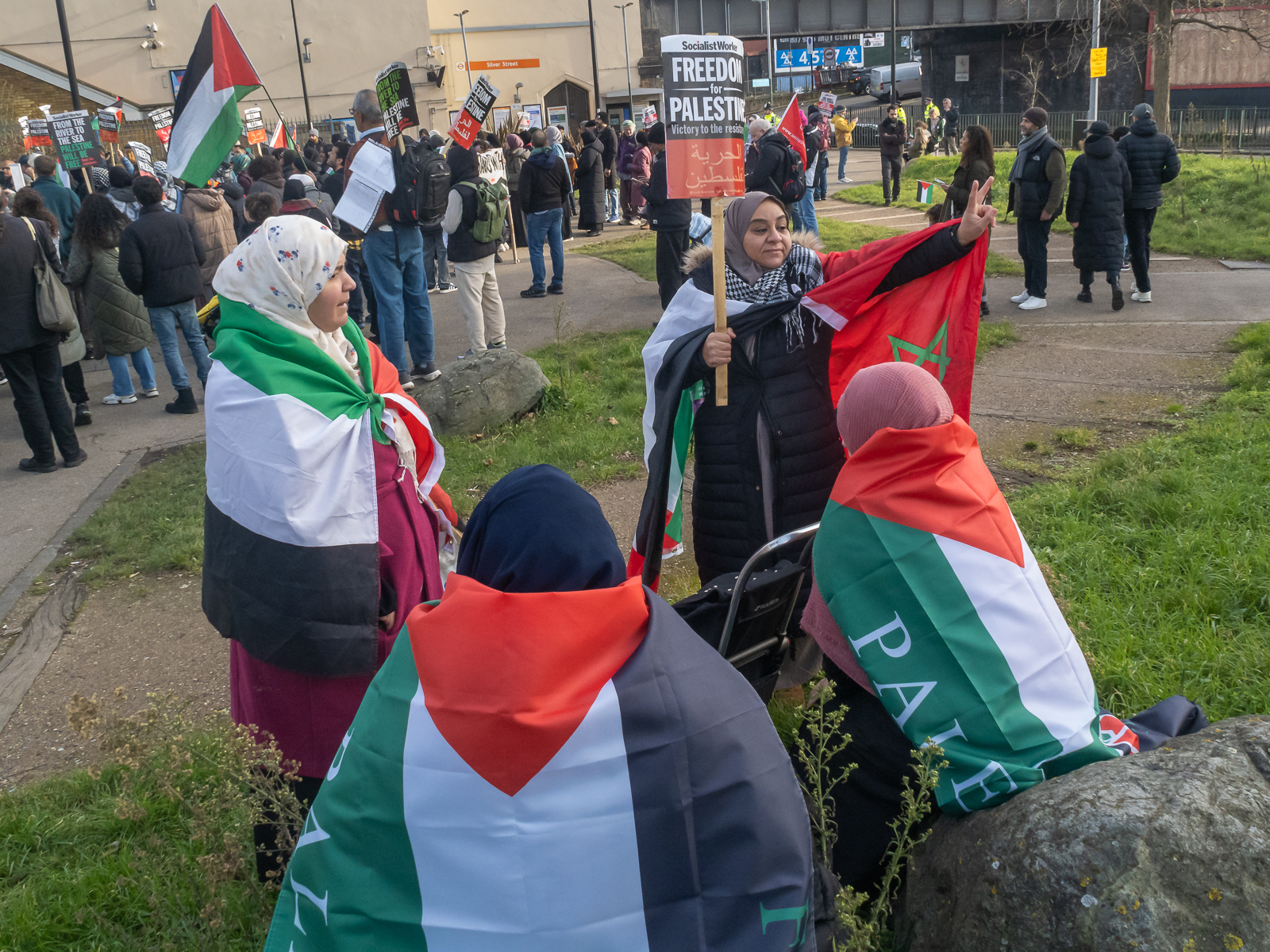
Edmonton Green march to a rally at Silver St
The ICJ decision came after South Africa brought the case, but protesters around the world have been clear that this is genocide. And in December the Lemkin Institute for Genocide Prevention, continuing the work of Raphael Lemkin, the Polish lawyer of Jewish descent who coined the term genocide and campaigned to establish the Genocide Convention, issued a statement explaining “the reasons why we believe the Israel-Palestine situation constitutes an instance of genocide.”
Edmonton Green march to a rally at Silver St
The killing in Gaza continues, with over 26,000 Palestinians now known to be killed including over 10,000 children. More than 8,000 are missing, probably most of them buried under the rubble, and over 65,000 are severely injured.
Edmonton Green march to a rally at Silver St
A BBC report states that more than half of all buildings in Gaza have been destroyed or damaged by the Israeli assault. There are also said to be almost 20,000 children in Gaza who have been orphaned or separated from their families. Other reports suggest that around three-quarters of Hamas fighters are men who became orphans, and so the current attacks are likely to be a powerful recruiting ground for future militants against Israel.
Edmonton Green march to a rally at Silver St
The whole Israeli policy over the years has been counter-productive. Peace in the region requires a thriving Palestine, not an area subjected to military occupation, under an apartheid system and subjected to destructive attacks – and certainly will not be achieved by genocide.
Edmonton Green march to a rally at Silver St
It’s very hard to see how any positive outcome can emerge now for Israel and Palestine, but perhaps the ICJ ruling is a small glimmer of hope – as years ago was Oslo. But hope then was soon defeated by Israel’s determination not to accept peace.
Edmonton Green march to a rally at Silver St
Last Saturday made my way around London on National Rail, Overground, Underground and Elizabeth Line to visit several pickets outside Barclays branches and then to Edmonton Green.
Edmonton Green march to a rally at Silver St
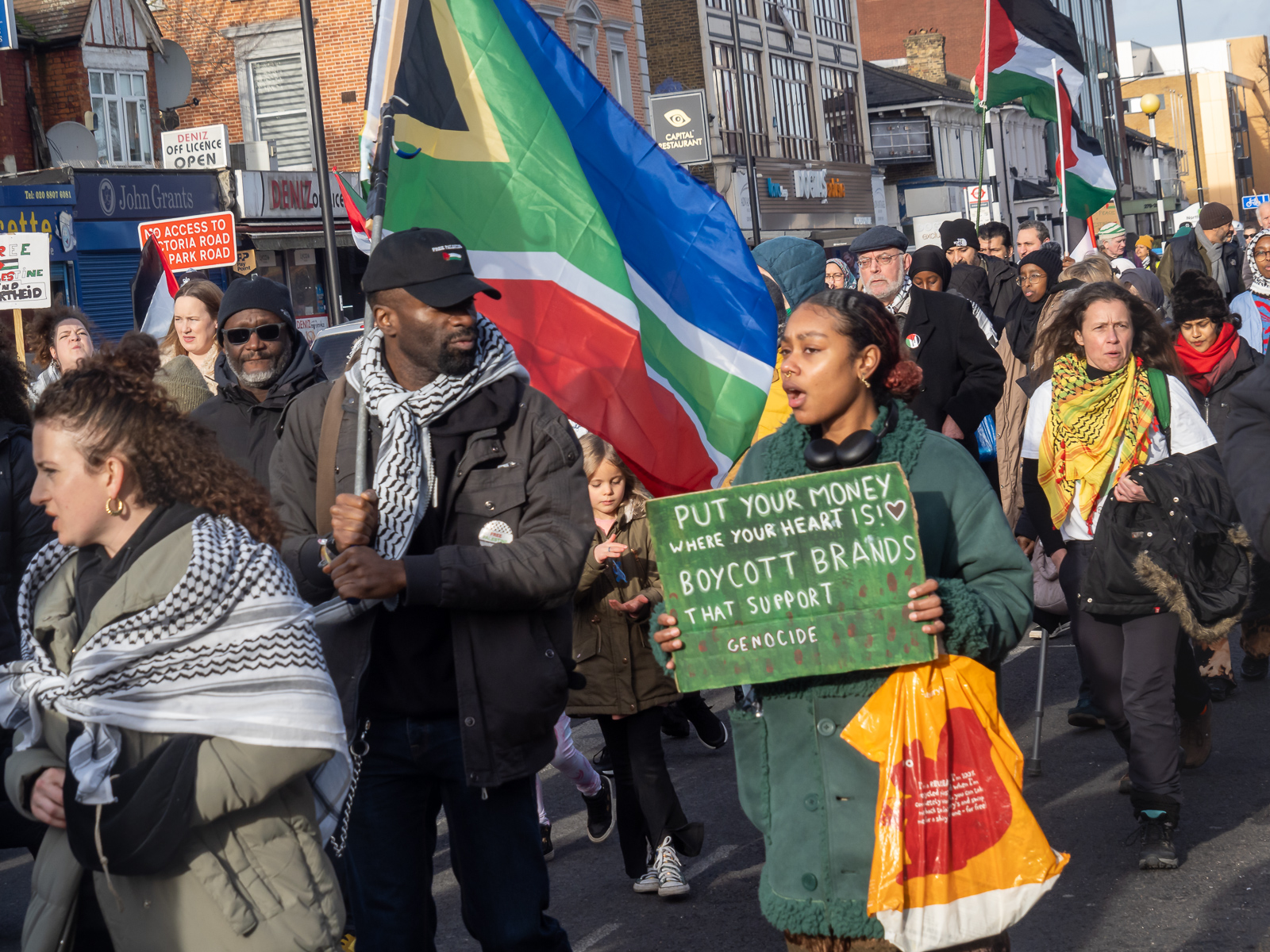
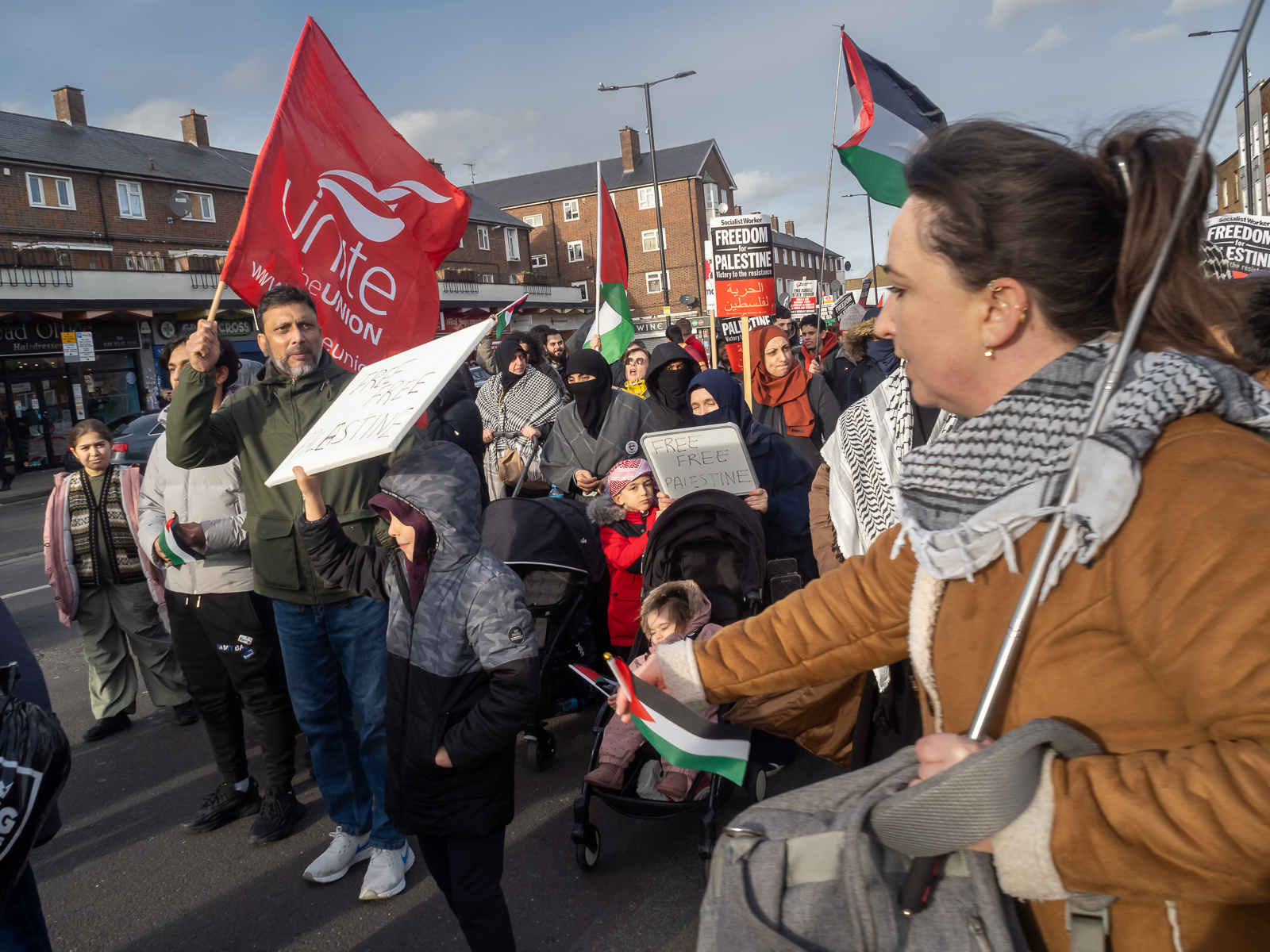
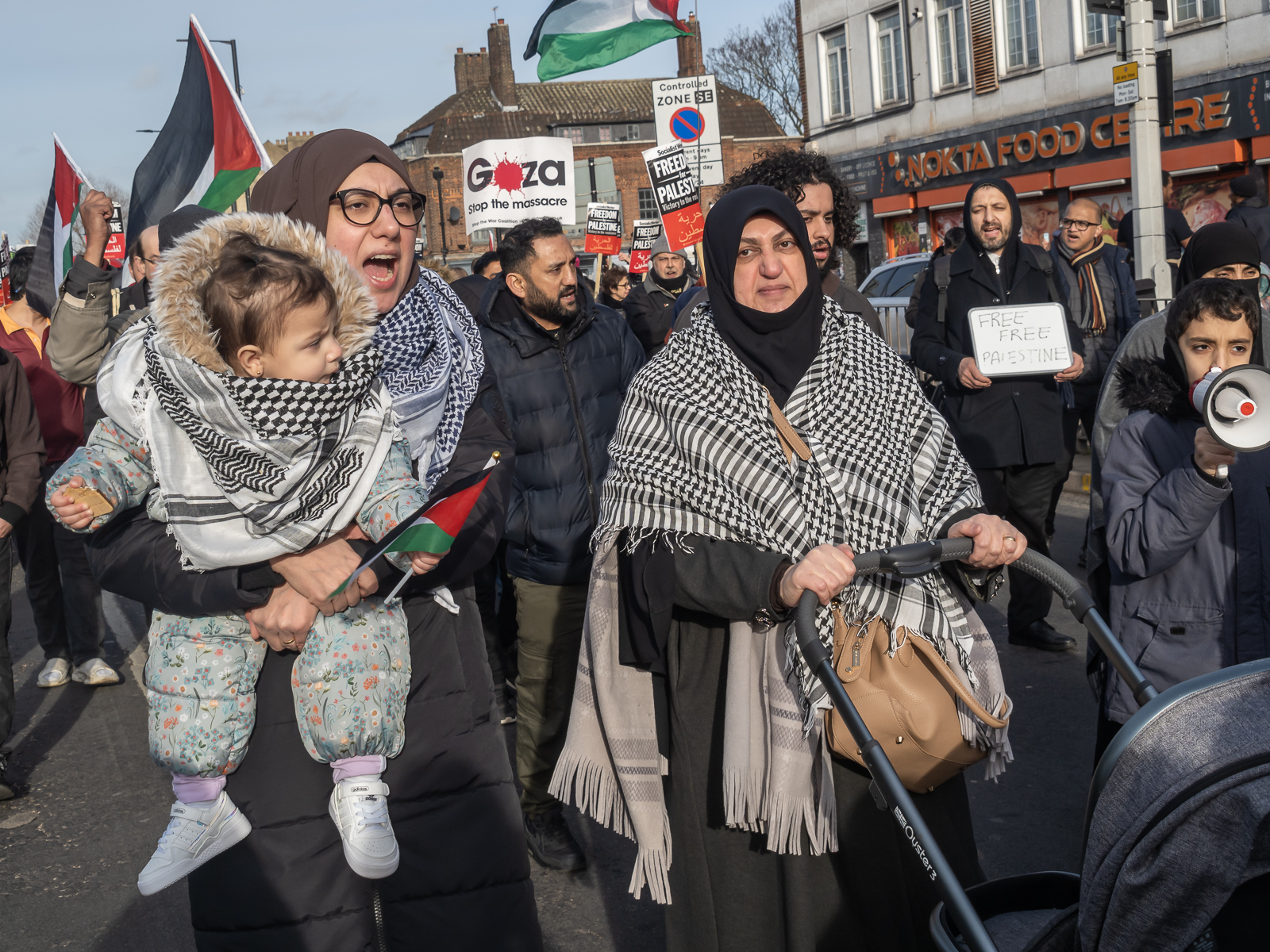
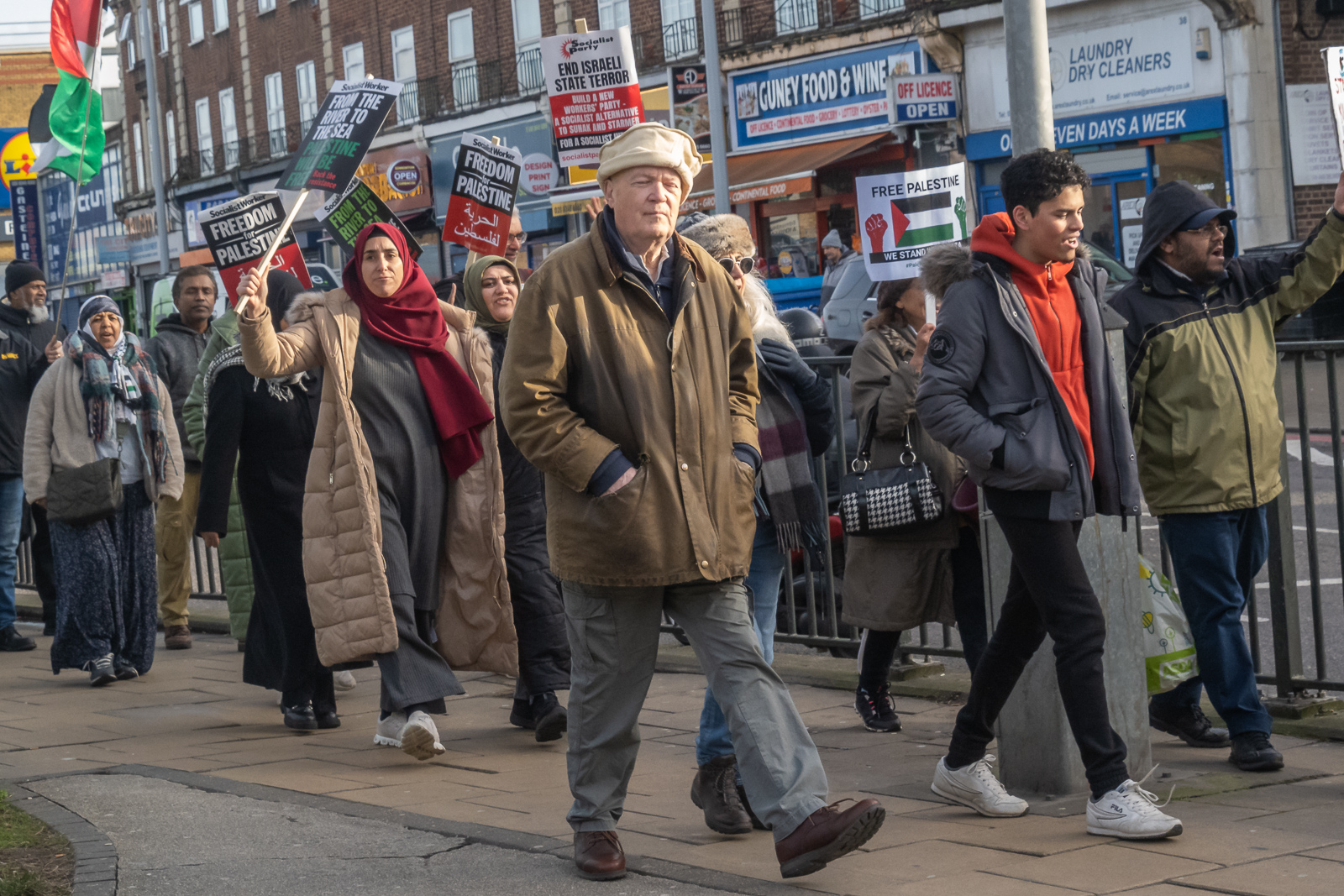
I arrived at Edmonton Green just in time for the march organised by the Enfield branch of the Palestine Solidarity Campaign to a rally at Silver Street. They demanded Israel ends its genocidal attack on Gaza, calling for an immediate ceasefire and an urgent programme of humanitarian aid to end famine and provide shelter, medicine and water. They praised South Africa for taking Israel to court for genocide and called for a just peace with freedom for Palestine.
Nakba, South Africa, Fair Votes & Iran: Events I covered in London on 15th May 2023 and one I just missed.
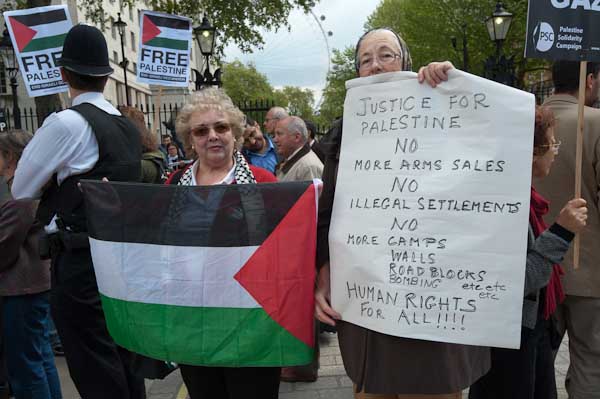
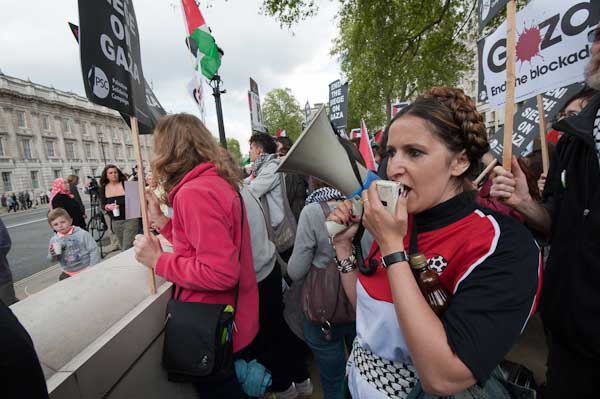
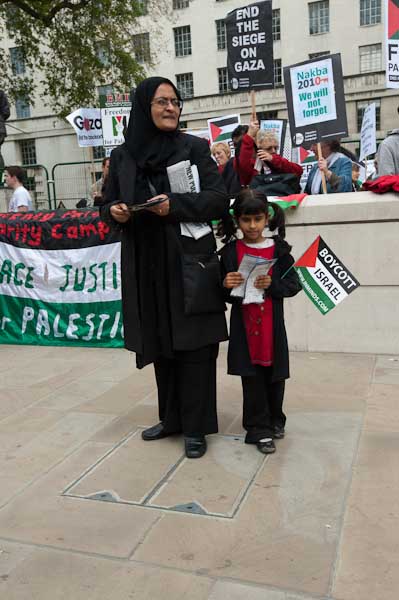
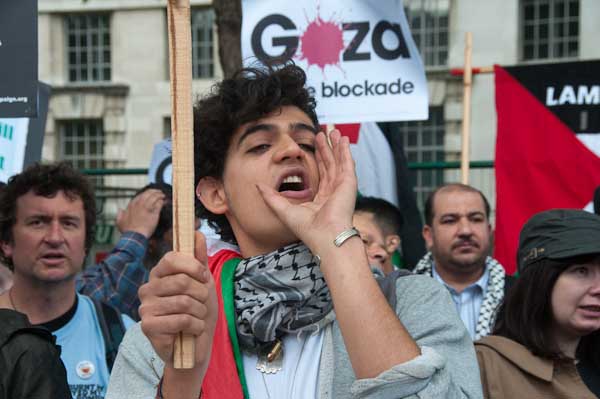
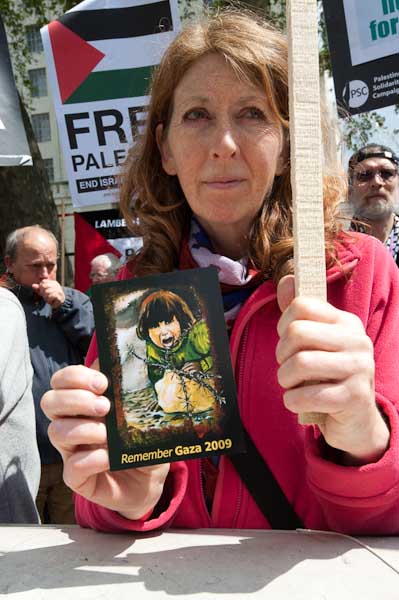
Nakba Protest For Free Palestine – Downing St
May 15 is Nakba Day, remembering the 1948 disaster when Palestinians were expelled from their land and calling for an end to Israeli occupation and breaches of international law.
Over 400 Palestinian villages were destroyed and the 1948 partition of Palestine to create the state of Israel created around 700,000 Palestinian refugees, many of whom or their descendants are still in refugee camps. Protests take place on or around May 15 every year around the world calling for justice for Palestine.
The biggest in London is on the nearest weekend to the 15th, and the 2023 London march organised by Palestine Solidarity Campaign together with Stop the War Coalition, Palestinian Forum in Britain, Friends of Al-Aqsa, Muslim Association of Britain and Campaign for Nuclear Disarmament was last Saturday, May 13th, marching from the BBC.
Organisations supporting this rally included Artists’ Union England, BFAWU, CWU, The MU, NEU, PCS, RMT, TSSA, UCU, UNISON and Unite the Union. In most recent years I’ve photographed these protests, but this year the rail strike meant I was unable to do so.
Back on 15th May 2010 the Nakba protest was a static one opposite Downing Street. Last Saturday the march to the rally began at the BBC, deliberately chosen to yet again expose the failure of our major broadcaster to report on protests in the UK, particularly those calling for freedom for Palestine.
It may not be written down anywhere in the BBC, but the broadcaster definitely has a policy of playing down or usually totally ignoring protests in the UK, at least unless it can condemn any acts of violence of criminal damage by protesters. Occasionally any involving major celebrities may also get a mention, though they may need to get arrested for the BBC to notice. You have more chance of your protest getting a mention if it occurs in another country, preferably one with a regime our government disapproves, than under their noses in London.
Other UK media tend to follow the example of the BBC and if you want to know about protests that are happening in the UK you need to follow foreign media such as Al Jazeera or RT, or read left wing publications in print or online. There you may even find out what the protests were about.
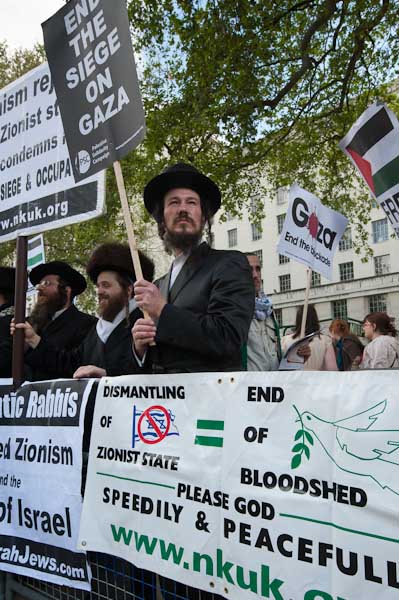
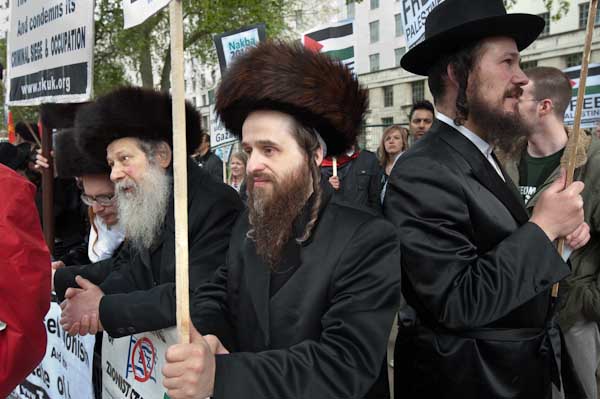
Among the protesters were many Jews opposed to the actions of the State of Israel who form a major part of most if not all left wing and anarchist groups. Most obvious were those from the ultra-orthodox ‘Neturei Karta’ who are totally opposed to Zionism and the idea of a Jewish political state. They say the Torah prohibits the use of human force to establish a Jewish state before the coming of the Messiah, and support the right of the Palestinians to their land, which should be returned to them. The say Jews should live in peace and harmony with their Muslim neighbours in Palestine as their ancestors did for many centuries.
South African Right March in London – Trafalgar Square
I arrived in Trafalgar Square too late to see a march by expatriate right-wingers, part of a campaign to persuade football supporters not to go to South Africa for the the World Cup. They say the country is too violent with around 18,000 murders a year.
Unfortunately that high rate is fairly typical among many countries in the global south and lower than in many of them. Perhaps the main difference between South Africa and the others is the large white population who also suffer from the violence and murders.
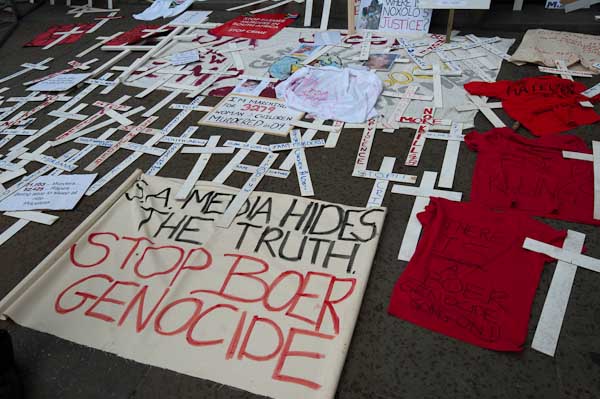
The march organisers had earlier regretted that police had prohibited any marchers carrying flags or banners of the extreme right Afrikaner Weerstandsbeweging (AWB) or other white nationalist groups. The extreme racist AWB protest at the ‘Boer Genocide’ and is committed to setting up an independent Volkstaat on parts of South Africa with extreme apartheid policies.
Although there were only a handful of people in red shirts who had taken part in the march I was able to photograph some of the crosses, posters and banners they had left behind in front of South Africa House before police removed them.
Purple Protest Demands Fair Votes – Old Palace Yard
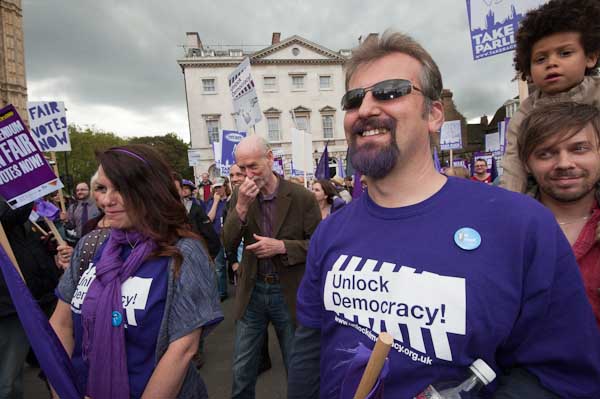
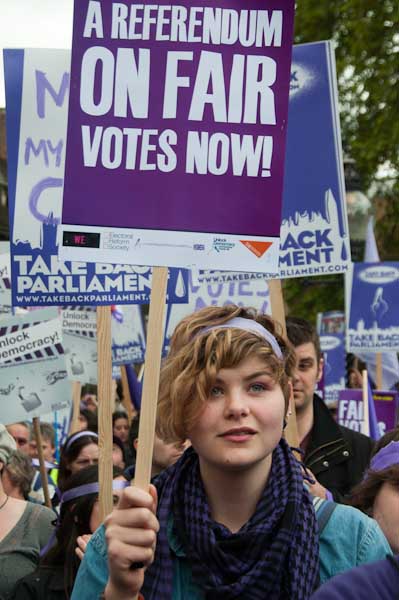
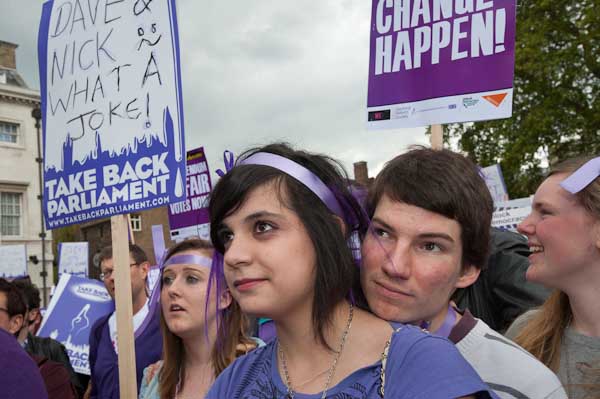
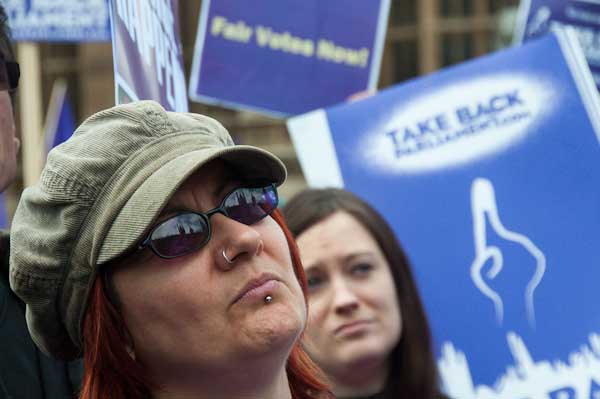
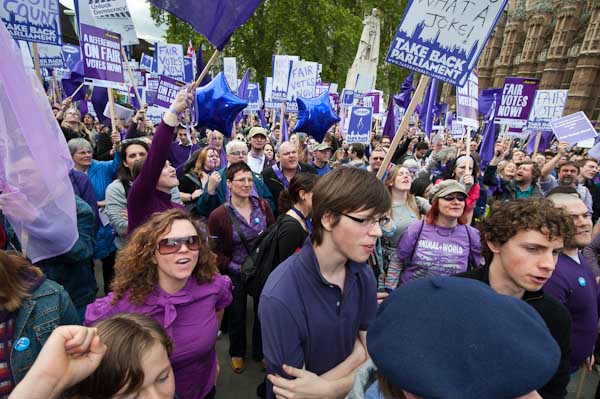
More than a thousand people, mainly wearing purple, had come to Westminster to demand a fair voting system, feeling cheated by the recent election results which failed to produce a government reflecting how people voted.
The 2010 election had clearly failed to reflect the votes cast, particularly for the Lib-Dems who got almost a quarter of the votes but less than one tenth of the seats. Perhaps even more importantly it showed that over a third of the population had so little confidence in our political system that they didn’t bother to cast there vote.
These results had left to a movement springing up rapidly through the Internet, using Twitter, Facebook, You Tube and other social networking sites, and it also attracted the backing of existing electoral campaigning groups such as the Electoral Reform Society, Unlock Democracy (incorporating Charter 88), 38 Degrees and Power2010.
Most of us have experience of elections taking place using the single transferable vote system with give much greater fairness. The Lib-Dems had demanded a UK-wide referendum on the Parliamentary voting system for taking part in the coalition governement, but the proposals were dismissed as more an attempt to defuse the issue than to deal with it. The vague proposal was in any case decisively rejected, though only 42% of the electorate bothered to vote.
This year has seen another attack on the fairness of our elections with the introduction of the need for photo-ID to cast a vote. I don’t know how many were put off from trying to vote by this requirement, but apparently 1.2% of those who turned up to polling stations were not allowed to vote.
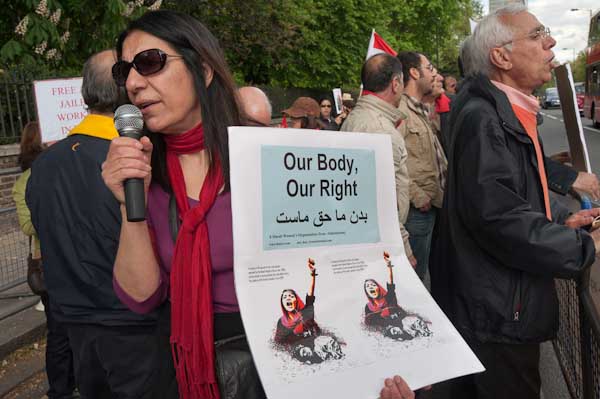
Around a hundred people demonstrated in Trafalgar Square and then marched for a rally opposite the Iran Embassy following the execution last Sunday of 5 political activists, the latest of many such death sentences.
In the previous year millions in Iran had protested for greater freedom in Iran, with the protests making headlines around the world after the fatal shooting of Neda Agha-Soltan in June 2009. Thousands have been arrested, tortured to make untrue confessions and then condemned in unfair trials and many have been executed.
The death of Jina Mahsa Amini after being arrested by the religious morality police for allegedly not wearing the hijab in accordance with government standards in September 2022 has led to a series of protests in Iran and around the world on an even more widespread scale than those in 2009-10, 2007 and 2019. Again the protests in Iran have been brutally repressed with at least 476 people killed by the end of 2022, and many arrested and tortured and a number of protesters hanged.
The protest on 15 May 2010 came after the executions of five political activists – four men and a woman – on Sunday 9 May; Farzad Kamangar, Ali Heydarian, Farhad Vakili, Mehdi Eslamian and Shirin Alam-Houli.
The protests in London around the world in 2022-3 have been on a larger scale than in 2010, with large and continuing protests with the slogan ‘Woman Life Freedom’.