Old Comrades, Women for Life & Sikhs – 2006

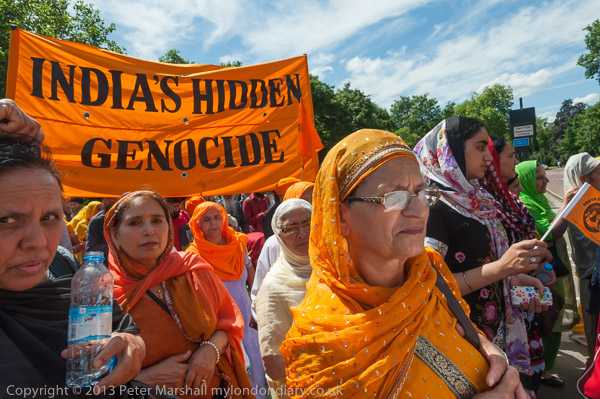
Old Comrades, Women for Life & Sikhs: Sunday 4th June 2006 was a day for marching and running on the streets of London. In the City, the London Regiments were remembering their fallen comrades, and several thousand women were raising funds for cancer research. In Hyde Park I joined several thousand Sikhs at a rally before they marched in memory of the martyrdom of the Fifth Guru and the Indian genocide of Sikhs, calling for the release of political prisoners and the formation of an independent Sikh state.

I wrote a rather longer piece than usual, ending with a complaint about the police harassment of photographers during the Sikh march. There do seem to be some officers who really have a very negative attitude towards photographers, and at times in particular towards those with UK Press Cards. Though formally these are recognised by all police forces in the UK, that recognition too often means nothing on the street. Below is what I wrote in 2006 – with the usual minor corrections.


London Old Comrades

Bank of England
Old Comrades, Women for Life & Sikhs - 2006

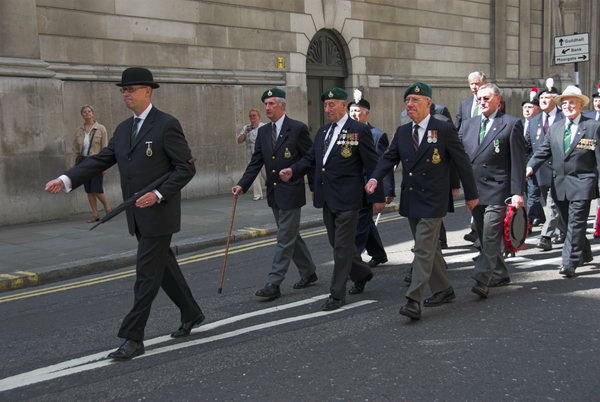
Early Sunday the centre of the real City, around the Bank Of England is generally pretty empty, but today things were going on. Immediately north of the bank a small group of ‘old comrades’ from the London Regiments were preparing to march and lay poppy wreaths at the monument to their fallen comrades in front of the Royal Exchange. Some of those I spoke to had fought in the second world war, though there were also some younger people there. It’s a remembrance that has taken place twice a year since 1919.

Old Comrades, Women for Life & Sikhs - 2006

It was a solemn and ceremonial occasion, impressive and colourful, with a well-disciplined smoothness. The monumental architecture of the Bank made a good setting, although the area on top of Bank Station itself is too fussy and cluttered.

more pictures


Race For Life London

City

Old Comrades, Women for Life & Sikhs - 2006
Towards the end of the event, when the numbers had thinned out a bit, London Wall was still fairly full.

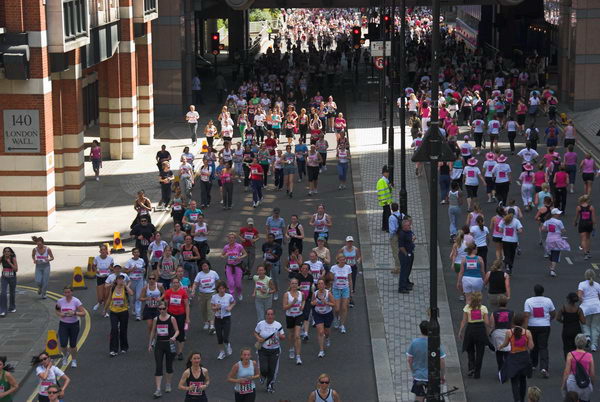
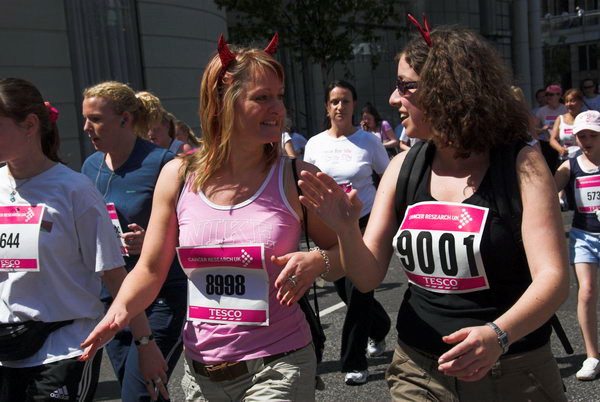
As they marched off, I peeled left in search of 750,000 women, or rather that fraction who were taking part in the Central London event. ‘Race For Life’ for Cancer Research UK, is the UK’s largest women-only nationwide fund-raising day. There certainly were a lot of them, [around 10,000], at times packing even the wider streets full from side to side, making it hard to walk along Cornhill.
Old Comrades, Women for Life & Sikhs - 2006

Women of all ages, shapes, sizes, races and speeds running, walking or limping or wheel-chairing around the 5km course. There were fewer serious runners than I’d expected and less fancy-dress, but the sheer numbers were impressive.

more pictures


Sikh Remembrance March and Freedom Rally

Hyde Park to Trafalgar Square
Old Comrades, Women for Life & Sikhs - 2006
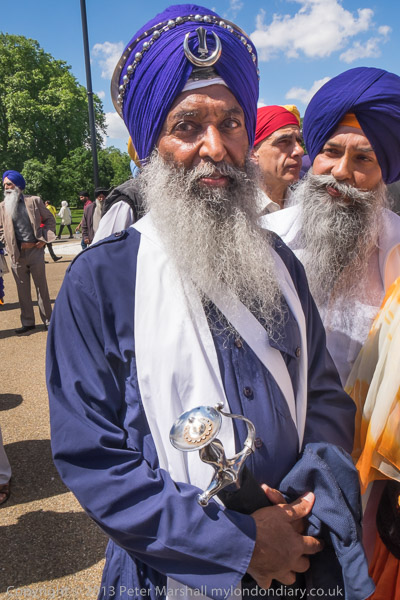
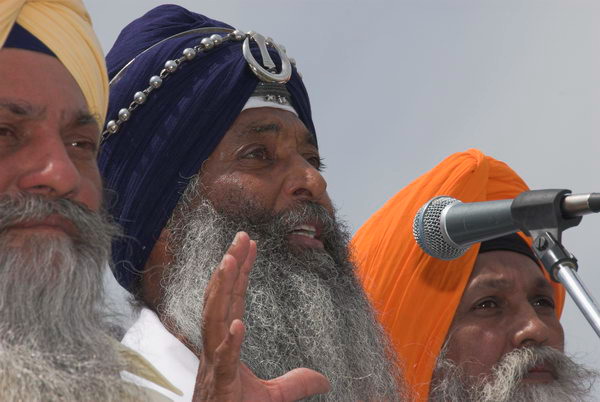
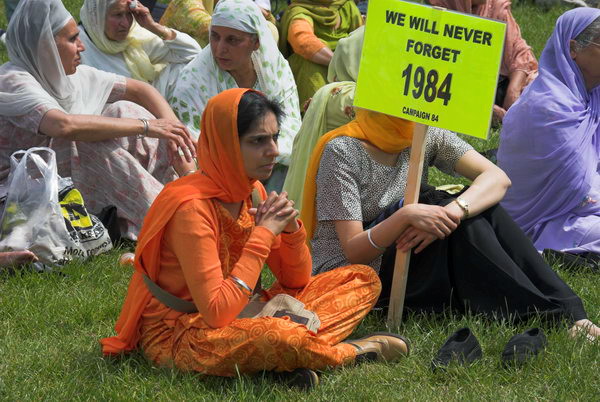
At the rally in Hyde Park before the march

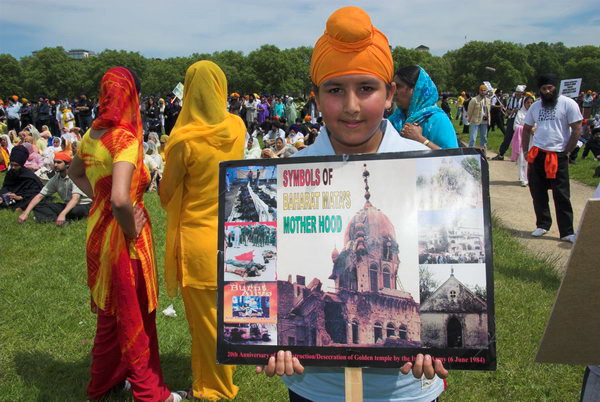
The Sikh Remembrance March and Freedom Rally commemorated the martyrdom of the fifth guru, Sri Guru Arjan Dev Ji 400 years ago, as well as the events of 1984.
Old Comrades, Women for Life & Sikhs - 2006

Guru Arjan Dev Ji compiled the first version of the Sikh holy book, the Guru Granth Sahib, in 1604, writing many of the hymns within it. He was arrested in Lahore in 1606 on the orders of Mogul Emperor Jehangir, tortured for 5 days and martyred on the banks of the River Riva.
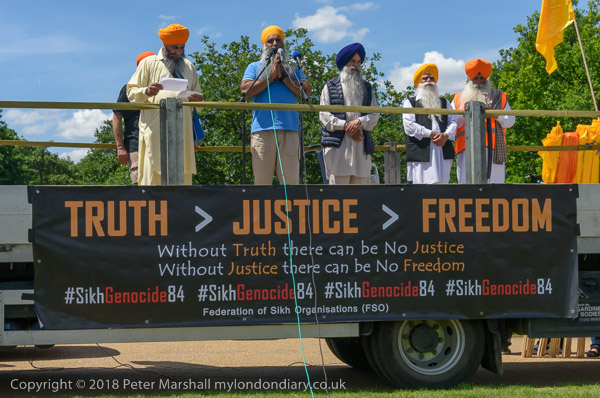
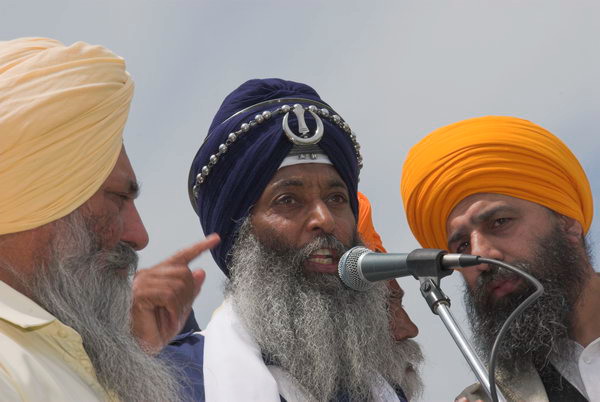
Punjabi speakers at the rally in Hyde Park described the events of 1984. The marchers demanded an acknowledgement of the Indian genocide of Sikhs, the release of Sikh political prisoners held in Indian jails, and for the establishment of an independent secular state of Khalistan in the Punjab.
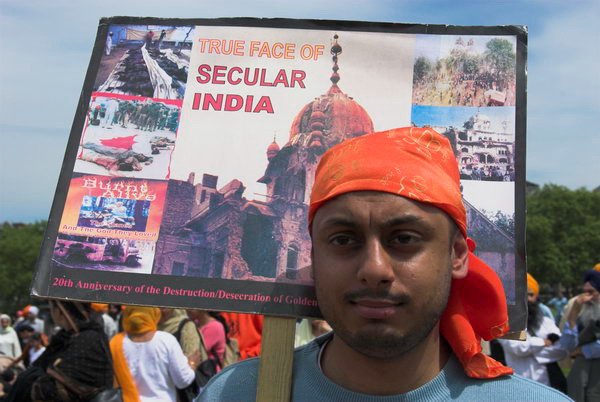
During the annual celebration of the death of Sri Guru Arjan Dev Ji in 1984, Indira Ghandi sent her troops to attack Sikh militants in the Golden Temple at Amritsar. Many innocent pilgrims – men, women and children – were killed in the brutal assault. Thousands more died around the Punjab, particularly in the riots incited by government TV and radio stations after the October assassination of Indira Ghandi by her Sikh bodyguards.
After the speeches came prayers, and then the march set off for Trafalgar Square and another rally. This was a serious event, with strongly felt grievances, and an impressive display of Sikh tradition and feelings.
The marchers were pleased to find photographers taking an interest in their cause, with many of them encouraging me and thanking me for my presence. Some had heard of this web site [My London Diary] too.
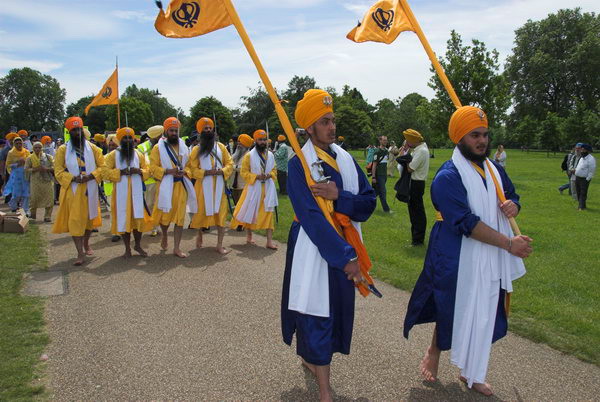
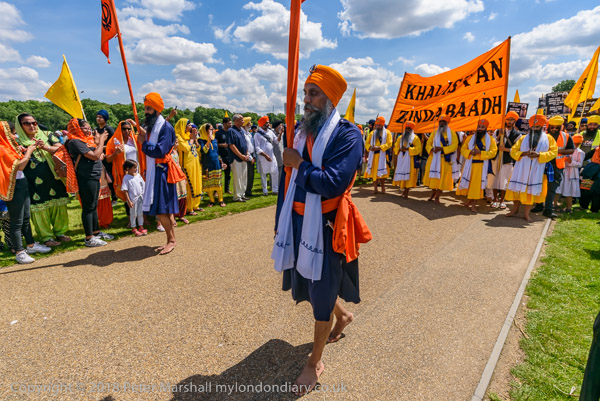
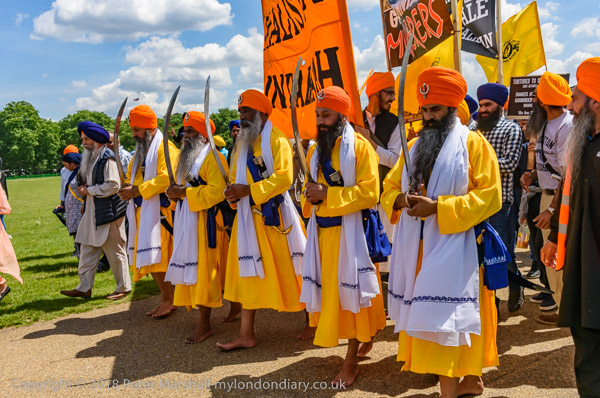
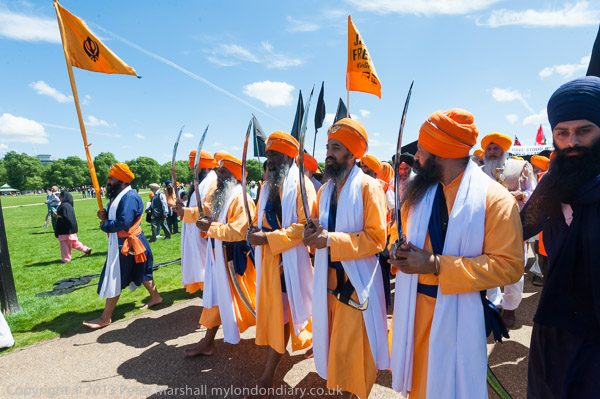
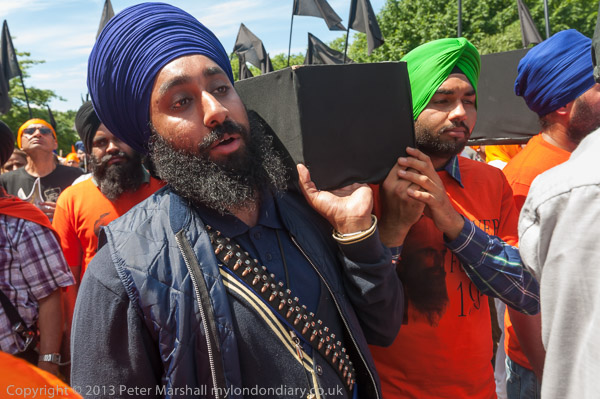
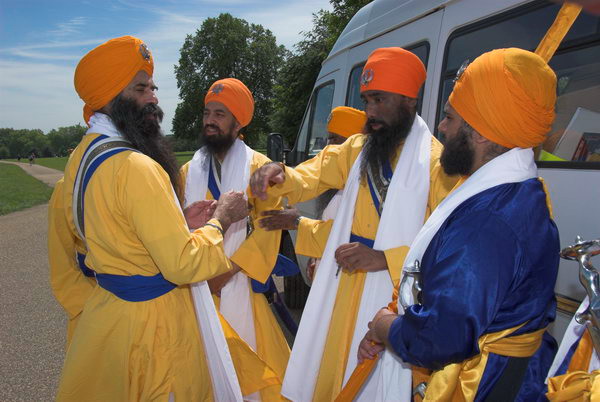
The march sets off in Hyde Park, with five men representing the original Panj Piare (Five Beloved Ones.)

Until we were close to Hyde Park Corner, the police were helpful and in good humour too, but then along came one of the rotten apples, someone who just wanted to push photographers around. He came and told me to get off the road, as I was stopping the demonstration. This was clearly absolute nonsense, and I tried to tell him, but reason held no interest for him.
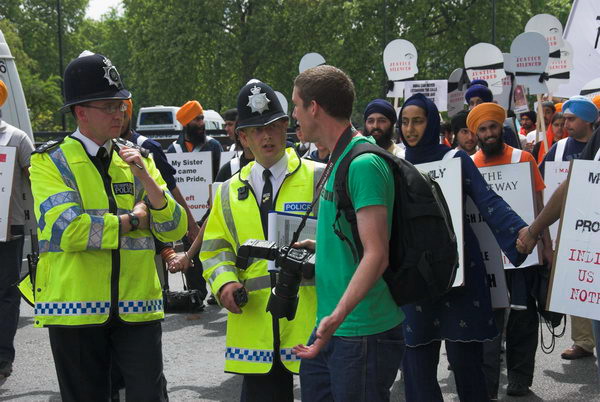
Police harass a photographer trying to do his job. I and other photographers got the same treatment

Other photographers got harassed too. You can see one of them in my picture. We are accused of holding up the march, generally nonsense as most of us want to capture action in our images, and if people even slow down, will wave them on.
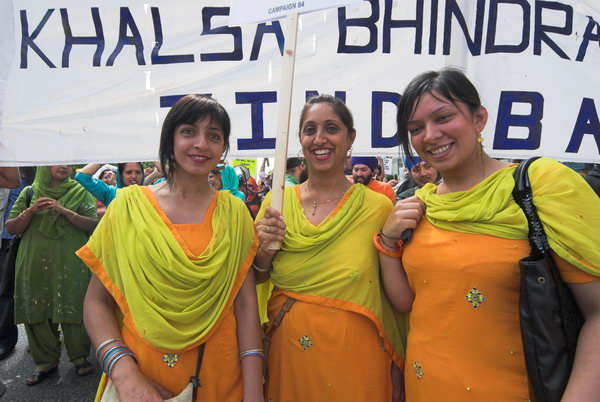
Of course it’s those at the actual front of the march who would have any effect on its progress. Further back where we were working, small gaps develop and are closed up all the time without affecting the overall progress.
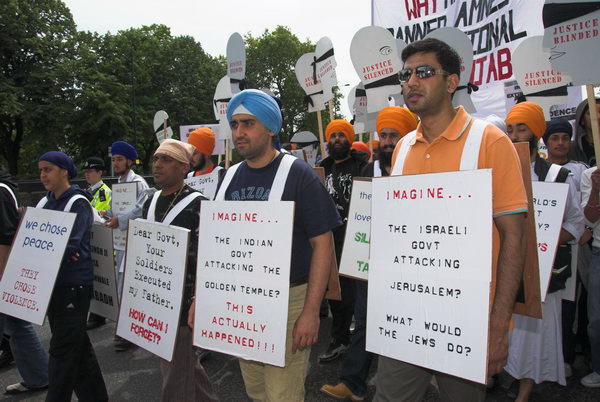
I have respect for the police – some at least of their work is essential, but this kind of petty and stupid behaviour simply makes their job harder for no reason.

It also makes the work of photographers impossible. I can’t work unless I can stand in the right place to take pictures, and that is seldom on the sidelines. At the highest level, the police realise this; it’s about time they got some of the little dictators in the middle to put it into practice.
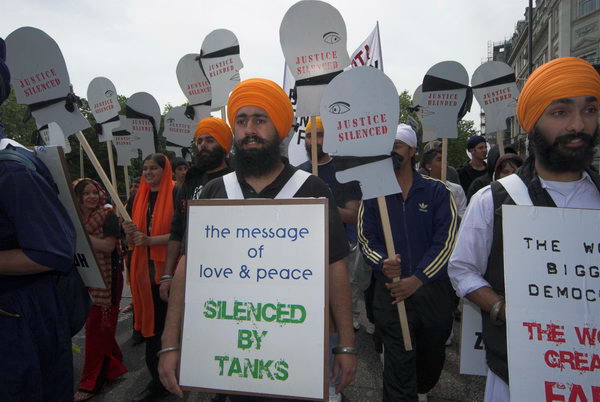
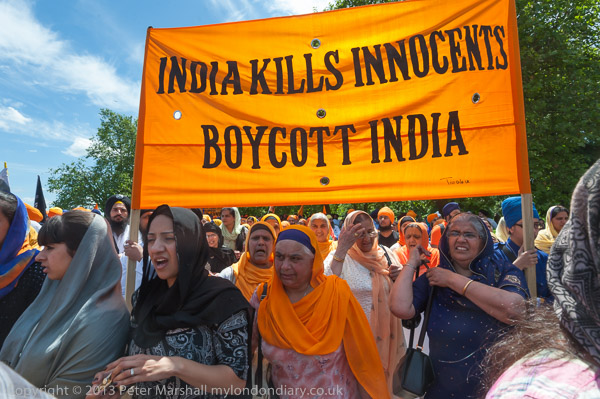
The message of love & peace SILENCED BY TANKS

Of course the policing of many marches is over the top. There were probably ten times the number needed for this event, which was predictably well ordered, good natured and essentially self-policing. Traffic control was really all that was required. Perhaps harassing photographers makes these surplus guys on overtime think they have a purpose.
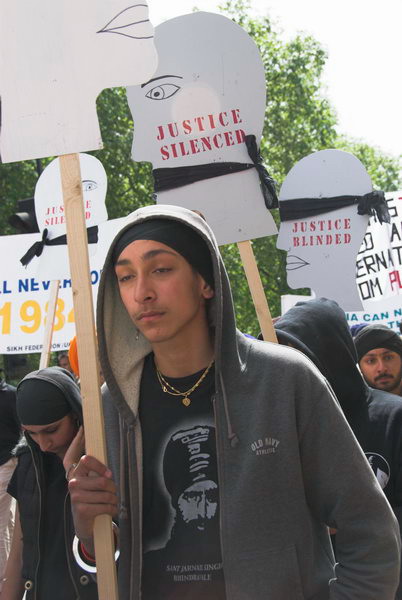
Twenty minutes later, along with several of the other photographers, I was on my third warning from this guy and he was getting redder and more and more tense. I was interested in how the situation might develop, but I was also tired and it was time for me to go elsewhere.

more pictures


FlickrFacebookMy London DiaryHull PhotosLea ValleyParis
London’s Industrial HeritageLondon Photos

All photographs on this page are copyright © Peter Marshall.
Contact me to buy prints or licence to reproduce.

Knife Crime & Sikh Genocide – 2018

Knife Crime & Sikh Genocide: On Saturday 3rd Jun 2018 Anti-Knife UK protested opposite Downing Street calling on Prime Minister Theresa May to take action against knife crime in the UK. From there I went to Hyde Park where several thousand Sikhs were meeting to march through London to Trafalgar Square in memory of the 1984 Indian Army attack on the Golden Temple in Amritsar and the mob killings of Sikhs later in the year encouraged by the Indian government following the assassination of Indira Gandhi by her Sikh bodyguards.


Anti-Knife UK protest – Downing St

Knife Crime & Sikh Genocide - 2018

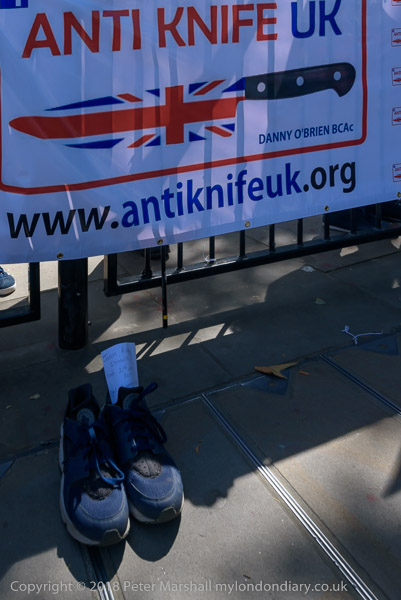
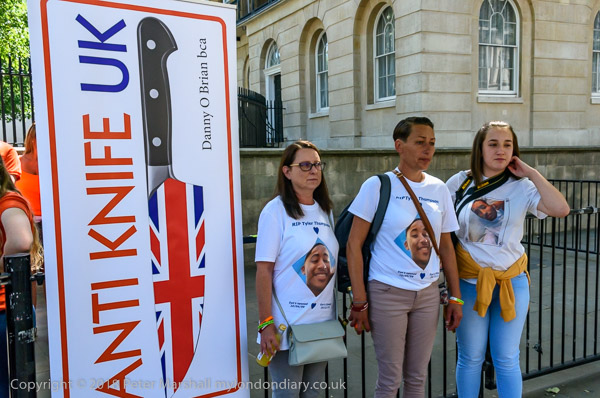
Anti-Knife UK had been founded by Danny O’Brien in 2008 to monitor knife crime incidents from across the UK on a daily basis and to campaign for legislation and other actions to reduce them. He announced at the protest that he was stepping down from active leadership because of the strains it had put on his mental health leaving the campaign to be carried forward by others.

Knife Crime & Sikh Genocide - 2018
Danny O’Brien

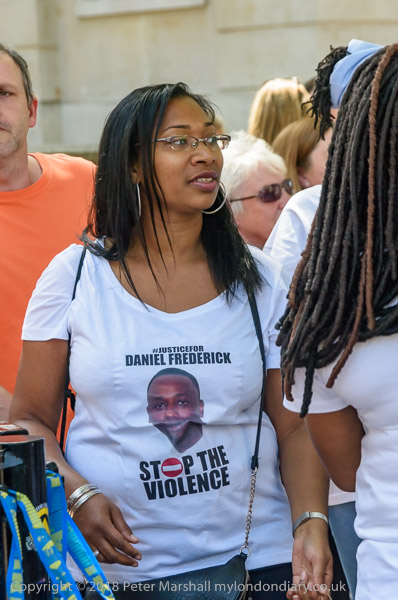
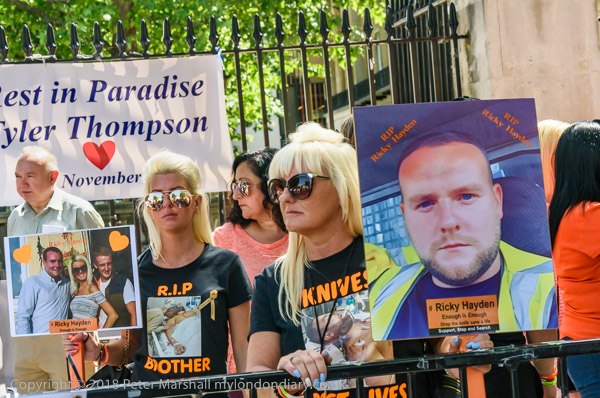
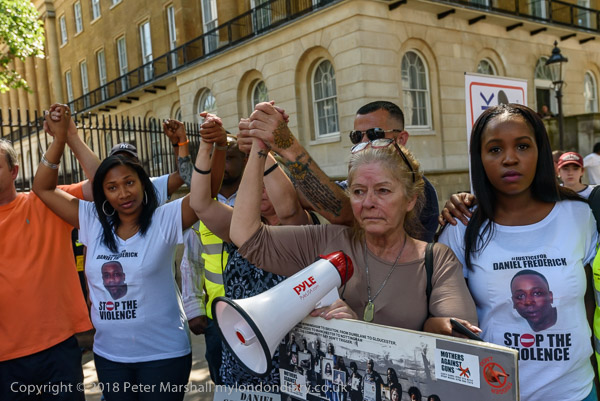
Anti-Knife UK had organised this protest by community groups and campaigners from various groups across the country to urge Theresa May to take action against this growing problem. Many at the protest were family and friends of those, mainly young men, who had been killed in knife crimes and wore t-shirts with pictures of the victims.

Knife Crime & Sikh Genocide - 2018

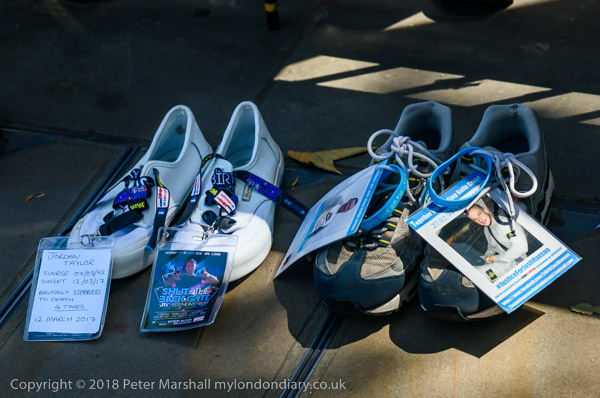
As well as placards and banners some had brought pairs of empty shoes to remember those killed.

Knife Crime & Sikh Genocide - 2018

Speakers at the rally called for government support for measures to tackle the problem including tougher sentences, tagging of all knives, knife arches in night clubs, equal rights for victims and families, and a review of the laws governing self-defence and reasonable force as well as more work in schools and communities.

More pictures at Anti-Knife UK protest.


Sikhs remember the 1984 genocide

Knife Crime & Sikh Genocide - 2018

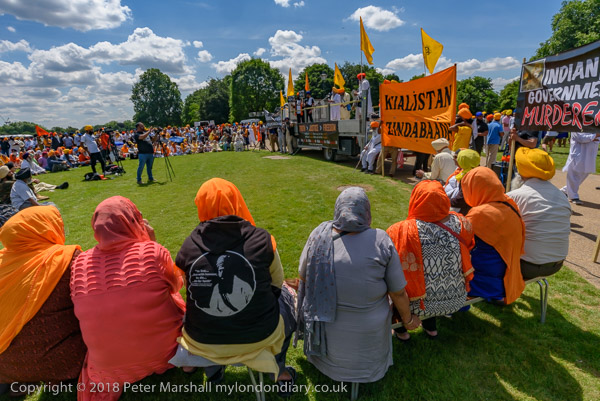
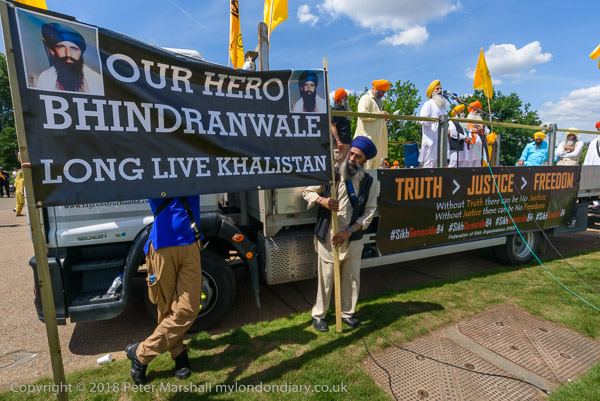
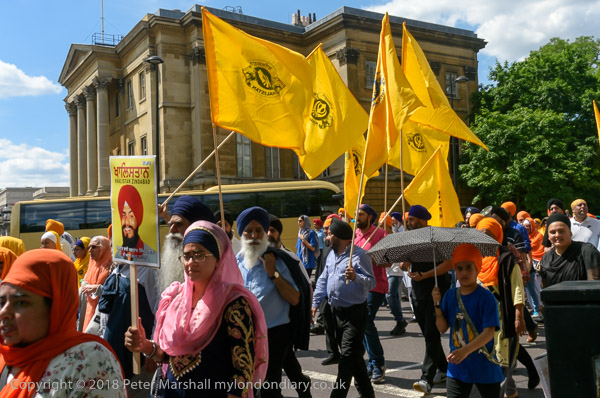
Several thousands of Sikhs sat in front of a stage on a lorry in Hyde Park for a rally addressed by a succession of Sikh leaders calling for and end to the persecution of Sikhs in the Punjab and for freedom in an independent Sikh state of Khalistan. Sikhs got a raw deal at partition in 1947 and promises made to them at the time were never kept.

They remembered the thousands of Sikhs killed in the 1984 Indian Army attack on the Golden Temple in Amritsar, Operation Blue Star, and more murdered later that year after the assassination of Indira Gandhi when the Indian government encouraged mob killings of Sikhs, crimes for which none have been brought to justice.

Since the 1984 Sikh genocide there has been a continuing program of police arrests, torture and killing of Sikh males in the Punjab and crippling economic and social policies. Many Sikhs demand independence from India and a Sikh state of Khalistan.

The militant Sikh group Babbar Khalsa calling for independence had been formed a few years before 1984 and had been active for some years in the Punjab before they gained international notoriety by planting a bomb in an Air India flight to Canada which killed 329 people in 1985. Some at least of the continuing activities of this group are thought to be financed by Pakistan.

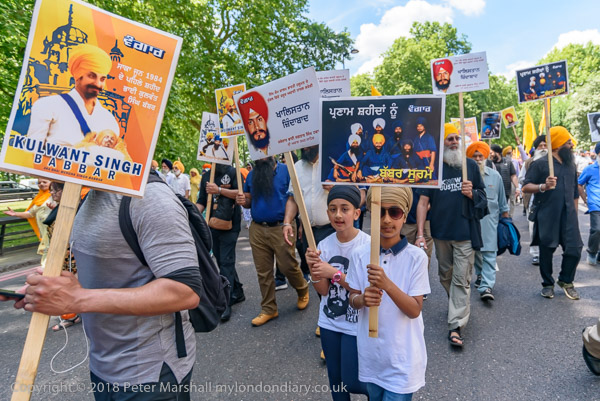
Babbar Khalsa are a proscribed group in the UK and in some earlier years I photographed this event some people were arrested for allegedly promoting this organisation. This year I saw none of this, but Babbar is an Indian family name.

Jarnail Singh Bhindranwale was killed in ‘Operation Blue Star’

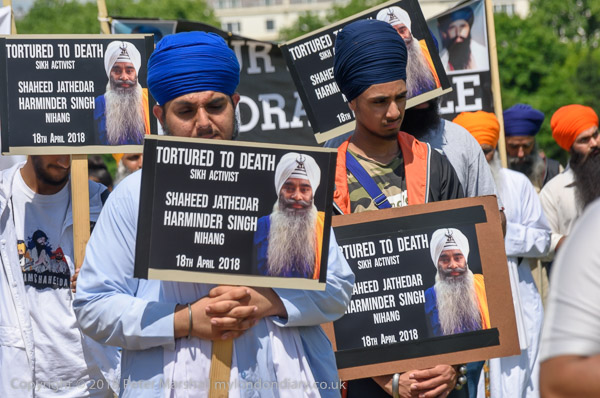
Some did carry placards showing Kulwant Singh Babbar, one of the first members and founders of Babbar Khalsa and a supporter of Khalistan movement, killed by Indian army snipers in Operation Blue Star in 1984.

This was a peaceful protest and I was made to feel welcome as I took pictures – and enjoyed some of the free food being handed out to all at the event before the march.

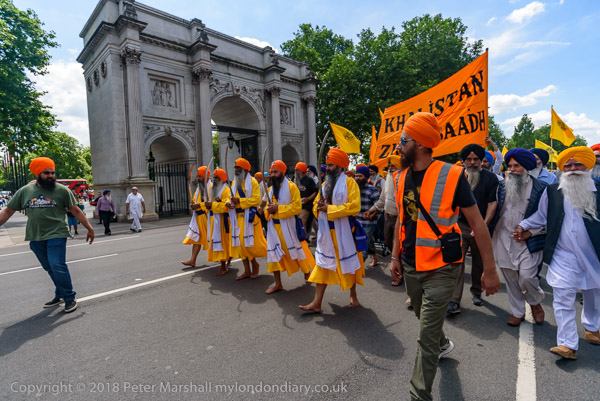
The start of the march was led by groups from Birmingham and when they reached Marble Arch they were unsure which way to proceed. They decided to go back into Hyde Park and get the police to tell them which way to go, and were led back through a gate a short distance down Park Lane and led across to continue,

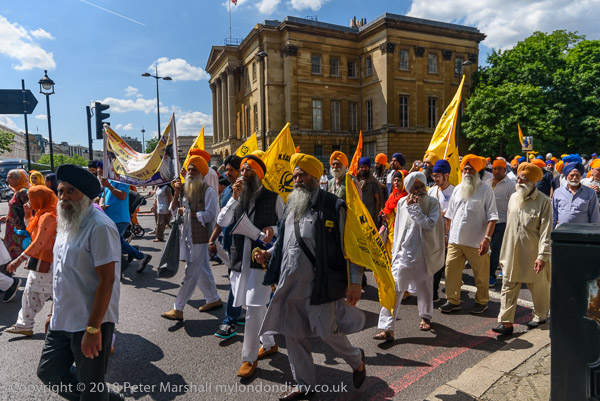
I left them at Hyde Park Corner on their way down Piccadilly towards a rally in Trafalgar Square.

More pictures on My London Diary at Sikhs remember the 1984 genocide.


FlickrFacebookMy London DiaryHull PhotosLea ValleyParis
London’s Industrial HeritageLondon Photos

All photographs on this page are copyright © Peter Marshall.
Contact me to buy prints or licence to reproduce.

Knife Crime & 1984 Sikh Genocide

Five years ago today on Saturday 3rd June 2018 I photographed two events in London, beginning with a protest opposite Downing Street by campaigners against gun and knife crime and moving on to an annual march remembering the 1984 Indian Army attack on the Golden Temple in Amritsar where thousands of Sikhs were massacred, and the Indian government encouraged mob killings of Sikhs across the country following the assassination of Indira Gandhi by her Sikh bodyguards later in the year.


Anti-Knife UK protest – Downing St

Knife Crime & 1984 Sikh Genocide

The event was organised by Anti-Knife UK, founded by Danny O’Brien in 2008 which monitors knife crime incidents from across the UK on a daily basis. 2008 had been a particularly bad year for the murder of teenagers on London’s streets, with 29 deaths, and thought the numbers had gone down until 2012 when there were 9 such deaths by 2017 they back up to 27.

Knife Crime & 1984 Sikh Genocide

All of these deaths are tragedies for the teenagers and their families, and the numbers of crimes involving knives across England and Wales is huge – now over 45,000, though many of those are for possession of knives – and the total number of deaths is the year ending march 2022 was 261.

Knife Crime & 1984 Sikh Genocide

Many of those at the protest were bereaved family members and their supporters and were wearing t-shirts or holding placards with photographs of the knife victims and pairs of empty shoes as well as banners.

Knife Crime & 1984 Sikh Genocide

Speakers called for measures to tackle the problem including tougher sentences, tagging of all knives, knife arches in night clubs, equal rights for victims and families, a review of the laws governing self-defence and reasonable force and work in schools and communities.

More pictures at Anti-Knife UK protest.


Sikhs remember the 1984 genocide

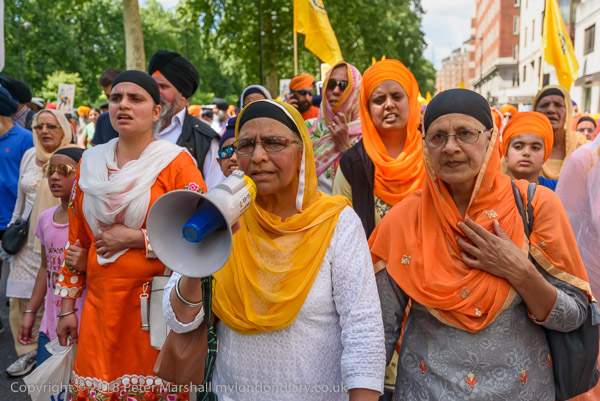
I went to meet a large crowd of Sikhs at a rally in Hyde Park before the march, sitting on the grass. It was 24 degrees in London, and without any shade I was far too hot. Few of the speeches were in English, but many of the placards were and others graphically made their message clear.

Sikhs were badly treated by the British at the time of partition which divided the country up between the Hindus and Muslims, with millions of people having to flee across the borders of the new states and millions were terribly killed in doing so. Sikhs had called for an independent Sikh state in the Punjab, but most were simply lumped in, along with Buddhists and Jains with Hindu dominated India, although large numbers also remained in the part of the Punjab which had been designated as Muslum Pakistan.

Although there were large numbers of Sikhs across the Punjab before partition were still a minority population and they were not united in their demands for an independent state of Khalistan. Althugh they would probably have been better joining Pakistan, their cultural ties to Hinduism as well as a history of persecution by Muslims led them to instead unite with India. Many Sikh leaders had been involved with the Indian Congress Party which had made them promises about their position in India where the are less than 1% of the population but these were never kept.

The idea of a separate Khalistan became talked about more widely particularly in the diaspora in the 1970s, with the movement in Punjab led by Jarnail Singh Bhindranwale advocating an autonomous state within India. The movement had become increasingly militant with a number of armed supporters, setting up in 1982 what Wikipedia describes as ‘what amounted to a “parallel government” in Punjab‘.

In June 1984, the Indian Army launched Operation Blue Star to remove Bhindranwale and his armed followers from the Golden Temple complex in Amritsar, killing Bhindranwale and large number of his supporters as well as many civilians as the temple was packed with pilgrims. The figures for deaths are disputed but probably between 5-7,000, with around 700 of the Indian army also dying.

In 2018 I commented “Since this 1984 Sikh genocide there has been a continuing program of police arrests, torture and killing of Sikh males in the Punjab and crippling economic and social policies. Sikhs demand independence from India and a Sikh state, Khalistan.”

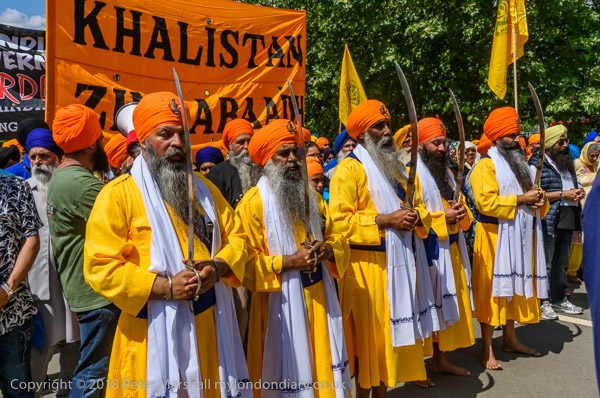
After the rally the march set off, led by Sikh standard bearers and five Khalsa representing the Five Blessed Ones or Panj Pyare holding swords and walking barefoot in their orange robes and followed by several thousand Sikhs with flags, placards and banners. I talked with them past Marble Arch and down to Hyde Park Corner where I left them going down Piccadilly towards another rally at the end of the march in Trafalgar Square.

You can see many more pictures and captions describing the event on My London Diary at Sikhs remember the 1984 genocide.

1984 Remembered

Every year around the 8th June, Sikhs march in London to remember the 1984 destruction at the Golden Temple in Amritsar. The Soviet government forged documents in 1982 to show that Sikh militants were getting CIA support for their plans to establish an independent Sikh state of Khalistan in the Punjab and these were taken seriously by Indian intelligence services and prime minister Indira Gandhi, who on June 1st 1984 sent in the Indian Army in Operation Blue Star, attacking scores of Sikh temples across the Punjab.

On 3rd June Indian forces surrounded the Golden Temple in Amritsar where many of the militants who were well armed had taken refuge, along with thousands of pilgrims who were there for the anniversary of the death of the fifth guru, Arjan Dev Ji. The siege lasted several days and many were killed, mostly pilgrims who had been allowed by the army to enter on the 3rd June but not allowed to leave later that day. As they secured the Temple, the army carried out many executions of those they detained and fired on men and women as they were trying to follow army orders to leave.

Acoording to Rajiv Gandhi, around 700 Indian Army soldiers were killed in the attack, although the official figure was 83. There are also huge discrepancies between the official figures of those who died inside the Temple, with an official figure of 554 casualties and independent estimates of 18-20,000.

Many Sikhs resigned from official positions and soldiers left the Indian Army after this assault on their religion, and five months later Indira Gandhi was assassinated by her Sikh bodyguards in an act of revenge. This in turn led to anti-Sikh riots in which thousands of Sikhs were killed.

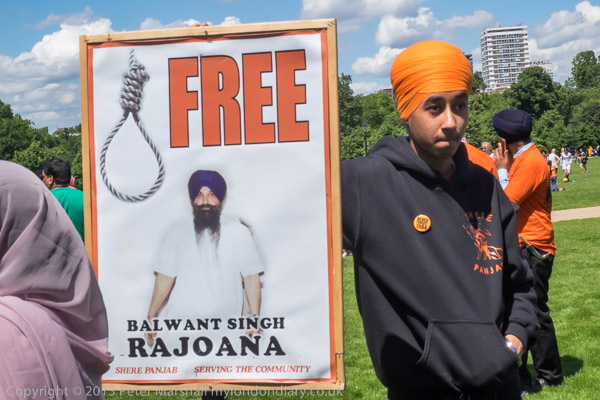
Many Sikhs still continue to call for an independent Sikh homeland, Khalistan, combining parts of the Punjab in both India and Pakistan that were severed at partition in 1947 when the whole area was divided between the two and Sikhs, along with other minorities were sidelined. Both political and military activities continue as does their repression by the Indian government, with many Sikhs held in Indian prisons, some under threat of hanging.

Feelings still run very high, and in 2013 four Sikhs were found guilty of attacking one of the generals who led the attack on the Temple, long retired and on holiday in London with his wife. Police have often taken a very keen interest in the annual march and prevented people from carrying some placards and posters which support the proscribed organisation Babbar Khalsa. The pictures here are from the march on Sunday 8th June 2014, which I left as the last of the protesters went down Park Lane on their way to a rally in Trafalgar Square

Sikhs march for Truth, Justice & Freedom


Protest Against Egypt Death Sentences

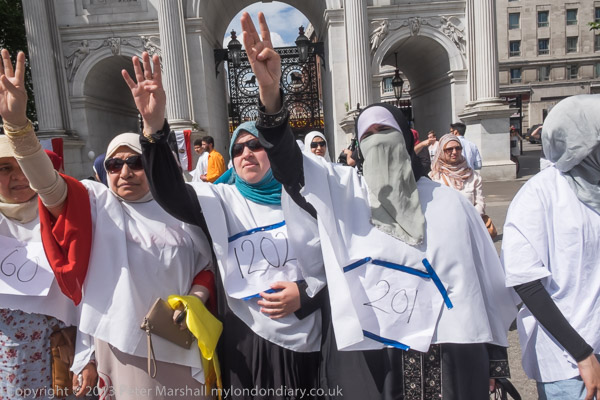
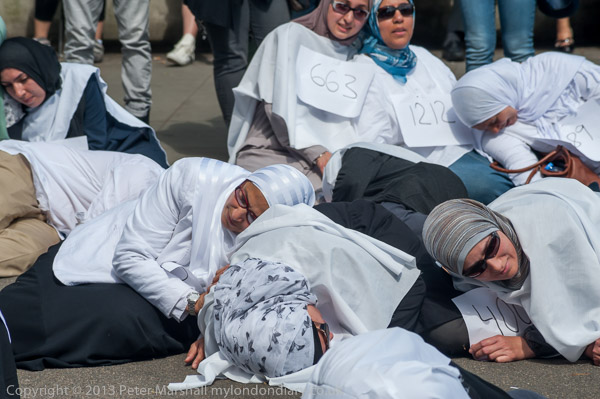
Also taking place on Sunday 8th June 2014 was a protest against the the 1,212 death sentences imposed on Islamists in Egypt, which was taking place as the new Egyptian president, Abdel Fattah el-Sisi, was sworn in. These included 529 members of the Muslim Brotherhood sentenced in 2014 following an attack on a police station in 2013.

There was a mock trial. People wearing numbers to represent the prisoners made the Islamist R4BIA (Rabia) sign and the event ended with a die-in in front of Marble Arch.

Protest Against Egypt Death Sentences


All photographs on this and my other sites, unless otherwise stated, are taken by and copyright of Peter Marshall, and are available for reproduction or can be bought as prints.