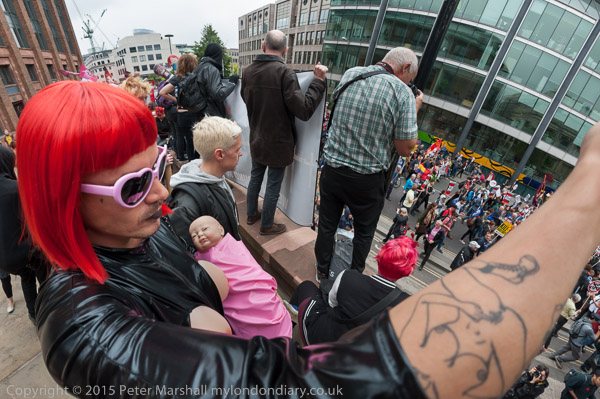
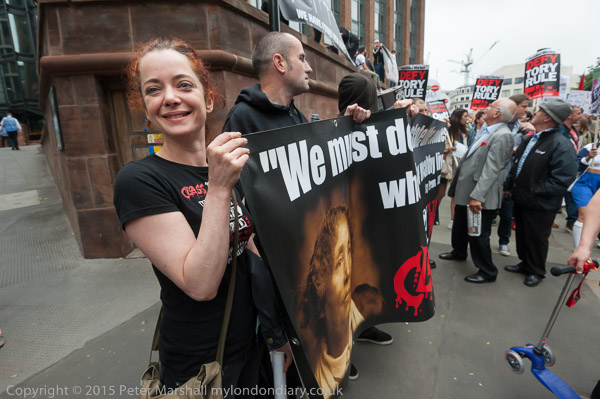
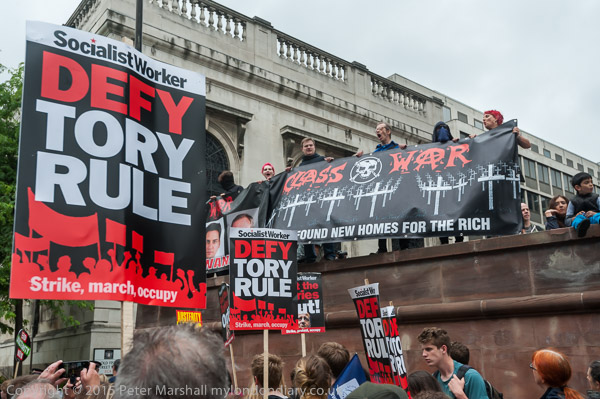
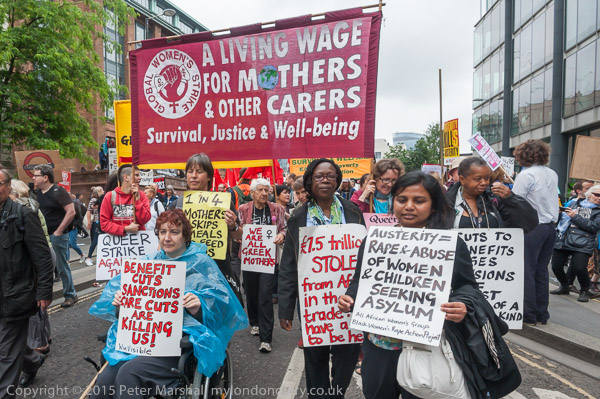
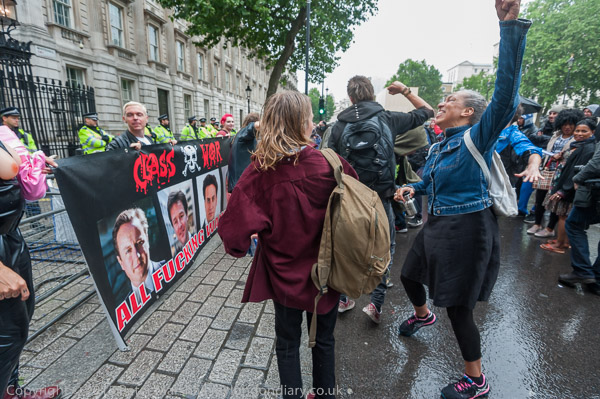
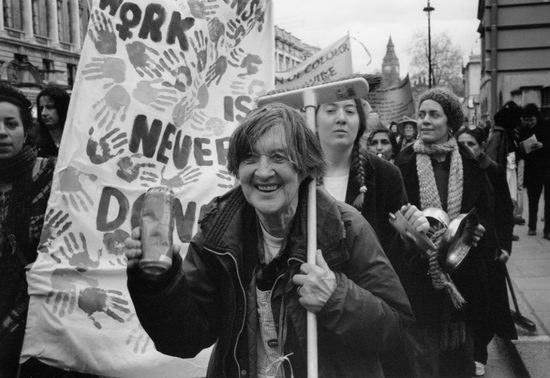
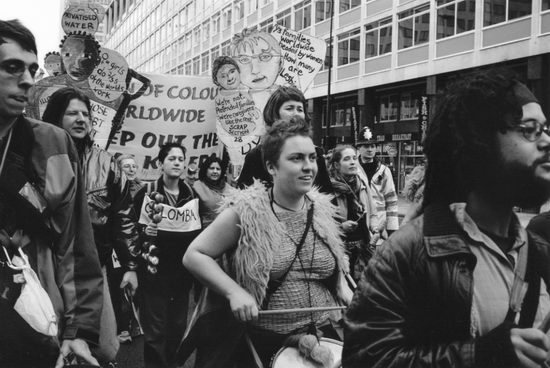
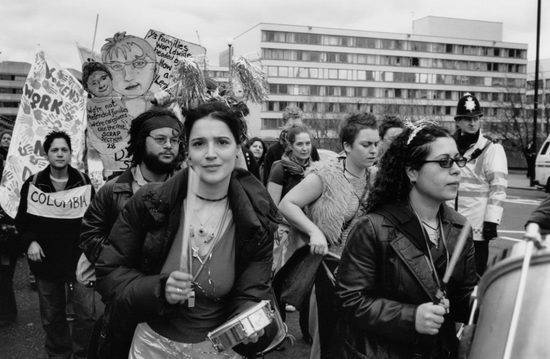
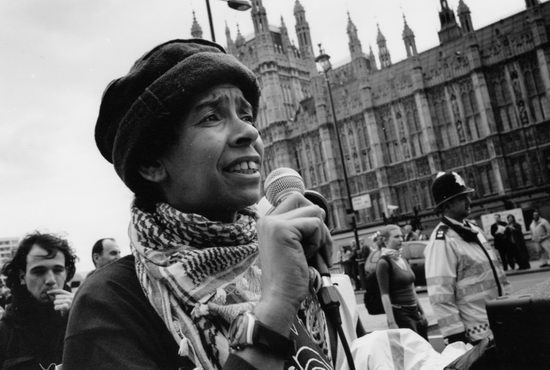
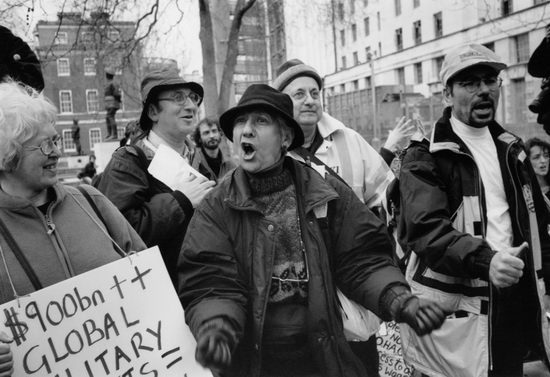
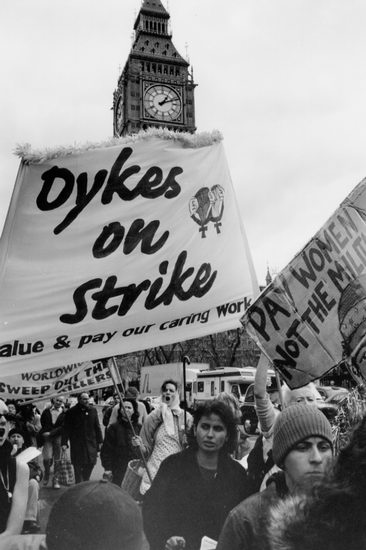
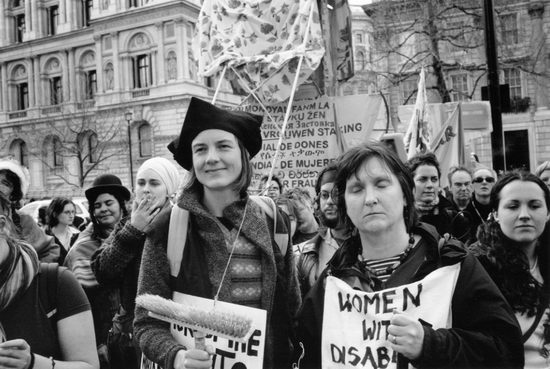
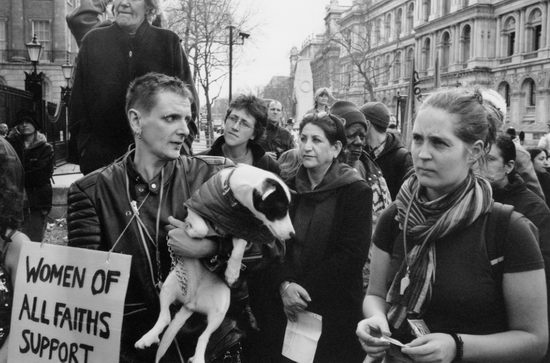
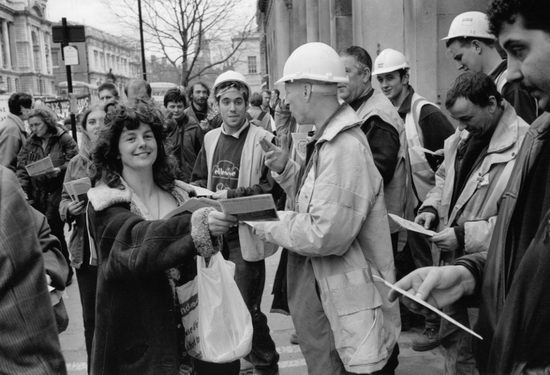
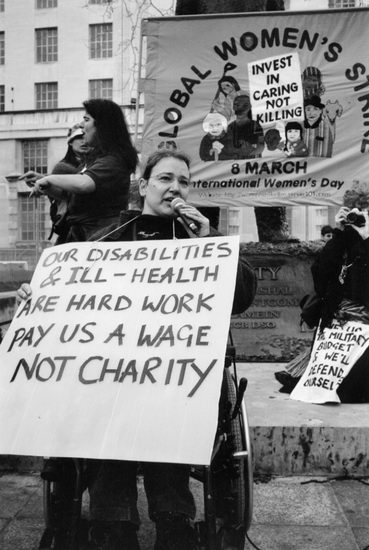
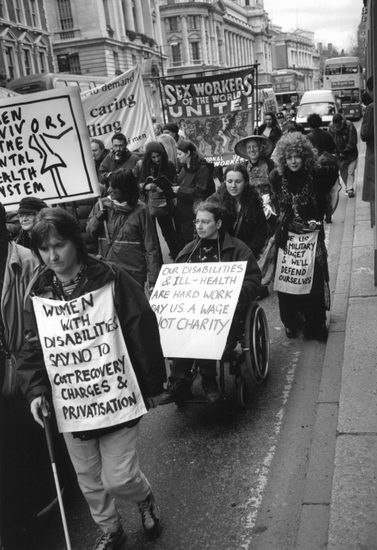
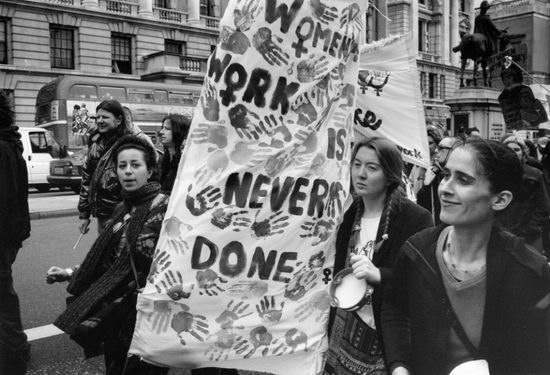
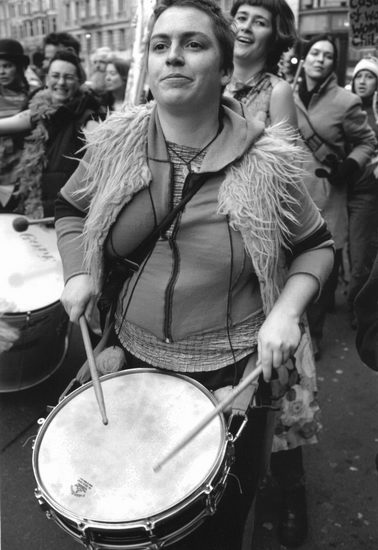
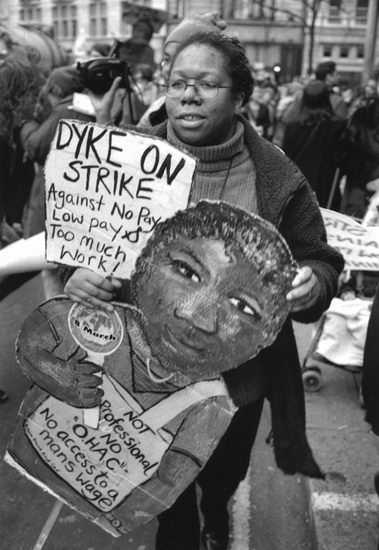
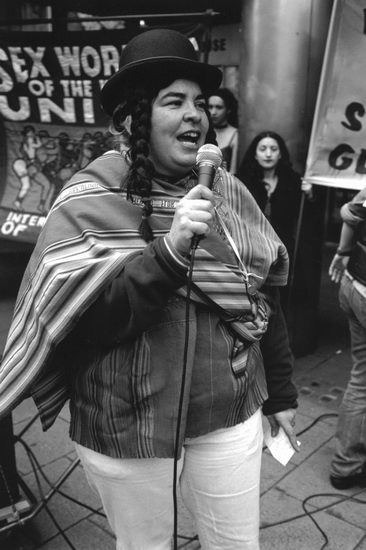
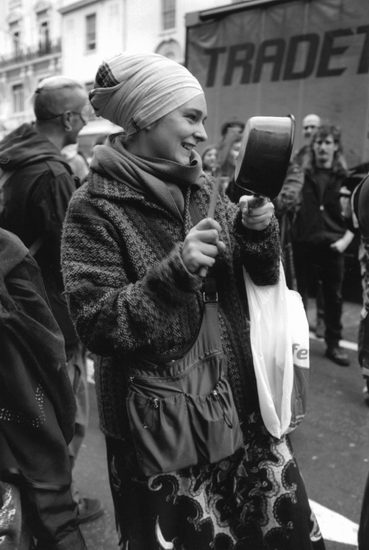
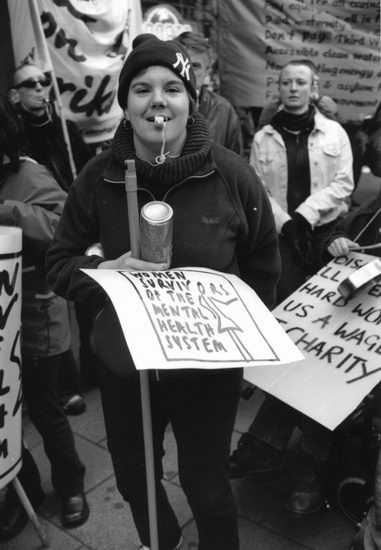
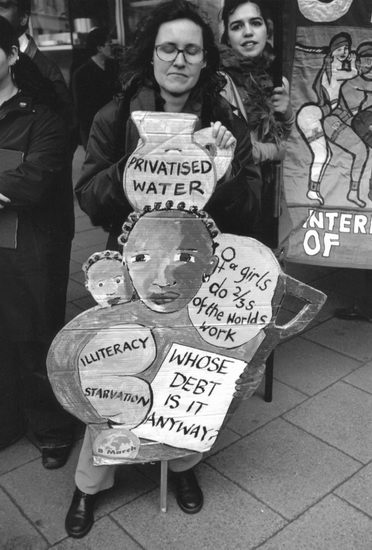
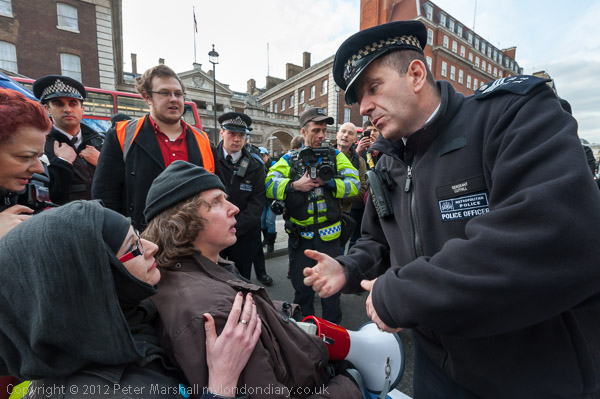
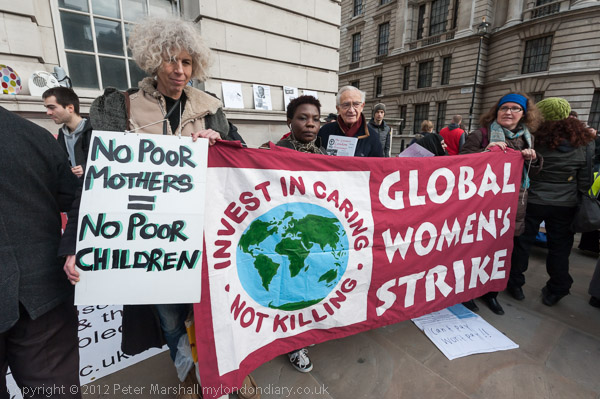
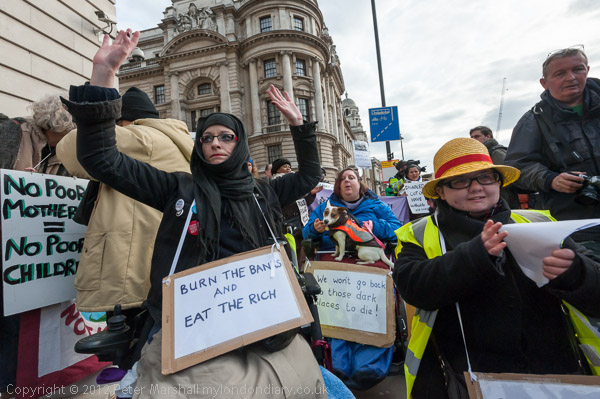
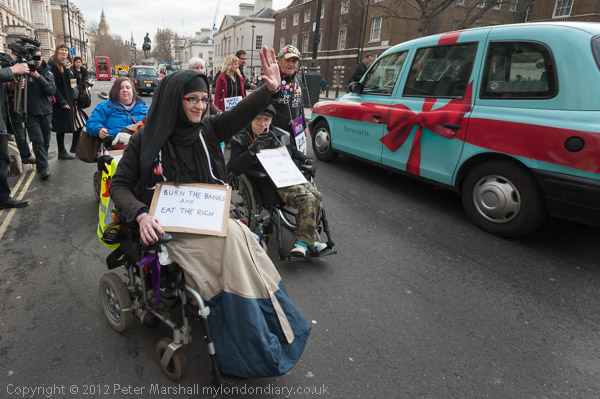
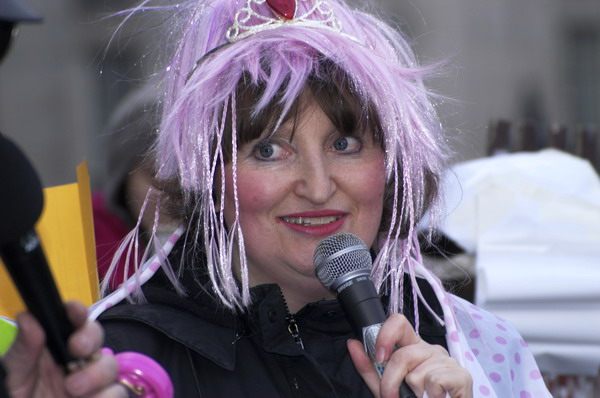
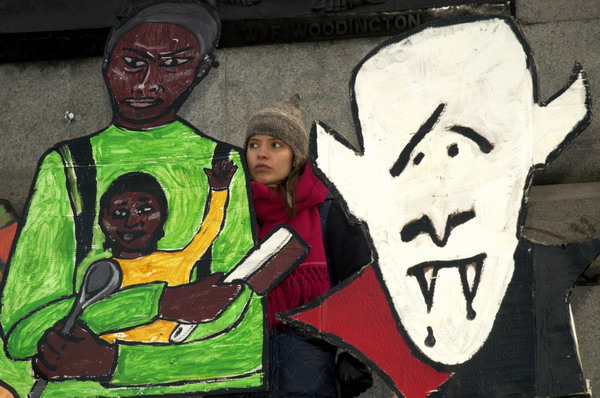
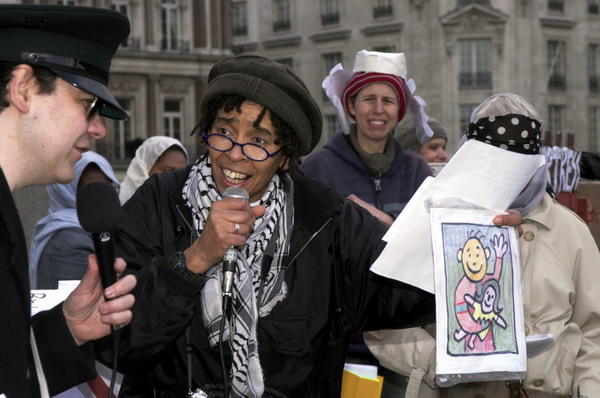
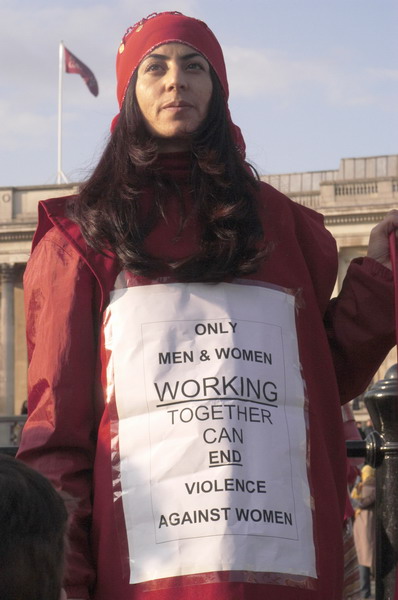
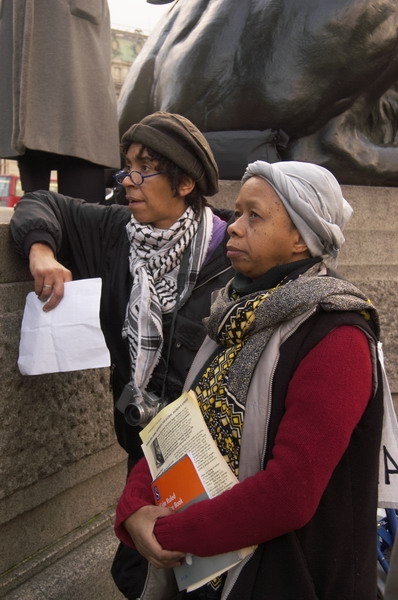
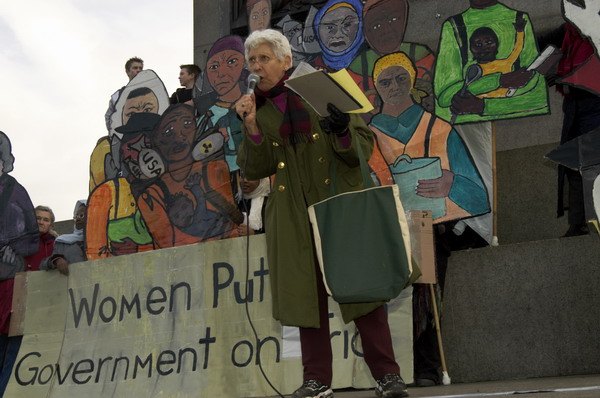
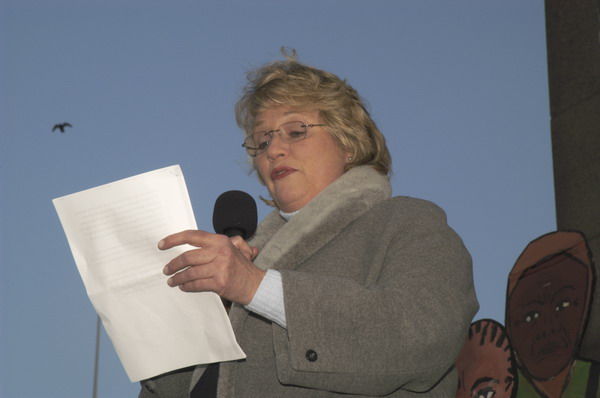
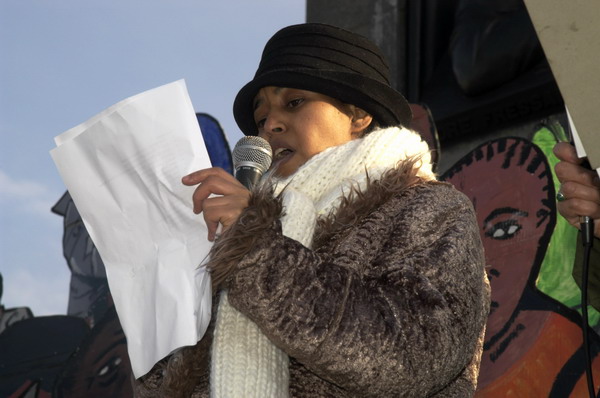
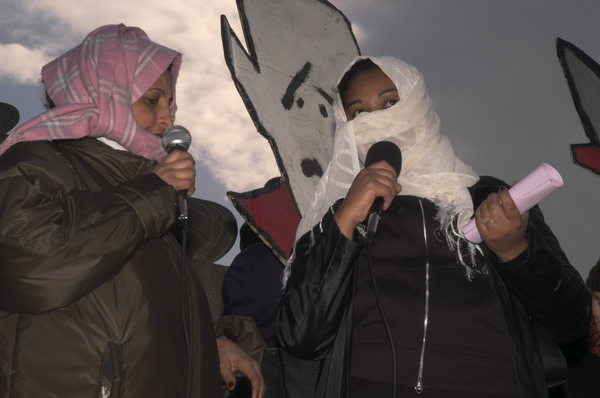
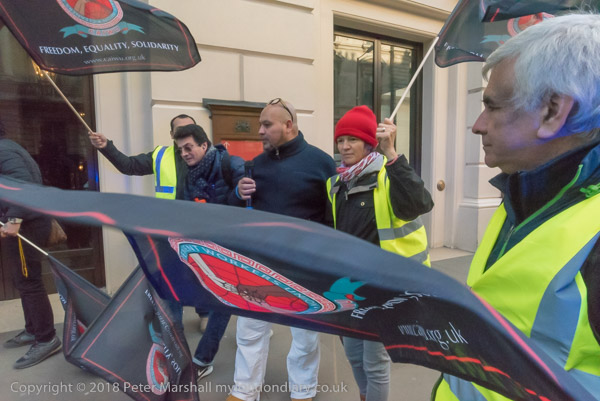
International Women’s Day: I’m not sure if this march on Friday 8th March 2002 was the first International Women’s Day event that I photographed, but it was the first that I published on My London Diary.
Back then all the pictures I published were in black and white, though I was also taking pictures in colour but was unable to easily digitise them. I still have to do so for many of the colour pictures I made on film, though I did make prints of a few of them in my darkroom.
Looking through these pictures I recognise quite a few faces I still photograph at protests, among them the founder of the Global Women’s Strike and the the International Wages for Housework Campaign Selma James.
International Women’s Day seems to have become much more widely celebrated since 2002, or at least getting more media attention, though this seems still very much around the very real problems faced by middle class professionals (including of course women in the media) than those faced by by working class women, refugees, asylum seekers, poor women being targeted by social services, those with disabilities, sex workers, victims of domestic violence, rape etc which are at the centre of this event and continuing protests.
Back in 2002, I didn’t write much about this march, at least in partly due to ignorance, but also I seldom wrote much about the events I was covering as I had a full-time job writing about photograph on the web, as well as my own photography – where the pictures I submitted had only brief captions.
“The 8 March is a World Woman’s Day and was celebrated by some as a Global Women’s Strike. The march in London stopped outside key sites including the War Office and World Bank for speeches.”
This was the full set of textt and images I posted in 2002 on My London Diary.
Boycott Workfare, Million Women Rise & Greece: On Saturday 3rd March 2012 I photographed a protest outside companies using people forced into free labour under the government workfare scheme, then a women-only march against male violence against women which I left to go to the Occupy meeting on the steps of St Paul’s which supported the protests in Greece against austerity measures imposed by the EU.
Boycott Workfare – Oxford St
Oxford St
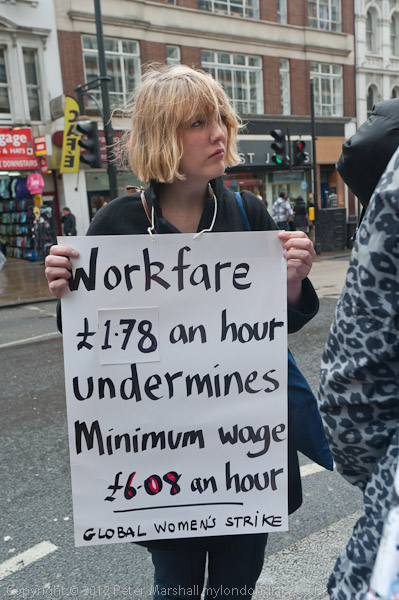
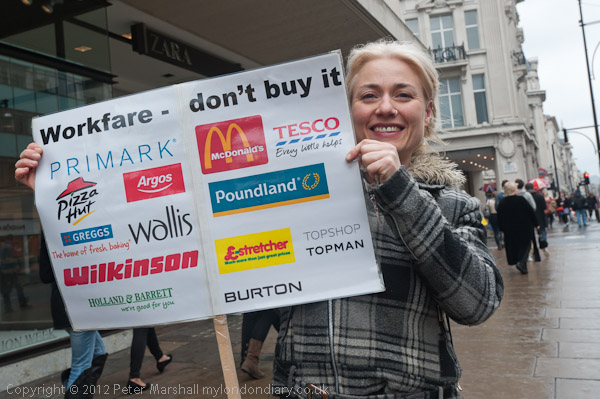
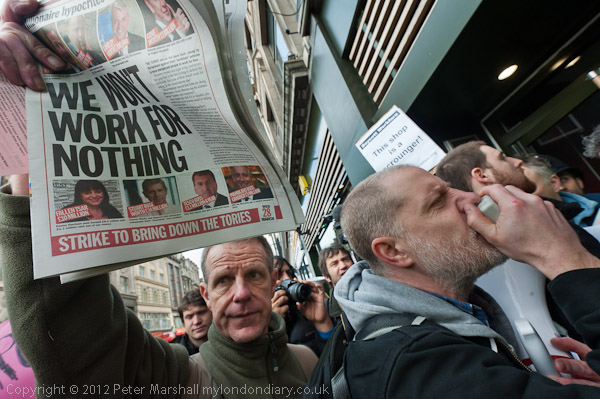
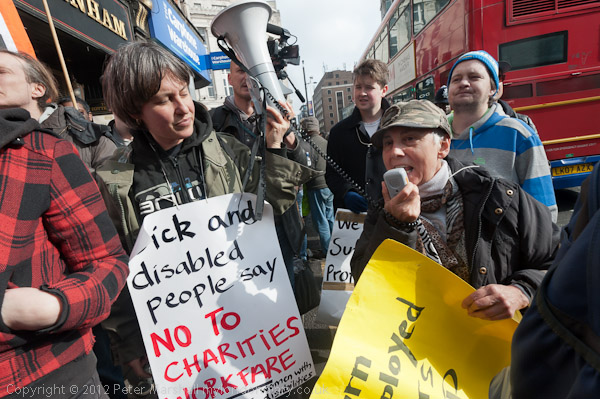
The group Boycott Workfare came to Oxford Street to lead a protest against companies who use unemployed and disabled people forced to work without pay but just a small allowance under the government workfare scheme.
As the protesters emphasised, workfare reduces the number of real jobs available in the workplaces, giving workers to the employers by forcing the unemployed to do work at no cost to the employer on an allowance roughly one quarter of the minimum pay – and around a fifth of the London Living Wage.
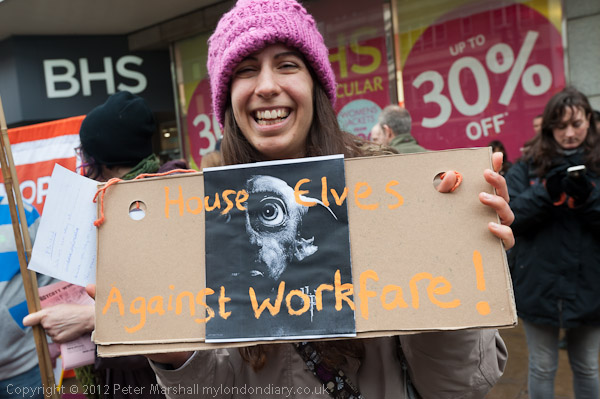
The event began with some good news when they met outside BHS near Oxford Circus by praising that company for having withdrawn from the scheme since the protest had been planned before moving off to protest elsewhere.
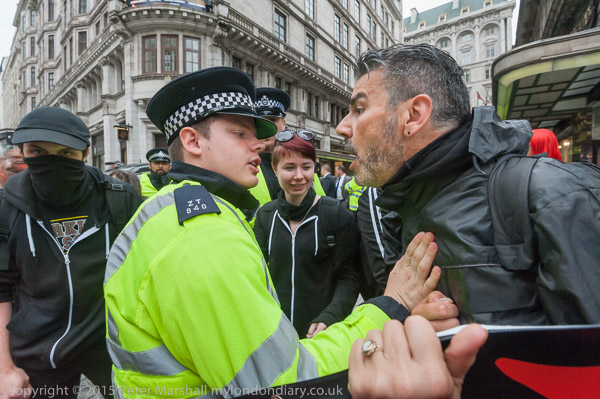
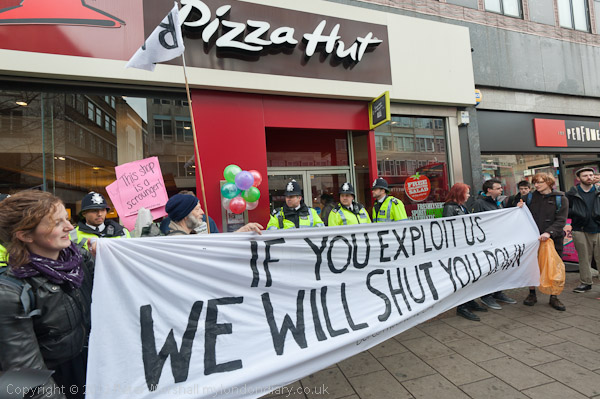
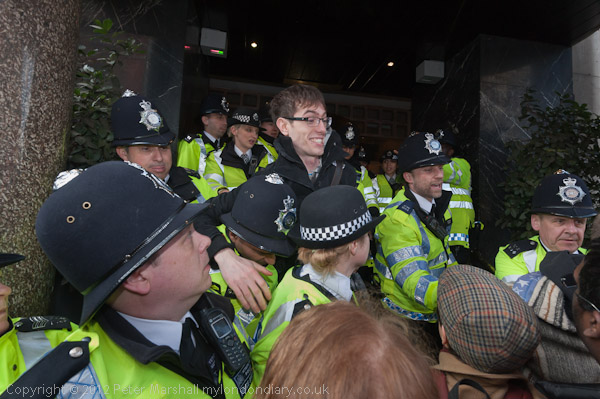
Around a hundred campaigners had arrived and were being carefully watched by police who went with them, guarding shop doorways and keeping a path along the crowded pavements clear when they stopped to protest.
The organisers had kept their route secret and had come with two ‘Boycott Warfare’ flags on long poles, white with the letters BW, and those taking part were told to follow the flags.
Police were also guarding some shops which had previously been targeted by UK Uncut over their failures to pay tax, though most of these were not involved in workfare and so of no interest to this protest.
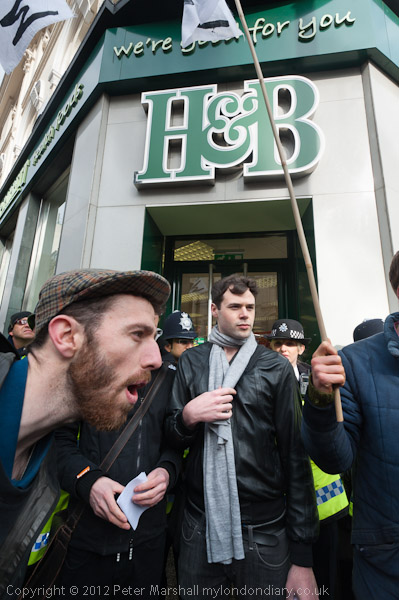
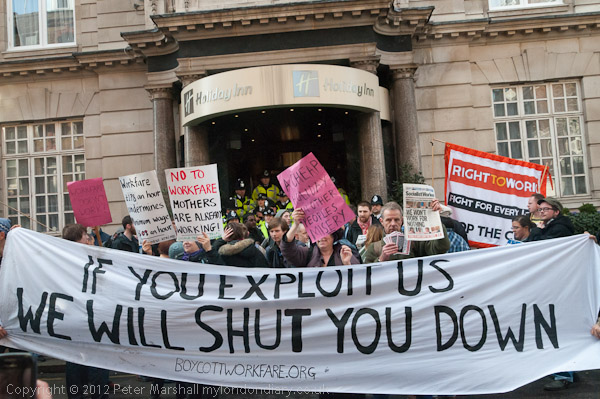
The first stop was a Pizza Hut, where police managed to stop any of the protesters entering – but the protest put off a number of customers entering while there were a few speeches. There we were handed a map showing the locations of some of the other businesses on Oxford Street taking part in workfare, including McDonalds, Holland and Barratt, Superdrug, WH Smith, Argos, and a little way north of Oxford St, Holiday Inn and Barnado’s.
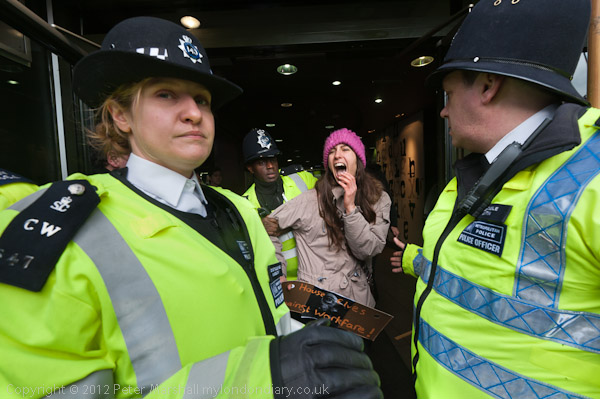
Police just managed to arrive at Holland and Barratt before the protesters, who only paused briefly there before rushing on to McDonalds, where a few managed to go inside. Police soon ejected them into the noisy crowd protesting outside, most of whom soon moved off towards Argos, with police following them.
I soon realised that not all the protesters had left for Argos, and hurried back to see another group being ejected from McDonalds. Another small group had returned to Pizza Hut – where again they were ejected by police.
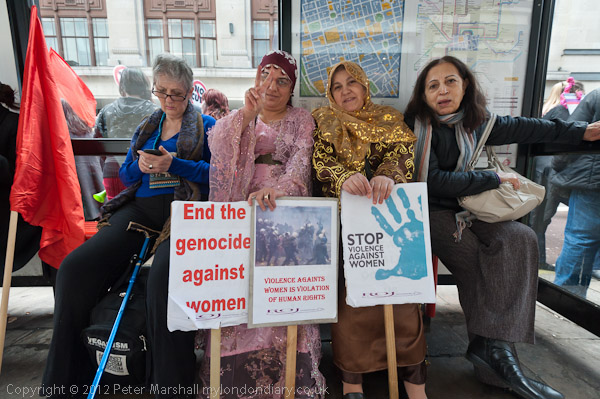
The main body of protesters turned into a shopping arcade, but were not sure which of the shops were using workfare and hesitated, allowing police to rush in and form a barrier. After a few noisy minutes they left and held a rally on a street corner with a few short speeches – including at least one by someone passing by.
At the Holiday Inn on Wellbeck Street a few protesters again beat the police and were rather forcibly ejected.
Some at least of the police who I and the campaigners talked with clearly shared their disgust at a scheme which forces people to work without payment, and were also worried about leaked plans to part-privatise the police and other cuts, but insisted that it was their job to keep order and protect property.
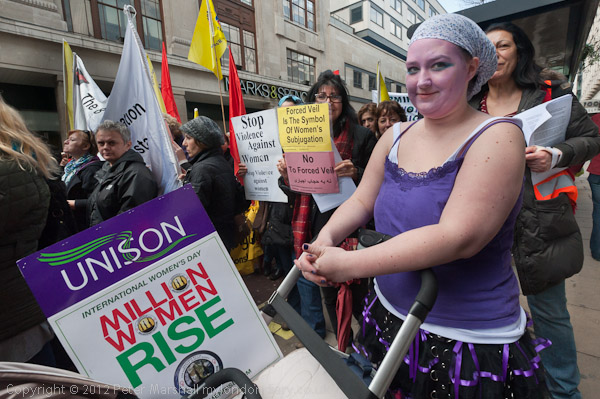
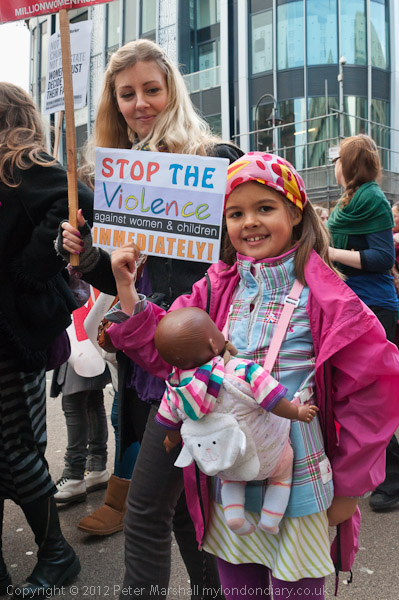
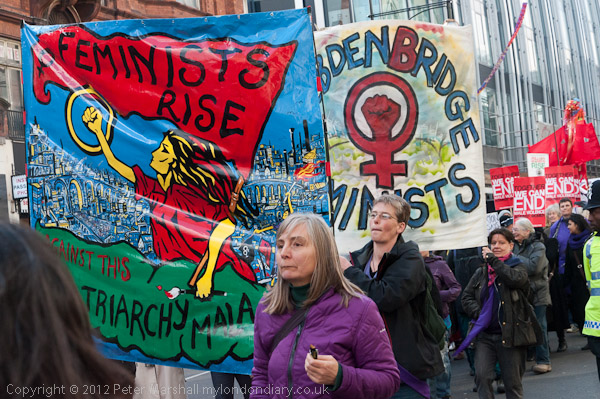
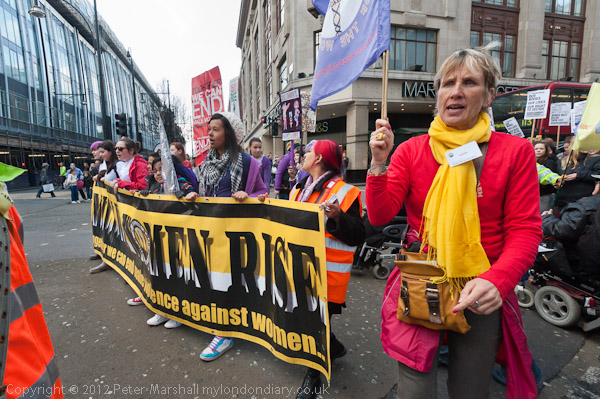
Women were gathering in the street on the west side of Selfridges to march through the centre of London calling for an end to domestic abuse, rape and commercial sexual exploitation. They called for prevention of abuse and support and protection for women.
They came from various womens groups and organisations around the country for this all-women march calling for and end to male violence against women.
Some of London’s more active women campaigning groups, including those that have been the leaders in previous celebrations around International Women’s Day were absent from the protest, and I was shocked to learn that they had been told they were not welcome at this march, despite the coalition’s aim to be non-partisan and to bring “together women who want to highlight the continuation of all forms of violence against women and demand that steps are taken to put an end to this.”
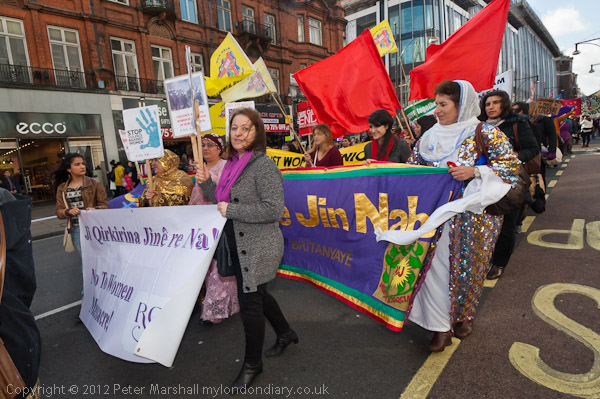
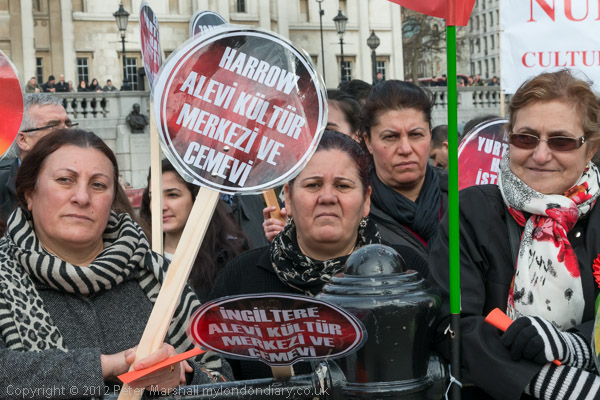
Among those marching were women from a number of political groups from London’s ethnic communities present, including Kurds, some in traditional dress and some holding posters calling for the release of their leader Abdullah Öcalan from prison in Turkey, as well as groups opposed to the Iranian regime.
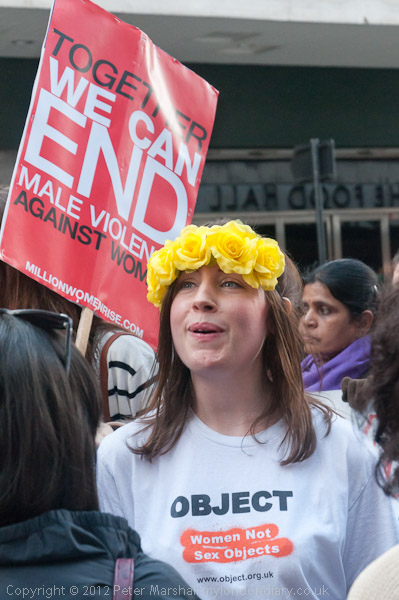
The Million Women Rise Coalition has a statement of demands for government and societies here and around the world. They demand the recognise and reflect in policies the discrimination faced by all women and those from black and other minority groups in particular. They demand that domestic abuse, rape and commercial sexual exploitation are linked together in a definition of violence against women and that support is given to support organisations for women in the not-for-profit sector.
Their long statement called for support for various groups opposing violence against women, and end to child prostitution and pornography and proper support for trafficked women and children.
They called for International Women’s Day to be made a Bank Holiday in the UK and Ireland, and oppose “the continued misrepresentation, misappropriation and abuse of the female body throughout all forms of media.”
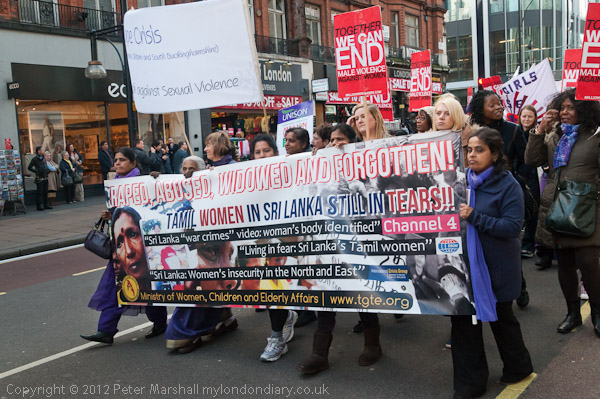
Their statement also made clear that wars and conflicts around the world perpetuate violence against women, and on the march a group carried a banner ‘Raped, Abused, Widowed and Forgotten – Tamil Women in Sri Lanka Still In Tears’ and others highlighted the ongoing abuses against women in DR Congo.
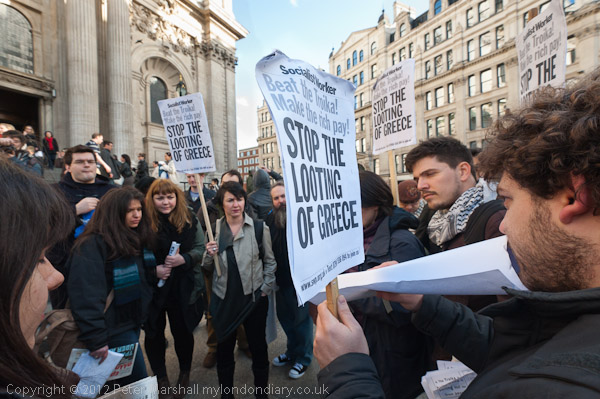
I left the march at Bond Street Station to report on a protest at St Paul’s Cathedral against the terms of the Eurozone rescue package for Greece at Occupy meeting on the steps there and to show solidarity with the protests in Greece.
Alevi, Union Flags, Fuel Poverty & Reclaim Love: Saturday 16th Feb was a busy day for me, beginning with a protest by Alevi against religious discrimination in Turkey, on to an extreme right protest in support of Belfast ‘loyalists’. Then a rally over fuel poverty which ended with a road block by disabled protesters. My day in London ended in Piccadilly Circus at the Reclaim Love Valentine Party, though I arrived there rather late.
You can read longer accounts and see more pictures of all these events on My London Diary.
Alevi Protest Discrimination in Turkey & UK
Trafalgar Square
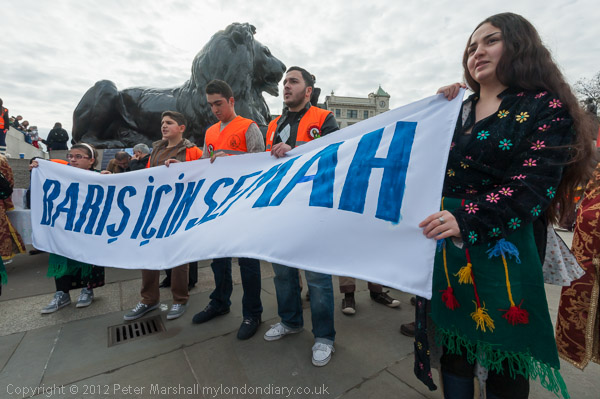
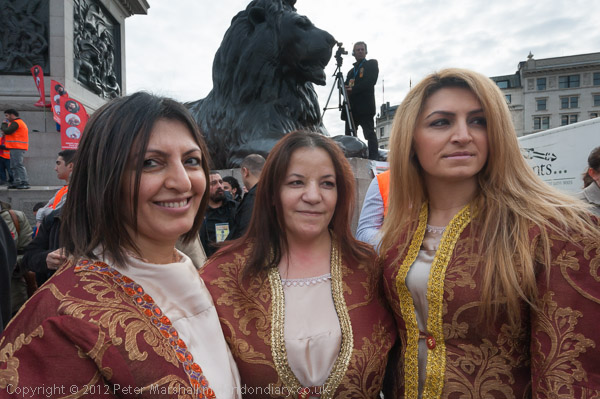
A woman in traditional costume holds a banner (Semah For Peace) in Trafalgar Square.
Estimates of the number of Alevi in Turkey vary widely but they probably make around 15% of the population, including many Kurds. Their religion is generally considered a part of Shi’ism, but they worship in their own languages, men and women together; women are not required to cover their hair, and their worship incorporates their rich traditions of poetry, music and dance – Semah.
Turkey is a country ruled and dominated by Sunni Muslims and the Alevi have suffered centuries of religious persecution – sometimes violent, and while Christian and Jewish children in Turkish schools are exempted from the compulsory Sunni Muslim religious classes, Alevi are not.
The rally called for democracy in Turkey, an end to discrimination and persecution, and an end to this compulsory religious education.
They also called for all immigrant cultures in the UK to unite and fight to remind the UK government of its responsibilities towards them, saying they face “ignorance from institutions such as the health, education, police, social and political bodies.” They call for an equal education system which considers the needs of all different cultural backgrounds.
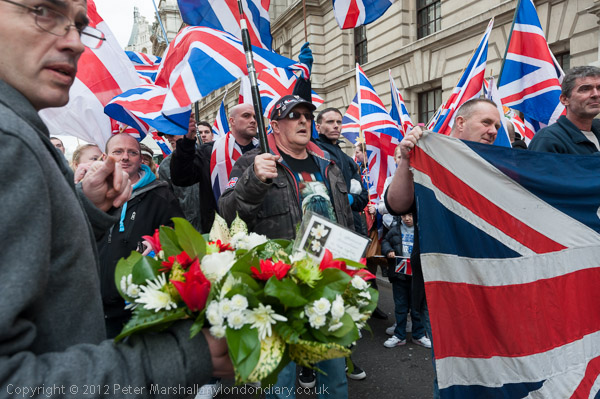
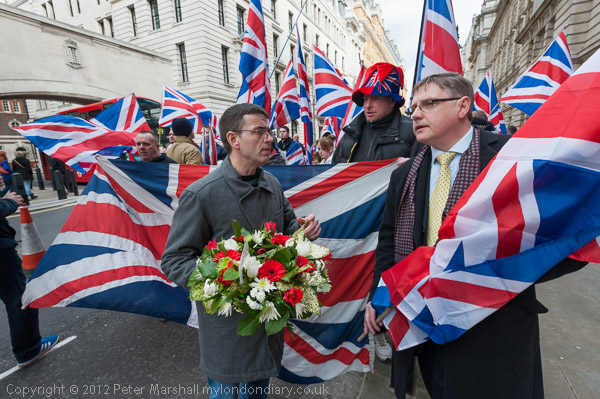
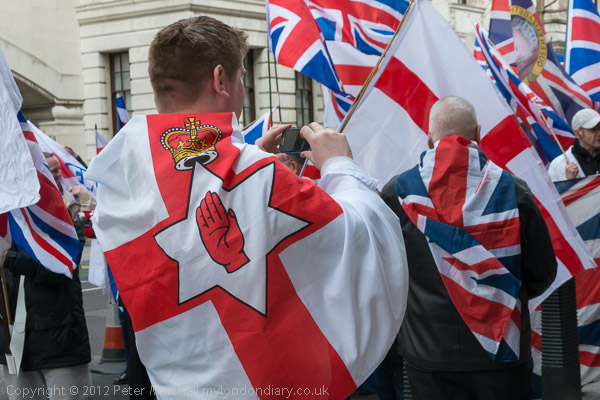
Around a hundred ‘patriots’ from the ‘South East Alliance’ marched down Whitehall carrying Union Flags to a rally with speakers from Britain First in support of Loyalist Flag protesters in Belfast.
Britain First Northern Ireland organiser Jim Dowson with the man carrying the wreath
Belfast City Council had decided only to fly the Union Flag on eighteen days a year as elsewhere in the UK, resulting in series of protests outside Belfast City Hall organised by a breakaway unionist group which disagrees with the peace process.
Around a hundred people came to the protest, mostly carrying Union flags, though there were a few Ulster and Orange flags also on show.
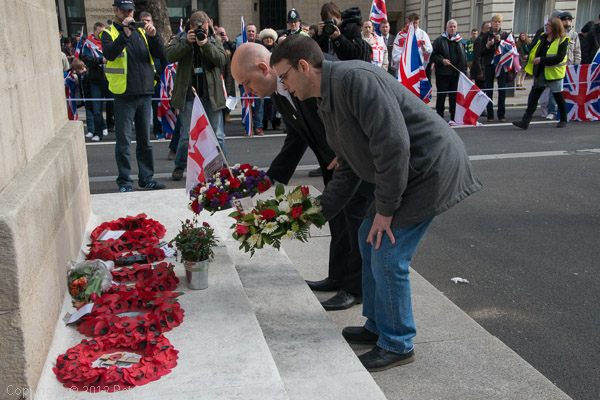
The marchers became silent at the Cenotaph where two wreaths were laid, one by the Kent Somme Society commemorating the Irishmen who died in the Battle of the Somme. They then marched on to Old Palace Yard for a rally.
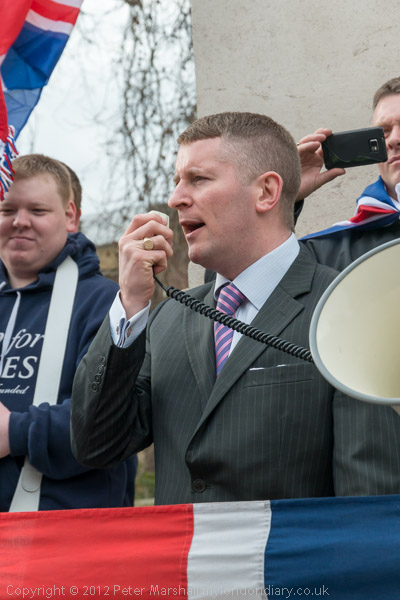
Paul Golding of Britain First, a former BNP councillor in Swanley on Sevenoaks District Council
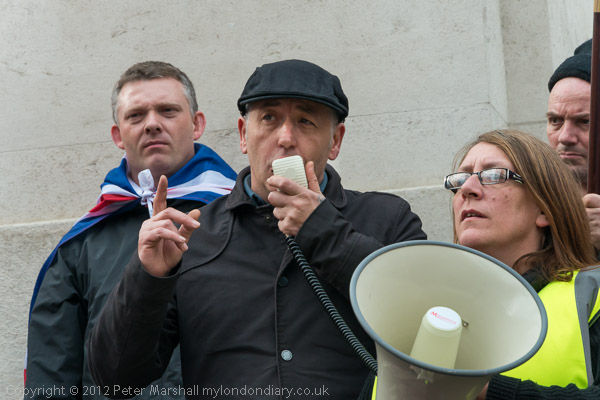
There were speeches from Paul Golding of Britain First, Paul Pitt of the South East Alliance and Britain First’s Northern Ireland organiser Jim Dowson who had been involved in the protests there.
Paul Pitt of South East Alliance, formerly the EDL’s South East organiser.
A few photographers were threatened by protesters but I suffered only some mainly relatively friendly banter from several who recognised me from other extreme right marches I had photographed, including some who mistook me for a Searchlight photographer.
A rally organised by Fuel Poverty Action and supported by Disabled People Against Cuts, Greater London Pensioners’ Association, Redbridge Pensioners’ Forum, Southwark Pensioners’ Action Group, Global Women’s Strike and others was a part of a national day of action against fuel price rises and the government’s energy policies
Cuts and rising prices now meant one in four families now have had to choose between heating their homes adequately or eating properly. Many children were going to school hungry and we had seen a phenomenal rise in the need for food banks – now even in the wealthier suburbs, with many unable to buy food.
Fuel Poverty Action say that the government was doing everything it could to keep the big six enery companies making profts while “disabled and elderly people are forced into libraries and shopping centres to keep warm and people with cancer freeze in their homes with the heating off” as crucial benefits are slashed.
Many also suffer from benefit sanctions, losing financial support often for trivial reasons or for things beyond their control – such as a cancelled bus making them arrive late for an appointment. There seems to be a particularly vindictive approach encouraged (or mandated) at job centres towards claimants.
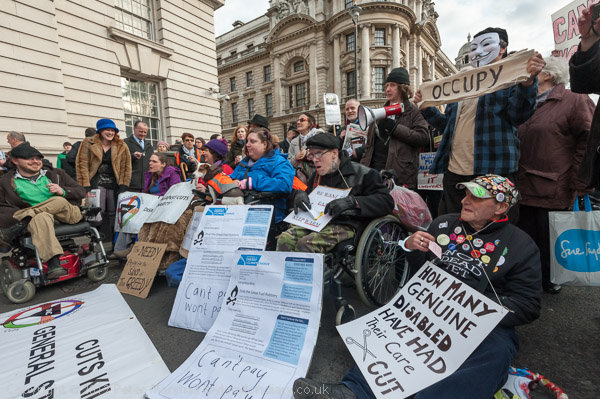
At the end of the rally disabled activists, many in wheelchairs went out onto Whitehall blocking the southbound carriageway. Some pensioners joined them, handcuffing themselves to the wheelchairs and others came to stand around them in the roadway. There were some more speeches from some of the protesters.
Protesters from the Disabled Peoples Direct Action Network move to block the road
After around a quarter of an hour police came and talked with the protesters asking them to leave. They were still asking 15 minutes later and by then many of the protesters were feeling they had made their point and were ready to go for a cup of tea. When they told police they would leave in ten minutes I left to rush to the Reclaim Love party which had started over an hour earlier.
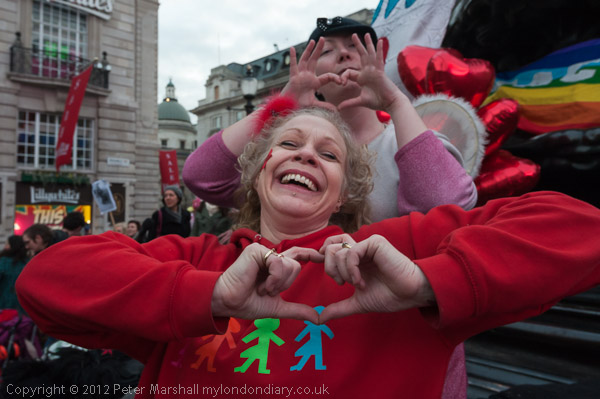
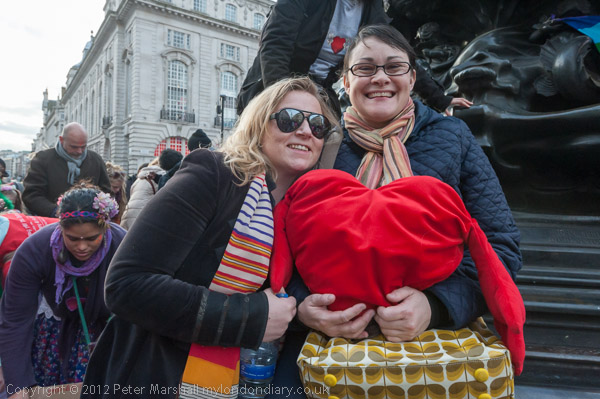
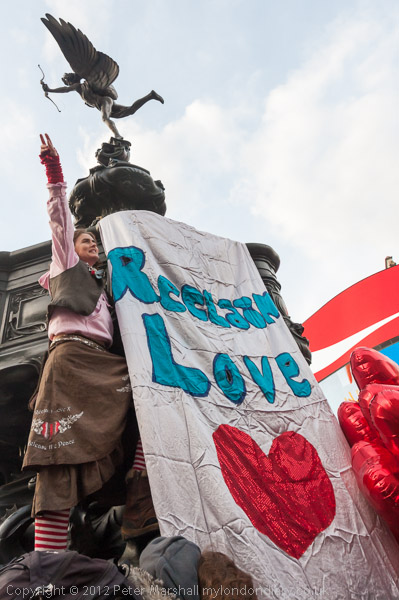
The 11th Reclaim Love free Valentine’s Party – and the 10th organised by Venus CuMara who started the whole thing in 2004 – took place around Eros in Piccadilly Circus, aiming to spread peace and love around the world, and to reclaim love from its commercial exploitation.
I arrived late, after people had joined hands in the large circle around Eros to make their call for peace and happiness around the world, but the party was continuing and I took rather a lot of pictures – here are a few.
Venus CuMara straightens up the Reclaim Love bannerFree T-shirts – for the first time a donation was requested
I’ve written more about Reclaim Love on My London Diary over the years, and there is some more, along with many more pictures from the 2013 event at Reclaim Love Valentine Party.
Junior Doctors, Uganda & Benefit Sanctions: On Wednesday 9th March 2016 Junior Doctors held a one-day strike over their claims for a better deal from the NHS and I joined a rally outside University College Hospital where health workers and trade unionists showed support and called for an end to the creeping privatisation of the NHS. Later in Trafalgar Square Ugandans were protesting the rigged presidential elections. Finally I went to the Dept of Work & Pensions to cover a National Day of Action against Benefit Sanctions, which often leave people with no means of support for sometimes trivial reasons and were by then known to have led to at least 95 deaths.
UCH rally for Junior Doctors Strike – Euston Rd
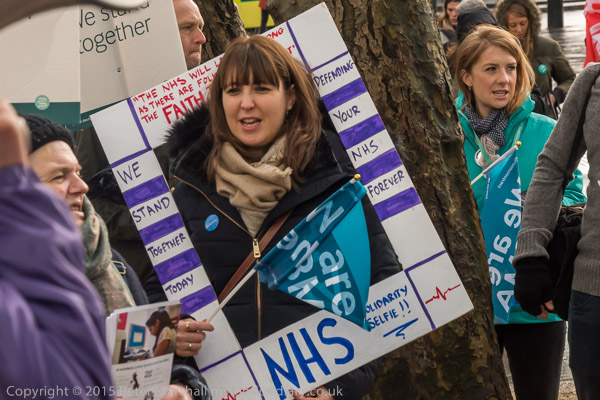
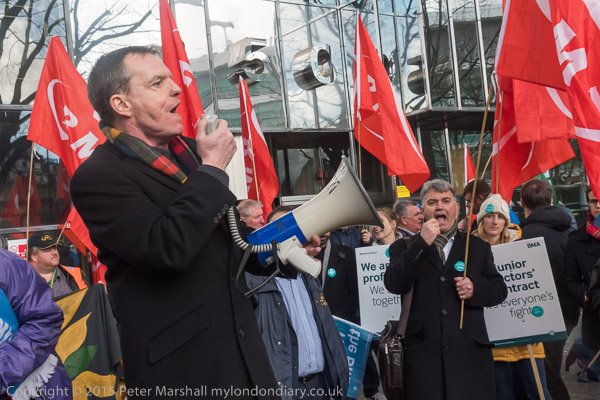
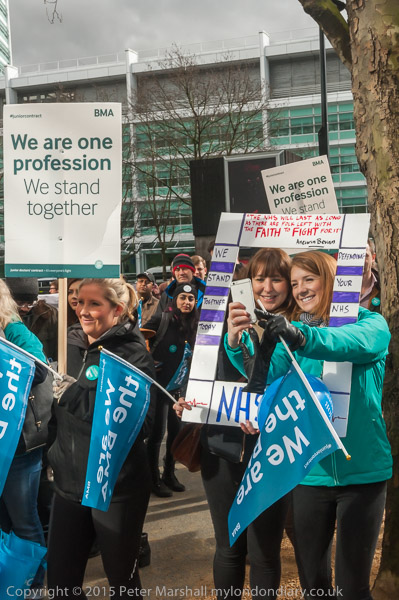
Trade unionists, medical staff at all levels and other supporters joined the Junior Doctors picket line outside University College Hospital to show their support.
Janet Maiden, an NHS campaigner and a Deputy Sister at UCH
They then held a rally across the road from the hospital, one of London’s largest on the busy Euston Road.
Junior doctors are fully trained doctors in postgraduate training and gaining clinical experience to become members of the appropriate Royal College of Medicine. They may remain as junior doctors for around 8-20 years and are the largest group of doctors working in our hospitals.
In 2023 the he British Medical Association (BMA) decided it would no longer use the term “junior doctor” as it failed to indicate their high level of skills. In 2024 and as a part of the settlement of their dispute which came finally after the election of a Labour government they were renamed “resident doctors.”
On My London Diary I gave a long list of some of the speakers which indicate the huge range of support for the junior doctors and their fight against a Tory government that was determined to wreck the NHS so that it could be fully privatised for the benefit of largely US-based health care companies in which many of them had a financial interest.
Their aim was move towards a US-style insurance-based system – which would lead to many of us being unable to afford appropriate treatment and to face enormous bills – healthcare is by far the largest cause of bankruptcy in the USA. It seems likely that Labour under Starmer will continue to move in the the same direction.
Personally I would be unable to get insurance for my existing long-term health conditions. The NHS has for over 22 years enabled me to lead a normal life without charge to me and at a relatively low cost to the nation, whereas in the USA my continuing treatment would by now have cost me well over a quarter of a million dollars.
Ugandans protest rigged Presidential Election – Uganda High Commission
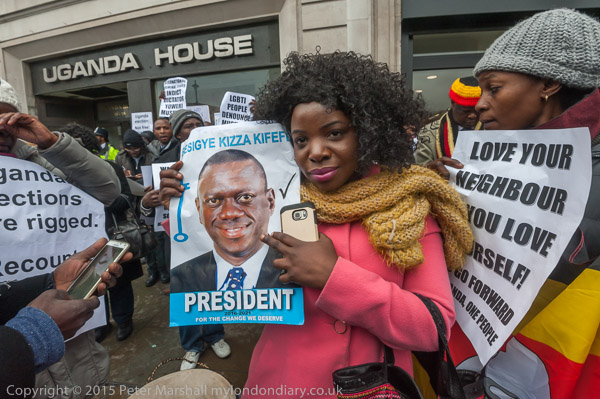
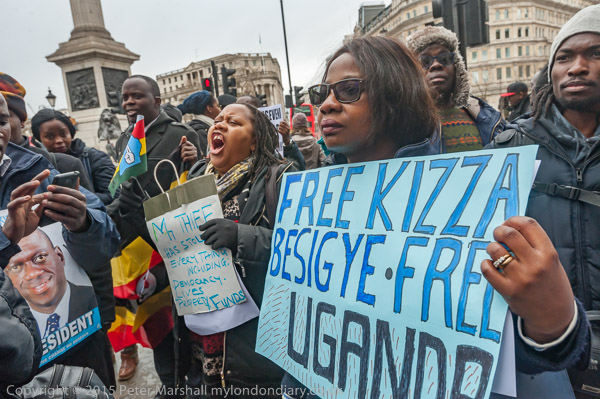
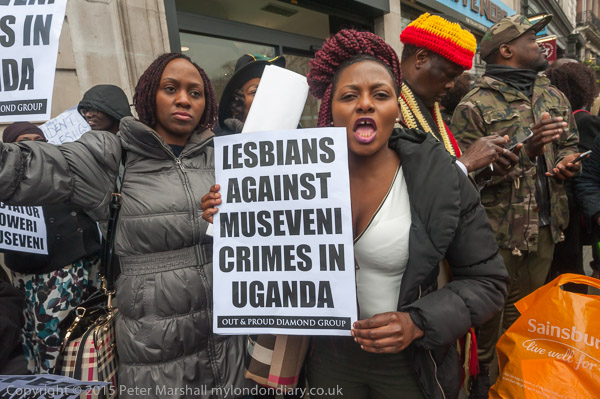
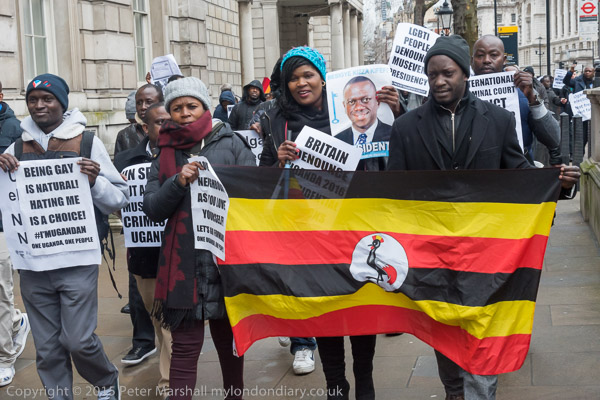
Many Ugandans believe that February 2016 elections that re-elecated Museeveni as president were rigged and protesters outside the High Commission in Trafalgar Square demanded an independent audit of the results and called for the immediate release of opposition candidate Dr Besigye and other political prisoners, as well as action against those responsible for torture.
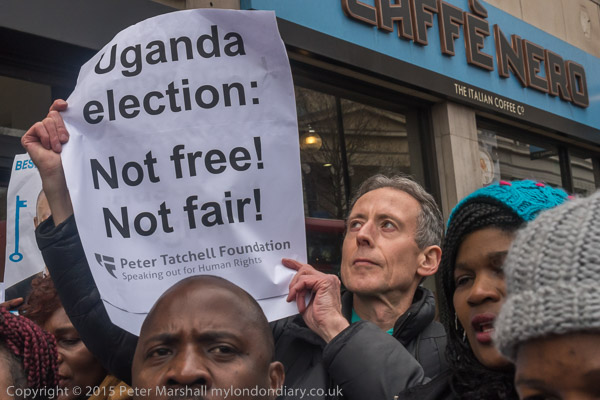
The protest was organised by the Uganda Diaspora P10 UK, and FDC UK Chapter and was supported by the African LGBTI Out & Proud Diamond Group and Peter Tatchell Foundation.
Yoweri Museveni has been in power since 1986, but international observers widely reported widespread fraud and irregularities, with many voters being unable to vote and the declared results from many polling stations being very different from the actual votes. Opposition candidates were repeatedly arrested and voters were intimidated.
Peter Tatchell
I arrived almost at the end of an hour-long protest in front of the High Commission and then photographed them marching down Whitehall behind a Nigerian flag towards Downing St where I left them.
Unite against Benefit Sanctions – DWP, Caxton House
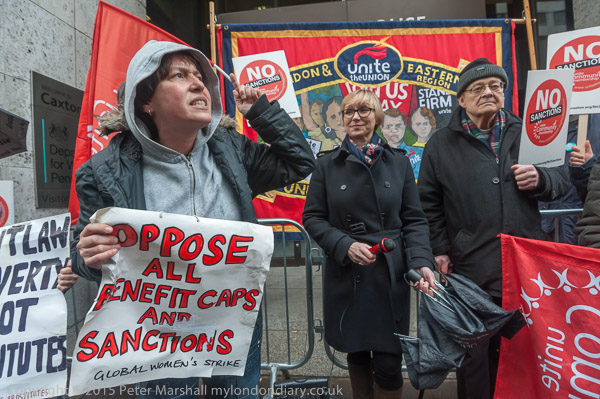
Didi Rossi from Global Women’s Strike accuses the Tories of deliberately targeting and killing the poor
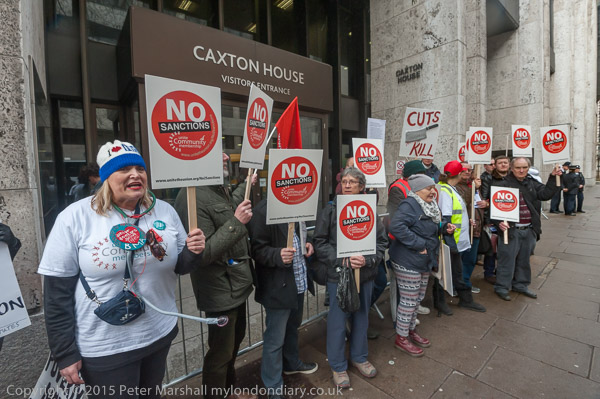
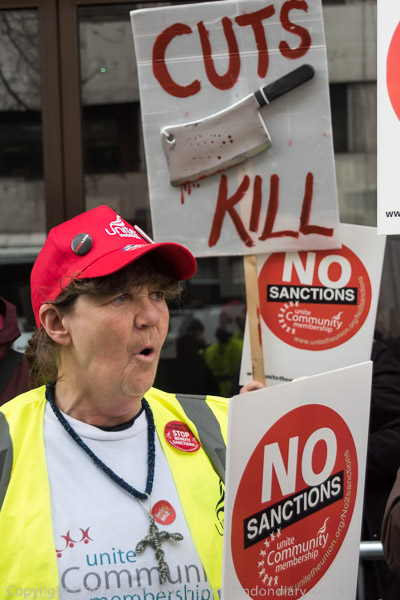
Unite Community members had come to hold a protest outside the DWP headquarters in Westminster as a part of their National Day of Action against Benefit Sanctions. There were other protests at job centres in over 70 towns and cities.
Benefit sanctions – periods where claimants lose their benefits – are often imposed for trivial reasons and those beyond the power of claimants. They may be sanctioned for arriving late after buses were cancelled or for not turning up when letters calling them to an appointment have not arrived in time or have been lost in the post.
Winvisble and Global Womens’s Strike members were there in support
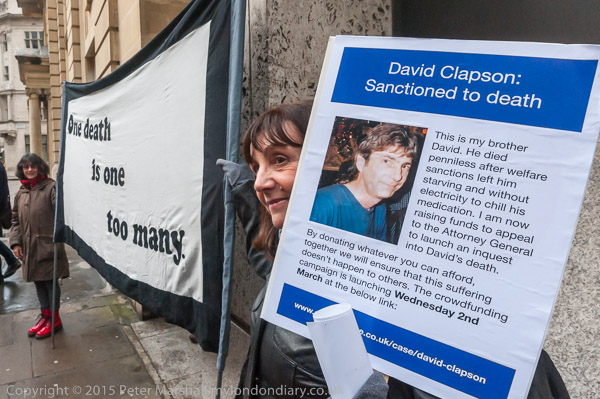
As I commented, “Despite government denials, at least 95 deaths are known to have been as a result of sanctions which leave people destitute and starving. Some, like David Clapson, have actually starved to death while others have been so desperate that they have killed themselves. Without the efforts of the many food banks the figure would be much higher.“
There was anger when a Unite Community speaker said that the DWP’s policies had failed. Didi Rossi of Global Women’s Strike retorted that the DWP had been extremely successful in their attacks on the unemployed and disabled, and that the deaths were the clear intention behind the policies of Iain Duncan Smith.
Rev Paul Nicholson
Staff working for the DWP were being given incentives and targets for giving sanctions. And the faulty tests administered for “fitness for work” and being stripped of benefits were leading to many deaths. Over 80 people a month were dying shortly after this, most while appealing against the decision. More than 2,500 sick and disabled benefit claimants are known to have died after being found ‘fit for work’ in just 2 years.
David Clapson – Sanctioned to Death – DWP, Caxton House
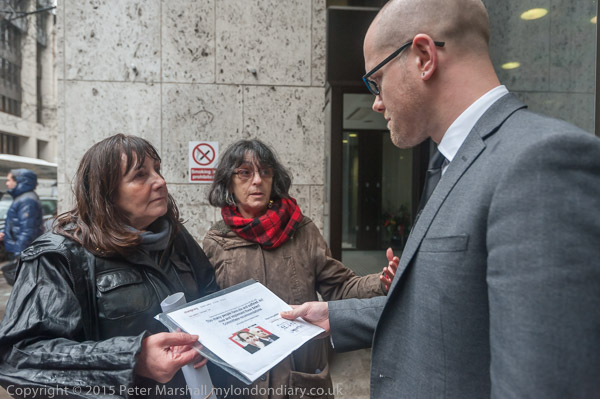
One of those taking part in the protest at the DWP was Gill Thompson, the sister of David Clapson, a diabetic ex-soldier who died starving and destitute because he was penalised by the Job Centre for missing a meeting.
She had come to hand in a petition to the DWP over his death and this was handed to a DWP representative together with another petition with over 200,000 signatures between them calling for an inquest into his death and an end to unfair benefit sanctions that leave claimants without support.
International Women’s Day: On Saturday 6th March 2004 I photographed an event in Trafalgar Square to celebrate International Women’s Day which was the following Monday, 8th March.
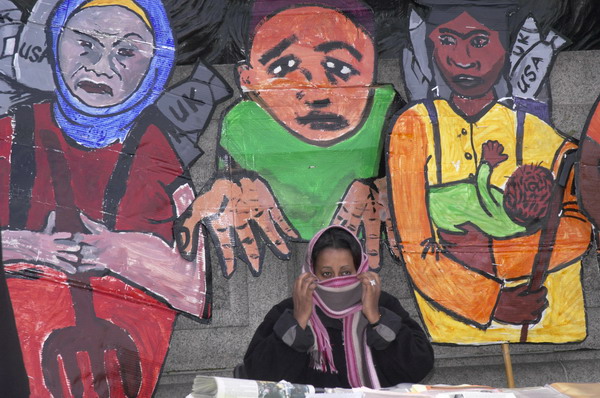
Bookstall in Trafalgar Square for International Woman’s Day
First celebrated in 1909 by the Socialist Party of America, International Women’s Day was established in 1910 by the Second International following a proposal by Clara Zetkin, although the date only became 8 March in 1913 when peace rallies were held on that day shortly before the First World War. IWD rallies led to the start of the Russian Revolution in 1917 and Lenin made the day an official “holiday”, although it remained a working day there until 1965. The UN adopted it in 1975 and in 2005 the TUC called for it to be made a UK public holiday.
Representing George W Bush with his attempt to dominate the world
This year, 2025, the 8th March is a Saturday and there will be an all-women march in London, Million Women Rise, demanding an end to male violence to women and girls, beginning on Oxford Street and marching to a rally in Trafalgar Square. I photographed the first London Million Women Rise in 2008 and have covered the event working from the sidelines most years since.
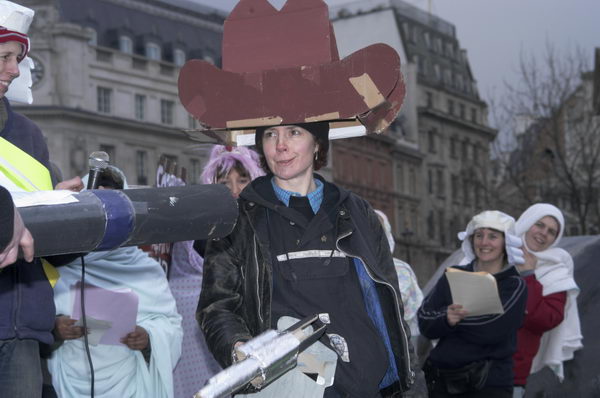
I’m not sure quite where the fairy queen came into it
I had photographed International Women’s Day events in some earlier years, and there are also a few pictures from 2003 on My London Diary, but I think 2004 was the first more extended post. Here with the usual corrections to case and spelling etc is what I wrote in 2004.
Woman’s Court Puts Bush and Blair On Trial
There are various events in London around the start of March connected with International Woman’s Day on the 8 March. In Trafalgar Square on Saturday 6th a Woman’s Court put George Bush and Tony Blair on trial for crimes against women, children and men. The event was a part of the 5th Global Women’s Strike.
Events started with a a short play by a group from Crossroads Women’s Centre in North London highlighting the racist immigration policy of Fortress Europe, typical agit-prop, enlivened as always by some individual performances that relied more on personality than script.
All good fun with the villains being George W Bush and our very own Tony Blair.
Good fun if it wasn’t for the fact that the consequences of the actions of these men and the interests they stand for were felt around the world.
Selma James, widow of C L R James, then opened the trial of Bush and Blair, represented in their absence by large puppets. One of the first witnesses was Elsa T, an Eritrean rape victim whose moving testimony was given us in translation.
Jocelyn Hurndall
Another moving speech came from Jocelyn Hurndall, the mother of Tom Hurndall who was shot by an Israeli soldier while trying to protect children in Palestine. The clothing he was wearing to identify himself as a non-combatant apparently made him into a target.
Other speakers included representatives from the Black Women’s Rape Action project, a Native American woman, a woman soldier, Mrs N from Zimbabwe whose son died in a British prison, and several men including Brian Haw from the 24/7 picket in Parliament Square.
Baltimore to Brixton – Black Lives Matter! The hashtag #BlackLivesMatter was first used on Twitter on 12th July 2013 but only became common in 2014 after the killings of Eric Garner, Michael Brown and Tamir Rice in 2014, reaching a peak when it was announced nobody wold be prosecuted over the killing of Michael Brown in Ferguson. According to a list published by Twitter on the tenth anniversary of the platform in 2016 #BlackLivesMatter was the third most used hashtag in those ten years, beaten by #Ferguson at number one and #LoveWins, celebrating the US Supreme Court’s ruling on gay marriage.
Of course the UK has its own cases of people, especially but not only black who have been killed by police and otherwise in custody and an annual march takes place in Whitehall on the last Saturday of October by the United Families and Friends Campaign to remembers them, with a list of over 2000 names being carried to a rally at Downing Street.
The United Families and Friends Campaign (UFFC) describes itself as “a coalition of families and friends of those that have died in the custody of police and prison officers as well as those who are killed in immigration detention and secure psychiatric hospitals. It includes the families of Roger Sylvester, Leon Patterson, Rocky Bennett, Alton Manning, Christopher Alder, Brian Douglas, Joy Gardner, Aseta Simms, Ricky Bishop, Paul Jemmott, Harry Stanley, Glenn Howard, Mikey Powell, Jason McPherson, Lloyd Butler, Azelle Rodney, Sean Rigg, Habib Ullah, Olaseni Lewis, David Emmanuel (aka Smiley Culture), Kingsley Burrell, Demetre Fraser, Mark Duggan and Anthony Grainger to name but a few. Together we have built a network for collective action to end deaths in custody.”
And we have a long history of racist prosecutions, most notably perhaps the trial of the Mangrove Nine in 1970. The defendants, most of whom defended themselves, were finally all acquitted on the main charge of incitement to riot with four receiving suspended sentences for less serious offences. But the judge made clear in his comments that the authorities and in particular the Metropolitan Police had been racist in their actions and in bringing the prosecution.
Since then there have been other high profile cases which have demonstrated the institutional racism of the police force – notably over their investigation of the murder of Stephen Lawrence and the police murder of Jean Charles de Menezes. In 2023 the report by Baroness Casey was only the latest to castigate them as racist, sexist and homophobic.
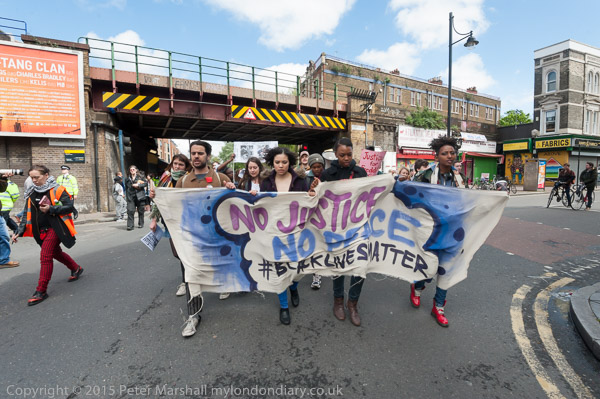
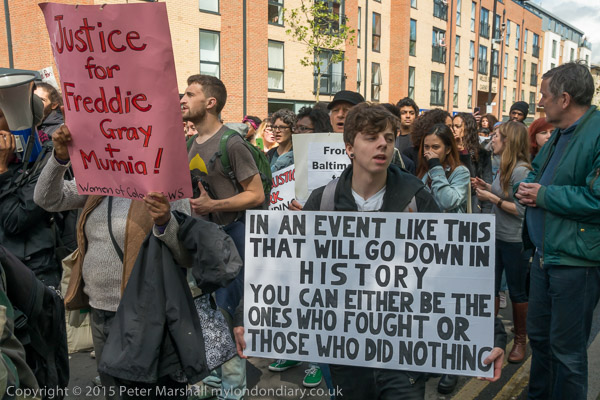
Activists in the UK have also responded to the police murders in USA, and on Sunday 3rd May 2015 following the killing of Freddie Gray in Baltimore and police attacks on his funeral which led to massive protest in the USA, they protested in Brixton in solidarity and pointed out similar problems in Brixton and the UK.
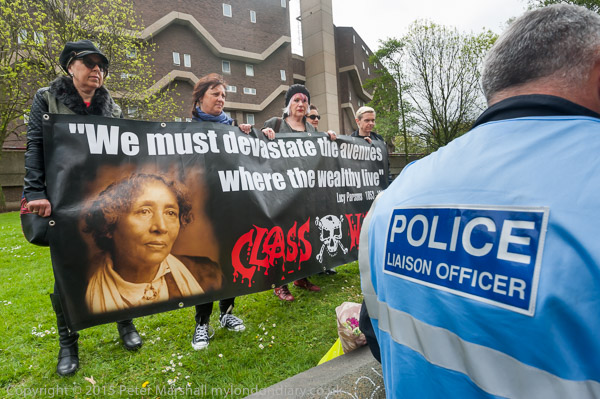
It wasn’t a huge protest but was supported by a wide range of groups from Brixton and across London, including London Black Revs, Class War, the International People’s Democratic Uhuru Movement, Reclaim Brixton, Women of Colour and the All-African Women’s Group from the Global Women’s Strike, Brixton Latin American Community, Mexica Movement London Chapter, Our Brixton, Latin Brixton, Justice for Christopher Alder, BirminghamStrong, Justice 4 ALL, The Brick Lane Debates, Occupy UAL, RCG, Revolutionary Communist Group, Occupy London, Rojava Solidarity Working Group, Algeria Solidarity Campaign, Environmental Justice North Africa and Justice4Paps.
On My London Diary I give some brief facts about the killing of 25-year-old African American Freddie Gray and the attack on his funeral by police which provoked riots. You can read a much more detailed account on Wikipedia.
The march began by going through the large barrier bloc of Southwyck House, built in the 1970s as a shield for the urban motorway, plans for which were dropped after the devastation it would cause became obvious after the Westway section was built in North Kensington, stopping for a brief protest there before it continued to a housing occupation against Guinness Trust opposite the Loughborough Park Estate. It then through the centre of Brixton to a rally in Windrush Square.
People then marched along Brixton Road past the Underground Station to Brixton Police Station and on to the Loughborough Estate to a community centre on Somerleyton Road.
I’d walked far enough and left the march there, walking back along Atlantic Road where I photographed some of the murals against the eviction of local shopkeepers from the railway arches before taking the tube to Westminster to go to visit the Occupy ‘Festival of Democracy‘ in Parliament Square, then in Day 3.
March 8th – Women Strike And Protest. In 2021 on International Women’s Day I published a long post, 8 March: International Women’s Day with some images from my coverage of the day from 2002 until 2020, and in 2022 I posted International Women’s Day Marches with a little history and more of my pictures from previous years.
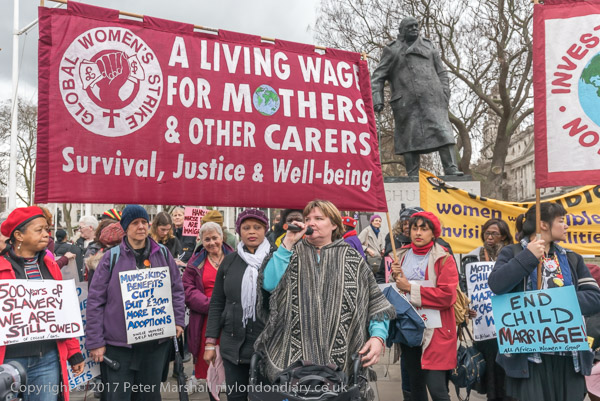
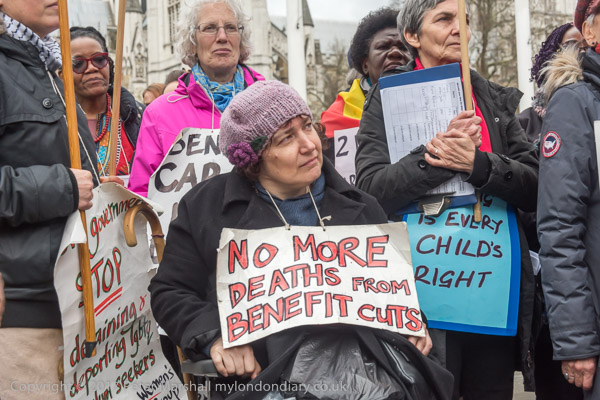
This year I look back seven years to Thursday 8th March 2017 when I covered a number of events on International Women’s Day.
From Russia With Love – Parliament Square
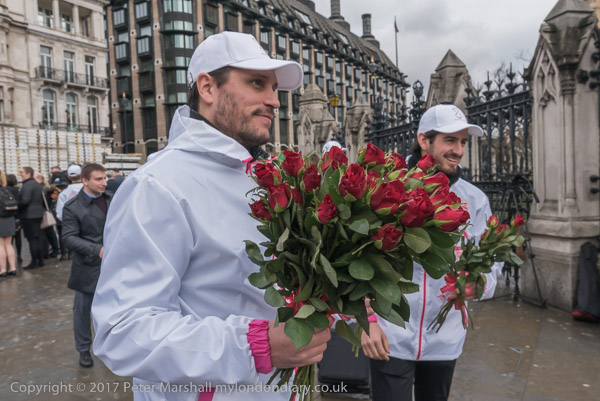
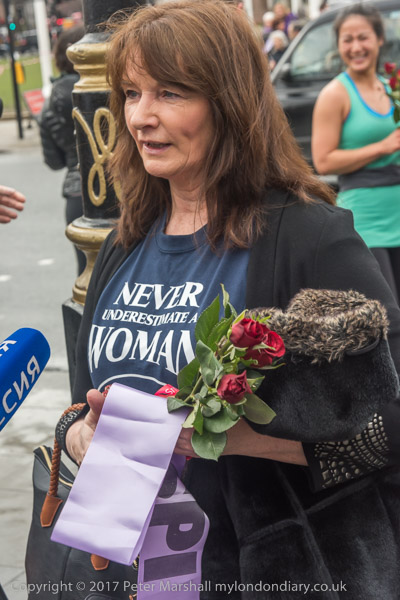
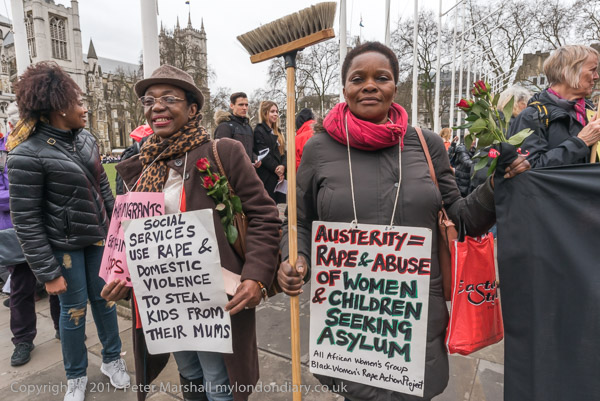
When I arrived to photograph a couple of protests about to take place in Parliament Square I found around a dozen young Russian men in white caps andjackers with a strange heart-based logo clutching large bunches of red roses being briefed before they went around the square stopping women an handing them roses.
Apparently this was a stunt for Rusian TV by the ‘Make Her Smile Movement’ and was taking place in various capitals around the world. Some women refused the flowers, but most took them and seemed pleased if rather confused by the gesture.
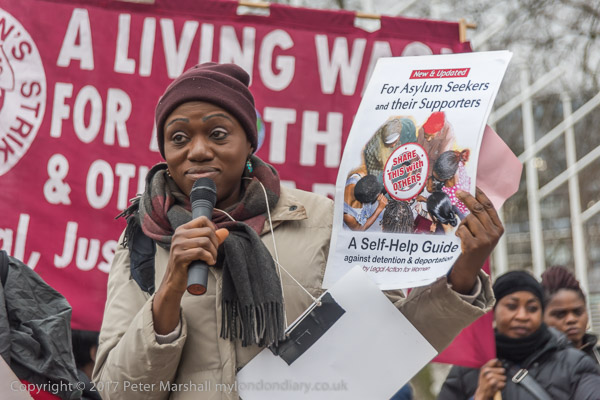
Global Women’s Strike had come to the square to celebrate the resistance of women worldwide and hold a protest in solidarity with the International Women’s Strike taking place in 46 countries.
They held a rally opposite Parliament as the Budget was being delivered inside, with speakers from a number of groups supporting women including the victims of domestic violence, the disabled and the victims of family courts.
Among the speakers were women from the Scottish Kinship Care Project, Dr Philippa Whitford SNP MP for Central Ayrshire, Denise McKenna, co-founder of Mental Health Resistance Network and Paula Peters of DPAC. Police initially tried to prevent the speakers using a microphone but were persuaded to let them go ahead.
The event ended with a short play by the All African Women’s Group about sexism and racism of the immigration system by the Borders Agency courts and in immigrations detention centres such as Yarl’s Wood Detention Centre.
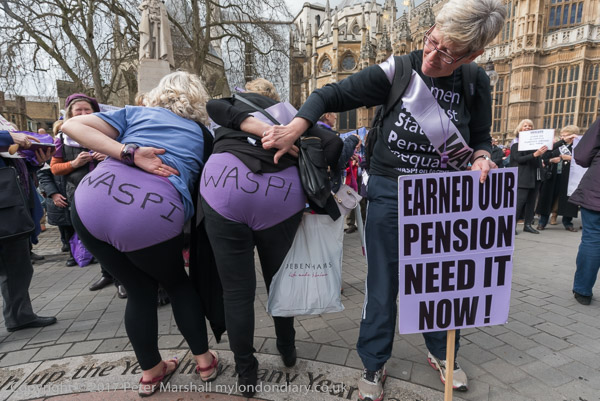
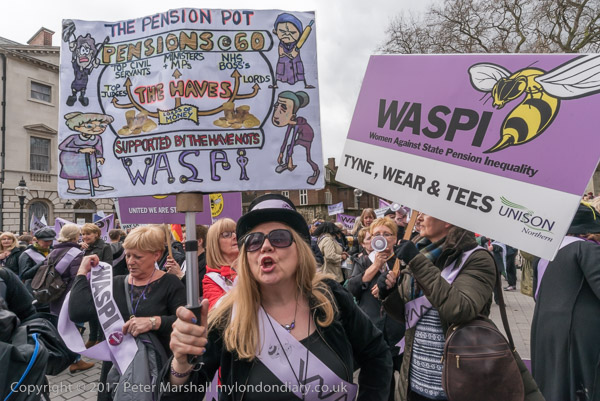
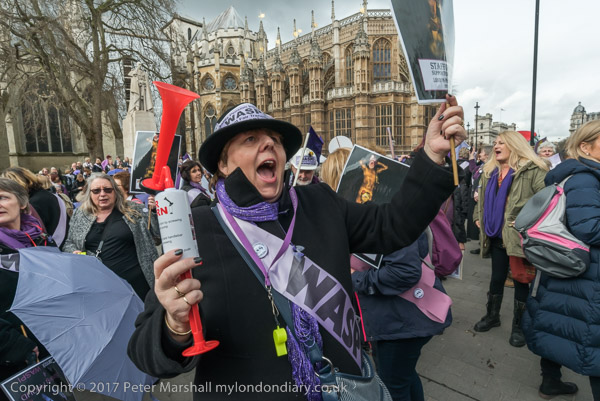
A few yards away in Old Palace Yard Women Against State Pension Inequality – WASPI – were holding a rally against the changes in the state pension scheme which are unfair to women born in the 1950s.
The 1995 Pensions Act included plans to increase the pension age for women to 65 but it was only 14 years later that letters were sent to many women born in 1951-3 Their situation was worsened by the accelerated raising of women’s pension age under the 2011 Pension Act, also made without properly informing those affected, with the age for both men and women increasing to 66 by 2020. Many got as little as one year’s warning of the up to a six-year increase to their State Pension age and it was not possible for them to make alternative plans. For men and women born in 1959 the state pension age is now 66 years.
The women affected are still awaiting the result of an independent investigation by the Parliamentary and Health Service Ombudsman which was started in 2019.
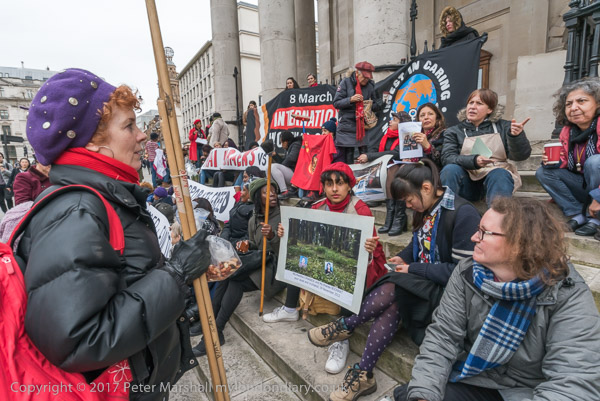
Global Women’s Strike went on to hold a silent vigil on the steps of St Martin-in-the-Fields in solidarity with the farmers of Thailand. Many of them are women in the Southern Peasant Federation of Thailand and the vigil was also in support of others all around the world risking their lives to defend land and water from corporate land grabs.
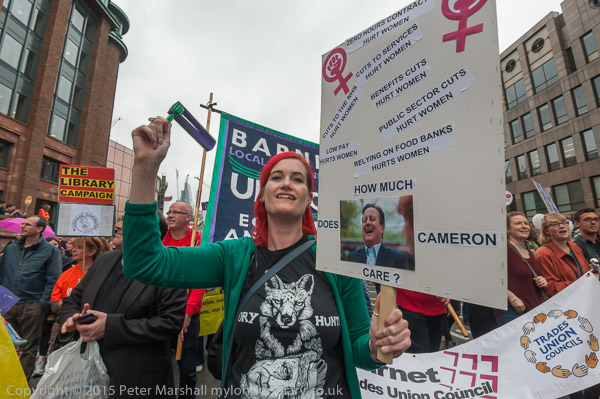
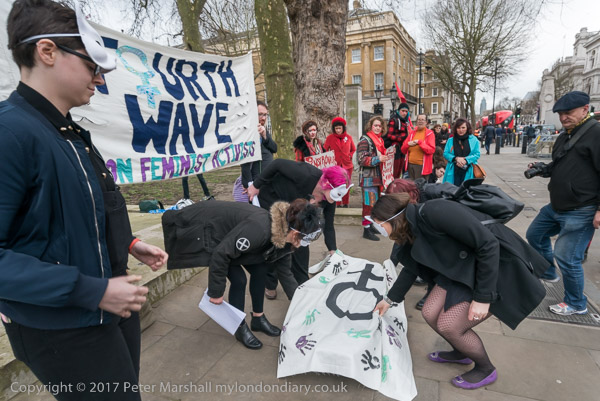
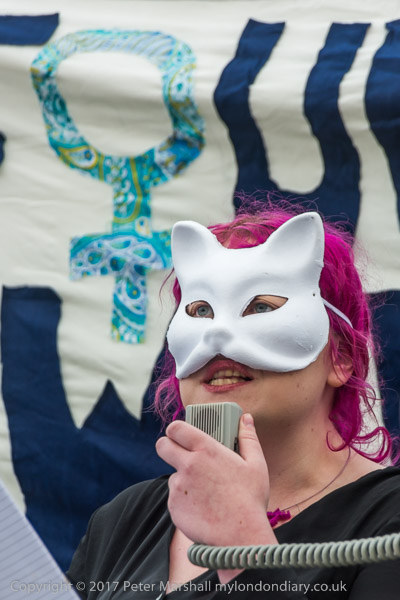
Fourth Wave London Feminist Activists held a protest at Downing St on International Women’s Day, drawing attention to the impact that cuts have had on women.
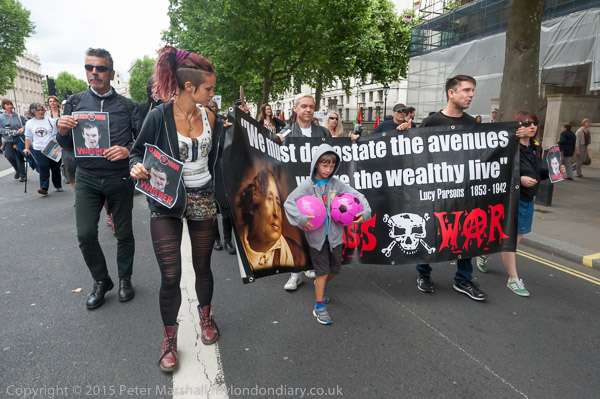
The unjust, ideologically-driven cuts to public services are disproportionately felt by women. Their protest contrasted to the more highly publicised corporate events on the day which are given a high degree of coverage in the media and concentrate on getting more women in boardrooms and other highly paid jobs. Though important issues, these are clearly irrelevant to the huge majority of women who have to deal with the realities of low pay, expensive housing, and caring for children and other family members.
International Women’s Strike Flash Mob – St Pancras International
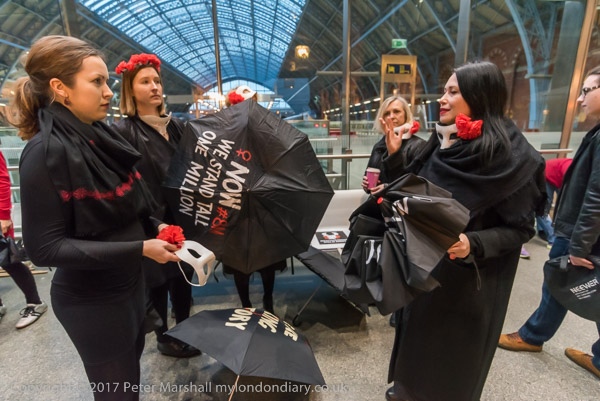
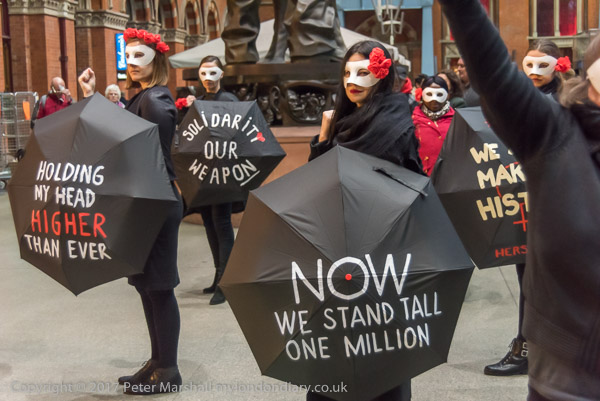
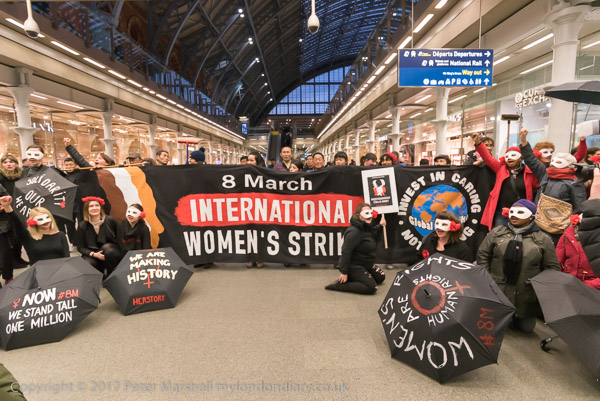
Finally I went to St Pancras International station where London Polish Feminists were joined by Global Women’s Strike in a flash mob celebrating the struggles of women around the world .
Wearing black and red clothing, after practising their routine with umbrellas with messages on them and a large banner at the entrance to St Pancras International they went down to the main concourse to perform it there.
Police came to see what was happening and made sure they did not block the concourse but remained friendly, and the waiting passengers applauded and took photographs.
Budget Day, Shaker and Sotheby’s: Wednesday 8th July 2015 was budget day, and campaigners were out in Whitehall to protest. For the Save Shaker Aamer Campaign it was just another Wednesday and they lined up to remind MPs of the need for action. Later United Voices of the World were back at Sotheby’s who had sacked four workers for taking part in the previous week’s protest.
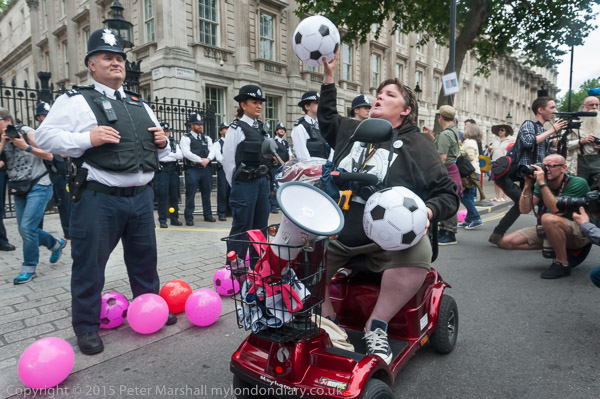
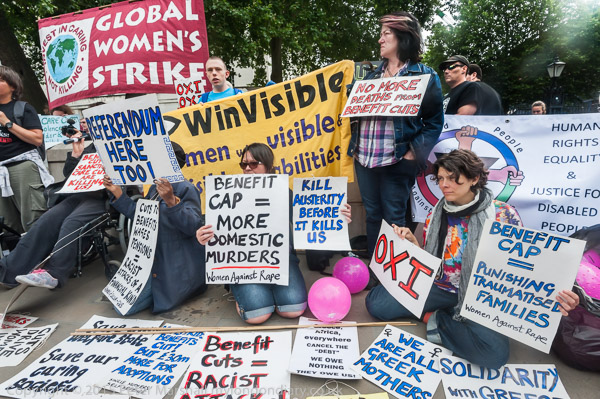
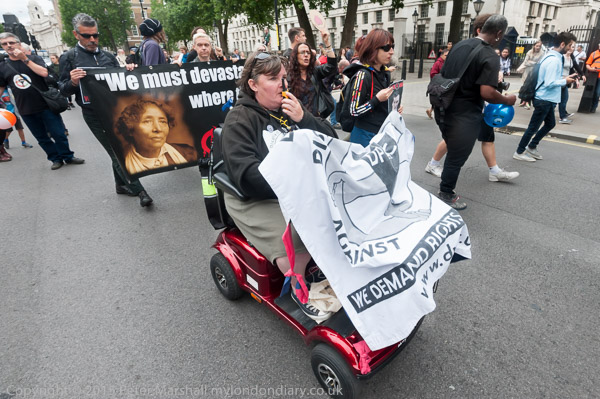
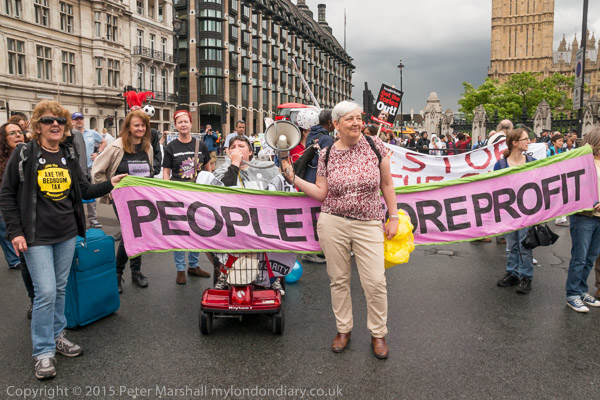
Disabled People Against Cuts supporters, some in wheelchairs and mobility scooters, were protesting against the changes to benefits which will hit the disabled hardest. Their supporters included Global Women’s Strike, Winvisible, Women Against Rape, Unite Community and Class War.
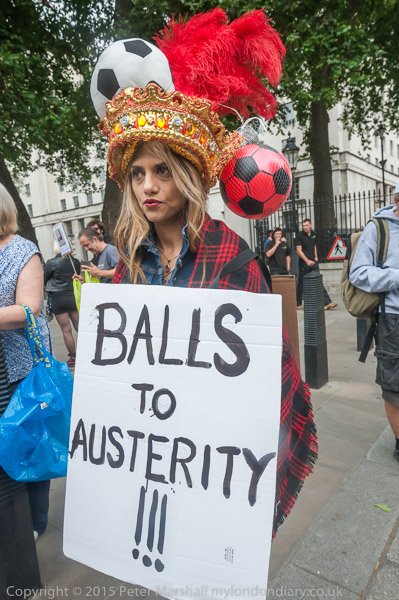
They began at Downing St with a ‘Balls to the Budget’ protest, arriving with footballs and balloons and and after some speeches on the pavement opposite Paula Peters led protesters across the road towards the gates, which were protected by two lines of police.
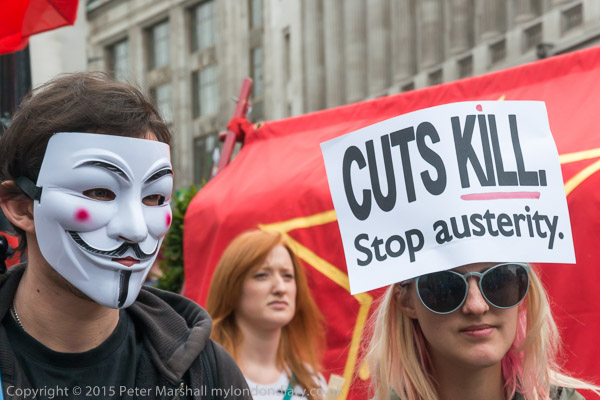
From there they tried to throw balls carrying messages such as ‘If the Tories had a soul they’d sell it’, ‘Cuts Kill‘ and ‘Blood on your hands‘ over the gates, but most fell short.
They then moved off down Whitehall and Parliament Street on their way to Westminster Bridge. Police who had largely stood back and watched earlier tried to persuade them to go on to the pavement but were ignored.
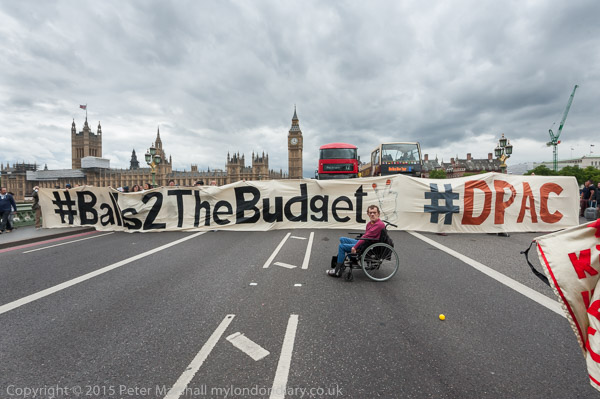
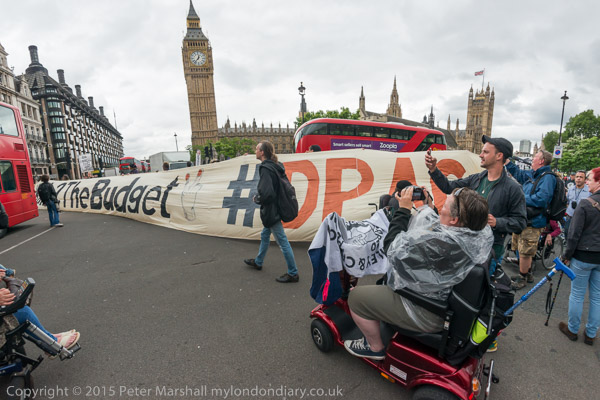
They moved to the middle of Westminster Bridge as a small group on the Embankment in front of St Thomas’s Hospital facing the Houses of Parliament displayed a huge banner with the message ‘#Balls2TheBudget #DPAC’ with ahand making an appropriate two-finger sign.
This was then brought up onto the bridge and stretched across its full width, and along with the protesters it completely blocked traffic in both directions.
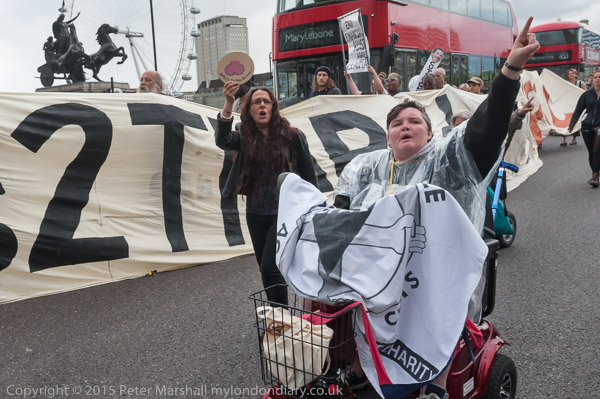
After some minutes Paula Peters called for the protesters to move to Parliament, leading the protesters and the huge banner on her own chariot past Boadicea.
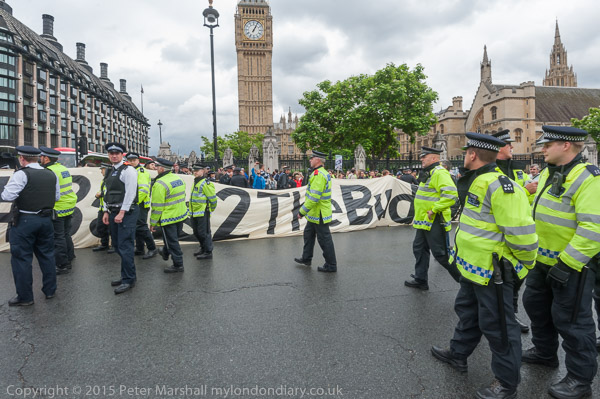
Here they made use of the banner to completely block all traffic moving through the busy road junction.
They held a short rally on the street and were joined by strikers marching down from the National Gallery led by the sacked PCS rep Candy Udwin, victimised for her trade union activities.
By now police patience had grown thin, and reinforcements arrived to try to clear the protesters from the streets. They tried to grab the large banner and began to push protesters and press onto the pavements.
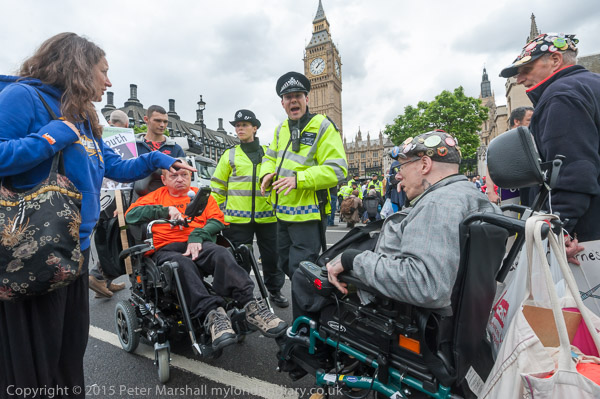
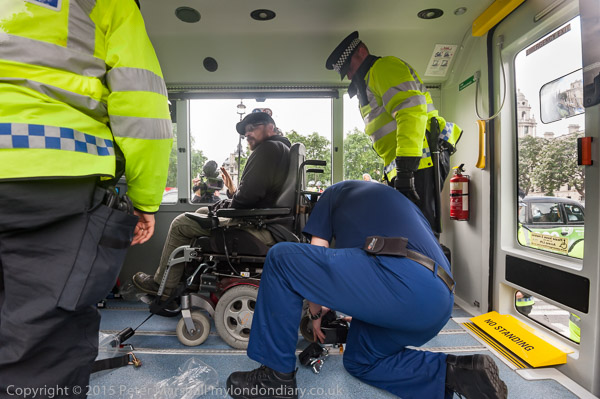
The press as usual obeyed the police instructions more or less, though that didn’t stop some being pushed rather too violently. Most of the protesters let themselves be pushed to the pavement, but many of those in wheelchairs refused to move. Eventually police made some arrests, including Andy Greene of DPAC who was on his mobility scooter.
Eventually police brought a specially adapted van they had hired into which they could put Andy, still on his mobility scooter and the others arrested and take them safely to the police station. Unlike normal police vans it had large windows through which I was able to take pictures.
Public sector workers striking against the privatisation of the council services in Barnet and Bromley came to join the PCS strikers and held a rally in Parliament Square, along with various trade union speakers, including one of the four cleaners sacked by Sotheby’s.
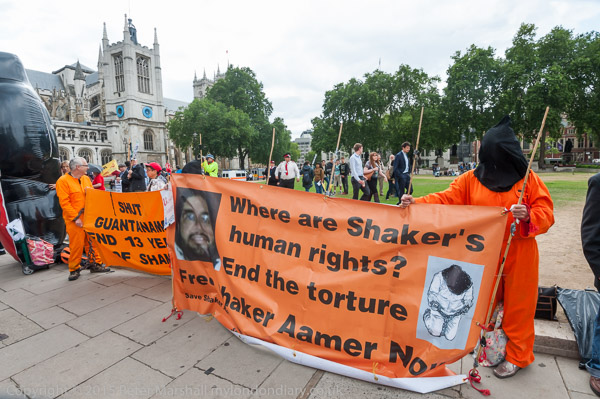
The Save Shaker Aamer Campaign was also in Parliament Square, holding its regular Wednesday weekly vigil calling for the immediate release and return to the UK of Londoner Shaker Aamer and for the closure of the illegal torture prison at Guantanamo.
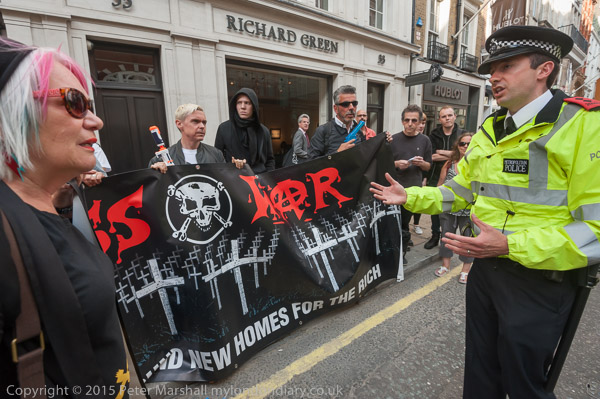
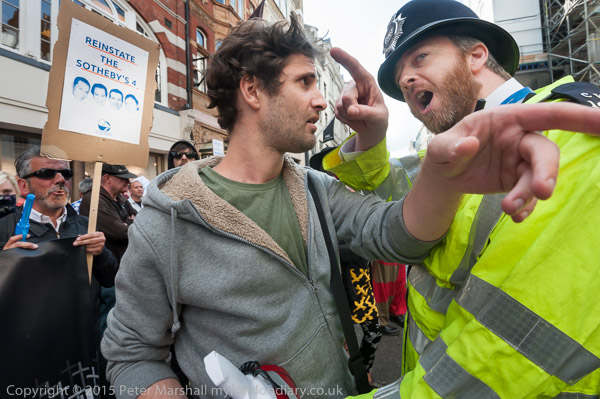
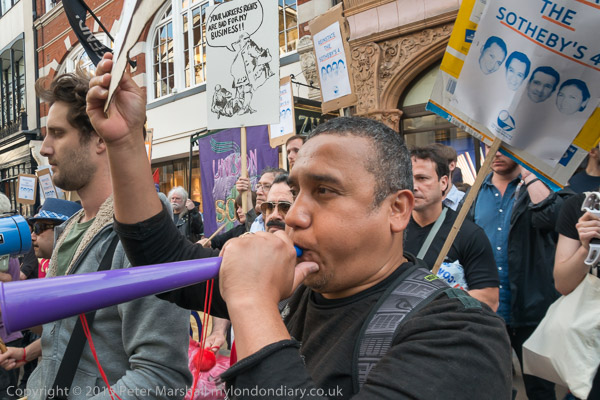
Later I met the United Voices of the World and their supporters at Oxford Circus, marching with them to Sotheby’s.- in Old Bond Street. As well as their original demands for proper sick pay, holidays and pensions they were now demanding the reinstatement of the ‘Sotheby’s 4’, cleaners sacked for taking place in the protest a week earlier.
At Sotheby’s police tried to move them away to the other side of the road, but the protesters, including a group from Class War and supporters from Lewisham People Against Profit, SOAS Unison, the National Gallery strikers and others ignored their requests. They left the entrance clear but wanted to make their presence clearly felt, protesting on the road outside.
Eventually two vans of police reinforcements arrived and started to push the protesters away, leading to a number of arguments. Eventually protesters were pushed to the pavement opposite, making it easier for taxis to drop clients directly in front of the entrance to Sotheby’s rather than having to walk past the noisy protest.
The protest was continuing when I had to leave after around an hour later.
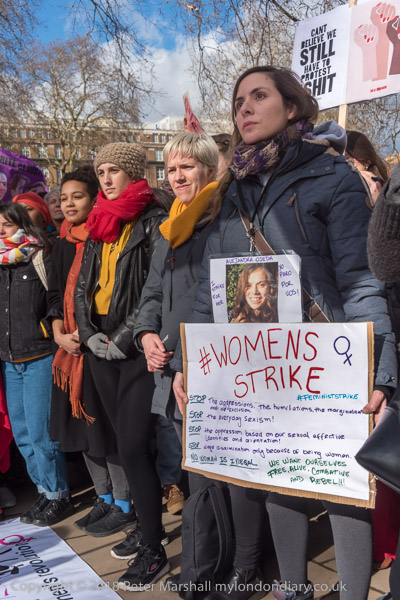
March 8th – Women Strike And Protest. Last year on International Women’s Day I published a long post, International Women’s Day Marches with images from my coverage of them from 2002 until 2020. This year I look back five years to Thursday 8th March 2018 when I covered a wide range of protests, most of which were linked to International Women’s Day
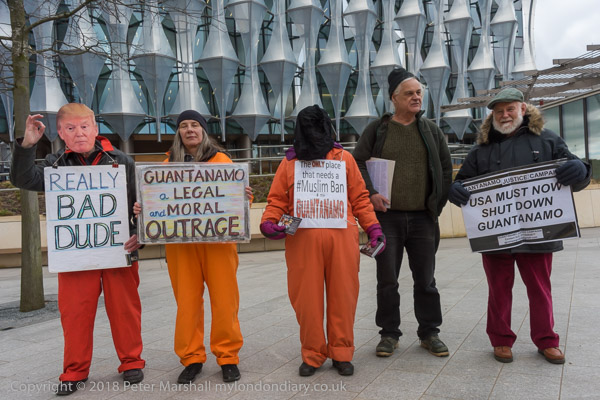
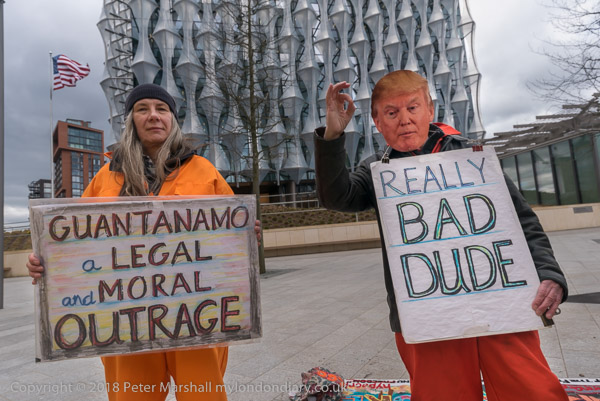
Shut Guantanamo at new US Embassy – US Embassy, Nine Elms
This was the first protest outside the new US Embassy where they intend to continue the regular monthly protests which they have had outside the old embassy in Grosvenor Square since 2007 until the illegal and immoral US prison camp is shut down and all the prisoners released.
Normally these protests take place on the first Thursday of every month, but in March 2018 the protest scheduled for March 1st was postponed for a week because of snow. Because of the change of date some regular protesters were unable to attend and the protest started a little later than usual as some had problems finding the new location. This was the only event not connected with International Women’s Day I covered on the day.
In March 2018, 41 prisoners remained held at Guantanamo. There was no evidence against most of those held and tortured there that would stand up in any court of law, often simply a matter of suspicion or hearsay or desperate statements made under extreme torture. Many were simply foreigners in the region seized to gain cash rewards from the US forces.
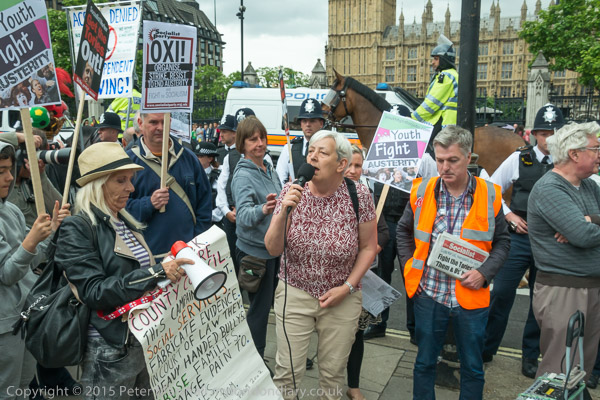
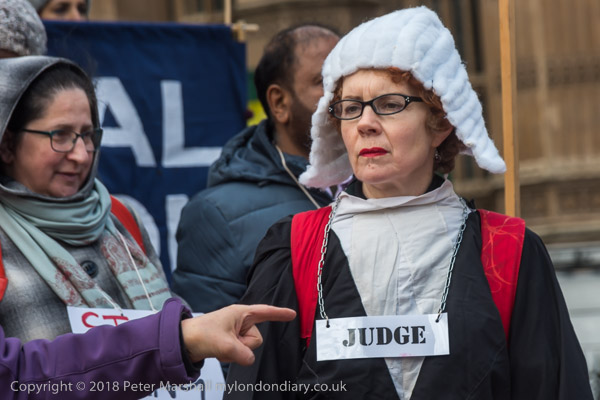
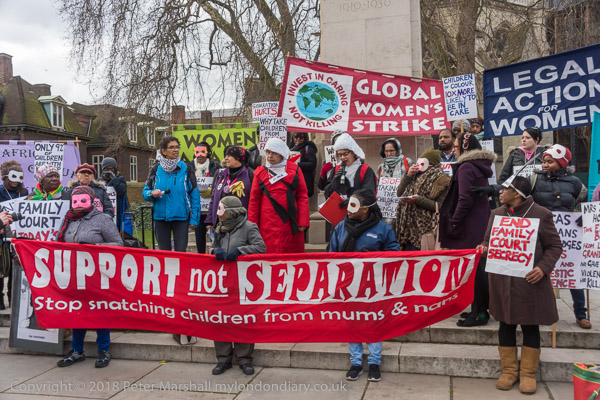
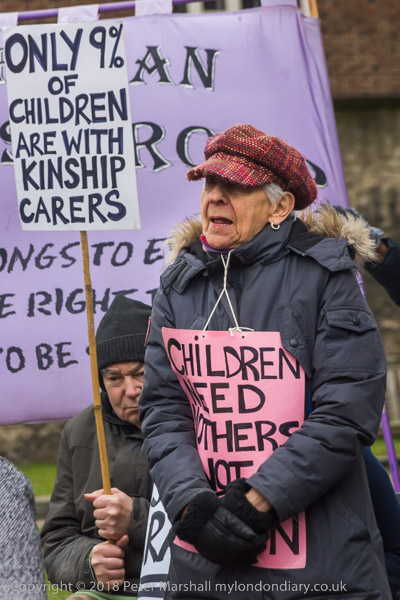
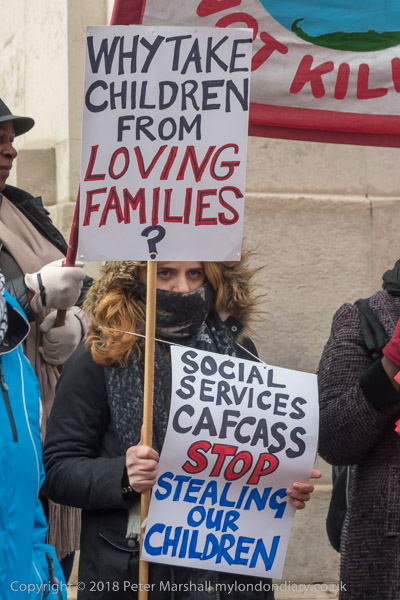
Global Women’s Strike had organised a mock trial of the UK Family Courts in an International Women’s Day protest in front of Parliament.
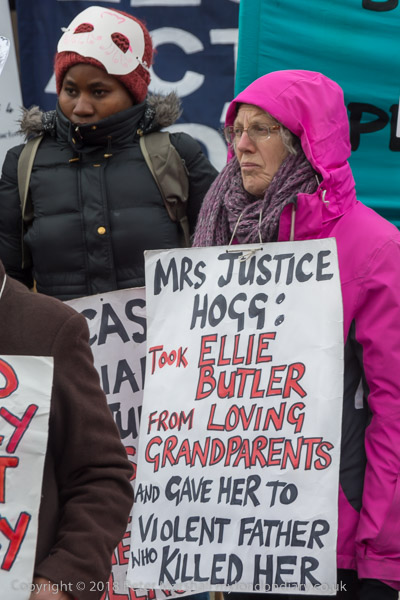
Among those who spoke were mothers whose children had been unjustly taken away, and statements from others were also read out, along with some shocking comments made in court by judges.
The UK has the highest rate of adoptions in Europe, almost all without consent of their birth family. Families of colour, immigrants and disabled are all disproportionately affected and in some working class areas 50% of children are referred to social services.
Poverty, often the result of benefit cuts and sanctions and poor housing conditions especially in temporary accommodation is often mistaken for neglect and the help mandated under the 1989 Childrens Act is seldom available. Children are often simply taken into care and then put up for adoption even though they have mothers or grandmothers who are capable of good parenting and only need support.
The campaigners say that victims of domestic abuse are often accused of ‘failing to protect’ their children and vague charges such as putting children at risk of future emotional harm and neglect are used by the secret courts to remove children from mothers and grandmothers. They want hearings with proper public scrutiny and an end to the gagging of mothers and familys, a great use of kinship carers and the proper implementation of the 1989 Children Act, and the Care Act 2014 which entitles disabled mothers to extra help.
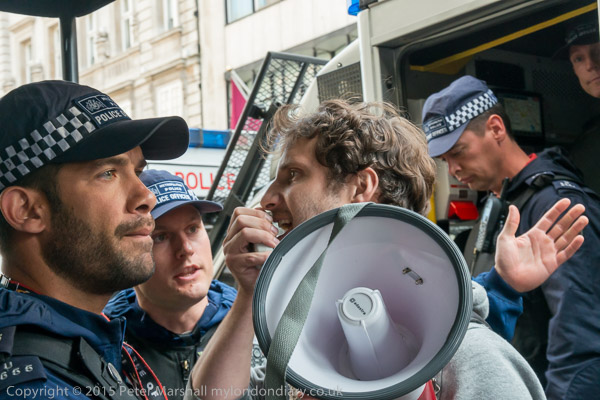
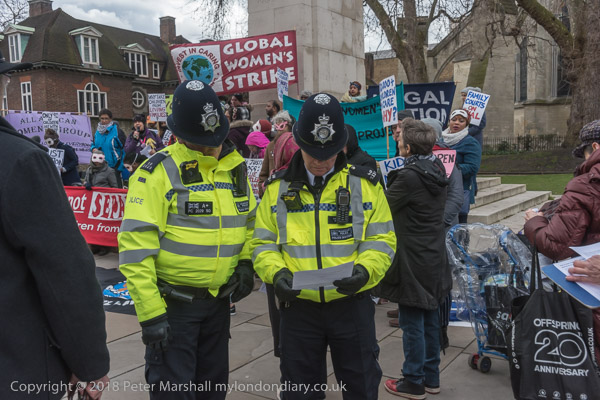
Parliamentary officer Black Rod sent police to try to shut down the protest, but the organisers showed them documents to say they had permission for the protest and to use a megaphone. They seemed puzzled but left.
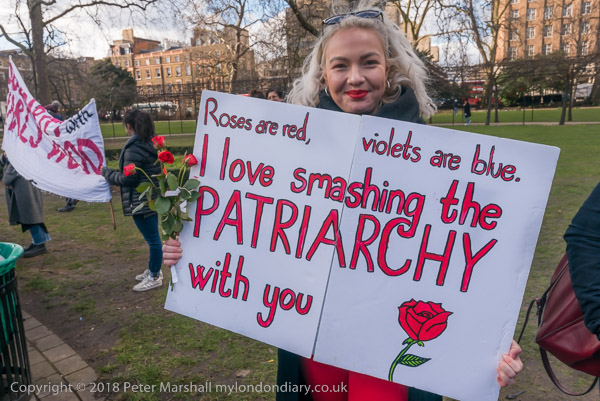
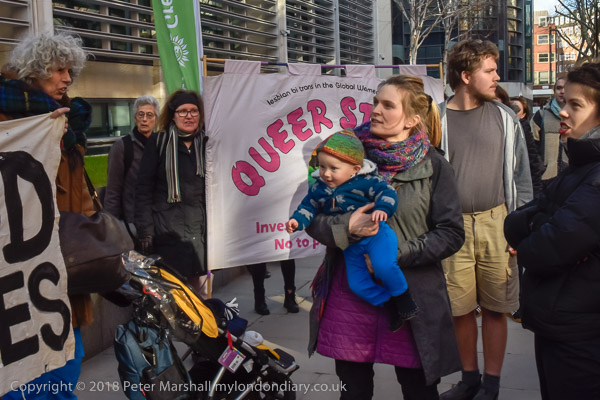
This was the big event of the day and included speeches about a wide range of causes. As the organisers said the “Women’s Strike is a strike for solidarity between women – women of colour, indigenous, working class, disabled, migrant, Muslim, lesbian, queer and trans women” and “is about realising the power we already hold – activating and nourishing resistance.“
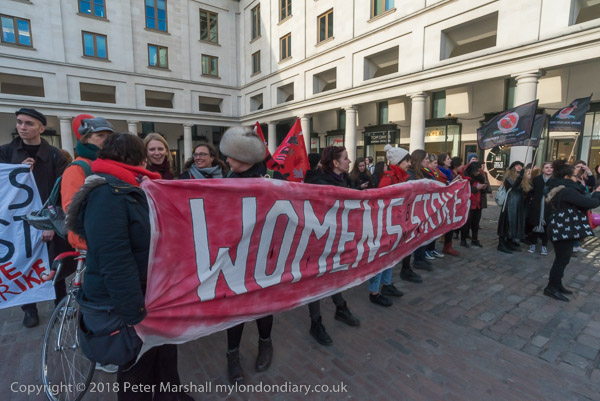
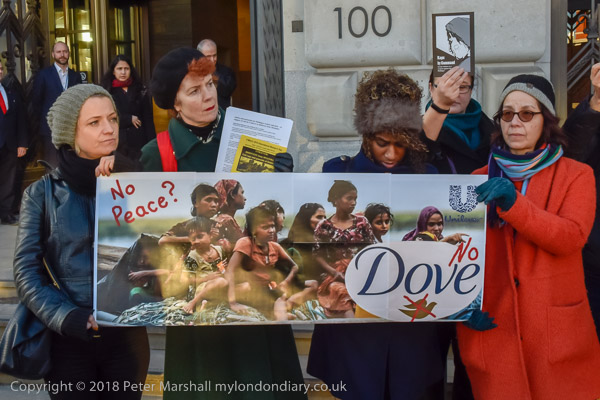
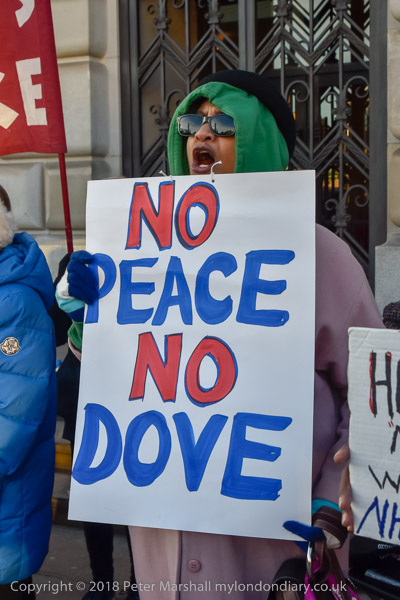
Many of the women present went on to other protests elsewhere including several protests in support of cleaners at the TopShop and The Royal Opera in Covent Garden, and cinema workers at Picturehouse, calling for an end to immigration detention an in solidarity with the Yarl’s Wood hunger strikers, for Unilever to withdraw its investment in Myanmar where its presence supports a government that has brutally raped, tortured and killed many Rohingya, and supporting sex workers by calling for the decriminalisation of prostitution and I also went to cover some of these
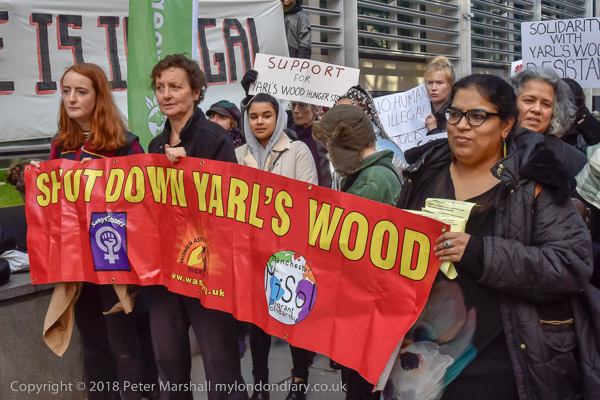
Solidarity with Yarl’s Wood hunger strikers – Home Office
At the Home Office protesters showed solidarity with those held in Yarl’s Wood on International Women’s Day, in particular with those who had began a hunger strike 15 days ago against their imprisonment and the conditions and treatment by the detention centre staff and the Home Office.
Since then the strike has gathered momentum and escalated into an all-out strike: work strikes, occupations, and a general refusal to cooperate, and long lists of the detainees demands have been published by Detained Voices.
Reinstate the Royal Opera House 6 – Royal Opera, Covent Garden
Six members of grassroots independent workers union CAIWU were fired by cleaning services company Kier for their jobs at the Royal Opera House, another disciplined and a sixth was on final written warning. They were clearly being victimised folloing successful trade union action which had forced Kier to pay its workers there the London Living Wage.
The large and loud action with union members augmented by women from the Women’s Strike blocked Drury Lane for some minutes. Police arrived, talked to the protesters and then went inside to talk to the managers inside before emerging, carefully removing poster and fliers the protesters had left on their car before driving off. The protesters later moved back into Covent Garden Market leaving the road free.
Women from the Women’s Strike called on Unilever to disinvest from Myanmar where they have a $667 million investment.
The military government there are committing systematic rape and other torture with total impunity as part of their genocide against the Rohingya people. Unilever claims, especially in its marketing for Dove products to respect the dignity and rights of women and girls and says it “aims to improve safety for women and girls in the communities where they operate.”
International Women’s Day Marches.Wikipedia has a good article on the origins of this “global holiday celebrated annually on March 8 to commemorate the cultural, political, and socioeconomic achievements of women” which focuses attention on such issues as “as gender equality, reproductive rights, and violence and abuse against women.“
International Womens Day 2020
So I won’t go into any great detail here. The earliest manifestation was a Woman’s Day organised by the Socialist Party of America in New York City on 28th February 1909, and the idea was taken up the following year by the International Socialist Women’s Conference. When women got the vote in Soviet Russia in 1917, March 8th became a national holiday and the date became established in socialist movements and countries worldwide, being taken up by feminists in the 1960s. International Women’s Day was celebrated by the UN in 1975 and adopted by them in 1977.
Since around 2000 IWD has been ” criticized as heavily diluted and commercialized, particularly in the West, where it is sponsored by major corporations and used to promote general and vague notions of equality, rather than radical social reforms” and in 2009 was hi-jacked by a British PR firm, but other groups have continued a more radical observance of the day and attempted to reclaim it, and it has been largely those that I’ve photographed over the years.
Until 2002 I’d been teaching most years on March 8th and hadn’t been able to photograph daytime IWD events, so I think that year was the first time I did so. Since then I’ve photographed them most years, and here I’ll post a few pictures from some of them, with links.
IWD 2002 – Global Women’s Strike
I only wrote a short text – so here it is:
the 8 march is a world woman’s day and was celebrated by some as a global women’s strike. the march in london stopped outside key sites including the war office and world bank for speeches.
There are 4 pages of pictures, each with a handful of images beginning here but the links are carefully hidden among the images (I got better at web design later.)
I think this was the first time I photographed Selma James, a leading anti-sexist and anti-racist campaigner and the originator in 1972 of Wages for Housework, “a demand and a political perspective that redefined the working class“. I was pleased to supply a picture for the cover of her recent book ‘Our Time Is Now‘, and recommend it to you.