Former Google diversity chief Mark Palmer-Edgecumbe had applied to Tower Hamlets Council for planning permission to open a “Museum of Women’s History” meant to celebrate suffragettes, equal-pay campaigners, and local social struggles, and got a number of historians, academics and others to advise on the project.
It was a shock when the building renovations were completed and those involved as well as the council saw from the frontage that it was instead to be a tourist trap celebrating the gruesome Victorian murders of ‘Jack the Ripper’.
Ian Bone asks “Would you protect it if it glorified the killing of police officers”
Many local residents, and others including descendants of the poor working class victims of the sadistic murderer where shocked, and even Tower Hamlets Council was moved to protest following its opening. Unfortunately the council found it had no power to close down what was described as a ‘sick horror attraction’.
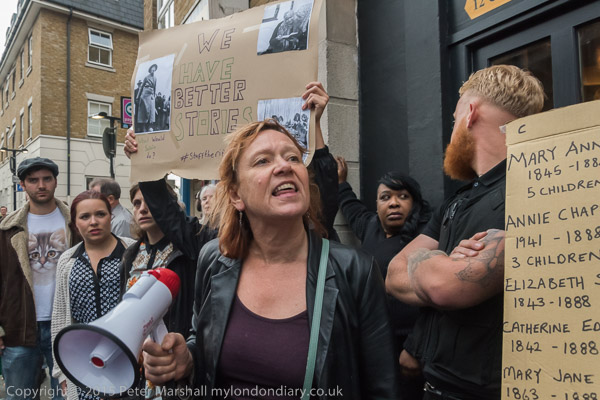
We have better stories’ says a poster with some images of women who should be celebrated rather than celebrating a brutal and deranged upper-class killer who attacked working class women
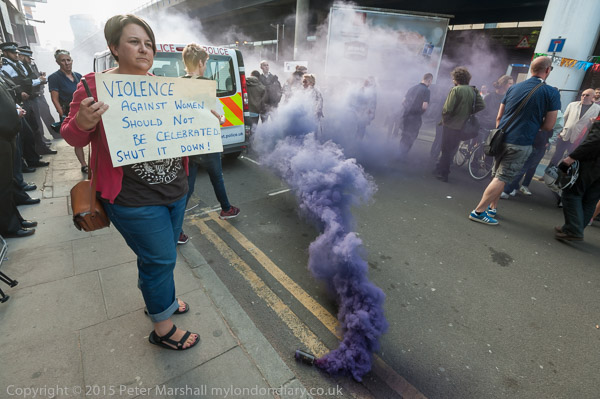
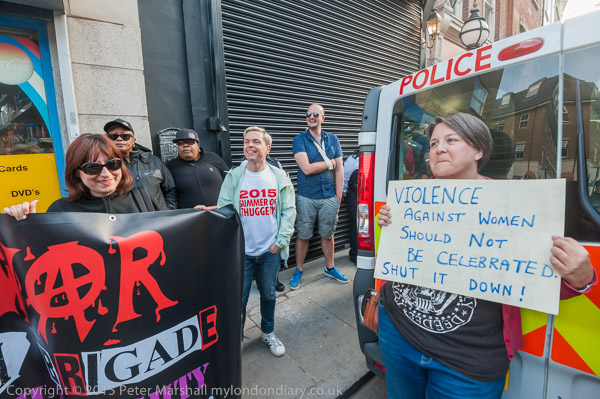
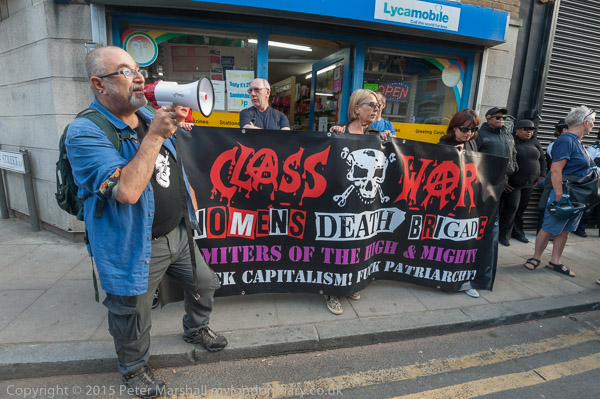
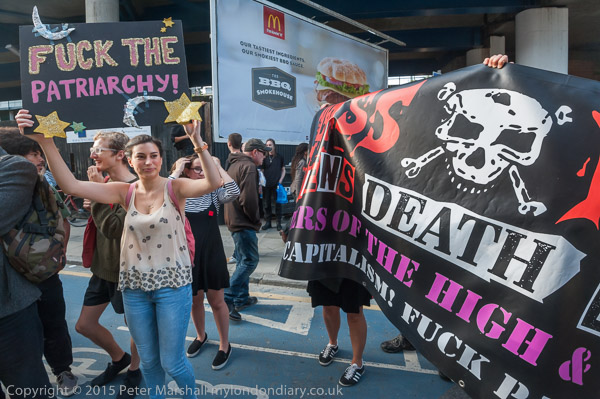
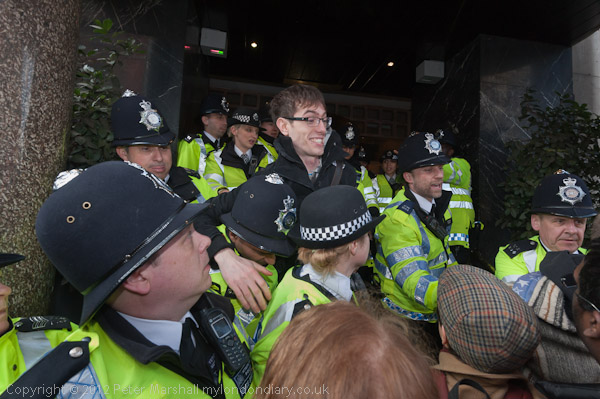
But the most sustained protests came from anarchist organisation Class War who carried out a series of colourful protests outside the so-called ‘museum’, including this one in which they were joined by Action East End and Fourth Wave and other feminists.
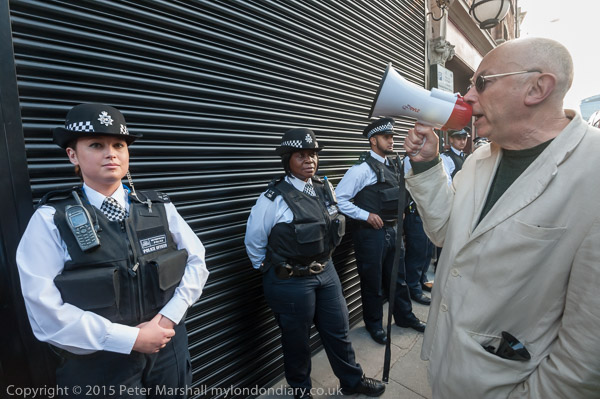
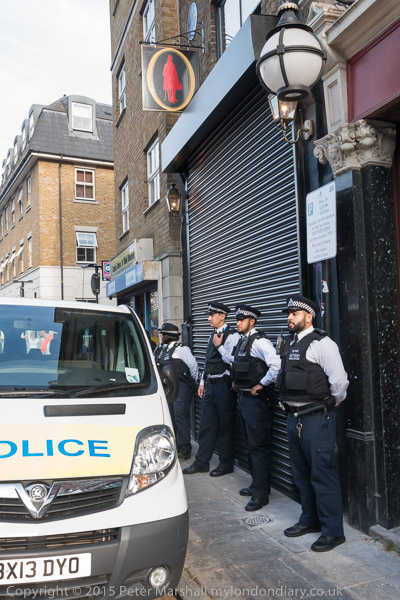
When protesters came to the tourist attraction they found it was hidden behind a heavy metal shutter, with police standing in front guarding it, erected since the previous protest a week ago. This was in breach of planning regulations and they were some time later foreced to remove it.
Among those who spoke at the protest was East End historian David Rosenberg who spoke about the real history of women in the East End, as well as Class War’s Ian Bone and Lisa McKenzie.
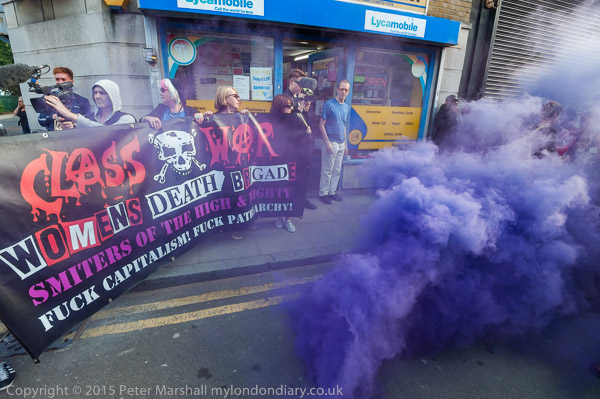
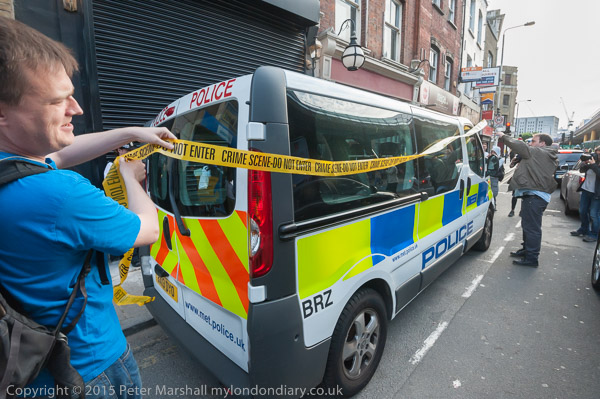
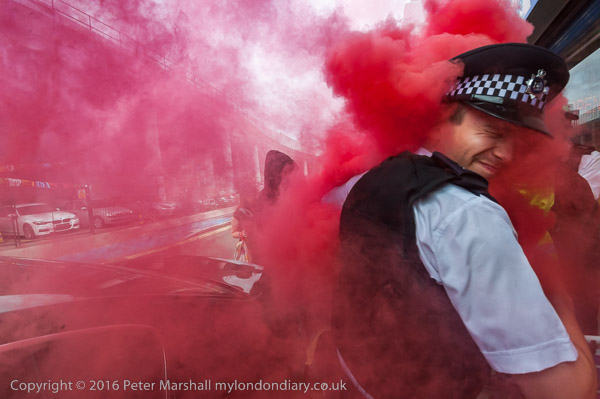
After the speeches and a couple of smoke flares the protesters, including some local residents blocked the road for some time though leaving the cycle path open. Police attempted to move them with no success, the women protesting asking them whether they would defend a museum celebrating the murders of police officers.
My final comment in 2015 was: “Protests will continue until the museum closes down or turns into what was promised, a museum of women’s history rather than of women’s degradation and brutal slaughter. It sensationalises the tragic fate of the working class victims at the hands of a deranged upper class murderer, presenting a voyeuristic experience that sickens anyone with any decency and humanity.”
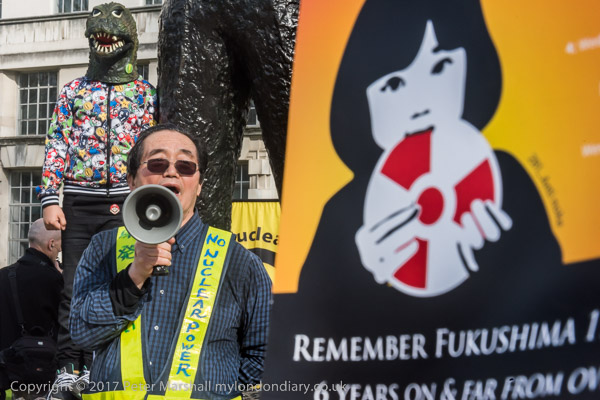
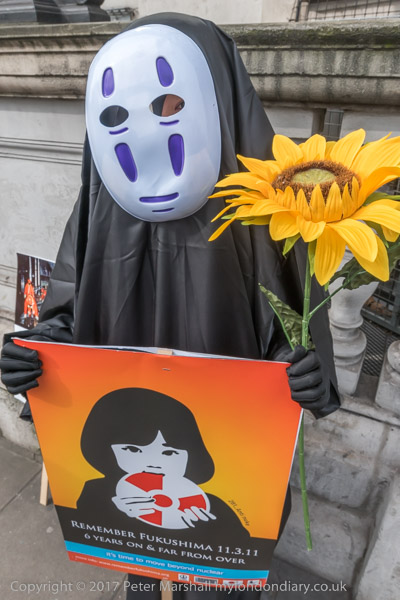
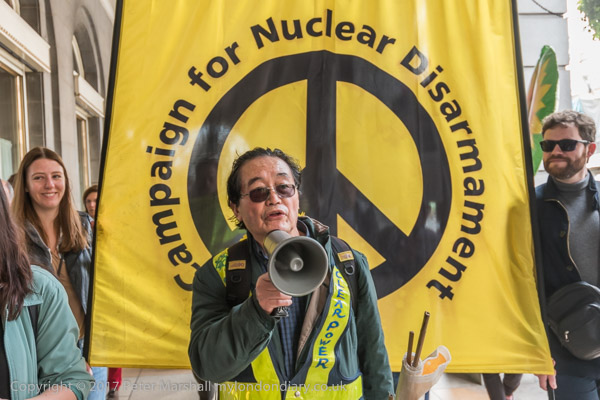
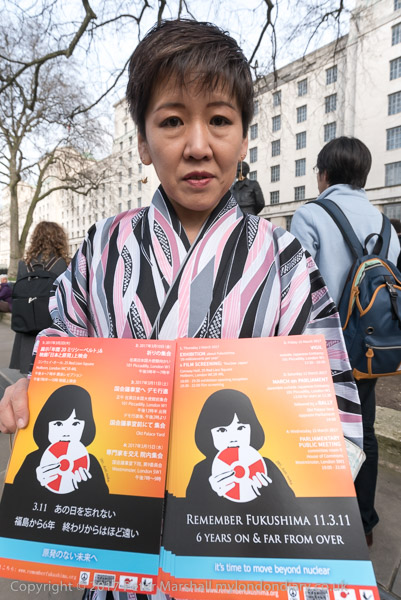
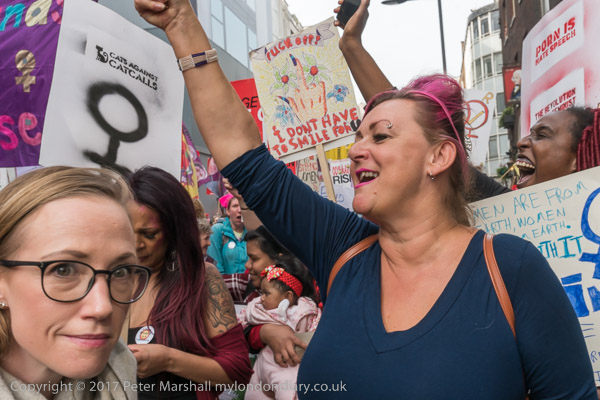
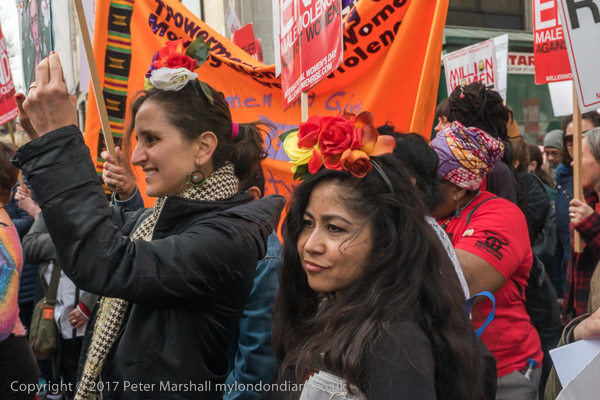
Fukushima & Million Women Rise: Saturday 11th March 2017 was the sixth anniversary of Fukushima nuclear power plant disaster in Japan and a march called for an end to nuclear power programmes around the world including in the UK. It was also the nearest Saturday to International Women’s Day and I photographed the Million Women Rise march.
Fukushima Anniversary Challenges Nuclear Future
London
Six years on, radiation was still leaking from the plant which was damaged by a tsunami from the Tohoku earthquake. This destroyed most of the plant’s cooling system and created the world’s worst nuclear disaster since Chernobyl.
Estimates of the human cost in the long-term from the radiation leaks vary considerably, but the financial cost of cleanup up has been estimated at around $180 US.
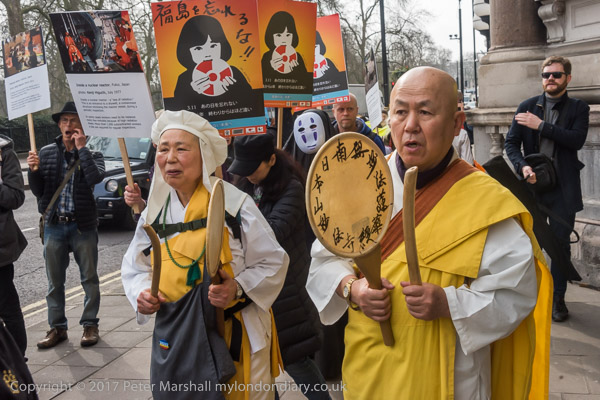
Buddhist Reverend Gyoro Nagase from Battersea and Reverend Sister Yoshie Maruta from Milton Keynes
Nuclear power has never achieved the early promises of cheap energy and remains the most expensive way of generating electricity. It is now promoted as an essential backup for renewable energy when the sun doesn’t shine and the wind doesn’t blow but its importance will fade as we exploit other continuous renewable sources and cheaper storage solutions become available. And as we move away from a grid-based power system to more local generation. Should nuclear fusion ever become feasible it promises to be a much safer, cheaper and cleaner way to generate electricity.
Probably the UK’s nuclear programme was never really about energy, but about our nuclear weapons programme.
The marchers met at the Japanese embassy on Piccadilly and marched on the pavement handing out leaflets to Downing Street. I left them on the march to photograph the start of Million Women Rise and then took to tube to Westminster for the Downing Street rally.
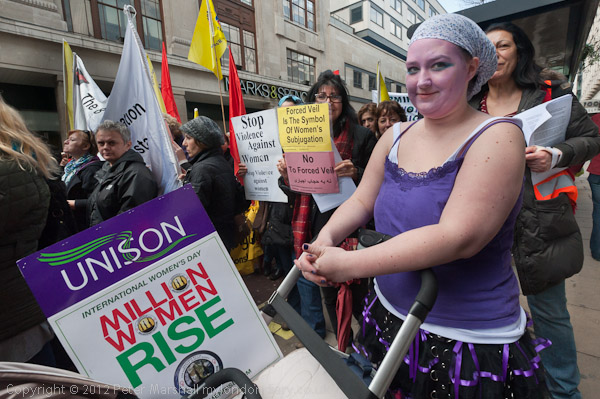
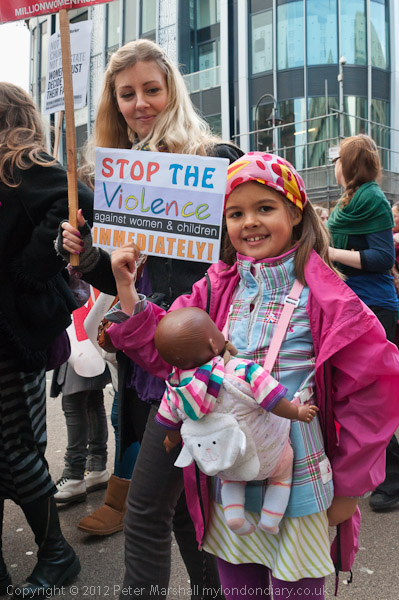
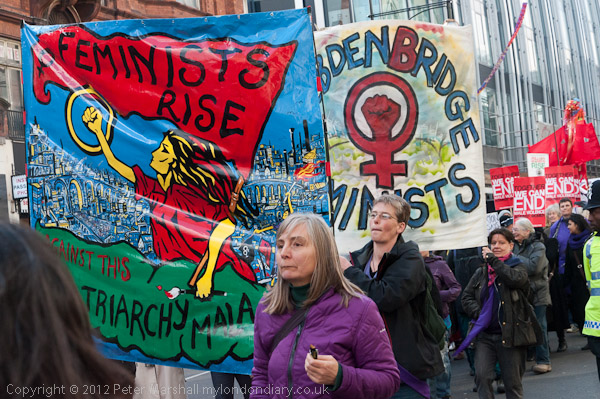
Around two or three thousand women gathered in Orchard Street to march to a rally in Trafalgar Square.
‘Women of the World Unite Against Violence’
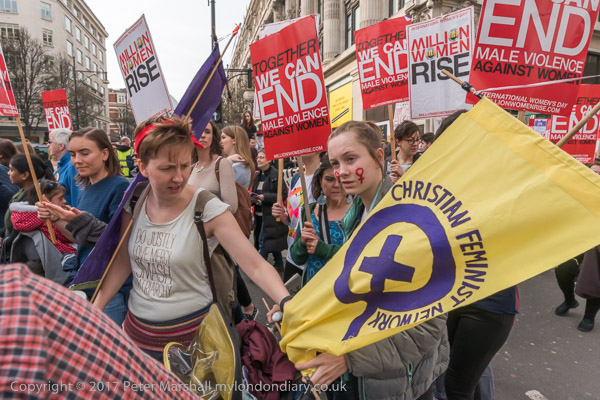
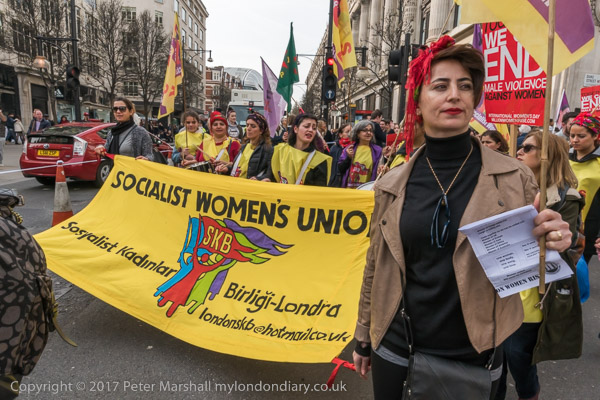
Many carried feminist placards and there were groups from various women’s organisations around the country, including from various ethnic communities.
This was a march for women only, but most of them were very happy for me to photograph them, but I was not able to mingle freely with them as I would on most marches, and my pictures were from the sidelines or in front of the march.
Violence Against Women is a Global Pandemic’
I was able to take many pictures, but not always as I would have liked. But I think they are an interesting set – and here are just a few of them.
I left as the march reached Bond Street station to go back for the Fukushima rally.
Boycott Workfare, Million Women Rise & Greece: On Saturday 3rd March 2012 I photographed a protest outside companies using people forced into free labour under the government workfare scheme, then a women-only march against male violence against women which I left to go to the Occupy meeting on the steps of St Paul’s which supported the protests in Greece against austerity measures imposed by the EU.
Boycott Workfare – Oxford St
Oxford St
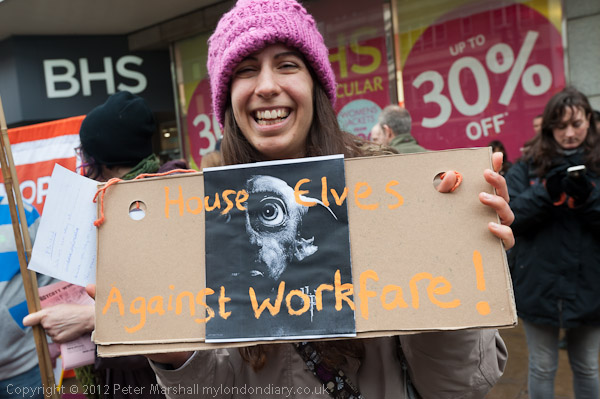
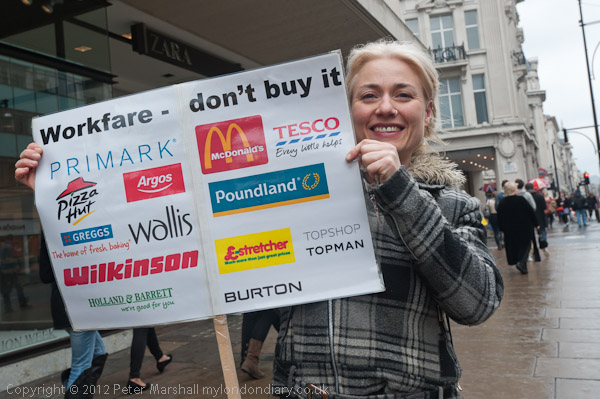
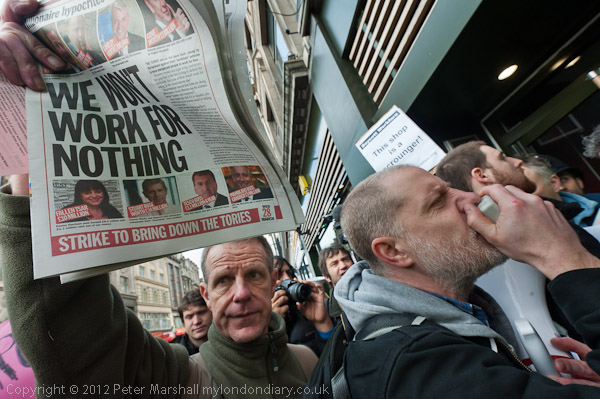
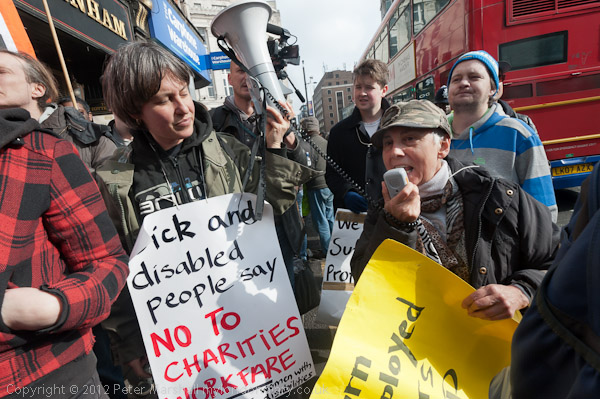
The group Boycott Workfare came to Oxford Street to lead a protest against companies who use unemployed and disabled people forced to work without pay but just a small allowance under the government workfare scheme.
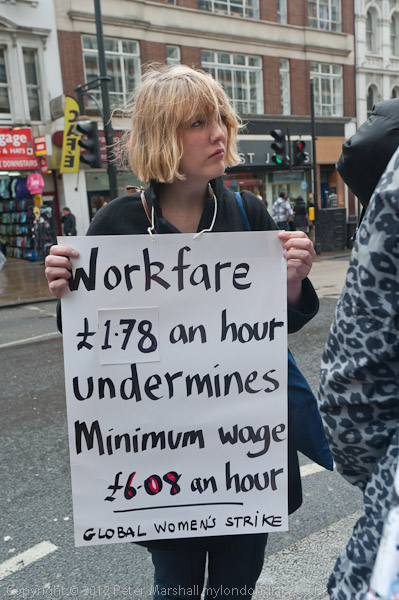
As the protesters emphasised, workfare reduces the number of real jobs available in the workplaces, giving workers to the employers by forcing the unemployed to do work at no cost to the employer on an allowance roughly one quarter of the minimum pay – and around a fifth of the London Living Wage.
The event began with some good news when they met outside BHS near Oxford Circus by praising that company for having withdrawn from the scheme since the protest had been planned before moving off to protest elsewhere.
Around a hundred campaigners had arrived and were being carefully watched by police who went with them, guarding shop doorways and keeping a path along the crowded pavements clear when they stopped to protest.
The organisers had kept their route secret and had come with two ‘Boycott Warfare’ flags on long poles, white with the letters BW, and those taking part were told to follow the flags.
Police were also guarding some shops which had previously been targeted by UK Uncut over their failures to pay tax, though most of these were not involved in workfare and so of no interest to this protest.
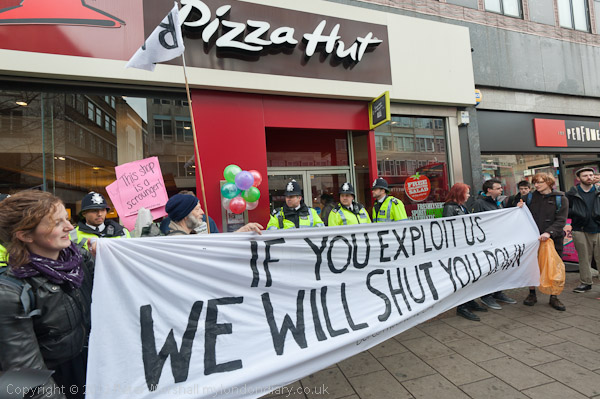
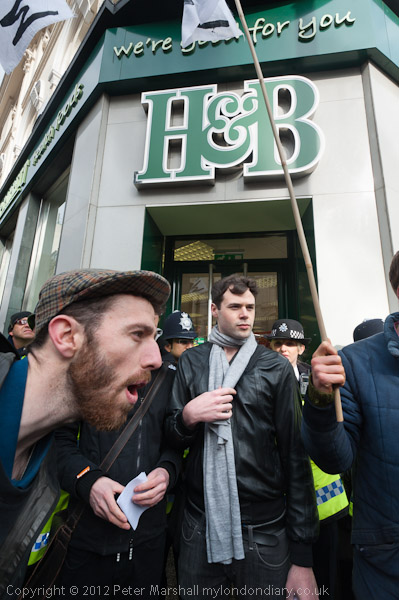
The first stop was a Pizza Hut, where police managed to stop any of the protesters entering – but the protest put off a number of customers entering while there were a few speeches. There we were handed a map showing the locations of some of the other businesses on Oxford Street taking part in workfare, including McDonalds, Holland and Barratt, Superdrug, WH Smith, Argos, and a little way north of Oxford St, Holiday Inn and Barnado’s.
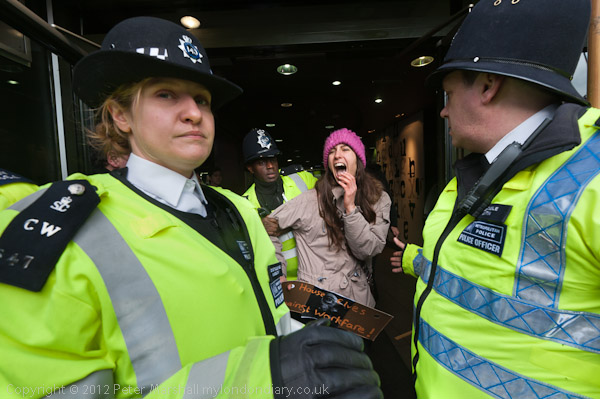
Police just managed to arrive at Holland and Barratt before the protesters, who only paused briefly there before rushing on to McDonalds, where a few managed to go inside. Police soon ejected them into the noisy crowd protesting outside, most of whom soon moved off towards Argos, with police following them.
I soon realised that not all the protesters had left for Argos, and hurried back to see another group being ejected from McDonalds. Another small group had returned to Pizza Hut – where again they were ejected by police.
The main body of protesters turned into a shopping arcade, but were not sure which of the shops were using workfare and hesitated, allowing police to rush in and form a barrier. After a few noisy minutes they left and held a rally on a street corner with a few short speeches – including at least one by someone passing by.
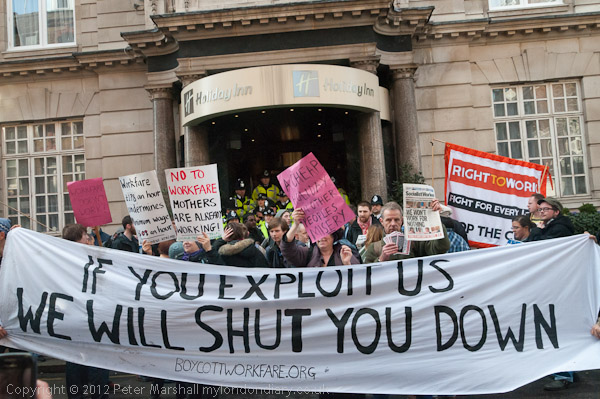
At the Holiday Inn on Wellbeck Street a few protesters again beat the police and were rather forcibly ejected.
Some at least of the police who I and the campaigners talked with clearly shared their disgust at a scheme which forces people to work without payment, and were also worried about leaked plans to part-privatise the police and other cuts, but insisted that it was their job to keep order and protect property.
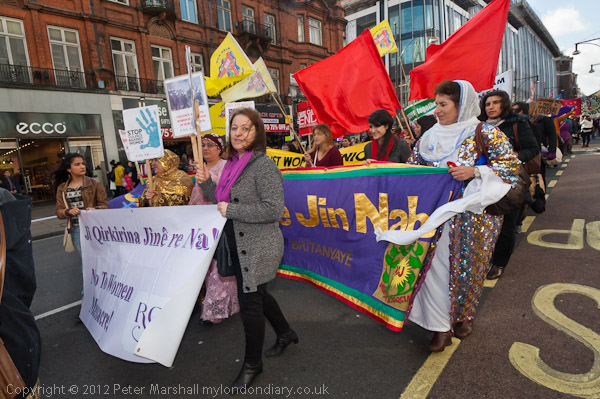
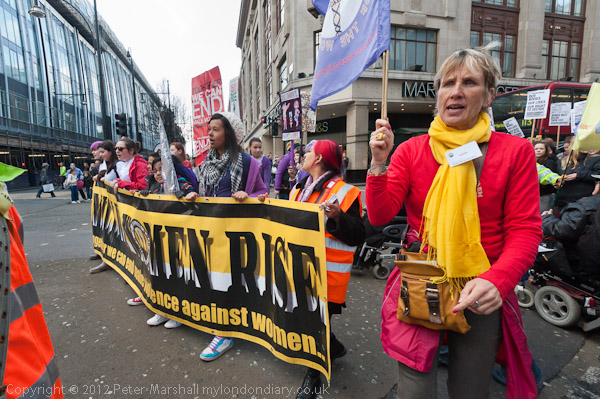
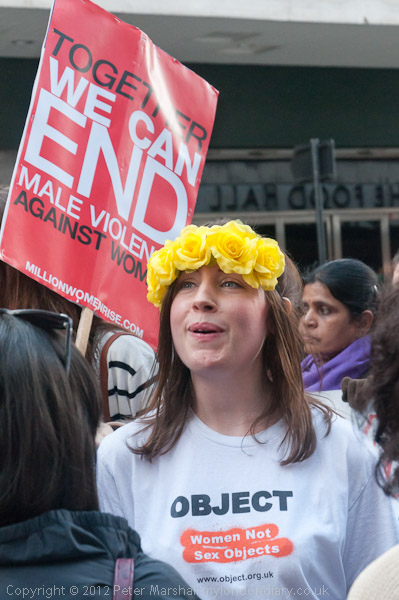
Women were gathering in the street on the west side of Selfridges to march through the centre of London calling for an end to domestic abuse, rape and commercial sexual exploitation. They called for prevention of abuse and support and protection for women.
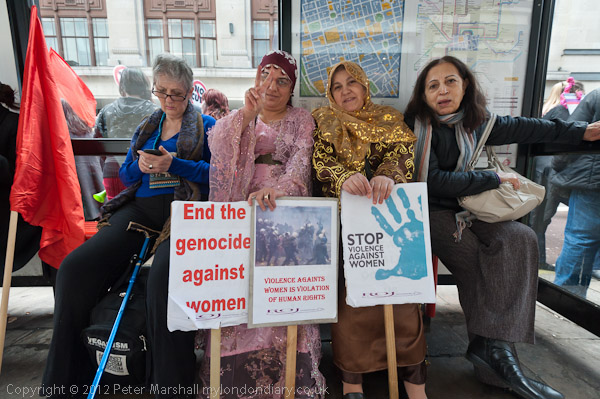
They came from various womens groups and organisations around the country for this all-women march calling for and end to male violence against women.
Some of London’s more active women campaigning groups, including those that have been the leaders in previous celebrations around International Women’s Day were absent from the protest, and I was shocked to learn that they had been told they were not welcome at this march, despite the coalition’s aim to be non-partisan and to bring “together women who want to highlight the continuation of all forms of violence against women and demand that steps are taken to put an end to this.”
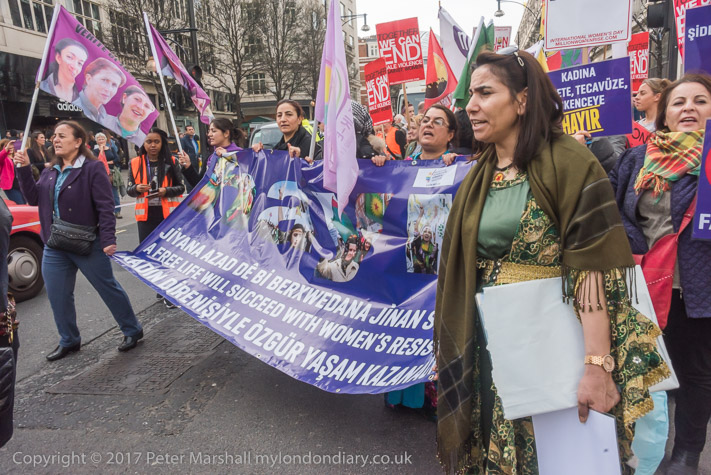
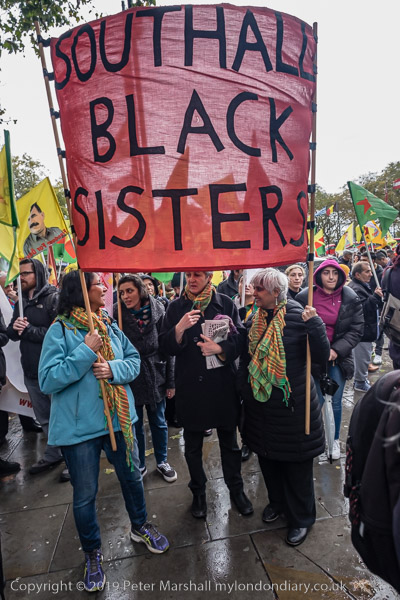
Among those marching were women from a number of political groups from London’s ethnic communities present, including Kurds, some in traditional dress and some holding posters calling for the release of their leader Abdullah Öcalan from prison in Turkey, as well as groups opposed to the Iranian regime.
The Million Women Rise Coalition has a statement of demands for government and societies here and around the world. They demand the recognise and reflect in policies the discrimination faced by all women and those from black and other minority groups in particular. They demand that domestic abuse, rape and commercial sexual exploitation are linked together in a definition of violence against women and that support is given to support organisations for women in the not-for-profit sector.
Their long statement called for support for various groups opposing violence against women, and end to child prostitution and pornography and proper support for trafficked women and children.
They called for International Women’s Day to be made a Bank Holiday in the UK and Ireland, and oppose “the continued misrepresentation, misappropriation and abuse of the female body throughout all forms of media.”
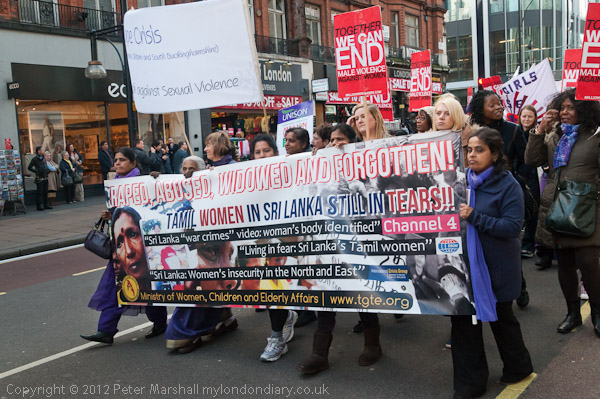
Their statement also made clear that wars and conflicts around the world perpetuate violence against women, and on the march a group carried a banner ‘Raped, Abused, Widowed and Forgotten – Tamil Women in Sri Lanka Still In Tears’ and others highlighted the ongoing abuses against women in DR Congo.
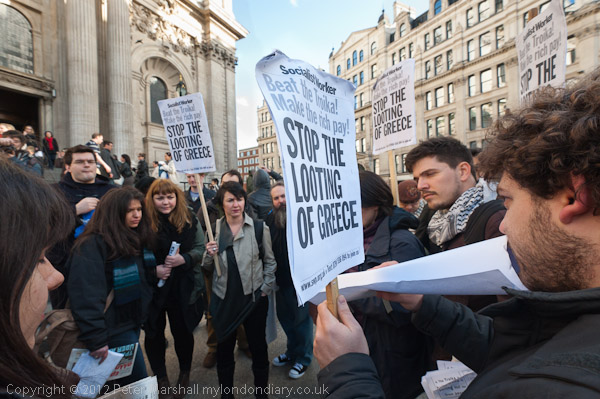
I left the march at Bond Street Station to report on a protest at St Paul’s Cathedral against the terms of the Eurozone rescue package for Greece at Occupy meeting on the steps there and to show solidarity with the protests in Greece.
Hate Crime, Turkish Invasion, Hong Kong & More – Saturday 2nd November 2019 was a busy day for me and I made six posts from different events on My London Diary – and here is a little about each in the order of my day.
Day of the Dead – Columbia Market, Bethnal Green
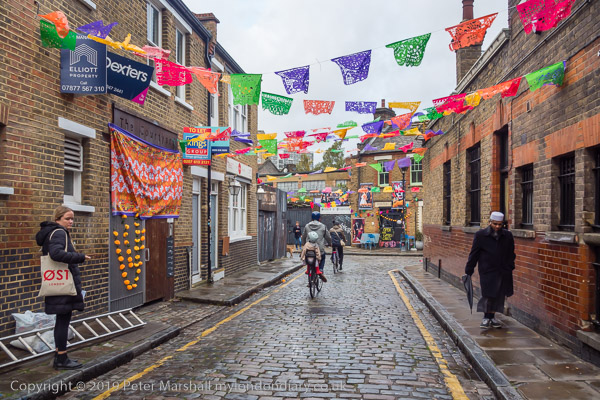
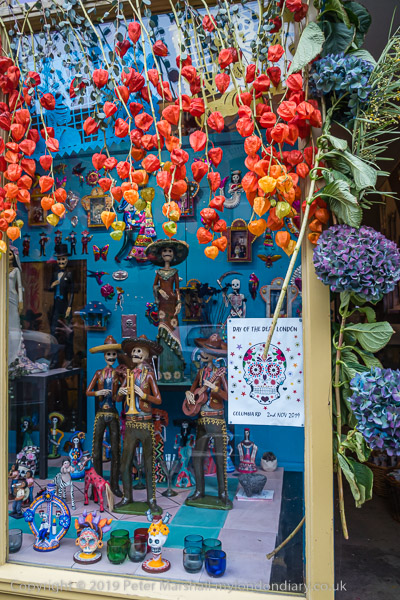
I walked from Hoxton Overground station to Columbia Market which was holding a festival for the Mexican Day of the Dead, arriving at the time this was supposed to start. But it had been raining heavily and had only just stopped which had put off others from coming early and the streets were pretty deserted. So all I was able to photograph were the decorations on the street and on some of the shops.
Things would almost certainly have become more interesting had I stayed, but I had other things to attend and had to leave after around half an hour. I’d intended to return later but was too busy. I did take a few pictures as I walked to and from the station as well.
Against constitutional change in Guinea – Downing St
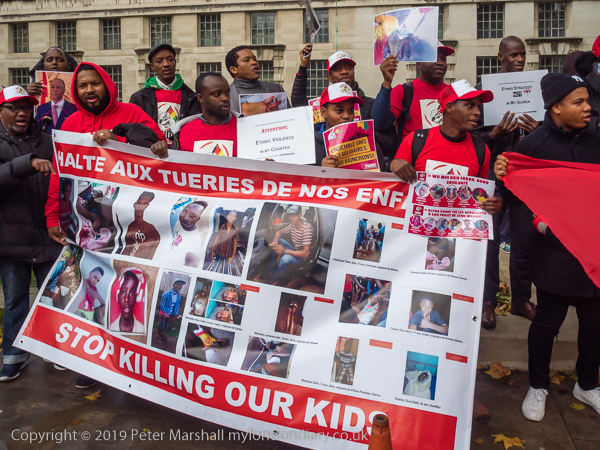
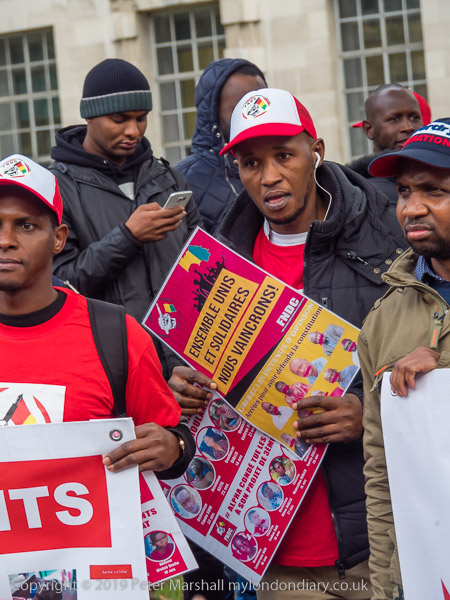
Back in central Westminster I photographed protesters from the UK branch of the National Front for the Defence of the Constitution (FNDC) who were demanding that President Alpha Conde abandoned the constitutional chages that would enable him to seek a third term in power.
The London protest came after massive protests in Guinea in October during which 11 people had been killed in government violence against the opposition and peaceful protesters. They called for an end to and end to the killing and the release of all political prisoners, with posters showing the victims and calling for peace and justice in their country.
Stop Hate Crime, Educate for Diversity – Downing Street
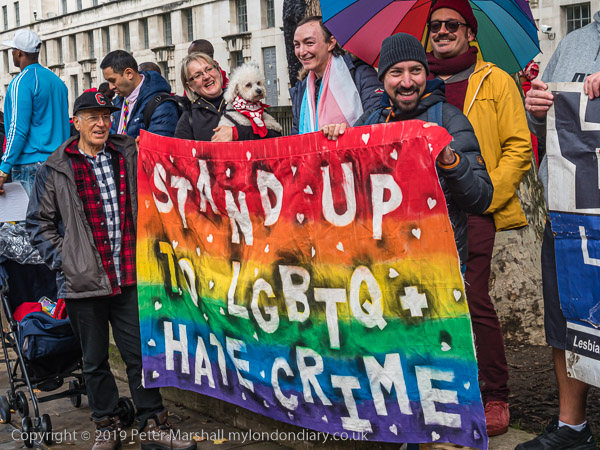
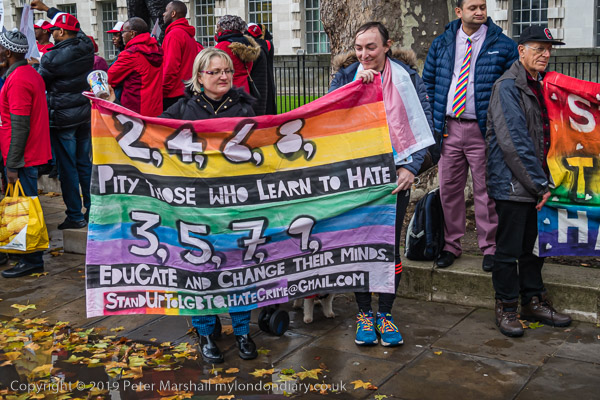
Also at Downing Street, campaigners from Stand Up to Lgbtq+ Hate Crime condemned the increasing incidence of hate crime and bigotry against LGBTQ+ people and defended the teaching of lessons which feature LGBTQ+ families and relationships.
Their message was one of celebrating love, inclusion and diversity and say No to Homophobia, Islamophobia and Transphobia. I took some pictures and left as some began to speak about their own experience of discrimination at school before before the group marched to Eros in Piccadilly Circus for a further rally.
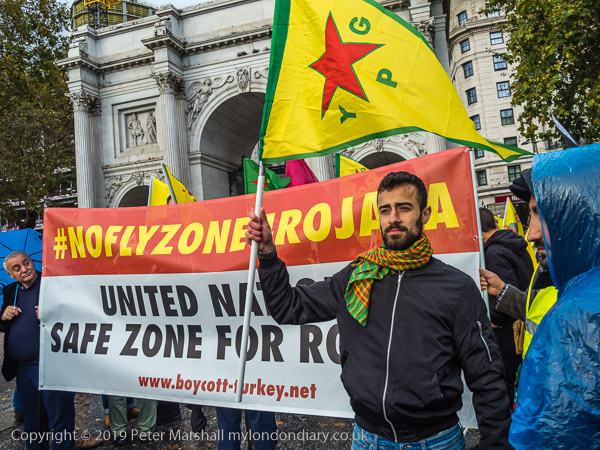
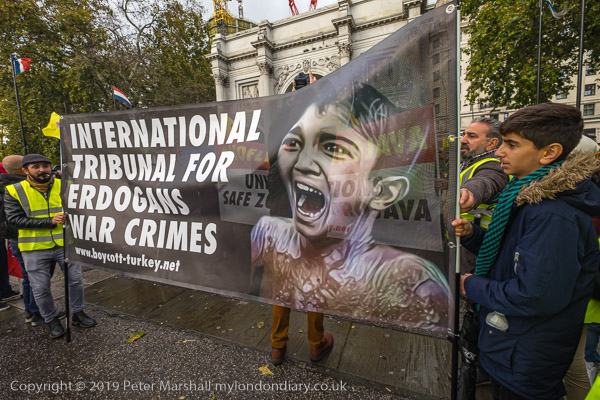
Defend Rojava against Turkish Invasion – Marble Arch & Oxford St
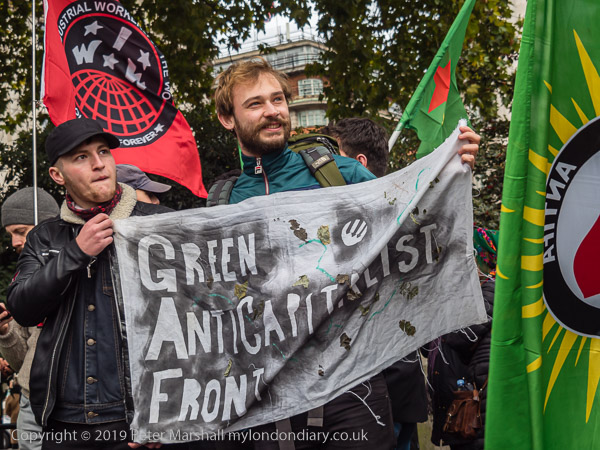
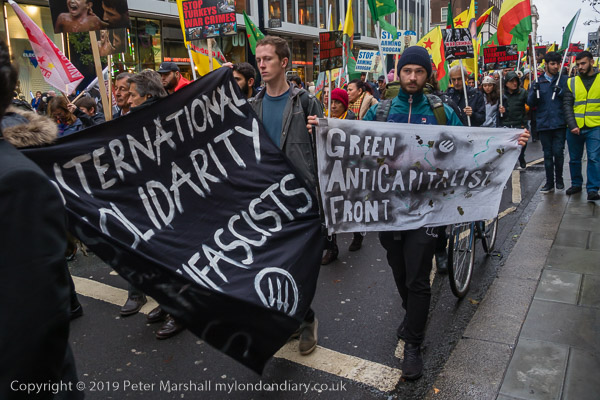
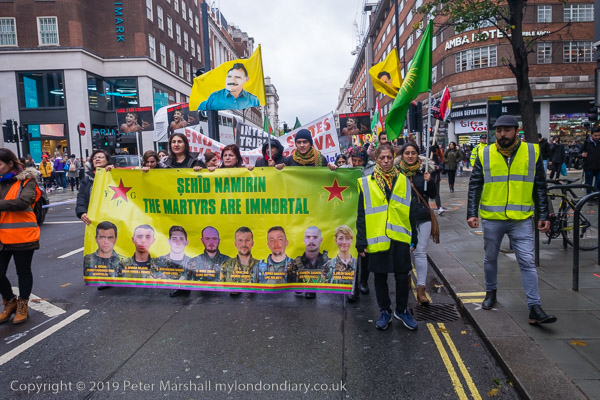
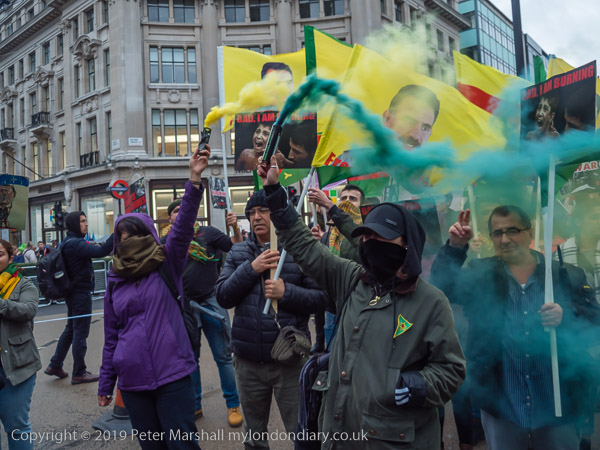
The largest protest of the day was a a rally and march in support of Rojava in North-East Syria against Turkish invasion which gathered at Marble Arch.
Since soon after the start of the revolution in Syria a large area of the country had been under the de-facto control of a Kurdish-led democratic administration which has put ecological justice, a cooperative economy and women’s liberation at the heart of society, enshrined in a constitution which recognises the rights of the many ethnic communities in the area.
Many have seen this area, Rojava, as an important model for more democratic government, particularly in multi-ethnic areas, but Turkey sees it as a threat on its borders. For generations it has been discriminating and fighting against its own Kurdish population which makes up almost a fifth of the country’s population, and the Kurdish leader Abdullah Ocalan, held in prison in Turkey since he was abducted from Kenya in 1999.
In prison Ocalan continued to campaign for the Kurdish people but had moved away from militancy towards political solutions. In jail he wrote about the rights of women and developed the philosophy of democratic confederalism which forms the basis of the constitution of Rojava.
Rojava has received wide support for its principles from environmental groups, green movements, feminists, human rights supports and those generally on the left, but not from western governments who see it as a threat to capitalist hegemony.
Despite this, the Kurdish people’s defence forces in Syria with the aid of US air power led the successful fight against ISIS. Turkey had backed ISIS although denying to do so, aiding them in getting the massive funds they needed by smuggling out oil from the ISIS held regions. Again they saw ISIS as an ally in their fight against the Kurds.
When Trump withdrew US troops from Syria, Turkey took advantage of this to invade areas of Syria controlled by the Kurds, and to encourage and aid Islamic groups to join them in their attacks. Turkey as a member of NATO has been encouraged and helped to develop its armed forces and is second only to the USA within Nation and is said to be the 13th largest military power in the world.
The Turkish invasion threatened the existence of Rojava, who had been forced to go to both Russia and President Asad of Syria for support. Obviously this threatens the future of the area and its constitution and its long-term hopes of autonomy in the area.
I left the protest on Oxford St on its way to the BBC who they accuse of having failed to report accurately on what is happening in the area. There had certainly been very little coverage of the recent events and a long-term failure to address issues of discrimination against the Kurds in Turkey.
March for Autonomy for Hong Kong – Marble Arch & Oxford St
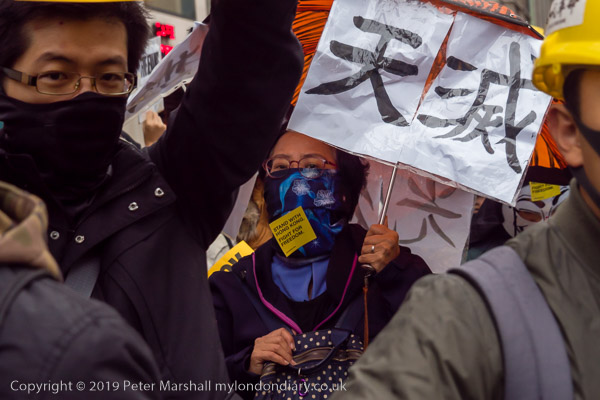
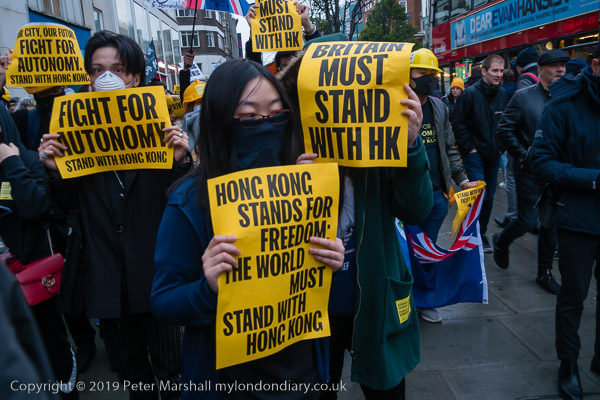
Also meeting at Marble Arch were protesters, mainly Chinese from Hong Kong living in the UK, and in solidarity and supporting the five demands of those then protesting in Hong Kong. Many wore masks to protect their identity, either because they may return home or fear their families there may be persecuted.
They demanded complete withdrawal of the Extradition Bill, a retraction of characterising the protests as riots, withdrawal of prosecutions against protesters, an independent investigation into police brutality and the implementation of Dual Universal Suffrage.
Queer Solidarity for trans and non-binary – Soho Square
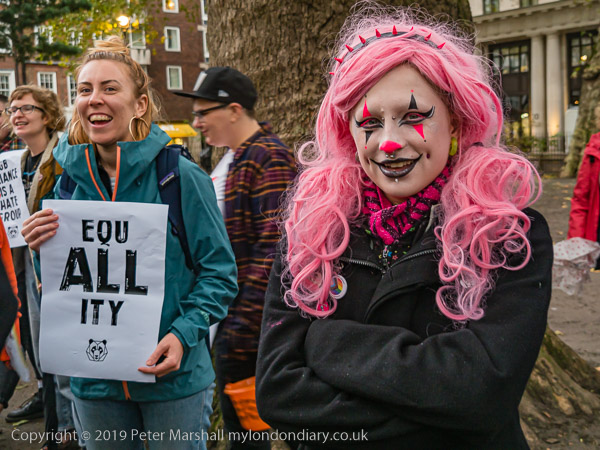
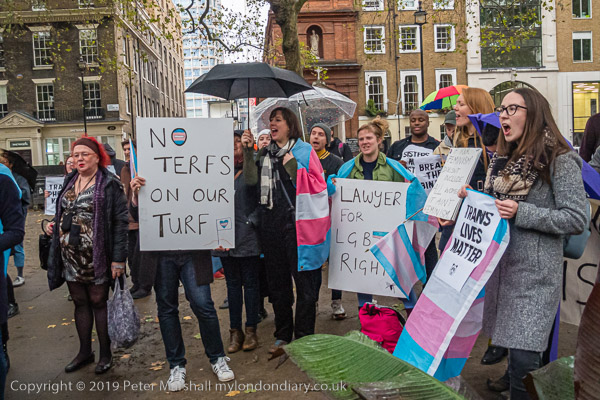
Bi Survivors Network, London Bi Pandas, Sister Not Cister UK, BwiththeT and LwiththeT held a rally in Soho Square pointing out that the newly announced ‘LGB Alliance’, which claims to be protecting LGB people is actually a hate group promoting transphobia.
They pointed out that trans and non-binary people have always been a part of the gay community and played an important part in the fight for gay rights and in particular Stonewall, and there is no place for such bi-phobic and gay-separatist views in the gay community.
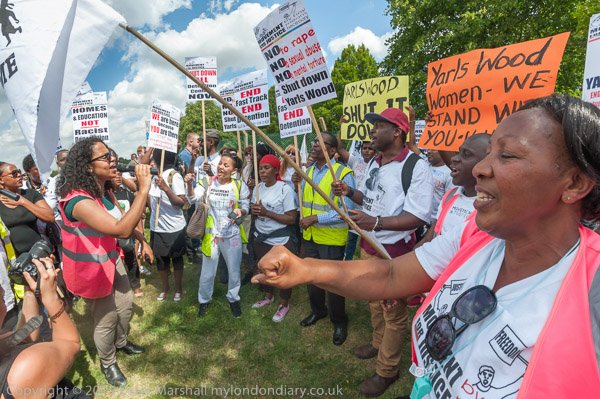
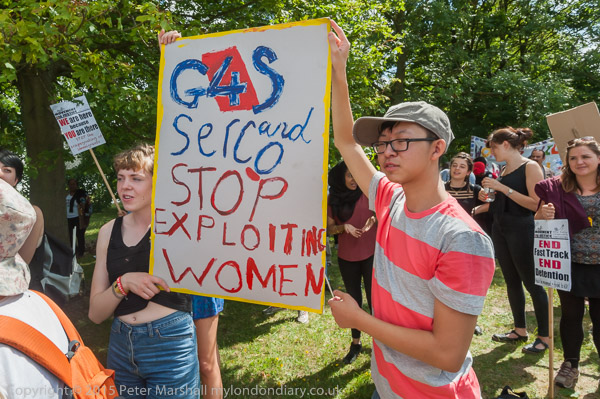
Close Down Yarl’s Wood – Yarl’s Wood Immigration prison, near Bedford
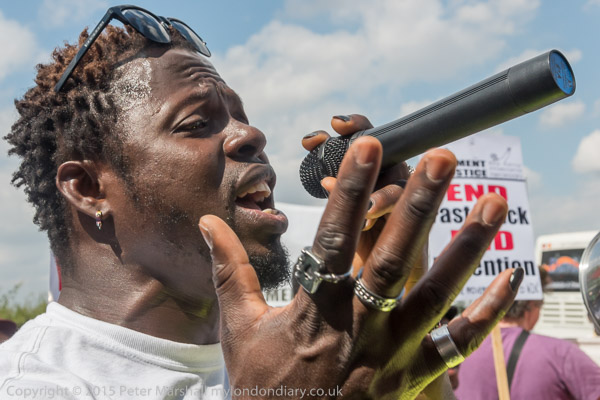
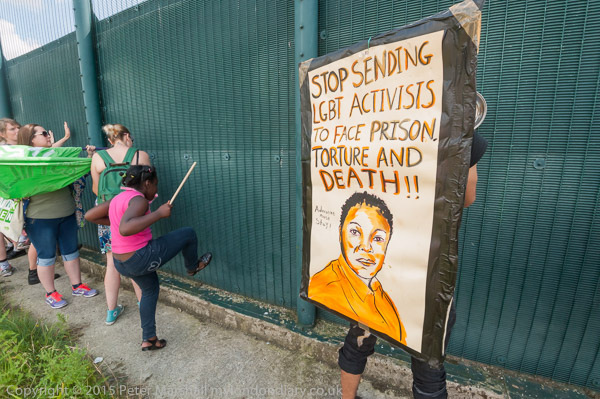
Saturday 8th August 2015 saw a large protest outside the immigration jail at Yarl’s Wood where asylum seekers are locked up indefinitely by our racist immigration system without trial, a prison run for profit by a private company where detainees are subjected to abuse and sexual harassment.
Yarl’s Wood was used to detain women, many of whom had fled abuse and violence in their own countries only to arrive in this country and be locked up and further abused here. The detention centre is in a remote location in a business park on a former wartime airfield around five miles from Bedford.
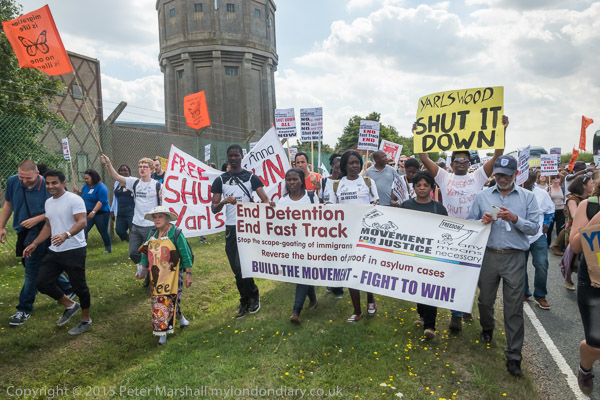
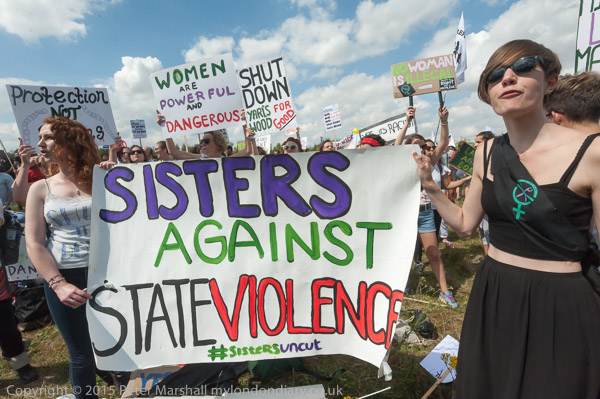
The protest was one of a long series organised by Movement for Justice, but was supported by a large number of other groups, particularly many women’s groups including Sisters Uncut. In my post on My London Diary I listed 25 of them, but there were others too. This was only the second protest they had organised at Yarls Wood, but it came after a series I’d photographed at the Harmondsworth and Colnbrook detention centres.
MfJ is a small Trotskyist group which has been one of the most active UK groups organising against racism and for civil rights in the UK since it was formed by students in North London in 1995. This protest came a couple of years before a bitter dispute led many other groups to end cooperation with them, but MfJ continue their active role, in particular in opposition to deportation charter flights and the shameful Rwanda plan.
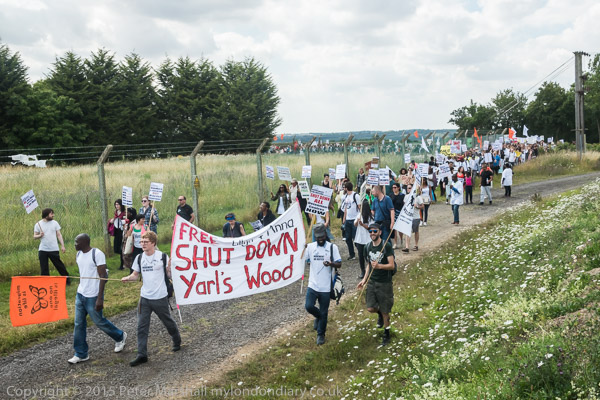
The main entrance to the detention centre is on a private road which is gated some distance from the centre. The coaches bringing people from across the country, and me and others from Bedford Station were parked in a long line at the side of a public road around a mile to the north, close to the locked entrance to the business park. The protest began on an area of grass here as we waited for everyone to arrive, and there were speeches and much chanting and dancing.
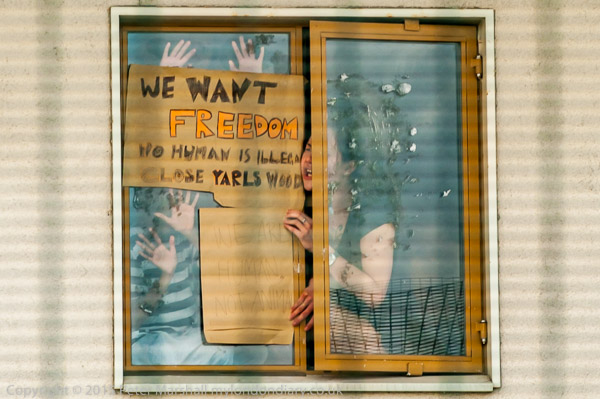
Finally the protest began its march, setting off around 300 metres along the road to a bridleway which eventually after around a mile of walking led to a hilly field beside the 20ft high fence around the prison. The lower 10ft of this is solid metal sheeting, but the upper 10ft a sturdy metal gauze, and from the hill we could see women at many of the windows waving to greet the protesters. Those held inside feel isolated and forgotten, though there are a few prison visitors and they are allowed some phone contact with solicitors and others to pursue their asylum cases.
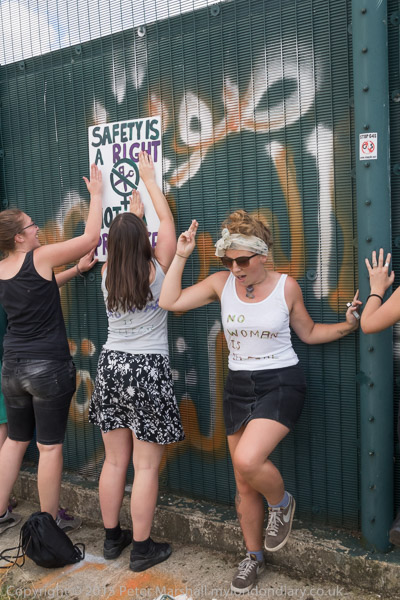
Protesters made a great noise, kicking and banging on the metal sheeting of the fence as well as shouting, and had brought a sound system so that they could speak to the women outside. They were also able to make phone contact with some of them and amplify their voices too.
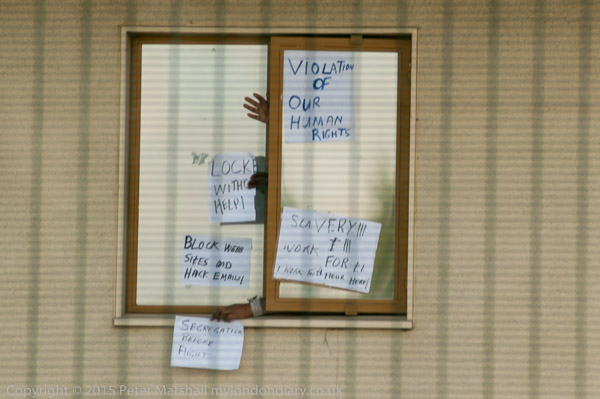
The windows of the centre only open a couple of inches, but some were able to squeeze their arms through the gap and wave cloths or articles of clothing, while others held up messages to the glass. One carefully drawn one read ‘We Want Freedom – No Human Is Illegal – Close Yarls Wood’ while another simply read ‘Help’. Others wrote their mobile numbers large enough to be read by the protesters to contact them.
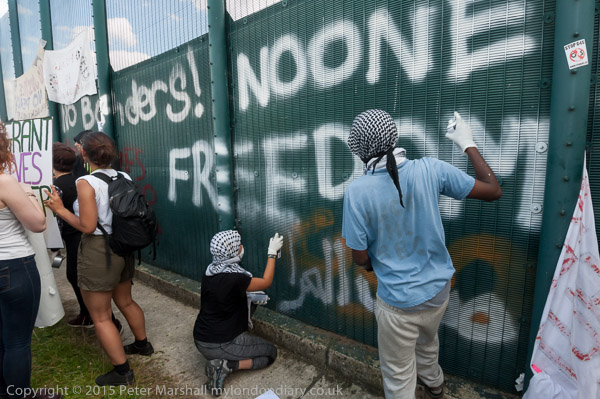
A group of people wearing face masks began to write slogans on the fence, and soon a long length of it was covered with them ‘No Borders’, ‘No One is Illegal’ ‘#SetHerFree’, ‘Shut it Down’, ‘Gaza 2 Yarls Wood Destroy Apartheid Walls’, ‘Racist Walls’ and more.
The speakers on the hill facing the prison included several who had been held inside Yarls Wood and could see women inside they knew, and others who had been in other detention centres. Most people who are held in this way are finally released and allowed to stay in the UK – sometimes after several years of imprisonment – and their seems no justification for locking them up in this way.
Here’s the final paragraph I wrote back in 2015:
Too soon we had to leave. And they had to stay. As I walked away to catch the coach back to Bedford station I felt ashamed at the way that my country treats asylum seekers. They deserve support and humanity and get treated worse than criminals.
Tower Hamlets council were pleased to apporpve a planning application in 2014 to convert an empty Victorian building in Cable St into a ‘Museum of Women’s History’, particularly since Whitechapel’s Women’s Library had closed the previous year. Owner Mark Palmer-Edgecumbe’s application featured pictures of suffragettes and trade union campaigners and promised the museum would be “the only dedicated resource in the East End to women’s history” and “recognise and celebrate the women of the East End who have shaped history, telling the story of how they have been instrumental in changing society. It will analyse the social, political and domestic experience from the Victorian period to the present day.” (Quoted in Wikipedia.)
On the basis of these promises the architects were persuaded to carry out the work for a lower than normal fee, and various others provided consultancy services at no cost. All, including the council, where shocked and felt duped when the covers were removed from the site in 2015 to reveal instead a ‘Jack the Ripper’ museum glorifying the unknown murderer of a number of working class women in the East End in 1888.
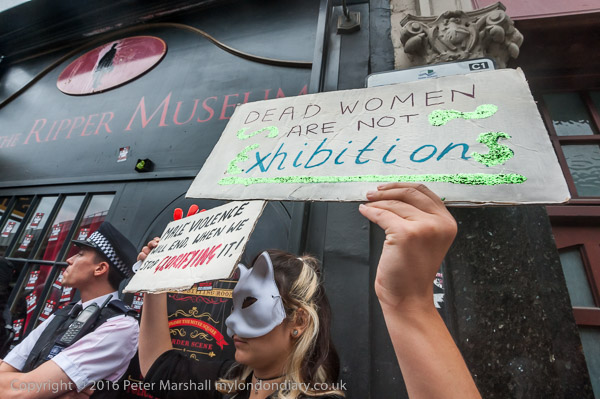
There were various protests organised outside the museum including some backed by the Mayor of Tower Hamlets, who found his council unable to take any real action over the deception, various women’s groups and Class War. Finally the local council did refuse retrospective planning permission for the shop front and ordered changes to the shop’s signage and the removal of a metal roller shutter installed after a window was broken during protests in 2015. The shop owner appealed against the decision and lost. The projecting sign was removed at some time in 2017-8 but I think the shop has failed to comply with some other aspects.
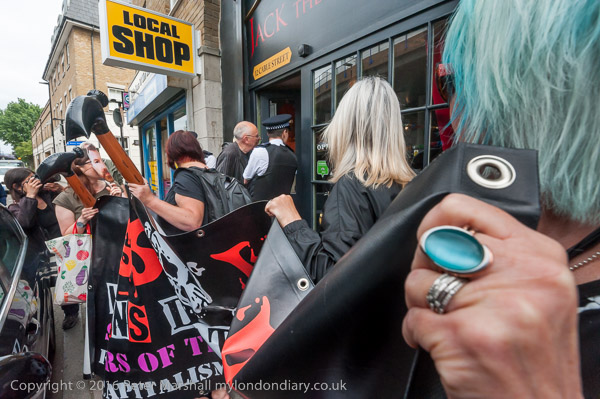
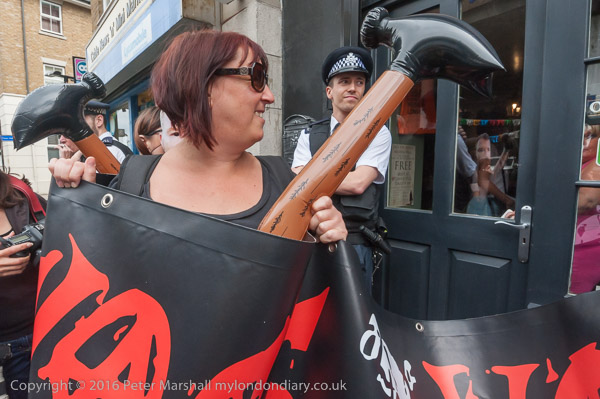
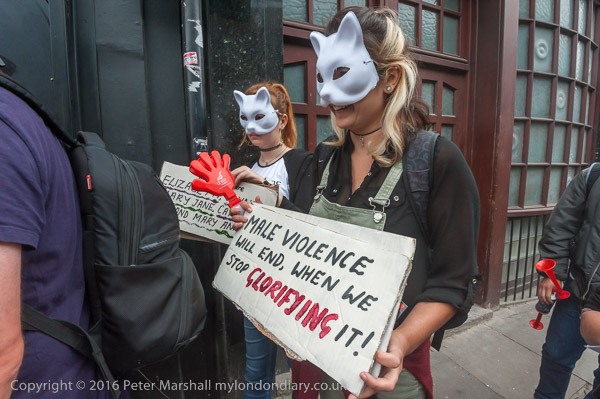
On Sunday 19 June 2016 Class War and supporters including London Fourth Wave Feminists in cat masks, protested outside with toy plastic hammers offering to take down the shutter which had been declared illegal.
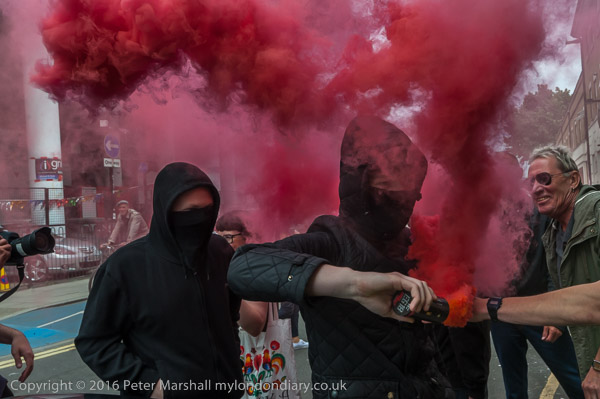
Police guarded the shop and prevented the protesters going inside but seemed generally fairly relaxed about the protest, with at least one making clear his distaste for the tacky tourist attraction they were having to protect. At one point they and the protesters were engulfed in red smoke after a couple of black-clad men arrived to join the protest, quickly fading away as the smoke cleared, with the protest then continuing in good spirits.
The good news is that the shop was put up for sale in April 2021 and is expected to close and take on some new use once sold. I’m not aware of any plans for its use and it will quite likely end up as some kind of offices, but it would be rather more satisfactory if it were bought and actually opened as a ‘Museum of Women’s History’. As I write it appears to still be unsold.
All photographs on this and my other sites, unless otherwise stated, are taken by and copyright of Peter Marshall, and are available for reproduction or can be bought as prints.
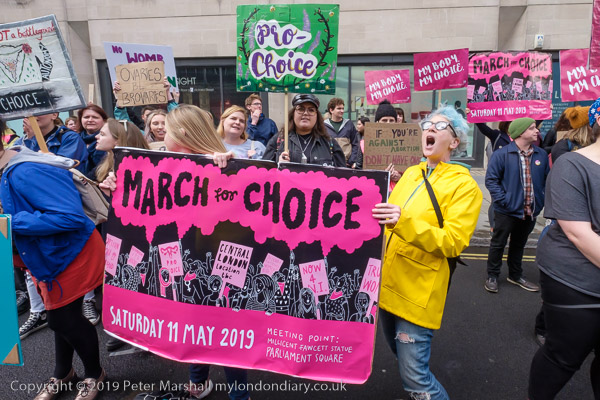
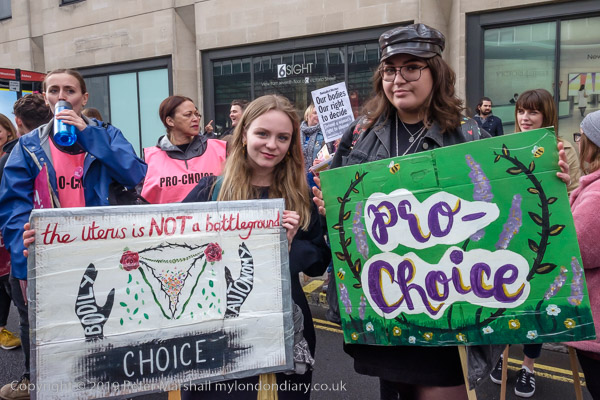
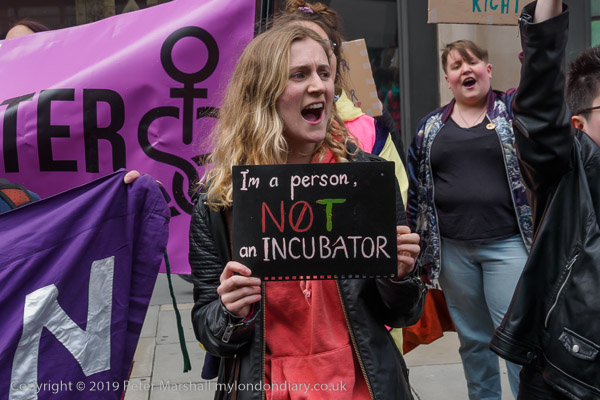
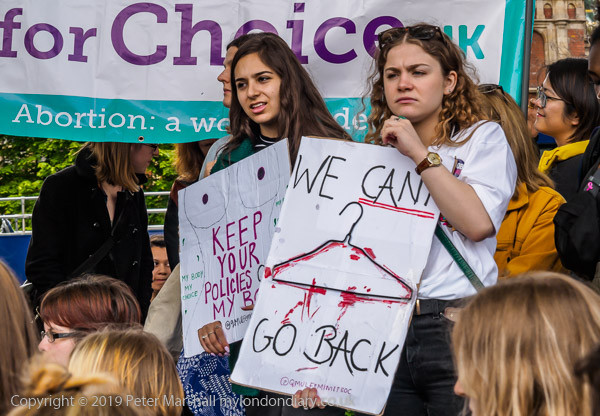
I missed the rally at the end of the demonstration in solidarity with Palestine in order to photograph the feminist rally in Parliament square for reproductive rights and the decriminalisation of abortion.
I felt by the time I left the Palestinian march I had enough pictures, particularly because I had managed to get what I thought was a decent picture of Ahed Tamimi who was to speak at the rally. Most of the other speakers were probably people I had photographed previously at other events.
I sometimes criticise news photographers who come to an event, take a few pictures (often setting up rather static group pictures) and then leave. I aim to tell the story of the event, and usually hang on for long enough to do so, while they want to get a single picture and send it (or more often a selection of single pictures) to the agency or newsroom before anyone else. In terms of making a living I’m sure they are right; what gets published is generally not the best picture but the one that arrives first.
And protests are rather like buses; you can wait for ages when nothing happens and then several come along at once. I think the most I’ve covered in a single day is seven, though there have been times when I’ve had double figures for the same date in the diary I make of protests I know about.
Of course they can even be in quite different places, though I very seldom leave London it can still involve a lot of travelling, and often I have to select not just on time but also on location, though my priority is always on the issues which the event is about. Though my definition of newsworthiness is often at odds with that of the mainstream media editors.
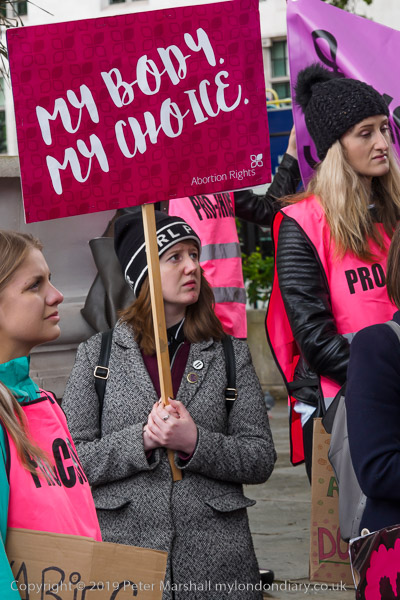
Abortion isn’t something to be encouraged or taken lightly, and I don’t believe that many women do, but the right of women to make choices about their bodies is a basic and important one. While at some point the rights of the unborn child also need to be considered, that time is most certainly not at conception but perhaps when that child becomes capable of an independent existence.
The 1967 Abortion Act was a great advance in clarifying law in this country, though unfortunately not in Northern Ireland and remains in force with the normal limit on abortion having been reduced from 28 weeks to 24 in 1990. It was a great advance as before 1967 the major cause of maternal deaths – around 60 -70 per year was unsafe abortions. And many children who might otherwise have been aborted because their mothers took thalidomide were born with severe or even fatal disabilities.
Apparently now 1 in 3 women in this country will at some time have a legal termination. Abortion outside the provisions of the Act (or in Northern Ireland under almost all circumstances) is still a crime – and can carry a sentence for both women and those who carry it out of life imprisonment.
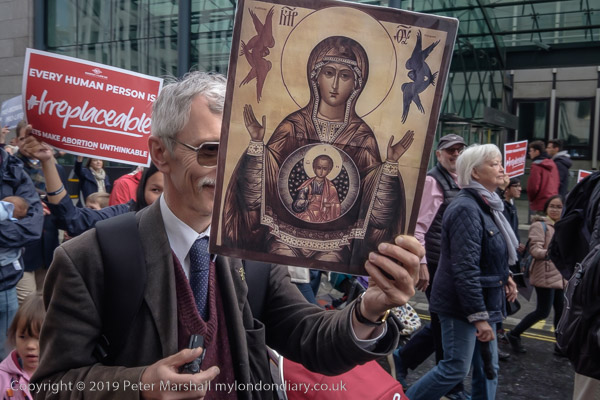
The ‘March for Choice’ was not really a march, but a rally followed by a short walk to a static protest in opposition to the anti-abortion March for Life UK, a largely Catholic event based on extreme right protests in the USA. March for Choice say it is made up of extreme anti-women, anti-choice, evangelical groups which regularly harass women outside abortion clinics, and has links to homophobic, fascist and far-right organisations. As well as abortion, it opposes contraception, sex education and IVF treatment.
All photographs on this and my other sites, unless otherwise stated, are taken by and copyright of Peter Marshall, and are available for reproduction or can be bought as prints.
There are no adverts on this site and it receives no sponsorship, and I like to keep it that way. But it does take a considerable amount of my time and thought, and if you enjoy reading it, please share on social media. And small donations via Paypal – perhaps the cost of a beer – would be appreciated.