National Gallery, Trayvon Martin & Dykes – 2012

National Gallery, Trayvon Martin & Dykes: Saturday 31 March 2012 I began outside the National Gallery were the Campaign Against the Arms Trade (CAAT) were demanding that the gallery stopped hosting events for the arms trade. From there I went to the US Embassy in Grosvenor Square for a protest about the US failure to prosecute the killer of black teenager Trayvon Martin. Finally I went to London’s first Dyke March since the 1980s.


Disarm The National Gallery

Trafalgar Square
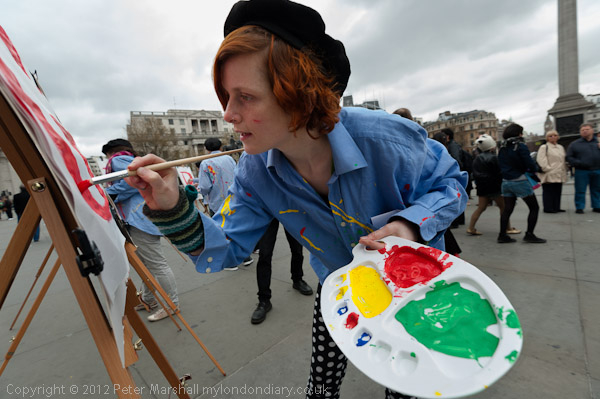
Around 20 protesters had come to Trafalgar square as ‘artists’, dressed in blue paint-stained smocks and equipped with moustaches, berets, paint brushes, palettes and easels with large sheets of paper and a smattering of Franglais.
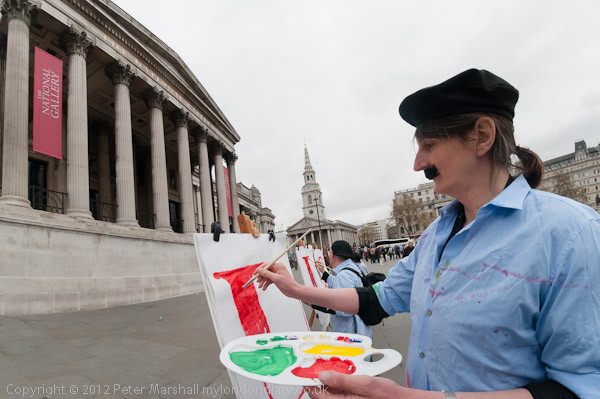
They erected their easels in a line on the North Terrace in front of the National Gallery and painted the letters D, I, S, A, R, M, T, H, E, G, A, L, L, E, R and Y anbefore standing with them in front of the gallery.
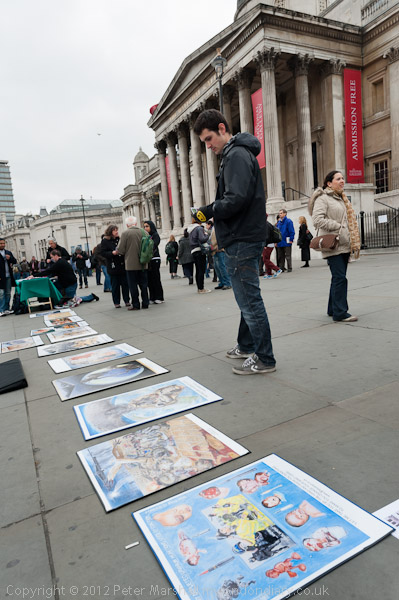
There also brought other anti-war artworks to display and handed out postcards for onlookers to sign calling on Nicholas Penny, Director of the National Gallery, to end his support of the arms trade.
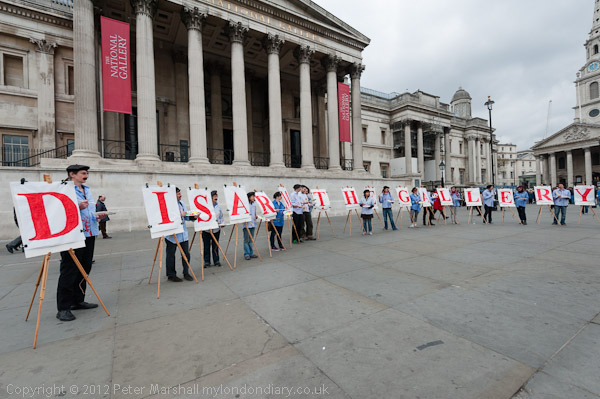
The main entrances of the gallery were closed during the protest and a long queue built up at the lower entrance. Many in that line were amazed to find that an art gallery was supporting arms sales. As the postcard says – and people overwhelmingly agreed – Art and arms don’t mix.

The Disarm the Gallery protest was organised by the Campaign Against the Arms Trade (CAAT) as the during the DSEi arms fair the previous September, weapons manufacturer Finmeccanica had paid the gallery £30,000 to hold events there.

DSEi is the worlds largest arms fair with buyers and sellers from around the world including many corrupt and tyrannical regimes, selling the equipment used by dictators around the world to equip armies and police to keep order and fuelling conflicts which kill thousands if not millions.

Disarm The National Gallery


Protest for Trayvon Martin

US Embassy, Grosvenor Square
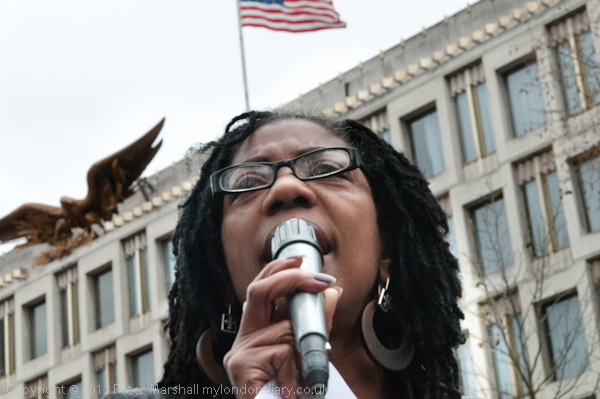
Marcia, sister of Sean Rigg, killed by police in Brixton police station speaks at the US embassy protest

Black teenager Trayvon Martin was walking back from a local convenience store to the house in Florida where he was staying with this father when he was stopped and then shot dead by George Zimmerman, a self appointed neighbourhood watchman who claimed he had felt threatened by a black teenager wearing a hoodie.
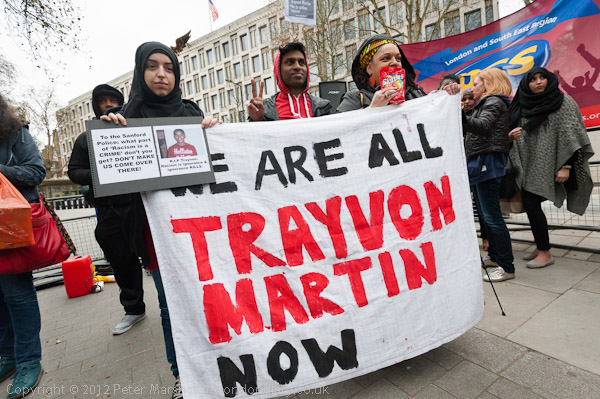
He had gone to the shop to buy a soft drink and some Skittle sweets and many at the protest wore hoodies and carried packets of Skittles and soft drinks.
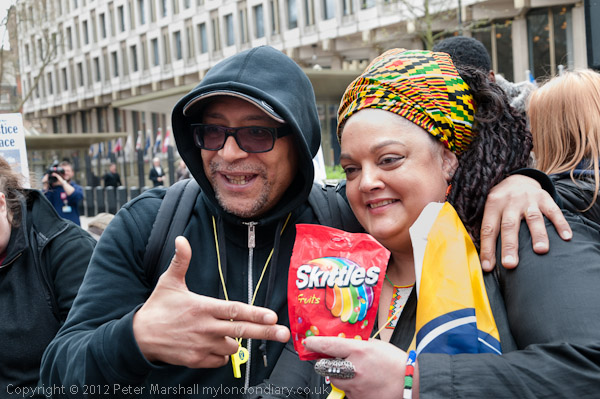
Lee Jasper and Zita Holbourne of BARAC

Florida police backed Zimmerman’s story that he had acted in self-defence and refused to arrest or charge him. Later the pressure from protests like this across America and around the world led to him being brought to trial, but a Florida jury acquitted him.
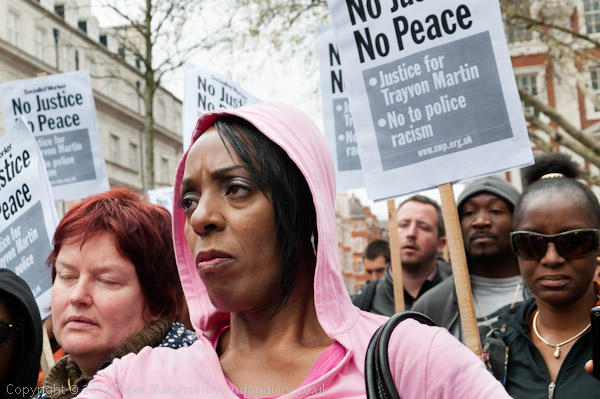
People stressed that the killing of Trayvon Martin very much reflects the treatment of black people not just in the USA but elsewhere including the UK

The embassy protest was was chaired by Merlin Emmanuel, brother of Smiley Culture, killed by police in his own kitchen, and speakers included Marcia, the brother of Sean Rigg, murdered in Brixton Police Station. Other speakers also brought up cases of deaths and discriminaton by police in the UK.

More pictures at Protest for Trayvon Martin.


London Dyke March 2012

Soho Square – South Bank
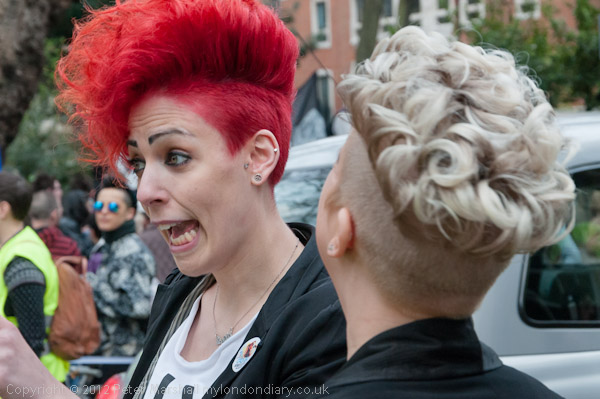
Stella and Lucy of DIVA magazine in Soho Square for the London Dyke March

After a rally in Soho Square over 600 women marched through Soho and Trafalgar Square to the National Theatre.
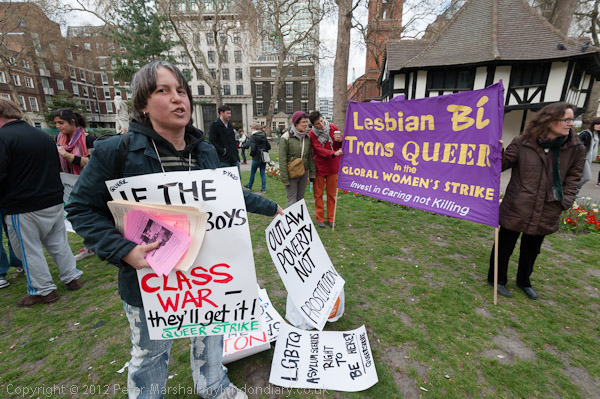
The march was the first dyke march since the 1980s and set out to support dyke visibility and welcomed “dykes, queers, bisexuals, transwomen, genderqueers and allies” and “all folk who want to support dykes to march with us” in “a grassroots, non-commercial, anti-racist, community-centred, accessible, inclusive event.”
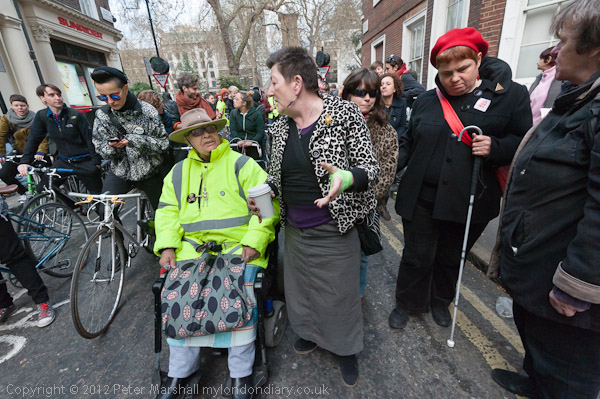
Speakers at the rally “were Kirstean Hearn, the chair of Inclusion London and someone who as a member of Equality 2005 gives disability equality advice to government, Lady Phyll Opoku, co-founder and Managing Director of UK Black Pride, journalist and founding editor of METQ magazine Paris Lees, Shi tou, an artist and film-maker who was the first lesbian to come out on Chinese TV and one of China’s most prominent lesbian activists, and Clare B Dimyon, awarded a MBE in 2010 for her work supporting LGBT people in Central and Eastern Europe.”

You can view many more pictures of the march and rally on My London Diary, including pictures of most or all of the speakers at London Dyke March 2012.


FlickrFacebookMy London DiaryHull PhotosLea ValleyParis
London’s Industrial HeritageLondon Photos

All photographs on this page are copyright © Peter Marshall.
Contact me to buy prints or licence to reproduce.

Keep our NHS Public – 2007

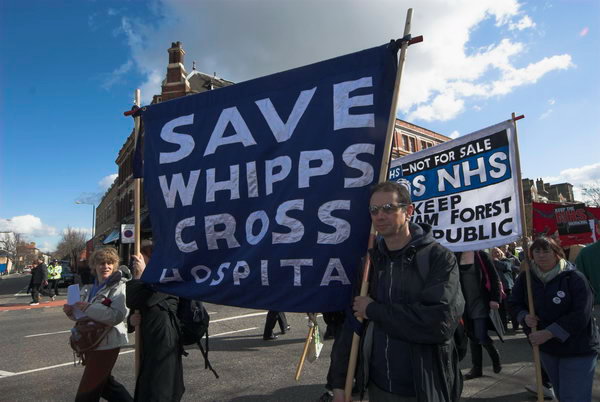
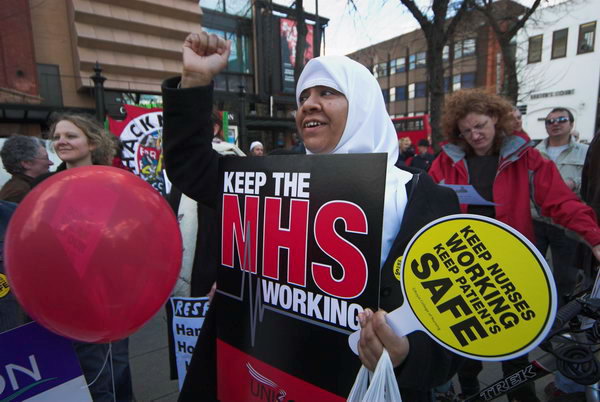
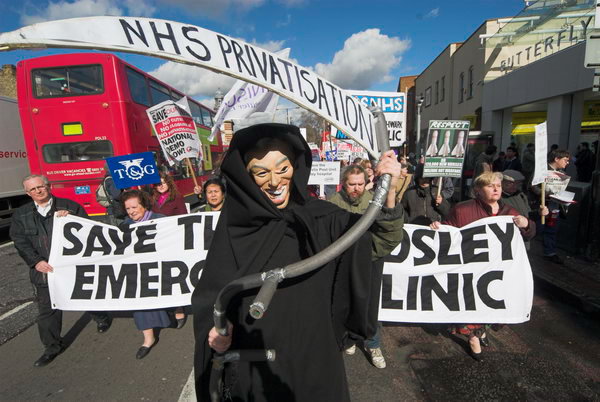
Keep our NHS Public: Saturday 3rd March 2007 saw protests around the country against the increasing privatisation of the National Health Service and I managed to cover several of these events in London, a march in Camberwell followed by a march from Whitechapel to Hackney Town Hall where they joined others who had marched in Hackney. After finishing my coverage of these events I photographed the Hare Krishna in Soho and then went to the Photographers Gallery.

Keep our NHS Public - 2007
The march on its way to the Maudsley Hospital

Here I’ll publish what I wrote back then on My London Diary with the usual corrections to spelling and capitalisation. Reading what I wrote below again now I think I was far too generous to New Labour. Although some MPs may have been well-intentioned I think the policies were largely driven by those with personal financial interests in private healthcare and other sectors that would profit from them. The NHS (and us) are still suffering from their actions and I have little confidence in the changes the current Labour government is now making.

Keep our NHS Public – Saturday 3rd March 2007

Keep our NHS Public - 2007
Local MP Kate Hooey gave her support to keeping the NHS public

Although health workers and other trade unionists had called for a national demonstration in London, the union bosses declined to organise one, perhaps not wanting to embarrass an already beleaguered Labour government. What took place instead was a whole series of local demonstrations – including at least 7 in the Greater London area – across the whole country.

Keep our NHS Public - 2007

The overall effect was perhaps to make it more impressive, and certainly it seemed to get more coverage in the media that might otherwise have been expected, although there were few reporters and no TV crews at the three events I photographed (for some reason they preferred Sheffield.)

Keep our NHS Public - 2007

Largely well-intentioned attempts to improve the health service have failed to deliver as they should, with many services being cut. Part of this has been caused by a dogmatic insistence on making use of private finance with results that range from fiasco to farce, inevitably accompanied by long-term financial loss.

A second disastrous dogma has led to bringing in private enterprise to do the simple work at artificially inflated prices (they even get paid for work they are not doing) which has the secondary result of making the NHS services appear more expensive, as they are left to deal with the trickier cases.

Kate Hooey holds the main banner with others on the Camberwell march

Further blows to our national health service have been through the predictably disastrous IT projects; as well as going millions over budget, these have largely failed to deliver. Add the proliferation of management and expensive consultants, along with crazed assumptions in negotiating doctors’ pay leading to an unbelievably generous offer, and it it hardly surprising that the whole system is in financial chaos.

The government clearly lacks a real commitment to the kind of National Health Service many of us grew up with, run for the benefit of the people rather than to make money for healthcare corporations. The health service certainly needed a shake-up to reduce bureaucracy and eliminate wasteful practices, but instead new layers of both have and are being added.

Outside the Maudsley Hospital – reading the letter which a delegation then delivered

I started off in Camberwell, and had time for a short walk before the speeches and march began. It wasn’t a huge event, but there was strong support from those in the service, from patients and from pensioners, as well as local MP Kate Hooey. From Camberwell Green the march went down to the Maudsley Hosptial where a letter was handed in and I got on a bus and left for Bethnal Green and Hackney.

Going up the Cambridge Heath Road in the centre of Bethnal Green, I saw the march from the Royal London Hospital in Whitechapel to Hackney in the distance. Unfortunately the bus was held up in the traffic behind it, taking almost five minutes to reach the next stop before the driver would open the doors and let me off. Some things were a lot easier with the Routemasters.

This was a smaller march than that from Camberwell, and after a few minutes I felt I’d photographed all I could, so I ran ahead and caught a bus for the centre of Hackney, arriving there just a couple of minutes before the Hackney march, which had come from Homerton Hospital, had returned to the town hall. I photographed them arriving and then the rally that ensued.

The Hackney march was a little larger, perhaps around two hundred, and there were quite a few speakers, including local councillors and representatives from the various organisations that had helped to organise the march.

A big cheer went up as the march from Whitechapel arrived, swelling the numbers in the square at the town hall.

Lindsey German who lives in Hackney

Among the better known speakers taking part were George Galloway, whose speech lived up to his usual high standards of wit and common sense. Lindsay German, a hackney resident well known for her work for ‘Stop The War’ also spoke with feeling on the issues of health and the NHS. Several of the other speakers were old enough to have known the problems before the health service was set up.

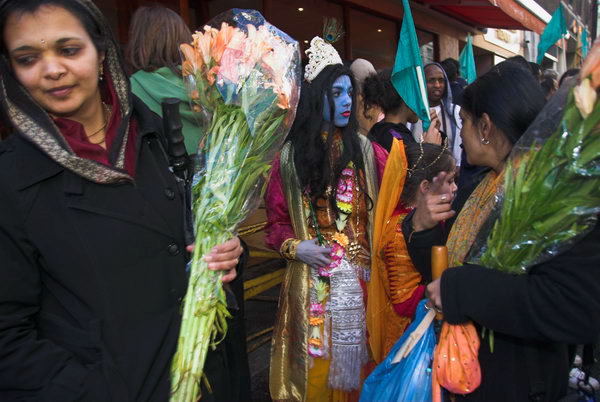
As the meeting began to wind down, I caught a bus to Bethnal Green and then the tube to Tottenham Court Road. Just to the north of Soho Square I got to the Hare Krishna Temple just as the annual Gaura Purnima [Golden Full Moon] procession was arriving back from its tour around the area.

Churchill and an entrance to a stairway with a red light

From there I went to the Photographers’ Gallery to have a good look at this year’s photography prize contestants. I hope the prize goes to one of the two photographers on the shortlist, Philippe Chance or Anders Petersen. [Neither won.] Walking through Soho and Westminster I took a few more pictures.

More pictures on My London Diary.


FlickrFacebookMy London DiaryHull PhotosLea ValleyParis
London’s Industrial HeritageLondon Photos

All photographs on this page are copyright © Peter Marshall.
Contact me to buy prints or licence to reproduce.


Hate Crime, Turkish Invasion, Hong Kong & More

Hate Crime, Turkish Invasion, Hong Kong & More – Saturday 2nd November 2019 was a busy day for me and I made six posts from different events on My London Diary – and here is a little about each in the order of my day.


Day of the Dead – Columbia Market, Bethnal Green

Hate Crime, Turkish Invasion, Hong Kong & More

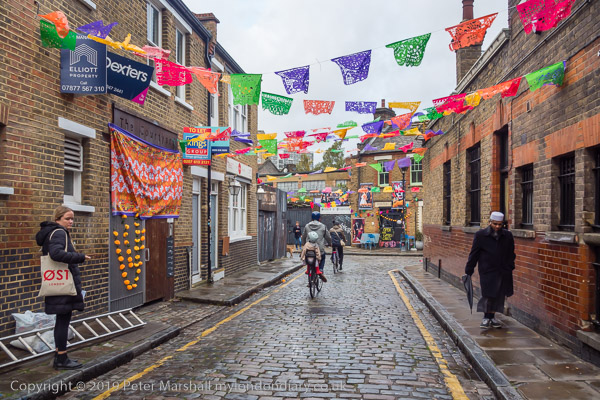
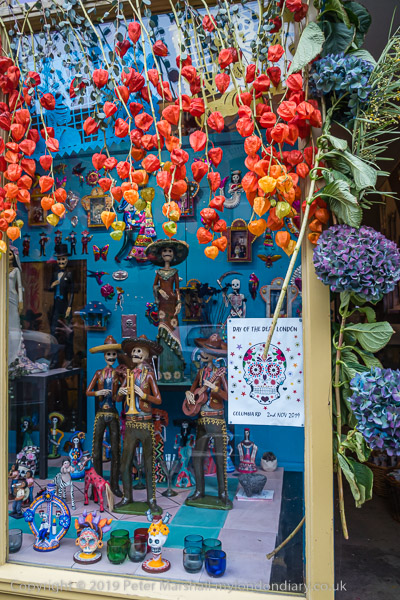
I walked from Hoxton Overground station to Columbia Market which was holding a festival for the Mexican Day of the Dead, arriving at the time this was supposed to start. But it had been raining heavily and had only just stopped which had put off others from coming early and the streets were pretty deserted. So all I was able to photograph were the decorations on the street and on some of the shops.

Hate Crime, Turkish Invasion, Hong Kong & More

Things would almost certainly have become more interesting had I stayed, but I had other things to attend and had to leave after around half an hour. I’d intended to return later but was too busy. I did take a few pictures as I walked to and from the station as well.

Day of the Dead


Against constitutional change in Guinea – Downing St

Hate Crime, Turkish Invasion, Hong Kong & More

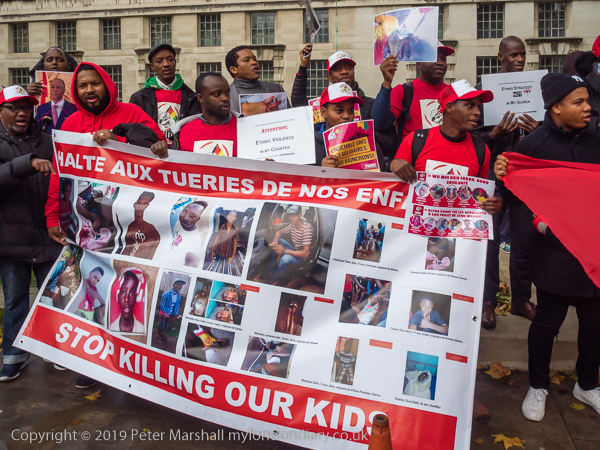
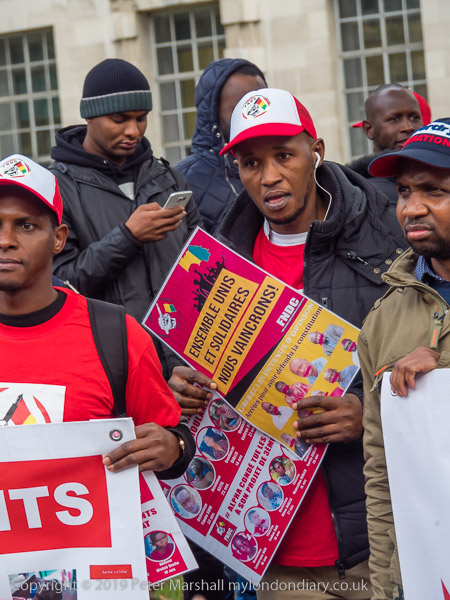
Back in central Westminster I photographed protesters from the UK branch of the National Front for the Defence of the Constitution (FNDC) who were demanding that President Alpha Conde abandoned the constitutional chages that would enable him to seek a third term in power.

Hate Crime, Turkish Invasion, Hong Kong & More

The London protest came after massive protests in Guinea in October during which 11 people had been killed in government violence against the opposition and peaceful protesters. They called for an end to and end to the killing and the release of all political prisoners, with posters showing the victims and calling for peace and justice in their country.

Against constitutional change in Guinea


Stop Hate Crime, Educate for Diversity – Downing Street

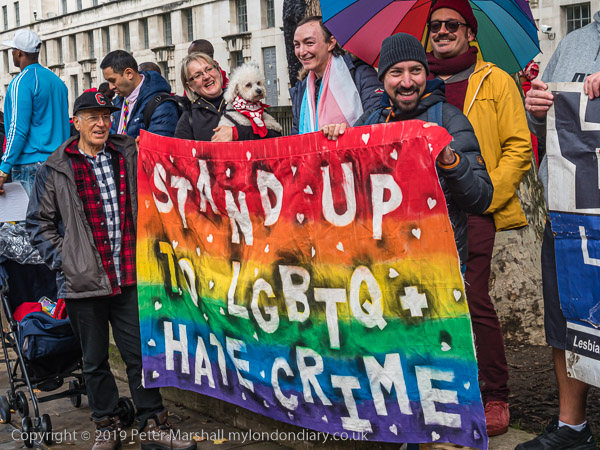
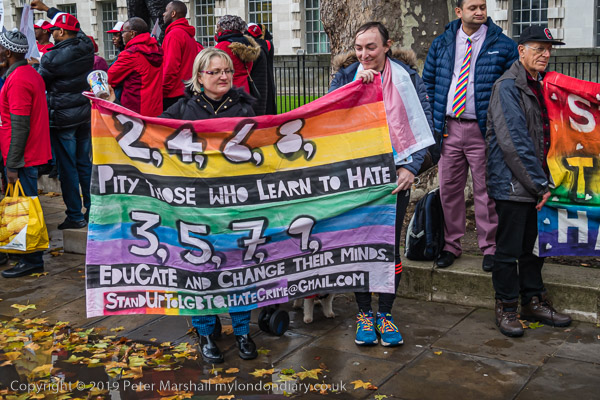
Also at Downing Street, campaigners from Stand Up to Lgbtq+ Hate Crime condemned the increasing incidence of hate crime and bigotry against LGBTQ+ people and defended the teaching of lessons which feature LGBTQ+ families and relationships.

Their message was one of celebrating love, inclusion and diversity and say No to Homophobia, Islamophobia and Transphobia. I took some pictures and left as some began to speak about their own experience of discrimination at school before before the group marched to Eros in Piccadilly Circus for a further rally.

Stop Hate Crime, Educate for Diversity


Defend Rojava against Turkish Invasion – Marble Arch & Oxford St

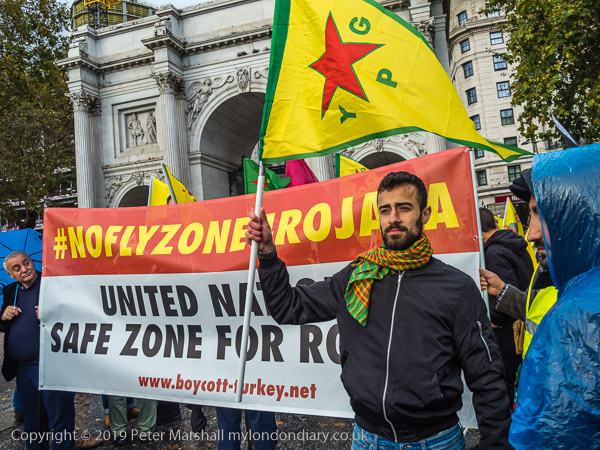
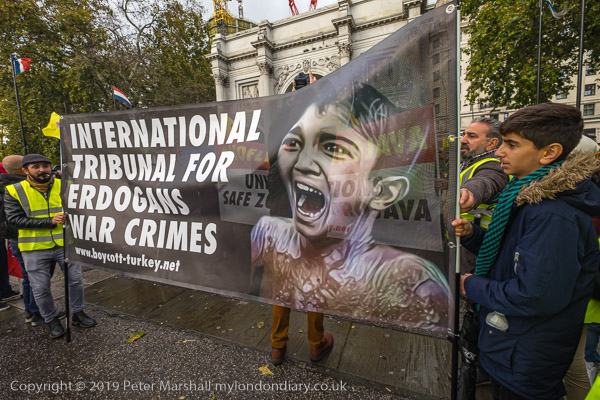
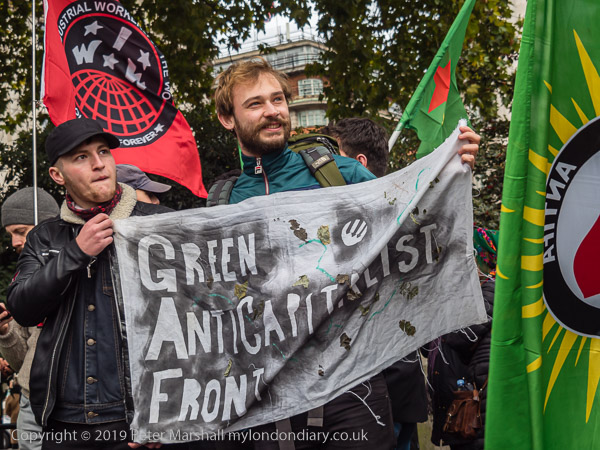
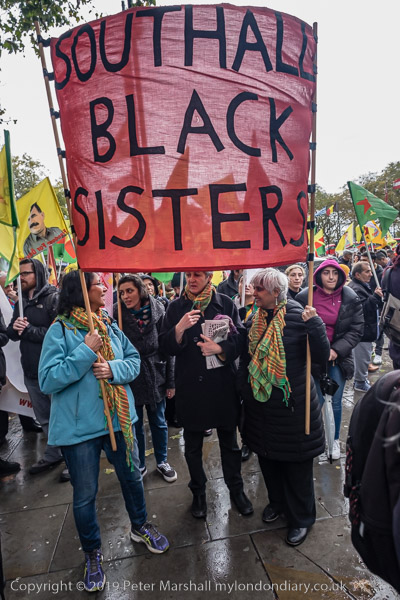
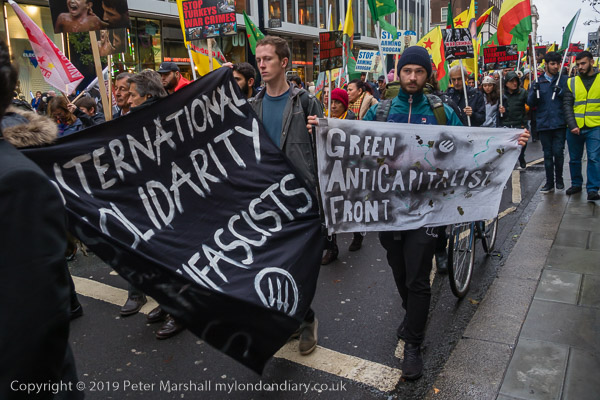
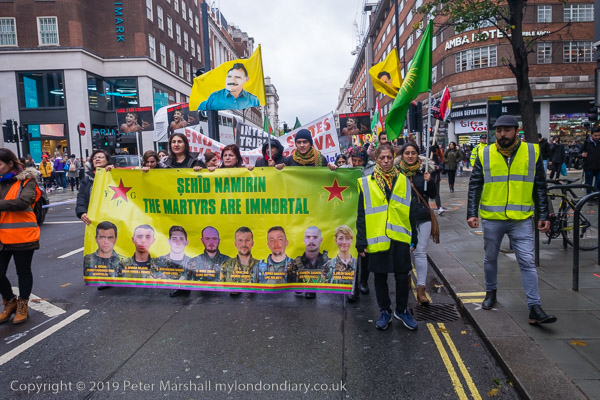
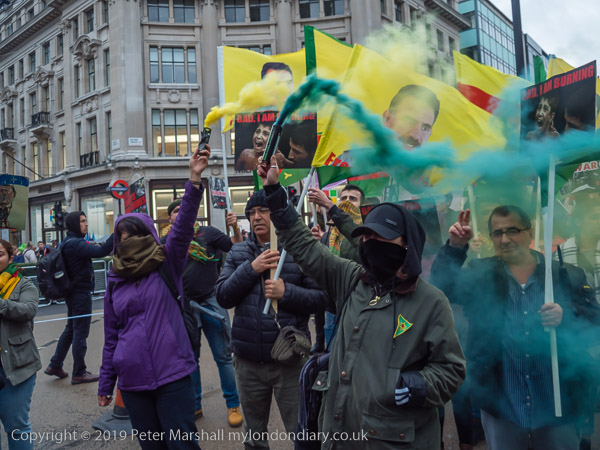
The largest protest of the day was a a rally and march in support of Rojava in North-East Syria against Turkish invasion which gathered at Marble Arch.

Since soon after the start of the revolution in Syria a large area of the country had been under the de-facto control of a Kurdish-led democratic administration which has put ecological justice, a cooperative economy and women’s liberation at the heart of society, enshrined in a constitution which recognises the rights of the many ethnic communities in the area.

Many have seen this area, Rojava, as an important model for more democratic government, particularly in multi-ethnic areas, but Turkey sees it as a threat on its borders. For generations it has been discriminating and fighting against its own Kurdish population which makes up almost a fifth of the country’s population, and the Kurdish leader Abdullah Ocalan, held in prison in Turkey since he was abducted from Kenya in 1999.

In prison Ocalan continued to campaign for the Kurdish people but had moved away from militancy towards political solutions. In jail he wrote about the rights of women and developed the philosophy of democratic confederalism which forms the basis of the constitution of Rojava.

Rojava has received wide support for its principles from environmental groups, green movements, feminists, human rights supports and those generally on the left, but not from western governments who see it as a threat to capitalist hegemony.

Despite this, the Kurdish people’s defence forces in Syria with the aid of US air power led the successful fight against ISIS. Turkey had backed ISIS although denying to do so, aiding them in getting the massive funds they needed by smuggling out oil from the ISIS held regions. Again they saw ISIS as an ally in their fight against the Kurds.

When Trump withdrew US troops from Syria, Turkey took advantage of this to invade areas of Syria controlled by the Kurds, and to encourage and aid Islamic groups to join them in their attacks. Turkey as a member of NATO has been encouraged and helped to develop its armed forces and is second only to the USA within Nation and is said to be the 13th largest military power in the world.

The Turkish invasion threatened the existence of Rojava, who had been forced to go to both Russia and President Asad of Syria for support. Obviously this threatens the future of the area and its constitution and its long-term hopes of autonomy in the area.

I left the protest on Oxford St on its way to the BBC who they accuse of having failed to report accurately on what is happening in the area. There had certainly been very little coverage of the recent events and a long-term failure to address issues of discrimination against the Kurds in Turkey.

Defend Rojava against Turkish Invasion


March for Autonomy for Hong Kong – Marble Arch & Oxford St

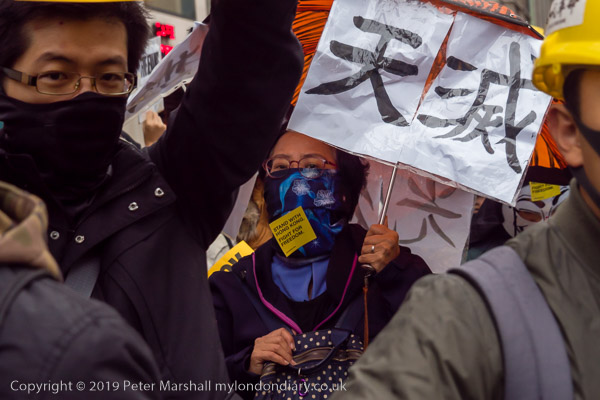
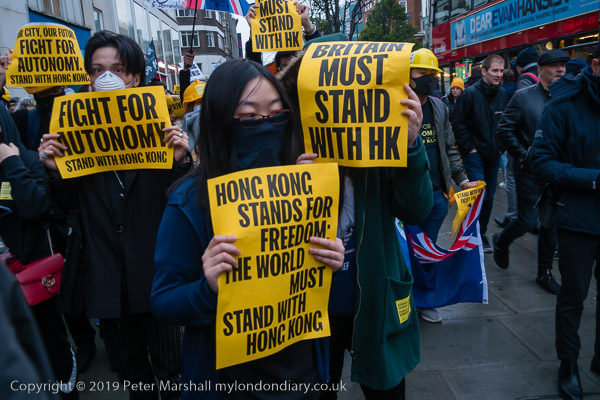
Also meeting at Marble Arch were protesters, mainly Chinese from Hong Kong living in the UK, and in solidarity and supporting the five demands of those then protesting in Hong Kong. Many wore masks to protect their identity, either because they may return home or fear their families there may be persecuted.

They demanded complete withdrawal of the Extradition Bill, a retraction of characterising the protests as riots, withdrawal of prosecutions against protesters, an independent investigation into police brutality and the implementation of Dual Universal Suffrage.

More pictures at March for Autonomy for Hong Kong


Queer Solidarity for trans and non-binary – Soho Square

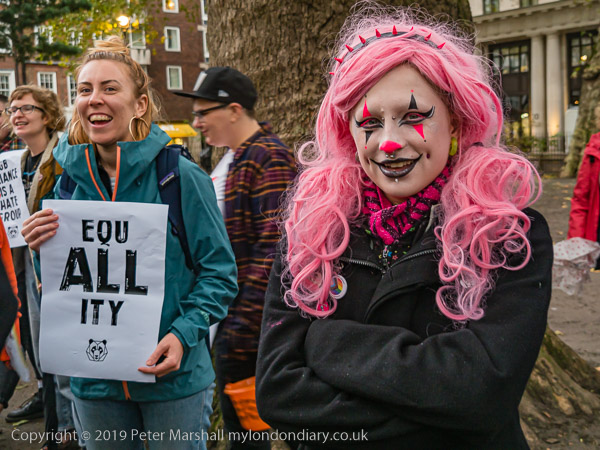
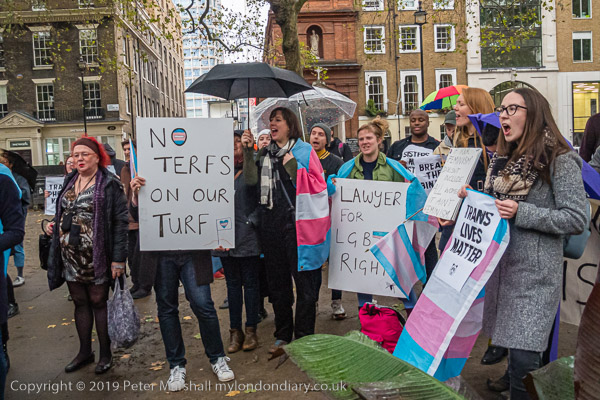
Bi Survivors Network, London Bi Pandas, Sister Not Cister UK, BwiththeT and LwiththeT held a rally in Soho Square pointing out that the newly announced LGB Alliance’, which claims to be protecting LGB people is actually a hate group promoting transphobia.

They pointed out that trans and non-binary people have always been a part of the gay community and played an important part in the fight for gay rights and in particular Stonewall, and there is no place for such bi-phobic and gay-separatist views in the gay community.

More pictures: Queer Solidarity for trans and non-binary


More 1987 – Mainly Soho

Camden Town Cemetery, St Martin's Gardens, Camden St, Camden, 1987 87-1k-46_2400
Camden Town Cemetery, St Martin’s Gardens, Camden St, Camden, 1987

The slow process of putting up my old black and white pictures is continuing, thanks to the lockdown leaving the time on my hands. Although I’m going out of the house for exercise, that only occupies around 50 minutes of the day – and perhaps another half hour to recover.

This picture of the piled up gravestones in Camden Town Cemetery was taken in January and is one of the last from that month I’ve put on line. Although I’ve always liked to wander in cemeteries, often the only real places of peace and quiet in cities, and often good places to rest and eat my sandwiches, I’ve generally tried hard to avoid taking too many pictures in them unless there is a very strong reason to do so.

Partly because as a teacher of photography I saw far too many pictures by students of gravestones and monuments. They were easy to photograph, didn’t move much or complain about being photographed and supposedly said something profound about the human condition. At the in-house moderation of student photography coursework from across the country it was never long before I or another assistant examiner would be exclaiming “Not another sodding angel!”.

Wardour St, Soho, Westminster, 1987 87-2f-55-positive_2400
Wardour St, Soho, Westminster, 1987

In February I turned my attention to Soho, where photography was not always welcomed, though I didn’t intend to emphasise its more sordid aspects. It was one of London’s most varied and interesting areas, and remains so despite the ravages of property developers and Westminster Council.

But I didn’t avoid photographing the frontages offering ‘Intimate Bed Show – No Extras‘ though I didn’t go inside and photographed them in the early mornings when there were few touts or barkers around and any workers who might have occupied them were at home in their own beds. Nor did I meet the ‘Very Sexy Busty Brunette Model‘ whose notice was by a door in D’Arblay St, not even to make my excuses and leave.

Shop WIndow, Berwick St, Soho, Westminster, 1987 87-2f-46-positive_2400

But Soho was remarkable for the variety of shops, a place were almost everything was on sale – and sometimes it was difficult to know exactly what was on offer.

Butterfly, Upper James St, Soho, Westminster, 1987 87-2g-14-positive_2400
Butterfly, Upper James St, Soho, Westminster, 1987

There is still a clothes shop on the corner of Upper James St and Beak St, but it is now larger and more corporate, with a bland plate glass frontage, and Butterfly proved to be as ephemeral as its name suggests. Many other Soho businesses were longer lasting, and Randall & Aubin, late Morin and Cavereau remains in place on Brewer St, though many of the older continental businesses have now gone.

Randall & Aubin, Charcuterie, Brewer St, Soho, Westminster, 1987 87-2e-62-positive_2400

If you look through my pictures of Soho from 1987 you will find some showing the increasing Chinese presence in the area, including one of a crowd watching the New Year celebrations, but far less than in my later pictures of the area.

Charles II, Cibber, Soho Square, Soho, Westminster, 1987 87-2e-24-positive_2400
Charles II, Soho Square, Soho, Westminster, 1987

Soho Square still looked much the same when I was last there a few months before the lockdown, though I do wonder if Cibber’s statue of Charles II looks rather more worn now. Though we may now regret the restoration of the monarchy and feel that the puritanical excesses of the Commonwealth would better have been ended without bringing back a king the so-called ‘Merry Monarch’ does sound in some respects an improvement on our present royal house. And a king with no legitimate children who acknowledged at least a dozen by various mistresses is perhaps a suitable character to be remembered in Soho.

Haverstock Hill, Chalk Farm, Camden, 1987 87-1a-12_2400
More at 1987 London Photos

All photographs on this and my other sites, unless otherwise stated, are taken by and copyright of Peter Marshall, and are available for reproduction or can be bought as prints.