ACTSA: Rally for Dignity & Tibet: On Saturday 10 March 2007 I photographed the ACTSA rally in Trafalgar Square and earlier in the day the annual march calling for an end to to Chinese occupation of Tibet.
Rally for Dignity
Trafalgar Square & Zimbabwe Embassy
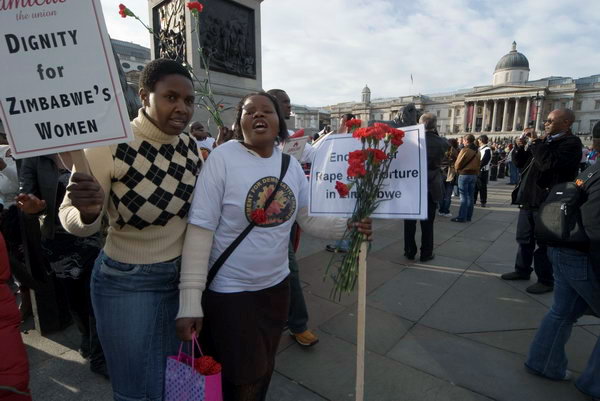
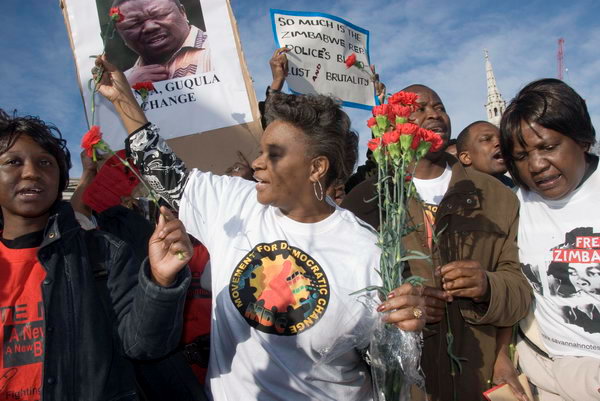
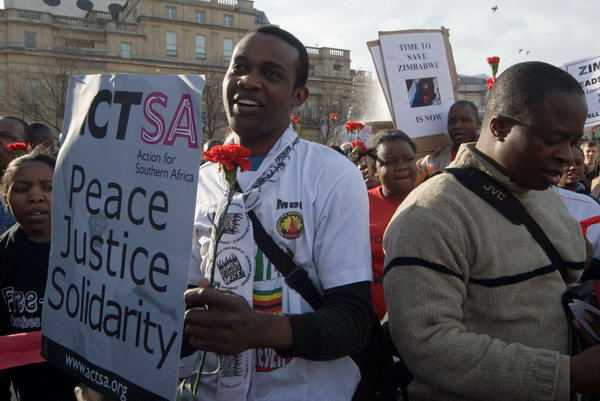
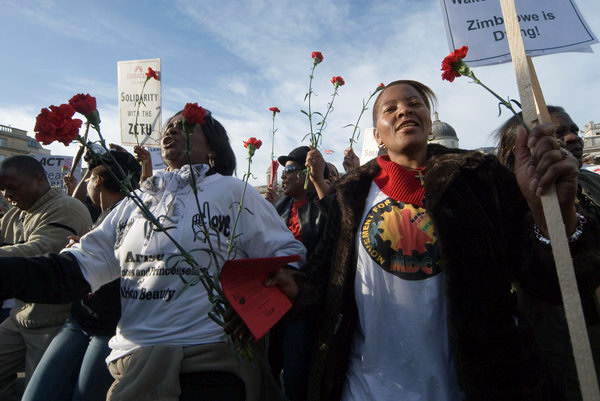
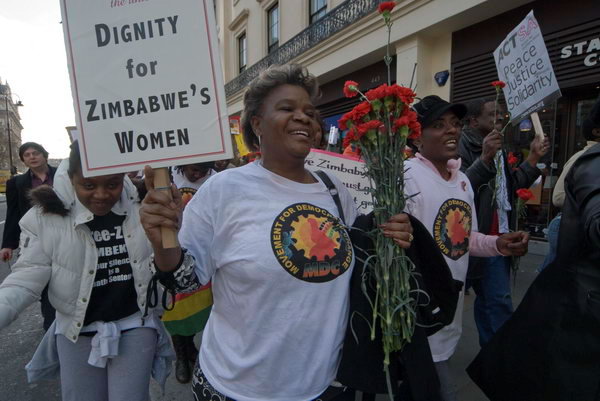
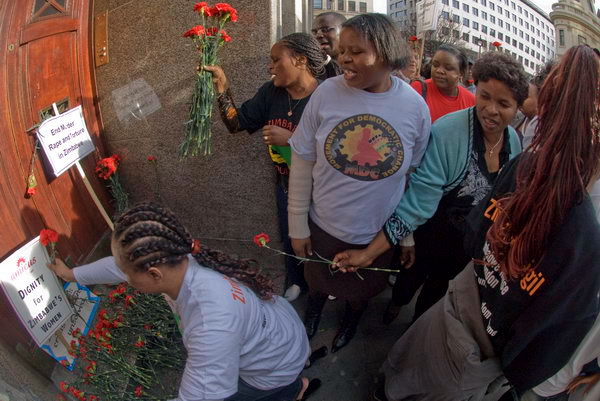
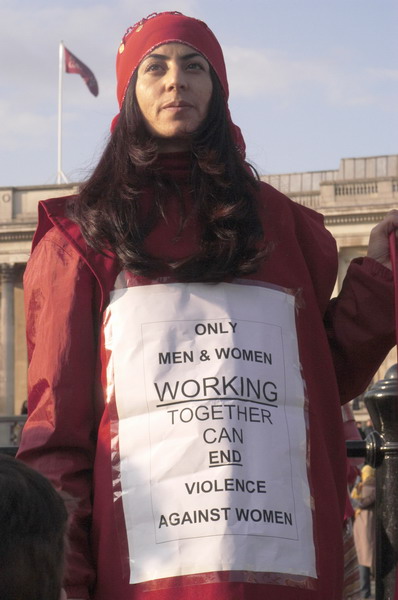
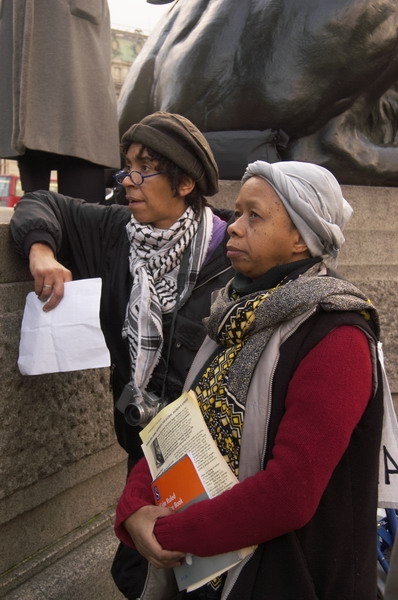
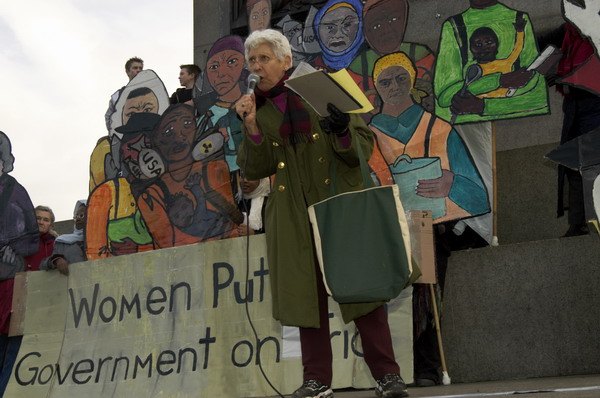
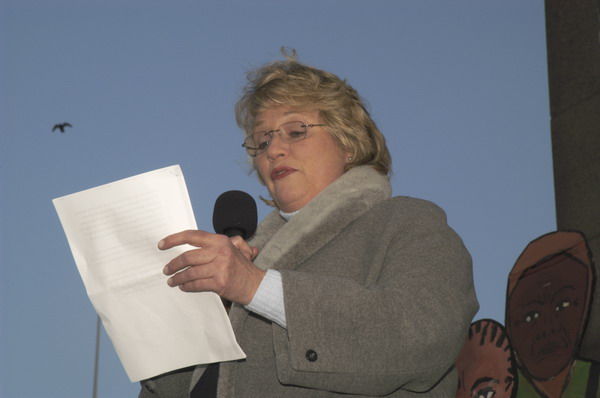
Action for Southern Africa (ACTSA) organised a rally in Trafalgar Square calling for an end to the crimes of the Mugabe regime in Zimbabwe. They called for peace, justice and solidarity with the people and an end to murder, rape and torture there and supported the DIGNITY!PERIOD campaign to provide essential sanitary protection for women backed by Amicus and Unison unions as well as ACTSA.
Many carried and gave out red carnations as symbols of the campaign and marched to lay them with placards at the door of the Zimbabwe Embassy in Strand.
Here is what I wrote in 2007:
For many years I've been a supporter of ACTSA, although I think my membership may have lapsed recently (its hard to keep up with my post.) They were the organisers of a 'Rally For Dignity' which celebrated the role of women in the worldwide struggle for justice.
Held two days after International Women's Day (8 March) it focused particularly on the struggle for freedom in Zimbabwe and on the efforts of the Zimbabwe Congress of Trade Unions.
Zimbabwe is currently in a mess, and the cause of that mess is Robert Mugabe. It is a beautiful country with some wonderful people, but so sadly crippled by a cruel, corrupt and senseless dictator who has seized land and persecuted any who dare oppose him.
The economy is in ruins, and men, women and children suffer as he rewards and lines the pockets of his supporters.
One product of many in short supply is sanitary towels, and ZCTU [Zimbabwe Congress of Trade Unions] organised the donation of these necessities by overseas friends, only to have the government demand duty on their import.
Free Tibet: 48th Anniversary of the Tibetan Rising
Westminster
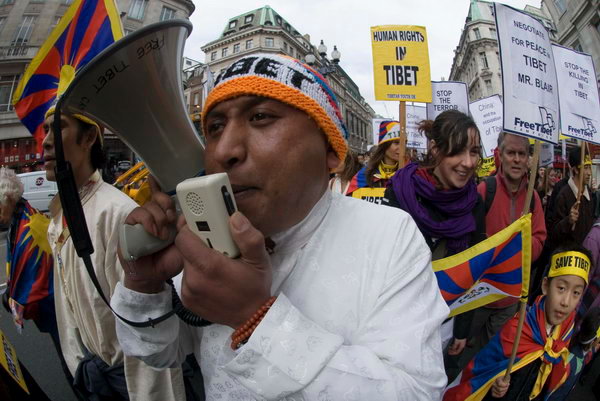
Earlier in the day I had once again photographed the annual march on the anniversary of the Tibetan Rising. I’ve written about this annual event in several posts recently so won’t write more about the 2007 march here.
You can find what I wrote in 2007 if you scroll down the March 2007 page on My London Diary, where there is also a picture of London’s second longest running protest, by Falun Gong opposite the Chinese Embassy against torture of religious prisoners in China.
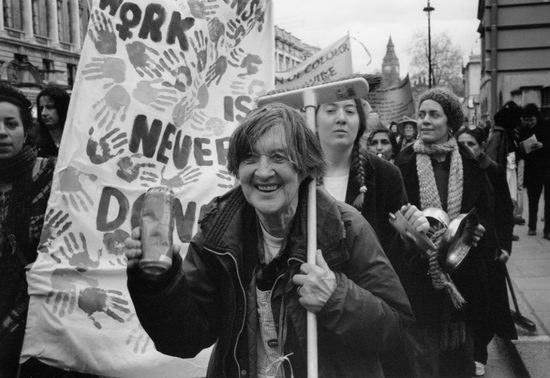
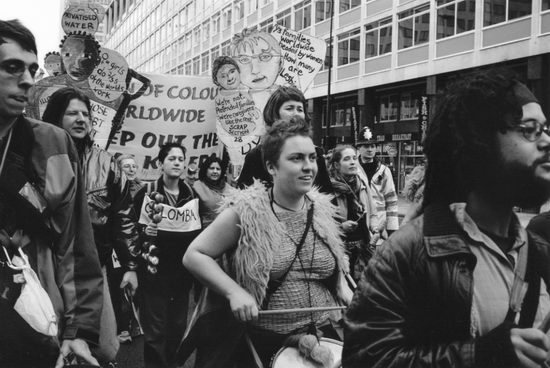
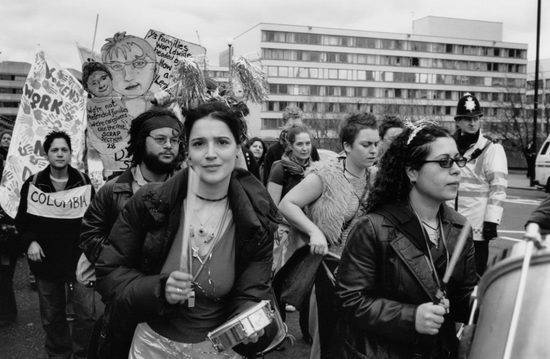
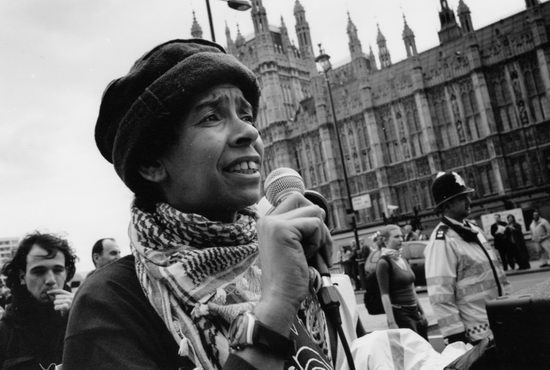
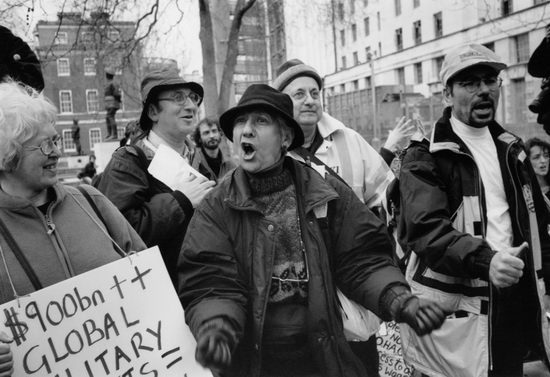
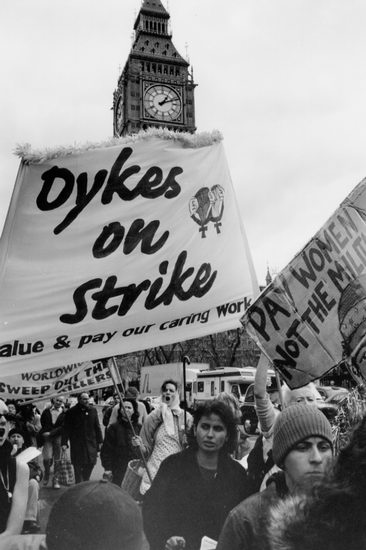
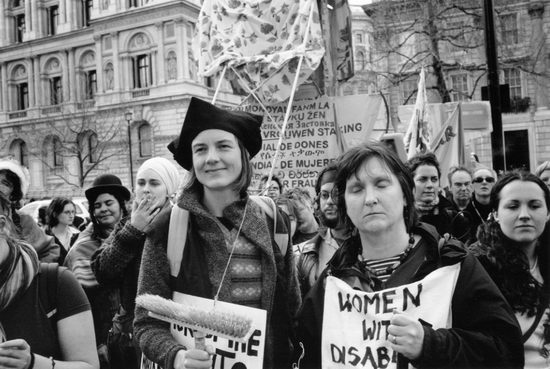
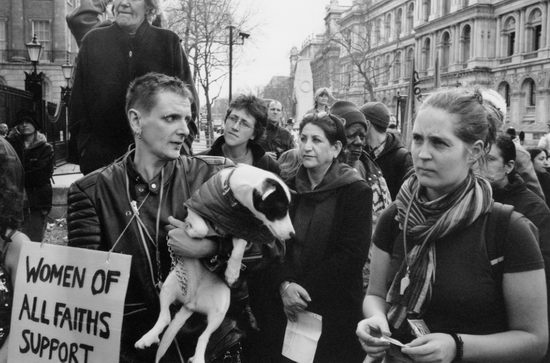
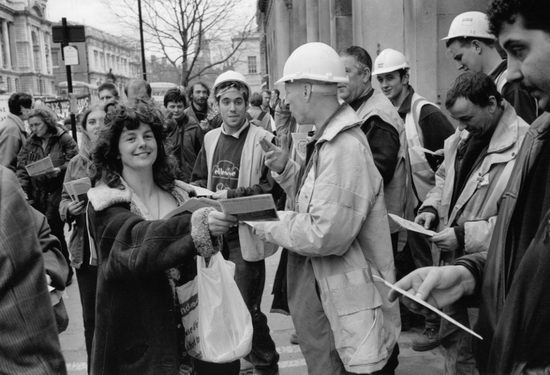
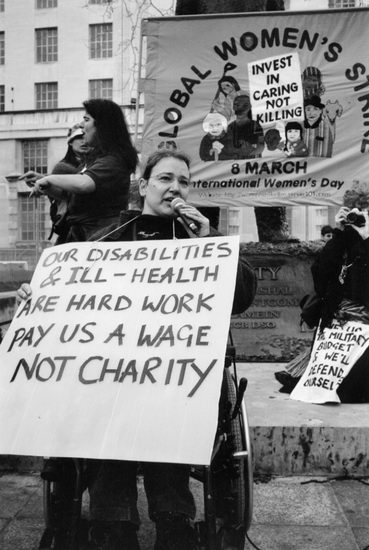
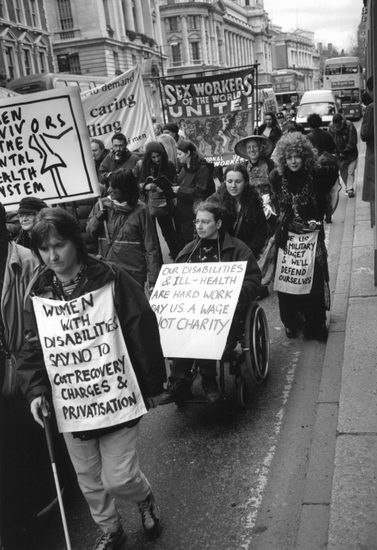
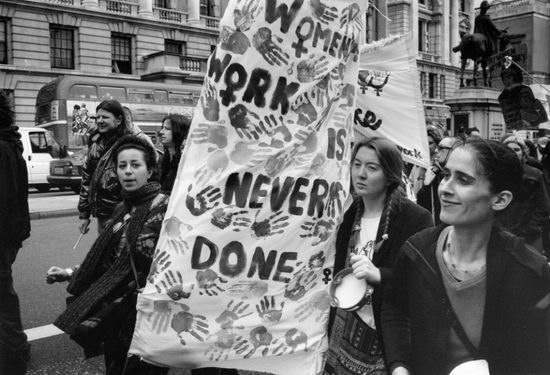
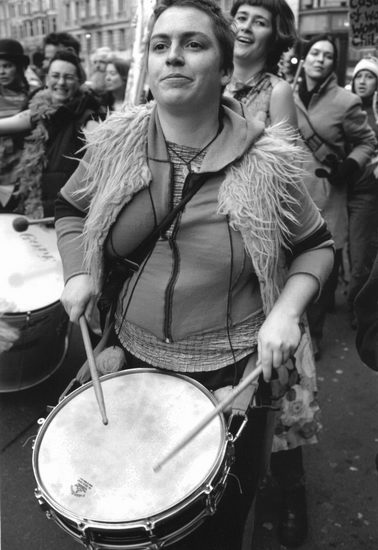
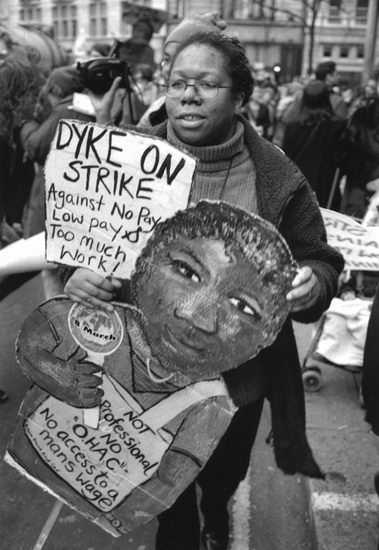
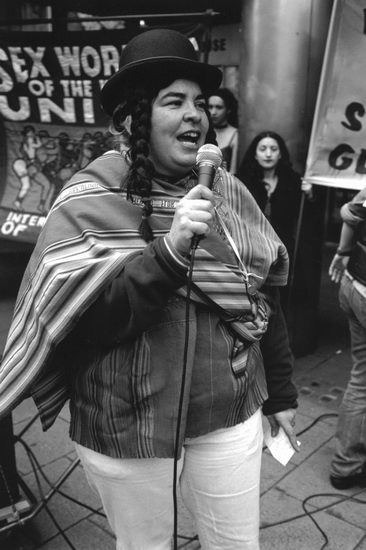
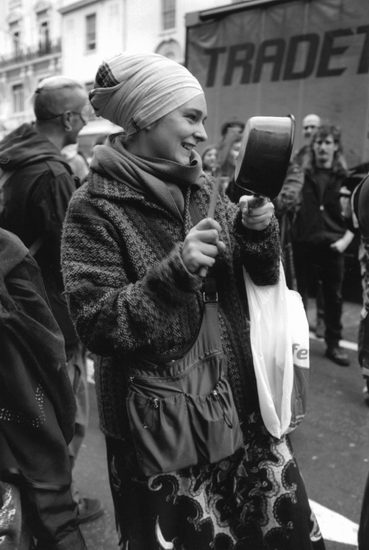
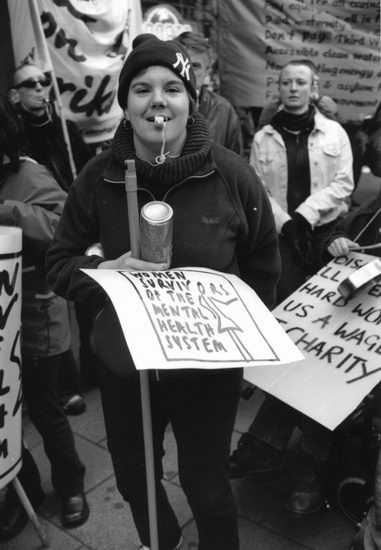
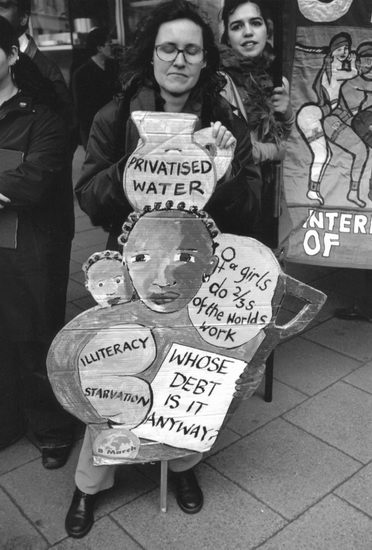
International Women’s Day: I’m not sure if this march on Friday 8th March 2002 was the first International Women’s Day event that I photographed, but it was the first that I published on My London Diary.
Back then all the pictures I published were in black and white, though I was also taking pictures in colour but was unable to easily digitise them. I still have to do so for many of the colour pictures I made on film, though I did make prints of a few of them in my darkroom.
Looking through these pictures I recognise quite a few faces I still photograph at protests, among them the founder of the Global Women’s Strike and the the International Wages for Housework Campaign Selma James.
International Women’s Day seems to have become much more widely celebrated since 2002, or at least getting more media attention, though this seems still very much around the very real problems faced by middle class professionals (including of course women in the media) than those faced by by working class women, refugees, asylum seekers, poor women being targeted by social services, those with disabilities, sex workers, victims of domestic violence, rape etc which are at the centre of this event and continuing protests.
Back in 2002, I didn’t write much about this march, at least in partly due to ignorance, but also I seldom wrote much about the events I was covering as I had a full-time job writing about photograph on the web, as well as my own photography – where the pictures I submitted had only brief captions.
“The 8 March is a World Woman’s Day and was celebrated by some as a Global Women’s Strike. The march in London stopped outside key sites including the War Office and World Bank for speeches.”
This was the full set of textt and images I posted in 2002 on My London Diary.
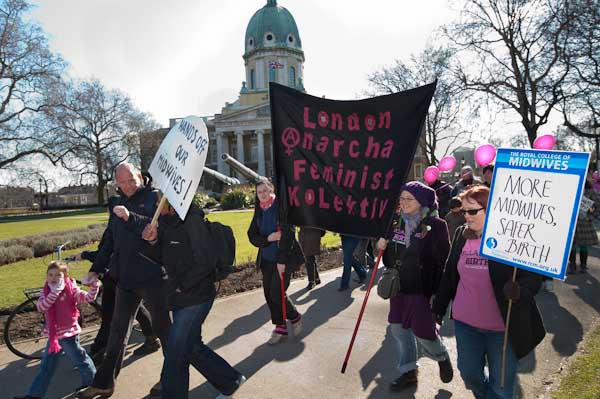
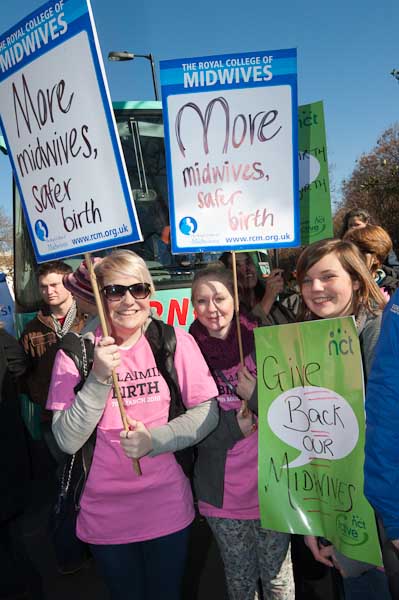
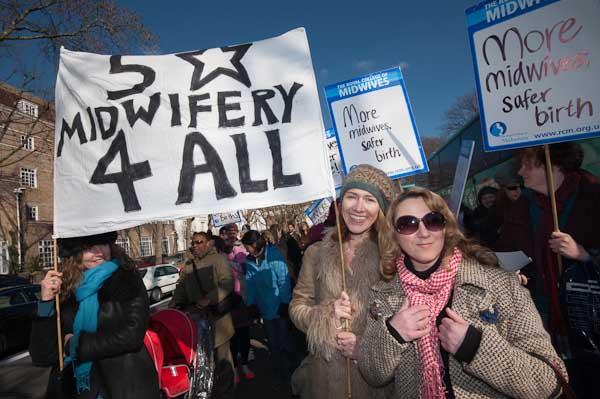
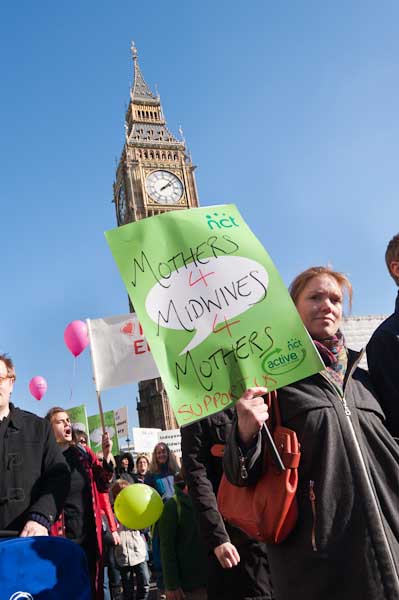
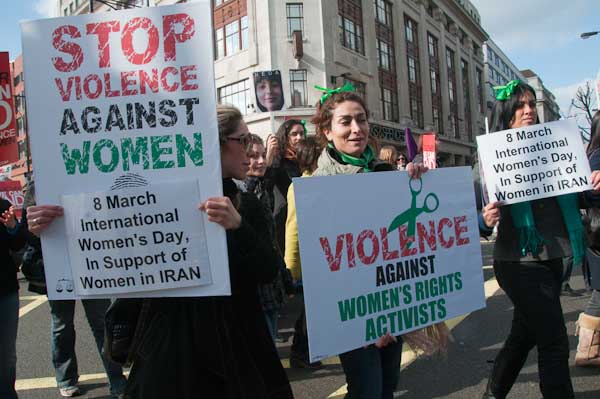
Iran & Midwives: On Sunday 7th March 2010 I photographed a protest marking International Women’s Day organised by Iranian women over the 31 years of repression and calling for an end to the Islamic regime who marched to a rally in Trafalgar Square. I then went south of the river to Geraldine Harmsworth Park for the start of a march back to Downing Street in support of better integrated midwifery services for all women.
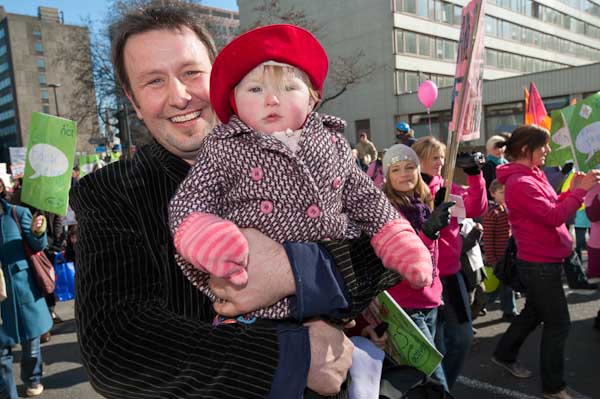
Of course there were Dads as well on the midwives march
Both Iran and maternity services are now still live issues. Baroness Amos’s interim review into maternity and neonatal services in England is harrowing and two thirds of maternity services are rated either “inadequate” or “requires improvement”.
Today I will be at a protest against the illegal war by Israel and the USA on Iran. Of course few if any support the Iranian Islamic regime, certainly not among those who like me will be at the protest.
The attacks on Iran, including the assassination of Ali Khamenei, are extremely unlikely to lead to regime change – and if anything are likely to lead to even greater repression, hardship and bloodshed in a country which is being pounded into greater poverty and extreme disorder, with possibly many years of destructive multi-sided civil wars. The decision to attack now appears to have been prompted by the Israeli fears that an agreement between the US and Iran might have been imminent – and perhaps also by the US feeling that a war might improve Trump’s position in the US mid-term elections.
Support the Iranian Women’s Struggle
Iranian Embassy to Trafalgar Square
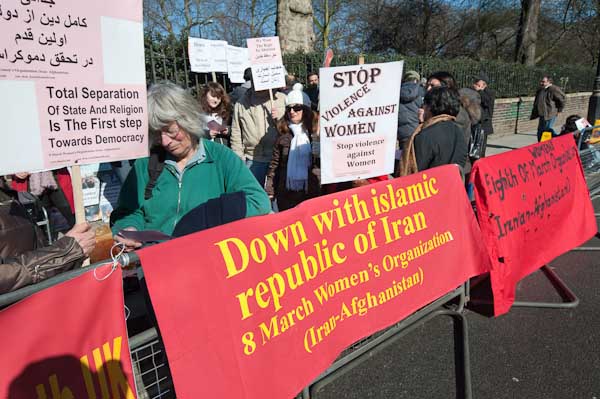
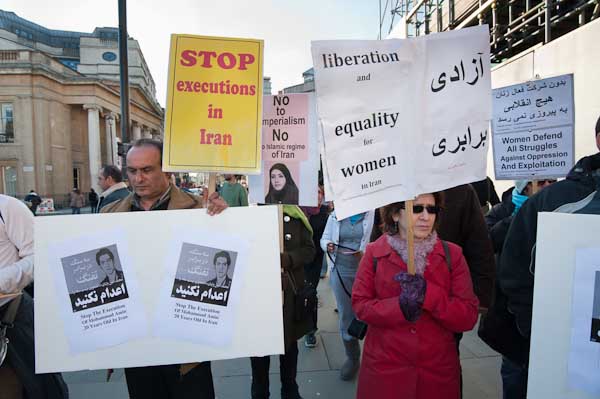
Women and men, mainly Iranians, held a rally opposite the Iranian embassy in Kensington to mark International Women’s Day and protest against the 31 years of anti-women Islamic laws and repression and calling for an end to the Islamic regime.
The protest was organised by the 8 March Women’s Organsiation (Iran-Afghanistan) and they marched from there to Trafalgar Square where there was a larger rally on the North Terrace with speeches and messages from the 8 March Women’s Organisation, the European Democratic Women Movement (Turkey), Hands off People of Iran, the Organisation of Women’s Freedom in Iraq and the Million Women Rise movement.
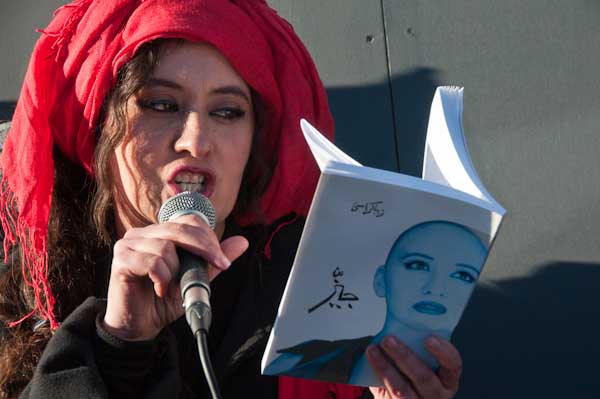
The speches were followed by performances by a number of artists including Iranian singers and poets.
Hands off our Midwives – London Anarcha Feminist Kolektiv – Royal College of Midwives
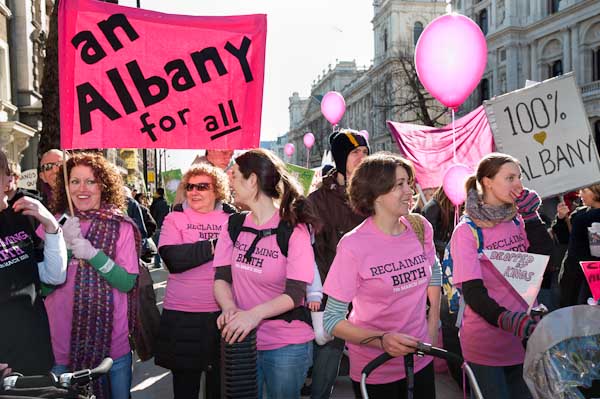
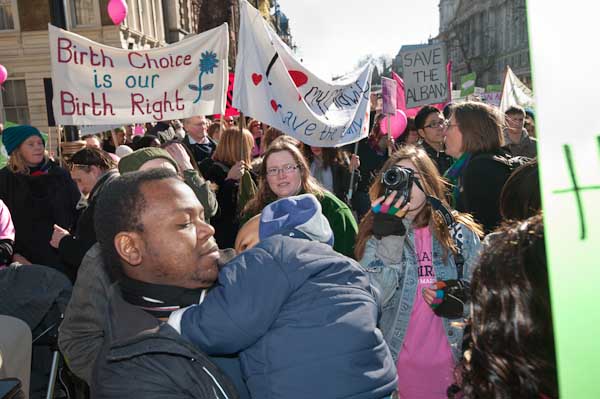
The Albany Midwifery Practice in Peckham in South London – one of the most highly deprived areas of England – was widely regarded as a model of best practice and a centre of excellence in NHS midwifery, giving support to women throughout pregnancy, birth and the post-natal period, encouraging women to make informed choices about how and where they give birth.
But at the end of 2009, King’s College Hospital terminated their contract following a critical report from the Centre for Maternal and Child Enquiries (CMACE) which King’s claim showed “serious shortcomings” over one aspect of their work, forcing the centre to close down. This report was shown to be based on incorrect use of statistics.
King’s decision was seen as an attack on on alternative ways of maternity care that provide better overall outcomes and better meet the needs of women.
Their perinatal mortality rates were well below the national average and well under half those for those in its London Borough. And far fewer of their mothers gave birth by Caesarean section – just over half of the rate in King’s College Hospital. Perhaps at the root of King’s objection to Albany was that almost half of the women chose to give birth at home – compared to 1 in 16 for the area as a whole.
More than three quarters of Albany mothers also continued to breastfeed their babies, well over twice the national average.
The march and rally was supported by AIMS (Association For Improvements In The Maternity Services), NCT (National Childbirth Trust), ARM (Association of Radical Midwives), IM UK (Independent Midwives UK) and Albany Mums.
As well as calling for a public inquiry into the decision to end the Albany contract it also called for a move across the country to replace the current doctor-led hospital services , often un-supportive and even traumatic for mothers, with services following the Albany example which provide a much more comprehensive service with better information and fuller support for women at no greater cost.
Peckham has a record of innovative medical services, with the groundbreaking Peckham Experiment in community health which began 100 years ago in 1926 and was ended under the NHS in 1950. The case of the Albany model of care echoes this, and there approach was fully vindicated in a detailed analysis published in 2017 which concluded “consideration should be given to making similar models of care available to all women.”
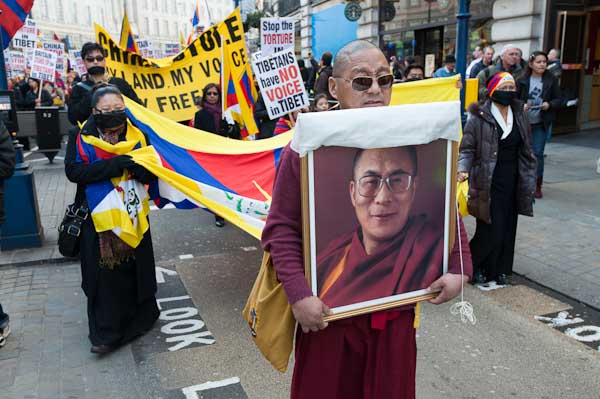
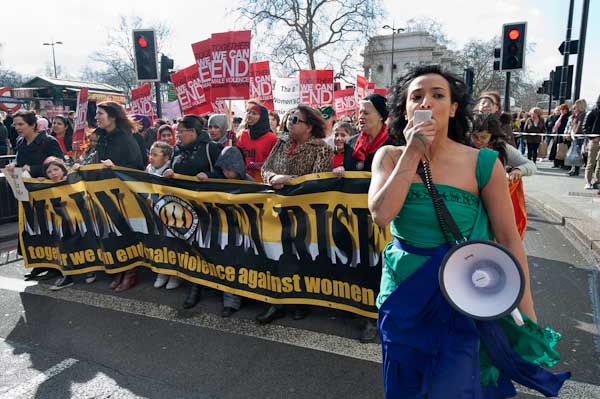
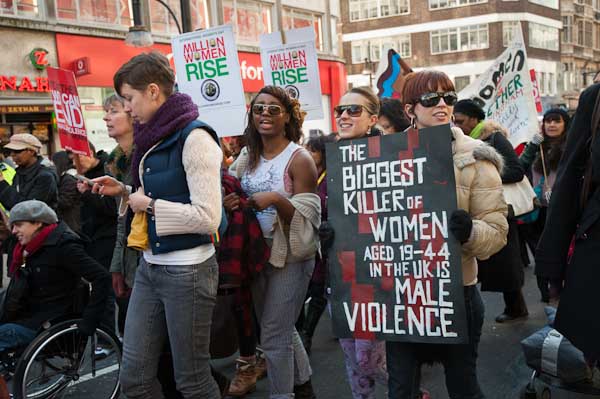
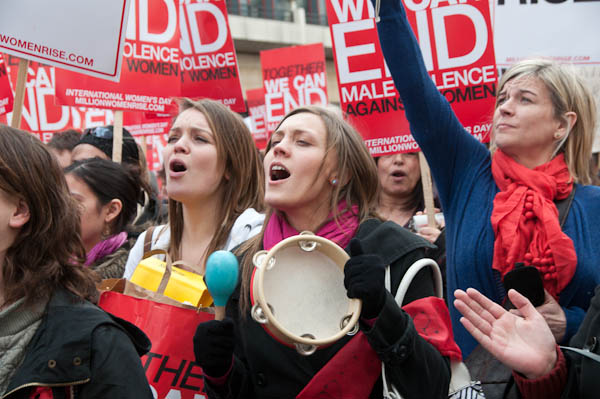
Tibet Freedom & Women Rise: On Saturday 6th March 2010 I photographed a march marking the 51st anniversary of the Tibetan National Uprising and calling for freedom from China and then went to Marble Arch for Million Women Rise, an all-women march calling for an end to male violence against women.
Tibet Freedom March
Chinese Embassy to Westminster
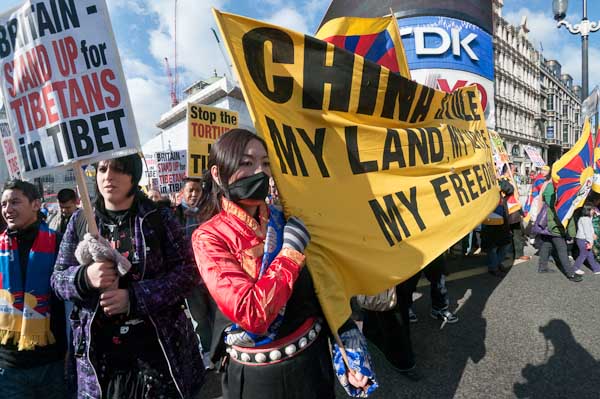
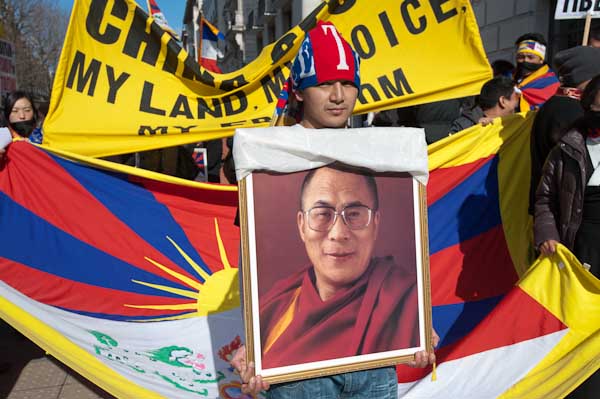
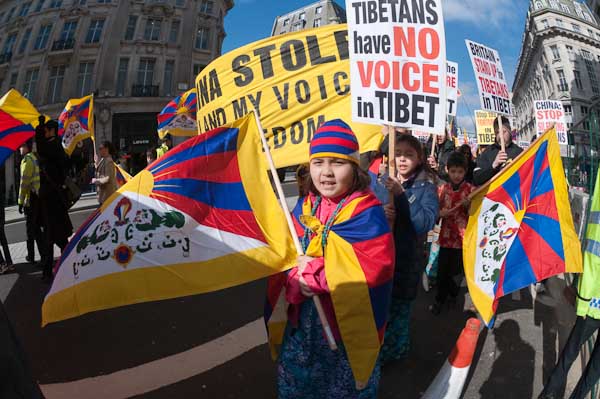
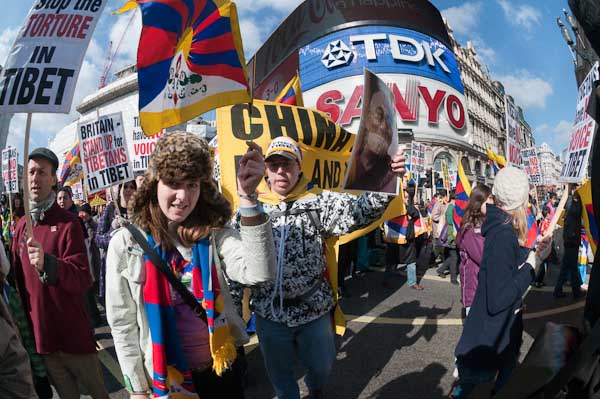
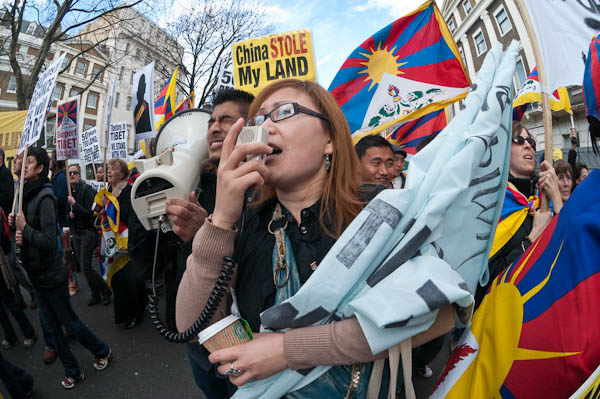
China Stole My Land, My Voice, My Freedom – the march at Piccadilly Circus
The Tibetan National Uprising began on 10 March 1959, prompted by fears that the Chinese authorities in charge of Tibet would arrest the Dalai Lama. The protests soon developed to demand independence from China which had annexed Tibet in 1951.
As well as civilians those taking part included Tibetan guerillas who had been trained by the US Central Intelligence Agency in camps in Nepal and the CIA organised several aerial supply missions. The Agency had supported Tibetan guerrillas from the mid-1950s and even after armed resistance ended in 1962 the CIA continued to train Tibetans in the USA, returning them to stir up revolts in Tibet until at least 1972.
The National Uprising was bloodily put down by the Chinese People’s Liberation Army, with widely varying estimates of the number of Tibetans killed, possibly over 80,000. The Dalai Lama and others fled to India where he and his followers were granted asylum.
In 2008 there had been further protests and demonstrations in Tibet against the Chinese Communist Party’s treatment and persecution of Tibetans which began around the 49th anniversary of the 1959 Uprising. The protests were again violently repressed, with over 200 young Tibetans killed and many imprisoned. Over 1000 were still unaccounted for in 2010 and two, Lobsang Gyaltsen and Mr Loyak, had been executed in October 2009.
The protest by around 600 people, many of them Tibetans, began outside the Chinese Embassy with a short speech and the singing of the Tibetan National Anthem was sung, followed by a minutes silence in memory of the dead and prayers.
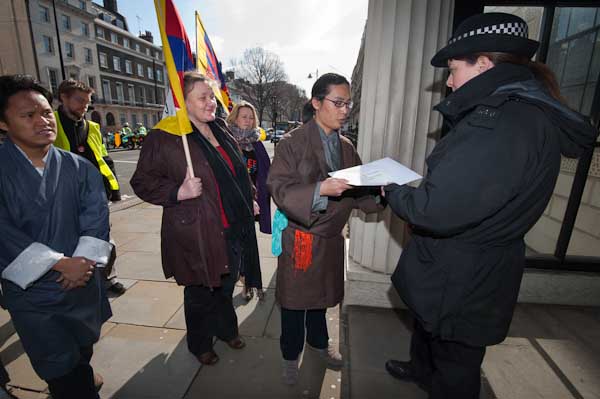
A small delegation went with a letter to the door of the Chinese Embassy, but no one from the Embassy was there to take it so they handed it to the police officer there and the march set off down Regent Street to a rally at Downing Street.
I reported, “Near the front of the march was a large banner with the Tibetans’ message “China stole my land, my voice, my freedom.” Among the slogans chanted by marchers were “Tibetans have no voice in Tibet“, “China: stop silencing Tibetans“; “Britain: stand up for Tibetans in Tibet” and “Stop the torture in Tibet”.
I left the Tibet Freedom March to rush to Marble Arch where several thousand women had gathered for the Million Women Rise march, arriving just before they set off.
Million Women Rise (MWR) founder Sabrina Qureshi addresses the women before the start of the march
The Million Women Rise movement was founded by campaigner and former outreach worker Sabrina Qureshi in 2007. I photographed their march in 2008. It takes place every year around March 8th, International Women’s Day, when there have been other events in London for many years which I had often photographed.
Kurdish women with the ROJ banner
Million Women Rise differs in being a women-only event and “led by Black/ Global Majority Women for all Women and Girls.” The annual march is supported by a wide range of groups and they included some left-wing organisations. But others have been excluded from speaking at the rallies or told they are not welcome on the marches.
In 2010 I wrote a little about the violence women experience:
“In this country almost 1 in 4 women are said to have experienced some form of sexual assault and on average two women are murdered each week by a partner or former partner. A third of all teenage girls who are in relationships suffer unwanted sexual acts and one in four are the subject of actual physical violence.”
“Trafficking is a large-scale global industry, with two million girls between the ages of 5 and fifteen being sold into sex slavery each year. Lack of health provision is also a major problem; one woman dies in pregnancy for every minute of the year, and most of these deaths are preventable”
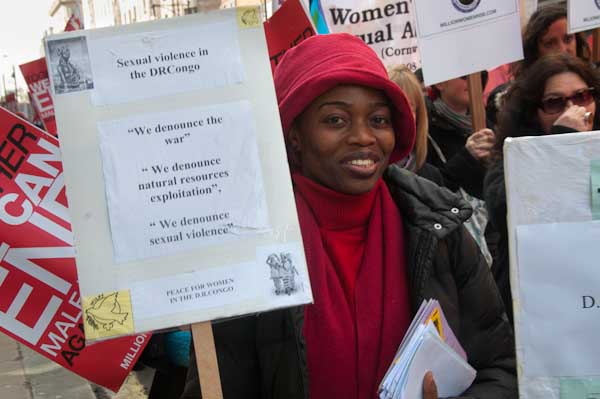
Now, particularly after what we have seen in Gaza with so many women and children among the dead, I might perhaps have also written about affect of wars. Among those on the marching were Tamils and women from the DRC where wars were killing many women and children, as well as from repressive regimes including Iran.
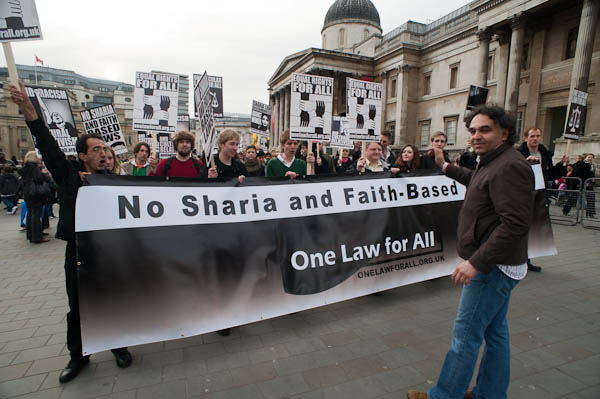
Union Busting, Tibet, Women & Sharia: My work on Saturday 7th March began outside fashion store Prada in Mayfair. I moved on to the Chinese Embassy for the annual Tibet Freedom March, then to Portman Square for a International Women’s Day march and finally to Trafalgar Square where ‘One Law for All’ were marching to a public meeting against the use of Sharia and other faith-based laws in the UK.
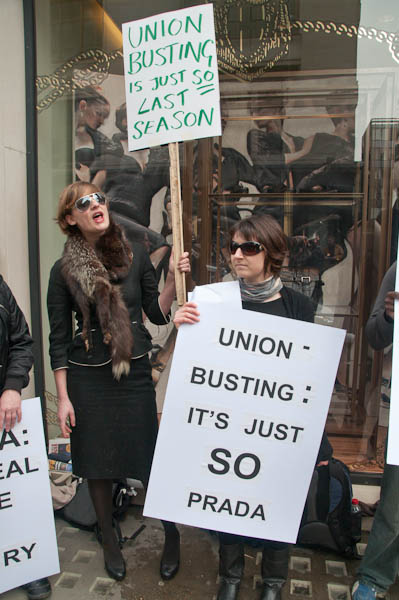
Union Busting – Just SO Last Season – Prada, Old Bond St
A dozen people from Labour Behind the Label, part of the international ‘Clean Clothes Campaign’ which campaigns in support of garment workers worldwide were protesting outside Prada, one of the best-known luxury brands around the world.
The ridiculously expensive fashion luxury goods its customers buy are not made in Milan where Prada was founding but in factories such as the DESA factory in Turkey. Workers there are on ridiculously low pay and work long shifts – sometimes up to 40 hours.
When in April 2008 workers at DESA decided to join the Turkish leather workers union, 44 were sacked and 50 forced to resign from the union.
Demonstrations outside the DESA factory have led to repression and arrests and when one union leader refused to accept a bribe, her family was threatened, and later that day men on a motorbike attempted to kidnap her 11 year old daughter.
Prada wasn’t the only luxury goods seller profiting from this despicable exploitation – the DESA factory in the Dzce Industrial Zone also makes goods for Mulberry, Louis Vuitton, Samsonite, Aspinal of London, Nicole Farhi and Luella.
As well as publishing more about the protest – and of course more pictures, my London Diary post also pointed out that it isn’t just the high price designer labels that support sweatshops, but also Matalan and other cheap suppliers and supermarkets – and urged readers to visit the Labour Behind the Label web site to find out more and support their actions.
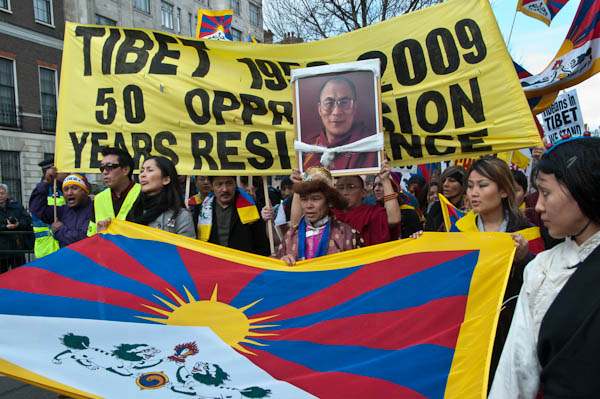
The march marked the 50th anniversary of the brutal repression by China of the ‘Tibetan People’s Uprising‘, when over 80,000 Tibetans were killed and many others jailed.
It was then the Dalai Lama fled the country along with many others. Those still in Tibet still suffer the same kind of brutal repression, with thousands missing after the demonstrations in Tibet in 2008, and hundreds serving lengthy prison sentences.
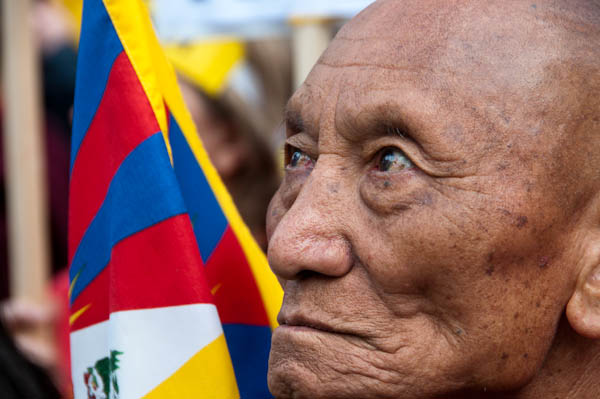
Many on the protest carried Tibetan flags. Two months earlier a young Tibetan, Pema Tsepak, had been beaten to death for carrying one in his own town in Tibet.
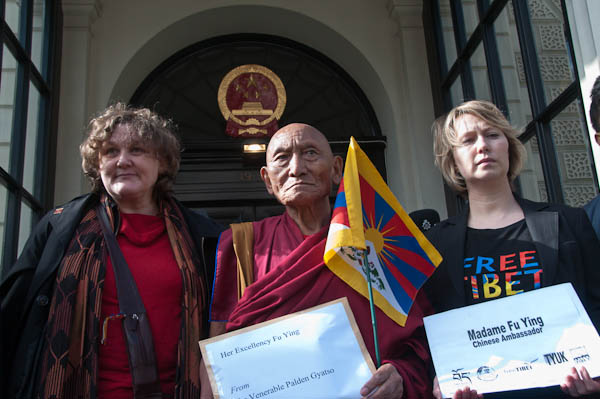
Palden Gyatso.
At the start of the march opposite the Chinese Embassy, Palden Gyatso, a Tibetan monk who spent 33 years in prison and labour camps from 1959 to 1992 and was permanently damaged by the beatings and inhumane torture he suffered tried to deliver a letter to the Chinese Embassy but the Embassy was not accepting any post.
Gyatso’s autobiography was the basis for the film, ‘Fire Under the Snow‘ – you can watch a trailer on YouTube.
I left the march when it reached Oxford Street to go to the International Women’s Day march.
Million Women Rise 2009 – Portman Square, Oxford St
The main celebration of International Women’s Day in London in 2009 was the ‘Million Women Rise 2009‘, a women-only march to end male violence against women.
This annual march since it started the previous year coincided with the global United Nation theme for 2009 which was ‘Women and men united to end violence against women and girls‘, but Million Women Rise is a women-only march.
Hackney Women Rise. The march was co-ordinated by Sabrina Qureshi
This year the numbers seemed rather smaller, despite the predictions of a much larger event, but it was still a lively event and one that made a greater impact with its route through London’s major shopping streets – Oxford Street and Regent Street and across Piccadilly Circus to a rally in Waterloo Place.
As they marched the women chanted their main message: “However we dress, wherever we go, yes means yes, no means no!” and called for an end to male violence against women.
“Yes means Yes and No means No” Women march along Oxford St
This was a national march with coaches bringing women from Birmingham, Bradford, Hebden Bridge, Wales, Nottingham and Todmorden as well as other groups coming from around the country. There was also a strong participation by Kurdish and Turkish groups based in London.
One group marched behind the main march, choosing to follow the UN theme rather than be a women-only march; “the European Confederation of Workers from Turkey (ATIK) Women’s Commission group included men marching (as their placards proclaimed in Turkish) in a spirit of socialist equality, fraternity and freedom.”
One Law For All – No Sharia Law in Britain – Trafalgar Square
The One Law for All campaign had been launched three months earlier on Human Rights Day by prominent civil rights activists, lawyers, feminists and academics as well as the National Secular Society.
A speaker from the Worker Communist Party of Iran UK Committee
Among those supporting it were many who had previously lived under Sharia, including both Muslims and ex-Muslims, some who had fled their home countries to claim asylum after persecution for political activities including the refusal to adhere to religious dictats.
The organisation objects to the setting up of Sharia courts in the UK, on the grounds that Sharia law is discriminatory and unjust, particularly against women and children. While supporters of religious courts see these as promoting minority rights and social cohesion they see them as a cheap short cut to injustice and call for one secular law to govern all of us.
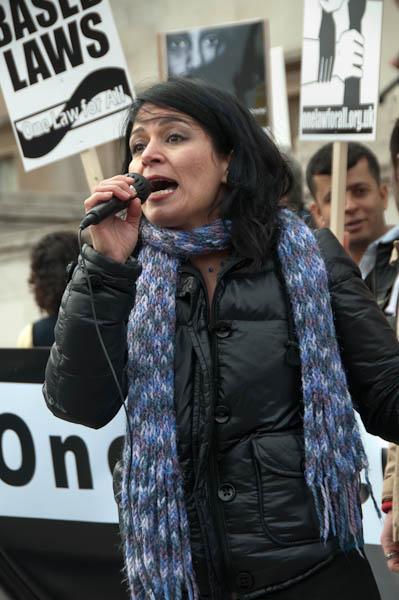
Maryam Namazie
After an hour of speeches One Law for All Spokesperson Maryam Namazie made a final address before the roughly 250 people present marched to a public meeting at Conway Hall. But I left for home instead.
International Women’s Day: On Saturday 6th March 2004 I photographed an event in Trafalgar Square to celebrate International Women’s Day which was the following Monday, 8th March.
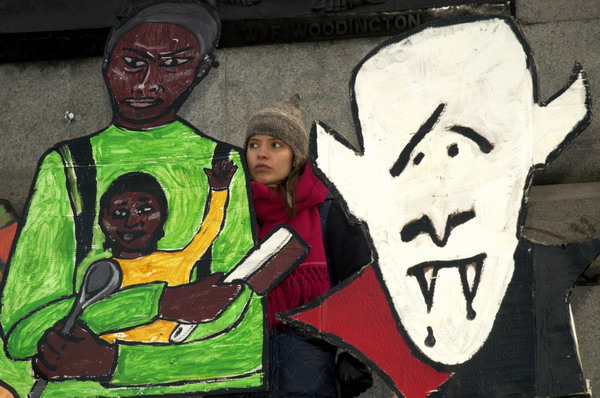
Bookstall in Trafalgar Square for International Woman’s Day
First celebrated in 1909 by the Socialist Party of America, International Women’s Day was established in 1910 by the Second International following a proposal by Clara Zetkin, although the date only became 8 March in 1913 when peace rallies were held on that day shortly before the First World War. IWD rallies led to the start of the Russian Revolution in 1917 and Lenin made the day an official “holiday”, although it remained a working day there until 1965. The UN adopted it in 1975 and in 2005 the TUC called for it to be made a UK public holiday.
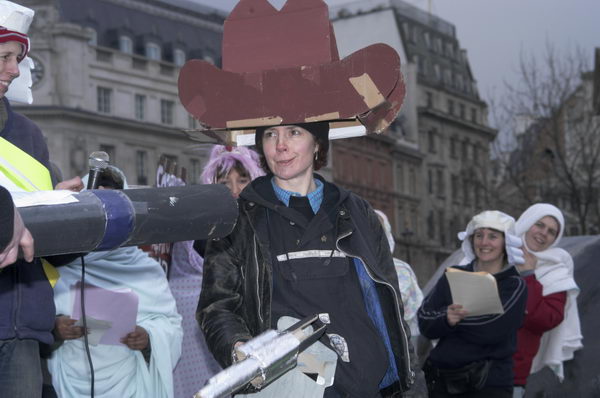
Representing George W Bush with his attempt to dominate the world
This year, 2025, the 8th March is a Saturday and there will be an all-women march in London, Million Women Rise, demanding an end to male violence to women and girls, beginning on Oxford Street and marching to a rally in Trafalgar Square. I photographed the first London Million Women Rise in 2008 and have covered the event working from the sidelines most years since.
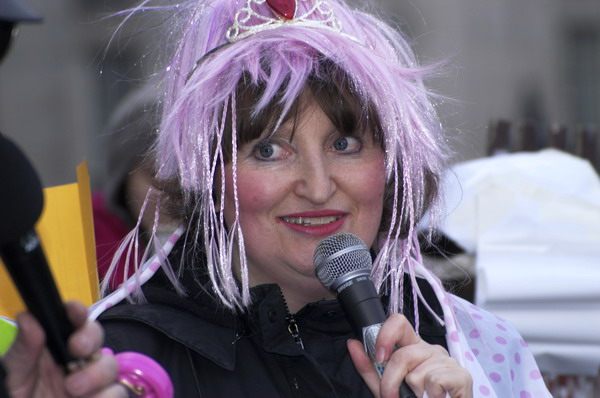
I’m not sure quite where the fairy queen came into it
I had photographed International Women’s Day events in some earlier years, and there are also a few pictures from 2003 on My London Diary, but I think 2004 was the first more extended post. Here with the usual corrections to case and spelling etc is what I wrote in 2004.
Woman’s Court Puts Bush and Blair On Trial
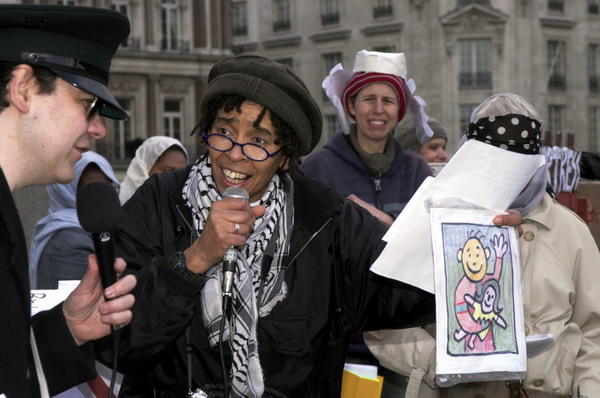
There are various events in London around the start of March connected with International Woman’s Day on the 8 March. In Trafalgar Square on Saturday 6th a Woman’s Court put George Bush and Tony Blair on trial for crimes against women, children and men. The event was a part of the 5th Global Women’s Strike.
Events started with a a short play by a group from Crossroads Women’s Centre in North London highlighting the racist immigration policy of Fortress Europe, typical agit-prop, enlivened as always by some individual performances that relied more on personality than script.
All good fun with the villains being George W Bush and our very own Tony Blair.
Good fun if it wasn’t for the fact that the consequences of the actions of these men and the interests they stand for were felt around the world.
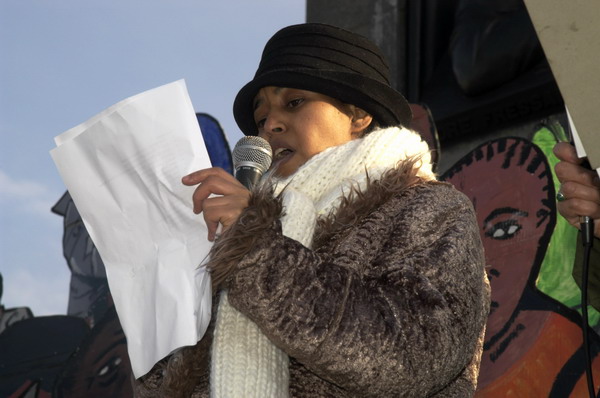
Selma James, widow of C L R James, then opened the trial of Bush and Blair, represented in their absence by large puppets. One of the first witnesses was Elsa T, an Eritrean rape victim whose moving testimony was given us in translation.
Jocelyn Hurndall
Another moving speech came from Jocelyn Hurndall, the mother of Tom Hurndall who was shot by an Israeli soldier while trying to protect children in Palestine. The clothing he was wearing to identify himself as a non-combatant apparently made him into a target.
Other speakers included representatives from the Black Women’s Rape Action project, a Native American woman, a woman soldier, Mrs N from Zimbabwe whose son died in a British prison, and several men including Brian Haw from the 24/7 picket in Parliament Square.
March 8th – Women Strike And Protest. In 2021 on International Women’s Day I published a long post, 8 March: International Women’s Day with some images from my coverage of the day from 2002 until 2020, and in 2022 I posted International Women’s Day Marches with a little history and more of my pictures from previous years.
This year I look back seven years to Thursday 8th March 2017 when I covered a number of events on International Women’s Day.
From Russia With Love – Parliament Square
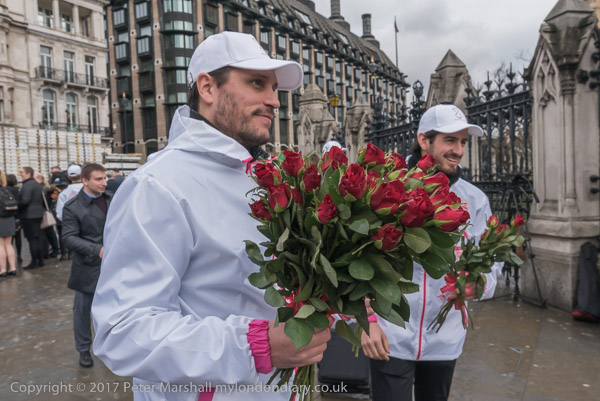
When I arrived to photograph a couple of protests about to take place in Parliament Square I found around a dozen young Russian men in white caps andjackers with a strange heart-based logo clutching large bunches of red roses being briefed before they went around the square stopping women an handing them roses.
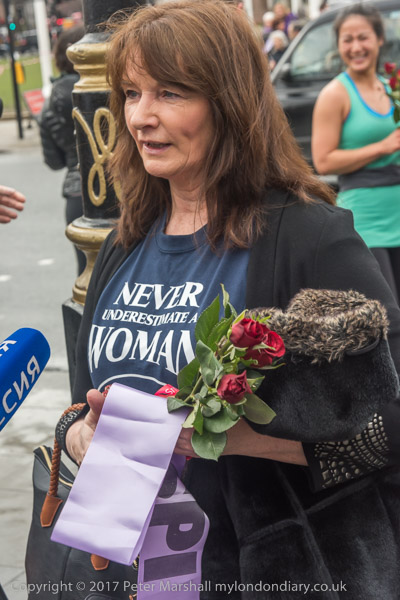
Apparently this was a stunt for Rusian TV by the ‘Make Her Smile Movement’ and was taking place in various capitals around the world. Some women refused the flowers, but most took them and seemed pleased if rather confused by the gesture.
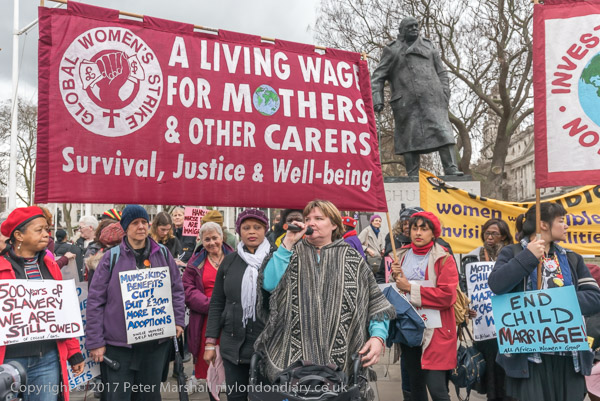
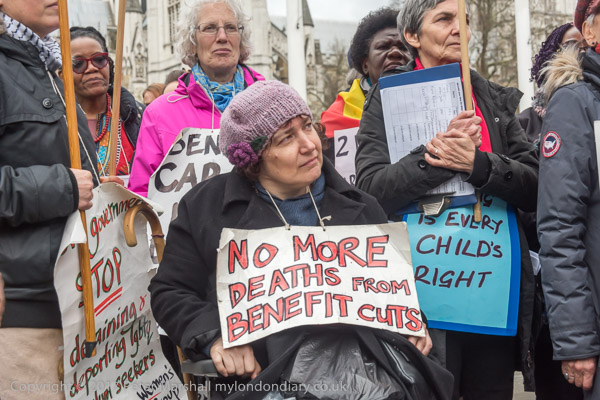
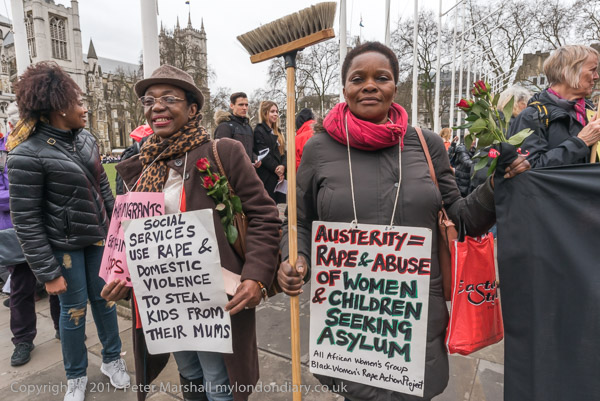
Global Women’s Strike had come to the square to celebrate the resistance of women worldwide and hold a protest in solidarity with the International Women’s Strike taking place in 46 countries.
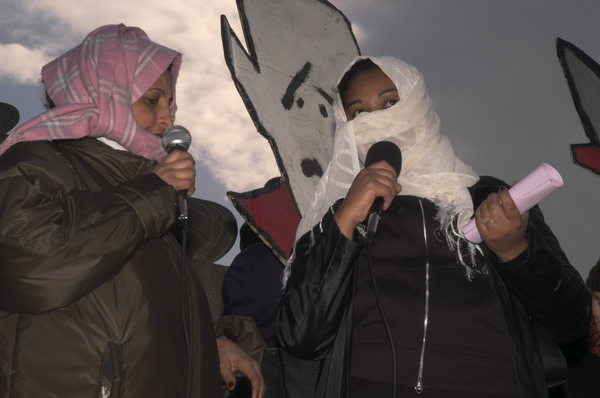
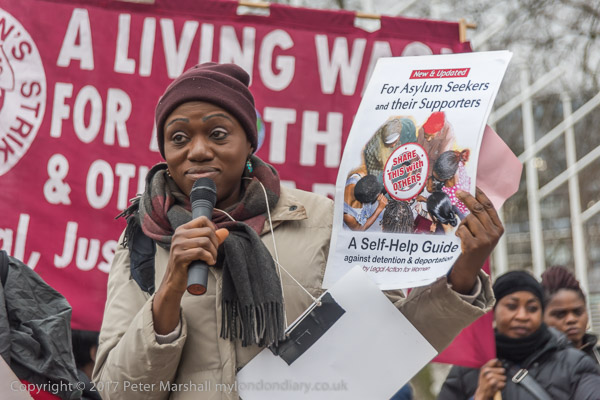
They held a rally opposite Parliament as the Budget was being delivered inside, with speakers from a number of groups supporting women including the victims of domestic violence, the disabled and the victims of family courts.
Among the speakers were women from the Scottish Kinship Care Project, Dr Philippa Whitford SNP MP for Central Ayrshire, Denise McKenna, co-founder of Mental Health Resistance Network and Paula Peters of DPAC. Police initially tried to prevent the speakers using a microphone but were persuaded to let them go ahead.
The event ended with a short play by the All African Women’s Group about sexism and racism of the immigration system by the Borders Agency courts and in immigrations detention centres such as Yarl’s Wood Detention Centre.
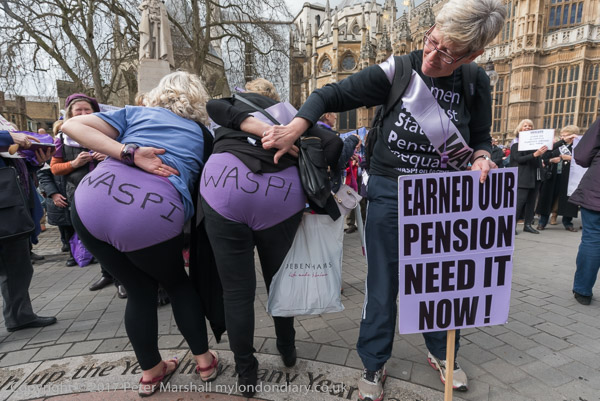
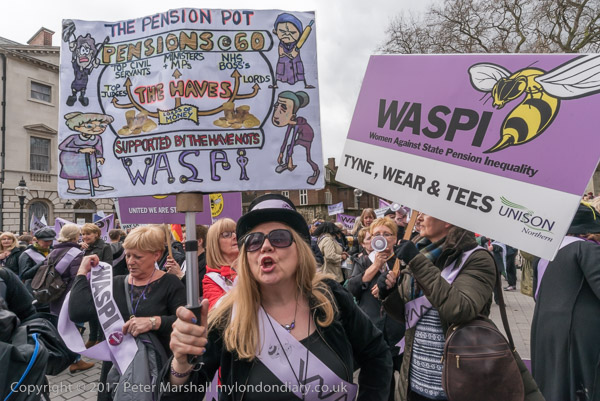
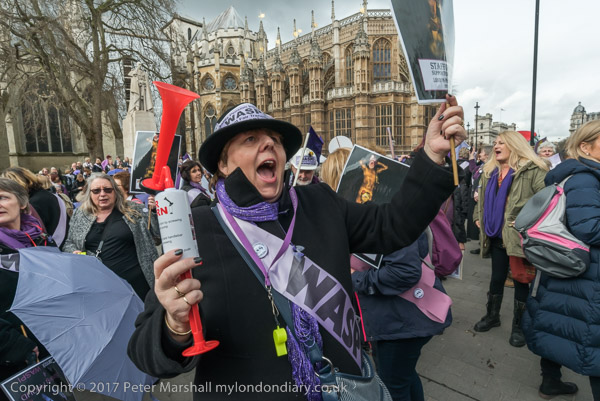
A few yards away in Old Palace Yard Women Against State Pension Inequality – WASPI – were holding a rally against the changes in the state pension scheme which are unfair to women born in the 1950s.
The 1995 Pensions Act included plans to increase the pension age for women to 65 but it was only 14 years later that letters were sent to many women born in 1951-3 Their situation was worsened by the accelerated raising of women’s pension age under the 2011 Pension Act, also made without properly informing those affected, with the age for both men and women increasing to 66 by 2020. Many got as little as one year’s warning of the up to a six-year increase to their State Pension age and it was not possible for them to make alternative plans. For men and women born in 1959 the state pension age is now 66 years.
The women affected are still awaiting the result of an independent investigation by the Parliamentary and Health Service Ombudsman which was started in 2019.
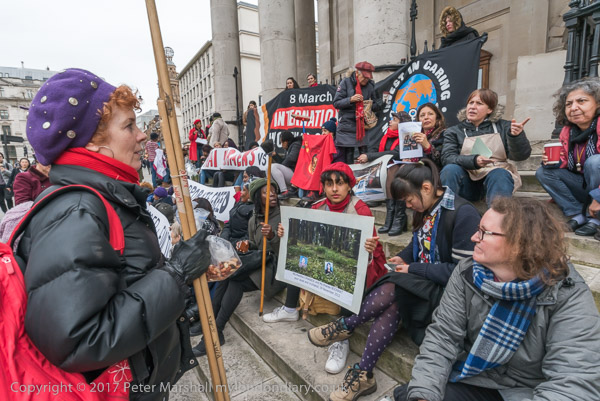
Global Women’s Strike went on to hold a silent vigil on the steps of St Martin-in-the-Fields in solidarity with the farmers of Thailand. Many of them are women in the Southern Peasant Federation of Thailand and the vigil was also in support of others all around the world risking their lives to defend land and water from corporate land grabs.
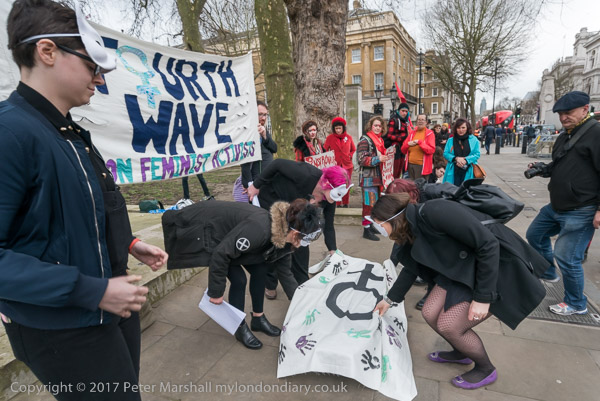
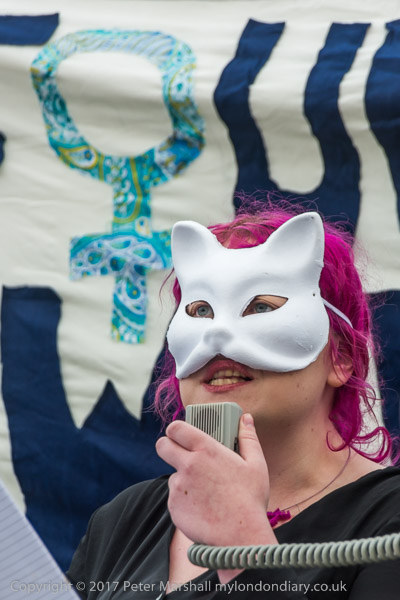
Fourth Wave London Feminist Activists held a protest at Downing St on International Women’s Day, drawing attention to the impact that cuts have had on women.
The unjust, ideologically-driven cuts to public services are disproportionately felt by women. Their protest contrasted to the more highly publicised corporate events on the day which are given a high degree of coverage in the media and concentrate on getting more women in boardrooms and other highly paid jobs. Though important issues, these are clearly irrelevant to the huge majority of women who have to deal with the realities of low pay, expensive housing, and caring for children and other family members.
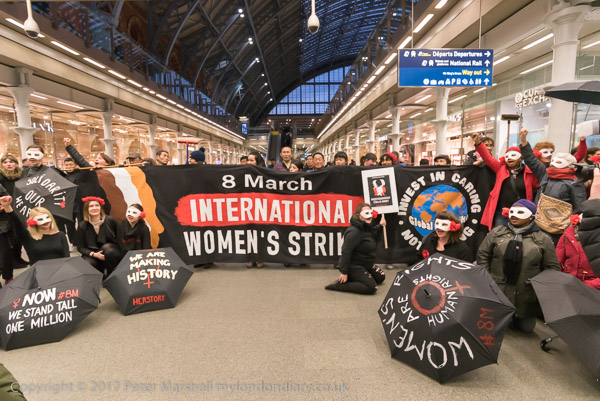
International Women’s Strike Flash Mob – St Pancras International
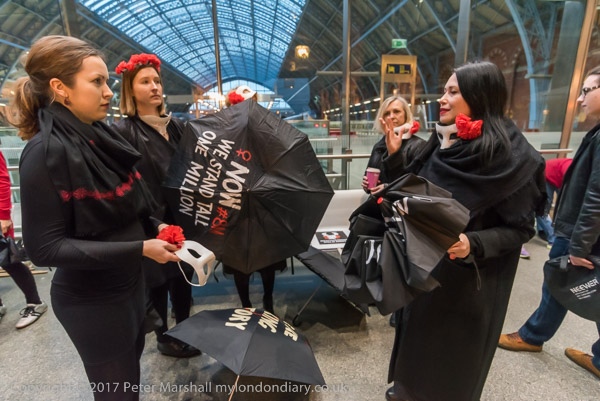
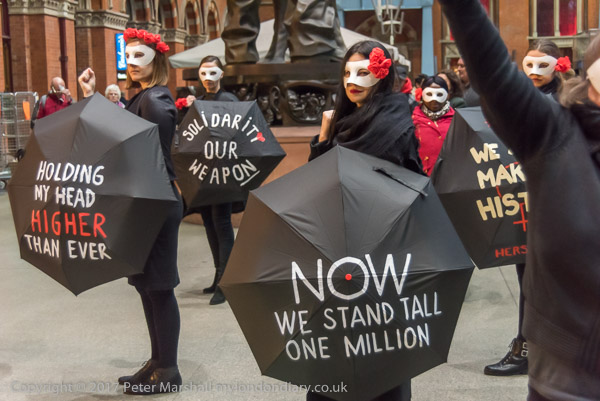
Finally I went to St Pancras International station where London Polish Feminists were joined by Global Women’s Strike in a flash mob celebrating the struggles of women around the world .
Wearing black and red clothing, after practising their routine with umbrellas with messages on them and a large banner at the entrance to St Pancras International they went down to the main concourse to perform it there.
Police came to see what was happening and made sure they did not block the concourse but remained friendly, and the waiting passengers applauded and took photographs.