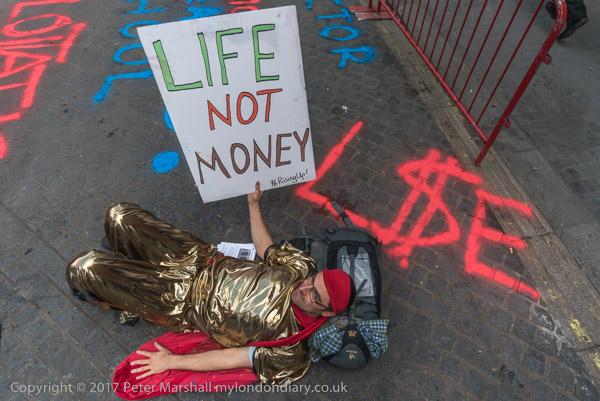
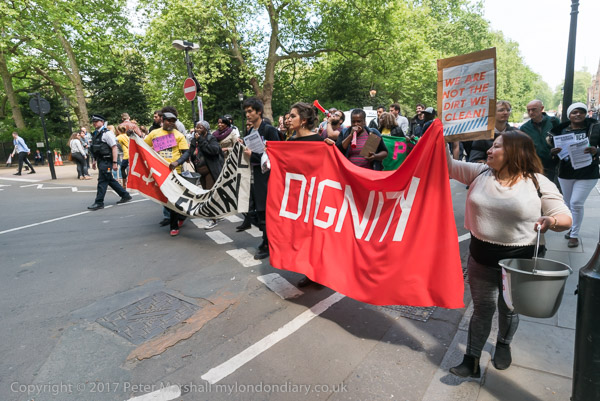
‘Life NOT Money at the LSE’ protesters chalked on the roadway and lay down, blocking the street
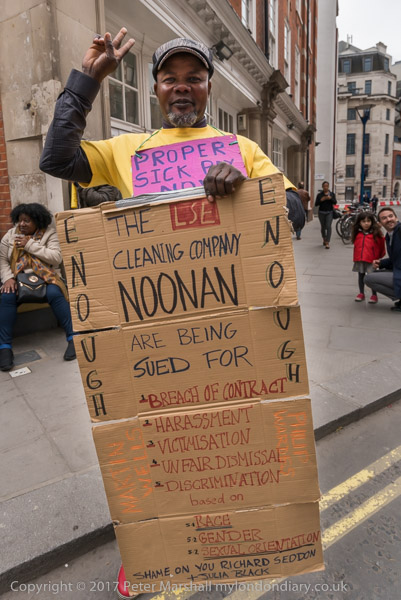
LSE Cleaners Strike For Equality And Dignity: The protest by cleaners at the LSE on Thursday 11th May 2017 was just one more in a long series of weekly one-day strikes demanding parity of terms and conditions with other staff there who were directly employed by the LSE.
The cleaning was outsourced to cleaning contractor Noonan, who employed cleaners under considerably inferior terms – pay, holidays, pensions etc – compared to those workers employed on the site by the LSE. I had been at the meeting in September 2016 when with their union, the United Voices of the World, they began their campaign for parity of treatment and had also photographed their protests.
The UVW were eventually successful after a series of strikes featuring “flashmobs, salsa, zumba, poetry, art sessions, teach-outs” and “after 10 months of struggle, and the then largest cleaners strike in UK history and the highest number of strike days of any group of outsourced workers in UK higher education – outsourcing was ended and all cleaners were brought in-house as LSE employees! Their fight against institutional racism was the first “to force a British university to end the practice of outsourcing cleaners!“
My post told the story of the event in picture and captions which describe the harassment by police and others of some of the supporters, particularly those from Class War. Here is a brief edited version.
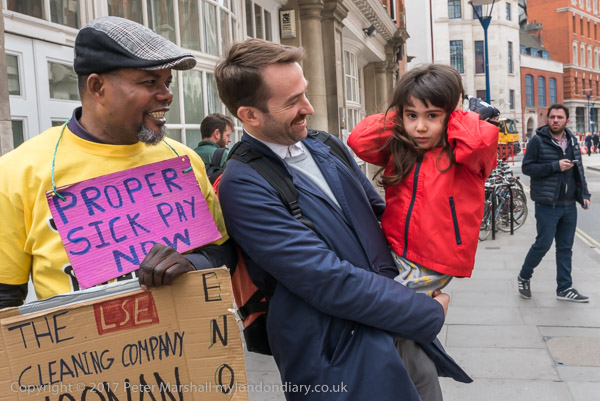
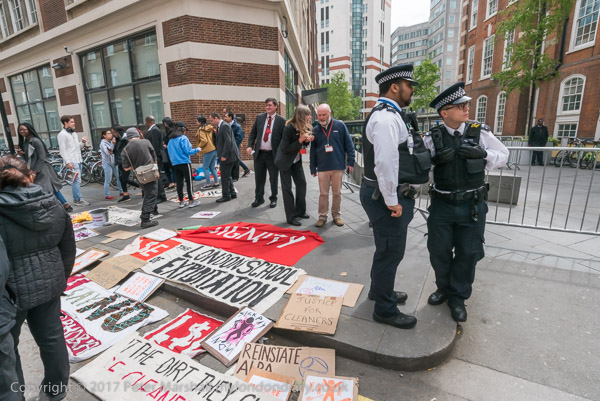
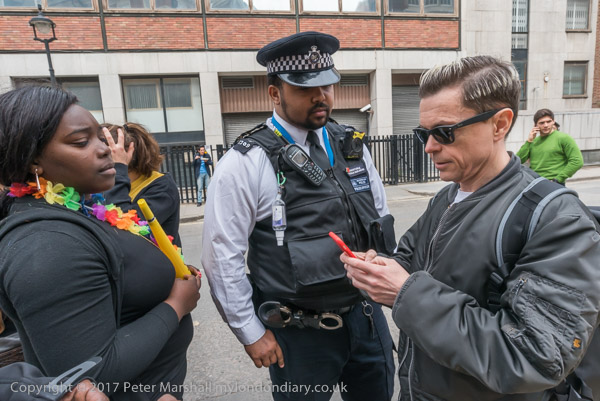
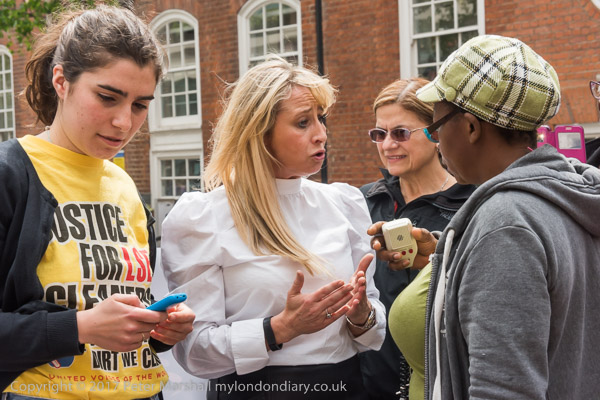
Noonan employs the cleaners at the LSE and the cleaners get low pay, low status and terrible managementThey work in the same place and deserve equal treatment. Their claims are supported by students and LSE staff. Trenton Oldfield brought his daughter with him to show solidarity with the cleaners.LSE Security have closed the area in front of the library normally open to the public. The road is a public highwayOne police officer starts harassing Sid Skill of Class War who has come to show solidarity. Sid refuses to talk to him and moves away – and eventually fled fearing arrest followed by two police officers, escaping them by jumping on a bus as the doors closedA woman who works in the LSE comes to tell the cleaners they are making a lot of noise and disturbing her day and then hugs the police officer and smiles when she sees I am photographing her. The cleaners say they have to make a lot of noise as the LSE management refuse to talk with them and their union.Cleaners make a noise – they want management to talk to them and to recognise their union. They also want to be treated with dignity and respect at work, a living wage and equal pensions, sick pay and other benefits.A man comes to complain to Class War about their support for the cleaners. He says that they don’t have any right to be there. Jane Nicholl puts him right. He seems to have no idea what class war is and no understanding of class solidarity. And as I suspect Jane put it is a stupid prick. Though she may have been less kind.The protesters march around the campus to visit a couple of other sites from brief protests in Lincolns Inn Fields and then Sardinia St before going to the Student Union, where there were speeches an poetry from Grim Chip of Poetry on the Picket Line.Meanwhile Life Not Money at the LSE had been at work, painting their message in chalk on the road and then sitting down on the Portugal St in front of Old Building, stopping lorries entering or leaving the LSE building site.
You can read the full version with more pictures and text at LSE Cleaners strike.
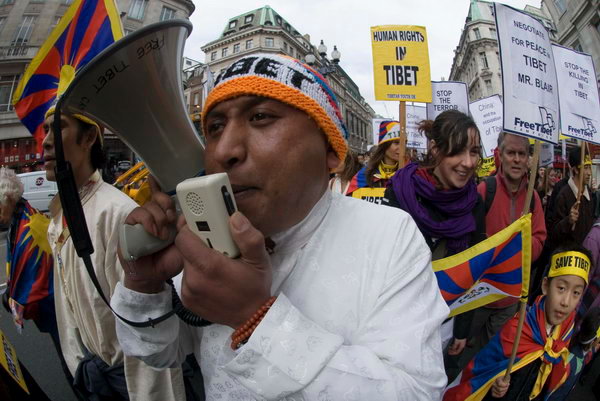
ACTSA: Rally for Dignity & Tibet: On Saturday 10 March 2007 I photographed the ACTSA rally in Trafalgar Square and earlier in the day the annual march calling for an end to to Chinese occupation of Tibet.
Rally for Dignity
Trafalgar Square & Zimbabwe Embassy
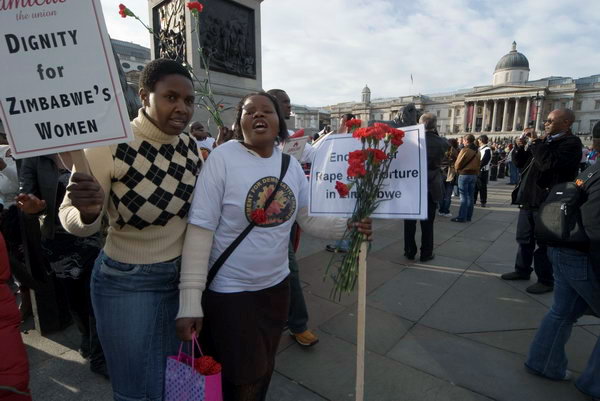
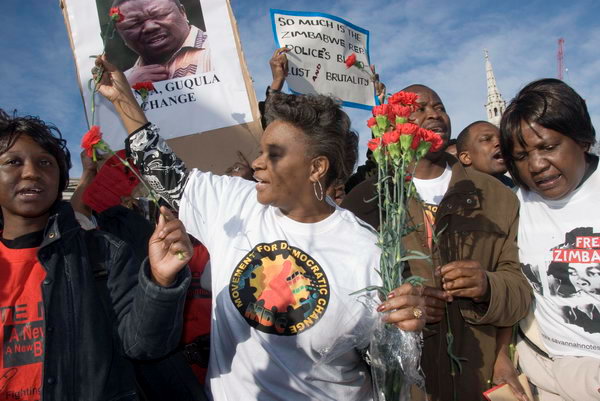
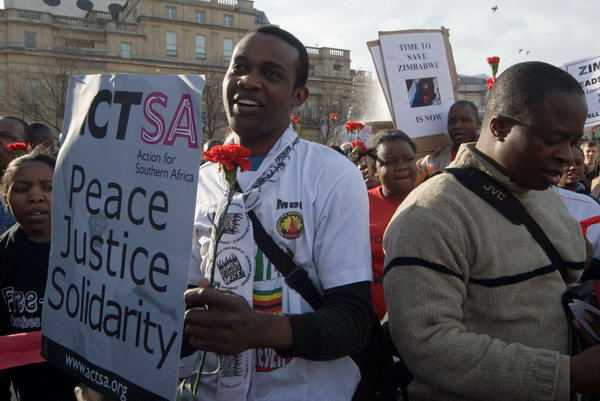
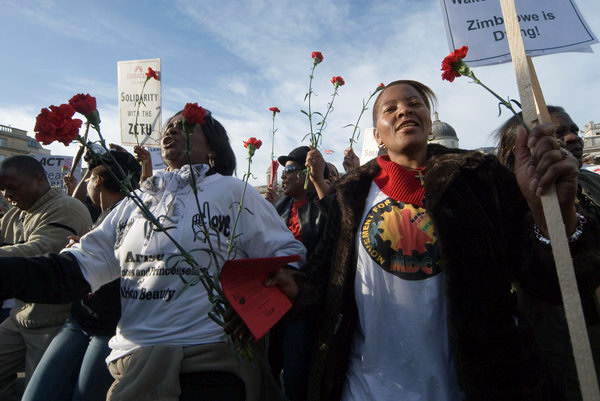
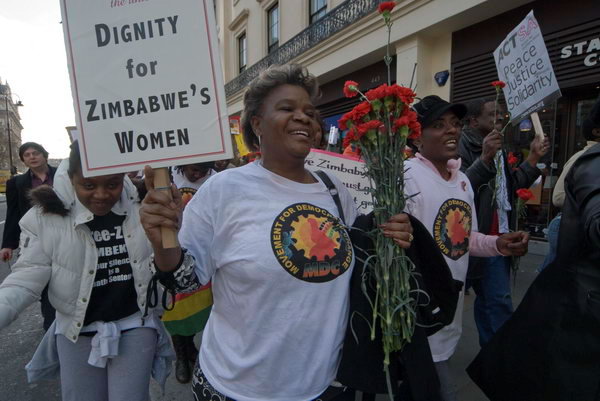
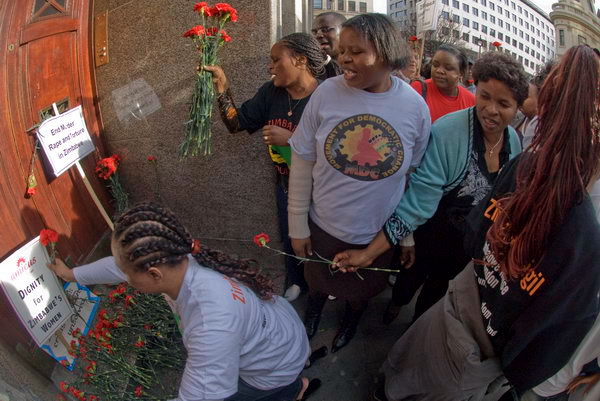
Action for Southern Africa (ACTSA) organised a rally in Trafalgar Square calling for an end to the crimes of the Mugabe regime in Zimbabwe. They called for peace, justice and solidarity with the people and an end to murder, rape and torture there and supported the DIGNITY!PERIOD campaign to provide essential sanitary protection for women backed by Amicus and Unison unions as well as ACTSA.
Many carried and gave out red carnations as symbols of the campaign and marched to lay them with placards at the door of the Zimbabwe Embassy in Strand.
Here is what I wrote in 2007:
For many years I've been a supporter of ACTSA, although I think my membership may have lapsed recently (its hard to keep up with my post.) They were the organisers of a 'Rally For Dignity' which celebrated the role of women in the worldwide struggle for justice.
Held two days after International Women's Day (8 March) it focused particularly on the struggle for freedom in Zimbabwe and on the efforts of the Zimbabwe Congress of Trade Unions.
Zimbabwe is currently in a mess, and the cause of that mess is Robert Mugabe. It is a beautiful country with some wonderful people, but so sadly crippled by a cruel, corrupt and senseless dictator who has seized land and persecuted any who dare oppose him.
The economy is in ruins, and men, women and children suffer as he rewards and lines the pockets of his supporters.
One product of many in short supply is sanitary towels, and ZCTU [Zimbabwe Congress of Trade Unions] organised the donation of these necessities by overseas friends, only to have the government demand duty on their import.
Free Tibet: 48th Anniversary of the Tibetan Rising
Westminster
Earlier in the day I had once again photographed the annual march on the anniversary of the Tibetan Rising. I’ve written about this annual event in several posts recently so won’t write more about the 2007 march here.
You can find what I wrote in 2007 if you scroll down the March 2007 page on My London Diary, where there is also a picture of London’s second longest running protest, by Falun Gong opposite the Chinese Embassy against torture of religious prisoners in China.
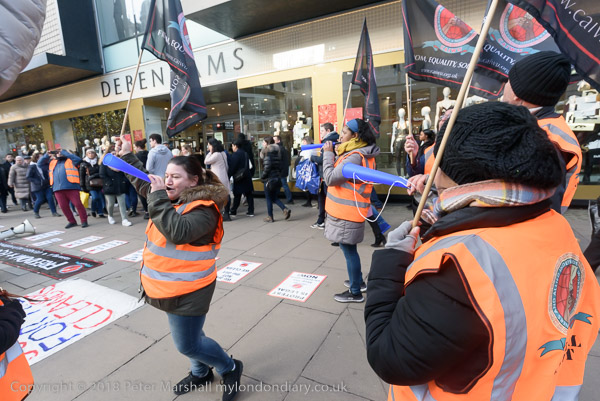
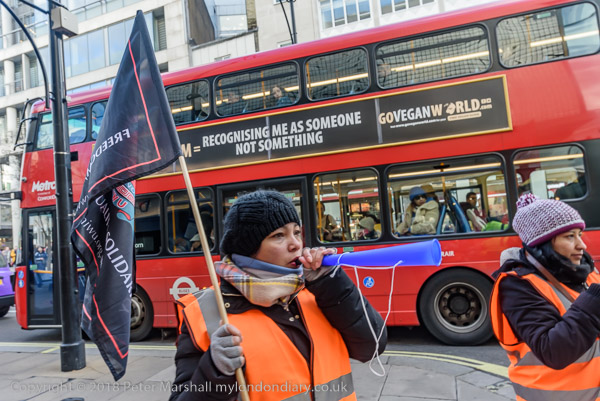
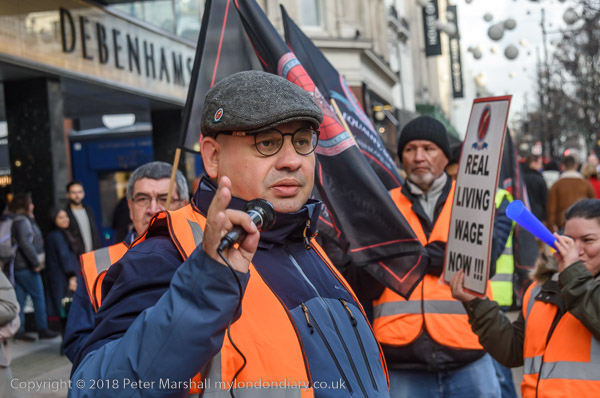
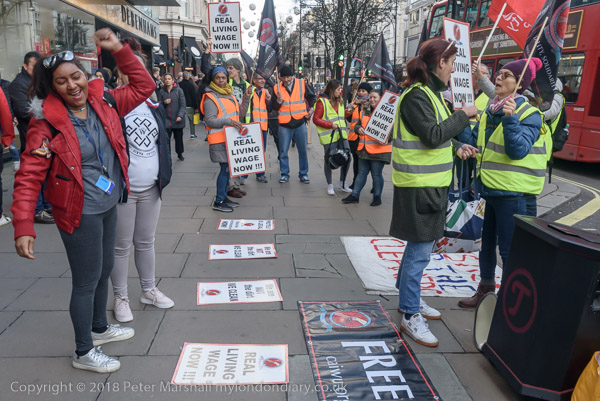
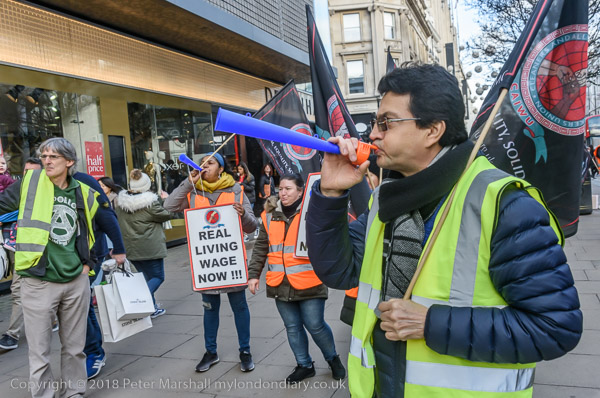
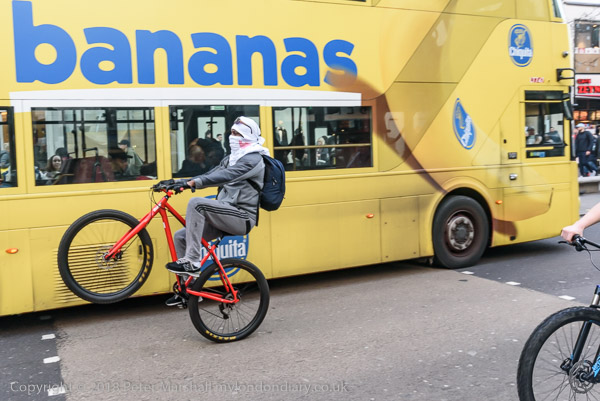
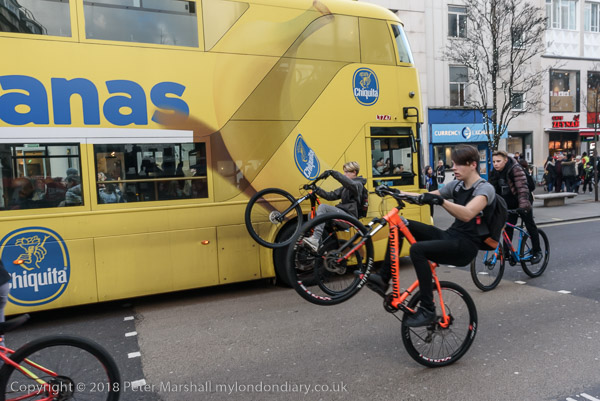
Scrooge Debenhams & Bikelife: Striking cleaners in the Independent Workers Union – CAIWU – protest outside Debenhams in Oxford Street with a noisy rally on Saturday 22nd December 2018, one of the biggest shopping days of the year. While I was there a large group of boys and young men on bikes rode past, some pulling wheelies.
Debenhams Pay Your Cleaners
Oxford St
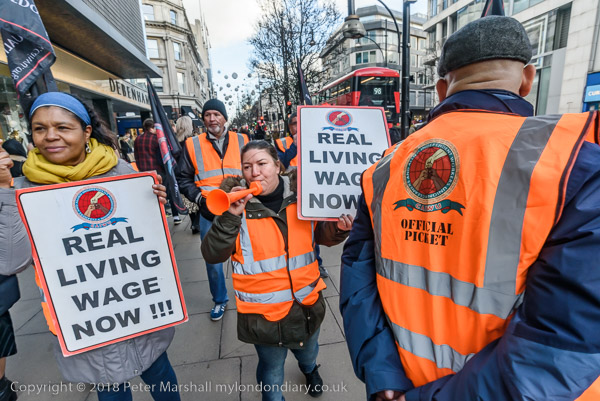
Debenhams Cleaners who belong to CAIWU call for a real Living Wage
The workers who clean the Debenhams store were not employed by them but are outsourced, working forInterserve, a company who have the cleaning contract with Debenhams.
Interserve are lousy employers, treating the cleaners badly and paying the minimum legal wage and conditions, interested only in making as much as they can for their owners or shareholders. The minimum wage isn’t enough to live on in London and reputable employers pay workers at least the London Living Wage – an amount determined every year and roughly 30% above the legal minimum.
As well as a living wage, workers also want to be treated with dignity & respect – as a passing bus puts it ‘Recognising me as someone not something‘.
The workers belong to the Cleaners & Allied Independent Workers Union, CAIWU, but Interserve refuses to recognise the union or to have any talks with them about their claim for the London Living Wage. CAIWU is one of several small grassroots trade unions which has been very successful in getting better pay and condition for low paid workers.
Organiser Alberto Durango spoke occasionally to tell shoppers why the cleaners at Debenhams were on strike and in Spanish to the cleaners (and some tourists)
Reputable companies such as Debenhams would be ashamed to pay their workers so little or treat them so badly and by using companies like Interserve they claim they have no responibilty for the people who work inside their shops to keep them clean.
Several people stopped for a while to dance when the cleaners played Latin-American music
Many of the shoppers walking by took leaflets and showed support for the cleaners and were surprised that Debenhams could legally evade their responsibilities to the workers in this way.
The cleaners had begun their picket in the early morning and were still protesting when I had to leave.
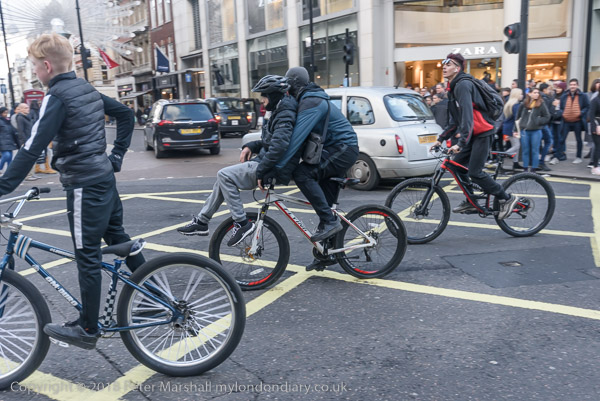
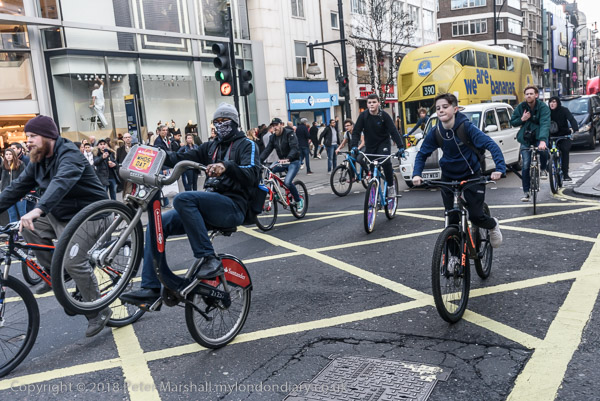
While I was outside Debenhams a group of several hundred mainly boys and young men rode past on bicycles, some balancing just on the rear wheel of their bikes. They were obviously having fun but it looked rather dangerous as they wove in and out of traffic.
I had heard there was going to be some sort of bike ride in London that day, but could not find any of the details in advance. And when it did arrive it came as a surprise and I didn’t have time to think about my camera settings but took the pictures at the same ISO and shutter speed as I had been using for the protest on the pavement – which meant many of my pictures were blurred and unusable.
I didn’t have time to choose a different position either, though I think the yellow ‘bananas’ bus was quite appropriate.
The guy getting a lift on the handlebars was one of the few wearing a cycle helmet
Later I found that these ‘UK Bike Life Wheelie Rides’ begin somewhere south of the river perhaps at Tower Bridge, Druid St or Leake St, around lunchtime. They have fun swarming around the city, showing off with wheelies, stopping traffic, riding on pavements as well as roads, ignoring traffic lights, forcing drivers to stop and generally behaving badly on bikes. Several missed me by inches as they sped past while I was taking pictures.
Some certainly displayed an impressive degree of skill, but it still seemed dangerous both to themselves and to other road users and pedestrians – and an activity that gives cycling a bad name.
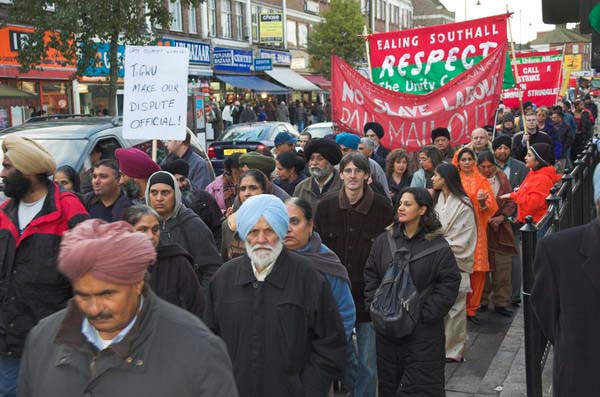
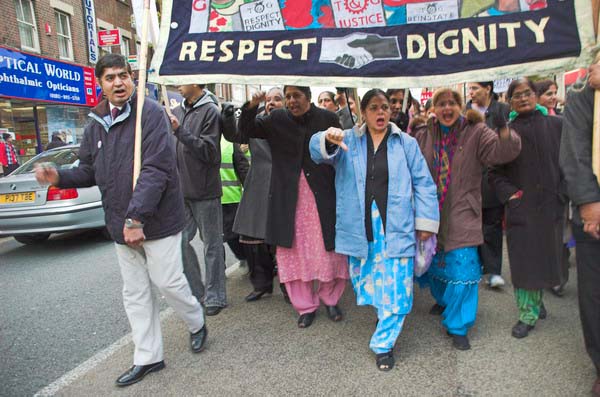
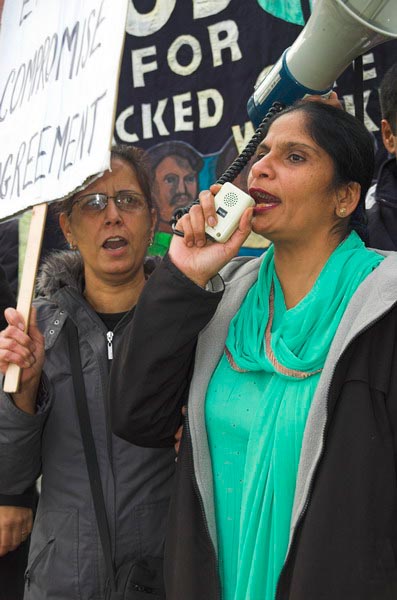
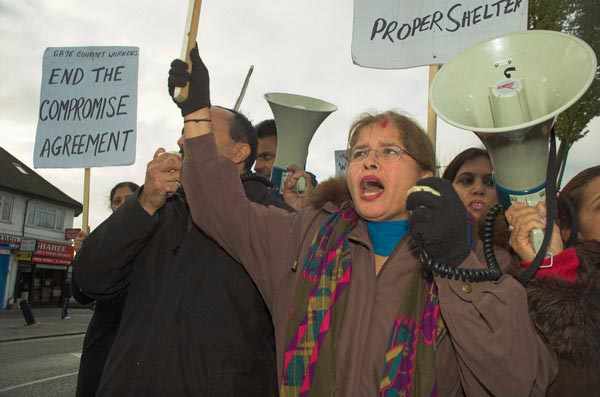
Gate Gourmet & a Bike Ride: On Sunday December 4th 2005 I got on my bike and rode the roughly 1l miles to Southall, where I locked up my bike (not the Brompton, but an old CinellI racer I’d got many years ago for my 13th birthday) and photographed a protest by workers sacked from their jobs at Heathrow airport catering firm Gate Gourmet.
There is an excellent article on the Striking Women website which gives the background to the dispute and explains why 56 women workers of South Asian origin felt betrayed by the agreement reached by the TGWU over the dispute and refused the compensation offered of between £5000 and £8000 – and refused to leave quietly – though most of the workers took the money rather than fight for justice.
The workers and their shop stewards received little support from the official trade union movement in their fight for justice and the TGWU hardship fund ended its support in January 2006, and the TGWU (by then part of UNITE) cease all support in 2009. Around a dozen of the workers – mainly those who were for various reasons not at work when Gate Gourmet locked the workers out – eventually won claims for unfair dismissal.
The dispute made very clear the extent to which union powers had been emasculated by a succession of Acts passed under Thatcher – the Employment Act 1980, Employment Act 1982, Trade Union Act 1984, Trade Union Art 1990, Employment Act 1988, Employment Act 1990. John Major continued with the Trade Union Reform and Employment Rights Act 1993 and then Blair and New Labour took over the job.
But even given all this, the TGWU ended up caving in to the employers and giving them everything they wanted in the settlement it made.
Below (with minor corrections) is the post I wrote back in 2005.
Gate Gourmet – the Struggle Continues
Southall, December 4, 2005
Gate Gourmet was split off from British Airways in 1997 to cut costs by out-sourcing their catering. It was sold to US company Texas Pacific in 2002, and they also decided to cut costs. This seems to have meant increasing workload, bringing in more managers (why?) and replacing skilled and experienced staff by unskilled workers. They went into a dispute with the TGWU (Heathrow’s major union) over layoffs and worsening conditions, then on 10 August 2005, took on 120 temporary workers.
Their aim was to provoke an unofficial walkout, which would allow them to sack the workers. The workers held a union meeting in the canteen and were told by management that if they were not back at work in 3 minutes they were all sacked. It is claimed that management had locked the doors just to make sure they didn’t return. The workers were then forcibly evicted from the premises by the private security guards the management just happened to have standing around waiting.
Britain’s anti-union laws (thanks to Mrs Thatcher) stack the odds against workers, allowing unscrupulous management to get away with most things short of murder if they put their minds to it.
The TGWU were hamstrung by a High Court injunction, which prevented them from doing much to help the workers. The only thing that helped them was illegal action by their former colleagues at BA, said to have cost that company £40 million. So eventually BA forced Gate Gourmet to come to some kind of compromise with the TGWU, but this has failed to satisfy most of the workers, who wanted their jobs back and decent working conditions. So, although all the papers reported it as over, the action still continues. When my wife flew BA from Heathrow a few days ago, she got a voucher to get sandwiches in the departure lounge rather than in-flight catering.
This is a dispute that highlights the need for proper trade union laws that give workers and unions a fair deal. It shows how union weakness has allowed the Labour Party to renege on the promises it made in opposition and to turn its back on its traditions of fair play. BA has also emerged as pretty short-sighted in its decision to out-source its catering, much as we have found out-sourcing to be a mistake over key services in hospitals and schools.
After the protest I was relieved to find my bike still in one piece where I had locked it and rode home. On my way to Southall I had time to spare and stopped to take a few pictures -and just a few more on my way home. Here is what I wrote in 2005.
I took my usual route to Southall on a push-bike – it takes me around 45 minutes if I don’t stop. but I nearly always do stop at least once to take some pictures. So here are a few pictures from around Heathrow, including a farm. Heathrow swallowed up some of the most productive arable land in the country including a number of fine orchards, but there are still a few farmed areas around its edges – cutting down the dangers of a crash, although some of the most used approaches come in low over many homes.
It was never a suitable site for a major airport, but the chances of any government biting the bullet and closing it down seem low. We should have been running it down for years, but instead have built 2 new terminals (both of which the airport authority said they would never need) and further disastrous development looks likely.
From My London Diary for 30th January 2011, with minor amendments. You can see many more pictures with the original post.
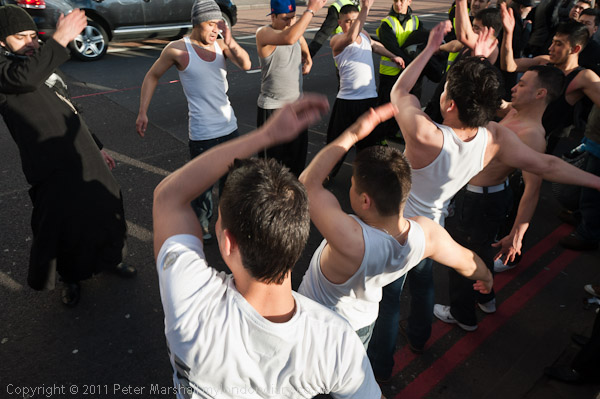
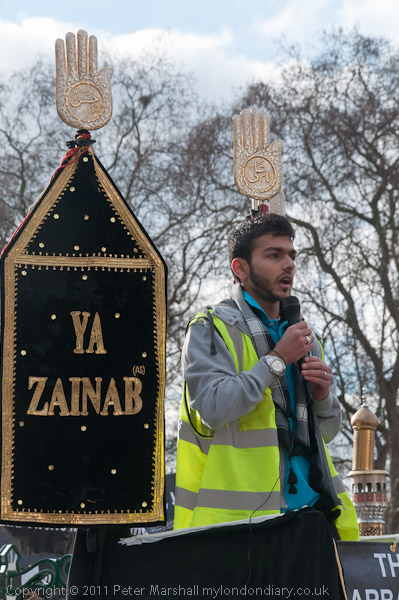
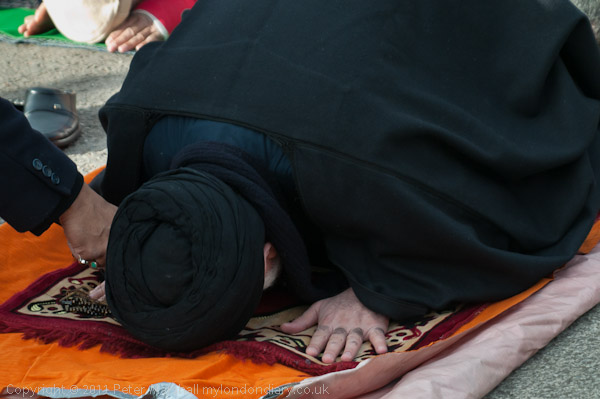
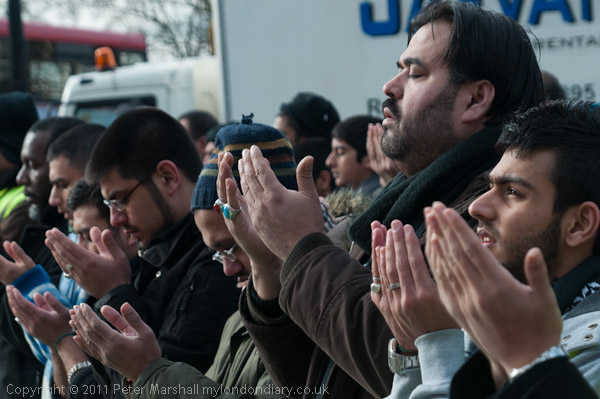
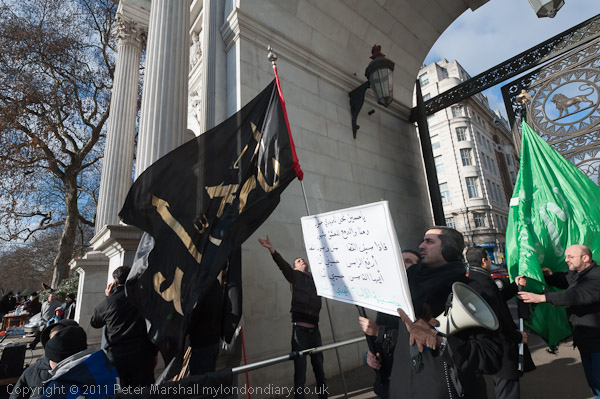
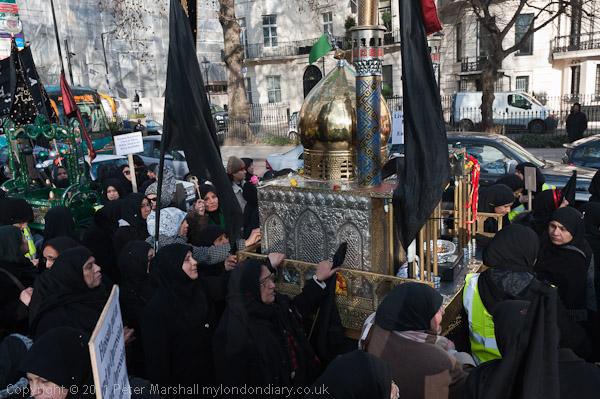
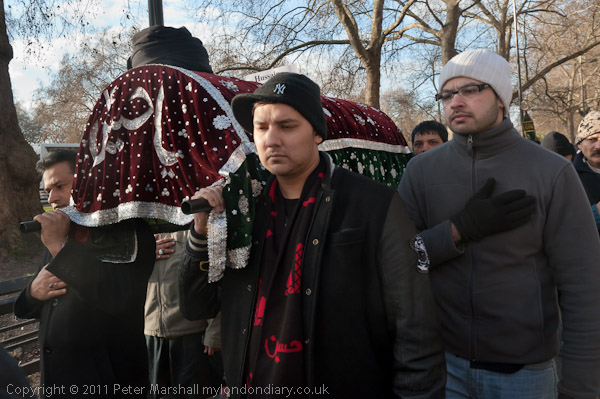
Several thousand Shia Muslims came to Marble Arch on 30th January 2011 for the 30th annual Arbaeen (Chelum) procession in London, commemorating the sacrifice made by the grandson of Mohammed, Imam Husain, killed with his family and companions at Kerbala in 680AD. Arbaeen takes place 40 days after Ashura, the day commemorating the martyrdom and marks the end of the traditional 40 days of mourning. After prayers and recitations they paraded along Park Lane in a ceremony of mourning.
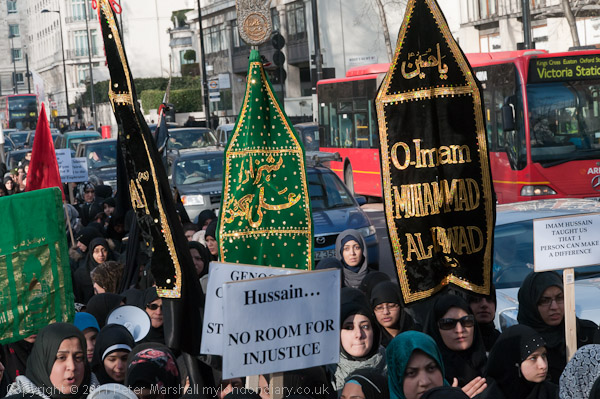
Imam Husain is seen by Shia Muslims as making a great stand against the oppression of a tyrant and representing the forces of good against evil. Husain and his small group of supporters were hugely outnumbered but chose to fight to the death for their beliefs rather than to compromise. Their stand is a symbol of freedom and dignity, and an aspiration to people and nations to strive for freedom, justice and equality.
Arbaeen is also said to commemorate the return of the wives and families of those killed – who were marched away as captives to Damascus after the massacre – to Kerbala to mourn the dead after their release around a year later.
Millions now attend the annual Arbaeen event in Kerbala (though it was banned while Saddam Hussein was in power) and the London event attracts Muslims from all over the UK, although numbers this year seemed rather fewer than in some previous years.
The Hussaini Islamic Trust UK first organised this annual procession since 1982, making it the oldest Arbaeen/Chelum Procession of Imam Husain in the west. It was the first annual Muslim procession in Central London and is still one of the larger annual Muslim processions in the UK. It is held on the Sunday closest to Arbaeen.
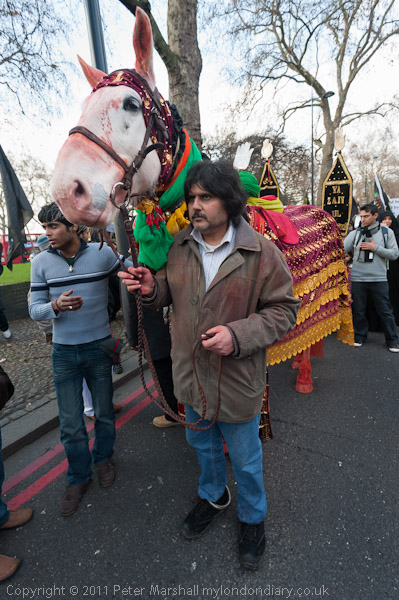
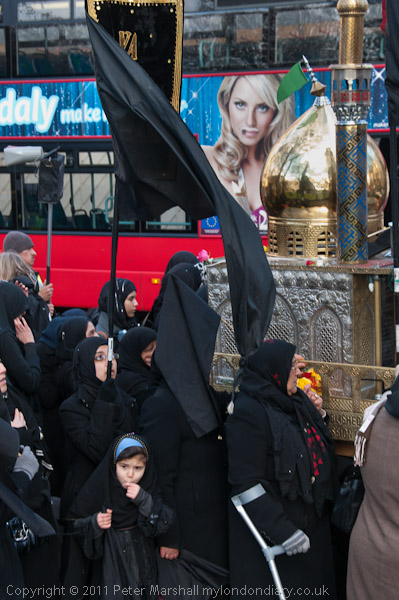
The procession includes several large replicas of the shrines of Karbala; known as Shabbih, these gold and silver models are over 10 feet high and the largest in Europe. There was also a decorated and blood-stained white horse or Zuljana representing the horse of Imam Husain, a cradle remembering his 6 month old child Hazrat Ali Asghar who was also murdered and a coffin.
The day started at Marble Arch with prayers and recitation which were followed by speeches in English, Arabic and Urdu before the procession set off. I missed some of this as I was busy covering another event, but returned shortly after the procession set off down Park Lane.
Groups among the men chanted and all those marching beat their chests as a token of mourning, most in a symbolic rather than very physical manner, but as the procession made its way down the road some were soon stripped to the waist and beating themselves vigorously, producing red marks and some drawing blood.
The women marched in a tightly packed separate group at the rear of the march, held back by a number of women stewards and pushing the cradle and one of the Shabbih. Like the men they chanted and made gestures of mourning. Although they were almost all dressed in black, many of them were carrying standards and flags, and some had some brightly coloured embroidery and headscarves.
After the march there are light refreshments provided, but I left before that, catching a bus along Park Lane. The procession only occupies one of the three lanes of each of the dual carriageways and traffic keeps flowing throughout, although with some slight delays.
More pictures from this event in 2011at Shia Muslims 30th Arbaeen Procession. I photographed this procession in other years from 2007 to 2012 and you can find pictures from these by entering Arbaeen in the search box on My London Diary.
As I mention in the account above, I left the march to photograph another protest, in Oxford St, a short walk away from Marble Arch. Around 50 UK Uncut activists dressed as doctors and nurses a staged a peaceful protest in Boots in Oxford St against their avoidance of UK tax, closing the store. You can read about it in UK Uncut Protest Boots Tax Scam.
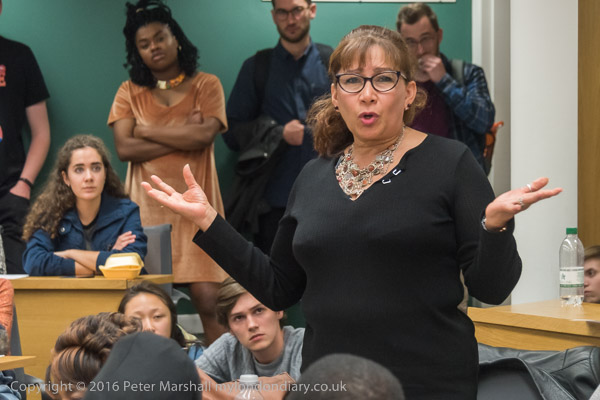
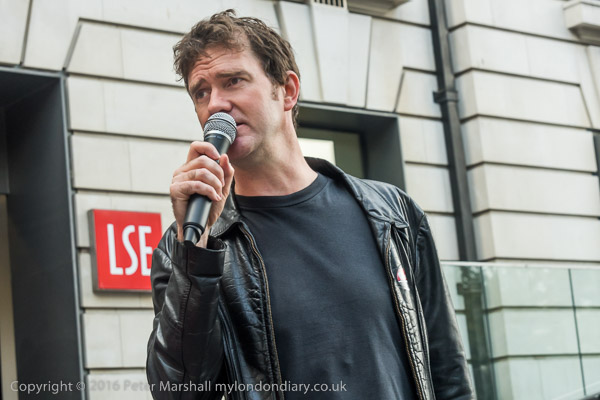
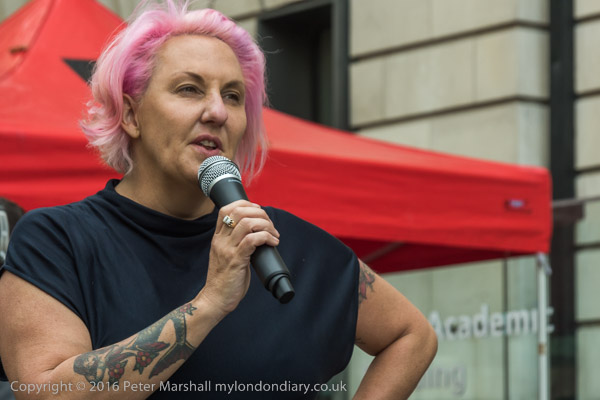
I’d gone to the LSE to attend a session in the LSE’s 3-day ‘Resist’ festival organised by Lisa McKenzie, then a research fellow in the Department of Sociology there, though I imagine that this was one of several reasons her contract was not renewed. It’s OK if your work is purely academic, or if it supports the kind of people and companies that fund universities, but anything practical which supports the working classes is definitely infra-dig.
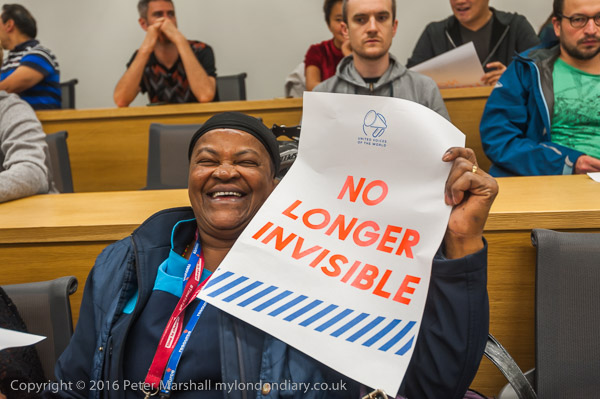
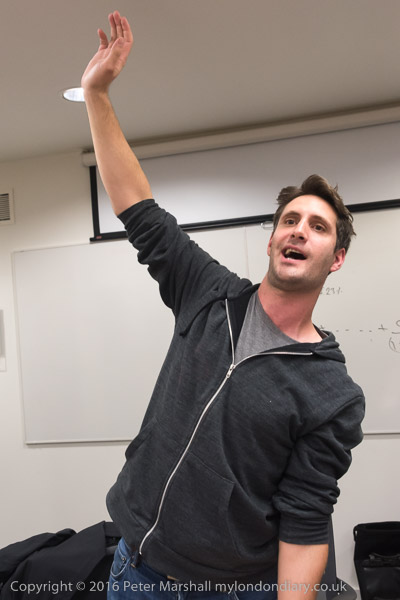
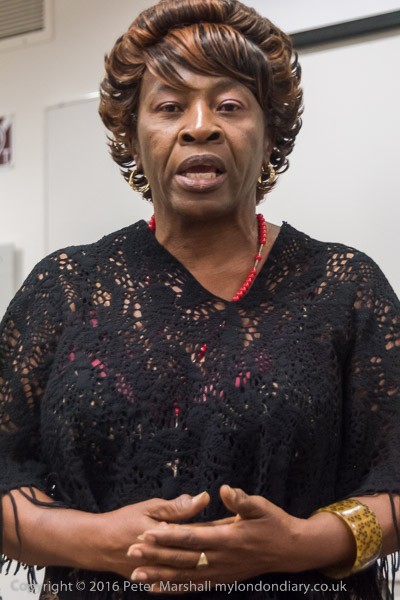
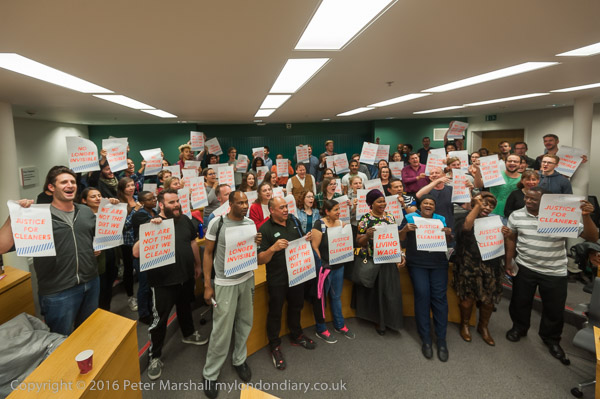
At the end of the session (more about it below) McKenzie called upon Petros Elia, General Secretary of the United Voices of the World trade union to which many of the LSE cleaners now belong. He accused the management of the LSE of failing to protect the interests of cleaners working there who they have outsourced to a cleaning contractor in a cost-cutting exercise without insisting on decent working conditions and conditions of service. He invited all present to a meeting to discuss action by the cleaners which was to be held as a part of the Resist festival later that day. I hadn’t intended to stay for that, but decided to do so.
Covid has made many re-evaluate the contributions of many low-paid workers, and to realise how essential their services are to the running of society. Cleaners are one such group and the meeting organised by the UVW made clear how terribly they were being treated by their employers, Noonan, while the LSE was happy to pocket the few pennies they were saving by outsourcing and look the other way to the injustices taking place under their own roof – while claiming the moral high ground and uncovering and moralising on those in societies around the world.
It was also a meeting which would have shattered any prejudices about low-paid workers being less intelligent, less aware or less articulate than those in higher positions. Many of them were migrant workers and speaking in their second (or third) language, though some through interpreters, but made themselves heard more clearly than the average cabinet minister in a radio or TV interview.
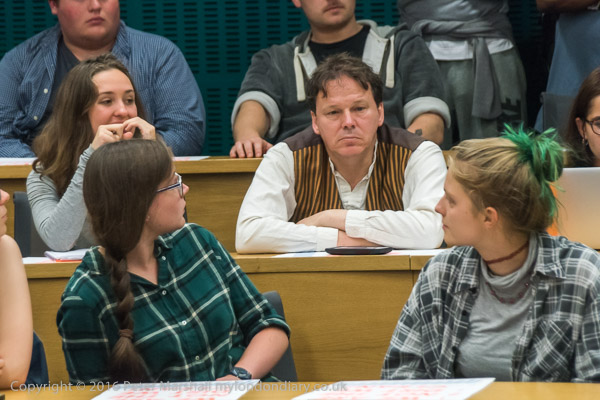
The cleaners’ campaign for parity of treatment with other workers employed directly was supported by students – including those on a new graduate course in Equality – and the students union General Secretary, several post-graduate students and staff. One of those present was LSE Professor of Anthropology David Graeber who so sadly died aged 59 just over a year ago and is much missed.
Students and staff continued to support the cleaners in various actions and the campaign was partly successful. The cleaners were brought in house in June 2017, but are still remained “frustrated and grieved by their continuing treatment as “second-class” workers.” A petition was launched in April 2021 making 14 demands. A major continuing problem is that the LSE does still not recognise or talk with the cleaners’ trade union, the UVW, but talks with Unison which never consults the cleaners and fails to represent many of their needs.
The earlier session of ‘Resist’ was a lengthy and detailed indictment by Simon Elmer of Architects for Social Housing of a report by a group of LSE academics on Kidbrooke Village, a development by Berkeley Homes and Southern Housing. This replaced the LCC-built Ferrier Estate in SE London, which was deliberately run-down, demonised and emptied by Greenwich Council from 1999 onwards.
Elmer accused the report of lies about the estate regeneration, of basing their report on that of the property developer and passing it off as their own, of placing the cultural legitimacy of an LSE report in the service of Government policy and the profits of Berkeley Homes and of accepting financial backing to validate the desired conclusions of their backers.
Elmer made a convincing case, but none of those responsible came to make any defence of the report, and it was hard to know whether there could have been any – though I suspect it might well have been only a matter of picking a few holes and making minor corrections to his analysis. Clearly universities should not be places where property developers or even governments call the tunes and the LSE would appear to have been caught out kowtowing to capital.
All photographs on this and my other sites, unless otherwise stated, are taken by and copyright of Peter Marshall, and are available for reproduction or can be bought as prints.