Iran & Midwives – 2010

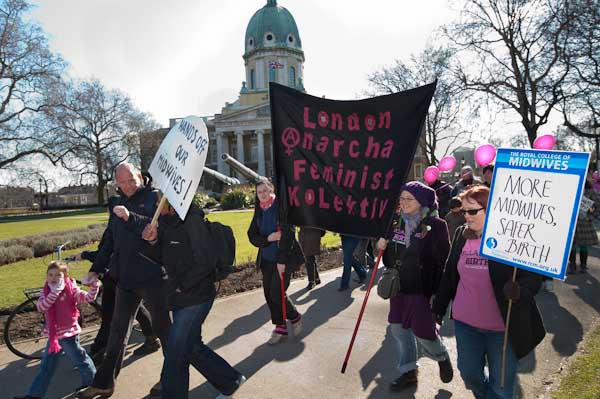
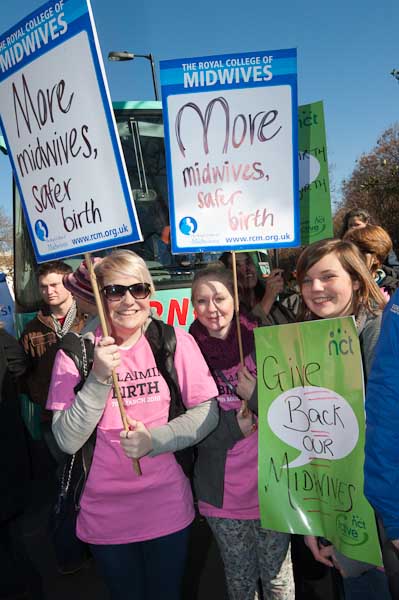
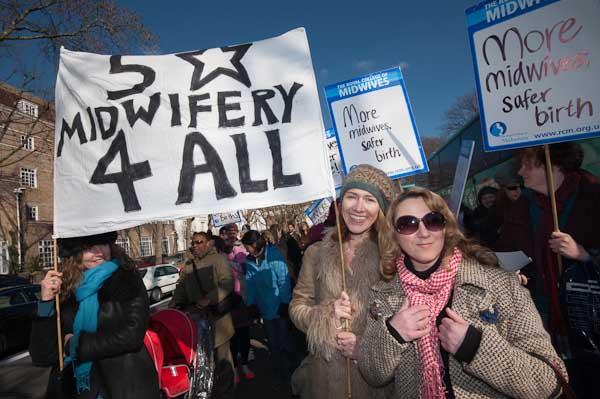
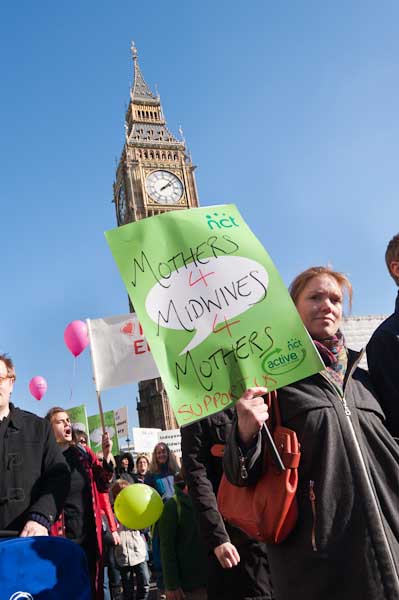
Iran & Midwives: On Sunday 7th March 2010 I photographed a protest marking International Women’s Day organised by Iranian women over the 31 years of repression and calling for an end to the Islamic regime who marched to a rally in Trafalgar Square. I then went south of the river to Geraldine Harmsworth Park for the start of a march back to Downing Street in support of better integrated midwifery services for all women.
Iran & Midwives - 2010
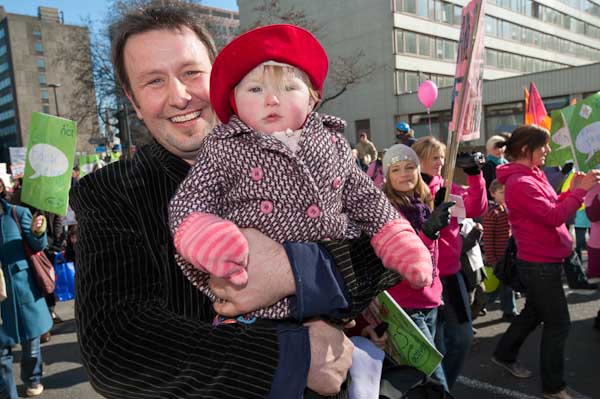
Of course there were Dads as well on the midwives march

Both Iran and maternity services are now still live issues. Baroness Amos’s interim review into maternity and neonatal services in England is harrowing and two thirds of maternity services are rated either “inadequate” or “requires improvement”.

Today I will be at a protest against the illegal war by Israel and the USA on Iran. Of course few if any support the Iranian Islamic regime, certainly not among those who like me will be at the protest.

The attacks on Iran, including the assassination of Ali Khamenei, are extremely unlikely to lead to regime change – and if anything are likely to lead to even greater repression, hardship and bloodshed in a country which is being pounded into greater poverty and extreme disorder, with possibly many years of destructive multi-sided civil wars. The decision to attack now appears to have been prompted by the Israeli fears that an agreement between the US and Iran might have been imminent – and perhaps also by the US feeling that a war might improve Trump’s position in the US mid-term elections.


Support the Iranian Women’s Struggle

Iranian Embassy to Trafalgar Square
Iran & Midwives - 2010

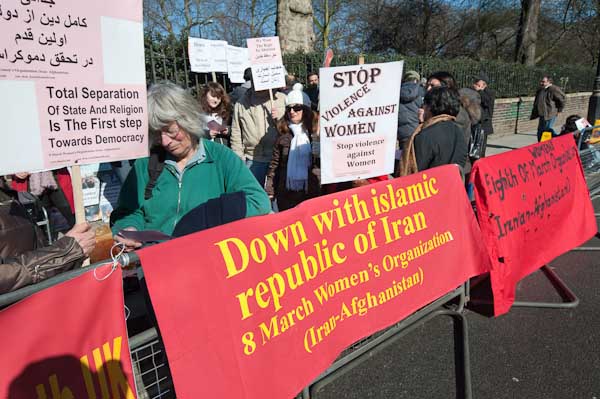
Women and men, mainly Iranians, held a rally opposite the Iranian embassy in Kensington to mark International Women’s Day and protest against the 31 years of anti-women Islamic laws and repression and calling for an end to the Islamic regime.
Iran & Midwives - 2010

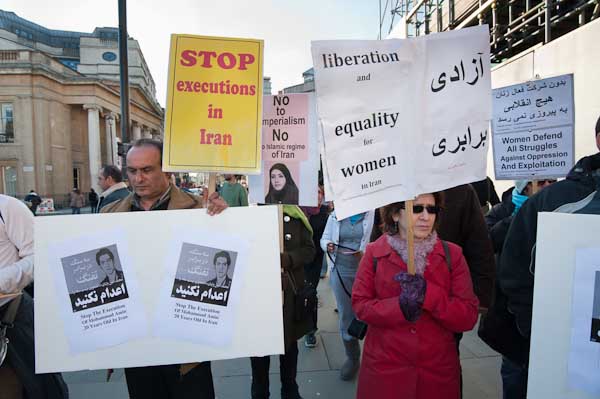
The protest was organised by the 8 March Women’s Organsiation (Iran-Afghanistan) and they marched from there to Trafalgar Square where there was a larger rally on the North Terrace with speeches and messages from the 8 March Women’s Organisation, the European Democratic Women Movement (Turkey), Hands off People of Iran, the Organisation of Women’s Freedom in Iraq and the Million Women Rise movement.
Iran & Midwives - 2010

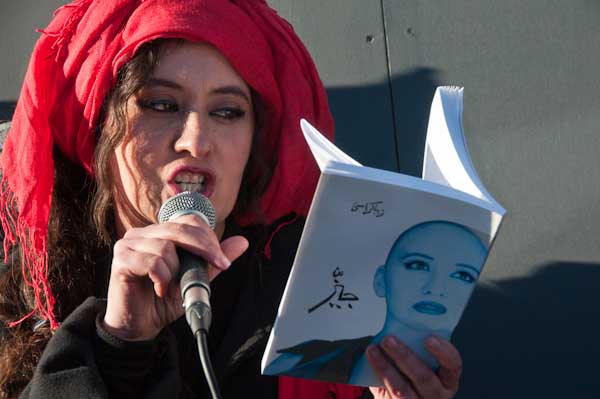
The speches were followed by performances by a number of artists including Iranian singers and poets.

More at Support the Iranian Women’s Struggle.


Mums and Midwives Reclaim Birth

Geraldine Harmsworth Park to Downing St
Iran & Midwives - 2010
Hands off our Midwives – London Anarcha Feminist Kolektiv – Royal College of Midwives

The Albany Midwifery Practice in Peckham in South London – one of the most highly deprived areas of England – was widely regarded as a model of best practice and a centre of excellence in NHS midwifery, giving support to women throughout pregnancy, birth and the post-natal period, encouraging women to make informed choices about how and where they give birth.
But at the end of 2009, King’s College Hospital terminated their contract following a critical report from the Centre for Maternal and Child Enquiries (CMACE) which King’s claim showed “serious shortcomings” over one aspect of their work, forcing the centre to close down. This report was shown to be based on incorrect use of statistics.
King’s decision was seen as an attack on on alternative ways of maternity care that provide better overall outcomes and better meet the needs of women.

Their perinatal mortality rates were well below the national average and well under half those for those in its London Borough. And far fewer of their mothers gave birth by Caesarean section – just over half of the rate in King’s College Hospital. Perhaps at the root of King’s objection to Albany was that almost half of the women chose to give birth at home – compared to 1 in 16 for the area as a whole.
More than three quarters of Albany mothers also continued to breastfeed their babies, well over twice the national average.
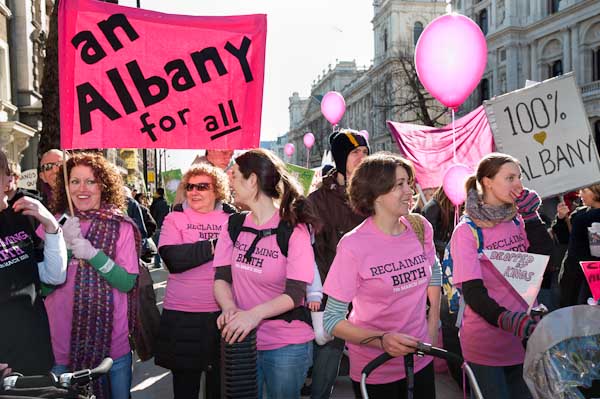
The march and rally was supported by AIMS (Association For Improvements In The Maternity Services), NCT (National Childbirth Trust), ARM (Association of Radical Midwives), IM UK (Independent Midwives UK) and Albany Mums.

As well as calling for a public inquiry into the decision to end the Albany contract it also called for a move across the country to replace the current doctor-led hospital services , often un-supportive and even traumatic for mothers, with services following the Albany example which provide a much more comprehensive service with better information and fuller support for women at no greater cost.
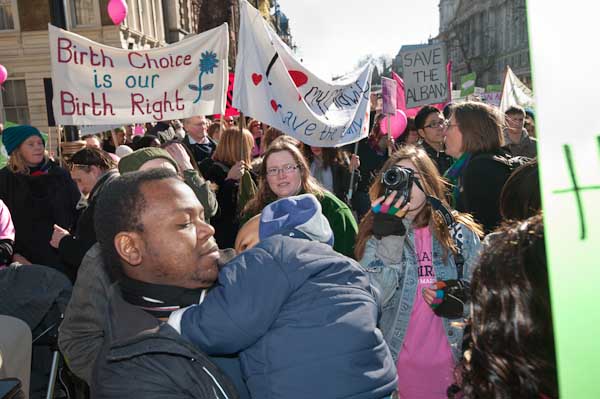
Peckham has a record of innovative medical services, with the groundbreaking Peckham Experiment in community health which began 100 years ago in 1926 and was ended under the NHS in 1950. The case of the Albany model of care echoes this, and there approach was fully vindicated in a detailed analysis published in 2017 which concluded “consideration should be given to making similar models of care available to all women.”

More at Mums & Midwives Reclaim Birth.


FlickrFacebookMy London DiaryHull PhotosLea ValleyParis
London’s Industrial HeritageLondon Photos

All photographs on this page are copyright © Peter Marshall.
Contact me to buy prints or licence to reproduce.


Denmark Hill, Ruskin and on to Dulwich

The previous post on this walk was Houses, Station, General Booth and more Houses.

I walked up Champion Hill to Denmark Hill and Ruskin Park, pausing briefly to take a photograph – not online – of what I later found to be a Grade II listed shelter before going further north towards the two hospitals further north.

Maudsley Hospital, Denmark Hill, Camberwell, Southwark, 1989 89-2a-32

Donations of £40,000 from psychiatrist Dr Henry Maudsley (1835-1918) went towards the establishment of a specialist hospital for the early treatment of recoverable mental disease, which was completed in 1915 when it was requisitioned for use as a military hospital, finally opening for civilian patients in 1923. Architects were William Charles Clifford-Smith, EP Wheeler and G Weald.

Although I’ve visited several of my family over the years in various mental hospitals, none has been in the Maudsley, which is the leading mental health training school in the UK. This was perhaps fortunate as it’s treatments have often been controversial over the years.

Statue, Robert Bentley Todd, Kings College Hospital, Denmark Hill, Camberwell, Lambeth, 1989 89-2a-34

Surgeon Robert Bentley Todd (1809-60) became a Professor at King’s College London in 1836 and took the lead in setting up King’s College Hospital in 1840 in Portugal St. The hospital moved to this new building designed by William Pite on Denmark Hill in 1909. The statue of Todd, financed by donations from his colleagues and friends was placed in the lobby of the Portugal St hospital in 1861, the year after his death, and moved here in 1913. The statue was not made to be displayed in the open air and has eroded.

Kings College Hosptial seems a rather random collection of buildings, few of any architectural interest. The photograph shows the statue in front of the Guthrie Wing, an Art Deco building dating from 1937 which is a private patients wing inside the main hospital, but was moved elsewhere on the campus when a new ambulance entrance and A&E department opened in 1997.

Rose Garden, Gateway, Ruskin Park, Camberwell, Lambeth, 1989 89-2a-35

I walked back to Ruskin Park and made a second picture of the Grade II listed shelter from the Rose Garden, which was looking a little sad, with no blooms but just the pruned growths with the odd leaf remaining. The shelter and its flanking walls was Grade II listed as long ago as 1951 and was built in the late 18th century as a part of the house which once stood here.

John Ruskin (1819-1900) moved to Herne Hill when he was five and the family moved to 163 Denmark Hill in 1842. The following year the first volume of his influential Modern Painters was publishing, promoting the work of JMW Turner. In 1871 he sold the house on Denmark Hill and it was demolished in 1949. Ruskin Park opened in 1907.

One of the few volumes I saved from my father’s books after his death was his copy of ‘WORK; FROM THE CROWN OF WILD OLIVE’ by John Ruskin, a miniscule volume designed to fit the waistcoat pocket of a working man and published I think in the 1920s when my father was just such a young working man in his 20s. This roughly 3″ by 4″ book is the text of a lecture he delivered to the Working Men’s Institute in Camberwell in 1865.

Saint Faith's Church, Red Post Hill, Dulwich, Southwark, 1989 89-2a-25
Saint Faith’s Church, Red Post Hill, Dulwich, Southwark, 1989 89-2a-25

I walked on southwards on Denmark Hill and then turned down Sunray Avenue to go down Red Post Hill. Early street direction signs were often painted red and one on the crossroads at the top of this road giving distance and directs to nearby villages was here by the mid-eighteenth century. It became a well-known local landmark by the 1800s, and the street it was at the top of was renamed from Ashpole Road (possibly also a reference to the post which could have been made from ash, a strong and durable wood) to Red Post Hill soon after. The post disappeared probably in the mid-nineteenth century, but in 2010 a new red post, the only one in London, was placed on the corner.

St Faith’s Church, North Dulwich began as an attractive Arts & Crafts church hall in 1908 which is now the neighbouring St Faith’s Centre. The church a large and rather plain brick box was only built and consecrated in 1957. On its west end is the sculpture at the right of my picture of Christ on the Cross with St John the Evangelist and St Mary Magdalene by Ivor Livi. The church no longer has what appears to be an excessively large flagpole.

House, Red Post Hill,  Dulwich, Southwark, 1989 89-2a-11
House, Red Post Hill, Dulwich, Southwark, 1989 89-2a-11

The road has a number of large suburban houses, including a row of similar semi-detached houses to this detached property and its neighbour close to North Dulwich Station.

Bistro Italiano, restaurant, East Dulwich Grove, Dulwich, Southwark, 1989 89-2a-12

I don’t think Italian bistros were common – certainly not in the areas of London which I knew well, but I think this one stood out for the crudeness of its lettering and strange letter-spacing.

Dulwich Hospital, East Dulwich Grove, Dulwich, Southwark, 1989 89-2a-13

Like many hospitals, Dulwich Hospital began life as a workhouse infirmary, built for the Guardians of the Poor of the parish of Southwark St Saviour and opened in 1887, though the building has the date 1886 at left. It became a military hospital in the First World War and in 1921 was renamed Southwark Hospital, becoming Dulwich Hospital ten years later.

The ward buildings in this picture were demolished around 18 months ago.

Dulwich Hospital, East Dulwich Grove, Dulwich, Southwark, 1989 89-2a-15

The land for building the infirmary was sold with the stipulation that the public building erected “should be of an ornamental character” and local architects Henry Jarvis & Son did their damndest, though not entirely to my taste, receiving praise in the local press at the time. The hospital was built with a central adminstration building and long pavilions of ‘Nightingale Wards’, long narrow rooms with large windows for light and ventilation with beds along both sides. I spent around ten days in a similar ward in St George’s Tooting shortly before it was closed twenty years ago.

Until fairly recently this was still Dulwich Community Hospital, though most medical services had ceased in 2005. Part of the hospital has been demolished to build a school and health centre, but the buildings in this picture are still there.


To be continued. My account of this walk from 5th February 1989 began with A Pub, Ghost Sign, Shops And The Sally Ann.