Gasholders, Goods Way and Midland Road: Continuing with pictures from my walk on Sunday 18th February 1990 – the first post on this was Between Kings Cross & St Pancras – 1990.
Gas Holders, Goods Way, Kings Cross, Camden, 1990, 90-2d-16
I photographed the gasholders here on various occasions and from various places, both in black and white and in colour. The Pancras Gasworks and those at Shoredittch were the first gas works of the Imperial Gas Light Company (later the Imperial Gas Light and Coke Co) were built in 1822 on Battlebridge Road beside the Regent’s Canal. In the 1860s it was still the largest gas works in Britain if not the world, but soon it was eclipsed by others.
Although the gas works closed in 1904 and was dismantled three years later, the gasholders continued in us for gas storage for gas from the company’s vast Beckton gasworks and were only finally decommissioned around 2000 well after town gas had been replaced by natural gas.
These three gasholders were originally built in 1879, replacing an earlier triplet from the 1860s designed by engineer John Clark. He had them built as ‘telescopic’ holders with two interlocking sections or ‘lifts’ around the outside of the ‘bell’ which could rise up inside the guide frames to increase the capacity.
As the Grade II listing text states this involved “replacing the guide frames in their entirety by the contractors Westwood and Wright under the direction of John Clark. The columns of the new guide frames observed classical rules so that the lowest tier was in the Tuscan order, the middle in the Doric and the topmost in a simplified version of Corinthian.”
These small industrial workshops were also demolished in the redevelopment of the area for the building of St Pancras International.
Water Point, St Pancras Station, Goods Way, Somers Town, Camden, 1990, 90-2e-01
This Grade II listed water point is close to the new location of the gasholder frames and also the redeveloped coal drops on the north side of the canal. Built around 1870 for the Midland Railway it was probably designed by Sir George Gilbert Scott’s architects office.
Like the gasholders its original location was in the way of St Pancras International and was moved around 2001 to its new location on Camley St, some 700 yards to the north. When built it was condemned by some architectural critics for being an inappropriate use of Gothic for a functional building, but it well matched the station and hotel.
Together with the Granary building and others in the area according to Historic England it forms “an evocative ensemble of former industrial buildings of considerable urban landscape value.” Having a theme park like this is certainly better than losing these structures completely but it isn’t any real replacement for the original.
Between Kings Cross & St Pancras: A week after my previous walk which began from Kings Cross I was back there again for another walk on Sunday 18th February 1990, beginning with a few pictures close to the station in Kings Cross and Somers Town. This was an area I’d photographed in earlier years but still interested me. Since 1990 it has of course changed dramatically.
Cheney Rd, Kings Cross, Camden, 1990, 90-2d-34
Cheney Road is no longer on the map of London although one of the buildings on it remains. It ran north-east from Pancras Road along the side of Kings Cross Station, then turned north-west towards Battlebridge Road and the gasholders you see here. Of course those gasholders are no longer where they were in 1990, but were moved further north and to the opposite side of the Grand Union Canal as a part of the redevelopment of the area including the addition of the Eurostar lines into St Pancras.
This street was a popular film location, best known for its use in The Ladykillers. In the middle distance at left you can see the roof of the German Gymnasium, with its distinctive windows at its top, I think the only building in my picture that remains (at least in part) in situ.
St Pancras Hotel and stating seen looking south down Pancras Road on a sunny Sunday morning. I think I used the controlled parking zone sign to cut down flare. A taxi is turning into Kings Cross over a short section of cobbles.
The station was completed in 1869 and the Midland Grand Hotel in 1876, though it had its first visitors in 1873. Both were designed by George Gilbert Scott and are Grade I listed. They were built for the Midland Railway whose main lines ran from here to Manchester, Sheffield and Nottingham via Derby. The hotel was expensive to maintain and closed in 1935, then becoming used as railway offices by the London, Midland & Scottish Railway.
My first trip to Manchester in 1962 was from here, but soon after in 1967 the central section of the route – one of England’s most scenic – was closed. Now the line ends at Matlock (with a Couple of miles of preserved railway to the north, and we have change at Derby on our journeys to Matlock.
Pancras Rd, Somers Town, Camden, 1990, 90-2d-21
Looking north up Pancras Road with the arches of the station to the left of the picture and one of the gasholders in the distance. The curved pediment above the door in the middle block at right is the entrance to the German Gymnasium. This end of the Grade II listed building was demolished when St Pancras International was built, and the west end of the building was replaced by modern brickwork in keeping with the other walls of the building.
Turnhalle, German Gymnasium, Pancras Rd, Kings Cross, Camden, 1990, 90-2f-66
This was the original west end of the Turnhalle at 26 Pancras Rd.
Pancras Rd, Somers Town, Camden, 1990, 90-2d-22
Kings Cross Automatic Gearbox Centre at 87-89 Pancras Road, Newport Joinery at 92 and other small businesses along the west side of athe road were all demolished to make room of the new platforms for St Pancras International
Stairs, Stanley Buildings, Stanley Passage, Kings Cross, Camden, 1990, 90-2d-15
A notice at the left of the stairs of Stanley Buildings flats, says NO to the British Rail bill in Parliament which would see the building of the new international station and the demolition of much of the conservation area. Despite much opposition, the Channel Tunnel Rail Link Act was passed in 1996.
Stanley Buildings were built in 1865, designed by Matthew Allen for the Improved Industrial Dwellings Company under the guidance of Sydney Waterlow. Grade II listed in 1994, but that has not enough to save them as they were and one block was entirely demolished and the remaining block incorporated into a modern building, losing much of its character. The listing text ends: “Among the earliest blocks built by Waterlow’s influential and prolific IIDC, Stanley Buildings are in addition an important part of a dramatic Victorian industrial landscape.” Their remnant now sits largely hidden in a modern development.
Police Killing, NoBorders, Malaysia & Dance of the Dead: Saturday 30th October 2010 I went to the annual protest by United Friends and Families against deaths in custody, then a march by No Borders against surveillance and border control. At the Malaysian High Commission I photographed a protest against torture and other human rights abuses before finally going to photograph zombies in a Halloween Dance of the Dead Street Parade in Hoxton.
United Friends & Families March
Trafalgar Square to Downing St
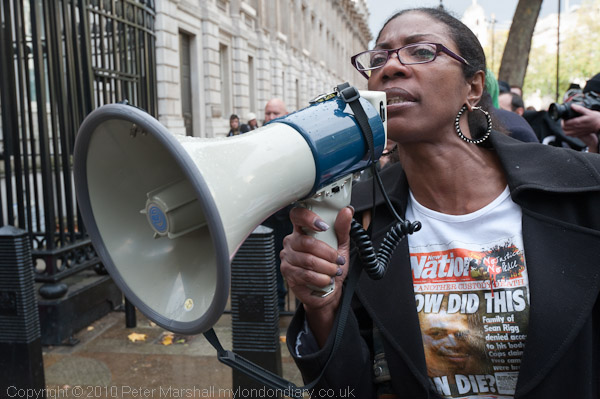
Marcia Rigg-Samuel, sister of Sean Rigg, killed by police in Brixton, tries to deliver a letter at Downing St
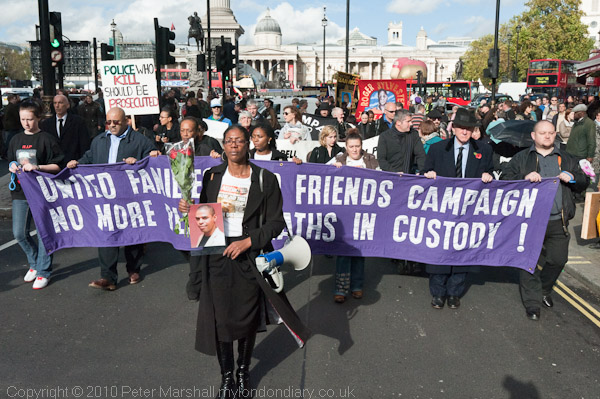
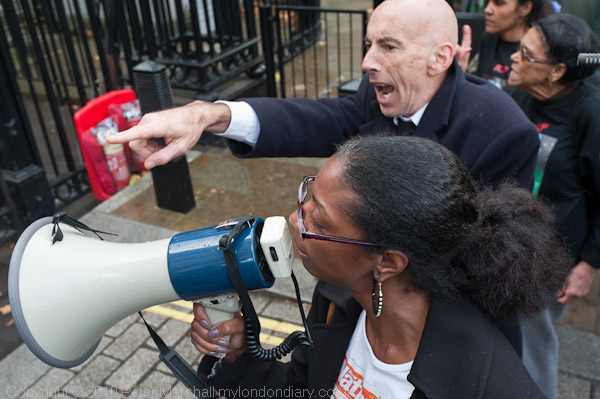
The annual march by United Friends and Families of those who have died in suspicious circumstances in police custody, prisons and secure mental institutions went in a slow, silent funeral march down Whitehall to Downing St, where they held a noisy rally.
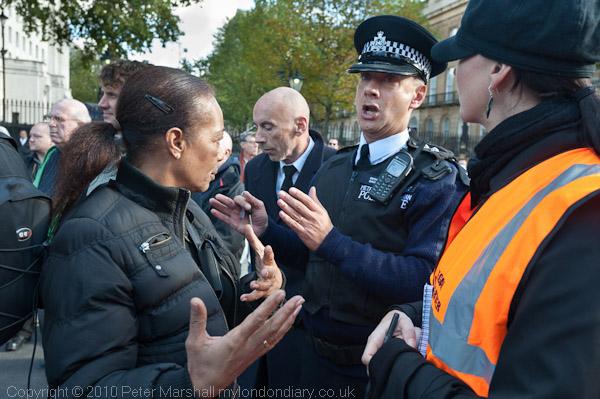
Police refused to allow them entry to the street to deliver a letter to the Prime Minister, David Cameron and would not take it. Apparently nobody from No 10 was prepared to come and receive it.
This march has taken place every year since 1999 and in most years police have stood back and let it happen, even facilitating it by stopping traffic. This year they had decided to try to stop people marching on the road down Whitehall, but the protesters simply stood in the road blocking it and refusing to move and were eventually allowed to proceed.
Stephanie speaks about her twin brother Leon Patterson and the lack of support for families who seek justice
On My London Diary you can read more about a few of the several thousands of deaths in police custody, often clearly at the hands of officers.
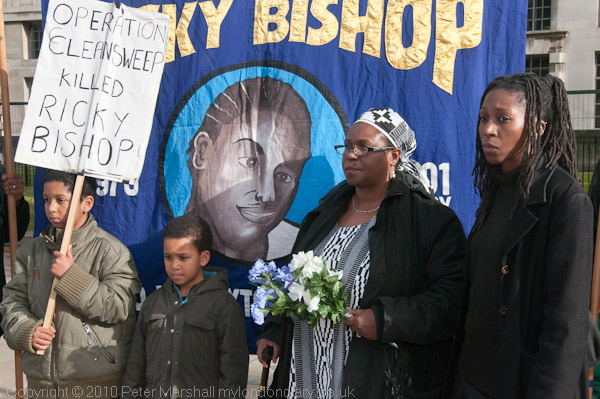
Operation Clean Sweep killed Ricky Bishop – his family protest
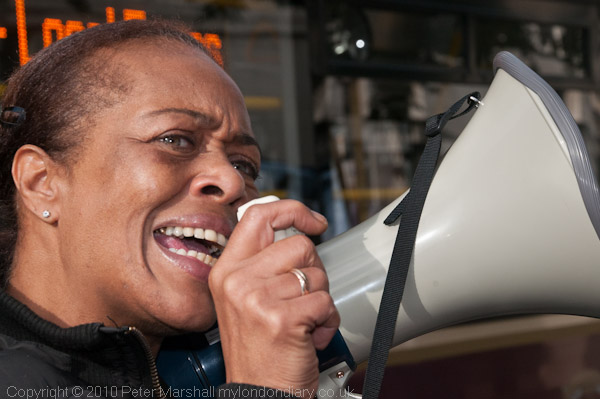
Among speakers at the rally were Stephanie, the twin sister of Leon Patterson, Rupert Sylvester, the father of Roger Sylvester, Ricky Bishop’s sister Rhonda and mother Doreen, Samantha, sister of Jason McPherson and his grandmother, Susan Alexander, the mother of Azelle Rodney, and finally the two sisters of Sean Rigg.
There were noisy scenes at the gates to Downing Street as the protesters tried to deliver a letter to the Prime Minister calling for justice, with police at the gate even refusing to accept the letter addressed to him. Eventually a few of the group were allowed to sellotape the flowers, a photo of Sean Rigg and the letter to the gates.
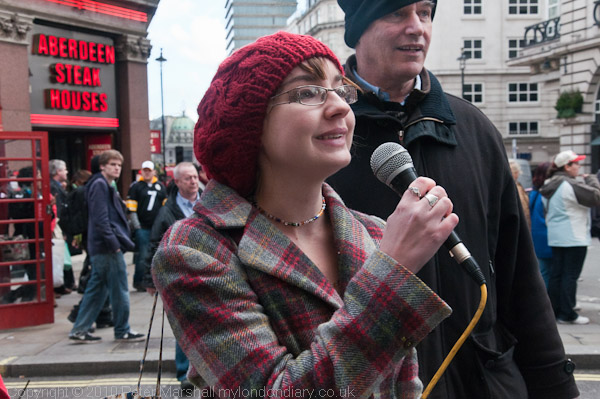
Juliet speaks at Piccadilly Circus before the march
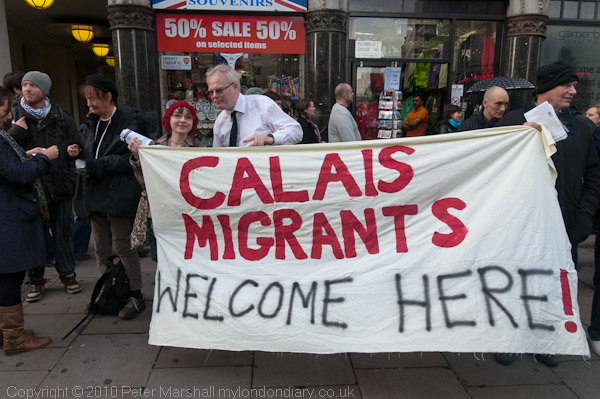
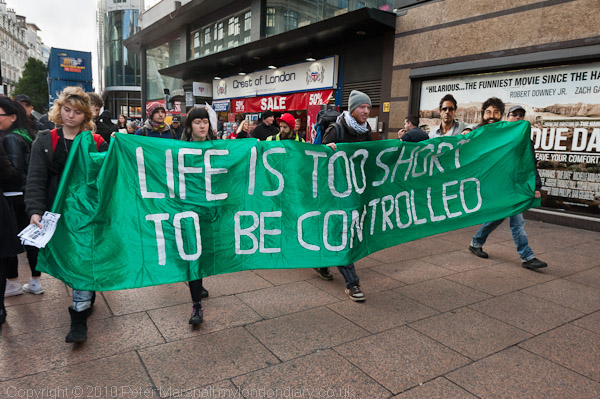
London NoBorders had organised a march from the pavement above the London main CCTV control room at Piccadilly Circus to the UK border at St Pancras International, protesting about the obsession with surveillance and border control.
Westminster Council CCTV HQ, which controls many of London’s 10,000 CCTV cameras, able to follow our movement on almost every street in the capital was an obvious starting point for the second ‘Life is Too Short to Be Controlled’ protest organised by London NoBorders.
They point out that despite CCTV everywhere on our streets it had not been possible to show a link between it and crimes being sold and say the real purpose of spying on our every movement is its potential to control dissent.
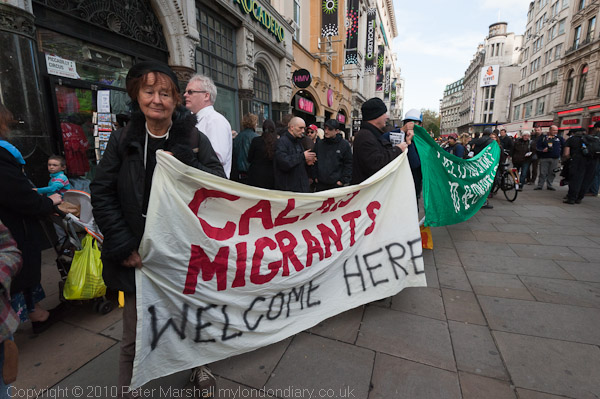
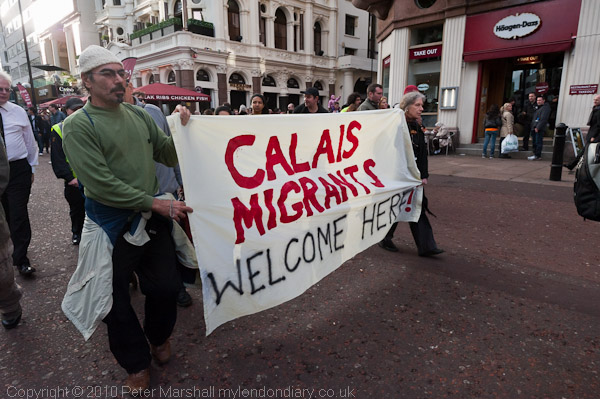
The protesters also called out the deliberate racism inherent in the term “illegal imigrants“. No immigrants on reaching this country are illegal; they simply do not have the particular documents that give them the right to live here and only became illegal once their case to stay here has been turned down.
Until recently the free movement of people – like the free movement of money, goods and capital – was seen as normal and beneficial.Our immigration rules are explicitly racist and NoBorders say anyone should be able to move and live where they please.
The march was delayed and I had to leave for another event before it reached St Pancras International, where those taking the Eurostar enter of leave the country. The station has detention facilities run by the UK Border Agency.
I returned later to hear that they had briefly occupied the ‘border’ area there before being escorted out by police. One person had been arrested and apparently charged with aggravated trespass, but I was told he was shortly to be released by the Transport Police.
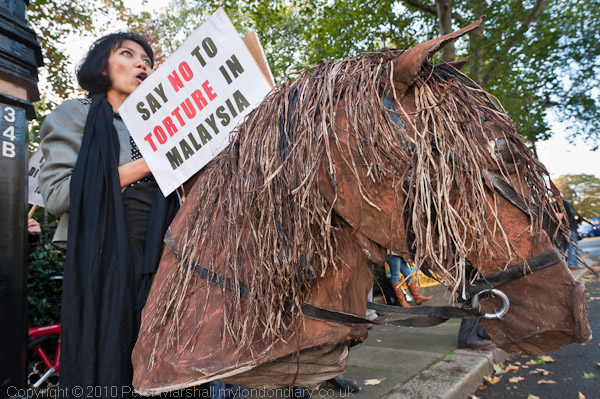
Opposite the Malaysian High Commission in Belgrave Square
2010 was the 50th anniversary of the Malaysian Internal Security Act, ISA, under which more than 10,000 people have been detained without trial for up to two years – and this can then then renewed making it effectively indefinite.
Detainees can be held incommunicado in detention for up to 60 days, during which they are often tortured, mistreated and placed under severe psychological stress while being denied access to legal process.
In June 2010 the UN Working Group on Arbitrary Detention visited Malaysia and they called for the ISA to be immediately repealed, and the UK chapter of the Malaysian Abolish ISA Movement (AIM) was protesting outside the Malaysian High Commission.
The protest in October marked 23 years since ‘Operation Weed Out’ (Operasi Lalang) when the ISA was used to arrest over 100 Chinese educationalists, civil rights lawyers, opposition politicians and others.
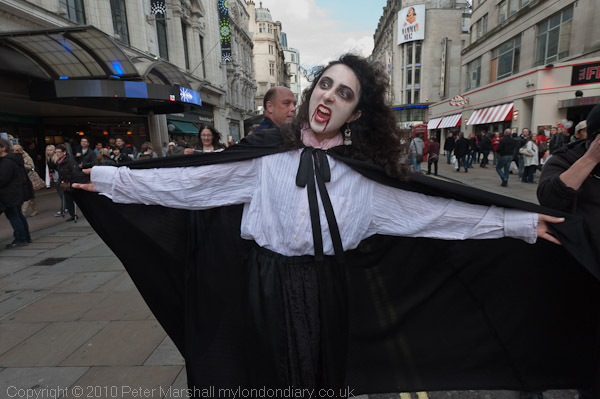
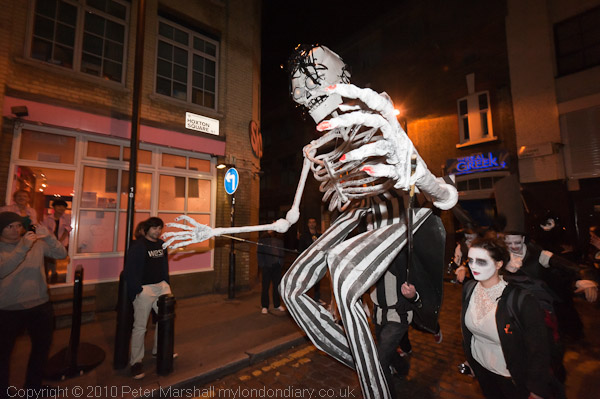
I’d met a few zombies stumbling around as I walked through the West End – and some of them had come to be photographed with the NoBorders ‘Life is too Short’ banner. But I went photograph the the Halloween Dance of the Dead Street Parade which started from Hoxton Square and was going on to end at a party in Gillett Square, Dalston.
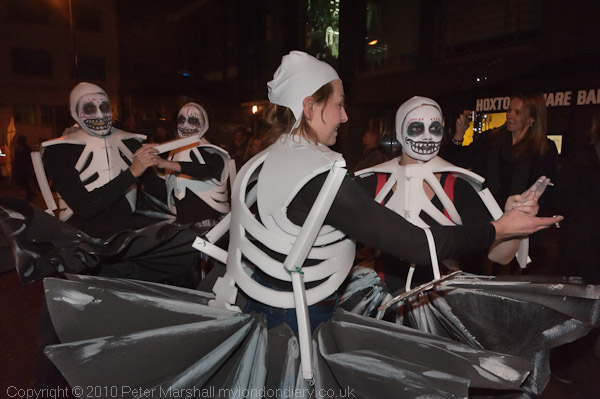
Corpse de Ballet
Hoxton Square had by 2010 become a trendy area with art galleries such as White Cube moving in an area some years after furniture and other local trades had declined and it had been squatted or rented as cheap studios for artists since the 1980s or so. Below is what I wrote in 2010 about the parade.
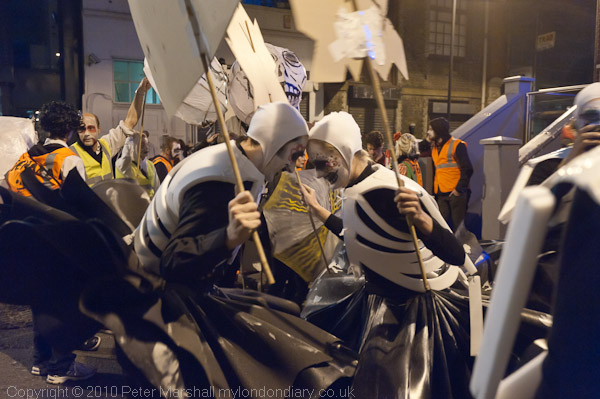
“By 7pm, there were several hundred people ready for the procession to start, including a group of dancers, the ‘Corpse de Ballet’ and a group from Strangeworks with some very well designed costumes, along with many others dressed up for the occasion.”
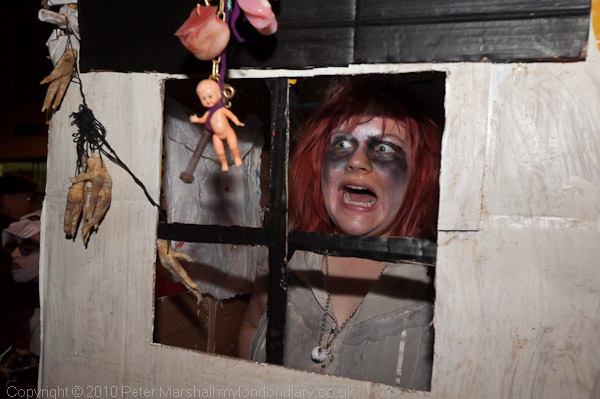
A woman in a haunted house
“A samba band, led by a giant skeleton came along from Coronet Street and led the large group of revellers, many carrying bottles, around Hoxton Square and then on to Old Street. By this time I’d been out taking pictures for around 8 hours and was feeling tired and hungry, so I jumped on a bus to begin my journey home, leaving the procession, organised by StrangeWorks Theatre collective and [then} in its fifth year, to head on its way to a dance in Gillett Square.”
March 8th – Women Strike And Protest. In 2021 on International Women’s Day I published a long post, 8 March: International Women’s Day with some images from my coverage of the day from 2002 until 2020, and in 2022 I posted International Women’s Day Marches with a little history and more of my pictures from previous years.
This year I look back seven years to Thursday 8th March 2017 when I covered a number of events on International Women’s Day.
From Russia With Love – Parliament Square
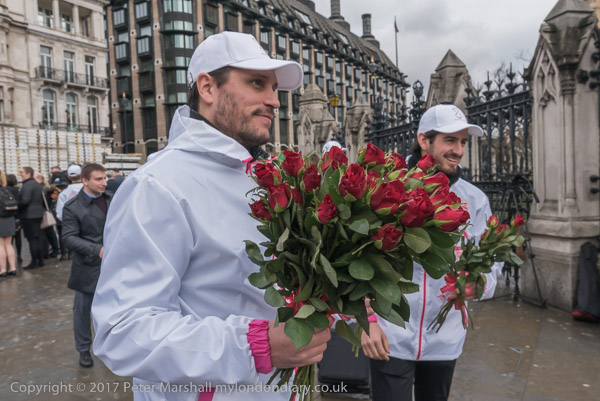
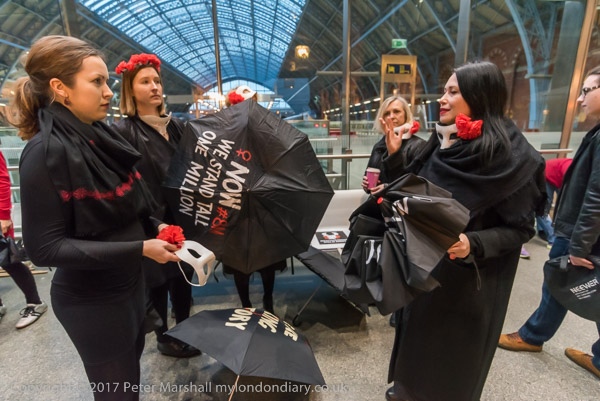
When I arrived to photograph a couple of protests about to take place in Parliament Square I found around a dozen young Russian men in white caps andjackers with a strange heart-based logo clutching large bunches of red roses being briefed before they went around the square stopping women an handing them roses.
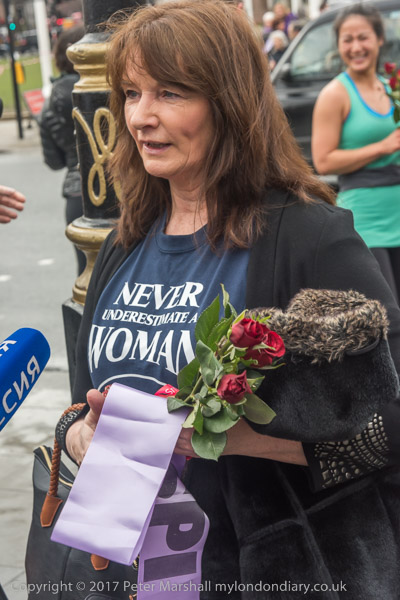
Apparently this was a stunt for Rusian TV by the ‘Make Her Smile Movement’ and was taking place in various capitals around the world. Some women refused the flowers, but most took them and seemed pleased if rather confused by the gesture.
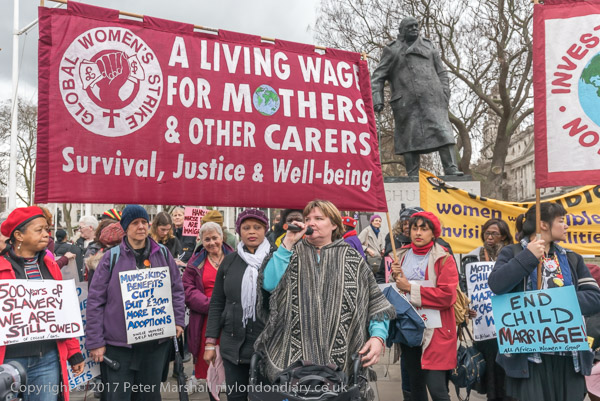
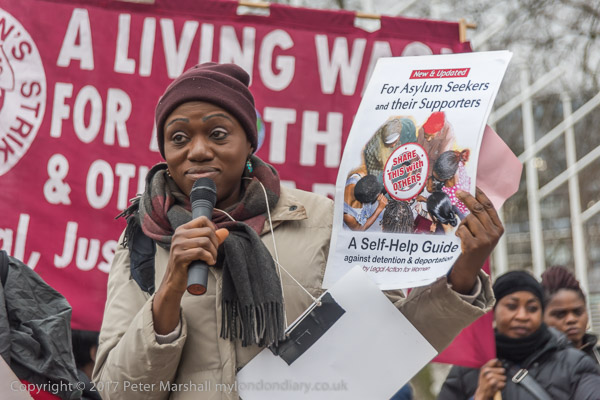
Global Women’s Strike had come to the square to celebrate the resistance of women worldwide and hold a protest in solidarity with the International Women’s Strike taking place in 46 countries.
They held a rally opposite Parliament as the Budget was being delivered inside, with speakers from a number of groups supporting women including the victims of domestic violence, the disabled and the victims of family courts.
Among the speakers were women from the Scottish Kinship Care Project, Dr Philippa Whitford SNP MP for Central Ayrshire, Denise McKenna, co-founder of Mental Health Resistance Network and Paula Peters of DPAC. Police initially tried to prevent the speakers using a microphone but were persuaded to let them go ahead.
The event ended with a short play by the All African Women’s Group about sexism and racism of the immigration system by the Borders Agency courts and in immigrations detention centres such as Yarl’s Wood Detention Centre.
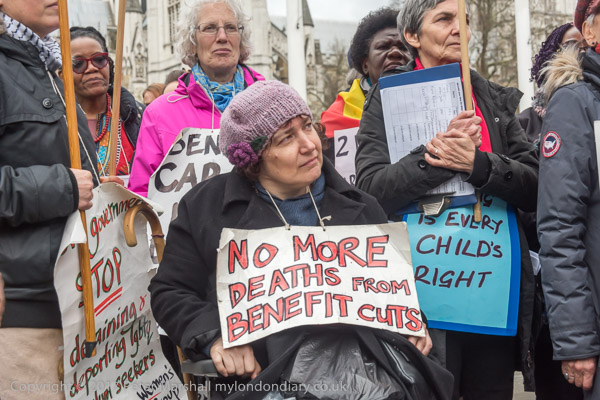
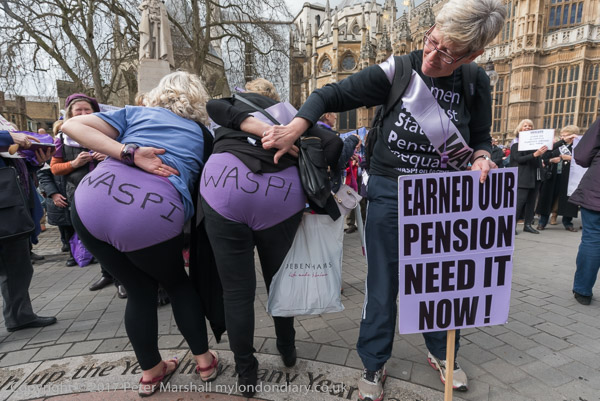
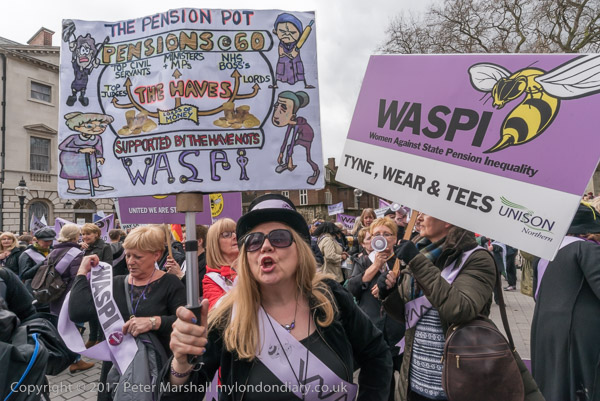
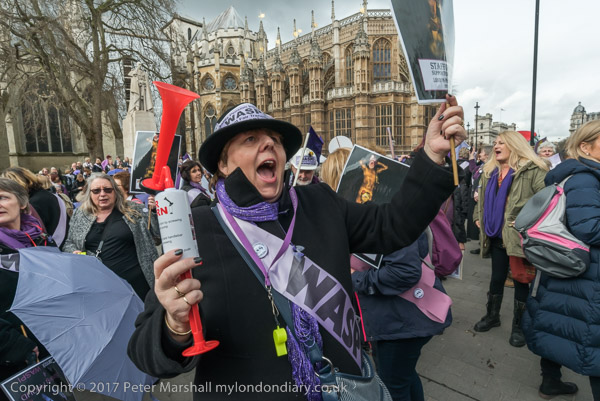
A few yards away in Old Palace Yard Women Against State Pension Inequality – WASPI – were holding a rally against the changes in the state pension scheme which are unfair to women born in the 1950s.
The 1995 Pensions Act included plans to increase the pension age for women to 65 but it was only 14 years later that letters were sent to many women born in 1951-3 Their situation was worsened by the accelerated raising of women’s pension age under the 2011 Pension Act, also made without properly informing those affected, with the age for both men and women increasing to 66 by 2020. Many got as little as one year’s warning of the up to a six-year increase to their State Pension age and it was not possible for them to make alternative plans. For men and women born in 1959 the state pension age is now 66 years.
The women affected are still awaiting the result of an independent investigation by the Parliamentary and Health Service Ombudsman which was started in 2019.
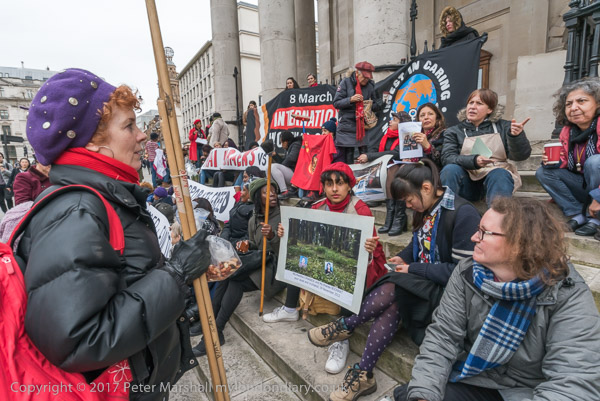
Global Women’s Strike went on to hold a silent vigil on the steps of St Martin-in-the-Fields in solidarity with the farmers of Thailand. Many of them are women in the Southern Peasant Federation of Thailand and the vigil was also in support of others all around the world risking their lives to defend land and water from corporate land grabs.
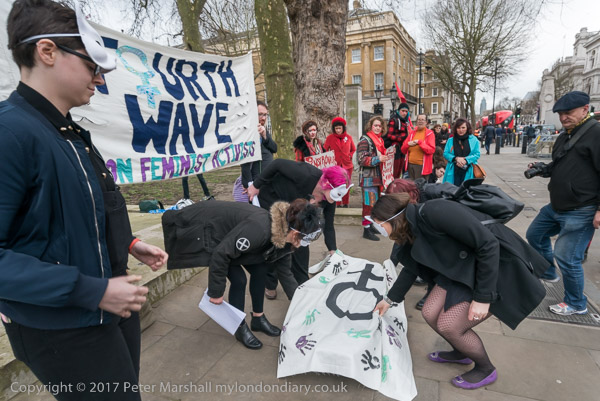
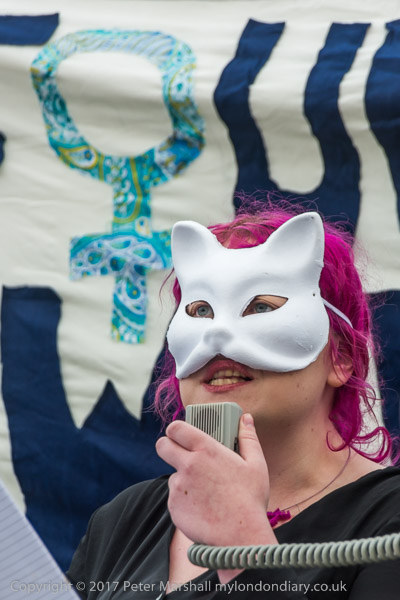
Fourth Wave London Feminist Activists held a protest at Downing St on International Women’s Day, drawing attention to the impact that cuts have had on women.
The unjust, ideologically-driven cuts to public services are disproportionately felt by women. Their protest contrasted to the more highly publicised corporate events on the day which are given a high degree of coverage in the media and concentrate on getting more women in boardrooms and other highly paid jobs. Though important issues, these are clearly irrelevant to the huge majority of women who have to deal with the realities of low pay, expensive housing, and caring for children and other family members.
International Women’s Strike Flash Mob – St Pancras International
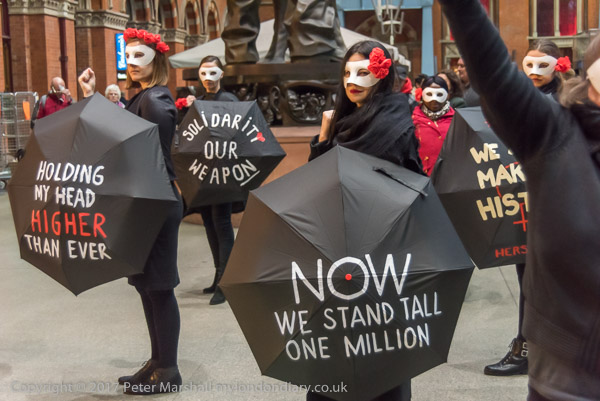
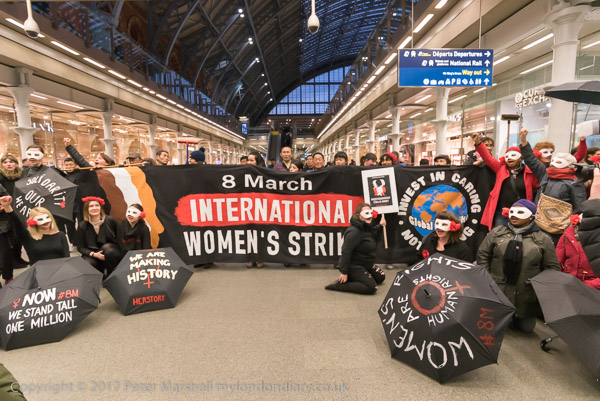
Finally I went to St Pancras International station where London Polish Feminists were joined by Global Women’s Strike in a flash mob celebrating the struggles of women around the world .
Wearing black and red clothing, after practising their routine with umbrellas with messages on them and a large banner at the entrance to St Pancras International they went down to the main concourse to perform it there.
Police came to see what was happening and made sure they did not block the concourse but remained friendly, and the waiting passengers applauded and took photographs.
I left London for a weekend in the middle of May 1989, going up to a conference in Derbyshire, taking the train from St Pancras to Chesterfield and then a bus journey with my family. We had come up to London by train and taken the Underground from Vauxhall to Kings Cross/St Pancras, arriving far too early for the train we had tickets reserved on.
I’m not sure if this was accidental or part of a plan by me to take a short walk and made some pictures before catching the train, but that is what I did, walking up York Road and then down to the Regent’s Canal on Goods Way to make this view across the canal.
A little further west on Goods Way I stopped at the bridge over the canal leading to the Granary. As you can see the view of the Granary then was restricted by a number of rather utilitarian buildings on the yard in front of it.
Further still along Goods Way, the road itself was between tall brick walls but gave a splendid view of the magnificent gas holders, including the fine triplet. I think some of the brick wall at right may remain, covered now in creeper, but on the left side are now new office buildings and no gasholders are in sight, with St Pancras International in their place. It’s a change I still find depressing, though at least the gas holders have been preserved in a new site.
I turned left into Pancras Road to take another picture of the block of shops containing the entrance to the Turnhalle (the German Gymnasium) with on one side the St Pancras Cafe and on the corner G Franchi & Sons, Locksmiths and Tools, with two ladders for sale leaning on its frontage.
I think photographers since W H Fox Talbot had always had a bit of a thing about ladders which perhaps made me take another picture of this scene, and I chose also to include the London taxi at left. I will have waited too for the man walking along the street to clear the shop, but as always there were also some elements outside my control.
Finally it was time to board my train and we were allowed onto the platform where it was waiting. I just had time to walk almost to the end of the platform and made this picture before we left the station.
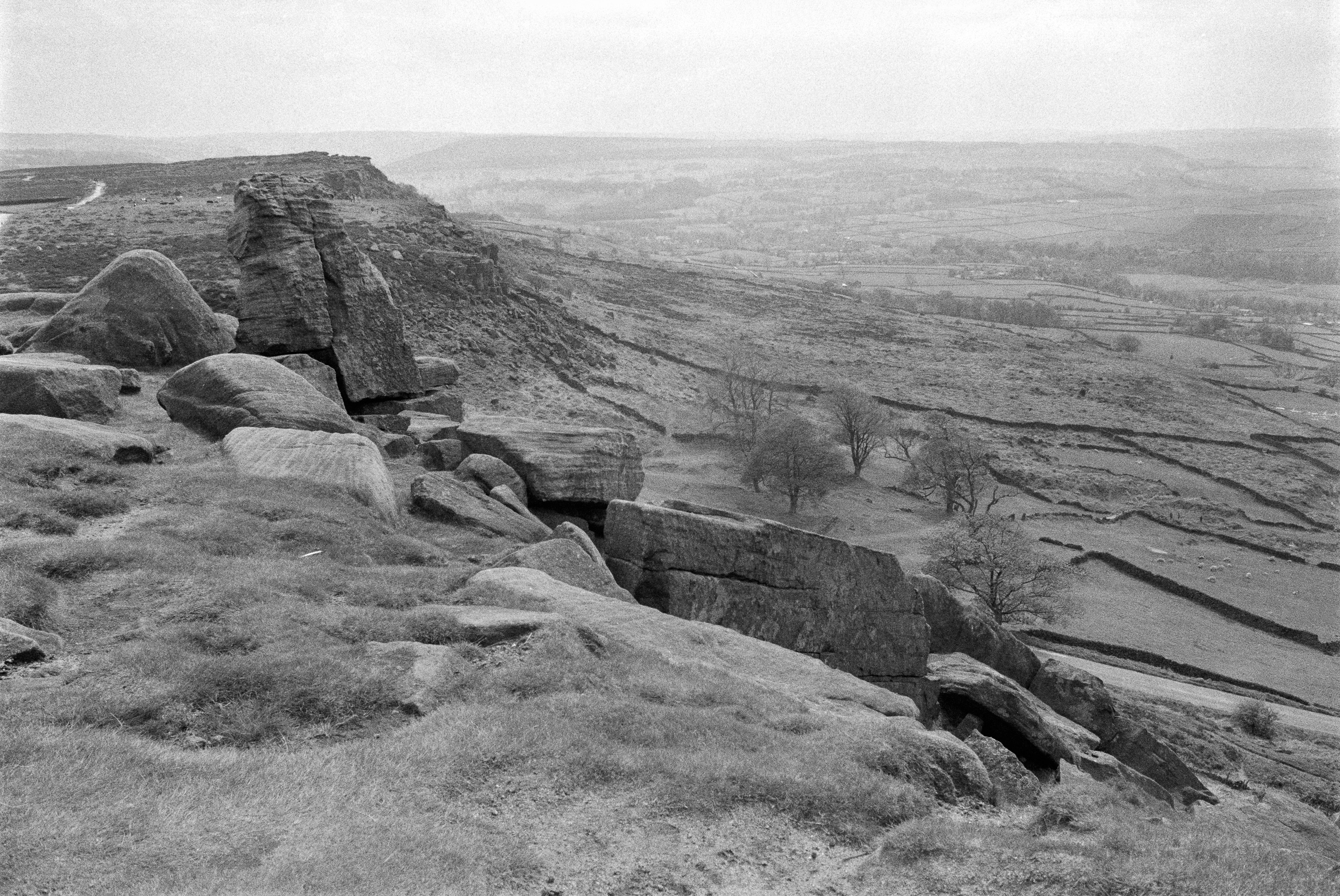
Baslow Edge, Derbyshire,1989
We did eventually get to Derbyshire and there was time while we were they for some short walks and I took just a few pictures. The first is I think on Baslow Edge.