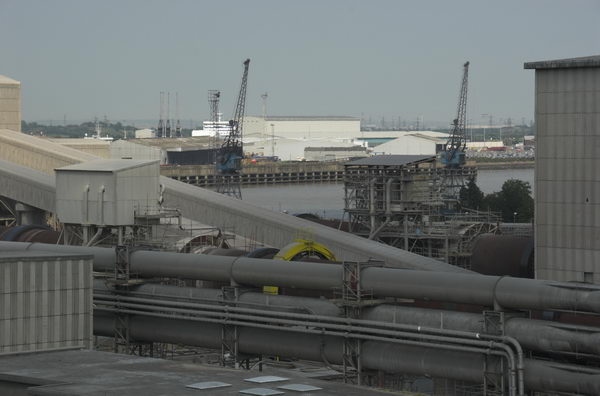
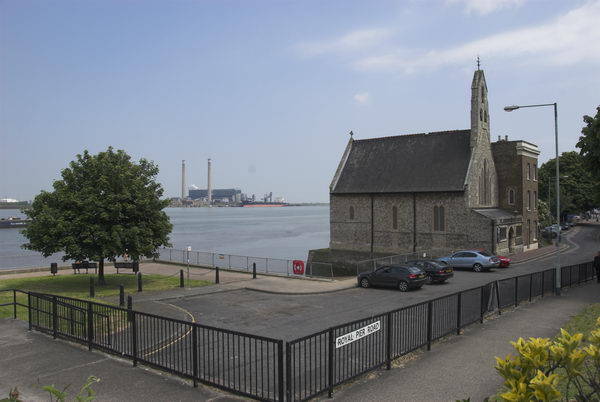
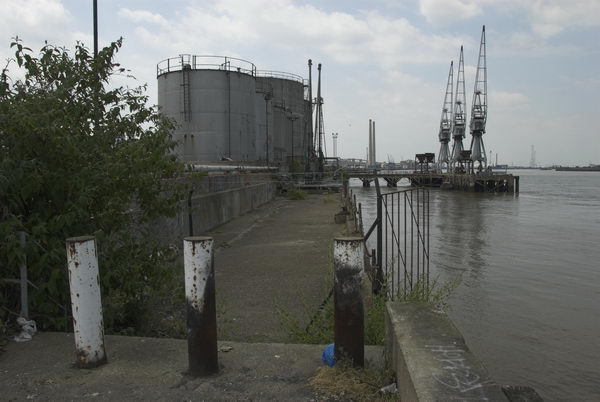
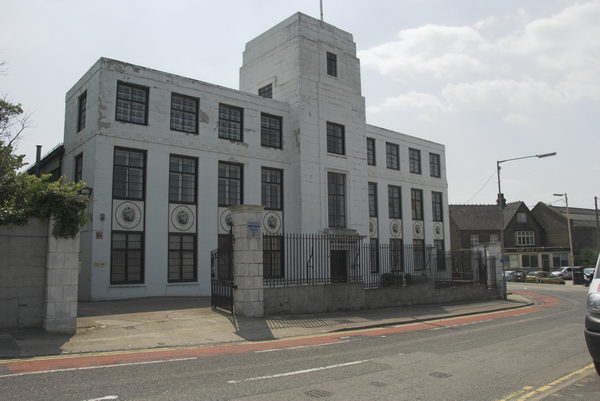
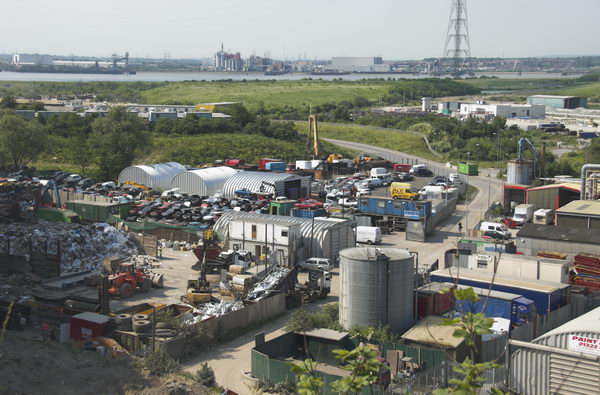
Gravesend and Northfleet, Kent: Twenty years ago on Thursday 8th June 2006 I took my folding bike by train to Gravesend and spent an afternoon cycling through the area on the Kent bank of the River Thames, long home to the cement industry – the manufacture of ‘Portland Cement’ began here in 1834.
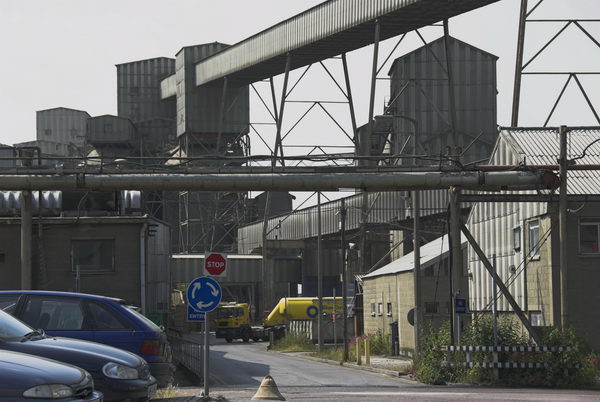
Looking across the cement works at Northfleet to Tilbury docks
I’d long had an interest in the area, both for its industrial history and for its sometimes spectacular landscapes created by this. I was first inspired when I borrowed an old book from my local library, Donald Maxwell’s ‘A Pilgrimage of the Thames‘, published in 1932. His accounts and sketches, some first published earlier in the Church Times present an interesting and romantic view of places and people along the river beginning at Gravesend and ending at Oxford.
Maxwell (1877-1936) reports a Thames pilot telling him as he sketched on a jetty, “The principal products of Gravesend are paper, cement and smoke – especially smoke.”
Later, writing about Northfleet he muses prophetically “One day, when the cement industry has left this valley, and centres of population have shifted, this district will be called the Switzerland of England, and weekend châlets, each with its aeroplane-landing on the cliff, will look down once again upon green shores and tree-embowered banks.”
Henley’s Cable Works Offices
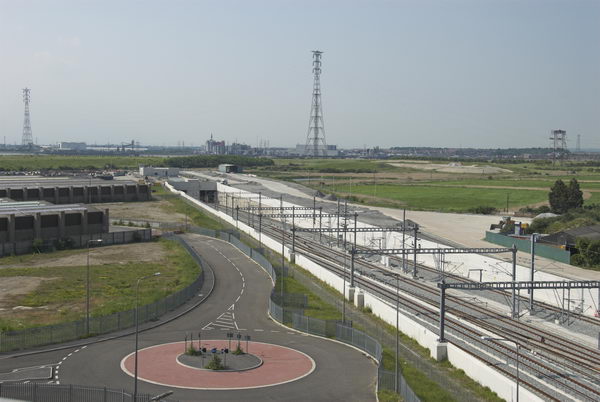
It hasn’t happened quite like that, though the cement industry has gone and there are some luxury riverside flats and the new town of Ebbsfleet developing around a new station on the Channel Tunnel Rail Link (which Eurostar trains whizz through non-stop at around the same speed as aircraft when Maxwell wrote.)
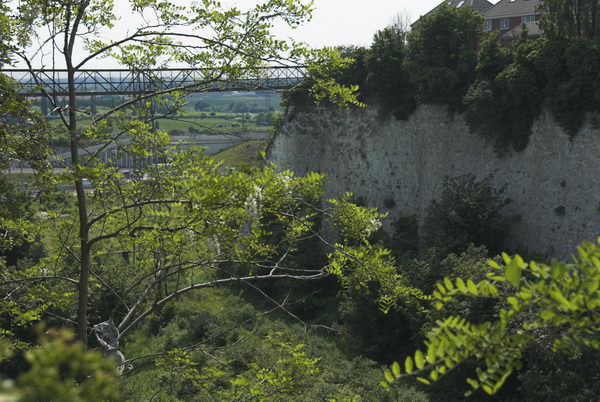
A footbridge over a chalk ravine left by quarrying
Of course Maxwell’s book was not my only source for information about the area. Particularly useful was the 1971 geography text ‘Lower Thameside‘ by Roy Millward & Adrian Robinson with its chapter ‘The Cement Industry of Lower Thameside‘ which gave some rather more precise information and a suggested itinerary which informed my first actual visits to the area in the 1980s.
A few years after I took these pictures in 2006 the vast cement works at Northfleet had gone.
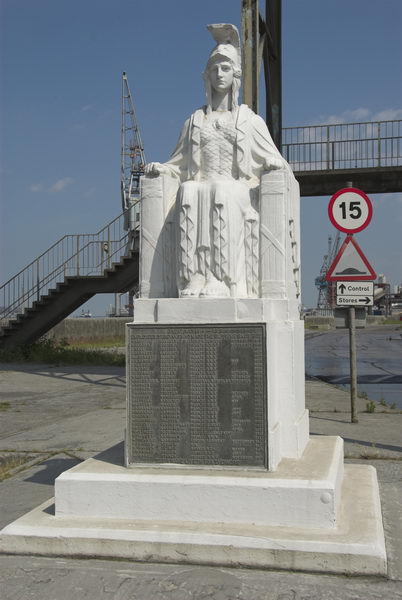
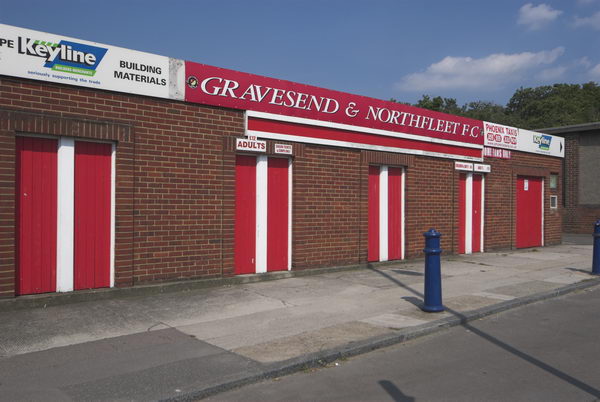
The photographs on My London Diary are not captioned (and I wrote nothing about them) but a they are in order of my ride beginning in Gravesend and moving west, with views across the Thames to Tilbury. From Rosherville I moved on to Northfleet (where Gravesend & Northfleet FC is now Ebbsfleet United) and then on to take the train home from Swanscombe.
Between Kings Cross & St Pancras: A week after my previous walk which began from Kings Cross I was back there again for another walk on Sunday 18th February 1990, beginning with a few pictures close to the station in Kings Cross and Somers Town. This was an area I’d photographed in earlier years but still interested me. Since 1990 it has of course changed dramatically.
Cheney Rd, Kings Cross, Camden, 1990, 90-2d-34
Cheney Road is no longer on the map of London although one of the buildings on it remains. It ran north-east from Pancras Road along the side of Kings Cross Station, then turned north-west towards Battlebridge Road and the gasholders you see here. Of course those gasholders are no longer where they were in 1990, but were moved further north and to the opposite side of the Grand Union Canal as a part of the redevelopment of the area including the addition of the Eurostar lines into St Pancras.
This street was a popular film location, best known for its use in The Ladykillers. In the middle distance at left you can see the roof of the German Gymnasium, with its distinctive windows at its top, I think the only building in my picture that remains (at least in part) in situ.
St Pancras Hotel and stating seen looking south down Pancras Road on a sunny Sunday morning. I think I used the controlled parking zone sign to cut down flare. A taxi is turning into Kings Cross over a short section of cobbles.
The station was completed in 1869 and the Midland Grand Hotel in 1876, though it had its first visitors in 1873. Both were designed by George Gilbert Scott and are Grade I listed. They were built for the Midland Railway whose main lines ran from here to Manchester, Sheffield and Nottingham via Derby. The hotel was expensive to maintain and closed in 1935, then becoming used as railway offices by the London, Midland & Scottish Railway.
My first trip to Manchester in 1962 was from here, but soon after in 1967 the central section of the route – one of England’s most scenic – was closed. Now the line ends at Matlock (with a Couple of miles of preserved railway to the north, and we have change at Derby on our journeys to Matlock.
Pancras Rd, Somers Town, Camden, 1990, 90-2d-21
Looking north up Pancras Road with the arches of the station to the left of the picture and one of the gasholders in the distance. The curved pediment above the door in the middle block at right is the entrance to the German Gymnasium. This end of the Grade II listed building was demolished when St Pancras International was built, and the west end of the building was replaced by modern brickwork in keeping with the other walls of the building.
Turnhalle, German Gymnasium, Pancras Rd, Kings Cross, Camden, 1990, 90-2f-66
This was the original west end of the Turnhalle at 26 Pancras Rd.
Pancras Rd, Somers Town, Camden, 1990, 90-2d-22
Kings Cross Automatic Gearbox Centre at 87-89 Pancras Road, Newport Joinery at 92 and other small businesses along the west side of athe road were all demolished to make room of the new platforms for St Pancras International
Stairs, Stanley Buildings, Stanley Passage, Kings Cross, Camden, 1990, 90-2d-15
A notice at the left of the stairs of Stanley Buildings flats, says NO to the British Rail bill in Parliament which would see the building of the new international station and the demolition of much of the conservation area. Despite much opposition, the Channel Tunnel Rail Link Act was passed in 1996.
Stanley Buildings were built in 1865, designed by Matthew Allen for the Improved Industrial Dwellings Company under the guidance of Sydney Waterlow. Grade II listed in 1994, but that has not enough to save them as they were and one block was entirely demolished and the remaining block incorporated into a modern building, losing much of its character. The listing text ends: “Among the earliest blocks built by Waterlow’s influential and prolific IIDC, Stanley Buildings are in addition an important part of a dramatic Victorian industrial landscape.” Their remnant now sits largely hidden in a modern development.
Paris in November: My trip to Paris in November 2007 was the only time I had stayed there on my own – and it made my visit rather different. Every other time I’ve been with my wife who speaks French more or less like a native – her accent impeccable, her grammar better than most who live there but her vocabulary now rather out of date, and had relied on her and spent much of my time there in her company. My own ‘O level’ 45 years earlier was extremely rusty and never really taught me to speak the language though I can still read a little and understand some if people speak slowly and clearly – as few in Paris do.
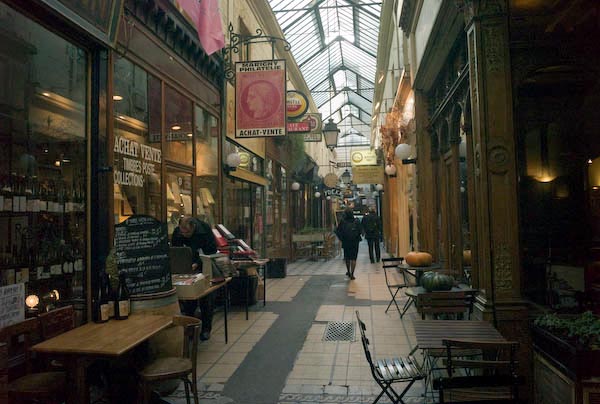
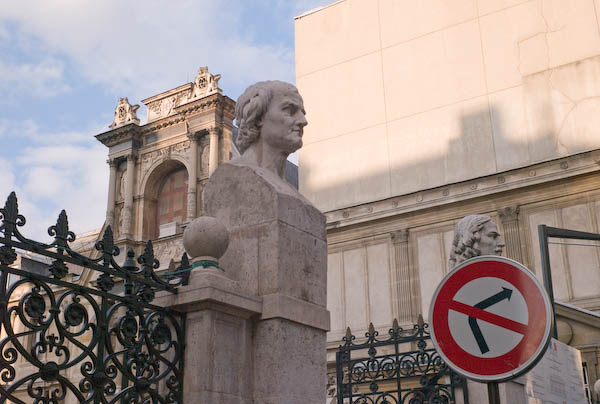
A passage close to my hotel
I’d come to Paris by Eurostar on the final day that their trains ran out of Waterloo. The following day, Tuesday 14th November 2007, was the first full day of my visit and also the day on which Paris Photo 2007 opened.
Here I’ll post what I wrote about that day back in 2007 with a few of my pictures from the day and links to many more on My London Diary.
Paris 2e, 9e and 6e
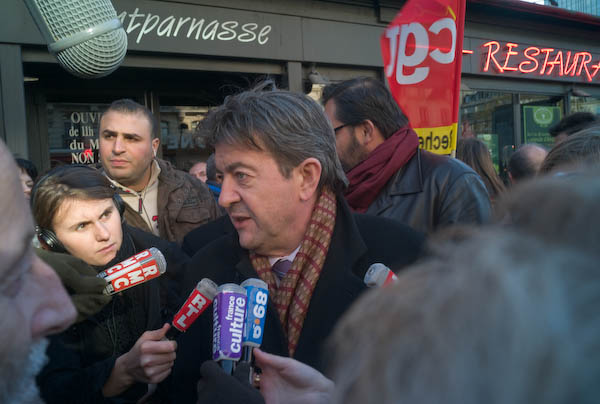
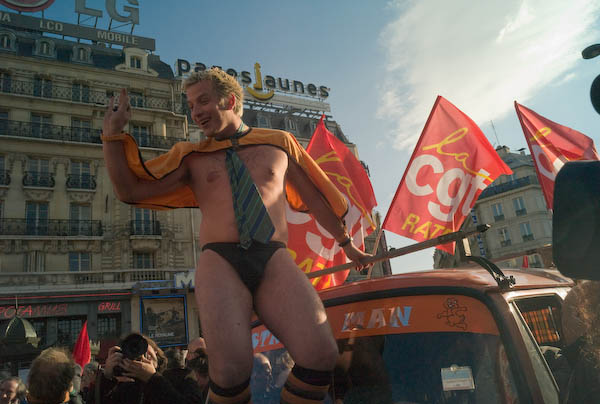
Next morning I had nothing special to do. Although I was in Paris to see photographs, none of the shows I wanted to view opened until 1pm. Eating a leisurely breakfast at the bar of a café close to my hotel I picked up a French newspaper and found their was a ‘manif‘ with the strikers meeting at Montparnasse at 2.30pm, and decided I’d take my Leica M8 along for some pictures.
Before then I had a walk around the 9th arrondissement before returning to a salad bar near my hotel for a very tasty ‘formule‘ with salmon salad, yogurt with a sweet chestnut paste and orange juice, and making my way across the Pont du Carroussel and down through the 6th to Montparnasse.
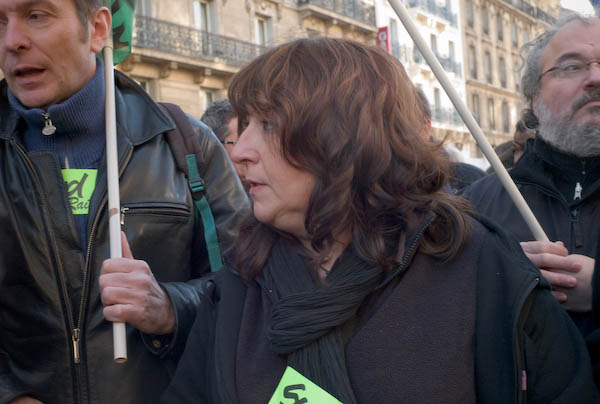
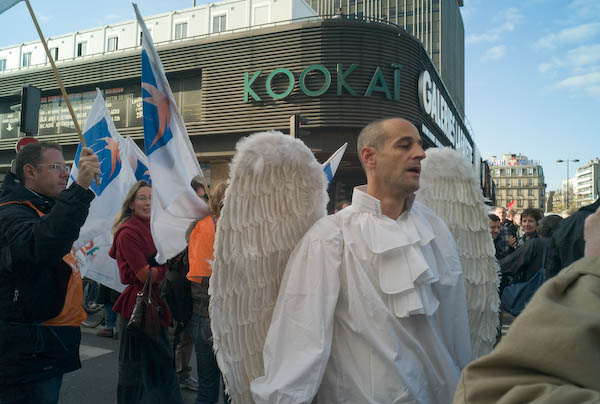
Perhaps everything seemed a little less organised than London demonstrations, and a big difference was the number of vehicles that appeared to be a part of it – in England such demonstrations are simply marches. The police tactics also seemed to be different, as there were none at all around where the march was massing, although there were plenty of them waiting around vans a few hundred metres along the road. And a number of those taking part in the ‘manif’ were wearing helmets and body padding in case of police attacks.
One difficulty was not being able to recognise the various union leaders. Rather than simply photographing them as usual I had to look for media scrums to identify who they were – and then get stuck in. At home I’m more often the guy who gets there first. But somehow it seemed easier to do here, perhaps because I was working with a smaller bag and the Leica. [I think all these pictures were with the Summilux 35mm f1.4, a ‘standard’ focal length on the M8.]
Then it was on to Paris Photo, held in the bowels of the earth under the Louvre. It’s hard to contemplate a more depressing location, although relatively spacious outside the show. It would make a good location for some nasty shoot-em-up video game, sort of half-way between underground car park and shopping mall, a slightly cooler version of hell.
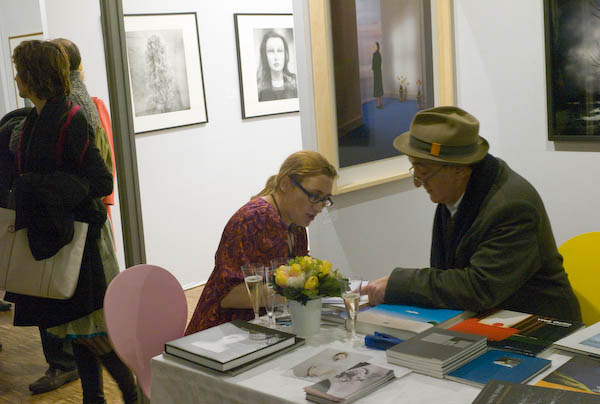
Inside the show, its far more cramped and claustrophobic, but there really are a lot of photographs on display on the stalls of the 80 or so dealers and 20 publishers, as well as special shows – this year of Italian photography – and the BMW prize.
Frankly both the Italian stuff and the prize were disappointing, and much of the large colour images on many stands were prestigiously expensive head office decor with little interest. But inside the stands the walls were crammed with an incredible variety of photography, including some truly great work amid the dross, including many of the classic images of photography. And on many of the booths you could browse in more depth in boxes of images.
Its a great opportunity to see almost the whole history of photography in a few days, a collection with much more depth than even the richest of museums – although with some great gaps, as many photographers produced very few prints and their work seldom comes up for sale.
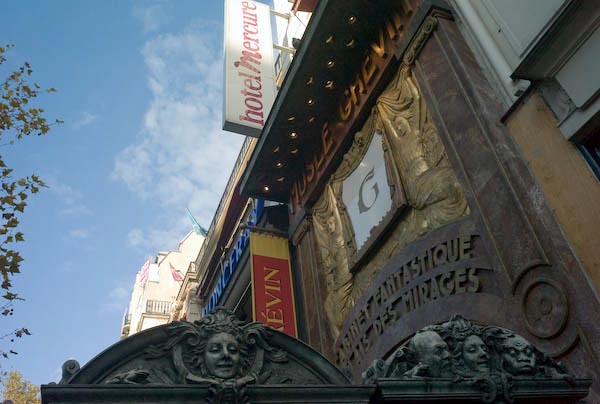
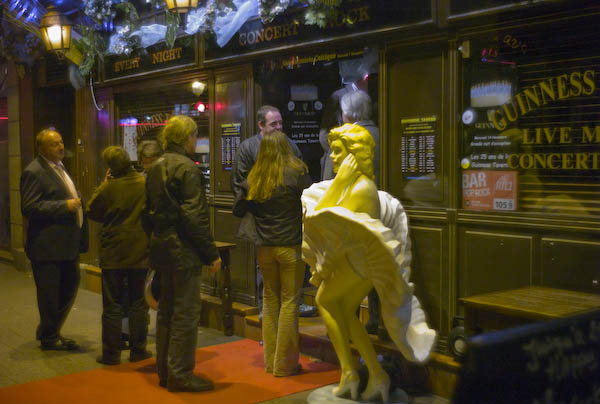
On my way to my hotel from Stolly’s bar
Several friends of mine had work on various stands, and they and many others were over there to see the show, meet people, go to the other exhibitions on in Paris, perhaps take some pictures and have a good time. I won’t bore you with a list of those I met, but it would be a good list of the best in British photography as well as a number of those I know from other countries. There were also quite a few others who I know were there that I didn’t manage to meet up with.
By around 6.30, the place was beginning to fill up with people coming for the opening at 7pm. Another of the problems of Paris Photo is that there is nowhere there to get anything decent to eat or drink, and half a dozen of us left for a considerably cheaper bar near the city hall, then on to a meal in a bistro, and finally to another bar, Stolly’s in the Marais.
It had been a long and interesting day – and rather different to those when I came together with Linda, and my the time I was walking back home from that last bar either my Leica was getting tired or its operator was pleasantly a little inebriated.
I slept well and was up early the next morning to go out for breakfast and then explore more of Paris. You can read more about my next three days in the city – with many more pictures some taken by others on my Leica M8 including some rather unusual pictures of me – and my return to a rather disappointing St Pancras on the November 2007 page of My London Diary.
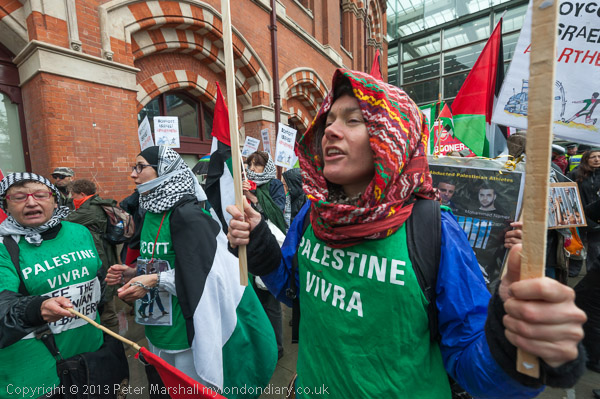
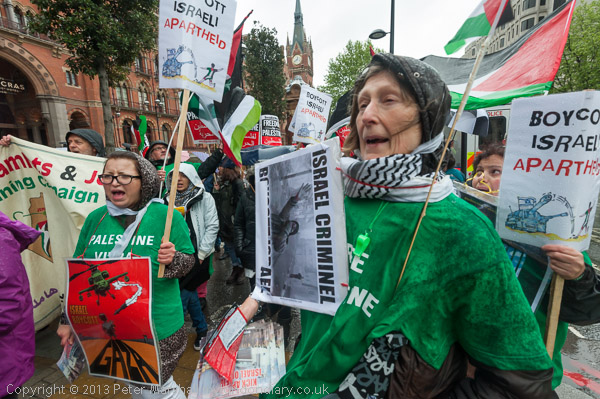
UEFA gets a Red Card for Israel – On Friday 24th May 2013 UK campaigners met those who had arrived by Eurostar at St Pancras to march to the Mayfair hotel where UEFA was holding its annual congress. They demanded it to kick out Israel and protested against the UEFA under-21 men’s football final being held in Israel in June 2013.
The event was organised by the London-based Red Card Israeli Racism Campaign founded by members of the Palestine Solidarity Campaign, Friends of al-Aqsa and Jews for Boycotting Israeli Goods and followed protests at UEFA’s Swiss offices following a letter signed by 52 leading players deploring Israel ’s attacks on Gaza.
Previously the Red Card campaign had led protests over the detention of Palestinian footballer Mahmoud Sarsak detained without charge in 2009 while travelling from Gaza to a new club on the West Bank. He lost almost half his body mass in a 3 month hunger strike and was only finally released in July 2012 after appeals from the international professional footballers association FIFPro, Eric Cantona, Frédéric Kanouté and the presidents of EUFA and FIFA, as well as others from outside football.
Israel’s participation in international football has long been controversial, and in 1974 they were expelled from the Asian Football Confederation of which they had been a founder member when several nations refused to play against them. They became a full member of UEFA in 1994. In February 2024 UEFA turned down demands from 12 Middle East Nations to suspend Israel from international competitions.
International football is clearly a political football. And Israel’s team have clearly demonstrated their intention to use it as such when captain Eli Dasa held up a small sports shoe of a missing child hostage and talked about it ahead of a Euro 2024 qualifier against Switzerland.
The Palestinian Football Association called in April on FIFA/UEFA to suspend Israel from international competition and are asking other FAs to join them. FIFA is carrying out a legal assessment before it makes a decision on whether to agree to Palestine’s call to suspend the Israeli federation over the war in Gaza was repeated a few days ago at FIFA’s congress in Bangkok.
PFA president Jibril Rajoub was quoted by the BBC as saying “How much more must the Palestine football family suffer for FIFA to act with the same severity and urgency as it did in other cases?” and others have also accused FIFA and UEFA of double standards.
As a petition by some football fans calling on the English FA to support the suspension of Israel states: “It took FIFA/UEFA less than one week to ban Russia from international competition following the invasion of Ukraine. Apartheid South Africa was suspended from FIFA for ten years before being expelled in 1976 and was only permitted to re-join in 1992 as the apartheid regime was dismantling. In that same year, the Yugoslavia national team was suspended by FIFA from international competition as a part of UN-led sanctions against the former state during the Balkans war.“
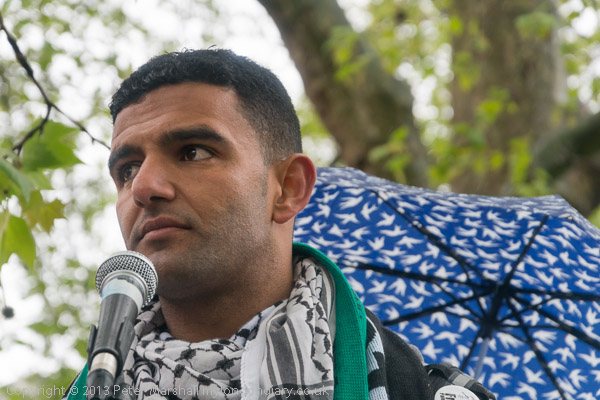
Palestinian footballer and former hunger striker Mahmoud Sarsak
You can read an account of the May 2013 march and the static protest outside the hotel in Park Lane on My London Diary with many more pictures. One of the speakers at this was former hunger striker Mahmoud Sarsak and he received a huge welcome and “the couple of hundred people present really sounded like a rather larger football crowd.”
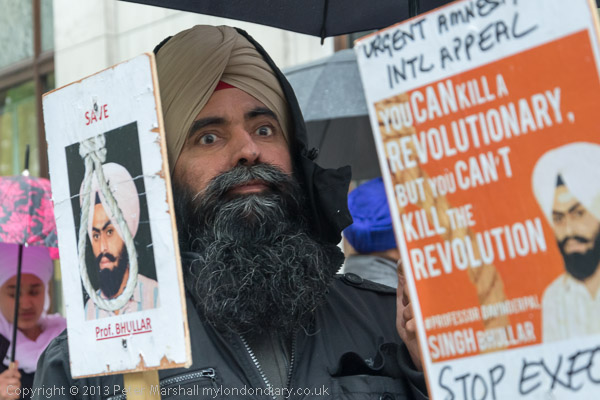
Also on Friday 24th May 2013 I photographed a protest by Sikhs at the Indian High Commission against the intended hanging of Professor Devender Pal Singh Bhullar who had then served 18 years on death row following his conviction for involvement in a car bomb in Delhi. His conviction was based on a confession based on torture in police custody. The Indian Supreme Court commuted his sentence to life imprisonment in March 2014. More on My London Dairy at Don’t hang Prof Bhullar!.
Freedom Protests in London: Two protests on Saturday 23rd January, 2010 were against the increasing powers which have been given to police and misused by them to control and harass lawful actions on the street.
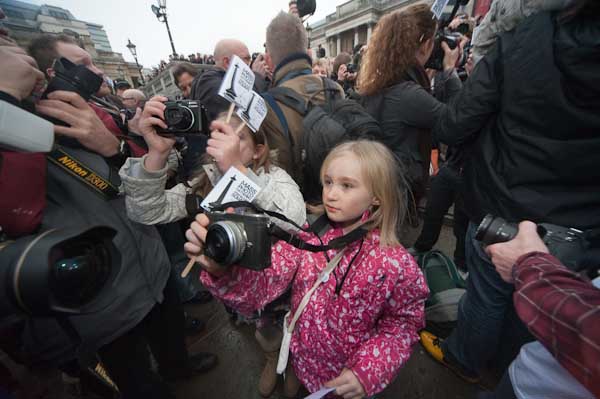
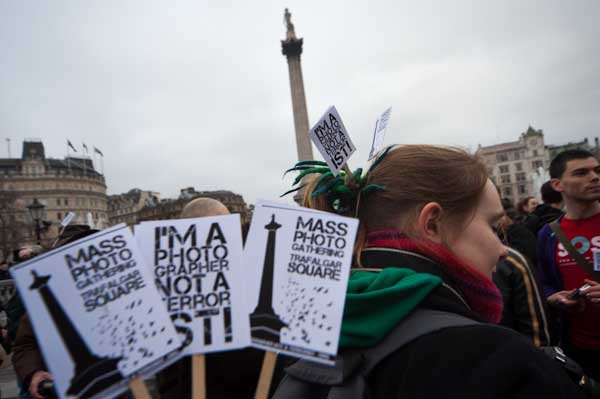
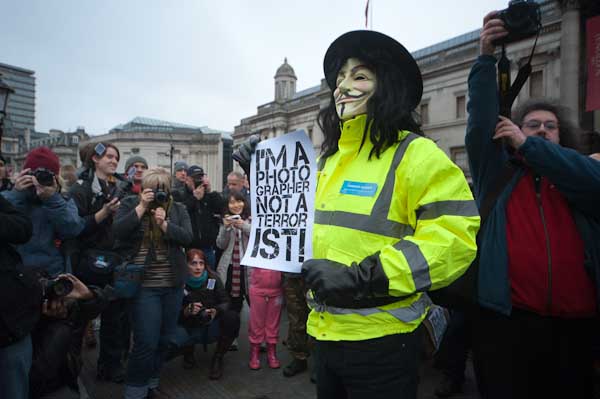
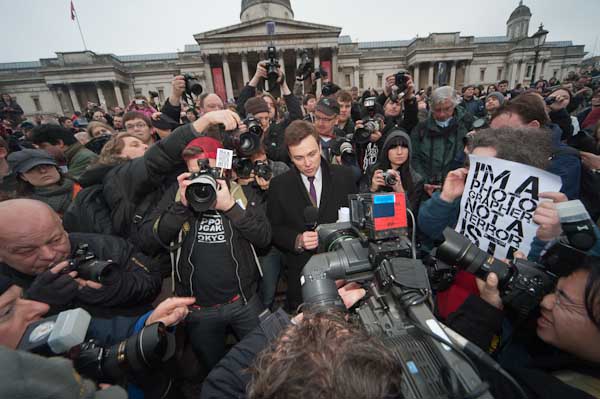
I’m A Photographer Not A Terrorist – Tragalgar Square
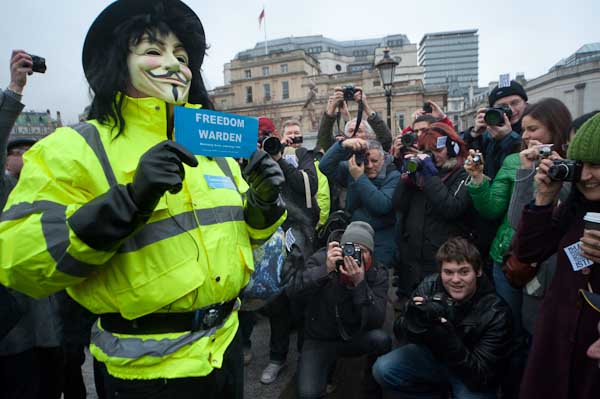
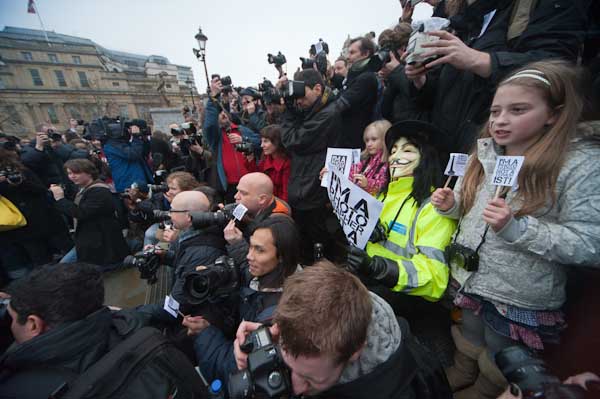
Around 1,500 photographers and supporters turned up to the I’m A Photographer Not A Terrorist rally in Trafalgar Square to protest at the increasing harassment of people taking photographs by police, and in particular their abuse of powers under the Terrorism Act.
I think those there included virtually every photographer who works in London as well as many amateurs. Almost all of us who work on the streets have been approached by police, questioned and then subjected to a search, usually under Section 44 of the Terrorism Act 2000 (S44.)
As I commented in 2010:
These stop and searches appear to have continued unabated despite a Home Office Circular in September that made it clear they should not be used to target photographers. Searches can also be carried out under Section 43 of the act, but for this officers must have reasonable grounds to suspect someone of being a terrorist. S44 stops can only be carried out in “authorised areas”, which although intended by Parliament to apply in very restricted areas for short lengths of time have been used by police – for example – to permanently to cover central London and some other areas.
The Press Card that we carry has the text “The Association of Chief Police Officers of England Wales and Northern Ireland and the Association of Chief Police Officers in Scotland recognise the holder of this card as a bona-fide newsgatherer.” But despite this, one of my colleagues was the subject of roughly 30 searches in 2009.
Personally although I’ve been approached and asked why why I’m taking pictures on a number of occasions I’ve only been been subjected to a S44 stop once. Being a still photographer I tend to work fast and keep on the move and I think videographers who stay around longer have suffered more. But certainly there was a lack of cooperation from the police and I was often finding my Press Card being unrecognised by offiers. Others told me that they didn’t regard those issued through the NUJ, one of the recognised gatekeepers to the system, as being valid. And most months if not most weeks I would be threatened with arrest when taking pictures.
Perhaps the most distressing aspect of this protest was listening to a BBC News reporter, standing in the middle of a crowd of experienced journalists and giving a report in which he gave the number attending the protest as “three hundred“. It drew immediate shouts of protest from those of us standing around him and was certainly “not a good advertisement for the competence or impartiality of the BBC who appear to have a policy of playing down dissent.” It’s a policy which still seems to govern the BBC reporting of protests in the UK which are either simply ignored or very much played down.
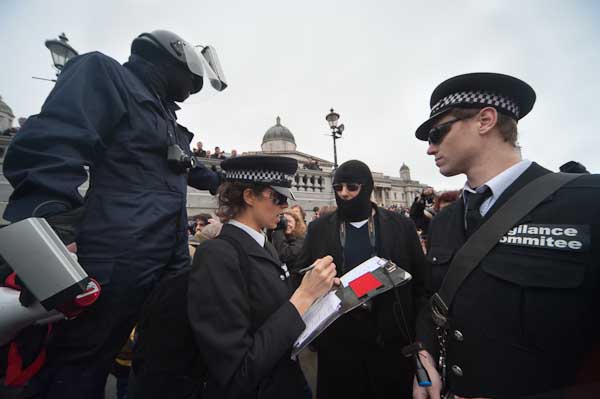
Among the protesters was a small “Vigilance Committee with a man on stilts wearing a number of CCTV cameras accompanied by a male and female vigilance officer, who picked on individuals and questioned them, taking their fingerprints before finding them guilty and sentencing them to a choice of six years hard labour or contributing to the Vigilance Committee.”
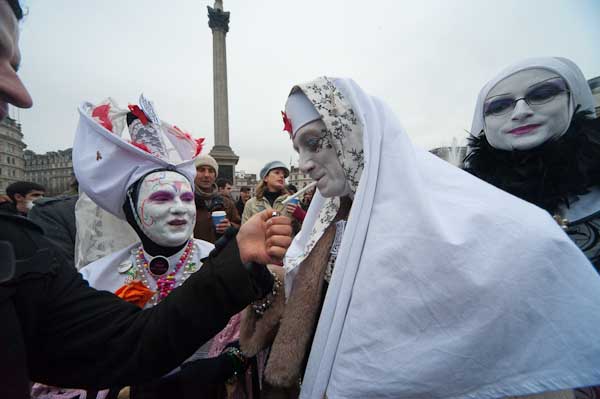
Also present were three Sisters of Perpetual Indulgence, but police and ‘heritage wardens’ largely kept away. Although this had been planned as an illegal protest taking place without the permission from the Mayor required by the bylaws, the authority had put in an application for it without any reference to the protesters.
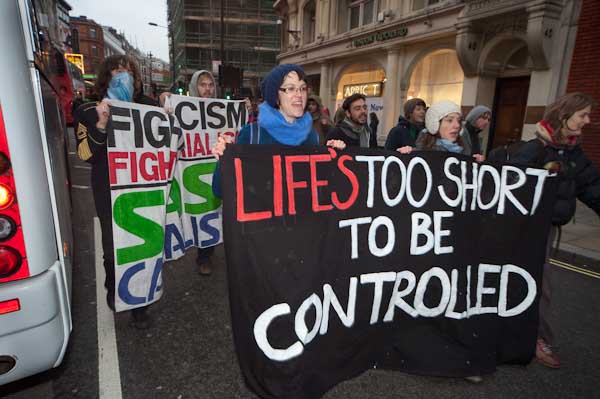
Life Is Too Short to be Controlled – St Pancras to Piccadilly Circus,
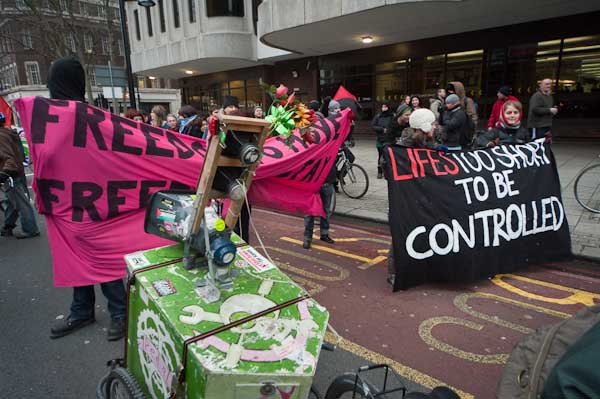
Later in the day protesters met at St Pancras for the ‘Life Is Too Short to be Controlled’ protest against the increasing control over our lives through increased police powers to stop and search, increased surveillance and controls on freedom of movement.
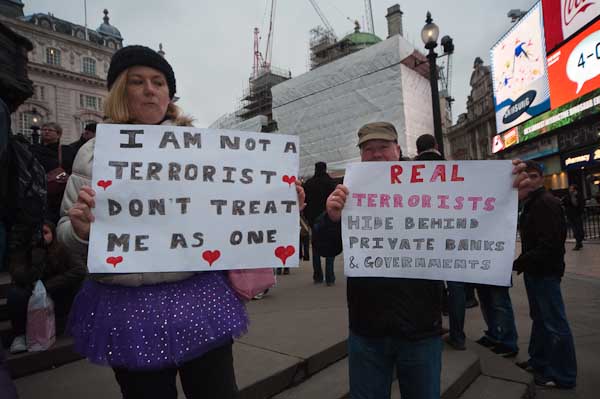
The protest, organised by ‘London NoBorders’ began outside St Pancras Station where the Border Authority detains migrants arriving by Eurostar and marched to Piccadilly Circus, beneath which Westminster’s CCTV HQ keeps a constant watch on the streets of London, the “City of CCTV”. Across the city there were then over 500,000 CCTV cameras watching us, installed by councils, public bodies, companies and individuals and on a typical day the average person in London will be recorded by 300 of them.
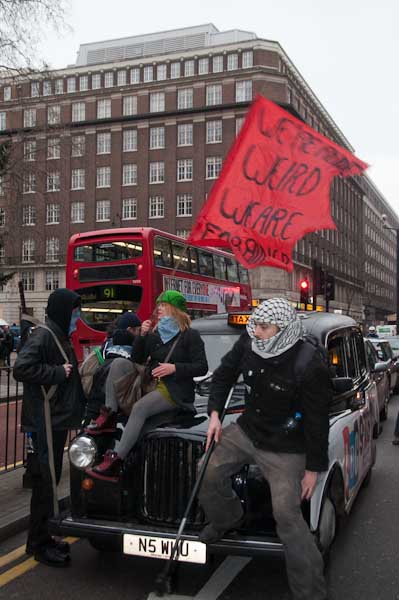
Police kept a relatively discrete watch on the event, with police vans parked out of site and even when the group marched along the busy Euston Road, holding up traffic for a few minutes not a single officer appeared. The march was well-ordered “and when an ambulance answering an emergency came along, the whole march cleared the road for it with remarkable speed. At Russell Square, one taxi driver decided to try to force his way through the marchers, but was soon stopped, with several people sitting on the bonnet of his vehicle.”
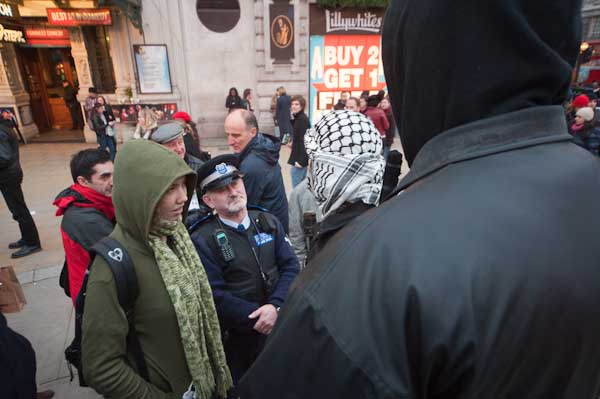
At Piccadilly Circus there was a short token road block before the protesters moved to the pavement around Eros for more speeches and some dancing. A Police Community Support Officer appeared briefly after someone climbed up and taped a Palestinian flag to Eros’s bow and tried to identify who had done this. The statue is rather fragile and could have been damaged. He soon gave up and went away and was replaced a few minutes later by a single police officer who was embarrassed by being greeted with hugs, and moved back a few yards to watch.
“Not me officer, someone borrowed my scarf”
The police had monitored the progress of the protest as it marched through London, both from some distance on the streets and also on CCTV. It had been peaceful and had caused only very minor disturbance. Few protests do, and the kind of heavy policing sometimes employed often means police cause more disruption that the protest, as well as sometimes provoking a response from protesters who would otherwise have protested peacefully.