Dancers, Shops, Gym, Laundry, a Lab and Cobblers – 1990

Dancers, Shops, Gym, Laundry, a Lab and Cobblers: The next set of pictures from my walk on February 18th 1990 around Kings Cross & St Pancras. The previous post on this was St Pancras Old Church & More – 1990.

Dancers, Mural, Stanley Buildings, Stanley Passage, Pancras Rd, Kings Cross, Camden, 1990, 90-2f-64

This was my favourite mural in London on the side of Stanley buildings and one I’d photographed several times since 1985. Unusually it was painted in black and white and it extended across the whole side of the flats from first floor level to the chimneys. You can see an image in colour I made a few months earlier from a similar viewpoint on Flickr.

Pancras Rd, Kings Cross, Camden, 1990, 90-2f-65

Nearby on Pancras Road I photographed this rather finely proportioned frontage with some interesting brickwork and decoration at its top. I wish I had made another exposure to show more clearly the two busts at the left of the ground floor.

Turnhalle, German Gymnasium, Pancras Rd, Kings Cross, Camden, 1990, 90-2f-66

Another image of the Pancras Road frontage of the German Gymnasium in a row of shops including the St Pancras Cafe. All this was lost for the redevelopment of St Pancras International – with the Gymnasium being given a new modern frontage in a style matching the rest of the building.

Kings Cross Laundry, Caledonia St, Pentonville, Islington, 1990, 90-2f-51

To the east of Kings Cross the first turning to the right from York Way is Caledonia Street. I’d photographed the laundry with its large intertwined KCL insignia on a walk the previous year. Although there were more recent signs for occupiers including those for Lanitis Fabrics Ltd, and Stella Models and signs calling for Machinists, Overlockers, Pressers, Finishers and Cutters, the building appeared to be no longer in use.

The building is still there, though all of the sings apart from the ‘KCL’ have gone and it is now offices with a gateway leading into the ‘Regent Quarter’ redevelopment.

New Wharf Rd, Pentonville, Islington, 1990, 90-2f-53

A little further to the north is Wharfdale Road, another right turning from York Way and from that New Wharf Road goes to the north. These two roads are on the south and east of the ‘new wharf’, Battlebridge Basin on the Regent’s Canal, serving the wharves around its sides.

A large notice on the lefthand buildin, formerly MAMMA ROMA, advertises the development of Battlebridge Basin with 3 buildings with planning consent for offices.

Ozonol Laboratories, New Wharf Rd, Pentonville, Islington, 1990, 90-2f-54

The next building on the road was the then derelict Ozonol Laboratories, Manufacturing Chemists. In 1932 the company had patented a product for “disinfecting mouthpieces of telephones, speaking tubes and the like” and similar products mainly under the similar names: “Ozonol”, “Ozlab”, “Oztox” and others were marketed for use in air purifiers and as an ointment for treating sunburn and hemorrhoids and a wide range of other uses. Ozonol ointments are still sold in some countries though probably not containing some of the original components such as lead oxide.

Shoe Repairs, Caledonian Rd, Pentonville, Islington, 1990, 90-2f-56

I walked through to Caledonian Road where I photographed through the window of this cobblers shop with its phone, hand-made sign, electric fire and general clutter. It looked then like something out of an earlier age.

It was time to go home, and I walked back to the tube at Kings Cross.


FlickrFacebookMy London DiaryHull PhotosLea ValleyParis
London’s Industrial HeritageLondon Photos

All photographs on this page are copyright © Peter Marshall.
Contact me to buy prints or licence to reproduce.


St Pancras Old Church & More – 1990

St Pancras Old Church & More: More from my wanderings to the north of St Pancras and Kings Cross on February 18th 1990. This walk began with Between Kings Cross & St Pancras – 1990 and continued in Gasholders, Goods Way and Midland Road, 1990.

The Chenies, Pancras Rd, Somers Town, Camden, 1990, 90-2e-41

This 8 storey block was built in a vaguely Art Deco style in the late 1940s as council flats for St Pancras Borough Council, one of two blocks in the Godlington Street Estate. Later it passed to the London Borough of Camden. John Russell, an adviser to Henry VIII was given the title Earl of Bedford in 1551 and the Bedford family later gained other titles including that of Baron Rusell of Chenies. The Bedford estate owns much of Bloomsbury and some other parts of Camden and in the 16th century acquired Chenies Manor in Buckinghamshire by marriage.

Pancras Tyres, Pancras Rd, Somers Town, Camden, 1990, 90-2e-42

The former premises of Pancras Tyres which had moved, though it was now impossible to see where they had moved to, I could still read 56 PEN, but there are a surprising number of streets in London beginning with Pen. The notice obscuring the rest of the address claims that (despite the move) the gates are in constant use, but they were certainly not while I was there.

St Pancras Old Church, St Pancras Old Burial Ground, Pancras Rd, Somers Town, Camden, 1990, 90-2e-4311-13th Century church enlarged by A D Gough and R L Roumieu in 1847-8century, later restorations and 'Norman' remodelling by A W Blomfield. Still in use.
St Pancras Old Church, St Pancras Old Burial Ground, Pancras Rd, Somers Town, Camden, 1990, 90-2e-43

This Grade II* listed 11-13th Century church was enlarged by A D Gough and R L Roumieu in 1847-8 and later ‘restored’ with Norman remodelling by A W Blomfield, Very little can now be seen of the original Norman building, but there are claims that there are some much older Roman remains in parts of the walls, and that this was a place of worship possibly as long ago as AD 314, A 6th century altar stone was found here.

The church remains in use as “a traditional Anglo-Catholic church that rejects the ordination of women as priests and bishops” and as a music venue.

The Hardy Tree, St Pancras Old Burial Ground, Pancras Rd, Somers Town, Camden, 1990, 90-2e-22

The railway line out of St Pancras Station runs through St Pancras Old Burial Ground and before it could be built in 1865 many of the graves their had to be dug up and moved. Some were piled up in a heap here, with the young Thomas Hardy, then an assistant to architect Arthur Blomfield, delegated to be the overseer for the work. At the centre of the pile of gravestones was an seed or small sapling, which sprouted and grew into the large ash tree whose trunk can just be seen in my picture and which became known and loved as ‘The Hardy Tree’.

Sadly the tree became infected with a fungus in 2014, severely weakening it and on 27th December 2022 it collapsed. A beech sapling was planted in 2024 to replace the original tree.

Tomb, Sir John Soane, St Pancras Old Burial Ground, Pancras Rd, Somers Town, Camden, 1990, 90-2e-26

Sir John Soane (1753 – 1837) was one of Britain’ greatest architects, the son of a bricklayer who rose to became a professor of architecture and was responsible for influential Neo-Classical buildings including the Bank of England and Dulwich Picture Gallery.

He designed this Grade I listed tomb following the death of his wife in 1815 and it was erected here in 1816. His wife, Soane and his son were all buried here. In 1924, Giles Gilbert Scott (son of Sir George Gilbert Scott architect of St Pancras Station and hotel) walked in the burial ground and was inspired by the central part of this tomb for his entry to the comptition to design a telephone box. His winning entry, the K2, produced in 1926 was the iconic telephone box – though it changed a little over the years, developing into the 1935 K6 model.

Gas Holders, Camley St, Goods Way, Kings Cross, Camden, 1990, 90-2e-14
Gasholders, Camley St, Goods Way, Kings Cross, Camden, 1990, 90-2e-14

I walked back towards the stations, turning down Goods Way where I could not resist taking a few more pictures of the gas holders.

Gas Holders, Camley St, Goods Way, Kings Cross, Camden, 1990, 90-2e-15
Gasholders, Camley St, Goods Way, Kings Cross, Camden, 1990, 90-2e-15
Gas Holders, Goods Way, Kings Cross, Camden, 1990, 90-2e-16
Gashholders, Goods Way, Kings Cross, Camden, 1990, 90-2e-16

More pictures from around Kings Cross and Pentonville in a later post.


FlickrFacebookMy London DiaryHull PhotosLea ValleyParis
London’s Industrial HeritageLondon Photos

All photographs on this page are copyright © Peter Marshall.
Contact me to buy prints or licence to reproduce.


Between Kings Cross & St Pancras – 1990

Between Kings Cross & St Pancras: A week after my previous walk which began from Kings Cross I was back there again for another walk on Sunday 18th February 1990, beginning with a few pictures close to the station in Kings Cross and Somers Town. This was an area I’d photographed in earlier years but still interested me. Since 1990 it has of course changed dramatically.

Cheney Rd, Kings Cross, Camden, 1990, 90-2d-34

Cheney Road is no longer on the map of London although one of the buildings on it remains. It ran north-east from Pancras Road along the side of Kings Cross Station, then turned north-west towards Battlebridge Road and the gasholders you see here. Of course those gasholders are no longer where they were in 1990, but were moved further north and to the opposite side of the Grand Union Canal as a part of the redevelopment of the area including the addition of the Eurostar lines into St Pancras.

This street was a popular film location, best known for its use in The Ladykillers. In the middle distance at left you can see the roof of the German Gymnasium, with its distinctive windows at its top, I think the only building in my picture that remains (at least in part) in situ.

Pancras Rd, Somers Town, Camden, 1990, 1990, 90-2d-36

St Pancras Hotel and stating seen looking south down Pancras Road on a sunny Sunday morning. I think I used the controlled parking zone sign to cut down flare. A taxi is turning into Kings Cross over a short section of cobbles.

The station was completed in 1869 and the Midland Grand Hotel in 1876, though it had its first visitors in 1873. Both were designed by George Gilbert Scott and are Grade I listed. They were built for the Midland Railway whose main lines ran from here to Manchester, Sheffield and Nottingham via Derby. The hotel was expensive to maintain and closed in 1935, then becoming used as railway offices by the London, Midland & Scottish Railway.

My first trip to Manchester in 1962 was from here, but soon after in 1967 the central section of the route – one of England’s most scenic – was closed. Now the line ends at Matlock (with a Couple of miles of preserved railway to the north, and we have change at Derby on our journeys to Matlock.

Pancras Rd, Somers Town, Camden, 1990, 90-2d-21

Looking north up Pancras Road with the arches of the station to the left of the picture and one of the gasholders in the distance. The curved pediment above the door in the middle block at right is the entrance to the German Gymnasium. This end of the Grade II listed building was demolished when St Pancras International was built, and the west end of the building was replaced by modern brickwork in keeping with the other walls of the building.

Turnhalle, German Gymnasium, Pancras Rd, Kings Cross, Camden, 1990, 90-2f-66

This was the original west end of the Turnhalle at 26 Pancras Rd.

Pancras Rd, Somers Town, Camden, 1990, 90-2d-22

Kings Cross Automatic Gearbox Centre at 87-89 Pancras Road, Newport Joinery at 92 and other small businesses along the west side of athe road were all demolished to make room of the new platforms for St Pancras International

Stairs, Stanley Buildings, Stanley Passage, Kings Cross, Camden, 1990, 90-2d-15

A notice at the left of the stairs of Stanley Buildings flats, says NO to the British Rail bill in Parliament which would see the building of the new international station and the demolition of much of the conservation area. Despite much opposition, the Channel Tunnel Rail Link Act was passed in 1996.

Stanley Buildings were built in 1865, designed by Matthew Allen for the Improved Industrial Dwellings Company under the guidance of Sydney Waterlow. Grade II listed in 1994, but that has not enough to save them as they were and one block was entirely demolished and the remaining block incorporated into a modern building, losing much of its character. The listing text ends: “Among the earliest blocks built by Waterlow’s influential and prolific IIDC, Stanley Buildings are in addition an important part of a dramatic Victorian industrial landscape.” Their remnant now sits largely hidden in a modern development.

More from this area in a later post.


FlickrFacebookMy London DiaryHull PhotosLea ValleyParis
London’s Industrial HeritageLondon Photos

All photographs on this page are copyright © Peter Marshall.
Contact me to buy prints or licence to reproduce.


King’s Cross, St Pancras & Derbyshire

Regents Canal, Granary, Kings Cross Goods Yard, Goods Way, Kings Cross, Camden, 1989 89-5g-61

I left London for a weekend in the middle of May 1989, going up to a conference in Derbyshire, taking the train from St Pancras to Chesterfield and then a bus journey with my family. We had come up to London by train and taken the Underground from Vauxhall to Kings Cross/St Pancras, arriving far too early for the train we had tickets reserved on.

I’m not sure if this was accidental or part of a plan by me to take a short walk and made some pictures before catching the train, but that is what I did, walking up York Road and then down to the Regent’s Canal on Goods Way to make this view across the canal.

Bridge, Granary, Kings Cross Goods Yard, Goods Way, Kings Cross, Camden, 1989 89-5g-63

A little further west on Goods Way I stopped at the bridge over the canal leading to the Granary. As you can see the view of the Granary then was restricted by a number of rather utilitarian buildings on the yard in front of it.

Gasholders, Goods Way, Kings Cross, Camden, 1989 89-5g-64

Further still along Goods Way, the road itself was between tall brick walls but gave a splendid view of the magnificent gas holders, including the fine triplet. I think some of the brick wall at right may remain, covered now in creeper, but on the left side are now new office buildings and no gasholders are in sight, with St Pancras International in their place. It’s a change I still find depressing, though at least the gas holders have been preserved in a new site.

Shops, Pancras Rd, Kings Cross, Camden,  1989 89-5g-65
Shops, Pancras Rd, Kings Cross, Camden, 1989 89-5g-65

I turned left into Pancras Road to take another picture of the block of shops containing the entrance to the Turnhalle (the German Gymnasium) with on one side the St Pancras Cafe and on the corner G Franchi & Sons, Locksmiths and Tools, with two ladders for sale leaning on its frontage.

I think photographers since W H Fox Talbot had always had a bit of a thing about ladders which perhaps made me take another picture of this scene, and I chose also to include the London taxi at left. I will have waited too for the man walking along the street to clear the shop, but as always there were also some elements outside my control.

Intercity train, gasholders, St Pancras Station, Somers Town, Camden, 1989 89-5g-66

Finally it was time to board my train and we were allowed onto the platform where it was waiting. I just had time to walk almost to the end of the platform and made this picture before we left the station.

King's Cross, St Pancras & Derbyshire
Baslow Edge, Derbyshire,1989

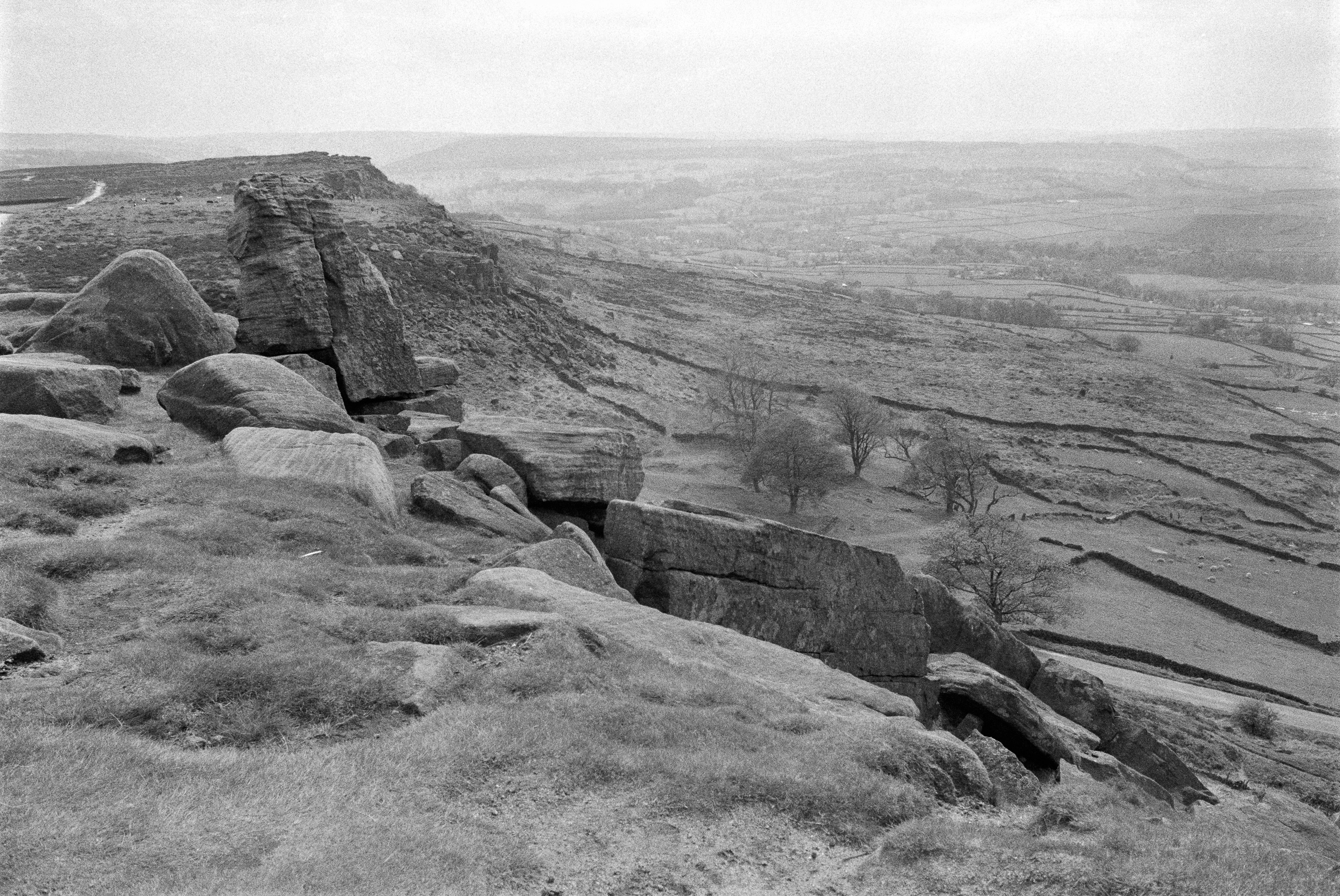
We did eventually get to Derbyshire and there was time while we were they for some short walks and I took just a few pictures. The first is I think on Baslow Edge.

King's Cross, St Pancras & Derbyshire
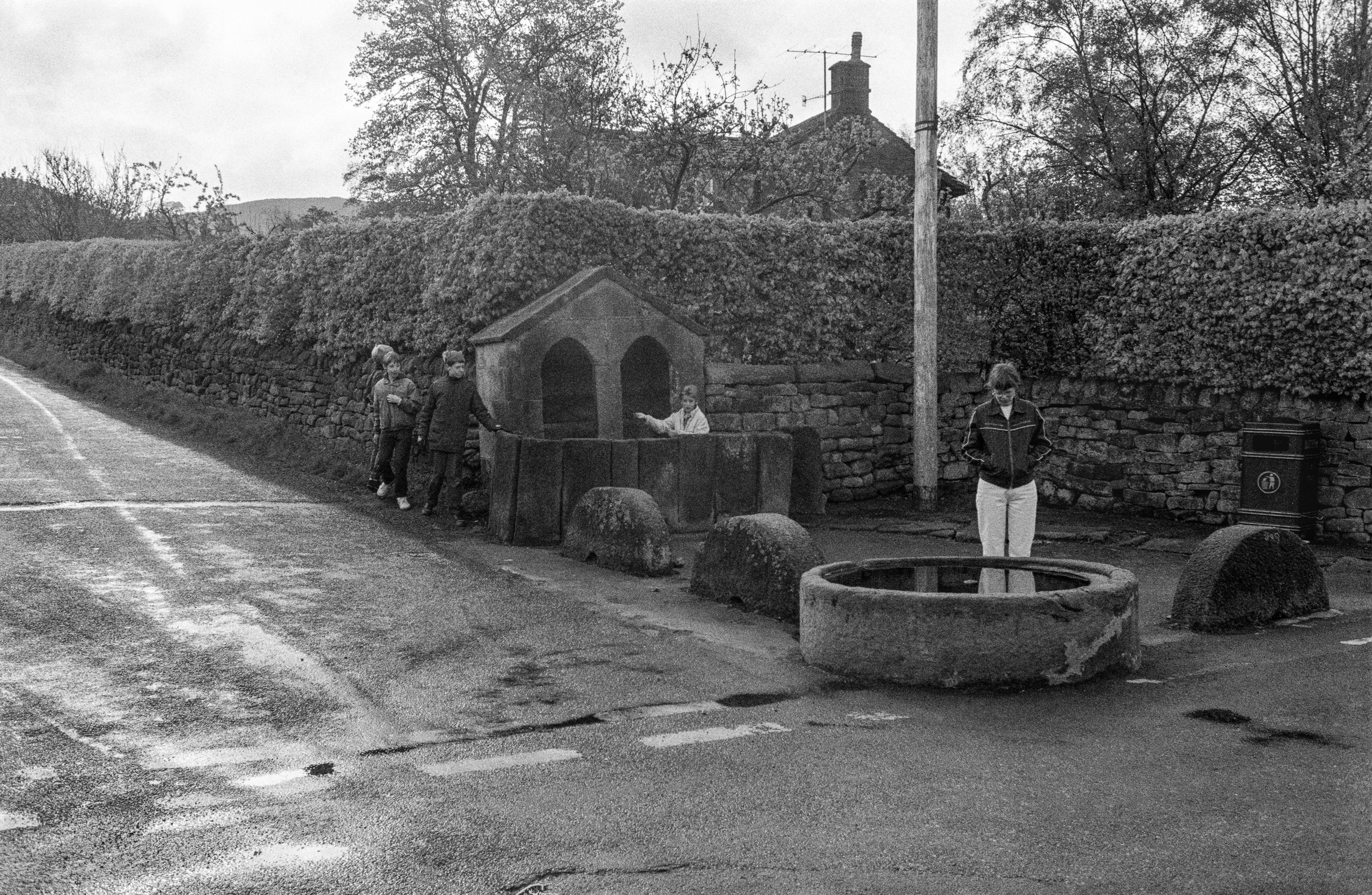
Well, Curbar, Derbyshire, 1989

And this well is in Curbar.


Buildings, Dancers, Gym and a Bison

This is the final part of my walk around King’s Cross after the walk led by the Greater London Industrial Archeology Society finished on Saturday 8th April 1989. The previous post was Goods Way, Gasholders & St Pancras.

Stanley Buildings, Stanley Passage, Cheney Rd, King's Cross, Camden, 1989 89-4h-61
Stanley Buildings, Stanley Passage, Cheney Rd, King’s Cross, Camden, 1989 89-4h-61

I was clearly in no hurry to get home and spent some time wandering around the area taking pictures. In this post they are in the order that I made them, along with some others, mainly near duplicates, but I haven’t kept to this in posting them to the album.

This block of flats was built 1864-5 by the Improved Industrial Dwellings Company, architect Matthew Allen. They were grade II listed five years after I made this picture and have been retained in the fairly comprehensive development around them, being incorporated after considerable rebuilding around 2014 into a modern office development.

The listing text decribes them as part of a group with the “King’s Cross Gasholders, Goods Way and Barlow’s great shed to St Pancras Station, Euston Road” and “in addition an important part of a dramatic Victorian industrial landscape.” Unfortunately this is no longer the case, and it is now simply an addendum to a modern development.

Gasholder, Cheney Rd, Battlebridge Rd, King's Cross, Camden, 1989 89-4h-62
Gasholder, Cheney Rd, Battlebridge Rd, King’s Cross, Camden, 1989 89-4h-62

Here and in the next picture we see a landscape and portrait view of a nearby part of that “dramatic Victorian industrial landscape”, now gone and replaced by modern blocks

89-4h-64-Edit_2400
Gasholder, Cheney Rd, Battlebridge Rd, King’s Cross, Camden, 1989 89-4h-64-Edit_2400

I made the landscape format view first, but then decided that it was probably better to include the top of the gasholder.

German Gymnasium, Cheney Rd, King's Cross, Camden, 1989 89-4h-65
German Gymnasium, Cheney Rd, King’s Cross, Camden, 1989 89-4h-65

The German Gymnasium on the south side of Clarence Passage was also built in 1964-5, paid for by the German Gymnastics Society and London’s German community and it had its front entrance on Pancras Road. It was one of the first venues used by the National Olympian Association for its first games in 1866.

Dancers, Mural, Stanley Buildings, Pancras Rd, King's Cross, Camden, 1989 89-4h-56
Dancers, Mural, Stanley Buildings, Pancras Rd, King’s Cross, Camden, 1989 89-4h-56

My favourite mural in London, on the side of this block of flats. I don’t know when this disappeared. The ‘preserved’ building has a huge featureless brick wall facing Pancras Road which could do with something like this to liven it up.

German Gymnasium, Cheney Rd, King's Cross, Camden, 1989 89-4h-42
German Gymnasium, Cheney Rd, King’s Cross, Camden, 1989 89-4h-42

Although this building was Grade II listed in 1976, part of its western end was demolished for the construction of St Pancras International, with a new end wall being built in matching fashion. The building is now in use as a restaurant and bar.

Culross Buildings, Kings Cross Station, King's Cross, Camden, 1989 89-4h-43
Culross Buildings, Kings Cross Station, King’s Cross, Camden, 1989 89-4h-43

I had wandered here to the side of the Motorail terminal at King Cross, where you used to be able to drive your car onto a train and sleep in a bunk bed all the way to Edinburgh or Aberdeen. This was the first such service, I think dating from the 1950s by British Rail, who set it up as Car Sleeper Limited, but it was soon joined by a network of similar services serving other stations and distant destinations, with London terminals at Olympia, Paddington and Euston.

As the motorway network grew, demand for motorail decreased, and I think the service from Kings Cross ended around the time I made this picture.

Culross Buildings, Kings Cross Station, King's Cross, Camden, 1989 89-4h-44
Culross Buildings, Kings Cross Station, King’s Cross, Camden, 1989 89-4h-44

Another image from somewhere around the north of King’s Cross Station where I had wandered.

Great Northern Hotel, Pancras Rd, King's Cross, Camden, 1989 89-4h-45
Great Northern Hotel, Pancras Rd, King’s Cross, Camden, 1989 89-4h-45

Back on Pancras Rd I walked to the eastern side of the Great Northern Hotel facing King’s Cross Station to take this picture of the main facade. The area in front of the hotel is now covered by the extended station building from 2008. The building was a part of Lewis Cubitt’s plans for the station, built in 1854 and Grade II listed in 1984. The slightly less impressive convex rear of the building is still fully visible on Pancras Rd.

Ox, Pancras Rd, King's Cross, Camden, 1989 89-4h-46
Ox, Pancras Rd, King’s Cross, Camden, 1989 89-4h-46

This rather threadbare beast was for some years a feature of Pancras Road, and although I’ve called it an Ox I think it was really a Bison. I think it was there simply to draw attention to the shop behind, or perhaps just to make it easier to find. Perhaps someone will be able to post more about it in a comment?

A short distance down the road was the Underground entrance at which my walk ended and my journey home began.

The first post on this walk was Kings Cross, St George’s Gardens & More

Goods Way, Gasholders & St Pancras

Goods Way, Gasholders & St Pancras: My walk around King’s Cross continued after the walk led by the Greater London Industrial Archeology Society finished on Saturday 8th April 1989 . The previous post was More from King’s Cross Goods Yard.

Works, Goods Way, King's Cross, Camden, 1989 89-4g-35
Works, Goods Way, King’s Cross, Camden, 1989 89-4g-35

I walked west along Goods Way, running parallel to the canal a short distance to the south. It was a way I’d walked before and I didn’t stop to make many photographs. Ii wanted to photograph the bridge across the canal to the goods yard, but couldn’t get the view I wanted and had to make a note to come back another day – which I did a couple of weeks later when I arrived early to take a train from St Pancras.

But this rather nicely proportioned building seemed worth recording at 3 and 3A, perhaps offices and a factory at right, particularly as it seemed unlikely to survive the redevelopment of the area. You can see the girders of a gasholder reflected in the window above the main doorway.

Gasholders, Goods Way, King's Cross, Camden, 1989 89-4g-36
Gasholders, Goods Way, King’s Cross, Camden, 1989 89-4g-36

This splendid group of gasholders is of course no longer at the corner of Goods Way and Camley Street. The last gasholder on Goods Way, on the south side and not included in this picture was demolished around 2010 while these ones were moved a short distance away to the other bank of the canal by St Pancras Lock.

The large name on the wall, HADEN YOUNG were electrical contractors and one of the smaller signs is for Balfour Beatty. The gasworks had been here and although the UK had been converted to gas the gasholders were still being used for storage.

Gasholder, Camley St, Goods Way, King's Cross, Camden, 1989 89-4g-25
Gasholder, Camley St, Goods Way, King’s Cross, Camden, 1989 89-4g-25

Looking across Goods Way from the corner of Camley Street this gasholder remained in place until around 2010.

Gasholders,  Goods Way, King's Cross, Camden, 1989 89-4g-14
Gasholders, Goods Way, King’s Cross, Camden, 1989 89-4g-14

Another view of the gasholders, this time from close to the bridge under the lines out of St Pancras, now underneath the widened viaduct for the Eurostar high speed rail link. Nothing in this picture remains in place, with gasholders and the brick Victorian water tower having been re-sited and the rest demolished.

St Pancras Station, Pancras Rd, Somers Town, Camden, 1989 89-4g-15

Pancras Road runs down the west side of St Pancras Station and this view disappeared with the building of St Pancras International Station which was officially opened in 2007, with much of the original station being converted into a shopping mall.

Culross Buildings, Battlebridge Rd, King's Cross, Camden, 1989 89-4g-16
Culross Buildings, Battlebridge Rd, King’s Cross, Camden, 1989 89-4g-16

Culross Buildings was built by the Great Northern Railway as housing for railway workers in 1891-2. As well as flats 1-40 and a basement workshop and boiler room there was an adjoining Mission Hall, Culross Hall and a canteen at 41 Battle Bridge Road. Derelict in postwar years and squatted the building eventually became a part of a housing co-op and the flats were brought closer to modern standards.

As the large writing on the wall states, in 1989 the building was home to 150 people. The buildings were unlisted but within the King’s Cross Conservation Area and were demolished in 2008.

This walk will be completed in a later post.

The first post on this walk was Kings Cross, St George’s Gardens & More.