St Pancras Old Church & More – 1990

St Pancras Old Church & More: More from my wanderings to the north of St Pancras and Kings Cross on February 18th 1990. This walk began with Between Kings Cross & St Pancras – 1990 and continued in Gasholders, Goods Way and Midland Road, 1990.

The Chenies, Pancras Rd, Somers Town, Camden, 1990, 90-2e-41

This 8 storey block was built in a vaguely Art Deco style in the late 1940s as council flats for St Pancras Borough Council, one of two blocks in the Godlington Street Estate. Later it passed to the London Borough of Camden. John Russell, an adviser to Henry VIII was given the title Earl of Bedford in 1551 and the Bedford family later gained other titles including that of Baron Rusell of Chenies. The Bedford estate owns much of Bloomsbury and some other parts of Camden and in the 16th century acquired Chenies Manor in Buckinghamshire by marriage.

Pancras Tyres, Pancras Rd, Somers Town, Camden, 1990, 90-2e-42

The former premises of Pancras Tyres which had moved, though it was now impossible to see where they had moved to, I could still read 56 PEN, but there are a surprising number of streets in London beginning with Pen. The notice obscuring the rest of the address claims that (despite the move) the gates are in constant use, but they were certainly not while I was there.

St Pancras Old Church, St Pancras Old Burial Ground, Pancras Rd, Somers Town, Camden, 1990, 90-2e-4311-13th Century church enlarged by A D Gough and R L Roumieu in 1847-8century, later restorations and 'Norman' remodelling by A W Blomfield. Still in use.
St Pancras Old Church, St Pancras Old Burial Ground, Pancras Rd, Somers Town, Camden, 1990, 90-2e-43

This Grade II* listed 11-13th Century church was enlarged by A D Gough and R L Roumieu in 1847-8 and later ‘restored’ with Norman remodelling by A W Blomfield, Very little can now be seen of the original Norman building, but there are claims that there are some much older Roman remains in parts of the walls, and that this was a place of worship possibly as long ago as AD 314, A 6th century altar stone was found here.

The church remains in use as “a traditional Anglo-Catholic church that rejects the ordination of women as priests and bishops” and as a music venue.

The Hardy Tree, St Pancras Old Burial Ground, Pancras Rd, Somers Town, Camden, 1990, 90-2e-22

The railway line out of St Pancras Station runs through St Pancras Old Burial Ground and before it could be built in 1865 many of the graves their had to be dug up and moved. Some were piled up in a heap here, with the young Thomas Hardy, then an assistant to architect Arthur Blomfield, delegated to be the overseer for the work. At the centre of the pile of gravestones was an seed or small sapling, which sprouted and grew into the large ash tree whose trunk can just be seen in my picture and which became known and loved as ‘The Hardy Tree’.

Sadly the tree became infected with a fungus in 2014, severely weakening it and on 27th December 2022 it collapsed. A beech sapling was planted in 2024 to replace the original tree.

Tomb, Sir John Soane, St Pancras Old Burial Ground, Pancras Rd, Somers Town, Camden, 1990, 90-2e-26

Sir John Soane (1753 – 1837) was one of Britain’ greatest architects, the son of a bricklayer who rose to became a professor of architecture and was responsible for influential Neo-Classical buildings including the Bank of England and Dulwich Picture Gallery.

He designed this Grade I listed tomb following the death of his wife in 1815 and it was erected here in 1816. His wife, Soane and his son were all buried here. In 1924, Giles Gilbert Scott (son of Sir George Gilbert Scott architect of St Pancras Station and hotel) walked in the burial ground and was inspired by the central part of this tomb for his entry to the comptition to design a telephone box. His winning entry, the K2, produced in 1926 was the iconic telephone box – though it changed a little over the years, developing into the 1935 K6 model.

Gas Holders, Camley St, Goods Way, Kings Cross, Camden, 1990, 90-2e-14
Gasholders, Camley St, Goods Way, Kings Cross, Camden, 1990, 90-2e-14

I walked back towards the stations, turning down Goods Way where I could not resist taking a few more pictures of the gas holders.

Gas Holders, Camley St, Goods Way, Kings Cross, Camden, 1990, 90-2e-15
Gasholders, Camley St, Goods Way, Kings Cross, Camden, 1990, 90-2e-15
Gas Holders, Goods Way, Kings Cross, Camden, 1990, 90-2e-16
Gashholders, Goods Way, Kings Cross, Camden, 1990, 90-2e-16

More pictures from around Kings Cross and Pentonville in a later post.


FlickrFacebookMy London DiaryHull PhotosLea ValleyParis
London’s Industrial HeritageLondon Photos

All photographs on this page are copyright © Peter Marshall.
Contact me to buy prints or licence to reproduce.


Thames Path, Tradescants, Leake Street – 2014

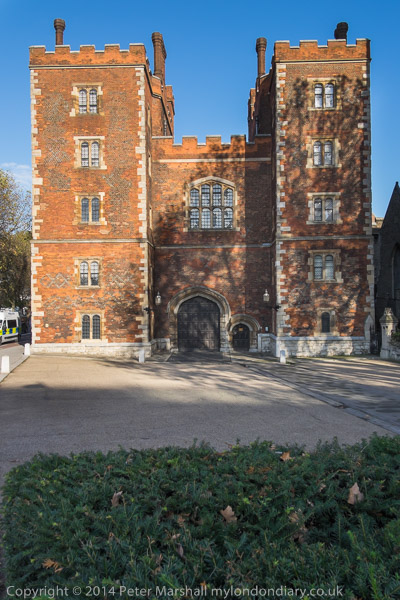
Thames Path, Tradescants, Leake Street – On Monday 10th November 2014 I went on a walk with some of my family in Lambeth, where my sister in particular was keen to visit the Garden Museum in the deconsecrated St Mary’s Church next to Lambeth Palace.

Thames Path, Tradescants, Leake Street

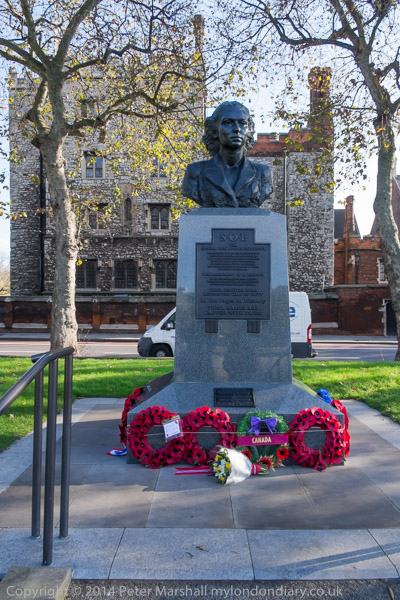
We began our walk at Waterloo station, making our way to the riverside path along by the Thames and walking west past St Thomas’s Hospital. A lttle beyond that in front of Lambeth Palace is a memorial bust of Violette Szabo, (1921-1945) standing on a monument to the SOE, the Maquis and the Norwegian resistance commandos, heroes of Telemark. Szabo, a Lambeth resident, was posthumously awarded the George Cross and the Croix de Guerre and was one of the 117 of the 470 agents the SOE sent to France who did not survive

Thames Path, Tradescants, Leake Street

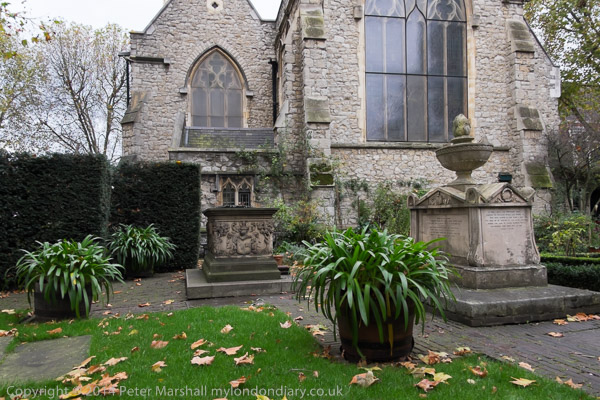
On My London Diary I give some more detail about the setting up of this museum after Rosemary Weekes (later Nicholson) began her campaign to save the church and the fine tomb of father and son John Tradescant, 17th century plant hunters and royal gardeners in its churchyard as a Museum of Garden History. Her work together with her husband John Nicholson is commemorated in the garden with a plaque.

Thames Path, Tradescants, Leake Street

I posted a photograph of a sculpture commemorating the two John Tradescants – father and son – a few days ago in the post Old Clapham Road and South Lambeth – 1989 and wrote rather more about them later in another post on my 1989 walk, Tradescant, Old South Lambeth Rd and Caron, which began with a picture of houses on Tradescant Road, built on the site of their home in South Lambeth, and I’ll try not to repeat myself more than I need here.

Thames Path, Tradescants, Leake Street

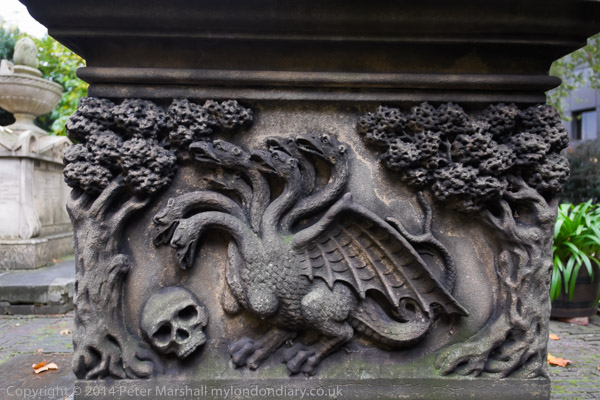
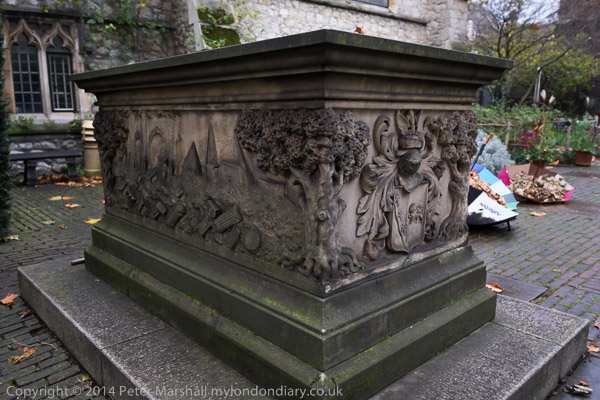
The Tradescant tomb was first commissioned by Hester Tradescant, the widow of the younger John when he died in 1662 and had elaborate carvings depicting rather fancifully some of the specimens of various kinds from their travels in search for new plants around much of the world. These formed the basis of the first public museum in England – the Lambeth Ark – and were fraudulently stolen by a neighbour who pretended to support this who later presented them to Oxford University to establish the Ashmolean Museum.

By the mid-nineteenth century the original memorial was in very poor condition, probably attacked by the noxious acidic fumes from the many industries in the area, and in 1853 a replica was re-carved using limestone from Darley Dale in Derbyshire.

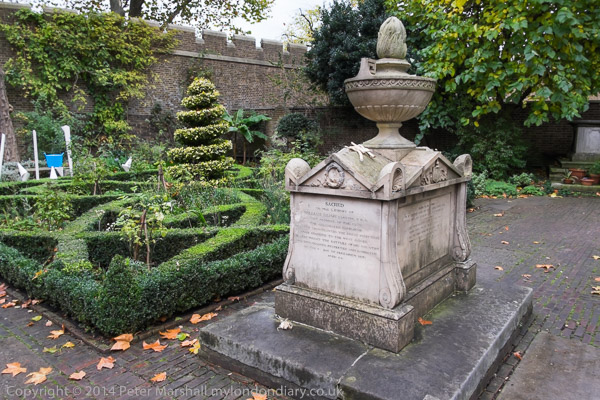
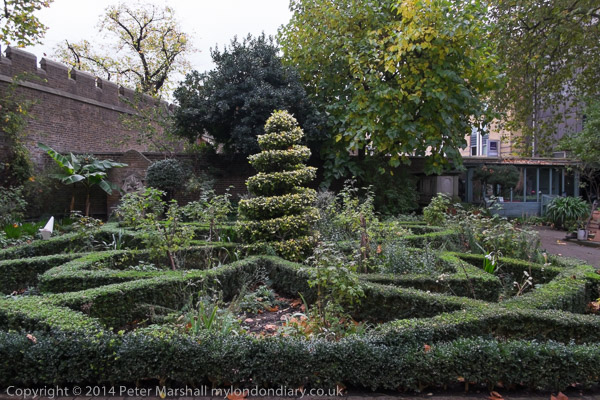
Also in the museum garden if the tomb of the notorious Captain Bligh of the Bounty, on whose ships the Tradescants brought back some of their plants. John Tradescant the Older had begun work as gardener to one of the wealthiest families in England and here there is a recreation of one of his Knot Gardens, based on designs for gardens at Hatfield and Cranbourne.

The museum is well worth a visit, particularly for keen gardeners, and has a pleasant cafe and of course a shop. The Tradescants also set up what was possibly the first garden centre a short distance away, though I think you would have then needed very deep pockets to buy any of their plants, many of which are now very common in our gardens.

We walked back through Archbishop’s Park, a public park with some fine trees and some green cyclists.

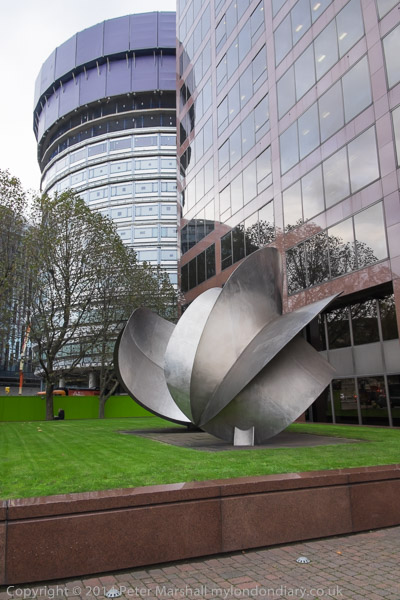
And came out on Lambeth Palace Road which has some modern buildings and a large metal sculpture, South of the River’ by Bernard Schottlander (b.1924) which was cast by British Steel in 1976 outside the offices at Becket House. As we went past the Lying-In Hospital (now just a frontage to a recent hotel) I found we had over 20 minutes before our train so I led our group down into Leake Street.

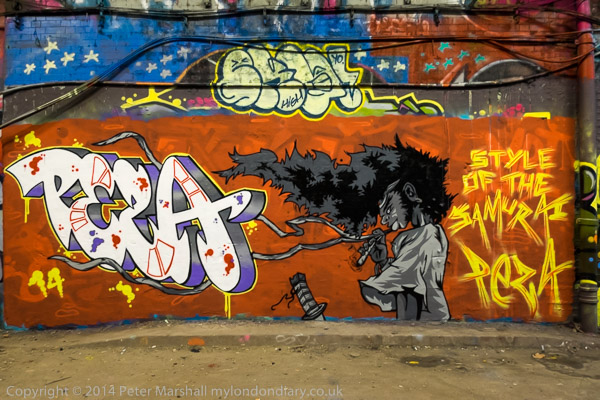
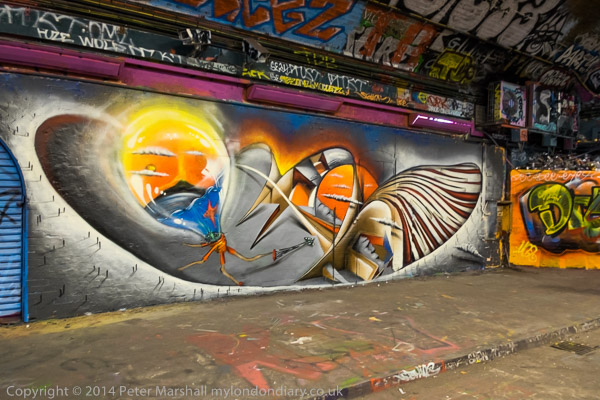
Although much of several parts of London are now covered with graffiti I think this tunnel remains the only officially sanctioned area for artists. I’d been there on various occasions but I think it was the first time the others in our group had been there

It wasn’t the fastest way to get into Waterloo Station, and took us to the far end from where our trains now run from the former Waterloo International platforms, but we still caught our train with time to spare.

Many more pictures from the walk and museum garden – including more graffiti – on My London Diary at Lambeth Walk.