Boycott Workfare, Million Women Rise & Greece – 2012

Boycott Workfare, Million Women Rise & Greece: On Saturday 3rd March 2012 I photographed a protest outside companies using people forced into free labour under the government workfare scheme, then a women-only march against male violence against women which I left to go to the Occupy meeting on the steps of St Paul’s which supported the protests in Greece against austerity measures imposed by the EU.


Boycott Workfare – Oxford St

Oxford St
Boycott Workfare, Million Women Rise & Greece - 2012

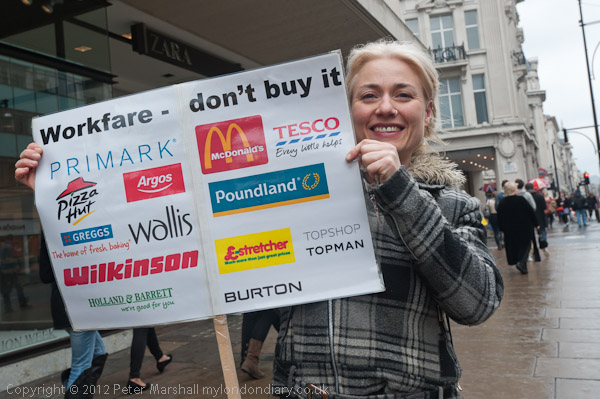
The group Boycott Workfare came to Oxford Street to lead a protest against companies who use unemployed and disabled people forced to work without pay but just a small allowance under the government workfare scheme.
Boycott Workfare, Million Women Rise & Greece - 2012

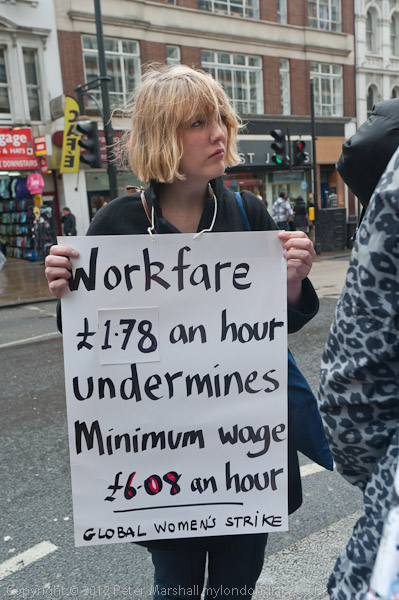
As the protesters emphasised, workfare reduces the number of real jobs available in the workplaces, giving workers to the employers by forcing the unemployed to do work at no cost to the employer on an allowance roughly one quarter of the minimum pay – and around a fifth of the London Living Wage.
Boycott Workfare, Million Women Rise & Greece - 2012

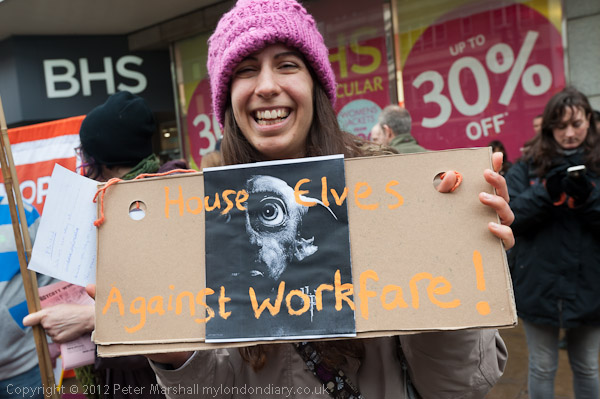
The event began with some good news when they met outside BHS near Oxford Circus by praising that company for having withdrawn from the scheme since the protest had been planned before moving off to protest elsewhere.
Boycott Workfare, Million Women Rise & Greece - 2012

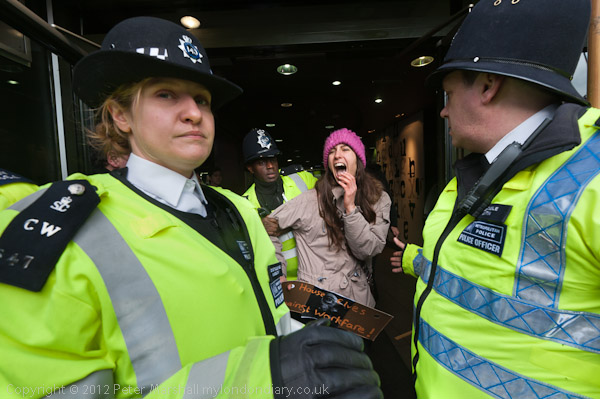
Around a hundred campaigners had arrived and were being carefully watched by police who went with them, guarding shop doorways and keeping a path along the crowded pavements clear when they stopped to protest.
Boycott Workfare, Million Women Rise & Greece - 2012

The organisers had kept their route secret and had come with two ‘Boycott Warfare’ flags on long poles, white with the letters BW, and those taking part were told to follow the flags.
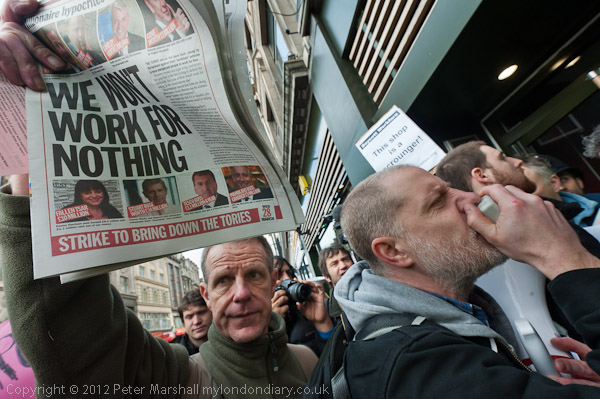
Police were also guarding some shops which had previously been targeted by UK Uncut over their failures to pay tax, though most of these were not involved in workfare and so of no interest to this protest.

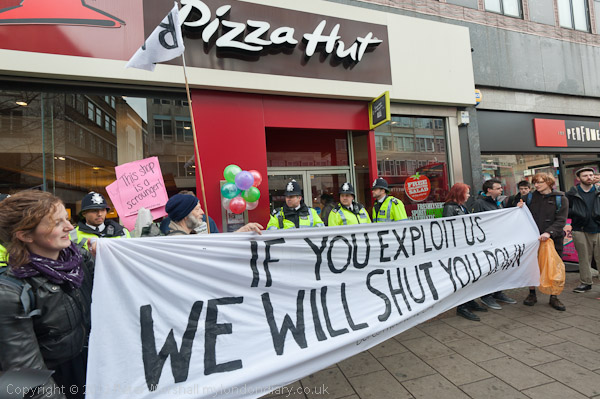
The first stop was a Pizza Hut, where police managed to stop any of the protesters entering – but the protest put off a number of customers entering while there were a few speeches. There we were handed a map showing the locations of some of the other businesses on Oxford Street taking part in workfare, including McDonalds, Holland and Barratt, Superdrug, WH Smith, Argos, and a little way north of Oxford St, Holiday Inn and Barnado’s.
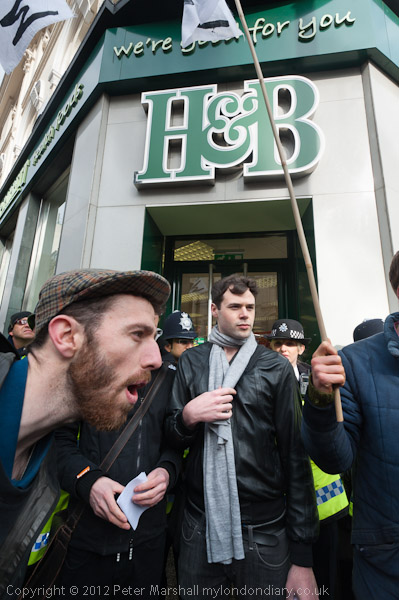
Police just managed to arrive at Holland and Barratt before the protesters, who only paused briefly there before rushing on to McDonalds, where a few managed to go inside. Police soon ejected them into the noisy crowd protesting outside, most of whom soon moved off towards Argos, with police following them.
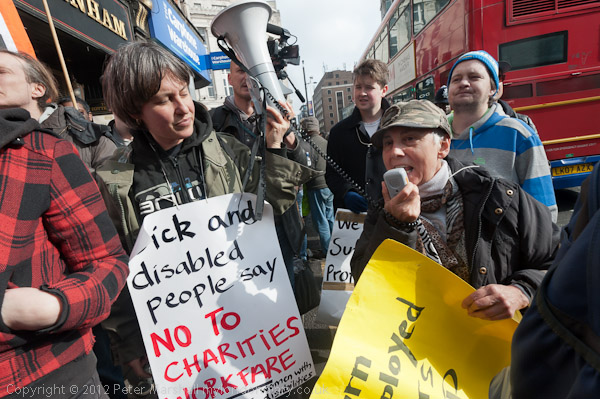
I soon realised that not all the protesters had left for Argos, and hurried back to see another group being ejected from McDonalds. Another small group had returned to Pizza Hut – where again they were ejected by police.

The main body of protesters turned into a shopping arcade, but were not sure which of the shops were using workfare and hesitated, allowing police to rush in and form a barrier. After a few noisy minutes they left and held a rally on a street corner with a few short speeches – including at least one by someone passing by.
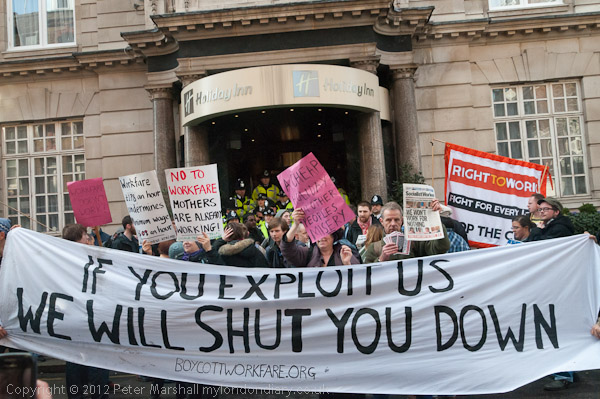
At the Holiday Inn on Wellbeck Street a few protesters again beat the police and were rather forcibly ejected.
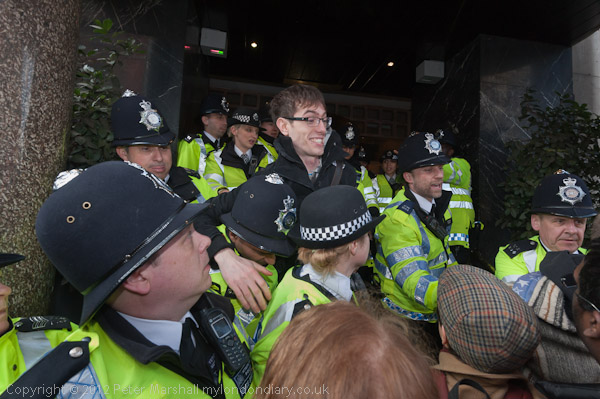
Some at least of the police who I and the campaigners talked with clearly shared their disgust at a scheme which forces people to work without payment, and were also worried about leaked plans to part-privatise the police and other cuts, but insisted that it was their job to keep order and protect property.

More on My London Diary at Boycott Workfare – Oxford St.


Million Women Rise March

Oxford St
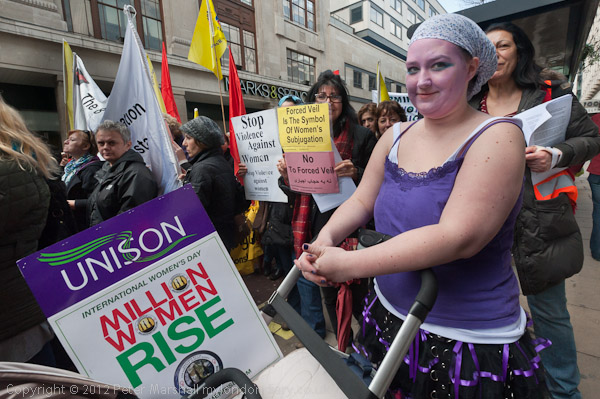
Women were gathering in the street on the west side of Selfridges to march through the centre of London calling for an end to domestic abuse, rape and commercial sexual exploitation. They called for prevention of abuse and support and protection for women.
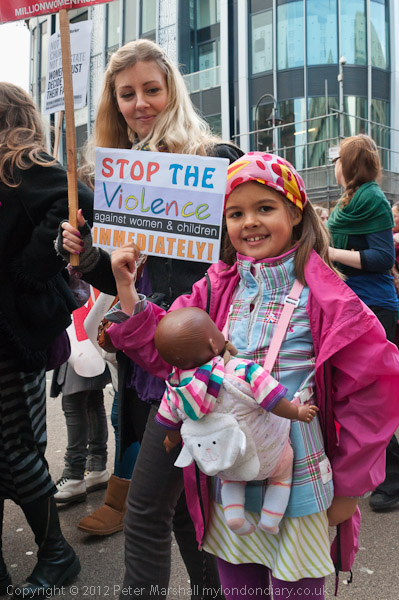
They came from various womens groups and organisations around the country for this all-women march calling for and end to male violence against women.
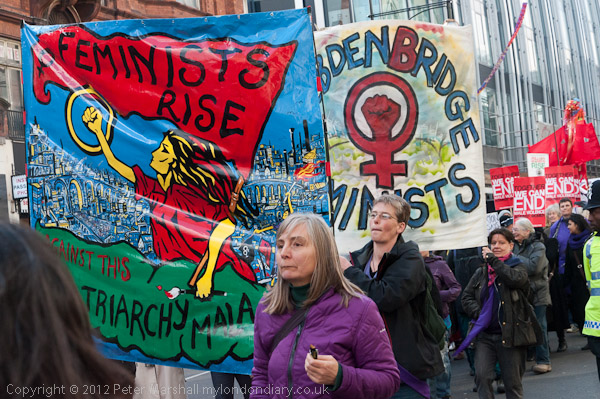
Some of London’s more active women campaigning groups, including those that have been the leaders in previous celebrations around International Women’s Day were absent from the protest, and I was shocked to learn that they had been told they were not welcome at this march, despite the coalition’s aim to be non-partisan and to bring “together women who want to highlight the continuation of all forms of violence against women and demand that steps are taken to put an end to this.”
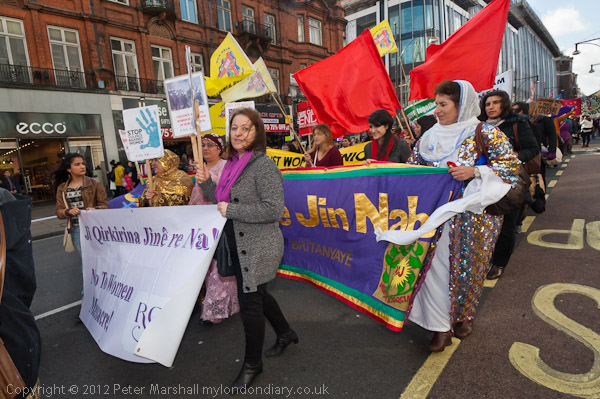
Among those marching were women from a number of political groups from London’s ethnic communities present, including Kurds, some in traditional dress and some holding posters calling for the release of their leader Abdullah Öcalan from prison in Turkey, as well as groups opposed to the Iranian regime.
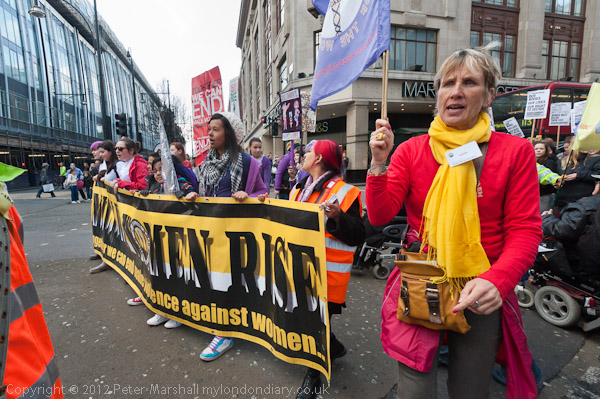
The Million Women Rise Coalition has a statement of demands for government and societies here and around the world. They demand the recognise and reflect in policies the discrimination faced by all women and those from black and other minority groups in particular. They demand that domestic abuse, rape and commercial sexual exploitation are linked together in a definition of violence against women and that support is given to support organisations for women in the not-for-profit sector.
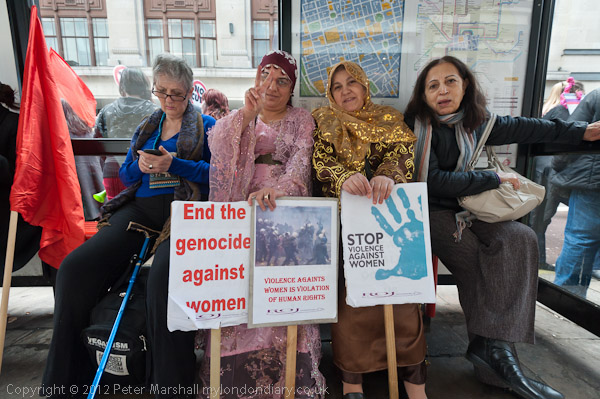
Their long statement called for support for various groups opposing violence against women, and end to child prostitution and pornography and proper support for trafficked women and children.
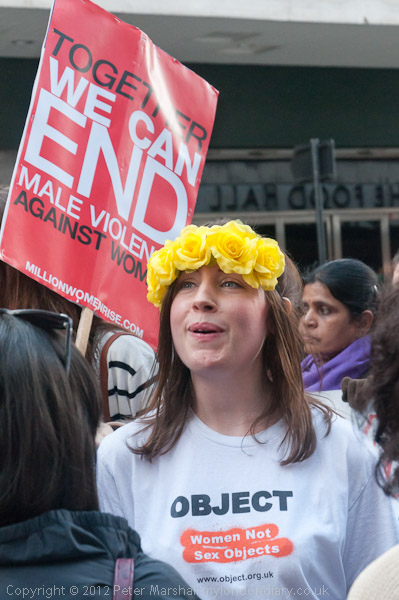
They called for International Women’s Day to be made a Bank Holiday in the UK and Ireland, and oppose “the continued misrepresentation, misappropriation and abuse of the female body throughout all forms of media.”
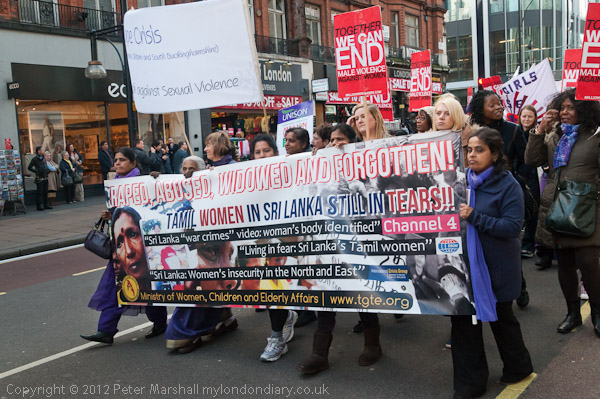
Their statement also made clear that wars and conflicts around the world perpetuate violence against women, and on the march a group carried a banner ‘Raped, Abused, Widowed and Forgotten – Tamil Women in Sri Lanka Still In Tears’ and others highlighted the ongoing abuses against women in DR Congo.

More on My London Diary at Million Women Rise March.


Greeks Protest With OccupyLSX

St Paul’s Cathedral Steps
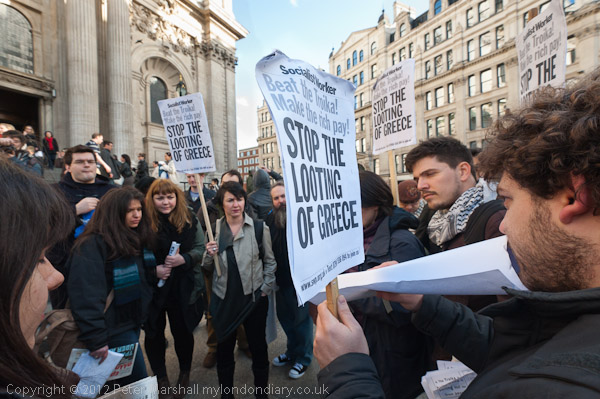
I left the march at Bond Street Station to report on a protest at St Paul’s Cathedral against the terms of the Eurozone rescue package for Greece at Occupy meeting on the steps there and to show solidarity with the protests in Greece.

Much more about this and more pictures on My London Diary at Greeks Protest At St Paul’s,


FlickrFacebookMy London DiaryHull PhotosLea ValleyParis
London’s Industrial HeritageLondon Photos

All photographs on this page are copyright © Peter Marshall.
Contact me to buy prints or licence to reproduce.
No More Benefit Deaths – 2016

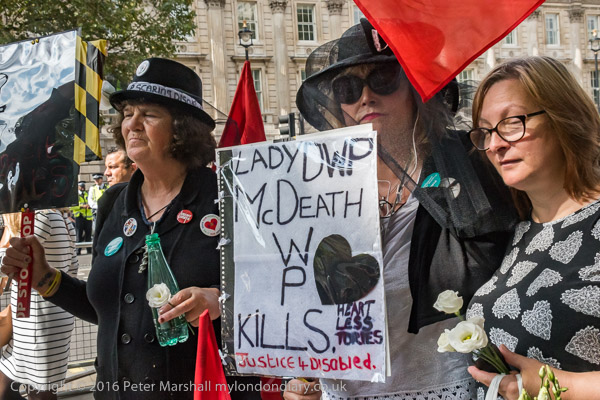
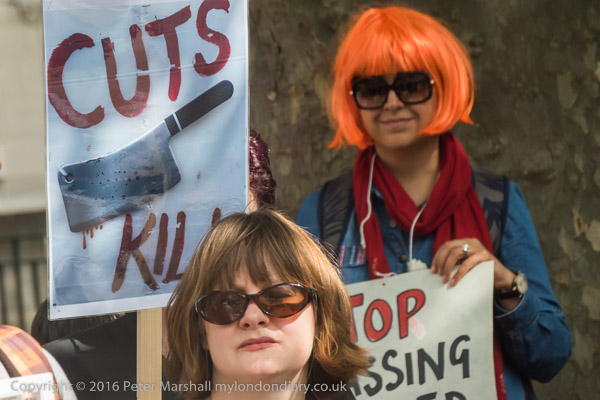
No More Benefit Deaths: On Wednesday 7th September 2016, the day of the opening ceremony for the Rio Paralympics, disablement campaigners demanded human rights for all disabled people and an end to the disastrous sanctions regime which has led to many deaths.

No More Benefit Deaths

They called on Prime Minister Theresa May, newly appointed in July 2016 to make public the findings of the UN investigation into the UK for violations of Deaf and Disabled people’s rights, to scrap the Work Capability Assessment and commit to preventing future benefit-related deaths.

No More Benefit Deaths

The UN committee on the rights of persons with disabilities published its report in November 2016. It stated that the UK had committed “grave or systematic” violations of UN Convention on the Rights of Persons with Disabilities and in June 2017 the committee clarified the reasons behind their conclusions.

No More Benefit Deaths

They stated that the breaches of the rights to independent living, work and employment and adequate standard of living under the convention were mainly caused by the policices introduced by Tory ministers at the DWP between 2010 and 2015. Some were grave violations, some systematic and others both grave and systematic.

No More Benefit Deaths

The UN inquiry had been prompted by the research and lobbying of Disabled People Against Cuts, and the Disability News Service article included this quote from DPAC co-founder Linda Burnip who:

“pointed to actions such as cuts to social care, the impact of the work capability assessment – which has been linked by public health experts from the Universities of Liverpool and Oxford to hundreds of suicides between 2010 and 2013 – the hugely damaging introduction of personal independence payment and consequent cuts to support, the increased use of sanctions and the resulting deaths of benefit claimants, and the introduction of the bedroom tax.”

As Burnip stated, the government’s actions were “based on a deliberate intention to cause harm without any regard to the horrendous consequences for disabled people.”

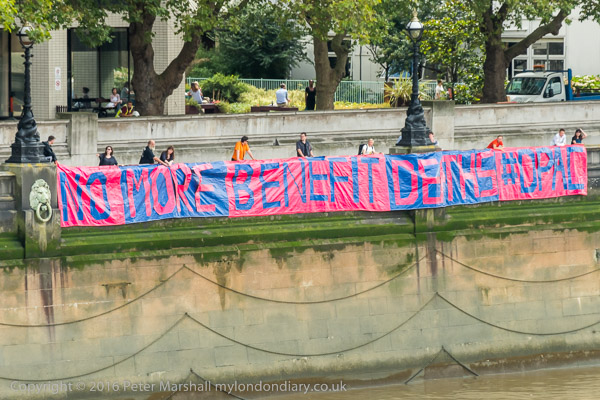
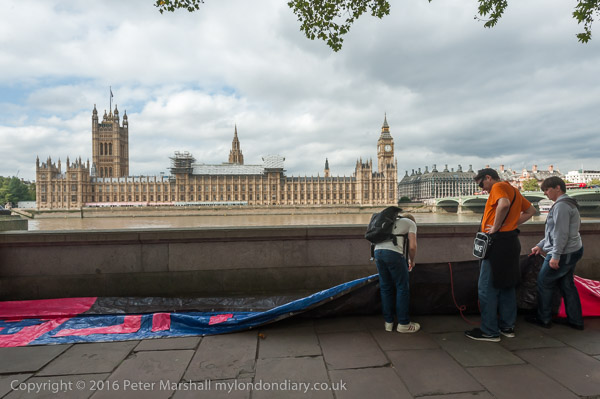
The day on Wednesday 7th September 2016 began with a huge banner with the message ‘NO MORE BENEFITS DEATHS #DPAC” being displayed on the wall of the River Thames facing the riverside terrace of the Houses of Parliament.

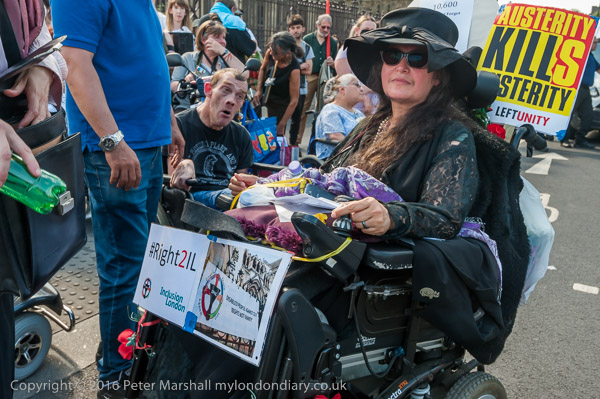
After photographing this I hurried to Downing Street were there was a rally in on the opposite side of the street with speakers from DPAC, Winvisible, the Scottish Black Triangle Campaign and others including John Clark from the Ontario Coalition Against Poverty who shared news of similar problems facing disabled people in Canada.

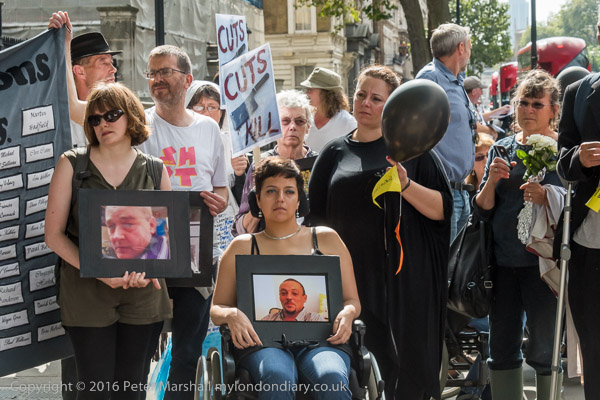
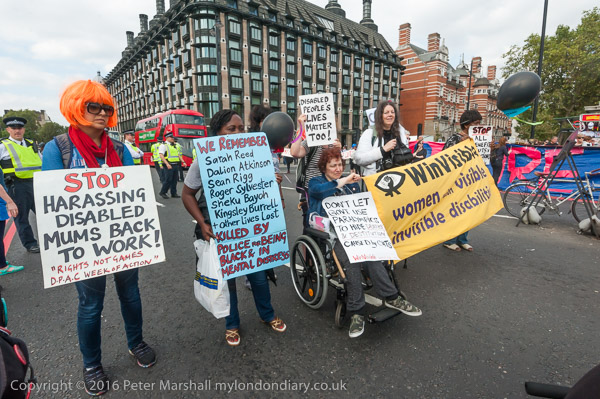
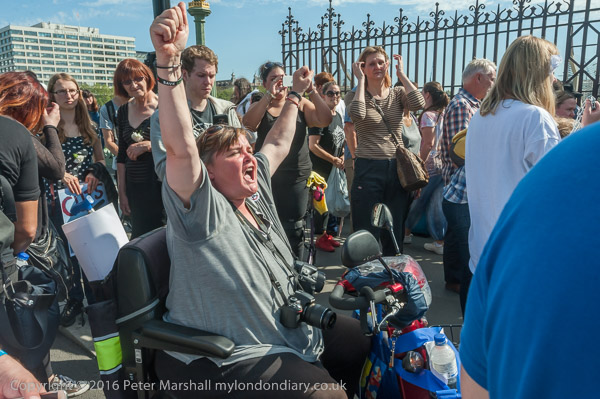
Gill Thompson spoke about her brother David Clapson, a diabetic ex-soldier died after his benefit was cut as he could not afford food or electricity to keep his insulin cool was there with a banner covered with the names and some photographs of around a hundred of the many who had died because of the DWP’s sanctions, cuts and scapegoating.

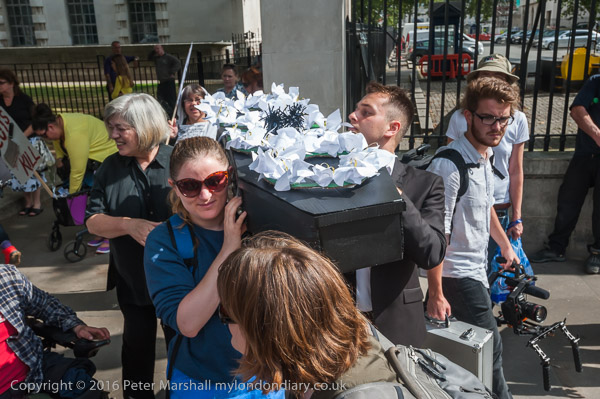
The protesters then lifted up the black coffin with white wreaths they had brought and began a march towards the Houses of Parliament.

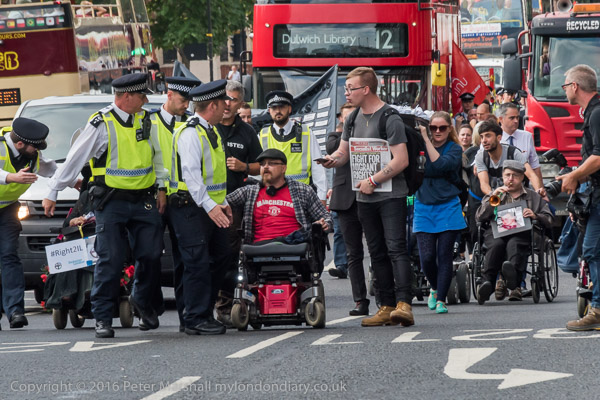
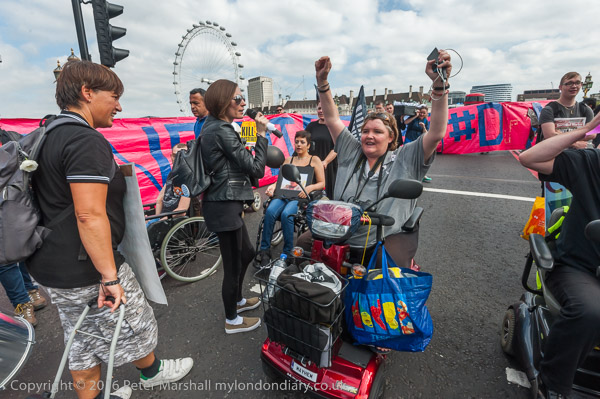
As they came to Bridge Street the marchers took the police by surprise by turning towards the bridge. The giant banner which had earlier been displayed facing Parliament was now stretched across the road, blocking the bridge in both directions.

After several minutes police began trying to get people to move off the road warning them they are committing an offence and may be arrested. I was also threatened with arrest, despite showing my Press card. One carer who refused to move away from the wheelchair user he was looking after was arrested and taken to a police van.

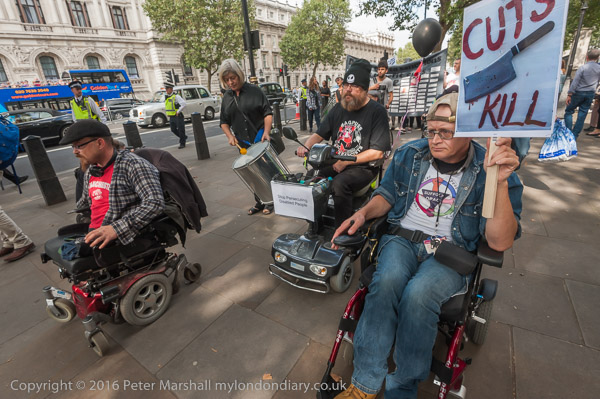
Most of those in wheelchairs and mobility scooters refused to move or did so only after a long series of threats by police, who eventually managed to clear one carraigeway to allow traffic to move out of Westminster. But a group remained blocking traffic in the other direction until after almost two hours Paula Peters triumphantly announced the protest was ending and everyone left.

The new Labour government dropped key disablity rights pledges made by the party for its election manifesto, and since becoming the government has sidelined disabled people in its first King’s Speech. It seems unlikely that there will be any significant improvement for disabled people under Starmer, and further cuts now seem to be coming.

Many more pictures on My London Diary:
Giant Banner ‘No More Benefit Deaths
‘No More Benefit Deaths’ rally
DPAC block bridge over benefit deaths


FlickrFacebookMy London DiaryHull PhotosLea ValleyParis
London’s Industrial HeritageLondon Photos

All photographs on this page are copyright © Peter Marshall.
Contact me to buy prints or licence to reproduce.

Tax Robbery, Racism & John Lewis

Tax Robbery, Racism & John Lewis. Saturday 21st March 2015 was another busy day for me in London, covering protests against the criminal activities of UK banks, a large march and rally against racism in the UK (and a few racists opposing this) and customers of John Lewis calling on the company to treat its cleaners fairly.


Great British Tax Robbery – HSBC, Regent St.

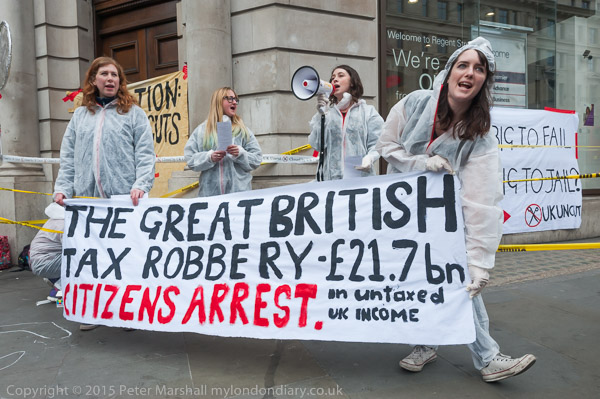
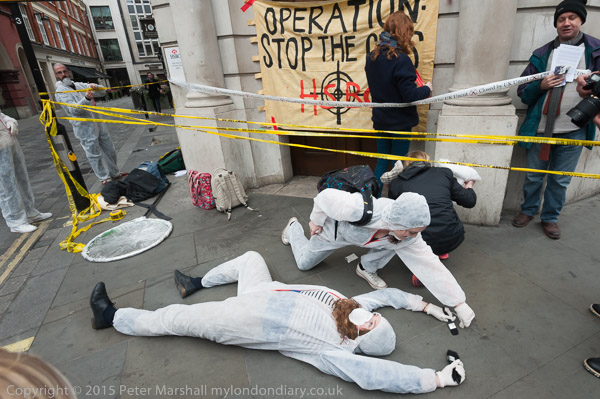
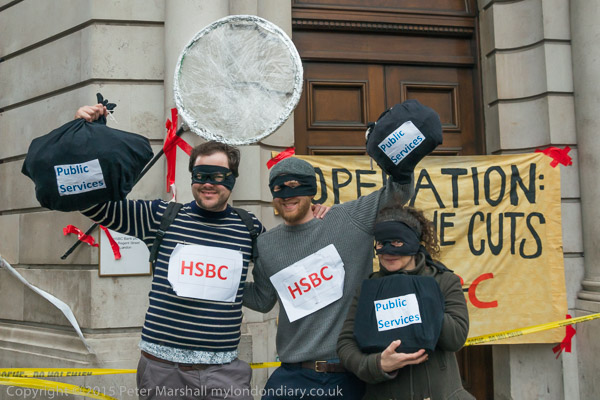
UK Uncut campaigners arrived at the HSBC Regent St branch dressed as detectives and robbers to highlight the bank’s crimes in causing the financial crash and tax dodging, which have led to drastic cuts in vital public services and welfare and attempt a ‘Citizen’s Arrest’.

UK Uncut had a clear message for both HSBC and the government, accusing them of being criminals:

The government told us they’d “protect the poorest and most vulnerable”. They said “those with the broadest shoulders will bear the brunt of the cuts”. And what have we seen? Dismantling the NHS and wrecking the welfare state. Cutting schools, youth clubs, sure start centres, domestic violence refuges and libraries. Slashing local council budgets. Attacking disabled people with inhumane ‘work capability assessments’ and cuts to vital benefits. Removing access to justice through legal aid cuts. Allowing the big six energy companies to push people into fuel poverty. Cutting jobs, wages and pensions. Selling off social housing and moving people away from their communities. Driving hundreds of thousands into food banks and making families choose between heating or eating

My London Diary, March 2015

The bank closed a few minutes before the protesters arrived and kept its doors shut as the protesters’ ‘forensic team’ chalked around ‘crime victims’ on the ground and put crime scene tape around the area, sealing off the door with a banner. There was a speech from a NHS campaigner from East London about the effects of the cuts on the NHS and ‘criminals’ with HSBC on their chests posed for pictures. After a few minutes the protest was ended as many of those taking part were, like me, joining the Anti-Racism protest.

Great British Tax Robbery


Stand Up to Racism March – BBC to Trafalgar Square

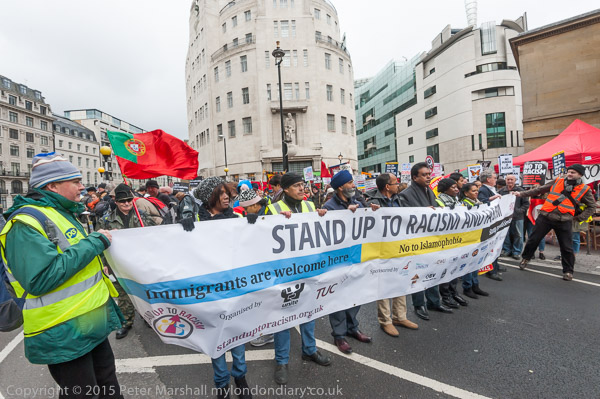
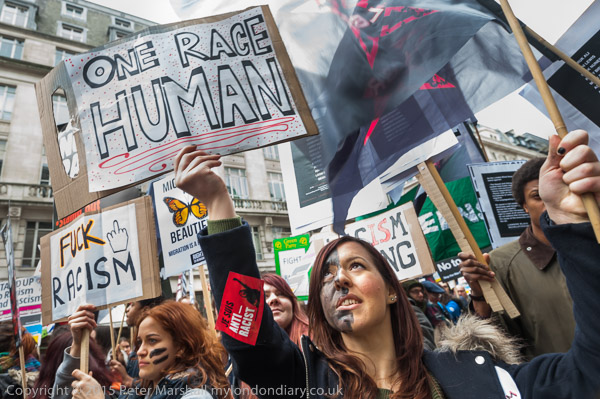
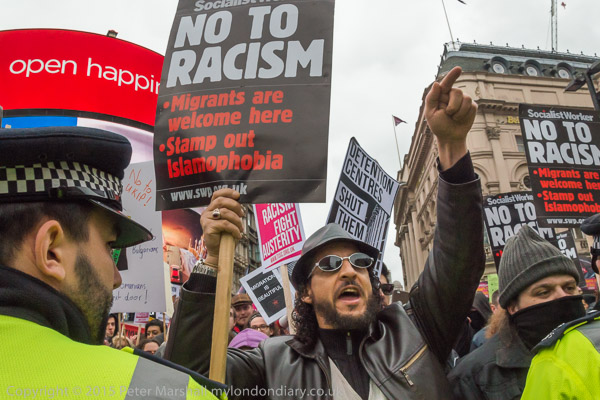
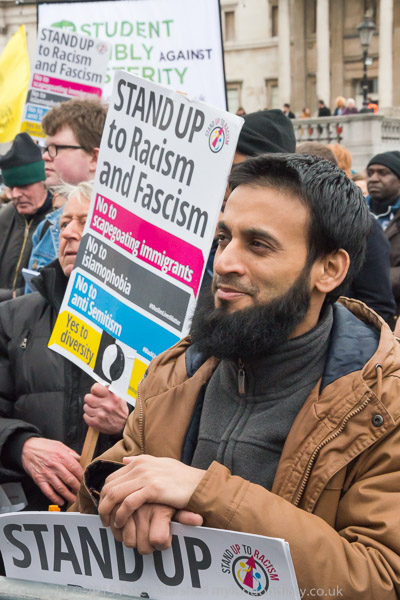
Thousands came to the Stand Up to Racism march from the BBC to Trafalgar Square to reject the scapegoating of immigrants, Islamophobia and anti-Semitism and to celebrate the diversity of Britain, with the message ‘Migrants are Welcome Here!

The march began at the BBC, who campaigners accuse of having a policy of ignoring protests in the UK, especially those against government policies – such as the racist hounding of immigrants under their ‘hostile environment’.

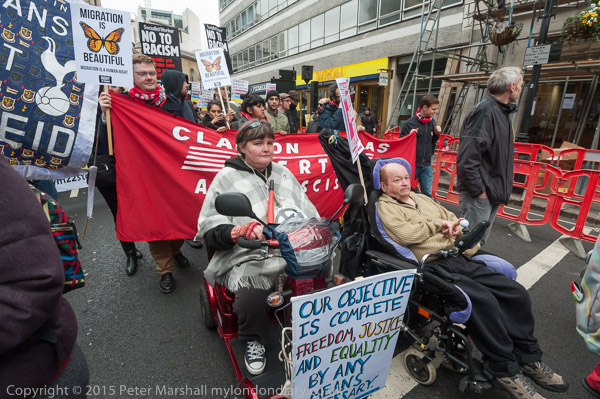
Among those marching were DPAC, Disabled People Against Cuts. Government policies have also targeted disabled people, cutting benefits and subjecting them to unfair ‘fitness to work’ tests which largely ignore medical evidence.

Stand Up to Racism March


Britain First Protests anti-Racist March – Piccadilly Circus

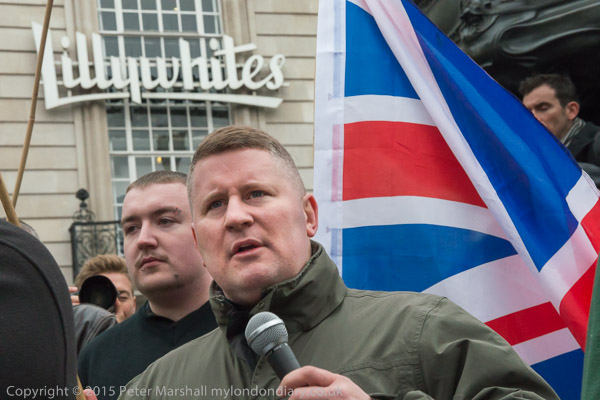
A small and rather sad extreme right-wing group stood on the steps around Eros waving flags and shouting insults at the anti-racist marchers as the thousands marched past. It was a reminder of the kind of bigotry the great majority were marching against.

Some of the marchers paused to shout back at them, while others followed the advice of the march stewards and ignored the small group. There were a few scuffles but generally police kept the two groups apart, though later I learnt that after I had gone past a group of anti-fascists had seized the Britain First banner.

Britain First Protests anti-Racist March


Stand Up to Racism Rally – Trafalgar Square

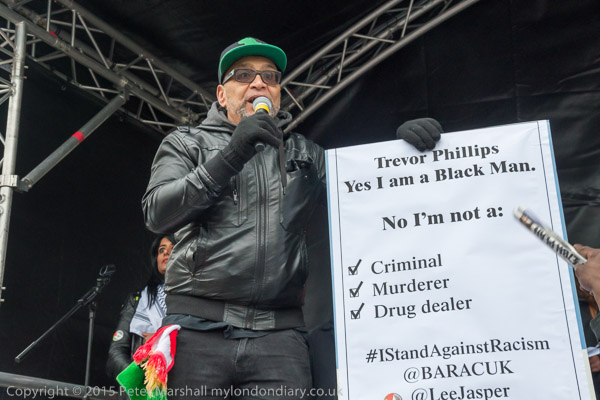
Lee Jasper holds up a large poster responding to Trevor Phillips saying he is not a criminal, murderer or thief

Several thousand who had marched to ‘Stand up to Racism’ through London stayed on to listen to speeches at a rally in Trafalgar Square.

Speakers included Owen Jones, Jeremy Corbyn, Zita Holbourne, Omer El Hamdoon, Lee Jasper and many others, whose photographs you can see on My London Diary.

Stand Up to Racism Rally


John Lewis customers support Living Wage – Oxford St

John Lewis is a company proud of its history and its reputation as a company based on its constitution as the UK’s largest employee owned business with both John Lewis and Waitrose owned in Trust by its 80,000 ‘partners’. They say everyone who works in its stores are not just employees, but a partners in the company, and in almost every year they enjoy a share in its profits.

Everyone who works there, except the cleaners who play a vital role in the proper running of the stores. John Lewis gets out of making them partners by using other companies to employ them and provide the cleaning as a service, choosing its cleaning company through competitive tendering. Cleaning companies cut wages and conditions of service such as sick pay, maternity pay, pensions, holiday pay to the bone – usually the absolute legal minimum – so they can put in low tenders and still make good profits. They exploit the workers – a largely migrant workforce with limited job opportunities – while John Lewis can claim it isn’t them who are doing so and try to maintain their reputation as a good employer.

For some years the cleaners have been protesting to get a living wage and also for John Lewis to recognise their responsibility as the actual company the cleaners are providing a service to. They want to be treated equally with the others who work in the stores, rather than the second-class employees they are now. The least John Lewis could do would be to insist on contractors paying the living wage and giving employees decent conditions of service as a condition of tender, but they had refused to take any responsibility.

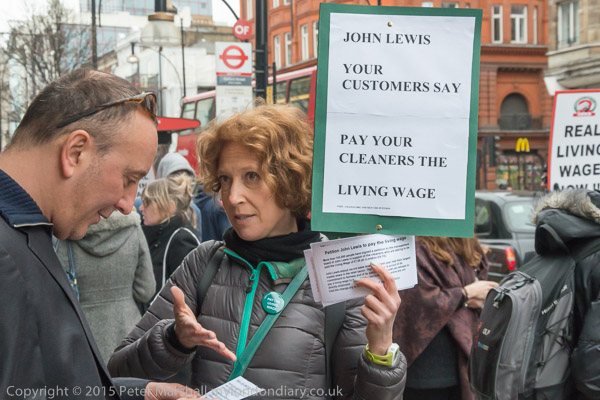
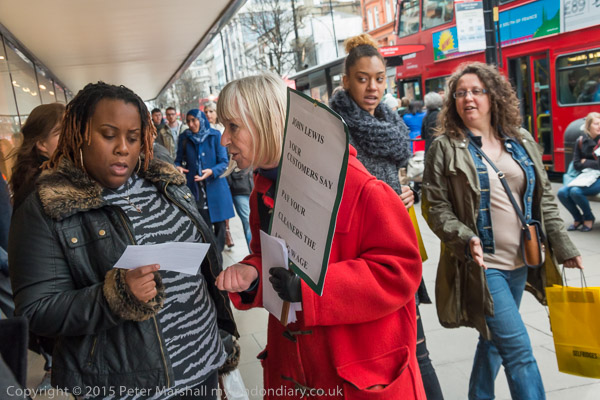
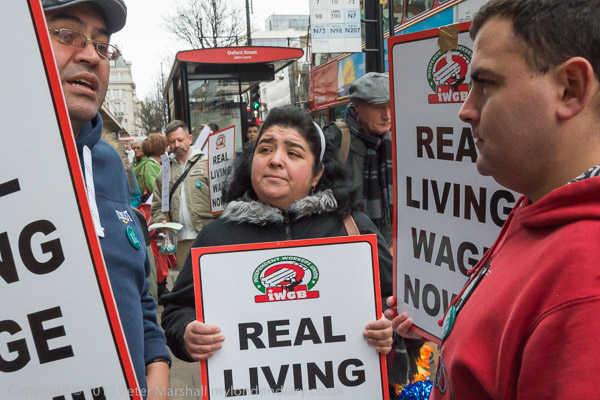
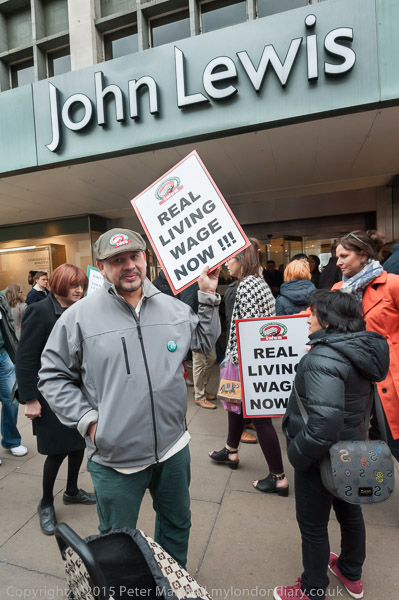
Many customers of John Lewis – a very middle-class group – back the cleaners’ case for fair and equal treatment, and a few had come to hand out flyers and talk to shoppers to back their case in a very restrained protest. One of them told me it was the first time she had ever taken part in any protest. They were supported by a few members of the cleaners union, the IWGB, who had brought some of their posters.

John Lewis customers support Living Wage