The name was Gold and the building was in a kind of pale gold colour and blue. The company was an independent wholesaler particularly in the music business, distributing records, CDs and videos as well as confectionery. It moved to larger premises at Uplands Business Estate on Blackhorse Road Walthamstow in 2001 and closed down suddenly in 2008 putting its 200 employees out of work.
It was a family business which began outside Sidney Gold’s delicatessen in Ilford in 1955 when his two sons began selling records from racks in front of the shop. From there the moved to a stall in Petticoat Lane before deciding to set up as wholesalers in Leyton.
Just an ordinary house in a long residential terrace but enlivened by decoration by a rather idiosyncratic resident. All the houses in this part of the street have tablets between the upper and lower bays, but this one has its name, Lytham House and decoration pointed out in red and green paint.
Probably the name was chosen by the first residents when this street was built in 1894-7, but the paintwork was rather more recent, and to me suggested a Caribbean influence. The house and wall have now faded to a rather duller appearance in keeping with its neighbours but still has its decorated windows.
Shandar is a Hini and Urdu adjective for something. It is Hindi and Urdu to describe something very impressive, excellent, grand, magnificent or beautiful, and used for this high quality takeaway. The render was scraped off the wall in 2008 and the wall re-covered and is now blank.
A mural on the wall of Dyke Court shows different colour youngsters many with very odd hairstyles lamenting the loss of their Markhouse Youth Club.
Jimmy’s Fish Bar, Walthamstow, Waltham Forest, 1994, 94-101-36
You could get a steak and kidney pie for £1 and 60p of chips for a filling meal at Jimmy’s back in 1994, though I think you paid a little extra to sit at the solid wooden table to eat it in rather than take it away. But the colour scheme made me feel a little queasy.
Café, London, 1994, 94-101-22
A traditional English café with a wide range of puddings listed for 55p and a little more. Every table with an ashtray. This could well have been in Walthamstow but might have been elsewhere on my journeys around London.
Café, London, 1994, 94-101-24
A much more limited menu for this smaller cafe located somewhere in London – and again it could be Walthamstow. Two lists give the prices for TAKE AWAY and TO EAT IN CAFE.
Music, Spoken Word and Protest. A week or two ago I received a Facebook invitation suggesting I listen to a monthly radio show on Riverside Radio, the Colin Crilly Takeover, a monthly show with hosts Andy Bungay and Colin Crilly. In this edition they were to “be playing SONGS with a political/social angle, and discussing the issues raised.”
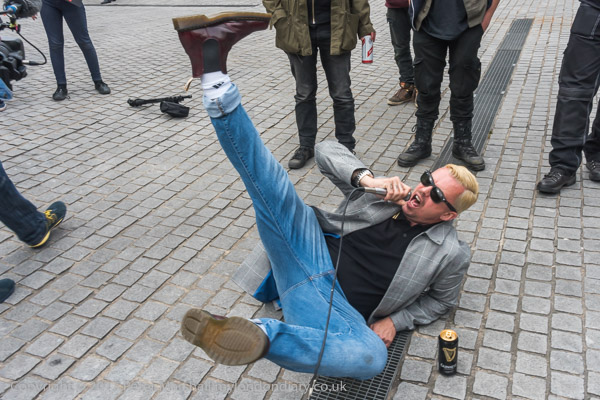
Adam Clifford performs at Class War newspaper launch, White Cub, Bermondsey, 2017
Colin Crilly is someone I’ve often met and photographed on protests in London and who has on occasion asked me to be interviewed for the show, but I’ve never done so. Radio isn’t really an ideal medium for photography.
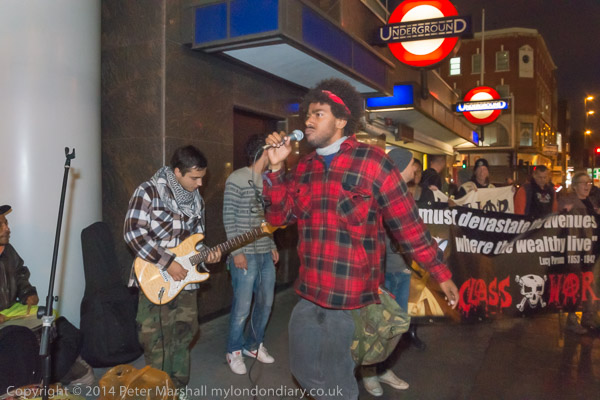
Different Moods play at Poor Doors protest, 2014
Riverside Radio is a local station covering a wide area of southwast London, mainly the boroughs of Wandsworth, Richmond and Merton but available to everyone on the web. I didn’t log on to the live show live as it airs for two hours from 11pm on a Saturday night, a time when I’m usually exhausted and only ready to fall asleep. Or if I’ve had a particularly busy day covering events I might still be editing the work.
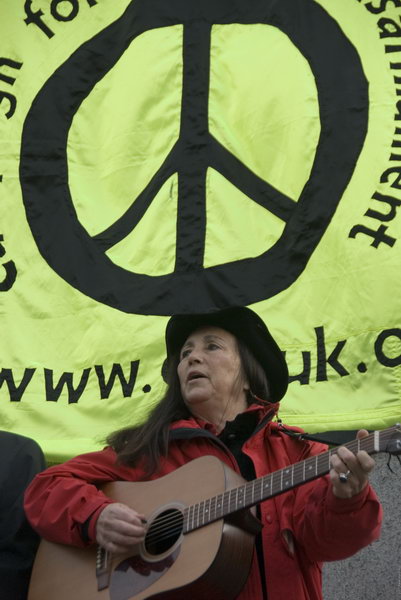
Julie Felix at CND protest, 2007
But a few days later, Colin sent me a link to a recording of the show on MixCloud and I began to listen to it. I’ve not managed to hear the whole two hours and I found MixCloud a frustrating experience as, perhaps because I haven’t subscribed, I couldn’t skip forward and when I took a rest it reverted to the start of the track. Since radio doesn’t come with pictures (except in the mind) I’ve added some of my own to this post.
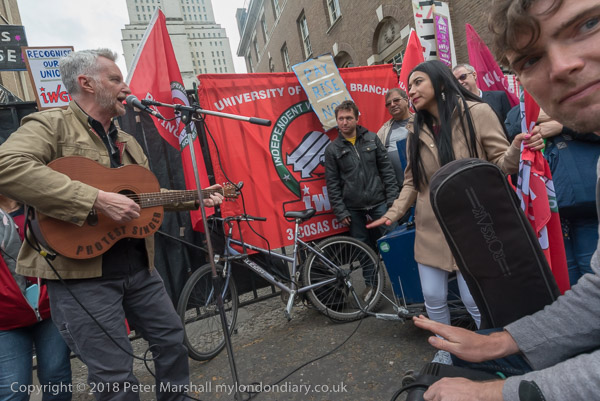
Billy Bragg supports IWGB strikers 2018
It was good to hear a track by Anne Feeney, the late great US folk musician, singer-activist and lawyer who died in 2021. Her ‘Have You Been To Jail For Justice?’ and her lines “A rotten law stays on the books til folks like us defy it, The law’s supposed to serve us, and so are the police, And when the system fails, it’s up to us to speak our piece …” are very relevant now. It led to some interesting discussion by Colin and Andy, but perhaps it could have been related rather more to the approaches of groups such as Extinction Rebellion and Insulate Britain in the UK.
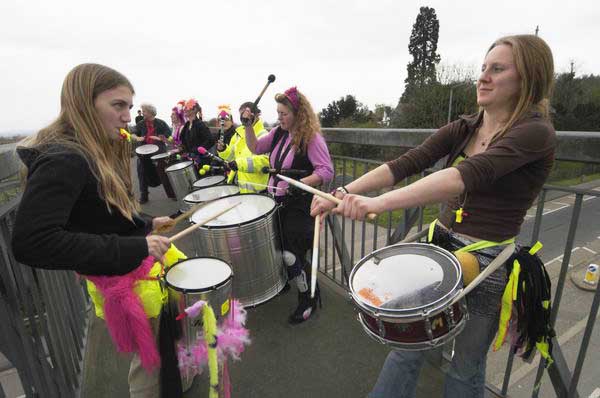
Sheffield Samba Band on march to Aldermaston, 2004
Next up was Paul Hardcastle’s ’19’, about the Vietnam War, but released in 1985, which apparently made a huge impression on a then-young Colin. It really was a ground-breaking release in several ways, but like the interview with John Lennon which followed – and preceded his ‘The Fool On the Hill’, did give the show seem rather an academic and historical approach to the subject.
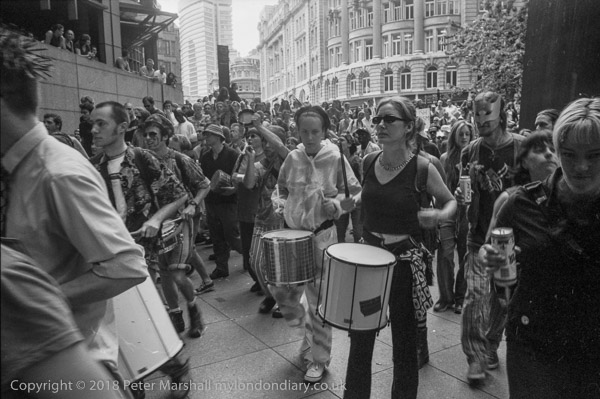
Samba band, Carnival Against Capitalism, 1999
I didn’t get much further in listening – and I think these were the only songs in the first hour of the show, though I might have fallen asleep a bit – there was a lot of long discussion. George Michael on BBC Hard Talk in 2002 came into it. It’s perhaps a shame that there wasn’t a playlist on the MixCloud page.
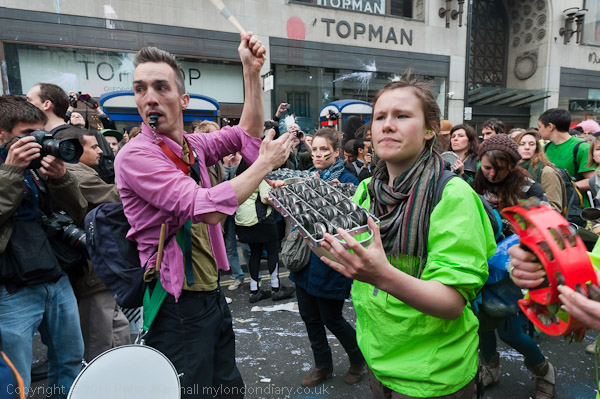
Samba – UK Uncut, 2011
Among the hashtags there was #london and I didn’t think I’d heard much about London or protests there in the part of the show I heard. Nor did I get to hear the promised Wood Guthrie, whose songs I used to play and sing badly from a much dog-eared paperbook in my youth, though fortunately seldom in public.
But many of the protests I’ve attended over the years have included performances by singers as well as spoken word performers, and of course the sound of almost all marches in recent years has been the samba band. How or if the recent act designed to prevent effective protest alters this remains to be seen.
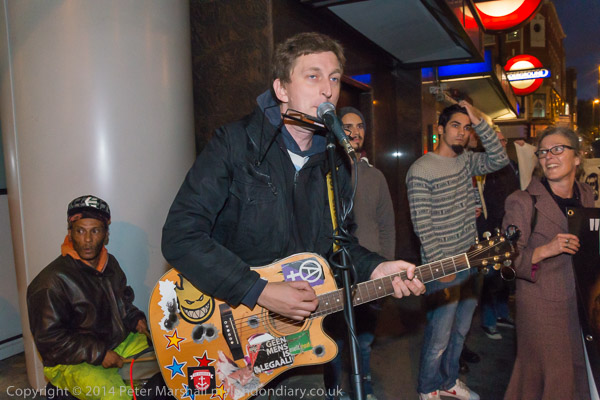
Cosmo at Poor Doors protest, 2014
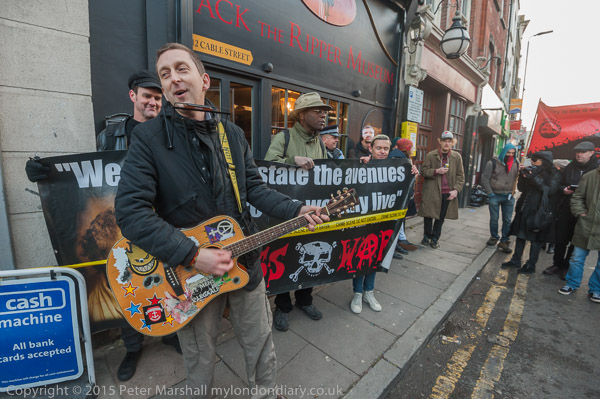
I’ll just mention a few of those I’ve been impressed by – and have photographed in London. On his web site is this description of Cosmo, based in Wales as well as a number of music videos featuring him and his friends.
Cosmo is “a one-man folk-punk phenomenon.” (Miniature Music Press). Over the course of 14 albums and 30 years of touring, he has established himself as a formidable voice on the UK and international underground.
He has appeared at Glastonbury, the Edinburgh Fringe and other major UK festivals, as well as touring across the UK, Europe, North and South America and the Middle East. In that time, he has shared stages with Billy Bragg, Frank Turner, Grace Petrie, John Cooper Clarke, Mark Thomas and more. Cosmo has won awards at the Edinburgh fringe and Hay fringe festivals.
An activist as well as a musician, Cosmo has also performed at countless picket lines, protest camps, rallies and demos, as well as being involved with community organising.
I’ve photographed Cosmo several times, particularly at protests with Class War and always been impressed by the lift he gives to protesters.
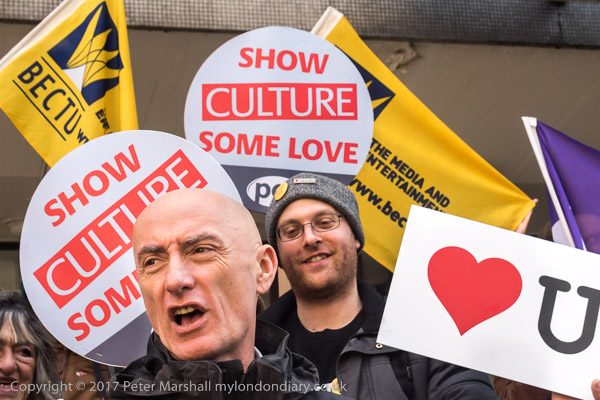
Grim Chip (left) outside the TUC, 2017
Quite a few rappers and poets have also performed at events I’ve photographed. Poetry on the Picket Line does exactly what the name suggest. Poets in the group, including hip Hamer, Janine Booth, Nadia Drews, Joe Solo, Tim Watts, Tim Kiely, Owen Collins, Repeat Beat Poet, Mark Coverdale, Lantern Carrier and Michael Breen, reading their work in the spirit of solidarity on picket lines and at rallies.
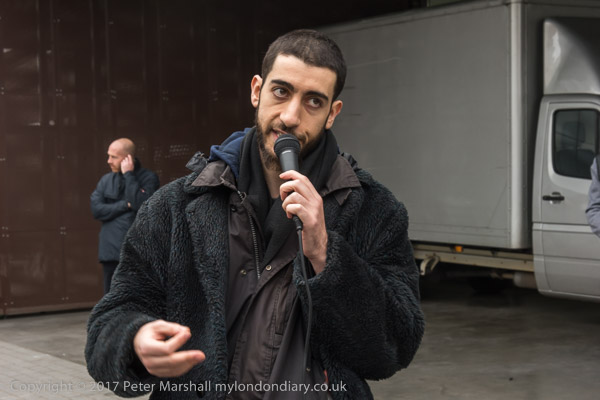
Potent Whisper performs ‘Estate Of War’ at Class War’s Newspaper Launch at the White Cube 2017
Georgie, a London based rapper and spoken word artist performs as Potent Whisper. Dog Section Press published his ‘The Rhyming Guide to Grenfell Britain‘ including the text of nine full-length pieces, I think all of which I’d heard him deliver at various demonstrations as well as in videos, including The Rhyming Guide to NHS Privatisation, Estate of War and Grenfell Britain. The book is worth getting if you can find a copy. An article by him in the New Internationalist includes a link to his ‘You’ll Never Edit Grenfell‘ and you can view more on his YouTube channel.