Jobs Justice Climate – 2009

Put People First: Jobs Justice Climate

Embankment to Hyde Park
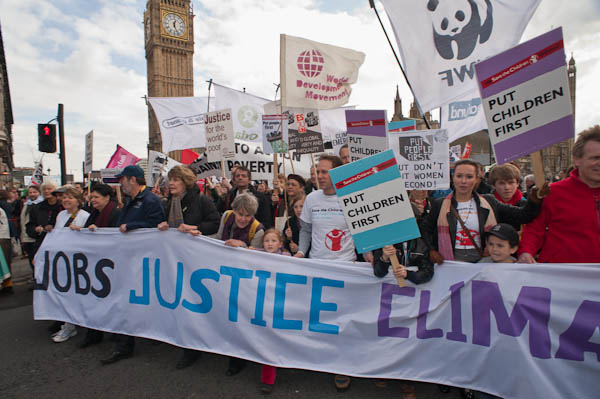
Jobs Justice Climate - 2009

World leaders were to hold the G20 London Summit at the Excel Centre in Docklands beginning on April 1st (a date some thought highly appropriate), with the stated themes “Stability, Growth, Jobs“, and chaired by Prime Minister Gordon Brown. Countries and organisations taking part, included Argentina, Australia, Brazil, Canada, Chile, China, Ethiopia, France, Germany, India, Indonesia, Italy, Japan, Mexico, Netherlands, Russia, Saudi Arabia, South Africa, South Korea, Spain, Switzerland, Thailand, Turkey and the USA, as well as the European Union and organisations including the International Monetary Fund, World Bank and the World Trade Organisations.
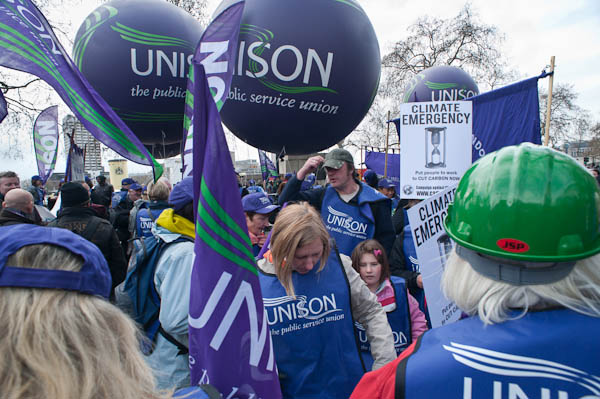
Jobs Justice Climate - 2009

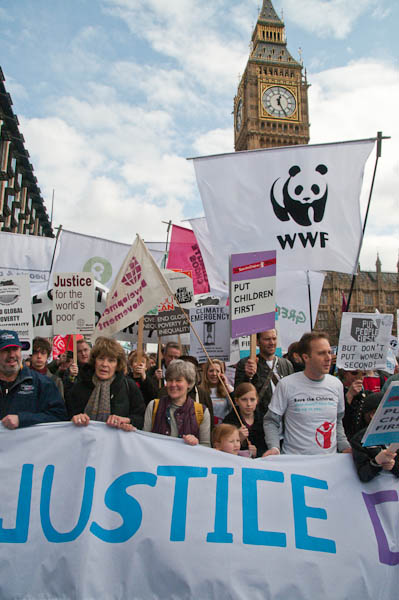
The ‘Put People First’ march was the first of several major demonstrations aimed at influencing the meeting and was backed by a very wide range of over 150 organisations, both from this country and abroad.
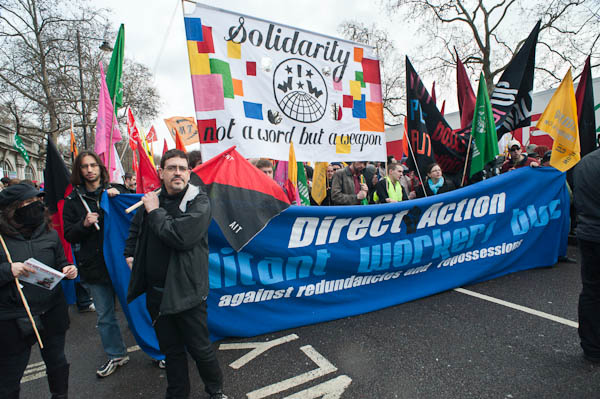
Jobs Justice Climate - 2009

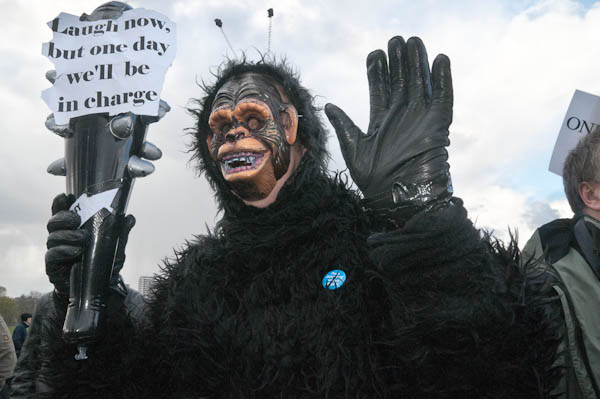
As well as trade unions, charities, and pressure groups there were also many other less organised groups and individuals.
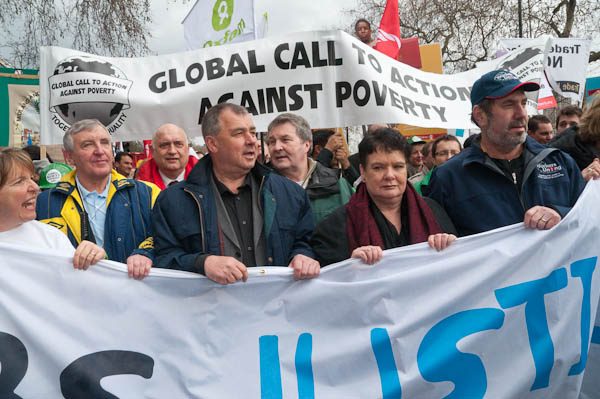
Jobs Justice Climate - 2009

Those marching were calling for a new approach to social justice for the world as a whole, and for urgency in action by world leaders not just to find a solution for the current financial problems, but to tackle the even deeper problems of global inequality and of climate crisis.
Jobs Justice Climate - 2009

But the G20 went ahead very much to prop up the banks and financial institutions that had caused the financial crisis, though agreeing on the need for greater regulation, making none of the wider changes that this and other protests demanded. If anything it worsened those deeper problems.
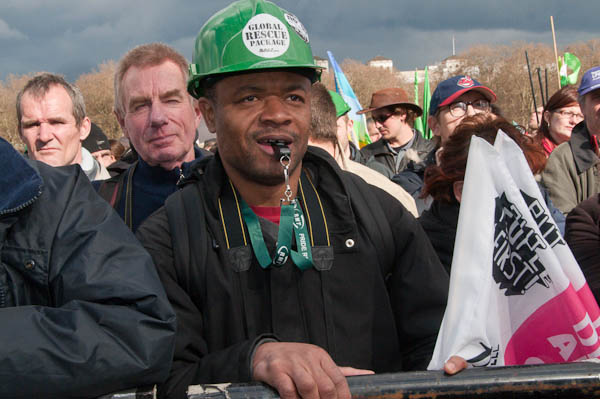
Unsurprisingly it was a very large march with probably several times the official police estimate of 35,000 taking party.
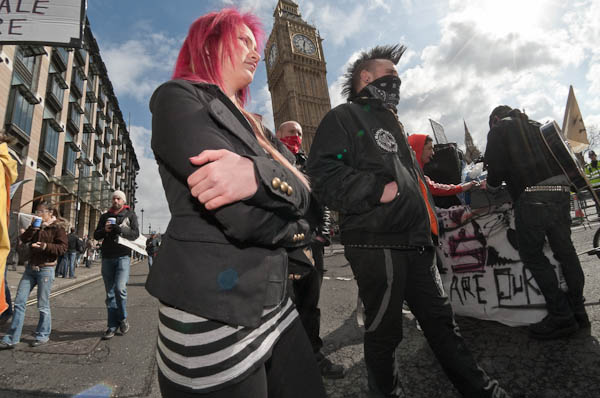
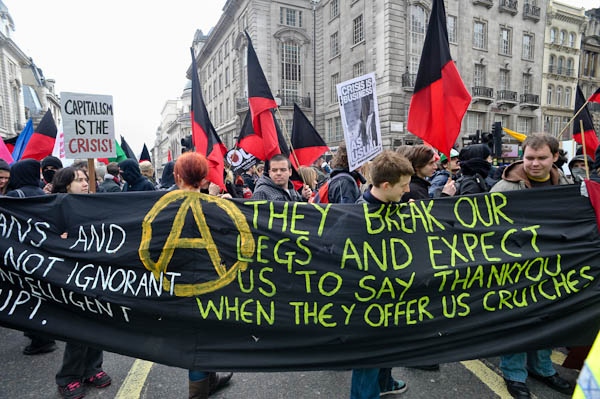
Most police attention was on a relatively small ‘autonomous’ block of around 800 people in the middle of the march which had a strong police escorted. They objected to the police behaviour, particularly very obtrusive photography by FIT teams and some sat down in the road blocking the march behind them for around half an hour.
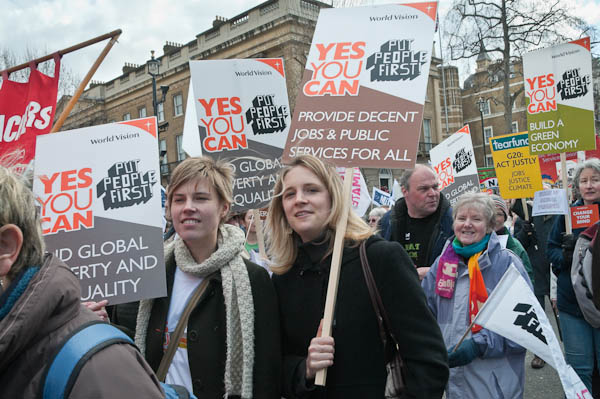
Police had bullied the front of the march to set off at a cracking pace, hard for photographers to keep up with and the march soon spread out over much of the route.
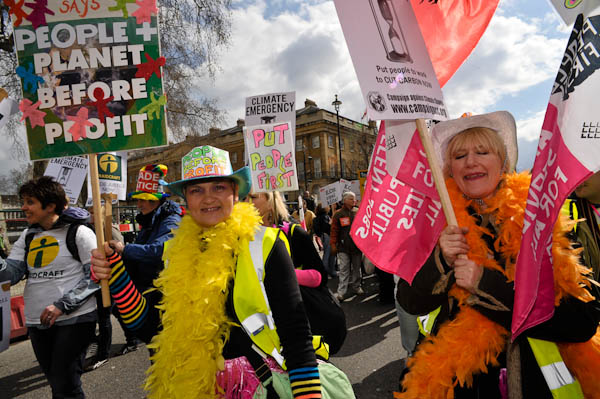
I wanted to photograph as many of the marchers as I could, walking slowly and letting them go past me as they walked along the Embankment, up Bridge Street and Whitehall to Trafalgar Square. Then I rushed to get to the rally in time.
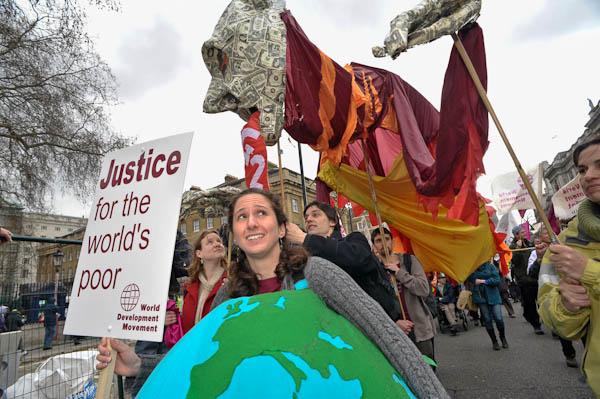
On My London Diary you can read more about the rally, and see pictures of many of the speakers. This protest was “a well ordered event with at times a carnival atmosphere, which made some of the police prognostications look rather silly.

Politicicans and Businessmen are not ignorant – they are intelligent and corrupt. They break our legs and expect us to say thankyou when they offer us crutches

One of my fellow NUJ members filming the ‘autonomous’ block rally was stopped and searched, and he and others reported a mysterious ‘man in black’ rushing into this alternative rally and emptying half a dozen small tightly wrapped packages from a black bin bag at the bottom of the stepladder from which people were speaking before exiting rapidly stage left.

Someone kicked one of these packages open and found it contained a catapult, and all the packages were quickly kicked away under a fence into an area under maintenance behind the speakers. Around 20 minutes later, a policeman entered that area and collected the packages; the anarchists saw what was happening and rapidly dispersed.
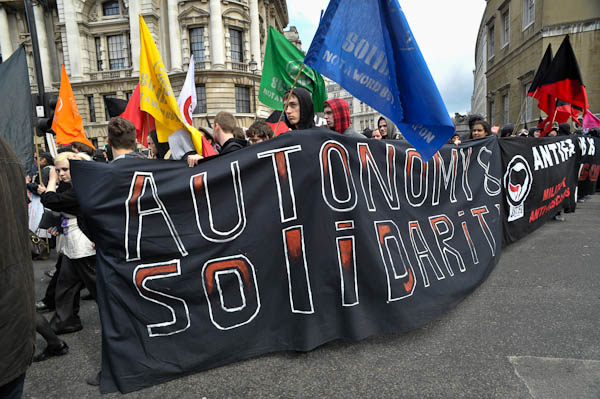
As I ended my post on My London Diary: “Earlier in the week a police spokesman had given a widely broadcast media interview in which he predicted that there would be violence – and that some protesters would use catapults. It seems as if someone was determined to make this loony-sounding prophecy come true.”

More at Put People First: Jobs Justice Climate.


FlickrFacebookMy London DiaryHull PhotosLea ValleyParis
London’s Industrial HeritageLondon Photos

All photographs on this page are copyright © Peter Marshall.
Contact me to buy prints or licence to reproduce.

Cabin Crew, Education, Living Wage & Light Up the Night – 2010

Cabin Crew, Education, Living Wage & Light Up the Night: Saturday 20th March 2010 was an unusual day for me, including protests in two parts of London I seldom visit, Hatton and Hampstead. It was also the start of a campaign on Oxford Street to get the London Living Wage for shop workers and there was a march to Downing Street against education cuts.


BA Cabin Crew at Heathrow – Hatton

Cabin Crew, Education, Living Wage & Light Up the Night - 2010

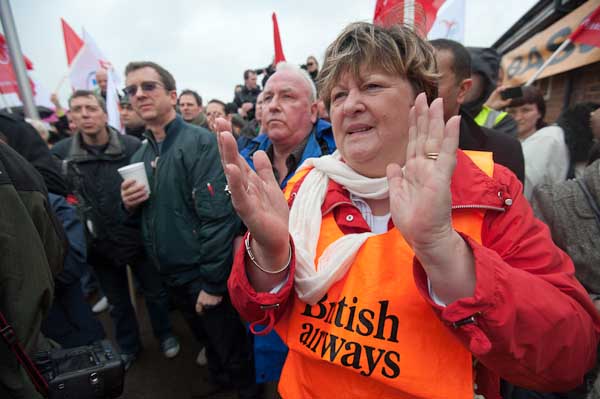
BA cabin crew on the first day of their 2-day strike at Heathrow held a rally outside Bedfont Football Club a short distance from Hatton Cross, where several hundred strikers came to listen to speakers, including Len McCluskey, Unite assistant general secretary, and show their determination to fight management plans to downgrade their conditions and make BA into a cut-price airline. Others kept up their pickets at gates around the airport.

Cabin Crew, Education, Living Wage & Light Up the Night - 2010

BA management under CEO Willie Walsh had refused to come to an agreement with the union, BASSA, and had threatened any workers who spoke at the meeting or appeared in media interviews with dismissal. So none of the strikers spoke at the meeting, but there was thunderous applause when speakers including local MP John McDonnell criticised BA management.

Cabin Crew, Education, Living Wage & Light Up the Night - 2010
Len McCluskey – We Offered Pay Cuts to keep BA Premium

I photographed the picket at Hatton Cross on my way to catch the Piccadilly line into central London.

More at BA Cabin Crew at Heathrow.


March Against Education Cuts

Cabin Crew, Education, Living Wage & Light Up the Night - 2010
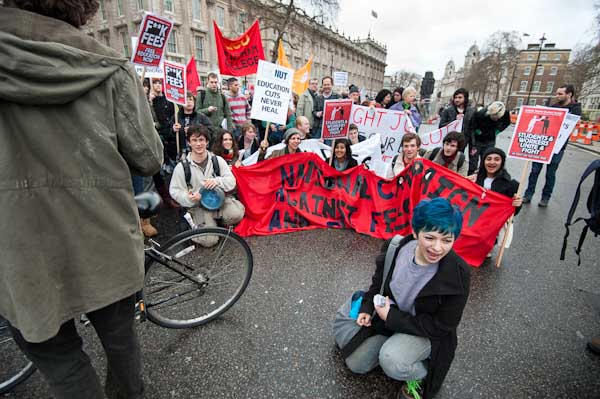
Sitting down in Whitehall outside Downing Street

A couple of thousand teachers and students met outside Kings College in Strand to call for the reversal of planned education cuts which they say abandon a generation of students and will damage our economic recovery.

Cabin Crew, Education, Living Wage & Light Up the Night - 2010

Police had insisted that they march on the pavement, but the numbers and the banners made this impossible and after a hundred yards or so they moved onto the street. At Downing Street they filled both carriageways for several minutes with a short token sit-down before police and stewards persuaded everyone to move to one side of the road, but the crowd was still a little large for the space available and there seemed to be a few dangerous incidents – including a rather uncontrolled police horse – but fortunately no injuries as police appeared keen to get a lane of traffic moving past without due regard for public safety.

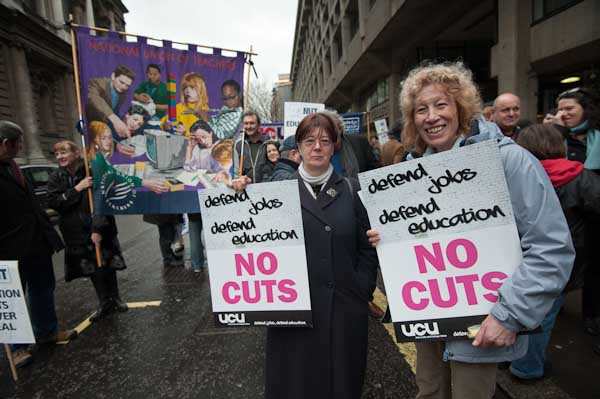
As speakers at the rally said, Labour had come into power on the mantra ‘Education, Education, Education‘ but 12 years later were proposing the largest cuts in education funding for a generation or more, estimated to lead to the loss of more than 20,000 jobs in Further Education, Higher Education and Adult Education. They will disproportionately affect the poorer and more disadvantaged in our society, in particular immigrants and young people who are unemployed or lacking in qualifications.

As Jenny Sutton, branch secretary of the UCU at the College of North East London pointed out the proposed cuts of £1.1 billion on education contrasted with the £21 billion spent on wars in Iraq and Afghanistan and the £500 billion given to the banks, one of which, the 84% publicly owned RBS is now paying out £1.3 billion in bonuses.

In protest Sutton was standing against the then Education Minister David Lammy in the May 2010 election. Lammy kept his seat and she lost her deposit, but the election put a Tory-led coalition into power. Education suffered even worse in the following years.

March Against Education Cuts


London Living Wage Launch in Oxford St

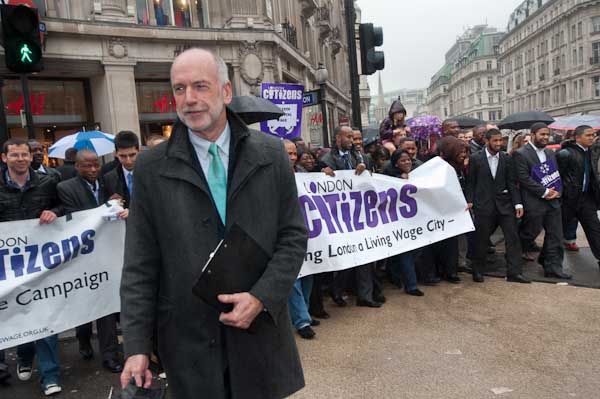
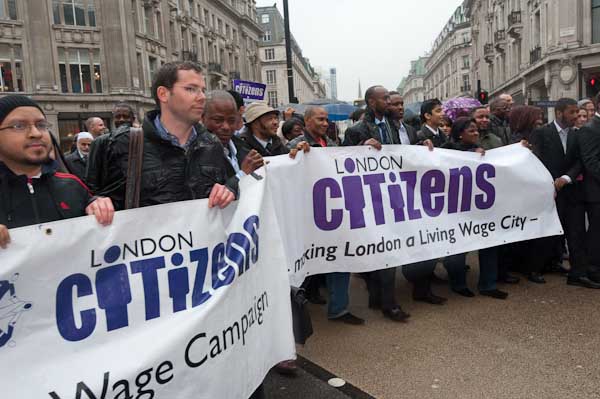
The London Living Wage campaign began in 2001 and has had the support of all London mayors since. Calculated annually by the Greater London Authority it takes into account the higher living costs in London, and Living Wage employers also have to provide fair employment conditions including holiday and sick pay and allowing employees to belong to a trade union.

Although some of London’s larger employers have adopted the London Living Wage, the retail sector, one of the most profitable areas of business in London, still had many of many of its workers struggling on wages below this level.

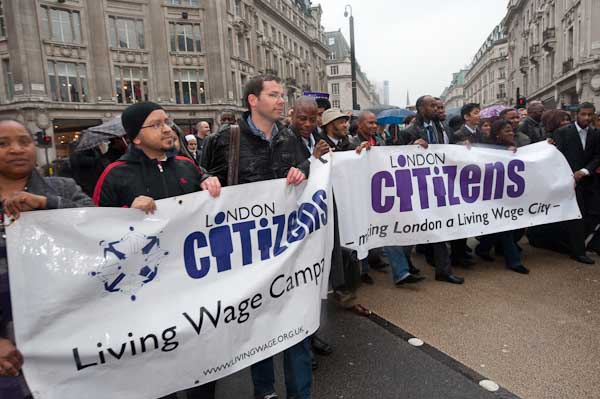
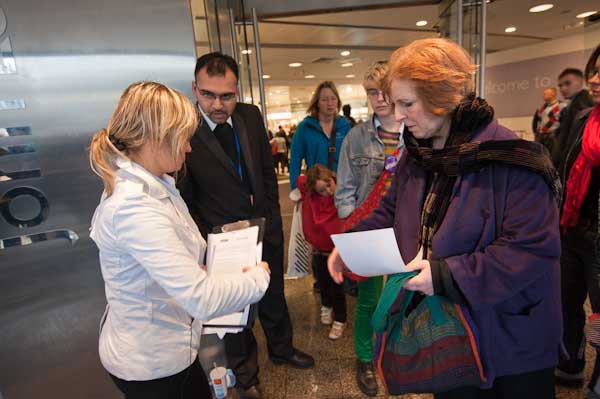
London Citizens, a grassroots charity working for social, economic and environmental justice , has led the campaign for a London Living Wage, and held a training session for its members before coming to Oxford Circus. Here they took advantage of the recently introduced diagonal crossing system to cross and recross several times with their banners before going off in smaller groups to continue the campaign inside the larger stores on Oxford Street.

They intended to give letters to all the general managers of shops on the street inviting them to meet with London Citizens to discuss the Living Wage.

London Living Wage – Oxford St


Light Up the Night in Hampstead

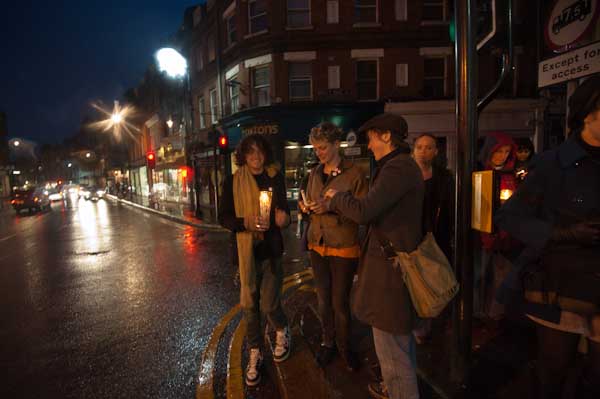
The Commons‘ candidate for the Hampstead and Kilburn constituency Tamsin Omond had organised a ‘Light Up The Night‘ candlelit march to show community solidarity against violent crime and make the streets safe for women at night.

Around 30 people, mainly women, turned up outside the Hollybush pub in Hampstead for the march, where there was a short speech by Sam Roddick, noted for her campaigning on issues related to human rights, feminism, pornography and for taking Fair Trade into hitherto unexplored areas through Coco De Mer, her Covent Garden ‘erotic emporium.

Tamsin Omond

It was a wet and windy night and it was hard to to keep the candles alight as the marchers made their way down the hill from Hampstead and the streets were emptier than usual.

‘The Commons’ campaign hoped to reach people who are fed up with politicians and appeal to ordinary people, many of whom, like Roddick have never bothered with voting because they felt it made no difference. But it made little progress. The election was closely fought with Labour’s Glenda Jackson gaining a narrow victory by 42 votes over the Tory candidate, but Omond was over 17,000 votes behind both of them with only 123 votes and the turnout was low.

More at Light Up the Night in Hampstead.


FlickrFacebookMy London DiaryHull PhotosLea ValleyParis
London’s Industrial HeritageLondon Photos

All photographs on this page are copyright © Peter Marshall.
Contact me to buy prints or licence to reproduce.