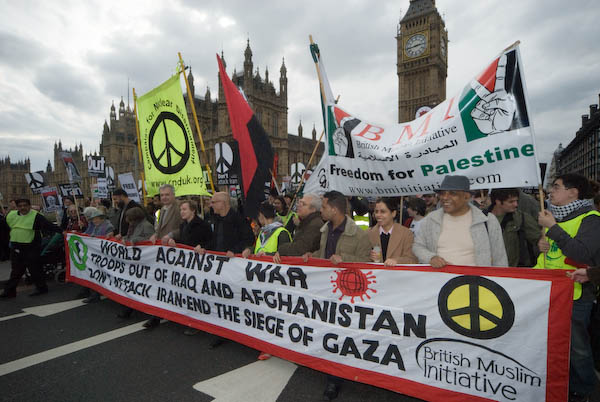
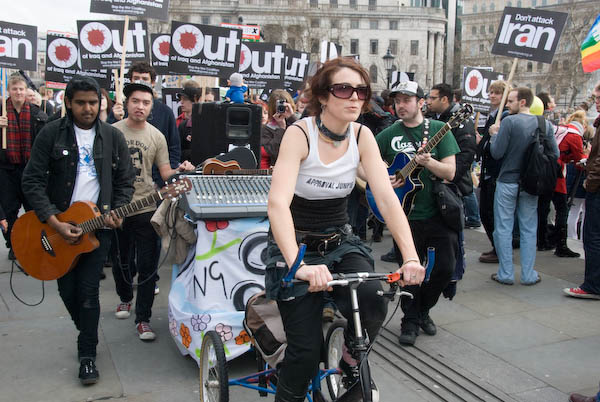
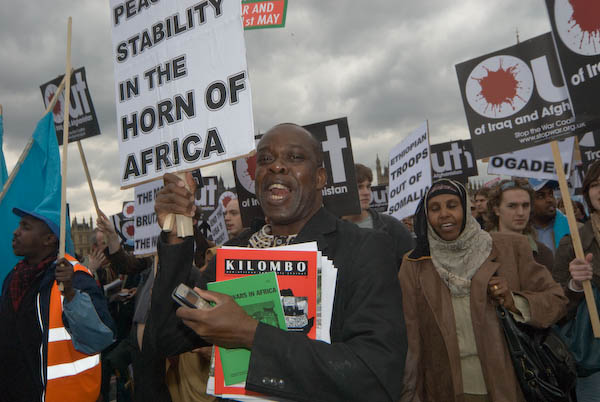
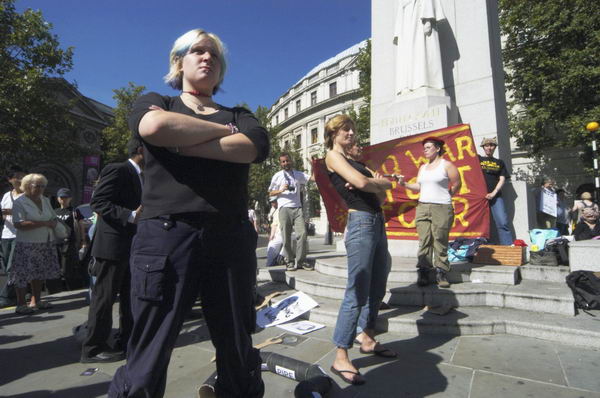
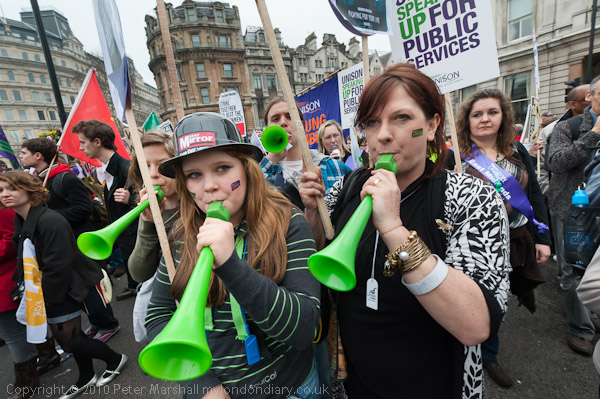
Stop the War – Troops Out: The protest organised by Stop the War, CND and British Muslim Initiative on Saturday 15th March, 2008 was an impressive one, with around 50,000 marchers calling for the withdrawal of our troops from Iraq and Afghanistan, no attack on Iran and a free Palestine, as well as many other groups drawing attention to other issues around the world including the genocide in Somalia.
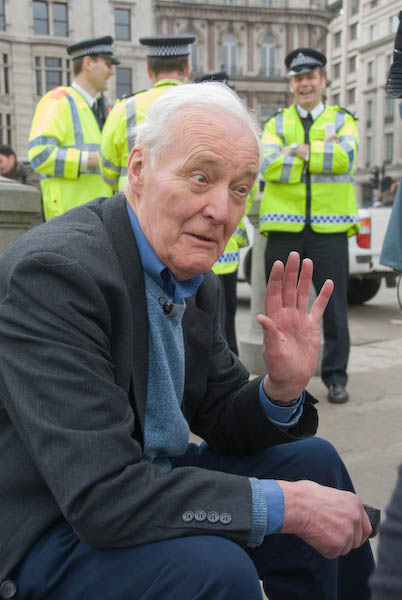
Tony Benn
It began with a rally in Trafalgar Square where speakers included Tony Benn and Bruce Kent and then took a roundabout route across Westminster Bridge and then back over the Thames on Lambeth Bridge and up Millbank to Parliament Square. Those at the rear of the march were still passing the corner of the square when those at the front arrived back there.
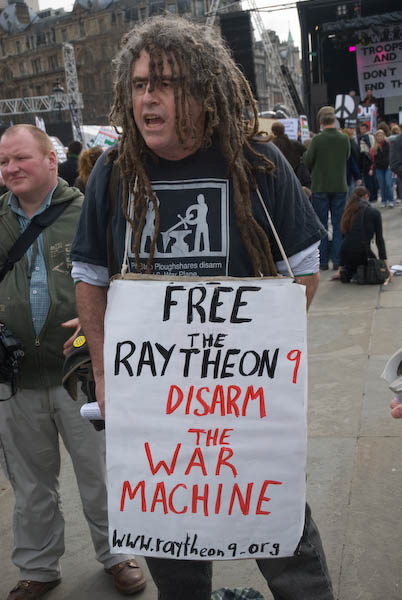
It was an event that included many issues still relevant now, particularly over Iran and Palestine, but also on direct action, with a reminder of the then upcoming trial of the Raytheon 9, anti-war activists who had entered the Raytheon factory in Derry in August 2006 after learning that Raytheon missiles were being used by Israel in their 2006 invasion of Lebanon.
Occupying the offices for eight hours before they were arrested they destroyed computers and documents, and six were tried for criminal damage and affray in May 2008. One man was found guilty of stealing two computer disks but they were all acquitted on all other charges.
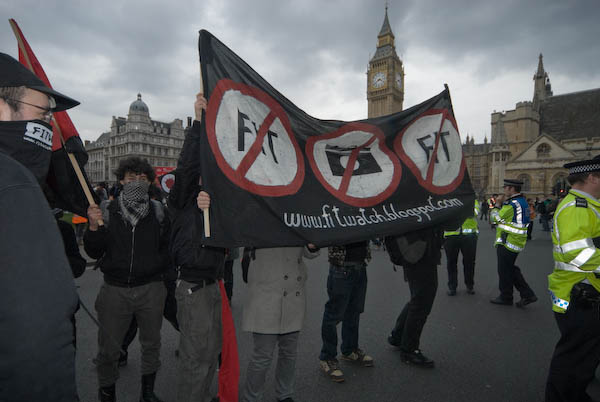
The police took a great deal of interest in the protest, with FIT teams who photograph protesters (and journalists, particularly photographers) took an unusual interest in anarchist protesters from Class War, the Anarchist Federation and FITwatch who use their banner to try to prevent the police taking photographs and video.
I missed seeing four of the FITwatch protesters arrested, apparently for intimidating the police. As I commented, “Since a couple of weeks ago one of their photographers and his minder had been seen taking flight and seeking refuge up the steps of the National Gallery when pursued by a polite and always well behaved woman with a shopping trolley and free cakes – much to the amusement of other police present – intimidating the FIT doesn’t seem too difficult.“
But this – like the many large pro-Palestine protests since ‘September 7th’ – was an entirely peaceful protest, calling for peace in many areas around the world and for an end to UK involvement in wars and oppression.
It was a lively protest, with samba band, sound systes, street theatre and dancing. People laid flowers at Nelson Mandela’s statue and Brian Haw – still permanently camped in Parliament Square despite the attempts to remove him by passing SOCPA – joined the protest.
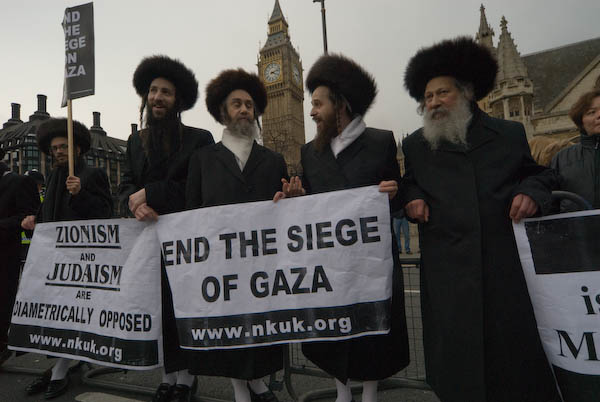
And like all of these marches it also included many Jewish marchers including the Neturei Karta ultra-orthodox anti-Zionists.
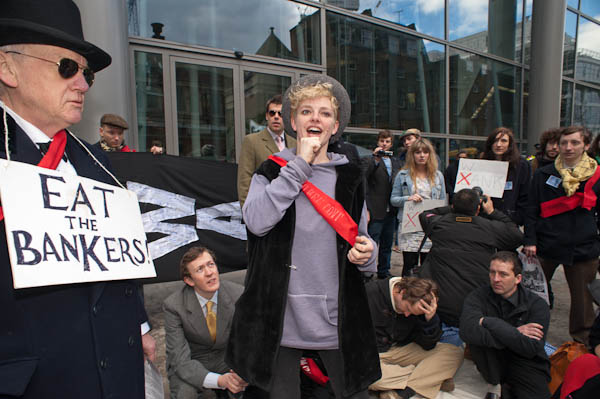
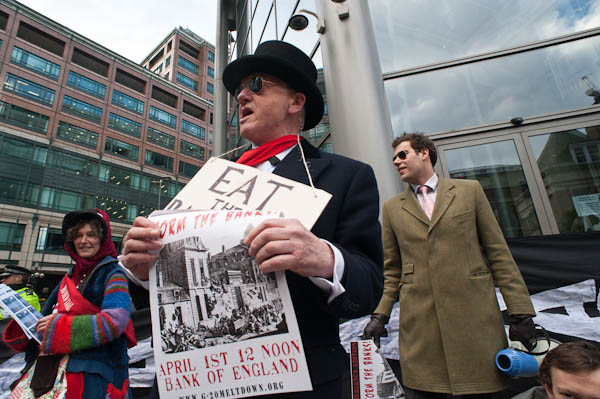
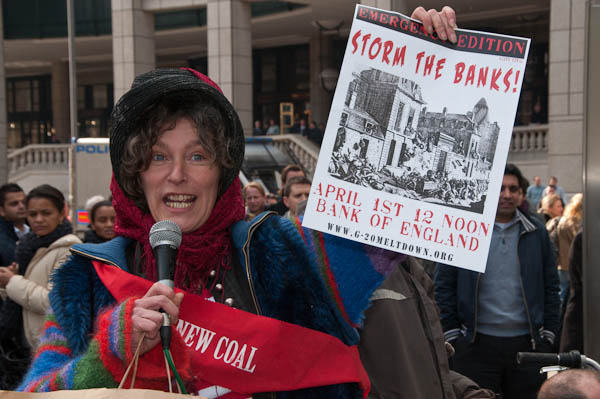
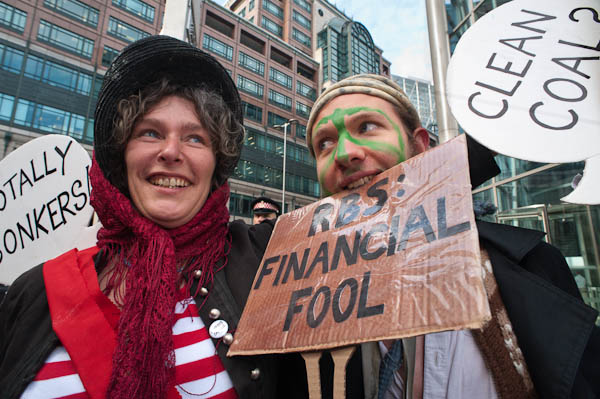
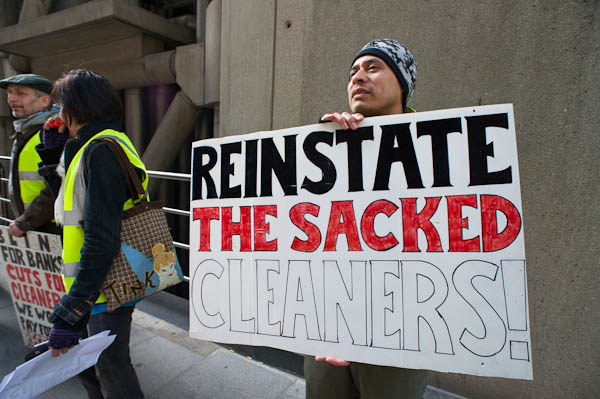
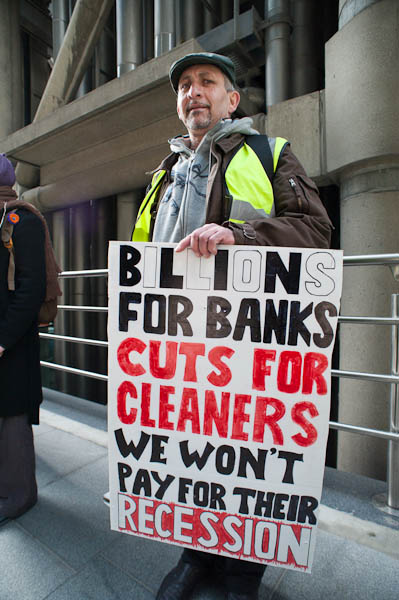
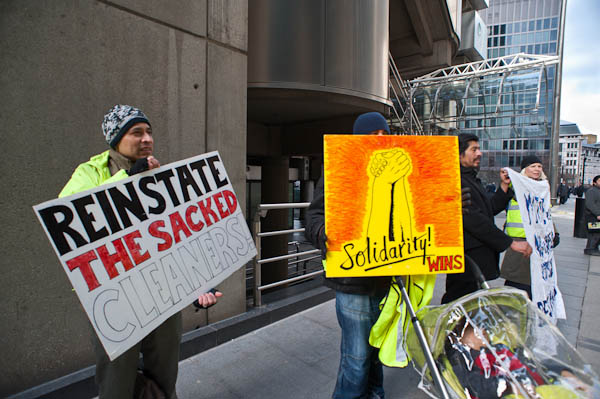
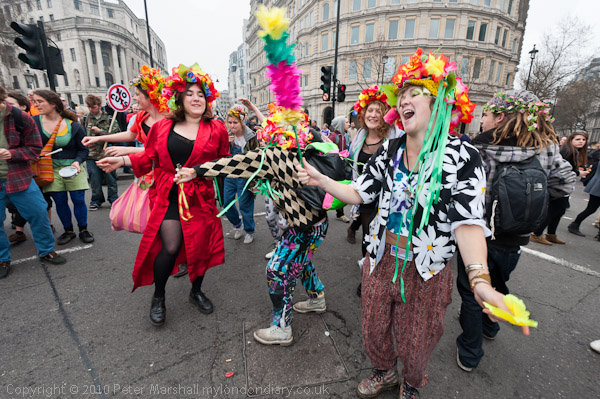
Climate Rush & Cleaners: On Thursday March 5th 2009 Climate Rush and friends staged a colourful protest against the huge support being given to the banks while the people were having to pay the price for their irresponsible and dishonest behaviour which had precipitated the financial crisis. I left their protest to photograph cleaners who were protesting at Willis Group insurance brokers demanding to be paid a living wage and better conditions of service.
Climate Rush hits RBS HQ
RBS, 250 Bishopsgate
Tamsin Omond says ‘Give us our money back and stop trashing the planet’
Here’s what I wrote back in 2009:
“The banks would have gone bankrupt but the government stepped in and paid off the former bosses – including Sir Fred Goowin of RBS – with double gold plated platinum pension pots as a reward for their greed, incompetence and dodgy investments. But even under the new management – unfortunately not of the people who are still just ripped off – the banks continue to bankroll the trashing of the planet, backing schemes such as a coal-fired power station at Kingsnorth.
So the Climate Rush came to the HQ of the RBS in Bishopsgate to protest (and party), drawing media attention to the bank’s crimes against the planet. Around a couple of hundred protesters, some in various costumes, a cycled hauled sound system for speeches and music and some lively dancers made it an enjoyable protest for those taking part and those passing by – and a little more to remember and talk about than a simple static protest.”
This was a piece of street theatre but the police had come out in force, obviously expecting something different, part of a growing paranoia about the coming ‘Storm The Banks‘ protest which this was advertised here and elsewhere to take place on April 1st. Obviously the police do not understand hyperbole.
A young ‘banker’ accepts the ‘RBS FInancial Fool’ award – a dead parrot – on behalf of RBS
In the lead up to April 1st, the G20 Meltdown – Financial Fools Day police (and politicians) released a number of provocative statements to try and justify the actions they were intending to take against the protesters – including the peaceful Climate Camp on Bishopsgate.
On April 1st, there was some disruptive action by protesters but the police went wild. I’d left a peaceful protest at Bank when I saw that police were beginning to kettle the protesters as I wanted to cover an event at the US Embassy. Had I stayed I too might have been assaulted by police like a fellow photographer. A police baton took out much of his teeth – he later received a large cash settlement from the police for his injuries and the cost of extensive dental treatment.
Later riot police stormed peaceful protesters in the Climate Camp who raised their hands in the air chanting “this is not a riot!” and later got they even more out of hand, wantonly smashing property and people. It was a riot, but by the police.
And Ian Tomlinson, an innocent bystander, going home through the Bank area after his work as a newsvendor, died after an unprovoked attack by a riot police officer.
On March 5th, the police simply stood and watched the protest – more a carnival, with presentations of the ‘RBS Financial Fool‘ award – a dead parrot – and the ‘No New Coal Award‘ and much music and dancing.
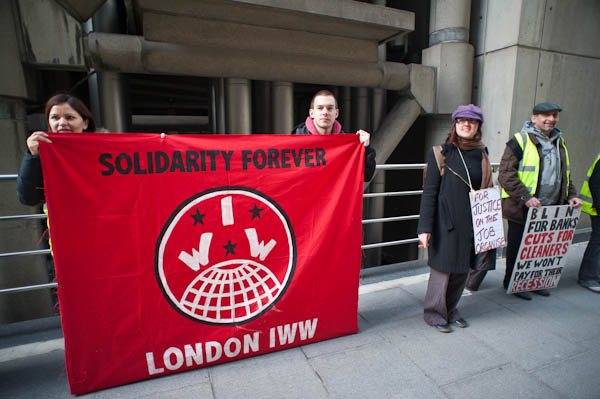
Cleaners at Willis Group, one of the City’s largest insurance brokers with offices facing those of Lloyds, were protesting outside the Willis building after five cleaners were sacked for trying to organise cleaners to take action and campaign for a living wage and better conditions of service.
Unite had been one of the unions involved in the Justice for Cleaners campaign which was launched in May 2006, but were no longer supporting the cleaners – and Unite had even agreed with the Willis management that these outsourced cleaners would not hold demonstrations outside the offices without informing them, They refused to support the sacked cleaners against their employer Mitie.
So the cleaners decided they needed a union that would support them, and went to the London branch of the Industrial Workers of the World, established in 2005 at the time of the centenary of the international IWW movement.
Later cleaners formed their own grass roots unions, the IWGB, CAIWU and the UVW who branched out to support other low paid workers, with very successful campaigns against outsourcing, low pay and harassment, gaining the London Living Wage for many of their members.
Bloody Murder at Ripper ‘Museum‘: Another of the series of protests by Class War at the so-called museum glorifying the gory murders of working-class women took place on Saturday 5th December 2015.
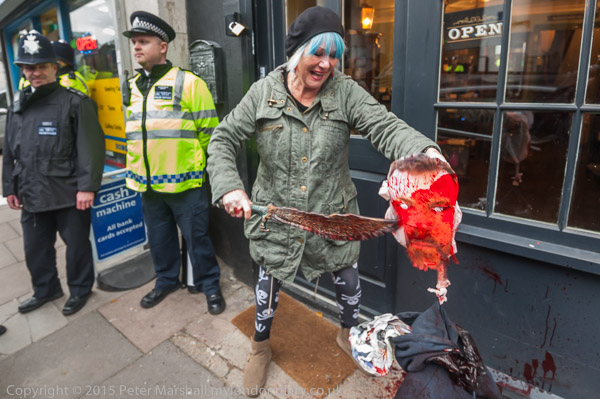
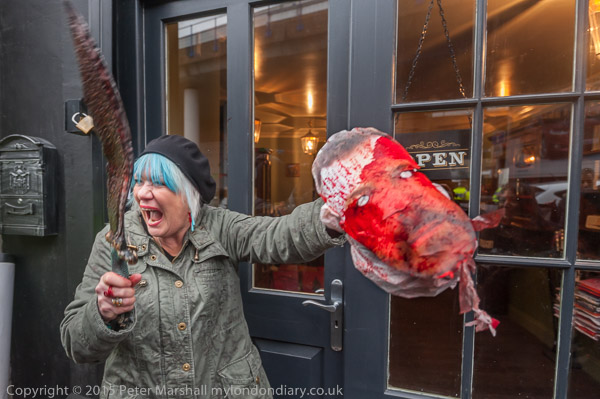
A police officer smiles while another looks fixedly away as Jane Nichol displays the bloody head
I photographed most if not all of the protests they organised in a campaign they kept up for some years, showing their disgust at this fake museum, which the owner, Mark Palmer-Edgecumbe got planning consent to open claiming it was to celebrate the powerful history of the women of London’s East end, not their bloody dismemberment by a homicidal maniac.
Jane Nicholl waves her grandson’s plastic cutlass (or scimitar?) at the Ripper ‘museum’
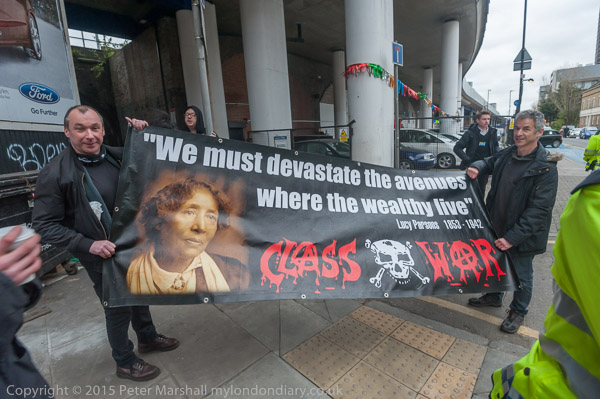
Class War were always interesting to photograph – and always fun to be with, as well as supporting important campaigns, particularly those around housing problems, bringing both a clear and informed anarchist perspective and a great deal of street theatre.
The Lucy Parsons banner. The Ripper attacks were by an upper class man on working working-class women
And their publications including the Class War magazine were always a good read, with often penetrating analysis as well as some distinctly black humour, truly black and red and read. You can see many earlier editions online at The Sparrow’s Nest.
Ian Bone’s autobiography, Bash the Rich: True Life Confessions of an Anarchist in the UK is certainly an interesting read and the 1991 Class War: A Decade of Disorder he edited comes with the ‘Publishers’ Warning! This book contains explicit language and illustration which may offend yuppies, police officers, members of the royal family and people who think the world can be changed by holding hands and singing “We shall overcome.” ‘
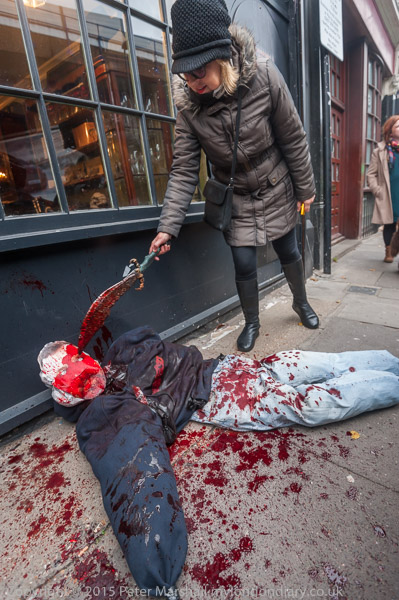
As I wrote back in 2015, “Class War re-enacted a murder outside the Jack the Ripper tourist attraction, women hacking and decapitating a dummy wearing the mask of owner Mark Palmer-Edgecumbe with a plastic scimitar and liberally spattering fake blood as others played kazoos“
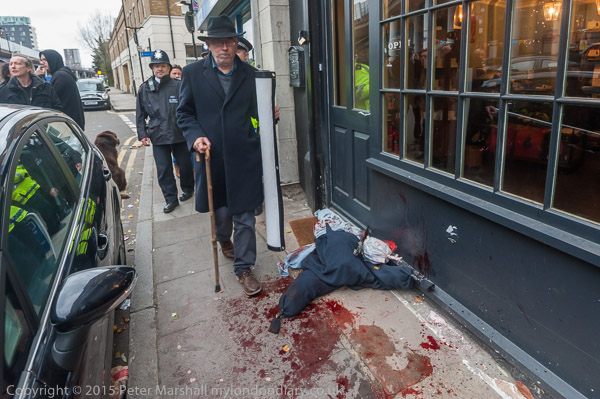
More fake blood is scattered on the Palmer-Edgecumbe ‘guy’ – and on my trousers as I took the picture – it washed out easily
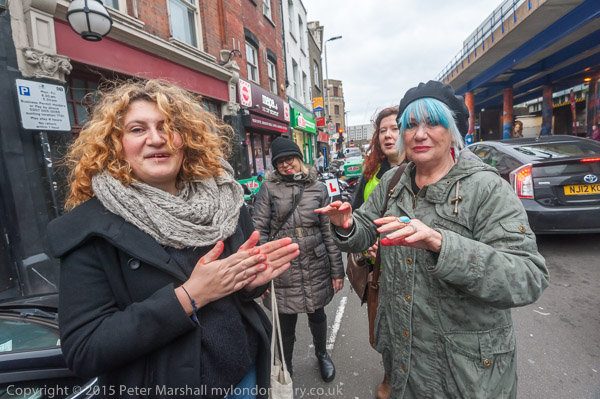
Class War is more of a loose association of like-minded people than an organisation and its actions often gain support from many others, including on this occasion and others fourth-wave feminists.
After Jane others took their turn in attacking the dummy which proved remarkably resistant to the plastic scimitar, but finally Jane could triumphantly display the bloody severed head of Palmer-Edgecumbe,
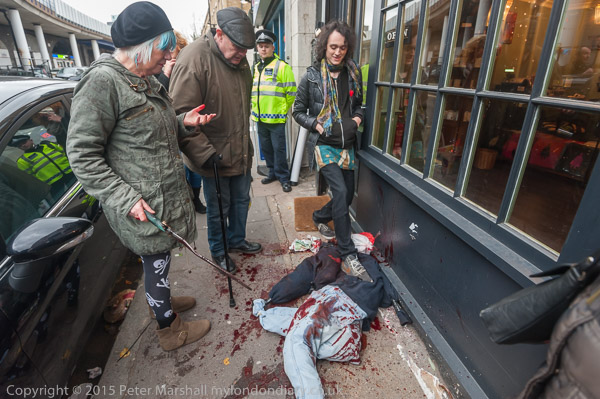
and others came to kick its body.
Women showed their bloody hands,
and Ian Bone came carrying the rolled-up banner and his walking stick to inspect the corpse.
Police wanted Class Wat to remove the Palmer-Edgecumbe ‘guy’ but they declined, saying they were donating it to the museum as one of the few genuine exhibits for their display. Police followed Class War as they walked away to the pub, and it seemed for a moment they might make and arrest – perhaps for littering – but they thought better of it and walked back to guard the shop. They were still there when I left the pub around an hour later.
Ten years later the tacky tourist attraction remains open, though my conclusion to this protest had hoped for a different conclusion:
“Thanks at least in part to Class War’s publicity and vigorous protests over around five months others have taken up the fight against the so-called museum, and the fight to get a real museum celebrating the powerful history of the women of London’s East End. It’s a rich heritage with powerful and colourful figures in which the bloody murders by the Ripper are only an insignificant and entirely negative episode. Perhaps it’s now time for others to take up a long-term if probably lower-key campaign here and continue it until this bloody blot on our heritage is closed down.“
More of my thoughts about the ‘museum’ and about the protest – with many more pictures – on My London Diary at Bloody Murder at Ripper ‘museum’.
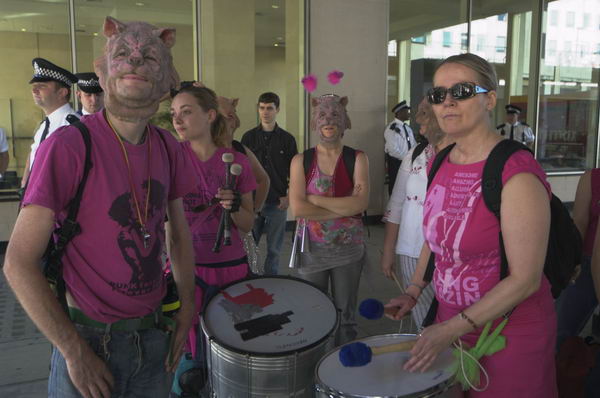
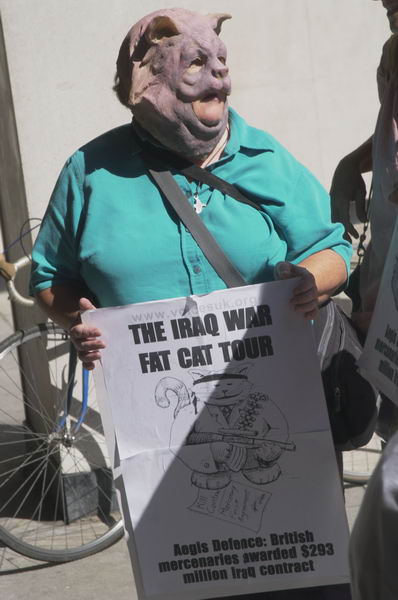
The Iraq War Fat Cat Tour: On Saturday 4th September 2004 I met campaigners from organisations including Voices in the Wilderness UK, a group opposed to the sanctions on Iraq and the war in Iraq, which between March 1996 and May 2003 had sent over 70 sanction-breaking delegations to Iraq.
I had photographed many of the protests leading up to the illegal invasion of Iraq in 2003 – and there are pictures and accounts from some of these on My London Diary, and of the protests after the invasion, particularly when it became clear that Tony Blair had deliberately misled Parliament and the facts about the “dodgy dossier” became clear. Many called for Blair to be indicted as a war criminal.
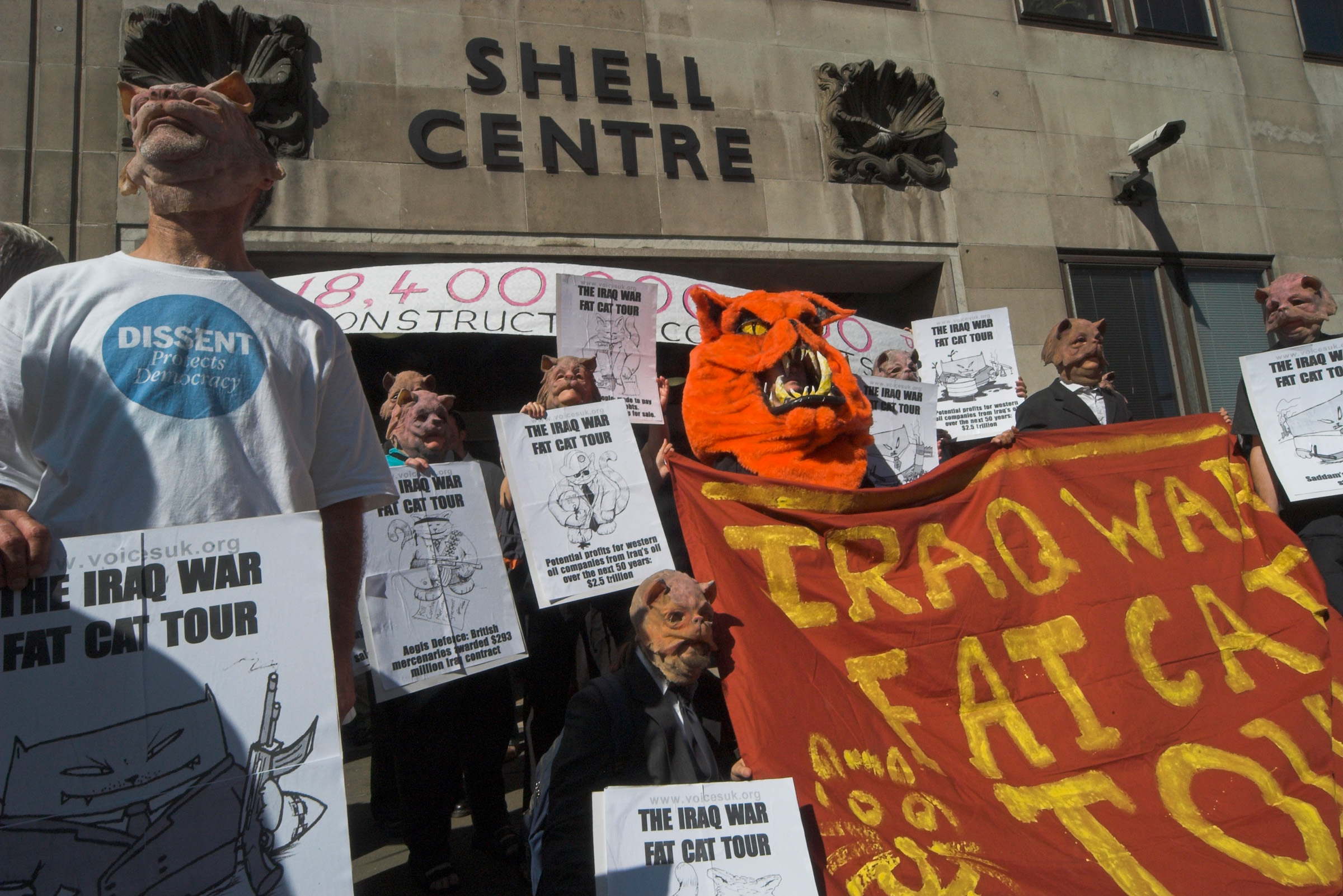
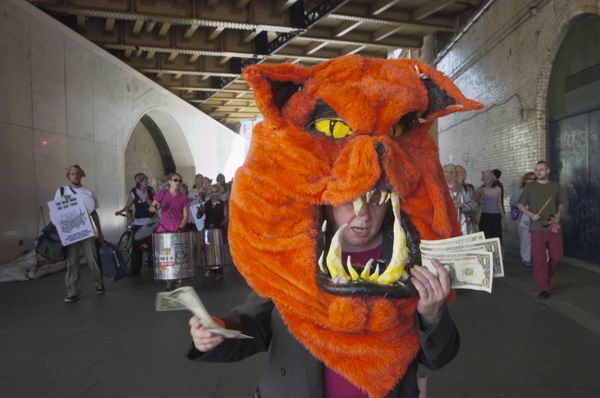
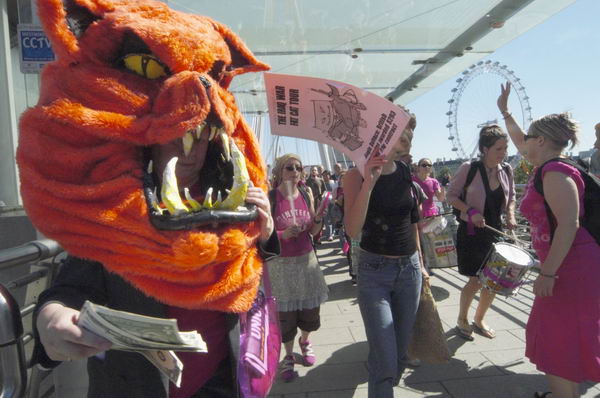
A fat cat handing out dollar bills next to the Shell Centre
Despite the huge protests and determined opposition of a huge proportion of the British people to the war, we failed to stop our army supporting the US, and many thought the protest movement had deliberately failed to press home its position – as Tony Benn and others had urged – thanks to the domination of its leadership by members of the SWP. Let’s hope that “Your Party” does not get sunk by the same hands – or by the efforts of those close advisers to Jeremy Corbyn when he was Labour leader.
‘Rhythms of Resistance’ samba band at the Shell Centre, Waterloo, London
I only wrote a short piece about the protest back in 2004, now rather hard to find on that web site, so here it is, with a few of the pictures from it in this post and there are more here on My London Diary.
Protestors walk across the new Hungerford Bridge (Jubilee Bridge)
After the initial military victory in Iraq, the American government were determined that their friends would profit from the situation. Lucrative contracts went largely to US companies that just happened to have friends and beneficiaries in the top level in the USA. Capitalism is always a winner from wars, with arms suppliers laughing all the way to the bank, but this extended the gravy train rather more widely and rather too obviously. Bush’s cronies sell the arms that knock the infrastructure to pieces, then get high margin contracts to rebuild.
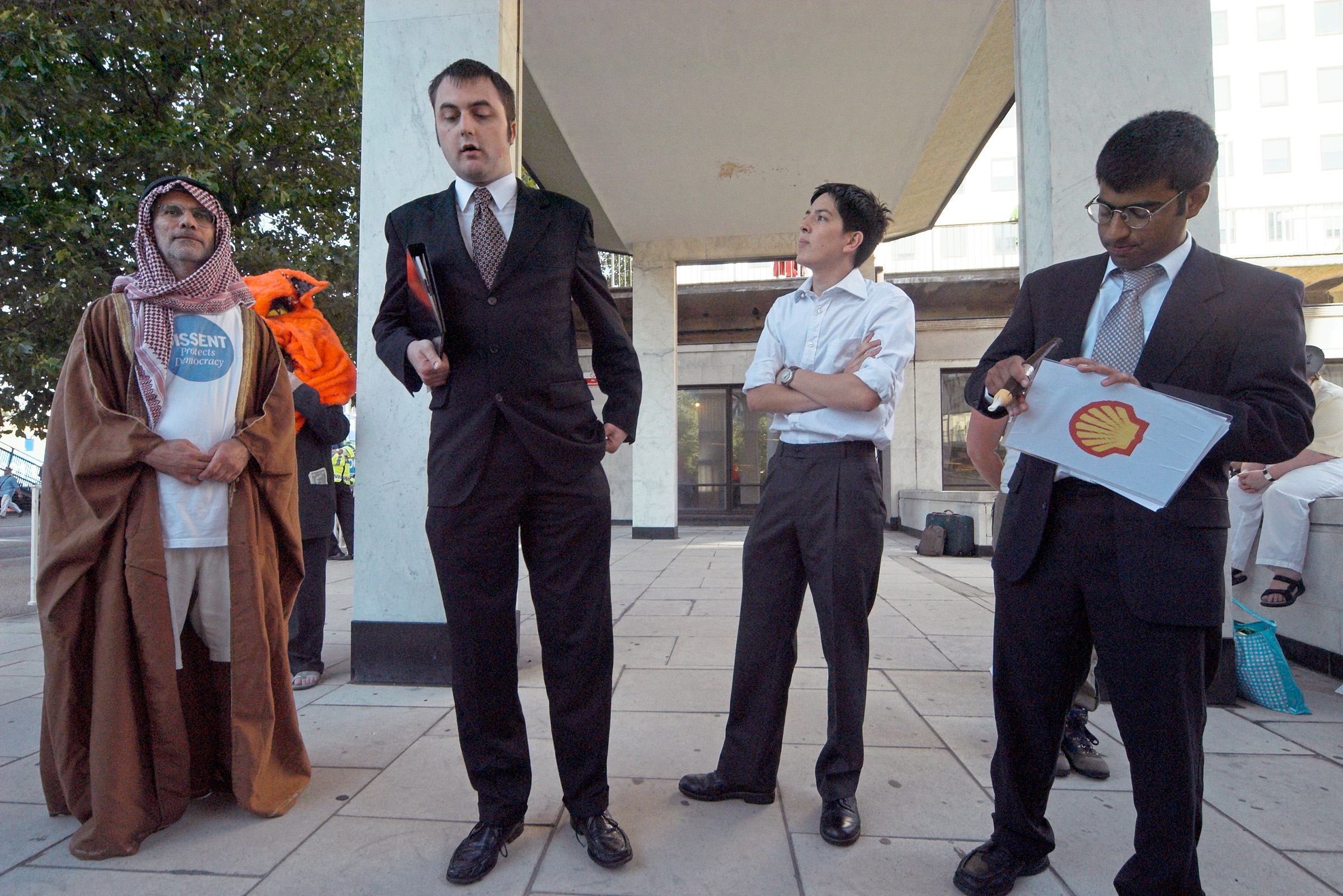
The Iraq War Fat Cat Tour of London aimed to visit some key sites to point out the profiteering from the occupation of Iraq. it started at the Shell Centre (Western oil companies look set to make $2.5 trillion from Iraqi oil over the next 50 years), then made its way across the new Hungerford Bridge to the Cavell statue at the north east of Trafalgar Square (where I left it) and continuing to some other key sites.
More street theatre in front of the Cavell memorial
There was singing from the Strawberry Theives Socialist Choir (the name a reference to a William Morris wallpaper design), who thoughtfully provided the words for the Internationale in case any of us had momentarily forgotten them, (Arise! ye starvelings from your slumbers, Arise! ye criminals of want… ), samba playing from Rhythms Of Resistance, and a couple of street theatre groups.
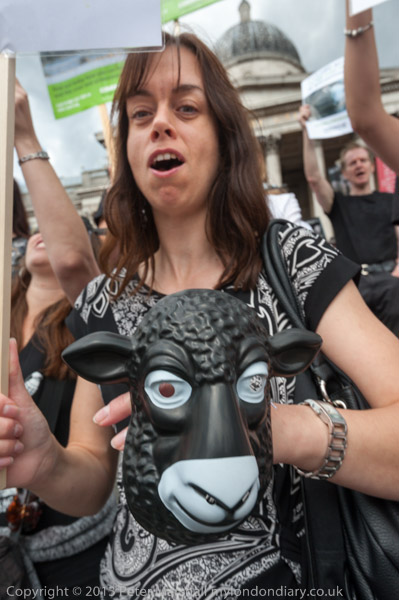
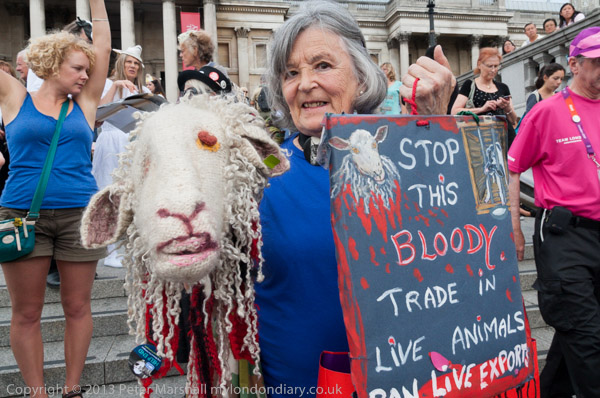
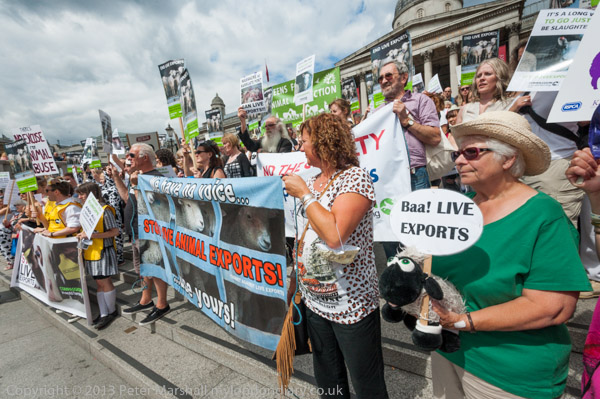
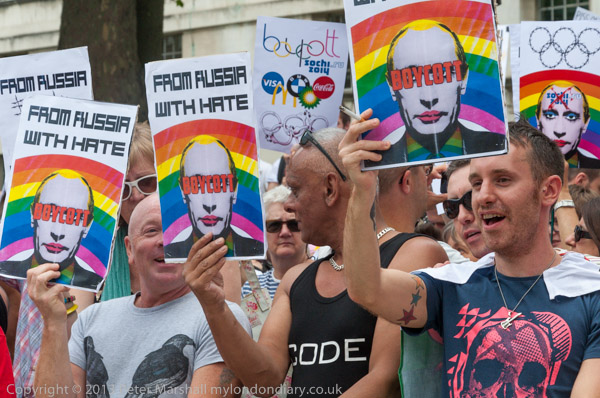
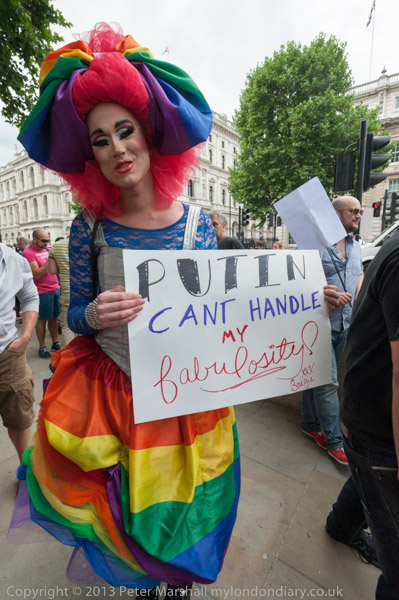
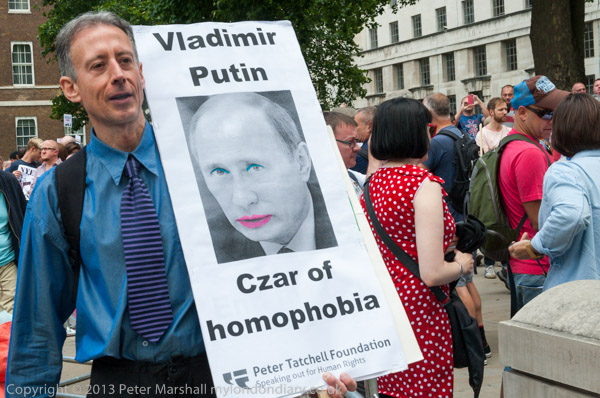
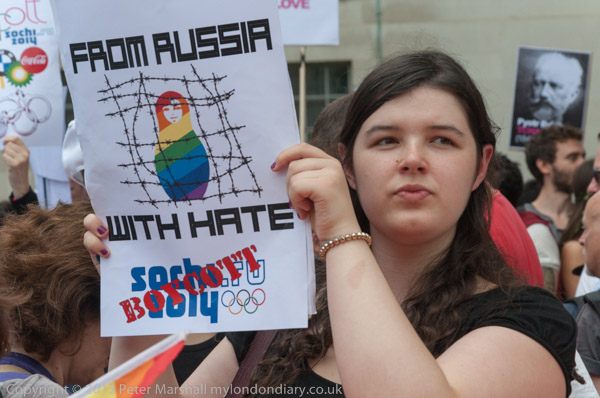
Frack Off, Animal Exports & Hands Off Queers! On Saturday 10th August 2013 I went to Trafalgar Square for a small anti-fracking protest, took a few more pictures there and met a march from Covent Garden against live animal exports which ended with photographs on the Trafalgar Square steps. Then I made a short walk down Whitehall to photograph a protest against the homophobic policies of President Putin.
Frack Off – Trafalgar Square
Protests were continuing at Balcombe, a small village in West Sussex, against test drilling and possible fracking for oil there by Cuadrilla, and a small group had come to Trafalgar Square to support their protests.
I took a few pictures and then wandered around the square a bit and missed them when they left to protest at Downing Street. Although a fracking ban later ended Cuadrilla’s attempts, Balcombe is still under threat from drilling for oil by another company, and legal battles continue.
I took a few pictures as I walked around Trafalgar Square, some including the blue cockerel then standing on the fourth plinth. It was hard to imagine why “Hahn/Cock” by German artist Katharina Fritsch had been selected other than to provide material for jokes, including many about us not needing another massive cock in London as we already had our then Mayor.
Trafalgar Square seems now more often to be used for religious events than political protest, and one of these was just starting, with a white-clad gosspel choir. But as I commented, “Nice hats, but some seem to have taken singing lessons from Florence Foster Jenkins” and I hope they got better after they had warmed up.
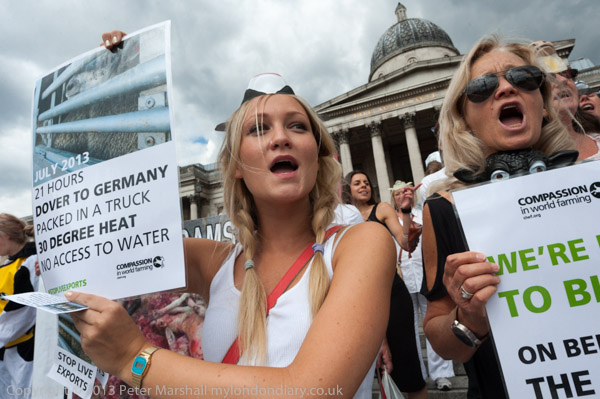
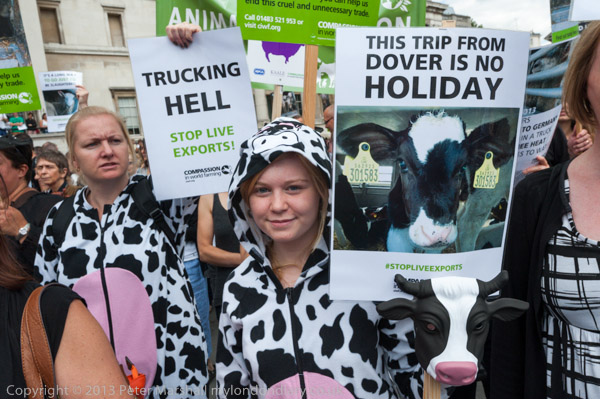
I was hanging around in Trafalgar Square waiting for a march by Compassion in World Farming against the live export of farm animals. I knew it was starting from Covent Garden but stupidly I hadn’t bothered to find out its route so I could meet it on the way.
Live exports take place under the 1847 UK Harbours, Docks and Piers Clauses Act 1847 which prevents public ports in Britain from refusing to export live animals as a part of the “free trade” in goods.
But EU law has recognised animals as sentient beings rather than “goods” since 1999, and different rules and regulations should apply to them.
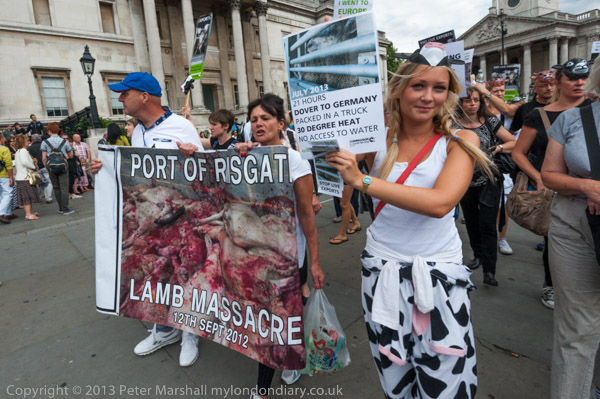
In 2012, over 47,000 young sheep and calves were crowded into lorries for long journeys from as far afield as Wales and Lincolnshire across the channel to France, Germany, the Netherlands and Belgium. The journeys inflict great suffering on the animals concerned with animals having no access to water and with temperatures inside the are often 30 degrees or more, and they are sometimes confined for 80 hours or more.
In 2012, 45 sheep died in a lorry at Ramsgate that had previously been declared several times unfit for use.
The marchers defied attempts by the Heritage Wardens to stop them posing on the wide steps in Trafalgar Square for photographs at the end of the march.
Armenians, Football, Tweed, TTIP, KFC, BP, NHS: Ten years ago on Saturday 18th April 2015 London was busy with protests and I rushed around covering seven events, though the last four at Shepherds Bush were all part of the Day of Dissent rally against TTIP, related to the problems which would be caused with a trade deal with the USA – and all threats now relevant to the current talks between our government and the Trump administration.
Centenary of Armenian Genocide
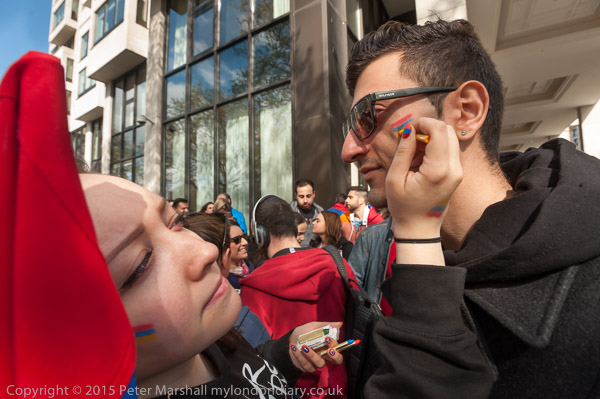
A woman paints an Armenian flag on a man’s cheek
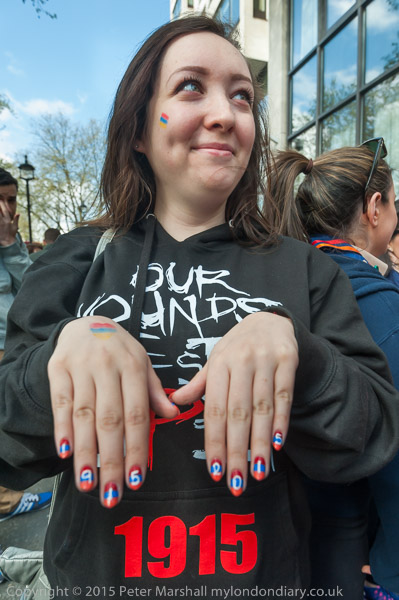
I met hundreds of Armenians close to Hyde Park corner on Piccadilly as they prepared for their annual march in protest against the Armenian Genocide. This year, 2015 marked the centenary of the start of the killing of 1.5m Armenians by Turkey between 1915 and 1923.
Turkey still refuse to accept the mass killings as genocide and the UK has not recognised the Armenian genocide. Armenians demannd that both countries should recognise this historic event and that it should be taught in the national curriculum.
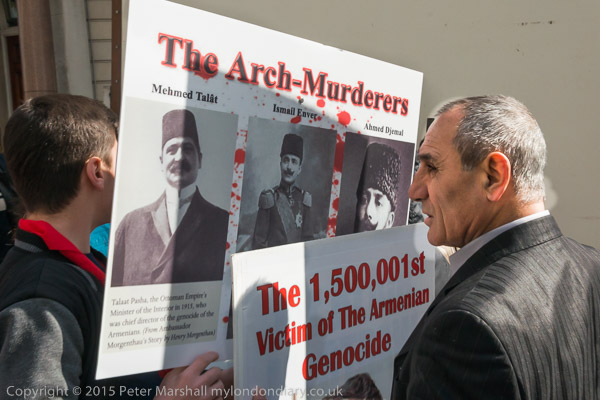
Some carried placards with pictures of Hrant Dink who is described as ‘The 1,500,001st Victim of The Armenian Genocide‘. Editor of the Istanbul Turkish-Armenian newspaper Agos, he was prosecuted under Article 301 of the Turkish Penal Code which makes it a crime to publicly denigrate the Turkish government, republic or nation. After having received many death threats he was assassinated by a 17 year old Turkish Nationalist in January 2007.
I left the protest shortly before the march began, hoping to see them later at Downing Street but had left Westminster before they arrived.
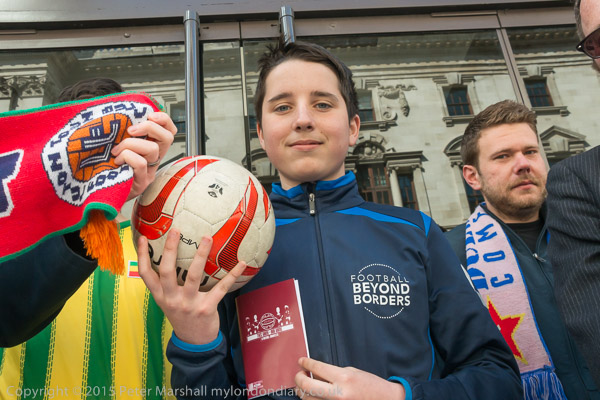
I went to Westminster to find the Football Action Network who were taking copies of their manifesto to the Labour, Tory and Lib-Dem offices, and finally caught up with them on the steps of the Lib-Dem offices.
Their demands include a Football Reform Bill, a living wage for all staff, fair ticket prices, safe standing, and reforms to clubs & FA.
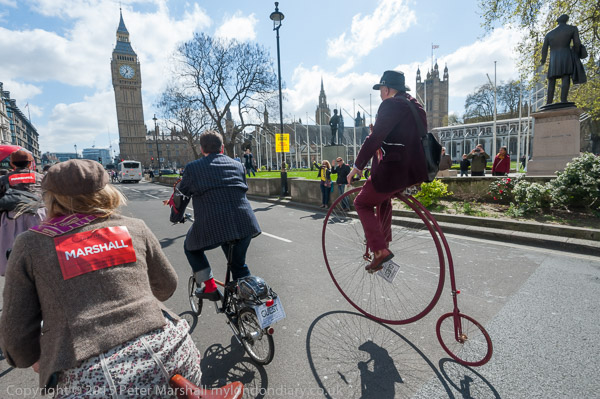
I briefly left the football fans as the Tweed Cycle Ride stopped on the road opposite and rushed to take pictures as it went into Parliament Square. The vintage-themed ride, “a jaunty bike ride around London in our sartorial best“, stops for tea and a picnic and ends with “a bit of a jolly knees-up” and raises funds for the London Cycling Campaign.
Shepherds Bush was the venue chosen for the Day of Dissent rally against TTIP, the Transatlantic Trade and Investment Partnership, a proposed trade treaty between the European Union (then still including Britain) and the United States which would have given excessive power to corporations, enabling them to override national laws.
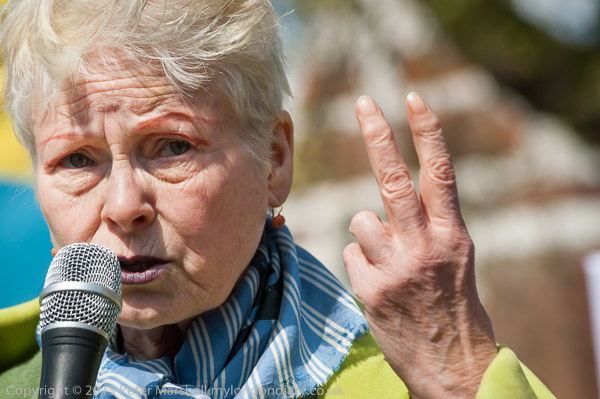
The event began with a rally on Shepherds Bush Green with speakers including Dame Vivienne Westwood, John Hilary of War on Want along with many others.
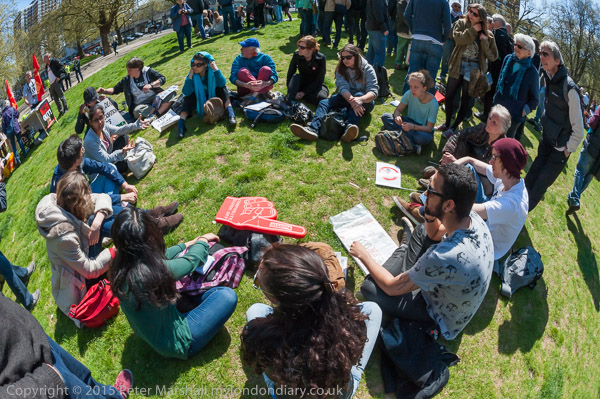
But much of the time was spent in a number of group discussions and it wasn’t an easy event to make interesting pictures. What was really clear was the threat that the TTIP treaty being negotiated by governments and corporations poses to democracy and all public services, that it would be a threat to public health and the NHS and would prevent changes made to combat climate change.
Campaigners then left to carry out the three separate actions I then photographed.
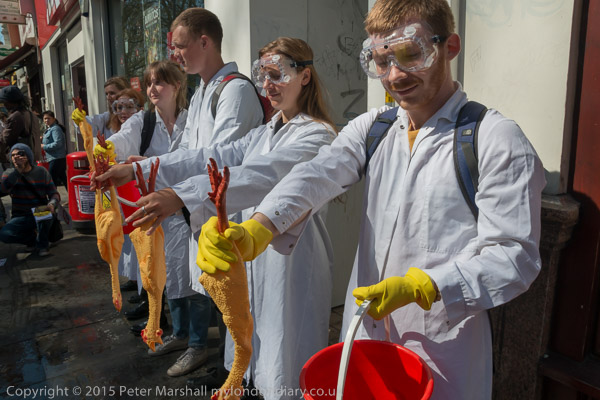
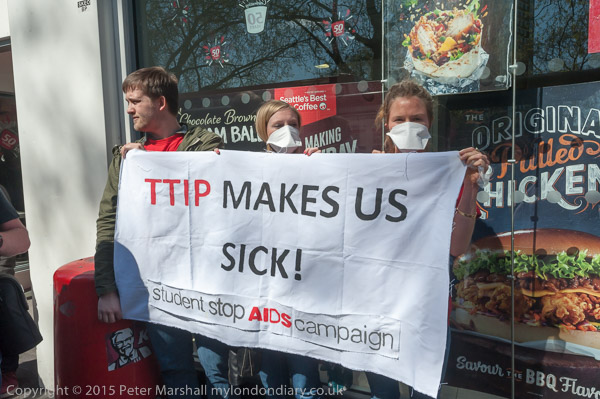
Protesters in white coats formed a line outside KFC at Shepherds Bush dipping rubber chickens in buckets of chlorine and acid, illustrating that TTIP would force the UK to accept unsafe agricultural and food practices (including GMO crops) allowed in the USA.
Chickens need chlorine washing because of lower farm hygiene standards and US meat contains much higher levels of hormones and other chemicals than here.
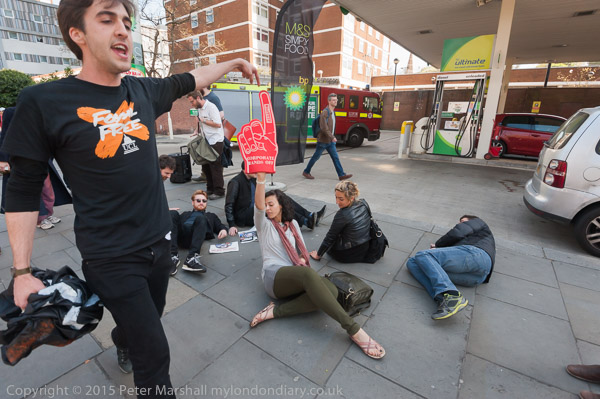
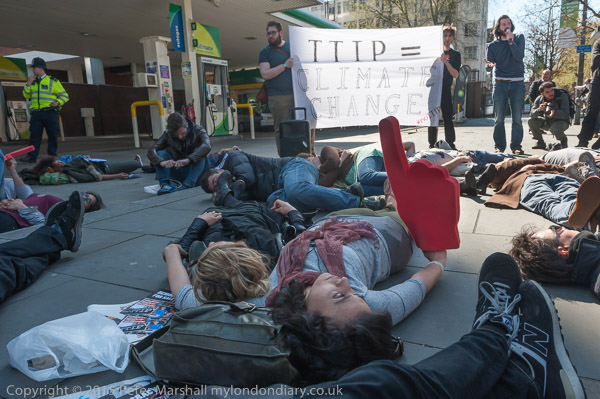
On the other side of Shepherds Bush Green protesters calling for a fossil fuel free future staged a die-in at BP Shepherds Bush against TTIP, which would force countries to use dirty fuels including coal, tar oil and arctic oil and seriously delay cutting carbon emissions and the move to renewable energy.
After some speeches about the protest the protesters got up from the garage forecourt and walked away.
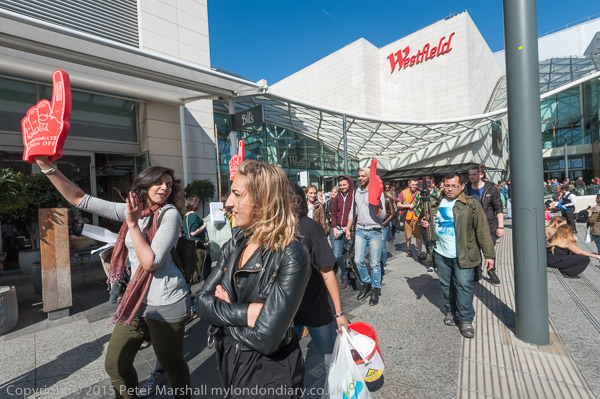
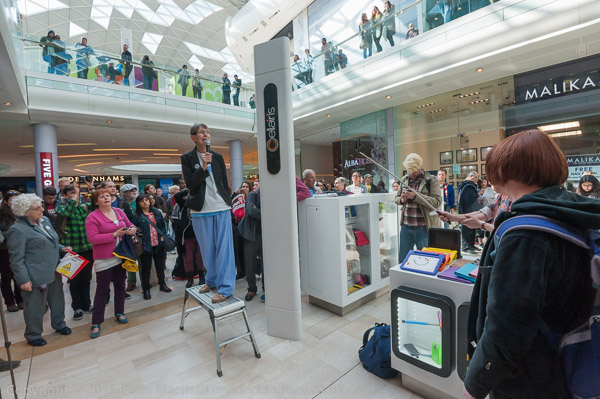
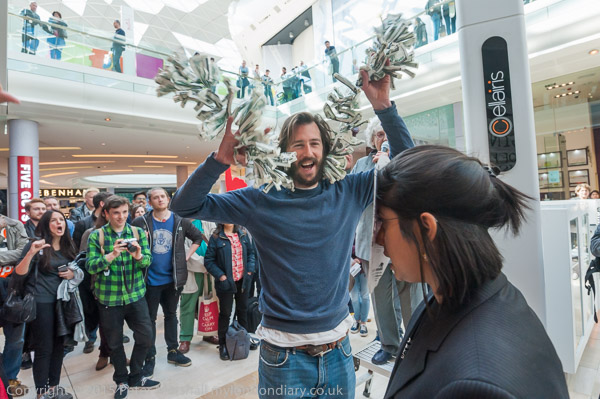
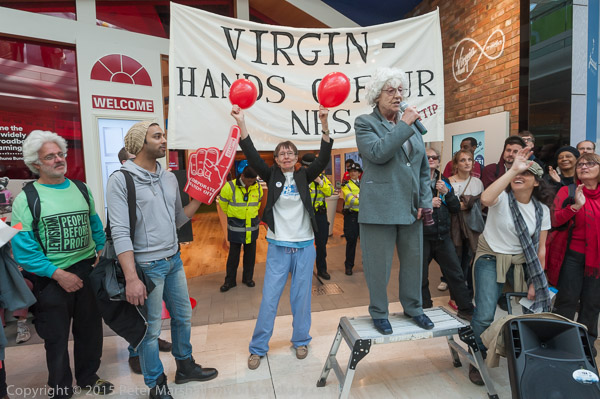
Protesters walked in to the Westfield Centre to protest outside the Virgin media shop over the danger that TTIP poses to our NHS. Virgin Healthcare, (in 2021 rebranded as HCRG Care Group) had already taken over providing large parts of the simpler services provided by the NHS, replacing the easily run parts of our National Health service, and taking money out of the system.
NHS campaigner Gay Lee introduces the protest and the short piece of street theatre
Campaigners urged that the NHS should be excluded from TTIP, but governments and business insist it should not be. Now in 2025 we are again worried that any US-UK trade agreement made by the Starmer Labour government may open up our health service to much greater privatisation by the giant US health companies.
George Barda offers his garland of dollars to ‘Richard Branson’
Many UK government members have significant financial interests in private healthcare companies, and coulld have expected rich profits if TTIP is agreed as it will force the NHS to contract out its services to them.
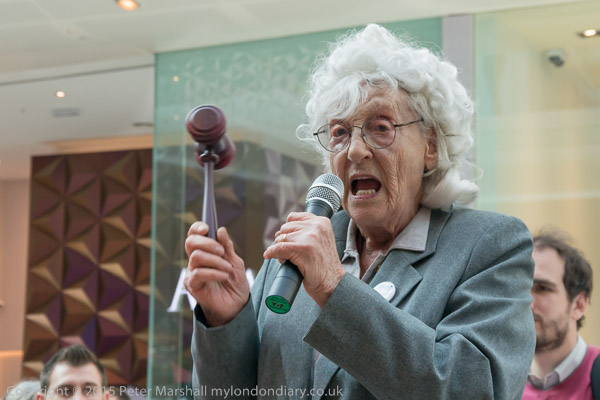
A pensioner in a wig acts as a judge
After Trump became president he stopped the TTIP talks so he could pursue a trade war with the EU. One of the few things we can thank him for.
I had been worried that security staff might try to stop photographers working as like most shopping centres, Westfield does not generally allow photography. Police and security watched the protest closely but did not generally try to stop it or photographers working.
The protesters were considering further protests, but I had been on my feet too long and left for home.
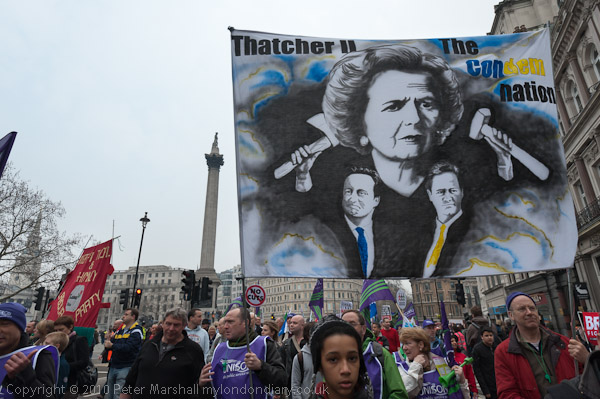
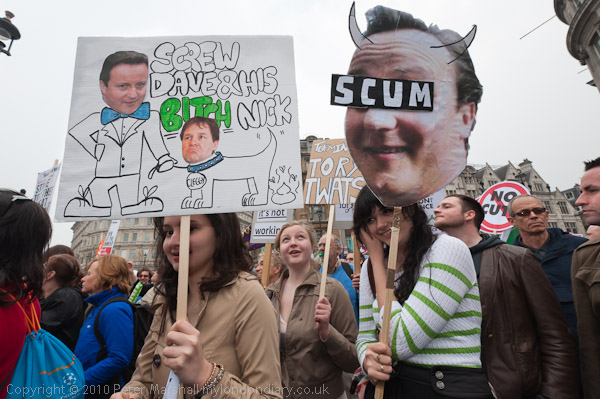
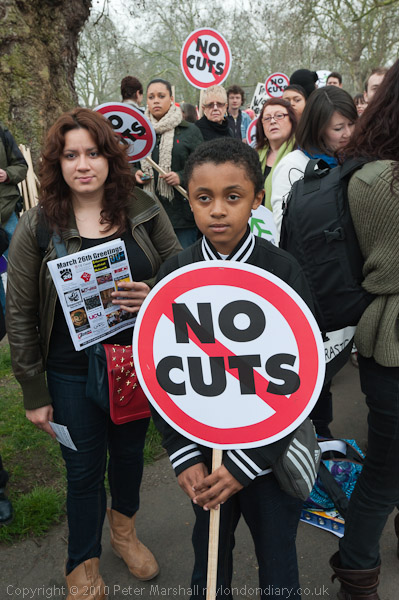
TUC ‘March For The Alternative – On 26th March 2011 between a quarter and half a million people marched through London against planned public spending cuts by the Conservative-Liberal Democrat coalition government in the largest demonstration since the 2003 protest against the plan to invade Iraq.
The TUC argued that what the country needed was not austerity but policies that would grow the economy, and that we should raise income from those more able to pay rather than by measures that had the greatest impact on the poorest in society.
It was the largest march and rally organised by the trade union movement since the Second World War, and like other major trade union marches was perhaps largely worthy but not exciting – and like others it achieved nothing. The cuts went ahead and we all suffered – except of course the wealthy – who continued to grow richer and richer, helped by government bail-outs and the deliberate failures to tackle tax evasion, stop tax avoidance loopholes and raise taxes on those with excessive wealth.
The cuts particularly hit the public services, including teachers, nurses and other medical professionals – and eventually helped drive these areas into the critical conditions that they are now in. They resulted in financial problems and excessive workloads and also meant that those of us who rely on public provision for health and education often failing to get proper treatment. The gap between those who could afford private services and those who relied on the state provision increased.
Particularly hard hit by the cuts were the disabled and for them the situation continues to worsen with our now Labour government announcing huge cuts which will leave many considerably worse off – and greatly reduce their ability to lead normal lives and contribute to society.
As well as the TUC, other groups contributed to the march, announcing various feeder marches and other activities, many of which added a little life and colour to the day’s events. They also resulted in over 200 arrests and a number of injuries.
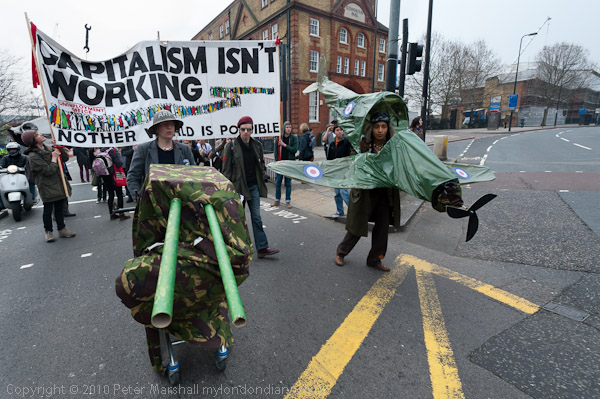
Too much was happening on the day for me to rehash it all here, but you can read my seven posts on my London Diary for my account of events. I started with the feeder marches from South London, disowned by the TUC. The ‘Armed Wing of the TUC’ brought its street theatre Trojan Horse, Spitfire, Tank and armed Lollipop Ladies produced by Camberwell art students to Camberwell Green where they marched to Kennington where the South London Feeeder March was gathering for a rally before the march in Kennington Park – the site of the final “monster meeting” of the Chartists on 10th April 1848 from where they marched to Parliament to deliver their final petition.
I left there to take the tube to Trafalgar Square where I found that the main march had started early and was well on its way to Hyde Park and I stayed around there for over an hour as marchers filed past, including photographing the Morris Liberation Front, an idea of Henry Flitton specially for the TUC demonstration, with music, provided by a couple of mandolins playing the Clash’s ‘I fought the Law’ and the Smith’s ‘Panic.
Later in the day Trafalgar Square was the site of bitter fighting as police made a largely unprovoked attack on a partying crowd, but when I was there things were peaceful.
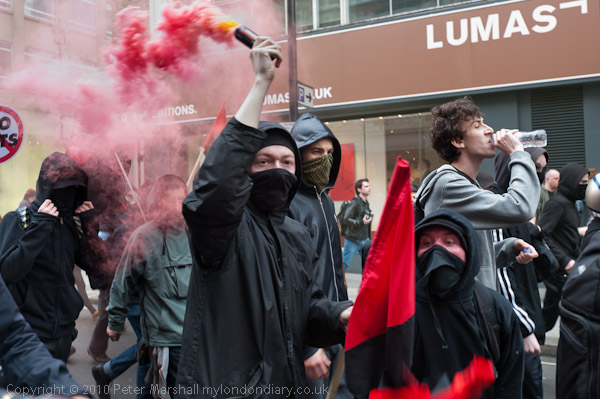
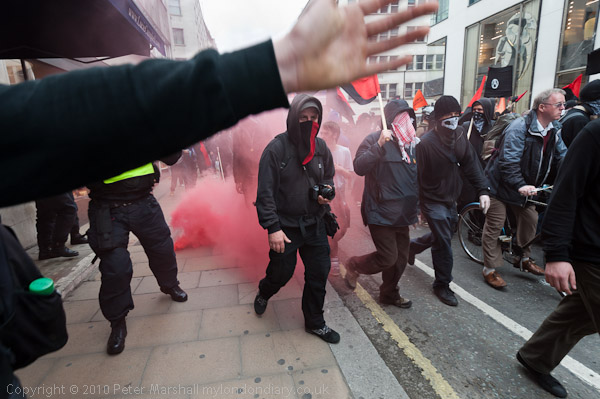
I left the square to follow several hundred anarchists, dressed in black and mainly wearing face masks making their way up past the National Portrait Gallery, many waving red and black flags. I went with them through the back streets to Piccadilly Circus and then up Regent Street where they turned off into Mayfair and were held off by police when they attacked a RBS branch – one of the main banks to receive a huge government handout.
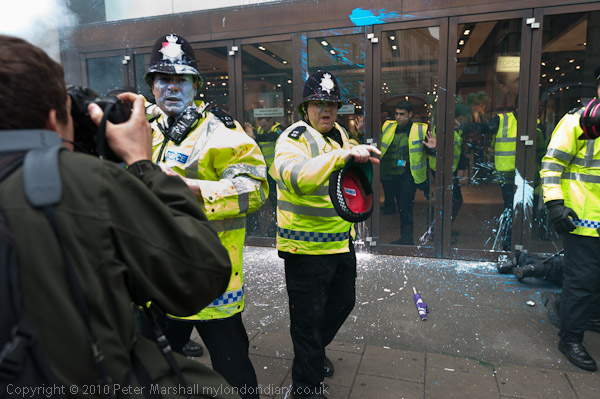
At Oxford Circus they attacked Topshop, then owned by the prominent tax avoider Sir Philip Green. As I went to take photographs of police arresting one of the protesters and holding him on the ground I was “hit full on the chest by a paint-bomb possibly aimed at the police, although many of the protesters also have an irrational fear of photographers. My cameras were still working and I continued to photograph, but I had also become a subject for the other photographers.”
It wasn’t painful, but it was very messy and bright yellow. I scraped and washed the worst off in a nearby public toilet for around 20 minutes, then went out to take more photographs, joining UK Uncut supporters who had come to hold peaceful protests at tax dodging shops and banks around Oxford St and to party at Oxford Circus.
Eventually I followed them down to Piccadilly Circus where 4 hours after the start of the official march people were still filing past. I stopped there and photographed until the end of the march passed, rather than going with UK Uncut into Fortnum and Mason. Inside the story they sat down and occupied the store peacefully. if noisily calling on them to pay their taxes. After an hour or more a senior police officer told them they were free to leave, promising they could make their way home “without obstruction”. 138 were arrested as they left the store, charged with ‘aggravated trespass’. Most of the cases were latter dropped but at least 10 were found guilty, given a six-month conditional discharge and a £1,000 fine.
Even after the official end of the march there were various other groups following the march route – including a group of Libyans with green flags, marching in support of Colonel Gaddaffi. I walked back to Trafalgar Square where there were still plenty of people around but everything was pretty quiet, so I got on the tube to come home and try to wash more of the paint off.
I think it was later when police made a charge to try and clear Trafalgar Square than almost all the arrests on the actual march took place – according to Google “Further clashes were reported later in Trafalgar Square. 201 people were arrested, and 66 were injured, including 31 police officers.” Had the police simply gone away people would have eventually dispersed and there would have been no trouble.
Others also got hit by paintballs
Back home I spent hours trying to scrub out yellow paint, but the rather expensive jacket I was wearing was only ever really fit to wear for gardening. The also expensive jumper underneath still has some small traces of yellow 14 years and many washes later, though I do sometimes still wear it around the house. Until my Nikon D700 came to the end of its life, beyond economic repair, a few years later I would still come across the occasional speck of yellow paint.
Much more about the day and many more pictures in the following posts on My London Diary
XR Zombie System Collapse Action: On Wednesday 30th October I returned to Trinity Square Garden to cover the third day and final day of Extinction Rebellion’s actions demanding the insurance industry end their support of new fossil fuel projects – part of a week of world-wide action, including protests the following two days in other UK cities. I’d missed Day 2 where they had marched with a giant potato.
XR had posted: “We Predict a Riot – mass action…..a zombie apocalypse! A wide range of creative actions will highlight what social collapse will look like in the UK as the population begins to panic in the face of repeated floods and food shortages over the next decade.”
And we had been promised a “Zombie die-in with flashmob, zombie insurers stumbling around” as well as a “Zombie Mass Dance Discobedience – This is the undead dance for life! – wear business suits with a zombie twist. We are the undead, dancing our way through the halls of power to expose the profiteers of destruction!”
I arrived to find a group of around 20 people practising the Zombie dance in Trinity Square, and a giant bomb of CO2 with protesters in business suits holding red boxes with the words WAR, FAMINE, EXTINCTION and FLOOD and a man reading a special copy of the ‘Daily Fail’.
Eventually the several hundred protesters set off on a march heading to Tower Palce, the home of insurers MarshMcLennan, where there was loud music from the Samba band, a short speech calling on them to end the insuring of new fossil fuel projects, a die-in, a few zombies runnning around and then the Zombie Mass Dance Discobedience.
Reading The Crimes outside insurers MarshMcLennan
Next stop was insurers AIG where a small group went inside the building to deliver a letter, but were soon ushered out.
The march continued around the City, before stopping for a lunch break outside the Howden Group offices on the corner with Bevis Marks.
After lunch the march continued, going back past Lloyds and on to the Sky Garden building in Fenchurch St, home to home to insurers Ascot, Talbot, Chaucer, Markel, Allied World, CNA Hardy, Tokio Marine Kiln, Sirius International and Lancashire Syndicates.
Here a small group had arrived before us to poster the windows with large signs, ‘INSURING FOSSIL FUELS = CLIMATE CHAOS’ and three campaigners were perched on top of the main entrance porch.
I’d been on my feet too long and things seemed to be at an end, so I sloped off for a pint of Brains (it was Halloween) in the Crosse Keys before making my way home. You can read about the protest in a press release from XR, and see more of my pictures here.
Horseman’s Sunday, Wallenberg & Car-Free Festivals: Sunday 19th September 2004 was a rather strange day for me with some very varied events across London.
Horseman’s Sunday
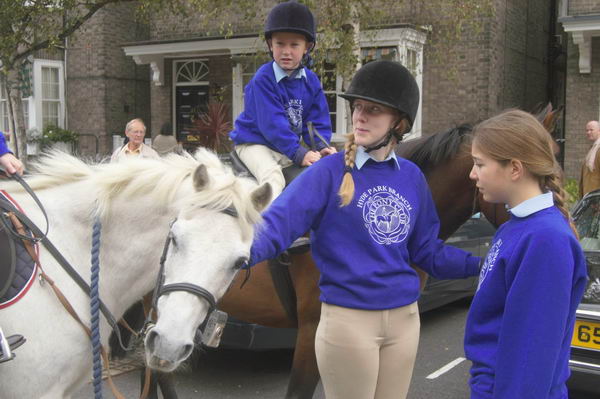
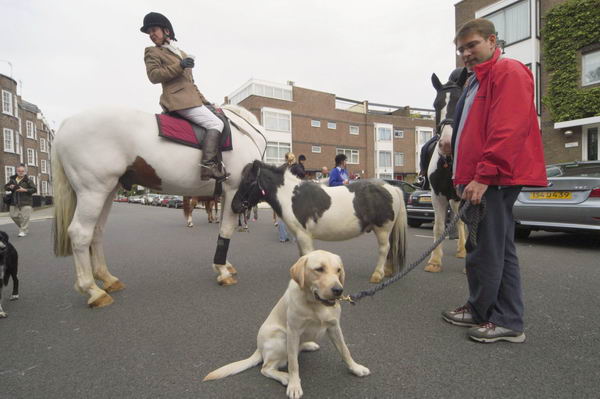
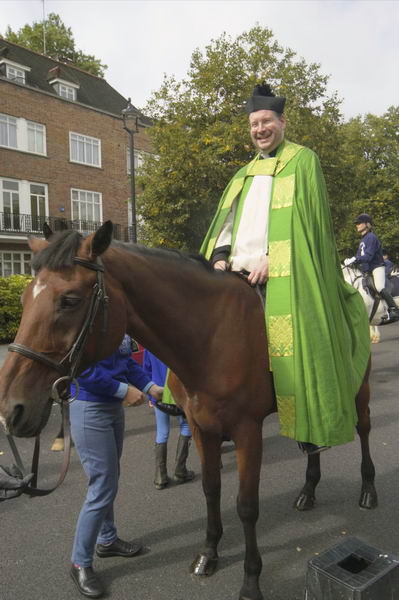
Horseman’s Sunday is apparently celebrated at several places in Surrey including Tattenham Corner at Epsom as well as in central London at the Church of St John’s, Hyde Park Crescent,where the The Hyde Park Pony Club met for the occasion.
Despite being ‘Horseman’s Sunday’ there were relatively few men taking part, mainly children and a few women along with the befrocked celebrants. As I noted on My London Diary, “fortunately the rite was Anglican, so everyone left the singing to the choir, avoiding scaring the horses.”
This was a curious example of the different world inhabited by the rich and priveleged in London. I’ve not felt moved to go back to photograph the event since.
Just around the the corner, a small group was remembering one of the heroes of the Second World War, Swedish diplomat Raoul Wallenberg, who saved perhaps a hundred thousand jews from the Nazi holocaust in Budapest, himself dying in a Russian jail.
There are monuments to him around the world including this one outside the West London Synagogue and close to the Swedish Embassy.
Hackney Mare De Gras Cancelled
I travelled out to Dalston, where I found a notice that the Hackney Mare De Gras Procession had been postponed because of a murder in Mare St.
Shoreditch Car Free Festival
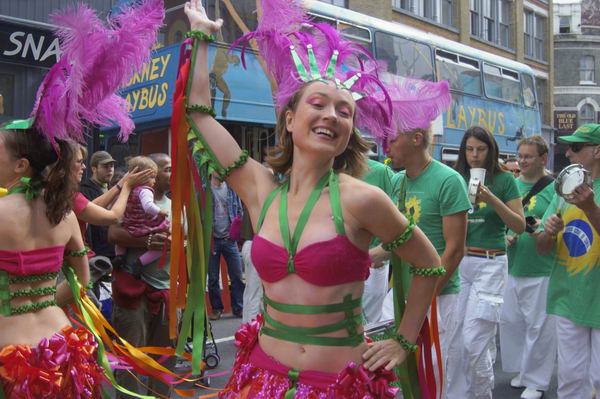
I walked down Kingsland Road to Shoreditch where a festival and car-free day was getting underway, with the London School Of Samba dancing through the streets and other events including the Secretsundaze Sound System.
On the way I took a few pictures including some of the graffiti which by 2004 seemed to be covering most of the walls in Shoreditch.
On Curtain Road people were trying out various different designs of bicycles, particularly recumbents. Though these may be comfortable and efficient I’ve never been attracted to riding at the level of vehicle exhausts and feel the low riding position gives a very restricted view compared to a normal bike, dangerous in city traffic. Perhaps if I lived in a remote area with empty roads I’d try one.
Part of the street was a carpeted area with benches where you could sit and enjoy tea from an anarchist tea bar with a revolutionary tea urn.
The Shoreditch Golf Club was set up for a chess competition, though I didn’t see anyone actually playing chess, and there were various theatrical performances on the street – and of course more graffiti to photograph. I spent some time taking pictures there before tearing myself away to catch the tube from Liverpool St to Leytonstone.
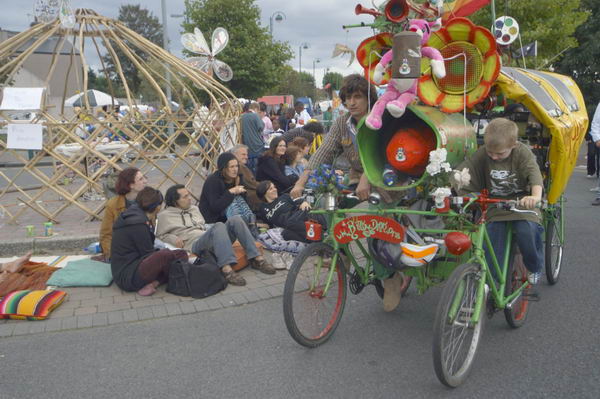
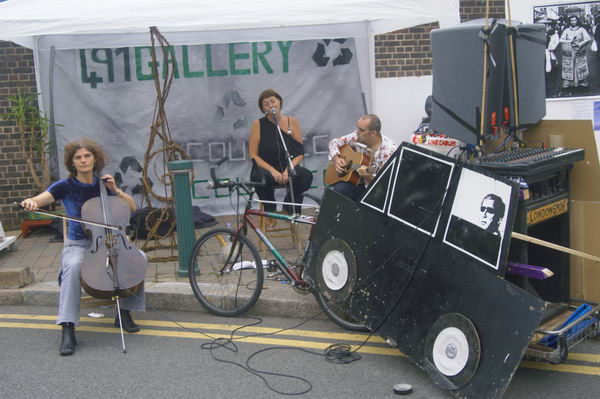
“Leytonstone was also enjoying a car-free day, and one of the highlights there was the Rinky Dink cycle-powered sound system, bringing back memories of April’s march to Aldermaston, where this accompanied us on the last few miles.“
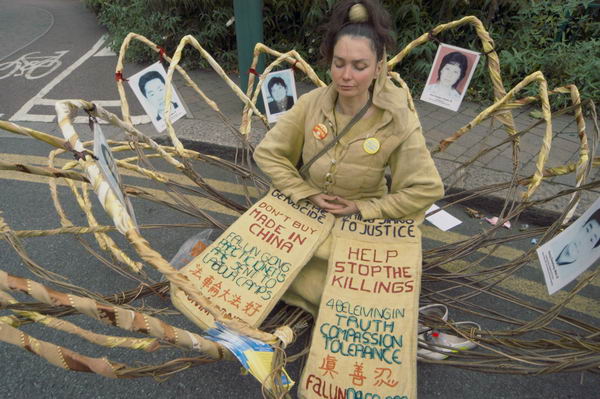
There was more music too, as well as various a childrens’ arts project and entertainment, and a rather unrelated political element from protesters against the Chinese persecution of Falun Gong practitioners.
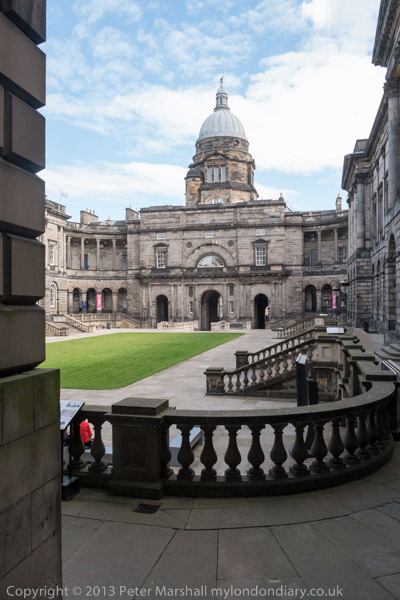
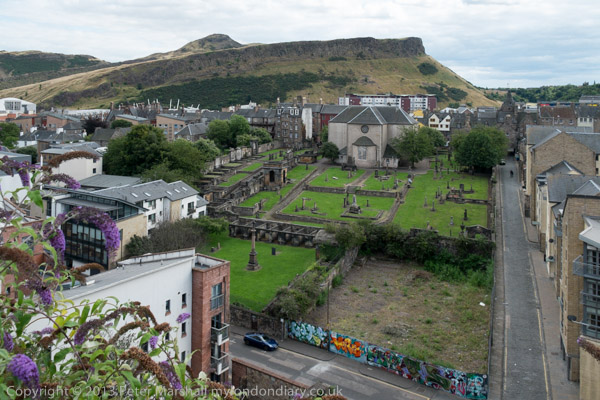
Festival Edinburgh: I’ve only stayed in Edinburgh a couple of weeks over the years and only one of these was during the annual festival. Ten years ago in 2013 we were invited to share a flat for a week a short walk from the city centre with half a dozen of the family of my younger son’s wife who I think were all Scottish.
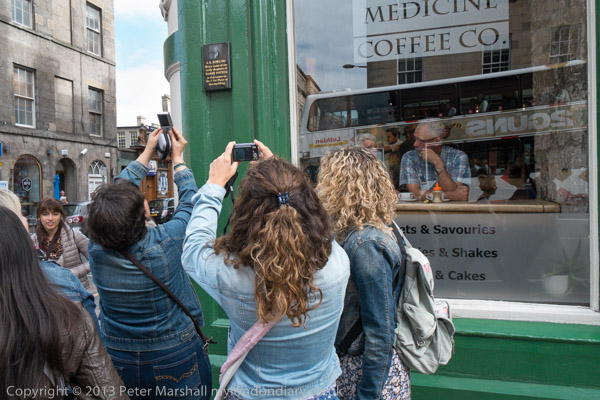
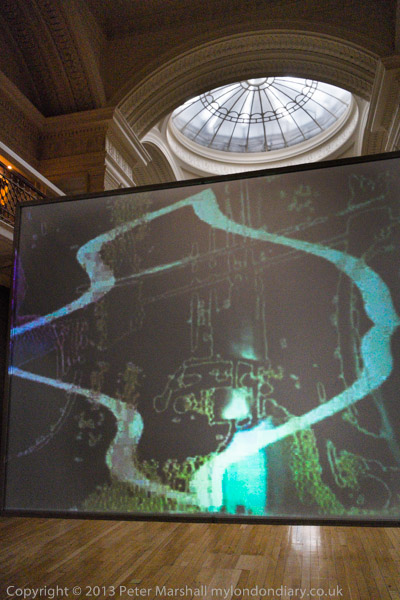
Tourists photograph the sign saying J K Rowling wrote some of her first Harry Potter book here. I’ve not read it.Old College, the University of EdinburghNam June Paik show in the College gallery
I’ve written a little about the week on My London Diary with rather a lot of pictures. We did go to a lot of events and performances, some together rather more on our own as our interests are different and there were so many things to choose from. But we also spent a lot of time walking around the city and surrounding areas.
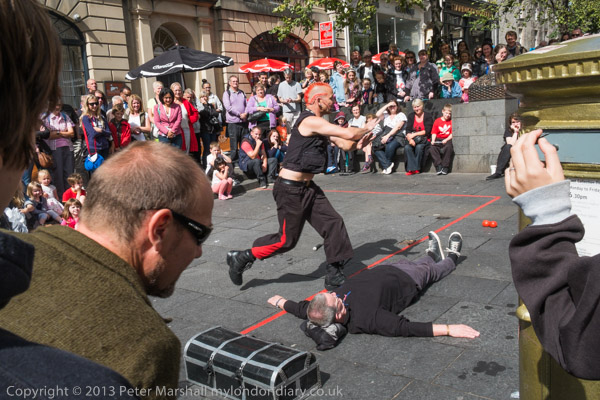
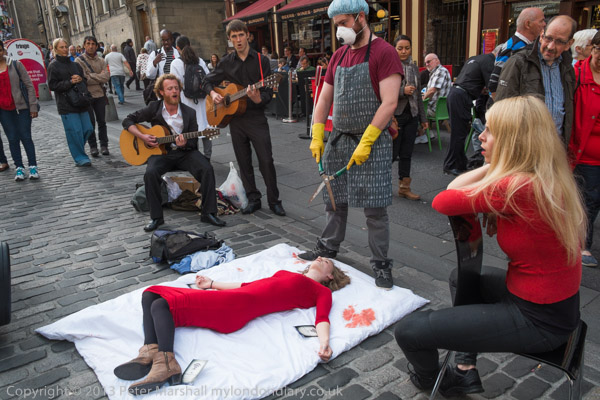
Street theatre
It was a busy week and we enjoyed it. But I’ve not felt it something I particularly wanted to do another year, once seemed enough.
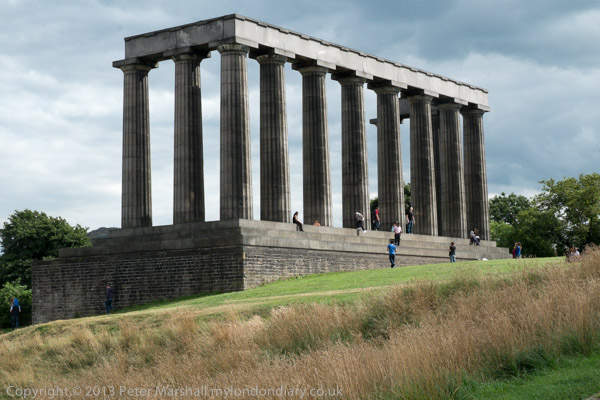
Calton Hill
The pictures here are from one day of that week, Tuesday 13th Aug 2013. It wasn’t a typical day as there were no typical days for us that week.
Canongate Kirk
Here’s the short text from My London Diary about what we did that day:
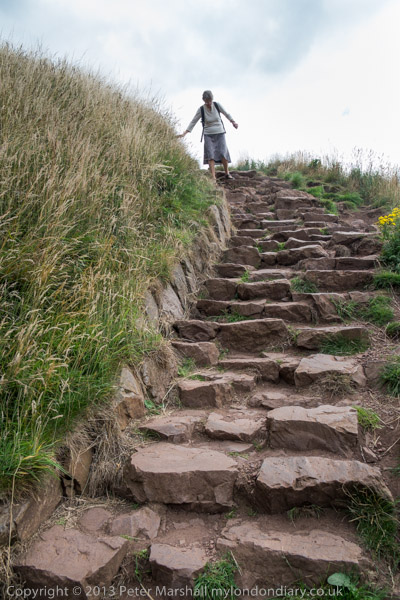
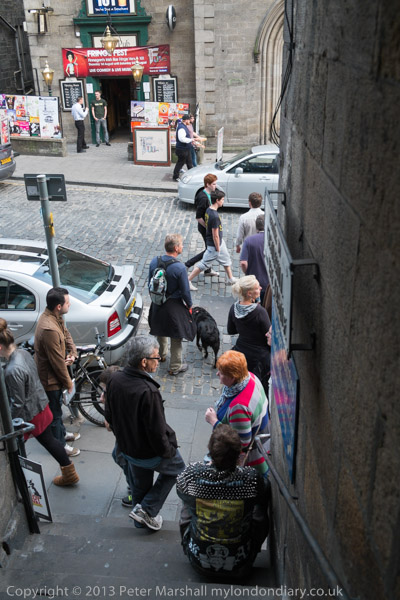
“I walked to the Nam June Paik exhibition, the visual arts high note of the festival, while Linda went to a concert. After that I went to hear poet Danny Chivers giving a great fringe performance. Linda and I grabbed some lunch from a street stall and then walked up Calton Hill and across to Arthurs Seat, rushing back to see a one-man play on the fringe, and after taking a few pictures along the High St before dinner.”
The quick path down from Arthur’s Seat
But I think the pictures probably make it rather clearer, certainly if you look at the larger set on My London Diary.